

- Market Size (2026)
- USD 9.5 Bn
- Forecast (2036)
- USD 18.8 Bn
- CAGR (2026 to 2036)
- 7.0%
How big is High Nickel Precursors Market in 2026?
USD 9.5 billion in 2026 and USD 18.8 billion by 2036 at a 7.0% CAGR.
Demand for high nickel precursors is projected to expand at a 7.0% CAGR between 2026 and 2036, lifting market value from USD 9.5 billion to USD 18.8 billion. Nickel-rich cathode chemistries remain important in electric vehicles that prioritize energy density and driving range. The IEA reported in 2026 that almost 80% of EV batteries deployed outside China in 2025 used nickel-containing chemistries. Precursor producers capture that demand after particle morphology and impurity limits are qualified for a named cathode program.
Regional purchasing depends on whether cell investment is matched by a qualified midstream supply base. The IEA estimated that China produced about 85% of global cathode active material in 2025, while Korea and Japan were the only other countries with sizeable output. This concentration makes local precursor projects valuable only where feedstock economics and customer offtake support stable plant utilization.
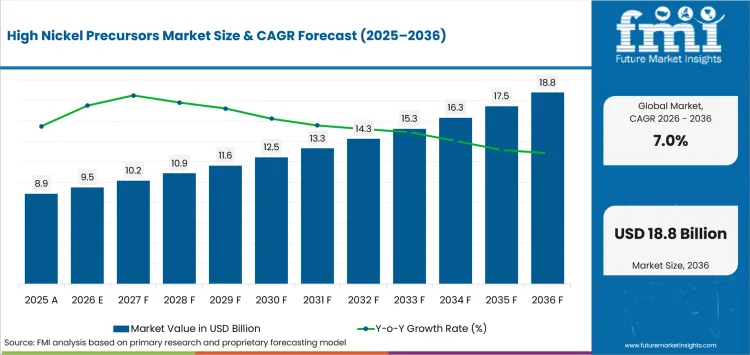
Key Takeaways
- High nickel precursor demand follows EV and premium battery programs that retain nickel-rich cathodes for energy-density requirements.
- NCM 811 precursors account for 34.0% of precursor type demand in 2026 because established cathode programs already qualify this chemistry.
- By nickel content, the 80-90% band holds 43.0% in 2026 because it limits processing difficulty compared with ultra-high-nickel grades.
- EV cells represent 61.0% of battery application demand in 2026 as vehicle programs absorb the largest qualified high-nickel volumes.
- LFP price pressure and unused precursor capacity can weaken project economics before new lines secure firm customer volume.
- Some of the key players in this market include Umicore, POSCO Future M, L&F, Ecopro Materials, CNGR Advanced Material, GEM Co., BASF Battery Materials, Sumitomo Metal Mining, Nichia, and Tanaka Chemical.
Analyst Perspective
"High nickel precursor contracts should be evaluated on qualified yield and lot-to-lot particle control rather than quoted nameplate capacity. Commercial value accrues where feedstock documentation and cathode qualification let a plant sustain customer-approved output without repeated process changes."
- Nikhil Kaitwade, Principal Consultant, Future Market Insights
How is the high nickel precursors market segmented?
The high nickel precursors market is segmented by precursor type, nickel content, battery application, form, sales channel, and region.
Precursor type covers NCM 811, NCM 9-series, NCA, NCMA, and custom high-nickel hydroxides. Nickel content spans 70-80%, 80-90%, above 90%, and gradient designs. Battery applications include EV cells, storage, power tools, premium electronics, and aerospace or defense cells. Form and sales channel distinguish powder routes from the commercial interface used to qualify and purchase pCAM.
How do EV cells shape the battery application category?
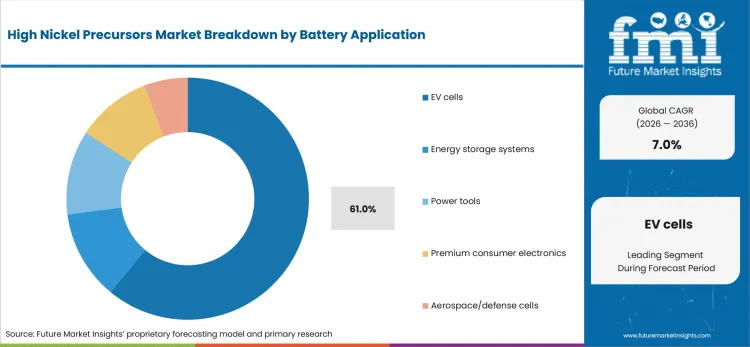
EV cells create the largest order base because vehicle platforms consume high material volumes under long qualification cycles. The electric vehicle battery market also places more value on energy density for longer-range models than many stationary storage applications.
- EV cells hold 61.0% of battery application demand in 2026 because automotive programs absorb large qualified volumes over multi-year model cycles.
- The IEA reported in 2026 that EV batteries represented more than 70% of total battery deployment in 2025. Most commercial lithium-ion batteries still depend on tightly specified cathode materials, so platform approval converts precursor consistency into repeat orders.
What makes NCM 811 precursors central to the precursor type category?
NCM 811 gives cathode producers a familiar high-nickel route with known calcination and qualification behavior. Related battery materials programs already use NMC platforms at commercial scale, which lowers changeover risk compared with newer nine-series designs.
- NCM 811 precursors hold 34.0% of precursor type demand in 2026 because the chemistry offers high specific energy within an established industrial qualification path.
- The IEA documented in 2025 that NMC and NCA remained major nickel-rich EV chemistries outside China. Development of solid-state cathode materials raises future performance targets, yet vehicle programs still require proven precursor consistency before changing qualified material sets.
Why does 80-90% nickel anchor the nickel content category?
The 80-90% range gives cell developers high energy density without taking every process penalty associated with nickel levels above 90%. High-purity nickel sulfate supply therefore affects precursor economics before crystallization and downstream cathode firing.
- By nickel content, the 80-90% band is estimated to hold 43.0% in 2026 because commercial plants can balance capacity performance with tighter reaction control.
- Sumitomo Metal Mining stated in its 2025 business plan that high-nickel NMC requires a shift toward batch crystallization for finer particle-size adjustment. That process change reduces near-term output and explains why the highest nickel percentage does not automatically secure volume.
What supports hydroxide precursors in the form category?
Hydroxide precursors fit co-precipitation lines that tune transition-metal ratios before lithium enters the cathode process. Process control matters because modern battery technology must hold particle size and impurity limits during scale-up rather than only in laboratory batches.
- Hydroxide precursors account for 41.0% of form demand in 2026 because co-precipitation provides a scalable route for composition and particle control.
- POSCO Future M completed a 45,000-ton annual precursor plant in June 2025 and linked its output to in-house cathode production. Precursor-free cathodes may shorten future process chains, but they face a harder consistency problem at industrial scale.
What drives cathode active material producers in the sales channel category?
Cathode active material producers control the immediate conversion from pCAM to lithiated cathode material, so they own the closest technical qualification interface. Battery materials recycling can also feed nickel and cobalt back into this route once recycled salts meet customer specifications.
- Cathode active material producers hold 38.0% of sales channel demand in 2026 because precursor quality directly affects their calcination yield and customer qualification.
- Umicore signed pCAM supply agreements with CNGR and Eco&Dream in March 2025 for customer contracts in North America and Asia. The agreements show why merchant precursor volume is commonly secured against named cathode commitments instead of short-term spot availability.
What are the drivers, restraints and opportunities in the High Nickel Precursors Market?
EV programs sustain nickel-rich cathode demand, while LFP economics and pCAM overcapacity pressure utilization. Regional supply-chain rules create openings for qualified precursor plants with documented nickel sourcing.
- Driver: Premium EV platforms continue to require nickel-rich cathodes where energy density carries more value than lowest material cost.
- Restraint: LFP substitution and underused pCAM capacity raise the risk that new precursor plants operate below economic throughput.
- Opportunity: Regional pCAM production can win qualified contracts where customers need traceable nickel inputs and non-Chinese supply options.
EV programs preserve a qualified nickel-rich demand pool
High nickel precursor orders start with cell programs that retain NMC or NCA for range and power requirements. The IEA found that almost 80% of EV batteries deployed outside China in 2025 used nickel-containing chemistries. Battery binders and other electrode inputs are also requalified during chemistry changes, which makes approved precursor recipes costly to replace once vehicle production begins.
Overcapacity turns announced projects into utilization risk
New capacity loses value if customers shift toward lower-cost chemistries before qualification is complete. Finnish Minerals Group said in April 2025 that CNGR withdrew from the Hamina pCAM project amid difficult conditions and significant regional overcapacity. The same substitution pressure is visible in alternative precursor systems such as Prussian blue cathode precursors, so capital plans need contracted high-nickel volume instead of demand assumptions.
Traceable regional supply offers a contract route
Local precursor plants can reduce sourcing risk if they pair technical qualification with documented mineral origin. The European Union amended its battery due-diligence rules in July 2025 for nickel and other battery raw materials. Commercial advantage therefore depends on auditable feedstock records plus stable quality, not regional location by itself.
Which country CAGRs are profiled in the High Nickel Precursors Market?
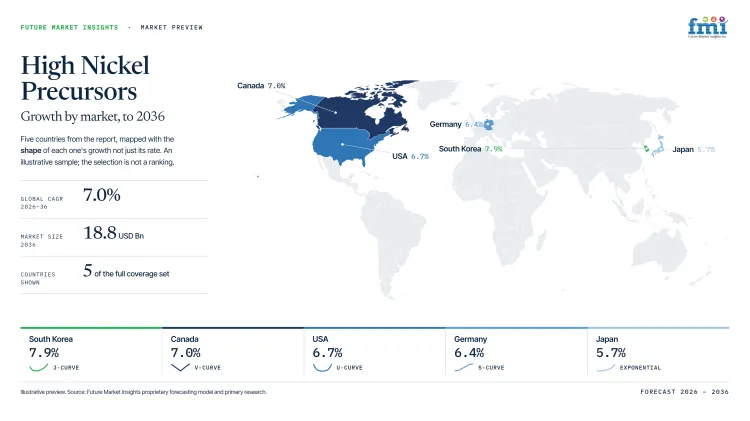
| Country | CAGR |
|---|---|
| South Korea | 7.9% |
| Finland | 7.3% |
| Canada | 7.0% |
| USA | 6.7% |
| Germany | 6.3% |
| France | 6.0% |
| Japan | 5.7% |
How do country-level CAGRs compare in the High Nickel Precursors Market?
The displayed range spans 2.2 percentage points and separates localization-led expansion from mature materials markets. South Korea and Finland form the upper band because precursor capacity is tied to existing battery-material infrastructure. Canada and the USA track close to the global rate. Germany, France and Japan depend more heavily on the pace of downstream cell qualification.
- South Korea integrates new precursor lines with large domestic cathode campuses.
- Finland pairs refined nickel access with a European battery-material corridor.
- Canada ties new materials capacity to customer-backed North American projects.
- USA incentives target midstream gaps but project qualification takes time.
- Germany relies on local cathode production and wider European cell utilization.
- France is building newer battery clusters linked to domestic gigafactory projects.
- Japan grows from a mature cathode base with slower volume replacement cycles.
Similar CAGRs can produce different revenue pools because plant utilization and chemistry choice vary by country. Qualification timing therefore matters as much as headline growth. The full report provides country-level CAGR analysis across North America, Latin America, Western Europe, Eastern Europe, East Asia, South Asia and Pacific, and Middle East and Africa.
Country-wise Analysis
- South Korean precursor orders are closely tied to domestic cathode campuses that serve export battery programs and increasingly need documented non-Chinese inputs. In November 2025, the Ministry of Trade, Industry and Energy set a three-region battery production belt covering manufacturing plus critical minerals and cathode materials. High nickel precursor demand is projected to expand at 7.9% CAGR through 2036 because local pCAM can enter nearby qualification loops. Price competition from Chinese material and uneven EV plant utilization remain the chief friction. New lines therefore need committed cathode offtake plus reliable nickel sulfate sourcing before nameplate capacity converts into regular shipments.
- Finland offers a short European route from refined nickel and cobalt into battery chemicals despite difficult pCAM permitting and utilization economics. The Geological Survey of Finland reported in July 2025 that the country produces and processes nickel and cobalt from mine to refinery. Finland is forecast to grow at 7.3% CAGR during the assessment period owing to that upstream base and access to European customers. Local advantage weakens if sodium-sulphate treatment or customer ramp timing raises operating cost. Precursor investors therefore need a clear environmental route and contracted cathode demand before building export capacity.
- Canadian battery-material projects are judged on whether local incentives can be matched with customer commitments in the North American cell chain. Finance Canada documented in 2025 a 10% refundable EV supply-chain investment tax credit covering qualifying battery and cathode active material buildings. Canada is projected to record 7.0% CAGR over the forecast period because the policy can lower capital friction for integrated projects. Vehicle programs can still shift chemistry or delay ramp-up. Precursor plants therefore need phased spending and a named cathode customer before large greenfield capacity becomes commercially defensible.
- USA precursor investment is concentrated on midstream gaps that can meet domestic qualification rules and secure offtake from cell or cathode plants. The Department of Energy stated in January 2025 that a planned battery-material funding round could award up to 14 grants and include precursor process technologies. USA demand is forecast to rise at 6.7% CAGR through 2036 given continued efforts to localize battery components. Commercial qualification is expensive and vehicle forecasts can change faster than plant schedules. Developers therefore need validated output and customer-backed volumes before expanding merchant supply.
- Germany has an operating cathode-material base at Schwarzheide and a dense automotive qualification network but precursor economics depend on the wider European cell pipeline. In May 2026, the federal economy ministry noted that Münster produced its first functional lithium-ion cell from a continuous European process chain in December 2025. Germany is expected to maintain 6.3% CAGR over the assessment period as domestic testing capacity supports regional material qualification. Asian cost pressure and uncertain gigafactory utilization limit faster conversion. High nickel precursor suppliers therefore need competitive feedstock and contracts tied to actual European cell ramps instead of announced capacity.
- French battery investment is building a newer domestic production chain tied to northern gigafactories and gives regional cathode suppliers a reason to qualify local precursor sources. The Direction générale des Entreprises said in March 2026 that France Batterie brought together 40 industrial companies and targets 100-120 GWh of cell capacity by 2030. High nickel precursor sales are forecast to expand at 6.0% CAGR by 2036 as this base develops. New plants can still adopt lower-nickel formats. Precursor entrants must prove that energy-density requirements justify high nickel specifications for each customer platform.
- Japanese cathode producers place high value on long qualification histories and controlled powder characteristics because material changes flow directly into cell validation programs. METI revised its battery strategy in June 2026 and retained a target for 150 GWh of annual domestic manufacturing capacity from 2030 into the mid-2030s. Japan is anticipated to advance at 5.7% CAGR over the forecast period as established materials expertise serves higher-value cells. Growth is slower than in newer localization markets because the installed supply base is mature. Differentiated particle design and dependable technical support therefore offer the clearer route to new high nickel precursor orders.
Who are the notable companies in the High Nickel Precursors Market?
Umicore, POSCO Future M, L&F, Ecopro Materials, CNGR Advanced Material, GEM Co., BASF Battery Materials, Sumitomo Metal Mining, Nichia, and Tanaka Chemical are notable companies serving this market.
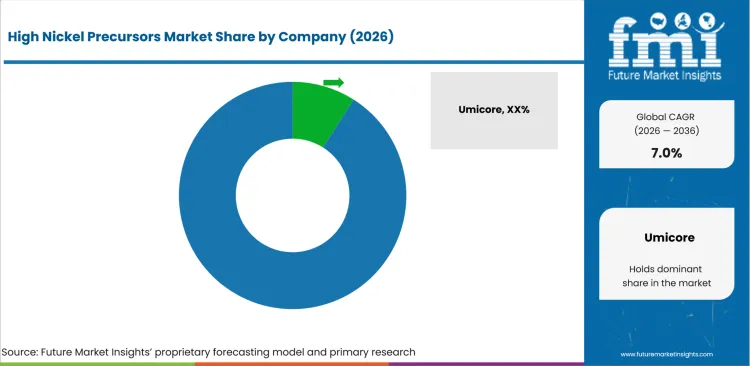
Competition is concentrated among integrated pCAM producers, cathode-material groups, and Japanese chemistry specialists. Entry is difficult because customers qualify particle morphology and metal ratios against specific cathode processes, while scale without firm offtake can leave new plants underused.
- Umicore, POSCO Future M, Ecopro Materials, CNGR Advanced Material, GEM Co., and Tanaka Chemical participate directly in precursor production or sourcing.
- L&F, BASF Battery Materials, Sumitomo Metal Mining, and Nichia influence precursor specifications through high-nickel cathode development and commercial qualification.
Competitive Benchmarking: High Nickel Precursors Market
| Company | High-Nickel Portfolio Evidence | Precursor Integration | Commercial Qualification Depth | Geographic Reach |
|---|---|---|---|---|
| Umicore | High | High | High | Europe, Asia and North America |
| POSCO Future M | High | High | High | South Korea and global exports |
| L&F | High | Low | High | South Korea and global OEM sales |
| Ecopro Materials | High | High | High | South Korea and Asia |
| CNGR Advanced Material | High | High | High | Asia, Europe and North Africa |
| GEM Co. | High | High | High | Asia, Europe and Indonesia |
| BASF Battery Materials | High | Medium | High | Europe, Asia and North America |
| Sumitomo Metal Mining | High | Medium | High | Japan and international customers |
| Nichia | Medium | Low | High | Japan and international sales |
| Tanaka Chemical | Medium | High | Medium | Japan and international customers |
Scoring basis: High portfolio evidence requires a current high-nickel precursor or cathode program, Medium requires a documented nickel-based cathode business, and Low would indicate no nickel-rich route. High precursor integration requires direct pCAM manufacture, Medium requires a documented precursor interface, and Low identifies cathode production without direct pCAM manufacture. High qualification depth requires current mass production or customer supply, while Medium reflects established industrial production without a recent exact-market contract.
Key Developments in the High Nickel Precursors Market
- In August 2025, BASF Battery Materials delivered its first mass-produced cathode active materials for semi-solid-state batteries to WELION New Energy.
- In April 2025, L&F raised its 2025 shipment growth target to 40% after demand increased for its NCMA95 high-nickel product.
- In April 2025, GEM Co. began mass production and shipped nearly 200 tons of its ultra-high-nickel 9-series core-shell precursor to South Korea.
Key Players in the High Nickel Precursors Market
Integrated Precursor and Cathode Platforms
- Umicore
- POSCO Future M
- Ecopro Materials
- CNGR Advanced Material
- GEM Co.
High-Nickel Cathode Material Producers
- L&F
- BASF Battery Materials
- Sumitomo Metal Mining
- Nichia
Specialist Precursor Producer
- Tanaka Chemical
High Nickel Precursors Market - Report Scope
| Coverage field | Report scope |
|---|---|
| Market breakdown | By precursor type, nickel content, battery application, form, sales channel, and region. |
| Quantitative Units | USD billion. |
| Market Definition | Commercial high-nickel pCAM and precursor materials used before lithiation into nickel-rich cathode active materials for rechargeable batteries. |
| Regions Covered | North America, Latin America, Western Europe, Eastern Europe, East Asia, South Asia and Pacific, and Middle East and Africa. |
| Countries Covered | South Korea, Finland, Canada, USA, Germany, France, Japan, and 20+ countries included in the full report. |
| Key Companies Profiled | Umicore, POSCO Future M, L&F, Ecopro Materials, CNGR Advanced Material, GEM Co., BASF Battery Materials, Sumitomo Metal Mining, Nichia, and Tanaka Chemical. |
| Forecast Period | 2026 to 2036. |
| Approach | Primary and secondary research with market triangulation. |
High Nickel Precursors Market - Research Methodology
| Method | Approach |
|---|---|
| Primary Research | FMI analysts gathered input from manufacturers, service providers, technology developers, distributors, end users, procurement teams, and subject-matter experts. Interviews examined purchasing decisions, product or service evaluation, adoption barriers, approval requirements, pricing considerations, and expectations for technical or commercial support. Respondents were also asked what evidence is required before a trial, pilot, or initial order develops into regular purchasing. |
| Desk Research | Desk research covered government statistics, regulatory publications, trade data, industry associations, technical literature, standards, company filings, product information, and official corporate announcements. Sources were reviewed for relevance, publication date, geographic coverage, and consistency with the defined market scope. Claims relating to performance, applications, approvals, capacity, investment, and commercial activity were retained only when supported by credible public evidence. |
| Market Sizing and Forecasting | The market model combined the baseline value with historical performance, segment structure, pricing and volume indicators, adoption levels, company participation, and country-level demand conditions. Forecast assumptions considered economic activity, investment trends, regulatory developments, technology adoption, purchasing cycles, supply availability, and barriers to wider market use. Segment and regional estimates were reconciled before the final market total was calculated. |
| Data Validation | Estimates were checked against multiple independent indicators, including public data, company activity, trade patterns, industry developments, and findings from primary interviews. Validation also tested whether products, services, applications, and company revenues fell within the defined market boundaries. Adjacent categories, unsupported claims, overlapping revenues, and activities without direct market relevance were excluded to reduce double counting and maintain consistency across segments and countries. |
High Nickel Precursors Market by Segments
High Nickel Precursors Market segmented by Precursor Type:
- NCM 811 precursors
- NCM 9-series precursors
- NCA precursors
- NCMA precursors
- Custom high-nickel hydroxides
High Nickel Precursors Market segmented by Nickel Content:
- 80-90% nickel
- 70-80% nickel
- Above 90% nickel
- Gradient nickel precursors
High Nickel Precursors Market segmented by Battery Application:
- EV cells
- Energy storage systems
- Power tools
- Premium consumer electronics
- Aerospace - defense cells
High Nickel Precursors Market segmented by Form:
- Hydroxide precursors
- Co-precipitated precursors
- Doped precursors
- Single-crystal precursor feed
High Nickel Precursors Market segmented by Sales Channel:
- Cathode active material producers
- Cell makers direct
- Integrated battery groups
- Long-term offtake contracts
High Nickel Precursors Market by Region:
- North America
- United States
- Canada
- Latin America
- Brazil
- Mexico
- Argentina
- Chile
- Western Europe
- Germany
- France
- United Kingdom
- Italy
- Spain
- Benelux
- Nordics
- Eastern Europe
- Poland
- Czech Republic
- Romania
- Hungary
- East Asia
- China
- Japan
- South Korea
- South Asia and Pacific
- India
- ASEAN
- Australia and New Zealand
- Middle East and Africa
- GCC Countries
- South Africa
- Türkiye
- Israel
Research Sources and Bibliography
- International Energy Agency. (2026, May 20). Global EV Outlook 2026: Electric vehicle batteries.
- International Energy Agency. (2026). Global EV Outlook 2026: Manufacturing and trade.
- International Energy Agency. (2025). Global EV Outlook 2025: Electric vehicle batteries.
- Sumitomo Metal Mining Co., Ltd.. (2025, May 12). 3-Year Business Plan 2027.
- POSCO Future M. (2025, June 17). POSCO Future M holds a completion ceremony for the Gwangyang Precursor Plant.
- Umicore. (2025, March 27). Umicore announces pCAM EV battery supply agreements with CNGR and Eco&Dream.
- Finnish Minerals Group. (2025, April 4). CNGR Advanced Material withdraws from the pCAM plant project in Hamina.
- European Union. (2025, July 30). Regulation (EU) 2025/1561 amending Regulation (EU) 2023/1542 as regards obligations of economic operators concerning battery due diligence policies.
- Ministry of Trade, Industry and Energy, Republic of Korea. (2025, November 28). K-battery competitiveness enhancement plan.
- Geological Survey of Finland. (2025, July 3). Finland has a Role in the EU Battery Mineral Value Chain Especially in Nickel and Cobalt.
- Department of Finance Canada. (2025). Report on Federal Tax Expenditures 2025: EV Supply Chain Investment Tax Credit.
- USA Department of Energy. (2025, January 10). DOE Issues Notice of Intent for Funding in Strengthening Domestic Critical Materials Processing and Manufacturing to Enhance National Security.
- Federal Ministry for Economic Affairs and Energy, Germany. (2026, May 20). Roadmaps of the Hightech Agenda Germany enter implementation with business, science and federal states.
- Direction générale des Entreprises. (2026, March 24). Avec France Batterie, la France structure une filière compétitive et souveraine.
- Ministry of Economy, Trade and Industry, Japan. (2026, June 2). Battery Industry Strategy Revised as the Battery and Power Industry Strategy.
- BASF Battery Materials. (2025, August 29). BASF Delivers First Cathode Active Materials for Semi-Solid-State Batteries to WELION New Energy.
- L&F. (2025, April 30). NCMA95 new-product demand rises sharply and 2025 annual shipment target is raised.
- GEM Co., Ltd.. (2025, April 8). GEM’s New-Gen Precursor Hits Mass Production, Ships Globally.
- Ecopro Materials. (n.d.). Overview. Retrieved September 7, 2026.
- BASF. (2026, May 28). Battery Materials.
- Sumitomo Metal Mining Co., Ltd.. (2025, November 28). Integrated Report 2025: Materials Business (Battery Materials).
- Nichia Corporation. (n.d.). Organization. Retrieved September 7, 2026.
- Nichia Corporation. (n.d.). Production / Development / Sales. Retrieved September 7, 2026.
- Tanaka Chemical Corporation. (2025, June 30). Fact Book 2025.
- BASF. (2025, July 28). BASF Battery Materials and CATL sign a framework agreement for cathode active materials.
- POSCO Future M. (2025, August 19). POSCO Future M pursues the LFP cathode material business for ESS.
- L&F. (2025, April 17). Mid-to-long-term high-nickel cathode material supply contract with a global OEM.
- POSCO Future M. (2025, September 1). POSCO Future M Completes Cathode Material Portfolio from Entry-Level to Premium Electric Vehicles.
- GEM Co., Ltd.. (2025, October 30). 2025 Q3 Report of GEM Co., Ltd..
- POSCO Future M. (2026, March 19). POSCO Future M signs MOU with USA-Based Sila to develop advanced battery materials.
- BASF Battery Materials. (2025, September 2). BASF Battery Materials renews long-term cathode active materials supply agreement for Schwarzheide.
- Sumitomo Metal Mining Co., Ltd.. (2025, May 27). Niihama Plant completion ceremony held.
- POSCO Future M. (2025, August 13). POSCO Future M makes first shipment of supply chain independent cathode materials to the United States.
This bibliography is provided for reader reference and is not exhaustive. The full report contains the complete reference list and detailed citations.
This Report Answers
- How large is the high nickel precursors market in 2026 and 2036?
- Why do NCM 811 precursors retain the leading precursor type share?
- How does the 80-90% nickel band balance energy density with process control?
- Why do EV cells account for the largest battery application share?
- How do LFP economics and pCAM overcapacity affect new precursor investment?
- Which profiled countries show the fastest high nickel precursor growth?
- What buyer criteria distinguish the main precursor and cathode-material companies?
- Which recent company developments are changing high-nickel supply and qualification?
- How do regional sourcing rules alter precursor contract requirements?
Frequently Asked Questions
How big is the high nickel precursors market in 2026?
The high nickel precursors market is valued at USD 9.5 billion in 2026 and is projected to reach USD 18.8 billion by 2036. Qualified nickel-rich cathode programs support growth.
What is the CAGR of the high nickel precursors market from 2026 to 2036?
The high nickel precursors market is projected to grow at 7.0% CAGR between 2026 and 2036. Expansion depends on continued NMC and NCA use plus qualified regional supply.
Which precursor type leads the high nickel precursors market?
NCM 811 precursors are expected to hold 34.0% in 2026 supported by established high-nickel qualification paths. Existing process knowledge lowers changeover risk for cathode producers.
Which battery application leads the high nickel precursors market?
EV cells are expected to hold 61.0% in 2026 attributable to vehicle battery volumes and energy-density requirements. Automotive qualification supports repeat precursor orders after approval.
Which companies are active in the high nickel precursors market?
Key companies include Umicore, POSCO Future M, L&F, Ecopro Materials, CNGR Advanced Material, GEM Co., BASF Battery Materials, Sumitomo Metal Mining, Nichia, and Tanaka Chemical. They compete on integration, particle control, qualification and regional coverage.
Preview the report firsthand - request a free sample
Get SampleGet the brochure for pricing and purchase details.
Get PDFTable of Content
- Key Takeaways
- Market Size and CAGR
- Top Growth Driver
- Fastest Growing Segment
- Leading Region
- Key Companies
- Emerging Opportunities
- Executive Summary
- Global Market Outlook
- Demand-side Trends
- Supply-side Trends
- Technology Roadmap Analysis
- Analysis and Recommendations
- Analyst Perspective (What is happening? Why now? What should investors know?)
- Key Questions Answered
- How large is the market?
- What is the CAGR?
- What are key trends?
- Which region dominates?
- Who are the leaders?
- Market Overview
- Market Coverage / Taxonomy
- Market Definition / Scope / Limitations
- Research Methodology
- Chapter Orientation
- Analytical Lens and Working Hypotheses
- Market Structure, Signals, and Trend Drivers
- Benchmarking and Cross-market Comparability
- Market Sizing, Forecasting, and Opportunity Mapping
- Research Design and Evidence Framework
- Desk Research Programme (Secondary Evidence)
- Expert Input and Fieldwork (Primary Evidence)
- Tooling, Models, and Reference Databases
- Data Engineering and Model Build
- Quality Assurance and Audit Trail
- Market Background
- Market Dynamics (Drivers, Restraints, Opportunity, Trends)
- Scenario Forecast (Optimistic, Likely, Conservative)
- Impact Analysis
- AI Impact
- Sustainability Impact
- Regulatory Impact
- Technology Impact
- Consumer / Buyer Analysis
- Purchase Drivers
- Adoption Barriers
- Buyer Journey
- Opportunity Map Analysis
- Product Life Cycle Analysis
- Supply Chain Analysis
- Investment Feasibility Matrix
- Value Chain Analysis
- PESTLE and Porter's Analysis
- Regulatory Landscape
- Regional Parent Market Outlook
- Production and Consumption Statistics
- Import and Export Statistics
- Global Market Analysis and Forecast, 2021 to 2036
- Historical Market Size Value (USD Billion) Analysis, 2021 to 2025
- Current and Future Market Size Value (USD Billion) Projections, 2026 to 2036
- Y-o-Y Growth Trend Analysis
- Absolute $ Opportunity Analysis
- Global Market Pricing Analysis, 2021 to 2036
- Global Market Analysis and Forecast, By Precursor Type, 2021 to 2036
- Introduction / Key Findings
- Historical Market Size Value (USD Billion) Analysis By Precursor Type, 2021 to 2025
- Current and Future Market Size Value (USD Billion) Analysis and Forecast By Precursor Type, 2026 to 2036
- NCM 811 precursors
- NCM 9-series precursors
- NCA precursors
- NCMA precursors
- Custom high-nickel hydroxides
- NCM 811 precursors
- Y-o-Y Growth Trend Analysis By Precursor Type, 2021 to 2025
- Absolute $ Opportunity Analysis By Precursor Type, 2026 to 2036
- Global Market Analysis and Forecast, By Nickel Content, 2021 to 2036
- Introduction / Key Findings
- Historical Market Size Value (USD Billion) Analysis By Nickel Content, 2021 to 2025
- Current and Future Market Size Value (USD Billion) Analysis and Forecast By Nickel Content, 2026 to 2036
- 80-90% nickel
- 70-80% nickel
- Above 90% nickel
- Gradient nickel precursors
- 80-90% nickel
- Y-o-Y Growth Trend Analysis By Nickel Content, 2021 to 2025
- Absolute $ Opportunity Analysis By Nickel Content, 2026 to 2036
- Global Market Analysis and Forecast, By Battery Application, 2021 to 2036
- Introduction / Key Findings
- Historical Market Size Value (USD Billion) Analysis By Battery Application, 2021 to 2025
- Current and Future Market Size Value (USD Billion) Analysis and Forecast By Battery Application, 2026 to 2036
- EV cells
- Energy storage systems
- Power tools
- Premium consumer electronics
- Aerospace/defense cells
- EV cells
- Y-o-Y Growth Trend Analysis By Battery Application, 2021 to 2025
- Absolute $ Opportunity Analysis By Battery Application, 2026 to 2036
- Global Market Analysis and Forecast, By Form, 2021 to 2036
- Introduction / Key Findings
- Historical Market Size Value (USD Billion) Analysis By Form, 2021 to 2025
- Current and Future Market Size Value (USD Billion) Analysis and Forecast By Form, 2026 to 2036
- Hydroxide precursors
- Co-precipitated precursors
- Doped precursors
- Single-crystal precursor feed
- Hydroxide precursors
- Y-o-Y Growth Trend Analysis By Form, 2021 to 2025
- Absolute $ Opportunity Analysis By Form, 2026 to 2036
- Global Market Analysis and Forecast, By Sales Channel, 2021 to 2036
- Introduction / Key Findings
- Historical Market Size Value (USD Billion) Analysis By Sales Channel, 2021 to 2025
- Current and Future Market Size Value (USD Billion) Analysis and Forecast By Sales Channel, 2026 to 2036
- Cathode active material producers
- Cell makers direct
- Integrated battery groups
- Long-term offtake contracts
- Cathode active material producers
- Y-o-Y Growth Trend Analysis By Sales Channel, 2021 to 2025
- Absolute $ Opportunity Analysis By Sales Channel, 2026 to 2036
- Global Market Analysis and Forecast, By Region, 2021 to 2036
- Introduction
- Historical Market Size Value (USD Billion) Analysis By Region, 2021 to 2025
- Current Market Size Value (USD Billion) Analysis and Forecast By Region, 2026 to 2036
- North America
- Latin America
- Western Europe
- Eastern Europe
- East Asia
- South Asia and Pacific
- Middle East & Africa
- Market Attractiveness Analysis By Region
- North America Market Analysis and Forecast, By Country, 2021 to 2036
- Historical Market Size Value (USD Billion) Trend Analysis By Market Taxonomy, 2021 to 2025
- Market Size Value (USD Billion) Forecast By Market Taxonomy, 2026 to 2036
- By Country
- USA
- Canada
- By Precursor Type
- By Nickel Content
- By Battery Application
- By Form
- By Sales Channel
- By Country
- Market Attractiveness Analysis
- By Country
- By Precursor Type
- By Nickel Content
- By Battery Application
- By Form
- By Sales Channel
- Key Takeaways
- Latin America Market Analysis and Forecast, By Country
- Historical Market Size Value (USD Billion) Trend Analysis By Market Taxonomy, 2021 to 2025
- Market Size Value (USD Billion) Forecast By Market Taxonomy, 2026 to 2036
- By Country
- Brazil
- Mexico
- Chile
- Rest of Latin America
- By Precursor Type
- By Nickel Content
- By Battery Application
- By Form
- By Sales Channel
- By Country
- Market Attractiveness Analysis
- By Country
- By Precursor Type
- By Nickel Content
- By Battery Application
- By Form
- By Sales Channel
- Key Takeaways
- Western Europe Market Analysis and Forecast, By Country
- Historical Market Size Value (USD Billion) Trend Analysis By Market Taxonomy, 2021 to 2025
- Market Size Value (USD Billion) Forecast By Market Taxonomy, 2026 to 2036
- By Country
- Germany
- UK
- Italy
- Spain
- France
- Nordic
- BENELUX
- Rest of Western Europe
- By Precursor Type
- By Nickel Content
- By Battery Application
- By Form
- By Sales Channel
- By Country
- Market Attractiveness Analysis
- By Country
- By Precursor Type
- By Nickel Content
- By Battery Application
- By Form
- By Sales Channel
- Key Takeaways
- Eastern Europe Market Analysis and Forecast, By Country
- Historical Market Size Value (USD Billion) Trend Analysis By Market Taxonomy, 2021 to 2025
- Market Size Value (USD Billion) Forecast By Market Taxonomy, 2026 to 2036
- By Country
- Russia
- Poland
- Hungary
- Balkan & Baltic
- Rest of Eastern Europe
- By Precursor Type
- By Nickel Content
- By Battery Application
- By Form
- By Sales Channel
- By Country
- Market Attractiveness Analysis
- By Country
- By Precursor Type
- By Nickel Content
- By Battery Application
- By Form
- By Sales Channel
- Key Takeaways
- East Asia Market Analysis and Forecast, By Country
- Historical Market Size Value (USD Billion) Trend Analysis By Market Taxonomy, 2021 to 2025
- Market Size Value (USD Billion) Forecast By Market Taxonomy, 2026 to 2036
- By Country
- China
- Japan
- South Korea
- By Precursor Type
- By Nickel Content
- By Battery Application
- By Form
- By Sales Channel
- By Country
- Market Attractiveness Analysis
- By Country
- By Precursor Type
- By Nickel Content
- By Battery Application
- By Form
- By Sales Channel
- Key Takeaways
- South Asia and Pacific Market Analysis and Forecast, By Country
- Historical Market Size Value (USD Billion) Trend Analysis By Market Taxonomy, 2021 to 2025
- Market Size Value (USD Billion) Forecast By Market Taxonomy, 2026 to 2036
- By Country
- India
- ASEAN
- Australia & New Zealand
- Rest of South Asia and Pacific
- By Precursor Type
- By Nickel Content
- By Battery Application
- By Form
- By Sales Channel
- By Country
- Market Attractiveness Analysis
- By Country
- By Precursor Type
- By Nickel Content
- By Battery Application
- By Form
- By Sales Channel
- Key Takeaways
- Middle East & Africa Market Analysis and Forecast, By Country
- Historical Market Size Value (USD Billion) Trend Analysis By Market Taxonomy, 2021 to 2025
- Market Size Value (USD Billion) Forecast By Market Taxonomy, 2026 to 2036
- By Country
- Kingdom of Saudi Arabia
- Other GCC Countries
- Türkiye
- South Africa
- Other African Union
- Rest of Middle East & Africa
- By Precursor Type
- By Nickel Content
- By Battery Application
- By Form
- By Sales Channel
- By Country
- Market Attractiveness Analysis
- By Country
- By Precursor Type
- By Nickel Content
- By Battery Application
- By Form
- By Sales Channel
- Key Takeaways
- Key Countries Market Analysis
- USA
- Pricing Analysis
- Market Share Analysis, 2025
- By Precursor Type
- By Nickel Content
- By Battery Application
- By Form
- By Sales Channel
- Canada
- Pricing Analysis
- Market Share Analysis, 2025
- By Precursor Type
- By Nickel Content
- By Battery Application
- By Form
- By Sales Channel
- Mexico
- Pricing Analysis
- Market Share Analysis, 2025
- By Precursor Type
- By Nickel Content
- By Battery Application
- By Form
- By Sales Channel
- Brazil
- Pricing Analysis
- Market Share Analysis, 2025
- By Precursor Type
- By Nickel Content
- By Battery Application
- By Form
- By Sales Channel
- Chile
- Pricing Analysis
- Market Share Analysis, 2025
- By Precursor Type
- By Nickel Content
- By Battery Application
- By Form
- By Sales Channel
- Germany
- Pricing Analysis
- Market Share Analysis, 2025
- By Precursor Type
- By Nickel Content
- By Battery Application
- By Form
- By Sales Channel
- UK
- Pricing Analysis
- Market Share Analysis, 2025
- By Precursor Type
- By Nickel Content
- By Battery Application
- By Form
- By Sales Channel
- Italy
- Pricing Analysis
- Market Share Analysis, 2025
- By Precursor Type
- By Nickel Content
- By Battery Application
- By Form
- By Sales Channel
- Spain
- Pricing Analysis
- Market Share Analysis, 2025
- By Precursor Type
- By Nickel Content
- By Battery Application
- By Form
- By Sales Channel
- France
- Pricing Analysis
- Market Share Analysis, 2025
- By Precursor Type
- By Nickel Content
- By Battery Application
- By Form
- By Sales Channel
- India
- Pricing Analysis
- Market Share Analysis, 2025
- By Precursor Type
- By Nickel Content
- By Battery Application
- By Form
- By Sales Channel
- ASEAN
- Pricing Analysis
- Market Share Analysis, 2025
- By Precursor Type
- By Nickel Content
- By Battery Application
- By Form
- By Sales Channel
- Australia & New Zealand
- Pricing Analysis
- Market Share Analysis, 2025
- By Precursor Type
- By Nickel Content
- By Battery Application
- By Form
- By Sales Channel
- China
- Pricing Analysis
- Market Share Analysis, 2025
- By Precursor Type
- By Nickel Content
- By Battery Application
- By Form
- By Sales Channel
- Japan
- Pricing Analysis
- Market Share Analysis, 2025
- By Precursor Type
- By Nickel Content
- By Battery Application
- By Form
- By Sales Channel
- South Korea
- Pricing Analysis
- Market Share Analysis, 2025
- By Precursor Type
- By Nickel Content
- By Battery Application
- By Form
- By Sales Channel
- Russia
- Pricing Analysis
- Market Share Analysis, 2025
- By Precursor Type
- By Nickel Content
- By Battery Application
- By Form
- By Sales Channel
- Poland
- Pricing Analysis
- Market Share Analysis, 2025
- By Precursor Type
- By Nickel Content
- By Battery Application
- By Form
- By Sales Channel
- Hungary
- Pricing Analysis
- Market Share Analysis, 2025
- By Precursor Type
- By Nickel Content
- By Battery Application
- By Form
- By Sales Channel
- Kingdom of Saudi Arabia
- Pricing Analysis
- Market Share Analysis, 2025
- By Precursor Type
- By Nickel Content
- By Battery Application
- By Form
- By Sales Channel
- Türkiye
- Pricing Analysis
- Market Share Analysis, 2025
- By Precursor Type
- By Nickel Content
- By Battery Application
- By Form
- By Sales Channel
- South Africa
- Pricing Analysis
- Market Share Analysis, 2025
- By Precursor Type
- By Nickel Content
- By Battery Application
- By Form
- By Sales Channel
- USA
- Market Structure Analysis
- Competition Dashboard
- Competition Benchmarking
- Market Share Analysis of Top Players
- By Regional
- By Precursor Type
- By Nickel Content
- By Battery Application
- By Form
- By Sales Channel
- Emerging Startups
- Innovation Benchmarking
- Competition Analysis
- Competition Deep Dive
- Umicore
- Overview
- Product Portfolio
- Profitability by Market Segments
- Sales Footprint
- Strategy Overview
- Marketing Strategy
- Product Strategy
- Channel Strategy
- POSCO Future M
- L&F
- Ecopro Materials
- CNGR Advanced Material
- GEM Co.
- BASF Battery Materials
- Sumitomo Metal Mining
- Nichia
- Tanaka Chemical
- Umicore
- Case Studies
- Success Stories
- Recent Developments
- Competition Deep Dive
- Assumptions & Acronyms Used


