

- Market Size (2026)
- USD 2.5 Bn
- Forecast (2036)
- USD 4.4 Bn
- CAGR (2026 to 2036)
- 6.1%
How big is Hot Fill PET Resin Market in 2026?
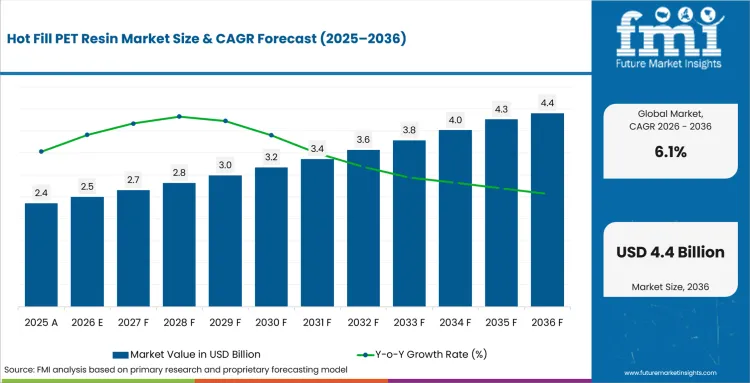
USD 2.5 billion in 2026 and USD 4.4 billion by 2036 at a 6.1% CAGR.
Demand for hot fill PET resin is projected to expand at 6.1% CAGR between 2026 and 2036, increasing valuation from USD 2.5 billion in 2026 to USD 4.4 billion by 2036. Beverage processors need heat-set PET packaging material that retains bottle geometry during thermal filling and controlled cooling. Recycled-feedstock availability shapes qualification across bottle programs requiring stable viscosity and food-contact records for commercial approval. NAPCOR reported in December 2025 that the United States recycled 30.2% of PET bottles during 2024. Limited recovery intensifies competition for food-grade recycled PET that tolerates demanding bottle processing during thermal filling. Resin producers must control intrinsic viscosity alongside acetaldehyde during PET preform conversion across bottle designs. Packaging engineers connect those properties with food-contact records and blow-molding results from each intended filling line.
Key Takeaways of Hot Fill PET Resin Market
- Thermal filling increases demand for resin grades that preserve bottle geometry during controlled heating and cooling cycles.
- High IV hot fill PET is projected at 31.0% share in 2026 due to stronger dimensional stability.
- The 0.80-0.84 dL/g range is estimated at 47.0% share in 2026 owing to balanced processing performance.
- Juice bottles are forecast at 31.0% share in 2026 driven by established heat-set filling infrastructure.
- Feedstock contamination remains a material restraint as viscosity variation increases qualification work across beverage plants.
- Indorama Ventures and Far Eastern New Century join Nan Ya Plastics and Alpek in supplying dedicated hot-fill grades.
Analyst Perspective
“Hot-fill resin approval depends on how viscosity control translates into wall distribution during commercial thermal cycles. Resin grades with stable recycled content can simplify qualification across bottle families without weakening closure or panel performance.”
- Nikhil Kaitwade, Principal Consultant, Future Market Insights
How is the Hot Fill PET Resin Market segmented?
The hot fill PET resin industry is segmented by resin grade, IV range, application, packaging format, sales channel and region.
The industry is segmented by resin grade, IV range, application, packaging format, sales channel and region. Resin grades cover high IV hot fill PET, heat-set bottle grade PET, copolyester modified PET, recycled hot fill PET and barrier-enhanced PET. IV ranges run from 0.76-0.80 dL/g to above 0.84 dL/g, and applications cover juice, tea, sauces, sports drinks and dairy. Formats cover single-serve, multi-serve, wide-mouth and specialty heat-set containers, with sales through direct resin supply, preform converters, packaging integrators and distributors.
Why is high IV hot fill PET central to the resin grade category?
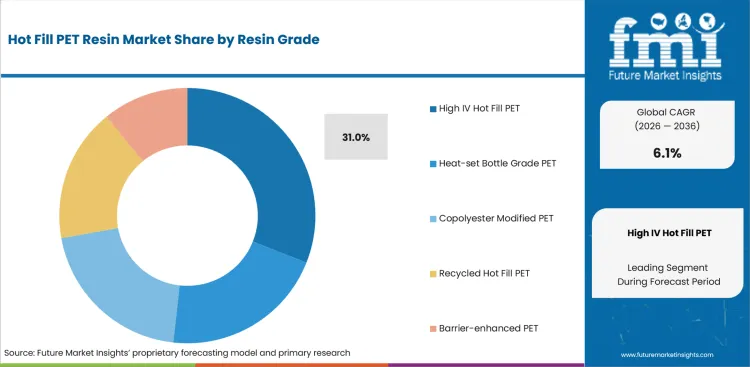
High IV resin helps heat-set PET packaging systems resist deformation during thermal filling, and Indorama Ventures lists commercial hot-fill grades at 0.80 and 0.82 dL/g across several production sites.
- High IV hot fill PET is set to lead the resin grade category with 31.0% share in 2026 due to stronger dimensional stability during thermal processing.
- Beverage plants qualify the grade through line trials that measure wall distribution and shrinkage across repeated commercial runs. Repeatable results reduce tooling changes and support common approvals across factories using comparable heat-set equipment.
Why does the 0.80-0.84 dL/g range hold the central IV position?
The 0.80-0.84 dL/g band balances preform flow with bottle strength across heat-set containers using familiar drying and stretching settings.
- The IV range category is forecast to be led by 0.80-0.84 dL/g at 47.0% share in 2026 due to balanced processing across commercial bottle programs.
- Converters qualify recycled PET packaging lots once viscosity remains stable through drying and injection molding across approved recipes. Novapet reports validation by final packagers and ISBM technology providers, reinforcing equipment-level approval for regular production on existing lines.
Why do juice bottles hold the main application position?
Juice bottles expose PET resin to elevated product temperatures and preserve clarity and shelf presentation through ambient distribution networks. Established beverage packaging lines favor grades that transfer across several juice formulations and closure systems without repeated equipment changes.
- Based on application, juice bottles are projected to account for 31.0% in 2026 due to established heat-set processing across shelf-stable beverage programs.
- Processors qualify resin through commercial plant trials that measure shrinkage and closure performance under realistic product temperatures. Common approvals reduce repeated testing across seasonal recipes and support faster bottle-family extensions throughout multi-plant production networks.
What supports single-serve bottles within the packaging format category?
Single-serve bottles concentrate thermal stress within lighter containers that need precise wall distribution and heat-set geometry. Nan Ya Plastics describes a fast-crystallizing hot-fill grade that limits container shrinkage across PET bottle programs, linking resin selection with lightweight stability.
- By packaging format, single-serve bottles are forecast to represent 38.0% in 2026 driven by frequent retail purchases and established filling infrastructure.
- Beverage brands approve single-serve formats through transport trials that measure panel stability during commercial storage. Common bottle families help plants retain existing molds across several fill volumes without repeating dimensional checks during changeovers.
What are the drivers, restraints and opportunities in the Hot Fill PET Resin Market?
Heat-set performance supports demand as feedstock variation delays approvals and shared files reduce bottle testing.
- Driver: Beverage processors need stable bottle geometry and verified recycled-content calculations across regulated retail programs.
- Restraint: Feedstock contamination and viscosity variation disrupt heat-set performance during repeated high-speed bottle production runs.
- Opportunity: Resin producers align virgin and recycled formulations through shared approval files across bottle programs.
Beverage groups compare thermal stability with recycled-content availability across 100% rPET containers and bottle families. NAPCOR's December 2025 report found bottle applications consumed over 60% of North American recycled PET during 2024. Concentrated bottle demand raises consistency requirements for food-grade resin during commercial thermal filling operations worldwide.
Food-contact decontamination establishes resin safety but does not guarantee stable heat-set bottle performance during filling. Unexpected shrinkage forces beverage plants to repeat commercial trials across approved molds and filling schedules.
Resin producers qualify virgin and recycled formulations through one testing route across comparable commercial bottle programs. Common approval files reduce repeated work across food packaging programs using comparable bottles and filling conditions.
Which country CAGRs are profiled in the Hot Fill PET Resin Market?
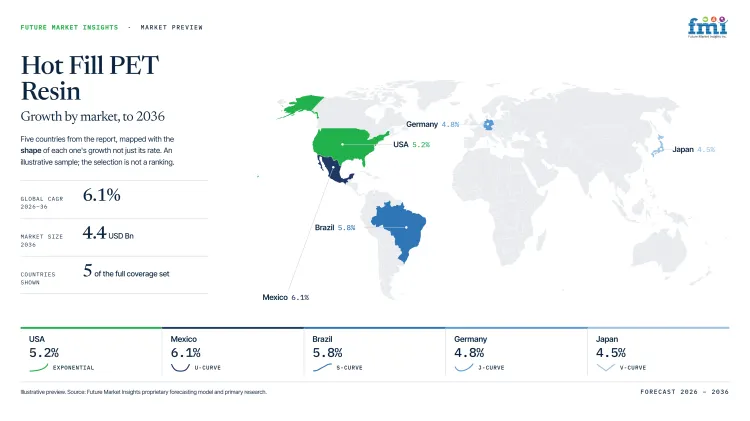
| Country | CAGR |
|---|---|
| United States | 5.2% |
| Germany | 4.8% |
| Japan | 4.5% |
| Mexico | 6.1% |
| Brazil | 5.8% |
How do country-level CAGRs compare in the Hot Fill PET Resin Markett?
The country forecasts remain relatively close across the hot fill PET resin market, with a 1.6 percentage point difference between Mexico and Japan. Mexico and Brazil form an upper group, reflecting expanding beverage production and increasing demand for packaging materials suitable for hot-filled juices, teas and functional drinks. The United States follows within a narrow range and benefits from a large packaged beverage industry and continued use of PET packaging in shelf-stable applications. Germany and Japan create a lower pair with limited separation, indicating steady demand supported by mature packaging markets and ongoing packaging optimization efforts. The pattern suggests that growth is being shaped by beverage consumption trends, packaging efficiency requirements and adoption of lightweight hot-fill compatible PET solutions.
- Mexico benefits from strong growth in packaged beverage manufacturing and increasing demand for cost-effective hot-fill packaging formats.
- Brazil supports market expansion through rising consumption of shelf-stable beverages and continued investment in PET packaging infrastructure.
- The United States reflects steady demand from juice, sports drink and ready-to-drink beverage segments that utilize hot-fill PET containers.
- Germany maintains growth through packaging innovation and efforts to improve material efficiency and recyclability.
- Japan supports market development through demand for high-quality beverage packaging and continued focus on lightweight packaging technologies.
Comparable CAGRs may still reflect different market conditions because beverage product mix, recycling infrastructure, hot-fill processing requirements and packaging regulations vary across countries. The full report provides country-level CAGR analysis across North America, Latin America, Europe, East Asia, South Asia, Oceania and the Middle East and Africa.
Country-wise Analysis
- United States bottle programs combine extensive heat-set converting capacity with uneven state recovery systems, so resin approvals must account for different recycled-feedstock quality across national beverage plants and contract manufacturing networks. Hot fill PET resin demand in the United States is forecast to rise at 5.2% CAGR over the forecast period, supported by accessible packaging laboratories and large beverage production networks serving several bottle formats nationally. NAPCOR reported in December 2025 that average recycled PET content in domestic bottles reached 15.9% during 2024, requiring contracts to define color limits and food-contact records for each participating plant and approved resin source.
- Germany combines a mature deposit-return network with published recyclability criteria that guide bottle design and resin documentation across established beverage converters and national brands serving several filling sites and retailer programs. Hot fill PET resin sales in Germany are forecast to expand at 4.8% CAGR by 2036, shaped by defined packaging rules and technical services that support controlled heat-set qualification across related bottle families. Zentrale Stelle Verpackungsregister published the 2025 minimum standard during August 2025 as changing European assessment requirements and limited food-grade recycled PET availability can extend formula approval until national brands approve common grades for several bottle sizes.
- Japan uses coordinated PET bottle collection and detailed design guidance to support controlled resin trials through domestic converters, experienced packaging engineers and beverage plants across several categories and filling sites using different fill temperatures. Japan is estimated to post 4.5% CAGR over the forecast period, reinforced by dependable recovery systems and predictable domestic technical support across high-volume single-serve bottle programs with established maintenance support. The Council for PET Bottle Recycling reported an 85.1% recycling rate for fiscal 2024 in November 2025, yet each bottle family needs separate shrinkage and closure records across different molds and closure types during final approval for additional sites.
- Mexico concentrates major food-grade recycled PET capacity near beverage production corridors that connect resin processors with large fillers, preform plants and technical distribution routes serving domestic and export programs. The Mexico hot fill PET resin sector is projected to record 6.1% CAGR during the assessment period, driven by integrated recycling capacity and established bottle conversion across regional beverage manufacturing centers. SEMARNAT reported in May 2025 that PetStar produces more than 69,000 metric tons of food-grade recycled PET annually but collection quality outside established corridors requires plant-specific controls across distant territories and seasonal supply periods during peak beverage seasons.
- Brazil applies national plastic-packaging reverse-logistics rules that connect bottle recovery with traceability across major production territories, converter networks and preform plants serving several beverage categories and filling centers. Adoption of hot fill PET resin in Brazil is estimated to expand at 5.8% CAGR through 2036, influenced by extensive beverage manufacturing capacity and growing documentation needs across regional juice and tea programs in populous territories. Brazil's October 2025 Decree 12,688 established national recovery and traceability requirements for plastic packaging whereas uneven collection quality and separate food-contact rules require regional resin documentation across conversion plants and distributor-led commercial beverage launches.
Who are the notable companies in the Hot Fill PET Resin Market?
Indorama Ventures, Far Eastern New Century, Nan Ya Plastics, Alpek, Lotte Chemical, Novatex, Novapet and Sichuan Hanjiang New Materials are notable companies serving this market.
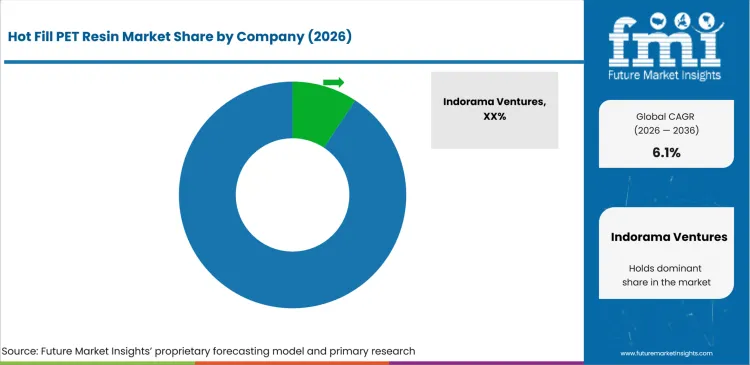
Hot-fill PET resin production is moderately concentrated among global producers and specialists serving heat-set bottle programs. Entry requires stable resin quality, food-contact records and support for preform molding and bottle qualification.
- Indorama Ventures and Far Eastern New Century combine heat-set grades with regional manufacturing and recycled PET programs.
- Nan Ya Plastics and Lotte Chemical compete through hot-fill formulas backed by regional bottle-grade manufacturing.
- Alpek, Novatex, Novapet and Sichuan Hanjiang New Materials support ready-to-drink packaging through regional hot-fill grades and testing.
Competitive Benchmarking: Hot Fill PET Resin Market
| Company | Hot-Fill Grade Breadth | Food-Contact Documentation | Bottle-Line Validation | Geographic Reach |
|---|---|---|---|---|
| Indorama Ventures | High | Medium | Medium | Global |
| Far Eastern New Century | High | High | Medium | Asia and the Americas |
| Nan Ya Plastics | Medium | High | Medium | Asia and selected export markets |
| Alpek | High | Medium | Medium | Americas and Middle East |
| Lotte Chemical | Medium | Medium | Medium | Asia and selected export markets |
| Novatex | Medium | High | High | South Asia and export markets |
| Novapet | Medium | Medium | High | Europe and selected export markets |
| Sichuan Hanjiang New Materials | Medium | Medium | Medium | China and selected export markets |
Key Developments in the Hot Fill PET Resin Market
- In March 2026, Indorama Ventures entered a strategic partnership for a Lagos facility designed to produce 45,000 metric tons of food-grade recycled PET resin annually.
- In October 2025, Far Eastern New Century secured financing for a Melaka plant designed to produce 50,000 metric tons of post-consumer recycled PET resin annually for food-grade packaging.
- In August 2025, Far Eastern New Century announced EN 15343 certification that verifies traceability and recycled content for food-contact PET pellets used in European packaging programs.
- In May 2025, Alpek announced the July closure of its North Carolina PET facility with 170,000 metric tons of resin capacity and 35,000 metric tons of rPET flake capacity.
Hot Fill PET Resin Market - Report Scope
| Coverage field | Report scope |
|---|---|
| Market breakdown | By resin grade, IV range, application, packaging format, sales channel and region. |
| Quantitative Units | Revenue in USD billion and CAGR in %. |
| Market Definition | The market covers bottle-grade PET resin sold for commercial hot-fill applications that require heat-set dimensional stability. |
| Regions Covered | North America, Latin America, Western Europe, Eastern Europe, East Asia, South Asia and Pacific and Middle East and Africa. |
| Countries Covered | United States, Germany, Japan, Mexico, Brazil and more than twenty-five additional countries in the full report. |
| Key Companies Profiled | Indorama Ventures, Far Eastern New Century, Nan Ya Plastics, Alpek, Lotte Chemical, Novatex, Novapet and Sichuan Hanjiang New Materials. |
| Forecast Period | 2026 to 2036. |
| Approach | Primary and secondary research with market triangulation. |
Hot Fill PET Resin Market - Research Methodology
| Method | Approach |
|---|---|
| Primary Research | FMI analysts gathered input from manufacturers, service providers, technology developers, distributors, end users, procurement teams, and subject-matter experts. Interviews examined purchasing decisions, product or service evaluation, adoption barriers, approval requirements, pricing considerations, and expectations for technical or commercial support. Respondents were also asked what evidence is required before a trial, pilot, or initial order develops into regular purchasing. |
| Desk Research | Desk research covered government statistics, regulatory publications, trade data, industry associations, technical literature, standards, company filings, product information, and official corporate announcements. Sources were reviewed for relevance, publication date, geographic coverage, and consistency with the defined market scope. Claims relating to performance, applications, approvals, capacity, investment, and commercial activity were retained only when supported by credible public evidence. |
| Market Sizing and Forecasting | The market model combined the baseline value with historical performance, segment structure, pricing and volume indicators, adoption levels, company participation, and country-level demand conditions. Forecast assumptions considered economic activity, investment trends, regulatory developments, technology adoption, purchasing cycles, supply availability, and barriers to wider market use. Segment and regional estimates were reconciled before the final market total was calculated. |
| Data Validation | Estimates were checked against multiple independent indicators, including public data, company activity, trade patterns, industry developments, and findings from primary interviews. Validation also tested whether products, services, applications, and company revenues fell within the defined market boundaries. Adjacent categories, unsupported claims, overlapping revenues, and activities without direct market relevance were excluded to reduce double counting and maintain consistency across segments and countries. |
Hot Fill PET Resin Market by Segments
Hot Fill PET Resin Market segmented by Resin Grade:
- High IV Hot Fill PET
- Heat-set Bottle Grade PET
- Copolyester Modified PET
- Recycled Hot Fill PET
- Barrier-enhanced PET
Hot Fill PET Resin Market segmented by IV Range:
- 0.80-0.84 dL/g
- 0.76-0.80 dL/g
- >0.84 dL/g
Hot Fill PET Resin Market segmented by Application:
- Juice Bottles
- Tea / Functional Beverages
- Sauces & Condiments
- Sports Drinks
- Dairy / Other Hot Fill
Hot Fill PET Resin Market segmented by Packaging Format:
- Single-serve Bottles
- Multi-serve Bottles
- Wide-mouth Containers
- Specialty Heat-set Containers
Hot Fill PET Resin Market segmented by Sales Channel:
- Direct Resin Supply
- Preform Converters
- Packaging Integrators
- Distributors
Hot Fill PET Resin Market by Region:
- North America
- United States
- Canada
- Latin America
- Brazil
- Chile
- Mexico
- Rest of Latin America
- Western Europe
- Germany
- United Kingdom
- Italy
- Spain
- France
- Nordics
- Benelux
- Rest of Western Europe
- Eastern Europe
- Russia
- Poland
- Hungary
- Balkan and Baltic States
- Rest of Eastern Europe
- East Asia
- China
- Japan
- South Korea
- South Asia and Pacific
- India
- ASEAN
- Australia and New Zealand
- Rest of South Asia and Pacific
- Middle East and Africa
- Kingdom of Saudi Arabia
- Other GCC Countries
- Türkiye
- South Africa
- Other African Union Countries
- Rest of Middle East and Africa
Research Sources and Bibliography
- National Association for PET Container Resources. (2025, December 10). NAPCOR Releases 2024 PET Recycling Report Highlighting System Efficiency Gains and Continued Strength of PET Circularity.
- Zentrale Stelle Verpackungsregister. (2025, August 29). 2025 minimum standard published - initial touchstone for companies preparing for the EU Packaging and Packaging Waste Regulation (PPWR).
- The Council for PET Bottle Recycling. (2025, November).
- Secretaría de Medio Ambiente y Recursos Naturales. (2025, May 13). Secretaria Bárcena llama a industriales del país a impulsar la economía circular.
- Presidência da República. (2025, October 21). DECRETO Nº 12.688, DE 21 DE OUTUBRO DE 2025.
- Nan Ya Plastics Corporation. (n.d.). Hot-Filled PET Bottle Resin.
- LOTTE Chemical. (n.d.). Plant #2 > PET - Melt Phase Condensation Polymerization Process.
- Indorama Ventures. (2026, March 12). Indorama Ventures, Nigerian Breweries and Genesis Energy Partner to Develop One of Africa’s Largest rPET Production Facilities.
- Far Eastern New Century. (2025, October 14). FE Green PET secures RM150 million in sustainable financing from HSBC Malaysia.
- Far Eastern New Century. (2025, August 14). FENC SSP Division Receives EN 15343 Certification, the First Company in Taiwan to Comply with EU Recycled Plastics Standard.
- Alpek. (2025, May 30). Alpek will cease operations at its PET Facility in North Carolina.
This Report Answers
- How large is the hot fill PET resin market in 2026 and 2036?
- Which thermal conditions support demand for commercial hot-fill bottle resin?
- Which resin grade holds the central share during 2026?
- How does intrinsic viscosity influence heat-set bottle performance?
- Which packaging format supports broad hot-fill beverage use?
- How do country growth rates reflect different qualification routes?
- Which companies provide dedicated hot-fill PET resin grades?
- What operating conditions limit wider hot-fill resin adoption?
- How should packaging teams compare resin grades and IV ranges?
Frequently Asked Questions
How big is the Hot Fill PET Resin Market in 2026?
The hot fill PET resin market is valued at USD 2.5 billion in 2026 and is forecast to reach USD 4.4 billion by 2036. Growth is supported by beverage processors requiring heat-set packaging material that retains bottle geometry during thermal filling and controlled cooling cycles.
What is the CAGR of the Hot Fill PET Resin Market from 2026 to 2036?
The hot fill PET resin market grows at a CAGR of 6.1% between 2026 and 2036, driven by beverage processors needing stable bottle geometry and verified recycled-content calculations, while feedstock contamination and viscosity variation continue to disrupt heat-set production runs.
Which resin grade leads the Hot Fill PET Resin Market?
High IV hot fill PET leads the hot fill PET resin market by resin grade, holding 31.0% share in 2026 due to stronger dimensional stability during thermal processing. Beverage plants qualify the grade through line trials measuring wall distribution and shrinkage.
How much will the Hot Fill PET Resin Market add between 2026 and 2036?
The hot fill PET resin market is set to add USD 1.9 billion between 2026 and 2036, growing from USD 2.5 billion to USD 4.4 billion as beverage processors expand recycled-content bottle programs across juice, tea, sauces, sports drinks and dairy applications.
Who are the leading companies in the Hot Fill PET Resin Market?
Eight companies lead the hot fill PET resin market, including Indorama Ventures, Far Eastern New Century, Nan Ya Plastics, Alpek, Lotte Chemical, Novatex, Novapet, and Sichuan Hanjiang New Materials, competing through hot-fill grade breadth, food-contact documentation and bottle-line validation.
Preview the report firsthand - request a free sample
Get SampleGet the brochure for pricing and purchase details.
Get PDFTable of Content
- Key Takeaways
- Market Size and CAGR
- Top Growth Driver
- Fastest Growing Segment
- Leading Region
- Key Companies
- Emerging Opportunities
- Executive Summary
- Global Market Outlook
- Demand-side Trends
- Supply-side Trends
- Technology Roadmap Analysis
- Analysis and Recommendations
- Analyst Perspective (What is happening? Why now? What should investors know?)
- Key Questions Answered
- How large is the market?
- What is the CAGR?
- What are key trends?
- Which region dominates?
- Who are the leaders?
- Market Overview
- Market Coverage / Taxonomy
- Market Definition / Scope / Limitations
- Research Methodology
- Chapter Orientation
- Analytical Lens and Working Hypotheses
- Market Structure, Signals, and Trend Drivers
- Benchmarking and Cross-market Comparability
- Market Sizing, Forecasting, and Opportunity Mapping
- Research Design and Evidence Framework
- Desk Research Programme (Secondary Evidence)
- Expert Input and Fieldwork (Primary Evidence)
- Tooling, Models, and Reference Databases
- Data Engineering and Model Build
- Quality Assurance and Audit Trail
- Market Background
- Market Dynamics (Drivers, Restraints, Opportunity, Trends)
- Scenario Forecast (Optimistic, Likely, Conservative)
- Impact Analysis
- AI Impact
- Sustainability Impact
- Regulatory Impact
- Technology Impact
- Consumer / Buyer Analysis
- Purchase Drivers
- Adoption Barriers
- Buyer Journey
- Opportunity Map Analysis
- Product Life Cycle Analysis
- Supply Chain Analysis
- Investment Feasibility Matrix
- Value Chain Analysis
- PESTLE and Porter's Analysis
- Regulatory Landscape
- Regional Parent Market Outlook
- Production and Consumption Statistics
- Import and Export Statistics
- Global Market Analysis and Forecast, 2021 to 2036
- Historical Market Size Value (USD Billion) Analysis, 2021 to 2025
- Current and Future Market Size Value (USD Billion) Projections, 2026 to 2036
- Y-o-Y Growth Trend Analysis
- Absolute $ Opportunity Analysis
- Global Market Pricing Analysis, 2021 to 2036
- Global Market Analysis and Forecast, By Resin Grade, 2021 to 2036
- Introduction / Key Findings
- Historical Market Size Value (USD Billion) Analysis By Resin Grade, 2021 to 2025
- Current and Future Market Size Value (USD Billion) Analysis and Forecast By Resin Grade, 2026 to 2036
- High IV Hot Fill PET
- Heat-set Bottle Grade PET
- Copolyester Modified PET
- Recycled Hot Fill PET
- Barrier-enhanced PET
- High IV Hot Fill PET
- Y-o-Y Growth Trend Analysis By Resin Grade, 2021 to 2025
- Absolute $ Opportunity Analysis By Resin Grade, 2026 to 2036
- Global Market Analysis and Forecast, By IV Range, 2021 to 2036
- Introduction / Key Findings
- Historical Market Size Value (USD Billion) Analysis By IV Range, 2021 to 2025
- Current and Future Market Size Value (USD Billion) Analysis and Forecast By IV Range, 2026 to 2036
- 0.80-0.84 dL/g
- 0.76-0.80 dL/g
- >0.84 dL/g
- 0.80-0.84 dL/g
- Y-o-Y Growth Trend Analysis By IV Range, 2021 to 2025
- Absolute $ Opportunity Analysis By IV Range, 2026 to 2036
- Global Market Analysis and Forecast, By Application, 2021 to 2036
- Introduction / Key Findings
- Historical Market Size Value (USD Billion) Analysis By Application, 2021 to 2025
- Current and Future Market Size Value (USD Billion) Analysis and Forecast By Application, 2026 to 2036
- Juice Bottles
- Tea / Functional Beverages
- Sauces & Condiments
- Sports Drinks
- Dairy / Other Hot Fill
- Juice Bottles
- Y-o-Y Growth Trend Analysis By Application, 2021 to 2025
- Absolute $ Opportunity Analysis By Application, 2026 to 2036
- Global Market Analysis and Forecast, By Packaging Format, 2021 to 2036
- Introduction / Key Findings
- Historical Market Size Value (USD Billion) Analysis By Packaging Format, 2021 to 2025
- Current and Future Market Size Value (USD Billion) Analysis and Forecast By Packaging Format, 2026 to 2036
- Single-serve Bottles
- Multi-serve Bottles
- Wide-mouth Containers
- Specialty Heat-set Containers
- Single-serve Bottles
- Y-o-Y Growth Trend Analysis By Packaging Format, 2021 to 2025
- Absolute $ Opportunity Analysis By Packaging Format, 2026 to 2036
- Global Market Analysis and Forecast, By Sales Channel, 2021 to 2036
- Introduction / Key Findings
- Historical Market Size Value (USD Billion) Analysis By Sales Channel, 2021 to 2025
- Current and Future Market Size Value (USD Billion) Analysis and Forecast By Sales Channel, 2026 to 2036
- Direct Resin Supply
- Preform Converters
- Packaging Integrators
- Distributors
- Direct Resin Supply
- Y-o-Y Growth Trend Analysis By Sales Channel, 2021 to 2025
- Absolute $ Opportunity Analysis By Sales Channel, 2026 to 2036
- Global Market Analysis and Forecast, By Region, 2021 to 2036
- Introduction
- Historical Market Size Value (USD Billion) Analysis By Region, 2021 to 2025
- Current Market Size Value (USD Billion) Analysis and Forecast By Region, 2026 to 2036
- North America
- Latin America
- Western Europe
- Eastern Europe
- East Asia
- South Asia and Pacific
- Middle East & Africa
- Market Attractiveness Analysis By Region
- North America Market Analysis and Forecast, By Country, 2021 to 2036
- Historical Market Size Value (USD Billion) Trend Analysis By Market Taxonomy, 2021 to 2025
- Market Size Value (USD Billion) Forecast By Market Taxonomy, 2026 to 2036
- By Country
- USA
- Canada
- By Resin Grade
- By IV Range
- By Application
- By Packaging Format
- By Sales Channel
- By Country
- Market Attractiveness Analysis
- By Country
- By Resin Grade
- By IV Range
- By Application
- By Packaging Format
- By Sales Channel
- Key Takeaways
- Latin America Market Analysis and Forecast, By Country
- Historical Market Size Value (USD Billion) Trend Analysis By Market Taxonomy, 2021 to 2025
- Market Size Value (USD Billion) Forecast By Market Taxonomy, 2026 to 2036
- By Country
- Brazil
- Mexico
- Chile
- Rest of Latin America
- By Resin Grade
- By IV Range
- By Application
- By Packaging Format
- By Sales Channel
- By Country
- Market Attractiveness Analysis
- By Country
- By Resin Grade
- By IV Range
- By Application
- By Packaging Format
- By Sales Channel
- Key Takeaways
- Western Europe Market Analysis and Forecast, By Country
- Historical Market Size Value (USD Billion) Trend Analysis By Market Taxonomy, 2021 to 2025
- Market Size Value (USD Billion) Forecast By Market Taxonomy, 2026 to 2036
- By Country
- Germany
- UK
- Italy
- Spain
- France
- Nordic
- BENELUX
- Rest of Western Europe
- By Resin Grade
- By IV Range
- By Application
- By Packaging Format
- By Sales Channel
- By Country
- Market Attractiveness Analysis
- By Country
- By Resin Grade
- By IV Range
- By Application
- By Packaging Format
- By Sales Channel
- Key Takeaways
- Eastern Europe Market Analysis and Forecast, By Country
- Historical Market Size Value (USD Billion) Trend Analysis By Market Taxonomy, 2021 to 2025
- Market Size Value (USD Billion) Forecast By Market Taxonomy, 2026 to 2036
- By Country
- Russia
- Poland
- Hungary
- Balkan & Baltic
- Rest of Eastern Europe
- By Resin Grade
- By IV Range
- By Application
- By Packaging Format
- By Sales Channel
- By Country
- Market Attractiveness Analysis
- By Country
- By Resin Grade
- By IV Range
- By Application
- By Packaging Format
- By Sales Channel
- Key Takeaways
- East Asia Market Analysis and Forecast, By Country
- Historical Market Size Value (USD Billion) Trend Analysis By Market Taxonomy, 2021 to 2025
- Market Size Value (USD Billion) Forecast By Market Taxonomy, 2026 to 2036
- By Country
- China
- Japan
- South Korea
- By Resin Grade
- By IV Range
- By Application
- By Packaging Format
- By Sales Channel
- By Country
- Market Attractiveness Analysis
- By Country
- By Resin Grade
- By IV Range
- By Application
- By Packaging Format
- By Sales Channel
- Key Takeaways
- South Asia and Pacific Market Analysis and Forecast, By Country
- Historical Market Size Value (USD Billion) Trend Analysis By Market Taxonomy, 2021 to 2025
- Market Size Value (USD Billion) Forecast By Market Taxonomy, 2026 to 2036
- By Country
- India
- ASEAN
- Australia & New Zealand
- Rest of South Asia and Pacific
- By Resin Grade
- By IV Range
- By Application
- By Packaging Format
- By Sales Channel
- By Country
- Market Attractiveness Analysis
- By Country
- By Resin Grade
- By IV Range
- By Application
- By Packaging Format
- By Sales Channel
- Key Takeaways
- Middle East & Africa Market Analysis and Forecast, By Country
- Historical Market Size Value (USD Billion) Trend Analysis By Market Taxonomy, 2021 to 2025
- Market Size Value (USD Billion) Forecast By Market Taxonomy, 2026 to 2036
- By Country
- Kingdom of Saudi Arabia
- Other GCC Countries
- Türkiye
- South Africa
- Other African Union
- Rest of Middle East & Africa
- By Resin Grade
- By IV Range
- By Application
- By Packaging Format
- By Sales Channel
- By Country
- Market Attractiveness Analysis
- By Country
- By Resin Grade
- By IV Range
- By Application
- By Packaging Format
- By Sales Channel
- Key Takeaways
- Key Countries Market Analysis
- USA
- Pricing Analysis
- Market Share Analysis, 2025
- By Resin Grade
- By IV Range
- By Application
- By Packaging Format
- By Sales Channel
- Canada
- Pricing Analysis
- Market Share Analysis, 2025
- By Resin Grade
- By IV Range
- By Application
- By Packaging Format
- By Sales Channel
- Mexico
- Pricing Analysis
- Market Share Analysis, 2025
- By Resin Grade
- By IV Range
- By Application
- By Packaging Format
- By Sales Channel
- Brazil
- Pricing Analysis
- Market Share Analysis, 2025
- By Resin Grade
- By IV Range
- By Application
- By Packaging Format
- By Sales Channel
- Chile
- Pricing Analysis
- Market Share Analysis, 2025
- By Resin Grade
- By IV Range
- By Application
- By Packaging Format
- By Sales Channel
- Germany
- Pricing Analysis
- Market Share Analysis, 2025
- By Resin Grade
- By IV Range
- By Application
- By Packaging Format
- By Sales Channel
- UK
- Pricing Analysis
- Market Share Analysis, 2025
- By Resin Grade
- By IV Range
- By Application
- By Packaging Format
- By Sales Channel
- Italy
- Pricing Analysis
- Market Share Analysis, 2025
- By Resin Grade
- By IV Range
- By Application
- By Packaging Format
- By Sales Channel
- Spain
- Pricing Analysis
- Market Share Analysis, 2025
- By Resin Grade
- By IV Range
- By Application
- By Packaging Format
- By Sales Channel
- France
- Pricing Analysis
- Market Share Analysis, 2025
- By Resin Grade
- By IV Range
- By Application
- By Packaging Format
- By Sales Channel
- India
- Pricing Analysis
- Market Share Analysis, 2025
- By Resin Grade
- By IV Range
- By Application
- By Packaging Format
- By Sales Channel
- ASEAN
- Pricing Analysis
- Market Share Analysis, 2025
- By Resin Grade
- By IV Range
- By Application
- By Packaging Format
- By Sales Channel
- Australia & New Zealand
- Pricing Analysis
- Market Share Analysis, 2025
- By Resin Grade
- By IV Range
- By Application
- By Packaging Format
- By Sales Channel
- China
- Pricing Analysis
- Market Share Analysis, 2025
- By Resin Grade
- By IV Range
- By Application
- By Packaging Format
- By Sales Channel
- Japan
- Pricing Analysis
- Market Share Analysis, 2025
- By Resin Grade
- By IV Range
- By Application
- By Packaging Format
- By Sales Channel
- South Korea
- Pricing Analysis
- Market Share Analysis, 2025
- By Resin Grade
- By IV Range
- By Application
- By Packaging Format
- By Sales Channel
- Russia
- Pricing Analysis
- Market Share Analysis, 2025
- By Resin Grade
- By IV Range
- By Application
- By Packaging Format
- By Sales Channel
- Poland
- Pricing Analysis
- Market Share Analysis, 2025
- By Resin Grade
- By IV Range
- By Application
- By Packaging Format
- By Sales Channel
- Hungary
- Pricing Analysis
- Market Share Analysis, 2025
- By Resin Grade
- By IV Range
- By Application
- By Packaging Format
- By Sales Channel
- Kingdom of Saudi Arabia
- Pricing Analysis
- Market Share Analysis, 2025
- By Resin Grade
- By IV Range
- By Application
- By Packaging Format
- By Sales Channel
- Türkiye
- Pricing Analysis
- Market Share Analysis, 2025
- By Resin Grade
- By IV Range
- By Application
- By Packaging Format
- By Sales Channel
- South Africa
- Pricing Analysis
- Market Share Analysis, 2025
- By Resin Grade
- By IV Range
- By Application
- By Packaging Format
- By Sales Channel
- USA
- Market Structure Analysis
- Competition Dashboard
- Competition Benchmarking
- Market Share Analysis of Top Players
- By Regional
- By Resin Grade
- By IV Range
- By Application
- By Packaging Format
- By Sales Channel
- Emerging Startups
- Innovation Benchmarking
- Competition Analysis
- Competition Deep Dive
- Indorama Ventures
- Overview
- Product Portfolio
- Profitability by Market Segments
- Sales Footprint
- Strategy Overview
- Marketing Strategy
- Product Strategy
- Channel Strategy
- Alpek
- Sinopec
- Far Eastern New Century
- Reliance Industries
- JBF Industries
- Lotte Chemical
- DAK Americas
- Nan Ya Plastics
- SABIC
- Indorama Ventures
- Case Studies
- Success Stories
- Recent Developments
- Competition Deep Dive
- Assumptions & Acronyms Used


