

- Market Size (2026)
- USD 9.6 Bn
- Forecast (2036)
- USD 23.8 Bn
- CAGR (2026 to 2036)
- 9.5%
How big is the Humira Biosimilars Market in 2026?
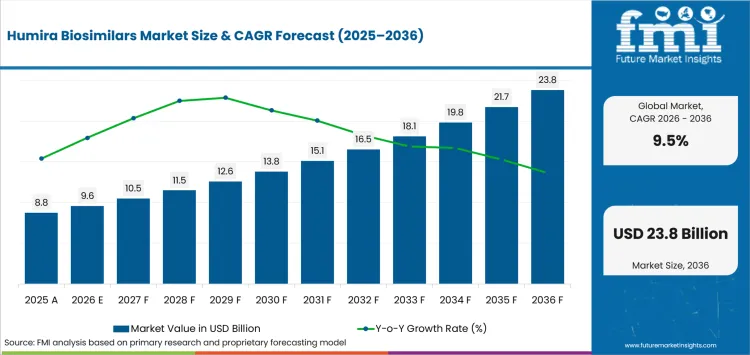
USD 9.6 billion in 2026 and USD 23.8 billion by 2036 at a 9.5% CAGR.
Humira biosimilar sales are projected to increase from USD 9.6 billion in 2026 to USD 23.8 billion by 2036 at a 9.5% CAGR as healthcare systems continue to shift patients from the reference product to lower-cost alternatives. The FDA listed ten adalimumab biosimilar products in July 2026, expanding treatment options across a mature biosimilar category. Recurring prescription volumes depend on the availability of comparable presentations and provider confidence in product substitution.
The pace of conversion varies across healthcare systems because reimbursement policies and formulary processes differ by country. NHS England's April 2025 best-value biological medicines framework targeted appropriate uptake among new patients within three months and 80% of existing patients within ten months. In contrast, USA interchangeable biosimilar adoption is influenced by state-level substitution rules, while Japanese institutions typically make product selections through local formulary processes that consider device compatibility and patient-support services.
Key Takeaways
- Organized switching programs convert approved biosimilarity into recurring prescriptions across long-term autoimmune treatment and dispensing pathways.
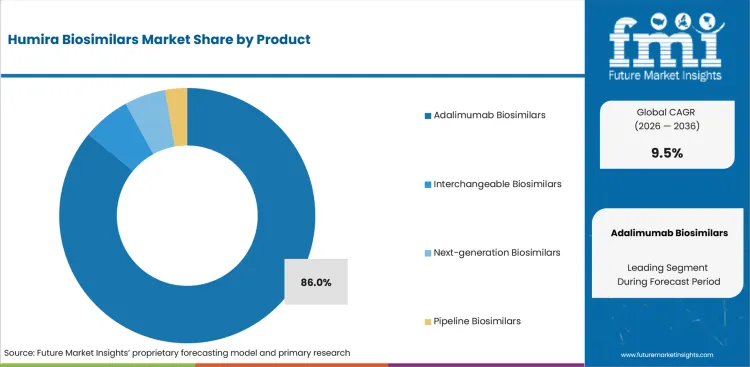
- Adalimumab biosimilars are projected to account for 86.0% by product in 2026 due to direct reference-product alignment.
- Rheumatoid arthritis is estimated to represent 31.0% of indication demand in 2026 owing to recurring specialist-managed biologic therapy.
- Hospitals are forecast to hold 42.0% share in 2026 because supervised conversion requires clinical oversight and documented follow-up.
- Fragmented substitution authority and mismatched injection formats delay eligible conversion across prescribing, dispensing and maintenance refills.
- Amgen, Samsung Bioepis, Sandoz, Celltrion, Pfizer, Alvotech, Organon and Boehringer Ingelheim comprise the profiled set.
Analyst Perspective
"Regulatory biosimilarity alone does not make adalimumab products commercially equivalent across treatment and dispensing pathways. Manufacturers earn repeat use by matching concentrations and devices while securing formularies plus dependable supply and patient conversion support."
- Anurag Sharma, Principal Consultant for Healthcare, Future Market Insights
How is the Humira Biosimilars Market segmented?
The Humira biosimilars market is segmented by product, indication, end user, distribution channel and region.
The market is segmented by product, indication, end user, distribution channel and region, covering adalimumab, interchangeable, next-generation and pipeline biosimilars. Indications span rheumatoid arthritis, inflammatory bowel disease, dermatological disorders and autoimmune conditions, while distribution categories cover hospitals, specialty clinics, home healthcare and pharmacy channels.
Why do adalimumab biosimilars lead demand within the product category?
Adalimumab biosimilars form the product base because every included medicine references Humira and must match approved treatment pathways. Developers need biologics contract manufacturing capacity that reproduces concentration, fill volume and delivery performance consistently across commercial batches.
- By product, adalimumab biosimilars are estimated to hold 86.0% in 2026 owing to their direct fit with established prescriptions and switching programs.
- FDA records list interchangeable adalimumab presentations across multiple strengths and three delivery formats used in routine treatment. Manufacturers use biosimilar testing services for comparability, then maintain presentation-specific supply so formularies preserve the prescribed dose and delivery device during switching.
Why does rheumatoid arthritis lead demand within the indication category?
Rheumatoid arthritis remains a core adalimumab pathway because specialists manage treatment initiation, response monitoring and long-term biologic use. Rheumatoid arthritis therapeutics require continuity across dose schedules, clinic reviews and self-injection support during formulary conversion within specialist care.
- In 2026, rheumatoid arthritis is expected to lead the indication category with 31.0% share because long-duration specialist treatment sustains recurring prescriptions.
- FDA-approved labels cover adult rheumatoid arthritis and juvenile idiopathic arthritis alongside gastrointestinal and dermatological conditions. Inflammatory bowel disease biologics follow separate gastroenterology pathways, so indication breadth expands use without making switching routes uniform across national treatment pathways.
Why do hospitals lead demand within the end user category?
Hospitals coordinate specialist assessment, biologic initiation and supervised switching for patients with complex autoimmune disease. Formularies connect approval with injection training, adverse-event review and treatment records before patients continue through clinics or home care.
- The end-user category is forecast to be led by hospitals at 42.0% share in 2026 due to their control of initiation and monitored conversion.
- NHS England expects every clinically appropriate new patient to start the best-value biological within three months. Hospital teams translate that target into pathway selection across autoimmune disease therapeutics, then document the product and device that community services must continue.
Why do hospital pharmacies lead demand within the distribution channel category?
Hospital pharmacies connect institutional purchasing with the brand, strength and device recorded in each treatment plan. Their inventory systems preserve cold-chain receipt, batch traceability and refill continuity across inpatient and outpatient biologic services during coordinated conversion programs.
- Hospital pharmacies are set to lead the distribution channel category with 46.0% share in 2026 due to integrated contracting and product traceability.
- FDA records place adalimumab products in prefilled syringes, autoinjectors and a single-dose vial for treatment. Hospital pharmacies match presentations to prescriptions, while specialty pharma home delivery extends maintenance therapy nationally after the initiating team confirms device suitability.
What are the drivers, restraints and opportunities in the Humira Biosimilars Market?
Regulatory standards and organized switching increase use, while substitution rules delay conversion and matched injection formats support recurring prescriptions.
- Driver: Regulatory standards and organized switching programs convert approved biosimilarity into routine prescribing and dispensing.
- Restraint: National and state substitution rules require distinct permissions, pharmacy checks and presentation matches before routine dispensing.
- Opportunity: High-concentration citrate-free formulations and familiar devices reduce patient retraining across established self-administered treatment pathways.
Regulatory confidence supports conversion
Regulators define biosimilarity and interchangeability, but health systems determine use through formularies and switching protocols. NHS targets give hospitals clear conversion timetables, while manufacturer support connects each contract with dependable implementation and supply.
Substitution rules restrict dispensing
Substitution authority differs across countries and USA states, so pharmacies must match strength plus volume and device conditions. Lower prices cannot sustain repeat use if the dispensed presentation conflicts with prescriptions or patient training.
Matched formats improve entry
High-concentration citrate-free formats align with established Humira presentations and reduce patient retraining during home administration. Complete dose ranges and familiar auto-injectors support treatment schedules, provided manufacturers maintain stock and channel-specific patient support.
Which country CAGRs are profiled in the Humira Biosimilars Market?
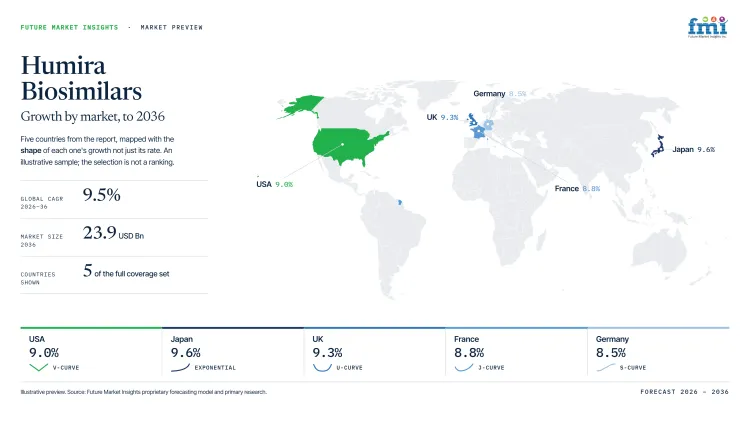
| Country | CAGR |
|---|---|
| Japan | 9.6% |
| United Kingdom | 9.3% |
| United States | 9.0% |
| France | 8.8% |
| Germany | 8.5% |
How do country-level CAGRs compare in the Humira Biosimilars Market?
The displayed 1.1 percentage-point spread measures forecast pace rather than current revenue or patient volume in profiled countries. Each rate reflects a distinct conversion, prescribing and dispensing route within its national healthcare system.
- Japan combines national biosimilar targets with hospital-led selection and device training for self-administered treatment pathways.
- The United Kingdom uses centralized commissioning with clinician-led switching and mandatory brand prescribing across biological treatment pathways.
- United States growth combines broad interchangeability with state substitution laws, formulary contracts and specialty-pharmacy access controls.
- France adds community-pharmacy substitution under prescriber authority, patient information duties and presentation-level safeguards for recurring adalimumab dispensing.
- Germany requires aligned indication, administration route, strength, pack size and container before pharmacy substitution becomes permissible.
Comparable CAGRs can produce different market entry conditions. The full report provides country-level CAGR analysis across North America, Latin America, Europe, East Asia, South Asia and Pacific, and the Middle East and Africa.
Country-wise Analysis
- Hospital-led conversion defines Japan's route because specialist institutions select adalimumab products and teach patients to use self-injection devices across urban and regional outpatient networks. Adoption of Humira biosimilars in Japan is estimated to expand at 9.6% CAGR through 2036, supported by the Ministry of Health target for biosimilars to reach at least 80% volume share across 60% of eligible molecules by fiscal 2029. The national goal gives manufacturers a measurable entry point, but repeat orders depend on stable supply and consistent devices across regional hospitals that manage smaller patient cohorts and cannot absorb frequent presentation changes or delayed replacement stock.
- Clinician-led brand prescribing gives NHS providers direct control over adalimumab switches and links national tenders with patient communication across NHS services. The United Kingdom's Humira biosimilars outlook is anticipated to advance at 9.3% CAGR over the assessment period, reinforced by NHS England's April 2025 ambition to start every appropriate new patient within three months and transition at least 80% of existing patients within ten months. Centralized contracting can spread awards quickly across trusts, although local formularies and homecare providers must preserve device familiarity and treatment continuity under mandatory brand prescribing during repeat dispensing and scheduled homecare deliveries across regional services.
- Formulary contracts give USA health plans and specialty pharmacies control over which interchangeable adalimumab products reach patients across commercial plans and Medicare or Medicaid programs serving long-term autoimmune treatment nationwide. Humira biosimilar demand in the United States is forecast to rise at 9.0% CAGR over the forecast period, supported by FDA records covering ten approved adalimumab biosimilars and multiple interchangeable presentations. Interchangeability permits pharmacy substitution under state law, yet rebate terms and annual preferred-brand changes can interrupt access unless manufacturers secure broad formulary placement and coordinate patient transitions while maintaining presentation-specific inventory across national specialty-pharmacy networks during regional benefit changes.
- Community-pharmacy substitution gives France a refill route beyond hospital-led conversion for eligible adalimumab prescriptions across regional care networks, and specialist follow-up remains mandatory across scheduled hospital reviews. France is estimated to post 8.8% CAGR over the forecast period, supported by Assurance Maladie's June 2026 guidance for adalimumab substitution under matched strength and injection-volume conditions. The broader channel can improve availability, provided pharmacists inform patients and preserve the prescribed dose while manufacturers support device training plus traceable lot records and dependable stocks across urban and regional pharmacies during successive refill cycles without product changes that could disrupt established regional treatment continuity.
- Pharmacy substitution became a new German commercial route on April 1, 2026 following years of physician-led biologic selection under sickness-fund contracts across hospitals and outpatient specialist clinics plus community pharmacies that regularly handle recurring specialty medicine refills nationwide. Humira biosimilar sales in Germany are forecast to expand at 8.5% CAGR by 2036, supported by G-BA rules requiring shared indications plus matched administration routes and presentation specifications. The framework increases pharmacy participation, but each presentation must satisfy the full equivalence test and remain available under rebate contracts before lower prices convert into repeat dispensing during contract changes and regional supply disruptions.
Who are the notable companies in the Humira Biosimilars Market?
Amgen Inc., Samsung Bioepis Co., Ltd., Sandoz Group AG, Celltrion Inc., Pfizer Inc., Alvotech, Organon & Co. and Boehringer Ingelheim International GmbH are the notable companies serving this market.
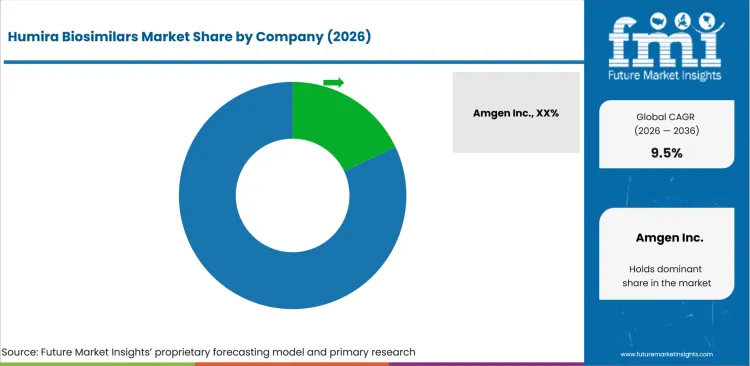
Licensed adalimumab developers and commercialization partners dominate reimbursement systems because entrants need comparability evidence plus validated manufacturing, device filings and pharmaceutical cold chain packaging before competing on access and supply.
- Amgen, Sandoz, Celltrion, Pfizer and Boehringer Ingelheim combine direct USA commercialization with multiple approved presentation filings.
- Samsung Bioepis and Organon divide development and commercialization, while Alvotech uses licensing partners for regional market access.
Competitive Benchmarking: Humira Biosimilars Market
| Company | Concentration Coverage | Strength Breadth | Delivery Formats | Geographic Reach |
|---|---|---|---|---|
| Amgen Inc. | High | High | Medium | United States |
| Samsung Bioepis Co., Ltd. | High | Medium | High | United States |
| Sandoz Group AG | High | High | Medium | United States |
| Celltrion Inc. | Medium | High | Medium | United States and South Korea |
| Pfizer Inc. | Medium | High | High | United States |
| Alvotech | Medium | High | Medium | United States |
| Organon & Co. | High | Medium | High | United States |
| Boehringer Ingelheim International GmbH | High | High | Medium | United States |
Scoring basis: High concentration coverage requires 50 and 100 mg/mL presentations, while high strength or delivery ratings require three options and medium ratings require two.
Key Developments in the Humira Biosimilars Market
- In March 2026, Celltrion gained South Korean approval for a 20 mg YUFLYMA syringe, completing its three-strength dose range.
- In July 2025, Sandoz received FDA interchangeability updates for HYRIMOZ autoinjectors across low- and high-concentration 40 mg and 80 mg formats.
- In May 2025, Samsung Bioepis and Organon received expanded FDA interchangeability for HADLIMA autoinjectors and a high-concentration prefilled syringe.
Key Players in the Humira Biosimilars Market
Integrated Development and Commercialization Platforms
- Amgen Inc.
- Sandoz Group AG
- Celltrion Inc.
- Pfizer Inc.
- Boehringer Ingelheim International GmbH
Development and Commercialization Partnerships
- Samsung Bioepis Co., Ltd.
- Organon & Co.
- Alvotech
Humira Biosimilars Market - Report Scope
| Coverage field | Report scope |
|---|---|
| Market breakdown | By product, indication, end user, distribution channel and region. |
| Quantitative Units | USD billion. |
| Market Definition | Approved adalimumab biosimilars referencing Humira across autoimmune indications and commercial channels. Originator Humira, other biologics and unapproved candidates are excluded. |
| Regions Covered | North America, Latin America, Europe, East Asia, South Asia and Pacific, and Middle East and Africa. |
| Countries Covered | Japan, United Kingdom, United States, France, Germany and 20+ additional countries. |
| Key Companies Profiled | Amgen Inc., Samsung Bioepis Co., Ltd., Sandoz Group AG, Celltrion Inc., Pfizer Inc., Alvotech, Organon & Co., Boehringer Ingelheim International GmbH. |
| Forecast Period | 2026 to 2036. |
| Approach | Primary and secondary research with market triangulation. |
Humira Biosimilars Market - Research Methodology
| Method | Approach |
|---|---|
| Primary Research | FMI analysts gathered input from manufacturers, service providers, technology developers, distributors, end users, procurement teams, and subject-matter experts. Interviews examined purchasing decisions, product or service evaluation, adoption barriers, approval requirements, pricing considerations, and expectations for technical or commercial support. Respondents were also asked what evidence is required before a trial, pilot, or initial order develops into regular purchasing. |
| Desk Research | Desk research covered government statistics, regulatory publications, trade data, industry associations, technical literature, standards, company filings, product information, and official corporate announcements. Sources were reviewed for relevance, publication date, geographic coverage, and consistency with the defined market scope. Claims relating to performance, applications, approvals, capacity, investment, and commercial activity were retained only when supported by credible public evidence. |
| Market Sizing and Forecasting | The market model combined the baseline value with historical performance, segment structure, pricing and volume indicators, adoption levels, company participation, and country-level demand conditions. Forecast assumptions considered economic activity, investment trends, regulatory developments, technology adoption, purchasing cycles, supply availability, and barriers to wider market use. Segment and regional estimates were reconciled before the final market total was calculated. |
| Data Validation | Estimates were checked against multiple independent indicators, including public data, company activity, trade patterns, industry developments, and findings from primary interviews. Validation also tested whether products, services, applications, and company revenues fell within the defined market boundaries. Adjacent categories, unsupported claims, overlapping revenues, and activities without direct market relevance were excluded to reduce double counting and maintain consistency across segments and countries. |
Humira Biosimilars Market by Segments
Humira Biosimilars Market segmented by Product:
- Adalimumab Biosimilars
- High-concentration Formulations
- Low-concentration Formulations
- Citrate-free Formulations
- Interchangeable Biosimilars
- Automatic Substitution Products
- Interchangeable Adalimumab Products
- Region-specific Interchangeable Products
- Next-generation Biosimilars
- High-volume Auto-injectors
- Prefilled Syringes
- Patient-friendly Delivery Systems
- Pipeline Biosimilars
- Late-stage Development Candidates
- Regional Biosimilar Candidates
- Biobetter Adalimumab Products
Humira Biosimilars Market segmented by Indication:
- Rheumatoid Arthritis
- Moderate to Severe Rheumatoid Arthritis
- Juvenile Idiopathic Arthritis
- Early Rheumatoid Arthritis
- Inflammatory Bowel Disease
- Crohn's Disease
- Ulcerative Colitis
- Pediatric Inflammatory Bowel Disease
- Dermatological Disorders
- Plaque Psoriasis
- Hidradenitis Suppurativa
- Psoriatic Arthritis
- Other Autoimmune Disorders
- Ankylosing Spondylitis
- Uveitis
- Non-infectious Inflammatory Diseases
Humira Biosimilars Market segmented by End User:
- Hospitals
- Tertiary Care Hospitals
- Multispecialty Hospitals
- Academic Medical Centers
- Specialty Clinics
- Rheumatology Clinics
- Gastroenterology Clinics
- Dermatology Clinics
- Home Healthcare
- Self-administration
- Home Nursing Services
- Patient Support Programs
Humira Biosimilars Market segmented by Distribution Channel:
- Hospital Pharmacies
- Inpatient Pharmacies
- Outpatient Hospital Pharmacies
- Biologics Distribution
- Retail Pharmacies
- Chain Pharmacies
- Independent Pharmacies
- Specialty Retail Pharmacies
- Specialty Pharmacies
- Biologic Therapy Providers
- Cold Chain Distribution
- Home Delivery Services
Humira Biosimilars Market by Region:
- North America
- United States
- Canada
- Latin America
- Brazil
- Mexico
- Chile
- Rest of Latin America
- Western Europe
- Germany
- United Kingdom
- Italy
- Spain
- France
- Nordics
- Benelux
- Rest of Western Europe
- Eastern Europe
- Russia
- Poland
- Hungary
- Balkan and Baltic States
- Rest of Eastern Europe
- East Asia
- China
- Japan
- South Korea
- South Asia and Pacific
- India
- ASEAN
- Australia and New Zealand
- Rest of South Asia and Pacific
- Middle East and Africa
- Kingdom of Saudi Arabia
- Other GCC Countries
- Türkiye
- South Africa
- Other African Union Countries
- Rest of Middle East and Africa
Research Sources and Bibliography
- USA Food and Drug Administration. (2026, July). Biosimilar Product Information.
- NHS England. (2025, April 9). Commissioning framework for best value biological medicines.
- USA Food and Drug Administration. (2026, July). Purple Book Search.
- Ministry of Health, Labour and Welfare. (2024, September 30). 「安定供給の確保を基本として、後発医薬品を適切に使用していくためのロードマップ」及び「バイオ後続品の使用促進のための取組方針」の策定について.
- Assurance Maladie. (2026, June 26). Règles de dispensation et substitution des médicaments biologiques (de référence ou biosimilaires).
- Gemeinsamer Bundesausschuss. (2026, March 2). Austauschbarkeit von Biologika in Apotheken: Regelungen des G-BA treten am 1. April 2026 in Kraft.
- Celltrion. (2026, March 5). 셀트리온, ‘유플라이마’ 20mg 용량제형 국내 허가 획득... 제형 다변화로 환자 맞춤형 치료 옵션 확대.
- Organon & Co. (2025, May 27). US Food and Drug Administration (FDA) Grants Interchangeability Designation to Samsung Bioepis and Organon HADLIMA™ (adalimumab-bwwd) Injection.
This bibliography is provided for reader reference and is not exhaustive. The full report contains the complete reference list and detailed citations.
This Report Answers
- How large is the global Humira Biosimilars market, and what is its growth outlook through 2036?
- What factors help translate regulatory approvals into increased biosimilar adoption and utilization?
- Why do adalimumab biosimilars hold the largest share of the biosimilars market?
- How do treatment settings, including hospitals, specialty clinics, and outpatient care centers, differ in their use of Humira biosimilars?
- Why do hospital pharmacies account for the leading share of Humira biosimilar distribution?
- How do market adoption pathways, reimbursement frameworks, and growth trends differ across key countries?
- Which companies offer Humira biosimilars across multiple formulations, strengths, and delivery presentations?
- Which regulatory, reimbursement, and substitution policies can delay pharmacy-level biosimilar substitution and broader market uptake?
Frequently Asked Questions
How big is the Humira Biosimilars Market in 2026?
The Humira biosimilars market is estimated at USD 9.6 billion in 2026 across approved treatment channels. It is forecast to reach USD 23.8 billion by 2036 as matched presentations gain formulary access.
What is the CAGR of the Humira Biosimilars Market from 2026 to 2036?
The Humira biosimilars market is projected to grow at 9.5% CAGR from 2026 to 2036. Growth depends on organized switching, defined substitution routes and presentation-specific supply across long-term autoimmune treatment.
Which product category leads the Humira Biosimilars Market?
Adalimumab biosimilars are estimated to hold 86.0% of the product category in 2026 within this market. Direct reference to Humira and compatible presentations support their position across established prescriptions and treatment pathways.
How much will the Humira Biosimilars Market add between 2026 and 2036?
The Humira biosimilars market is forecast to add USD 14.2 billion between 2026 and 2036. Manufacturers capture that opportunity through formulary contracts, matched formats and dependable refills that protect treatment continuity.
Which companies are active in the Humira Biosimilars Market?
The Humira biosimilars market include key companies with verified adalimumab activity across major commercial regions. Amgen, Samsung Bioepis, Sandoz, Celltrion, Pfizer, Alvotech, Organon and Boehringer Ingelheim use integrated or partnership access models.
Preview the report firsthand - request a free sample
Get SampleGet the brochure for pricing and purchase details.
Get PDFTable of Content
- Key Takeaways
- Market Size and CAGR
- Top Growth Driver
- Fastest Growing Segment
- Leading Region
- Key Companies
- Emerging Opportunities
- Executive Summary
- Global Market Outlook
- Demand-side Trends
- Supply-side Trends
- Technology Roadmap Analysis
- Analysis and Recommendations
- Analyst Perspective (What is happening? Why now? What should investors know?)
- Key Questions Answered
- How large is the market?
- What is the CAGR?
- What are key trends?
- Which region dominates?
- Who are the leaders?
- Market Overview
- Market Coverage / Taxonomy
- Market Definition / Scope / Limitations
- Research Methodology
- Chapter Orientation
- Analytical Lens and Working Hypotheses
- Market Structure, Signals, and Trend Drivers
- Benchmarking and Cross-market Comparability
- Market Sizing, Forecasting, and Opportunity Mapping
- Research Design and Evidence Framework
- Desk Research Programme (Secondary Evidence)
- Expert Input and Fieldwork (Primary Evidence)
- Tooling, Models, and Reference Databases
- Data Engineering and Model Build
- Quality Assurance and Audit Trail
- Market Background
- Market Dynamics (Drivers, Restraints, Opportunity, Trends)
- Scenario Forecast (Optimistic, Likely, Conservative)
- Impact Analysis
- AI Impact
- Sustainability Impact
- Regulatory Impact
- Technology Impact
- Consumer / Buyer Analysis
- Purchase Drivers
- Adoption Barriers
- Buyer Journey
- Opportunity Map Analysis
- Product Life Cycle Analysis
- Supply Chain Analysis
- Investment Feasibility Matrix
- Value Chain Analysis
- PESTLE and Porter's Analysis
- Regulatory Landscape
- Regional Parent Market Outlook
- Production and Consumption Statistics
- Import and Export Statistics
- Global Market Analysis and Forecast, 2021 to 2036
- Historical Market Size Value (USD Billion) Analysis, 2021 to 2025
- Current and Future Market Size Value (USD Billion) Projections, 2026 to 2036
- Y-o-Y Growth Trend Analysis
- Absolute $ Opportunity Analysis
- Global Market Pricing Analysis, 2021 to 2036
- Global Market Analysis and Forecast, By Product, 2021 to 2036
- Introduction / Key Findings
- Historical Market Size Value (USD Billion) Analysis By Product, 2021 to 2025
- Current and Future Market Size Value (USD Billion) Analysis and Forecast By Product, 2026 to 2036
- Adalimumab Biosimilars
- High-concentration Formulations
- Low-concentration Formulations
- Citrate-free Formulations
- Interchangeable Biosimilars
- Automatic Substitution Products
- Interchangeable Adalimumab Products
- Region-specific Interchangeable Products
- Next-generation Biosimilars
- High-volume Auto-injectors
- Prefilled Syringes
- Patient-friendly Delivery Systems
- Pipeline Biosimilars
- Late-stage Development Candidates
- Regional Biosimilar Candidates
- Biobetter Adalimumab Products
- Adalimumab Biosimilars
- Y-o-Y Growth Trend Analysis By Product, 2021 to 2025
- Absolute $ Opportunity Analysis By Product, 2026 to 2036
- Global Market Analysis and Forecast, By Indication, 2021 to 2036
- Introduction / Key Findings
- Historical Market Size Value (USD Billion) Analysis By Indication, 2021 to 2025
- Current and Future Market Size Value (USD Billion) Analysis and Forecast By Indication, 2026 to 2036
- Rheumatoid Arthritis
- Moderate to Severe Rheumatoid Arthritis
- Juvenile Idiopathic Arthritis
- Early Rheumatoid Arthritis
- Inflammatory Bowel Disease
- Crohn's Disease
- Ulcerative Colitis
- Pediatric Inflammatory Bowel Disease
- Dermatological Disorders
- Plaque Psoriasis
- Hidradenitis Suppurativa
- Psoriatic Arthritis
- Other Autoimmune Disorders
- Ankylosing Spondylitis
- Uveitis
- Non-infectious Inflammatory Diseases
- Rheumatoid Arthritis
- Y-o-Y Growth Trend Analysis By Indication, 2021 to 2025
- Absolute $ Opportunity Analysis By Indication, 2026 to 2036
- Global Market Analysis and Forecast, By End User, 2021 to 2036
- Introduction / Key Findings
- Historical Market Size Value (USD Billion) Analysis By End User, 2021 to 2025
- Current and Future Market Size Value (USD Billion) Analysis and Forecast By End User, 2026 to 2036
- Hospitals
- Tertiary Care Hospitals
- Multispecialty Hospitals
- Academic Medical Centers
- Specialty Clinics
- Rheumatology Clinics
- Gastroenterology Clinics
- Dermatology Clinics
- Home Healthcare
- Self-administration
- Home Nursing Services
- Patient Support Programs
- Hospitals
- Y-o-Y Growth Trend Analysis By End User, 2021 to 2025
- Absolute $ Opportunity Analysis By End User, 2026 to 2036
- Global Market Analysis and Forecast, By Distribution Channel, 2021 to 2036
- Introduction / Key Findings
- Historical Market Size Value (USD Billion) Analysis By Distribution Channel, 2021 to 2025
- Current and Future Market Size Value (USD Billion) Analysis and Forecast By Distribution Channel, 2026 to 2036
- Hospital Pharmacies
- Inpatient Pharmacies
- Outpatient Hospital Pharmacies
- Biologics Distribution
- Retail Pharmacies
- Chain Pharmacies
- Independent Pharmacies
- Specialty Retail Pharmacies
- Specialty Pharmacies
- Biologic Therapy Providers
- Cold Chain Distribution
- Home Delivery Services
- Hospital Pharmacies
- Y-o-Y Growth Trend Analysis By Distribution Channel, 2021 to 2025
- Absolute $ Opportunity Analysis By Distribution Channel, 2026 to 2036
- Global Market Analysis and Forecast, By Region, 2021 to 2036
- Introduction
- Historical Market Size Value (USD Billion) Analysis By Region, 2021 to 2025
- Current Market Size Value (USD Billion) Analysis and Forecast By Region, 2026 to 2036
- North America
- Latin America
- Western Europe
- Eastern Europe
- East Asia
- South Asia and Pacific
- Middle East & Africa
- Market Attractiveness Analysis By Region
- North America Market Analysis and Forecast, By Country, 2021 to 2036
- Historical Market Size Value (USD Billion) Trend Analysis By Market Taxonomy, 2021 to 2025
- Market Size Value (USD Billion) Forecast By Market Taxonomy, 2026 to 2036
- By Country
- USA
- Canada
- By Product
- By Indication
- By End User
- By Distribution Channel
- By Country
- Market Attractiveness Analysis
- By Country
- By Product
- By Indication
- By End User
- By Distribution Channel
- Key Takeaways
- Latin America Market Analysis and Forecast, By Country
- Historical Market Size Value (USD Billion) Trend Analysis By Market Taxonomy, 2021 to 2025
- Market Size Value (USD Billion) Forecast By Market Taxonomy, 2026 to 2036
- By Country
- Brazil
- Mexico
- Chile
- Rest of Latin America
- By Product
- By Indication
- By End User
- By Distribution Channel
- By Country
- Market Attractiveness Analysis
- By Country
- By Product
- By Indication
- By End User
- By Distribution Channel
- Key Takeaways
- Western Europe Market Analysis and Forecast, By Country
- Historical Market Size Value (USD Billion) Trend Analysis By Market Taxonomy, 2021 to 2025
- Market Size Value (USD Billion) Forecast By Market Taxonomy, 2026 to 2036
- By Country
- Germany
- UK
- Italy
- Spain
- France
- Nordic
- BENELUX
- Rest of Western Europe
- By Product
- By Indication
- By End User
- By Distribution Channel
- By Country
- Market Attractiveness Analysis
- By Country
- By Product
- By Indication
- By End User
- By Distribution Channel
- Key Takeaways
- Eastern Europe Market Analysis and Forecast, By Country
- Historical Market Size Value (USD Billion) Trend Analysis By Market Taxonomy, 2021 to 2025
- Market Size Value (USD Billion) Forecast By Market Taxonomy, 2026 to 2036
- By Country
- Russia
- Poland
- Hungary
- Balkan & Baltic
- Rest of Eastern Europe
- By Product
- By Indication
- By End User
- By Distribution Channel
- By Country
- Market Attractiveness Analysis
- By Country
- By Product
- By Indication
- By End User
- By Distribution Channel
- Key Takeaways
- East Asia Market Analysis and Forecast, By Country
- Historical Market Size Value (USD Billion) Trend Analysis By Market Taxonomy, 2021 to 2025
- Market Size Value (USD Billion) Forecast By Market Taxonomy, 2026 to 2036
- By Country
- China
- Japan
- South Korea
- By Product
- By Indication
- By End User
- By Distribution Channel
- By Country
- Market Attractiveness Analysis
- By Country
- By Product
- By Indication
- By End User
- By Distribution Channel
- Key Takeaways
- South Asia and Pacific Market Analysis and Forecast, By Country
- Historical Market Size Value (USD Billion) Trend Analysis By Market Taxonomy, 2021 to 2025
- Market Size Value (USD Billion) Forecast By Market Taxonomy, 2026 to 2036
- By Country
- India
- ASEAN
- Australia & New Zealand
- Rest of South Asia and Pacific
- By Product
- By Indication
- By End User
- By Distribution Channel
- By Country
- Market Attractiveness Analysis
- By Country
- By Product
- By Indication
- By End User
- By Distribution Channel
- Key Takeaways
- Middle East & Africa Market Analysis and Forecast, By Country
- Historical Market Size Value (USD Billion) Trend Analysis By Market Taxonomy, 2021 to 2025
- Market Size Value (USD Billion) Forecast By Market Taxonomy, 2026 to 2036
- By Country
- Kingdom of Saudi Arabia
- Other GCC Countries
- Türkiye
- South Africa
- Other African Union
- Rest of Middle East & Africa
- By Product
- By Indication
- By End User
- By Distribution Channel
- By Country
- Market Attractiveness Analysis
- By Country
- By Product
- By Indication
- By End User
- By Distribution Channel
- Key Takeaways
- Key Countries Market Analysis
- USA
- Pricing Analysis
- Market Share Analysis, 2025
- By Product
- By Indication
- By End User
- By Distribution Channel
- Canada
- Pricing Analysis
- Market Share Analysis, 2025
- By Product
- By Indication
- By End User
- By Distribution Channel
- Mexico
- Pricing Analysis
- Market Share Analysis, 2025
- By Product
- By Indication
- By End User
- By Distribution Channel
- Brazil
- Pricing Analysis
- Market Share Analysis, 2025
- By Product
- By Indication
- By End User
- By Distribution Channel
- Chile
- Pricing Analysis
- Market Share Analysis, 2025
- By Product
- By Indication
- By End User
- By Distribution Channel
- Germany
- Pricing Analysis
- Market Share Analysis, 2025
- By Product
- By Indication
- By End User
- By Distribution Channel
- UK
- Pricing Analysis
- Market Share Analysis, 2025
- By Product
- By Indication
- By End User
- By Distribution Channel
- Italy
- Pricing Analysis
- Market Share Analysis, 2025
- By Product
- By Indication
- By End User
- By Distribution Channel
- Spain
- Pricing Analysis
- Market Share Analysis, 2025
- By Product
- By Indication
- By End User
- By Distribution Channel
- France
- Pricing Analysis
- Market Share Analysis, 2025
- By Product
- By Indication
- By End User
- By Distribution Channel
- India
- Pricing Analysis
- Market Share Analysis, 2025
- By Product
- By Indication
- By End User
- By Distribution Channel
- ASEAN
- Pricing Analysis
- Market Share Analysis, 2025
- By Product
- By Indication
- By End User
- By Distribution Channel
- Australia & New Zealand
- Pricing Analysis
- Market Share Analysis, 2025
- By Product
- By Indication
- By End User
- By Distribution Channel
- China
- Pricing Analysis
- Market Share Analysis, 2025
- By Product
- By Indication
- By End User
- By Distribution Channel
- Japan
- Pricing Analysis
- Market Share Analysis, 2025
- By Product
- By Indication
- By End User
- By Distribution Channel
- South Korea
- Pricing Analysis
- Market Share Analysis, 2025
- By Product
- By Indication
- By End User
- By Distribution Channel
- Russia
- Pricing Analysis
- Market Share Analysis, 2025
- By Product
- By Indication
- By End User
- By Distribution Channel
- Poland
- Pricing Analysis
- Market Share Analysis, 2025
- By Product
- By Indication
- By End User
- By Distribution Channel
- Hungary
- Pricing Analysis
- Market Share Analysis, 2025
- By Product
- By Indication
- By End User
- By Distribution Channel
- Kingdom of Saudi Arabia
- Pricing Analysis
- Market Share Analysis, 2025
- By Product
- By Indication
- By End User
- By Distribution Channel
- Türkiye
- Pricing Analysis
- Market Share Analysis, 2025
- By Product
- By Indication
- By End User
- By Distribution Channel
- South Africa
- Pricing Analysis
- Market Share Analysis, 2025
- By Product
- By Indication
- By End User
- By Distribution Channel
- USA
- Market Structure Analysis
- Competition Dashboard
- Competition Benchmarking
- Market Share Analysis of Top Players
- By Regional
- By Product
- By Indication
- By End User
- By Distribution Channel
- Emerging Startups
- Innovation Benchmarking
- Competition Analysis
- Competition Deep Dive
- Amgen Inc.
- Overview
- Product Portfolio
- Profitability by Market Segments
- Sales Footprint
- Strategy Overview
- Marketing Strategy
- Product Strategy
- Channel Strategy
- Samsung Bioepis Co., Ltd.
- Sandoz Group AG
- Biocon Biologics Ltd.
- Celltrion Inc.
- Fresenius Kabi AG
- Pfizer Inc.
- Alvotech
- Organon & Co.
- Boehringer Ingelheim International GmbH
- Amgen Inc.
- Case Studies
- Success Stories
- Recent Developments
- Competition Deep Dive
- Assumptions & Acronyms Used


