

- Market Size (2026)
- USD 355.0 Mn
- Forecast (2036)
- USD 1083.0 Mn
- CAGR (2026 to 2036)
- 11.8%
How big is the hyperspectral inspection for food processing lines market in 2026?
USD 355.0 million in 2026 and USD 1,083.0 million by 2036 at an 11.8% CAGR.
The hyperspectral inspection for food processing lines industry value is forecast to grow from USD 317.5 million in 2025 to USD 1,083.0 million by 2036 at 11.8% CAGR. Cameras are forecast to account for 38.0% share in 2026 because spectral capture quality shapes contaminant detection accuracy. Defect Detection is expected to hold 41.0% share in 2026 as processors prioritize checks that standard RGB vision and metal detection cannot complete.
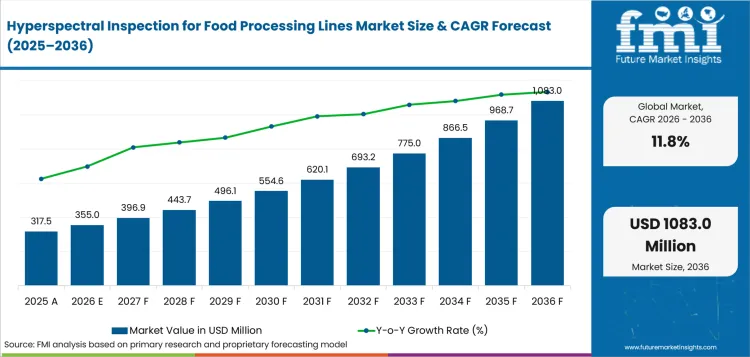
Hyperspectral Inspection for Food Processing Lines Market Overview: Size and Forecast
- 2025 Market Size: USD 317.5 million
- 2026 Market Size: USD 355.0 million
- 2036 Market Size: USD 1,083.0 million
- Forecast CAGR: 11.8% from 2026 to 2036
- Leading Component: Cameras
- Cameras Share in 2026: 38.0%
- Leading Inspection Type: Defect Detection
- Defect Detection Share in 2026: 41.0%
- Fastest-growing Country: India
- India CAGR: 13.5% by 2036
Summary of the Hyperspectral Inspection for Food Processing Lines Market
- Demand and Growth Drivers
- Food processors are moving spectral inspection into live production where sampling delay creates yield loss and delayed corrective action.
- Retailer quality audits are expected to support adoption because spectral records can create repeatable evidence for reject decisions.
- Labor limits are expected to strengthen automated sorting demand where manual inspection cannot hold accuracy across long shifts.
- Product and Segment View
- Cameras are projected to represent 38.0% share in 2026 as wavelength range, frame rate, and spatial resolution decide detection depth.
- Defect Detection is projected to represent 41.0% share in 2026 because contamination and spoilage checks carry direct cost risk.
- Inline deployment is forecast to hold 57.0% share in 2026 as buyers align inspection with sorting equipment and packing lines.
- Geography and Competitive Outlook
- East Asia is forecast to hold 31.0% regional share in 2026 due to food plant scale and automation supplier depth.
- India is projected to record the fastest country CAGR at 13.5% through 2036 due to packaged-food expansion and exporter quality needs.
- Specim, Headwall, EVK, TOMRA, Resonon, HySpex, and Cubert compete through spectral hardware, application software, and line integration.
- Analyst Opinion
- Nikhil Kaitwade, Principal Consultant at Future Market Insights for the industrial domain, observes, “Food processors are not buying hyperspectral cameras for curiosity. They are buying them to catch invisible defects, protect yield, and reduce slow lab sampling. Suppliers with strong line integration, stable lighting, and usable spectral software are best placed to convert trials into plant programs.”
Growth is supported by a shift from sample testing to continuous release control. Patel et al. reported in May 2024 that hyperspectral imaging is used for non-destructive food quality and safety assessment across fruits, vegetables, dairy, meat, seafood, grains, and legumes. Specim's GX17 product information states that the camera can detect 1 mm square flakes on high-speed conveyor and free-fall systems. These claims connect the market with food sorting machines and industrial machine vision demand.
Which factors support expansion in the hyperspectral inspection for food processing lines market?
Finished camera systems, spectral software, and calibration services support market value across line-side inspection workflows.
- Market value is supported by camera, lens, lighting, frame grabber, software, and integration revenue before service contracts add recurring sales.
- Supplier pricing reflects spectral band range and line-speed requirements before reject mechanisms and operator screens affect installed cost.
- Revenue improves as buyers convert one high-loss product stream into adjacent line installations after model proof.
- Service revenue is expected to expand as processors link spectral inspection with machine condition monitoring and uptime programs.
Why is the hyperspectral inspection for food processing lines market growing?
Food processors use hyperspectral inspection to identify chemical and physical differences that color cameras often miss.
The technology demand is expected to be strongest where products look acceptable on the surface but differ in moisture, fat, ripeness, spoilage, or foreign-material response. This places the market close to machine vision systems and services used for quality control. Inline release control is the practical buying reason. Specim's GX17 product information states that the camera operates across 950 nm to 1700 nm and supports inspection on conveyor belts and free-fall systems. In June 2024, EVK and Clearview signed a distribution agreement covering EVK hyperspectral imaging solutions in selected European countries.
How is the hyperspectral inspection for food processing lines market segmented?
The industry is segmented by component, inspection type, deployment, end-use industry, and region.
- Cameras are projected to secure 38.0% share in 2026 as spectral resolution and frame rate shape detection accuracy.
- Defect Detection is expected to hold 41.0% share in 2026 due to contaminant, spoilage, and foreign-material checks.
- Inline systems are forecast to represent 57.0% share in 2026 as processors need pass-fail decisions before packing.
- Food & Beverage is projected to generate 52.0% share in 2026 because the report scope centers on food processing lines.
- East Asia is expected to hold 31.0% share in 2026 due to China and Japan plant scale.
Why do cameras lead the component segment?
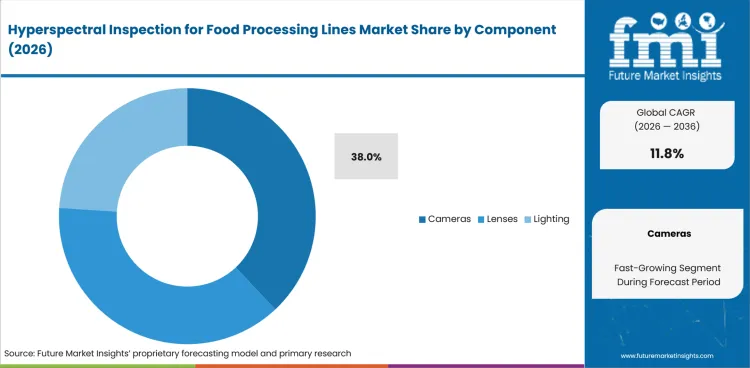
- Cameras lead because wavelength range, frame speed, and spatial resolution decide whether the system can separate target defects on a moving line.
- The segment links closely with the machine vision camera market because inspection accuracy depends on camera selection.
Which inspection type leads the market?
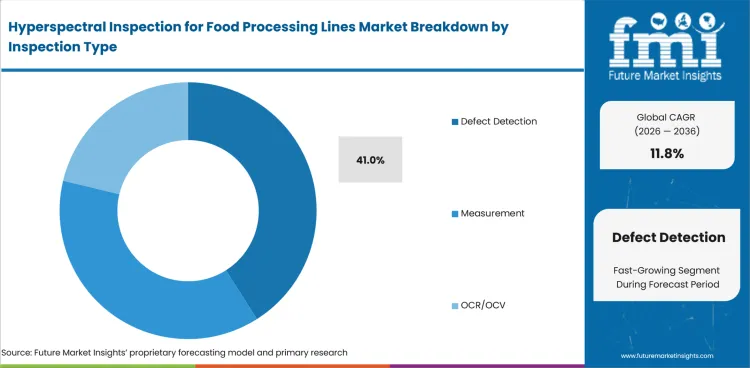
- Defect Detection leads because it converts spectral contrast into reject decisions for contaminants, spoilage, discoloration, and product-quality faults.
- Processors prioritize defect detection where false accepts can affect product release and retailer confidence.
Which deployment type leads the market?
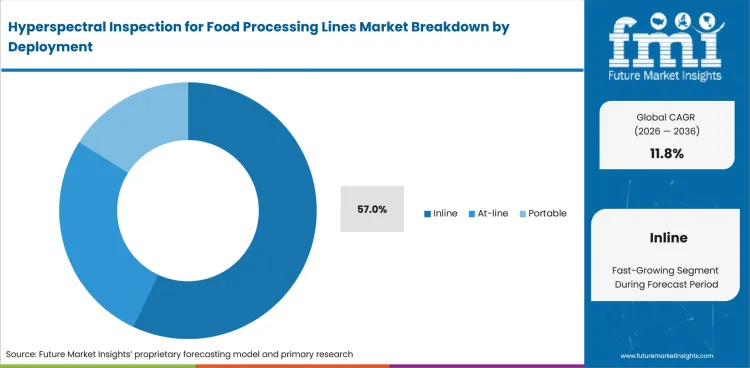
- Inline deployment leads because processors want inspection before packing and release.
- Inline systems align with sorting and grading machines used in food plants because they support continuous inspection records.
Which end-use industry leads the market?
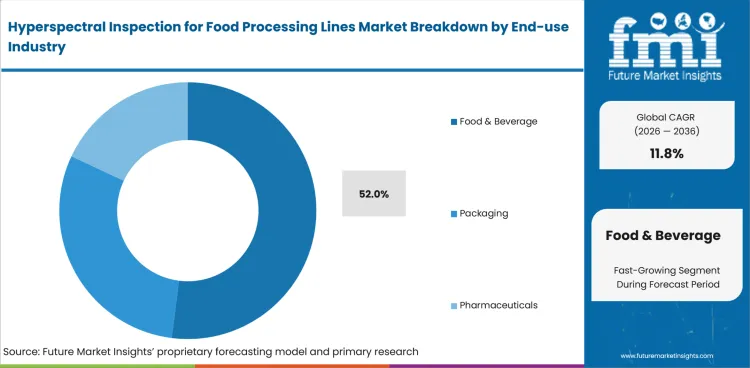
- Food & Beverage leads because meat, produce, bakery, dairy, grains, nuts, and frozen foods create direct uses for spectral inspection.
- Large processors use hyperspectral inspection where product chemistry, moisture, and foreign-material risk need stronger control.
What are the driver, restraints, and opportunities in the hyperspectral inspection for food processing lines market?
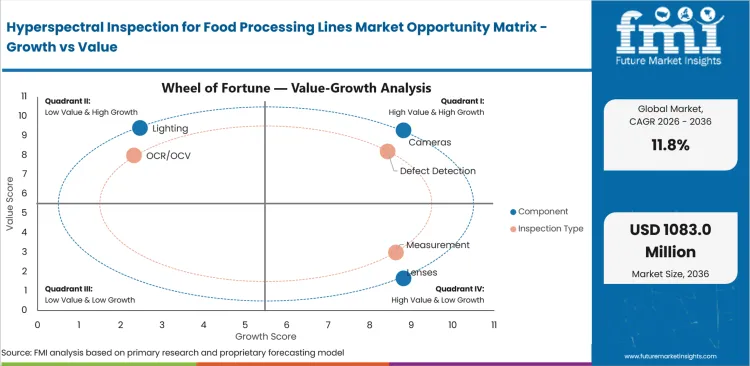
Chemical contrast detection and inline release control support demand while calibration cost and model maintenance slow smaller buyers.
- Driver: Spectral contaminant detection expands where color, weight, and metal detection cannot isolate the defect.
- Driver: Inline quality release grows as processors replace slow sampling with continuous inspection records.
- Driver: Software-led recipe models create repeat purchases after the first line proves yield benefit.
- Restraint: Calibration effort slows adoption when product moisture and raw input quality shift often.
- Opportunity: Retrofit modules can open demand among plants that are not ready for full replacement of robotic packaging machines.
Line-side Hyperspectral Inspection Demand Outlook
Demand is moving from laboratory validation toward line-side inspection that can trigger production decisions in real time. Resonon stated in January 2024 that hyperspectral machine vision can classify products on a per-pixel or per-object basis. It also said results can be translated for factory systems such as picking robots or air-jet sorters. This matters because food processors need inspection systems that separate defects or foreign material during active production and not only during offline testing.
Buyer Decision Drivers for Food Line Inspection
Processor decisions are shaped by false reject cost and food safety documentation before a project moves beyond pilot testing. The FDA’s January 2025 preventive controls page states that covered food facilities must implement a written food safety plan with hazard analysis and risk-based preventive controls. This supports demand for inspection platforms that produce usable records and not only camera images. Buyers are more likely to approve hyperspectral inspection when suppliers can prove line-speed performance on the processor’s own raw material.
Which countries are growing fastest in the hyperspectral inspection for food processing lines market?
India 13.5% CAGR, China 13.2% CAGR, South Korea 12.1% CAGR, Germany 11.6% CAGR, United Kingdom 10.9% CAGR, France 10.8% CAGR, United States 10.7% CAGR, and Japan 10.5% CAGR through 2036.
.webp "Top Country Growth Comparison Hyperspectral Inspection For Food Processing Lines Market Cagr (2026 2036)")
| Country | CAGR |
|---|---|
| India | 13.5% |
| China | 13.2% |
| South Korea | 12.1% |
| Germany | 11.6% |
| United Kingdom | 10.9% |
| France | 10.8% |
| United States | 10.7% |
| Japan | 10.5% |
Source: Future Market Insights, 2026.
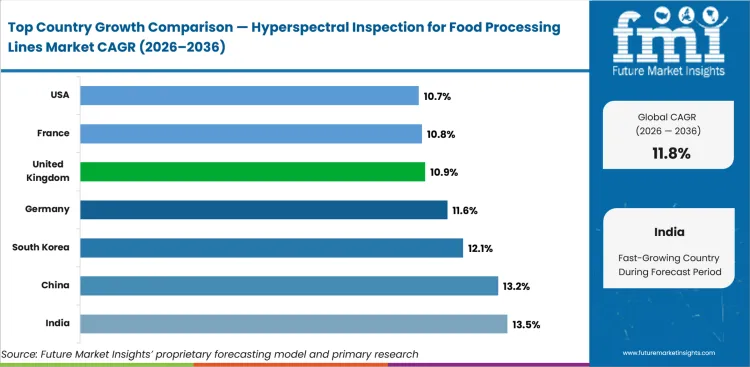
How do country-level CAGRs compare in the hyperspectral inspection for food processing lines market?
India leads country growth while Japan records the most cautious expansion among profiled markets.
- India’s growth is supported by rapid expansion in food processing capacity, increasing automation adoption on production lines, and rising demand for inline inspection to reduce contamination risks.
- China’s market trajectory is shaped by its large-scale food manufacturing base, strong investments in smart processing facilities, and widespread implementation of automated inspection technologies.
- South Korea’s expansion is driven by technologically advanced food production operations that prioritize high inspection accuracy, traceability, and process consistency.
- Germany’s growth is underpinned by strict food safety regulations, advanced processing infrastructure, and steady integration of precision inspection systems in industrial food plants.
- The United Kingdom benefits from modernization of food processing lines, growing use of automation to ensure compliance, and increased focus on reducing manual inspection dependency.
- France’s adoption is supported by quality-focused food manufacturing practices, regulatory emphasis on contamination control, and gradual deployment of advanced optical inspection tools.
- The United States sees growth driven by large-scale commercial food processing operations, rising labor cost pressures, and increasing reliance on automated inspection for operational efficiency.
- Japan’s more cautious expansion reflects a mature food processing sector, selective automation investments, and a preference for incremental upgrades rather than rapid system-wide adoption.
How fast is the hyperspectral inspection market growing in India?
A 13.5% CAGR through 2036 reflects Maharashtra, Gujarat, and southern processing clusters and food-processing inspection needs.
Country Market Snapshot Table
| Parameter | Value |
|---|---|
| Market Size in 2025 (Value) | USD 17.4 million |
| Market Size in 2026 (Value) | USD 19.8 million |
| Market Forecast in 2036 (Value) | USD 70.5 million |
| CAGR (2026 to 2036) | 13.5% |
| Years Considered | 2021 to 2036 |
| Base Year | 2025 |
| Forecast Period | 2026 to 2036 |
| Units Considered | Value (USD million) |
| Leading Sub-Region | Maharashtra, Gujarat, and southern processing clusters |
India Hyperspectral Inspection for Food Processing Lines Market Outlook
India demand is driven by food processing formalization, packaged-food expansion, and new cold-chain capacity.
Hyperspectral inspection is expected to gain fastest where exporters and larger domestic brands need stronger defect control.
Key Growth Drivers
- India's food processing base is expanding. PIB reported sector GVA of Rs. 2.24 lakh crore in 2023-24.
- Packaged food demand is scaling quickly. USDA FAS reported India's packaged-food demand reached USD 116 billion in 2025.
- Export-oriented spice, grain, nut, and frozen-food processors are expected to use spectral sorting to reduce contaminant risk.
- Cold-chain and processing schemes can create new installation points for inline inspection in organized food plants.
Key Restraints
- Funding dependence can slow adoption. MoFPI lists a Rs. 10,900 crore PLISFPI outlay for food processing support.
- Small processors may delay hyperspectral systems when manual sorting and lower-cost optical sorters meet current buyer needs.
- Dust, heat, and inconsistent incoming raw material quality can raise lighting maintenance and model recalibration needs.
What makes India unique
India is unique due to fast packaged-food demand and a large base of exporters that need stronger quality screening.
Key Companies
- Hikrobot India
- TOMRA India
- Bühler India
- Marel India
- Cognex India
- Key Technology India
- SensoVision Systems
Sales & Marketing Channels
- Food park integrators
- Cold-chain project contractors
- Exporter quality labs
- Optical sorter distributors
- OEM packaging partners
- Direct supplier demonstrations
Country Segment Breakdown Table
| Segment | Sub-Segments |
|---|---|
| By Component | Cameras · Lenses · Lighting · Frame Grabbers · Vision Software · Services |
| By Inspection Type | Defect Detection · Measurement · OCR/OCV · Presence/Absence · Guidance |
| By Deployment | Inline · At-line · Robotic Cell · Portable |
| By End-use Industry | Food & Beverage · Packaging · Pharmaceuticals · Electronics · Automotive · Metals |
| By Buyer Type | Food Processors · Sorter OEMs · Packaging-line Integrators · Quality-control Labs |
| Key Sub-Regions Covered, Manufacturing and automation corridors | Maharashtra · Gujarat · Karnataka · Tamil Nadu · Telangana · Punjab |
Frequently Asked Questions
How fast is India hyperspectral inspection market growing?
Sales in India are forecast to rise at 13.5% CAGR from 2026 to 2036.
Who leads India hyperspectral inspection market?
TOMRA India, Bühler India, Hikrobot India, Cognex India, and Marel India compete through sorter and inspection channels.
What drives India adoption?
Packaged-food expansion and exporter quality pressure support faster adoption in organized processing plants.
How fast is the hyperspectral inspection market growing in China?
A 13.2% CAGR through 2036 reflects Yangtze River Delta and coastal processing zones and food-processing inspection needs.
Country Market Snapshot Table
| Parameter | Value |
|---|---|
| Market Size in 2025 (Value) | USD 56.5 million |
| Market Size in 2026 (Value) | USD 64.0 million |
| Market Forecast in 2036 (Value) | USD 221.0 million |
| CAGR (2026 to 2036) | 13.2% |
| Years Considered | 2021 to 2036 |
| Base Year | 2025 |
| Forecast Period | 2026 to 2036 |
| Units Considered | Value (USD million) |
| Leading Sub-Region | Yangtze River Delta and coastal processing zones |
China Hyperspectral Inspection for Food Processing Lines Market Outlook
China demand is supported by plant scale, food retail expansion, and rising use of automated sorting in large factories.
Hyperspectral inspection is expected to grow fastest where processors need to protect export quality and reduce manual grading.
Key Growth Drivers
- China's raw material base supports large food-processing lines. NBS reported total grain production of 706.50 million tons in 2024.
- Food retail scale supports packaged-product quality investment. USDA FAS reported China's food retail sales reached USD 431.9 billion in 2024.
- Large processors are expected to use spectral sorting for nuts, grains, frozen vegetables, and meat where throughput is high.
- Domestic automation suppliers can lower integration cost by pairing imported cameras with local conveyors and reject systems.
Key Restraints
- Price pressure can slow purchases. MOFCOM reported that China's food producer price index fell 1.6% year over year in October 2025.
- Processors outside coastal clusters may lack application engineers who can tune spectral models after installation.
- Price-sensitive plants may choose RGB or NIR upgrades before moving to full hyperspectral inspection.
What makes China unique
China is unique due to very large processing volumes and fast automation catch-up across food manufacturing corridors.
Key Companies
- Hikrobot
- MindVision
- OPT Machine Vision
- TOMRA China
- Bühler China
- Marel China
- Cognex China
Sales & Marketing Channels
- Automation integrators
- Food sorter distributors
- Industrial camera houses
- Regional OEM partners
- Direct supplier demos
- Processor engineering groups
Country Segment Breakdown Table
| Segment | Sub-Segments |
|---|---|
| By Component | Cameras · Lenses · Lighting · Frame Grabbers · Vision Software · Services |
| By Inspection Type | Defect Detection · Measurement · OCR/OCV · Presence/Absence · Guidance |
| By Deployment | Inline · At-line · Robotic Cell · Portable |
| By End-use Industry | Food & Beverage · Packaging · Pharmaceuticals · Electronics · Automotive · Metals |
| By Buyer Type | Food Processors · Sorter OEMs · Packaging-line Integrators · Quality-control Labs |
| Key Sub-Regions Covered, Manufacturing and automation corridors | Shanghai · Jiangsu · Zhejiang · Guangdong · Shandong · Henan |
Frequently Asked Questions
How fast is China hyperspectral inspection market growing?
Sales in China are forecast to rise at 13.2% CAGR from 2026 to 2036.
Who leads China hyperspectral inspection market?
Hikrobot, OPT Machine Vision, TOMRA China, Bühler China, and Cognex China compete through local integration.
What drives China adoption?
Large food-processing volumes and automation catch-up support higher demand for inline inspection.
How fast is the hyperspectral inspection market growing in South Korea?
A 12.1% CAGR through 2036 reflects Seoul Capital Area and southern food clusters and food-processing inspection needs.
Country Market Snapshot Table
| Parameter | Value |
|---|---|
| Market Size in 2025 (Value) | USD 17.5 million |
| Market Size in 2026 (Value) | USD 19.6 million |
| Market Forecast in 2036 (Value) | USD 61.5 million |
| CAGR (2026 to 2036) | 12.1% |
| Years Considered | 2021 to 2036 |
| Base Year | 2025 |
| Forecast Period | 2026 to 2036 |
| Units Considered | Value (USD million) |
| Leading Sub-Region | Seoul Capital Area and southern food clusters |
South Korea Hyperspectral Inspection for Food Processing Lines Market Outlook
South Korea demand is shaped by branded packaged-food exports and compact high-throughput factories.
Processors are expected to test hyperspectral inspection where premium snacks, ready meals, and ingredient sorting need tighter controls.
Key Growth Drivers
- South Korea has a sizable food-processing base. USDA FAS reported industry sales of USD 82.1 billion in 2024.
- The broader food industry creates many application points. Korea.net reported 504,657 food-industry businesses in 2024.
- Export-led branded foods are expected to support spectral inspection where foreign-material control affects retailer confidence.
- Compact automation cells can fit Korean plants where processors need inspection without adding manual sorting stations.
Key Restraints
- Input and consumer price pressure can narrow payback cases. Korea's Ministry of Data and Statistics reported CPI rose 3.1% in May 2026.
- Imported ingredient dependence can change spectral signatures across batches and increase model maintenance load.
- Smaller processors may prefer service-backed deployment because internal spectroscopy expertise remains limited.
What makes South Korea unique
South Korea is unique due to branded packaged-food exports and compact plants that favor integrated inspection cells.
Key Companies
- Vieworks
- Hikrobot Korea
- TOMRA Korea
- Cognex Korea
- Marel Korea
- Mettler-Toledo Korea
- Ishida Korea
Sales & Marketing Channels
- Machine-vision distributors
- Food automation integrators
- Export-quality consultants
- OEM packaging partners
- Direct supplier trials
- Retailer audit networks
Country Segment Breakdown Table
| Segment | Sub-Segments |
|---|---|
| By Component | Cameras · Lenses · Lighting · Frame Grabbers · Vision Software · Services |
| By Inspection Type | Defect Detection · Measurement · OCR/OCV · Presence/Absence · Guidance |
| By Deployment | Inline · At-line · Robotic Cell · Portable |
| By End-use Industry | Food & Beverage · Packaging · Pharmaceuticals · Electronics · Automotive · Metals |
| By Buyer Type | Food Processors · Sorter OEMs · Packaging-line Integrators · Quality-control Labs |
| Key Sub-Regions Covered, Manufacturing and automation corridors | Seoul Capital Area · Busan · Daegu · Daejeon · Gwangju · Jeolla food corridors |
Frequently Asked Questions
How fast is South Korea hyperspectral inspection market growing?
Sales in South Korea are forecast to rise at 12.1% CAGR from 2026 to 2036.
Who leads South Korea hyperspectral inspection market?
Vieworks, TOMRA Korea, Cognex Korea, Marel Korea, and Ishida Korea compete through inspection and integration support.
What drives South Korea adoption?
Packaged-food exports and compact factories support inspection systems that fit automated cells.
How fast is the hyperspectral inspection market growing in Germany?
A 11.6% CAGR through 2036 reflects Bavaria and North Rhine-Westphalia food plants and food-processing inspection needs.
Country Market Snapshot Table
| Parameter | Value |
|---|---|
| Market Size in 2025 (Value) | USD 27.4 million |
| Market Size in 2026 (Value) | USD 30.6 million |
| Market Forecast in 2036 (Value) | USD 91.8 million |
| CAGR (2026 to 2036) | 11.6% |
| Years Considered | 2021 to 2036 |
| Base Year | 2025 |
| Forecast Period | 2026 to 2036 |
| Units Considered | Value (USD million) |
| Leading Sub-Region | Bavaria and North Rhine-Westphalia food plants |
Germany Hyperspectral Inspection for Food Processing Lines Market Outlook
Germany demand is supported by large food and beverage production capacity and strong industrial automation channels.
Processors are expected to test hyperspectral inspection where product uniformity and export quality are tied to plant reputation.
Key Growth Drivers
- Germany has one of Europe's largest processed-food bases. USDA FAS reported USD 270.1 billion in processed food and beverage output in 2024.
- Food product manufacturing employs a large plant workforce. Destatis reported 855,229 employees in Germany's food product manufacturing branch.
- Automation distributors near packaging and sorting OEMs make pilot projects easier for bakery, meat, and snack processors.
- Export-oriented processors are expected to value spectral reject records when buyer specifications require repeatable quality evidence.
Key Restraints
- Input cost pressure can delay inspection upgrades. Eurostat reported EU industrial producer prices increased 4.9% year over year in April 2026.
- Germany's smaller regional processors may avoid systems that require frequent model maintenance after recipe changes.
- Strict plant qualification processes can extend trials when hyperspectral sensors must be validated against existing inspection rules.
What makes Germany unique
Germany is unique due to strong automation channels and a food-processing base linked to export quality expectations.
Key Companies
- inno-spec GmbH
- Headwall inno-spec
- TOMRA Sorting GmbH
- Mettler-Toledo Garvens
- Baader
- Sesotec GmbH
- Cognex Germany
Sales & Marketing Channels
- Automation distributors
- Sorter OEMs
- Packaging machinery integrators
- Food safety consultants
- Direct camera suppliers
- Trade-fair demonstrations
Country Segment Breakdown Table
| Segment | Sub-Segments |
|---|---|
| By Component | Cameras · Lenses · Lighting · Frame Grabbers · Vision Software · Services |
| By Inspection Type | Defect Detection · Measurement · OCR/OCV · Presence/Absence · Guidance |
| By Deployment | Inline · At-line · Robotic Cell · Portable |
| By End-use Industry | Food & Beverage · Packaging · Pharmaceuticals · Electronics · Automotive · Metals |
| By Buyer Type | Food Processors · Sorter OEMs · Packaging-line Integrators · Quality-control Labs |
| Key Sub-Regions Covered, Manufacturing and automation corridors | Bavaria · North Rhine-Westphalia · Lower Saxony · Baden-Württemberg · Hesse · Saxony |
Frequently Asked Questions
How fast is Germany hyperspectral inspection market growing?
Sales in Germany are forecast to rise at 11.6% CAGR from 2026 to 2036.
Who leads Germany hyperspectral inspection market?
inno-spec, TOMRA Sorting, Sesotec, Baader, and Cognex Germany compete through local integration depth.
What drives Germany adoption?
Automation maturity and export quality discipline support adoption across bakery, meat, and beverage-linked lines.
How fast is the hyperspectral inspection market growing in United Kingdom?
A 10.9% CAGR through 2036 reflects England chilled food and meat corridors and food-processing inspection needs.
Country Market Snapshot Table
| Parameter | Value |
|---|---|
| Market Size in 2025 (Value) | USD 16.1 million |
| Market Size in 2026 (Value) | USD 17.8 million |
| Market Forecast in 2036 (Value) | USD 50.1 million |
| CAGR (2026 to 2036) | 10.9% |
| Years Considered | 2021 to 2036 |
| Base Year | 2025 |
| Forecast Period | 2026 to 2036 |
| Units Considered | Value (USD million) |
| Leading Sub-Region | England chilled food and meat corridors |
United Kingdom Hyperspectral Inspection for Food Processing Lines Market Outlook
United Kingdom demand is led by chilled food, bakery, and private-label suppliers serving retailer quality programs.
Inline inspection is expected to gain share where plants need auditable release records and lower manual sorting dependence.
Key Growth Drivers
- The United Kingdom has a large manufacturing sales base for inspection upgrades. ONS reported £452.2 billion in manufacturers' product sales in 2024.
- Food manufacturing remains central to factory output. GOV.UK reported that food and drink manufacturing employed 0.444 million people in 2025.
- Chilled prepared-food plants are expected to adopt spectral checks where recipe variation makes color-only inspection weak.
- European machine-vision distributors can support trials from local offices before processors commit to permanent line integration.
Key Restraints
- Food standards enforcement keeps processor documentation strict. FSA reported 163,694 outstanding food standards interventions in October 2024.
- Retailer price pressure can delay capital approvals when hyperspectral yield savings are not proven in a live line.
- Legacy chilled factories may need lighting and conveyor changes before line-speed hyperspectral modules can be installed.
What makes United Kingdom unique
The United Kingdom is unique due to retailer-led quality programs and chilled private-label processing density.
Key Companies
- Clearview Imaging
- Marel UK
- Ishida Europe
- Campden BRI partners
- Pacepacker Services
- Cognex UK
- Key Technology UK
Sales & Marketing Channels
- Machine-vision distributors
- Chilled-food engineering firms
- Retailer audit consultants
- OEM sorter partners
- Food technology centers
- Direct supplier pilots
Country Segment Breakdown Table
| Segment | Sub-Segments |
|---|---|
| By Component | Cameras · Lenses · Lighting · Frame Grabbers · Vision Software · Services |
| By Inspection Type | Defect Detection · Measurement · OCR/OCV · Presence/Absence · Guidance |
| By Deployment | Inline · At-line · Robotic Cell · Portable |
| By End-use Industry | Food & Beverage · Packaging · Pharmaceuticals · Electronics · Automotive · Metals |
| By Buyer Type | Food Processors · Sorter OEMs · Packaging-line Integrators · Quality-control Labs |
| Key Sub-Regions Covered, Manufacturing and automation corridors | London · Midlands · Yorkshire · Scotland · Wales · Northern Ireland |
Frequently Asked Questions
How fast is the United Kingdom hyperspectral inspection market growing?
Sales in the United Kingdom are forecast to rise at 10.9% CAGR from 2026 to 2036.
Who leads the United Kingdom hyperspectral inspection market?
Clearview Imaging, Marel UK, Ishida Europe, and Cognex UK compete through integration and inspection support.
What drives United Kingdom adoption?
Private-label quality programs and chilled food complexity support adoption in higher-throughput plants.
How fast is the hyperspectral inspection market growing in France?
A 10.8% CAGR through 2036 reflects Northern and western agri-food clusters and food-processing inspection needs.
Country Market Snapshot Table
| Parameter | Value |
|---|---|
| Market Size in 2025 (Value) | USD 15.3 million |
| Market Size in 2026 (Value) | USD 16.9 million |
| Market Forecast in 2036 (Value) | USD 47.0 million |
| CAGR (2026 to 2036) | 10.8% |
| Years Considered | 2021 to 2036 |
| Base Year | 2025 |
| Forecast Period | 2026 to 2036 |
| Units Considered | Value (USD million) |
| Leading Sub-Region | Northern and western agri-food clusters |
France Hyperspectral Inspection for Food Processing Lines Market Outlook
France demand is linked to agri-food production breadth and higher scrutiny across dairy, bakery, and prepared-food plants.
Adoption is expected to advance where processors need repeatable checks for moisture, foreign material, and product composition.
Key Growth Drivers
- France has a broad food-processing base. USDA FAS reported more than 19,000 food-processing companies in the country.
- Domestic food demand supports inspection upgrades. The U.S. International Trade Administration reported French food retail sales of USD 394 billion in 2024.
- Dairy, bakery, and confectionery processors are expected to use spectral imaging where product chemistry affects release decisions.
- Local integrators can package hyperspectral modules with conveyor, reject, and operator-screen upgrades for mid-sized plants.
Key Restraints
- Food product price movement can weaken capital approvals. INSEE reported food product prices fell 0.3% year over year in April 2026.
- A high SME presence makes payback proof more important before buyers accept sensor and software service costs.
- Plants with frequent recipe changes may defer adoption when validation teams cannot maintain spectral models internally.
What makes France unique
France is unique due to a large agri-food SME base and strong demand for quality proof in branded food categories.
Key Companies
- TOMRA Food France
- Marel France
- Antares Vision Group France
- Precia Molen
- Cognex France
- Bühler France
- Sesotec France
Sales & Marketing Channels
- Food machinery integrators
- Regional automation houses
- Retailer quality advisors
- Supplier application labs
- OEM sorter partners
- Direct sales teams
Country Segment Breakdown Table
| Segment | Sub-Segments |
|---|---|
| By Component | Cameras · Lenses · Lighting · Frame Grabbers · Vision Software · Services |
| By Inspection Type | Defect Detection · Measurement · OCR/OCV · Presence/Absence · Guidance |
| By Deployment | Inline · At-line · Robotic Cell · Portable |
| By End-use Industry | Food & Beverage · Packaging · Pharmaceuticals · Electronics · Automotive · Metals |
| By Buyer Type | Food Processors · Sorter OEMs · Packaging-line Integrators · Quality-control Labs |
| Key Sub-Regions Covered, Manufacturing and automation corridors | Île-de-France · Hauts-de-France · Brittany · Normandy · Auvergne-Rhône-Alpes · Occitanie |
Frequently Asked Questions
How fast is France hyperspectral inspection market growing?
Sales in France are forecast to rise at 10.8% CAGR from 2026 to 2036.
Who leads France hyperspectral inspection market?
TOMRA Food France, Marel France, Cognex France, and Antares Vision Group France compete through application support.
What drives France adoption?
Agri-food processing breadth and branded quality requirements support plant-level trials.
How fast is the hyperspectral inspection market growing in United States?
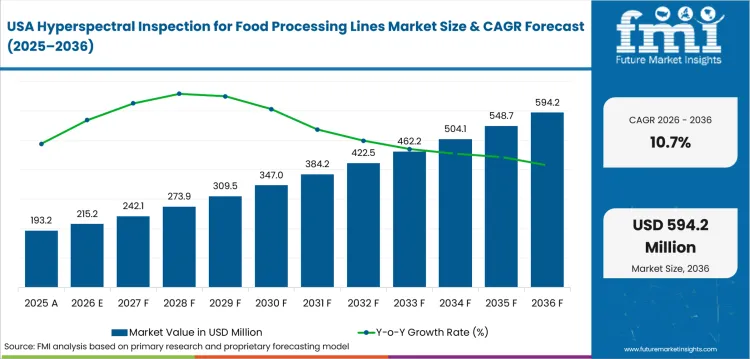
A 10.7% CAGR through 2036 reflects Midwest meat and produce corridors and food-processing inspection needs.
Country Market Snapshot Table
| Parameter | Value |
|---|---|
| Market Size in 2025 (Value) | USD 52.8 million |
| Market Size in 2026 (Value) | USD 58.4 million |
| Market Forecast in 2036 (Value) | USD 161.3 million |
| CAGR (2026 to 2036) | 10.7% |
| Years Considered | 2021 to 2036 |
| Base Year | 2025 |
| Forecast Period | 2026 to 2036 |
| Units Considered | Value (USD million) |
| Leading Sub-Region | Midwest meat and produce corridors |
United States Hyperspectral Inspection for Food Processing Lines Market Outlook
United States hyperspectral inspection demand is shaped by large multi-plant processors and strict retailer audit programs.
Large meat, nuts, bakery, and frozen food lines are expected to test hyperspectral systems where visual checks miss moisture or foreign-material signals.
Key Growth Drivers
- Food manufacturing gives hyperspectral vendors a large production base to target. BLS reported 1.7676 million food manufacturing jobs in 2024.
- Labor replacement pressure supports inspection automation. USDA ERS reported food-system labor compensation of USD 1.17 trillion in 2024.
- High-value meat and nut processors are expected to adopt spectral reject rules where false accepts can lead to retailer claims.
- Large branded processors can validate one model on a pilot line before scaling the same inspection recipe across plants.
Key Restraints
- Food safety documentation raises validation cost. FDA CORE reported ten public health advisories in 2024 across FDA-regulated food incidents.
- Mixed product lines require frequent recalibration when seasonality changes product moisture and surface texture.
- Regional processors may delay purchases where existing metal detection and RGB vision already satisfy buyer audits.
What makes United States unique
The United States is unique due to national processor scale and higher tolerance for line-level automation investment.
Key Companies
- Headwall Photonics
- Resonon
- TOMRA Food U.S.
- Key Technology
- Marel Inc.
- Cognex Corporation
- KPM Analytics
Sales & Marketing Channels
- Food plant system integrators
- Optical sorter distributors
- OEM packaging-line partners
- Direct supplier trials
- University extension networks
- Processor engineering teams
Country Segment Breakdown Table
| Segment | Sub-Segments |
|---|---|
| By Component | Cameras · Lenses · Lighting · Frame Grabbers · Vision Software · Services |
| By Inspection Type | Defect Detection · Measurement · OCR/OCV · Presence/Absence · Guidance |
| By Deployment | Inline · At-line · Robotic Cell · Portable |
| By End-use Industry | Food & Beverage · Packaging · Pharmaceuticals · Electronics · Automotive · Metals |
| By Buyer Type | Food Processors · Sorter OEMs · Packaging-line Integrators · Quality-control Labs |
| Key Sub-Regions Covered, Manufacturing and automation corridors | California · Texas · Illinois · Wisconsin · Pennsylvania · Georgia |
Frequently Asked Questions
How fast is the United States hyperspectral inspection market growing?
Sales in the United States are forecast to rise at 10.7% CAGR from 2026 to 2036.
Who leads the United States hyperspectral inspection market?
Headwall Photonics, Resonon, TOMRA Food U.S., and Key Technology compete through camera portfolios and line integration.
What drives United States adoption?
Large processor scale and retailer audit pressure are moving hyperspectral inspection from pilots into inline use.
How fast is the hyperspectral inspection market growing in Japan?
A 10.5% CAGR through 2036 reflects Kanto and Kansai prepared-food clusters and food-processing inspection needs.
Country Market Snapshot Table
| Parameter | Value |
|---|---|
| Market Size in 2025 (Value) | USD 30.9 million |
| Market Size in 2026 (Value) | USD 34.1 million |
| Market Forecast in 2036 (Value) | USD 92.6 million |
| CAGR (2026 to 2036) | 10.5% |
| Years Considered | 2021 to 2036 |
| Base Year | 2025 |
| Forecast Period | 2026 to 2036 |
| Units Considered | Value (USD million) |
| Leading Sub-Region | Kanto and Kansai prepared-food clusters |
Japan Hyperspectral Inspection for Food Processing Lines Market Outlook
Japan demand is shaped by strict quality expectations and high use of prepared, frozen, and convenience foods.
Processors are expected to adopt hyperspectral modules where compact lines require objective inspection without adding labor.
Key Growth Drivers
- Japan has a high-value food-processing base. USDA FAS reported Japan's food processing sector totaled USD 174 billion in 2024.
- Export-oriented food quality is gaining importance. OECD reported Japan's agriculture and food exports reached JPY 1.5 trillion in 2024.
- Convenience food and frozen food producers are expected to value compact inline systems that can inspect before packaging.
- High reliability expectations support suppliers that offer stable lighting, calibration support, and operator-ready software.
Key Restraints
- Input-cost pressure can delay inspection upgrades. The Bank of Japan reported the Producer Price Index rose 2.3% month over month in April 2026.
- Slow internal approval cycles may extend the period between a successful line trial and multi-plant purchasing.
- Small factory footprints can limit adoption where conveyor width and lighting distance cannot be changed easily.
What makes Japan unique
Japan is unique due to strict appearance standards and compact prepared-food production lines.
Key Companies
- Keyence Corporation
- Mitsubishi Electric
- Omron Corporation
- TOMRA Japan
- Ishida Co. Ltd.
- Anritsu Infivis
- Marel Japan
Sales & Marketing Channels
- Automation OEMs
- Quality-control equipment distributors
- Food packaging integrators
- Convenience-food plant engineers
- Direct supplier labs
- University testing partners
Country Segment Breakdown Table
| Segment | Sub-Segments |
|---|---|
| By Component | Cameras · Lenses · Lighting · Frame Grabbers · Vision Software · Services |
| By Inspection Type | Defect Detection · Measurement · OCR/OCV · Presence/Absence · Guidance |
| By Deployment | Inline · At-line · Robotic Cell · Portable |
| By End-use Industry | Food & Beverage · Packaging · Pharmaceuticals · Electronics · Automotive · Metals |
| By Buyer Type | Food Processors · Sorter OEMs · Packaging-line Integrators · Quality-control Labs |
| Key Sub-Regions Covered, Manufacturing and automation corridors | Kanto · Kansai · Chubu · Kyushu · Tohoku · Hokkaido |
Frequently Asked Questions
How fast is Japan hyperspectral inspection market growing?
Sales in Japan are forecast to rise at 10.5% CAGR from 2026 to 2036.
Who leads Japan hyperspectral inspection market?
Keyence, Omron, Ishida, Anritsu Infivis, and TOMRA Japan compete through sensors and inspection systems.
What drives Japan adoption?
Quality expectations and compact prepared-food lines support adoption where manual checks are costly.
Who are the leading companies in the hyperspectral inspection for food processing lines market?
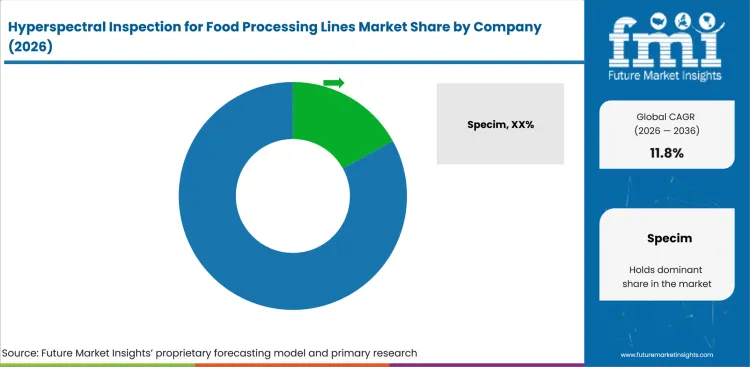
Specim, Headwall Photonics, EVK, TOMRA Food, Resonon, HySpex, and Cubert are the most relevant suppliers in this niche.
- Hyperspectral camera specialists hold an advantage where processors need wavelength fit and application libraries.
- Optical sorter companies gain traction when buyers prefer a complete reject system rather than a stand-alone camera.
- Machine-vision suppliers compete by integrating spectral outputs with plant controls and operator screens.
- Regional integrators influence conversion in countries where processors need trials before approving capital purchases.
Supplier competition is shaped by application depth more than camera hardware alone. Specim and Headwall compete through industrial hyperspectral cameras and machine-vision application support. TOMRA and Key Technology gain relevance where processors want sorter platforms with reject handling. EVK, Resonon, HySpex, and Cubert compete through spectral software, compact imaging formats, and integration-ready systems.
Companies best positioned for expansion are those that can prove detection accuracy on the buyer’s own product stream. Camera suppliers without food-specific models may face slower conversion because plants need recipe testing and line-speed validation before purchase approval.
How do top hyperspectral inspection companies compare?
Specim and Headwall score strongest on hyperspectral camera depth while TOMRA leads turnkey food sorting relevance.
| Company | Relevance to Market Title | Hyperspectral Portfolio | Food-line Integration | Software Depth | Channel Reach | Geographic Footprint |
|---|---|---|---|---|---|---|
| Specim | Very High | Very Strong | Strong | Strong | Strong | Global |
| Headwall Photonics | Very High | Very Strong | Strong | Strong | Strong | Global |
| TOMRA Food | Very High | Strong | Very Strong | Strong | Very Strong | Global |
| EVK DI Kerschhaggl | High | Strong | Strong | Very Strong | Moderate | Europe and Asia |
| Resonon | High | Strong | Moderate | Strong | Moderate | United States |
| HySpex | Moderate to High | Very Strong | Moderate | Moderate | Moderate | Europe and North America |
| Cubert GmbH | Moderate to High | Strong | Moderate | Moderate | Moderate | Europe |
| Key Technology | High | Moderate | Very Strong | Strong | Strong | North America and Europe |
| Bühler Group | High | Moderate | Very Strong | Strong | Very Strong | Global |
| Cognex Corporation | Moderate | Low to Moderate | Strong | Strong | Very Strong | Global |
Source: Future Market Insights competitive analysis, 2026.
Who are the key players in the hyperspectral inspection for food processing lines market?
Specim, Headwall Photonics, TOMRA Food, EVK, Resonon, HySpex, and Cubert are listed with sorter and machine-vision suppliers.
Key global companies leading the hyperspectral inspection for food processing lines market include:
- Specim
- Headwall Photonics
- EVK DI Kerschhaggl GmbH
- TOMRA Food
- HySpex
- Resonon
- Cubert GmbH
- inno-spec GmbH
- Bühler Group
- Marel
- Key Technology
- Sesotec GmbH
- Cognex Corporation
- Mettler-Toledo
- Ishida Co. Ltd.
Key Developments in Hyperspectral Inspection for Food Processing Lines Market
- Specim's GX17 NIR hyperspectral camera supports industrial machine vision with an 800 Hz maximum frame rate and 950 nm to 1700 nm coverage.
- In November 2025, Headwall published its acquisition of inno-spec GmbH to expand industrial hyperspectral imaging capabilities.
- In June 2024, EVK and Clearview signed a distribution agreement covering EVK hyperspectral imaging solutions in selected European countries.
Key Players in the Hyperspectral Inspection for Food Processing Lines Market
Hyperspectral Camera Specialists
- Specim
- Headwall Photonics
- HySpex
- Resonon
- Cubert GmbH
Food Sorting and Line Integration Suppliers
- TOMRA Food
- Bühler Group
- Marel
- Key Technology
- Ishida Co. Ltd.
Machine Vision and Inspection Companies
- EVK DI Kerschhaggl GmbH
- Cognex Corporation
- Sesotec GmbH
- Mettler-Toledo
- inno-spec GmbH
Hyperspectral Inspection for Food Processing Lines Market - Report Scope
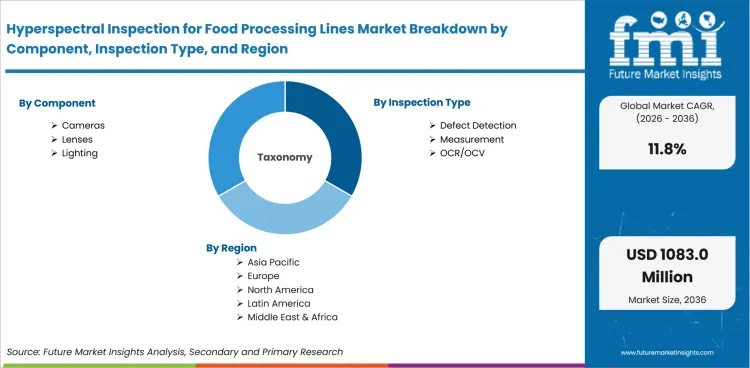
| Parameter | Details |
|---|---|
| Forecast period | 2026 to 2036 |
| Historical period | 2021 to 2025 |
| Quantitative unit | Revenue in USD million |
| By component | Cameras, lenses, lighting, frame grabbers, vision software, services |
| By inspection type | Defect detection, measurement, OCR/OCV, presence/absence, guidance |
| By deployment | Inline, at-line, robotic cell, portable |
| By end-use industry | Food & beverage, packaging, pharmaceuticals, electronics, automotive, metals |
| Regions covered | North America, Latin America, Europe, East Asia, South Asia and Pacific, Middle East and Africa |
| Countries covered | United States, United Kingdom, Germany, France, Japan, China, South Korea, India |
| Key companies profiled | Specim, Headwall Photonics, EVK, TOMRA Food, HySpex, Resonon, Cubert, Bühler, Marel, Cognex |
| Approach | Bottom-up equipment-boundary approach using camera systems, software, services, line count assumptions, country-level processing scale, and adoption evidence |
Hyperspectral Inspection for Food Processing Lines Market - Scope & Definition
| Attribute | Detail |
|---|---|
| Market Definition | Hyperspectral cameras, lenses, lighting, frame grabbers, software, and services used to inspect food processing lines for chemical and physical quality differences |
| Functions Covered | Defect detection, moisture analysis, foreign-material detection, composition checks, ripeness assessment, packaging-interface verification |
| Applications Covered | Inline and at-line inspection across meat, produce, grains, nuts, bakery, dairy, frozen food, and packaged food processing lines |
| End-Use Industries | Food and beverage processors, packaging-line integrators, sorter OEMs, quality-control labs, and adjacent industrial inspection users |
| Grades Covered | Visible-NIR, NIR, and SWIR hyperspectral configurations used with line lighting, optics, software, and reject mechanisms |
| Inclusions | Commercial hyperspectral systems, software, and services sold for food processing line inspection across components, inspection types, deployments, end-use industries, and regions |
| Exclusions | Laboratory-only spectroscopy, generic RGB machine vision, metal detectors without hyperspectral capability, X-ray inspection without spectral imaging, and non-food remote sensing systems |
Hyperspectral Inspection for Food Processing Lines Market - Research Methodology
| Method | Description |
|---|---|
| Primary Research | FMI analyst interviews with food processors, machine-vision distributors, optical sorter integrators, hyperspectral camera suppliers, and quality-control managers across key markets |
| Desk Research | Review of government food manufacturing data, supplier product pages, company releases, peer-reviewed food inspection studies, and official statistics related to processing scale |
| Market Sizing & Forecasting | Bottom-up equipment-boundary approach using camera system revenue, software attach rates, service revenue, line count assumptions, food category adoption, and country readiness |
| Data Validation | Cross-verification using supplier portfolios, processor line economics, food manufacturing statistics, country-level automation readiness, and documented hyperspectral application evidence |
Hyperspectral Inspection for Food Processing Lines Market Breakdown by Component, Inspection Type, Deployment, End-use Industry, and Region
Hyperspectral Inspection for Food Processing Lines Market Segmented by Component:
- Cameras
- Lenses
- Lighting
- Frame Grabbers
- Vision Software
- Services
Hyperspectral Inspection for Food Processing Lines Market Segmented by Inspection Type:
- Defect Detection
- Measurement
- OCR/OCV
- Presence/Absence
- Guidance
Hyperspectral Inspection for Food Processing Lines Market Segmented by Deployment:
- Inline
- At-line
- Robotic Cell
- Portable
Hyperspectral Inspection for Food Processing Lines Market Segmented by End-use Industry:
- Food & Beverage
- Packaging
- Pharmaceuticals
- Electronics
- Automotive
- Metals
Hyperspectral Inspection for Food Processing Lines Market by Region:
- North America
- Latin America
- Europe
- East Asia
- South Asia and Pacific
- Middle East and Africa
Research Sources and Bibliography
- Bank of Japan. (2026, May 15). Monthly report on the corporate goods price index: April 2026.
- Bureau of Labor Statistics. (2025, August 28). Employment and output by industry.
- Department for Environment, Food & Rural Affairs. (2026, February 25). Food statistics in your pocket.
- Destatis. (2026, June 18). Enterprises in manufacturing.
- Eurostat. (2026, June 3). Industrial producer prices up by 0.6% in the euro area and by 0.7% in the EU.
- EVK. (2025, July 28). EVK and Clearview sign distribution agreement.
- Food Standards Agency. (2025, June 19). Our food 2024: An annual review of food standards across the UK.
- Headwall Photonics. (2025, November 10). Headwall acquires inno-spec GmbH.
- INSEE. (2026, May 28). In April 2026, producer prices in the French industry fell by 2.0% over a month and rose by 2.0% over a year.
- Korea Ministry of Data and Statistics. (2026, June 2). Consumer price index in May 2026.
- Korea.net. (2025, July 31). The result of the survey on the Korean food industry.
- Ministry of Commerce of the People’s Republic of China. (2025, November 10). Industrial producer price indexes in October 2025.
- National Bureau of Statistics of China. (2024, December 19). Bulletin on the national grain production in 2024.
- Office for National Statistics. (2025, July 22). UK manufacturers’ sales by product: 2024.
- Organisation for Economic Co-operation and Development. (2025, October 30). Agricultural policy monitoring and evaluation 2025: Japan.
- Patel, D., Bhise, S., Kapdi, S. S., & Bhatt, T. (2024, May 9). Non-destructive hyperspectral imaging technology to assess the quality and safety of food: A review. Food Production, Processing and Nutrition, 6, Article 69.
- Press Information Bureau. (2026, February 6). Status and progress of food processing sector.
- Resonon. (2024, January 10). Getting started with hyperspectral machine vision systems.
- Specim. (2026, May 5). Specim launches the next-generation NIR hyperspectral camera Specim GX17 for industrial machine vision.
- U.S. Department of Agriculture, Economic Research Service. (2026, March 25). Food dollar series: Summary findings.
- U.S. Department of Agriculture, Foreign Agricultural Service. (2025, April 1). Food processing ingredients annual: Japan.
- U.S. Department of Agriculture, Foreign Agricultural Service. (2025, April 2). Food processing ingredients annual: France.
- U.S. Department of Agriculture, Foreign Agricultural Service. (2026, May 27). Food processing ingredients annual: South Korea.
- U.S. Department of Agriculture, Foreign Agricultural Service. (2026, March 27). Food processing ingredients annual: India.
- U.S. Department of Agriculture, Foreign Agricultural Service. (2026, March 30). Food processing ingredients annual: Germany.
- U.S. Department of Agriculture, Foreign Agricultural Service. (2025, July 3). Exporter guide annual: China.
- U.S. Food and Drug Administration. (2026, March 17). CORE annual report 2024.
- U.S. International Trade Administration. (2026, May 21). France: Agricultural sector.
This bibliography is provided for reader reference and is not exhaustive. The full report contains the complete reference list and detailed citations.
This Report Answers
- Market size estimates for 2026 and forecasts through 2036 for the hyperspectral inspection for food processing lines market.
- Insights across regional and country-level markets covering processor scale and automation readiness.
- Analysis of demand drivers, inspection use cases, calibration barriers, and purchasing behavior.
- Evaluation of key components and inspection types including cameras, software, services, and defect detection.
- Assessment of deployment models including inline, at-line, robotic cell, and portable configurations.
- Identification of opportunities across food categories, retrofit modules, and line integration programs.
- Country-level growth analysis covering the United States, United Kingdom, Germany, France, Japan, China, South Korea, and India.
- Assessment of the competitive landscape including hyperspectral camera specialists, sorter OEMs, and machine-vision suppliers.
- Analysis of supplier positioning, application libraries, and regional channel structures.
- Delivery of market data, forecasts, and supporting analysis in PDF and Excel formats.
Frequently Asked Questions
What is the growth prospect for hyperspectral inspection for food processing lines?
Demand is expected to rise as processors move quality checks from sample testing to line-side release control.
Which companies are expected to shape the hyperspectral inspection market?
Specim, Headwall Photonics, TOMRA Food, EVK, Resonon, HySpex, and Cubert are expected to shape market competition through hardware and software depth.
Why are food processors investing in hyperspectral inspection?
Food processors are investing in hyperspectral inspection to detect defects that color cameras, manual checks, and metal detection can miss.
Why is inline deployment important in this market?
Inline deployment supports faster reject decisions before product reaches packing or downstream blending.
Which component formats are gaining attention?
Cameras, vision software, and calibration services are gaining attention because detection accuracy depends on both spectral capture and model tuning.
How do calibration needs influence adoption?
Calibration needs influence adoption by raising service requirements when recipes, moisture levels, and raw material quality change often.
Why are country-level food statistics important?
Country-level food statistics indicate plant scale and processing intensity before suppliers prioritize local trials.
How do regional integrators support hyperspectral inspection adoption?
Regional integrators support adoption by connecting cameras, lighting, conveyors, reject devices, and operator interfaces into usable line systems.
Preview the report firsthand - request a free sample
Get SampleGet the brochure for pricing and purchase details.
Get PDFTable of Content
- Executive Summary
- Global Market Outlook
- Demand-side Trends
- Supply-side Trends
- Technology Roadmap Analysis
- Analysis and Recommendations
- Market Overview
- Market Coverage / Taxonomy
- Market Definition / Scope / Limitations
- Research Methodology
- Research Design
- Primary Research
- Desk Research
- Market Sizing and Forecasting
- Data Validation
- Global Market Analysis 2021 to 2025 and Forecast, 2026 to 2036
- Historical Market Size Value (USD Million) Analysis, 2021 to 2025
- Current and Future Market Size Value (USD Million) Projections, 2026 to 2036
- Y-o-Y Growth Trend Analysis
- Absolute $ Opportunity Analysis
- Global Market Pricing Analysis 2021 to 2025 and Forecast 2026 to 2036
- Global Market Analysis 2021 to 2025 and Forecast 2026 to 2036, By Component
- Introduction / Key Findings
- Historical Market Size Value (USD Million) Analysis By Component, 2021 to 2025
- Current and Future Market Size Value (USD Million) Analysis By Component, 2026 to 2036
- Global Market Analysis 2021 to 2025 and Forecast 2026 to 2036, By Inspection Type
- Introduction / Key Findings
- Historical Market Size Value (USD Million) Analysis By Inspection Type, 2021 to 2025
- Current and Future Market Size Value (USD Million) Analysis By Inspection Type, 2026 to 2036
- Global Market Analysis 2021 to 2025 and Forecast 2026 to 2036, By Deployment
- Introduction / Key Findings
- Historical Market Size Value (USD Million) Analysis By Deployment, 2021 to 2025
- Current and Future Market Size Value (USD Million) Analysis By Deployment, 2026 to 2036
- Global Market Analysis 2021 to 2025 and Forecast 2026 to 2036, By End-use Industry
- Introduction / Key Findings
- Historical Market Size Value (USD Million) Analysis By End-use Industry, 2021 to 2025
- Current and Future Market Size Value (USD Million) Analysis By End-use Industry, 2026 to 2036
- Global Market Analysis 2021 to 2025 and Forecast 2026 to 2036, By Buyer Type
- Introduction / Key Findings
- Historical Market Size Value (USD Million) Analysis By Buyer Type, 2021 to 2025
- Current and Future Market Size Value (USD Million) Analysis By Buyer Type, 2026 to 2036
- Global Market Analysis 2021 to 2025 and Forecast 2026 to 2036, By Region
- Introduction / Key Findings
- Historical Market Size Value (USD Million) Analysis By Region, 2021 to 2025
- Current and Future Market Size Value (USD Million) Analysis By Region, 2026 to 2036
- North America Market Analysis 2021 to 2025 and Forecast 2026 to 2036
- Pricing Analysis
- Market Share Analysis, 2025
- By Country
- By Component
- By Inspection Type
- By Deployment
- By End-use Industry
- By Buyer Type
- Country-level Analysis
- United States
- Canada
- Latin America Market Analysis 2021 to 2025 and Forecast 2026 to 2036
- Pricing Analysis
- Market Share Analysis, 2025
- By Country
- By Component
- By Inspection Type
- By Deployment
- By End-use Industry
- By Buyer Type
- Country-level Analysis
- Brazil
- Mexico
- Rest of Latin America
- Western Europe Market Analysis 2021 to 2025 and Forecast 2026 to 2036
- Pricing Analysis
- Market Share Analysis, 2025
- By Country
- By Component
- By Inspection Type
- By Deployment
- By End-use Industry
- By Buyer Type
- Country-level Analysis
- Germany
- France
- United Kingdom
- Italy
- Spain
- BENELUX
- Nordics
- Rest of Western Europe
- Eastern Europe Market Analysis 2021 to 2025 and Forecast 2026 to 2036
- Pricing Analysis
- Market Share Analysis, 2025
- By Country
- By Component
- By Inspection Type
- By Deployment
- By End-use Industry
- By Buyer Type
- Country-level Analysis
- Russia
- Poland
- Rest of Eastern Europe
- East Asia Market Analysis 2021 to 2025 and Forecast 2026 to 2036
- Pricing Analysis
- Market Share Analysis, 2025
- By Country
- By Component
- By Inspection Type
- By Deployment
- By End-use Industry
- By Buyer Type
- Country-level Analysis
- China
- Japan
- South Korea
- South Asia and Pacific Market Analysis 2021 to 2025 and Forecast 2026 to 2036
- Pricing Analysis
- Market Share Analysis, 2025
- By Country
- By Component
- By Inspection Type
- By Deployment
- By End-use Industry
- By Buyer Type
- Country-level Analysis
- India
- ASEAN
- Australia & New Zealand
- Rest of South Asia and Pacific
- Middle East & Africa Market Analysis 2021 to 2025 and Forecast 2026 to 2036
- Pricing Analysis
- Market Share Analysis, 2025
- By Country
- By Component
- By Inspection Type
- By Deployment
- By End-use Industry
- By Buyer Type
- Country-level Analysis
- GCC Countries
- South Africa
- Turkey
- Rest of Middle East & Africa
- Market Structure Analysis
- Competition Dashboard
- Competition Benchmarking
- Market Share Analysis of Top Players
- By Region
- By Component
- By Inspection Type
- By Deployment
- By End-use Industry
- By Buyer Type
- Emerging Startups
- Innovation Benchmarking
- Competition Analysis
- Competition Deep Dive
- Company Profiles
- Case Studies
- Success Stories
- Recent Developments
- Assumptions & Acronyms Used
- List of Tables: Hyperspectral Inspection for Food Processing Lines Market
- List of Figures: Hyperspectral Inspection for Food Processing Lines Market


