

- Market Size (2026)
- USD 2.9 Bn
- Forecast (2036)
- USD 7.1 Bn
- CAGR (2026 to 2036)
- 9.3%
How big is the Idiopathic Short Stature Market in 2026?
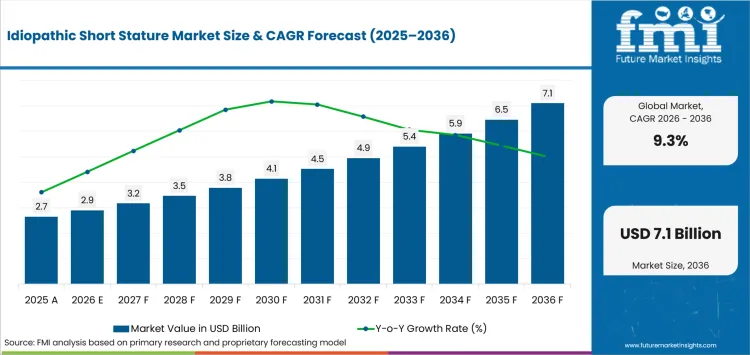
USD 2.9 billion in 2026 and USD 7.1 billion by 2036 at a 9.3% CAGR.
The idiopathic short stature market is projected to expand at 9.3% CAGR from 2026 to 2036, rising from USD 2.9 billion to USD 7.1 billion. Growth hormone therapy remains the principal pharmaceutical intervention for children who meet idiopathic short stature eligibility criteria after alternative causes of growth impairment have been excluded. The July 2025 GENOTROPIN label retained an ISS indication after excluding other causes. That prescription base supports recurring growth hormone treatments across multi-year pediatric regimens.
Country conditions differ despite the narrow forecast range because approved indications and reimbursement routes remain nationally specific. The United States is estimated at 8.9% CAGR compared with Germany at 8.4% as American labels recognize more pediatric growth indications. The FDA's April 2026 import alert listed eight conditions for legal pediatric growth hormone prescribing. Broader indications widen specialist pathways while prior authorization workflows and response criteria still govern continuity.
Key Takeaways of Idiopathic Short Stature Market
- Demand is rising as established daily somatropin regimens gain weekly alternatives that reduce injection frequency without removing specialist monitoring.
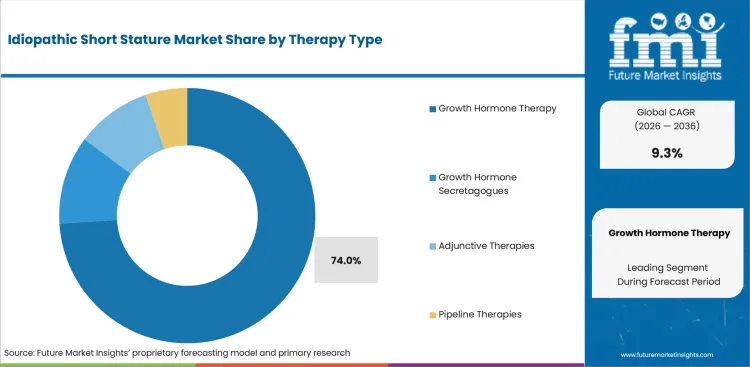
- Growth hormone therapy is estimated to represent 74.0% share in 2026 owing to approved recombinant products across established prescribing pathways.
- Pediatric patients are forecast to account for 91.0% share in 2026 because remaining growth potential narrows as skeletal maturity approaches.
- Injectable therapies are projected to hold 94.0% share in 2026 as approved daily and weekly growth hormone products use subcutaneous administration.
- Diagnostic exclusion, long treatment duration and payer continuation rules can delay initiation or interrupt therapy before expected height gains are documented.
- Novo Nordisk A/S, Pfizer Inc., Eli Lilly and Company, Sandoz Group AG, Ferring Pharmaceuticals Inc., Merck KGaA, Ascendis Pharma A/S and Changchun GeneScience Pharmaceutical Co., Ltd. are the verified companies serving this market.
Analyst Perspective
“Idiopathic short stature portfolios should be judged by indication coverage, injection burden and the evidence required to continue therapy. A weekly schedule earns commercial value only when device training, reimbursement support and growth-response records keep eligible children on treatment.”
- Anurag Sharma, Principal Consultant, Future Market Insights
How is the Idiopathic Short Stature Market segmented?
The idiopathic short stature market is segmented by therapy type, patient type, route of administration, end user, distribution channel and region.
Therapy type covers growth hormone therapy, growth hormone secretagogues, adjunctive therapies and pipeline therapies. Patient type includes pediatric patients, adolescent patients and adult follow-up. Routes are injectable and oral. End users are hospitals, specialty clinics and home healthcare. Channels comprise hospital pharmacies, retail pharmacies and specialty pharmacies.
What makes growth hormone therapy central to the therapy type category?
Growth hormone therapy provides the established treatment route after pediatric endocrinologists exclude endocrine and systemic causes of short stature. Current hormone replacement therapies also provide the comparator base for longer-acting formulations during treatment periods that require repeated response review.
- By therapy type, growth hormone therapy is estimated to hold 74.0% in 2026 owing to approved recombinant products across established specialist prescribing pathways.
- The November 2025 HUMATROPE label reports clinical evidence from 310 pediatric patients with idiopathic short stature. The evidence supports injectable drug portfolios but leaves dosing persistence and response monitoring central to treatment value.
How do pediatric endocrinologists evaluate pediatric patients?
Pediatric patients retain the treatment window needed for linear growth before epiphyseal closure. Endocrinology teams assess growth velocity, bone age and predicted adult height before discussing a multi-year regimen with children and caregivers.
- In 2026, pediatric patients are expected to lead patient type with 91.0% share because remaining growth potential narrows as skeletal maturity approaches.
- Prepubertal children usually provide the longest response window for subcutaneous delivery systems. Pubertal children require closer dose review as delayed diagnosis reduces available treatment time and increases the importance of early response evidence.
How does injectable therapy influence selection within the route of administration category?
Approved idiopathic short stature therapies use subcutaneous administration. Selection therefore focuses on dosing frequency, device accuracy and whether caregivers can maintain correct administration outside specialist visits during a long pediatric treatment period.
- The route of administration category is forecast to be led by injectable therapy at 94.0% share in 2026 due to approved daily and weekly subcutaneous regimens.
- The July 2025 NORDITROPIN label requires subcutaneous administration and individualized response review. Prefilled auto-injector platforms reduce handling steps but do not remove caregiver training, injection-site management or refrigerated storage requirements.
What role do hospitals play within the end-user category?
Hospitals combine pediatric endocrinology, laboratory testing and imaging within one referral pathway. The setting supports diagnosis of exclusion and gives clinicians a controlled route for treatment initiation, growth measurement and response review.
- Hospitals are set to lead the end-user category with 45.0% share in 2026 due to specialist diagnostic work-up and treatment initiation.
- Hospital teams coordinate bone-age imaging with reimbursement documents and initial device training. Specialty clinics and remote patient monitoring extend repeat assessment after the treatment plan is established while preserving endocrinologist oversight.
What are the drivers, restraints and opportunities in the Idiopathic Short Stature Market?
Approved growth hormone pathways support demand, but diagnostic and reimbursement controls restrain conversion while weekly dosing and connected support create a practical expansion route.
- Driver: Current ISS labels give pediatric endocrinologists an established treatment base that weekly formulations can extend.
- Restraint: Diagnostic exclusion and continuation criteria can delay initiation or interrupt multi-year treatment before expected growth response is documented.
- Opportunity: Weekly injection devices and coordinated adherence services can reduce administration burden and improve evidence for ongoing treatment.
Approved Labels Convert Diagnosed Patients into Treatment
Several current US labels carry an idiopathic short stature indication that applies only once clinicians have excluded other causes of short stature. The July 2025 OMNITROPE label also requires individualized dosing and response review. Label requirements connect self-administered biologics with specialist diagnosis while giving weekly formulations a route into established prescribing pathways.
Diagnostic and Coverage Rules Limit Continuity
Clinicians must rule out endocrine, genetic and systemic causes that require different care. Payers can then request baseline height measures and documented response before continuing coverage. The combined process delays treatment starts and can shorten the usable growth window.
Weekly Dosing Extends the Service Opportunity
Weekly regimens reduce annual injections and shift service needs toward device training, refill coordination and administration records. Patient support logistics can protect refrigerated delivery and scheduled refills across multi-year care. Connected services earn value when endocrinologists receive dependable adherence information.
Which country CAGRs are profiled in the Idiopathic Short Stature Market?
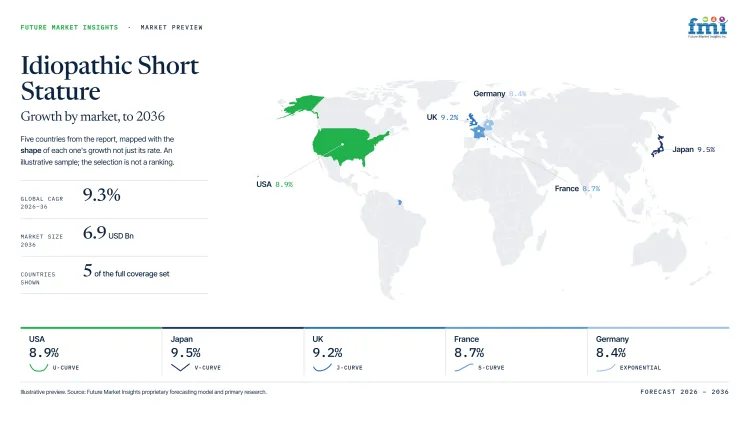
| Country | CAGR |
|---|---|
| Japan | 9.5% |
| United Kingdom | 9.2% |
| United States | 8.9% |
| France | 8.7% |
| Germany | 8.4% |
How do country-level CAGRs compare in the Idiopathic Short Stature Market?
The forecasts span 1.1 percentage points between Japan and Germany. The narrow range measures projected pace rather than current revenue or treated-patient volume.
- Japan maintains established pediatric growth screening and specialist referral, although growth hormone remains approved there only for indications other than idiopathic short stature.
- The United Kingdom supports market growth through structured pediatric care pathways and increasing awareness of growth-related conditions.
- The United States reflects steady demand driven by advanced diagnostic capabilities and broad access to treatment.
- France continues to expand through improved identification and management of children with growth disorders.
- Germany maintains growth through strong pediatric healthcare infrastructure and continued use of hormone-based therapies.
Comparable CAGRs can produce different entry conditions because indications and payment rules remain nationally specific. The full report covers country-level growth across every standard FMI region.
Country-wise Analysis
- Japan's national reimbursement system connects pediatric endocrinology centers with hospital and community pharmacies, but growth hormone is dispensed only against domestically approved indications. Forecasts place Japan at 9.5% CAGR through 2036, reflecting a treated population confined to approved uses such as growth hormone deficiency, Turner syndrome, chronic renal disease, achondroplasia, Prader-Willi syndrome and short stature in children born small for gestational age. Idiopathic short stature is not an approved growth hormone indication in Japan, so any commercial expansion in this indication depends on a future approval rather than on current dispensing breadth.
- Specialist pediatric endocrine services control diagnosis and continuing eligibility within coordinated hospital pathways across the United Kingdom. The United Kingdom's idiopathic short stature outlook is anticipated to advance at 9.2% CAGR over the assessment period, shaped by specialist access to three authorized weekly growth hormone medicines. The Advisory Council on the Misuse of Drugs reported on 13 August 2025 that somapacitan, lonapegsomatropin and somatrogon each hold a UK marketing authorization, with the authorized use of all three limited to growth hormone deficiency, so routine ISS conversion depends on exceptional funding plus documented clinical justification.
- United States pediatric endocrinologists can select several daily ISS labels and one weekly product after completing diagnostic exclusion and payer documentation. Idiopathic short stature sales in the United States are forecast to expand at 8.9% CAGR by 2036, driven by several daily labels and one weekly option. The February 2026 SOGROYA label included 88 children in its ISS cohort and expanded dosing choice, although prior authorization and continuing-response criteria can interrupt treatment before eligible patients use the full remaining growth window.
- French access remains centered in hospital endocrinology centers that connect diagnosis with medicine-specific reimbursement decisions and continuing supervision. Idiopathic short stature demand in France is forecast to rise at 8.7% CAGR over the forecast period, influenced by hospital-led diagnosis and medicine-specific reimbursement review. The Haute Autorité de Santé set three initiation conditions for weekly somapacitan in pediatric growth hormone deficiency during March 2024, but the assessed indication did not include ISS and each product therefore needs separate evidence before routine reimbursement can follow.
- Germany routes newer growth hormone medicines through formal additional-benefit review before price and prescribing conditions settle within statutory insurance. Germany is estimated to post 8.4% CAGR over the forecast period, shaped by formal benefit assessment and indication-specific evidence requirements. The Federal Joint Committee completed separate 2024 assessments for somapacitan and lonapegsomatropin in pediatric growth hormone deficiency, giving developers a defined review route while leaving ISS conversion dependent on indication-specific benefit evidence.
Who are the notable companies in the Idiopathic Short Stature Market?
Novo Nordisk A/S, Pfizer Inc., Eli Lilly and Company, Sandoz Group AG, Ferring Pharmaceuticals Inc., Merck KGaA, Ascendis Pharma A/S and Changchun GeneScience Pharmaceutical Co., Ltd. are the notable companies serving this market.
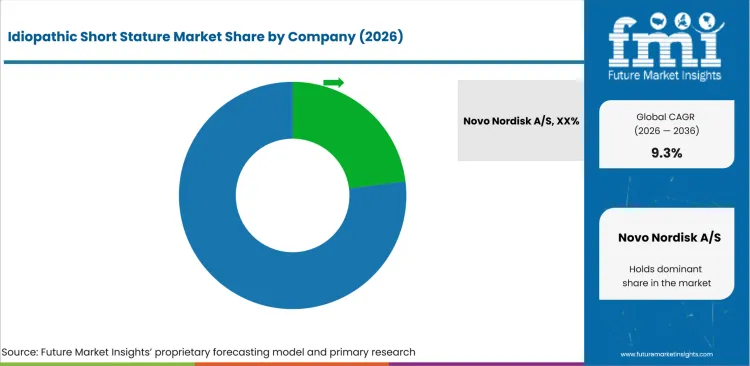
The competitive field separates approved daily ISS franchises from weekly growth hormone platforms and active label-expansion programs. Entry barriers arise from indication-specific evidence, pediatric device training and cold-chain logistics rather than manufacturing scale alone.
- Novo Nordisk A/S, Pfizer Inc., Eli Lilly and Company, Sandoz Group AG and Ferring Pharmaceuticals Inc. hold current USA ISS positions under approved somatropin or somapacitan labels.
- Merck KGaA and Changchun GeneScience Pharmaceutical Co., Ltd. hold ISS positions in selected Asian markets under nationally approved growth hormone routes.
- Ascendis Pharma A/S maintains an active long-acting ISS clinical program that could extend its weekly platform beyond pediatric growth hormone deficiency.
Competitive Benchmarking: Idiopathic Short Stature Market
| Company | ISS Commercial Position | Long-acting GH Capability | Delivery and Adherence Support | Geographic Reach |
|---|---|---|---|---|
| Novo Nordisk A/S | High | High | High | Multiple regions |
| Pfizer Inc. | High | High | High | Multiple regions |
| Eli Lilly and Company | High | Low | Medium | United States and selected markets |
| Sandoz Group AG | High | Low | Medium | United States, Europe and Japan |
| Ascendis Pharma A/S | Medium | High | High | United States and Europe |
| Ferring Pharmaceuticals Inc. | High | Low | Low | United States and selected markets |
| Changchun GeneScience Pharmaceutical Co., Ltd. | Medium | High | Medium | China and selected markets |
| Merck KGaA | High | Low | Medium | Europe and selected Asian markets |
Key Developments in the Idiopathic Short Stature Market
- In March 2026, Changchun GeneScience Pharmaceutical Co., Ltd. registered a phase 1b/2 dose-finding study of GenSci134 against Norditropin in 128 children with ISS.
- In February 2026, Novo Nordisk A/S received an updated USA SOGROYA label that added ISS for patients aged 2.5 years and older.
- In December 2025, Ascendis Pharma A/S initiated the phase 3 HighLiGHts basket trial comparing once-weekly lonapegsomatropin with daily somatropin in approximately 186 children across idiopathic short stature, SHOX deficiency, Turner syndrome and small for gestational age.
Key Players in the Idiopathic Short Stature Market
Approved ISS Product Franchises
- Novo Nordisk A/S
- Pfizer Inc.
- Eli Lilly and Company
- Sandoz Group AG
ISS Development and Selected Asian Franchises
- Ascendis Pharma A/S
- Changchun GeneScience Pharmaceutical Co., Ltd.
- Merck KGaA
Vial-based ISS Product Specialist
- Ferring Pharmaceuticals Inc.
Idiopathic Short Stature Market - Report Scope
| Coverage field | Report scope |
|---|---|
| Market breakdown | By therapy type, patient type, route of administration, end user, distribution channel and region. |
| Quantitative Units | Revenue in USD billion and CAGR in %. |
| Market Definition | Commercial therapies and coordinated care pathways used for pediatric idiopathic short stature after diagnostic evaluation has excluded other causes, including daily and long-acting growth hormone plus adjacent or pipeline approaches. |
| Regions Covered | North America, Latin America, Europe, East Asia, South Asia and Pacific and Middle East and Africa. |
| Countries Covered | Japan, United Kingdom, United States, France, Germany, and 20+ countries included in the full report. |
| Key Companies Profiled | Novo Nordisk A/S, Pfizer Inc., Eli Lilly and Company, Sandoz Group AG, Ferring Pharmaceuticals Inc., Merck KGaA, Ascendis Pharma A/S and Changchun GeneScience Pharmaceutical Co., Ltd. |
| Forecast Period | 2026 to 2036. |
| Approach | Primary and secondary research with market triangulation. |
Idiopathic Short Stature Market - Research Methodology
| Method | Approach |
|---|---|
| Primary Research | FMI analysts gathered input from manufacturers, service providers, technology developers, distributors, end users, procurement teams, and subject-matter experts. Interviews examined purchasing decisions, product or service evaluation, adoption barriers, approval requirements, pricing considerations, and expectations for technical or commercial support. Respondents were also asked what evidence is required before a trial, pilot, or initial order develops into regular purchasing. |
| Desk Research | Desk research covered government statistics, regulatory publications, trade data, industry associations, technical literature, standards, company filings, product information, and official corporate announcements. Sources were reviewed for relevance, publication date, geographic coverage, and consistency with the defined market scope. Claims relating to performance, applications, approvals, capacity, investment, and commercial activity were retained only when supported by credible public evidence. |
| Market Sizing and Forecasting | The market model combined the baseline value with historical performance, segment structure, pricing and volume indicators, adoption levels, company participation, and country-level demand conditions. Forecast assumptions considered economic activity, investment trends, regulatory developments, technology adoption, purchasing cycles, supply availability, and barriers to wider market use. Segment and regional estimates were reconciled before the final market total was calculated. |
| Data Validation | Estimates were checked against multiple independent indicators, including public data, company activity, trade patterns, industry developments, and findings from primary interviews. Validation also tested whether products, services, applications, and company revenues fell within the defined market boundaries. Adjacent categories, unsupported claims, overlapping revenues, and activities without direct market relevance were excluded to reduce double counting and maintain consistency across segments and countries. |
Idiopathic Short Stature Market by Segments
Idiopathic Short Stature Market segmented by Therapy Type:
- Growth Hormone Therapy
- Recombinant Human Growth Hormone
- Long-acting Growth Hormone
- Biosimilar Growth Hormone
- Growth Hormone Secretagogues
- Growth Hormone-releasing Hormone Analogues
- Ghrelin Receptor Agonists
- Oral Growth Hormone Secretagogues
- Adjunctive Therapies
- Nutritional Supplementation
- Endocrine Support Therapy
- Personalized Growth Management
- Pipeline Therapies
- Gene-based Growth Therapies
- Novel Peptide Therapeutics
- Long-duration Endocrine Therapies
Idiopathic Short Stature Market segmented by Patient Type:
- Pediatric Patients
- Prepubertal Children
- Pubertal Children
- Early Intervention Patients
- Adolescent Patients
- Late-diagnosed Adolescents
- Growth Plate Preservation Therapy
- Transition Care Patients
- Adult Follow-up
- Long-term Growth Monitoring
- Endocrine Assessment
- Post-treatment Evaluation
Idiopathic Short Stature Market segmented by Route of Administration:
- Injectable
- Daily Subcutaneous Injection
- Weekly Long-acting Injection
- Prefilled Injection Pens
- Oral
- Oral Secretagogues
- Pipeline Oral Therapies
- Endocrine Modulators
Idiopathic Short Stature Market segmented by End User:
- Hospitals
- Pediatric Hospitals
- Endocrinology Departments
- Tertiary Care Hospitals
- Specialty Clinics
- Pediatric Endocrinology Clinics
- Growth Disorder Clinics
- Multispecialty Clinics
- Home Healthcare
- Home Injection Therapy
- Remote Patient Monitoring
- Patient Support Programs
Idiopathic Short Stature Market segmented by Distribution Channel:
- Hospital Pharmacies
- Inpatient Pharmacies
- Outpatient Hospital Pharmacies
- Endocrine Drug Distribution
- Retail Pharmacies
- Chain Pharmacies
- Independent Pharmacies
- Specialty Retail Pharmacies
- Specialty Pharmacies
- Biologics Distribution
- Cold Chain Distribution
- Home Delivery Services
Idiopathic Short Stature Market by Region
- North America
- United States
- Canada
- Latin America
- Brazil
- Mexico
- Chile
- Rest of Latin America
- Western Europe
- Germany
- United Kingdom
- Italy
- Spain
- France
- Nordics
- Benelux
- Rest of Western Europe
- Eastern Europe
- Russia
- Poland
- Hungary
- Balkan and Baltic States
- Rest of Eastern Europe
- East Asia
- China
- Japan
- South Korea
- South Asia and Pacific
- India
- ASEAN
- Australia and New Zealand
- Rest of South Asia and Pacific
- Middle East and Africa
- Kingdom of Saudi Arabia
- Other GCC Countries
- Türkiye
- South Africa
- Other African Union Countries
- Rest of Middle East and Africa
Research Sources and Bibliography
- National Library of Medicine. (2025, July). GENOTROPIN- somatropin.
- USA Food and Drug Administration. (2026, April 7). Import Alert 66-71.
- National Library of Medicine. (2025, November 25). HUMATROPE- somatropin kit.
- National Library of Medicine. (2025, July 7). NORDITROPIN- somatropin injection, solution.
- National Library of Medicine. (2025, July 10). OMNITROPE- somatropin injection, solution; OMNITROPE- somatropin kit.
- Ministry of Health, Labour and Welfare. (2026, August 1).
- Advisory Council on the Misuse of Drugs. (2025, August 13). ACMD advice on somapacitan, lonapegsomatropin and somatrogon (accessible).
- National Library of Medicine. (2026, February). SOGROYA- somapacitan-beco injection, solution.
- Haute Autorité de Santé. (2024, March 4). SOGROYA (somapacitan) - Déficit en hormone de croissance.
- Gemeinsamer Bundesausschuss. (2024, May 2). Nutzenbewertungsverfahren zum Wirkstoff Somapacitan.
- Gemeinsamer Bundesausschuss. (2024, March 7). Nutzenbewertungsverfahren zum Wirkstoff Lonapegsomatropin.
- National Library of Medicine. (2026, February 24). ZOMACTON- somatropin kit.
- Indonesian Food and Drug Authority. (2025, October 27). BPOM - Assessment Report.
- Ascendis Pharma A/S. (2026, January 12). Ascendis Pharma provides business and strategic roadmap update at 44th Annual J.P. Morgan Healthcare Conference.
- National Library of Medicine. (2026, March 4). A study (Phase 1b/2) of GenSci134 in children with idiopathic short stature.
This bibliography is provided for reader reference and is not exhaustive. The full report contains the complete reference list and detailed citations.
This Report Answers
- How large is the idiopathic short stature market in 2026 and 2036?
- Which treatment route supports recurring idiopathic short stature demand?
- Why does growth hormone therapy account for 74.0% of demand in 2026?
- Why do pediatric patients represent 91.0% of demand in 2026?
- How does injectable administration shape product and device selection?
- Which diagnostic and reimbursement conditions limit treatment conversion?
- How do country growth rates differ across the profiled markets?
- How do verified companies compare across ISS position and long-acting capability?
- Which recent regulatory and clinical developments are changing competition?
Frequently Asked Questions
How big is the Idiopathic Short Stature Market in 2026?
The idiopathic short stature market is estimated at USD 2.9 billion in 2026 and is projected to reach USD 7.1 billion by 2036. The idiopathic short stature market expands as daily somatropin regimens gain weekly alternatives that reduce injection burden.
What is the CAGR of the Idiopathic Short Stature Market from 2026 to 2036?
The idiopathic short stature market is projected to grow at 9.3% CAGR from 2026 to 2036. The idiopathic short stature market remains tied to specialist diagnosis, approved indications and sustained adherence across multi-year pediatric treatment.
Which therapy type segment leads the Idiopathic Short Stature Market?
Growth hormone therapy is estimated to account for 74.0% of the idiopathic short stature market in 2026. The idiopathic short stature market favors this segment because approved recombinant products provide the established clinical and reimbursement base for specialist care.
How much incremental opportunity will the Idiopathic Short Stature Market add from 2026 to 2036?
The idiopathic short stature market is projected to add USD 4.2 billion between 2026 and 2036. The idiopathic short stature market gains this incremental value as established daily products retain specialist pathways while weekly formulations compete on injection burden, adherence records and indication-specific reimbursement.
Which companies are active in the Idiopathic Short Stature Market?
The idiopathic short stature market includes Novo Nordisk, Pfizer, Eli Lilly, Sandoz, Ferring, Merck KGaA, Ascendis Pharma and Changchun GeneScience.
Preview the report firsthand - request a free sample
Get SampleGet the brochure for pricing and purchase details.
Get PDFTable of Content
- Key Takeaways
- Market Size and CAGR
- Top Growth Driver
- Fastest Growing Segment
- Leading Region
- Key Companies
- Emerging Opportunities
- Executive Summary
- Global Market Outlook
- Demand-side Trends
- Supply-side Trends
- Technology Roadmap Analysis
- Analysis and Recommendations
- Analyst Perspective (What is happening? Why now? What should investors know?)
- Key Questions Answered
- How large is the market?
- What is the CAGR?
- What are key trends?
- Which region dominates?
- Who are the leaders?
- Market Overview
- Market Coverage / Taxonomy
- Market Definition / Scope / Limitations
- Research Methodology
- Chapter Orientation
- Analytical Lens and Working Hypotheses
- Market Structure, Signals, and Trend Drivers
- Benchmarking and Cross-market Comparability
- Market Sizing, Forecasting, and Opportunity Mapping
- Research Design and Evidence Framework
- Desk Research Programme (Secondary Evidence)
- Expert Input and Fieldwork (Primary Evidence)
- Tooling, Models, and Reference Databases
- Data Engineering and Model Build
- Quality Assurance and Audit Trail
- Market Background
- Market Dynamics (Drivers, Restraints, Opportunity, Trends)
- Scenario Forecast (Optimistic, Likely, Conservative)
- Impact Analysis
- AI Impact
- Sustainability Impact
- Regulatory Impact
- Technology Impact
- Consumer / Buyer Analysis
- Purchase Drivers
- Adoption Barriers
- Buyer Journey
- Opportunity Map Analysis
- Product Life Cycle Analysis
- Supply Chain Analysis
- Investment Feasibility Matrix
- Value Chain Analysis
- PESTLE and Porter's Analysis
- Regulatory Landscape
- Regional Parent Market Outlook
- Production and Consumption Statistics
- Import and Export Statistics
- Global Market Analysis and Forecast, 2021 to 2036
- Historical Market Size Value (USD Billion) Analysis, 2021 to 2025
- Current and Future Market Size Value (USD Billion) Projections, 2026 to 2036
- Y-o-Y Growth Trend Analysis
- Absolute $ Opportunity Analysis
- Global Market Pricing Analysis, 2021 to 2036
- Global Market Analysis and Forecast, By Therapy Type, 2021 to 2036
- Introduction / Key Findings
- Historical Market Size Value (USD Billion) Analysis By Therapy Type, 2021 to 2025
- Current and Future Market Size Value (USD Billion) Analysis and Forecast By Therapy Type, 2026 to 2036
- Growth Hormone Therapy
- Recombinant Human Growth Hormone
- Long-acting Growth Hormone
- Biosimilar Growth Hormone
- Growth Hormone Secretagogues
- Growth Hormone-releasing Hormone Analogues
- Ghrelin Receptor Agonists
- Oral Growth Hormone Secretagogues
- Adjunctive Therapies
- Nutritional Supplementation
- Endocrine Support Therapy
- Personalized Growth Management
- Pipeline Therapies
- Gene-based Growth Therapies
- Novel Peptide Therapeutics
- Long-duration Endocrine Therapies
- Growth Hormone Therapy
- Y-o-Y Growth Trend Analysis By Therapy Type, 2021 to 2025
- Absolute $ Opportunity Analysis By Therapy Type, 2026 to 2036
- Global Market Analysis and Forecast, By Patient Type, 2021 to 2036
- Introduction / Key Findings
- Historical Market Size Value (USD Billion) Analysis By Patient Type, 2021 to 2025
- Current and Future Market Size Value (USD Billion) Analysis and Forecast By Patient Type, 2026 to 2036
- Pediatric Patients
- Prepubertal Children
- Pubertal Children
- Early Intervention Patients
- Adolescent Patients
- Late-diagnosed Adolescents
- Growth Plate Preservation Therapy
- Transition Care Patients
- Adult Follow-up
- Long-term Growth Monitoring
- Endocrine Assessment
- Post-treatment Evaluation
- Pediatric Patients
- Y-o-Y Growth Trend Analysis By Patient Type, 2021 to 2025
- Absolute $ Opportunity Analysis By Patient Type, 2026 to 2036
- Global Market Analysis and Forecast, By Route of Administration, 2021 to 2036
- Introduction / Key Findings
- Historical Market Size Value (USD Billion) Analysis By Route of Administration, 2021 to 2025
- Current and Future Market Size Value (USD Billion) Analysis and Forecast By Route of Administration, 2026 to 2036
- Injectable
- Daily Subcutaneous Injection
- Weekly Long-acting Injection
- Prefilled Injection Pens
- Oral
- Oral Secretagogues
- Pipeline Oral Therapies
- Endocrine Modulators
- Injectable
- Y-o-Y Growth Trend Analysis By Route of Administration, 2021 to 2025
- Absolute $ Opportunity Analysis By Route of Administration, 2026 to 2036
- Global Market Analysis and Forecast, By End User, 2021 to 2036
- Introduction / Key Findings
- Historical Market Size Value (USD Billion) Analysis By End User, 2021 to 2025
- Current and Future Market Size Value (USD Billion) Analysis and Forecast By End User, 2026 to 2036
- Hospitals
- Pediatric Hospitals
- Endocrinology Departments
- Tertiary Care Hospitals
- Specialty Clinics
- Pediatric Endocrinology Clinics
- Growth Disorder Clinics
- Multispecialty Clinics
- Home Healthcare
- Home Injection Therapy
- Remote Patient Monitoring
- Patient Support Programs
- Hospitals
- Y-o-Y Growth Trend Analysis By End User, 2021 to 2025
- Absolute $ Opportunity Analysis By End User, 2026 to 2036
- Global Market Analysis and Forecast, By Distribution Channel, 2021 to 2036
- Introduction / Key Findings
- Historical Market Size Value (USD Billion) Analysis By Distribution Channel, 2021 to 2025
- Current and Future Market Size Value (USD Billion) Analysis and Forecast By Distribution Channel, 2026 to 2036
- Hospital Pharmacies
- Inpatient Pharmacies
- Outpatient Hospital Pharmacies
- Endocrine Drug Distribution
- Retail Pharmacies
- Chain Pharmacies
- Independent Pharmacies
- Specialty Retail Pharmacies
- Specialty Pharmacies
- Biologics Distribution
- Cold Chain Distribution
- Home Delivery Services
- Hospital Pharmacies
- Y-o-Y Growth Trend Analysis By Distribution Channel, 2021 to 2025
- Absolute $ Opportunity Analysis By Distribution Channel, 2026 to 2036
- Global Market Analysis and Forecast, By Region, 2021 to 2036
- Introduction
- Historical Market Size Value (USD Billion) Analysis By Region, 2021 to 2025
- Current Market Size Value (USD Billion) Analysis and Forecast By Region, 2026 to 2036
- North America
- Latin America
- Western Europe
- Eastern Europe
- East Asia
- South Asia and Pacific
- Middle East & Africa
- Market Attractiveness Analysis By Region
- North America Market Analysis and Forecast, By Country, 2021 to 2036
- Historical Market Size Value (USD Billion) Trend Analysis By Market Taxonomy, 2021 to 2025
- Market Size Value (USD Billion) Forecast By Market Taxonomy, 2026 to 2036
- By Country
- USA
- Canada
- By Therapy Type
- By Patient Type
- By Route of Administration
- By End User
- By Distribution Channel
- By Country
- Market Attractiveness Analysis
- By Country
- By Therapy Type
- By Patient Type
- By Route of Administration
- By End User
- By Distribution Channel
- Key Takeaways
- Latin America Market Analysis and Forecast, By Country
- Historical Market Size Value (USD Billion) Trend Analysis By Market Taxonomy, 2021 to 2025
- Market Size Value (USD Billion) Forecast By Market Taxonomy, 2026 to 2036
- By Country
- Brazil
- Mexico
- Chile
- Rest of Latin America
- By Therapy Type
- By Patient Type
- By Route of Administration
- By End User
- By Distribution Channel
- By Country
- Market Attractiveness Analysis
- By Country
- By Therapy Type
- By Patient Type
- By Route of Administration
- By End User
- By Distribution Channel
- Key Takeaways
- Western Europe Market Analysis and Forecast, By Country
- Historical Market Size Value (USD Billion) Trend Analysis By Market Taxonomy, 2021 to 2025
- Market Size Value (USD Billion) Forecast By Market Taxonomy, 2026 to 2036
- By Country
- Germany
- UK
- Italy
- Spain
- France
- Nordic
- BENELUX
- Rest of Western Europe
- By Therapy Type
- By Patient Type
- By Route of Administration
- By End User
- By Distribution Channel
- By Country
- Market Attractiveness Analysis
- By Country
- By Therapy Type
- By Patient Type
- By Route of Administration
- By End User
- By Distribution Channel
- Key Takeaways
- Eastern Europe Market Analysis and Forecast, By Country
- Historical Market Size Value (USD Billion) Trend Analysis By Market Taxonomy, 2021 to 2025
- Market Size Value (USD Billion) Forecast By Market Taxonomy, 2026 to 2036
- By Country
- Russia
- Poland
- Hungary
- Balkan & Baltic
- Rest of Eastern Europe
- By Therapy Type
- By Patient Type
- By Route of Administration
- By End User
- By Distribution Channel
- By Country
- Market Attractiveness Analysis
- By Country
- By Therapy Type
- By Patient Type
- By Route of Administration
- By End User
- By Distribution Channel
- Key Takeaways
- East Asia Market Analysis and Forecast, By Country
- Historical Market Size Value (USD Billion) Trend Analysis By Market Taxonomy, 2021 to 2025
- Market Size Value (USD Billion) Forecast By Market Taxonomy, 2026 to 2036
- By Country
- China
- Japan
- South Korea
- By Therapy Type
- By Patient Type
- By Route of Administration
- By End User
- By Distribution Channel
- By Country
- Market Attractiveness Analysis
- By Country
- By Therapy Type
- By Patient Type
- By Route of Administration
- By End User
- By Distribution Channel
- Key Takeaways
- South Asia and Pacific Market Analysis and Forecast, By Country
- Historical Market Size Value (USD Billion) Trend Analysis By Market Taxonomy, 2021 to 2025
- Market Size Value (USD Billion) Forecast By Market Taxonomy, 2026 to 2036
- By Country
- India
- ASEAN
- Australia & New Zealand
- Rest of South Asia and Pacific
- By Therapy Type
- By Patient Type
- By Route of Administration
- By End User
- By Distribution Channel
- By Country
- Market Attractiveness Analysis
- By Country
- By Therapy Type
- By Patient Type
- By Route of Administration
- By End User
- By Distribution Channel
- Key Takeaways
- Middle East & Africa Market Analysis and Forecast, By Country
- Historical Market Size Value (USD Billion) Trend Analysis By Market Taxonomy, 2021 to 2025
- Market Size Value (USD Billion) Forecast By Market Taxonomy, 2026 to 2036
- By Country
- Kingdom of Saudi Arabia
- Other GCC Countries
- Türkiye
- South Africa
- Other African Union
- Rest of Middle East & Africa
- By Therapy Type
- By Patient Type
- By Route of Administration
- By End User
- By Distribution Channel
- By Country
- Market Attractiveness Analysis
- By Country
- By Therapy Type
- By Patient Type
- By Route of Administration
- By End User
- By Distribution Channel
- Key Takeaways
- Key Countries Market Analysis
- USA
- Pricing Analysis
- Market Share Analysis, 2025
- By Therapy Type
- By Patient Type
- By Route of Administration
- By End User
- By Distribution Channel
- Canada
- Pricing Analysis
- Market Share Analysis, 2025
- By Therapy Type
- By Patient Type
- By Route of Administration
- By End User
- By Distribution Channel
- Mexico
- Pricing Analysis
- Market Share Analysis, 2025
- By Therapy Type
- By Patient Type
- By Route of Administration
- By End User
- By Distribution Channel
- Brazil
- Pricing Analysis
- Market Share Analysis, 2025
- By Therapy Type
- By Patient Type
- By Route of Administration
- By End User
- By Distribution Channel
- Chile
- Pricing Analysis
- Market Share Analysis, 2025
- By Therapy Type
- By Patient Type
- By Route of Administration
- By End User
- By Distribution Channel
- Germany
- Pricing Analysis
- Market Share Analysis, 2025
- By Therapy Type
- By Patient Type
- By Route of Administration
- By End User
- By Distribution Channel
- UK
- Pricing Analysis
- Market Share Analysis, 2025
- By Therapy Type
- By Patient Type
- By Route of Administration
- By End User
- By Distribution Channel
- Italy
- Pricing Analysis
- Market Share Analysis, 2025
- By Therapy Type
- By Patient Type
- By Route of Administration
- By End User
- By Distribution Channel
- Spain
- Pricing Analysis
- Market Share Analysis, 2025
- By Therapy Type
- By Patient Type
- By Route of Administration
- By End User
- By Distribution Channel
- France
- Pricing Analysis
- Market Share Analysis, 2025
- By Therapy Type
- By Patient Type
- By Route of Administration
- By End User
- By Distribution Channel
- India
- Pricing Analysis
- Market Share Analysis, 2025
- By Therapy Type
- By Patient Type
- By Route of Administration
- By End User
- By Distribution Channel
- ASEAN
- Pricing Analysis
- Market Share Analysis, 2025
- By Therapy Type
- By Patient Type
- By Route of Administration
- By End User
- By Distribution Channel
- Australia & New Zealand
- Pricing Analysis
- Market Share Analysis, 2025
- By Therapy Type
- By Patient Type
- By Route of Administration
- By End User
- By Distribution Channel
- China
- Pricing Analysis
- Market Share Analysis, 2025
- By Therapy Type
- By Patient Type
- By Route of Administration
- By End User
- By Distribution Channel
- Japan
- Pricing Analysis
- Market Share Analysis, 2025
- By Therapy Type
- By Patient Type
- By Route of Administration
- By End User
- By Distribution Channel
- South Korea
- Pricing Analysis
- Market Share Analysis, 2025
- By Therapy Type
- By Patient Type
- By Route of Administration
- By End User
- By Distribution Channel
- Russia
- Pricing Analysis
- Market Share Analysis, 2025
- By Therapy Type
- By Patient Type
- By Route of Administration
- By End User
- By Distribution Channel
- Poland
- Pricing Analysis
- Market Share Analysis, 2025
- By Therapy Type
- By Patient Type
- By Route of Administration
- By End User
- By Distribution Channel
- Hungary
- Pricing Analysis
- Market Share Analysis, 2025
- By Therapy Type
- By Patient Type
- By Route of Administration
- By End User
- By Distribution Channel
- Kingdom of Saudi Arabia
- Pricing Analysis
- Market Share Analysis, 2025
- By Therapy Type
- By Patient Type
- By Route of Administration
- By End User
- By Distribution Channel
- Türkiye
- Pricing Analysis
- Market Share Analysis, 2025
- By Therapy Type
- By Patient Type
- By Route of Administration
- By End User
- By Distribution Channel
- South Africa
- Pricing Analysis
- Market Share Analysis, 2025
- By Therapy Type
- By Patient Type
- By Route of Administration
- By End User
- By Distribution Channel
- USA
- Market Structure Analysis
- Competition Dashboard
- Competition Benchmarking
- Market Share Analysis of Top Players
- By Regional
- By Therapy Type
- By Patient Type
- By Route of Administration
- By End User
- By Distribution Channel
- Emerging Startups
- Innovation Benchmarking
- Competition Analysis
- Competition Deep Dive
- Novo Nordisk A/S
- Overview
- Product Portfolio
- Profitability by Market Segments
- Sales Footprint
- Strategy Overview
- Marketing Strategy
- Product Strategy
- Channel Strategy
- Pfizer Inc.
- Eli Lilly and Company
- Merck KGaA
- Ascendis Pharma A/S
- Sandoz Group AG
- GeneScience Pharmaceuticals Co., Ltd.
- Ferring Pharmaceuticals
- OPKO Health, Inc.
- Teva Pharmaceutical Industries Ltd.
- Novo Nordisk A/S
- Case Studies
- Success Stories
- Recent Developments
- Competition Deep Dive
- Assumptions & Acronyms Used


