

- Market Size (2026)
- USD 512 Mn
- Forecast (2036)
- USD 988 Mn
- CAGR
- 6.8 (2026 to 2036)
Inlet Lip Anti-Icing and De-Icing Component Systems Market Size, Market Forecast and Outlook By FMI
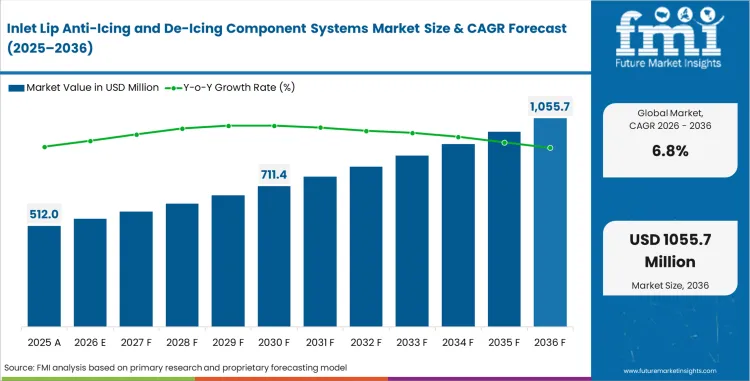
The inlet lip anti-icing and de-icing component systems market was valued at USD 479.4 million in 2025. The industry is expected to reach USD 512 million in 2026 at a CAGR of 6.8% during the forecast period. Revenue expansion takes the valuation to USD 988 million through 2036 as inlet protection remains tied to airworthiness discipline, recurring winter exposure, and replacement demand across fleets that cannot tolerate airflow disturbance or avoidable engine-ingestion risk.
Summary of Inlet Lip Anti-Icing and De-Icing Component Systems Market
- Inlet Lip Anti-Icing and De-Icing Component Systems Market Snapshot
- Inlet lip anti-icing and de-icing component systems industry is valued at USD 479.4 million in 2025 and is projected to reach USD 988.5 million by 2036.
- Industry outlook points to a CAGR of 6.8% from 2026 to 2036, creating an incremental opportunity of USD 476.5 million.
- Certification burden, thermal reliability, and maintainability carry more weight in this aerospace subsystem than raw shipment volume.
- Airworthiness requirements keep this hardware tied to essential aircraft operation, since engine and airframe applications need ice protection in known or forecast icing conditions.
- Inlet Lip Anti-Icing and De-Icing Component Systems Market Demand Drivers
- Aircraft production and fleet renewal continue to support inlet-lip and nacelle protection demand by keeping original-equipment content visible across new programs.
- Bleed-air nacelle anti-icing remains firmly placed in turbofan applications, which keeps valves, ducts, manifolds, and control hardware relevant even as electrical formats gain more attention.
- Electro-thermal adoption is rising where air inlets, engines, and retrofit-heavy platforms need tighter thermal control with cleaner system integration.
- Country outlook remains strongest in China at a CAGR of 8.8% through 2036, followed by India at 8.5%, the United Arab Emirates at 7.6%, Brazil at 6.4%, the United States at 6%, France at 5.9%, and the United Kingdom at 5.7%.
- Long validation cycles, low tolerance for in-service failure, and the need to balance anti-icing performance against bleed-air extraction or onboard electrical load keep adoption discipline tight.
- Inlet Lip Anti-Icing and De-Icing Component Systems Market Product and Segment View
- Coverage includes inlet-lip and engine-intake protection hardware built from titanium, aluminum, composites, and elastomers for nacelles, turboprop inlets, rotorcraft air inlets, and retrofit protection packages.
- Bleed-air is expected to account for 47% share in 2026 because hot-air nacelle anti-icing remains the preferred configuration across many transport-category turbofan applications.
- Supported by electro-thermal layouts, inlet-lip hot zones, and retrofit protection kits that keep, heater content central in both OE and spare demand Heaters are projected to secure 24% share in 2026.
- Titanium is likely to represent 39% of the segment in 2026, reflecting its suitability for inlet-lip environments where heat tolerance, corrosion resistance, and durability matter around thin leading-edge surfaces.
- Narrowbody aircraft are anticipated to emerge with 31% share in 2026 because single-aisle platforms make up the densest OE volume base in commercial aviation.
- Since nacelle-lip anti-ice remains closely tied to the installed base of transport-category turbofan aircraft, Turbofan is forecast to represent 54% share in 2026.
- Integrated systems are expected to contribute 55% of total share in 2026 as airframers and engine OEMs continue to favor packaged control, thermal, ducting, and monitoring arrangements over isolated parts.
- Aftermarket is likely to secure 46% share in 2026 because heaters, valves, harnesses, boots, and controller elements require recurring MRO attention and replacement over long service lives.
- Supported by the concentration of inlet-lip system value in transport-category aircraft, part 25 is set to account for 52% share in 2026.
- Scope includes inlet-lip heaters, valves, ducts, controllers, harnesses, sensors, boots, manifolds, and integrated protection modules, while airport ground deicing fluids, wing-only systems, windshield-only systems, and generic anti-icing coatings remain outside scope unless they are directly integrated into inlet-lip component assemblies.
- Inlet Lip Anti-Icing and De-Icing Component Systems Market Geography and Competitive Outlook
- China, India, and the United Arab Emirates remain the fastest-advancing country pockets in this study, while the United States and France continue to represent stable high-value industry bases because of supplier depth, installed fleet presence, and certification capability.
- Competitive intensity is shaped by platform qualification, long-cycle OEM approvals, retrofit acceptance, and MRO access rather than rapid share movement, which keeps the industry moderately fragmented.
Key Takeaways, Market Size, and Forecast
- Inlet Lip Anti-Icing and De-Icing Component Systems Market is projected to rise from USD 512 million in 2026 to USD 988 million by 2036, at a CAGR of 6.8%.
- The inlet lip anti-icing and de-icing component systems market was valued at USD 479.4 million in 2025.
- By 2036, the Inlet Lip Anti-Icing and De-Icing Component Systems Market is likely to be worth USD 988 million.
- From 2026 to 2036, the market is anticipated to expand at a CAGR of 6.8%.
- The market is expected to generate an incremental opportunity of USD 476.5 million between 2026 and 2036.
- In 2026, Bleed-air is expected to account for 47% of the protection method segment.
- China (8.8% CAGR) and India (8.5% CAGR) are anticipated to be two of the fastest growing markets.
Nacelle and propulsion teams now have to decide much earlier whether an inlet lip system will remain on a bleed-air path or move toward an electric layout that can balance thermal coverage, wiring load, maintenance access, and certification effort within one package. Earlier programs could leave ice protection until later in nacelle development. Current programs do not allow that separation, because the inlet lip now affects heat management, controls, maintenance manuals, and shop turnaround at the same time. Lowest-power design choices also do not automatically make qualification easier, since temperature uniformity and repeatable ice shedding still carry more weight than novelty alone. Close overlap with anti-icing coatings and adjacent inlet-focused protection work keeps this category tied to a broader inlet-performance discussion rather than a narrow component decision.
Platform qualification on a live inlet installation remains the point that decides how quickly this category can move forward. Once airworthiness teams, engine programs, and maintenance documentation align around a common installation path, follow-on use across sister fleets becomes easier to support. Repeat hardware fitment begins only after service access and thermal behavior are proven together, because line maintenance acceptance matters as much as technical performance.
China is estimated to register a CAGR of 8.8% during 2026 to 2036, supported by fleet additions and stronger maintenance depth. India, where the industry outlook is expected to advance at 8.5% CAGR over the same period, follows closely as fleet expansion keeps adding service requirements. Fleet intensity and MRO activity keep the United Arab Emirates on an ascending path, with a CAGR of 7.6% projected for 2026 to 2036. Brazil remains on a positive trend, and its sector is likely to post 6.4% CAGR as regional aircraft activity continues to support inlet-related service work. In the United States, the industry is projected to move at 6% CAGR through 2036, while France is expected to hold 5.9% and the United Kingdom 5.7% over the forecast period. Variation across these countries comes less from headline fleet size and more from fleet age, nacelle-service capability, and how readily more-electric inlet solutions can be absorbed without disrupting line maintenance.
Inlet Lip Anti-Icing and De-Icing Component Systems Market Key Takeaways
| Metric | Details |
|---|---|
| Industry Size (2026) | USD 512 million |
| Industry Value (2036) | USD 988 million |
| CAGR (2026-2036) | 6.8% |
Source: Future Market Insights (FMI) analysis, based on proprietary forecasting model and primary research
Segmental Analysis
Inlet Lip Anti-Icing and De-Icing Component Systems Market Analysis by Protection Method
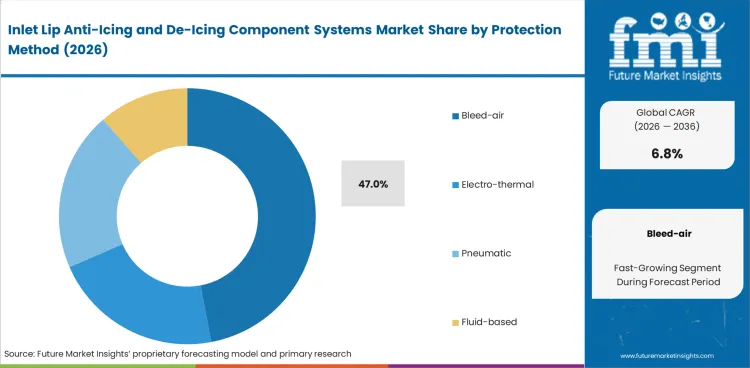
Installed transport fleets still lean on bleed-air because certified nacelle layouts, thermal familiarity, and established maintenance logic keep it practical across a wide swath of inlet applications. In 2026, Bleed-air is expected to contribute 47% of total protection-method demand. Lead position reflects the way existing transport designs already support hot-air routing and valve control without requiring a full electrical rework at the inlet lip. Electro-thermal solutions continue to enter selected programs where power management, wiring protection, and temperature control can be handled more cleanly. Pneumatic and fluid-based options keep relevance in narrower use cases, yet neither matches the installed-base advantage of bleed-air. Delayed movement away from proven heat-routing methods can leave engineering teams carrying extra qualification work at the point where nacelle timing is least forgiving. aerospace valves remain a close adjacent category because valve performance still determines how consistently thermal energy reaches the lip.
- Heat source: Bleed-air keeps heat delivery close to established nacelle practice. Maintenance crews benefit when diagnostic logic and replacement routes are already familiar.
- Flow control: Valve and duct coordination matters because uneven heat application can create cold spots near the lip. Airworthiness teams prefer hardware that keeps thermal coverage predictable across the full inlet arc.
- Upgrade path: Electric entry is easier on platforms that can absorb wiring and control changes early. Late design changes usually add review burden rather than shortening release work.
Inlet Lip Anti-Icing and De-Icing Component Systems Market Analysis by Component Type
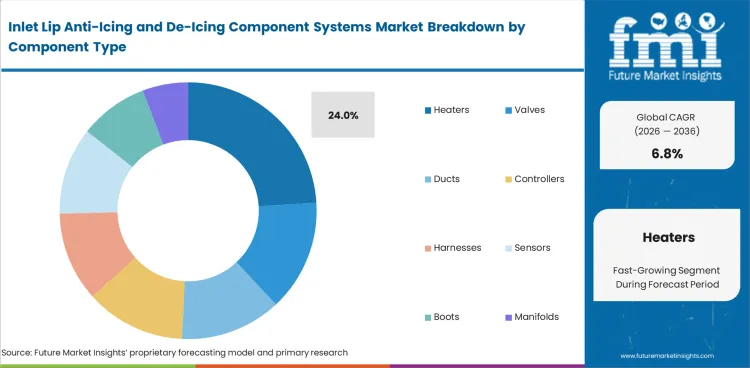
Heaters are projected to represent 24% share in 2026 within component type. Heat-delivery parts sit at the center of inlet protection because they carry the most direct exposure to thermal cycling, moisture, and repeated winter-service stress. Position stems from the way electric and mixed architectures rely on the heater element itself to maintain repeatable lip temperature rather than on supporting hardware alone. Valves, controllers, ducts, harnesses, sensors, boots, and manifolds remain essential, yet they support or regulate the protection event instead of creating it. Replacement demand also lands more visibly on heater assemblies because wear, localized damage, and performance drift are easier to trace there during shop evaluation. Weak heater reliability can pull an otherwise acceptable inlet system back into repeat inspection loops. aircraft generators stay relevant to this category as electrical supply quality becomes more visible in electric protection layouts.
- Thermal coverage: Heater design controls whether the inlet lip warms evenly across exposed zones. Uneven output can extend troubleshooting time during cold-weather checks.
- Inspection burden: Shop visits often trace performance loss back to element damage or connection faults. Clear test procedures reduce repeat removals and help hold turnaround time.
- Control link: Sensor and controller quality still matters because heater output must match icing severity. Faulty coordination can create either under-heating or wasted electrical load.
Inlet Lip Anti-Icing and De-Icing Component Systems Market Analysis by Material
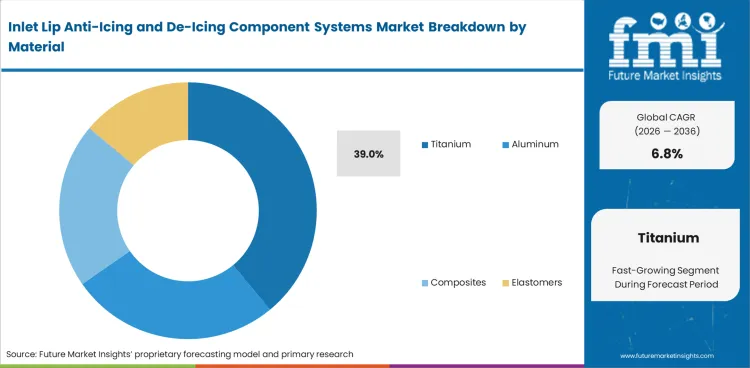
Leading-edge duty places unusual demands on material choice, since inlet lips face heat, erosion, moisture, and corrosion at the same time. Titanium is expected to account for 39% share in 2026. Titanium stays ahead because it can handle exposed inlet service without giving up the durability required around heated surfaces and airflow-critical geometry. Aluminum and composites remain important where weight, cost, or program design point in another direction, while elastomers matter more in specific boot or seal applications. Material choice is rarely an isolated cost decision here. Repair rhythm, surface finish, and heat-response consistency all sit inside the same conversation. Choosing a material that looks acceptable on paper yet underperforms in service can turn winter reliability into a recurring shop problem. Hybrid exterior components provide a useful adjacent read because mixed-material exterior parts face similar durability and repair questions.
- Corrosion duty: Inlet lips operate where moisture exposure is persistent and surface breakdown cannot be ignored. Material choice must protect both durability and thermal response.
- Erosion resistance: Rain, particles, and repeated service handling wear exposed leading edges over time. Durable material selection lowers the chance of early refurbishment work.
- Repair rhythm: Material choice changes how easily the lip can be restored during overhaul. Faster repair paths help maintenance heads keep winter-service readiness intact.
Inlet Lip Anti-Icing and De-Icing Component Systems Market Analysis by Aircraft Type
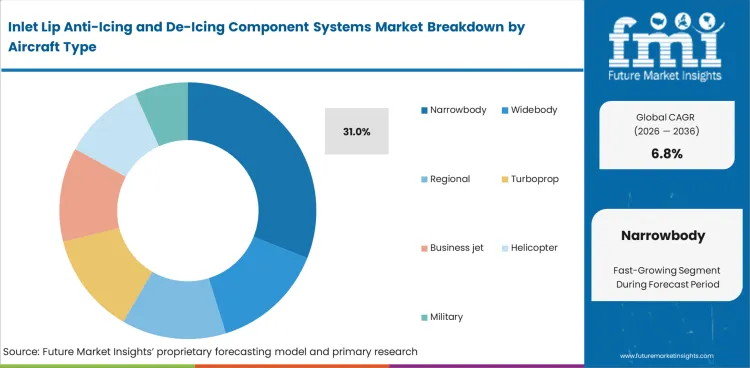
Single-aisle aircraft anchor the value base for inlet lip hardware because they combine the deepest fleet count with frequent service exposure and heavy utilization across varied climates. Narrowbody aircraft are likely to secure 31% share in 2026. Lead position comes less from hardware novelty and more from installed fleet density, recurring maintenance activity, and the volume of nacelle work tied to mainstream commercial service. Widebody programs contribute higher content on selected platforms, while regional aircraft, turboprops, helicopters, military aircraft, and business jets keep the category diverse. Yet none of those groups match the sheer service footprint of the narrowbody fleet. Missing narrowbody qualification can limit supplier reach even when a system performs well on smaller or more specialized platforms. turbofan engines remain tightly linked because narrowbody value is inseparable from the turbofan nacelle base they carry.
- Dispatch rhythm: High cycle counts keep inlet components under regular review on narrowbody fleets. Frequent service exposure supports recurring replacement and overhaul demand.
- Fleet density: Installed-base depth gives suppliers more repeatability once a program is qualified. Common hardware families also simplify spare stocking across multiple operators.
- Service access: Narrowbody maintenance windows are often tight, especially during winter schedules. Components that can be removed and reinstalled cleanly hold a practical advantage.
Inlet Lip Anti-Icing and De-Icing Component Systems Market Analysis by Engine Type
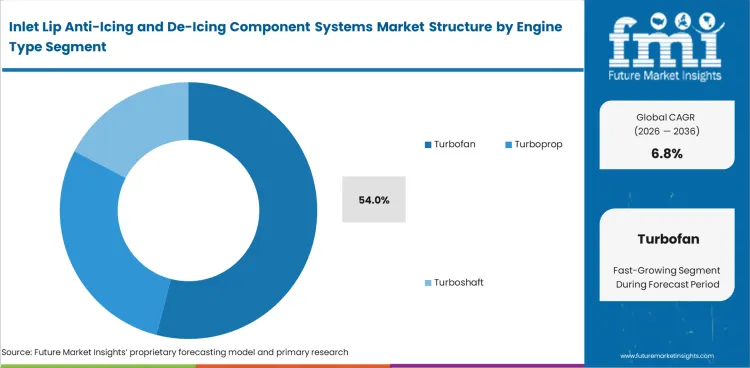
Turbofan is forecast to represent 54.0% share in 2026. Commercial propulsion volume keeps turbofan nacelles at the center of this category, since the largest inlet-lip value pools sit on transport aircraft with active winter-service exposure. The share reflects the balance of fleet size, nacelle content, and the ongoing need to protect inlet geometry on heavily utilized transport aircraft. Turboprop and turboshaft platforms still matter, especially where boot-based or mixed anti-icing layouts remain active, but they do not carry the same aggregate value base. Engine-type leadership here is really a fleet-and-duty-cycle story. Misreading that balance can leave suppliers over-focused on smaller platform niches while the larger transport base continues to set replacement demand. Engine blades form a useful adjacent category because inlet protection exists to keep downstream engine hardware safe from icing-related disruption.
- Ice envelope: Turbofan inlet protection must preserve airflow quality under demanding operating conditions. Reliable inlet performance guards downstream engine hardware from avoidable disturbance.
- Platform mix: Turboprop and turboshaft demand remains real, yet total component value is lower across the broader fleet base. Portfolio balance matters more than single-platform visibility.
- Lifecycle fit: Engine family selection affects service intervals, spares logic, and replacement patterns. Strong alignment with active transport fleets keeps suppliers closer to recurring demand.
Inlet Lip Anti-Icing and De-Icing Component Systems Market Analysis by Integration Level
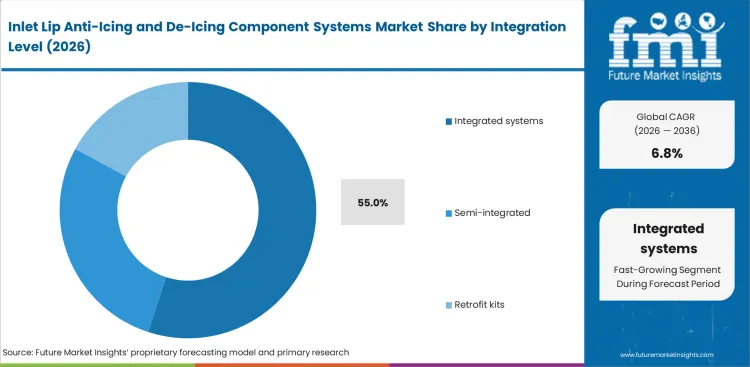
Engineering teams increasingly prefer packaged inlet systems because certification, wiring, controls, and service documentation move more smoothly when the lip assembly is treated as one coordinated unit. Integrated systems are expected to make up 55% share in 2026. The that lead reflects how many programs now want fewer handoff points between heater elements, sensors, controllers, harnesses, and mounting hardware. Semi-integrated sets still fit programs with partial legacy carryover, while retrofit kits serve installed fleets that need targeted winter upgrades without a full redesign. Even so, the strongest pull sits with assemblies that reduce coordination risk across design, qualification, and line service. Fragmented hardware can leave maintenance teams carrying extra troubleshooting burden because fault isolation becomes less clean across disconnected parts. aircraft actuators provide an adjacent comparison, since integrated motion-control systems face a similar demand for coordinated component behavior.
- Installation path: Packaged assemblies shorten handoff points during integration and release work. Fewer interface questions help engineering teams keep nacelle timing under control.
- Manual integration: Service documentation is easier to maintain when one assembly carries aligned test and replacement logic. Mixed hardware sources often complicate fault tracing.
- Retrofit tension: Installed fleets still need targeted winter upgrades where full replacement is unnecessary. Retrofit kits remain relevant when airframe timing or cost blocks a full packaged move.
Inlet Lip Anti-Icing and De-Icing Component Systems Market Analysis by Sales Channel
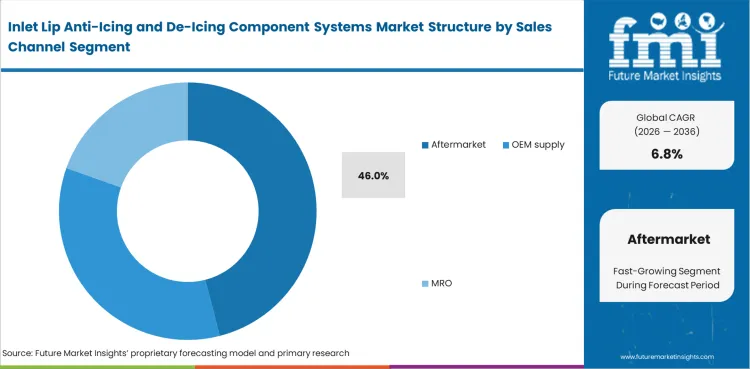
Winter wear, overhaul cycles, and long aircraft service lives keep replacement demand visible well beyond first fitment. Aftermarket is expected to account for 46% share in 2026. Dominance rests on the recurring need to inspect, replace, and refurbish inlet hardware exposed to harsh operating conditions over long service periods. OEM supply remains essential for new programs and line-fit installation, while MRO channels matter where testing, overhaul, and scheduled replacement carry more weight. Value does not disappear after certification. It often becomes more repeatable once a component family enters regular maintenance schedules across active fleets. Weak spare coverage can undermine an otherwise accepted system because winter service does not wait for long replenishment cycles. commercial aircraft mro is closely related because ongoing inlet support lives inside the broader maintenance economy.
- Renewal logic: Replacement demand follows component wear, overhaul findings, and winter exposure rather than new-build cycles alone. Long service lives keep the aftermarket active.
- Spare stocking: Readily available parts matter when cold-weather events tighten maintenance windows. Thin inventory can delay return-to-service on otherwise manageable repairs.
- Shop demand: MRO channels remain important because testing and refurbishment stay tied to inlet reliability. Service activity often reveals recurring failure points before line crews do.
Inlet Lip Anti-Icing and De-Icing Component Systems Market Analysis by Certification Class
Transport-category aircraft dominate certified inlet protection value because their operating profiles, nacelle content, and compliance burden make ice-protection hardware harder to treat as a minor accessory. Part 25 aircraft are expected to represent 52% share in 2026. The result reflects the depth of commercial transport activity and the level of evidence required before inlet systems can enter active service on these aircraft. Part 23, Part 27, and Part 29 applications remain relevant and sometimes more flexible, yet their combined value still trails the transport base. Certification class shapes not only qualification cost but also documentation depth, service logic, and replacement discipline over time. Underestimating that burden can leave smaller suppliers unprepared for the full release path. Ice accretion sensors offer a nearby reference point because sensing hardware faces the same airworthiness evidence demands in icing-related applications.
- Qualification trail: Transport-class approval requires clear proof of performance, durability, and service behavior. Documentation quality matters almost as much as hardware quality.
- Service evidence: Part 25 programs place heavier emphasis on repeatable field performance once systems enter fleet use. Inlet hardware must remain credible beyond the initial release stage.
- Compliance depth: Smaller classes can move faster in selected cases, yet total value still sits with transport applications. Supplier readiness depends on matching the documentation burden to the target class.
Inlet Lip Anti-Icing and De-Icing Component Systems Market Drivers, Restraints, and Opportunities
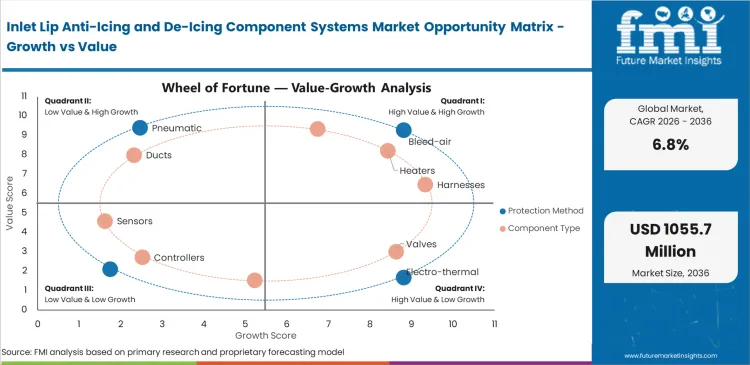
Certification teams, nacelle engineers, and maintenance heads now have to settle inlet-lim decisions earlier because icing protection reaches into thermal routing, electrical planning, access clearances, and manual release work at the same time. Winter reliability no longer settles the choice on its own. Program teams also need to judge how a selected assembly will perform after repeated service events, overhaul findings, and line troubleshooting. Hardware families that preserve clean installation logic and consistent thermal coverage retain an advantage, especially as aerostructures and other exposed exterior parts are expected to carry more than one performance role.
Qualification effort remains the main restraint when programs move late or try to build the inlet package from too many disconnected parts. From a component view, inlet hardware can look manageable. Once the nacelle release path begins, test evidence, temperature mapping, replacement logic, and control integration can widen the workload quickly. Smaller suppliers face an added hurdle when service documentation and spares coverage do not mature at the same pace as the hardware. More modular assemblies and earlier pre-validation are easing part of that pressure, but neither removes the need to prove repeatable in-service behavior.
Opportunities in the Inlet Lip Anti-Icing and De-Icing Component Systems Market
- Electrified platforms: More-electric aircraft programs create room for inlet systems that can deliver precise heat control without relying on legacy bleed architecture. Engineering teams can capture this opening by proving wiring protection, power draw discipline, and repeatable lip temperature across the full icing envelope.
- Retrofit cycles: Installed fleets create a useful path for targeted inlet upgrades where operators want better winter reliability without a full nacelle redesign. Maintenance heads can take advantage when replacement kits enter existing service documents cleanly and avoid extra hangar time.
- Thermal integration: Programs tied to electric motors and other more-electric subsystems widen the need for coordinated heat-management planning. Nacelle teams that can align inlet protection with broader onboard power discipline hold a clearer route into future aircraft work.
Regional Analysis
Based on the regional analysis, the Inlet Lip Anti-Icing and De-Icing Component Systems market is segmented into North America, Latin America, Europe, Asia Pacific, and Middle East across 40 plus countries.
.webp "Top Country Growth Comparison Inlet Lip Anti Icing And De Icing Component Systems Market Cagr (2026 2036)")
| Country | CAGR (2026 to 2036) |
|---|---|
| China | 8.8% |
| India | 8.5% |
| United Arab Emirates | 7.6% |
| Brazil | 6.4% |
| United States | 6% |
| France | 5.9% |
| United Kingdom | 5.7% |
Source: Future Market Insights (FMI) analysis, based on proprietary forecasting model and primary research
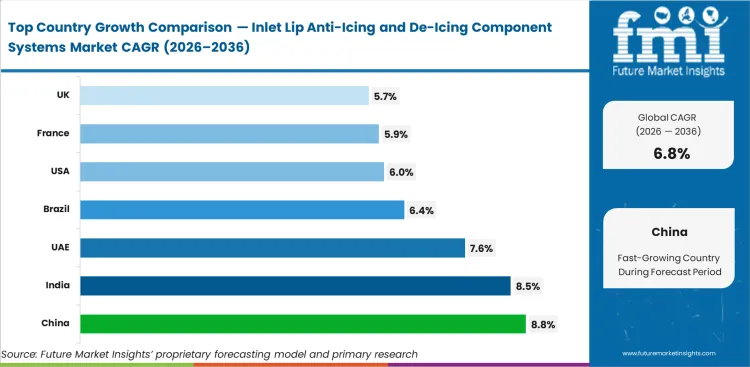
Asia Pacific Inlet Lip Anti-Icing and De-Icing Component Systems Market Analysis
Asia Pacific holds the strongest forward pace in this report because aircraft additions, local service capacity, and winter-capable fleet planning are advancing together. Inlet-lip demand across the region depends less on a single platform program and more on the combined effect of fleet expansion, regional manufacturing depth, and maintenance capability. Engineering teams also have reason to keep both bleed-air and electric routes open while fleet age and mission mix remain varied. Leading- edge coatings points to the same regional direction, with more attention being given to exposed cold-weather surfaces across multiple layers of protection.
- China: Production depth and fleet expansion keep China at the front of this regional group. Industry outlook in China points to 8.8% CAGR through 2036, supported by a larger aviation base that can absorb both first-fit and replacement demand. Nacelle work also benefits from broader qualified aerospace manufacturing capacity than many peer countries can offer. Suppliers gain ground only when thermal performance, documentation quality, and spare support move together. Related attention around icephobic coatings also suggests a wider regional interest in limiting ice attachment on exposed aviation surfaces.
- India: India is expected to record 8.5% CAGR in the sector through 2036. Fleet expansion remains the clearest signal in India, but the more useful point is how that expansion is starting to pull service capability with it. Engineering teams here often have to balance rising fleet numbers with practical replacement routes and manual clarity once winter-service requirements become more visible. Inlet systems that are easier to inspect and remove are likely to stay better placed, since service depth is still catching up in parts of the chain. Wider progress in air transport MRO supports the same reading, because service capacity matters nearly as much as initial installation.
FMI's report includes additional Asia Pacific countries beyond the two profiled above. Common direction across those market points to a gradual rise in qualified service depth, yet pace still depends on how quickly local maintenance capability can support recurring winter hardware needs after first fitment.
Americas Inlet Lip Anti-Icing and De-Icing Component Systems Market Analysis
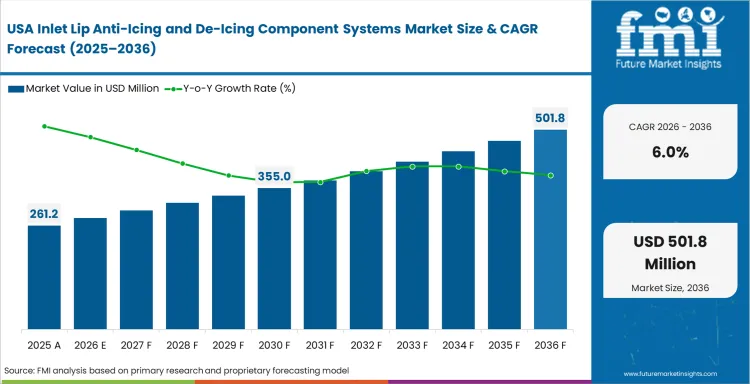
North and Latin America do not follow the same pace in this category, yet both remain important for different operating reasons. United States demand analysis stays anchored by a mature aviation base, deep supplier presence, and a wide installed fleet. Brazil matters because regional-aircraft activity keeps inlet hardware relevant even with a smaller overall fleet than North America. Deicing fluid demand across the broader aviation chain reinforces the same point, as cold-weather readiness remains a recurring operating discipline even when the component mix changes.
- United States: Mature aerospace depth defines the United States more than headline expansion alone. Inlet lip anti-icing and de-icing component systems in the United States are projected to expand at a CAGR of 6.0% through 2036. Rate of advance sits below China and India, yet industry quality remains high because design authority, certification capability, and installed fleet scale are already well established. Maintenance heads in the country also work within a dense repair and overhaul base, which supports recurring hardware replacement after a part family is accepted. Adjacent activity in hydraulic systems underlines the same commercial truth which is mature aviation platforms reward suppliers that can support long service lives, not just first-fit delivery.
- Brazil: Sector outlook in Brazil indicates 6.4% CAGR through 2036. Regional-aircraft relevance gives Brazil a distinct role in this category. Local industry strength comes from aircraft activity where winter protection cannot be overlooked even if the fleet base is smaller than in the United States. Serviceability carries extra weight here because component replacement has to fit operating economics closely. Suppliers able to support refurbishment, targeted upgrades, and workable overhaul routes are likely to perform better than firms offering hardware without dependable service follow-through. Interest around aircraft refurbishing supports the same direction.
FMI's report includes additional countries in North and Latin America where inlet hardware demand stays linked to fleet renewal, winter exposure, and service-readiness discipline. Wider regional pattern suggests that mature aviation bases reward deep documentation and repair support, while smaller fleets favor flexible replacement paths and refurbishment-friendly hardware.
Europe and Middle East Inlet Lip Anti-Icing and De-Icing Component Systems Market Analysis
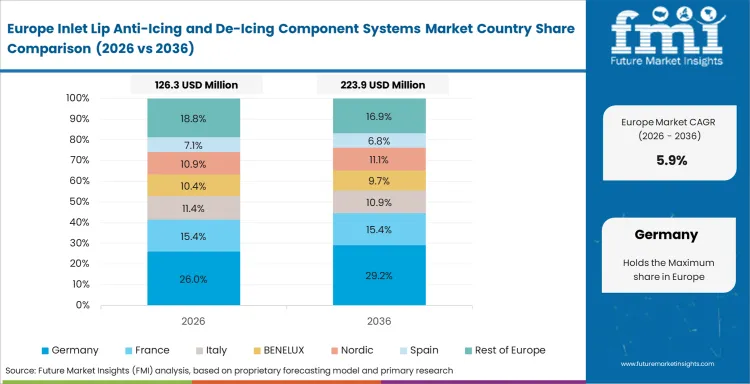
Europe and the Middle East make a useful pairing because both regions carry serious aviation capability, though the operating logic is different. Europe leans more heavily on engineering depth, certification rigor, and established supplier capability. Middle East demand for inlet lip anti-icing and de-icing component systems is shaped more by high-value fleet activity, hub-driven maintenance, and the need to protect dispatch reliability across demanding schedules. Adjacent reading on aerospace c-class parts also shows how supply quality and documentation discipline continue to influence acceptance long after initial installation.
- France: Supplier depth gives France more importance than its pace alone might suggest. France is forecast to post 5.9% CAGR in the industry through 2036. Airworthiness work, nacelle expertise, and long experience in transport-aircraft programs keep the country close to high-value component activity even though faster-expanding countries sit elsewhere. Engineering groups here are unlikely to favor hardware that reduces cost at the start but creates uncertainty in manual treatment or shop inspection later. Preference for disciplined and repeatable assemblies keeps qualified programs relatively stable.
- United Kingdom: Service logic carries heavy weight in the United Kingdom because approved repair depth and long-established aerospace capability keep replacement credibility strong. Through 2036, the sector in the United Kingdom is likely to advance at a CAGR of 5.7%. Pace is moderate, yet moderate pace does not reduce commercial relevance. Suppliers still have to meet demanding expectations around traceability, thermal consistency, and parts support. Hardware that reaches release quickly but complicates later maintenance is less likely to hold position in this environment. Stable aftermarket activity and adjacent maintenance chemicals demand reinforce that point.
- United Arab Emirates: Hub-driven fleet intensity gives the United Arab Emirates a steeper climb than most mature Western bases. Widebody-heavy operations and active service networks keep replacement demand visible, which is why the country is set to register 7.6% CAGR through 2036. Line maintenance pressure is especially important here because dispatch interruptions carry immediate schedule consequences. Component families that combine reliable thermal behavior with clear shop procedures are likely to remain well placed. Ties with commercial aircraft mro are especially close, since heavy service activity keeps recurring component use visible.
FMI's report includes additional European and Middle East countries not listed in the table above. Shared regional pattern points to a split between engineering-led acceptance in Europe and service-intensity-led consumption in the Middle East, yet both paths reward suppliers that can keep certification quality, documentation discipline, and replacement support tightly aligned.
Competitive Aligners for Market Players
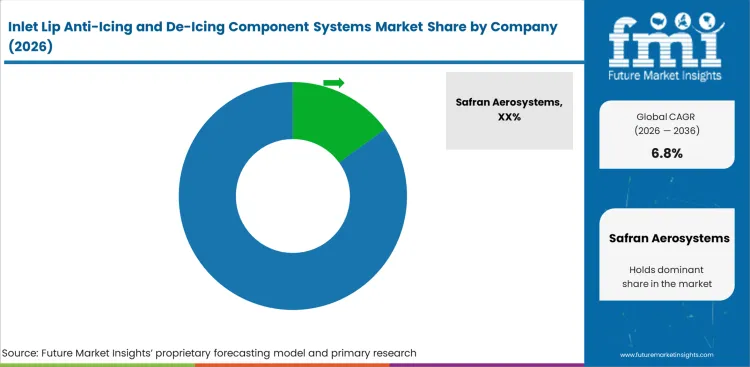
Qualification burden keeps this market moderately concentrated. Safran Aerosystems, Collins Aerospace, Parker Aerospace, GKN Aerospace, ITT Aerospace Controls, Cox & Company, and Hutchinson compete inside a category where component acceptance depends on repeatable thermal behavior, clean installation logic, and dependable manual treatment more than on headline breadth alone. Engineering teams do not separate the part from the release path. A heater, valve, harness, or boot must fit the nacelle, the control logic, and the service document set at the same time. Related activity in engine blades points to the same operating reality of aviation hardware gains staying power when it protects downstream performance without creating a new maintenance burden.
Incumbents keep an edge because they have already built the evidence trail, program familiarity, and support rhythm that this category demands. Safran Aerosystems, Collins Aerospace, and Parker Aerospace benefit from deeper installed visibility across nacelle and inlet-adjacent hardware. ITT Aerospace Controls and Hutchinson remain relevant where focused capability and application fit matter more than sheer portfolio size. Cox & Company stands out in more-electric inlet work because targeted thermal expertise can matter when a program is evaluating alternatives. Adjacent categories such as aircraft actuators and aircraft generators show a similar pattern, where integrated support and documentation readiness keep challengers from entering too casually.
Challengers can still gain room, but the opening is narrow. Progress is more likely when a supplier solves a specific inlet problem such as service access, thermal uniformity, lighter integration, or retrofit practicality rather than trying to displace every incumbent position at once. Hardware that reaches accepted fleets with a clean replacement path can build follow-on demand over time. Yet that progress usually depends on strong parts support, proven field behavior, and the ability to hold quality across recurring winter-service cycles. Nearby work on aircraft generators and aircraft de-icing offers the same lesson: accepted aviation hardware tends to expand from trusted execution, not from broad claims.
Key Players in Inlet Lip Anti-Icing and De-Icing Component Systems Market
- Safran Aerosystems
- Collins Aerospace
- Parker Aerospace
- GKN Aerospace
- ITT Aerospace Controls
- Cox & Company
- Hutchinson
Scope of the Report
| Metric | Value |
|---|---|
| Quantitative Units | USD 512 million in 2026 and USD 988.5 million by 2036, at a CAGR of 6.8% |
| Market Definition | Certified components and linked assemblies used to prevent or remove ice on engine and nacelle inlet lips. |
| Segmentation | Protection Method; Component Type; Material; Aircraft Type; Engine Type; Integration Level; Sales Channel; Certification Class |
| Regions Covered | North America; Latin America; Europe; Asia Pacific; Middle East |
| Countries Covered | China; India; United Arab Emirates; Brazil; United States; France; United Kingdom |
| Key Companies Profiled | Safran Aerosystems; Collins Aerospace; Parker Aerospace; GKN Aerospace; ITT Aerospace Controls; Cox & Company; Hutchinson |
| Forecast Period | 2026 to 2036 |
| Estimate Base Year | 2025 |
| Approach | Aircraft production flow, installed fleet service demand, subsystem content assumptions, and replacement intensity across inlet-lip anti-icing and de-icing component systems. |
Source: Future Market Insights (FMI) analysis, based on proprietary forecasting model and primary research
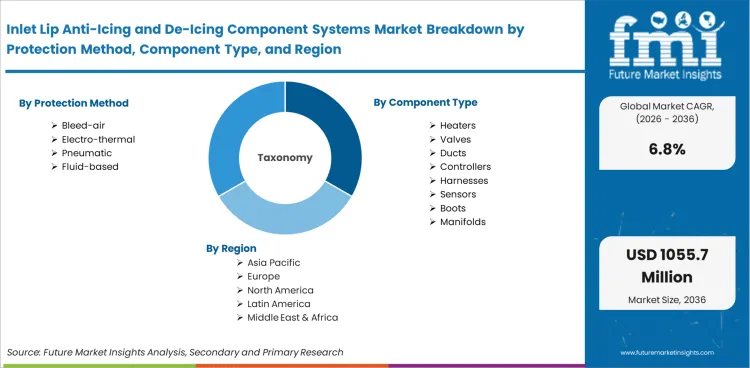
Inlet Lip Anti-Icing and De-Icing Component Systems Market Analysis by Segments
By Protection Method:
- Bleed-air
- Electro-thermal
- Pneumatic
- Fluid-based
By Component Type:
- Heaters
- Valves
- Ducts
- Controllers
- Harnesses
- Sensors
- Boots
- Manifolds
By Material:
- Titanium
- Aluminum
- Composites
- Elastomers
By Aircraft Type:
- Narrowbody
- Widebody
- Regional
- Turboprop
- Business jet
- Helicopter
- Military
By Engine Type:
- Turbofan
- Turboprop
- Turboshaft
By Integration Level:
- Integrated systems
- Semi-integrated
- Retrofit kits
By Sales Channel:
- Aftermarket
- OEM supply
- MRO
By Certification Class:
- Part 25
- Part 23
- Part 27
- Part 29
By Region:
- Asia Pacific
- China
- India
- Americas
- United States
- Brazil
- Europe and Middle East
- France
- United Kingdom
- United Arab Emirates
Bibliography
- Airbus. (2025, January 9). Airbus reports 766 commercial aircraft deliveries in 2024.
- Boeing. (2025, January 14). Boeing announces fourth quarter deliveries.
- Embraer. (2025, January 7). Embraer reached 75 deliveries in the last quarter of 2024, for a total of 206 new aircraft in the year.
- Federal Aviation Administration. (2024, August 6). FAA holdover time guidelines winter 2024-2025.
- European Union Aviation Safety Agency. (2024, December 12). 2024-0233: Equipment and furnishings / ice and rain protection / fuselage - dual hoist removable parts or de-icing system - removal.
This bibliography is provided for reader reference. The full FMI report contains the complete reference list with primary source documentation.
This Report Addresses
- Current and forecast valuation for inlet lip anti-icing and de-icing component systems from 2026 to 2036.
- Component-level analysis across heaters, valves, ducts, controllers, harnesses, sensors, boots, and manifolds.
- Technology mixes across bleed-air, electro-thermal, pneumatic, and fluid-based protection methods.
- Material outlook across titanium, aluminum, composites, and elastomers in exposed inlet applications.
- Aircraft and engine coverage spanning narrowbody, widebody, regional, turboprop, business-jet, helicopter, and military platforms.
- Channel analysis covering OEM supply, aftermarket demand, and MRO-linked replacement activity.
- Country-level forecast view for China, India, United Arab Emirates, Brazil, United States, France, and United Kingdom.
- Competitive positioning of key suppliers active in certified inlet-lip hardware and related support.
Frequently Asked Questions
What was the estimated size in 2025?
Inlet Lip Anti-Icing and De-Icing Component Systems Market was valued at USD 479.4 million in 2025, reflecting certified inlet hardware demand tied to active fleets, winter exposure, and replacement cycles.
What value is expected in 2026?
FMI estimates the category will reach USD 512 million in 2026 as installed transport fleets continue to require qualified inlet-lip protection assemblies.
How large can the category become by 2036?
FMI projects total valuation to advance to USD 988.5 million by 2036, supported by recurring replacement needs and steady fleet expansion.
What CAGR is forecast from 2026 to 2036?
The market is projected to expand at a CAGR of 6.8% during 2026 to 2036, with growth led by certified transport applications.
Which protection method leads in 2026?
Bleed-air leads protection method in 2026 with 47% share because established nacelle layouts still favor proven thermal routing.
Which component type leads in 2026?
Heaters lead component type with 24% share in 2026, since heat delivery remains central to inlet-lip performance.
Which material leads the market in 2026?
Titanium leads material demand with 39% share in 2026 due to durability, corrosion resistance, and exposed leading-edge duty.
Which aircraft type carries the largest share?
Narrowbody aircraft are expected to hold 31% share in 2026 because fleet depth and service frequency remain strongest there.
Which engine type remains dominant?
Turbofan-powered applications lead engine type with 54% share in 2026, reflecting transport-aircraft nacelle value concentration.
Which integration level remains ahead?
Integrated systems are expected to account for 55% share in 2026 because coordinated assemblies ease qualification and servicing.
Which sales channel is the largest?
Aftermarket demand leads with 46% share in 2026 as winter wear, overhaul findings, and replacement cycles remain active.
Which certification class contributes the most?
Part 25 leads certification class with 52.0% share in 2026 because transport-category aircraft hold the deepest value pool.
Which country records the fastest growth?
China records the fastest forecast pace at 8.8% through 2036, helped by fleet expansion and wider local aerospace capability.
How does India compare with China?
India follows China closely with 8.5%, showing that fast fleet growth is also pulling inlet-related service demand higher.
Why does the aftermarket stay important?
Aftermarket demand stays important because inlet components remain exposed to winter wear, repeated inspections, and overhaul-driven replacement across long aircraft lives.
Why do integrated systems lead this category?
Integrated systems lead because they reduce handoff points across heaters, controls, harnesses, and service documentation during qualification and field support.
What keeps bleed-air ahead today?
Bleed-air stays ahead because many certified transport nacelles already accommodate that heat source, reducing redesign pressure on active aircraft programs.
How are electro-thermal systems entering the field?
Electro-thermal systems are entering where power management, wiring protection, and precise temperature control can be handled early within the program release path.
What does Part 25 dominance indicate?
Part 25 dominance indicates that transport-category aircraft set the pace for inlet-lip value, documentation burden, and long-run replacement demand.
Who are the key companies covered here?
Key companies include Safran Aerosystems, Collins Aerospace, Parker Aerospace, GKN Aerospace, ITT Aerospace Controls, Cox & Company, and Hutchinson.
What is included within scope?
Scope includes heaters, valves, ducts, manifolds, harnesses, controllers, sensors, boots, and integrated assemblies used directly in inlet-lip protection.
What sits outside the scope?
Wing-only systems, windshield-only systems, airport deicing operations, and generic coatings without certified inlet-lip integration remain outside the scope.
Preview the report firsthand - request a free sample
Get SampleGet the brochure for pricing and purchase details.
Get PDFTable of Content
- Executive Summary
- Global Market Outlook
- Demand-side Trends
- Supply-side Trends
- Technology Roadmap Analysis
- Analysis and Recommendations
- Market Overview
- Market Coverage / Taxonomy
- Market Definition / Scope / Limitations
- Research Methodology
- Chapter Orientation
- Analytical Lens and Working Hypotheses
- Market Structure, Signals, and Trend Drivers
- Benchmarking and Cross-market Comparability
- Market Sizing, Forecasting, and Opportunity Mapping
- Research Design and Evidence Framework
- Desk Research Programme (Secondary Evidence)
- Company Annual and Sustainability Reports
- Peer-reviewed Journals and Academic Literature
- Corporate Websites, Product Literature, and Technical Notes
- Earnings Decks and Investor Briefings
- Statutory Filings and Regulatory Disclosures
- Technical White Papers and Standards Notes
- Trade Journals, Industry Magazines, and Analyst Briefs
- Conference Proceedings, Webinars, and Seminar Materials
- Government Statistics Portals and Public Data Releases
- Press Releases and Reputable Media Coverage
- Specialist Newsletters and Curated Briefings
- Sector Databases and Reference Repositories
- FMI Internal Proprietary Databases and Historical Market Datasets
- Subscription Datasets and Paid Sources
- Social Channels, Communities, and Digital Listening Inputs
- Additional Desk Sources
- Expert Input and Fieldwork (Primary Evidence)
- Primary Modes
- Qualitative Interviews and Expert Elicitation
- Quantitative Surveys and Structured Data Capture
- Blended Approach
- Why Primary Evidence is Used
- Field Techniques
- Interviews
- Surveys
- Focus Groups
- Observational and In-context Research
- Social and Community Interactions
- Stakeholder Universe Engaged
- C-suite Leaders
- Board Members
- Presidents and Vice Presidents
- R&D and Innovation Heads
- Technical Specialists
- Domain Subject-matter Experts
- Scientists
- Physicians and Other Healthcare Professionals
- Governance, Ethics, and Data Stewardship
- Research Ethics
- Data Integrity and Handling
- Primary Modes
- Tooling, Models, and Reference Databases
- Desk Research Programme (Secondary Evidence)
- Data Engineering and Model Build
- Data Acquisition and Ingestion
- Cleaning, Normalisation, and Verification
- Synthesis, Triangulation, and Analysis
- Quality Assurance and Audit Trail
- Market Background
- Market Dynamics
- Drivers
- Restraints
- Opportunity
- Trends
- Scenario Forecast
- Demand in Optimistic Scenario
- Demand in Likely Scenario
- Demand in Conservative Scenario
- Opportunity Map Analysis
- Product Life Cycle Analysis
- Supply Chain Analysis
- Investment Feasibility Matrix
- Value Chain Analysis
- PESTLE and Porter’s Analysis
- Regulatory Landscape
- Regional Parent Market Outlook
- Production and Consumption Statistics
- Import and Export Statistics
- Market Dynamics
- Global Market Analysis 2021 to 2025 and Forecast, 2026 to 2036
- Historical Market Size Value (USD Million) Analysis, 2021 to 2025
- Current and Future Market Size Value (USD Million) Projections, 2026 to 2036
- Y-o-Y Growth Trend Analysis
- Absolute $ Opportunity Analysis
- Global Market Pricing Analysis 2021 to 2025 and Forecast 2026 to 2036
- Global Market Analysis 2021 to 2025 and Forecast 2026 to 2036, By Protection Method
- Introduction / Key Findings
- Historical Market Size Value (USD Million) Analysis By Protection Method , 2021 to 2025
- Current and Future Market Size Value (USD Million) Analysis and Forecast By Protection Method , 2026 to 2036
- Bleed-air
- Electro-thermal
- Pneumatic
- Fluid-based
- Bleed-air
- Y-o-Y Growth Trend Analysis By Protection Method , 2021 to 2025
- Absolute $ Opportunity Analysis By Protection Method , 2026 to 2036
- Global Market Analysis 2021 to 2025 and Forecast 2026 to 2036, By Component Type
- Introduction / Key Findings
- Historical Market Size Value (USD Million) Analysis By Component Type, 2021 to 2025
- Current and Future Market Size Value (USD Million) Analysis and Forecast By Component Type, 2026 to 2036
- Heaters
- Valves
- Ducts
- Controllers
- Harnesses
- Sensors
- Boots
- Manifolds
- Heaters
- Y-o-Y Growth Trend Analysis By Component Type, 2021 to 2025
- Absolute $ Opportunity Analysis By Component Type, 2026 to 2036
- Global Market Analysis 2021 to 2025 and Forecast 2026 to 2036, By Material
- Introduction / Key Findings
- Historical Market Size Value (USD Million) Analysis By Material, 2021 to 2025
- Current and Future Market Size Value (USD Million) Analysis and Forecast By Material, 2026 to 2036
- Titanium
- Aluminum
- Composites
- Elastomers
- Titanium
- Y-o-Y Growth Trend Analysis By Material, 2021 to 2025
- Absolute $ Opportunity Analysis By Material, 2026 to 2036
- Global Market Analysis 2021 to 2025 and Forecast 2026 to 2036, By Aircraft Type
- Introduction / Key Findings
- Historical Market Size Value (USD Million) Analysis By Aircraft Type, 2021 to 2025
- Current and Future Market Size Value (USD Million) Analysis and Forecast By Aircraft Type, 2026 to 2036
- Narrowbody
- Widebody
- Regional
- Turboprop
- Business jet
- Helicopter
- Military
- Narrowbody
- Y-o-Y Growth Trend Analysis By Aircraft Type, 2021 to 2025
- Absolute $ Opportunity Analysis By Aircraft Type, 2026 to 2036
- Global Market Analysis 2021 to 2025 and Forecast 2026 to 2036, By Engine Type
- Introduction / Key Findings
- Historical Market Size Value (USD Million) Analysis By Engine Type, 2021 to 2025
- Current and Future Market Size Value (USD Million) Analysis and Forecast By Engine Type, 2026 to 2036
- Turbofan
- Turboprop
- Turboshaft
- Turbofan
- Y-o-Y Growth Trend Analysis By Engine Type, 2021 to 2025
- Absolute $ Opportunity Analysis By Engine Type, 2026 to 2036
- Global Market Analysis 2021 to 2025 and Forecast 2026 to 2036, By Integration Level
- Introduction / Key Findings
- Historical Market Size Value (USD Million) Analysis By Integration Level, 2021 to 2025
- Current and Future Market Size Value (USD Million) Analysis and Forecast By Integration Level, 2026 to 2036
- Integrated systems
- Semi-integrated
- Retrofit kits
- Integrated systems
- Y-o-Y Growth Trend Analysis By Integration Level, 2021 to 2025
- Absolute $ Opportunity Analysis By Integration Level, 2026 to 2036
- Global Market Analysis 2021 to 2025 and Forecast 2026 to 2036, By Sales Channel
- Introduction / Key Findings
- Historical Market Size Value (USD Million) Analysis By Sales Channel, 2021 to 2025
- Current and Future Market Size Value (USD Million) Analysis and Forecast By Sales Channel, 2026 to 2036
- Aftermarket
- OEM supply
- MRO
- Aftermarket
- Y-o-Y Growth Trend Analysis By Sales Channel, 2021 to 2025
- Absolute $ Opportunity Analysis By Sales Channel, 2026 to 2036
- Global Market Analysis 2021 to 2025 and Forecast 2026 to 2036, By Region
- Introduction
- Historical Market Size Value (USD Million) Analysis By Region, 2021 to 2025
- Current Market Size Value (USD Million) Analysis and Forecast By Region, 2026 to 2036
- North America
- Latin America
- Western Europe
- Eastern Europe
- East Asia
- South Asia and Pacific
- Middle East & Africa
- Market Attractiveness Analysis By Region
- North America Market Analysis 2021 to 2025 and Forecast 2026 to 2036, By Country
- Historical Market Size Value (USD Million) Trend Analysis By Market Taxonomy, 2021 to 2025
- Market Size Value (USD Million) Forecast By Market Taxonomy, 2026 to 2036
- By Country
- USA
- Canada
- Mexico
- By Protection Method
- By Component Type
- By Material
- By Aircraft Type
- By Engine Type
- By Integration Level
- By Sales Channel
- By Country
- Market Attractiveness Analysis
- By Country
- By Protection Method
- By Component Type
- By Material
- By Aircraft Type
- By Engine Type
- By Integration Level
- By Sales Channel
- Key Takeaways
- Latin America Market Analysis 2021 to 2025 and Forecast 2026 to 2036, By Country
- Historical Market Size Value (USD Million) Trend Analysis By Market Taxonomy, 2021 to 2025
- Market Size Value (USD Million) Forecast By Market Taxonomy, 2026 to 2036
- By Country
- Brazil
- Chile
- Rest of Latin America
- By Protection Method
- By Component Type
- By Material
- By Aircraft Type
- By Engine Type
- By Integration Level
- By Sales Channel
- By Country
- Market Attractiveness Analysis
- By Country
- By Protection Method
- By Component Type
- By Material
- By Aircraft Type
- By Engine Type
- By Integration Level
- By Sales Channel
- Key Takeaways
- Western Europe Market Analysis 2021 to 2025 and Forecast 2026 to 2036, By Country
- Historical Market Size Value (USD Million) Trend Analysis By Market Taxonomy, 2021 to 2025
- Market Size Value (USD Million) Forecast By Market Taxonomy, 2026 to 2036
- By Country
- Germany
- UK
- Italy
- Spain
- France
- Nordic
- BENELUX
- Rest of Western Europe
- By Protection Method
- By Component Type
- By Material
- By Aircraft Type
- By Engine Type
- By Integration Level
- By Sales Channel
- By Country
- Market Attractiveness Analysis
- By Country
- By Protection Method
- By Component Type
- By Material
- By Aircraft Type
- By Engine Type
- By Integration Level
- By Sales Channel
- Key Takeaways
- Eastern Europe Market Analysis 2021 to 2025 and Forecast 2026 to 2036, By Country
- Historical Market Size Value (USD Million) Trend Analysis By Market Taxonomy, 2021 to 2025
- Market Size Value (USD Million) Forecast By Market Taxonomy, 2026 to 2036
- By Country
- Russia
- Poland
- Hungary
- Balkan & Baltic
- Rest of Eastern Europe
- By Protection Method
- By Component Type
- By Material
- By Aircraft Type
- By Engine Type
- By Integration Level
- By Sales Channel
- By Country
- Market Attractiveness Analysis
- By Country
- By Protection Method
- By Component Type
- By Material
- By Aircraft Type
- By Engine Type
- By Integration Level
- By Sales Channel
- Key Takeaways
- East Asia Market Analysis 2021 to 2025 and Forecast 2026 to 2036, By Country
- Historical Market Size Value (USD Million) Trend Analysis By Market Taxonomy, 2021 to 2025
- Market Size Value (USD Million) Forecast By Market Taxonomy, 2026 to 2036
- By Country
- China
- Japan
- South Korea
- By Protection Method
- By Component Type
- By Material
- By Aircraft Type
- By Engine Type
- By Integration Level
- By Sales Channel
- By Country
- Market Attractiveness Analysis
- By Country
- By Protection Method
- By Component Type
- By Material
- By Aircraft Type
- By Engine Type
- By Integration Level
- By Sales Channel
- Key Takeaways
- South Asia and Pacific Market Analysis 2021 to 2025 and Forecast 2026 to 2036, By Country
- Historical Market Size Value (USD Million) Trend Analysis By Market Taxonomy, 2021 to 2025
- Market Size Value (USD Million) Forecast By Market Taxonomy, 2026 to 2036
- By Country
- India
- ASEAN
- Australia & New Zealand
- Rest of South Asia and Pacific
- By Protection Method
- By Component Type
- By Material
- By Aircraft Type
- By Engine Type
- By Integration Level
- By Sales Channel
- By Country
- Market Attractiveness Analysis
- By Country
- By Protection Method
- By Component Type
- By Material
- By Aircraft Type
- By Engine Type
- By Integration Level
- By Sales Channel
- Key Takeaways
- Middle East & Africa Market Analysis 2021 to 2025 and Forecast 2026 to 2036, By Country
- Historical Market Size Value (USD Million) Trend Analysis By Market Taxonomy, 2021 to 2025
- Market Size Value (USD Million) Forecast By Market Taxonomy, 2026 to 2036
- By Country
- Kingdom of Saudi Arabia
- Other GCC Countries
- Turkiye
- South Africa
- Other African Union
- Rest of Middle East & Africa
- By Protection Method
- By Component Type
- By Material
- By Aircraft Type
- By Engine Type
- By Integration Level
- By Sales Channel
- By Country
- Market Attractiveness Analysis
- By Country
- By Protection Method
- By Component Type
- By Material
- By Aircraft Type
- By Engine Type
- By Integration Level
- By Sales Channel
- Key Takeaways
- Key Countries Market Analysis
- USA
- Pricing Analysis
- Market Share Analysis, 2025
- By Protection Method
- By Component Type
- By Material
- By Aircraft Type
- By Engine Type
- By Integration Level
- By Sales Channel
- Canada
- Pricing Analysis
- Market Share Analysis, 2025
- By Protection Method
- By Component Type
- By Material
- By Aircraft Type
- By Engine Type
- By Integration Level
- By Sales Channel
- Mexico
- Pricing Analysis
- Market Share Analysis, 2025
- By Protection Method
- By Component Type
- By Material
- By Aircraft Type
- By Engine Type
- By Integration Level
- By Sales Channel
- Brazil
- Pricing Analysis
- Market Share Analysis, 2025
- By Protection Method
- By Component Type
- By Material
- By Aircraft Type
- By Engine Type
- By Integration Level
- By Sales Channel
- Chile
- Pricing Analysis
- Market Share Analysis, 2025
- By Protection Method
- By Component Type
- By Material
- By Aircraft Type
- By Engine Type
- By Integration Level
- By Sales Channel
- Germany
- Pricing Analysis
- Market Share Analysis, 2025
- By Protection Method
- By Component Type
- By Material
- By Aircraft Type
- By Engine Type
- By Integration Level
- By Sales Channel
- UK
- Pricing Analysis
- Market Share Analysis, 2025
- By Protection Method
- By Component Type
- By Material
- By Aircraft Type
- By Engine Type
- By Integration Level
- By Sales Channel
- Italy
- Pricing Analysis
- Market Share Analysis, 2025
- By Protection Method
- By Component Type
- By Material
- By Aircraft Type
- By Engine Type
- By Integration Level
- By Sales Channel
- Spain
- Pricing Analysis
- Market Share Analysis, 2025
- By Protection Method
- By Component Type
- By Material
- By Aircraft Type
- By Engine Type
- By Integration Level
- By Sales Channel
- France
- Pricing Analysis
- Market Share Analysis, 2025
- By Protection Method
- By Component Type
- By Material
- By Aircraft Type
- By Engine Type
- By Integration Level
- By Sales Channel
- India
- Pricing Analysis
- Market Share Analysis, 2025
- By Protection Method
- By Component Type
- By Material
- By Aircraft Type
- By Engine Type
- By Integration Level
- By Sales Channel
- ASEAN
- Pricing Analysis
- Market Share Analysis, 2025
- By Protection Method
- By Component Type
- By Material
- By Aircraft Type
- By Engine Type
- By Integration Level
- By Sales Channel
- Australia & New Zealand
- Pricing Analysis
- Market Share Analysis, 2025
- By Protection Method
- By Component Type
- By Material
- By Aircraft Type
- By Engine Type
- By Integration Level
- By Sales Channel
- China
- Pricing Analysis
- Market Share Analysis, 2025
- By Protection Method
- By Component Type
- By Material
- By Aircraft Type
- By Engine Type
- By Integration Level
- By Sales Channel
- Japan
- Pricing Analysis
- Market Share Analysis, 2025
- By Protection Method
- By Component Type
- By Material
- By Aircraft Type
- By Engine Type
- By Integration Level
- By Sales Channel
- South Korea
- Pricing Analysis
- Market Share Analysis, 2025
- By Protection Method
- By Component Type
- By Material
- By Aircraft Type
- By Engine Type
- By Integration Level
- By Sales Channel
- Russia
- Pricing Analysis
- Market Share Analysis, 2025
- By Protection Method
- By Component Type
- By Material
- By Aircraft Type
- By Engine Type
- By Integration Level
- By Sales Channel
- Poland
- Pricing Analysis
- Market Share Analysis, 2025
- By Protection Method
- By Component Type
- By Material
- By Aircraft Type
- By Engine Type
- By Integration Level
- By Sales Channel
- Hungary
- Pricing Analysis
- Market Share Analysis, 2025
- By Protection Method
- By Component Type
- By Material
- By Aircraft Type
- By Engine Type
- By Integration Level
- By Sales Channel
- Kingdom of Saudi Arabia
- Pricing Analysis
- Market Share Analysis, 2025
- By Protection Method
- By Component Type
- By Material
- By Aircraft Type
- By Engine Type
- By Integration Level
- By Sales Channel
- Turkiye
- Pricing Analysis
- Market Share Analysis, 2025
- By Protection Method
- By Component Type
- By Material
- By Aircraft Type
- By Engine Type
- By Integration Level
- By Sales Channel
- South Africa
- Pricing Analysis
- Market Share Analysis, 2025
- By Protection Method
- By Component Type
- By Material
- By Aircraft Type
- By Engine Type
- By Integration Level
- By Sales Channel
- USA
- Market Structure Analysis
- Competition Dashboard
- Competition Benchmarking
- Market Share Analysis of Top Players
- By Regional
- By Protection Method
- By Component Type
- By Material
- By Aircraft Type
- By Engine Type
- By Integration Level
- By Sales Channel
- Competition Analysis
- Competition Deep Dive
- Safran Aerosystems
- Overview
- Product Portfolio
- Profitability by Market Segments (Product/Age /Sales Channel/Region)
- Sales Footprint
- Strategy Overview
- Marketing Strategy
- Product Strategy
- Channel Strategy
- Collins Aerospace
- Parker Aerospace
- GKN Aerospace
- ITT Aerospace Controls
- Cox & Company
- Hutchinson
- Safran Aerosystems
- Competition Deep Dive
- Assumptions & Acronyms Used


