

- Industry Size (2025)
- USD 85.8 Mn
- Forecast (2035)
- USD 119.6 Mn
- CAGR (2025 to 2035)
- 3.4%
Demand for Cup Filling Machines in Japan Forecast and Outlook 2025 to 2035
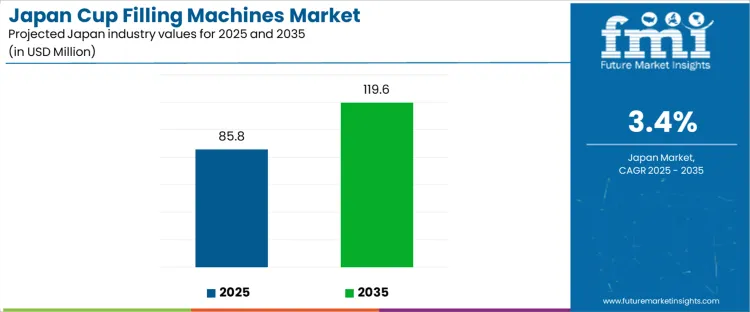
Demand for cup filling machines in Japan is expected to grow from USD 85.8 million in 2025 to USD 119.6 million by 2035, reflecting a compound annual growth rate (CAGR) of 3.4%. Cup filling machines, which are used for packaging liquids, powders, and other products into cups, are essential in industries such as food and beverage, cosmetics, and pharmaceuticals. Growth in demand is driven by the need for efficient, high-speed filling machines that ensure accuracy and consistency in production. As consumer demand for pre-packaged products continues to rise, particularly for ready-to-eat meals, beverages, and other consumer goods, the adoption of cup filling machines is expected to increase in Japan.
Technological advancements in automation, increased demand for hygienic and high-quality filling processes, and rise of eco-friendly packaging solutions will also contribute to the growing demand for cup filling machines.
Quick Stats of the Demand for Cup Filling Machines in Japan
- Demand for Cup Filling Machines in Japan Value (2025): USD 85.8 million
- Demand for Cup Filling Machines in Japan Forecast Value (2035): USD 119.6 million
- Demand for Cup Filling Machines in Japan Forecast CAGR (2025-2035): 3.4%
- Demand for Cup Filling Machines in Japan Leading Technology: Fill Seal (94.0%)
- Demand for Cup Filling Machines in Japan Key Growth Regions: Kyushu & Okinawa, Kanto, Kansai, Chubu, Tohoku, Rest of Japan
- Demand for Cup Filling Machines in Japan Key Players: I.M.A. INDUSTRIA MACCHINE AUTOMATICHE S.P.A, R.A Jones, Serac Group, Paxiom, Cemre Cup Filling Machines
What is the Growth Forecast for the Cup Filling Machines Market through 2035?
Absolute dollar opportunity for the cup filling machines industry in Japan shows steady growth in the coming decade. Starting at USD 85.8 million in 2025, the industry grows gradually, reaching USD 88.7 million in 2026 and USD 91.7 million in 2027. This early phase reflects gradual increases in demand as food and beverage manufacturers, along with other industries, adopt cup filling machines to meet growing consumer demand for packaged products.
From 2027 to 2030, the industry continues its steady growth trajectory, reaching USD 94.8 million in 2028, USD 98.0 million in 2029, and USD 101.3 million in 2030. The absolute dollar opportunity expands as new technologies and more efficient filling machines are adopted, helping manufacturers meet production requirements with greater precision and speed. By 2035, the industry is projected to reach USD 119.6 million, reflecting a steady increase in demand as automation, sustainability, and packaging innovations continue to drive the growth.
Key Takeaways of Cup Filling Machines Industry in Japan
| Metric | Value |
|---|---|
| Industry Sales Value (2025) | USD 85.8 million |
| Industry Forecast Value (2035) | USD 119.6 million |
| Industry Forecast CAGR (2025-2035) | 3.4% |
What Is Driving the Demand for Cup Filling Machines in Japan?
Demand for cup filling machines in Japan is driven by rising consumption of packaged and ready to eat foods. Food and beverage producers increasingly adopt automated cup filling and sealing equipment to meet demand for yogurt cups, desserts, soups, sauces, chilled meals and single-serve portions. Efficiency and hygiene requirements in food production encourage use of machines capable of precise portioning and secure sealing. The broader packaging machinery growth supports the uptake of filling machines as firms modernize packaging lines.
Future demand for cup filling machines in Japan is expected to grow steadily over the next decade as food consumption patterns evolve toward convenience, single-serve packaging and portion-controlled meals. Producers will expand the use of automated and flexible machines to handle a range of cup sizes, multiple food types, and faster production cycles. Growth in ready-to-eat meals, chilled foods, desserts and portion-packaged products will drive demand. Adoption may accelerate if manufacturers focus on packaging efficiency, hygiene standards, and automation across the food and beverage sectors.
What Are the Key Segments in Cup Filling Machines Industry in Japan?
Cup filling machines industry in Japan is segmented by machine type and technology. Rotary machines lead the machine type segment, holding 63% of the market share. In terms of technology, fill seal is the dominant technology, accounting for 94%. The demand for cup-filling machines is driven by the growing need for efficient, high-speed packaging solutions across industries such as food and beverages, dairy, and pharmaceuticals.
Which Machine Type Drives Cup Filling Machines Demand in Japan?
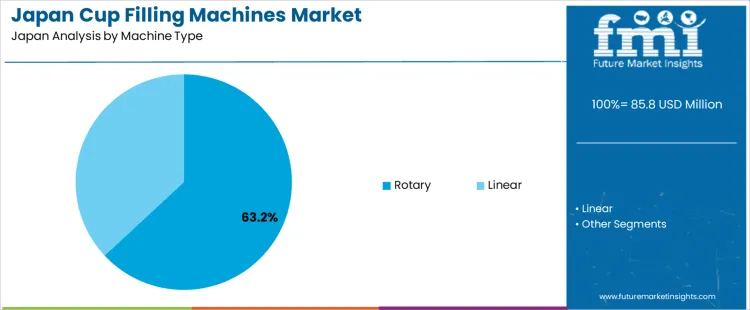
Rotary machines are the most widely used type in the cup filling machines industry, representing 63% of the market share. Rotary cup filling machines are preferred for their high-speed production capabilities and efficient filling processes, making them ideal for large-scale production lines. These machines can fill and seal cups quickly, improving throughput and reducing labor costs in packaging operations. Rotary machines are particularly favored in industries such as food and beverage, where high-volume filling is required. Their flexibility, ease of use, and ability to handle a wide range of cup sizes and types make them the preferred choice. While linear machines also contribute, rotary machines dominate due to their superior performance in high-speed, high-volume applications.
Which Technology Drives Cup Filling Machines Demand in Japan?
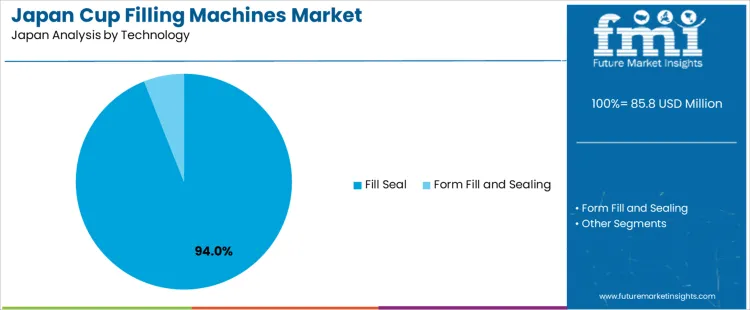
Fill seal technology is the most commonly used in the cup filling machines industry in Japan, holding 94% of the market share. This technology involves filling cups with a product and immediately sealing them, providing an airtight and secure closure. Fill seal technology is highly efficient, ensuring product safety, freshness, and extended shelf life. It is especially popular in the food and beverage industry, where maintaining product integrity is crucial. High demand for fill seal technology is driven by its reliability, speed, and suitability for a wide range of cup-based products, such as dairy, sauces, soups, and desserts. Other technologies, such as form fill and sealing, are also used but are less prevalent compared to fill seal due to its widespread application and efficiency.
What is the Key Dynamics for Cup Filling Machines Demand in Japan?
Demand for cup filling machines in Japan is rising as food and beverage producers increasingly turn to single serve and portion controlled packaging. The convenience culture and consumer preference for ready to eat meals, desserts, dairy products, and sauces contribute to greater use of cup based packaging. Packaging lines are being upgraded for efficiency, hygiene, and consistency. The food processing industry’s push for automation supports broader adoption of cup filling machines as core equipment in production and packaging operations.
What are the Key Drivers for Cup Filling Machines Demand in Japan?
One driver is growing consumption of packaged and ready to eat food items across urban and convenience oriented segments. Cup filling machines allow manufacturers to meet demand for individually packaged cups and portion controlled servings with speed and hygiene-features valued by both producers and consumers. Automation in food and beverage manufacturing is another driver, reducing reliance on manual labor, ensuring precision in filling and sealing, and supporting high throughput production. Rising expectations for consistent quality, safety, and extended shelf life push producers to invest in reliable cup filling equipment.
What are the Restraints for Cup Filling Machines Demand in Japan?
High upfront costs and capital investment required for advanced cup filling and sealing machines pose a barrier, especially for small and medium sized food processors. Older manufacturing lines may lack compatibility with new automated machines, creating retrofitting challenges or requiring additional investments. Space constraints in many Japanese manufacturing facilities may limit installation of large equipment. Variability in cup formats, sealing materials, and regulatory requirements for food safety and hygiene may also complicate machine adoption.
What are the Key Trends in Cup Filling Machines Demand in Japan?
There is a shift toward high speed, fully automated cup filling and sealing machines capable of handling multiple cup sizes and batch formats, increasing flexibility in production. Integration of smart manufacturing technologies, including automated controls, robotics, hygiene oriented features, and quick changeovers, is gaining ground among food producers. Growth in single serve and convenience oriented food consumption, including desserts, dairy, sauces, and ready meals, continues to fuel demand for cup pack formats and thus cup filling machines. Demand is particularly strong in sectors where product safety, portion control, and packaging consistency are critical.
What is the Regional Demand Outlook for Cup Filling Machines in Japan?
Demand for cup filling machines in Japan is projected to grow steadily, with Kyushu & Okinawa leading the way at a projected CAGR of 4.2%. Kanto follows with a growth rate of 3.9%, while Kansai is expected to grow at 3.4%. Chubu is projected to grow at a rate of 3.0%, while Tohoku and Rest of Japan show more moderate growth, with CAGRs of 2.6% and 2.5%, respectively. Increasing demand for automated packaging solutions, particularly in the food and beverage sectors, is driving the adoption of cup filling machines across Japan. Rise in convenience food consumption and the need for efficient packaging processes are key contributors to industry growth.
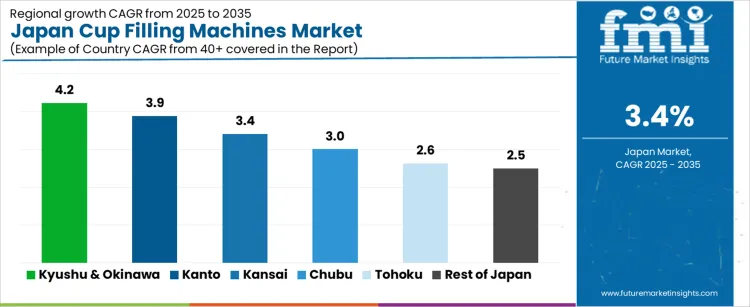
| Region | CAGR (2025-2035) |
|---|---|
| Kyushu & Okinawa | 4.2% |
| Kanto | 3.9% |
| Kansai | 3.4% |
| Chubu | 3.0% |
| Tohoku | 2.6% |
| Rest of Japan | 2.5% |
What is Driving the Growth of Cup Filling Machines in Kyushu & Okinawa?
Kyushu & Okinawa are projected to experience the highest growth in the cup filling machines industry, with a projected CAGR of 4.2%. The region’s increasing focus on manufacturing automation, especially in the food and beverage industry, is a key driver of this growth. With growing demand for packaged beverages, dairy products, and other consumables, businesses in Kyushu & Okinawa are adopting cup filling machines to enhance production efficiency and reduce labor costs. The trend towards more convenient, ready-to-eat foods in the region is further fueling the adoption of cup filling machines, making them essential in streamlining production and improving packaging accuracy.
Why is the Cup Filling Machines Industry Expanding in Kanto?
In Kanto, demand for cup-filling machines is projected to grow at a CAGR of 3.9%. Kanto, which includes Tokyo, the largest metropolitan area in Japan, is a hub for the food and beverage industry. The region’s extensive manufacturing infrastructure and strong consumer demand for packaged products are driving the need for advanced packaging solutions. Cup filling machines are increasingly used in Kanto to meet the growing demand for convenient food and beverages, particularly in sectors like dairy, juice, and ready-to-eat meals. Additionally, Kanto’s focus on innovation and efficiency in production is contributing to the adoption of automated filling machines, allowing manufacturers to streamline operations and meet high production volumes. The region's emphasis on sustainability and eco-friendly packaging options is also supporting the adoption of energy-efficient and waste-reducing filling machines.
How is the Cup Filling Machines Industry Growing in Kansai?
In Kansai, the cup filling machines industry is projected to grow at a CAGR of 3.4%. The region, which includes cities like Osaka and Kyoto, is seeing an increased demand for packaged food and beverage products, particularly as consumers continue to prioritize convenience and ready-to-eat meals. Kansai’s strong food processing industry is driving the demand for automated packaging solutions, such as cup filling machines, which help improve production efficiency and meet increasing consumer demand. Manufacturers in Kansai are focusing on improving their packaging processes, reducing labor costs, and enhancing the precision of their packaging systems, contributing to the adoption of cup filling machines. As the region’s food and beverage industry continues to grow, the industry for cup filling machines is expected to expand steadily.
What is Contributing to the Growth of Cup Filling Machines in Chubu?
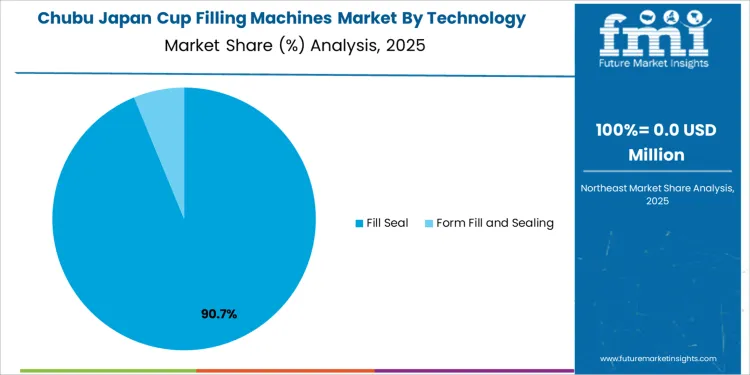
In Chubu, the cup filling machines industry is expected to grow at a CAGR of 3.0%. Chubu, which includes major industrial cities like Nagoya, has a well-developed manufacturing sector, with a focus on food and beverage production. The region’s demand for packaged food, beverages, and other consumer goods is driving the adoption of cup filling machines to meet production needs. These machines offer businesses in Chubu the ability to scale their operations efficiently while maintaining product quality. The region’s emphasis on improving manufacturing processes and reducing costs is contributing to the steady rise in demand for automated filling machines. As Chubu continues to invest in more advanced production technologies, the industry for cup filling machines is expected to grow, driven by the food processing industry and the shift towards more efficient packaging solutions.
What is Influencing the Growth of Cup Filling Machines in Tohoku?
In Tohoku, the cup filling machines industry is projected to grow at a CAGR of 2.6%. Although the growth rate is more moderate compared to other regions, the adoption of automated packaging solutions is increasing as demand for packaged food and beverages rises. Tohoku’s growing food manufacturing sector, especially in agriculture and dairy, is driving the need for efficient packaging solutions like cup filling machines. The region’s increasing focus on improving production efficiency and reducing labor costs is also contributing to the adoption of these machines. Tohoku’s shift towards more sustainable and cost-effective production methods is fueling the demand for automated filling equipment, including cup filling machines, to improve packaging accuracy and speed.
What is Contributing to the Growth of Cup Filling Machines in Rest of Japan?
In Rest of Japan, the cup filling machines industry is expected to grow at a more moderate rate of 2.5%. While the demand is smaller compared to major metropolitan regions, the increasing awareness of packaging efficiency and the demand for convenience food are driving steady growth in the industry. As access to automated filling technologies becomes more widespread across rural and less densely populated areas, more manufacturers are adopting cup filling machines to streamline production processes. The growing interest in sustainable packaging solutions and the push towards reducing labor costs are expected to support the continued demand for cup filling machines in these regions. As consumer preferences for ready-to-eat meals and convenient beverages rise, Rest of Japan is likely to see gradual growth in the demand for these packaging solutions.
What is the Competitive Landscape for Demand for Cup Filling Machines in Japan?
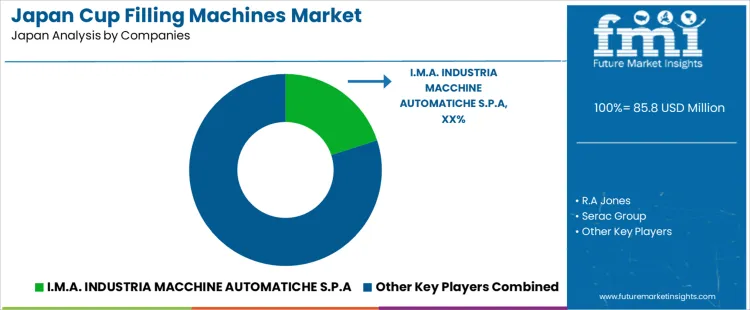
Demand for cup filling machines in Japan has been rising as food and beverage manufacturers respond to growing consumer demand for ready to eat meals, individual serving products, dairy items, desserts, sauces, and other cup packaged goods. Automation of packaging helps ensure hygiene, consistent portioning, and faster throughput factors, especially valued in an industry with tight labour costs and strict food safety standards. The broader expansion of the Japanese packaging machinery industry, driven by demand across food, beverage, pharmaceutical, and personal care sectors, supports rising investment in filling and sealing equipment.
On the supply side, several global and specialized manufacturers compete to meet this demand. According to your list, key players include I.M.A. Industria Macchine Automatiche S.p.A., R.A Jones, Serac Group, Paxiom, and Cemre Cup Filling Machines. These firms supply cup filling and sealing systems designed for a variety of cup types, capacity requirements, and food production standards. Competition centers on machine throughput (cups per hour), flexibility to handle different cup sizes and products, reliability, ease of cleaning or maintenance (crucial for hygiene), and compatibility with Japanese regulatory and food safety standards. Suppliers that can combine robust, high speed machines with flexibility and reliability are best positioned to capture growth as Japanese food and beverage producers increasingly adopt automated cup filling solutions.
Key Players of the Cup Filling Machines Industry in Japan
- I.M.A. INDUSTRIA MACCHINE AUTOMATICHE S.P.A
- R.A Jones
- Serac Group
- Paxiom
- Cemre Cup Filling Machines
Scope of the Report
| Items | Details |
|---|---|
| Quantitative Units | USD Million |
| Regions Covered | Japan |
| Machine Type | Linear; Rotary |
| Technology | Form Fill Seal / Cup Fill & Seal |
| Capacity | Above 6000 cups/hr; 3001-6000/hr; 1001-3000/hr; Below 1000/hr |
| Application | Pharmaceutical, Beverages, Food |
| Key Companies | I.M.A. INDUSTRIA MACCHINE AUTOMATICHE S.P.A; R.A. Jones; Serac Group; Paxiom; Cemre Cup Filling Machines |
| Additional Attributes | Dollar sales by machine type and capacity reflect steady demand-driven by demand for convenience foods, ready to eat cups, dairy & beverage packaging. The food & beverage sector remains the dominant end use, pushing demand for linear and rotary machines with high throughput for cost effective, hygienic packaging. |
Key Segments in the Demand for Cup Filling Machines in Japan
Machine Type:
- Linear
- Rotary
Technology:
- Form Fill and Sealing
- Fill Seal
Capacity:
- Above 6000/hr
- 3001 to 6000/hr
- 1001 to 3000/hr
- Below 1000/hr
Aseptic Application:
- Pharmaceutical
- Beverages
- Food
Region:
- Kyushu & Okinawa
- Kanto
- Kansai
- Chubu
- Tohoku
- Rest of Japan
Frequently Asked Questions
How big is the demand for cup filling machines in Japan in 2025?
The demand for cup filling machines in Japan is estimated to be valued at USD 85.8 million in 2025.
What will be the size of cup filling machines in Japan in 2035?
The market size for the cup filling machines in Japan is projected to reach USD 119.6 million by 2035.
How much will be the demand for cup filling machines in Japan growth between 2025 and 2035?
The demand for cup filling machines in Japan is expected to grow at a 3.4% CAGR between 2025 and 2035.
What are the key product types in the cup filling machines in Japan?
The key product types in cup filling machines in Japan are rotary and linear.
Which technology segment is expected to contribute significant share in the cup filling machines in Japan in 2025?
In terms of technology, fill seal segment is expected to command 94.0% share in the cup filling machines in Japan in 2025.
Preview the report firsthand - request a free sample
Get SampleGet the brochure for pricing and purchase details.
Get PDFTable of Content
- Executive Summary
- Japan Market Outlook
- Demand-side Trends
- Supply-side Trends
- Technology Roadmap Analysis
- Analysis and Recommendations
- Market Overview
- Market Coverage / Taxonomy
- Market Definition / Scope / Limitations
- Market Background
- Market Dynamics
- Drivers
- Restraints
- Opportunity
- Trends
- Scenario Forecast
- Demand in Optimistic Scenario
- Demand in Likely Scenario
- Demand in Conservative Scenario
- Opportunity Map Analysis
- Product Life Cycle Analysis
- Supply Chain Analysis
- Investment Feasibility Matrix
- Value Chain Analysis
- PESTLE and Porter’s Analysis
- Regulatory Landscape
- Regional Parent Market Outlook
- Production and Consumption Statistics
- Import and Export Statistics
- Market Dynamics
- Japan Market Analysis 2020 to 2024 and Forecast, 2025 to 2035
- Historical Market Size Value (USD Million) Analysis, 2020 to 2024
- Current and Future Market Size Value (USD Million) Projections, 2025 to 2035
- Y-o-Y Growth Trend Analysis
- Absolute $ Opportunity Analysis
- Japan Market Pricing Analysis 2020 to 2024 and Forecast 2025 to 2035
- Japan Market Analysis 2020 to 2024 and Forecast 2025 to 2035, By Machine Type
- Introduction / Key Findings
- Historical Market Size Value (USD Million) Analysis By Machine Type , 2020 to 2024
- Current and Future Market Size Value (USD Million) Analysis and Forecast By Machine Type , 2025 to 2035
- Rotary
- Linear
- Y-o-Y Growth Trend Analysis By Machine Type , 2020 to 2024
- Absolute $ Opportunity Analysis By Machine Type , 2025 to 2035
- Japan Market Analysis 2020 to 2024 and Forecast 2025 to 2035, By Technology
- Introduction / Key Findings
- Historical Market Size Value (USD Million) Analysis By Technology, 2020 to 2024
- Current and Future Market Size Value (USD Million) Analysis and Forecast By Technology, 2025 to 2035
- Fill Seal
- Form Fill and Sealing
- Y-o-Y Growth Trend Analysis By Technology, 2020 to 2024
- Absolute $ Opportunity Analysis By Technology, 2025 to 2035
- Japan Market Analysis 2020 to 2024 and Forecast 2025 to 2035, By Capacity
- Introduction / Key Findings
- Historical Market Size Value (USD Million) Analysis By Capacity, 2020 to 2024
- Current and Future Market Size Value (USD Million) Analysis and Forecast By Capacity, 2025 to 2035
- Above 6000/hr
- 3001 to 6000/hr
- 1001 to 3000/hr
- Below 1000/hr
- Y-o-Y Growth Trend Analysis By Capacity, 2020 to 2024
- Absolute $ Opportunity Analysis By Capacity, 2025 to 2035
- Japan Market Analysis 2020 to 2024 and Forecast 2025 to 2035, By Aseptic Application
- Introduction / Key Findings
- Historical Market Size Value (USD Million) Analysis By Aseptic Application, 2020 to 2024
- Current and Future Market Size Value (USD Million) Analysis and Forecast By Aseptic Application, 2025 to 2035
- Pharmaceutical
- Beverages
- Food
- Y-o-Y Growth Trend Analysis By Aseptic Application, 2020 to 2024
- Absolute $ Opportunity Analysis By Aseptic Application, 2025 to 2035
- Market Structure Analysis
- Competition Dashboard
- Competition Benchmarking
- Market Share Analysis of Top Players
- By Regional
- By Machine Type
- By Technology
- By Capacity
- By Aseptic Application
- Competition Analysis
- Competition Deep Dive
- I.M.A. INDUSTRIA MACCHINE AUTOMATICHE S.P.A
- Overview
- Product Portfolio
- Profitability by Market Segments (Product/Age /Sales Channel/Region)
- Sales Footprint
- Strategy Overview
- Marketing Strategy
- Product Strategy
- Channel Strategy
- R.A Jones
- Serac Group
- Paxiom
- Cemre Cup Filling Machines
- I.M.A. INDUSTRIA MACCHINE AUTOMATICHE S.P.A
- Competition Deep Dive
- Assumptions & Acronyms Used
- Research Methodology


