

- Industry Size (2025)
- USD 8960.0 Mn
- Forecast (2035)
- USD 11695.4 Mn
- CAGR (2025 to 2035)
- 2.7%
Demand for Displays in Japan Forecast and Outlook 2025 to 2035
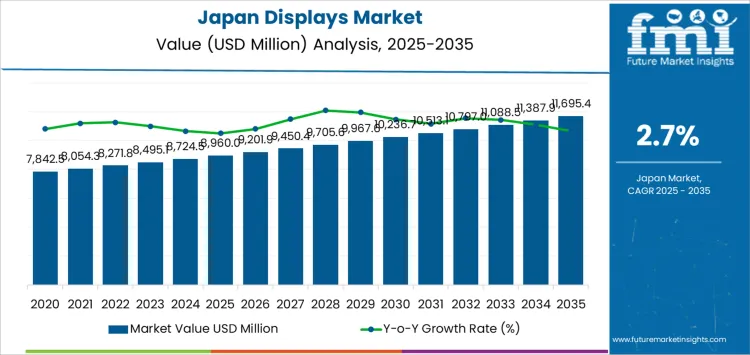
Demand for displays in Japan is valued at USD 8,960.0 million in 2025 and is projected to reach USD 11,695.4 million by 2035, reflecting a CAGR of 2.7%. The historical track from 2020 to 2025 shows growth from USD 7,842.5 million to USD 8,960.0 million, supported by steady replacement across consumer electronics and commercial installations. Large panels and small to medium panels hold equal shares, reflecting balanced demand between televisions, monitors, and embedded systems. Liquid crystal display technology accounts for the largest installed base due to cost stability and long production runs. Consumer uses account for the largest vertical share, supported by regular device refresh cycles. Automotive and retail applications contribute stable secondary volumes. Demand during this phase reflects controlled purchasing tied to device renewal rather than capacity expansion.
From 2026 onward, display demand rises from USD 9,201.9 million to USD 10,513.1 million by 2031, then advances to USD 11,695.4 million by 2035, driven by continued annual additions. Organic light-emitting diode and direct-view LED technologies expand within premium consumer and commercial segments as unit pricing stabilizes. Micro LED remains limited to specialized microdisplay uses. Automotive demand is growing as vehicle screen integration expands across dashboards and infotainment systems. Retail, hospitality, and financial services maintain steady installation linked to signage and transaction interfaces. Annual value increases remain narrow, indicating limited volatility. After 2030, replacement demand will outweigh first-time deployment across most display applications.
Quick Stats of the Demand for Displays in Japan
- Demand for Displays in Japan Value (2025): USD 8,960.0 million
- Demand for Displays in Japan Forecast Value (2035): USD 11,695.4 million
- Demand for Displays in Japan Forecast CAGR (2025-2035): 2.7%
- Demand for Displays in Japan Leading Technology: Liquid Crystal Display (38%)
- Demand for Displays in Japan Key Growth Regions: Kyushu & Okinawa, Kanto, Kansai
- Demand for Displays in Japan Top Players: Samsung Display, LG Display, BOE Technology Group, AU Optronics, Innolux
What is the Growth Forecast for Displays in Japan through 2035?
Between 2025 and 2030, demand for displays in Japan is projected to rise from USD 8,960.0 million to USD 10,236.7 million, creating an absolute increase of USD 1,276.7 million and representing about 46.7% of total decade growth. This phase reflects steady replacement demand across consumer electronics, automotive interfaces, and commercial signage systems. Panel efficiency improvements, resolution upgrades, and domestic electronics production support near term expansion. Historical growth depended on television and handset volumes, while near term performance is shaped by in vehicle displays, factory automation interfaces, and fixed installation upgrades across transport, retail, and workplace environments.
From 2030 to 2035, demand is forecast to expand from USD 10,236.7 million to USD 11,695.4 million, adding USD 1,458.7 million and accounting for nearly 53.3% of the total ten-year growth. This period reflects the wider deployment of smart infrastructure screens, medical imaging displays, and industrial control visualization systems. Export-linked electronics manufacturing strengthens volume stability.
Displays Industry in Japan Key Takeaways
| Metric | Value |
|---|---|
| Industry Value (2025) | USD 8,960.0 million |
| Forecast Value (2035) | USD 11,695.4 million |
| Forecast CAGR (2025-2035) | 2.7% |
What Is Driving Demand for Displays in Japan Across Historical and Future Growth Cycles?
Demand for displays in Japan expanded over the past decade as smartphones, televisions, laptops, and tablets achieved widespread adoption. Flat-panel displays replaced older CRT screens because they offered slimmer form factors, lower power use, and easier integration into modern electronics. Consumer appetite for higher resolution and sharper image quality pushed manufacturers toward LCD and LED panels. Growth in gaming, video streaming, and mobile computing contributed to a stable increase in display shipments. Corporate and public-sector demand also rose for monitors used in offices, education, and retail settings.
Future demand for displays in Japan will draw from rising uptake of OLED, flexible, and high-performance panels across consumer electronics, automotive, commercial signage, and smart infrastructure. Expansion of digital signage, retail display installations, smart-vehicle dashboards, and large-format displays for business use adds new demand streams. Improvements in energy efficiency and support for newer display technologies appeal to environmentally and cost-conscious buyers. Gaming monitors and high-definition panels for creative professionals, remote work, and entertainment support sustained growth. Broader deployment in transportation hubs, public venues, and smart city initiatives could further expand the market beyond traditional consumer electronics.
What Is the Demand for Displays in Japan by Technology and Panel Size?
The demand for displays in Japan is shaped by consumer electronics production, automotive cockpit upgrades, and commercial visualization investment. Liquid crystal display leads by technology due to broad deployment across televisions, monitors, and industrial screens. Large panels and small to medium sized panels share equal prominence by panel size, reflecting parallel strength in home entertainment and mobile devices. Procurement is driven by electronics OEMs, automotive system integrators, and retail electronics brands. Import reliance remains present for driver ICs, polarizers, and advanced backlight units. Substitution pressure exists across OLED and Micro LED in premium segments. Demand stability is supported by steady replacement cycles and expanding digital signage installations.
Why does liquid crystal display account for 38% of the demand for displays in Japan by technology?
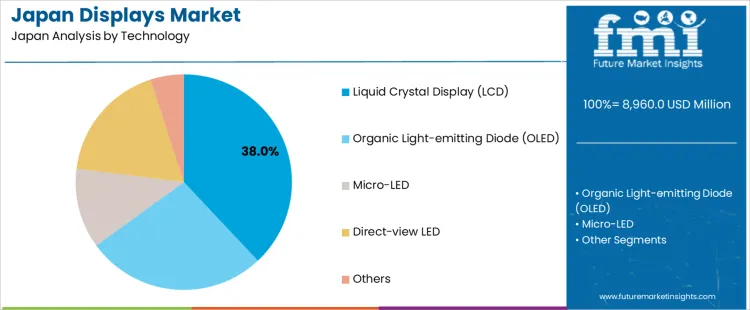
Liquid crystal display accounts for 38% of the demand for displays in Japan by technology, reflecting its wide adoption across cost controlled and mid performance applications. Consumption intensity is driven by television assembly, desktop monitors, industrial control panels, and in vehicle infotainment screens. Usage remains stable because LCD offers predictable performance, long operating life, and controlled power consumption. Procurement is led by Japanese electronics manufacturers and module integrators supplying both domestic and export programs. Price sensitivity remains moderate because LCD pricing benefits from mature supply chains. Specification control emphasizes response time consistency, brightness uniformity, color calibration stability, and backlight endurance under long duty cycles.
Liquid crystal display also generates steady repeat demand through panel refresh cycles and line upgrades across multiple device categories. Repeat utilization remains predictable as television and monitor replacement continues on multiyear intervals. Buyers favor standardized panel formats to simplify tooling and module integration. Margin structure remains controlled under intense competition among regional panel suppliers. Regulatory exposure centers on energy efficiency labeling and recycling compliance. Import reliance persists for glass substrates and backlight components. Substitution pressure from OLED remains confined to high contrast and thin format applications rather than mass volume segments.
Why do large panels represent 45.0% of the demand for displays in Japan by panel size?
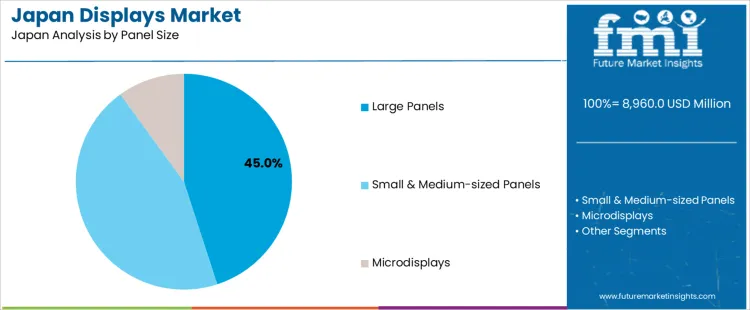
Large panels represent 45.0% of the demand for displays in Japan by panel size, reflecting strong demand from home entertainment systems, commercial signage, and control room installations. Consumption intensity is driven by high definition television upgrades, retail advertising displays, and transportation hub visualization systems. Usage remains stable because screen size preference continues to rise in residential and commercial environments. Procurement is dominated by consumer electronics brands, digital signage operators, and system integrators. Price sensitivity remains moderate because large panels carry visible performance differentiation. Specification control emphasizes pixel density consistency, structural rigidity, thermal management, and luminance stability across extended viewing periods.
Large panel demand also generates consistent repeat volume through renovation programs, signage replacement, and consumer upgrade cycles. Repeat utilization remains predictable as display lifespans shorten under continuous high brightness operation. Buyers favor standardized mounting formats and interface compatibility to reduce installation complexity. Margin structure remains controlled under panel oversupply and retailer pricing pressure. Regulatory exposure centers on electrical safety certification and transportation vibration standards for public installs. Import reliance persists for ultra large glass sheets and advanced driver electronics. Substitution pressure from projection systems remains limited to event venues rather than fixed commercial display use.
What Is Driving the Demand for Displays in Japan Across Urban Retail, Transport, and Home Use?
Demand for displays in Japan reflects dense urban retail, transport communication needs, and precision manufacturing culture. Railway stations, convenience stores, and department storefronts rely on high brightness panels for continuous information and promotion. Corporate offices use large format screens for workflow coordination and safety messaging. Home consumers favor compact high resolution displays for gaming, streaming, and compact living rooms. Public sector projects deploy outdoor units for disaster alerts and traffic control. Local buyers expect durability, low power draw, and color accuracy under long operating hours. Demand grows through replacement cycles tied to technology refresh and messaging needs rather than upgrades.
How Is Railway and Urban Transport Infrastructure Sustaining Display Deployment in Japan?
Japan transport operators depend on displays for scheduling precision, crowd guidance, and multilingual passenger information. Platforms, concourses, and bus terminals run synchronized screens that update service changes in real time. High passenger density requires sharp visibility under varied lighting conditions. Maintenance teams favor modular panels that allow fast swap during overnight service windows. Advertising networks lease screen time during off peak hours to support operating revenue. Disaster alert integration remains a mandatory specification across public transport nodes. This infrastructure driven usage ties display demand to rail investment budgets, station renovation programs, and digital signage standardization across metropolitan corridors nationwide today.
Why Are Retail and Consumer Electronics Driving Indoor Display Demand in Japan?
Retailers in Japan rely on displays for price updates, promotion cycles, and space efficient product guidance within narrow shop layouts. Convenience stores use vertical screens to rotate content without expanding shelf area. Consumer demand for gaming monitors, tablets, and ultra high definition televisions supports steady home display replacement. Small apartment living raises preference for thin bezels and wall mounted units that conserve floor space. Seasonal product launches in electronics districts stimulate frequent model turnover. This combination of store utility and home entertainment keeps indoor display demand linked to retail density and consumer technology refresh behavior across urban household purchasing cycles.
What Limits the Expansion Pace of Display Systems in Japan?
Display demand in Japan faces control from energy efficiency rules, waste electronics management, and high quality expectations for long life operation. Commercial users track electricity load closely under rising utility costs. Disposal of large panels follows strict recycling protocols that add logistics planning. Outdoor units require typhoon resistance and corrosion protection that raise installation budgets. Labor availability for on site mounting and calibration remains tight in many regions. Rapid model change also creates hesitation around inventory risk for resellers. These structural factors steady the pace of expansion despite strong utilization across transport, retail, and home environments within current upgrade cycles.
What is the Demand for Displays in Japan by Region?
| Region | CAGR (%) |
|---|---|
| Kyushu & Okinawa | 3.4% |
| Kanto | 3.1% |
| Kansai | 2.7% |
| Chubu | 2.4% |
| Tohoku | 2.1% |
| Rest of Japan | 2.0% |
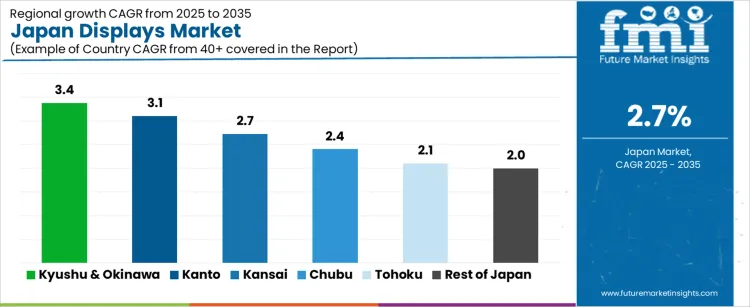
The demand for displays in Japan is expanding steadily across manufacturing and consumer electronics regions, led by Kyushu and Okinawa at a 3.4% CAGR. Growth in this region is supported by semiconductor related fabrication, automotive electronics integration, and rising use of industrial display panels in production equipment. Kanto follows at 3.1%, driven by dense clusters of consumer electronics brands, retail digital signage deployment, and steady replacement demand in commercial buildings. Kansai records 2.7% growth, reflecting stable demand from appliance manufacturers and public infrastructure projects. Chubu at 2.4% shows moderate uptake linked to automotive displays and factory automation systems. Tohoku and the Rest of Japan, at 2.1% and 2.0%, reflect slower growth shaped by lower electronics manufacturing density, conservative capital spending, and longer equipment refresh cycles.
How Is Retail Modernization and Tourism Signage Driving Display Demand in Kyushu and Okinawa?
Demand for displays in Kyushu and Okinawa is advancing at a CAGR of 3.4% through 2035, supported by retail store upgrades, expansion of hospitality signage, and steady adoption of digital screens across transport hubs and tourist zones. Airports, shopping arcades, and resort facilities show rising use of digital information boards and advertising panels. This region records steady replacement demand linked to humid climate exposure. Growth reflects retail digitization programs, tourism focused infrastructure upgrades, and controlled integration of energy efficient display systems across public and commercial spaces.
- Airport and resort signage supports consistent panel installations
- Retail digital screens expand in shopping districts
- Humid climate drives steady replacement demand
- Energy efficient panels gain higher procurement preference
Why Is Commercial Advertising Density Sustaining Display Growth in Kanto?
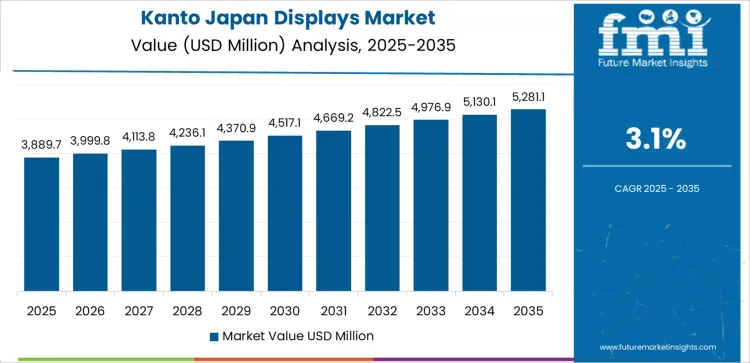
Demand for displays in Kanto is rising at a CAGR of 3.1% through 2035, driven by high concentration of commercial advertising, dense retail networks, and continuous upgrades of digital billboards across metropolitan zones. Kanto records the highest deployment across shopping malls, transit stations, and corporate offices. Demand remains strong for large format LED displays and interactive information screens. Growth reflects frequent content refresh cycles, steady commercial leasing activity, and consistent investment in high visibility digital advertising infrastructure.
- Transit station screens anchor large volume installations
- Corporate offices support internal communication display demand
- Interactive panels gain stronger adoption in malls
- Advertising refresh cycles guide recurring panel upgrades
What Is Supporting Balanced Display Adoption Across Kansai Commercial Spaces?
Demand for displays in Kansai is progressing at a CAGR of 2.7% through 2035, supported by steady shopping mall expansion, cultural venue upgrades, and stable digital signage demand across Osaka and Kyoto. Kansai shows balanced use of indoor advertising panels and public information displays. Investment remains measured across entertainment venues and retail outlets. Growth remains guided by visitor driven commercial activity, event based signage needs, and routine replacement of aging liquid crystal panel systems in public spaces.
- Cultural venues support steady visual display installations
- Retail centers anchor consistent panel replacement demand
- Event signage drives periodic short term deployments
- Aging panel upgrades guide controlled procurement activity
How Is Industrial Digitalization Shaping Display Demand in Chubu?
Demand for displays in Chubu is advancing at a CAGR of 2.4% through 2035, supported by factory automation dashboards, logistics facility monitoring screens, and steady use of industrial information displays in Aichi. Chubu shows stronger orientation toward operational workflow visualization rather than advertising applications. Demand remains focused on rugged industrial monitors and process tracking panels. Growth reflects manufacturing digitization initiatives, warehouse automation activity, and rising use of data visualization in production control environments.
- Factory dashboards drive industrial display procurement
- Logistics facilities adopt real time tracking screens
- Rugged monitors support harsh environment operations
- Production monitoring drives recurrent replacement cycles
Why Is Limited Commercial Expansion Moderating Display Growth in Tohoku?
Demand for displays in Tohoku is advancing at a CAGR of 2.1% through 2035, supported by essential public signage upgrades, gradual retail modernization, and steady use across government buildings and community facilities. Tohoku shows limited advertising driven display installations. Demand remains focused on transport terminals, local administration offices, and basic retail signage. Growth remains moderate due to slower commercial expansion and conservative capital spending across regional public and private infrastructure.
- Public buildings drive baseline displays installations
- Transport signage sustains essential replacement demand
- Limited advertising activity restricts aggressive growth
- Conservative capital budgets guide procurement pace
How Is Small City Infrastructure Modernization Influencing Display Demand in Rest of Japan?
Demand for displays in Rest of Japan is advancing at a CAGR of 2.0% through 2035, supported by town level digital signage projects, healthcare facility upgrades, and gradual deployment of information panels in municipal offices. These areas record lower use of commercial advertising screens. Demand remains focused on public information and basic retail display formats. Growth remains steady and guided by local government funding cycles, modest retail upgrades, and gradual transition from static boards to digital signage solutions.
- Municipal offices drive public information screen demand
- Healthcare facility upgrades support steady panel use
- Static to digital transitions guide gradual adoption
- Local funding cycles regulate procurement frequency
What Is Driving the Demand for Displays in Japan and Which Companies Shape OEM and Consumer Electronics Supply?
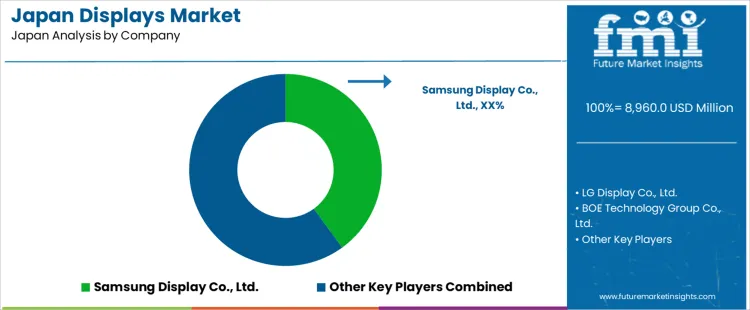
The demand for displays in Japan is shaped by steady output of smartphones, televisions, automotive clusters, medical monitors, and gaming hardware across consumer and industrial electronics. Sharp holds a central domestic position through LCD and IGZO panels supplied to televisions, mobile devices, and vehicle dashboards for Japanese OEM platforms. Japan Display Inc. supports demand through small and mid-size panels used in smartphones, wearables, and instrument clusters. Samsung Display participates strongly through OLED panels supplied to premium smartphones and notebook PCs sold in Japan. LG Display supports large format OLED and LCD demand tied to televisions and commercial signage. BOE Technology Group, AU Optronics, and Innolux Corporation contribute imported panels used in mid-range monitors, tablets, and public information displays. Automotive electrification and cockpit digitization sustain replacement demand cycles nationally.
Procurement in Japan is governed by resolution density, burn in control, brightness stability, power efficiency, and long term supply reliability across product life cycles. OEM engineering teams favor suppliers with domestic field support, rapid failure analysis, and stable yield rates during mass production ramps. Automotive programs prioritize wide temperature tolerance, low glare under direct sunlight, and vibration resistance for long service intervals. Medical buyers focus on grayscale accuracy, long backlight life, and regulatory documentation aligned with hospital equipment standards. Retail electronics brands monitor cost stability, panel availability, and predictable generation roadmaps for annual refresh planning. Buyer preference centers on suppliers that align with keiretsu sourcing structures, domestic testing facilities, and secure logistics. Demand visibility tracks vehicle production schedules, television replacement cycles, gaming hardware launches, and continued expansion of digital signage.
Key Players in the Displays Industry in Japan
- Samsung Display Co., Ltd.
- LG Display Co., Ltd.
- BOE Technology Group Co., Ltd.
- AU Optronics Corp.
- Innolux Corporation
Scope of the Report
| Items | Values |
|---|---|
| Quantitative Units (2025) | USD million |
| Type | Liquid Crystal Display (LCD), Organic Light emitting Diode (OLED), Micro LED, Direct view LED, Others |
| Application | Consumers, Automotive, Sports and Entertainment, Transportation, Retail / Hospitality / BFSI |
| End User | Consumer Electronics OEMs, Automotive OEMs, Retail Chains and Digital Signage Operators, Transport and Infrastructure Operators, Public Sector and Healthcare Facilities |
| Regions Covered | Kyushu and Okinawa, Kanto, Kansai, Chubu, Tohoku, Rest of Japan |
| Countries Covered | Japan |
| Key Companies Profiled | Sharp, Japan Display Inc., Samsung Display Co. Ltd., LG Display Co. Ltd., BOE Technology Group Co. Ltd., AU Optronics Corp., Innolux Corporation |
| Additional Attributes | Dollar sales by technology and panel size categories, regional demand led by manufacturing and retail corridors, replacement driven demand cycles across consumer and commercial installations, OEM procurement linked to automotive clusters and smart infrastructure, performance requirements around resolution, brightness stability, and power efficiency, regulatory focus on energy use and recycling compliance for large panels. |
Displays Industry in Japan Segmentation
Technology:
- Liquid Crystal Display (LCD)
- Organic Light-emitting Diode (OLED)
- Micro-LED
- Direct-view LED
- Others
Panel Size:
- Large Panels
- Small & Medium-sized Panels
- Microdisplays
Vertical:
- Consumers
- Automotive
- Sports & Entertainment
- Transportation
- Retail/Hospitality/BFSI
Region:
- Kyushu & Okinawa
- Kanto
- Kansai
- Chubu
- Tohoku
- Rest of Japan
Frequently Asked Questions
How big is the demand for displays in Japan in 2025?
The demand for displays in Japan is estimated to be valued at USD 8,960.0 million in 2025.
What will be the size of displays in Japan in 2035?
The market size for the displays in Japan is projected to reach USD 11,695.4 million by 2035.
How much will be the demand for displays in Japan growth between 2025 and 2035?
The demand for displays in Japan is expected to grow at a 2.7% CAGR between 2025 and 2035.
What are the key product types in the displays in Japan?
The key product types in displays in Japan are liquid crystal display (lcd), organic light-emitting diode (oled), micro-led, direct-view led and others.
Which panel size segment is expected to contribute significant share in the displays in Japan in 2025?
In terms of panel size, large panels segment is expected to command 45.0% share in the displays in Japan in 2025.
Preview the report firsthand - request a free sample
Get SampleGet the brochure for pricing and purchase details.
Get PDFTable of Content
- Executive Summary
- Japan Market Outlook
- Demand-side Trends
- Supply-side Trends
- Technology Roadmap Analysis
- Analysis and Recommendations
- Market Overview
- Market Coverage / Taxonomy
- Market Definition / Scope / Limitations
- Market Background
- Market Dynamics
- Drivers
- Restraints
- Opportunity
- Trends
- Scenario Forecast
- Demand in Optimistic Scenario
- Demand in Likely Scenario
- Demand in Conservative Scenario
- Opportunity Map Analysis
- Product Life Cycle Analysis
- Supply Chain Analysis
- Investment Feasibility Matrix
- Value Chain Analysis
- PESTLE and Porter’s Analysis
- Regulatory Landscape
- Regional Parent Market Outlook
- Production and Consumption Statistics
- Import and Export Statistics
- Market Dynamics
- Japan Market Analysis 2020 to 2024 and Forecast, 2025 to 2035
- Historical Market Size Value (USD Million) Analysis, 2020 to 2024
- Current and Future Market Size Value (USD Million) Projections, 2025 to 2035
- Y-o-Y Growth Trend Analysis
- Absolute $ Opportunity Analysis
- Japan Market Pricing Analysis 2020 to 2024 and Forecast 2025 to 2035
- Japan Market Analysis 2020 to 2024 and Forecast 2025 to 2035, By Technology
- Introduction / Key Findings
- Historical Market Size Value (USD Million) Analysis By Technology , 2020 to 2024
- Current and Future Market Size Value (USD Million) Analysis and Forecast By Technology , 2025 to 2035
- Liquid Crystal Display (LCD)
- Organic Light-emitting Diode (OLED)
- Micro-LED
- Direct-view LED
- Others
- Y-o-Y Growth Trend Analysis By Technology , 2020 to 2024
- Absolute $ Opportunity Analysis By Technology , 2025 to 2035
- Japan Market Analysis 2020 to 2024 and Forecast 2025 to 2035, By Panel Size
- Introduction / Key Findings
- Historical Market Size Value (USD Million) Analysis By Panel Size, 2020 to 2024
- Current and Future Market Size Value (USD Million) Analysis and Forecast By Panel Size, 2025 to 2035
- Large Panels
- Small & Medium-sized Panels
- Microdisplays
- Y-o-Y Growth Trend Analysis By Panel Size, 2020 to 2024
- Absolute $ Opportunity Analysis By Panel Size, 2025 to 2035
- Japan Market Analysis 2020 to 2024 and Forecast 2025 to 2035, By Vertical
- Introduction / Key Findings
- Historical Market Size Value (USD Million) Analysis By Vertical, 2020 to 2024
- Current and Future Market Size Value (USD Million) Analysis and Forecast By Vertical, 2025 to 2035
- Consumers
- Automotive
- Sports & Entertainment
- Transportation
- Retail/Hospitality/BFSI
- Y-o-Y Growth Trend Analysis By Vertical, 2020 to 2024
- Absolute $ Opportunity Analysis By Vertical, 2025 to 2035
- Market Structure Analysis
- Competition Dashboard
- Competition Benchmarking
- Market Share Analysis of Top Players
- By Regional
- By Technology
- By Panel Size
- By Vertical
- Competition Analysis
- Competition Deep Dive
- Samsung Display Co., Ltd.
- Overview
- Product Portfolio
- Profitability by Market Segments (Product/Age /Sales Channel/Region)
- Sales Footprint
- Strategy Overview
- Marketing Strategy
- Product Strategy
- Channel Strategy
- LG Display Co., Ltd.
- BOE Technology Group Co., Ltd.
- AU Optronics Corp.
- Innolux Corporation
- Samsung Display Co., Ltd.
- Competition Deep Dive
- Assumptions & Acronyms Used
- Research Methodology


