

- Industry Size (2026)
- USD 26.73 Mn
- Forecast (2036)
- USD 41.11 Mn
- CAGR (2026 to 2036)
- 4.4%
Guacamole Market Size, Market Forecast and Outlook By FMI
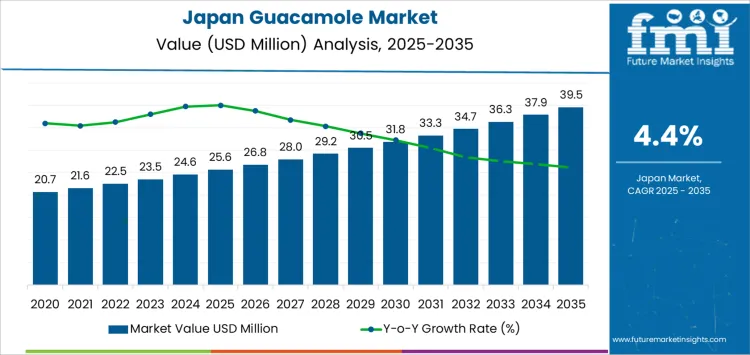
Demand for guacamole in Japan was valued at USD 25.60 Million in 2025. Based on Future Market Insights' analysis, demand for guacamole is estimated to grow to USD 26.73 Million in 2026 and USD 41.11 Million by 2036. FMI projects a CAGR of 4.4% during the forecast period from 2026 to 2036. This translates to an incremental opportunity worth USD Million 14.38 over the ten-year assessment window.
Summary of Guacamole Market in Japan
- Market Snapshot
- Demand for guacamole in Japan is valued at USD 25.60 Million in 2025 and is projected to reach USD 41.11 Million by 2036.
- The market is expected to grow at a 4.4% CAGR from 2026 to 2036, creating an incremental opportunity of USD 14.38 Million.
- The market is a supply-chain-dependent, prepared food category where avocado origin sourcing, cold chain logistics, and HoReCa menu diversification define demand patterns.
- Demand and Growth Drivers
- Menu diversification at Japanese HoReCa chains incorporating Latin American cuisine is driving upstream demand for prepared guacamole products.
- Retail-ready guacamole in single-serve and family-size formats is gaining shelf allocation at supermarkets and convenience stores for household consumption.
- Cold chain infrastructure investment and high-pressure processing technology adoption are enabling extended shelf life for fresh guacamole products.
- Among key regions, Kyushu & Okinawa leads at 5.5% CAGR, followed by Kanto at 5.1%, Kansai at 4.5%, Chubu at 3.9%, Tohoku at 3.5%, and Rest of Japan at 3.3%.
- Product and Segment View
- Guacamole is a prepared avocado-based food product used as a dip, spread, and food processing ingredient, available in conventional and organic formulations.
- End-user channels include food processing, HoReCa operations, household retail, supermarket distribution, and convenience store placement.
- Conventional leads by Nature with 75% share in 2026, reflecting price accessibility and broader distribution through all retail and foodservice channels.
- Food Processing Industry leads by End User with 43% share in 2026, driven by large-volume usage in restaurant chain menu items and prepared food manufacturing.
- Scope includes prepared guacamole products for food and retail use. Excluded are fresh whole avocados, avocado oil, and non-avocado dip products.
- Geography and Competitive Outlook
- Kyushu & Okinawa and Kanto are the fastest-growing regional clusters, driven by concentrated processing and distribution infrastructure serving metropolitan consumption.
- Demand in Tohoku and Rest of Japan follows steadier, replacement-driven procurement cycles in established manufacturing and retail networks.
- Competition depends on avocado origin diversification, cold chain logistics reliability, high-pressure processing capability, and the ability to serve both HoReCa bulk and retail-ready format requirements.
- Key players include Afp Advanced Food Products, Calavo Growers, Cg Produce, Conagra Foodservice, Hormel Foods Corporation.
- Analyst Opinion at FMI
- Nandini Roy Choudhury, Principal Consultant for Food & Beverages, opines: 'In my analysis, I have observed that guacamole demand in Japan is transitioning from a niche imported condiment toward a mainstream food processing ingredient, driven by menu diversification at HoReCa chains and private-label expansion at major supermarket operators. Cold chain logistics costs and avocado supply variability from Mexican and Chilean sources remain the binding constraints on margin stability for processors. Companies that secure forward contracts with diversified origin sourcing and invest in high-pressure processing for extended shelf life will capture the volume growth that conventional ambient distributors cannot serve.'
- Strategic Implications / Executive Takeaways
- Processors should diversify avocado sourcing across Mexican, Chilean, and Peruvian origins to stabilize supply costs and reduce single-source dependency risk.
- Manufacturers should invest in high-pressure processing capacity to extend product shelf life and meet the quality requirements of both HoReCa and retail-ready distribution channels.
- Marketing teams should develop retail-ready packaging formats in portion-controlled sizes aligned with Japanese household consumption patterns.
Japan's guacamole market is shaped by the country's growing adoption of Latin American food products, supported by menu diversification at restaurant chains and increasing retail shelf allocation for prepared dips and spreads. Import dependency on avocado supply from Mexico, Chile, and Peru introduces supply chain variability that directly affects processor margins. FMI analysts observe that the HoReCa channel remains the largest consumption driver, though retail-ready guacamole products in single-serve and family-size formats are capturing incremental household demand. Cold chain infrastructure investment and high-pressure processing technology adoption are key differentiators among processors seeking to extend product shelf life while maintaining fresh taste profiles.
Across Japanese prefectural clusters, growth trajectories vary based on industrial concentration and end-use demand density. Kyushu & Okinawa is projected to expand at 5.5% CAGR. Kanto is projected to expand at 5.1% CAGR. Kansai is projected to expand at 4.5% CAGR. Chubu is projected to expand at 3.9% CAGR. Tohoku is projected to expand at 3.5% CAGR. Rest of Japan is projected to expand at 3.3% CAGR. Kyushu & Okinawa leads the growth ranking, supported by concentrated processing activity and proximity to distribution logistics infrastructure in the region. Kanto, anchoring the Tokyo metropolitan consumption base, follows closely. Mature clusters such as Tohoku and Rest of Japan register steadier, replacement-driven demand patterns.
Guacamole Market Key Takeaways
| Metric | Details |
|---|---|
| Industry Size (2026) | USD 26.73 Million |
| Industry Value (2036) | USD 41.11 Million |
| CAGR (2026 to 2036) | 4.4% |
Source: Future Market Insights, 2026
Guacamole Market Definition
Guacamole is a prepared avocado-based food product used as a dip, spread, or ingredient in food processing and foodservice operations. In the Japanese market, guacamole encompasses both conventional and organic formulations distributed through food processing, HoReCa (hotel, restaurant, and catering), household retail, supermarket, and convenience store channels.
Guacamole Market Inclusions
Market scope includes conventional and organic guacamole products sold through food processing, HoReCa, household, supermarket, and convenience store channels in Japan. The assessment covers market sizes by nature, end user, and Japanese prefectural region for 2026 to 2036.
Guacamole Market Exclusions
The scope excludes fresh whole avocados, avocado oil, and avocado-based cosmetic products. It also omits generic salsa and dip products that do not contain avocado as a primary ingredient.
Guacamole Market Research Methodology
- Primary Research: Analysts engaged with procurement managers, product formulators, and quality assurance leads at guacamole manufacturing and distribution facilities across Japan to map decision triggers and specification requirements.
- Desk Research: Data collection aggregated regulatory filings from the Ministry of Health, Labour and Welfare, trade statistics from Japan Customs, and published technical standards relevant to guacamole production and distribution in Japan.
- Market-Sizing and Forecasting: Baseline values derive from a bottom-up aggregation of manufacturer shipments and import volumes, applying region-specific consumption curves to project adoption velocity through 2036.
- Data Validation and Update Cycle: Projections are cross-checked against publicly reported production volumes, trade data, and downstream procurement disclosures from major processors and distributors operating in Japan.
Why is the Demand for Guacamole in Japan Growing?
The demand for guacamole in Japan is growing as consumer tastes evolve towards more diverse and international food options. Traditionally a Mexican dip made from avocados, guacamole has gained popularity in Japan, driven by the increasing interest in cuisines, particularly Mexican food. As Japanese consumers explore new and unique flavors, guacamole’s creamy texture and rich taste have made it a desirable addition to various meals, snacks, and party spreads.
A major factor driving this growth is the rising demand for healthy, plant-based foods. Avocados, the primary ingredient in guacamole, are known for their high content of healthy fats, fiber, and essential nutrients. This aligns with Japan’s growing trend toward health-conscious eating, as more consumers focus on nutrition and wellness. Guacamole, with its natural and nutritious ingredients, has become an attractive option for those seeking flavorful, wholesome alternatives. The increasing popularity of plant-based and flexitarian diets also plays a role in boosting guacamole’s appeal, as it offers a versatile, flavorful addition to a variety of dishes.
The growing availability of guacamole in supermarkets, restaurants, and fast-food outlets is making it more accessible to consumers. As demand for convenient, ready-to-eat products continues to rise, guacamole is increasingly featured in both retail and foodservice sectors, catering to consumers who value convenience without sacrificing quality or taste. As food trends continue to shape Japanese dining habits, guacamole is becoming more mainstream. With these factors driving its popularity, the demand for guacamole in Japan is expected to grow steadily through 2035.
What is the Segment-Wise Analysis of Demand for Guacamole in Japan?
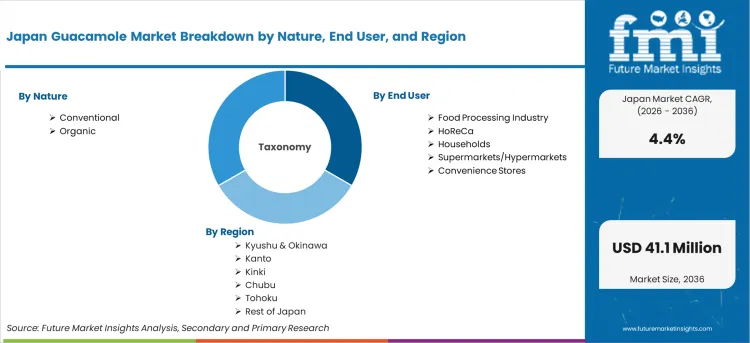
Demand for guacamole in Japan is segmented by nature, end user, and region. By nature, demand is divided into conventional and organic, with conventional guacamole leading at 75%. The demand is also segmented by end user, including the food processing industry, HoReCa (Hotels, Restaurants, and Catering), households, supermarkets/hypermarkets, and convenience stores, with the food processing industry accounting for 43%. Regionally, demand spans across Kyushu & Okinawa, Kanto, Kansai, Chubu, Tohoku, and the rest of Japan.
How Does Conventional Guacamole Lead the Demand in Japan?
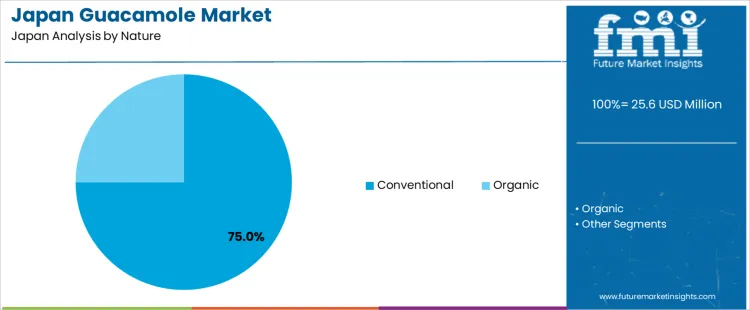
Conventional guacamole accounts for 75% of the demand in Japan, driven by its affordability, availability, and widespread use in food applications. Conventional guacamole is primarily used in the food processing industry, where it serves as an ingredient in ready-to-eat meals, packaged foods, and as a topping in snack foods like chips and wraps. Its popularity is fueled by its easy integration into processed food formulations, providing a quick, cost-effective solution for manufacturers. The high availability of conventional avocados and their cost efficiency compared to organic alternatives further boost the demand for conventional guacamole. As consumers in Japan continue to enjoy the rich flavor and texture of guacamole, especially in fusion cuisine and fast food offerings, conventional guacamole remains the dominant product type, ensuring its continued popularity in the Japanese market.
Why Does the Food Processing Industry Lead the Demand for Guacamole in Japan?
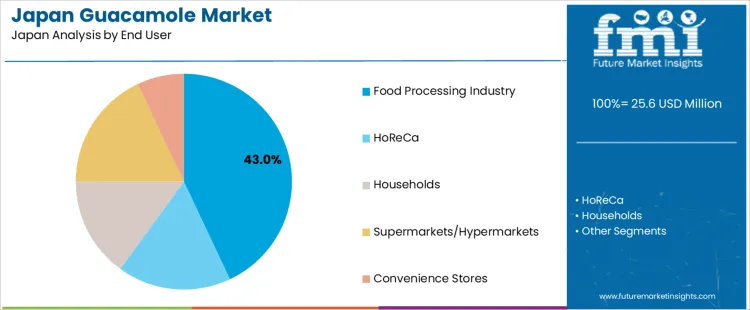
The food processing industry accounts for 43% of the demand for guacamole in Japan, driven by its use as a versatile ingredient in processed foods. Guacamole is widely used in ready-to-eat meals, frozen foods, dips, sauces, and snacks due to its flavor, nutritional value, and convenience. The food processing industry's need for stable, long shelf-life ingredients has further increased the demand for guacamole, especially in its processed form. As Japan's food industry continues to innovate with new snack foods, fusion dishes, and convenience meals, guacamole is increasingly used to enhance the taste and texture of various products. The rise in the popularity of Mexican cuisine and the demand for healthy, flavorful ingredients in processed foods continue to drive the use of guacamole in this sector. As the food processing industry grows, guacamole remains a key ingredient for manufacturers in Japan.
What are the Key Trends, Drivers, and Restraints in Demand for Guacamole in Japan?
Demand for guacamole in Japan is growing, supported by the rising popularity of avocados and growing interest in international or Western-style foods. As the industry for avocados expands driven by health-conscious, younger consumers processed and ready-to-eat avocado-based products like guacamole are gradually gaining traction. The growing restaurant and foodservice sector (casual dining, fast-food, cafes) increasingly uses guacamole as a dip, topping, or sandwich spread, extending usage beyond just home cooking. On the restraint side, limited familiarity among many consumers, occasional high retail prices (because avocados are largely imported), and perishability/short shelf-life compared with domestic foods can slow adoption.
Why is Demand for Guacamole Growing in Japan?
One key driver is the increasing health awareness among Japanese consumers. Avocados the main ingredient in guacamole are valued as nutrient-dense fruits rich in healthy fats, vitamins, and fiber, and this “healthy eating” image appeals to urban, health-conscious buyers. As avocados become more common in salads, sandwiches, sushi, and other fusion dishes, guacamole benefits from this rising “avocado culture.” An increased interest in = western cuisines especially among younger demographics and cosmopolitan cities fuels demand for Mexican or Tex-Mex-style foods. Guacamole fits well as a familiar yet exotic condiment, topping, or snack item, especially when offered in ready-to-eat or easy-to-use formats.
How are Technological & Industry Innovations Driving Guacamole Demand in Japan?
Industry and supply-chain innovations such as improved import logistics for avocados, better cold-chain management, and processing technology are making guacamole more viable and convenient in Japan. As fresh avocado supply becomes more stable, producers and retailers can offer ready-to-eat guacamole or pre-prepared avocado products in supermarkets and convenience stores. Packaging innovations resealable pouches, portion-controlled containers, and chilled ready-to-eat formats make guacamole more accessible to consumers with busy lifestyles, without the hassle of preparing from scratch. Also, foodservice and restaurant menus are increasingly integrating guacamole as dips, toppings or salad components, helping normalize its use beyond niche or foreign-food restaurants.
What are the Key Challenges and Risks That Could Limit Guacamole Demand in Japan?
Cost and price volatility since avocados are mostly imported and subject to shipping/import costs can make guacamole relatively expensive compared with typical domestic foods, limiting frequent consumption among price-sensitive consumers. Second, product perishability and logistics guacamole requires reliable cold-chain and freshness management, which increases cost and complicates distribution, especially for smaller retailers or remote areas. Third, cultural eating habits and taste preferences: many Japanese consumers may still prefer traditional foods and flavors, reducing guacamole’s appeal outside urban or Western-food-curious segments. Finally, inconsistent awareness and limited everyday familiarity may keep guacamole as more of an occasional/novelty item rather than a staple in many households.
What is the Regional Demand Outlook for Guacamole in Japan?
.webp "Top Country Growth Comparison Japan Guacamole Market Cagr (2026 2036)")
| Region | CAGR (%) |
|---|---|
| Kyushu & Okinawa | 5.5% |
| Kanto | 5.1% |
| Kansai | 4.5% |
| Chubu | 3.9% |
| Tohoku | 3.5% |
| Rest of Japan | 3.3% |
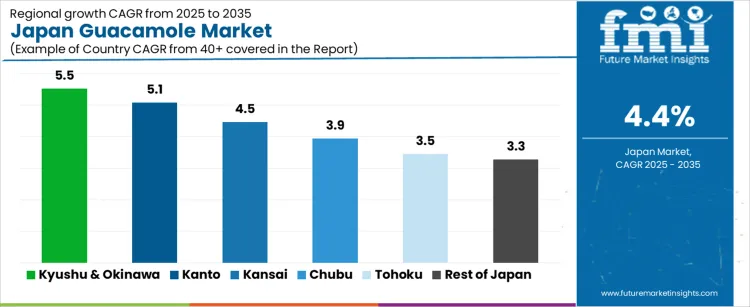
Demand for guacamole in Japan is growing steadily across all regions, with Kyushu & Okinawa leading at a 5.5% CAGR, driven by increasing consumer interest in Mexican cuisine and healthy food options. Kanto follows with a 5.1% CAGR, supported by the region’s large urban population and the rising demand for diverse, international flavors in the foodservice and retail sectors. Kansai shows a 4.5% CAGR, fueled by the region’s rich culinary culture and expanding food innovation trends. Chubu experiences a 3.9% CAGR, as consumer interest in international cuisines and healthy dips grows. Tohoku and the Rest of Japan see moderate growth at 3.5% and 3.3%, respectively, as awareness of guacamole and avocado-based products increases in both urban and rural areas.
How is Demand for Guacamole Growing in Kyushu & Okinawa?
Kyushu & Okinawa leads the demand for guacamole, growing at a 5.5% CAGR. The region's increasing interest in international cuisine, particularly Mexican food, is a key driver of this trend. With a growing focus on healthy eating, avocado-based products like guacamole have gained popularity as a nutritious and versatile dip. Okinawa, known for its health-conscious population, has seen a rise in the demand for guacamole as part of a broader interest in superfoods and plant-based diets. The region’s tourism sector also contributes to this demand, as visitors seek to enjoy diverse flavors and experience cuisine. The increasing availability of guacamole in supermarkets and foodservice outlets is helping to meet the growing demand in both urban and rural areas. As health trends and food influences continue to spread, the demand for guacamole in Kyushu & Okinawa is expected to rise steadily.
Why is Demand for Guacamole Rising in Kanto?
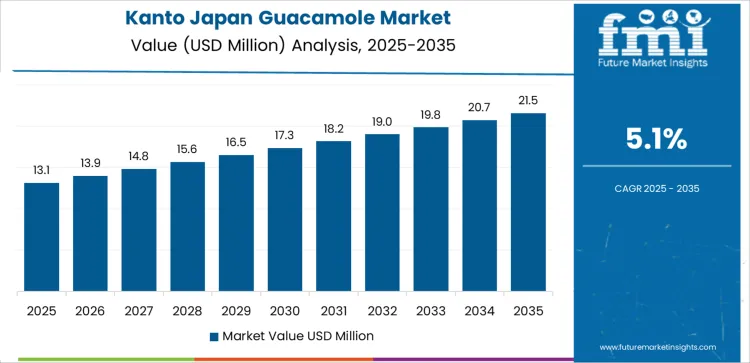
In Kanto, demand for guacamole is rising at a 5.1% CAGR. The region’s large urban population, particularly in Tokyo, has led to an increasing preference for diverse and healthy food options, including guacamole. As consumers in Kanto embrace international flavors and the growing trend of plant-based diets, guacamole, with its healthy fats and versatility, has become a popular choice for snacks, sandwiches, and salads. The expanding foodservice sector, including Mexican restaurants and eateries, further supports the demand for guacamole, as more establishments incorporate this dip into their menus. The rise of convenience stores and supermarkets offering ready-made guacamole has made it more accessible to consumers. As Kanto continues to embrace culinary trends and health-conscious eating habits, the demand for guacamole is expected to remain strong and continue growing steadily in the region.
How is Demand for Guacamole Expanding in Kansai?
Kansai shows steady demand for guacamole, growing at a 4.5% CAGR. The region’s rich food culture, particularly in cities like Osaka, is increasingly embracing flavors and international cuisines, which has contributed to the rising popularity of guacamole. As consumers in Kansai seek healthier food options, avocado-based products have gained traction, with guacamole becoming a favored dip due to its nutritional benefits and versatility. The region’s foodservice sector has also responded by offering guacamole in restaurants, cafés, and international cuisine establishments. With the increasing availability of guacamole in retail outlets, Kansai’s consumers now have greater access to this popular dip. As awareness of healthy eating continues to rise, demand for guacamole in Kansai is expected to grow steadily, driven by the region’s openness to culinary innovation and health-focused eating trends.
Why is Demand for Guacamole Growing in Chubu?
Chubu is experiencing steady demand for guacamole, growing at a 3.9% CAGR. The region’s growing interest in international cuisines and health-conscious food trends has led to an increasing adoption of guacamole. As Chubu’s food industry expands and diversifies, especially in urban centers like Nagoya, the demand for flavors, including Mexican food, has grown. Avocado-based products like guacamole are perceived as healthy and nutrient-rich, which appeals to Chubu’s health-conscious consumers. The availability of guacamole in both retail outlets and foodservice establishments is helping to meet this growing demand. As younger consumers and urban dwellers become more open to experimenting with international dishes, guacamole is expected to become an increasingly popular choice. As the region’s food culture continues to evolve, the demand for guacamole in Chubu is expected to rise steadily, supported by both health trends and dining influences.
How is Demand for Guacamole Expanding in Tohoku?
Tohoku is seeing moderate growth in guacamole demand, with a 3.5% CAGR. While the region’s consumption of guacamole is smaller compared to urban areas, there is growing interest in healthy food products, particularly those rich in nutrients, like avocado-based products. As awareness of the health benefits of avocados and plant-based diets spreads, Tohoku’s consumers are gradually adopting guacamole as part of their diets. As supermarkets and convenience stores begin offering pre-packaged guacamole, accessibility has improved, making it easier for consumers in Tohoku to try this international food. While the trend is still developing in rural areas, younger generations and urban dwellers are increasingly looking for new flavors and healthier food options. As more consumers embrace culinary trends, the demand for guacamole in Tohoku is expected to grow at a moderate but steady pace.
Why is Demand for Guacamole Steady in the Rest of Japan?
The Rest of Japan is experiencing steady demand for guacamole, with a 3.3% CAGR. Although adoption is slower compared to major urban regions, there is a gradual rise in interest as consumers in rural and smaller cities become more exposed to international cuisines. The increasing awareness of the health benefits of avocados, coupled with growing availability in local supermarkets and convenience stores, is helping boost consumption. As culinary trends continue to influence local tastes, demand for guacamole is slowly increasing, especially among younger generations and health-conscious consumers. The gradual shift towards more diverse food choices and the rising popularity of plant-based diets further supports the steady growth of guacamole in the Rest of Japan. While growth is slower compared to larger urban centers, the expanding distribution networks and changing consumer preferences ensure a steady increase in demand for this popular dip.
What is the Competitive Landscape of Guacamole Demand in Japan?
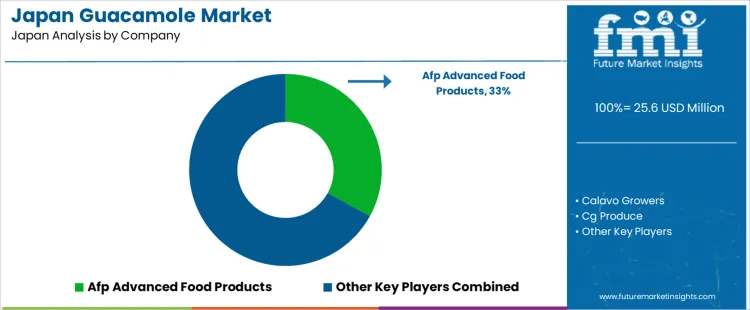
Demand for guacamole in Japan is rising as avocado-based foods gain popularity among health- and flavor-conscious consumers. As imported avocados become more widely available and urban restaurants adopt Western-style menus, guacamole is gaining traction as a dip, salad ingredient, or condiment. The appeal lies in its creamy texture, nutritional profile, and versatility making it attractive not just to trend-seeking younger buyers but also to consumers open to plant-based or healthier food options.
Key suppliers in this niche include Afp Advanced Food Products, Calavo Growers, CG Produce, Conagra Foodservice, and Hormel Foods Corporation. Afp Advanced Food Products holds a leading share of 33.0%, offering packaged guacamole and avocado-based products adapted for Japanese retail and foodservice channels. Other players compete by offering imported guacamole, fresh-made dipping sauces, or ready-to-use avocado mixes. Some focus on food-service supply (restaurants and cafés), while others target retail shelves and convenience stores. The mix of domestic and international supply helps ensure availability even when fresh avocado imports fluctuate.
Competition among suppliers is shaped by price, freshness, convenience, and localization. Suppliers offering ready-to-eat or easy-to-prepare guacamole (pre-seasoned, vacuum-packed) tend to attract busy urban consumers and restaurants. Others push freshness importing Hass avocados or cold-chain packaging to ensure quality, especially targeting premium or health-oriented segments. Some emphasize versatility: supplying guacamole in formats suitable for dips, toppings, or even sandwich spreads to fit Japanese eating habits. As demand increases, those combining supply reliability, competitive price, easy preparation, and acceptable flavor adaptation are likely to lead.
Key Players in Japan Guacamole Demand
- Afp Advanced Food Products
- Calavo Growers
- Cg Produce
- Conagra Foodservice
- Hormel Foods Corporation
Scope of the Report
| Metric | Value |
|---|---|
| Quantitative Units | USD 26.73 Million to USD 41.11 Million, at a CAGR of 4.4% |
| Market Definition | Guacamole is a prepared avocado-based food product used as a dip, spread, or ingredient in food processing and foodservice operations. In the Japanese market, guacamole encompasses both conventional and organic formulations distributed through food processing, HoReCa (hotel, restaurant, and catering), household retail, supermarket, and convenience store channels. |
| Segmentation | Nature: Conventional, Organic; End User: Food Processing Industry, HoReCa, Households, Supermarkets/Hypermarkets, Convenience Stores |
| Regions Covered | Kyushu & Okinawa, Kanto, Kansai, Chubu, Tohoku, Rest of Japan |
| Key Companies Profiled | Afp Advanced Food Products, Calavo Growers, Cg Produce, Conagra Foodservice, Hormel Foods Corporation |
| Forecast Period | 2026 to 2036 |
| Approach | Forecasting models apply a bottom-up methodology starting with manufacturer shipment metrics and import volume data, cross-validated against downstream consumption patterns and regulatory compliance filings. |
Japan Guacamole Demand by Key Segments
Nature
- Conventional
- Organic
End User
- Food Processing Industry
- HoReCa
- Households
- Supermarkets/Hypermarkets
- Convenience Stores
Region
- Kyushu & Okinawa
- Kanto
- Kansai
- Chubu
- Tohoku
- Rest of Japan
Bibliography
- 1. Ministry of Agriculture, Forestry and Fisheries. (2025). Fresh Fruit Import Statistics: Avocado. MAFF Japan.
- 2. Japan External Trade Organization. (2025). Prepared Food Import Trends Report. JETRO.
- 3. Food and Agriculture Organization. (2024). Global Avocado Production and Trade Statistics. FAO.
- 4. Japan Food Service Association. (2025). HoReCa Menu Trend Report. JFSA.
- 5. Ministry of Health, Labour and Welfare. (2024). Food Labeling Standards for Prepared Foods. MHLW.
This bibliography is provided for reader reference. The full Future Market Insights report contains the complete reference list with primary research documentation.
Frequently Asked Questions
How large is the demand for Guacamole in Japan in 2026?
Demand for guacamole in Japan is estimated to be valued at USD Million 26.73 in 2026.
What will be the market size of Guacamole in Japan by 2036?
Market size for guacamole in Japan is projected to reach USD Million 41.11 by 2036.
What is the expected demand growth for Guacamole in Japan between 2026 and 2036?
Demand for guacamole in Japan is expected to grow at a CAGR of 4.4% between 2026 and 2036.
Which Nature is poised to lead sales in 2026?
Conventional accounts for 75% share in 2026, driven by established procurement preferences and formulation compatibility across primary end-use applications.
Which region is growing fastest for Guacamole in Japan?
Kyushu & Okinawa is projected to grow at a CAGR of 5.5% during 2026 to 2036, leading all regional clusters in Japan.
What is included in the scope of this Guacamole report?
Market scope includes conventional and organic guacamole products sold through food processing, HoReCa, household, supermarket, and convenience store channels in Japan. The assessment covers market sizes by nature, end user, and Japanese prefectural region for 2026 to 2036.
What is excluded from the scope of this report?
The scope excludes fresh whole avocados, avocado oil, and avocado-based cosmetic products. It also omits generic salsa and dip products that do not contain avocado as a primary ingredient.
How does FMI build and validate the Guacamole forecast?
Forecasting models apply a bottom-up methodology starting with manufacturer shipment data and import volumes, cross-validated against downstream consumption patterns and regulatory compliance filings.
Preview the report firsthand - request a free sample
Get SampleGet the brochure for pricing and purchase details.
Get PDFTable of Content
- Executive Summary
- Japan Market Outlook
- Demand-side Trends
- Supply-side Trends
- Technology Roadmap Analysis
- Analysis and Recommendations
- Market Overview
- Market Coverage / Taxonomy
- Market Definition / Scope / Limitations
- Research Methodology
- Chapter Orientation
- Analytical Lens and Working Hypotheses
- Market Structure, Signals, and Trend Drivers
- Benchmarking and Cross-market Comparability
- Market Sizing, Forecasting, and Opportunity Mapping
- Research Design and Evidence Framework
- Desk Research Programme (Secondary Evidence)
- Company Annual and Sustainability Reports
- Peer-reviewed Journals and Academic Literature
- Corporate Websites, Product Literature, and Technical Notes
- Earnings Decks and Investor Briefings
- Statutory Filings and Regulatory Disclosures
- Technical White Papers and Standards Notes
- Trade Journals, Industry Magazines, and Analyst Briefs
- Conference Proceedings, Webinars, and Seminar Materials
- Government Statistics Portals and Public Data Releases
- Press Releases and Reputable Media Coverage
- Specialist Newsletters and Curated Briefings
- Sector Databases and Reference Repositories
- FMI Internal Proprietary Databases and Historical Market Datasets
- Subscription Datasets and Paid Sources
- Social Channels, Communities, and Digital Listening Inputs
- Additional Desk Sources
- Expert Input and Fieldwork (Primary Evidence)
- Primary Modes
- Qualitative Interviews and Expert Elicitation
- Quantitative Surveys and Structured Data Capture
- Blended Approach
- Why Primary Evidence is Used
- Field Techniques
- Interviews
- Surveys
- Focus Groups
- Observational and In-context Research
- Social and Community Interactions
- Stakeholder Universe Engaged
- C-suite Leaders
- Board Members
- Presidents and Vice Presidents
- R&D and Innovation Heads
- Technical Specialists
- Domain Subject-matter Experts
- Scientists
- Physicians and Other Healthcare Professionals
- Governance, Ethics, and Data Stewardship
- Research Ethics
- Data Integrity and Handling
- Primary Modes
- Tooling, Models, and Reference Databases
- Desk Research Programme (Secondary Evidence)
- Data Engineering and Model Build
- Data Acquisition and Ingestion
- Cleaning, Normalisation, and Verification
- Synthesis, Triangulation, and Analysis
- Quality Assurance and Audit Trail
- Market Background
- Market Dynamics
- Drivers
- Restraints
- Opportunity
- Trends
- Scenario Forecast
- Demand in Optimistic Scenario
- Demand in Likely Scenario
- Demand in Conservative Scenario
- Opportunity Map Analysis
- Product Life Cycle Analysis
- Supply Chain Analysis
- Investment Feasibility Matrix
- Value Chain Analysis
- PESTLE and Porter’s Analysis
- Regulatory Landscape
- Regional Parent Market Outlook
- Production and Consumption Statistics
- Import and Export Statistics
- Market Dynamics
- Japan Market Analysis 2021 to 2025 and Forecast, 2026 to 2036
- Historical Market Size Value (USD Million) Analysis, 2021 to 2025
- Current and Future Market Size Value (USD Million) Projections, 2026 to 2036
- Y-o-Y Growth Trend Analysis
- Absolute $ Opportunity Analysis
- Japan Market Pricing Analysis 2021 to 2025 and Forecast 2026 to 2036
- Japan Market Analysis 2021 to 2025 and Forecast 2026 to 2036, By Nature
- Introduction / Key Findings
- Historical Market Size Value (USD Million) Analysis By Nature , 2021 to 2025
- Current and Future Market Size Value (USD Million) Analysis and Forecast By Nature , 2026 to 2036
- Conventional
- Organic
- Conventional
- Y-o-Y Growth Trend Analysis By Nature , 2021 to 2025
- Absolute $ Opportunity Analysis By Nature , 2026 to 2036
- Japan Market Analysis 2021 to 2025 and Forecast 2026 to 2036, By End User
- Introduction / Key Findings
- Historical Market Size Value (USD Million) Analysis By End User, 2021 to 2025
- Current and Future Market Size Value (USD Million) Analysis and Forecast By End User, 2026 to 2036
- Food Processing Industry
- HoReCa
- Households
- Supermarkets/Hypermarkets
- Convenience Stores
- Food Processing Industry
- Y-o-Y Growth Trend Analysis By End User, 2021 to 2025
- Absolute $ Opportunity Analysis By End User, 2026 to 2036
- Japan Market Analysis 2021 to 2025 and Forecast 2026 to 2036, By Region
- Introduction
- Historical Market Size Value (USD Million) Analysis By Region, 2021 to 2025
- Current Market Size Value (USD Million) Analysis and Forecast By Region, 2026 to 2036
- Kyushu & Okinawa
- Kanto
- Kinki
- Chubu
- Tohoku
- Rest of Japan
- Market Attractiveness Analysis By Region
- Kyushu & Okinawa Market Analysis 2021 to 2025 and Forecast 2026 to 2036, By Country
- Historical Market Size Value (USD Million) Trend Analysis By Market Taxonomy, 2021 to 2025
- Market Size Value (USD Million) Forecast By Market Taxonomy, 2026 to 2036
- By Country
- By Nature
- By End User
- By Country
- Market Attractiveness Analysis
- By Country
- By Nature
- By End User
- Key Takeaways
- Kanto Market Analysis 2021 to 2025 and Forecast 2026 to 2036, By Country
- Historical Market Size Value (USD Million) Trend Analysis By Market Taxonomy, 2021 to 2025
- Market Size Value (USD Million) Forecast By Market Taxonomy, 2026 to 2036
- By Country
- By Nature
- By End User
- By Country
- Market Attractiveness Analysis
- By Country
- By Nature
- By End User
- Key Takeaways
- Kinki Market Analysis 2021 to 2025 and Forecast 2026 to 2036, By Country
- Historical Market Size Value (USD Million) Trend Analysis By Market Taxonomy, 2021 to 2025
- Market Size Value (USD Million) Forecast By Market Taxonomy, 2026 to 2036
- By Country
- By Nature
- By End User
- By Country
- Market Attractiveness Analysis
- By Country
- By Nature
- By End User
- Key Takeaways
- Chubu Market Analysis 2021 to 2025 and Forecast 2026 to 2036, By Country
- Historical Market Size Value (USD Million) Trend Analysis By Market Taxonomy, 2021 to 2025
- Market Size Value (USD Million) Forecast By Market Taxonomy, 2026 to 2036
- By Country
- By Nature
- By End User
- By Country
- Market Attractiveness Analysis
- By Country
- By Nature
- By End User
- Key Takeaways
- Tohoku Market Analysis 2021 to 2025 and Forecast 2026 to 2036, By Country
- Historical Market Size Value (USD Million) Trend Analysis By Market Taxonomy, 2021 to 2025
- Market Size Value (USD Million) Forecast By Market Taxonomy, 2026 to 2036
- By Country
- By Nature
- By End User
- By Country
- Market Attractiveness Analysis
- By Country
- By Nature
- By End User
- Key Takeaways
- Rest of Japan Market Analysis 2021 to 2025 and Forecast 2026 to 2036, By Country
- Historical Market Size Value (USD Million) Trend Analysis By Market Taxonomy, 2021 to 2025
- Market Size Value (USD Million) Forecast By Market Taxonomy, 2026 to 2036
- By Country
- By Nature
- By End User
- By Country
- Market Attractiveness Analysis
- By Country
- By Nature
- By End User
- Key Takeaways
- Key Countries Market Analysis
- Kyushu & Okinawa
- Pricing Analysis
- Market Share Analysis, 2025
- By Nature
- By End User
- Kanto
- Pricing Analysis
- Market Share Analysis, 2025
- By Nature
- By End User
- Kinki
- Pricing Analysis
- Market Share Analysis, 2025
- By Nature
- By End User
- Chubu
- Pricing Analysis
- Market Share Analysis, 2025
- By Nature
- By End User
- Tohoku
- Pricing Analysis
- Market Share Analysis, 2025
- By Nature
- By End User
- Rest of Japan
- Pricing Analysis
- Market Share Analysis, 2025
- By Nature
- By End User
- Kyushu & Okinawa
- Market Structure Analysis
- Competition Dashboard
- Competition Benchmarking
- Market Share Analysis of Top Players
- By Regional
- By Nature
- By End User
- Competition Analysis
- Competition Deep Dive
- Afp Advanced Food Products
- Overview
- Product Portfolio
- Profitability by Market Segments (Product/Age /Sales Channel/Region)
- Sales Footprint
- Strategy Overview
- Marketing Strategy
- Product Strategy
- Channel Strategy
- Calavo Growers
- Cg Produce
- Conagra Foodservice
- Hormel Foods Corporation
- Afp Advanced Food Products
- Competition Deep Dive
- Assumptions & Acronyms Used


