

- Industry Size (2026)
- USD 7.4 Mn
- Forecast (2036)
- USD 11.7 Mn
- CAGR (2026 to 2036)
- 4.7%
Demand for Industrial V Belts in Japan Forecast and Outlook 2026 to 2036
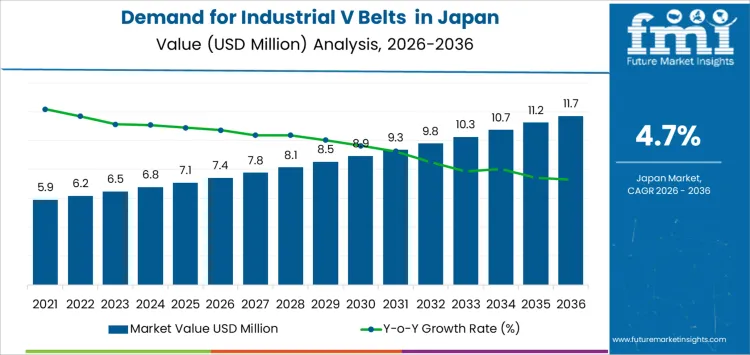
The demand for industrial V belts in Japan is valued at USD 7.4 million in 2026 and is projected to reach USD 11.7 million by 2036, reflecting a CAGR of 4.7%. The historical rise from USD 5.6 million in 2020 to USD 7.4 million in 2026 shows steady intake across machinery used in food and beverage processing, pharmaceutical production, and consumer goods manufacturing. Early demand reflects routine belt replacement linked to motor load cycles and conveyor duty hours rather than changes in industrial structure. LLDPE based formats hold the largest material share, though the provided product and application categories align more closely with packaging support items used around rotating equipment. Wine, glassware, and crockery packaging contribute stable procurement levels tied to handling safeguards within plant operations. Growth during this phase remains guided by maintenance schedules and regulated equipment safety norms across Japanese factories.
From 2027 onward, annual values increase from USD 7.8 million to USD 9.3 million by 2031, then reach USD 11.7 million by 2036 through consistent incremental gains. Industrial V belt demand strengthens as production lines maintain continuous operation across food, beverage, and pharmaceutical facilities. Replacement cycles shorten modestly where higher throughput machinery drives wear rates upward. Wraps, sleeves, and hoods used alongside belt driven systems maintain regular intake in packaging lines linked to final product protection. Consumer goods manufacturing provides a steady secondary base as multipurpose belt driven equipment remains common. After 2030, growth reflects incremental increases in machinery utilization rather than expansion of facility counts. Annual value movement stays narrow, indicating low volatility. The long range pattern shows disciplined maintenance driven procurement shaped by predictable operational loads and established industrial workflows in Japan.
Quick Stats of the Demand for Industrial V Belts in Japan:
- Demand for Industrial V Belts in Japan Value (2026): USD 7.4 million
- Demand for Industrial V Belts in Japan Forecast Value (2036): USD 11.7 million
- Demand for Industrial V Belts in Japan Forecast CAGR (2026–2036): 4.7%
- Demand for Industrial V Belts in Japan Leading Product Type: Narrow Type (65%)
- Demand for Industrial V Belts in Japan Leading Application: Automotive (30%)
- Demand for Industrial V Belts in Japan Key Growth Regions: Kyushu & Okinawa, Kanto, Kansai
- Demand for Industrial V Belts in Japan Top Players: PIX Transmissions Ltd., Mitsuboshi Belting Ltd., Bando Chemical Industries Ltd., SKF Group, Dunlop Belting Products
What is the Growth Forecast for Industrial V Belts in Japan through 2036?
Between 2026 and 2031, demand for industrial V belts in Japan increases from USD 7.4 million to USD 8.9 million, reflecting an absolute gain of USD 1.5 million across five years. Annual value contribution in this phase remains close to USD 0.3 million. Growth is shaped by ongoing replacement cycles in general machinery, compressors, and material handling systems. Earlier demand was influenced by stable industrial operating hours. Near term momentum reflects wider use of compact belt drives, steady refurbishment in small and mid-sized factories, and continued reliance on belt driven transmission systems across established manufacturing clusters.
From 2031 to 2036, demand rises from USD 8.9 million to USD 11.7 million, adding USD 2.8 million during the latter phase of the outlook. Annual value creation approaches USD 0.6 million, indicating a faster progression than the earlier period. Growth is supported by higher equipment density in logistics operations, modernization of production lines, and increasing deployment of belt driven units in engineered machinery. Earlier growth was influenced by maintenance driven procurement, while later expansion reflects broader system level upgrades, tighter performance requirements, and consistent investment in industrial equipment supporting Japan’s long term manufacturing continuity.
Industrial V Belts Industry in Japan Key Takeaways
| Metric | Value |
|---|---|
| Industry Value (2026) | USD 7.4 million |
| Forecast Value (2036) | USD 11.7 million |
| Forecast CAGR (2026–2036) | 4.7% |
What Is Driving the Demand for Industrial V-Belts in Japan from 2026 to 2036?
Demand for industrial V-belts in Japan has been shaped by the scale and structure of domestic manufacturing and equipment installations. V-belts serve as primary power transmission elements in conveyors, pumps, compressors, machine tools, and HVAC systems across factories and facilities nationwide. Historical usage centred on standard rubber and reinforced belt grades configured to local machine designs and maintenance practices. Procurement emphasised reliability, ease of replacement, and compatibility with established drive ratios. In sectors such as automotive assembly, electronics fabrication, and food processing, service schedules for belt inspection and replacement formed predictable demand patterns. Buyers focused on proven supplier performance, stock availability, and established vendor relationships rather than frequent specification changes.
From 2026 to 2036 forecast demand for industrial V-belts in Japan is expected to correlate with continued equipment refurbishment, automation and energy efficiency initiatives. Growth of smart factories and increased adoption of predictive maintenance systems encourage procurement of belts designed for longer service life, lower vibration, and integration with condition-monitoring sensors. Manufacturers renovating plants seek belts that support higher speed, lower slip, and reduced energy loss to meet efficiency targets. Sectors such as semiconductor tool fabrication, automated logistics, and food processing maintain stable replacement cycles tied to equipment uptime requirements. Buyers evaluate total cost of ownership, durability under variable loads, and compatibility with automated tensioning systems. Demand also reflects investment in retrofitting older machinery to extend operational life while meeting tighter performance and emissions standards. Forecast growth depends on industrial reinvestment, plant automation rollout, and maintenance strategy shifts toward predictive servicing across key sectors.
What Is the Demand for Industrial V Belts in Japan by Product Type and Application for 2026 to 2036?
The demand for industrial V belts in Japan from 2026 to 2036 is influenced by industrial automation, equipment replacement cycles, and sustained automotive sector usage. Narrow type belts account for 65% of the volume, with widespread use in compact machinery and space-restricted configurations. Automotive leads all application areas at 30% due to consistent use in engine systems, pulleys, and accessory drives. Buyer behavior includes long-term procurement for OEM supply chains and high replacement frequency in fleets. Performance differentiation is based on belt strength, heat resistance, and precision fitting. Import dependence remains for precision molded V profiles. Procurement is managed through equipment integrators, automotive suppliers, and maintenance contractors.
Why do narrow type V belts contribute 65% to Japan’s demand by product type from 2026 to 2036?
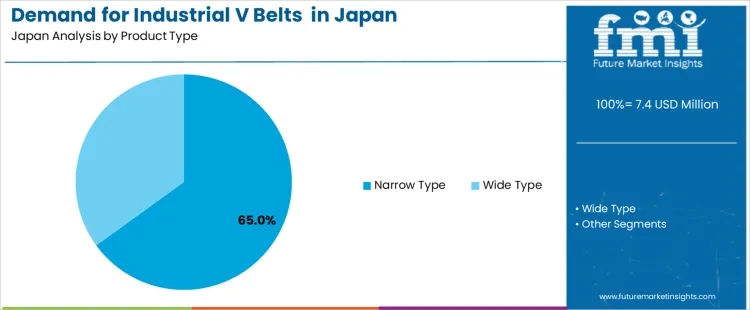
Narrow type V belts contribute 65% to Japan’s demand by product type due to their space-efficient design, compatibility with high-speed pulleys, and favorable stress distribution across compact systems. This belt category dominates usage in automotive, light manufacturing, and power tools where component space is limited. Buyers prefer narrow types for their alignment tolerance and efficient transmission across smaller diameter sheaves. Repeat replacement occurs frequently in vehicles, leading to stable aftermarket volume. Procurement behavior is driven by distributor stocking and OEM partnerships. Narrow belts benefit from higher transmission efficiency per unit width compared to wide belts, supporting compact design mandates across Japanese machinery.
Demand for narrow V belts remains predictable across 2026 to 2036 due to consistent application in small motors, fans, pumps, and compressors. Volume share is stable because newer systems increasingly adopt this configuration to reduce belt mass and mechanical losses. Usage intensity remains high in factory automation and transport equipment. Product lifecycle management focuses on maintaining belt tracking, flexibility, and resistance to edge wear. Margins are maintained through OEM relationships and aftermarket sales. Import dependency exists for raw rubber and precision-molded profiles. Regulatory exposure is minimal, limited to quality assurance and noise control in machinery environments.
Why does automotive represent 30.0% of industrial V belt demand in Japan by application?
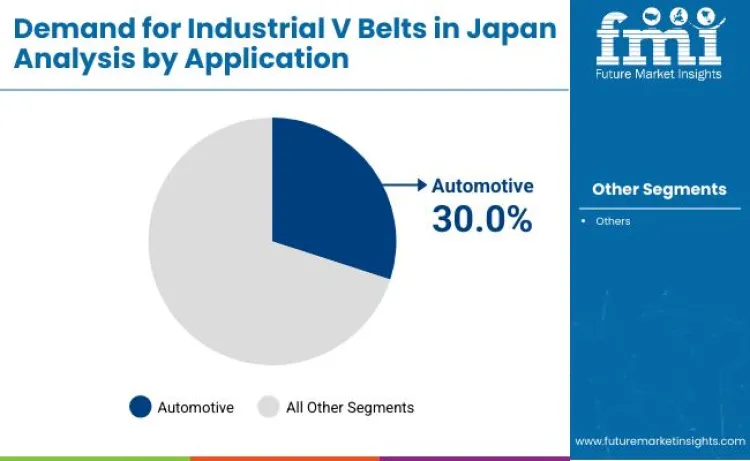
Automotive represents 30.0% of industrial V belt demand in Japan by application due to extensive usage in internal combustion engine components, alternators, air conditioning systems, and steering mechanisms. V belts remain essential in both passenger and commercial vehicles where torque transfer and drive system reliability are critical. Demand is driven by both OEM production lines and aftermarket replacement needs. Vehicle maintenance cycles ensure steady procurement for fleets, dealerships, and repair shops. Belt performance is judged on heat resistance, minimal elongation, and friction coefficient. Narrow type V belts are dominant in this segment due to engine layout constraints and efficiency requirements.
From 2026 to 2036, stable vehicle parc and ongoing maintenance support the repeat demand for automotive belts in Japan. Hybrid vehicles continue to use belt systems for auxiliary drives, supporting demand resilience. Usage remains stable despite partial electrification of fleets. Volume contribution remains significant due to the long service life of traditional engine platforms and ongoing part wear. Procurement behavior includes bulk orders through supply chain contracts and fast-moving aftermarket sales. OEM specification alignment is critical for compatibility. Margins are maintained through brand differentiation, warranty terms, and volume-based pricing. Import exposure exists for rubber compounding ingredients and advanced reinforcement materials.
What Is Driving the Demand for Industrial V Belts in Japan Equipment Reliability Across Aging Factories and Distributed Plants?
Demand for industrial V belts in Japan grows through the need to stabilize mechanical uptime across aging factories, regional processing plants, and compact workshop environments. Many facilities continue operating long-running mixers, conveyors, blowers, pumps, and compressors that rely on belt drives rather than fully servomotor conversions. Reliability expectations remain high because downtime causes quality drift in batch operations such as food, plastics, rubber, and ceramics. Seasonal humidity affects belt grip and slip resistance, especially in coastal regions.
How Are Manufacturing Workflows and Maintenance Practices Shaping Belt Consumption in Japan?
Japanese maintenance teams emphasize preventive schedules that replace belts before failure to maintain process uniformity. Precision component suppliers, automotive workshops, and packaging lines operate continuous shifts where belt deterioration directly affects cycle timing. Plants running mixed vintages of machinery stock multiple belt profiles, including classical, narrow, and cogged types. Maintenance crews value predictable lead times and consistent tensioning behavior to avoid mid-shift recalibration. Production planners coordinate belt replacements with mold changes, sanitation windows, and seasonal demand peaks. This workflow-driven approach links belt consumption to operational discipline and equipment age distribution across diverse industrial clusters nationwide.
Why Do HVAC, Agriculture, and Small Equipment Fleets Support Steady Background Demand in Japan?
Beyond large factories, HVAC systems, agricultural machines, and small workshops sustain steady year-round belt demand across Japan. Air handling units in offices, schools, and hospitals rely on V belts for blower drives under long operating hours. Agricultural belts support rice mills, irrigation pumps, threshers, and feed preparation. Community workshops and municipal repair depots maintain belts for compressors, polishing tools, and woodworking equipment. These environments favor dependable stock rather than specialized designs. Demand remains grounded in continuous field usage, community infrastructure support, and long equipment life typical in regional towns where replacement cycles extend across decades.
What is the Demand for Industrial V Belts in Japan by Region?
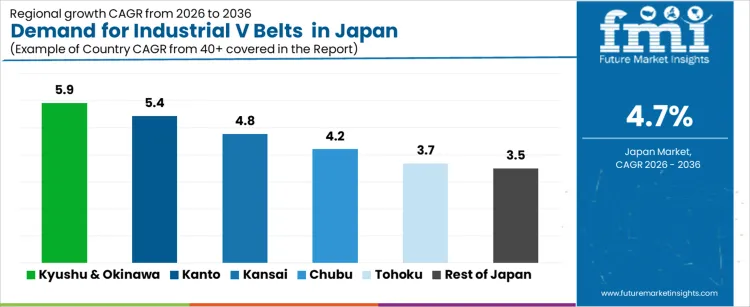
| Region | CAGR (%) |
|---|---|
| Kyushu & Okinawa | 5.9% |
| Kanto | 5.4% |
| Kansai | 4.8% |
| Chubu | 4.2% |
| Tohoku | 3.7% |
| Rest of Japan | 3.5% |
The demand for industrial V belts in Japan is growing steadily across machinery, manufacturing, and industrial maintenance sectors, led by Kyushu and Okinawa at a 5.9% CAGR. Growth in this region is supported by active machinery repair operations, expanding food processing units, and widespread use of belt driven systems in marine and agricultural equipment. Kanto follows at 5.4%, driven by dense industrial clusters, high equipment replacement needs, and strong uptake across commercial HVAC systems and material handling equipment. Kansai records 4.8% growth, reflecting stable demand from regional factories, packaging machinery users, and general engineering industries. Chubu at 4.2% shows moderate expansion linked to automotive production and component machining. Tohoku and the Rest of Japan, at 3.7% and 3.5%, reflect slower growth shaped by smaller industrial bases, reduced machinery installation activity, and longer maintenance intervals.
How Is Mechanical Equipment Usage Influencing Industrial V Belt Demand in Kyushu and Okinawa?
Demand for industrial V belts in Kyushu and Okinawa is moving at a CAGR of 5.9% from 2026 to 2036, supported by steady operation of conveyor lines, mixers, and general machinery across food plants, packaging units, and regional logistics hubs. Facilities continue to use belt driven equipment for predictable torque transmission and manageable upkeep. Operational stability, consistent load profiles, and routine inspections shape replacement cycles. Plants maintain belt stocks to reduce downtime during maintenance. Regional activity reflects practical use of mechanical systems across industries that rely on continuous production, structured material movement, and cost controlled equipment servicing needs throughout daily operations.
- Food processing plants use belt driven systems
- Logistics hubs operate conveyors with standard belts
- Packaging units rely on simple drive mechanisms
- Routine servicing guides belt replacement activity
Why Is Wide Industrial Diversity Sustaining V Belt Adoption in Kanto?
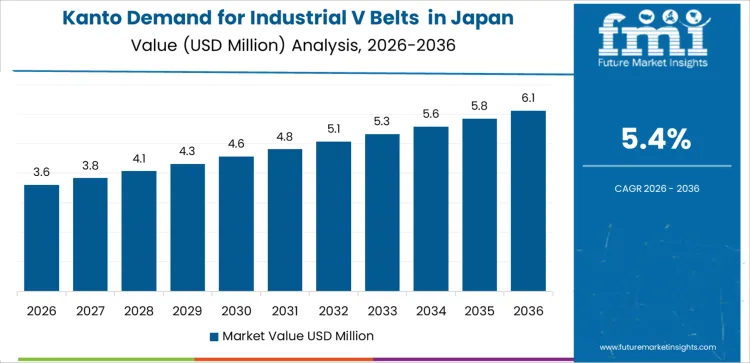
Demand for industrial V belts in Kanto is rising at a CAGR of 5.4% from 2026 to 2036, supported by electronics assembly lines, automotive component plants, and commercial building mechanical systems. Many sites continue to operate mixed equipment fleets using both traditional belt driven machinery and updated automation platforms. V belts remain relevant in auxiliary systems where stable performance and accessible maintenance remain important. Replacement cycles mirror operating hours, mechanical loading patterns, and consistent use across varied production zones. Regional consumption reflects structured maintenance planning, broad sector involvement, and ongoing reliance on belt driven systems in daily industrial and commercial operations.
- Electronics plants use belts in support equipment
- Automotive units operate belt driven transfer systems
- Commercial buildings apply belts in ventilation setups
- Broad industrial activity supports steady belt use
How Are Manufacturing Workflows Shaping V Belt Needs Across Kansai?
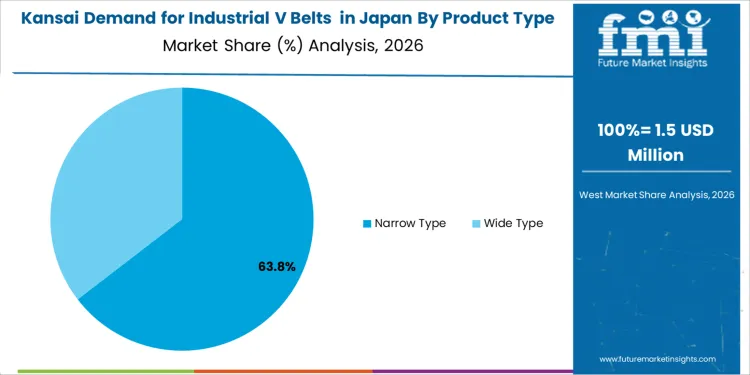
Demand for industrial V belts in Kansai is progressing at a CAGR of 4.8% from 2026 to 2036, supported by machinery fabrication, textile processing, and beverage production. Many facilities continue to rely on belt driven mixers, fans, conveyors, and auxiliary drive systems due to predictable operation and straightforward maintenance. Regional plants plan belt inspections around routine shift cycles and operational schedules, creating consistent replacement patterns. Equipment configurations vary across sectors, creating demand for multiple belt specifications. Kansai industrial zones maintain balanced usage across both primary and secondary systems that depend on mechanical power transfer in production, handling, and utility operations.
- Textile units operate belt driven processing lines
- Beverage facilities apply belts in production stages
- Machinery plants use belt systems in drive assemblies
- Varied applications require multiple belt types
What Is Guiding Industrial V Belt Consumption in Chubu?
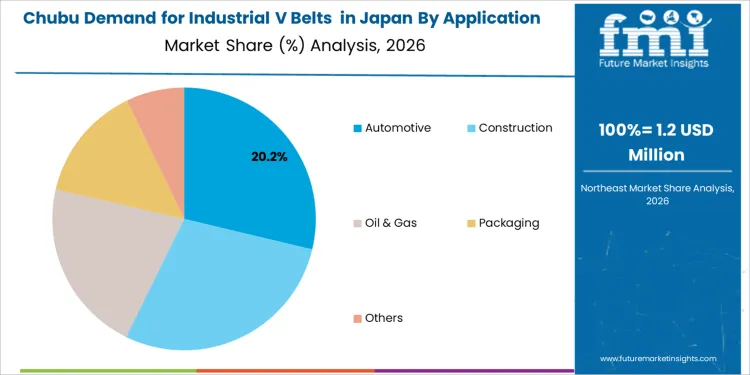
Demand for industrial V belts in Chubu is increasing at a CAGR of 4.2% from 2026 to 2036, supported by automotive production, machining centers, and metal fabrication plants. V belts play a role in coolant pumps, ventilation units, and auxiliary drives across manufacturing floors. Many plants use belts to maintain simple, reliable power transfer in systems not yet migrated to advanced automation. Replacement timing reflects equipment wear, mechanical stress, and inspection routines. Chubu demand remains linked to stable industrial output and the continued presence of belt operated systems in environments where ease of maintenance and predictable load behavior remain important.
- Automotive plants maintain belt driven auxiliary systems
- Machining centers use belts in coolant circulation units
- Metal fabrication plants rely on belt ventilation equipment
- Maintenance cycles determine replacement frequency
How Are Regional Industries Supporting V Belt Usage in Tohoku?
Demand for industrial V belts in Tohoku is expanding at a CAGR of 3.7% from 2026 to 2036, supported by agricultural processing operations, food manufacturing units, and modest scale industrial facilities. V belts remain part of mixers, pumps, conveyors, and smaller mechanical systems used across seasonal and continuous production lines. Plants adopt belt driven systems where reliability, simple servicing, and accessible spare parts remain priorities. Replacement cycles align with usage intensity and environmental conditions. Tohoku industrial activity reflects consistent demand from operations that rely on dependable mechanical transmission for daily processing, material handling, and utility functions across distributed regional facilities.
- Agricultural processors use belt driven handling systems
- Food plants operate conveyors with standard belts
- Regional factories maintain simple mechanical drives
- Seasonal workloads shape belt wear and replacement
What Is Sustaining V Belt Demand Across Rest of Japan?
Demand for industrial V belts in Rest of Japan is advancing at a CAGR of 3.5% from 2026 to 2036, supported by small workshops, community industries, and distribution sites. Belt driven equipment continues to operate in modest scale production lines, compact machining units, and warehouse conveyors used for regional goods handling. Facilities value straightforward belt replacement, predictable wear cycles, and the availability of standard belt sizes. Replacement decisions follow routine inspections and localized maintenance practices. Stable throughput across smaller industrial operations contributes to ongoing belt consumption where mechanical drive systems remain an efficient and practical choice for daily equipment operation.
- Small workshops maintain belt driven machinery
- Warehouses rely on belt based conveyors
- Local production sites use mechanical power transfer
- Standard belt sizes simplify maintenance planning
What Is Driving the Demand for Industrial V Belts in Japan and Which Companies Shape Machinery and Maintenance Supply
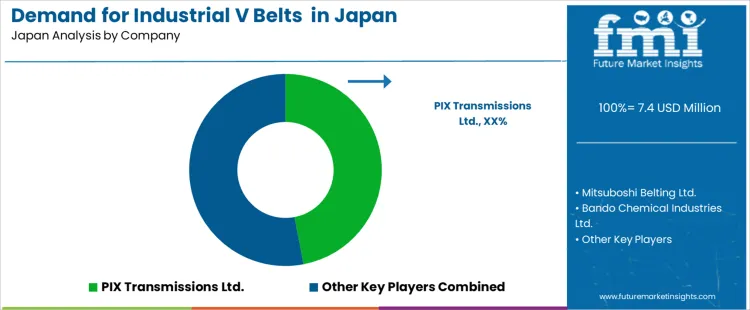
The demand for industrial V belts in Japan is shaped by continuous operation of manufacturing plants, strong machinery production, and routine maintenance cycles across automotive, packaging, textile, steel, and food processing facilities. Mitsuboshi Belting Ltd. holds a central domestic position through molded and wrapped V belts used in conveyors, compressors, agricultural equipment, and factory drive systems. Bando Chemical Industries Ltd. supports demand through high strength belts supplied to automotive OEMs, machine tool builders, and industrial maintenance contractors. PIX Transmissions Ltd. participates through imported industrial belts used in export oriented machinery and selected OEM applications. SKF Group supports drive system reliability through bearing and belt related components used in maintenance programs. Dunlop Belting Products serves niche industrial segments through heavy duty belts used in material handling.
The selection of V belts in Japan is governed by tensile strength, heat resistance, precise dimensional stability, and predictable operating life under continuous duty. Plants favor belts that deliver low slip, quiet running, and reduced maintenance intervention across multi shift operations. Buyer preference centers on suppliers with local stocking capability, rapid technical support, and documented performance under Japanese industrial standards. Usage spans conveyors in logistics centers, pulleys in machining lines, blowers in HVAC systems, and compact drives in agricultural machinery. Replacement cycles align with scheduled plant shutdowns and machinery overhaul intervals. Demand visibility tracks automotive parts output, factory modernization in major industrial prefectures, and steady adoption of belt based drive systems in equipment designed for reduced noise and lower lubrication needs.
Key Players in the Industrial V Belts Industry in Japan
- PIX Transmissions Ltd.
- Mitsuboshi Belting Ltd.
- Bando Chemical Industries Ltd.
- SKF Group
- Dunlop Belting Products
Scope of the Report
| Items | Values |
|---|---|
| Quantitative Units (2026) | USD million |
| Product Type | Narrow Type, Wide Type |
| Application | Automotive, Construction, Oil and Gas, Packaging, Others |
| Industry | Food and Beverage, Pharmaceutical, Consumer Goods, Automotive, General Manufacturing |
| Regions Covered | Kyushu and Okinawa, Kanto, Kansai, Chubu, Tohoku, Rest of Japan |
| Countries Covered | Japan |
| Key Companies Profiled | PIX Transmissions Ltd., Mitsuboshi Belting Ltd., Bando Chemical Industries Ltd., SKF Group, Dunlop Belting Products |
| Additional Attributes | Dollar sales by product type and application; replacement versus new installation demand cycles; V belt usage intensity across equipment types; narrow type share at 65%; automotive share at 30%; performance factors including heat resistance, slip control, and tension stability; procurement behavior across OEM and aftermarket channels; constraints from legacy pulley geometry and qualification requirements; regional variation tied to industrial density and mechanical load cycles |
Industrial V Belts Industry in Japan Segmentation
Product Type:
- Narrow Type
- Wide Type
Application:
- Automotive
- Construction
- Oil & Gas
- Packaging
- Others
Region
- Kyushu & Okinawa
- Kanto
- Kansai
- Chubu
- Tohoku
- Rest of Japan
Frequently Asked Questions
How big is the demand for industrial V belts in Japan in 2026?
The demand for industrial V belts in Japan is estimated to be valued at USD 7.4 million in 2026.
What will be the size of industrial V belts in Japan in 2036?
The market size for the industrial V belts in Japan is projected to reach USD 11.7 million by 2036.
How much will be the demand for industrial V belts in Japan growth between 2026 and 2036?
The demand for industrial V belts in Japan is expected to grow at a 4.7% CAGR between 2026 and 2036.
What are the key product types in the industrial V belts in Japan?
The key product types in industrial V belts in Japan are narrow type and wide type.
Which application segment is expected to contribute significant share in the industrial V belts in Japan in 2026?
In terms of application, automotive segment is expected to command 20.0% share in the industrial V belts in Japan in 2026.
Preview the report firsthand - request a free sample
Get SampleGet the brochure for pricing and purchase details.
Get PDFTable of Content
- Executive Summary
- Japan Market Outlook
- Demand-side Trends
- Supply-side Trends
- Technology Roadmap Analysis
- Analysis and Recommendations
- Market Overview
- Market Coverage / Taxonomy
- Market Definition / Scope / Limitations
- Market Background
- Market Dynamics
- Drivers
- Restraints
- Opportunity
- Trends
- Scenario Forecast
- Demand in Optimistic Scenario
- Demand in Likely Scenario
- Demand in Conservative Scenario
- Opportunity Map Analysis
- Product Life Cycle Analysis
- Supply Chain Analysis
- Investment Feasibility Matrix
- Value Chain Analysis
- PESTLE and Porter’s Analysis
- Regulatory Landscape
- Regional Parent Market Outlook
- Production and Consumption Statistics
- Import and Export Statistics
- Market Dynamics
- Japan Market Analysis 2021 and 2026 and Forecast, 2026 to 2036
- Historical Market Size Value (USD Million) Analysis, 2021 and 2026
- Current and Future Market Size Value (USD Million) Projections, 2026 to 2036
- Y-o-Y Growth Trend Analysis
- Absolute $ Opportunity Analysis
- Japan Market Pricing Analysis 2021 and 2026 and Forecast 2026 to 2036
- Japan Market Analysis 2021 and 2026 and Forecast 2026 to 2036, By Product Type
- Introduction / Key Findings
- Historical Market Size Value (USD Million) Analysis By Product Type , 2021 and 2026
- Current and Future Market Size Value (USD Million) Analysis and Forecast By Product Type , 2026 to 2036
- Narrow Type
- Wide Type
- Y-o-Y Growth Trend Analysis By Product Type , 2021 and 2026
- Absolute $ Opportunity Analysis By Product Type , 2026 to 2036
- Japan Market Analysis 2021 and 2026 and Forecast 2026 to 2036, By Application
- Introduction / Key Findings
- Historical Market Size Value (USD Million) Analysis By Application, 2021 and 2026
- Current and Future Market Size Value (USD Million) Analysis and Forecast By Application, 2026 to 2036
- Automotive
- Construction
- Oil & Gas
- Packaging
- Others
- Y-o-Y Growth Trend Analysis By Application, 2021 and 2026
- Absolute $ Opportunity Analysis By Application, 2026 to 2036
- Market Structure Analysis
- Competition Dashboard
- Competition Benchmarking
- Market Share Analysis of Top Players
- By Regional
- By Product Type
- By Application
- Competition Analysis
- Competition Deep Dive
- PIX Transmissions Ltd.
- Overview
- Product Portfolio
- Profitability by Market Segments (Product/Age /Sales Channel/Region)
- Sales Footprint
- Strategy Overview
- Marketing Strategy
- Product Strategy
- Channel Strategy
- Mitsuboshi Belting Ltd.
- Bando Chemical Industries Ltd.
- SKF Group
- Dunlop Belting Products
- PIX Transmissions Ltd.
- Competition Deep Dive
- Assumptions & Acronyms Used
- Research Methodology


