

- Industry Size (2026)
- USD 51.94 Mn
- Forecast (2036)
- USD 93.02 Mn
- CAGR (2026 to 2036)
- 6%
Demand for Industrial V Belts in USA Market Size, Market Forecast and Outlook By FMI
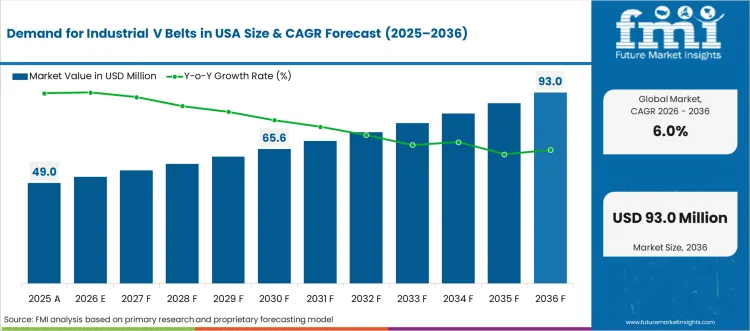
The Industrial V Belts in USA market was valued at USD 49.00 million in 2025, projected to reach USD 51.94 million in 2026, and is forecast to expand to USD 93.02 million by 2036 at a 6% CAGR. As per FMI, aftermarket replacement cycles in automotive, construction, and oil and gas sectors are sustaining steady procurement of industrial V belts across USA manufacturing and maintenance channels. FMI is of the opinion that the ongoing electrification of auxiliary drive systems in commercial vehicles is not displacing V belt demand but rather shifting specification requirements toward narrow-profile, high-tensile belt configurations compatible with hybrid powertrain architectures.
Summary of Demand for Industrial V Belts in USA Market
- Market Overview
- The Industrial V Belts in USA market is valued at USD 49.00 million in 2025 and is projected to reach USD 93.02 million by 2036.
- The industry is expected to grow at a 6% CAGR from 2026 to 2036, creating an incremental opportunity of USD 41.08 million.
- The market is a replacement-cycle-driven industrial consumables category where equipment duty cycle intensity, aftermarket distribution reach, and belt specification compliance define competitive positioning across USA industrial sectors.
- Demand and Growth Drivers
- Demand is sustained by aftermarket replacement cycles in automotive, construction, and oil and gas sectors driving steady V belt procurement through maintenance channels.
- Hybrid powertrain electrification in commercial vehicles is shifting specifications toward narrow-profile, high-tensile belt configurations rather than displacing demand.
- Continuous duty cycle installations in manufacturing and processing facilities generate replacement frequencies materially above intermittent-use equipment.
- West USA leads at 6.9% CAGR, followed by South USA at 6.2%, Northeast USA at 5.5%, and Midwest USA at 4.8%.
- Product and Segment View
- The market includes product type, application as primary segmentation dimensions.
- Narrow Type leads by Product Type with 65% share in 2026.
- Automotive leads by Application with 20% share in 2026.
- Geography and Competitive Outlook
- West USA is the fastest-growing region at 6.9% CAGR, while South USA anchors the second-largest demand base.
- Competition is shaped by technical specialisation, regulatory compliance capability, and distribution depth, with key players including SKF Group, Mitsuboshi Belting Ltd., Bando Chemical Industries Ltd., PIX Transmissions Ltd., Dunlop Belting Products.
- Analyst Opinion at FMI
- Nikhil Kaitwade, Principal Consultant, opines: 'FMI's analysis reveals that the industrial v belts in usa market is entering a phase where procurement decisions are increasingly dictated by regulatory compliance timelines and measurable performance thresholds. Organisations that delay platform investment risk permanent lockout from competitive procurement tiers their counterparts are actively securing.'
- Strategic Implications / Executive Takeaways
- Solution providers must secure certified integration pathways with tier-1 enterprise systems to qualify for forthcoming institutional procurement contracts.
- Capital project directors should phase out legacy approaches and mandate native platform compatibility in all new equipment and software procurement specifications.
- Technical teams must develop specialised competencies in product type validation to demonstrate compliance parameters during the evaluation phase.
Demand for Industrial V Belts in USA Market Key Takeaways
| Metric | Details |
|---|---|
| Industry Size (2026) | USD 51.94 million |
| Industry Value (2036) | USD 93.02 million |
| CAGR (2026 to 2036) | 6% |
Source: Future Market Insights, 2026
FMI analysts observe that regional demand patterns across the United States reflect varying concentrations of manufacturing, agriculture, and energy extraction infrastructure. West USA leads at 6.9% CAGR, driven by California manufacturing facility upgrades and Pacific Northwest agricultural equipment replacement cycles. South USA follows at 6.2%, supported by oil and gas equipment maintenance demand in Texas and Louisiana alongside construction activity in Florida and Georgia. Northeast USA registers 5.5% growth anchored by packaging machinery belt replacement in New York and Pennsylvania distribution centres. Midwest USA maintains 4.8% growth as agricultural equipment and automotive assembly plant conveyor systems generate baseline replacement demand across Iowa, Michigan, and Ohio. Based on FMI's report, facilities operating continuous duty cycle equipment show V belt replacement frequencies 40% higher than intermittent-use installations.
Demand for Industrial V Belts in USA Market Definition
Based on FMI's report, the Industrial V Belts in USA market covers narrow type and wide type industrial V belts used in power transmission applications across automotive, construction, oil and gas, packaging, and other industrial sectors within the United States.
Demand for Industrial V Belts in USA Market Inclusions
Future Market Insights analysis covers narrow type and wide type V belts across all major industrial applications. The scope encompasses regional market sizes across USA census regions, forecast projections from 2026 to 2036, and segmentation by product type and application.
Demand for Industrial V Belts in USA Market Exclusions
The scope excludes consumer-grade automotive accessory belts sold through retail auto parts channels, timing belts, flat belts, and synchronous belts not classified under V belt product specifications.
Demand for Industrial V Belts in USA Market Research Methodology
- Primary Research: Analysts engaged with industrial belt distributors, OEM procurement managers, and maintenance engineering directors to map replacement cycle triggers and specification upgrade patterns.
- Desk Research: Data collection aggregated OSHA industrial equipment safety reports, DOE manufacturing energy efficiency programme records, and published capital expenditure disclosures from major USA industrial operators.
- Market-Sizing and Forecasting: Baseline values derive from a bottom-up aggregation of industrial V belt shipments within the United States, applying equipment installed base profiles and duty cycle replacement frequency curves.
- Data Validation and Update Cycle: Projections are cross-validated against quarterly power transmission product revenue guidance from major belt manufacturers and USA Census Bureau manufacturing shipment statistics.
Why is the Demand for Industrial V Belts in USA Growing?
The demand for industrial V belts in the USA is growing due to their critical role in power transmission applications across various industries such as manufacturing, automotive, agriculture, and construction. These belts are essential for efficiently transferring mechanical power between components, ensuring smooth and reliable operation of machines. The ongoing industrialization, coupled with the need for improved efficiency and equipment longevity, is driving the demand for high-performance V belts. As industries increasingly rely on automated systems and machinery, the need for durable and efficient belts continues to rise.
Key drivers for this growth include the rising demand for energy-efficient equipment and machinery, as industrial V belts play a vital role in reducing energy consumption by minimizing friction and improving operational performance. The increasing adoption of automated and precision machinery in sectors such as manufacturing and automotive is also fueling growth. The growing focus on reducing maintenance costs and downtime in industrial operations is pushing the demand for high-quality V belts that offer extended lifespan and reliability.
Despite these growth drivers, challenges such as the high cost of advanced materials, competition from alternative drive systems, and the need for regular maintenance may pose barriers. However, the ongoing demand for durable, energy-efficient, and cost-effective power transmission solutions is expected to drive steady growth for industrial V belts in the USA through 2035.
What is the Segment-Wise Analysis of Demand for Industrial V Belts in USA?
Demand for industrial V belts in the USA is segmented by product type, application, and region. By product type, narrow type V belts lead with 65% of the demand, followed by wide type V belts. In terms of application, automotive accounts for 30% of the demand, with construction, oil and gas, packaging, and other sectors making up the remaining share. Regionally, demand is distributed across West USA, South USA, Northeast USA, and Midwest USA.
How Does Narrow Type V Belts Lead the Demand for Industrial V Belts in USA?
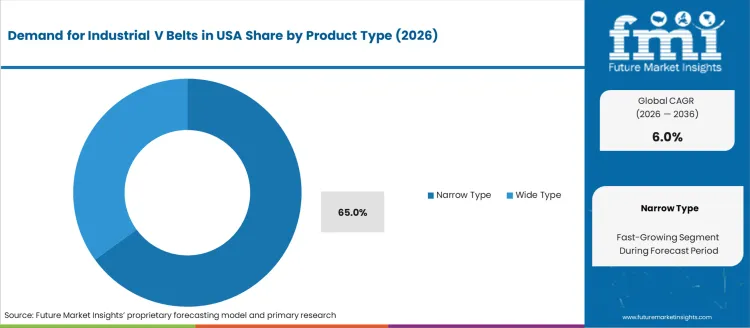
Narrow type V belts account for 65% of the demand for industrial V belts in the USA, driven by their widespread use in various industrial applications. These belts are highly preferred due to their ability to transmit power efficiently in compact spaces. Their design enables them to perform well in high-speed and high-load conditions, making them ideal for machinery in industries like automotive, packaging, and manufacturing. Narrow type V belts are cost-effective, durable, and offer smooth performance, which contributes to their dominance in the industry. Their adaptability to various pulley sizes and efficient operation under demanding conditions further enhances their popularity. As industries continue to prioritize efficient power transmission systems, the demand for narrow type V belts remains strong, cementing their position as the preferred choice in the industrial V belt industry.
How Does Automotive Application Lead the Demand for Industrial V Belts in USA?
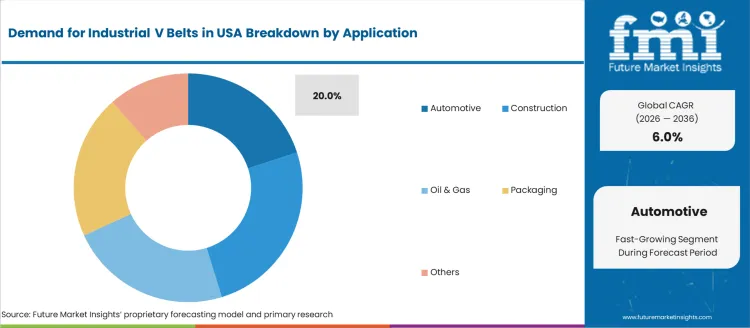
The automotive sector accounts for 20% of the demand for industrial V belts in the USA, driven by the critical role these belts play in vehicle engines and power transmission systems. V belts are widely used in automotive applications for functions such as driving alternators, water pumps, and air conditioning compressors. Their ability to operate efficiently and reliably under varying conditions is essential for vehicle performance and longevity. As the automotive industry focuses on improving fuel efficiency and reducing emissions, the demand for reliable and durable V belts continues to grow. The rise of electric vehicles (EVs) and advancements in automotive technologies are further driving the need for specialized V belts that meet new performance standards. The automotive industry's continued growth and innovation will support the steady demand for industrial V belts, ensuring their ongoing significance in this sector.
What are the Key Trends, Drivers, and Restraints in Demand for Industrial V Belts in USA?
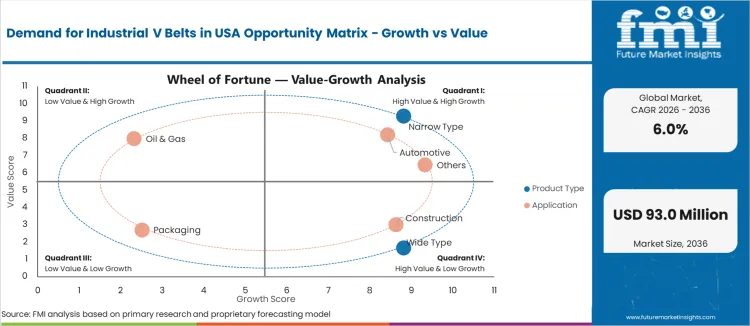
V belts remain fundamental for power transmission in a variety of machinery from conveyors, pumps, compressors and HVAC blowers to agricultural and mining equipment. As companies upgrade or replace older equipment, V belts deliver reliable torque and motion transfer, making them a go to choice for maintenance and retrofit needs. The shift toward energy efficient operations and low maintenance solutions boosts interest in high quality, durable belts. Restraints include competition from alternative transmission solutions such as gear or chain drives. Fluctuating raw material costs, especially rubber or synthetic compounds, can raise belt prices and affect demand.
Why is Demand for Industrial V Belts Growing in USA?
Demand grows because a broad range of industries in the USA rely on belt drives to power mechanical systems. Manufacturing plants, automated lines, HVAC systems, agricultural machinery, mining operations, and heavy duty industrial equipment all use V belts for their simplicity, reliability, and relative cost effectiveness. As companies invest in new machinery, expansions, or replacement of worn parts, belts represent an inexpensive yet effective way to maintain equipment uptime. The trend toward automation and efficient power transmission underlines the need for robust belts that can handle variable loads and operate continuously. The aftermarket replacement segment refurbishments, maintenance, upgrades also drives consistent demand, especially in sectors where downtime is costly and reliable belt performance is critical.
How are Technological and Industry Innovations Driving Industrial V Belt Demand in USA?
Advances in materials and manufacturing processes are strengthening demand for modern V belts in the USA. Belts made from improved rubber or synthetic compounds offer enhanced tensile strength, heat or chemical resistance, and longer service life, meeting needs of demanding industrial environments. Specialist belt types such as high power narrow belts, cogged or wedge designs, and heat resistant belts support high load, high speed, or harsh environment applications. Belt manufacturers also focus on energy efficient transmission and reducing slippage or wear, aligning with broader industrial goals of energy conservation and lower maintenance costs. Such innovations make V belts a competitive option for both new installations and retrofits in industrial machinery, HVAC systems, agricultural equipment, and more.
What are the Key Challenges and Risks That Could Limit Industrial V Belt Demand in USA?
Price volatility in raw materials especially natural rubber or synthetic polymers can raise production costs and end user prices, putting pressure on cost sensitive buyers. In heavy duty, high stress environments (mining, chemical processing, heat intensive operations), belts may suffer wear, degradation or failure, reducing reliability compared with more rugged alternatives such as gear or chain drives. Alternative power transmission technologies and tailored drive systems may offer better efficiency, longer life, or lower maintenance in certain applications, reducing demand for conventional V belts. For some applications, maintenance and periodic replacement requirements also add to lifecycle cost, which might push buyers toward more set and forget transmission solutions.
What is the Regional Demand Outlook for Industrial V Belts in USA?
.webp "Top Country Growth Comparison Demand For Industrial V Belts In Usa Cagr (2026 2036)")
| Region | CAGR (%) |
|---|---|
| West USA | 6.9% |
| South USA | 6.2% |
| Northeast USA | 5.5% |
| Midwest USA | 4.8% |
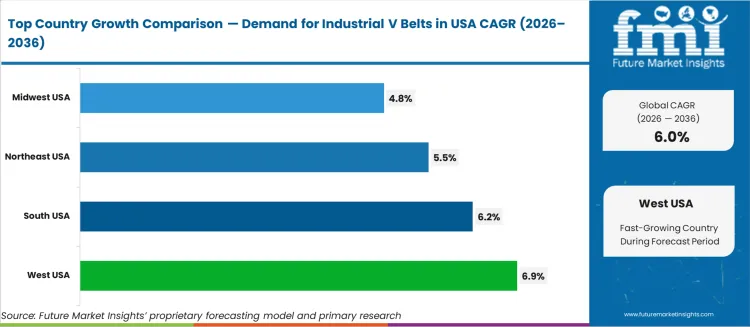
Demand for industrial V belts in the USA is growing steadily, with West USA leading at a 6.9% CAGR, driven by strong industrial sectors like manufacturing, agriculture, and automation. South USA follows with a 6.2% CAGR, fueled by the expanding manufacturing base, particularly in sectors such as automotive and food processing. Northeast USA shows a 5.5% CAGR, supported by its established industrial sectors and increasing focus on automation. Midwest USA experiences a 4.8% CAGR, with demand driven by the region’s automotive and machinery industries. As industrial sectors continue to modernize, demand for V belts will remain strong across all regions.
How is Demand for Industrial V Belts Growing in West USA?
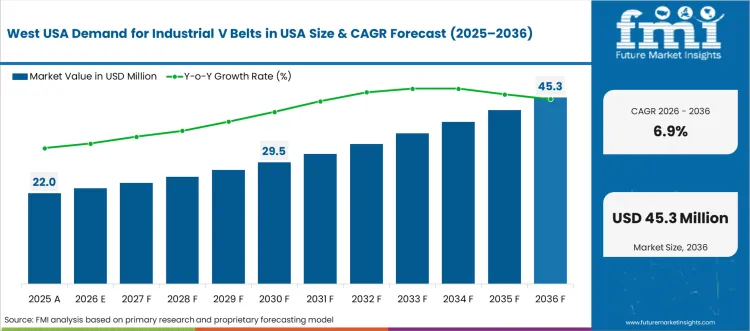
West USA leads the demand for industrial V belts, with a 6.9% CAGR. The region’s diverse industrial base, including sectors such as manufacturing, agriculture, transportation, and energy, is driving the adoption of reliable and efficient power transmission solutions like V belts. As automation in industries like food processing, construction, and automotive continues to rise, the demand for V belts is increasing. Urban centers such as Los Angeles and San Francisco, with their strong industrial and technological advancements, are seeing significant growth in the use of V belts for machinery operations. Industries in the West are focusing on energy efficiency, with V belts being a key component in reducing energy consumption and improving operational efficiency. As the region continues to grow in both technological innovation and industrial production, the need for industrial V belts will remain strong, providing long-term growth opportunities. With manufacturing and automation advancing rapidly, West USA will continue to drive demand for power transmission components like industrial V belts.
Why is Demand for Industrial V Belts Rising in South USA?
South USA is experiencing steady demand for industrial V belts, with a 6.2% CAGR. The region’s rapidly growing manufacturing base, particularly in states like Texas, Georgia, and Florida, is significantly contributing to the rise in demand. As industries such as automotive, chemical, and food processing expand, the need for reliable and high-performance V belts is increasing to ensure smooth machinery operation. The South’s industrial automation efforts intensify, the demand for V belts, which are critical in maintaining operational efficiency, rises. With a growing emphasis on logistics, supply chain optimization, and manufacturing automation, industries in the region rely on power transmission components like V belts for effective machine function. As the region continues to diversify and modernize its manufacturing base, the demand for V belts will remain robust, driven by the increasing adoption of machinery and equipment that relies on these essential components. The strong industrial growth in South USA is expected to continue to fuel the need for industrial V belts.
How is Demand for Industrial V Belts Expanding in Northeast USA?
Northeast USA is seeing steady demand for industrial V belts, with a 5.5% CAGR. The region’s established industrial sectors, including manufacturing, automotive, and energy, rely heavily on V belts for effective power transmission in their machinery. States like Pennsylvania, New York, and New Jersey are seeing increased demand for reliable and durable V belts, as industries continue to focus on improving operational efficiency and reducing maintenance costs. As the Northeast embraces automation in manufacturing, the use of advanced machinery requiring V belts is growing. The rising demand for energy-efficient solutions in machinery and production processes is also contributing to this growth. V belts play a critical role in ensuring the smooth and efficient operation of industrial equipment, reducing energy consumption, and extending equipment lifespan. As environmental regulations become more stringent, businesses in the Northeast are seeking cost-effective and sustainable solutions, further driving the adoption of industrial V belts. With a strong manufacturing base and focus on efficiency, demand will continue to grow steadily.
Why is Demand for Industrial V Belts Growing in Midwest USA?
Midwest USA is experiencing moderate demand for industrial V belts, with a 4.8% CAGR. The region’s diverse industrial landscape, with strong manufacturing sectors in automotive, machinery, and food processing, drives the need for reliable and durable power transmission components like V belts. Cities such as Detroit and Chicago, known for their heavy industrial activity, contribute significantly to the demand for V belts. As industries in the Midwest modernize their equipment and adopt more advanced machinery, V belts remain crucial in ensuring smooth operation and minimizing downtime. The rise in automation in manufacturing processes is increasing the demand for industrial V belts to support efficient and continuous machine operations. With the Midwest’s focus on maintaining reliable production systems and reducing energy costs, the demand for V belts is expected to remain steady. As more companies in the region invest in efficient machinery and automated systems, the adoption of V belts will continue to grow, ensuring steady demand in the Midwest.
What is the Competitive Landscape of Industrial V Belts Demand in USA?
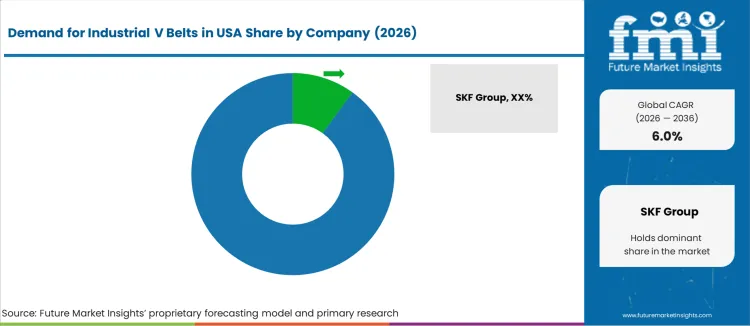
Demand for industrial V belts in the USA is driven by their essential role in various mechanical systems, including manufacturing, automotive, and agriculture. These belts are crucial for power transmission, offering efficient performance, durability, and cost-effectiveness. As industries look for reliable solutions to enhance operational efficiency, the demand for high-quality industrial V belts continues to rise, particularly in sectors requiring high performance and long-lasting components. Other major players in the industry include Mitsuboshi Belting Ltd., Bando Chemical Industries Ltd., SKF Group, and Dunlop Belting Products. These companies focus on offering reliable, high-quality V belts that cater to a broad range of industrial applications. Mitsuboshi Belting and Bando Chemical Industries emphasize product innovation and engineering expertise, offering belts that meet the specific demands of high-performance machinery. SKF Group is known for integrating its V belts with advanced technology, ensuring greater efficiency and reliability. Dunlop Belting Products specializes in providing durable solutions for heavy-duty applications. As competition intensifies, companies continue to innovate in materials and design, focusing on durability, cost-effectiveness, and performance to stay ahead in the industrial V belt industry.
Key Players in USA Industrial V Belts Demand
- PIX Transmissions Ltd.
- Mitsuboshi Belting Ltd.
- Bando Chemical Industries Ltd.
- SKF Group
- Dunlop Belting Products
Scope of the Report

| Metric | Value |
|---|---|
| Quantitative Units | USD 51.94 million to USD 93.02 million, at a CAGR of 6% |
| Market Definition | Based on FMI's report, the Industrial V Belts in USA market covers narrow type and wide type industrial V belts used in power transmission applications across automotive, construction, oil and gas, packaging, and other industrial sectors within the United States. |
| Segmentation | Product Type: Narrow Type, Wide Type; Application: Automotive, Construction, Oil & Gas, Packaging, Others |
| Regions Covered | West USA, South USA, Northeast USA, Midwest USA |
| Key Companies Profiled | SKF Group, Mitsuboshi Belting Ltd., Bando Chemical Industries Ltd., PIX Transmissions Ltd., Dunlop Belting Products |
| Forecast Period | 2026 to 2036 |
| Approach | Hybrid bottom-up methodology combining installed base metrics with regulatory compliance adoption curves and primary research validation. |
USA Industrial V Belts Demand by Key Segments
Product Type
- Narrow Type
- Wide Type
Application
- Automotive
- Construction
- Oil & Gas
- Packaging
- Others
Region
- West USA
- South USA
- Northeast USA
- Midwest USA
Bibliography
- 1. USA Bureau of Labor Statistics. (2025). Occupational Safety and Health Statistics: Industrial Equipment Maintenance. BLS.
- 2. Rubber Manufacturers Association. (2025). USA Power Transmission Belt Market Statistical Report. RMA.
- 3. USA Census Bureau. (2025). Annual Survey of Manufactures: Power Transmission Equipment. USA Census Bureau.
- 4. International Organization for Standardization. (2024). ISO 4184: Belt Drives, Classical and Narrow V-belts. ISO.
- 5. USA Department of Energy. (2025). Industrial Motor Systems and Power Transmission Efficiency Guide. DOE.
- 6. Organisation for Economic Co-operation and Development. (2025). Industrial Outlook: Manufacturing Sector Analysis. OECD Publishing.
This bibliography is provided for reader reference. The full Future Market Insights report contains the complete reference list with primary research documentation.
Frequently Asked Questions
How large is the Industrial V Belts in USA market in 2026?
The Industrial V Belts in USA market is estimated to be valued at USD 51.94 million in 2026.
What will be the market size of Industrial V Belts in USA by 2036?
Market size for Industrial V Belts in USA is projected to reach USD 93.02 million by 2036.
What is the expected CAGR for Industrial V Belts in USA between 2026 and 2036?
The Industrial V Belts in USA market is expected to grow at a CAGR of 6% between 2026 and 2036.
Which Product Type leads the Industrial V Belts in USA market in 2026?
Narrow Type accounts for 65% share in 2026 by Product Type.
Which region is projected to grow fastest?
West USA is projected to grow at a CAGR of 6.9% during 2026 to 2036.
What does this report include in its scope?
The report covers market sizing, segmentation analysis, regional forecasts, competitive landscape evaluation, and forecast projections from 2026 to 2036.
How does FMI build and validate the Industrial V Belts in USA forecast?
Forecasting models apply a bottom-up methodology starting with installed base metrics and cross-validate projections against quarterly revenue volumes and regulatory compliance adoption data.
Preview the report firsthand - request a free sample
Get SampleGet the brochure for pricing and purchase details.
Get PDFTable of Content
- Executive Summary
- Global Market Outlook
- Demand-side Trends
- Supply-side Trends
- Technology Roadmap Analysis
- Analysis and Recommendations
- Market Overview
- Market Coverage / Taxonomy
- Market Definition / Scope / Limitations
- Research Methodology
- Chapter Orientation
- Analytical Lens and Working Hypotheses
- Market Structure, Signals, and Trend Drivers
- Company Annual and Sustainability Reports
- Peer-reviewed Journals and Academic Literature
- Corporate Websites, Product Literature, and Technical Notes
- Earnings Decks and Investor Briefings
- Statutory Filings and Regulatory Disclosures
- Technical White Papers and Standards Notes
- Trade Journals, Industry Magazines, and Analyst Briefs
- Conference Proceedings, Webinars, and Seminar Materials
- Government Statistics Portals and Public Data Releases
- Press Releases and Reputable Media Coverage
- Specialist Newsletters and Curated Briefings
- Sector Databases and Reference Repositories
- FMI Internal Proprietary Databases and Historical Market Datasets
- Subscription Datasets and Paid Sources
- Social Channels, Communities, and Digital Listening Inputs
- Additional Desk Sources
- Expert Input and Fieldwork (Primary Evidence)
- Primary Modes
- Qualitative Interviews and Expert Elicitation
- Quantitative Surveys and Structured Data Capture
- Blended Approach
- Why Primary Evidence is Used
- Field Techniques
- Interviews
- Surveys
- Focus Groups
- Observational and In-context Research
- Social and Community Interactions
- Stakeholder Universe Engaged
- C-suite Leaders
- Board Members
- Presidents and Vice Presidents
- R&D and Innovation Heads
- Technical Specialists
- Domain Subject-matter Experts
- Scientists
- Physicians and Other Healthcare Professionals
- Governance, Ethics, and Data Stewardship
- Research Ethics
- Data Integrity and Handling
- Primary Modes
- Tooling, Models, and Reference Databases
- Data Engineering and Model Build
- Data Acquisition and Ingestion
- Cleaning, Normalisation, and Verification
- Synthesis, Triangulation, and Analysis
- Quality Assurance and Audit Trail
- Market Background
- Market Dynamics
- Drivers
- Restraints
- Opportunity
- Trends
- Scenario Forecast
- Demand in Optimistic Scenario
- Demand in Likely Scenario
- Demand in Conservative Scenario
- Opportunity Map Analysis
- Product Life Cycle Analysis
- Supply Chain Analysis
- Investment Feasibility Matrix
- Value Chain Analysis
- PESTLE and Porter’s Analysis
- Regulatory Landscape
- Regional Parent Market Outlook
- Production and Consumption Statistics
- Import and Export Statistics
- Market Dynamics
- Global Market Analysis 2021 to 2025 and Forecast, 2026 to 2036
- Historical Market Size Value (USD Million) Analysis, 2021 to 2025
- Current and Future Market Size Value (USD Million) Projections, 2026 to 2036
- Y-o-Y Growth Trend Analysis
- Absolute $ Opportunity Analysis
- Global Market Pricing Analysis 2021 to 2025 and Forecast 2026 to 2036
- Global Market Analysis 2021 to 2025 and Forecast 2026 to 2036, By Product Type
- Introduction / Key Findings
- Historical Market Size Value (USD Million) Analysis By Product Type , 2021 to 2025
- Current and Future Market Size Value (USD Million) Analysis and Forecast By Product Type , 2026 to 2036
- Narrow Type
- Wide Type
- Narrow Type
- Y-o-Y Growth Trend Analysis By Product Type , 2021 to 2025
- Absolute $ Opportunity Analysis By Product Type , 2026 to 2036
- Global Market Analysis 2021 to 2025 and Forecast 2026 to 2036, By Application
- Introduction / Key Findings
- Historical Market Size Value (USD Million) Analysis By Application, 2021 to 2025
- Current and Future Market Size Value (USD Million) Analysis and Forecast By Application, 2026 to 2036
- Automotive
- Construction
- Oil & Gas
- Packaging
- Others
- Automotive
- Y-o-Y Growth Trend Analysis By Application, 2021 to 2025
- Absolute $ Opportunity Analysis By Application, 2026 to 2036
- Global Market Analysis 2021 to 2025 and Forecast 2026 to 2036, By Region
- Introduction
- Historical Market Size Value (USD Million) Analysis By Region, 2021 to 2025
- Current Market Size Value (USD Million) Analysis and Forecast By Region, 2026 to 2036
- North America
- Latin America
- Western Europe
- Eastern Europe
- East Asia
- South Asia and Pacific
- Middle East & Africa
- Market Attractiveness Analysis By Region
- North America Market Analysis 2021 to 2025 and Forecast 2026 to 2036, By Country
- Historical Market Size Value (USD Million) Trend Analysis By Market Taxonomy, 2021 to 2025
- Market Size Value (USD Million) Forecast By Market Taxonomy, 2026 to 2036
- By Country
- USA
- Canada
- Mexico
- By Product Type
- By Application
- By Country
- Market Attractiveness Analysis
- By Country
- By Product Type
- By Application
- Key Takeaways
- Latin America Market Analysis 2021 to 2025 and Forecast 2026 to 2036, By Country
- Historical Market Size Value (USD Million) Trend Analysis By Market Taxonomy, 2021 to 2025
- Market Size Value (USD Million) Forecast By Market Taxonomy, 2026 to 2036
- By Country
- Brazil
- Chile
- Rest of Latin America
- By Product Type
- By Application
- By Country
- Market Attractiveness Analysis
- By Country
- By Product Type
- By Application
- Key Takeaways
- Western Europe Market Analysis 2021 to 2025 and Forecast 2026 to 2036, By Country
- Historical Market Size Value (USD Million) Trend Analysis By Market Taxonomy, 2021 to 2025
- Market Size Value (USD Million) Forecast By Market Taxonomy, 2026 to 2036
- By Country
- Germany
- UK
- Italy
- Spain
- France
- Nordic
- BENELUX
- Rest of Western Europe
- By Product Type
- By Application
- By Country
- Market Attractiveness Analysis
- By Country
- By Product Type
- By Application
- Key Takeaways
- Eastern Europe Market Analysis 2021 to 2025 and Forecast 2026 to 2036, By Country
- Historical Market Size Value (USD Million) Trend Analysis By Market Taxonomy, 2021 to 2025
- Market Size Value (USD Million) Forecast By Market Taxonomy, 2026 to 2036
- By Country
- Russia
- Poland
- Hungary
- Balkan & Baltic
- Rest of Eastern Europe
- By Product Type
- By Application
- By Country
- Market Attractiveness Analysis
- By Country
- By Product Type
- By Application
- Key Takeaways
- East Asia Market Analysis 2021 to 2025 and Forecast 2026 to 2036, By Country
- Historical Market Size Value (USD Million) Trend Analysis By Market Taxonomy, 2021 to 2025
- Market Size Value (USD Million) Forecast By Market Taxonomy, 2026 to 2036
- By Country
- China
- Japan
- South Korea
- By Product Type
- By Application
- By Country
- Market Attractiveness Analysis
- By Country
- By Product Type
- By Application
- Key Takeaways
- South Asia and Pacific Market Analysis 2021 to 2025 and Forecast 2026 to 2036, By Country
- Historical Market Size Value (USD Million) Trend Analysis By Market Taxonomy, 2021 to 2025
- Market Size Value (USD Million) Forecast By Market Taxonomy, 2026 to 2036
- By Country
- India
- ASEAN
- Australia & New Zealand
- Rest of South Asia and Pacific
- By Product Type
- By Application
- By Country
- Market Attractiveness Analysis
- By Country
- By Product Type
- By Application
- Key Takeaways
- Middle East & Africa Market Analysis 2021 to 2025 and Forecast 2026 to 2036, By Country
- Historical Market Size Value (USD Million) Trend Analysis By Market Taxonomy, 2021 to 2025
- Market Size Value (USD Million) Forecast By Market Taxonomy, 2026 to 2036
- By Country
- Kingdom of Saudi Arabia
- Other GCC Countries
- Turkiye
- South Africa
- Other African Union
- Rest of Middle East & Africa
- By Product Type
- By Application
- By Country
- Market Attractiveness Analysis
- By Country
- By Product Type
- By Application
- Key Takeaways
- Key Countries Market Analysis
- USA
- Pricing Analysis
- Market Share Analysis, 2025
- By Product Type
- By Application
- Canada
- Pricing Analysis
- Market Share Analysis, 2025
- By Product Type
- By Application
- Mexico
- Pricing Analysis
- Market Share Analysis, 2025
- By Product Type
- By Application
- Brazil
- Pricing Analysis
- Market Share Analysis, 2025
- By Product Type
- By Application
- Chile
- Pricing Analysis
- Market Share Analysis, 2025
- By Product Type
- By Application
- Germany
- Pricing Analysis
- Market Share Analysis, 2025
- By Product Type
- By Application
- UK
- Pricing Analysis
- Market Share Analysis, 2025
- By Product Type
- By Application
- Italy
- Pricing Analysis
- Market Share Analysis, 2025
- By Product Type
- By Application
- Spain
- Pricing Analysis
- Market Share Analysis, 2025
- By Product Type
- By Application
- France
- Pricing Analysis
- Market Share Analysis, 2025
- By Product Type
- By Application
- India
- Pricing Analysis
- Market Share Analysis, 2025
- By Product Type
- By Application
- ASEAN
- Pricing Analysis
- Market Share Analysis, 2025
- By Product Type
- By Application
- Australia & New Zealand
- Pricing Analysis
- Market Share Analysis, 2025
- By Product Type
- By Application
- China
- Pricing Analysis
- Market Share Analysis, 2025
- By Product Type
- By Application
- Japan
- Pricing Analysis
- Market Share Analysis, 2025
- By Product Type
- By Application
- South Korea
- Pricing Analysis
- Market Share Analysis, 2025
- By Product Type
- By Application
- Russia
- Pricing Analysis
- Market Share Analysis, 2025
- By Product Type
- By Application
- Poland
- Pricing Analysis
- Market Share Analysis, 2025
- By Product Type
- By Application
- Hungary
- Pricing Analysis
- Market Share Analysis, 2025
- By Product Type
- By Application
- Kingdom of Saudi Arabia
- Pricing Analysis
- Market Share Analysis, 2025
- By Product Type
- By Application
- Turkiye
- Pricing Analysis
- Market Share Analysis, 2025
- By Product Type
- By Application
- South Africa
- Pricing Analysis
- Market Share Analysis, 2025
- By Product Type
- By Application
- USA
- Market Structure Analysis
- Competition Dashboard
- Competition Benchmarking
- Market Share Analysis of Top Players
- By Regional
- By Product Type
- By Application
- Competition Analysis
- Competition Deep Dive
- SKF Group
- Overview
- Product Portfolio
- Profitability by Market Segments (Product/Age /Sales Channel/Region)
- Sales Footprint
- Strategy Overview
- Marketing Strategy
- Product Strategy
- Channel Strategy
- Mitsuboshi Belting Ltd.
- Bando Chemical Industries Ltd.
- PIX Transmissions Ltd.
- Dunlop Belting Products
- SKF Group
- Competition Deep Dive
- Assumptions & Acronyms Used


