

- Industry Size (2026)
- USD 0.85 Bn
- Forecast (2036)
- USD 1.18 Bn
- CAGR (2026 to 2036)
- 3.4%
Demand for Industrial Evaporative Condensers in USA Market Size, Market Forecast and Outlook By FMI
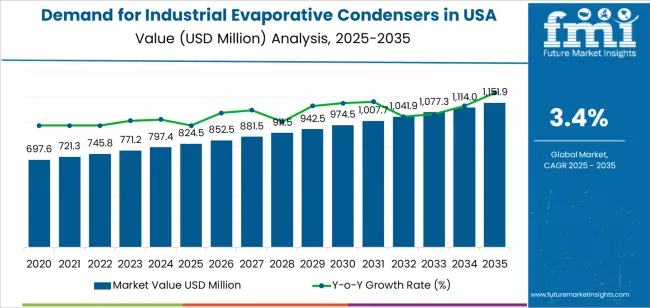
The Industrial Evaporative Condensers in USA market was valued at USD 0.82 billion in 2025, projected to reach USD 0.85 billion in 2026, and is forecast to expand to USD 1.18 billion by 2036 at a 3.4% CAGR. FMI analysts observe that industrial refrigeration facility upgrades and commercial HVAC efficiency mandates across the United States are sustaining replacement demand for high-efficiency evaporative condenser units. As per FMI, the EPA's updated refrigerant management regulations and the phasedown of high-GWP refrigerants under the AIM Act are compelling cold storage operators and food processing facilities to retrofit condenser systems compatible with next-generation low-GWP refrigerant chemistries.
Summary of Demand for Industrial Evaporative Condensers in USA Market
- Market Overview
- The Industrial Evaporative Condensers in USA market is valued at USD 0.82 billion in 2025 and is projected to reach USD 1.18 billion by 2036.
- The industry is expected to grow at a 3.4% CAGR from 2026 to 2036, creating an incremental opportunity of USD 0.33 billion.
- The market is a regulation-driven industrial equipment category where EPA refrigerant phasedown mandates, cold chain capacity expansion, and HVAC efficiency requirements define competitive positioning across USA industrial cooling sectors.
- Demand and Growth Drivers
- Demand is sustained by industrial refrigeration facility upgrades compelled by EPA refrigerant management regulations and AIM Act high-GWP phasedown schedules.
- Cold storage warehouse construction in the South and West is generating greenfield condenser procurement cycles tied to population growth logistics.
- Commercial HVAC efficiency retrofits in aging Northeast building stock create steady replacement demand for high-efficiency evaporative units.
- The West leads at 3.8% CAGR, followed by the South at 3.5%, the Midwest at 3.3%, and the Northeast at 3.1%.
- Product and Segment View
- The market includes type, application as primary segmentation dimensions.
- Combined Flow Type leads by Type with 54.8% share in 2026.
- Industrial Refrigeration leads by Application with 41.7% share in 2026.
- Geography and Competitive Outlook
- West is the fastest-growing region at 3.8% CAGR, while South anchors the second-largest demand base.
- Competition is shaped by technical specialisation, regulatory compliance capability, and integration depth, with key players including EVAPCO, Baltimore Aircoil, SPX Cooling Technologies, Delta Cooling Towers, Phoenix Manufacturing, Tranter, Carrier Global, Munters Group, GEA Group, Danfoss.
- Analyst Opinion at FMI
- Nikhil Kaitwade, Principal Consultant, opines: 'FMI's analysis reveals that the industrial evaporative condensers in usa market is entering a phase where procurement decisions are increasingly dictated by regulatory compliance timelines and measurable performance thresholds. Organisations that delay platform investment risk permanent lockout from competitive procurement tiers their counterparts are actively securing.'
- Strategic Implications / Executive Takeaways
- Solution providers must secure certified integration pathways with tier-1 enterprise systems to qualify for forthcoming institutional procurement contracts.
- Capital project directors should phase out legacy approaches and mandate native platform compatibility in all new equipment and software procurement specifications.
- Technical teams must develop specialised competencies in type validation to demonstrate compliance parameters during the evaluation phase.
Demand for Industrial Evaporative Condensers in USA Market Key Takeaways
| Metric | Details |
|---|---|
| Industry Size (2026) | USD 0.85 billion |
| Industry Value (2036) | USD 1.18 billion |
| CAGR (2026 to 2036) | 3.4% |
Source: Future Market Insights, 2026
FMI is of the opinion that regional demand patterns across the United States reflect varying concentrations of cold chain infrastructure and industrial processing capacity. The West leads at 3.8% CAGR, driven by California food processing operations and data centre cooling demand in Oregon and Washington. The South follows at 3.5%, supported by expanding cold storage warehouse construction in Texas and Florida to serve growing population centres. The Midwest registers 3.3% growth anchored by meat and dairy processing facility condenser replacements across Iowa, Wisconsin, and Minnesota. The Northeast maintains 3.1% growth as commercial HVAC efficiency retrofits in aging building stock generate steady condenser procurement cycles. Based on FMI's report, facilities subject to EPA refrigerant transition mandates show condenser replacement rates materially above voluntary upgrade baselines.
Demand for Industrial Evaporative Condensers in USA Market Definition
Based on FMI's report, the Industrial Evaporative Condensers in USA market covers combined flow and counterflow evaporative condensers used in industrial refrigeration, commercial HVAC, manufacturing cooling, power generation, chemical processing, and food and beverage processing applications within the United States.
Demand for Industrial Evaporative Condensers in USA Market Inclusions
Future Market Insights analysis covers combined flow type and counterflow type evaporative condensers across all major industrial and commercial applications. The scope encompasses regional market sizes across USA census regions, forecast projections from 2026 to 2036, and segmentation by condenser type and application.
Demand for Industrial Evaporative Condensers in USA Market Exclusions
The scope excludes residential air conditioning condensers, air-cooled condensers without evaporative cooling components, and cooling tower systems not integrated with condenser heat rejection functions.
Demand for Industrial Evaporative Condensers in USA Market Research Methodology
- Primary Research: Analysts engaged with industrial refrigeration engineers, cold storage facility managers, and HVAC procurement directors to map equipment replacement triggers and refrigerant transition compliance timelines.
- Desk Research: Data collection aggregated EPA refrigerant management compliance records, ASHRAE standard adoption statistics, and published capital expenditure disclosures from major cold storage and food processing operators.
- Market-Sizing and Forecasting: Baseline values derive from a bottom-up aggregation of evaporative condenser unit shipments within the United States, applying facility age profiles and refrigerant transition compliance adoption curves.
- Data Validation and Update Cycle: Projections are cross-validated against quarterly HVAC equipment revenue guidance from major condenser manufacturers and USDA cold storage capacity statistics.
Why is the USA Industrial Evaporative Condensers Demand Growing?
Demand expansion is being supported by the accelerating emphasis on energy efficiency optimization and facility modernization nationwide, with the USA maintaining its position as an industrial cooling technology and manufacturing innovation leadership region, and the corresponding need for effective thermal management systems for operational cost reduction, heat rejection processing, and performance integration. Modern industrial facilities rely on evaporative condenser technologies to ensure operational competitiveness, energy compliance, and optimal pathway achievement toward efficiency-focused cooling operations. Advanced thermal requirements necessitate comprehensive heat rejection solutions including specialized cooling capabilities, thermal processing control, and operational efficiency infrastructure to address diverse application needs and performance specifications.
The growing emphasis on facility modernization and increasing federal and state-level energy efficiency regulations, particularly operational cost reduction commitments across the USA, are driving demand for cooling systems from proven technology suppliers with appropriate thermal expertise and energy management capabilities. Industrial facilities and processing companies are increasingly investing in condenser technology sourcing and integrated thermal management solutions to enhance operational profiles, access efficiency optimization trends, and demonstrate cooling leadership in competitive manufacturing environments. Energy policies and facility modernization requirements are establishing standardized thermal pathways that require evaporative condenser systems and performance assurance, with USA industrial operations often pioneering large-scale implementation of advanced cooling technologies.
Opportunity Pathways - Demand for Industrial Evaporative Condensers in the United States
The industrial evaporative condensers demand in the USA is positioned for steady expansion, growing from USD 824.5 million in 2025 to USD 1,176.4 million by 2035, reflecting a 3.4% CAGR. Rising adoption of combined flow cooling systems in manufacturing facilities, power generation plants, and industrial refrigeration is driving growth as operators seek thermal solutions that maximize energy efficiency and comply with stringent operational standards. Additionally, demand from automated cooling systems and predictive maintenance applications strengthens opportunities for both advanced thermal platforms and integrated heat rejection solutions.
Manufacturers focusing on combined flow implementations, intelligent thermal management, and energy-efficient cooling capabilities stand to gain from evolving facility standards and customer expectations for thermal processing, reliability, and operational optimization.
Pathway A - Combined Flow Implementation and Energy Efficiency
Industrial facilities face increasing demands for scalable cooling environments in modern manufacturing plants. Combined flow evaporative condensers enable flexible thermal processing and enhanced operational efficiency without compromising manufacturing performance. Solutions targeting large-scale processors, power generation facilities, and chemical plants can achieve strong adoption rates through cost optimization and energy efficiency improvements. Estimated revenue opportunity: USD 94.2-142.8 million.
Pathway B - Intelligent Thermal Management and Predictive Analytics
The growth in predictive maintenance, automated cooling control, and intelligent heat rejection optimization creates robust demand for AI-powered condenser systems ensuring precision in thermal processes. Manufacturers offering machine learning solutions for industrial cooling applications can build relationships with equipment suppliers and facility integrators. Estimated revenue opportunity: USD 77.1-116.8 million.
Pathway C - Real-Time Monitoring and System Integration
Industrial facilities are increasingly adopting real-time thermal monitoring systems for consistent cooling performance. Collaborations with equipment manufacturers for integrated condenser solutions can unlock large-volume supply contracts and long-term partnerships in precision cooling applications. Estimated revenue opportunity: USD 68.9-104.5 million.
Pathway D - Advanced Heat Exchange and Efficiency Solutions
Energy requirements and operational performance demands are driving preference for high-efficiency condensers with superior thermal characteristics. Suppliers offering comprehensive heat exchange solutions with exceptional performance profiles can differentiate offerings and attract efficiency-focused facilities. Estimated revenue opportunity: USD 85.3-129.2 million.
Pathway E - Industry-Specific Configurations
Critical cooling applications require specialized condenser configurations with optimized thermal features and enhanced operational properties. Manufacturers investing in application-specific development can secure advantages in serving performance-critical industrial cooling applications. Estimated revenue opportunity: USD 63.7-96.5 million.
Pathway F - Technical Services and Maintenance Support
Comprehensive service networks offering installation, maintenance, and ongoing optimization support create recurring revenue opportunities. Companies building strong technical support capabilities can capture ongoing relationships and enhance customer satisfaction across industrial cooling facilities. Estimated revenue opportunity: USD 54.2-82.1 million.
Segmental Analysis
Demand is segmented by type, application, and region. By type, sales are divided into combined flow type and counterflow type categories. In terms of application, sales are segmented into industrial refrigeration, commercial HVAC, manufacturing facilities, power generation, chemical processing, and food & beverage processing. Regionally, demand is divided into West, Midwest, Northeast, and South, with West representing a key growth and innovation hub for industrial evaporative condenser technologies.
By Type, Combined Flow Type Segment Accounts for 54.8% Share
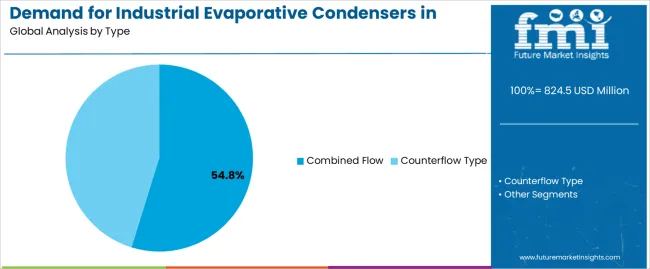
The combined flow type segment is projected to account for 54.8% of USA industrial evaporative condenser demand in 2026, making it the leading type category across the sector. This dominance reflects the energy efficiency requirements and operational flexibility of combined flow cooling systems for existing industrial facilities and modern applications where thermal performance is optimized through enhanced heat transfer capabilities and integrated system architecture. In the USA, where substantial manufacturing infrastructure requires cooling technology integration without complete system replacement, combined flow condensers provide practical pathways for efficiency enhancement while maintaining operational continuity. Continuous innovations are improving thermal performance, heat transfer characteristics, and system integration parameters, enabling facilities to achieve high efficiency standards while maximizing operational performance. The segment's strong position is reinforced by the extensive existing industrial infrastructure requiring cooling system upgrades and growing availability of combined flow technology suppliers with proven commercial experience.
- Processing compatibility and existing system integration make combined flow condensers the preferred technology for enhancing operating industrial facilities and manufacturing installations.
- Performance reliability and commercial demonstration track records are enhancing facility confidence and project viability across large-scale deployment initiatives.
By Application, Industrial Refrigeration Segment Accounts for 41.7% Share

Industrial refrigeration applications are expected to represent 41.7% of USA industrial evaporative condenser demand in 2026, highlighting the critical importance of large-scale cooling systems requiring comprehensive heat rejection solutions. Large refrigeration facilities including cold storage operations, food processing plants, chemical processing applications, and commercial refrigeration systems generate consistent demand for condenser systems that are technically and economically favorable for industrial cooling applications. The segment benefits from thermal characteristics that often provide superior operational efficiency compared to traditional cooling alternatives, reducing energy consumption and costs. Industrial refrigeration facilities also access enhanced performance optimization through condenser positioning that improve cooling reliability and operational appeal. In the USA, where large-scale industrial refrigeration represents substantial portions of manufacturing industry development, operational cooling requires evaporative condenser integration across diverse refrigeration operations. In Southwest and Southeast regions, where industrial processing concentrations are significant, condenser demand is elevated by emphasis on maintaining operational excellence while achieving energy efficiency integration targets.
- Performance optimization and favorable application economics make this the largest application segment for industrial evaporative condenser technologies.
- Cooling precision preferences and operational requirements drive consistent demand across major food processors, chemical facilities, power plants, and commercial refrigeration applications.
What are the Drivers, Restraints, and Key Trends in the USA Industrial Evaporative Condensers Demand?
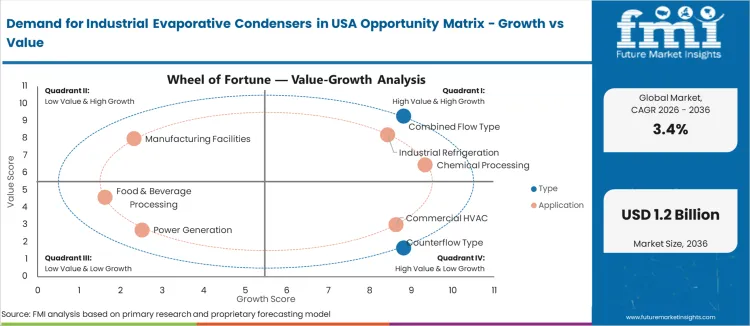
USA industrial evaporative condenser demand is advancing steadily due to increasing energy efficiency requirements and growing recognition of advanced thermal management necessity for facility development, with West region serving as a key driver of innovation and application development. The sector faces challenges including competition from alternative cooling systems, need for specialized installation infrastructure development, and ongoing concerns regarding water usage complexity and maintenance considerations. Federal energy efficiency guidelines and state-level facility modernization initiatives, particularly efficiency programs in West and Midwest regions, continue to influence thermal technology selection and deployment timelines.
Expansion of Energy Efficiency Requirements and Operational Cost Standards
The enhancement of energy efficiency regulations, gaining particular significance through facility modernization guidelines and cost reduction campaigns, is enabling condenser suppliers to achieve differentiation without prohibitive development costs, providing predictable demand patterns through facility requirements and operational preferences. Enhanced efficiency standards offering substantial opportunities for cooling systems and thermal applications provide foundational dynamics while allowing suppliers to secure facility agreements and technology partnerships. These trends are particularly valuable for first-mover suppliers and premium thermal development that require substantial technology investments without immediate cost advantages.
Integration of Automated Cooling Technologies and Thermal Management Systems
Modern condenser suppliers and industrial facilities are establishing advanced cooling networks and centralized thermal management facilities that improve operational efficiency through system standardization and economies of scale. Integration of automated cooling systems, real-time thermal processing, and coordinated performance management enables more efficient condenser operation across multiple facility sources. Advanced cooling concepts also support next-generation industrial applications including specialized thermal integration, facility cluster optimization, and regional condenser supply networks that optimize system-level economics while enabling comprehensive thermal management across industrial regions, with USA developments increasingly adopting collaborative cooling models to reduce individual facility costs and accelerate deployment.
How is USA Industrial Evaporative Condensers Demand Analyzed by Key Region?
.webp "Top Country Growth Comparison Demand For Industrial Evaporative Condensers In Usa Cagr (2026 2036)")
| Region | CAGR (2026-2036) |
|---|---|
| West | 3.8% |
| South | 3.5% |
| Midwest | 3.3% |
| Northeast | 3.1% |
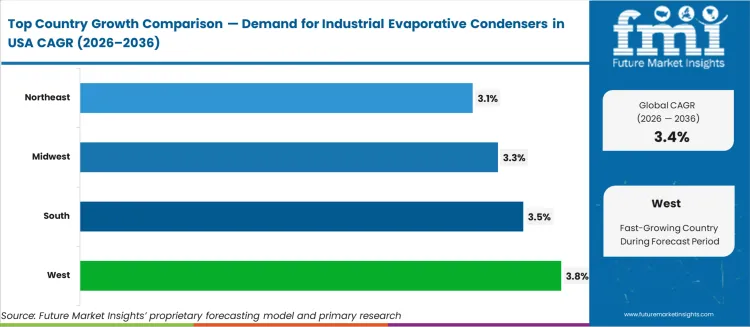
The USA industrial evaporative condensers demand is witnessing steady growth, supported by rising energy efficiency requirements, expanding facility modernization initiatives, and the deployment of advanced thermal technologies across regions. West leads the nation with a 3.8% CAGR, reflecting progressive industrial trends, substantial thermal technology innovation, and early adoption of premium cooling systems. South follows with a 3.5% CAGR, driven by extensive manufacturing infrastructure, favorable industrial demographics, and concentration of large-scale operations that enhance application development. Midwest grows at 3.3%, as facility modernization and energy efficiency opportunities increasingly drive condenser deployment. Northeast demonstrates growth at 3.1%, supported by expanding industrial facilities and regional manufacturing initiatives.
Why does the West Lead National Growth with Innovation and Premium Technology Applications?
Demand for industrial evaporative condensers in West is projected to exhibit strong growth with a CAGR of 3.8% through 2036, driven by progressive industrial preferences, substantial technology development creating premium cooling opportunities, and concentration of innovation across California and surrounding states. As the dominant region with extensive industrial infrastructure and efficiency-focused operational policies, West's emphasis on comprehensive facility excellence and technology leadership is creating significant demand for advanced condenser systems with proven performance and reliable application potential. Major industrial facilities and equipment suppliers are establishing comprehensive cooling development programs to support technology innovation and premium thermal deployment across diverse applications.
- Industrial processing trends and operational efficiency preferences are requiring comprehensive thermal management strategies and cooling solutions, driving demand for condenser systems with demonstrated performance enhancement capabilities and permanent efficiency assurance throughout diverse industrial operations.
- Innovation ecosystem strength and technology capital availability are supporting deployment of next-generation cooling technologies and novel application pathways that enhance commercial viability, reduce operational costs, and create new industrial opportunities across manufacturing and processing applications, positioning West as a national condenser leadership region.
How does the South Demonstrate Strong Potential with Manufacturing Infrastructure?
Demand for industrial evaporative condensers in South is expanding at a CAGR of 3.5%, supported by extensive manufacturing facilities including large-scale industrial production, chemical processing, and power generation operations generating concentrated demand favorable for condenser systems. The region's operational characteristics, featuring substantial industrial infrastructure and cooling requirements ideal for evaporative integration, provide natural advantages. Industrial expertise concentrated in Texas, North Carolina, and regional manufacturing corridors facilitates application development and operational management. Equipment suppliers and manufacturers are implementing comprehensive cooling strategies to serve expanding efficiency-focused requirements throughout South.
- Manufacturing concentration and favorable application economics are creating opportunities for specialized condenser suppliers that can integrate cooling systems with existing industrial operations.
- Operational efficiency positioning and facility awareness are building regional competitive advantages in thermal applications, enabling comprehensive technology development and industrial processing cluster enhancement that meets operational targets while accessing efficiency pricing opportunities.
Why does the Midwest Maintain Strong Growth with Processing Expansion?
Demand for industrial evaporative condensers in Midwest is growing at a CAGR of 3.3%, driven by substantial industrial facilities from automotive manufacturing, steel production, and regional processing requiring thermal management pathways. The region's manufacturing base, supporting critical industrial operations, is increasingly adopting condenser technologies to maintain competitiveness while meeting efficiency expectations. Manufacturers and equipment suppliers are investing in cooling integration systems and regional supply infrastructure to address growing thermal management requirements.
- Facility modernization imperatives and operational competitiveness concerns are facilitating adoption of condenser technologies that enable continued operations while achieving efficiency enhancement across manufacturing, processing, and industrial facilities.
- Energy efficiency opportunities including regional facility development and thermal utilization for enhanced commercial operations are creating unique regional advantages and diversified application types throughout Midwest industrial operations.
How does the Northeast Show Progressive Adoption with Specialty Manufacturing?
Demand for industrial evaporative condensers in Northeast is advancing at a CAGR of 3.1%, supported by expanding specialty manufacturing facilities, regional industrial processing including pharmaceutical operations, and growing emphasis on energy-efficient cooling solutions across the region. Facility modernization and specialty industrial expansion are driving consideration of condenser systems as operational enhancement pathways. Technology companies and equipment suppliers are developing regional capabilities to support emerging cooling deployment requirements.
- Specialty manufacturing expansion and operational diversification are creating economic drivers for advanced cooling technologies and condenser deployment across industrial facilities and processing operations seeking competitive differentiation pathways.
- Regional technology cooperation and coordinated facility development are establishing consistent cooling environments and shared operational infrastructure that support multi-state industrial projects throughout Northeast operations.
What is the Competitive Landscape of USA Industrial Evaporative Condensers Demand?
USA industrial evaporative condensers demand is defined by competition among specialized cooling equipment manufacturers, thermal technology companies, and facility modernization providers, with major industrial equipment corporations maintaining significant influence through technology resources and application development capabilities. Companies are investing in condenser technology advancement, thermal infrastructure optimization, cooling network structures, and comprehensive facility services to deliver effective, reliable, and scalable thermal management solutions across USA industrial and manufacturing applications. Strategic partnerships, technology infrastructure development, and first-mover application execution are central to strengthening competitive positioning and presence across manufacturing, power generation, and industrial processing cooling applications.
EVAPCO, internationally recognized cooling technology leader, leads with 28.3% share, offering comprehensive condenser solutions including implementation, technology, and support services with focus on industrial applications, thermal reliability, and cost optimization across USA operations. Baltimore Aircoil, operating with extensive USA market presence, provides integrated cooling solutions leveraging thermal expertise, equipment development, and facility management capabilities.
SPX Cooling Technologies delivers full-service condenser implementation including technology development, performance optimization, and thermal management serving USA and international industrial projects. Delta Cooling Towers emphasizes comprehensive cooling solutions with integrated efficiency systems, quality control, and monitoring capabilities leveraging industrial sector expertise. Phoenix Manufacturing offers condenser application development and performance optimization operations for facility and processing applications across USA operations.
Key Players in USA Industrial Evaporative Condensers Demand
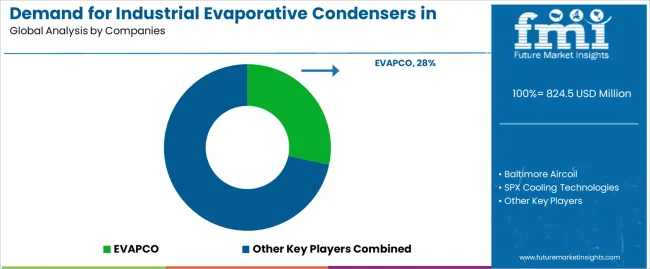
- EVAPCO
- Baltimore Aircoil
- SPX Cooling Technologies
- Delta Cooling Towers
- Phoenix Manufacturing
- Tranter
- Carrier Global
- Munters Group
- GEA Group
- Danfoss
Scope of the Report
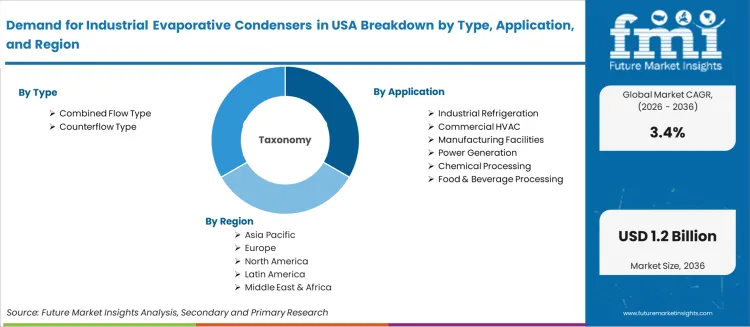
| Metric | Value |
|---|---|
| Quantitative Units | USD 0.85 billion to USD 1.18 billion, at a CAGR of 3.4% |
| Market Definition | Based on FMI's report, the Industrial Evaporative Condensers in USA market covers combined flow and counterflow evaporative condensers used in industrial refrigeration, commercial HVAC, manufacturing cooling, power generation, chemical processing, and food and beverage processing applications within the United States. |
| Segmentation | Type: Combined Flow Type, Counterflow Type; Application: Industrial Refrigeration, Commercial HVAC, Manufacturing Facilities, Power Generation, Chemical Processing, Food & Beverage Processing |
| Regions Covered | West, South, Midwest, Northeast |
| Key Companies Profiled | EVAPCO, Baltimore Aircoil, SPX Cooling Technologies, Delta Cooling Towers, Phoenix Manufacturing, Tranter, Carrier Global, Munters Group, GEA Group, Danfoss |
| Forecast Period | 2026 to 2036 |
| Approach | Hybrid bottom-up methodology combining installed base metrics with regulatory compliance adoption curves and primary research validation. |
USA Industrial Evaporative Condensers Demand by Segments
Type:
- Combined Flow Type
- Counterflow Type
Application:
- Industrial Refrigeration
- Commercial HVAC
- Manufacturing Facilities
- Power Generation
- Chemical Processing
- Food & Beverage Processing
Region:
- West
- South
- Midwest
- Northeast
Bibliography
- 1. USA Environmental Protection Agency. (2025). AIM Act: Phasedown of Hydrofluorocarbons, Final Rule Implementation Report. EPA.
- 2. American Society of Heating, Refrigerating and Air-Conditioning Engineers. (2024). ASHRAE Standard 15: Safety Standard for Refrigeration Systems. ASHRAE.
- 3. USA Department of Agriculture. (2025). USDA Cold Storage Capacity Report. USDA.
- 4. International Institute of Refrigeration. (2024). The Role of Refrigeration in Food Security. IIR.
- 5. USA Department of Energy. (2025). Energy Efficiency Standards for Commercial and Industrial Equipment. DOE.
- 6. Organisation for Economic Co-operation and Development. (2025). Environmental Performance Reviews: United States. OECD Publishing.
This bibliography is provided for reader reference. The full Future Market Insights report contains the complete reference list with primary research documentation.
Frequently Asked Questions
How large is the Industrial Evaporative Condensers in USA market in 2026?
The Industrial Evaporative Condensers in USA market is estimated to be valued at USD 0.85 billion in 2026.
What will be the market size of Industrial Evaporative Condensers in USA by 2036?
Market size for Industrial Evaporative Condensers in USA is projected to reach USD 1.18 billion by 2036.
What is the expected CAGR for Industrial Evaporative Condensers in USA between 2026 and 2036?
The Industrial Evaporative Condensers in USA market is expected to grow at a CAGR of 3.4% between 2026 and 2036.
Which Type leads the Industrial Evaporative Condensers in USA market in 2026?
Combined Flow Type accounts for 54.8% share in 2026 by Type.
Which region is projected to grow fastest?
West is projected to grow at a CAGR of 3.8% during 2026 to 2036.
What does this report include in its scope?
The report covers market sizing, segmentation analysis, regional forecasts, competitive landscape evaluation, and forecast projections from 2026 to 2036.
How does FMI build and validate the Industrial Evaporative Condensers in USA forecast?
Forecasting models apply a bottom-up methodology starting with installed base metrics and cross-validate projections against quarterly revenue volumes and regulatory compliance adoption data.
Preview the report firsthand - request a free sample
Get SampleGet the brochure for pricing and purchase details.
Get PDFTable of Content
- Executive Summary
- Global Market Outlook
- Demand-side Trends
- Supply-side Trends
- Technology Roadmap Analysis
- Analysis and Recommendations
- Market Overview
- Market Coverage / Taxonomy
- Market Definition / Scope / Limitations
- Research Methodology
- Chapter Orientation
- Analytical Lens and Working Hypotheses
- Market Structure, Signals, and Trend Drivers
- Benchmarking and Cross-market Comparability
- Market Sizing, Forecasting, and Opportunity Mapping
- Research Design and Evidence Framework
- Desk Research Programme (Secondary Evidence)
- Company Annual and Sustainability Reports
- Peer-reviewed Journals and Academic Literature
- Corporate Websites, Product Literature, and Technical Notes
- Earnings Decks and Investor Briefings
- Statutory Filings and Regulatory Disclosures
- Technical White Papers and Standards Notes
- Trade Journals, Industry Magazines, and Analyst Briefs
- Conference Proceedings, Webinars, and Seminar Materials
- Government Statistics Portals and Public Data Releases
- Press Releases and Reputable Media Coverage
- Specialist Newsletters and Curated Briefings
- Sector Databases and Reference Repositories
- FMI Internal Proprietary Databases and Historical Market Datasets
- Subscription Datasets and Paid Sources
- Social Channels, Communities, and Digital Listening Inputs
- Additional Desk Sources
- Expert Input and Fieldwork (Primary Evidence)
- Primary Modes
- Qualitative Interviews and Expert Elicitation
- Quantitative Surveys and Structured Data Capture
- Blended Approach
- Why Primary Evidence is Used
- Field Techniques
- Interviews
- Surveys
- Focus Groups
- Observational and In-context Research
- Social and Community Interactions
- Stakeholder Universe Engaged
- C-suite Leaders
- Board Members
- Presidents and Vice Presidents
- R&D and Innovation Heads
- Technical Specialists
- Domain Subject-matter Experts
- Scientists
- Physicians and Other Healthcare Professionals
- Governance, Ethics, and Data Stewardship
- Research Ethics
- Data Integrity and Handling
- Primary Modes
- Tooling, Models, and Reference Databases
- Desk Research Programme (Secondary Evidence)
- Data Engineering and Model Build
- Data Acquisition and Ingestion
- Cleaning, Normalisation, and Verification
- Synthesis, Triangulation, and Analysis
- Quality Assurance and Audit Trail
- Market Background
- Market Dynamics
- Drivers
- Restraints
- Opportunity
- Trends
- Scenario Forecast
- Demand in Optimistic Scenario
- Demand in Likely Scenario
- Demand in Conservative Scenario
- Opportunity Map Analysis
- Product Life Cycle Analysis
- Supply Chain Analysis
- Investment Feasibility Matrix
- Value Chain Analysis
- PESTLE and Porter’s Analysis
- Regulatory Landscape
- Regional Parent Market Outlook
- Production and Consumption Statistics
- Import and Export Statistics
- Market Dynamics
- Global Market Analysis 2021 to 2025 and Forecast, 2026 to 2036
- Historical Market Size Value (USD Million) Analysis, 2021 to 2025
- Current and Future Market Size Value (USD Million) Projections, 2026 to 2036
- Y-o-Y Growth Trend Analysis
- Absolute $ Opportunity Analysis
- Global Market Pricing Analysis 2021 to 2025 and Forecast 2026 to 2036
- Global Market Analysis 2021 to 2025 and Forecast 2026 to 2036, By Type
- Introduction / Key Findings
- Historical Market Size Value (USD Million) Analysis By Type , 2021 to 2025
- Current and Future Market Size Value (USD Million) Analysis and Forecast By Type , 2026 to 2036
- Combined Flow Type
- Counterflow Type
- Combined Flow Type
- Y-o-Y Growth Trend Analysis By Type , 2021 to 2025
- Absolute $ Opportunity Analysis By Type , 2026 to 2036
- Global Market Analysis 2021 to 2025 and Forecast 2026 to 2036, By Application
- Introduction / Key Findings
- Historical Market Size Value (USD Million) Analysis By Application, 2021 to 2025
- Current and Future Market Size Value (USD Million) Analysis and Forecast By Application, 2026 to 2036
- Industrial Refrigeration
- Commercial HVAC
- Manufacturing Facilities
- Power Generation
- Chemical Processing
- Food & Beverage Processing
- Industrial Refrigeration
- Y-o-Y Growth Trend Analysis By Application, 2021 to 2025
- Absolute $ Opportunity Analysis By Application, 2026 to 2036
- Global Market Analysis 2021 to 2025 and Forecast 2026 to 2036, By Region
- Introduction
- Historical Market Size Value (USD Million) Analysis By Region, 2021 to 2025
- Current Market Size Value (USD Million) Analysis and Forecast By Region, 2026 to 2036
- North America
- Latin America
- Western Europe
- Eastern Europe
- East Asia
- South Asia and Pacific
- Middle East & Africa
- Market Attractiveness Analysis By Region
- North America Market Analysis 2021 to 2025 and Forecast 2026 to 2036, By Country
- Historical Market Size Value (USD Million) Trend Analysis By Market Taxonomy, 2021 to 2025
- Market Size Value (USD Million) Forecast By Market Taxonomy, 2026 to 2036
- By Country
- USA
- Canada
- Mexico
- By Type
- By Application
- By Country
- Market Attractiveness Analysis
- By Country
- By Type
- By Application
- Key Takeaways
- Latin America Market Analysis 2021 to 2025 and Forecast 2026 to 2036, By Country
- Historical Market Size Value (USD Million) Trend Analysis By Market Taxonomy, 2021 to 2025
- Market Size Value (USD Million) Forecast By Market Taxonomy, 2026 to 2036
- By Country
- Brazil
- Chile
- Rest of Latin America
- By Type
- By Application
- By Country
- Market Attractiveness Analysis
- By Country
- By Type
- By Application
- Key Takeaways
- Western Europe Market Analysis 2021 to 2025 and Forecast 2026 to 2036, By Country
- Historical Market Size Value (USD Million) Trend Analysis By Market Taxonomy, 2021 to 2025
- Market Size Value (USD Million) Forecast By Market Taxonomy, 2026 to 2036
- By Country
- Germany
- UK
- Italy
- Spain
- France
- Nordic
- BENELUX
- Rest of Western Europe
- By Type
- By Application
- By Country
- Market Attractiveness Analysis
- By Country
- By Type
- By Application
- Key Takeaways
- Eastern Europe Market Analysis 2021 to 2025 and Forecast 2026 to 2036, By Country
- Historical Market Size Value (USD Million) Trend Analysis By Market Taxonomy, 2021 to 2025
- Market Size Value (USD Million) Forecast By Market Taxonomy, 2026 to 2036
- By Country
- Russia
- Poland
- Hungary
- Balkan & Baltic
- Rest of Eastern Europe
- By Type
- By Application
- By Country
- Market Attractiveness Analysis
- By Country
- By Type
- By Application
- Key Takeaways
- East Asia Market Analysis 2021 to 2025 and Forecast 2026 to 2036, By Country
- Historical Market Size Value (USD Million) Trend Analysis By Market Taxonomy, 2021 to 2025
- Market Size Value (USD Million) Forecast By Market Taxonomy, 2026 to 2036
- By Country
- China
- Japan
- South Korea
- By Type
- By Application
- By Country
- Market Attractiveness Analysis
- By Country
- By Type
- By Application
- Key Takeaways
- South Asia and Pacific Market Analysis 2021 to 2025 and Forecast 2026 to 2036, By Country
- Historical Market Size Value (USD Million) Trend Analysis By Market Taxonomy, 2021 to 2025
- Market Size Value (USD Million) Forecast By Market Taxonomy, 2026 to 2036
- By Country
- India
- ASEAN
- Australia & New Zealand
- Rest of South Asia and Pacific
- By Type
- By Application
- By Country
- Market Attractiveness Analysis
- By Country
- By Type
- By Application
- Key Takeaways
- Middle East & Africa Market Analysis 2021 to 2025 and Forecast 2026 to 2036, By Country
- Historical Market Size Value (USD Million) Trend Analysis By Market Taxonomy, 2021 to 2025
- Market Size Value (USD Million) Forecast By Market Taxonomy, 2026 to 2036
- By Country
- Kingdom of Saudi Arabia
- Other GCC Countries
- Turkiye
- South Africa
- Other African Union
- Rest of Middle East & Africa
- By Type
- By Application
- By Country
- Market Attractiveness Analysis
- By Country
- By Type
- By Application
- Key Takeaways
- Key Countries Market Analysis
- USA
- Pricing Analysis
- Market Share Analysis, 2025
- By Type
- By Application
- Canada
- Pricing Analysis
- Market Share Analysis, 2025
- By Type
- By Application
- Mexico
- Pricing Analysis
- Market Share Analysis, 2025
- By Type
- By Application
- Brazil
- Pricing Analysis
- Market Share Analysis, 2025
- By Type
- By Application
- Chile
- Pricing Analysis
- Market Share Analysis, 2025
- By Type
- By Application
- Germany
- Pricing Analysis
- Market Share Analysis, 2025
- By Type
- By Application
- UK
- Pricing Analysis
- Market Share Analysis, 2025
- By Type
- By Application
- Italy
- Pricing Analysis
- Market Share Analysis, 2025
- By Type
- By Application
- Spain
- Pricing Analysis
- Market Share Analysis, 2025
- By Type
- By Application
- France
- Pricing Analysis
- Market Share Analysis, 2025
- By Type
- By Application
- India
- Pricing Analysis
- Market Share Analysis, 2025
- By Type
- By Application
- ASEAN
- Pricing Analysis
- Market Share Analysis, 2025
- By Type
- By Application
- Australia & New Zealand
- Pricing Analysis
- Market Share Analysis, 2025
- By Type
- By Application
- China
- Pricing Analysis
- Market Share Analysis, 2025
- By Type
- By Application
- Japan
- Pricing Analysis
- Market Share Analysis, 2025
- By Type
- By Application
- South Korea
- Pricing Analysis
- Market Share Analysis, 2025
- By Type
- By Application
- Russia
- Pricing Analysis
- Market Share Analysis, 2025
- By Type
- By Application
- Poland
- Pricing Analysis
- Market Share Analysis, 2025
- By Type
- By Application
- Hungary
- Pricing Analysis
- Market Share Analysis, 2025
- By Type
- By Application
- Kingdom of Saudi Arabia
- Pricing Analysis
- Market Share Analysis, 2025
- By Type
- By Application
- Turkiye
- Pricing Analysis
- Market Share Analysis, 2025
- By Type
- By Application
- South Africa
- Pricing Analysis
- Market Share Analysis, 2025
- By Type
- By Application
- USA
- Market Structure Analysis
- Competition Dashboard
- Competition Benchmarking
- Market Share Analysis of Top Players
- By Regional
- By Type
- By Application
- Competition Analysis
- Competition Deep Dive
- EVAPCO
- Overview
- Product Portfolio
- Profitability by Market Segments (Product/Age /Sales Channel/Region)
- Sales Footprint
- Strategy Overview
- Marketing Strategy
- Product Strategy
- Channel Strategy
- Baltimore Aircoil
- SPX Cooling Technologies
- Delta Cooling Towers
- Phoenix Manufacturing
- Tranter
- Carrier Global
- Munters Group
- GEA Group
- Danfoss
- EVAPCO
- Competition Deep Dive
- Assumptions & Acronyms Used


