

- Industry Size (2026)
- USD 40.18 Mn
- Forecast (2036)
- USD 64.82 Mn
- CAGR (2026 to 2036)
- 4.9%
Kokum Butter Market Size, Market Forecast and Outlook By FMI
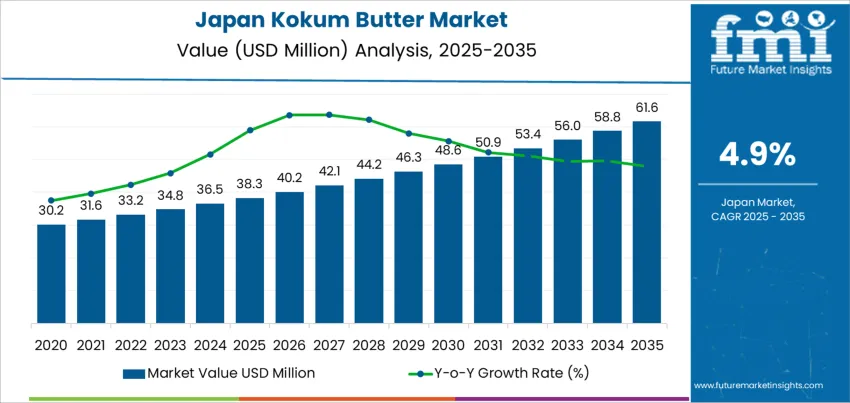
Demand for kokum butter in Japan was valued at USD 38.30 Million in 2025. Based on Future Market Insights' analysis, demand for kokum butter is estimated to grow to USD 40.18 Million in 2026 and USD 64.82 Million by 2036. FMI projects a CAGR of 4.9% during the forecast period from 2026 to 2036. This translates to an incremental opportunity worth USD Million 24.64 over the ten-year assessment window.
Summary of Kokum Butter Market in Japan
- Market Snapshot
- Demand for kokum butter in Japan is valued at USD Million 38.30 in 2025 and is projected to reach USD Million 64.82 by 2036.
- The market is expected to grow at a 4.9% CAGR from 2026 to 2036, creating an incremental opportunity of USD Million 24.64.
- The market is an import-dependent, dual-application specialty fat category where cosmetic clean-beauty reformulation, pharmaceutical excipient qualification, and Indian harvest supply variability define procurement dynamics.
- Demand and Growth Drivers
- Clean-beauty reformulation cycles in Japan's premium cosmetic sector are driving substitution of cocoa butter and synthetic emollients with kokum butter for its non-comedogenic profile and oxidative stability.
- Pharmaceutical industry evaluation of kokum butter as a topical base excipient for dermatological formulations is creating a secondary, higher-margin application channel.
- Import dependency on Indian kokum butter supply introduces procurement timing risks linked to monsoon-season harvest yields and Indian commodity export pricing cycles.
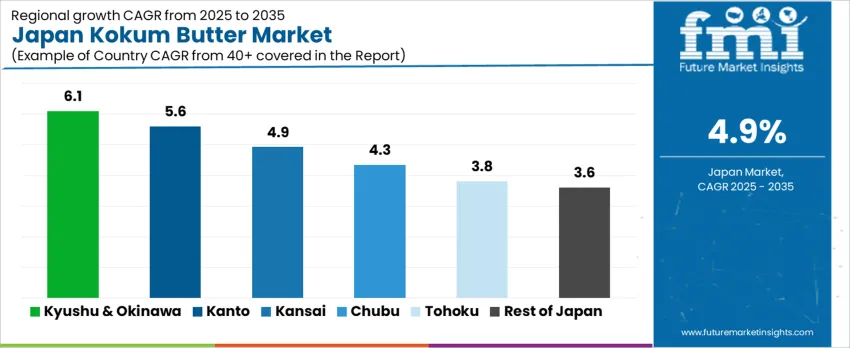
- Among key regions, Kyushu & Okinawa leads at 6.1% CAGR, followed by Kanto at 5.6%, Kinki at 4.9%, Chubu at 4.3%, Tohoku at 3.8%, and Rest of Japan at 3.6%.
- Product and Segment View
- Kokum butter is a specialty vegetable fat derived from Garcinia indica seeds, valued for its high stearic acid content, firm ambient texture, and non-comedogenic emollient characteristics.
- Applications span creams, skin lotions, balms, shaving creams, and hair conditioners across the cosmetic and pharmaceutical industries.
- Creams leads by Application with 32% share in 2026, driven by premium facial and body care formulation requirements for naturally sourced, non-comedogenic emollient bases.
- Cosmetic Industry leads by End Use with 61% share in 2026, anchored by clean-beauty ingredient sourcing mandates across Japanese premium skincare and hair care brands.
- Scope includes kokum butter for cosmetic and pharmaceutical formulation use. Excluded are kokum fruit pulp products, other specialty vegetable butters, and bulk commodity kokum fat for re-export.
- Geography and Competitive Outlook
- Kyushu & Okinawa and Kanto are the fastest-growing regional clusters, driven by concentrated manufacturing, distribution, and consumption infrastructure.
- Demand in Tohoku and Rest of Japan follows steadier, replacement-driven procurement cycles in established industrial networks.
- Competition depends on Indian supply chain control, pharmaceutical-grade purity certification, cosmetic ingredient safety documentation, and the ability to serve both premium beauty and topical pharmaceutical formulation requirements from a single sourcing platform.
- Key players include AAK, Bunge Loders Croklaan, Wilmar International, Fuji Oil, Olam International.
- Analyst Opinion at FMI
- Nandini Roy Choudhury, Principal Consultant for Chemicals & Materials, opines: 'In my analysis, I have observed that kokum butter demand in Japan is being shaped by the convergence of two distinct procurement drivers: the clean-beauty reformulation cycle in premium cosmetics and the pharmaceutical excipient qualification pathway for topical drug delivery bases. Cosmetic formulators in Japan are substituting cocoa butter and synthetic emollients with kokum butter to meet consumer expectations for naturally sourced, non-comedogenic ingredients, while pharmaceutical compounders are evaluating kokum butter's oxidative stability for dermatological base formulations. Suppliers who position kokum butter solely as a cosmetic ingredient are missing the pharmaceutical-grade premium that comes with meeting Japanese Pharmacopoeia excipient specifications, where pricing per kilogram can exceed cosmetic-grade material by 40% to 60%.'
- Strategic Implications / Executive Takeaways
- Cosmetic formulators should secure forward contracts with diversified Indian kokum butter suppliers to mitigate monsoon-season harvest yield variability and export pricing fluctuations.
- Pharmaceutical compounders should pursue Japanese Pharmacopoeia excipient qualification for kokum butter to access the topical drug delivery base market, where per-kilogram pricing premiums exceed cosmetic-grade material by 40% to 60%.
- Product development teams should position kokum butter formulations as clean-beauty alternatives to cocoa butter and synthetic emollients, leveraging its non-comedogenic profile and oxidative stability as documented technical differentiators.
Japan's kokum butter market is positioned within the premium specialty fats and oils category, serving cosmetic, pharmaceutical, and niche food applications. Kokum butter (Garcinia indica seed fat) is a hard, naturally occurring triglyceride valued for its high stearic and oleic acid content, non-comedogenic profile, and oxidative stability at ambient temperatures. FMI analysts observe that the cosmetic industry is the primary demand driver, where Japanese formulators incorporate kokum butter into creams, lotions, balms, and conditioners as a naturally sourced emollient that meets clean-beauty ingredient standards. The pharmaceutical industry represents a secondary but growing application channel, where kokum butter's thermal stability and skin compatibility are evaluated for topical base formulations. Japan's import dependency on kokum butter supply from Indian producers introduces supply chain variability that correlates with monsoon-season harvest yields and export pricing set by Indian commodity markets.
Across Japanese prefectural clusters, growth trajectories vary based on industrial concentration and end-use demand density. Kyushu & Okinawa is projected to expand at 6.1% CAGR. Kanto is projected to expand at 5.6% CAGR. Kinki is projected to expand at 4.9% CAGR. Chubu is projected to expand at 4.3% CAGR. Tohoku is projected to expand at 3.8% CAGR. Rest of Japan is projected to expand at 3.6% CAGR. Kyushu & Okinawa leads the growth ranking, supported by concentrated manufacturing activity and proximity to distribution infrastructure. Kanto, anchoring the Tokyo metropolitan consumption base, follows closely. Mature clusters such as Tohoku and Rest of Japan register steadier, replacement-driven demand patterns.
Kokum Butter Market Key Takeaways
| Metric | Details |
|---|---|
| Industry Size (2026) | USD 40.18 Million |
| Industry Value (2036) | USD 64.82 Million |
| CAGR (2026 to 2036) | 4.9% |
Source: Future Market Insights, 2026
Kokum Butter Market Definition
Kokum butter is a specialty vegetable fat extracted from the seeds of the Garcinia indica tree, characterized by high stearic acid content, a firm texture at room temperature, and non-comedogenic emollient properties. In the Japanese market, kokum butter is used as a formulation ingredient in creams, skin lotions, balms, shaving creams, and hair conditioners within the cosmetic industry, and as an excipient base in pharmaceutical topical preparations. Import supply is sourced predominantly from Indian producers.
Kokum Butter Market Inclusions
Market scope includes kokum butter (Garcinia indica seed fat) sold for cosmetic, pharmaceutical, and other industrial applications in Japan. Coverage extends to formulated use in creams, skin lotions, balms, shaving creams, and conditioners. The assessment covers market sizes by application, end use, and Japanese prefectural region for 2026 to 2036.
Kokum Butter Market Exclusions
The scope excludes kokum fruit pulp products, kokum-based culinary ingredients such as kokum syrup and dried rind, and other specialty vegetable butters including shea butter, mango butter, and cocoa butter. It also omits kokum butter sold as a raw bulk commodity for re-export without value-added processing.
Kokum Butter Market Research Methodology
- Primary Research: Analysts engaged with procurement managers, formulation chemists, and quality assurance leads at kokum butter manufacturing and processing facilities across Japan to map decision triggers, specification requirements, and supplier qualification criteria.
- Desk Research: Data collection aggregated regulatory filings from the Ministry of Health, Labour and Welfare, trade statistics from Japan Customs, and published technical standards relevant to kokum butter production and distribution in Japan.
- Market-Sizing and Forecasting: Baseline values derive from a bottom-up aggregation of manufacturer shipments and import volumes, applying region-specific consumption curves to project demand velocity through 2036.
- Data Validation and Update Cycle: Projections are cross-checked against publicly reported production volumes, trade data, and downstream procurement disclosures from major producers and distributors operating in Japan.
Why is the Demand for Kokum Butter in Japan Growing?
The demand for kokum butter in Japan is rising as Japanese cosmetic and personal care manufacturers increasingly seek natural, plant based ingredients for moisturizers, creams, lip balms and hair care formulations. Kokum butter, derived from the seeds of the Garcinia indica tree, is known for a relatively high proportion of stearic oleic stearic triglycerides, a firm texture at room temperature, and a melting point close to human skin temperature. These properties make it useful for cosmetics intended to absorb smoothly, deliver deep skin hydration, and remain stable in formulations. As consumer awareness grows around skin health, ingredient safety, and clean beauty, products featuring such natural butters gain popularity over synthetic alternatives. This trend aligns with broader interest in organic, minimal additive formulations and eco friendly personal care that appears to influence Japanese beauty market preferences.
Beyond personal care, kokum butter may gain traction where alternatives such as cocoa butter or synthetic fats had predominated. The global kokum butter market is forecast to grow at a compound annual growth rate around 6 9% in the coming decade, driven especially by cosmetic and personal care applications and rising demand for natural ingredients globally. That growth suggests potential for increased imports or supply into markets like Japan, particularly given Japan’s established cosmetics industry and consumer sensitivity to skin care quality. As extraction and refining techniques improve globally, supply becomes more consistent and quality more uniform, making kokum butter more feasible for inclusion in mid to premium tier formulations. These supply side improvements, combined with demand for natural, moisturizing, stable ingredients, point toward steady growth of kokum butter demand in Japan over coming years.
What Is the Current State of the Demand for Kokum Butter in Japan in Terms of Application and End-Use?
The demand for kokum butter in Japan is primarily driven by application and end-use industry. The leading application is creams, capturing 32% of the market share, while the cosmetic industry is the dominant end-use sector, accounting for 61% of the demand. Kokum butter, known for its moisturizing, healing, and skin-softening properties, is increasingly used in skincare products such as creams, lotions, and balms. The growing consumer interest in natural, sustainable ingredients continues to drive the demand for kokum butter in Japan's skincare and cosmetic products.
How Are Creams Leading the Application Demand for Kokum Butter in Japan?
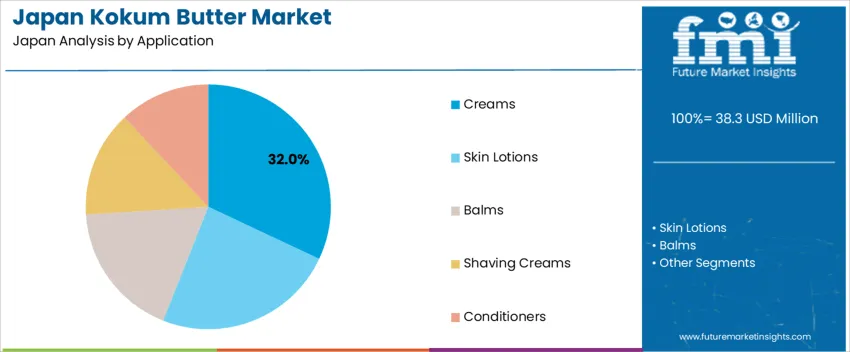
Creams are the leading application for kokum butter in Japan, holding 32% of the market share. Kokum butter’s emollient properties make it an ideal ingredient in cream formulations, particularly for moisturizing and nourishing dry or sensitive skin. It is commonly used in high-end skincare products due to its ability to provide deep hydration without being greasy, offering a smooth, soft finish on the skin. Additionally, kokum butter is valued for its antioxidant content, which helps protect the skin from environmental stressors.
The demand for kokum butter in creams is driven by its natural and gentle properties, making it suitable for a wide range of skin types, including sensitive skin. With the increasing preference for products that are both effective and made from natural ingredients, kokum butter’s role in creams continues to grow. As the demand for eco-friendly and sustainable beauty products rises in Japan, kokum butter is becoming a popular ingredient in premium skincare formulations that aim to provide nourishment and protection.
How Is the Cosmetic Industry Leading the End-Use Demand for Kokum Butter in Japan?
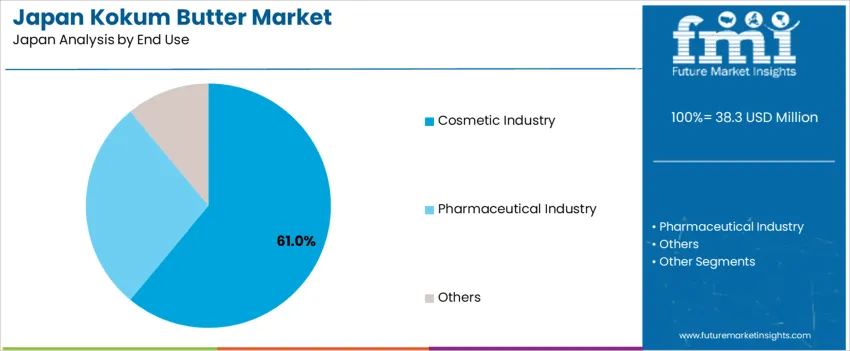
The cosmetic industry is the leading end-use sector for kokum butter in Japan, capturing 61% of the demand. Kokum butter is widely used in the formulation of skincare products such as moisturizers, balms, and lotions. Its deep moisturizing and skin-soothing properties make it an essential ingredient in a variety of cosmetic products that focus on hydration, anti-aging, and skin repair. The growing demand for natural and organic beauty products in Japan has further boosted kokum butter’s popularity in the cosmetic sector.
The demand for kokum butter in the cosmetic industry is driven by consumer preferences for high-quality, natural ingredients that are gentle on the skin. With increasing awareness about the harmful effects of synthetic chemicals in skincare, the demand for natural alternatives like kokum butter continues to rise. As Japan’s cosmetic industry continues to prioritize natural beauty solutions, kokum butter is expected to remain a key ingredient in skincare and personal care products, helping brands cater to consumers who seek safe, effective, and eco-friendly options.
What is the Summary of Demand for Kokum butter in Japan?
Demand for Kokum butter in Japan is rising gradually, driven by growth in the cosmetics and natural personal care sectors. This butter is increasingly used in creams, lotions, balms, and other skincare and hair care formulations owing to its emollient, antioxidant, and skin nourishing properties. As the Japanese market shifts toward natural, plant based ingredients and simpler ingredient lists, Kokum butter finds a place in “clean beauty” and wellness oriented products. The expanding natural cosmetics market and rising consumer interest in gentle and effective skincare support growing use of Kokum butter by manufacturers.
What are the Drivers of Demand for Kokum Butter in Japan?
Several factors drive demand for Kokum butter in Japan. First, growing consumer preference for natural and plant derived ingredients leads cosmetics and personal care companies to seek alternatives to synthetic oils and butters. Kokum butter, with its light texture, rapid skin absorption, and moisturizing and emollient properties, matches these preferences. Second, the aging population and rising interest in skincare and anti aging products create demand for high moisture, skin friendly fats that support skin barrier, elasticity, and hydration. Third, the expanding natural cosmetics segment in Japan encourages product launches that highlight simple and clean ingredient lists, with Kokum butter serving as a core natural ingredient in creams, balms, soaps, and hair care. Additionally, demand for sensitive skin and non comedogenic care supports Kokum butter’s adoption, since it tends to be non greasy and less likely to clog pores relative to heavier butters. Finally, growth in e commerce and niche beauty brands enables wider distribution and experimentation with exotic butters imported from abroad, supporting steady demand increase for Kokum butter-based products.
What are the Restraints on Demand for Kokum Butter in Japan?
Despite favorable drivers, some factors restrain wider adoption of Kokum butter in Japan. Supply constraints and import dependency may limit availability, since Kokum butter is produced chiefly outside Japan and must meet quality, certification, and shipping standards. Variability in supply and potential import delays may discourage some manufacturers from relying on it. Cost is another restraint: exotic plant butters like Kokum may be more expensive than common alternatives, which can affect pricing and margins for mass market cosmetic products, deterring use in price sensitive segments. Regulatory and certification requirements for cosmetic ingredients in Japan add complexity; companies may prefer well established ingredients with clear compliance history instead of newer or less common butters. Also, some consumers or brands may remain cautious about ingredient novelty or potential skin reactions, limiting widespread adoption. Finally, competition from other plant butters whose supply chains are well established (like shea, cocoa, or domestic oils) may reduce impetus for large scale switch to Kokum butter in some product lines.
What are the Key Trends Influencing Demand for Kokum Butter in Japan?
A key trend is rising demand for clean beauty and natural ingredient cosmetics. Consumers increasingly prefer products with plant derived components, minimal synthetic chemicals, and simple ingredient lists. In response, more Japanese skincare and hair care brands are formulating with butters like Kokum, marketed as natural moisturizers and emollients. Another trend is specialized skin care targeting-including products for sensitive skin, anti aging, moisturizing, and skin barrier support-where Kokum butter’s light texture and moisturizing properties are valued. Growth in small and niche beauty brands, including indie and artisanal producers, encourages experimentation with alternative butters and exotic ingredients, increasing use of Kokum butter. Also, expansion of online beauty retail channels facilitates easier sourcing and distribution of imported ingredients, which supports entry of Kokum based products. Finally, as global demand for ethically and sustainably sourced natural ingredients rises, suppliers and manufacturers promoting traceability and quality may help Kokum butter to gain acceptance and market share in Japan’s beauty and personal care industry.
What is the Regional Demand Outlook for Kokum Butter in Japan?
The demand for kokum butter in Japan is growing steadily across regions, with Kyushu & Okinawa leading at a CAGR of 6.1%. Kanto follows with a CAGR of 5.6%, driven by its strong cosmetics and skincare industries. The Kinki region shows moderate growth at 4.9%, while Chubu, Tohoku, and the Rest of Japan exhibit more modest growth, with respective CAGRs of 4.3%, 3.8%, and 3.6%. These variations are influenced by regional consumer preferences, industry applications, and the adoption of natural ingredients in skincare and food products.
.webp "Top Country Growth Comparison Japan Kokum Butter Market Cagr (2026 2036)")
| Region | CAGR (%) |
|---|---|
| Kyushu & Okinawa | 6.1 |
| Kanto | 5.6 |
| Kinki | 4.9 |
| Chubu | 4.3 |
| Tohoku | 3.8 |
| Rest of Japan | 3.6 |
What factors are driving the demand for kokum butter in Kyushu & Okinawa?
The demand for kokum butter in Kyushu & Okinawa is projected to grow at a CAGR of 6.1%, driven by the region’s increasing use of natural and organic ingredients in cosmetics, skincare, and wellness products. Kyushu & Okinawa have strong traditions of utilizing indigenous and natural materials in beauty and health products. Kokum butter, known for its moisturizing and healing properties, is gaining popularity in skincare formulations, especially among consumers who prefer sustainable and eco-friendly products. The region’s growing focus on sustainability and the rising awareness of the benefits of natural ingredients in personal care products are major contributors to this demand. As more companies in Kyushu & Okinawa incorporate kokum butter into their product lines, the demand for this natural ingredient is expected to rise significantly.
Why is the demand for kokum butter increasing in Kanto?
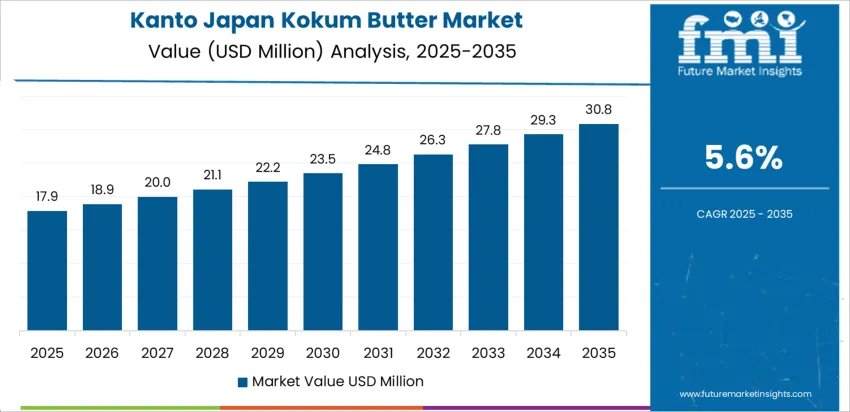
In Kanto, the demand for kokum butter is expected to grow at a CAGR of 5.6%, supported by the region’s strong cosmetics and personal care industry. Kanto, home to Tokyo and other major urban centers, is a hub for consumer goods, including high-end skincare and beauty products. As consumers become more aware of the benefits of natural and plant-based ingredients, demand for kokum butter in cosmetic formulations is increasing. Kokum butter is valued for its deep moisturizing, anti-aging, and soothing properties, which make it popular in premium skincare products. The region’s growing preference for eco-conscious, organic beauty products aligns well with the demand for kokum butter. Furthermore, the continuous innovation and expanding product offerings in the cosmetics and wellness industries ensure that the demand for kokum butter in Kanto will remain strong.
What influences the demand for kokum butter in Kinki?
The demand for kokum butter in Kinki is projected to grow at a CAGR of 4.9%, driven by the region’s strong focus on natural ingredients in skincare and food products. Kinki, which includes Osaka and Kyoto, has a well-established cosmetics industry, with a growing shift toward the use of sustainable and organic ingredients. Kokum butter is gaining popularity in Kinki for its skin-healing and hydrating properties, which make it a preferred choice in creams, lotions, and balms. The region’s increasing focus on wellness, natural beauty, and eco-friendly products has contributed to the rise in demand for kokum butter. As consumer preferences continue to shift towards cleaner and more sustainable ingredients, Kinki’s demand for kokum butter is expected to grow steadily.
How is the demand for kokum butter growing in Chubu?
The demand for kokum butter in Chubu is expected to grow at a CAGR of 4.3%, supported by the region’s expanding food and cosmetics sectors. Chubu, home to Nagoya and other industrial centers, is seeing increasing interest in natural and organic products. In the cosmetics industry, kokum butter is valued for its deep moisturizing and skin-softening qualities, making it ideal for use in skincare products targeting dry or sensitive skin. Additionally, Chubu’s growing consumer interest in health and wellness products that incorporate plant-based ingredients is contributing to the steady rise in demand for kokum butter. As awareness of natural and sustainable ingredients continues to grow, demand in Chubu for kokum butter in both personal care products and food applications is expected to increase.
What factors are influencing the demand for kokum butter in Tohoku?
In Tohoku, the demand for kokum butter is projected to grow at a CAGR of 3.8%, reflecting moderate growth driven by the region’s increasing awareness of natural ingredients and their benefits. Tohoku has a smaller but growing market for eco-friendly and natural products, especially in the skincare and wellness sectors. As consumers in Tohoku become more conscious of the environmental and health benefits of plant-based ingredients, kokum butter is gaining popularity in personal care formulations for its nourishing and moisturizing properties. While growth in Tohoku is slower compared to other regions, the region’s expanding interest in wellness and natural beauty products is expected to contribute to steady demand for kokum butter over time.
How is the demand for kokum butter evolving in the Rest of Japan?
In the Rest of Japan, the demand for kokum butter is expected to grow at a CAGR of 3.6%, reflecting gradual but steady adoption. This region, which includes smaller cities and rural areas, is witnessing an increasing demand for natural ingredients in skincare and food products. Kokum butter’s benefits for skin health and its use in natural wellness products are driving its adoption, particularly in rural areas where organic and sustainable products are becoming more popular. As consumer preferences for eco-friendly, plant-based ingredients continue to grow, the Rest of Japan is expected to see a consistent rise in the demand for kokum butter, although at a slower pace compared to more urbanized regions like Kyushu & Okinawa and Kanto.
How Are Companies Competing in the Kokum Butter Market in Japan?
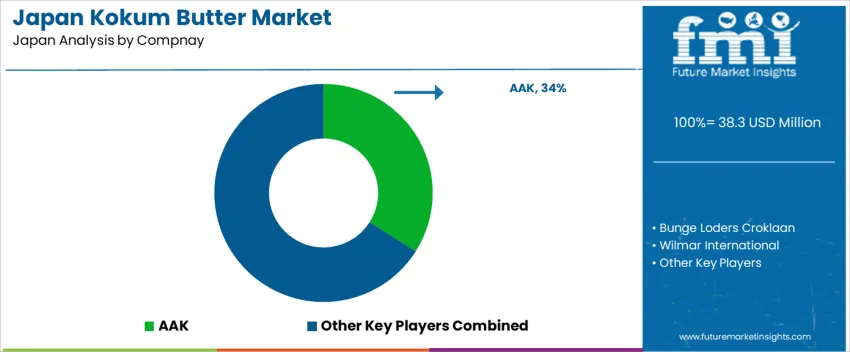
Demand for kokum butter in Japan is growing as food, cosmetics, and personal-care manufacturers increasingly seek alternatives to cocoa butter and other plant-derived fats. Kokum butter is derived from the seeds of the kokum tree (Garcinia indica) and is known for its firm texture at room temperature and melting at near skin temperature-traits that suit both edible fat use and cosmetic formulations. Key suppliers in this segment include AAK (holding about 34% market share among major producers), Bunge Loders Croklaan, Wilmar International, Fuji Oil, and Olam International. These firms supply refined kokum butter for use in confectionery, chocolate substitutes, creams, lip balms, soaps, lotions, and other personal-care products.
Competition in the Japanese kokum butter market centers on product quality, purity, and supply reliability. Producers emphasize refined kokum butter with consistent triglyceride profiles, low impurity levels, and stable melting behavior-important for both food and cosmetic applications. Another area of competition is formulation flexibility: kokum butter that blends well with other vegetable fats or oils allows manufacturers to create cost-effective cocoa butter equivalents, vegan-friendly chocolates, or skin-care items suitable for sensitive skin. Cosmetic uses exploit kokum butter’s non-greasy emollient character and gentle absorption on skin and lips. Companies that can ensure steady supply, batch-to-batch consistency, and regulatory compliance for edible or cosmetic use are better positioned to capture demand in Japan’s growing kokum butter market.
Key Players of the Kokum Butter Industry in Japan
- AAK
- Bunge Loders Croklaan
- Wilmar International
- Fuji Oil
- Olam International
Scope of the Report
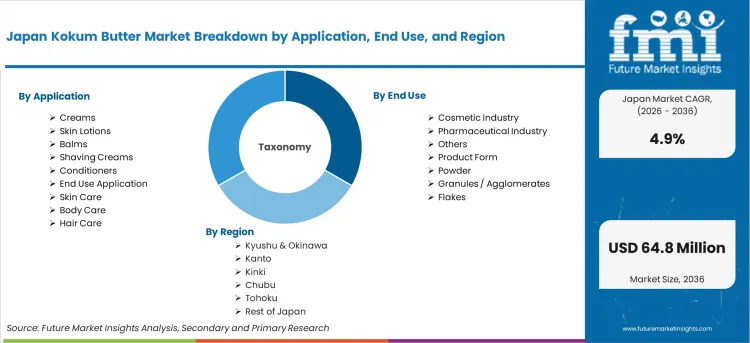
| Metric | Value |
|---|---|
| Quantitative Units | USD Million 40.18 to USD Million 64.82, at a CAGR of 4.9% |
| Market Definition | Kokum butter is a specialty vegetable fat extracted from the seeds of the Garcinia indica tree, characterized by high stearic acid content, a firm texture at room temperature, and non-comedogenic emollient properties. In the Japanese market, kokum butter is used as a formulation ingredient in creams, skin lotions, balms, shaving creams, and hair conditioners within the cosmetic industry, and as an excipient base in pharmaceutical topical preparations. |
| Segmentation | Application: Creams, Skin Lotions, Balms, Shaving Creams, Conditioners; End Use: Cosmetic Industry, Pharmaceutical Industry, Others |
| Regions Covered | Kyushu & Okinawa, Kanto, Kinki, Chubu, Tohoku, Rest of Japan |
| Key Companies Profiled | AAK, Bunge Loders Croklaan, Wilmar International, Fuji Oil, Olam International |
| Forecast Period | 2026 to 2036 |
| Approach | Forecasting models apply a bottom-up methodology starting with manufacturer shipment metrics and import volume data, cross-validated against downstream consumption patterns and regulatory compliance filings. |
Japan Kokum Butter Demand by Segments
Application:
- Creams
- Skin Lotions
- Balms
- Shaving Creams
- Conditioners
End Use:
- Cosmetic Industry
- Pharmaceutical Industry
- Others
Region:
- Kyushu & Okinawa
- Kanto
- Kansai
- Chubu
- Tohoku
- Rest of Japan
Bibliography
- 1. Ministry of Health, Labour and Welfare. (2024). Cosmetic Ingredient Standards: Naturally Sourced Emollient Specifications. MHLW.
- 2. Pharmaceuticals and Medical Devices Agency. (2025). Japanese Pharmacopoeia: Excipient Qualification Standards for Topical Base Materials. PMDA.
- 3. Codex Alimentarius Commission. (2024). Standard for Named Vegetable Oils: Garcinia indica Seed Fat. FAO/WHO.
- 4. Japan Cosmetic Industry Association. (2025). Cosmetic Raw Material Standards and Compliance Report. JCIA.
- 5. Food and Agriculture Organization. (2024). Global Garcinia indica Production and Trade Statistics. FAO.
- 6. Japan External Trade Organization. (2025). Specialty Fats and Oils Import Trends: India-Japan Trade Corridor. JETRO.
This bibliography is provided for reader reference. The full Future Market Insights report contains the complete reference list with primary research documentation.
Frequently Asked Questions
How large is the demand for Kokum Butter in Japan in 2026?
Demand for kokum butter in Japan is estimated to be valued at USD Million 40.18 in 2026.
What will be the market size of Kokum Butter in Japan by 2036?
Market size for kokum butter in Japan is projected to reach USD Million 64.82 by 2036.
What is the expected demand growth for Kokum Butter in Japan between 2026 and 2036?
Demand for kokum butter in Japan is expected to grow at a CAGR of 4.9% between 2026 and 2036.
Which Application is poised to lead sales in 2026?
Creams accounts for 32% share in 2026, driven by established procurement preferences and formulation compatibility across primary end-use applications.
Which End Use is estimated to command in 2026?
Cosmetic Industry accounts for 61% share in 2026, supported by established processing infrastructure and specification compliance across downstream applications.
Which region is growing fastest for Kokum Butter in Japan?
Kyushu & Okinawa is projected to grow at a CAGR of 6.1% during 2026 to 2036, leading all regional clusters in Japan.
What is included in the scope of this Kokum Butter report?
Market scope includes kokum butter (Garcinia indica seed fat) sold for cosmetic, pharmaceutical, and other industrial applications in Japan. Coverage extends to formulated use in creams, skin lotions, balms, shaving creams, and conditioners.
How does FMI build and validate the Kokum Butter forecast?
Forecasting models apply a bottom-up methodology starting with manufacturer shipment data and import volumes, cross-validated against downstream consumption patterns and regulatory compliance filings.
Preview the report firsthand - request a free sample
Get SampleGet the brochure for pricing and purchase details.
Get PDFTable of Content
- Executive Summary
- Japan Market Outlook
- Demand-side Trends
- Supply-side Trends
- Technology Roadmap Analysis
- Analysis and Recommendations
- Market Overview
- Market Coverage / Taxonomy
- Market Definition / Scope / Limitations
- Research Methodology
- Chapter Orientation
- Analytical Lens and Working Hypotheses
- Market Structure, Signals, and Trend Drivers
- Benchmarking and Cross-market Comparability
- Market Sizing, Forecasting, and Opportunity Mapping
- Research Design and Evidence Framework
- Desk Research Programme (Secondary Evidence)
- Company Annual and Sustainability Reports
- Peer-reviewed Journals and Academic Literature
- Corporate Websites, Product Literature, and Technical Notes
- Earnings Decks and Investor Briefings
- Statutory Filings and Regulatory Disclosures
- Technical White Papers and Standards Notes
- Trade Journals, Industry Magazines, and Analyst Briefs
- Conference Proceedings, Webinars, and Seminar Materials
- Government Statistics Portals and Public Data Releases
- Press Releases and Reputable Media Coverage
- Specialist Newsletters and Curated Briefings
- Sector Databases and Reference Repositories
- FMI Internal Proprietary Databases and Historical Market Datasets
- Subscription Datasets and Paid Sources
- Social Channels, Communities, and Digital Listening Inputs
- Surveys
- Focus Groups
- Observational and In-context Research
- Social and Community Interactions
- Stakeholder Universe Engaged
- C-suite Leaders
- Board Members
- Presidents and Vice Presidents
- R&D and Innovation Heads
- Technical Specialists
- Domain Subject-matter Experts
- Scientists
- Physicians and Other Healthcare Professionals
- Governance, Ethics, and Data Stewardship
- Research Ethics
- Data Integrity and Handling
- Desk Research Programme (Secondary Evidence)
- Tooling, Models, and Reference Databases
- Data Engineering and Model Build
- Data Acquisition and Ingestion
- Cleaning, Normalisation, and Verification
- Synthesis, Triangulation, and Analysis
- Quality Assurance and Audit Trail
- Market Background
- Market Dynamics
- Drivers
- Restraints
- Opportunity
- Trends
- Scenario Forecast
- Demand in Optimistic Scenario
- Demand in Likely Scenario
- Demand in Conservative Scenario
- Opportunity Map Analysis
- Product Life Cycle Analysis
- Supply Chain Analysis
- Investment Feasibility Matrix
- Value Chain Analysis
- PESTLE and Porter’s Analysis
- Regulatory Landscape
- Regional Parent Market Outlook
- Production and Consumption Statistics
- Import and Export Statistics
- Market Dynamics
- Japan Market Analysis 2021 to 2025 and Forecast, 2026 to 2036
- Historical Market Size Value (USD Million) Analysis, 2021 to 2025
- Current and Future Market Size Value (USD Million) Projections, 2026 to 2036
- Y-o-Y Growth Trend Analysis
- Absolute $ Opportunity Analysis
- Japan Market Pricing Analysis 2021 to 2025 and Forecast 2026 to 2036
- Japan Market Analysis 2021 to 2025 and Forecast 2026 to 2036, By Application
- Introduction / Key Findings
- Historical Market Size Value (USD Million) Analysis By Application , 2021 to 2025
- Current and Future Market Size Value (USD Million) Analysis and Forecast By Application , 2026 to 2036
- Creams
- Skin Lotions
- Balms
- Shaving Creams
- Conditioners
- Creams
- Y-o-Y Growth Trend Analysis By Application , 2021 to 2025
- Absolute $ Opportunity Analysis By Application , 2026 to 2036
- Japan Market Analysis 2021 to 2025 and Forecast 2026 to 2036, By End Use
- Introduction / Key Findings
- Historical Market Size Value (USD Million) Analysis By End Use, 2021 to 2025
- Current and Future Market Size Value (USD Million) Analysis and Forecast By End Use, 2026 to 2036
- Cosmetic Industry
- Pharmaceutical Industry
- Others
- Cosmetic Industry
- Y-o-Y Growth Trend Analysis By End Use, 2021 to 2025
- Absolute $ Opportunity Analysis By End Use, 2026 to 2036
- Japan Market Analysis 2021 to 2025 and Forecast 2026 to 2036, By Region
- Introduction
- Historical Market Size Value (USD Million) Analysis By Region, 2021 to 2025
- Current Market Size Value (USD Million) Analysis and Forecast By Region, 2026 to 2036
- Kyushu & Okinawa
- Kanto
- Kinki
- Chubu
- Tohoku
- Rest of Japan
- Market Attractiveness Analysis By Region
- Kyushu & Okinawa Market Analysis 2021 to 2025 and Forecast 2026 to 2036, By Country
- Historical Market Size Value (USD Million) Trend Analysis By Market Taxonomy, 2021 to 2025
- Market Size Value (USD Million) Forecast By Market Taxonomy, 2026 to 2036
- By Country
- By Application
- By End Use
- By Country
- Market Attractiveness Analysis
- By Country
- By Application
- By End Use
- Key Takeaways
- Kanto Market Analysis 2021 to 2025 and Forecast 2026 to 2036, By Country
- Historical Market Size Value (USD Million) Trend Analysis By Market Taxonomy, 2021 to 2025
- Market Size Value (USD Million) Forecast By Market Taxonomy, 2026 to 2036
- By Country
- By Application
- By End Use
- By Country
- Market Attractiveness Analysis
- By Country
- By Application
- By End Use
- Key Takeaways
- Kinki Market Analysis 2021 to 2025 and Forecast 2026 to 2036, By Country
- Historical Market Size Value (USD Million) Trend Analysis By Market Taxonomy, 2021 to 2025
- Market Size Value (USD Million) Forecast By Market Taxonomy, 2026 to 2036
- By Country
- By Application
- By End Use
- By Country
- Market Attractiveness Analysis
- By Country
- By Application
- By End Use
- Key Takeaways
- Chubu Market Analysis 2021 to 2025 and Forecast 2026 to 2036, By Country
- Historical Market Size Value (USD Million) Trend Analysis By Market Taxonomy, 2021 to 2025
- Market Size Value (USD Million) Forecast By Market Taxonomy, 2026 to 2036
- By Country
- By Application
- By End Use
- By Country
- Market Attractiveness Analysis
- By Country
- By Application
- By End Use
- Key Takeaways
- Tohoku Market Analysis 2021 to 2025 and Forecast 2026 to 2036, By Country
- Historical Market Size Value (USD Million) Trend Analysis By Market Taxonomy, 2021 to 2025
- Market Size Value (USD Million) Forecast By Market Taxonomy, 2026 to 2036
- By Country
- By Application
- By End Use
- By Country
- Market Attractiveness Analysis
- By Country
- By Application
- By End Use
- Key Takeaways
- Rest of Japan Market Analysis 2021 to 2025 and Forecast 2026 to 2036, By Country
- Historical Market Size Value (USD Million) Trend Analysis By Market Taxonomy, 2021 to 2025
- Market Size Value (USD Million) Forecast By Market Taxonomy, 2026 to 2036
- By Country
- By Application
- By End Use
- By Country
- Market Attractiveness Analysis
- By Country
- By Application
- By End Use
- Key Takeaways
- Key Countries Market Analysis
- Kyushu & Okinawa
- Pricing Analysis
- Market Share Analysis, 2025
- By Application
- By End Use
- Kanto
- Pricing Analysis
- Market Share Analysis, 2025
- By Application
- By End Use
- Kinki
- Pricing Analysis
- Market Share Analysis, 2025
- By Application
- By End Use
- Chubu
- Pricing Analysis
- Market Share Analysis, 2025
- By Application
- By End Use
- Tohoku
- Pricing Analysis
- Market Share Analysis, 2025
- By Application
- By End Use
- Rest of Japan
- Pricing Analysis
- Market Share Analysis, 2025
- By Application
- By End Use
- Kyushu & Okinawa
- Market Structure Analysis
- Competition Dashboard
- Competition Benchmarking
- Market Share Analysis of Top Players
- By Regional
- By Application
- By End Use
- Competition Analysis
- Competition Deep Dive
- AAK
- Overview
- Product Portfolio
- Profitability by Market Segments (Product/Age /Sales Channel/Region)
- Sales Footprint
- Strategy Overview
- Marketing Strategy
- Product Strategy
- Channel Strategy
- Bunge Loders Croklaan
- Wilmar International
- Fuji Oil
- Olam International
- AAK
- Competition Deep Dive
- Assumptions & Acronyms Used


