

- Industry Size (2025)
- USD 11.8 Mn
- Forecast (2035)
- USD 23.9 Mn
- CAGR (2025 to 2035)
- 7.4%
Demand for Power-to-X in Japan Forecast and Outlook 2025 to 2035
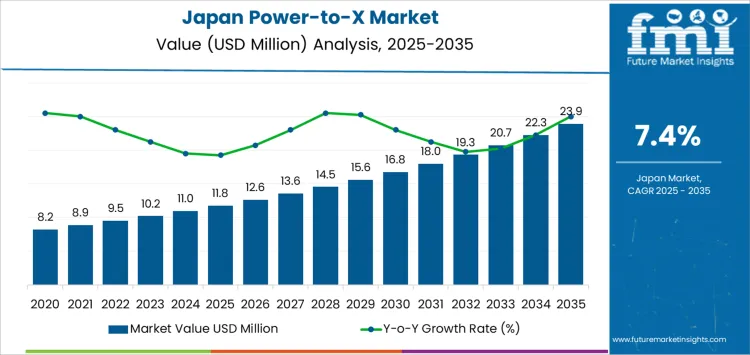
Demand for Power-to-X in Japan is at USD 11.8 million in 2025, with a projected rise to USD 23.9 million by 2035 at a CAGR of 7.4%. Power-to-hydrogen and Power-to-methanol systems form the backbone of current project pipelines, supported by Power-to-methane, Power-to-H2O2, and syngas pathways under pilot commercialization programs. Transportation and industrial energy substitution anchor the primary end-use base, while manufacturing and agricultural feedstock conversion add incremental load demand. Kanto and Chubu dominate early project deployment due to grid access and industrial clustering, while Kyushu supports renewable coupling projects. Siemens Energy, ITM Power, Ørsted A/S, Mitsubishi Heavy Industries, and NEL ASA remain central to electrolyzer systems, balance-of-plant supply, and hydrogen derivative processing integration.
Capacity additions across Japanese Power-to-X installations reflect grid balancing priorities, hydrogen import substitution strategies, and ammonia co-firing programs across coastal industrial zones. Manufacturing-linked projects focus on low carbon feedstock production for steel, chemicals, and synthetic fuels. Residential and distributed energy pilots remain limited in scale yet show consistent funding support under regional decarbonization programs. Deployment economics remain shaped by electrolyzer efficiency, renewable power availability, and compression and storage logistics at port infrastructure. Regional diversification beyond metropolitan corridors progresses through public-private project structuring in Hokkaido and northern Honshu. Competitive positioning across system supplier’s centers on modular plant scalability, asset uptime guarantees, and integration with offshore wind and solar assets under long-duration power offtake frameworks aligned with national hydrogen and synthetic fuel policy targets through 2035.
Quick Stats of the Power to X Industry in Japan
- Power to X Industry in Japan Value (2025): USD 11.8 million
- Power to X Industry in Japan Forecast Value (2035): USD 23.9 million
- Power to X Industry in Japan Forecast CAGR (2025-2035): 7.4%
- Leading Product Type in Power to X Industry in Japan: Power-to-Methanol (23%)
- Key Growth Regions in Power to X Industry in Japan: Kyushu & Okinawa, Kanto, Kansai
- Top Players in Power to X Industry in Japan: Siemens Energy, ITM Power, Ørsted A/S, Mitsubishi Heavy Industries, NEL ASA
What is the Demand Forecast for Endoscope Reprocessing Device in Japan through 2035?
Endoscope reprocessing device demand in Japan stands at USD 131.3 million in 2025 and advances to USD 162.5 million by 2030, generating a USD 31.2 million value increase within this five-year window. The climb from USD 100.6 million in 2020 reflects rising endoscopy procedure density across gastroenterology, pulmonology, and urology departments. Hospital infection control frameworks place strong operational pressure on rapid, standardized, and traceable reprocessing cycles. Large hospital networks continue shifting away from manual disinfection toward automated systems that deliver cycle validation, chemical dosing accuracy, and audit-ready documentation. Demand during this stage remains closely linked to procedure turnover growth and tightening national compliance benchmarks for device hygiene.
From 2030 to 2035, demand expands from USD 162.5 million to USD 223.7 million, adding USD 61.2 million in fresh value during the later phase. Annual value gains widen as secondary hospitals and outpatient endoscopy centers scale their own automated reprocessing capacity. Higher screening volumes for colorectal cancer, respiratory disease, and biliary conditions sustain continuous equipment utilization. Replacement-driven demand also strengthens as early-generation units reach end-of-life thresholds. Integration of digital tracking, consumable optimization, and chemical-free disinfection modules increases the average system value per installation. By 2035, endoscope reprocessing device demand in Japan reflects structurally higher diagnostic procedure throughput and stricter contamination control discipline across the healthcare system.
Power to X Industry in Japan Key Takeaways
| Metric | Value |
|---|---|
| Industry Value (2025) | USD 11.8 million |
| Forecast Value (2035) | USD 23.9 million |
| Forecast CAGR (2025-2035) | 7.4% |
What Is Driving the Demand for Power to X in Japan?
Demand for Power to X in Japan is shaped by long-term energy security concerns, limited domestic fossil fuel resources, and national pressure to decarbonize hard-to-electrify sectors. Japan's energy system has relied heavily on imported LNG, coal, and oil since the reduction of nuclear output after the past disruptions. This import dependence exposed the economy to price shocks and supply risk. Power to X gained attention as a pathway to convert surplus renewable electricity into hydrogen, synthetic fuels, and chemical feedstocks that can be stored, transported, and used across industry, power generation, and mobility. Heavy industries such as steel, chemicals, and refining view these conversion pathways as tools to retain domestic production while lowering direct carbon exposure.
Future demand for Power-to-X in Japan will be shaped by the hydrogen supply chain buildout, industrial decarbonization mandates, and cross-border energy partnerships. Synthetic fuels will gain relevance in aviation, shipping, and thermal power, where direct electrification remains limited. Demand will also rise from seasonal renewable balancing as offshore wind and solar capacity expand. Barriers include high conversion losses, the capital intensity of electrolysis and synthesis plants, and uncertainty about long-term price competitiveness with imported fuels. Port infrastructure upgrades, regulatory alignment, and long-duration storage development remain unresolved constraints.
What Is the Demand for Power to X in Japan by Product Type and End Use?
Decarbonization policy targets, renewable electricity integration, and fuel security planning shape the demand for Power-to-X in Japan. Power-to-methanol leads by product type because it supports liquid-fuel synthesis that fits existing storage and distribution systems. Transportation leads by end use due to the push toward low-carbon mobility fuels and synthetic alternatives for shipping and heavy vehicles. Procurement activity is led by energy utilities, chemical producers, and industrial consortia supported by national demonstration funding. Import reliance remains present for electrolyzer stacks and catalytic reactors. Substitution pressure exists across conversion pathways based on efficiency and cost performance. Demand stability is supported by long term energy transition programs and industrial emissions reduction mandates.
Why does power to methanol lead the demand for Power to X in Japan by product type?
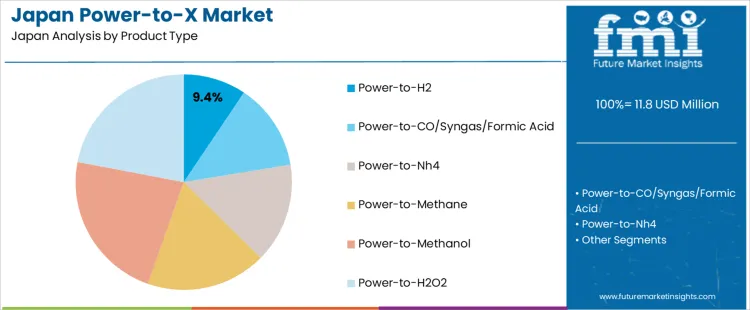
Power-to-methanol accounts for 9.4% of the demand for Power-to-X in Japan by product type, reflecting its compatibility with existing fuel infrastructure and chemical feedstock networks. Consumption intensity is driven by interest in synthetic fuel blending, marine fuel trials, and low carbon chemical production. Usage remains stable because methanol supports both energy and industrial feedstock applications. Procurement is led by chemical manufacturers and utility backed project developers operating pilot and scale up facilities. Price sensitivity remains moderate because renewable methanol cost remains tied to power pricing and carbon policy incentives. Specification control emphasizes conversion efficiency, catalyst stability, and product purity for downstream fuel and chemical processing.
Power to methanol projects also generate recurring demand through phased capacity expansion and continuous plant optimization programs. Repeat investment remains predictable as demonstration facilities progress toward commercial scale. Buyers favor integrated system designs that combine CO2 capture, hydrogen production, and catalytic synthesis under unified control systems. Margin structure remains controlled under project finance models and long payback periods. Regulatory exposure remains elevated due to chemical handling standards and fuel quality certification. Import reliance persists for electrolyzer modules and high performance catalysts. Substitution pressure from power to hydrogen remains present in mobility focused applications.
What drives transportation to lead the demand for Power to X in Japan by end use?
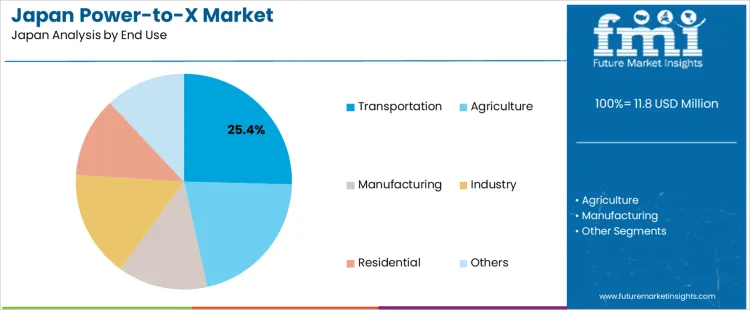
Transportation represents 25.4% of the demand for Power to X in Japan by end use, reflecting national goals to decarbonize freight, maritime transport, and heavy duty vehicles. Consumption intensity is driven by pilot use of synthetic fuels, ammonia based shipping trials, and hydrogen derived fuel blends for buses and logistics fleets. Usage remains stable because battery electrification alone does not cover long distance and high load mobility needs. Procurement is guided by transport operators, port authorities, and fuel suppliers working under government backed transition programs. Price sensitivity remains moderate because early adoption relies on subsidies and demonstration funding. Specification control emphasizes fuel energy density, combustion stability, and engine compatibility.
Transportation related Power to X deployment also generates steady repeat demand through fleet expansion and refueling network development. Repeat utilization remains predictable as more vehicles enter pilot programs and infrastructure coverage improves. Buyers favor fuels that align with existing engine platforms to reduce retrofit cost exposure. Margin structure remains constrained under high production cost and limited early scale. Regulatory exposure remains elevated due to fuel certification, safety handling, and emissions accounting frameworks. Import reliance persists for conversion equipment and control systems. Substitution pressure exists between synthetic fuels, hydrogen, and battery pathways based on route length and payload requirements.
What Is Driving the Demand for Power-to-X in Japan Energy Security and Industrial Decarbonization Strategy?
Demand for Power-to-X in Japan is shaped by limited domestic energy resources, dependence on imported fuels, and legally binding carbon reduction targets. Heavy industry, power utilities, and shipping operators are evaluating synthetic fuels, green hydrogen derivatives, and ammonia as long-term supply anchors. Power-to-X supports conversion of surplus renewable electricity into transportable energy carriers suited for storage and cross border trade. Grid stability, fuel diversity, and industrial feedstock security guide deployment interest. National policy links Power-to-X with offshore wind, solar expansion, and hydrogen supply chain development platforms aligned with industrial competitiveness rather than short cycle energy experimentation or pilot scale decarbonization branding.
How Is Industrial Feedstock Risk Driving Hydrogen and E-Fuel Conversion Demand?
Japan steel, chemical, and refining complexes rely on stable feedstock flows for continuous output. Power-to-X pathways offer synthetic hydrogen, methanol, and ammonia derived from domestic renewable electricity. These fuels reduce exposure to overseas fossil fuel price swings. Industrial firms lead offtake planning to secure long-term input stability for blast furnaces, fertilizer production, and process heat units. Synthetic feedstocks also carry regulatory value under national emission accounting frameworks. This industrial anchoring role drives Power-to-X evaluation beyond power generation into core manufacturing continuity and export oriented production security planning under tightening carbon reporting expectations across listed industrial enterprises nationwide today.
Why Is Maritime Fuel Transition Pulling Power-to-X into Port Infrastructure Planning?
Japan shipping fleets and port authorities face rising pressure to reduce greenhouse gas emissions across international routes. Ammonia and synthetic methanol appear as practical Power-to-X outputs for deep sea vessels and bunkering operations. Major ports are assessing storage tanks, safety systems, and fueling corridors to support alternative maritime fuels. Vessel operators seek predictable green fuel supply to meet charter requirements. Coastal industrial zones tie port fueling demand to nearby renewable generation and conversion hubs. Power-to-X demand grows through maritime decarbonization planning rather than passenger vehicle fuel replacement or urban power load substitution strategies.
How Do Capital Intensity, Grid Constraints, and Permitting Control Expansion Pace?
Power-to-X deployment in Japan faces restraint from high capital requirements for electrolyzers, synthesis units, and storage systems. Grid interconnection constraints limit direct linkage between offshore wind farms and conversion sites. Land availability near ports and industrial zones remains limited under zoning controls. Environmental permitting requires long review timelines for chemical processing facilities. Financing risk increases under uncertain offtake contract duration. These infrastructure and regulatory limits slow project execution cycles despite strong policy alignment. Expansion follows phased investment scheduling aligned with grid reinforcement, port redevelopment, and national hydrogen corridor planning frameworks rather than rapid scale construction.
What is the Demand for Power to X in Japan by Region?
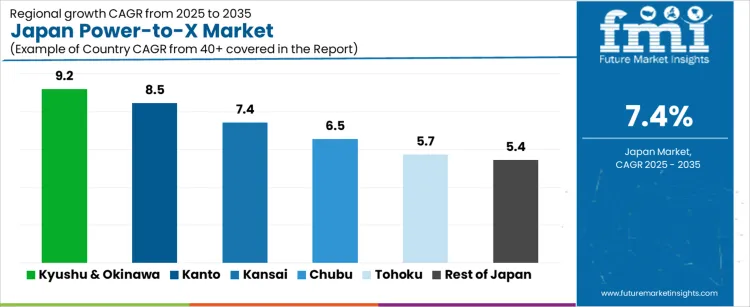
| Region | CAGR (%) |
|---|---|
| Kyushu & Okinawa | 9.2% |
| Kanto | 8.5% |
| Kansai | 7.4% |
| Chubu | 6.5% |
| Tohoku | 5.7% |
| Rest of Japan | 5.4% |
The demand for power to X in Japan is increasing steadily across regions, led by Kyushu and Okinawa at a 9.2% CAGR. Growth in this region is supported by renewable energy integration projects, hydrogen production pilots, and port based fuel conversion infrastructure. Kanto follows at 8.5%, driven by industrial decarbonization programs, refinery upgrades, and strong participation from large utilities and manufacturing firms. Kansai records 7.4% growth, reflecting steady adoption in chemical processing, power generation trials, and municipal energy systems. Chubu at 6.5% shows moderate uptake linked to automotive supply chains and synthetic fuel research. Tohoku and the Rest of Japan, at 5.7% and 5.4%, reflect slower growth shaped by infrastructure constraints, grid limitations, and longer project development timelines across regional energy systems.
How Is Renewable Integration Shaping Power to X Demand in Kyushu and Okinawa?
Demand for Power to X in Kyushu and Okinawa is expanding at a CAGR of 9.2% through 2035, supported by strong solar and wind power integration, regional hydrogen pilot projects, and island energy security initiatives. This region records steady progress in green hydrogen production linked to surplus renewable electricity. Kyushu leads large scale electrolysis deployment tied to utility backed demonstration programs. Growth reflects grid balancing requirements, storage needs for intermittent renewables, and regional decarbonization targets focused on power, mobility, and industrial fuel substitution.
- Solar and wind capacity drive surplus electricity availability
- Green hydrogen pilots anchor early Power to X demand
- Island energy security supports local fuel conversion use
- Utility backed projects sustain long term infrastructure buildup
Why Is Industrial Scale Energy Transition Driving Power to X Growth in Kanto?
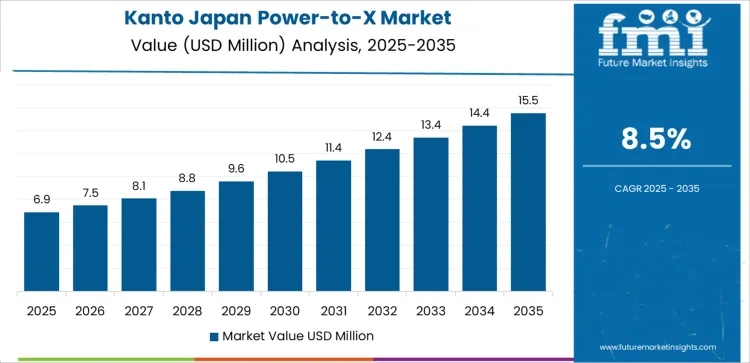
Demand for Power to X in Kanto is advancing at a CAGR of 8.5% through 2035, driven by dense industrial energy consumption, port based hydrogen import infrastructure, and strong private sector investment in synthetic fuel projects. Kanto leads adoption across steel, chemicals, and logistics fuel conversion pathways. This region shows the highest project concentration tied to metropolitan decarbonization roadmaps. Growth reflects carbon reduction targets among energy intensive industries, growing demand for green ammonia, and integration of Power to X within urban energy transition strategies.
- Heavy industry demand anchors large scale conversion projects
- Port infrastructure supports hydrogen and ammonia imports
- Private sector investment accelerates project execution
- Urban decarbonization targets sustain long term deployment
What Is Enabling Steady Power to X Expansion Across Kansai Energy Networks?
Demand for Power to X in Kansai is progressing at a CAGR of 7.4% through 2035, supported by industrial heat decarbonization needs, regional hydrogen mobility programs, and steady renewable power integration across Osaka and surrounding prefectures. Kansai shows balanced development across power grid stabilization, transport fuel substitution, and chemical feedstock production. Growth remains linked to industrial electrification, refinery conversion planning, and regional low carbon logistics networks supporting hydrogen powered transport corridors.
- Industrial heat conversion drives early fuel switching demand
- Hydrogen mobility programs support transport fuel applications
- Renewable grid stabilization shapes storage project activity
- Refinery conversion plans sustain synthetic fuel development
How Is Manufacturing Base Energy Demand Supporting Power to X Adoption in Chubu?
Demand for Power to X in Chubu is advancing at a CAGR of 6.5% through 2035, supported by energy intensive manufacturing operations, industrial fuel decarbonization planning, and growing use of hydrogen for mobility and backup power in Aichi. Chubu shows strong linkage between automotive manufacturing and hydrogen energy systems. Power to X demand remains focused on synthetic fuel blending, on site hydrogen generation, and controlled pilot projects for industrial heat replacement.
- Automotive manufacturing drives hydrogen energy integration
- On site hydrogen generation supports industrial fuel needs
- Synthetic fuel blending anchors early demand volumes
- Industrial pilots guide controlled technology adoption
Why Is Grid Stability and Rural Energy Transition Driving Power to X Demand in Tohoku?
Demand for Power to X in Tohoku is rising at a CAGR of 5.7% through 2035, supported by high renewable power generation capacity, grid stabilization needs, and rural energy transition programs. Tohoku plays a major role in surplus renewable electricity conversion into hydrogen and synthetic fuels. Power to X development remains closely linked to wind power scaling and regional energy export ambitions. Growth is shaped by storage requirements, long distance energy transport planning, and regional support for renewable driven industrial fuel pathways.
- Wind power output supports surplus energy conversion
- Grid stabilization needs drive storage based applications
- Rural energy exports shape long distance fuel transport plans
- Regional transition programs sustain infrastructure rollout
How Is Gradual Infrastructure Development Influencing Power to X Growth in Rest of Japan?
Demand for Power to X in Rest of Japan is expanding at a CAGR of 5.4% through 2035, supported by gradual renewable power additions, local hydrogen demonstration programs, and slow expansion of industrial fuel conversion capacity. These areas show lower project density with emphasis on municipal energy pilots and small scale hydrogen supply chains. Growth remains steady and linked to regional decarbonization roadmaps, public sector backed pilot funding, and progressive energy storage deployment.
- Municipal pilot programs support localized fuel conversion
- Public funding anchors early stage project development
- Small scale hydrogen supply chains guide adoption pace
- Regional decarbonization plans shape long term demand growth
What Is Driving the Demand for Power to X in Japan and Which Companies Shape Project Deployment?
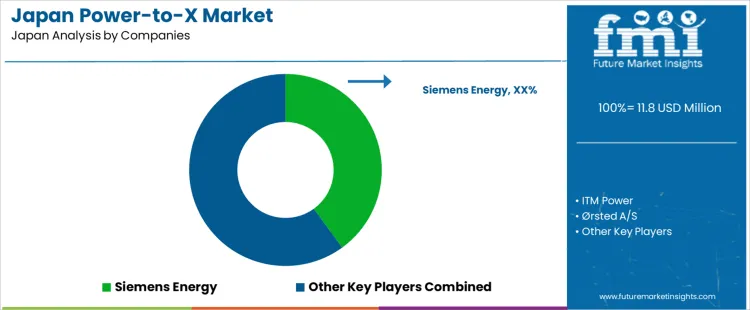
The demand for Power to X in Japan is shaped by national hydrogen policy targets, grid stabilization needs, and industrial decarbonization programs tied to steel, chemicals, and refining. Mitsubishi Heavy Industries holds a central domestic position through hydrogen production systems, ammonia synthesis integration, and large scale plant engineering used in government backed demonstration projects. NEL ASA supports demand through electrolyzer systems supplied into pilot hydrogen production facilities linked to mobility and storage programs. Siemens Energy participates through power conversion systems, electrolysis integration, and grid interface technology used in utility scale projects. Ørsted A S contributes through upstream renewable to hydrogen project design expertise referenced in Japanese consortium developments. ITM Power supports selected deployments through electrolyzer modules supplied for test scale and industrial prototype facilities. Project selection in Japan is governed by long term power purchase structures, hydrogen offtake security, safety certification under high pressure gas regulations, and alignment with METI funding frameworks. Buyer preference favors suppliers with domestic engineering presence, Japanese language operational support, and proven performance under continuous load conditions. Demand visibility tracks refinery hydrogen substitution projects, green ammonia programs for power generation, and export oriented synthetic fuel planning linked to shipping and heavy industry.
Key Players in the Power to X Industry in Japan
- Siemens Energy
- ITM Power
- Ørsted A/S
- Mitsubishi Heavy Industries
- NEL ASA
Scope of the Report
| Items | Values |
|---|---|
| Quantitative Units (2025) | USD million |
| Product Type | Power-to-H2, Power-to-CO/Syngas/Formic Acid, Power-to-NH4, Power-to-Methane, Power-to-Methanol, Power-to-H2O2 |
| End Use | Transportation, Agriculture, Manufacturing, Industry, Residential, Others |
| Region | Kyushu & Okinawa, Kanto, Kansai, Chubu, Tohoku, Rest of Japan |
| Countries Covered | Japan |
| Key Companies Profiled | Siemens Energy, ITM Power, Ørsted A/S, Mitsubishi Heavy Industries, NEL ASA |
| Additional Attributes | Dollar by sales by product type and end use; Regional CAGR and deployment patterns; Renewable electricity integration and electrolyzer capacity; Industrial decarbonization program adoption; Port infrastructure and maritime fuel substitution; Project finance and long term PPA alignment; Grid interconnection and storage constraints; Capital expenditure and modular plant scalability; Hydrogen and synthetic fuel offtake planning; Regulatory approvals and safety certification under high pressure gas frameworks; Import reliance for electrolyzer stacks and catalytic reactors; Substitution pressure across conversion pathways based on efficiency and cost |
Power to X Industry in Japan Segmentation
Product Type:
- Power-to-H2
- Power-to-CO/Syngas/Formic Acid
- Power-to-Nh4
- Power-to-Methane
- Power-to-Methanol
- Power-to-H2O2
End Use:
- Transportation
- Agriculture
- Manufacturing
- Industry
- Residential
- Others
Region:
- Kyushu & Okinawa
- Kanto
- Kansai
- Chubu
- Tohoku
- Rest of Japan
Frequently Asked Questions
How big is the demand for power-to-x in Japan in 2025?
The demand for power-to-x in Japan is estimated to be valued at USD 11.8 million in 2025.
What will be the size of power-to-x in Japan in 2035?
The market size for the power-to-x in Japan is projected to reach USD 23.9 million by 2035.
How much will be the demand for power-to-x in Japan growth between 2025 and 2035?
The demand for power-to-x in Japan is expected to grow at a 7.4% CAGR between 2025 and 2035.
What are the key product types in the power-to-x in Japan?
The key product types in power-to-x in Japan are power-to-h2, power-to-co/syngas/formic acid, power-to-nh4, power-to-methane, power-to-methanol and power-to-h2o2.
Which end use segment is expected to contribute significant share in the power-to-x in Japan in 2025?
In terms of end use, transportation segment is expected to command 25.4% share in the power-to-x in Japan in 2025.
Preview the report firsthand - request a free sample
Get SampleGet the brochure for pricing and purchase details.
Get PDFTable of Content
- Executive Summary
- Japan Market Outlook
- Demand-side Trends
- Supply-side Trends
- Technology Roadmap Analysis
- Analysis and Recommendations
- Market Overview
- Market Coverage / Taxonomy
- Market Definition / Scope / Limitations
- Market Background
- Market Dynamics
- Drivers
- Restraints
- Opportunity
- Trends
- Scenario Forecast
- Demand in Optimistic Scenario
- Demand in Likely Scenario
- Demand in Conservative Scenario
- Opportunity Map Analysis
- Product Life Cycle Analysis
- Supply Chain Analysis
- Investment Feasibility Matrix
- Value Chain Analysis
- PESTLE and Porter’s Analysis
- Regulatory Landscape
- Regional Parent Market Outlook
- Production and Consumption Statistics
- Import and Export Statistics
- Market Dynamics
- Japan Market Analysis 2020 to 2024 and Forecast, 2025 to 2035
- Historical Market Size Value (USD Million) Analysis, 2020 to 2024
- Current and Future Market Size Value (USD Million) Projections, 2025 to 2035
- Y-o-Y Growth Trend Analysis
- Absolute $ Opportunity Analysis
- Japan Market Pricing Analysis 2020 to 2024 and Forecast 2025 to 2035
- Japan Market Analysis 2020 to 2024 and Forecast 2025 to 2035, By Product Type
- Introduction / Key Findings
- Historical Market Size Value (USD Million) Analysis By Product Type , 2020 to 2024
- Current and Future Market Size Value (USD Million) Analysis and Forecast By Product Type , 2025 to 2035
- Power-to-H2
- Power-to-CO/Syngas/Formic Acid
- Power-to-Nh4
- Power-to-Methane
- Power-to-Methanol
- Power-to-H2O2
- Y-o-Y Growth Trend Analysis By Product Type , 2020 to 2024
- Absolute $ Opportunity Analysis By Product Type , 2025 to 2035
- Japan Market Analysis 2020 to 2024 and Forecast 2025 to 2035, By End Use
- Introduction / Key Findings
- Historical Market Size Value (USD Million) Analysis By End Use, 2020 to 2024
- Current and Future Market Size Value (USD Million) Analysis and Forecast By End Use, 2025 to 2035
- Transportation
- Agriculture
- Manufacturing
- Industry
- Residential
- Others
- Y-o-Y Growth Trend Analysis By End Use, 2020 to 2024
- Absolute $ Opportunity Analysis By End Use, 2025 to 2035
- Market Structure Analysis
- Competition Dashboard
- Competition Benchmarking
- Market Share Analysis of Top Players
- By Regional
- By Product Type
- By End Use
- Competition Analysis
- Competition Deep Dive
- Siemens Energy
- Overview
- Product Portfolio
- Profitability by Market Segments (Product/Age /Sales Channel/Region)
- Sales Footprint
- Strategy Overview
- Marketing Strategy
- Product Strategy
- Channel Strategy
- ITM Power
- Ørsted A/S
- Mitsubishi Heavy Industries
- NEL ASA
- Siemens Energy
- Competition Deep Dive
- Assumptions & Acronyms Used
- Research Methodology


