

- Market Size (2026)
- USD 1653.8 Mn
- Forecast (2036)
- USD 2693.9 Mn
- CAGR (2026 to 2036)
- 5.0%
How big is L-Citrulline Market in 2026?
USD 1653.8 million in 2026 and USD 2693.9 million by 2036 at a 5.0% CAGR.
Sales of L-citrulline are estimated to rise at 5.0% CAGR through 2036, increasing valuation from USD 1653.8 million in 2026 to USD 2693.9 million by 2036. The market was valued at USD 1575.05 million in 2025 across established performance and daily wellness applications. Repeat purchasing across sports nutrition products supports predictable ingredient demand through familiar training routines and transparent serving instructions. GNC announced in September 2025 that Beyond Raw LIT V2 increased L-citrulline from three grams to five grams per serving. The reformulation shows that established brands are raising disclosed ingredient levels within products that already have physical and digital distribution.
Industry growth is influenced by channel access and the cost of meeting local rules for dietary supplements. United States brands can coordinate launches across specialist stores and direct digital channels through one commercial release. GNC launched Beyond Raw LIT AF V2 through stores and GNC.com in May 2026 alongside TikTok Shop. The route gives a citrulline formula immediate discovery and replenishment options without relying on one retail outlet. Japan and South Korea require structured functional-food documentation, while Germany and the United Kingdom demand careful label control. Companies therefore need local regulatory support and clear serving information to convert distribution access into repeat national sales.
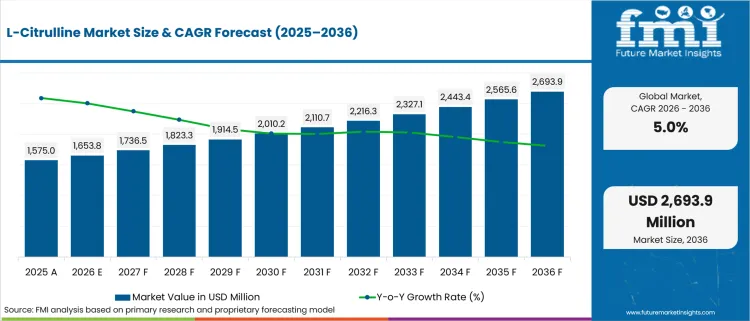
Key Takeaways of L-Citrulline Market
- L-citrulline industry is driven by increasing demand for sports nutrition supplements and the expanding use of amino acids in functional foods and nutraceuticals.
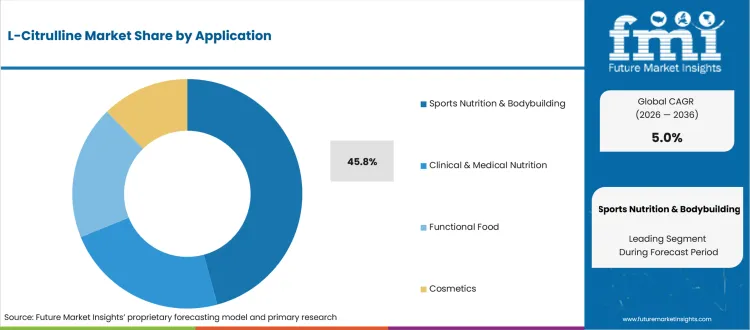
- Sports nutrition & bodybuilding is estimated to represent 45.8% share in 2026 through repeated use in endurance and pre-workout formulas.
- Capsules are forecast to capture 38.2% share in 2026 through measured servings that fit established daily supplement routines.
- Food-grade material is anticipated to account for 60.5% share in 2026 through broad suitability across consumer nutrition products.
- Quality documentation and visible price comparison limit commercial flexibility across amino-acid products with similar positioning and serving formats.
- Plumino and NOW Foods compete with specialist finished-product brands through different supply roles and dosage choices within the category.
Analyst Perspective
“L-citrulline earns repeat demand through transparent serving levels and practical formats rather than novelty claims alone. Sports formulas reward clear dosage information, while capsule production depends on powder flow that maintains fill accuracy. Food-grade manufacturers also need consistent specifications across regions since quality gaps can interrupt qualification and batch release. The strongest companies connect dependable fermentation supply with practical labels and familiar retail routes across consumer channels.”
- Nandini Roy Choudhury, Principal Analyst, Future Market Insights
How is the L-Citrulline Market segmented?
The L-citrulline industry is segmented by application, form, grade, distribution channel, and region.
The market is divided by end use, delivery format, product grade, sales route, and region. Application covers sports nutrition & bodybuilding, clinical & medical nutrition, functional food, cosmetics, and other defined uses. Form distinguishes powder, capsules, tablets, liquid, and other delivery formats through preparation needs and serving control. Grade separates food-grade and pharmaceutical-grade material within the wider amino acids category according to quality expectations and intended use. Distribution channel covers supermarkets & hypermarkets, pharmacies, specialty & health stores, online sales, and other outlets through distinct purchasing routes. Regional analysis compares North America, Latin America, Western Europe, Eastern Europe, East Asia, South Asia & Pacific, and the Middle East & Africa.
Why does sports nutrition & bodybuilding lead the application category?
Training formulas use L-citrulline within defined serving systems that consumers can compare across familiar pre-workout products. Nutrabolt launched C4 AlphaBomb in May 2025 with an eight-gram VELOX blend of L-arginine and L-citrulline. The launch placed the ingredient inside a commercial formula designed for experienced users seeking higher-intensity routines. Product renewal across pre-workout supplements gives brands a direct route to communicate serving strength and replenishment timing.
- Sports nutrition & bodybuilding is set to lead the application with 45.8% share in 2026 due to repeat use across pre-workout and endurance formulas with clearly disclosed serving levels. The position reflects repeated inclusion within products that already carry clear timing and serving instructions. Formula developers can compare ingredient levels across competing launches without changing the wider consumption occasion.
- Performance brands use L-citrulline in products consumed around scheduled training sessions and familiar exercise routines. Clear serving disclosure and consistent flavor performance reduce uncertainty during repeated use across several product varieties. Brands that explain dosage without exaggerated claims can support regular replenishment across several defined training goals and experience levels.
Why do capsules lead the form category?
Capsules convert bulk powder into measured servings that require no mixing and avoid most taste exposure during daily use. Stable powder flow protects fill accuracy and reduces interruptions during measured-dose production across repeated capsule batches. NNB Nutrition announced non-hygroscopic L-citrulline in September 2025 to reduce clumping and support consistent blending in capsules. Production of food supplement ingredients also depends on predictable powder behavior during measured-dose manufacturing and routine production-line operation.
- Capsules are likely to capture 38.2% share in 2026 attributable to fixed dosing and portable use across established daily supplement routines. The format reduces preparation steps and allows brands to state a fixed amount on each serving panel. Consistent capsule filling also supports predictable package counts across retail programs and recurring subscription channels.
- Each capsule carries a defined amount without preparation equipment and supports travel or routine wellness use. Manufacturers gain a familiar package format that works across direct subscriptions and retail shelves without changing dosage instructions. Powder remains stronger for adjustable servings within specialized training routines that combine several complementary performance ingredients.
Why does food-grade material lead the grade category?
Food-grade L-citrulline supports consumer supplements and functional nutrition products that require repeatable purity without pharmaceutical release systems. Jingjing Pharmaceutical disclosed a proposed food-additive project in December 2025 with planned L-citrulline capacity of 1,500 metric tons within a wider 25,000-metric-ton amino-acid food-additive project. The proposal also included citrulline malate and outlined planned scale across closely related food applications at the same site. Capacity planning for nutraceutical ingredients depends on completed commissioning and customer qualification rather than announced equipment volume alone.
- By grade, food-grade material is estimated to hold 60.5% in 2026 owing to broad qualification across mainstream supplements and functional nutrition formulas. The grade supports consumer-scale batches without release costs attached to pharmaceutical production routes and clinical documentation. Formulators can use one qualified material across capsules and powders as well as functional nutrition products with different serving designs.
- Food-grade material supports larger consumer batches and common quality documentation across several commercial supplement formats. Pharmaceutical-grade material serves narrower clinical or medical nutrition routes with tighter records and higher handling costs. Grade selection follows the intended claim environment and release process so manufacturers avoid controls that the final consumer route does not require.
Why do supermarkets & hypermarkets lead the distribution channel category?
Mass retailers place performance supplements beside wider wellness products and allow immediate comparison of format and serving price. Store discovery depends on familiar packaging and clear serving information that shoppers can compare without specialist assistance. In a March 2026 company article aimed at beginners, Bucked Up listed its L-citrulline pre-workout among recommended Walmart options. The retail placement supports store discovery and later digital replenishment through an established national retailer. Listings for nutraceutical products require consistent serving descriptions across store shelves and digital product pages.
- The distribution channel category is forecast to be led by supermarkets & hypermarkets at 31.4% share in 2026 due to broad consumer reach and immediate comparison during routine wellness shopping. The channel reaches shoppers who discover supplements during routine visits rather than planned specialist searches. Immediate availability also supports trial purchases without delivery delays or commitments to recurring subscription programs.
- Retail chains favor familiar formats and restrained benefit language that support comparison without specialist assistance. Online channels provide detailed product information and convenient replenishment for experienced users who understand preferred serving formats. Pharmacies and specialist stores remain relevant for consumers seeking dosage guidance, while each route supports a different replenishment pattern.
What are the drivers, restraints, and opportunities in the L-Citrulline Market?
Repeat performance use supports demand, regulatory preparation limits smaller launches, and stable fermentation supply creates room for differentiated formulations.
- Driver: Established training routines create recurring purchase occasions for formulas with transparent L-citrulline serving levels.
- Restraint: Safety documentation and claims preparation raise launch costs for smaller brands entering established supplement channels.
- Opportunity: Integrated fermentation ownership can improve supply continuity and technical coordination for qualified food-grade material.
Consumers use pre-workout products around established exercise routines, which creates repeat demand instead of isolated purchase occasions. GNC launched a color-changing Beyond Raw formula in June 2025 with three grams of citrulline and Nitrosigine per serving. The release added a visible preparation feature to an established sports food product without changing the normal pre-workout occasion. Brands can convert routine use into repeat sales through clear servings and sensory differences that remain easy to understand.
Regulatory preparation limits smaller brands that lack scientific staff and complete ingredient records for commercial supplement review. The FDA released educational materials on the new dietary ingredient notification process in June 2025 for manufacturers and distributors. The process requires a scientifically supported safety submission for qualifying new ingredients before consumer availability. The required evidence can delay unfamiliar formulas beyond sourcing and package design during commercial preparation. Commercial budgets must separate regulatory work from promotion and routine manufacturing expenses across every proposed launch.
Consolidated fermentation ownership creates an opening for companies that need stable specifications and technical contact across several regions. Plumino completed its acquisition of Kyowa Hakko Bio amino-acid and HMO businesses in July 2025. The transaction preserved customer support and combined established fermentation operations with planned technology and capacity investment. Plumino also lists citrulline within its current food portfolio for commercial inquiries across regional nutrition accounts. The platform can support functional foods, where product qualification and repeat supply matter more than broad portfolio claims.
Which country CAGRs are profiled in the L-Citrulline Market?
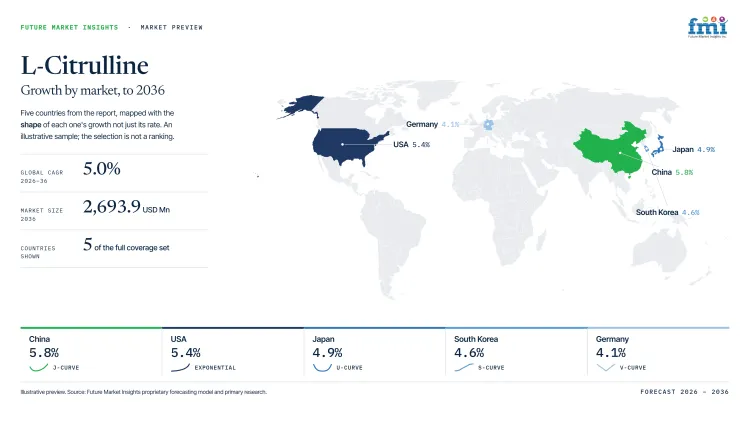
| Country | CAGR |
|---|---|
| China | 5.8% |
| United States | 5.4% |
| Japan | 4.9% |
| South Korea | 4.6% |
| Germany | 4.1% |
| United Kingdom | 3.7% |
How do country-level CAGRs compare in the L-Citrulline Market?
The profiled country CAGRs span 2.1 percentage points across regulatory systems and supplement channels with different entry costs. China and the United States form an upper band separated by 0.4 percentage points. Japan and South Korea create a middle group separated by 0.3 percentage points within comparable functional-food systems. Germany and the United Kingdom remain 0.4 percentage points apart within mature European channels.
- China combines domestic amino-acid production with a registration route for products using ingredients outside the official health-food catalog.
- The United States remains close to China through broad specialist retail access and a federal notification route for qualifying new dietary ingredients.
- Japan sits below the upper band through a filing system that requires structured evidence and careful label preparation for commercial use.
- South Korea remains near Japan through active digital retail and formal standards that control health-functional-food ingredients and manufacturing.
- Germany reflects mature supplement access alongside mandatory product notification and retailer expectations for German-language compliance records.
- The United Kingdom combines broad online comparison with food-business registration and restrictions on unauthorized health claims.
Comparable CAGRs can create different commercial entry conditions across manufacturing access, product registration and retail qualification. The full report provides country-level CAGR analysis across North America, Latin America, Europe, East Asia, South Asia, Oceania and the Middle East and Africa.
Country-wise Analysis
- Health-food products using ingredients outside China’s official catalog require registration before commercial sale through regulated national channels. Adoption of L-citrulline products in China is estimated to expand at 5.8% CAGR through 2036, owing to domestic fermentation capacity and broad supplement manufacturing. Domestic fermentation capacity supports food-grade supply across large supplement manufacturing clusters and established export operations. In June 2025, the State Administration for Market Regulation confirmed that non-catalog ingredients and first imported health foods require registration. Detailed safety and quality dossiers remain a material friction for unfamiliar formulas entering regulated health-food channels. Brands can reduce launch risk through local regulatory support and package designs prepared for the approved sales route.
- Brands in the United States sell L-citrulline through specialist stores and direct websites that support several dosage formats. L-citrulline sales in the United States are forecast to expand at 5.4% CAGR by 2036, supported by broad specialist retail and recurring performance-nutrition use. The FDA addressed the required DSHEA disclaimer in a December 2025 letter to supplement manufacturers and retailers. The letter clarified placement rules for eligible structure or function claims without establishing the approved market CAGR. Claims substantiation and quality testing remain material frictions for smaller brands entering a crowded amino-acid category. Commercial plans should separate consumer acquisition spending from the technical work required for labels and ingredient qualification.
- Japanese supplement purchasing favors compact formats and detailed quality information across pharmacies and specialist online channels. Measured servings support daily routines that place value on precise instructions and limited storage requirements. The Japanese L-citrulline market is projected to record 4.9% CAGR during the assessment period, reflecting functional nutrition use and demand for serving information. The Consumer Affairs Agency revised functional-claim filing guidance in October 2025 alongside related questions and answers. Companies remain responsible for accurate submissions and packaging statements throughout the updated functional-claim review process. Scientific support and careful Japanese-language labels create a material friction for unfamiliar positioning in retail channels. Brands gain acceptance through restrained claims and compact formats designed for established purchasing habits and storage preferences.
- South Korean brands reach consumers through mobile retail within tightly managed health-functional-food categories and short product cycles. South Korea's L-citrulline market outlook is anticipated to advance at 4.6% CAGR over the assessment period, underpinned by mobile retail access and defined health-functional-food standards. The Ministry of Food and Drug Safety updated health-functional-food standards and specifications in March 2025. The framework gives manufacturers defined requirements for recognized ingredients and compliant production across registered health-functional-food categories. Formulas outside standardized categories face additional recognition and label preparation work before wider commercialization across national retail channels. Local strategies should combine digital education with conservative claims and dependable documentation across short product cycles.
- German supplement channels require product notification and clear food-law compliance for pharmacy or specialist retail entry. Established wellness outlets and experienced distributors support supplement listings across German retail and pharmacy channels. L-citrulline demand in Germany is predicted to advance at 4.1% CAGR through 2036, shaped by mature retail access and product-notification requirements. The Federal Office of Consumer Protection and Food Safety stated in January 2025 that supplements require notification rather than product approval. Notification records the product but does not confirm legal compliance or commercial suitability for retailers. German-language labels and quality records remain material frictions during retailer onboarding and recurring product reviews. Companies can improve listing continuity through stable specifications and restrained benefit statements across each channel.
- United Kingdom consumers compare performance supplements across specialist retailers and mature digital platforms with visible dose pricing. L-citrulline demand in the United Kingdom is forecast to rise at 3.7% CAGR over the forecast period, influenced by mature online comparison and established specialist retail coverage. The Food Standards Agency updated food-supplement guidance in June 2026 for businesses that manufacture or sell these products. The guidance covers business registration and restrictions on unauthorized health claims within national food-law requirements for supplements. Compliant labels and importer responsibility remain material frictions for brands entering national retail and digital channels. Clear unit-cost communication and credible testing can protect premium positioning across transparent comparison environments with many similar formulations.
Who are the notable companies in the L-Citrulline Market?
Plumino Precision Fermentation, NOW Foods, BulkSupplements.com, Nutricost, Jarrow Formulas, Kaged, Doctor's Best, and Swanson Health Products are notable companies profiled in this market.
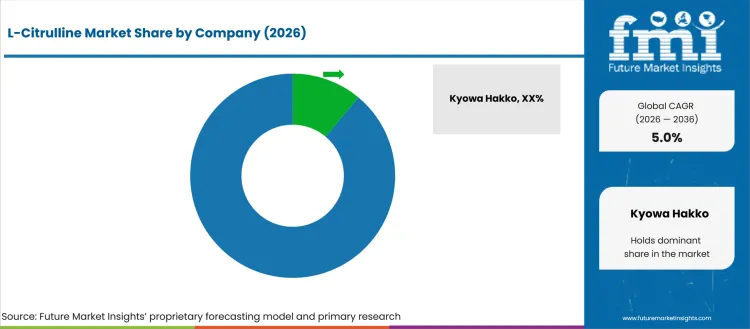
The competitive landscape separates bulk ingredient manufacturing from finished products sold through direct and specialist channels. Plumino represents bulk supply through a current citrulline food offer, while consumer brands compete through dosage format and access. NOW Foods and BulkSupplements.com offer more than one dosage format across current consumer portfolios, whereas several specialist brands concentrate on one defined form. Competition in functional food ingredients depends on specification reliability and clear serving information. Brands strengthen differentiation through verified testing and practical format choices rather than repeated performance language.
- Plumino Precision Fermentation lists citrulline in its food portfolio and reports three production sites with five sales companies. Consistent specification control determines whether commercial customers qualify the ingredient and continue repeat bulk orders across several regions. Regional technical contacts can also support documentation requests from food and nutrition manufacturers during product qualification.
- NOW Foods sells L-citrulline powder and capsules through direct sales and named international distributors across several national channels. Its current portfolio also includes a tablet format available through store and online purchasing routes in the United States. BulkSupplements.com and Nutricost address capsule and powder preferences through direct ordering routes that support routine consumer replenishment.
- Jarrow Formulas and Kaged address defined routines through tablets and fermented powder products supported by direct consumer access. Doctor's Best and Swanson Health Products extend powder availability through established direct and specialist supplement channels. Their market roles depend on brand trust and understandable serving instructions that support repeat consumer purchases.
Competitive Benchmarking: L-Citrulline Market
| Company | Ingredient Manufacturing | Finished-Product Breadth | Channel Integration | Geographic Reach |
|---|---|---|---|---|
| Plumino Precision Fermentation | High | Low | Low | International ingredient operations |
| NOW Foods | Low | High | High | United States retail and named international distributors |
| BulkSupplements.com | Low | Medium | Low | Worldwide direct shipping |
| Nutricost | Low | Medium | Low | United States and international direct shipping |
| Jarrow Formulas | Low | Low | Low | United States direct sales |
| Kaged | Low | Low | Low | United States online availability |
| Doctor's Best | Low | Low | Low | United States online availability |
| Swanson Health Products | Low | Low | Low | United States online availability |
Key Developments in the L-Citrulline Market
- In January 2026, Jingjing Pharmaceutical reported that export volumes for L-citrulline and related performance ingredients continued to rise across its international amino-acid business. The company connected this activity with synthetic-biology production capabilities and multiple quality certifications used across international accounts. The update confirms active commercial supply instead of proposed capacity and gives formulators another documented source for applications requiring consistent records during qualification and repeat production.
- In July 2025, Kaged launched Pre-Workout Max with fermented L-citrulline in a formula designed around absorption and higher-intensity training. The release extended the ingredient from a standalone powder into a multi-ingredient product with a defined digital sales route. The launch gives performance consumers another disclosed serving option and broadens demand for qualified fermented material across established online channels and repeat subscription purchases.
- In June 2025, NOW Foods expanded its ISO/IEC 17025 accreditation across internal chemical and microbiology laboratories. The accredited chemistry scope reached fourteen methods, while microbiology expanded from six methods to twelve across two laboratory locations. The development strengthens internal identity and safety testing for supplement products sold through retail and international distribution. Retail partners gain clearer assurance that testing operates within a recognized laboratory management system during routine product release.
- In July 2026, GNC launched Beyond Raw LIT OTG V2 as a ready-to-drink pre-workout containing five grams of L-citrulline. The product extended the ingredient from powder preparation into a portable beverage format sold through stores and digital channels. The release creates a new consumption occasion for users who prefer measured servings without mixing and supports wider format competition within performance nutrition.
L-Citrulline Market - Report Scope
| Coverage field | Report scope |
|---|---|
| Market breakdown | Application, form, grade, distribution channel, and region |
| Quantitative Units | Reenue in USD Million adn CAGR in %. |
| Market Definition | L-citrulline ingredients and finished supplement products used across sports nutrition, bodybuilding, functional food, clinical nutrition, and wellness applications. |
| Regions Covered | North America, Latin America, Western Europe, Eastern Europe, East Asia, South Asia & Pacific, and Middle East & Africa. |
| Countries Covered | China, United States, Japan, South Korea, Germany, and United Kingdom. |
| Key Companies Profiled | Plumino Precision Fermentation, NOW Foods, BulkSupplements.com, Nutricost, Jarrow Formulas, Kaged, Doctor's Best, and Swanson Health Products. |
| Forecast Period | 2026 to 2036. |
| Approach | Hybrid bottom-up and top-down market sizing supported by primary interviews and official desk research. |
L-Citrulline Market - Research Methodology
| Method | Approach |
|---|---|
| Primary Research | FMI analysts gathered input from manufacturers, service providers, technology developers, distributors, end users, procurement teams, and subject-matter experts. Interviews examined purchasing decisions, product or service evaluation, adoption barriers, approval requirements, pricing considerations, and expectations for technical or commercial support. Respondents were also asked what evidence is required before a trial, pilot, or initial order develops into regular purchasing. |
| Desk Research | Desk research covered government statistics, regulatory publications, trade data, industry associations, technical literature, standards, company filings, product information, and official corporate announcements. Sources were reviewed for relevance, publication date, geographic coverage, and consistency with the defined market scope. Claims relating to performance, applications, approvals, capacity, investment, and commercial activity were retained only when supported by credible public evidence. |
| Market Sizing and Forecasting | The market model combined the baseline value with historical performance, segment structure, pricing and volume indicators, adoption levels, company participation, and country-level demand conditions. Forecast assumptions considered economic activity, investment trends, regulatory developments, technology adoption, purchasing cycles, supply availability, and barriers to wider market use. Segment and regional estimates were reconciled before the final market total was calculated. |
| Data Validation | Estimates were checked against multiple independent indicators, including public data, company activity, trade patterns, industry developments, and findings from primary interviews. Validation also tested whether products, services, applications, and company revenues fell within the defined market boundaries. Adjacent categories, unsupported claims, overlapping revenues, and activities without direct market relevance were excluded to reduce double counting and maintain consistency across segments and countries. |
L-Citrulline Market by Segments
L-Citrulline Market segmented by Application:
- Sports Nutrition & Bodybuilding
- Clinical & Medical Nutrition
- Functional Food
- Cosmetics
L-Citrulline Market segmented by Form:
- Capsules
- Powder
- Tablets
- Liquid
L-Citrulline Market segmented by Grade:
- Food-grade
- Pharmaceutical-grade
L-Citrulline Market segmented by Distribution Channel:
- Supermarkets & Hypermarkets
- Online
- Specialty & Health Stores
- Pharmacies
L-Citrulline Market by Region:
- North America
- United States
- Canada
- Latin America
- Brazil
- Mexico
- Rest of Latin America
- Western Europe
- Germany
- United Kingdom
- France
- Italy
- Spain
- Rest of Western Europe
- Eastern Europe
- Poland
- Russia
- Rest of Eastern Europe
- East Asia
- China
- Japan
- South Korea
- South Asia & Pacific
- India
- Australia & New Zealand
- ASEAN
- Rest of South Asia & Pacific
- Middle East & Africa
- GCC Countries
- South Africa
- Rest of Middle East & Africa
Research Sources and Bibliography
- GNC. (2025, September 12). GNC Supercharges Beyond Raw Line-up with New Formula and Flavors.
- GNC. (2026, May 28). GNC Unleashes Beyond Raw’s Next-Generation Advanced Pre-Workout.
- Nutrabolt. (2025, May 6). C4 unveils C4 AlphaBomb: The pre-workout for next-level performance.
- NNB Nutrition. (2025, September 12). NNB Nutrition Advances Ingredient Innovation with Non-Hygroscopic L-Citrulline.
- Jingjing Pharmaceutical Co., Ltd. (2025, December 24). Jingjing Pharmaceutical Co., Ltd. Annual Production of 25,000 Tons of Amino Acid Food Additives Construction Project - First Information Publicity on Environmental Impact Assessment.
- Bucked Up. (2026, March 31). Best Pre Workout Options at Walmart for Beginners.
- GNC. (2025, June 12). GNC Expands Beyond Raw Line-up with First-Ever Flavor & Color Changing Pre-Workout.
- USA Food and Drug Administration. (2025, June 11). FDA Releases Educational Materials on the New Dietary Ingredient Notification Process for Dietary Supplements.
- USA Food and Drug Administration. (2025, December 11). Letter to the Dietary Supplement Industry on the DSHEA Disclaimer.
- Plumino Precision Fermentation Holdings Pte. Ltd. (2025, July 1). Plumino Group Completes its Acquisition of Kyowa Hakko Bio's amino acid and HMO businesses.
- Plumino Precision Fermentation Holdings Pte. Ltd. (n.d.). Products Overview. Retrieved July 26, 2026.
- Plumino Precision Fermentation Holdings Pte. Ltd. (n.d.). Who We Are?
- State Administration for Market Regulation. (2025, June 21).
- Consumer Affairs Agency. (2025, October 1).
- Ministry of Food and Drug Safety. (2025, March 5).
- Bundesamt für Verbraucherschutz und Lebensmittelsicherheit. (2025, January 15). Keine Zulassung von Nahrungsergänzungsmitteln notwendig.
- Food Standards Agency. (2026, June 25). Food supplements guidance.
- Jingjing Pharmaceutical Co., Ltd. (2026, January 14). Technology empowers health! After 20 years of dedicated effort, Jingjing Pharmaceutical has been delivering high-quality ingredients to the world.
- Kaged. (2025, July 14). Meet Pre-Workout Max: The High-Absorption Pre-Workout.
- NOW Foods. (2025, June 23). NOW ISO 17025 Accreditation Expanded in Both Chemical and Biological Scopes.
- GNC. (2026, July 9). GNC Debuts Beyond Raw’s Latest Advancement in On-the-Go Performance Energy.
- NOW Foods. (n.d.). Citrulline. Retrieved July 26, 2026.
- NOW Foods. (n.d.). International distributors. Retrieved July 26, 2026.
- BulkSupplements.com. (n.d.). L-Citrulline Capsules. Retrieved July 26, 2026.
- BulkSupplements.com. (n.d.). L-Citrulline Powder. Retrieved July 26, 2026.
- Nutricost. (n.d.). Nutricost L-Citrulline Capsules. Retrieved July 26, 2026.
- Nutricost. (n.d.). Nutricost L-Citrulline (Base) Powder. Retrieved July 26, 2026.
- Jarrow Formulas. (n.d.). Arginine-Citrulline Sustain™, 120 Tablets. Retrieved July 26, 2026.
- Kaged. (n.d.). Fermented L-Citrulline Powder - Pure Nitric Oxide Booster. Retrieved July 26, 2026.
- Doctor’s Best. (n.d.). Doctor's Best L-Citrulline Powder, 7 oz (200 g). Retrieved July 26, 2026.
- Swanson Health Products, Inc. (n.d.). L-Citrulline Malate Complex Powder. Retrieved July 26, 2026.
This bibliography is provided for reader reference and is not exhaustive. The full report contains the complete reference list and detailed citations
This Report Answers
- How large is the L-citrulline market in 2026 and what valuation is projected for 2036?
- Which commercial conditions support growth between 2026 and 2036?
- Why does sports nutrition & bodybuilding account for the largest application share in 2026?
- How do capsules support measured dosing and routine consumer replenishment?
- Why does food-grade L-citrulline represent the largest grade share in 2026?
- How do supermarkets & hypermarkets compare with online and specialist channels?
- How do country CAGRs differ across China, the United States, Japan, South Korea, Germany and the United Kingdom?
- Which companies manufacture ingredients or sell finished L-citrulline products?
- What quality and regulatory factors influence product launches and retail acceptance?
Frequently Asked Questions
How big is the L-Citrulline Market in 2026?
The L-citrulline market is valued at USD 1653.8 million in 2026 and is forecast to reach USD 2693.9 million by 2036. Growth is supported by repeat purchasing across sports nutrition products that sustains recurring demand through familiar training routines and transparent serving instructions.
What is the CAGR of the L-Citrulline Market from 2026 to 2036?
The L-citrulline market grows at a CAGR of 5.0% between 2026 and 2036, supported by established training routines that create recurring purchase occasions for formulas carrying transparent L-citrulline serving levels across sports nutrition, functional food, and clinical nutrition applications.
Which application leads the L-Citrulline Market?
Sports nutrition & bodybuilding accounts for 45.8% of the L-citrulline market by application in 2026, driven by repeated use across pre-workout and endurance formulas that carry clearly disclosed serving levels and consistent flavor performance for regular replenishment.
How much will the L-Citrulline Market add between 2026 and 2036?
The L-citrulline market is set to add USD 1,040.1 million between 2026 and 2036, growing from USD 1653.8 million to USD 2693.9 million as sports nutrition formulas and functional food applications expand across established retail and digital replenishment channels.
Who are the leading companies in the L-Citrulline Market?
Eight companies lead the L-citrulline market, including Plumino Precision Fermentation, NOW Foods, BulkSupplements.com, Nutricost, Jarrow Formulas, Kaged, Doctor's Best, and Swanson Health Products, competing through fermentation supply, finished-product breadth, and channel integration across sports and wellness segments.
Preview the report firsthand - request a free sample
Get SampleGet the brochure for pricing and purchase details.
Get PDFTable of Content
- Key Takeaways
- Market Size and CAGR
- Top Growth Driver
- Fastest Growing Segment
- Leading Region
- Key Companies
- Emerging Opportunities
- Executive Summary
- Global Market Outlook
- Demand-side Trends
- Supply-side Trends
- Technology Roadmap Analysis
- Analysis and Recommendations
- Analyst Perspective (What is happening? Why now? What should investors know?)
- Key Questions Answered
- How large is the market?
- What is the CAGR?
- What are key trends?
- Which region dominates?
- Who are the leaders?
- Market Overview
- Market Coverage / Taxonomy
- Market Definition / Scope / Limitations
- Research Methodology
- Chapter Orientation
- Analytical Lens and Working Hypotheses
- Market Structure, Signals, and Trend Drivers
- Benchmarking and Cross-market Comparability
- Market Sizing, Forecasting, and Opportunity Mapping
- Research Design and Evidence Framework
- Desk Research Programme (Secondary Evidence)
- Expert Input and Fieldwork (Primary Evidence)
- Tooling, Models, and Reference Databases
- Data Engineering and Model Build
- Quality Assurance and Audit Trail
- Market Background
- Market Dynamics (Drivers, Restraints, Opportunity, Trends)
- Scenario Forecast (Optimistic, Likely, Conservative)
- Impact Analysis
- AI Impact
- Sustainability Impact
- Regulatory Impact
- Technology Impact
- Consumer / Buyer Analysis
- Purchase Drivers
- Adoption Barriers
- Buyer Journey
- Opportunity Map Analysis
- Product Life Cycle Analysis
- Supply Chain Analysis
- Investment Feasibility Matrix
- Value Chain Analysis
- PESTLE and Porter's Analysis
- Regulatory Landscape
- Regional Parent Market Outlook
- Production and Consumption Statistics
- Import and Export Statistics
- Global Market Analysis and Forecast, 2021 to 2036
- Historical Market Size Value (USD Million) Analysis, 2021 to 2025
- Current and Future Market Size Value (USD Million) Projections, 2026 to 2036
- Y-o-Y Growth Trend Analysis
- Absolute $ Opportunity Analysis
- Global Market Pricing Analysis, 2021 to 2036
- Global Market Analysis and Forecast, By Application, 2021 to 2036
- Introduction / Key Findings
- Historical Market Size Value (USD Million) Analysis By Application, 2021 to 2025
- Current and Future Market Size Value (USD Million) Analysis and Forecast By Application, 2026 to 2036
- Sports Nutrition & Bodybuilding
- Clinical & Medical Nutrition
- Functional Food
- Cosmetics
- Sports Nutrition & Bodybuilding
- Y-o-Y Growth Trend Analysis By Application, 2021 to 2025
- Absolute $ Opportunity Analysis By Application, 2026 to 2036
- Global Market Analysis and Forecast, By Form, 2021 to 2036
- Introduction / Key Findings
- Historical Market Size Value (USD Million) Analysis By Form, 2021 to 2025
- Current and Future Market Size Value (USD Million) Analysis and Forecast By Form, 2026 to 2036
- Capsules
- Powder
- Tablets
- Liquid
- Capsules
- Y-o-Y Growth Trend Analysis By Form, 2021 to 2025
- Absolute $ Opportunity Analysis By Form, 2026 to 2036
- Global Market Analysis and Forecast, By Grade, 2021 to 2036
- Introduction / Key Findings
- Historical Market Size Value (USD Million) Analysis By Grade, 2021 to 2025
- Current and Future Market Size Value (USD Million) Analysis and Forecast By Grade, 2026 to 2036
- Food-grade
- Pharmaceutical-grade
- Food-grade
- Y-o-Y Growth Trend Analysis By Grade, 2021 to 2025
- Absolute $ Opportunity Analysis By Grade, 2026 to 2036
- Global Market Analysis and Forecast, By Distribution Channel, 2021 to 2036
- Introduction / Key Findings
- Historical Market Size Value (USD Million) Analysis By Distribution Channel, 2021 to 2025
- Current and Future Market Size Value (USD Million) Analysis and Forecast By Distribution Channel, 2026 to 2036
- Supermarkets & Hypermarkets
- Online
- Specialty & Health Stores
- Pharmacies
- Supermarkets & Hypermarkets
- Y-o-Y Growth Trend Analysis By Distribution Channel, 2021 to 2025
- Absolute $ Opportunity Analysis By Distribution Channel, 2026 to 2036
- Global Market Analysis and Forecast, By Region, 2021 to 2036
- Introduction
- Historical Market Size Value (USD Million) Analysis By Region, 2021 to 2025
- Current Market Size Value (USD Million) Analysis and Forecast By Region, 2026 to 2036
- North America
- Latin America
- Western Europe
- Eastern Europe
- East Asia
- South Asia and Pacific
- Middle East & Africa
- Market Attractiveness Analysis By Region
- North America Market Analysis and Forecast, By Country, 2021 to 2036
- Historical Market Size Value (USD Million) Trend Analysis By Market Taxonomy, 2021 to 2025
- Market Size Value (USD Million) Forecast By Market Taxonomy, 2026 to 2036
- By Country
- USA
- Canada
- By Application
- By Form
- By Grade
- By Distribution Channel
- By Country
- Market Attractiveness Analysis
- By Country
- By Application
- By Form
- By Grade
- By Distribution Channel
- Key Takeaways
- Latin America Market Analysis and Forecast, By Country
- Historical Market Size Value (USD Million) Trend Analysis By Market Taxonomy, 2021 to 2025
- Market Size Value (USD Million) Forecast By Market Taxonomy, 2026 to 2036
- By Country
- Brazil
- Mexico
- Chile
- Rest of Latin America
- By Application
- By Form
- By Grade
- By Distribution Channel
- By Country
- Market Attractiveness Analysis
- By Country
- By Application
- By Form
- By Grade
- By Distribution Channel
- Key Takeaways
- Western Europe Market Analysis and Forecast, By Country
- Historical Market Size Value (USD Million) Trend Analysis By Market Taxonomy, 2021 to 2025
- Market Size Value (USD Million) Forecast By Market Taxonomy, 2026 to 2036
- By Country
- Germany
- UK
- Italy
- Spain
- France
- Nordic
- BENELUX
- Rest of Western Europe
- By Application
- By Form
- By Grade
- By Distribution Channel
- By Country
- Market Attractiveness Analysis
- By Country
- By Application
- By Form
- By Grade
- By Distribution Channel
- Key Takeaways
- Eastern Europe Market Analysis and Forecast, By Country
- Historical Market Size Value (USD Million) Trend Analysis By Market Taxonomy, 2021 to 2025
- Market Size Value (USD Million) Forecast By Market Taxonomy, 2026 to 2036
- By Country
- Russia
- Poland
- Hungary
- Balkan & Baltic
- Rest of Eastern Europe
- By Application
- By Form
- By Grade
- By Distribution Channel
- By Country
- Market Attractiveness Analysis
- By Country
- By Application
- By Form
- By Grade
- By Distribution Channel
- Key Takeaways
- East Asia Market Analysis and Forecast, By Country
- Historical Market Size Value (USD Million) Trend Analysis By Market Taxonomy, 2021 to 2025
- Market Size Value (USD Million) Forecast By Market Taxonomy, 2026 to 2036
- By Country
- China
- Japan
- South Korea
- By Application
- By Form
- By Grade
- By Distribution Channel
- By Country
- Market Attractiveness Analysis
- By Country
- By Application
- By Form
- By Grade
- By Distribution Channel
- Key Takeaways
- South Asia and Pacific Market Analysis and Forecast, By Country
- Historical Market Size Value (USD Million) Trend Analysis By Market Taxonomy, 2021 to 2025
- Market Size Value (USD Million) Forecast By Market Taxonomy, 2026 to 2036
- By Country
- India
- ASEAN
- Australia & New Zealand
- Rest of South Asia and Pacific
- By Application
- By Form
- By Grade
- By Distribution Channel
- By Country
- Market Attractiveness Analysis
- By Country
- By Application
- By Form
- By Grade
- By Distribution Channel
- Key Takeaways
- Middle East & Africa Market Analysis and Forecast, By Country
- Historical Market Size Value (USD Million) Trend Analysis By Market Taxonomy, 2021 to 2025
- Market Size Value (USD Million) Forecast By Market Taxonomy, 2026 to 2036
- By Country
- Kingdom of Saudi Arabia
- Other GCC Countries
- Türkiye
- South Africa
- Other African Union
- Rest of Middle East & Africa
- By Application
- By Form
- By Grade
- By Distribution Channel
- By Country
- Market Attractiveness Analysis
- By Country
- By Application
- By Form
- By Grade
- By Distribution Channel
- Key Takeaways
- Key Countries Market Analysis
- USA
- Pricing Analysis
- Market Share Analysis, 2025
- By Application
- By Form
- By Grade
- By Distribution Channel
- Canada
- Pricing Analysis
- Market Share Analysis, 2025
- By Application
- By Form
- By Grade
- By Distribution Channel
- Mexico
- Pricing Analysis
- Market Share Analysis, 2025
- By Application
- By Form
- By Grade
- By Distribution Channel
- Brazil
- Pricing Analysis
- Market Share Analysis, 2025
- By Application
- By Form
- By Grade
- By Distribution Channel
- Chile
- Pricing Analysis
- Market Share Analysis, 2025
- By Application
- By Form
- By Grade
- By Distribution Channel
- Germany
- Pricing Analysis
- Market Share Analysis, 2025
- By Application
- By Form
- By Grade
- By Distribution Channel
- UK
- Pricing Analysis
- Market Share Analysis, 2025
- By Application
- By Form
- By Grade
- By Distribution Channel
- Italy
- Pricing Analysis
- Market Share Analysis, 2025
- By Application
- By Form
- By Grade
- By Distribution Channel
- Spain
- Pricing Analysis
- Market Share Analysis, 2025
- By Application
- By Form
- By Grade
- By Distribution Channel
- France
- Pricing Analysis
- Market Share Analysis, 2025
- By Application
- By Form
- By Grade
- By Distribution Channel
- India
- Pricing Analysis
- Market Share Analysis, 2025
- By Application
- By Form
- By Grade
- By Distribution Channel
- ASEAN
- Pricing Analysis
- Market Share Analysis, 2025
- By Application
- By Form
- By Grade
- By Distribution Channel
- Australia & New Zealand
- Pricing Analysis
- Market Share Analysis, 2025
- By Application
- By Form
- By Grade
- By Distribution Channel
- China
- Pricing Analysis
- Market Share Analysis, 2025
- By Application
- By Form
- By Grade
- By Distribution Channel
- Japan
- Pricing Analysis
- Market Share Analysis, 2025
- By Application
- By Form
- By Grade
- By Distribution Channel
- South Korea
- Pricing Analysis
- Market Share Analysis, 2025
- By Application
- By Form
- By Grade
- By Distribution Channel
- Russia
- Pricing Analysis
- Market Share Analysis, 2025
- By Application
- By Form
- By Grade
- By Distribution Channel
- Poland
- Pricing Analysis
- Market Share Analysis, 2025
- By Application
- By Form
- By Grade
- By Distribution Channel
- Hungary
- Pricing Analysis
- Market Share Analysis, 2025
- By Application
- By Form
- By Grade
- By Distribution Channel
- Kingdom of Saudi Arabia
- Pricing Analysis
- Market Share Analysis, 2025
- By Application
- By Form
- By Grade
- By Distribution Channel
- Türkiye
- Pricing Analysis
- Market Share Analysis, 2025
- By Application
- By Form
- By Grade
- By Distribution Channel
- South Africa
- Pricing Analysis
- Market Share Analysis, 2025
- By Application
- By Form
- By Grade
- By Distribution Channel
- USA
- Market Structure Analysis
- Competition Dashboard
- Competition Benchmarking
- Market Share Analysis of Top Players
- By Regional
- By Application
- By Form
- By Grade
- By Distribution Channel
- Emerging Startups
- Innovation Benchmarking
- Competition Analysis
- Competition Deep Dive
- Kyowa Hakko
- Overview
- Product Portfolio
- Profitability by Market Segments
- Sales Footprint
- Strategy Overview
- Marketing Strategy
- Product Strategy
- Channel Strategy
- CJ CheilJedang
- Zhejiang NHU
- Nutra Green Biotech
- NOW Foods
- Jarrow Formulas
- Glanbia
- Doctor's Best
- Kyowa Hakko
- Case Studies
- Success Stories
- Recent Developments
- Competition Deep Dive
- Assumptions & Acronyms Used


