

- Market Size (2026)
- USD 202.1 Mn
- Forecast (2036)
- USD 638.9 Mn
- CAGR (2026 to 2036)
- 12.2%
How Big is the Lactation Hydration Beverage Market in 2026?
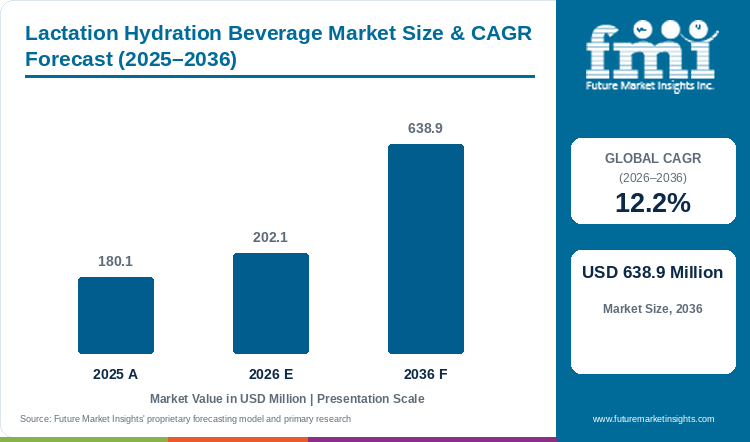
Sales of lactation hydration beverages will expand at a 12.2% CAGR between 2026 and 2036. Market value is estimated at USD 202.1 Million in 2026, up from USD 180.1 Million in 2025, and will reach USD 638.9 Million by 2036.
Growth of the lactation hydration beverage market will add USD 436.8 Million between 2026 and 2036, and nearby maternal and hydration categories will open further sales routes for the same brands. Sales of hydration supplements will rise from USD 41.8 Billion in 2026 to USD 89.4 Billion by 2036 at a 7.9% CAGR, an opportunity of USD 47.6 Billion, giving lactation brands a wider shelf from which to borrow formats and flavors. Demand for lactation support supplements will grow from USD 1.7 Billion in 2025 to USD 3.1 Billion by 2035 at a 6.0% CAGR, adding USD 1.4 Billion from the same mothers who are already buying capsules and powders. Adoption of herbal tea will move from USD 4.2 Billion in 2026 to USD 5.8 Billion by 2036 at a 3.3% CAGR, adding USD 1.6 Billion, with lactation teas sitting at the overlap between the two categories.
Per-birth spend will rise to about USD 1.5 in 2026 as the lactation hydration beverage market grows to USD 202.1 Million, up from USD 180.1 Million in 2025, as per FMI. A low per-birth figure on a large birth base shows that the category is still at an early stage outside a few core markets, and brands will have wide room to grow by converting new mothers into regular buyers.
CDC data show that 85.7% of infants born in 2022 in the USA were ever breastfed and 62.1% were still breastfed at six months [1], which points to a repeat purchase that lasts for months. Nursing and pumping mothers are drinking extra fluid several times a day across that period, and portable mixes are turning the daily routine into recurring orders. Maternal-specific labels will also give brands a price premium over plain water or electrolyte drinks.
As per FMI's analysis, lactation hydration beverages will outgrow all three adjacent categories by selling a daily-use format to a narrow, high-need buyer group. Brands pairing clear electrolyte content with low sugar will lift per-birth spend fastest, and online subscriptions will keep mothers buying across the full breastfeeding period.
Key Takeaways
- Lactation electrolyte powders will hold 47.1% market share among product types in 2026.
- By form, FMI finds that stick packs & powders will account for 48.5% of market share in 2026, and online / DTC will take 41.9% of sales channel revenue.
- Key companies operating in lactation hydration beverages include Legendairy Milk, Boobie Superfoods, Earth Mama Organics, UpSpring, Milky Mama, Traditional Medicinals, Pink Stork, and Oat Mama, and the full FMI report covers many more players.
- By country, South Korea grows fastest at 12.5%, and Japan slowest at 10.5%.
Analyst Perspective
“Brands selling simple, low-sugar electrolyte mixes with honest labels will keep mothers buying through the full breastfeeding period, and brands promising more milk from a drink will lose trust first.”
- Nandini Roy Choudhury, Principal Consultant, Future Market Insights
How is the Lactation Hydration Beverage Market Segmented?
According to FMI, the lactation hydration beverage market is segmented by product type, key ingredient, sweetener profile, form, sales channel, and region.
The report segments the market by product type, key ingredient, sweetener profile, form, and sales channel. Lactation electrolyte powders, coconut water & electrolytes, sugar-free, stick packs & powders, and online / DTC lead each category in 2026. The regional study includes seven regions and over 30 countries.
Why Do Lactation Electrolyte Powders Lead the Lactation Hydration Beverage Market by Product Type?
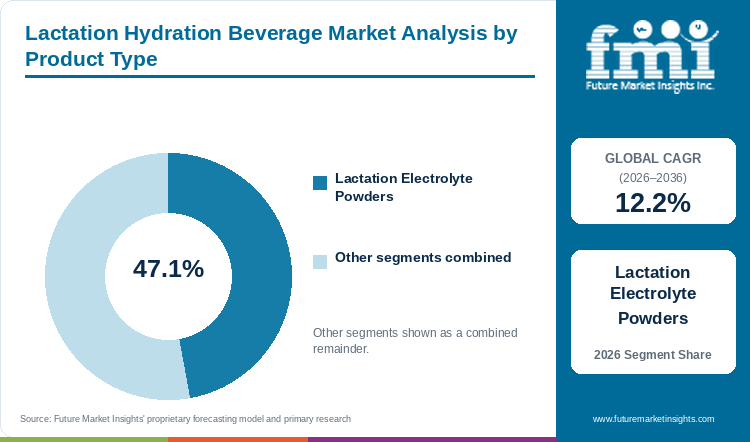
FMI finds that lactation electrolyte powders will account for 47.1% of product type revenue in 2026.
Demand for lactation electrolyte powders will remain the highest by product type, as per FMI. A mother mixes one serving beside a pump or at a desk, with no bottles to store or carry. Key challenges in the powder segment include crowded shelves next to cheaper general electrolyte mixes.
- Lactation electrolyte powders will hold 47.1% of product type revenue in 2026, backed by portability and repeat use.
- In September 2026, UpSpring listed five Milkflow drink mixes, including electrolyte and fenugreek-free formulas [2].
Why Do Coconut Water & Electrolytes Lead the Lactation Hydration Beverage Market by Key Ingredient?
At 50.6%, coconut water & electrolytes will account for the highest market share by key ingredient.
Coconut water gives shoppers a familiar hydration cue and lets brands build formulas around sodium, potassium and magnesium. Legendairy Milk's She's Thirsty lists 150 mg of sodium, 400 mg of potassium and 70 mg of magnesium per stick pack, with no added sugar [3].
- Coconut water & electrolytes will represent 50.6% of key ingredient revenue in 2026, as the pairing makes hydration visible on pack.
- In September 2026, Earth Mama Organics listed LactaHYDRATE, a certified organic coconut water electrolyte mix sold in 15 stick packs and made without fenugreek [4].
Why Does Sugar-Free Lead the Lactation Hydration Beverage Market by Sweetener Profile?
Sugar-free formulas will hold 47.0% of sweetener profile revenue in 2026.
Daily use over many months makes sugar load a bigger concern than in a one-time treat. Germany's Federal Centre for Nutrition advises nursing mothers to drink plenty, ideally water with a glass at each feed, and lists unsweetened herbal or fruit tea as suitable [5]. Sweeteners such as stevia and monk fruit let brands keep flavor without added sugar. Regular formulas compete on taste.
- Sugar-free will account for 47.0% of sweetener profile revenue in 2026, as repeat buyers cut added sugar.
- In September 2026, Milky Mama listed reformulated Lactation LeMOOnade stick packs with 5 g of sugar per serving [6].
Why Do Stick Packs & Powders Lead the Lactation Hydration Beverage Market by Form?
At 48.5%, stick packs & powders will account for the highest market share by form.
Stick packs & powders turn a drink into one light, measured unit. Single-serve stick packaging fixes the dose, lowers shipping weight and fits a diaper bag. Boobie Superfoods sells Hydromom in 15-serving bags of stick packs made with organic coconut water [7]. Packaging economics will keep the format ahead through 2036.
- Stick packs & powders will lead with 48.5% of form revenue in 2026, owing to ease of carrying.
- In September 2026, Legendairy Milk directed buyers to mix one She's Thirsty stick pack in 16 fl oz of water, a fixed dose for every serving [3].
Why Does Online / DTC Lead the Lactation Hydration Beverage Market by Sales Channel?
Online / DTC will account for 41.9% of sales channel revenue in 2026.
Online / DTC gives niche maternal brands space to describe ingredients before the first order. Subscriptions then lock in replenishment across the breastfeeding period. Legendairy Milk offers She's Thirsty on one-, three- and six-month plans with savings of up to 20% [3]. Mass retail is catching up as DTC brands add store shelves for first trial.
- Online / DTC will hold 41.9% of sales channel revenue in 2026, backed by subscription replenishment.
- In September 2026, Pink Stork priced the organic Smooth Vanilla lactation tea at USD 18, or USD 14 on a 15-day subscription [8].
What are the Drivers, Restraints, and Opportunities in the Lactation Hydration Beverage Market?
As per FMI's analysis, long breastfeeding routines will drive sales, weak evidence for galactagogue herbs will slow trust, and low-sugar electrolyte mixes in mass retail will open a wider revenue pool till 2036.
- Driver: Months of breastfeeding and pumping create daily hydration occasions that favor portable, repeat-purchase formats.
- Restraint: Weak evidence for common galactagogue herbs raises the claim burden and slows trust among cautious buyers.
- Opportunity: Key drivers of the next sales phase include sugar-free electrolyte mixes moving from DTC sites onto grocery and pharmacy shelves.
LactMed's July 2026 review of fenugreek cites one meta-analysis showing a mild galactagogue effect and another finding no good evidence of efficacy [9]. LactMed adds that galactagogues should never replace evaluation and counseling on factors affecting milk production [9]. As a result, lactation hydration beverages will compete on convenience and electrolyte content, not on milk-supply promises. Brands with clear labels and fenugreek-free options will gain repeat buyers during the forecast period.
Which Country CAGRs are Profiled in the Lactation Hydration Beverage Market?
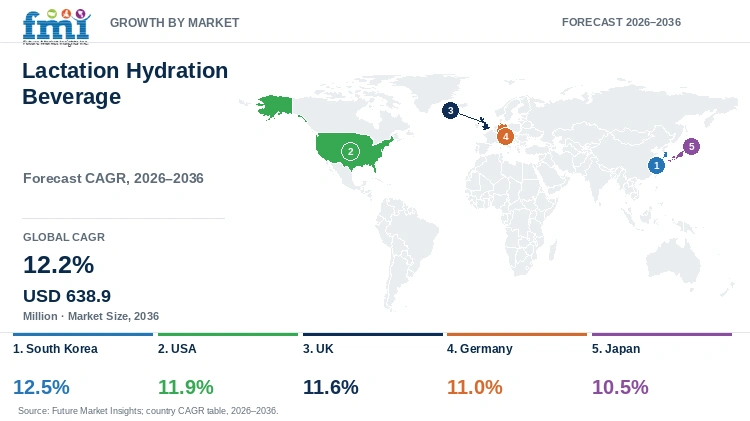
| Country | CAGR, 2026 to 2036 |
|---|---|
| South Korea | 12.5% |
| USA | 11.9% |
| UK | 11.6% |
| Germany | 11.0% |
| Japan | 10.5% |
How do Country-level CAGRs Compare in the Lactation Hydration Beverage Market?
As per FMI's analysis, growth rates in the lactation hydration beverage market will vary by 2.0 percentage points across profiled countries through 2036. South Korea will lead at a 12.5% CAGR, and Japan will record the slowest rate at 10.5%. The USA at 11.9% and the UK at 11.6% form a close middle band, with Germany next at 11.0%.
- Sales in South Korea will record the highest CAGR, helped by postpartum care centres that concentrate product education [10].
- Demand in the USA will gain from long breastfeeding duration and wider mass-retail access.
- Growth in the UK runs 0.3 points below the USA, with a sharp drop from initiation to six-month breastfeeding [11].
- Adoption in Japan will rise slowest, as precise labeling and Japanese-language education slow first purchase.
Beyond the profiled countries, the full FMI report analyzes CAGRs across North America, Latin America, Western Europe, Eastern Europe, East Asia, South Asia and Pacific, and the Middle East and Africa. The study includes 30+ countries.
Country Outlook
- Demand for lactation hydration beverages in South Korea will rise at a 12.5% CAGR, the fastest pace among profiled countries. Economist Korea reported in December 2025 that 85.5% of mothers used postpartum care centres in the 2024 government survey [10]. A two-week stay in Seoul averaged about KRW 4.9 million in 2025 [10]. Families paying that premium expect evidence behind every maternal claim.
- Sales of lactation hydration beverages in the USA will grow at an 11.9% CAGR till 2036, supported by long feeding windows and mass retail. CDC figures put six-month breastfeeding at 62.1% for infants born in 2022 [1]. Legendairy Milk took a women's health line into more than 1,600 Walmart stores in May 2025 [12]. The brand added She's Thirsty Retro Pop to Target in April 2026 [13].
- Lactation hydration beverage market growth in the UK will hold at an 11.6% CAGR through 2036. The Office for Health Improvement and Disparities reported in June 2026 that 86% of mothers in England started breastfeeding in the 2024 survey [11]. Only 58% were still breastfeeding at six months [11]. The drop shortens the repeat-use window for some households.
- Key trends in the German lactation hydration market point to low-sugar formulas, with growth at an 11.0% CAGR. The Federal Centre for Nutrition advises nursing mothers to drink a glass of water at each feed and to choose low-calorie drinks such as unsweetened tea [5]. Premium mixes will justify cost against plain water through convenience and clear mineral content.
- Adoption potential of lactation hydration beverages in Japan supports a 10.5% CAGR, the slowest among profiled countries. METI reported in August 2025 that Japan's B2C e-commerce market reached JPY 26.1 trillion in 2024 [14]. Food, beverages and liquor accounted for JPY 3.1163 trillion of that total [14]. Precise portion labels and Japanese-language education will decide first purchase.
Who are the Notable Companies in the Lactation Hydration Beverage Market?
Key companies in the market include Legendairy Milk, Boobie Superfoods, Earth Mama Organics, UpSpring, Milky Mama, Traditional Medicinals, Pink Stork, and Oat Mama.
Competition among lactation hydration brands centers on format, label clarity and route to market, as per FMI. The report sorts the companies profiled into three strategy groups. Oat Mama launched in 1,700 Target stores in 2025, according to Seattle Met [15]. Traditional Medicinals has sold Mother's Milk tea to nursing mothers for over four decades [16].
- Electrolyte-First Lactation Mixes: Legendairy Milk, Boobie Superfoods, and Earth Mama Organics sell coconut-water electrolyte stick packs built on a direct hydration story.
- Lactation Supplement Brands with Drink Mixes: UpSpring and Milky Mama extend capsule and snack ranges into flavored lactation drink mixes.
- Herbal Lactation Tea Specialists: Traditional Medicinals, Pink Stork, and Oat Mama sell caffeine-free lactation teas tied to a daily ritual.
Competitive Benchmarking
| Company | Lactation Electrolyte Depth | Beverage Format Breadth | Retail and DTC Access | Geographic Reach |
|---|---|---|---|---|
| Legendairy Milk | High | Medium | High | USA, through DTC, Walmart, Target, Sprouts, H-E-B, and Amazon |
| Boobie Superfoods | High | Low | Medium | USA, DTC-led |
| Earth Mama Organics | High | Low | Medium | USA, through DTC and specialty retail |
| UpSpring | High | High | Medium | USA, through DTC and national retail |
| Milky Mama | Low | Medium | Medium | USA, DTC-led |
| Traditional Medicinals | Low | Medium | High | USA, Canada, and grocery and natural food retail |
| Pink Stork | Low | Medium | Medium | USA, DTC-led |
| Oat Mama | Low | High | High | USA, through DTC and Target |
Scoring basis: Lactation Electrolyte Depth scores documented electrolyte or coconut-water content in lactation beverages. Beverage Format Breadth counts the lactation drink mixes, teas or lattes each company documents. Retail and DTC Access scores whether a brand pairs direct ordering with documented store distribution. High marks broad, clearly documented capability. Medium marks credible but narrower documented capability. Low marks limited public documentation for the criterion. Geographic Reach reflects evidenced sales or distribution activity. Each score reflects an FMI review of public company documentation in September 2026.
Key Developments
- In June 2025, Traditional Medicinals moved ahead with a USD 47 million herbal tea plant in Franklin County, Virginia, adding 57 jobs [17].
- In March 2026, Legendairy Milk entered Sprouts Farmers Market stores nationwide with a certified organic lactation and wellness supplement line [18].
- In April 2026, Legendairy Milk widened the Target range with She's Thirsty Retro Pop, an electrolyte hydration blend, in stores and on Target.com [13].
Key Players
Electrolyte-First Lactation Mixes
- Legendairy Milk
- Boobie Superfoods
- Earth Mama Organics
Lactation Supplement Brands with Drink Mixes
- UpSpring
- Milky Mama
Herbal Lactation Tea Specialists
- Traditional Medicinals
- Pink Stork
- Oat Mama
Report Scope and Methodology
| Coverage field | Report scope |
|---|---|
| Market breakdown | 6 categories: Product Type (Lactation Electrolyte Powders, Lactation Teas (Hydration-Focused), RTD Lactation Drinks, Others), Key Ingredient (Coconut Water & Electrolytes, Oat & Galactagogue Blends, Botanical Infusions, Others), Sweetener Profile (Sugar-Free, Low-Sugar, Regular), Form (Stick Packs & Powders, RTD, Tea Bags, Others), Sales Channel (Online / DTC, Retail Pharmacy, Supermarkets & Hypermarkets, Specialty & Health Stores, Others), and Region |
| Quantitative units | USD Million |
| Market definition | Revenue from beverages and beverage-preparation products marketed for lactating, breastfeeding or postpartum mothers with hydration as a principal use benefit. Included formats are electrolyte powders, hydration-focused lactation teas, RTD lactation drinks and other qualifying beverages. The definition excludes general sports drinks, generic coconut water, non-beverage lactation supplements, infant feeding products, pumps and services. |
| Regions covered | North America, Latin America, Western Europe, Eastern Europe, East Asia, South Asia and Pacific, Middle East and Africa |
| Countries covered | 30+ countries, including the USA, UK, Germany, Japan, and South Korea |
| Key companies profiled | A few of the notable companies out of many players covered by FMI: Legendairy Milk, Boobie Superfoods, Earth Mama Organics, UpSpring, Milky Mama, Traditional Medicinals, Pink Stork, and Oat Mama |
| Forecast period | 2026 to 2036 |
| Approach | FMI applies a hybrid bottom-up and top-down sizing framework that reconciles in-scope brand and channel revenue with segment structure, breastfeeding indicators and country demand signals. |
Research Methodology
| Method | Approach |
|---|---|
| Primary research | FMI's primary-research framework engages maternal-wellness brands, distributors, online and store retailers, lactation professionals and category buyers to test purchase triggers, claim limits, pricing and repeat-use conditions. |
| Desk research | The analysis reviews official breastfeeding statistics, national nutrition guidance, drug and lactation reviews, e-commerce data, company announcements and product pages. FMI retains sources that define demand mechanisms, supplier roles, country conditions or product developments inside the market boundary. |
| Market sizing and forecasting | The sizing framework combines the baseline value with segment structure, price and volume indicators, channel mix and country-level breastfeeding demand. Forecasts consider format adoption, retail expansion, low-sugar preference and evidence-related purchase friction. |
| Data validation | Estimates are checked against public data, company activity and interview findings. General electrolytes, non-beverage lactation supplements, infant-feeding products, overlapping revenues and unsupported claims are excluded before final reconciliation. |
Lactation Hydration Beverage Market by Segments
Lactation Hydration Beverage Market Segmented by Product Type
- Lactation Electrolyte Powders
- Lactation Teas (Hydration-Focused)
- RTD Lactation Drinks
- Others
Lactation Hydration Beverage Market Segmented by Key Ingredient
- Coconut Water & Electrolytes
- Oat & Galactagogue Blends
- Botanical Infusions
- Others
Lactation Hydration Beverage Market Segmented by Sweetener Profile
- Sugar-Free
- Low-Sugar
- Regular
Lactation Hydration Beverage Market Segmented by Form
- Stick Packs & Powders
- RTD
- Tea Bags
- Others
Lactation Hydration Beverage Market Segmented by Sales Channel
- Online / DTC
- Retail Pharmacy
- Supermarkets & Hypermarkets
- Specialty & Health Stores
- Others
Lactation Hydration Beverage Market Segmented by Region
- North America
- Latin America
- Western Europe
- Eastern Europe
- East Asia
- South Asia and Pacific
- Middle East and Africa
Research Sources and Bibliography
- [1] Centers for Disease Control and Prevention (2025, July 7). NIS-Child Breastfeeding Rates by State: 2022.
- [2] UpSpring (2026, September). Milkflow Drink Mixes.
- [3] Legendairy Milk (2026, September). She's Thirsty Coconut Water Electrolyte Mix.
- [4] Earth Mama Organics (2026, September). LactaHYDRATE Organic Lactation Electrolyte Drink Mix.
- [5] Bundeszentrum für Ernährung (2026, September 22). Gut essen in der Stillzeit.
- [6] Milky Mama (2026, September). Lactation LeMOOnade.
- [7] Boobie Superfoods (2026, September). Hydromom.
- [8] Pink Stork (2026, September). Lactation Tea, Smooth Vanilla.
- [9] National Institute of Child Health and Human Development (2026, July 15). Fenugreek. Drugs and Lactation Database (LactMed).
- [10] Economist Korea (2025, December 7). The 5 million won for two weeks era, postpartum care center costs soar.
- [11] Office for Health Improvement and Disparities (2026, June 4). Infant feeding survey in England 2024.
- [12] Legendairy Milk (2025, May 12). Legendairy Milk Brings Women's Wellness Supplements to Walmart Aisles Nationwide.
- [13] Legendairy Milk (2026, April 27). Legendairy Milk Expands Women's Health Product Line in Target Stores.
- [14] Ministry of Economy, Trade and Industry, Japan (2025, August 26). Results of FY2024 E-Commerce Market Survey Compiled.
- [15] Seattle Met (2026, January 28). The Rise of Oat Mama.
- [16] Traditional Medicinals (2026, September). Mother's Milk Tea.
- [17] Virginia Business (2025, June 18). Traditional Medicinals moves forward with $47M plant in Franklin County.
- [18] Legendairy Milk (2026, March 18). Legendairy Milk Expands Into Sprouts Farmers Market Nationwide With Certified Organic Supplement Line.
This bibliography is provided for reader reference and is not exhaustive. The full FMI report contains the complete reference list and detailed citations.
This Report Answers
- What is the Lactation Hydration Beverage Market size in 2026, and what value is FMI forecasting for 2036?
- Which breastfeeding and pumping routines will continue to support repeat demand for lactation hydration beverages?
- Why are lactation electrolyte powders expected to hold the leading position within the Product Type category in 2026?
- Why will coconut water & electrolytes and sugar-free formulas lead the Key Ingredient and Sweetener Profile categories?
- How do growth rates differ across South Korea, the USA, the UK, Germany, and Japan till 2036?
- How will mass-retail listings change the route to market for DTC-born lactation brands?
- How should buyers assess the roles and capabilities of the profiled companies?
- How will weak evidence for galactagogue herbs limit claims and conversion?
- What should retail buyers evaluate before listing a lactation hydration beverage?
Frequently Asked Questions
How Big Is the Lactation Hydration Beverage Market Expected to Be in 2026?
Sales of lactation hydration beverages total USD 202.1 Million in 2026, up from USD 180.1 Million in 2025, according to FMI. Revenue reaches USD 638.9 Million by 2036 as mothers buy portable hydration across the breastfeeding period.
What Is the CAGR of the Lactation Hydration Beverage Market from 2026 to 2036?
As per FMI, sales of lactation hydration beverages will grow at a 12.2% CAGR from 2026 to 2036. Repeat purchase sets the pace. Mothers reorder when taste, sugar content and price hold up against plain water.
Which Product Type Holds the Largest Share of the Lactation Hydration Beverage Market?
Lactation electrolyte powders lead with 47.1% of product type revenue in 2026. The format mixes on demand and ships light.
Which Sweetener Profile Leads the Lactation Hydration Beverage Market?
FMI opines that sugar-free formulas will take 47.0% of sweetener profile revenue in 2026. Brands will keep using stevia and monk fruit to hold flavor without added sugar.
Which Country Is Expected to Grow Fastest in the Lactation Hydration Beverage Market?
Growth of lactation hydration sales is fastest in South Korea, at a 12.5% CAGR till 2036. The USA follows at 11.9%. Japan sits last among the five profiled countries at 10.5%.
What Notable Restraint Affects the Lactation Hydration Beverage Market?
Key challenges in the lactation hydration beverage market include weak evidence for galactagogue herbs such as fenugreek, owing to which milk-supply claims carry risk. Cautious buyers and lactation professionals discount products that overpromise. Clear labels and fenugreek-free options add formulation cost.
Which Are the Key Companies in the Lactation Hydration Beverage Market?
Legendairy Milk, Boobie Superfoods, Earth Mama Organics, UpSpring, Milky Mama, Traditional Medicinals, Pink Stork, and Oat Mama rank among the notable companies covered by FMI. The report assigns each company to one of three strategy groups by competitive approach.
Preview the report firsthand - request a free sample
Get SampleGet the brochure for pricing and purchase details.
Get PDFTable of Content
- Key Takeaways
- Market Size and CAGR
- Top Growth Driver
- Fastest Growing Segment
- Leading Region
- Key Companies
- Emerging Opportunities
- Executive Summary
- Global Market Outlook
- Demand-side Trends
- Supply-side Trends
- Technology Roadmap Analysis
- Analysis and Recommendations
- Analyst Perspective (What is happening? Why now? What should investors know?)
- Key Questions Answered
- How large is the market?
- What is the CAGR?
- What are key trends?
- Which region dominates?
- Who are the leaders?
- Market Overview
- Market Coverage / Taxonomy
- Market Definition / Scope / Limitations
- Research Methodology
- Chapter Orientation
- Analytical Lens and Working Hypotheses
- Market Structure, Signals, and Trend Drivers
- Benchmarking and Cross-market Comparability
- Market Sizing, Forecasting, and Opportunity Mapping
- Research Design and Evidence Framework
- Desk Research Programme (Secondary Evidence)
- Expert Input and Fieldwork (Primary Evidence)
- Tooling, Models, and Reference Databases
- Data Engineering and Model Build
- Quality Assurance and Audit Trail
- Market Background
- Market Dynamics (Drivers, Restraints, Opportunity, Trends)
- Scenario Forecast (Optimistic, Likely, Conservative)
- Impact Analysis
- AI Impact
- Sustainability Impact
- Regulatory Impact
- Technology Impact
- Consumer / Buyer Analysis
- Purchase Drivers
- Adoption Barriers
- Buyer Journey
- Opportunity Map Analysis
- Product Life Cycle Analysis
- Supply Chain Analysis
- Investment Feasibility Matrix
- Value Chain Analysis
- PESTLE and Porter's Analysis
- Regulatory Landscape
- Regional Parent Market Outlook
- Production and Consumption Statistics
- Import and Export Statistics
- Global Market Analysis and Forecast, 2021 to 2036
- Historical Market Size Value (USD Million) Analysis, 2021 to 2025
- Current and Future Market Size Value (USD Million) Projections, 2026 to 2036
- Y-o-Y Growth Trend Analysis
- Absolute $ Opportunity Analysis
- Global Market Pricing Analysis, 2021 to 2036
- Global Market Analysis and Forecast, By Product Type, 2021 to 2036
- Introduction / Key Findings
- Historical Market Size Value (USD Million) Analysis By Product Type, 2021 to 2025
- Current and Future Market Size Value (USD Million) Analysis and Forecast By Product Type, 2026 to 2036
- Lactation Electrolyte Powders
- Lactation Teas (Hydration-Focused)
- RTD Lactation Drinks
- Others
- Y-o-Y Growth Trend Analysis By Product Type, 2021 to 2025
- Absolute $ Opportunity Analysis By Product Type, 2026 to 2036
- Global Market Analysis and Forecast, By Key Ingredient, 2021 to 2036
- Introduction / Key Findings
- Historical Market Size Value (USD Million) Analysis By Key Ingredient, 2021 to 2025
- Current and Future Market Size Value (USD Million) Analysis and Forecast By Key Ingredient, 2026 to 2036
- Coconut Water & Electrolytes
- Oat & Galactagogue Blends
- Botanical Infusions
- Others
- Y-o-Y Growth Trend Analysis By Key Ingredient, 2021 to 2025
- Absolute $ Opportunity Analysis By Key Ingredient, 2026 to 2036
- Global Market Analysis and Forecast, By Sweetener Profile, 2021 to 2036
- Introduction / Key Findings
- Historical Market Size Value (USD Million) Analysis By Sweetener Profile, 2021 to 2025
- Current and Future Market Size Value (USD Million) Analysis and Forecast By Sweetener Profile, 2026 to 2036
- Sugar-Free
- Low-Sugar
- Regular
- Y-o-Y Growth Trend Analysis By Sweetener Profile, 2021 to 2025
- Absolute $ Opportunity Analysis By Sweetener Profile, 2026 to 2036
- Global Market Analysis and Forecast, By Form, 2021 to 2036
- Introduction / Key Findings
- Historical Market Size Value (USD Million) Analysis By Form, 2021 to 2025
- Current and Future Market Size Value (USD Million) Analysis and Forecast By Form, 2026 to 2036
- Stick Packs & Powders
- RTD
- Tea Bags
- Others
- Y-o-Y Growth Trend Analysis By Form, 2021 to 2025
- Absolute $ Opportunity Analysis By Form, 2026 to 2036
- Global Market Analysis and Forecast, By Sales Channel, 2021 to 2036
- Introduction / Key Findings
- Historical Market Size Value (USD Million) Analysis By Sales Channel, 2021 to 2025
- Current and Future Market Size Value (USD Million) Analysis and Forecast By Sales Channel, 2026 to 2036
- Online / DTC
- Retail Pharmacy
- Supermarkets & Hypermarkets
- Specialty & Health Stores
- Others
- Y-o-Y Growth Trend Analysis By Sales Channel, 2021 to 2025
- Absolute $ Opportunity Analysis By Sales Channel, 2026 to 2036
- Global Market Analysis and Forecast, By Region, 2021 to 2036
- Introduction
- Historical Market Size Value (USD Million) Analysis By Region, 2021 to 2025
- Current Market Size Value (USD Million) Analysis and Forecast By Region, 2026 to 2036
- North America
- Latin America
- Western Europe
- Eastern Europe
- East Asia
- South Asia and Pacific
- Middle East and Africa
- Market Attractiveness Analysis By Region
- North America Market Analysis and Forecast, By Country, 2021 to 2036
- Historical Market Size Value (USD Million) Trend Analysis By Market Taxonomy, 2021 to 2025
- Market Size Value (USD Million) Forecast By Market Taxonomy, 2026 to 2036
- By Country
- By Product Type
- By Key Ingredient
- By Sweetener Profile
- By Form
- By Sales Channel
- Market Attractiveness Analysis
- By Country
- By Product Type
- By Key Ingredient
- By Sweetener Profile
- By Form
- By Sales Channel
- Key Takeaways
- Latin America Market Analysis and Forecast, By Country
- Historical Market Size Value (USD Million) Trend Analysis By Market Taxonomy, 2021 to 2025
- Market Size Value (USD Million) Forecast By Market Taxonomy, 2026 to 2036
- By Country
- By Product Type
- By Key Ingredient
- By Sweetener Profile
- By Form
- By Sales Channel
- Market Attractiveness Analysis
- By Country
- By Product Type
- By Key Ingredient
- By Sweetener Profile
- By Form
- By Sales Channel
- Key Takeaways
- Western Europe Market Analysis and Forecast, By Country
- Historical Market Size Value (USD Million) Trend Analysis By Market Taxonomy, 2021 to 2025
- Market Size Value (USD Million) Forecast By Market Taxonomy, 2026 to 2036
- By Country
- By Product Type
- By Key Ingredient
- By Sweetener Profile
- By Form
- By Sales Channel
- Market Attractiveness Analysis
- By Country
- By Product Type
- By Key Ingredient
- By Sweetener Profile
- By Form
- By Sales Channel
- Key Takeaways
- Eastern Europe Market Analysis and Forecast, By Country
- Historical Market Size Value (USD Million) Trend Analysis By Market Taxonomy, 2021 to 2025
- Market Size Value (USD Million) Forecast By Market Taxonomy, 2026 to 2036
- By Country
- By Product Type
- By Key Ingredient
- By Sweetener Profile
- By Form
- By Sales Channel
- Market Attractiveness Analysis
- By Country
- By Product Type
- By Key Ingredient
- By Sweetener Profile
- By Form
- By Sales Channel
- Key Takeaways
- East Asia Market Analysis and Forecast, By Country
- Historical Market Size Value (USD Million) Trend Analysis By Market Taxonomy, 2021 to 2025
- Market Size Value (USD Million) Forecast By Market Taxonomy, 2026 to 2036
- By Country
- By Product Type
- By Key Ingredient
- By Sweetener Profile
- By Form
- By Sales Channel
- Market Attractiveness Analysis
- By Country
- By Product Type
- By Key Ingredient
- By Sweetener Profile
- By Form
- By Sales Channel
- Key Takeaways
- South Asia and Pacific Market Analysis and Forecast, By Country
- Historical Market Size Value (USD Million) Trend Analysis By Market Taxonomy, 2021 to 2025
- Market Size Value (USD Million) Forecast By Market Taxonomy, 2026 to 2036
- By Country
- By Product Type
- By Key Ingredient
- By Sweetener Profile
- By Form
- By Sales Channel
- Market Attractiveness Analysis
- By Country
- By Product Type
- By Key Ingredient
- By Sweetener Profile
- By Form
- By Sales Channel
- Key Takeaways
- Middle East and Africa Market Analysis and Forecast, By Country
- Historical Market Size Value (USD Million) Trend Analysis By Market Taxonomy, 2021 to 2025
- Market Size Value (USD Million) Forecast By Market Taxonomy, 2026 to 2036
- By Country
- By Product Type
- By Key Ingredient
- By Sweetener Profile
- By Form
- By Sales Channel
- Market Attractiveness Analysis
- By Country
- By Product Type
- By Key Ingredient
- By Sweetener Profile
- By Form
- By Sales Channel
- Key Takeaways
- Key Countries Market Analysis
- South Korea
- Pricing Analysis
- Market Share Analysis, 2025
- By Product Type
- By Key Ingredient
- By Sweetener Profile
- By Form
- By Sales Channel
- USA
- Pricing Analysis
- Market Share Analysis, 2025
- By Product Type
- By Key Ingredient
- By Sweetener Profile
- By Form
- By Sales Channel
- UK
- Pricing Analysis
- Market Share Analysis, 2025
- By Product Type
- By Key Ingredient
- By Sweetener Profile
- By Form
- By Sales Channel
- Germany
- Pricing Analysis
- Market Share Analysis, 2025
- By Product Type
- By Key Ingredient
- By Sweetener Profile
- By Form
- By Sales Channel
- Japan
- Pricing Analysis
- Market Share Analysis, 2025
- By Product Type
- By Key Ingredient
- By Sweetener Profile
- By Form
- By Sales Channel
- South Korea
- Market Structure Analysis
- Competition Dashboard
- Competition Benchmarking
- Market Share Analysis of Top Players
- By Regional
- By Product Type
- By Key Ingredient
- By Sweetener Profile
- By Form
- By Sales Channel
- Emerging Startups
- Innovation Benchmarking
- Competition Analysis
- Competition Deep Dive
- Legendairy Milk
- Overview
- Product Portfolio
- Profitability by Market Segments
- Sales Footprint
- Strategy Overview
- Marketing Strategy
- Product Strategy
- Channel Strategy
- Boobie Superfoods
- Earth Mama Organics
- UpSpring
- Milky Mama
- Traditional Medicinals
- Pink Stork
- Oat Mama
- Legendairy Milk
- Case Studies
- Success Stories
- Recent Developments
- Competition Deep Dive
- Assumptions & Acronyms Used


