

- Market Size (2026)
- USD 2140.6 Mn
- Forecast (2036)
- USD 4290.3 Mn
- CAGR (2026 to 2036)
- 7.2%
How big is the Leakproof Textile Laminates Market in 2026?
USD 2,140.6 million in 2026 and USD 4,290.3 million by 2036 at a 7.2% CAGR.
Demand for leakproof textile laminates is projected to rise at a CAGR of 7.2% by 2036, driving industry valuation from USD 2,140.6 million in 2026 to USD 4,290.3 million during the forecast period. Healthcare fluid-control requirements are expected to raise the specification burden for medical apparel and hygiene laminate converters. CDC reported in January 2026 that about one in 31 USA hospital patients had at least one healthcare-associated infection.
India and China are anticipated to emphasize converter access, roll cost and technical textile capacity during supplier screening. United States buyers are expected to focus on risk-level claims, barrier testing and quality-file discipline during material changes. Laminate suppliers are projected to gain where materials reduce leakage risk without weakening converting speed or audit files.
Medical apparel converters and hygiene product manufacturers are expected to adopt leakproof laminates to reduce leakage complaints during repeat production. FDA’s January 2024 medical gown guidance describes risk levels from minimal to high exposure, which keeps barrier proof tied to product use. Converter teams evaluate film bonding, substrate stability and chemical files before accepting supply for coated fabric systems. Direct channel control has commercial value in this market due to repeat orders needing stable roll quality and fast technical response.
Summary of the Leakproof Textile Laminates Market
| Market Signal | Commercial Impact |
|---|---|
| Demand and Growth Drivers | Fluid-barrier assurance is expected to push spending toward leakproof textile laminates. Converter qualification is projected to make documentation and roll consistency central to recurring supply.
|
| Product and Segment View | PU film laminates, liquid barrier functions and direct converter routes are expected to shape 2026 demand. Nonwoven substrates and hygiene products are forecast to remain central use screens.
|
| Geography and Growth Outlook | India and China are projected to form the higher-growth tier due to technical textile policy and converter scale. Established healthcare markets are expected to grow under documentation-heavy material changes.
|
| Competitive Landscape | Competition is moderately concentrated around film know-how, nonwoven assets and converter service.
|
| Analyst Perspective | Leakproof textile laminates is predicted to be judged by their ability to balance barrier performance with converter efficiency. Medical, hygiene and bedding buyers need materials that prevent leakage without creating roll defects, comfort issues or audit gaps.
|
Source: FMI's proprietary forecasting model and primary research
How is the leakproof textile laminates market segmented?
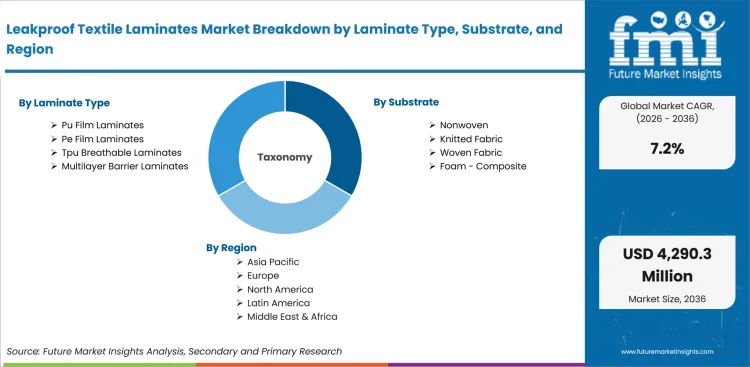
The leakproof textile laminates industry is segmented by laminate type, substrate, application, function, sales channel, and region.
The leakproof textile laminates market is segmented by laminate type, substrate, application, function, sales channel and region. By laminate type, the market covers PU film laminates, PE film laminates, TPU breathable laminates and multilayer barrier laminates. By substrate, it covers nonwoven, knitted fabric, woven fabric and foam or composite structures. By application, it covers hygiene products, medical protective apparel, mattress or bedding protectors and outdoor or performance textiles. By function, it covers liquid barrier, breathable barrier, odor or microbial barrier and stretch or comfort. By sales channel, it covers direct to converters, brand or OEM contracts and distributors. Regional coverage includes North America, Latin America, Europe, East Asia, South Asia and Pacific, and Middle East and Africa aligned to technical textile demand.
How does direct to converters shape purchasing within the sales channel category?
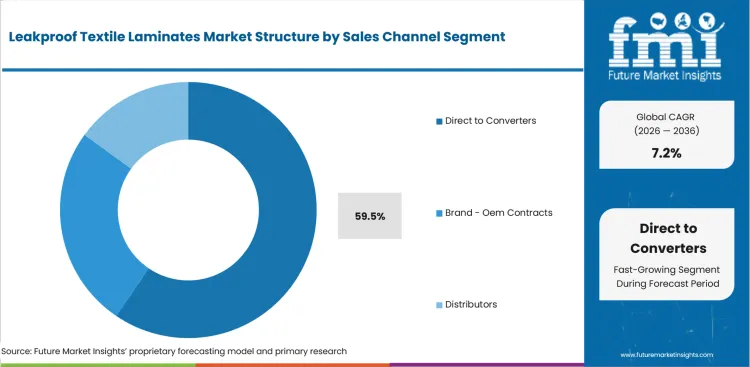
Converter accounts need supply routes that handle film trials, roll defects and lamination troubleshooting without adding extra approval steps. Freudenberg Performance Materials relaunched its website in October 2025 with clearer customer and recruitment navigation. The update shows why direct access has value in healthcare and hygiene laminates, where product teams need fast answers on barrier behavior and substrate compatibility.
- By sales channel, direct to converters is projected to account for 59.5% share in 2026 driven by faster technical response during roll trials. Freudenberg Performance Materials reported 35 production sites in October 2025 for global technical-textile supply coverage. The route gives converters one accountable contact for coating behavior, film bonding and lot files before products move into repeat hygiene or medical apparel production.
- Direct converter programs are witnessing demand from hygiene manufacturers owing to shorter problem-solving loops during leakage or delamination checks. Sourcing teams comparing non-woven fabric sourcing prefer direct technical support owing to limited options during urgent distributor-only line trials.
What supports demand for liquid barrier functions within the function category?
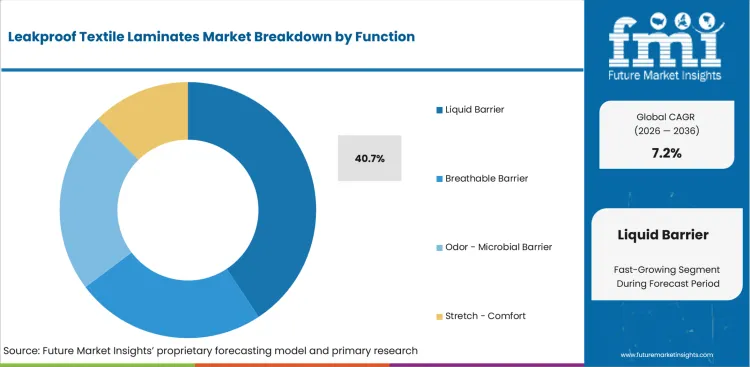
Medical gowns and hygiene articles need liquid holdout that remains stable during movement and contact. FDA’s January 2024 medical gown guidance defines medical gown use by exposure risk from minimal to high exposure. The requirement gives laminate suppliers a clear function test, especially where converters must match barrier rating to product use and care setting.
- By function, liquid barrier is estimated to hold 40.7% share in 2026 owing to leakage prevention in gowns and hygiene backsheets. FDA’s January 2024 guidance ties Level 3 gowns to emergency rooms and trauma cases, which pushes converters to verify film continuity before recurring purchase orders.
- Demand for liquid barrier laminates is expected to grow among medical apparel converters attributable to claim defensibility and user protection. Material teams using antimicrobial additive selection also review barrier files during protective apparel and hygiene qualification.
How is PU film laminates positioned within the laminate type category?
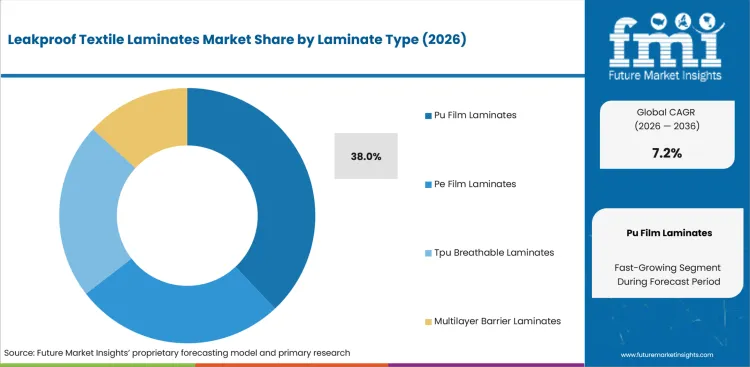
PU film laminates compete in applications that need flexibility, bonding behavior and wearer comfort in one structure. Covestro’s 2024 TPU films story described Platilon films for waterproofing and printability in apparel applications. The evidence supports PU film review in leakproof laminates due to converter demand for films that bend and seal without stiff finished goods.
- PU film laminates are forecast to represent 38.0% of laminate type demand in 2026 propelled by flexible sealing and fabric compatibility. Covestro’s 2024 TPU film application note links waterproofing and lamination to apparel use, which supports PU-based barrier selection in protective and performance textile programs.
- Purchase activity for PU film laminates is anticipated to rise driven by converter interest in soft handfeel and reliable seam behavior. Apparel and bedding product teams reviewing breathable membrane use prefer PU films where wearer comfort must stay aligned with liquid resistance.
How do converters evaluate nonwoven substrates within the substrate category?
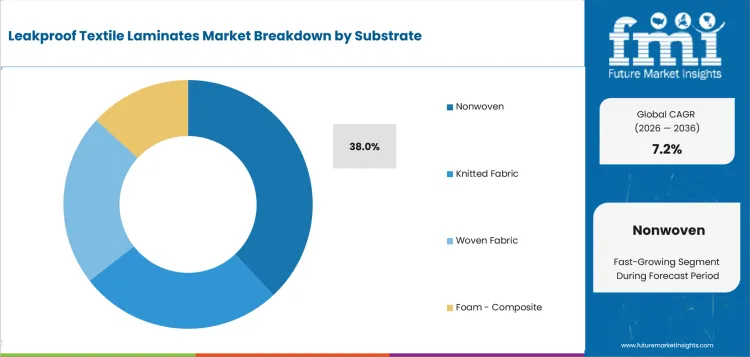
Nonwoven substrates are central to leakproof laminates due to coverstock strength and a stable face for film bonding. Magnera’s healthcare materials portfolio includes nonwoven, film and laminate solutions for surgical products and wound care. The portfolio shows why substrate choice affects leakage control, handfeel and converter line behavior at the same time.
- The substrate category is likely to be led by nonwoven at 38.0% share in 2026 attributable to hygiene and medical apparel compatibility. Magnera’s healthcare portfolio links nonwoven and film materials to surgical product use, which helps converters pair soft touch with barrier layers in disposable products.
- Nonwoven substrate adoption is gaining momentum in hygiene and protective apparel supported by familiar converting behavior and lower qualification friction. Product teams tracking nonwoven fabric demand prefer substrates that already fit bonding, slitting and inspection routines inside high-volume lines.
What drives hygiene products within the application category?
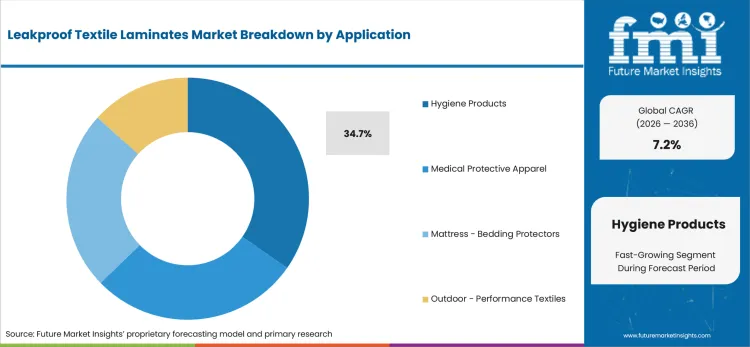
Hygiene product laminate decisions start with leakage complaints and repeat production stability for converter programs. RKW’s April 2024 Techtextil update described Aptra as a breathable film suitable for laminate use in disposable protective clothing and textile applications. The same barrier and breathability balance carries into hygiene backsheets, which need liquid control without adding stiffness or noise.
- Hygiene products are set to lead the application category with 34.7% share in 2026 due to absorbent product scale and repeated backsheet sourcing. RKW’s 2024 film update shows how breathable films support laminate construction, which fits hygiene programs that balance leakage protection with comfort expectations.
- Hygiene product manufacturers are expected to favor leakproof laminates over uncoated substrates due to leakage risk and brand complaint costs. Direct converter teams also review Asia textile chemicals owing to film additives and surface treatments affecting barrier stability in warm and humid production environments.
What are the drivers, restraints, and opportunities in the Leakproof Textile Laminates Market?
Near-term purchases are being shaped by surgical barrier requirements, chemical documentation burden, and direct converter qualification routes outlined below.
- Driver: Fluid-barrier specifications are expected to push converters toward laminates that hold liquid out during product movement and use.
- Restraint: Chemical file gaps are anticipated to delay approval in accounts that review PFAS exposure and skin-contact safety.
- Opportunity: Direct converter programs are projected to open account access for suppliers that solve lamination and roll-consistency issues.
Healthcare product teams are expected to raise interest in laminates that give gowns and drapes a clearer barrier story. CDC’s April 2024 standard precautions guidance states that PPE choice should be based on the nature of patient interaction and exposure risk. Documentation pressure is expected to keep barrier claims tied to actual product use during specification review. Converter teams need that proof before shifting trial rolls into recurring medical apparel programs.
Chemical review is likely to slow purchase decisions if film and adhesive files do not answer skin-contact or disposal questions. Magnera introduced a PFAS-free fluid-repellent nonwoven in December 2025 for healthcare and related uses. Magnera’s launch points to a tighter screening environment for barrier materials in healthcare programs. Product teams are expected to request more chemistry detail before accepting new laminate constructions for hygiene or protective apparel lines.
Direct technical support is projected to convert qualification delays into a channel advantage for film and nonwoven producers. India’s National Technical Textiles Mission reported 168 research projects in March 2025, which supports local material testing and converter learning. Suppliers connected to technical textile equipment are expected to receive closer review where laminating capability and documentation must move together.
Which country CAGRs are profiled in the Leakproof Textile Laminates Market?
.webp "Top Country Growth Comparison Leakproof Textile Laminates Market Cagr (2026 2036)")
| Country | CAGR |
|---|---|
| United States | 6.0% |
| China | 8.4% |
| India | 9.4% |
| Germany | 5.4% |
| United Kingdom | 5.8% |
| Japan | 5.2% |
| South Korea | 6.6% |
Source: FMI's proprietary forecasting model and primary research
How do country-level CAGRs compare in the Leakproof Textile Laminates Market?
Country CAGRs show a split between documentation-led healthcare systems and converter-led production networks. India at 9.4%, China at 8.4% and the Rest of World at 7.8% are influenced by manufacturing expansion and hygiene penetration. South Korea at 6.6% and the United States at 6.03% sit between export-led converter activity and clinical documentation pressure. The United Kingdom at 5.8%, Germany at 5.4% and Japan at 5.2% are shaped by stricter qualification cycles and slower replacement of approved materials.
- Hospital purchasing in the United States keeps fluid-barrier textiles inside strict clinical documentation routines before approval. The United States is projected to record 6.0% CAGR through 2036 driven by hospital network qualification and surgical apparel replacement. American Hospital Association reported 6,100 total hospitals in February 2026 across the United States. The broad care base keeps gown and drape demand tied to documented barrier performance. Local converters face longer material-change cycles due to group purchasing files and infection-control committees needing clear support. W. L. Gore & Associates and DuPont are positioned to gain traction in accounts that require material proof and clinical-use fit.
- China’s textile supply chain gives laminate producers a high-volume conversion base for hygiene and protective applications. Leakproof textile laminate demand in China is forecast to rise at 8.4% CAGR over the forecast period attributable to fabric output and converter scale. National Bureau of Statistics of China reported cloth output of 4.5 billion meters from January to February 2025. The production base supports local film and textile integration for large hygiene and protective apparel programs. Price discipline remains central due to converters comparing imported films against domestic alternatives during local sourcing reviews. Domestic converters are expected to screen suppliers for price stability and lot consistency before accepting imported specialty films.
- India is turning technical textiles into an industrial policy channel beyond a converter purchasing category. India’s outlook is anticipated to advance at 9.4% CAGR over the assessment period supported by medical textile programs and hygiene conversion. Press Information Bureau reported 1,480 crore rupees in March 2025 for the National Technical Textiles Mission budget through 2025-26. The budget base gives local producers more testing routes for coated and laminated materials. Regional converters still need stable polymer supply and skilled line support before replacing imported laminates.
- Germany’s hospital infrastructure keeps medical textile decisions connected to formal product files and clinical-risk committees. Adoption of leakproof textile laminates in Germany is estimated to expand at 5.4% CAGR through 2036 owing to healthcare qualification discipline. Eurostat reported that Germany had 638,354 hospital beds in 2023 in its June 2026 healthcare resource statistics. The large bed base supports recurring protective apparel and bedding protector needs across clinical textile sourcing. German converters also face careful chemical documentation review before film changes enter approved product lines. Freudenberg Performance Materials and RKW Group are positioned to gain traction where European compliance files shape buying decisions.
- The United Kingdom’s acute care system keeps disposable protective apparel tied to urgent-care traffic and buying control. Leakproof textile laminate sales in the United Kingdom are forecast to expand at 5.8% CAGR by 2036 led by hospital pressure and bedding protection needs. NHS England reported 76.9% four-hour emergency department performance in April 2026 across provider performance reporting. The gap against the March 2026 operating target keeps infection-control consumables under service pressure. UK sourcing teams still prefer approved material lists that reduce switching risk during winter planning. Suppliers with hospital textile documentation are expected to receive closer consideration before seasonal purchasing cycles.
- Japan’s aging profile gives hygiene laminates a stable use case beyond surgical apparel and hospital bedding. In Japan, leakproof textile laminate demand is predicted to advance at 5.2% CAGR through 2036 shaped by adult hygiene and care setting needs. Japan’s Cabinet Office reported that people aged 65 and over reached 36.24 million in fiscal 2025 ageing data. The age structure supports absorbent hygiene and bedding protector demand that needs soft liquid-barrier materials. Local product teams emphasize comfort claims and skin-contact evidence during supplier screening for care textiles. Format programs for breathable barrier laminates are expected to draw attention from care-product brands in urban retail channels.
- South Korea’s export-oriented manufacturing base keeps specialty textile converters close to global apparel and hygiene programs. South Korea is estimated to post 6.6% CAGR over the forecast period reinforced by export-capable manufacturing and fast specification changes. Statistics Korea reported that export value rose 6.5% year-on-year in the third quarter of 2025. The increase supports converter confidence in specialized roll goods and overseas OEM supply programs. Local adoption still depends on whether film producers support fast trials and narrow delivery windows. Suppliers with converter service teams are expected to receive closer review in accounts tied to export schedules.
Who are the notable companies in the Leakproof Textile Laminates Market?
W. L. Gore & Associates, Freudenberg Performance Materials, Magnera Corporation, Toray, DuPont, Mativ, Covestro, Arkema, Fitesa, and RKW Group are the notable companies shaping this market.
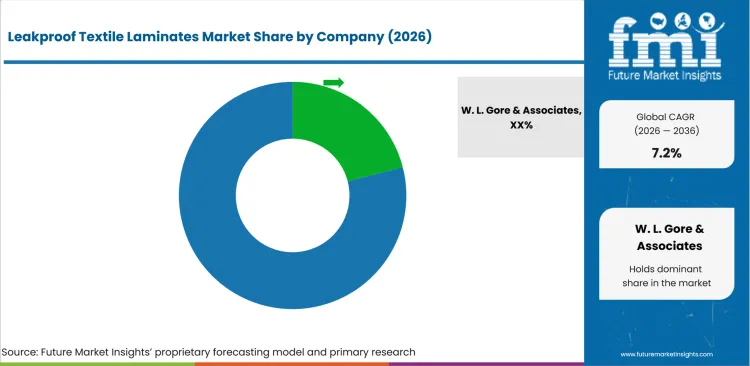
Competition is moderately concentrated around film formulation, nonwoven production and converter technical service for hygiene and medical accounts. Multinational material producers hold an advantage where sourcing teams need barrier files and repeatable roll quality. Adhesive compatibility and chemical documentation are also central to repeat account protection in converter programs. Suppliers connected to waterproof breathable textiles are expected to protect accounts where line speed and test records guide qualification.
- Barrier-performance specialists compete where protection and breathability must be defended in the same product. W. L. Gore & Associates and Toray serve accounts that ask for membrane credibility and repeatable comfort claims. Their fit is clearest in outdoor and protective textile programs that require technical story support.
- Nonwoven scale gives Freudenberg Performance Materials and Magnera Corporation a practical route into medical and hygiene laminates. Both companies serve product teams that need substrate depth beside barrier functionality during qualification. Converter accounts benefit from suppliers that understand both fabric behavior and lamination consequences during early trials.
- Polymer and film knowledge shapes the role of DuPont, Covestro and Arkema in protective apparel and breathable barrier structures. These companies compete on resin behavior, film consistency and compatibility with coated fabric programs. Product selection teams select these producers in programs where chemistry proof remains close to productccepta ance decisions
- Converter-facing supply is where Mativ, Fitesa and RKW Group have a clearer route to recurring purchase decisions. Their advantage is practical line support and access to nonwoven or film process know-how. These suppliers are expected to receive closer consideration where rollout timing is shorter than a full material redesign cycle.
Competitive Benchmarking: Leakproof Textile Laminates Market
| Company | Barrier Laminate Portfolio | Compliance Documentation | Converter Support | Geographic Reach |
|---|---|---|---|---|
| W. L. Gore & Associates | Strong | High | Medium | Global |
| Freudenberg Performance Materials | High | High | Strong | Global |
| Magnera Corporation | High | Medium | Strong | Global |
| Toray | Strong | Medium | Medium | Global |
| DuPont | Strong | High | Medium | Global |
| Mativ | Medium | Medium | Strong | Global |
| Covestro | Strong | High | Medium | Global |
| Arkema | Strong | High | Medium | Global |
| Fitesa | Medium | Medium | Strong | Regional |
| RKW Group | High | Medium | Strong | Regional |
Source: Future Market Insights competitive analysis, 2026. Ratings reflect relative portfolio relevance and workflow fit. Service capability and geographic reach shape the remaining comparison.
Key Developments in the Leakproof Textile Laminates Market
- In November 2024, Magnera Corporation was launched following the merger of Berry Global’s Health, Hygiene and Specialties nonwovens and films business with Glatfelter. The newly formed company combined absorbent hygiene, protective apparel, and specialty materials operations under a single corporate platform.
- In October 2025, Freudenberg Performance Materials launched binder-free wetlaid nonwovens made from PLA and wood pulp. The company stated that the materials offer water absorption, biodegradability, high strength, and hot-sealability for technical conversion applications.
- In November 2025, DuPont introduced Tyvek® APX for disposable chemical protective garments at A+A 2025. The company highlighted the material’s combination of breathability, protection, and durability for protective apparel applications.
- In March 2026, RKW Group announced plans to showcase its nonwoven and film solutions at Techtextil 2026. The company highlighted its Trikoron film portfolio as functional layers that can be processed into laminates with a wide range of materials.
Key Players in the Leakproof Textile Laminates Market
Performance laminate and barrier material producers
- W. L. Gore & Associates
- Freudenberg Performance Materials
- Magnera Corporation
- Toray
Polymer and film material specialists
- DuPont
- Mativ
- Covestro
- Arkema
Nonwoven and hygiene film converters
- Fitesa
- RKW Group
Leakproof Textile Laminates Market - Report Scope
| Coverage field | Report scope |
|---|---|
| Market breakdown | Leakproof Textile Laminates Market Breakdown By Laminate Type, Substrate, Application, Function, Sales Channel, and Region |
| Market Definition | Leakproof textile laminates are layered film and fabric materials that block liquid migration in hygiene products, medical protective apparel, bedding protectors and performance textiles used by converters and OEM product teams. |
| Regions Covered | North America, Latin America, Europe, East Asia, South Asia and Pacific, and Middle East and Africa |
| Countries Covered | United States, China, India, Germany, United Kingdom, Japan, South Korea, France, Brazil, Mexico, GCC Countries, South Africa, and 30+ countries |
| Key Companies Profiled | W. L. Gore & Associates, Freudenberg Performance Materials, Magnera Corporation, Toray, DuPont, Mativ, Covestro, Arkema, Fitesa, and RKW Group |
| Forecast Period | 2026 to 2036 |
| Approach | Hybrid bottom-up and top-down methodology using laminate type share, substrate mix, application demand, sales channel route and country-level converter evidence |
Source: Future Market Insights - analysis driven by proprietary forecasting models and primary research
Leakproof Textile Laminates Market - Research Methodology
| Method | Approach |
|---|---|
| Primary Research | Primary interviews covered hygiene converters, medical apparel converters, bedding protector suppliers and technical textile sourcing teams. Discussions focused on leakage complaints, roll variation, film bonding behavior and chemical documentation needs. Respondents also reviewed how direct supplier support affects trials, line stoppage handling and account expansion across hygiene, medical and outdoor textile applications. |
| Desk Research | Desk research used government infection-control references, healthcare capacity data, national textile policy releases, official statistics offices and company product pages. Product relevance was checked against barrier function, breathable film use, nonwoven substrate fit and converter service evidence. Company portfolios were screened to exclude adjacent coatings or fabrics that do not provide leakproof laminate functionality. |
| Market Sizing and Forecasting | Market sizing used a hybrid bottom-up and top-down model based on laminate type share, substrate adoption, application mix and sales channel route. Forecast assumptions were adjusted for hygiene backsheet demand, medical protective apparel qualification and outdoor textile usage. Country estimates were cross-checked against healthcare exposure indicators, technical textile programs and converter production evidence. |
| Data Validation | Forecasts were validated against medical gown guidance, infection-control pressure, technical textile funding and supplier portfolio reviews. Company profiles were checked for direct involvement in films, nonwovens, laminates or protective apparel materials. Validation also reviewed country-level constraints such as chemical documentation, local converter support and replacement risk in approved product lines. |
Source: Future Market Insights (FMI) analysis, based on proprietary forecasting model and primary research
Leakproof Textile Laminates Market by Segments
Leakproof Textile Laminates Market segmented by Laminate Type:
- PU Film Laminates
- PE Film Laminates
- TPU Breathable Laminates
- Multilayer Barrier Laminates
Leakproof Textile Laminates Market segmented by Substrate:
- Nonwoven
- Knitted Fabric
- Woven Fabric
- Foam / Composite
Leakproof Textile Laminates Market segmented by Application:
- Hygiene Products
- Medical Protective Apparel
- Mattress / Bedding Protectors
- Outdoor / Performance Textiles
Leakproof Textile Laminates Market segmented by Function:
- Liquid Barrier
- Breathable Barrier
- Odor / Microbial Barrier
- Stretch / Comfort
Leakproof Textile Laminates Market segmented by Sales Channel:
- Direct to Converters
- Brand / OEM Contracts
- Distributors
Leakproof Textile Laminates Market by Region:
- North America
- United States
- Canada
- Latin America
- Brazil
- Mexico
- Europe
- Germany
- United Kingdom
- France
- Italy
- Spain
- East Asia
- China
- Japan
- South Korea
- South Asia and Pacific
- India
- ASEAN
- Australia and New Zealand
- Middle East and Africa
- GCC Countries
- South Africa
Research Sources and Bibliography
- American Hospital Association. (2026, February). Fast Facts on USA Hospitals, 2026. American Hospital Association.
- Centers for Disease Control and Prevention. (2026, January). HAIs: Reports and Data. Centers for Disease Control and Prevention.
- Centers for Disease Control and Prevention. (2024, April). Standard Precautions for All Patient Care. Centers for Disease Control and Prevention.
- USA Food and Drug Administration. (2024, January). Medical Gowns. USA Food and Drug Administration.
- National Bureau of Statistics of China. (2025, March). Industrial Production Operation from January to February 2025. National Bureau of Statistics of China.
- Press Information Bureau. (2025, March). 5 Years of National Technical Textiles Mission. Ministry of Textiles.
- Eurostat. (2026, June). Healthcare resource statistics - beds. European Commission.
- NHS England. (2026, June). Integrated Performance Report. NHS England.
- Cabinet Office, Government of Japan. (2025, June). Annual Report on the Ageing Society [Summary] FY2025. Cabinet Office.
- Statistics Korea. (2025, November). Preliminary Results of Trade by Enterprise Characteristics in the Third Quarter of 2025. Ministry of Data and Statistics.
- World Health Organization. (2024, November). Global report on infection prevention and control 2024. World Health Organization.
- Magnera Corporation. (2024, November). Magnera Emerges as a New Global Leader in the Specialty Materials and Nonwovens Industry, Following the Merger of Berry’s Health, Hygiene and Specialties Global Nonwovens and Films Business with Glatfelter. Magnera Corporation.
- Magnera Corporation. (2025, December). Magnera Introduces Innovative Solution for Healthcare and Beyond, Focusing on Safety and Sustainability. Magnera Corporation.
- Freudenberg Performance Materials. (2025, October). Sustainable innovation: Freudenberg launches unique binder-free PLA/wood pulp wetlaid nonwovens. Freudenberg Performance Materials.
- Freudenberg Performance Materials. (2025, October). Freudenberg Performance Materials presents new website: modern design with clear focus on customers and recruitment. Freudenberg Performance Materials.
- RKW Group. (2024, April). RKW at Techtextil 2024. RKW Group.
- RKW Group. (2026, March). RKW Group presents innovative nonwoven and film solutions at Techtextil 2026. RKW Group.
- DuPont. (2025, November). DuPont Introduces Tyvek® APX™, Heralding a New Era in Worker Safety. DuPont.
- Covestro. (2024). Futuristic inflatable vest showcases TPU Film applications in apparel. Covestro.
- Arkema. (2026, May). 2025 Universal Registration Document. Arkema.
This bibliography is provided for reader reference and uses primary government, standards-body, official trade body, and company sources.
This Report Answers
- What value is the leakproof textile laminates market estimated at in 2026 and projected to reach by 2036?
- What CAGR is expected for the leakproof textile laminates market from 2026 to 2036?
- Which laminate type, substrate, application, function and sales channel segments shape demand?
- Which surgical barrier, hygiene conversion and qualification pressures support purchase activity?
- How do country CAGRs differ across the United States, China, India, Germany, the United Kingdom, Japan, South Korea and rest of world?
- Which companies compete across barrier documentation, converter support, material portfolio and geographic reach?
- How does FMI validate forecasts using hybrid bottom-up and top-down methodology?
- What should converters and OEM product teams address before broader sourcing commitments?
- How do fluid-barrier claims, chemical documentation and regulatory expectations affect vendor selection?
Frequently Asked Questions
What is driving growth in the Leakproof Textile Laminates Market?
Growth is being driven by fluid-barrier requirements in medical apparel, hygiene products and protective textiles. Converters need laminates that reduce leakage complaints during repeat production.
Who are the key players in the Leakproof Textile Laminates Market?
Key players include W. L. Gore & Associates, Freudenberg Performance Materials, Magnera, Toray, DuPont, Mativ, Covestro, Arkema, Fitesa and RKW Group. Competition centers on barrier proof and converter support.
What is a significant restraint in the Leakproof Textile Laminates Market?
A significant restraint is chemical documentation burden and approval delay. Accounts may slow adoption when PFAS, skin-contact or barrier files remain incomplete.
Why should executives track the Leakproof Textile Laminates Market?
Executives should track this market due to leakage failures directly affecting product claims and repeat account access. The category also links hygiene, medical apparel and performance textile programs.
What business problem does the Leakproof Textile Laminates Market address?
The market addresses liquid migration in products that need comfort and barrier performance together. It helps converters reduce leakage complaints without relying only on thicker or less flexible materials.
What should procurement leaders evaluate before selecting suppliers?
Procurement leaders should evaluate barrier test files, chemical documentation, roll consistency and converter service response. Supplier choice should also reflect whether the material fits existing bonding and inspection routines.
What is expected to limit return on investment for purchasers?
Return on investment is expected to be limited by requalification delays and poor fit between film layers and substrates. Chemistry gaps and weak technical support also raise switching costs.
How should suppliers build long-term account confidence?
Suppliers should provide lot records, barrier test evidence and line-trial support before asking for repeat orders. Account confidence improves when technical teams solve leakage or delamination problems quickly.
Preview the report firsthand - request a free sample
Get SampleGet the brochure for pricing and purchase details.
Get PDFTable of Content
- Key Takeaways
- Market Size and CAGR
- Top Growth Driver
- Fastest Growing Segment
- Leading Region
- Key Companies
- Emerging Opportunities
- Executive Summary
- Global Market Outlook
- Demand-side Trends
- Supply-side Trends
- Technology Roadmap Analysis
- Analysis and Recommendations
- Analyst Perspective (What is happening? Why now? What should investors know?)
- Key Questions Answered
- How large is the market?
- What is the CAGR?
- What are key trends?
- Which region dominates?
- Who are the leaders?
- Market Overview
- Market Coverage / Taxonomy
- Market Definition / Scope / Limitations
- Research Methodology
- Chapter Orientation
- Analytical Lens and Working Hypotheses
- Market Structure, Signals, and Trend Drivers
- Benchmarking and Cross-market Comparability
- Market Sizing, Forecasting, and Opportunity Mapping
- Research Design and Evidence Framework
- Desk Research Programme (Secondary Evidence)
- Expert Input and Fieldwork (Primary Evidence)
- Tooling, Models, and Reference Databases
- Data Engineering and Model Build
- Quality Assurance and Audit Trail
- Market Background
- Market Dynamics (Drivers, Restraints, Opportunity, Trends)
- Scenario Forecast (Optimistic, Likely, Conservative)
- Impact Analysis
- AI Impact
- Sustainability Impact
- Regulatory Impact
- Technology Impact
- Consumer / Buyer Analysis
- Purchase Drivers
- Adoption Barriers
- Buyer Journey
- Opportunity Map Analysis
- Product Life Cycle Analysis
- Supply Chain Analysis
- Investment Feasibility Matrix
- Value Chain Analysis
- PESTLE and Porter's Analysis
- Regulatory Landscape
- Regional Parent Market Outlook
- Production and Consumption Statistics
- Import and Export Statistics
- Global Market Analysis and Forecast, 2021 to 2036
- Historical Market Size Value (USD Million) & Volume (Unit) Analysis, 2021 to 2025
- Current and Future Market Size Value (USD Million) & Volume (Unit) Projections, 2026 to 2036
- Y-o-Y Growth Trend Analysis
- Absolute $ Opportunity Analysis
- Global Market Pricing Analysis, 2021 to 2036
- Global Market Analysis and Forecast, By Laminate Type, 2021 to 2036
- Introduction / Key Findings
- Historical Market Size Value (USD Million) & Volume (Unit) Analysis By Laminate Type, 2021 to 2025
- Current and Future Market Size Value (USD Million) & Volume (Unit) Analysis and Forecast By Laminate Type, 2026 to 2036
- Pu Film Laminates
- Pe Film Laminates
- Tpu Breathable Laminates
- Multilayer Barrier Laminates
- Pu Film Laminates
- Y-o-Y Growth Trend Analysis By Laminate Type, 2021 to 2025
- Absolute $ Opportunity Analysis By Laminate Type, 2026 to 2036
- Global Market Analysis and Forecast, By Substrate, 2021 to 2036
- Introduction / Key Findings
- Historical Market Size Value (USD Million) & Volume (Unit) Analysis By Substrate, 2021 to 2025
- Current and Future Market Size Value (USD Million) & Volume (Unit) Analysis and Forecast By Substrate, 2026 to 2036
- Nonwoven
- Knitted Fabric
- Woven Fabric
- Foam - Composite
- Nonwoven
- Y-o-Y Growth Trend Analysis By Substrate, 2021 to 2025
- Absolute $ Opportunity Analysis By Substrate, 2026 to 2036
- Global Market Analysis and Forecast, By Application, 2021 to 2036
- Introduction / Key Findings
- Historical Market Size Value (USD Million) & Volume (Unit) Analysis By Application, 2021 to 2025
- Current and Future Market Size Value (USD Million) & Volume (Unit) Analysis and Forecast By Application, 2026 to 2036
- Hygiene Products
- Medical Protective Apparel
- Mattress - Bedding Protectors
- Outdoor - Performance Textiles
- Hygiene Products
- Y-o-Y Growth Trend Analysis By Application, 2021 to 2025
- Absolute $ Opportunity Analysis By Application, 2026 to 2036
- Global Market Analysis and Forecast, By Function, 2021 to 2036
- Introduction / Key Findings
- Historical Market Size Value (USD Million) & Volume (Unit) Analysis By Function, 2021 to 2025
- Current and Future Market Size Value (USD Million) & Volume (Unit) Analysis and Forecast By Function, 2026 to 2036
- Liquid Barrier
- Breathable Barrier
- Odor - Microbial Barrier
- Stretch - Comfort
- Liquid Barrier
- Y-o-Y Growth Trend Analysis By Function, 2021 to 2025
- Absolute $ Opportunity Analysis By Function, 2026 to 2036
- Global Market Analysis and Forecast, By Sales Channel, 2021 to 2036
- Introduction / Key Findings
- Historical Market Size Value (USD Million) & Volume (Unit) Analysis By Sales Channel, 2021 to 2025
- Current and Future Market Size Value (USD Million) & Volume (Unit) Analysis and Forecast By Sales Channel, 2026 to 2036
- Direct to Converters
- Brand - Oem Contracts
- Distributors
- Direct to Converters
- Y-o-Y Growth Trend Analysis By Sales Channel, 2021 to 2025
- Absolute $ Opportunity Analysis By Sales Channel, 2026 to 2036
- Global Market Analysis and Forecast, By Region, 2021 to 2036
- Introduction
- Historical Market Size Value (USD Million) & Volume (Unit) Analysis By Region, 2021 to 2025
- Current Market Size Value (USD Million) & Volume (Unit) Analysis and Forecast By Region, 2026 to 2036
- North America
- Latin America
- Western Europe
- Eastern Europe
- East Asia
- South Asia and Pacific
- Middle East & Africa
- Market Attractiveness Analysis By Region
- North America Market Analysis and Forecast, By Country, 2021 to 2036
- Historical Market Size Value (USD Million) & Volume (Unit) Trend Analysis By Market Taxonomy, 2021 to 2025
- Market Size Value (USD Million) & Volume (Unit) Forecast By Market Taxonomy, 2026 to 2036
- By Country
- USA
- Canada
- Mexico
- By Laminate Type
- By Substrate
- By Application
- By Function
- By Sales Channel
- By Country
- Market Attractiveness Analysis
- By Country
- By Laminate Type
- By Substrate
- By Application
- By Function
- By Sales Channel
- Key Takeaways
- Latin America Market Analysis and Forecast, By Country
- Historical Market Size Value (USD Million) & Volume (Unit) Trend Analysis By Market Taxonomy, 2021 to 2025
- Market Size Value (USD Million) & Volume (Unit) Forecast By Market Taxonomy, 2026 to 2036
- By Country
- Brazil
- Chile
- Rest of Latin America
- By Laminate Type
- By Substrate
- By Application
- By Function
- By Sales Channel
- By Country
- Market Attractiveness Analysis
- By Country
- By Laminate Type
- By Substrate
- By Application
- By Function
- By Sales Channel
- Key Takeaways
- Western Europe Market Analysis and Forecast, By Country
- Historical Market Size Value (USD Million) & Volume (Unit) Trend Analysis By Market Taxonomy, 2021 to 2025
- Market Size Value (USD Million) & Volume (Unit) Forecast By Market Taxonomy, 2026 to 2036
- By Country
- Germany
- UK
- Italy
- Spain
- France
- Nordic
- BENELUX
- Rest of Western Europe
- By Laminate Type
- By Substrate
- By Application
- By Function
- By Sales Channel
- By Country
- Market Attractiveness Analysis
- By Country
- By Laminate Type
- By Substrate
- By Application
- By Function
- By Sales Channel
- Key Takeaways
- Eastern Europe Market Analysis and Forecast, By Country
- Historical Market Size Value (USD Million) & Volume (Unit) Trend Analysis By Market Taxonomy, 2021 to 2025
- Market Size Value (USD Million) & Volume (Unit) Forecast By Market Taxonomy, 2026 to 2036
- By Country
- Russia
- Poland
- Hungary
- Balkan & Baltic
- Rest of Eastern Europe
- By Laminate Type
- By Substrate
- By Application
- By Function
- By Sales Channel
- By Country
- Market Attractiveness Analysis
- By Country
- By Laminate Type
- By Substrate
- By Application
- By Function
- By Sales Channel
- Key Takeaways
- East Asia Market Analysis and Forecast, By Country
- Historical Market Size Value (USD Million) & Volume (Unit) Trend Analysis By Market Taxonomy, 2021 to 2025
- Market Size Value (USD Million) & Volume (Unit) Forecast By Market Taxonomy, 2026 to 2036
- By Country
- China
- Japan
- South Korea
- By Laminate Type
- By Substrate
- By Application
- By Function
- By Sales Channel
- By Country
- Market Attractiveness Analysis
- By Country
- By Laminate Type
- By Substrate
- By Application
- By Function
- By Sales Channel
- Key Takeaways
- South Asia and Pacific Market Analysis and Forecast, By Country
- Historical Market Size Value (USD Million) & Volume (Unit) Trend Analysis By Market Taxonomy, 2021 to 2025
- Market Size Value (USD Million) & Volume (Unit) Forecast By Market Taxonomy, 2026 to 2036
- By Country
- India
- ASEAN
- Australia & New Zealand
- Rest of South Asia and Pacific
- By Laminate Type
- By Substrate
- By Application
- By Function
- By Sales Channel
- By Country
- Market Attractiveness Analysis
- By Country
- By Laminate Type
- By Substrate
- By Application
- By Function
- By Sales Channel
- Key Takeaways
- Middle East & Africa Market Analysis and Forecast, By Country
- Historical Market Size Value (USD Million) & Volume (Unit) Trend Analysis By Market Taxonomy, 2021 to 2025
- Market Size Value (USD Million) & Volume (Unit) Forecast By Market Taxonomy, 2026 to 2036
- By Country
- Kingdom of Saudi Arabia
- Other GCC Countries
- Türkiye
- South Africa
- Other African Union
- Rest of Middle East & Africa
- By Laminate Type
- By Substrate
- By Application
- By Function
- By Sales Channel
- By Country
- Market Attractiveness Analysis
- By Country
- By Laminate Type
- By Substrate
- By Application
- By Function
- By Sales Channel
- Key Takeaways
- Key Countries Market Analysis
- USA
- Pricing Analysis
- Market Share Analysis, 2025
- By Laminate Type
- By Substrate
- By Application
- By Function
- By Sales Channel
- Canada
- Pricing Analysis
- Market Share Analysis, 2025
- By Laminate Type
- By Substrate
- By Application
- By Function
- By Sales Channel
- Mexico
- Pricing Analysis
- Market Share Analysis, 2025
- By Laminate Type
- By Substrate
- By Application
- By Function
- By Sales Channel
- Brazil
- Pricing Analysis
- Market Share Analysis, 2025
- By Laminate Type
- By Substrate
- By Application
- By Function
- By Sales Channel
- Chile
- Pricing Analysis
- Market Share Analysis, 2025
- By Laminate Type
- By Substrate
- By Application
- By Function
- By Sales Channel
- Germany
- Pricing Analysis
- Market Share Analysis, 2025
- By Laminate Type
- By Substrate
- By Application
- By Function
- By Sales Channel
- UK
- Pricing Analysis
- Market Share Analysis, 2025
- By Laminate Type
- By Substrate
- By Application
- By Function
- By Sales Channel
- Italy
- Pricing Analysis
- Market Share Analysis, 2025
- By Laminate Type
- By Substrate
- By Application
- By Function
- By Sales Channel
- Spain
- Pricing Analysis
- Market Share Analysis, 2025
- By Laminate Type
- By Substrate
- By Application
- By Function
- By Sales Channel
- France
- Pricing Analysis
- Market Share Analysis, 2025
- By Laminate Type
- By Substrate
- By Application
- By Function
- By Sales Channel
- India
- Pricing Analysis
- Market Share Analysis, 2025
- By Laminate Type
- By Substrate
- By Application
- By Function
- By Sales Channel
- ASEAN
- Pricing Analysis
- Market Share Analysis, 2025
- By Laminate Type
- By Substrate
- By Application
- By Function
- By Sales Channel
- Australia & New Zealand
- Pricing Analysis
- Market Share Analysis, 2025
- By Laminate Type
- By Substrate
- By Application
- By Function
- By Sales Channel
- China
- Pricing Analysis
- Market Share Analysis, 2025
- By Laminate Type
- By Substrate
- By Application
- By Function
- By Sales Channel
- Japan
- Pricing Analysis
- Market Share Analysis, 2025
- By Laminate Type
- By Substrate
- By Application
- By Function
- By Sales Channel
- South Korea
- Pricing Analysis
- Market Share Analysis, 2025
- By Laminate Type
- By Substrate
- By Application
- By Function
- By Sales Channel
- Russia
- Pricing Analysis
- Market Share Analysis, 2025
- By Laminate Type
- By Substrate
- By Application
- By Function
- By Sales Channel
- Poland
- Pricing Analysis
- Market Share Analysis, 2025
- By Laminate Type
- By Substrate
- By Application
- By Function
- By Sales Channel
- Hungary
- Pricing Analysis
- Market Share Analysis, 2025
- By Laminate Type
- By Substrate
- By Application
- By Function
- By Sales Channel
- Kingdom of Saudi Arabia
- Pricing Analysis
- Market Share Analysis, 2025
- By Laminate Type
- By Substrate
- By Application
- By Function
- By Sales Channel
- Türkiye
- Pricing Analysis
- Market Share Analysis, 2025
- By Laminate Type
- By Substrate
- By Application
- By Function
- By Sales Channel
- South Africa
- Pricing Analysis
- Market Share Analysis, 2025
- By Laminate Type
- By Substrate
- By Application
- By Function
- By Sales Channel
- USA
- Market Structure Analysis
- Competition Dashboard
- Competition Benchmarking
- Market Share Analysis of Top Players
- By Regional
- By Laminate Type
- By Substrate
- By Application
- By Function
- By Sales Channel
- Emerging Startups
- Innovation Benchmarking
- Competition Analysis
- Competition Deep Dive
- W. L. Gore & Associates
- Overview
- Product Portfolio
- Profitability by Market Segments (Product/Region/Sales Channel)
- Sales Footprint
- Strategy Overview
- Marketing Strategy
- Product Strategy
- Channel Strategy
- Freudenberg Performance Materials
- Magnera Corporation
- Toray
- DuPont
- Mativ
- Covestro
- Arkema
- Fitesa
- and RKW Group
- W. L. Gore & Associates
- Case Studies
- Success Stories
- Recent Developments
- Competition Deep Dive
- Assumptions & Acronyms Used


