

- Market Size (2026)
- USD 682.1 Mn
- Forecast (2036)
- USD 1244.8 Mn
- CAGR (2026 to 2036)
- 6.2%
How Big is the Leather Defect Scanners Market in 2026?
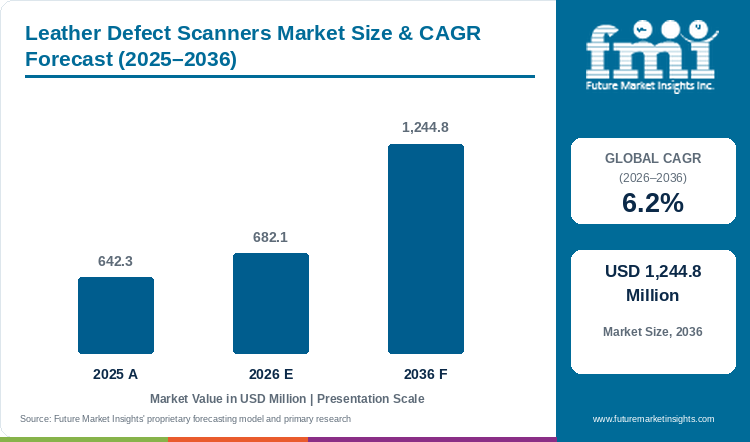
Tanneries, automotive interior suppliers and leather goods makers will spend USD 682.1 Million on leather defect scanners in 2026, up from USD 642.3 Million in 2025. Revenue will rise to USD 1,244.8 Million by 2036 at a 6.2% CAGR.
Demand for leather defect scanners is estimated to increase at 6.2% CAGR between 2026 and 2036, in FMI's assessment. Sales value is set to rise from USD 642.3 Million in 2025 to USD 682.1 Million in 2026 and is projected to reach USD 1,244.8 Million by 2036, an additional opportunity of USD 562.7 Million.
Increasing focus on usable hide area at tanneries is supporting the demand for leather defect scanners. Tanneries are expected to account for 33% of demand by end use in 2026, as hide grading sets the usable area for every later stage. Surveyed Brazilian tanneries received 11.13 million whole raw hides in the fourth quarter of 2025, up 11.8% from a year earlier [1]. Due to this, higher hide volume is increasing the number of grading decisions per plant, and automotive interior suppliers are following with tight surface limits on every cut part.
Demand for leather defect scanners is developing faster in tannery districts than in mature manufacturing bases. Italy is projected at 7% CAGR through 2036, and Japan is forecast at 4.8% as buyers validate new equipment carefully. A scar missed at the tannery costs one grade on a hide, and the same scar found on a finished bag or seat cover costs a rejected part. French leather sector exports reached EUR 18.6 billion in 2025, including EUR 12.5 billion from leather goods, due to which premium buyers are placing a higher value on early detection [2]. However, lighting recipes and false-reject tuning will decide the speed of conversion from manual grading.
Adjacent markets are also widening the sales base for scanner suppliers. The automotive interior leather market was valued at USD 24.3 Billion in 2025 and is projected to reach USD 39.2 Billion by 2035 at 4.9% CAGR. Inspection tools are growing faster, with the machine vision market estimated to rise from USD 11.57 Billion in 2026 to USD 25.21 Billion by 2036 at 8.1% CAGR. Sales of AI machine vision and quality inspection systems are expected to increase fastest, from USD 5.8 Billion to USD 23.3 Billion at 15% CAGR. FMI predicts that high-throughput tanneries in Italy, Brazil and Mexico will automate grading first, followed by automotive suppliers linking scanners with nesting software. By 2036, scanner sales will follow the value of leather saved per hide, and vendors selling defect maps ready for cutting systems will hold the strongest pricing power.
Key Takeaways
- Notable companies in the leather defect scanners market include Cognex, Keyence, Isra Vision / Atlas Copco, SICK, LMI Technologies, Baumer, Suntech and Gerber Technology.
- By scanner type, line-scan camera systems are projected to account for 31% in 2026, owing to continuous imaging of wide hides at conveyor speed.
- Based on end use, tanneries are estimated to hold 33% in 2026, as grading decisions are taken before finishing and cutting, and machine vision suppliers are expected at 36% by sales channel.
- Italy is projected at 7% CAGR through 2036, followed by Mexico at 6.6%, as dense tanning districts and the Guanajuato cluster concentrate scanner buyers.
Analyst Perspective
“Defect maps readable by cutting and nesting systems will open the largest opportunity, as usable hide area is the figure tannery buyers already price. Suppliers bundling lighting recipes with site-specific defect libraries will receive fleet orders from high-volume tanneries in Brazil, Italy and Mexico.”
- Nikhil Kaitwade, Principal Consultant, Future Market Insights
How is the Leather Defect Scanners Market Segmented?
The leather defect scanners market is segmented into scanner type, leather type, defect detected, end use, sales channel and region.
As per FMI, the market is segmented by scanner type into line-scan camera systems, area-scan inspection systems, AI vision scanners, 3D surface scanners and multi-spectral scanners. By leather type, the market is segmented into automotive leather, footwear leather, furniture leather, garment leather and luxury goods leather. By defect detected, the market is segmented into scars and scratches, color variation, grain defects, thickness irregularity and stains or spots. By end use, the market is segmented into tanneries, automotive interiors, footwear manufacturers, luxury goods manufacturers and furniture upholstery. By sales channel, the market is segmented into machine vision suppliers, leather machinery OEMs, direct factory installations and system integrators. The regional analysis covers seven regions and more than 30 countries.
Why Do Line-Scan Camera Systems Lead the Leather Defect Scanners Market by Scanner Type?
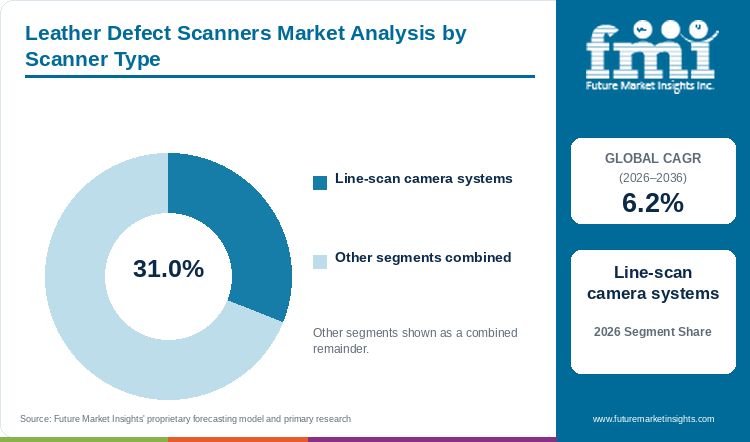
By scanner type, line-scan camera systems will account for 31% of market share in 2026.
Continuous grading of whole hides on conveyors is supporting the demand for leather defect scanners built on line-scan camera systems. These cameras capture the moving hide strip after strip in fine detail with no pause in transport, due to which tanneries and cutting rooms can check wide skins at normal production speed. AI vision scanners carry added computing cost and still need a steady picture from a camera. 3D and multi-spectral scanners cost more per station and are mostly bought to add depth and wavelength readings to a line-scan setup. Area-scan inspection systems, tracked in the area scan cameras market, are growing at a slower pace, as an irregular hide requires several separate shots. However, finer sensors and faster processors will decide single-station coverage of wide hides at full conveyor speed.
- Line-scan camera systems are projected to account for 31% of demand by scanner type in 2026, owing to continuous imaging of wide hides at conveyor speed.
- In May 2026, Cognex launched the In-Sight 3900 vision system with support for up to 25 megapixels and PC-free, deterministic inspection synchronized to high-speed production lines [3].
Why Does Automotive Leather Lead the Leather Defect Scanners Market by Leather Type?
Based on leather type, automotive leather will account for 28% of market share in 2026.
Strict appearance rules set by carmakers are supporting the demand for leather defect scanners in automotive leather. Seats, door panels and trim expose wide areas of leather to the buyer, due to which interior suppliers check every hide against one standard for the whole vehicle program. Footwear and garment leather account for fewer scanners, as small cut pieces accept more natural marks. Furniture leather is growing at a slower pace, as upholstery buyers allow broader grade ranges. Luxury goods leather is valuable per square meter, but small batches limit the number of stations. However, takt time on interior supplier lines will decide scanner speed needs and the pace of plant-wide orders.
- Automotive leather is expected to account for 28% of demand by leather type in 2026, supported by one appearance standard applied across seats, panels and trim.
- VDA reported that Germany produced 4.15 million passenger cars in 2025, up 2% from the prior year [4].
Why Do Scars and Scratches Lead the Leather Defect Scanners Market by Defect Detected?
In 2026, scars and scratches will account for 29% of market share by defect detected.
Loss of usable hide area from surface damage is supporting the demand for leather defect scanners focused on scars and scratches. Every such mark pushes the nesting program to place pattern pieces around the damaged zone, due to which cutting rooms rank these defects first for detection. Color variation and stains are often fixed during finishing and get lower priority at grading. Grain defects are growing at a slower pace, as systems need to tell real flaws apart from natural texture. Thickness irregularity requires 3D measurement and accounts for fewer installations. Accurate scar detection also needs steady illumination, supplied by products covered in the industrial vision lighting controllers market. However, the mix of shiny and embossed leather in each plant will decide lighting spend per station.
- Scars and scratches are estimated to hold 29% of demand by defect detected in 2026, owing to the direct link between surface marks and lost cutting area.
Why Do Tanneries Lead the Leather Defect Scanners Market by End Use?
By end use, tanneries will account for 33% of market share in 2026.
Tanneries are buying more scanners to grade hides before finishing and cutting add value. Defect maps produced at the grading stage guide sorting, surface treatment and allocation to customers, due to which tanneries account for the biggest portion of scanner budgets. Luxury goods manufacturers hold strict quality limits, yet low output keeps unit purchases small. Automotive interiors, footwear manufacturers and furniture upholstery are growing at a slower pace, as these buyers inspect leather only at the cutting stage and install a few stations per site. Hide supply from the tanning base served by the leather tanning chemicals market also keeps the grading workload highest at tanneries. However, access to funds for small operators in dense tanning clusters will decide the speed of scanner retrofits.
- Tanneries are projected to hold 33% of demand by end use in 2026, supported by grading decisions taken before finishing and cutting.
- Data México counted 940 leather and hide tanning and finishing units in May 2026, with 720 located in Guanajuato [5].
Why Do Machine Vision Suppliers Lead the Leather Defect Scanners Market by Sales Channel?
Based on sales channel, machine vision suppliers will account for 36% of market share in 2026.
Machine vision suppliers are widely preferred by plants buying a complete inspection station for hides. A single vendor tunes optics, illumination and classification software to each finish and remains responsible for results after commissioning, due to which buyers place first orders through this channel. On-camera processing, tracked in the edge AI gateways for machine vision market, is cutting the custom programming needed for packaged stations. Direct factory installations are limited to large groups employing automation engineers on staff. System integrators bill engineering time on every project and suit plants with mixed equipment. Leather machinery OEMs are growing at a slower pace, as scanners are usually sold together with a new cutting or measuring machine. However, local service for recipe tuning after start-up will decide which vendors get follow-on station orders.
- Machine vision suppliers are expected to account for 36% of demand by sales channel in 2026, owing to single-vendor accountability for imaging, lighting and classification.
- In April 2026, Cognex launched the In-Sight 6900 vision controller, running AI classification models trained on 10 to 20 images [6].
What are the Drivers, Restraints, and Opportunities in the Leather Defect Scanners Market?
According to FMI, hide yield pressure is pushing demand, natural grain and finish variation is slowing validation, and edge AI tied to cutting workflows will open the largest revenue pool till 2036.
- Driver: Need to protect usable hide area is encouraging tanneries and cutting rooms to replace manual grading with repeatable defect maps.
- Restraint: Natural grain, color and gloss variation is raising false-reject risk and extending recipe validation on each plant's own leather.
- Opportunity: Edge AI, 3D and spectral sensing can feed richer defect data into grading, nesting and cutting systems.
Smart cameras running inference at the line are supporting adoption of leather defect scanners. LMI Technologies launched Gocator 2D Smart Cameras in January 2026 with 5 MP or 12 MP global-shutter imaging, on-device AI and industrial connectivity requiring no external PC or cloud setup [7]. Compact stations of this kind are expected to reduce integration overhead for smaller tanneries.
Key challenges in the leather defect scanners market appear during commissioning, as each scanner has to separate scars and stains from natural texture on the buyer's own leather. Lighting recipes and false-reject tuning add engineering time, due to which plants delay orders until a supplier proves stable results across lots.
AI surface inspection is also reaching trade show floors on standard smart cameras, as senswork showed AI-based surface crack detection on a Cognex In-Sight 3800 Edge Learning camera at IMTS 2026 in September [8]. Leather inspection vendors are expected to apply the same tools to scar and stain classes, and suppliers building site-specific defect libraries will gain the larger share of new orders.
Which Country CAGRs are Profiled in the Leather Defect Scanners Market?
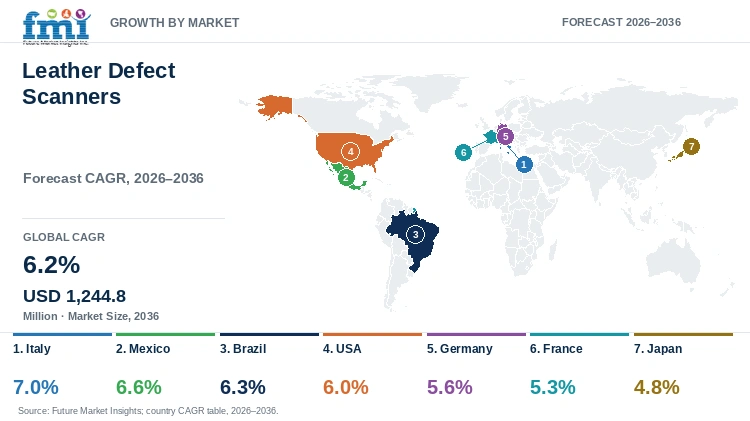
| Country | CAGR, 2026 to 2036 |
|---|---|
| Italy | 7% |
| Mexico | 6.6% |
| Brazil | 6.3% |
| USA | 6% |
| Germany | 5.6% |
| France | 5.3% |
| Japan | 4.8% |
How do Country-level CAGRs Compare in the Leather Defect Scanners Market?
FMI's analysis groups demand for leather defect scanners in the seven profiled countries into two clusters. Italy, Mexico, Brazil and the USA are projected at 6% or above, and Germany, France and Japan are expected to grow between 4.8% and 5.6%. Tannery density is supporting the faster cluster, and qualification cycles for automotive and premium buyers are setting a steadier pace in the second.
- Italy leads at 7% as three tanning districts concentrate scanner buyers.
- Mexico follows at 6.6%, with the Guanajuato cluster setting the pace of retrofits.
- Hide throughput will carry Brazil to a 6.3% CAGR through 2036.
- Growth of 6% in the USA will track capital projects at dispersed plants.
- Germany grows at 5.6% under automotive qualification rules for interior suppliers.
- France will expand at 5.3% as premium leather goods tighten defect tolerances.
- Japan grows slowest at 4.8%, guided by careful validation of new equipment.
Beyond these seven countries, the complete study models growth for more than 30 national and grouped markets across seven regions.
Country Outlook
- District density gives Italy the fastest growth among profiled countries, with demand rising at a 7% CAGR through 2036. About 93% of Italian tanning production is concentrated in three districts, with footwear and leather goods as the main customers [9]. District-level service and configurable lighting recipes will help suppliers retrofit varied plant layouts.
- Mexico is projected at 6.6% CAGR, owing to one dense cluster made up of many small plants. Data México counted 940 leather and hide tanning and finishing units in May 2026, with 720 located in Guanajuato [5]. Due to capital sensitivity, staged packages and smart-camera stations fitted to existing conveyors are expected to gain preference.
- High hide throughput makes inspection speed the business case for Brazilian tanneries, and demand will rise at a 6.3% CAGR through 2036. Surveyed tanneries received 11.13 million whole raw hides in the fourth quarter of 2025, an 11.8% year-over-year increase [1]. Wide-area scanning will matter most, since variable raw material tests detection consistency at full speed.
- Demand for leather defect scanners in the USA, on a 6% CAGR till 2036, comes from a thinner and more dispersed tannery base than the European districts. Plants evaluate machine vision as a capital project with explicit payback terms, and modular stations with remote diagnostics are expected to keep support costs per site in check.
- Automotive discipline shapes German adoption, with the market growing at a 5.6% CAGR. VDA reported domestic passenger car production of 4.15 million units in 2025, up 2% from the prior year [4]. Interior-material inspection cannot interrupt line takt, so proof on automotive leather will come before plant-wide rollout.
- Premium leather goods set the tolerance bar in France, a market expanding at a 5.3% CAGR. Alliance France Cuir reported 2025 sector exports of EUR 18.6 billion, including EUR 12.5 billion from leather goods [2]. Scanners will need fine color and texture control, since some natural marks are accepted in premium material.
- Japan grows slowest at 4.8%, and repeatability will guide equipment choices in a mature manufacturing base. The Ministry of Economy, Trade and Industry announced recipients of the FY2026 leather industry promotion subsidy on March 31, 2026 [10]. Compact systems with local engineering support and documented repeatability will clear qualification fastest.
Who are the Notable Companies in the Leather Defect Scanners Market?
Cognex, Keyence, Isra Vision / Atlas Copco, Stemmer Imaging, LMI Technologies and Gerber Technology are among the notable companies profiled by FMI across vision platforms, surface specialists and leather workflow suppliers.
Vision platforms, surface specialists and leather workflow suppliers each cover one part of the inspection job, due to which supply of leather defect scanners remains fragmented. Platform vendors are competing on embedded AI and processing power, as Cognex launched the In-Sight 6900 controller in April 2026 [6]. Cognex followed with the In-Sight 3900 vision system in May 2026 [3]. Surface and 3D specialists are offering engineered integration, and LMI Technologies moved AI onto the camera with Gocator 2D Smart Cameras in January 2026 [7]. Specialists are already linked with larger owners, with ISRA VISION inside Atlas Copco, Stemmer Imaging owned by MiddleGround Capital and Gerber Technology part of Lectra. Lighting expertise and defect libraries are needed to enter, and buyers rarely change vendor once a recipe is validated on the buyer's own leather type. However, edge AI cameras are expected to reduce hardware cost through 2036, owing to which pricing power will move toward vendors selling validated defect maps ready for cutting systems.
- Configurable Machine Vision Platforms: Cognex, Keyence, Baumer, Datalogic and SICK compete through configurable cameras, smart vision, software and industrial connectivity.
- Surface, 3D and Engineered Vision Specialists: Isra Vision / Atlas Copco, Stemmer Imaging and LMI Technologies compete through surface inspection depth, systems engineering, 3D measurement and edge-based vision.
- Leather and Material-Flow Workflow Specialists: Suntech and Gerber Technology compete closer to hide capture, flaw marking, nesting and production workflow integration.
Competitive Benchmarking
| Company | Surface Inspection Breadth | 3D Surface Measurement | Leather Workflow Integration | Geographic Reach |
|---|---|---|---|---|
| Cognex | High | High | Medium | North America, Europe and Asia-Pacific |
| Keyence | High | High | Medium | North America, Europe and Asia-Pacific |
| Isra Vision / Atlas Copco | High | High | Medium | Europe with global machine vision operations |
| Baumer | High | Medium | Medium | Europe, Americas and Asia |
| Stemmer Imaging | High | High | High | Europe and North America with partner coverage |
| Datalogic | High | Low | Medium | Europe, Americas and Asia-Pacific |
| LMI Technologies | High | High | High | North America, Europe and Asia |
| SICK | High | High | High | Global direct and partner coverage |
| Suntech | Medium | Low | High | Asia with broad export and agent network |
| Gerber Technology | Medium | Low | High | Global fashion, automotive and furniture customer base |
Scoring basis: Surface Inspection Breadth is High for documented line-scan and area-scan inspection with AI or specialized lighting. 3D Surface Measurement is High for documented depth or topography inspection. Leather Workflow Integration is High for documented links from image capture to defect mapping, nesting or cutting. Medium marks narrower coverage, and Low marks limited public documentation.
Key Developments
- In January 2026, LMI Technologies launched Gocator 2D Smart Cameras combining 5 MP or 12 MP global-shutter imaging with on-device AI and industrial connectivity, removing the need for an external PC [7].
- In April 2026, Cognex launched the In-Sight 6900 vision controller with up to 157 TOPS of AI performance for pixel-level segmentation and defect detection [6].
- In May 2026, Cognex introduced the In-Sight 3900 vision system with support for up to 25 megapixels and processing four times faster than earlier Cognex vision systems [3].
Key Players
Configurable Machine Vision Platforms
- Cognex
- Keyence
- Baumer
- Datalogic
- SICK
Surface, 3D and Engineered Vision Specialists
- Isra Vision / Atlas Copco
- Stemmer Imaging
- LMI Technologies
Leather and Material-Flow Workflow Specialists
- Suntech
- Gerber Technology
Report Scope and Methodology
| Coverage field | Report scope |
|---|---|
| Market breakdown | 5 categories plus region: Scanner Type (Line-scan camera systems, Area-scan inspection systems, AI vision scanners, 3D surface scanners, Multi-spectral scanners), Leather Type (Automotive leather, Footwear leather, Furniture leather, Garment leather, Luxury goods leather), Defect Detected (Scars and scratches, Color variation, Grain defects, Thickness irregularity, Stains/spots), End Use (Tanneries, Automotive interiors, Footwear manufacturers, Luxury goods manufacturers, Furniture upholstery), Sales Channel (Machine vision suppliers, Leather machinery OEMs, Direct factory installations, System integrators), and Region |
| Quantitative units | USD Million |
| Market definition | Revenue from dedicated leather defect scanner systems and configured industrial vision inspection packages sold for detecting, locating or classifying defects on hides and finished leather, including integral imaging, illumination, processing, embedded analytics and inseparable system integration. The definition excludes downstream finished-product revenue, general-purpose vision components not configured for leather inspection, textile inspection, and standalone cutting or nesting revenue not attributable to scanning. |
| Regions covered | North America, Latin America, Western Europe, Eastern Europe, East Asia, South Asia and Pacific, Middle East and Africa |
| Countries covered | More than 30 national and grouped markets, with Italy, the USA, Japan, Germany, Mexico, Brazil and France profiled in detail |
| Key companies profiled | Cognex, Keyence, Isra Vision / Atlas Copco, Baumer, Stemmer Imaging, Datalogic, LMI Technologies, SICK, Suntech and Gerber Technology |
| Forecast period | 2026 to 2036 |
| Approach | Hybrid bottom-up and top-down sizing by FMI reconciles supplier activity, demand by application, installation patterns and country indicators within the defined revenue boundary. |
Research Methodology
| Method | Approach |
|---|---|
| Primary research | Interviews with machine vision suppliers, system integrators, leather machinery specialists, tannery managers and end-user quality and procurement teams test buying criteria, deployment patterns, replacement cycles, service needs and channel behavior. |
| Desk research | The analysis reviews official manufacturing and trade statistics, company filings and product documentation, industry association publications, peer-reviewed leather inspection studies and industrial vision technical material. Sources are retained for relevance, publication date and fit with the defined revenue boundary. |
| Market sizing and forecasting | Sizing triangulates supplier exposure, system configuration and pricing, installation patterns, end-use manufacturing activity, demand for upgrades and country operating indicators. Forecasts consider automation penetration, buyer validation cycles, downstream quality pressure and technology substitution within the scanner universe. |
| Data validation | Estimates are cross-checked across source types and commercial logic. Double counting between scanner hardware and integrated systems is removed, and downstream finished products, adjacent inspection categories and unsupported claims are excluded. |
Leather Defect Scanners Market by Segments
Leather Defect Scanners Market Segmented by Scanner Type
- Line-scan camera systems
- Area-scan inspection systems
- AI vision scanners
- 3D surface scanners
- Multi-spectral scanners
Leather Defect Scanners Market Segmented by Leather Type
- Automotive leather
- Footwear leather
- Furniture leather
- Garment leather
- Luxury goods leather
Leather Defect Scanners Market Segmented by Defect Detected
- Scars and scratches
- Color variation
- Grain defects
- Thickness irregularity
- Stains/spots
Leather Defect Scanners Market Segmented by End Use
- Tanneries
- Automotive interiors
- Footwear manufacturers
- Luxury goods manufacturers
- Furniture upholstery
Leather Defect Scanners Market Segmented by Sales Channel
- Machine vision suppliers
- Leather machinery OEMs
- Direct factory installations
- System integrators
Leather Defect Scanners Market Segmented by Region
- North America
- Latin America
- Western Europe
- Eastern Europe
- East Asia
- South Asia and Pacific
- Middle East and Africa
Research Sources and Bibliography
- [1] Brazilian Institute of Geography and Statistics (2026, February 12). Quarterly Livestock Surveys: slaughter of cattle, hogs and pigs and chicken grows in Q4.
- [2] Alliance France Cuir (2026). Foreign trade in 2025, the French leather sector maintains a record surplus.
- [3] Cognex Corporation (2026, May 5). Cognex launches highest-performance embedded AI vision system powered by Qualcomm.
- [4] German Association of the Automotive Industry (2026, January 5). Passenger car production in 2025 slightly above previous year's level.
- [5] Secretaría de Economía, Data México (2026, May). Leather and Hide Tanning and Finishing.
- [6] Cognex Corporation (2026, April 28). Cognex launches In-Sight vision controller powered by NVIDIA technology.
- [7] LMI Technologies (2026, January 29). LMI Technologies Launches Gocator 2D Smart Cameras.
- [8] Association for Advancing Automation (2026, September). senswork showcases AI-powered surface inspection and high-resolution 3D quality control at IMTS 2026.
- [9] UNIC - Italian Tanneries (2025). The Italian Tanning Industry, Year 2025 industry results and sector profile.
- [10] Ministry of Economy, Trade and Industry, Japan (2026, March 31). FY2026 Leather Industry Promotion Measures Subsidy, Selection Results.
This bibliography is provided for reader reference and is not exhaustive. The full report contains the complete reference list and detailed citations.
This Report Answers
- What will the Leather Defect Scanners Market size be in 2026, and what value will the market reach by 2036?
- Which costs from missed hide defects and usable area losses will shape scanner budgets at tanneries and cutting rooms?
- Why will line-scan camera systems hold the leading position within the Scanner Type category in 2026?
- Why will automotive leather and scars and scratches lead the Leather Type and Defect Detected categories?
- Which growth rates will Italy, Mexico, Brazil, the USA, Germany, France and Japan post till 2036?
- What change will edge AI cameras and defect maps linked to nesting software bring to scanner purchasing?
- Which validation and integration hurdles will slow adoption of automated leather defect scanning?
- What will tannery, quality and automation teams need to test before approving a leather defect scanner?
Frequently Asked Questions
How Big Is the Leather Defect Scanners Market Expected to Be in 2026?
Leather defect scanner sales will reach USD 682.1 Million in 2026, up from USD 642.3 Million in 2025, as per FMI estimates. Revenue will rise to USD 1,244.8 Million by 2036 as tanneries and cutting rooms automate hide grading.
What Is the CAGR of the Leather Defect Scanners Market from 2026 to 2036?
The market will expand at a 6.2% CAGR from 2026 to 2036. Validation on each plant's own leather grades will set the pace, since buyers will scale orders only after a scanner proves stable detection and low false rejects.
Which Scanner Type Holds the Largest Share of the Leather Defect Scanners Market?
Line-scan camera systems will lead with 31% of market share by scanner type in 2026. Continuous line-by-line imaging will suit moving hides and wide surfaces without stopping the conveyor.
Which End Use Leads the Leather Defect Scanners Market?
Tanneries will lead with 33% of market share by end use in 2026. Hide grading and sorting decisions will be made at the tannery before finishing and cutting add value.
Which Country Is Expected to Grow Fastest in the Leather Defect Scanners Market?
Italy will post the quickest rise, a 7% CAGR till 2036, with Mexico next at 6.6% and Brazil third at 6.3%. Japan, at 4.8%, will post the slowest rate of the seven profiled countries.
What Notable Restraint Affects the Leather Defect Scanners Market?
Key challenges will include natural grain, color and gloss variation that can resemble true defects and raise false-reject rates. Integration cost will also increase as camera output is engineered into transport, classification software and downstream quality systems.
Which Are the Key Companies in the Leather Defect Scanners Market?
Vision and leather workflow suppliers covered by FMI include Cognex, Keyence, Isra Vision / Atlas Copco, Baumer, Stemmer Imaging, Datalogic, LMI Technologies, SICK, Suntech and Gerber Technology. The suppliers fall into three groups, covering configurable machine vision platforms, surface and 3D vision specialists, and leather workflow specialists.
Preview the report firsthand - request a free sample
Get SampleGet the brochure for pricing and purchase details.
Get PDFTable of Content
- Key Takeaways
- Market Size and CAGR
- Top Growth Driver
- Fastest Growing Segment
- Leading Region
- Key Companies
- Emerging Opportunities
- Executive Summary
- Global Market Outlook
- Demand-side Trends
- Supply-side Trends
- Technology Roadmap Analysis
- Analysis and Recommendations
- Analyst Perspective (What is happening? Why now? What should investors know?)
- Key Questions Answered
- How large is the market?
- What is the CAGR?
- What are key trends?
- Which region dominates?
- Who are the leaders?
- Market Overview
- Market Coverage / Taxonomy
- Market Definition / Scope / Limitations
- Research Methodology
- Chapter Orientation
- Analytical Lens and Working Hypotheses
- Market Structure, Signals, and Trend Drivers
- Benchmarking and Cross-market Comparability
- Market Sizing, Forecasting, and Opportunity Mapping
- Research Design and Evidence Framework
- Desk Research Programme (Secondary Evidence)
- Expert Input and Fieldwork (Primary Evidence)
- Tooling, Models, and Reference Databases
- Data Engineering and Model Build
- Quality Assurance and Audit Trail
- Market Background
- Market Dynamics (Drivers, Restraints, Opportunity, Trends)
- Scenario Forecast (Optimistic, Likely, Conservative)
- Impact Analysis
- AI Impact
- Sustainability Impact
- Regulatory Impact
- Technology Impact
- Consumer / Buyer Analysis
- Purchase Drivers
- Adoption Barriers
- Buyer Journey
- Opportunity Map Analysis
- Product Life Cycle Analysis
- Supply Chain Analysis
- Investment Feasibility Matrix
- Value Chain Analysis
- PESTLE and Porter's Analysis
- Regulatory Landscape
- Regional Parent Market Outlook
- Production and Consumption Statistics
- Import and Export Statistics
- Global Market Analysis and Forecast, 2021 to 2036
- Historical Market Size Value (USD Million) Analysis, 2021 to 2025
- Current and Future Market Size Value (USD Million) Projections, 2026 to 2036
- Y-o-Y Growth Trend Analysis
- Absolute $ Opportunity Analysis
- Global Market Pricing Analysis, 2021 to 2036
- Global Market Analysis and Forecast, By Scanner Type, 2021 to 2036
- Introduction / Key Findings
- Historical Market Size Value (USD Million) Analysis By Scanner Type, 2021 to 2025
- Current and Future Market Size Value (USD Million) Analysis and Forecast By Scanner Type, 2026 to 2036
- Line-scan camera systems
- Area-scan inspection systems
- AI vision scanners
- 3D surface scanners
- Multi-spectral scanners
- Y-o-Y Growth Trend Analysis By Scanner Type, 2021 to 2025
- Absolute $ Opportunity Analysis By Scanner Type, 2026 to 2036
- Global Market Analysis and Forecast, By Leather Type, 2021 to 2036
- Introduction / Key Findings
- Historical Market Size Value (USD Million) Analysis By Leather Type, 2021 to 2025
- Current and Future Market Size Value (USD Million) Analysis and Forecast By Leather Type, 2026 to 2036
- Automotive leather
- Footwear leather
- Furniture leather
- Garment leather
- Luxury goods leather
- Y-o-Y Growth Trend Analysis By Leather Type, 2021 to 2025
- Absolute $ Opportunity Analysis By Leather Type, 2026 to 2036
- Global Market Analysis and Forecast, By Defect Detected, 2021 to 2036
- Introduction / Key Findings
- Historical Market Size Value (USD Million) Analysis By Defect Detected, 2021 to 2025
- Current and Future Market Size Value (USD Million) Analysis and Forecast By Defect Detected, 2026 to 2036
- Scars and scratches
- Color variation
- Grain defects
- Thickness irregularity
- Stains/spots
- Y-o-Y Growth Trend Analysis By Defect Detected, 2021 to 2025
- Absolute $ Opportunity Analysis By Defect Detected, 2026 to 2036
- Global Market Analysis and Forecast, By End Use, 2021 to 2036
- Introduction / Key Findings
- Historical Market Size Value (USD Million) Analysis By End Use, 2021 to 2025
- Current and Future Market Size Value (USD Million) Analysis and Forecast By End Use, 2026 to 2036
- Tanneries
- Automotive interiors
- Footwear manufacturers
- Luxury goods manufacturers
- Furniture upholstery
- Y-o-Y Growth Trend Analysis By End Use, 2021 to 2025
- Absolute $ Opportunity Analysis By End Use, 2026 to 2036
- Global Market Analysis and Forecast, By Sales Channel, 2021 to 2036
- Introduction / Key Findings
- Historical Market Size Value (USD Million) Analysis By Sales Channel, 2021 to 2025
- Current and Future Market Size Value (USD Million) Analysis and Forecast By Sales Channel, 2026 to 2036
- Machine vision suppliers
- Leather machinery OEMs
- Direct factory installations
- System integrators
- Y-o-Y Growth Trend Analysis By Sales Channel, 2021 to 2025
- Absolute $ Opportunity Analysis By Sales Channel, 2026 to 2036
- Global Market Analysis and Forecast, By Region, 2021 to 2036
- Introduction
- Historical Market Size Value (USD Million) Analysis By Region, 2021 to 2025
- Current Market Size Value (USD Million) Analysis and Forecast By Region, 2026 to 2036
- North America
- Latin America
- Western Europe
- Eastern Europe
- East Asia
- South Asia and Pacific
- Middle East and Africa
- Market Attractiveness Analysis By Region
- North America Market Analysis and Forecast, By Country, 2021 to 2036
- Historical Market Size Value (USD Million) Trend Analysis By Market Taxonomy, 2021 to 2025
- Market Size Value (USD Million) Forecast By Market Taxonomy, 2026 to 2036
- By Country
- By Scanner Type
- By Leather Type
- By Defect Detected
- By End Use
- By Sales Channel
- Market Attractiveness Analysis
- By Country
- By Scanner Type
- By Leather Type
- By Defect Detected
- By End Use
- By Sales Channel
- Key Takeaways
- Latin America Market Analysis and Forecast, By Country
- Historical Market Size Value (USD Million) Trend Analysis By Market Taxonomy, 2021 to 2025
- Market Size Value (USD Million) Forecast By Market Taxonomy, 2026 to 2036
- By Country
- By Scanner Type
- By Leather Type
- By Defect Detected
- By End Use
- By Sales Channel
- Market Attractiveness Analysis
- By Country
- By Scanner Type
- By Leather Type
- By Defect Detected
- By End Use
- By Sales Channel
- Key Takeaways
- Western Europe Market Analysis and Forecast, By Country
- Historical Market Size Value (USD Million) Trend Analysis By Market Taxonomy, 2021 to 2025
- Market Size Value (USD Million) Forecast By Market Taxonomy, 2026 to 2036
- By Country
- By Scanner Type
- By Leather Type
- By Defect Detected
- By End Use
- By Sales Channel
- Market Attractiveness Analysis
- By Country
- By Scanner Type
- By Leather Type
- By Defect Detected
- By End Use
- By Sales Channel
- Key Takeaways
- Eastern Europe Market Analysis and Forecast, By Country
- Historical Market Size Value (USD Million) Trend Analysis By Market Taxonomy, 2021 to 2025
- Market Size Value (USD Million) Forecast By Market Taxonomy, 2026 to 2036
- By Country
- By Scanner Type
- By Leather Type
- By Defect Detected
- By End Use
- By Sales Channel
- Market Attractiveness Analysis
- By Country
- By Scanner Type
- By Leather Type
- By Defect Detected
- By End Use
- By Sales Channel
- Key Takeaways
- East Asia Market Analysis and Forecast, By Country
- Historical Market Size Value (USD Million) Trend Analysis By Market Taxonomy, 2021 to 2025
- Market Size Value (USD Million) Forecast By Market Taxonomy, 2026 to 2036
- By Country
- By Scanner Type
- By Leather Type
- By Defect Detected
- By End Use
- By Sales Channel
- Market Attractiveness Analysis
- By Country
- By Scanner Type
- By Leather Type
- By Defect Detected
- By End Use
- By Sales Channel
- Key Takeaways
- South Asia and Pacific Market Analysis and Forecast, By Country
- Historical Market Size Value (USD Million) Trend Analysis By Market Taxonomy, 2021 to 2025
- Market Size Value (USD Million) Forecast By Market Taxonomy, 2026 to 2036
- By Country
- By Scanner Type
- By Leather Type
- By Defect Detected
- By End Use
- By Sales Channel
- Market Attractiveness Analysis
- By Country
- By Scanner Type
- By Leather Type
- By Defect Detected
- By End Use
- By Sales Channel
- Key Takeaways
- Middle East and Africa Market Analysis and Forecast, By Country
- Historical Market Size Value (USD Million) Trend Analysis By Market Taxonomy, 2021 to 2025
- Market Size Value (USD Million) Forecast By Market Taxonomy, 2026 to 2036
- By Country
- By Scanner Type
- By Leather Type
- By Defect Detected
- By End Use
- By Sales Channel
- Market Attractiveness Analysis
- By Country
- By Scanner Type
- By Leather Type
- By Defect Detected
- By End Use
- By Sales Channel
- Key Takeaways
- Key Countries Market Analysis
- Italy
- Pricing Analysis
- Market Share Analysis, 2025
- By Scanner Type
- By Leather Type
- By Defect Detected
- By End Use
- By Sales Channel
- Mexico
- Pricing Analysis
- Market Share Analysis, 2025
- By Scanner Type
- By Leather Type
- By Defect Detected
- By End Use
- By Sales Channel
- Brazil
- Pricing Analysis
- Market Share Analysis, 2025
- By Scanner Type
- By Leather Type
- By Defect Detected
- By End Use
- By Sales Channel
- USA
- Pricing Analysis
- Market Share Analysis, 2025
- By Scanner Type
- By Leather Type
- By Defect Detected
- By End Use
- By Sales Channel
- Germany
- Pricing Analysis
- Market Share Analysis, 2025
- By Scanner Type
- By Leather Type
- By Defect Detected
- By End Use
- By Sales Channel
- France
- Pricing Analysis
- Market Share Analysis, 2025
- By Scanner Type
- By Leather Type
- By Defect Detected
- By End Use
- By Sales Channel
- Japan
- Pricing Analysis
- Market Share Analysis, 2025
- By Scanner Type
- By Leather Type
- By Defect Detected
- By End Use
- By Sales Channel
- Italy
- Market Structure Analysis
- Competition Dashboard
- Competition Benchmarking
- Market Share Analysis of Top Players
- By Regional
- By Scanner Type
- By Leather Type
- By Defect Detected
- By End Use
- By Sales Channel
- Emerging Startups
- Innovation Benchmarking
- Competition Analysis
- Competition Deep Dive
- Cognex
- Overview
- Product Portfolio
- Profitability by Market Segments
- Sales Footprint
- Strategy Overview
- Marketing Strategy
- Product Strategy
- Channel Strategy
- Keyence
- Isra Vision / Atlas Copco
- Baumer
- Stemmer Imaging
- Datalogic
- LMI Technologies
- SICK
- Suntech
- Gerber Technology
- Cognex
- Case Studies
- Success Stories
- Recent Developments
- Competition Deep Dive
- Assumptions & Acronyms Used


