

- Industry Size (2026)
- USD 1.42 Bn
- Forecast (2036)
- USD 3.5 Bn
- CAGR (2026 to 2036)
- 9.2%
Lifting Columns Market Size, Market Forecast and Outlook By FMI
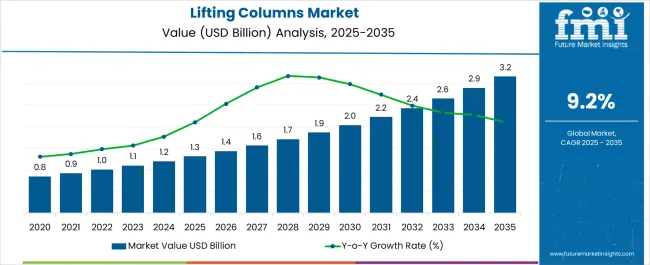
In 2025, the lifting columns market was valued at USD 1.3 billion. Based on Future Market Insights' analysis, demand for lifting columns is estimated to grow to USD 1.42 billion in 2026 and USD 3.5 billion by 2036. FMI projects a CAGR of 9.2% during the forecast period.
An absolute dollar growth of USD 2.08 billion between 2026 and 2036 reflects structural automation of height adjustment rather than volume-only expansion in traditional furniture. Growth depends on increased conversion from manual and hydraulic systems to electric columns that improve precision, energy efficiency, and integration with smart building and Industry 4.0 ecosystems. As per FMI, lifting column suppliers are capturing value not from incremental unit counts alone, but from engineering complexity embedded in medical, industrial, and ergonomic workstations.
Summary of the Lifting Columns Market
- Market Definition
- The market comprises precision-engineered columns designed for linear lifting and height adjustment across medical, industrial, furniture, and workstation applications.
- Demand Drivers
- Rising adoption of electric columns for hospital beds and patient lifts to meet caregiver ergonomics and patient safety standards.
- Expansion of height-adjustable workstations in industrial and commercial settings to improve worker productivity and well-being.
- Increasing integration of intelligent control systems, IoT connectivity, and programmable movement in premium furniture and automation.
- Key Segments Analyzed
- Mode of Operation: Electric leads, accounting for a 45.0% share in 2025 due to precision, programmability, and low maintenance.
- Screw Type: Ball Screws are dominant, commanding 50.0% share in 2025 for their high efficiency and precision.
- Loading Capacity: The 2,500 N – 5,000 N segment leads, favored for its balance of strength and versatility.
- Application: Medical & Healthcare and Industrial remain dominant consumption segments.
- Geography: Asia-Pacific leads volume growth, while North America and Europe drive value through system integration and smart features.
- Analyst Opinion at FMI
- Nikhil Kaitwade, Head of Industrial Automation at Future Market Insights, opines, 'In this revamped edition of the Lifting Columns Market report, CXOs will find that value creation is shifting from basic lifting functionality toward intelligent, connected motion systems aligned with Industry 4.0, smart healthcare, and premium ergonomic programs. Electric column technology is no longer optional in high-growth segments, and suppliers that invest in precision mechanics, control software, and energy efficiency will define the competitive landscape through 2036.'
- Strategic Implications / Executive Takeaways
- Invest in advanced motor, screw, and control system integration capabilities.
- Align product development with the specific load, speed, and duty-cycle demands of medical vs. industrial applications.
- Prioritize value-added features like programmability, noise reduction, and connectivity in healthcare and industrial automation to capture margin expansion.
- Methodology
- Built on primary interviews with lifting column manufacturers and end-use equipment procurement leaders.
- Benchmarked against linear motion component consumption data and production capacity trends.
- Validated using trade data and internal peer review as per FMI modeling standards.
China (12.4% CAGR) leads global expansion, supported by large-scale industrial automation and the modernization of hospital infrastructure, coupled with rising domestic production of premium office furniture. India (11.5% CAGR) follows, driven by rapid urbanization, commercial real estate growth, and expanding local manufacturing of medical and office equipment. Germany (10.6% CAGR) grows on the back of Industry 4.0 investments and a strong export base for medical technology and high-end industrial machinery. Brazil (9.7% CAGR) benefits from modernization in commercial infrastructure and a recovering healthcare equipment sector.
Mature markets such as the United States (8.7% CAGR), the United Kingdom (7.8% CAGR), and Japan (6.9% CAGR) generate comparatively slower expansion, where demand is shaped more by replacement cycles and upgrades to smart, energy-efficient systems than by new unit growth, with intense pricing pressure in standard segments acting as a constraint on value growth.
Lifting Columns Market Definition
The lifting columns market covers the global production and supply of linear actuation systems that provide controlled height adjustment and lifting movements. Manufactured using precision mechanics and electric, hydraulic, or manual drive systems, these columns are engineered for durability, load capacity, and smooth motion. They are widely used in medical and healthcare equipment, industrial workstations, office and residential furniture, and commercial applications where ergonomic positioning and reliable lifting are required.
Market Inclusions
The report includes global and regional market size estimates in value terms, with a forecast period from 2026 to 2036. It provides segmentation by Mode of Operation, Screw Type, Loading Capacity, Application, Stage, and Region. The analysis incorporates manufacturing technology trends, control system integration, developments in screw and motor efficiency, and performance benchmarking across load classes. Regional demand dynamics, country-level growth rates, and competitive positioning are also evaluated as per FMI methodology.
Market Exclusions
The scope excludes standalone linear actuators without integrated column housings, pneumatic lifting systems, and non-adjustable fixed-height supports. It also excludes revenues from finished products like complete hospital beds or desks and focuses strictly on the lifting column component manufacturing layer. Custom low-volume artisanal systems and non-commercial laboratory prototypes are not considered due to negligible market contribution.
Research Methodology
- Primary Research: Interviews were conducted with lifting column manufacturers, linear motion technology suppliers, motor and screw producers, medical and office furniture procurement heads, and industrial automation specialists.
- Desk Research: Public company filings, industrial automation statistics, trade data under relevant HS codes, industry association publications, and regulatory documentation were reviewed.
- Market-Sizing and Forecasting: A hybrid top-down and bottom-up model was constructed, reconstructing demand from end-use equipment production volumes and column-per-unit consumption ratios across applications.
- Data Validation and Update Cycle: Outputs were subjected to variance testing against production capacity data, trade flow benchmarking, and structured internal review prior to publication.
Segmental Analysis
Lifting Columns Market Analysis by Mode of Operation
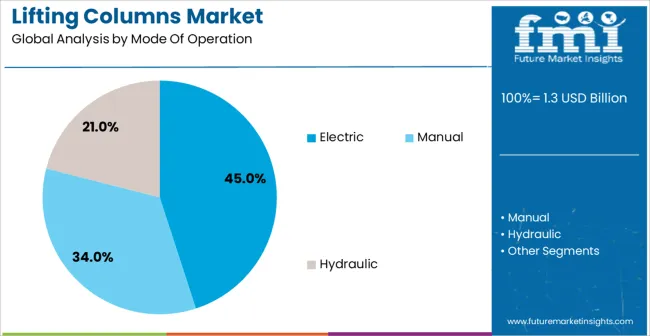
Based on FMI's lifting columns market report, demand for electric lifting columns is estimated to remain the leading mode of operation, capturing 45.0% of the market share. Its balance of precision control, programmability, energy efficiency, and low maintenance requirements supports growth across medical, industrial, and furniture applications. Electric columns are also the default choice for integration with smart control systems and IoT platforms, which keeps them specified in redesign programs even when manufacturers seek to optimize costs through component sourcing.
- Capacity acquisition and expansion: Linak has consistently expanded its production capacity and technological capabilities, including investments in new manufacturing facilities in the USA and China to meet global demand for electric lifting solutions in healthcare and industry.
- Product engineering: Phoenix Mecano's Rose + Krieger brand has launched new modular column systems designed for industrial automation, emphasizing flexibility, load capacity, and ease of integration with existing control architectures.
- Compliance alignment: The increasing adoption of international safety standards for medical electrical equipment (IEC 60601) and industrial machinery (IEC 60204) is reinforcing the need for certified, high-reliability electric lifting columns, creating barriers to entry for uncertified alternatives and favoring established players.
Lifting Columns Market Analysis by Application
Medical & Healthcare and Industrial applications generate maximum demand, as the need for reliable, precise, and safe lifting is procurement-critical in hospital beds, patient lifts, surgical tables, and automated production lines. At the same time, faster value growth is increasingly concentrated in the Furniture segment, where premium residential and commercial customers pay for quiet, smooth, and programmable motion in height-adjustable desks, kitchens, and televisions, pushing advanced electric columns into higher-margin consumer-oriented programs.
- Portfolio expansion: Hettich, a major player in furniture fittings, has strengthened its motion solutions portfolio, integrating smart electric lifting columns into its range for modern, automated living and working environments. 66
- Medical innovation: Key players like Timotion and DewertOkin focus heavily on the medical sector, developing columns with enhanced safety features, quiet operation, and high dynamic load capacities specifically for complex patient handling and care equipment.
- Regional pull-through: The growth split in this market increasingly tracks end-use mix by geography, with Asia-Pacific scaling unit volumes through furniture and industrial equipment manufacturing, while Europe and North America pull higher-value specifications through system integration and smart feature adoption under healthcare and automation investment cycles.
Lifting Columns Market Drivers, Restraints, and Opportunities
Future Market Insights analysis indicates the market has historically existed as a component category tied to specific applications in furniture and basic industrial equipment. Its baseline scale is anchored in the growing recognition of ergonomics as a driver of worker productivity and patient outcomes. As per FMI, the market's valuation is increasingly linked to the automation of work and care environments, where the lifting column becomes a critical element in a broader shift toward smart, adaptable infrastructure.
FMI analysts observe a clear tension between legacy manual and hydraulic columns optimized for low initial cost and newer electric designs that raise unit value through engineered performance, control, and connectivity. Standard columns face pressure where cost is the primary driver, while growth is concentrated in applications that justify higher prices through precision, programmability, reliability, and integration with digital systems in premium medical and industrial settings. This shift nets out as higher value growth because electrification adds manufacturing complexity, control electronics, and tighter tolerances that support margin expansion.
- Aging population and healthcare investment: The global demographic shift toward an older population is increasing demand for hospital beds, patient lifts, and home care equipment, all of which require reliable and safe lifting columns. Government and private healthcare infrastructure spending, particularly in Asia and North America, is a primary driver. 22
- Workplace ergonomics and safety regulations: Stringent occupational safety and health regulations in North America and Europe are mandating ergonomic workstations in industrial and office settings. This drives the adoption of height-adjustable desks and industrial workstations, directly increasing demand for lifting columns. The focus on reducing musculoskeletal disorders among workers is a key commercial imperative for end-users. 33
- Industry 4.0 and smart manufacturing: The push toward automation and data-driven manufacturing is creating demand for intelligent lifting columns that can be integrated into networked production lines. Columns with programmable positions, feedback sensors, and predictive maintenance capabilities are increasingly specified in modern factories, opening higher-value opportunities beyond simple actuation.
Regional Analysis
The lifting columns market is segmented geographically across North America, Europe, Asia-Pacific, Latin America, and Middle East & Africa. Growth dynamics differ based on industrial automation intensity, healthcare infrastructure investment, and furniture manufacturing localization. The full report also provides market attractiveness analysis across regions.
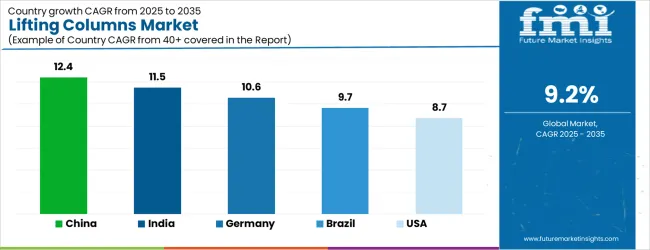
| Country | CAGR |
|---|---|
| China | 12.4% |
| India | 11.5% |
| Germany | 10.6% |
| Brazil | 9.7% |
| USA | 8.7% |
| UK | 7.8% |
| Japan | 6.9% |
Source: Future Market Insights (FMI) analysis, based on proprietary forecasting model and primary research
North America Market Analysis
North America functions as an innovation-driven procurement market, where workplace safety regulations, healthcare technology adoption, and smart building trends shape column selection. Major players include Linak, Phoenix Mecano, and Thomson Industries, all operating strong regional manufacturing and engineering divisions serving medical and industrial clients.
- United States: Demand for lifting columns in the United States is forecasted to advance at an 8.7% CAGR through 2036. Workplace safety standards from OSHA and the modernization of the healthcare sector shape growth. The ongoing shift toward value-based care is driving hospital investments in advanced patient handling equipment to improve outcomes and reduce staff injuries. In the industrial sector, adoption of ergonomic workstations is supported by guidelines from the National Institute for Occupational Safety and Health (NIOSH) to prevent work-related musculoskeletal disorders.
- Unlike Asia, where growth is volume-led, USA growth is driven by product mix upgrades. Medical and industrial applications increasingly require columns with precise control, higher duty cycles, and validated performance under safety standards. Value growth outpaces unit growth, supporting engineered electric column adoption even amid cost pressures in standard segments.
FMI's analysis of lifting columns market in North America consists of country-wise assessment that includes the United States and Canada. Readers can find policy mapping, technology adoption trends, and specification evolution insights.
Europe Market Analysis
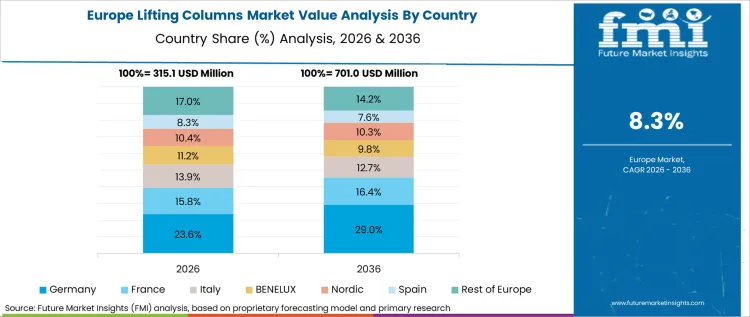
Europe acts as the compliance and quality-intensive zone for the lifting columns sector. Regional players such as Linak, Phoenix Mecano, and DewertOkin maintain strong engineering and manufacturing networks and align closely with EU machinery directives, medical device regulations, and sustainability frameworks.
- Germany: Demand for lifting columns in Germany is projected to rise at a 10.6% CAGR through 2036. Growth is influenced by the strength of its industrial automation and medical technology sectors. Germany's position as a global leader in Industry 4.0 drives demand for intelligent, networked lifting solutions in factories. The country's robust medical technology export industry requires high-precision, reliable columns for surgical tables, hospital beds, and diagnostic equipment. Compliance with stringent European standards like the Machinery Directive (2006/42/EC) and the Medical Device Regulation (MDR) is a baseline requirement.
- In 2024, Germany held a dominant revenue share in the Western Europe market. The country's strong manufacturing base in both industrial machinery and healthcare equipment supports sustained demand for high-quality, high-performance lifting columns. Growth in this market is therefore quality-led and export-aligned.
FMI's analysis of lifting columns market in Europe consists of country-wise assessment that includes Germany, United Kingdom, France, Italy, and Spain. Readers can find regulatory impact assessment, technology adoption modeling, and material transition insights.
Asia-Pacific Market Analysis
Asia-Pacific remains the volume expansion engine of the global market. The region benefits from dense manufacturing clusters for furniture, industrial equipment, and medical devices, supported by integrated supply chains. Key players include Linak's regional subsidiaries, Timotion's manufacturing base, and a vast network of local precision-motion suppliers across China and Taiwan.
- China: Lifting columns sales in China are projected to rise at a 12.4% CAGR through 2036. Rapid industrial automation, massive healthcare infrastructure investment, and the expanding domestic premium furniture market support growth. In line with the "Healthy China 2030" initiative, there is significant government and private investment in upgrading hospital facilities, directly boosting demand for advanced medical beds and equipment. 99 The "Made in China 2025" strategy continues to drive automation across manufacturing, increasing adoption of flexible, ergonomic industrial workstations.
- China's strength lies in its manufacturing density and its role as the world's largest producer of office and home furniture. As domestic consumption of premium, adjustable furniture grows, so does the demand for locally produced or integrated high-quality lifting columns.
FMI's analysis of lifting columns market in Asia-Pacific consists of country-wise assessment that includes China, India, Japan, and South Korea. Readers can find capacity tracking, export linkage evaluation, and regional demand modeling.
- India: Demand for lifting columns in India is projected to rise at an 11.5% CAGR through 2036. Growth is supported by rapid urbanization, the expansion of the commercial real estate sector, and increasing localization of manufacturing for furniture and medical equipment. The Indian government's 'Production Linked Incentive' (PLI) schemes for medical devices and white goods are stimulating domestic manufacturing, creating demand for local supply of components like lifting columns.
- In the commercial sector, the growth of co-working spaces and modern offices is accelerating the adoption of height-adjustable desks. In healthcare, the Ayushman Bharat scheme is driving demand for new hospital infrastructure in Tier II and Tier III cities. This domestic consumption focus, rather than an export-heavy model, is driving India's growth. Modern trade expansion and higher-value SKU launches increase demand for precision electric columns over basic manual alternatives.
FMI's analysis of lifting columns market in Asia-Pacific consists of country-wise assessment that includes China, India, Japan, and South Korea. Readers can find domestic manufacturing trends, policy implications, and end-use sector demand evolution insights.
Competitive Aligners for Market Players
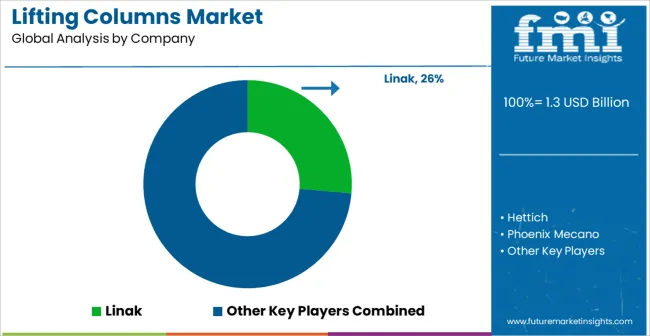
The lifting columns market is moderately consolidated at the global level, with multinational specialists accounting for a significant share of value revenue, while regional precision-motion suppliers compete aggressively in high-volume, price-sensitive segments. As per FMI estimates, the top five global players collectively control a substantial portion of total market value, particularly in the medical and high-end industrial segments. The primary competitive variable is not raw material pricing but engineering precision in electromechanical design, control software integration, reliability under cyclical load, and global certification support.
Large integrated players such as Linak, Phoenix Mecano, and Thomson benefit from scale advantages in R&D investment, automated assembly lines, and global customer contracts. Companies with broad portfolios covering medical, industrial, and furniture applications can cross-sell solutions across different sectors. Structural advantage also comes from geographic manufacturing footprints that allow localized production near key end-use equipment markets, minimizing logistics costs and improving supply reliability.
Buyer behavior in this market reflects concentrated procurement power in key end-use sectors. Major medical equipment and office furniture manufacturers typically dual-source column suppliers to mitigate supply chain risk. Framework agreements often include multi-year volume commitments with cost pass-through mechanisms tied to raw material indices. As a result, pricing power for suppliers depends less on commodity swings and more on differentiated performance, reliability, compliance documentation, and the ability to support rapid new product development without engineering delays.
Recent Developments
- Linak - Product Launch (April 2026): Linak launched a new generation of DESKLINE (Furniture) and HOMELINE (Healthcare) lifting columns at Interpack 2026, emphasizing ultra-quiet operation, energy efficiency, and enhanced design integration capabilities for modern applications.
- Phoenix Mecano - Production Modernization (March 2025): Phoenix Mecano announced a significant investment in automating its assembly lines for industrial columns at its Kenly, NC, facility in the USA to improve efficiency and meet growing North American demand.
- Timotion - Strategic Partnership (October 2025): Timotion announced a strategic partnership with a major European controls manufacturer to integrate advanced IoT and predictive maintenance capabilities into its next-generation medical lifting columns.
Key Players in the Lifting Columns Market
- Linak
- Hettich
- Phoenix Mecano
- Thomson
- Timotion
- Dewertokin
- Hoerbiger
- Ketterer
- Roemheld
- Suspa
- X2 Technology
Scope of Report
| Metric | Value |
|---|---|
| Quantitative Units | USD 1.42 billion (2026) to USD 3.5 billion (2036), at a CAGR of 9.2% |
| Market Definition | The lifting columns market comprises the global production and supply of mechanical and electromechanical linear actuation systems designed for height adjustment and lifting tasks across medical, industrial, furniture, and workstation applications. |
| Mode of Operation Segmentation | Electric, Manual, Hydraulic |
| Screw Type Segmentation | Ball Screws, Telescopic Lead Screws, Trapezoidal Screws |
| Loading Capacity Segmentation | 2,500 N – 5,000 N, Up To 2,500 N, Above 5000 N |
| Application Segmentation | Furniture, Medical & Healthcare, Workstations, Industrial |
| Stage Segmentation | 2 Stage, 1 Stage, 3 Stage |
| Region Segmentation | North America, Europe, Asia-Pacific, Latin America, Middle East & Africa |
| Countries Covered | United States, Canada, Germany, United Kingdom, France, Italy, Spain, China, India, Japan, South Korea, Brazil and 40+ countries |
| Key Companies Profiled | Linak, Hettich, Phoenix Mecano, Thomson, Timotion, Dewertokin, Hoerbiger, Ketterer, Roemheld, Suspa, X2 Technology |
| Forecast Period | 2026 to 2036 |
| Approach | Hybrid top-down and bottom-up market modeling validated through primary interviews with lifting column manufacturers, linear motion component suppliers, and end-use equipment procurement leaders, supported by trade benchmarking and production capacity analysis |
Lifting Columns Market Analysis by Segments
Mode of Operation
- Electric
- Manual
- Hydraulic
Screw Type
- Ball Screws
- Telescopic Lead Screws
- Trapezoidal Screws
Loading Capacity
- 2,500 N - 5,000 N
- Up To 2,500 N
- Above 5000 N
Application
- Furniture
- Medical & Healthcare
- Workstations
- Industrial
Stage
- 2 Stage
- 1 Stage
- 3 Stage
Region
- North America
- USA
- Canada
- Mexico
- Latin America
- Brazil
- Chile
- Rest of Latin America
- Western Europe
- Germany
- UK
- Italy
- Spain
- France
- Nordic
- BENELUX
- Rest of Western Europe
- Eastern Europe
- Russia
- Poland
- Hungary
- Balkan & Baltic
- Rest of Eastern Europe
- East Asia
- China
- Japan
- South Korea
- South Asia and Pacific
- India
- ASEAN
- Australia & New Zealand
- Rest of South Asia and Pacific
- Middle East & Africa
- Kingdom of Saudi Arabia
- Other GCC Countries
- Turkiye
- South Africa
- Other African Union
- Rest of Middle East & Africa
Bibliography
- [1] Linak. (2025). Annual Report 2025.
- [2] United Nations, Department of Economic and Social Affairs, Population Division. (2022). World Population Prospects 2022: Summary of Results.
- [3] Occupational Safety and Health Administration (OSHA). (2024). Ergonomics for the Prevention of Musculoskeletal Disorders.
- [4] Linak. (2025). Linak expands production capacity in the US and China. Company Press Release.
- [5] Phoenix Mecano. (2025). Rose + Krieger product catalog: Linear motion technology.
- [6] Hettich. (2025). Motion Solutions for Modern Living. Company Brochure.
- [7] National Institute for Occupational Safety and Health (NIOSH). (2024). Elements of Ergonomic Programs.
- [8] European Parliament and Council. (2006). *Directive 2006/42/EC on machinery*.
- [9] State Council of the People's Republic of China. (2016). "Healthy China 2030" Blueprint.
- [10] Ministry of Commerce and Industry, Government of India. (2025). Production Linked Incentive (PLI) Scheme for Medical Devices.
- [11] Phoenix Mecano. (2025). Phoenix Mecano invests in automation at Kenly facility. Company Press Release.
Frequently Asked Questions
How large is the demand for lifting columns in the global market in 2026?
Demand for lifting columns is estimated to be valued at USD 1.42 billion in 2026.
What will be the market size of lifting columns in the global market by 2036?
Market size for lifting columns is projected to reach USD 3.5 billion by 2036.
What is the expected demand growth for lifting columns between 2026 and 2036?
Demand for lifting columns is expected to grow at a 9.2% CAGR between 2026 and 2036.
Which mode of operation is poised to lead global sales?
Electric is expected to remain the leading mode of operation, anchored by its precision and programmability, and it held a 45.0% share in 2025.
Which screw type segment contributes a significant share in the lifting columns market?
Ball screws command a 50.0% share, leading due to their high efficiency and precision in linear motion.
Which loading capacity segment is the largest?
Ball screws command a 50.0% share, leading due to their high efficiency and precision in linear motion.
Which loading capacity segment is the largest?
The 2,500 N – 5,000 N segment leads, favored for its balance of strength and versatility across applications.
How significant is the role of Medical & Healthcare in driving adoption of lifting columns?
Medical & Healthcare is a primary consumption sector because reliability, safety, and precise control in hospital beds and patient lifts are procurement-critical.
What is driving demand in the United States?
Workplace safety regulations, healthcare technology upgrades, and industrial automation are supporting demand growth in the United States.
What is the United States growth outlook in this report?
The United States is projected to expand at an 8.7% CAGR during 2026 to 2036.
Why is Europe described as a quality-intensive region in this report?
European demand is shaped by stringent machinery and medical device regulations that elevate scrutiny of column design, certification, and performance documentation.
What type of demand dominates in Europe?
Demand is driven primarily by high-quality applications in industrial automation and medical technology, rather than low-cost unit expansion alone.
What is Germany growth outlook in this report?
Germany is projected to expand at a 10.6% CAGR during 2026 to 2036.
Does the report cover the United Kingdom in its regional analysis?
Yes, the United Kingdom is included within Europe under the regional coverage framework.
What is the United Kingdom growth outlook in this report?
The United Kingdom is projected to expand at a 7.8% CAGR during 2026 to 2036.
Does the report cover China in its regional analysis?
Yes, China is included within Asia-Pacific and is a high-growth country market covered in the report.
What is the China growth outlook in this report?
China is projected to expand at a 12.4% CAGR during 2026 to 2036.
Does the report cover India in its regional analysis?
Yes, India is included within Asia-Pacific and is covered in the country-wise assessment.
What is the India growth outlook in this report?
India is projected to expand at a 11.5% CAGR during 2026 to 2036.
Does the report cover Japan in its regional analysis?
Yes, Japan is included within Asia-Pacific under the regional scope of analysis.
What is the Japan growth outlook in this report?
Japan is projected to expand at a 6.9% CAGR during 2026 to 2036.
Does the report cover Brazil in its regional analysis?
Yes, Brazil is included within Latin America and is covered in the country-wise assessment.
What is the Brazil growth outlook in this report?
Brazil is projected to expand at a 9.7% CAGR during 2026 to 2036.
What is a lifting column and what is it mainly used for?
A lifting column is a precision linear actuation system, mainly used for controlled height adjustment and lifting in medical equipment (beds, patient lifts), industrial workstations, and ergonomic furniture (desks).
What does the lifting columns market mean in this report?
It refers to the global manufacturing and supply of lifting columns by mode of operation, screw type, loading capacity, application, stage, and region, measured in value terms.
What is included in the scope of this lifting columns market report?
Scope includes market sizing and forecasting for 2026 to 2036, segmentation by mode of operation, screw type, loading capacity, application, stage, and region, along with competitive assessment and country-wise outlook.
What is excluded from the scope of this report?
The scope excludes standalone actuators without integrated housings, pneumatic systems, and downstream revenues from finished equipment, focusing strictly on lifting column component manufacturing and supply.
Preview the report firsthand - request a free sample
Get SampleGet the brochure for pricing and purchase details.
Get PDFTable of Content
- Executive Summary
- Global Market Outlook
- Demand-side Trends
- Supply-side Trends
- Technology Roadmap Analysis
- Analysis and Recommendations
- Market Overview
- Market Coverage / Taxonomy
- Market Definition / Scope / Limitations
- Research Methodology
- Chapter Orientation
- Analytical Lens and Working Hypotheses
- Market Structure, Signals, and Trend Drivers
- Benchmarking and Cross-market Comparability
- Market Sizing, Forecasting, and Opportunity Mapping
- Research Design and Evidence Framework
- Desk Research Programme (Secondary Evidence)
- Company Annual and Sustainability Reports
- Peer-reviewed Journals and Academic Literature
- Corporate Websites, Product Literature, and Technical Notes
- Earnings Decks and Investor Briefings
- Statutory Filings and Regulatory Disclosures
- Technical White Papers and Standards Notes
- Trade Journals, Industry Magazines, and Analyst Briefs
- Conference Proceedings, Webinars, and Seminar Materials
- Government Statistics Portals and Public Data Releases
- Press Releases and Reputable Media Coverage
- Specialist Newsletters and Curated Briefings
- Sector Databases and Reference Repositories
- FMI Internal Proprietary Databases and Historical Market Datasets
- Subscription Datasets and Paid Sources
- Social Channels, Communities, and Digital Listening Inputs
- Additional Desk Sources
- Expert Input and Fieldwork (Primary Evidence)
- Primary Modes
- Qualitative Interviews and Expert Elicitation
- Quantitative Surveys and Structured Data Capture
- Blended Approach
- Why Primary Evidence is Used
- Field Techniques
- Interviews
- Surveys
- Focus Groups
- Observational and In-context Research
- Social and Community Interactions
- Stakeholder Universe Engaged
- C-suite Leaders
- Board Members
- Presidents and Vice Presidents
- R&D and Innovation Heads
- Technical Specialists
- Domain Subject-matter Experts
- Scientists
- Physicians and Other Healthcare Professionals
- Governance, Ethics, and Data Stewardship
- Research Ethics
- Data Integrity and Handling
- Primary Modes
- Tooling, Models, and Reference Databases
- Desk Research Programme (Secondary Evidence)
- Data Engineering and Model Build
- Data Acquisition and Ingestion
- Cleaning, Normalisation, and Verification
- Synthesis, Triangulation, and Analysis
- Quality Assurance and Audit Trail
- Market Background
- Market Dynamics
- Drivers
- Restraints
- Opportunity
- Trends
- Scenario Forecast
- Demand in Optimistic Scenario
- Demand in Likely Scenario
- Demand in Conservative Scenario
- Opportunity Map Analysis
- Product Life Cycle Analysis
- Supply Chain Analysis
- Investment Feasibility Matrix
- Value Chain Analysis
- PESTLE and Porter’s Analysis
- Regulatory Landscape
- Regional Parent Market Outlook
- Production and Consumption Statistics
- Import and Export Statistics
- Market Dynamics
- Global Market Analysis 2021 to 2025 and Forecast, 2026 to 2036
- Historical Market Size Value (USD Million) Analysis, 2021 to 2025
- Current and Future Market Size Value (USD Million) Projections, 2026 to 2036
- Y-o-Y Growth Trend Analysis
- Absolute $ Opportunity Analysis
- Global Market Pricing Analysis 2021 to 2025 and Forecast 2026 to 2036
- Global Market Analysis 2021 to 2025 and Forecast 2026 to 2036, By Mode of Operation
- Introduction / Key Findings
- Historical Market Size Value (USD Million) Analysis By Mode of Operation , 2021 to 2025
- Current and Future Market Size Value (USD Million) Analysis and Forecast By Mode of Operation , 2026 to 2036
- Electric
- Manual
- Hydraulic
- Electric
- Y-o-Y Growth Trend Analysis By Mode of Operation , 2021 to 2025
- Absolute $ Opportunity Analysis By Mode of Operation , 2026 to 2036
- Global Market Analysis 2021 to 2025 and Forecast 2026 to 2036, By Screw Type
- Introduction / Key Findings
- Historical Market Size Value (USD Million) Analysis By Screw Type, 2021 to 2025
- Current and Future Market Size Value (USD Million) Analysis and Forecast By Screw Type, 2026 to 2036
- Ball Screws
- Telescopic Lead Screws
- Trapezoidal Screws
- Ball Screws
- Y-o-Y Growth Trend Analysis By Screw Type, 2021 to 2025
- Absolute $ Opportunity Analysis By Screw Type, 2026 to 2036
- Global Market Analysis 2021 to 2025 and Forecast 2026 to 2036, By Region
- Introduction
- Historical Market Size Value (USD Million) Analysis By Region, 2021 to 2025
- Current Market Size Value (USD Million) Analysis and Forecast By Region, 2026 to 2036
- North America
- Latin America
- Western Europe
- Eastern Europe
- East Asia
- South Asia and Pacific
- Middle East & Africa
- Market Attractiveness Analysis By Region
- North America Market Analysis 2021 to 2025 and Forecast 2026 to 2036, By Country
- Historical Market Size Value (USD Million) Trend Analysis By Market Taxonomy, 2021 to 2025
- Market Size Value (USD Million) Forecast By Market Taxonomy, 2026 to 2036
- By Country
- USA
- Canada
- Mexico
- By Mode of Operation
- By Screw Type
- By Country
- Market Attractiveness Analysis
- By Country
- By Mode of Operation
- By Screw Type
- Key Takeaways
- Latin America Market Analysis 2021 to 2025 and Forecast 2026 to 2036, By Country
- Historical Market Size Value (USD Million) Trend Analysis By Market Taxonomy, 2021 to 2025
- Market Size Value (USD Million) Forecast By Market Taxonomy, 2026 to 2036
- By Country
- Brazil
- Chile
- Rest of Latin America
- By Mode of Operation
- By Screw Type
- By Country
- Market Attractiveness Analysis
- By Country
- By Mode of Operation
- By Screw Type
- Key Takeaways
- Western Europe Market Analysis 2021 to 2025 and Forecast 2026 to 2036, By Country
- Historical Market Size Value (USD Million) Trend Analysis By Market Taxonomy, 2021 to 2025
- Market Size Value (USD Million) Forecast By Market Taxonomy, 2026 to 2036
- By Country
- Germany
- UK
- Italy
- Spain
- France
- Nordic
- BENELUX
- Rest of Western Europe
- By Mode of Operation
- By Screw Type
- By Country
- Market Attractiveness Analysis
- By Country
- By Mode of Operation
- By Screw Type
- Key Takeaways
- Eastern Europe Market Analysis 2021 to 2025 and Forecast 2026 to 2036, By Country
- Historical Market Size Value (USD Million) Trend Analysis By Market Taxonomy, 2021 to 2025
- Market Size Value (USD Million) Forecast By Market Taxonomy, 2026 to 2036
- By Country
- Russia
- Poland
- Hungary
- Balkan & Baltic
- Rest of Eastern Europe
- By Mode of Operation
- By Screw Type
- By Country
- Market Attractiveness Analysis
- By Country
- By Mode of Operation
- By Screw Type
- Key Takeaways
- East Asia Market Analysis 2021 to 2025 and Forecast 2026 to 2036, By Country
- Historical Market Size Value (USD Million) Trend Analysis By Market Taxonomy, 2021 to 2025
- Market Size Value (USD Million) Forecast By Market Taxonomy, 2026 to 2036
- By Country
- China
- Japan
- South Korea
- By Mode of Operation
- By Screw Type
- By Country
- Market Attractiveness Analysis
- By Country
- By Mode of Operation
- By Screw Type
- Key Takeaways
- South Asia and Pacific Market Analysis 2021 to 2025 and Forecast 2026 to 2036, By Country
- Historical Market Size Value (USD Million) Trend Analysis By Market Taxonomy, 2021 to 2025
- Market Size Value (USD Million) Forecast By Market Taxonomy, 2026 to 2036
- By Country
- India
- ASEAN
- Australia & New Zealand
- Rest of South Asia and Pacific
- By Mode of Operation
- By Screw Type
- By Country
- Market Attractiveness Analysis
- By Country
- By Mode of Operation
- By Screw Type
- Key Takeaways
- Middle East & Africa Market Analysis 2021 to 2025 and Forecast 2026 to 2036, By Country
- Historical Market Size Value (USD Million) Trend Analysis By Market Taxonomy, 2021 to 2025
- Market Size Value (USD Million) Forecast By Market Taxonomy, 2026 to 2036
- By Country
- Kingdom of Saudi Arabia
- Other GCC Countries
- Turkiye
- South Africa
- Other African Union
- Rest of Middle East & Africa
- By Mode of Operation
- By Screw Type
- By Country
- Market Attractiveness Analysis
- By Country
- By Mode of Operation
- By Screw Type
- Key Takeaways
- Key Countries Market Analysis
- USA
- Pricing Analysis
- Market Share Analysis, 2025
- By Mode of Operation
- By Screw Type
- Canada
- Pricing Analysis
- Market Share Analysis, 2025
- By Mode of Operation
- By Screw Type
- Mexico
- Pricing Analysis
- Market Share Analysis, 2025
- By Mode of Operation
- By Screw Type
- Brazil
- Pricing Analysis
- Market Share Analysis, 2025
- By Mode of Operation
- By Screw Type
- Chile
- Pricing Analysis
- Market Share Analysis, 2025
- By Mode of Operation
- By Screw Type
- Germany
- Pricing Analysis
- Market Share Analysis, 2025
- By Mode of Operation
- By Screw Type
- UK
- Pricing Analysis
- Market Share Analysis, 2025
- By Mode of Operation
- By Screw Type
- Italy
- Pricing Analysis
- Market Share Analysis, 2025
- By Mode of Operation
- By Screw Type
- Spain
- Pricing Analysis
- Market Share Analysis, 2025
- By Mode of Operation
- By Screw Type
- France
- Pricing Analysis
- Market Share Analysis, 2025
- By Mode of Operation
- By Screw Type
- India
- Pricing Analysis
- Market Share Analysis, 2025
- By Mode of Operation
- By Screw Type
- ASEAN
- Pricing Analysis
- Market Share Analysis, 2025
- By Mode of Operation
- By Screw Type
- Australia & New Zealand
- Pricing Analysis
- Market Share Analysis, 2025
- By Mode of Operation
- By Screw Type
- China
- Pricing Analysis
- Market Share Analysis, 2025
- By Mode of Operation
- By Screw Type
- Japan
- Pricing Analysis
- Market Share Analysis, 2025
- By Mode of Operation
- By Screw Type
- South Korea
- Pricing Analysis
- Market Share Analysis, 2025
- By Mode of Operation
- By Screw Type
- Russia
- Pricing Analysis
- Market Share Analysis, 2025
- By Mode of Operation
- By Screw Type
- Poland
- Pricing Analysis
- Market Share Analysis, 2025
- By Mode of Operation
- By Screw Type
- Hungary
- Pricing Analysis
- Market Share Analysis, 2025
- By Mode of Operation
- By Screw Type
- Kingdom of Saudi Arabia
- Pricing Analysis
- Market Share Analysis, 2025
- By Mode of Operation
- By Screw Type
- Turkiye
- Pricing Analysis
- Market Share Analysis, 2025
- By Mode of Operation
- By Screw Type
- South Africa
- Pricing Analysis
- Market Share Analysis, 2025
- By Mode of Operation
- By Screw Type
- USA
- Market Structure Analysis
- Competition Dashboard
- Competition Benchmarking
- Market Share Analysis of Top Players
- By Regional
- By Mode of Operation
- By Screw Type
- Competition Analysis
- Competition Deep Dive
- Linak
- Overview
- Product Portfolio
- Profitability by Market Segments (Product/Age /Sales Channel/Region)
- Sales Footprint
- Strategy Overview
- Marketing Strategy
- Product Strategy
- Channel Strategy
- Hettich
- Phoenix Mecano
- Thomson
- Timotion
- Dewertokin
- Hoerbiger
- Ketterer
- Linak
- Competition Deep Dive
- Assumptions & Acronyms Used


