

- Market Size (2026)
- USD 7.3 Bn
- Forecast (2036)
- USD 29.2 Bn
- CAGR (2026 to 2036)
- 14.8%
How big is the liquid biopsy market in 2026?
USD 7.3 billion in 2026, reaching USD 29.2 billion by 2036 at a 14.8% CAGR
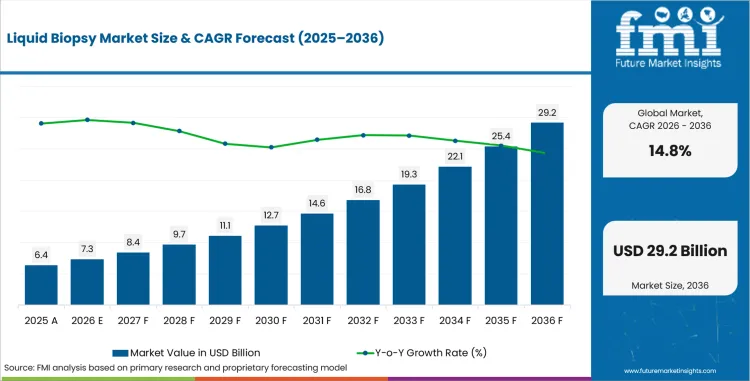
The liquid biopsy market was valued at USD 6.4 billion in 2025. The market is set to reach USD 7.3 billion by 2026-end and grow at a CAGR of 14.8% between 2026-2036 to reach USD 29.2 billion by 2036. Circulating Tumor Cells (CTCs) will dominate with a 70.0% share, while Blood will lead with a 87.4% share.
Key Takeaways, Market Size, and Forecast
- Liquid Biopsy Market Value (2025): USD 6.4 Bn
- Liquid Biopsy Market Forecast Value (2036): USD 29.2 Bn
- Liquid Biopsy Market Forecast CAGR (2026 TO 2036): 14.8%
- Liquid Biopsy Market Leading Biomarker Type Segment: Circulating Tumor Cells (CTCs) (70.0%)
- Liquid Biopsy Market Key Growth Regions: China, India, Germany, Brazil, USA, UK
- Liquid Biopsy Market Key Players: Guardant Health, Illumina, Inc., Bio-Rad Laboratories, Roche Diagnostics, Natera, Inc., Exact Sciences Corporation, Foundation Medicine
| Parameter | Details |
|---|---|
| Market Size in 2026 (Value) | USD 7.3 Bn |
| Market Forecast in 2036 (Value) | USD 29.2 Bn |
| CAGR (2026 to 2036) | 14.8% |
| Years Considered | 2021 to 2036 |
| Base Year | 2025 |
| Forecast Period | 2026 to 2036 |
| Units Considered | Value (USD Bn) |
| Leading Sub-Region | China |
Summary of the Liquid Biopsy Market
- Demand and Growth Drivers
- Rising cancer incidence and demand for non-invasive diagnostic alternatives are accelerating adoption of liquid biopsy technologies for early cancer detection and treatment monitoring.
- Clinical validation of circulating tumor cell and cell-free DNA assays is expanding reimbursement coverage and physician adoption across oncology treatment pathways.
- Growth in companion diagnostic applications, where liquid biopsy guides targeted therapy selection, is creating structured demand linked to the expansion of precision oncology programs.
- Product and Segment View
- Circulating tumor cells (CTCs) account for 70.0% of biomarker type share, reflecting established clinical evidence for CTC enumeration in treatment response monitoring and prognosis assessment.
- Blood-based sample collection holds 87.4% of sample type share, as peripheral blood draws offer the least invasive collection method with the broadest clinical utility.
- Lung cancer accounts for 38.0% of cancer type share, supported by the high clinical need for non-invasive molecular profiling in advanced non-small cell lung cancer treatment selection.
- Geography and Competitive Outlook
- China leads at 20.0% CAGR, reflecting government investment in precision medicine infrastructure, hospital laboratory expansion, and growing adoption of molecular oncology diagnostics.
- North America sustains the largest market, anchored by established reimbursement coverage, clinical practice guideline integration, and strong commercial laboratory infrastructure for liquid biopsy testing.
- Companies with validated multi-cancer detection platforms and established laboratory distribution networks are positioned to capture expanding demand across diagnostic and treatment monitoring applications.
- Analyst Opinion
- Anurag Sharma, Principal Consultant at FMI says, 'Diagnostic companies that can demonstrate clinical utility across multiple cancer types while securing broad payer coverage are likely to establish durable competitive positions over the forecast period.'
- The liquid biopsy market is transitioning from single-cancer diagnostic applications toward multi-cancer early detection platforms that screen for multiple tumor types from a single blood draw.
- Adoption is increasing due to clinical evidence demonstrating liquid biopsy utility for treatment selection, minimal residual disease monitoring, and recurrence surveillance.
- Demand is supported by precision oncology program expansion that requires molecular profiling to guide targeted therapy and immunotherapy treatment decisions.
- Growth is attributable to technology advancement in next-generation sequencing sensitivity, which enables detection of tumor-derived biomarkers at earlier disease stages.
What is a liquid biopsy and what does the market cover?
Diagnostic tests and technologies analyzing circulating biomarkers in blood to detect and monitor cancer without tissue biopsy
The liquid biopsy market encompasses diagnostic tests and technologies that analyze circulating biomarkers in body fluids, primarily blood, to detect, monitor, and characterize cancer and other diseases without invasive tissue biopsy procedures. Products include assays for circulating tumor cells (CTCs), circulating tumor nucleic acids (ctDNA, ctRNA), and exosome analysis platforms used in cancer diagnosis, treatment monitoring, and recurrence surveillance.
What is included in the liquid biopsy market scope?
Assays for circulating tumor cells (CTCs), circulating tumor nucleic acids (ctDNA, ctRNA) and exosome analysis platforms, 2026 to 2036.
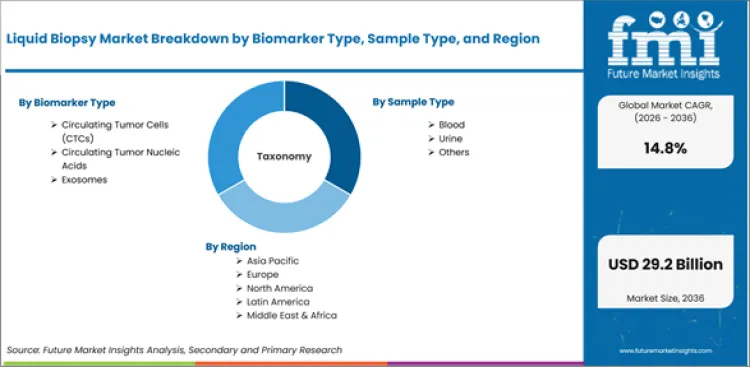
Market scope covers all commercially available liquid biopsy products categorized by biomarker type (circulating tumor cells, circulating tumor nucleic acids, exosomes), sample type (blood, urine, others), end user (hospitals, cancer institutes, academic institutes, diagnostic centers), application (cancer diagnosis, treatment monitoring, recurrence monitoring), and cancer type (lung cancer, breast cancer, colorectal cancer, others). Revenue is tracked from 2026 to 2036.
What is excluded from the liquid biopsy market scope?
Traditional tissue biopsy procedures, imaging-based diagnostics, and non-specific laboratory equipment and consumables
The scope does not include traditional tissue biopsy procedures, imaging-based cancer diagnostic technologies, or laboratory equipment and consumables not specific to liquid biopsy workflows.
How was the liquid biopsy market research conducted?
Primary interviews, desk research, bottom-up sizing, and quarterly validation
- Primary Research: FMI analysts interviewed oncologists, pathologists, directors of diagnostic laboratories, and developers of liquid biopsy technologies in key clinical and commercial markets.
- Desk Research: Compile data from clinical laboratory test volume registries, diagnostic company revenue disclosures and databases of enrollment for precision oncology programs.
- Market Size and Forecast: Bottom-up market sizing of test volumes by biomarker types, cancer indications, and clinical settings. Adoption velocity by geography.
- Data Validation: Cross-validation of quarterly clinical trial outcome data, payer coverage decisions, and reference laboratory test volume tracking.
Why is the liquid biopsy market growing?
Rising cancer incidence and demand for non-invasive molecular profiling and monitoring
- The global rise in cancer incidence has resulted in an unmet clinical need for non-invasive diagnostic alternatives that enable molecular profiling, treatment monitoring, and recurrence surveillance without the need for repeated tissue biopsies.
- Reimbursement expansion for liquid biopsy tests in the USA and Europe is removing a key adoption barrier, enabling broader physician ordering and patient access across oncology care pathways.
- China leads at 20.0% CAGR due to investment in precision medicine infrastructure, expansion of hospital molecular diagnostics laboratory, development of a national cancer screening program.
The clinical limitations of conventional tissue biopsy (invasive, not always feasible due to tumor location, single-timepoint snapshot of tumor molecular characteristics) shape the demand for liquid biopsy technologies. Liquid biopsy offers the ability to longitudinally track the molecular status via non-invasive blood collection, giving oncologists a tool to evaluate treatment response, emerging resistance mutations, and detect disease relapse earlier than surveillance based on imaging. Circulating tumor cells have a biomarker type share of 70.0%. Clinical evidence for CTC enumeration has been established to assess prognosis and treatment response.
Blood-based sample collection dominates with 87.4% sample type share as peripheral blood draws are widely accepted by patients, easy to perform in outpatient settings and compatible with existing laboratory processing infrastructure. The sensitivity of circulating tumor DNA detection has been dramatically improved with next-generation sequencing platforms allowing detection of tumor-derived mutations at very low allele frequencies. This technical advance is broadening clinical utility from late-stage treatment monitoring to earlier-stage cancer detection and minimal residual disease assessment.
The application spectrum includes cancer diagnosis (34.0% share), treatment monitoring and recurrence monitoring. Lung cancer accounted for 38.0% of cancer type share, illustrating the high clinical need for molecular profiling in advanced non-small cell lung cancer (NSCLC) where EGFR, ALK and other targetable mutations guide therapy selection. Liquid biopsy is also used in other major application areas such as breast cancer and colorectal cancer for treatment decision making and for longitudinal disease monitoring.
How is the liquid biopsy market segmented?
By biomarker type, sample type, end user, application and cancer type
- Circulating tumor cells (CTCs) account for 70.0% of biomarker type share. CTC enumeration has demonstrated clinical evidence for prognosis assessment and treatment response monitoring in solid tumor types.
- Blood-based collection accounts for 87.4% of sample type share, reflecting the acceptance of peripheral blood draws and the compatibility with existing clinical laboratory infrastructure.
- Cancer diagnosis accounts for 34.0% of application share. Treatment monitoring and recurrence surveillance are increasing applications with growing clinical evidence.
Why do circulating tumor cells (CTCs) lead the liquid biopsy market?
They hold 70.0% share, led by CTC enumeration in breast, prostate and colorectal cancers
Biomarker type share in 2026 - 70.0% Circulating tumor cells. Clinical validation of CTC enumeration for prognosis assessment has been demonstrated in metastatic breast, prostate and colorectal cancers where CTC counts are associated with disease burden and treatment response.
Advanced platforms for CTC analysis now offer molecular characterization of captured cells, including information on mutation profile and drug sensitivity in addition to simple enumeration. This increased analytical power is transforming CTC-based liquid biopsy into a more complete companion diagnostic tool that not only guides treatment selection but also longitudinal disease monitoring.
How big is the blood sample segment in the liquid biopsy market?
About 87.4% share, led by minimally invasive peripheral blood draws for serial monitoring
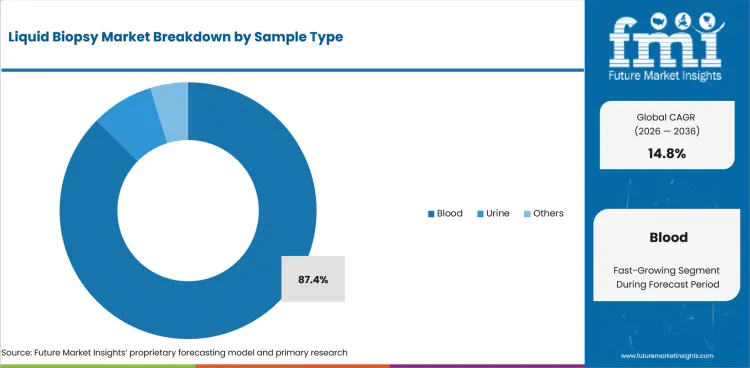
Blood samples will make up 87.4% of the sample type share in 2026. Peripheral blood draws are minimally invasive, well tolerated by patients, and can be easily repeated for serial monitoring applications. Stabilization agents in standard blood collection tubes maintain circulating biomarkers during transport to reference laboratories.
Urine-based liquid biopsy is becoming a complementary sample type for certain cancer indications where urinary biomarkers offer additional diagnostic information. The ease of non-venipuncture urine collection is especially important for screening applications, where patient adherence to regular testing is essential for the success of the clinical program.
What drives and restrains the liquid biopsy market?
Driven by rising cancer incidence and non-invasive profiling demand; restrained by reimbursement complexity and coverage gaps
- Rising cancer incidence and demand for non-invasive molecular profiling are creating sustained growth in liquid biopsy adoption across diagnostic and treatment monitoring applications.
- Reimbursement complexity and payer coverage variability across geographies constrain adoption in markets where liquid biopsy tests lack established coverage pathways.
- Multi-cancer early detection platforms represent the largest growth opportunity, with potential to create population-scale screening programs that fundamentally expand the addressable market.
The liquid biopsy market continues to expand rapidly under the influence of trends in cancer incidence, clinical validation development and reimbursement growth. Market development is hampered by challenges with payer coverage and variable clinical adoption, but multi-cancer detection and companion diagnostic applications offer transformative growth opportunities.
What drives clinical adoption?
Growing evidence and guideline integration for liquid biopsy in treatment selection
Demand is being driven by increasing clinical evidence for the utility of liquid biopsy in treatment selection and monitoring. Liquid biopsy testing is now supported by NCCN and ESMO clinical practice guidelines for certain indications such as EGFR mutation testing in NSCLC, providing confidence to physicians and helping to justify reimbursement.
What constrains the liquid biopsy market?
Inconsistent payer coverage, especially for early-detection and screening tests
The adoption of liquid biopsy tests is hampered by inconsistent payer coverage, especially for novel multi-cancer detection applications, which do not have long-term clinical outcome data. Medicare coverage decisions in the USA and Health Technology Assessment (HTA) outcomes in Europe strongly impact commercial uptake rates and time to market penetration.
What opportunity does multi-cancer detection offer?
Blood-based tests detecting signals from multiple cancers in a single assay
Growth reflects the development of blood-based tests capable of detecting signals from multiple cancer types simultaneously. These platforms have the potential to create population-scale cancer screening programs that would dramatically expand liquid biopsy test volumes beyond current oncology treatment-linked applications.
How does companion-diagnostic use expand the market?
Increasing integration as a companion diagnostic for targeted therapy and immunotherapy
Liquid biopsy is increasingly integrated as a companion diagnostic for targeted therapy and immunotherapy selection. As the number of approved targeted cancer therapies grows, the demand for molecular profiling tests that guide treatment decisions creates a structurally linked growth pathway for liquid biopsy providers.
Which countries are growing fastest in the liquid biopsy market?
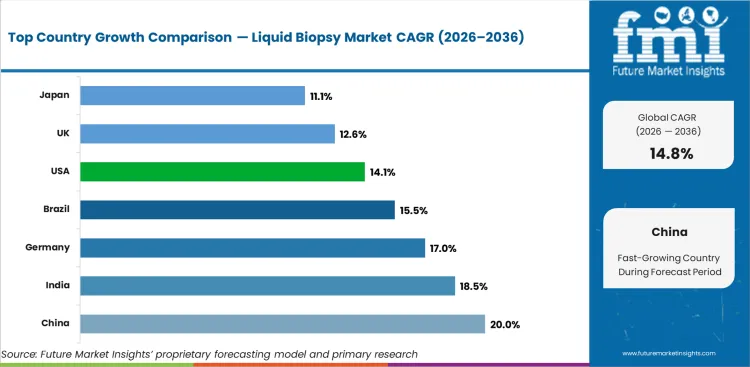
China 20.0%, India 18.5%, Germany 17.0%, Brazil 15.5%, USA 14.1% through 2036
.webp "Top Country Growth Comparison Liquid Biopsy Market Cagr (2026 2036)")
| Country | CAGR |
|---|---|
| China | 20.0% |
| India | 18.5% |
| Germany | 17.0% |
| Brazil | 15.5% |
| USA | 14.1% |
| UK | 12.6% |
| Japan | 11.1% |
- China registers the highest CAGR of 20.0%, with robust healthcare and industrial investment increasing the demand for liquid biopsy products.
- Next is India at 18.5%, supported by growing infrastructure and increasing market penetration.
- Germany (17.0%) and Brazil (15.5%) continue to see solid growth based on existing demand and regulatory support.
The global liquid biopsy market is estimated to grow at 14.8% CAGR from 2026 to 2036. The study covers more than 30 countries, and the key markets are listed below.
What is the liquid biopsy market outlook in the United States?
14.1% CAGR, driven by Established Medicare coverage for key liquid biopsy indications, strong commercial
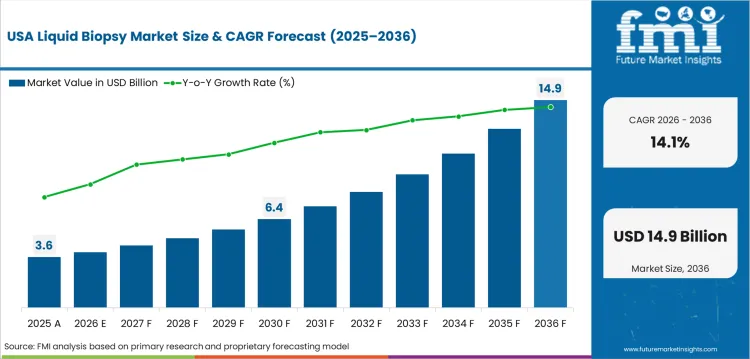
The United States is projected to register 14.1% CAGR through 2036. Established Medicare coverage for key liquid biopsy indications, strong commercial laboratory infrastructure, and integration into NCCN clinical guidelines sustain market leadership.
- Medicare coverage decisions for ctDNA-based companion diagnostics in NSCLC and colorectal cancer are expanding physician ordering and patient access across community oncology settings.
- Commercial reference laboratories, including Guardant Health and Foundation Medicine, provide national distribution infrastructure for liquid biopsy testing with rapid turnaround times.
- Multi-cancer early detection test development is progressing toward potential large-scale screening implementation that could fundamentally expand the addressable test volume market.
How fast is the liquid biopsy market growing in China?
20.0% CAGR through 2036, the fastest country-level market in the study
China leads at 20.0% CAGR through 2036. Government precision medicine investment, hospital molecular diagnostics laboratory expansion, and national cancer screening programs are accelerating liquid biopsy adoption.
- National precision medicine programs are funding hospital molecular diagnostics laboratory buildout that creates the infrastructure for liquid biopsy test adoption across cancer centers.
- Domestic liquid biopsy companies are developing cost-competitive testing platforms that address the price sensitivity of the Chinese healthcare market while maintaining analytical quality.
- Rising cancer incidence and growing patient awareness of non-invasive diagnostic options are increasing demand for liquid biopsy across lung, liver, and gastric cancer applications.
What is driving liquid biopsy growth in India?
18.5% CAGR, driven by Private oncology center investment, growing precision medicine awareness,
India is projected to register 18.5% CAGR through 2036. Private oncology center investment, growing precision medicine awareness, and cost-effective testing models are creating access pathways for liquid biopsy adoption.
- Private cancer center chains are investing in molecular diagnostics laboratories that offer liquid biopsy testing alongside traditional pathology services for comprehensive oncology care.
- Cost-effective test pricing models adapted for the Indian market are making liquid biopsy accessible to a broader patient population beyond premium hospital settings.
- Growing physician familiarity with targeted therapy protocols is increasing demand for companion diagnostic testing including liquid biopsy-based molecular profiling.
How is the liquid biopsy market performing in Germany?
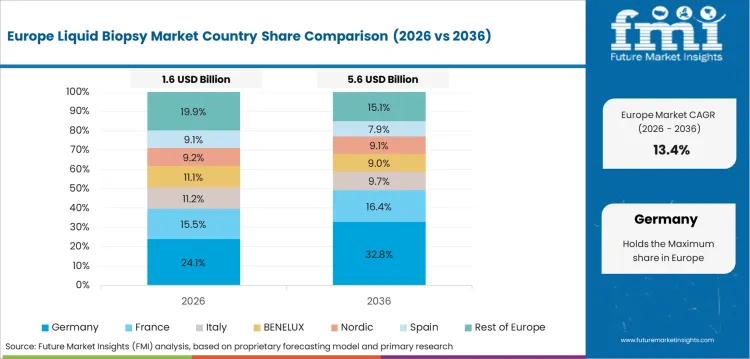
17.0% CAGR, driven by Advanced hospital diagnostics infrastructure, strong clinical research programs, and health
Germany is projected to register 17.0% CAGR through 2036. Advanced hospital diagnostics infrastructure, strong clinical research programs, and health technology assessment frameworks support liquid biopsy adoption.
- University hospital molecular diagnostics programs provide comprehensive liquid biopsy testing capabilities that support both clinical care and ongoing validation research.
- G-BA health technology assessment decisions influence national coverage for liquid biopsy tests, creating structured pathways for market access once clinical evidence thresholds are met.
- Precision oncology clinical trial participation positions Germany as a leading market for emerging liquid biopsy applications including minimal residual disease monitoring.
What is the liquid biopsy market forecast for Brazil?
15.5% CAGR, driven by Expanding private oncology infrastructure and growing awareness of precision medicine
Brazil is projected to register 15.5% CAGR through 2036. Expanding private oncology infrastructure and growing awareness of precision medicine approaches are creating adoption pathways for liquid biopsy testing.
- Private hospital and oncology clinic investment in molecular diagnostics capabilities is increasing the availability of liquid biopsy testing in major metropolitan centers.
- Rising cancer incidence rates across lung, breast, and colorectal cancers are increasing the clinical need for non-invasive molecular profiling to guide treatment selection.
- International diagnostic company partnerships with Brazilian laboratories are enabling access to validated liquid biopsy platforms with local support infrastructure.
What is the growth outlook for the liquid biopsy market in the United Kingdom?
12.6% CAGR, driven by NHS genomic medicine programs and cancer research infrastructure
The United Kingdom is projected to register 12.6% CAGR through 2036. NHS genomic medicine programs and cancer research infrastructure support structured adoption of liquid biopsy technologies.
- NHS Genomic Medicine Service integration of liquid biopsy testing into cancer diagnostic pathways is creating national-scale adoption infrastructure.
- Cancer Research UK-funded clinical trials provide ongoing clinical evidence for liquid biopsy utility in treatment monitoring and early detection applications.
- NICE technology appraisal processes are evaluating liquid biopsy tests for cost-effectiveness, with positive assessments enabling NHS-wide deployment for approved indications.
Who are the leading companies in the liquid biopsy market?
Guardant Health, Illumina, Inc., Bio-Rad Laboratories, Roche Diagnostics, and Natera, Inc.
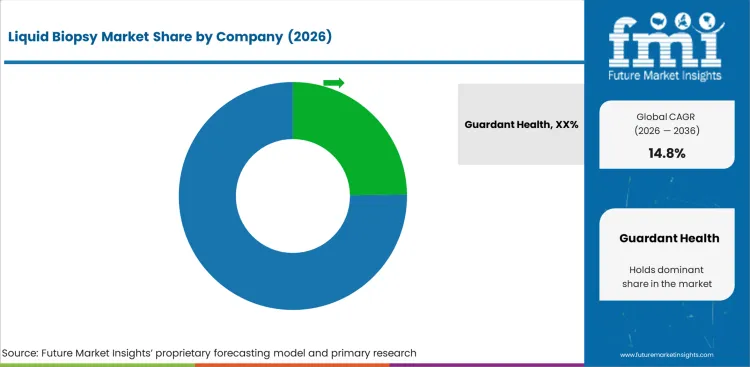
- Guardant Health boasts the largest commercial liquid biopsy test volume, supported by the Guardant360 platform for comprehensive genomic profiling and broad physician adoption across community oncology networks.
- Meanwhile, Roche Diagnostics and Illumina sit across the value chain, providing the underlying sequencing and assay platforms that power many of the laboratory-developed liquid biopsy tests.
- Natera and Exact Sciences are moving beyond their existing footholds in prenatal testing and colorectal cancer screening, respectively, to a wider range of liquid biopsy uses in multi-cancer detection.
- Foundation Medicine (Roche) provides validated liquid biopsy panels and sequencing platforms for both companion diagnostic and research use.
Who are the key players in the liquid biopsy market?
- Guardant Health, Illumina, Inc., Bio-Rad Laboratories, Roche Diagnostics and Natera, Inc., plus regional players
Key global companies leading the liquid biopsy market include:
- Guardant Health (USA), Roche Diagnostics (Switzerland), Illumina, Inc. (USA) lead global liquid biopsy markets through validated test platforms, sequencing technology infrastructure, established laboratory distribution networks, and clinical evidence supporting regulatory approvals and reimbursement coverage.
- Natera, Inc. (USA), Exact Sciences Corporation (USA), and Foundation Medicine (USA) hold strong positions through focused oncology diagnostic strategies, established payer coverage for specific indications, and expanding test menus that address multi-cancer detection and minimal residual disease monitoring.
- Bio-Rad Laboratories (USA), and Freenome Holdings (USA) are advancing liquid biopsy platforms through technology development, clinical trial partnerships, and novel biomarker discovery programs targeting early cancer detection applications.
How do top liquid biopsy companies compare?
- Guardant Health and Illumina, Inc. lead globally; Bio-Rad Laboratories, Roche Diagnostics and Natera, Inc. are regional specialists
| Company | Test Menu Breadth | Technology Platform Capability | Clinical/Payer Network Access | Geographic Footprint |
|---|---|---|---|---|
| Guardant Health | High | High | Strong | N. America, Global |
| Roche Diagnostics | High | High | Strong | Global |
| Illumina | High | High | Strong | Global |
| Natera | Medium | High | Moderate | N. America |
| Exact Sciences | Medium | High | Moderate | N. America |
| Foundation Medicine | Medium | High | Moderate | N. America, Europe |
| Bio-Rad Laboratories | Medium | Medium | Moderate | Global |
| Freenome Holdings | Low | High | Low | N. America |
Source: Future Market Insights competitive analysis, 2026.
Key Developments in Liquid Biopsy Market
- In 2025, Guardant Health continued expanding the clinical utility of its Guardant360® liquid biopsy platform through additional companion diagnostic applications and reimbursement support, strengthening the adoption of blood-based genomic testing in precision oncology.
- In 2025, Exact Sciences continued advancing its multi-cancer early detection blood test program through large-scale clinical validation studies, supporting the development of non-invasive cancer screening solutions for asymptomatic populations.
Key Players in the Liquid Biopsy Market
Major Global Players
- Guardant Health
- Illumina, Inc.
- Bio-Rad Laboratories
- Roche Diagnostics
- Natera, Inc.
- Exact Sciences Corporation
- Foundation Medicine
- Thermo Fisher Scientific
Emerging Players/Startups
- Freenome Holdings
- Delfi Diagnostics
- Haystack Oncology
- BillionToOne
- Angle plc
Liquid Biopsy Market - Research Methodology
| Method | Description |
|---|---|
| Primary Research | FMI analysts conducted interviews with manufacturers, distributors, procurement specialists, and end-use operators across China, India, and Germany to validate demand patterns and pricing structures for Circulating Tumor Cells (CTCs), and Circulating Tumor Nucleic Acids and related product categories. |
| Desk Research | Combined trade statistics, regulatory filings, industry association data, and manufacturer disclosures to establish baseline parameters for Liquid Biopsy across biomarker, sample, end user, application, and cancer segments. |
| Market Sizing & Forecasting | Bottom-up aggregation across Circulating Tumor Cells (CTCs), Circulating Tumor Nucleic Acids, and Exosomes product categories and Blood, Urine, and Others sample segments, triangulated with top-down macro indicators and regional adoption curves. |
| Data Validation | Cross-checked quarterly against production statistics, trade flow data, and manufacturer revenue disclosures for Liquid Biopsy products. |
What does the classified platform market report cover?
2016 to 2025 history and 2026 to 2036 forecasts across all segments and 30+ countries
| Parameter | Details |
|---|---|
| Market size by 2036 | USD 29.2 Bn |
| Growth rate | 14.8% CAGR (2026 to 2036) |
| Forecast period | 2026 to 2036 |
| Base year value (2025) | USD 6.4 Bn |
| Key Segment Covered | Biomarker Type, Sample Type, End User, Application, Cancer Type |
| Regions covered | North America, Latin America, Eastern Europe, Western Europe, East Asia, South Asia and Pacific, Middle East and Africa |
| Countries covered | USA, China, India, Germany, Brazil, UK, Japan, 30 plus countries |
| Key companies profiled | Guardant Health, Illumina, Inc., Bio-Rad Laboratories, Roche Diagnostics, Natera, Inc., Exact Sciences Corporation, Foundation Medicine, Freenome Holdings |
| Approach | Hybrid bottom-up and top-down methodology starting with verified transaction data, projecting adoption velocity across segments and regions. |
Market Segmentation Analysis
Liquid Biopsy Market Segmented by Biomarker Type:
- Circulating Tumor Cells (CTCs)
- Epithelial Tumor Cells
- Cancer Progression Monitoring
- Metastatic Disease Detection
- Stem Cell Like Tumor Cells
- Therapy Resistance Analysis
- Personalized Oncology Support
- Epithelial Tumor Cells
- Circulating Tumor Nucleic Acids
- Circulating Tumor DNA (ctDNA)
- Genetic Mutation Detection
- Minimal Residual Disease Monitoring
- Circulating Tumor RNA (ctRNA)
- Gene Expression Profiling
- Treatment Response Evaluation
- Circulating Tumor DNA (ctDNA)
- Exosomes
- Tumor Derived Exosomes
- Cell To Cell Communication Analysis
- Early Cancer Detection
- Extracellular Vesicle Biomarkers
- Non Invasive Molecular Profiling
- Precision Medicine Applications
- Tumor Derived Exosomes
Liquid Biopsy Market Segmented by Sample Type:
- Blood
- Plasma Samples
- High Biomarker Availability
- Routine Diagnostic Collection
- Serum Samples
- Non Invasive Testing Method
- Cancer Monitoring Applications
- Plasma Samples
- Urine
- Urinary Biomarker Testing
- Urological Cancer Detection
- Easy Sample Collection
- Molecular Urine Analysis
- Mutation Detection Support
- Bladder Cancer Monitoring
- Urinary Biomarker Testing
- Others
- Saliva Samples
- Non Invasive Collection Method
- Genetic Biomarker Analysis
- Cerebrospinal Fluid Samples
- Neurological Cancer Detection
- Advanced Molecular Diagnostics
- Saliva Samples
Liquid Biopsy Market Segmented by End User:
- Hospitals
- Multispecialty Hospitals
- Advanced Oncology Diagnostics
- Integrated Cancer Care Services
- Cancer Treatment Hospitals
- Personalized Treatment Monitoring
- Inpatient Diagnostic Support
- Multispecialty Hospitals
- Cancer Institutes
- Comprehensive Cancer Centers
- Precision Oncology Research
- Clinical Trial Programs
- Specialized Oncology Institutes
- Advanced Biomarker Testing
- Targeted Therapy Evaluation
- Comprehensive Cancer Centers
- Academic Institutes
- Medical Universities
- Cancer Biomarker Research
- Clinical Research Collaborations
- Genomics Research Centers
- Molecular Diagnostic Development
- Translational Oncology Studies
- Medical Universities
- Diagnostic Centers
- Independent Diagnostic Laboratories
- Routine Liquid Biopsy Testing
- High Throughput Sample Analysis
- Molecular Pathology Centers
- Advanced Genomic Profiling
- Companion Diagnostic Services
- Independent Diagnostic Laboratories
Liquid Biopsy Market Segmented by Application:
- Cancer Diagnosis
- Early Cancer Detection
- Non Invasive Screening Methods
- Tumor Identification Support
- Companion Diagnostics
- Targeted Therapy Selection
- Precision Medicine Applications
- Early Cancer Detection
- Treatment Monitoring
- Therapy Response Monitoring
- Real Time Treatment Evaluation
- Drug Resistance Detection
- Minimal Residual Disease Monitoring
- Post Treatment Surveillance
- Relapse Risk Assessment
- Therapy Response Monitoring
- Recurrence Monitoring
- Post Treatment Follow Up
- Cancer Recurrence Detection
- Long Term Patient Monitoring
- Metastatic Disease Monitoring
- Tumor Progression Tracking
- Advanced Cancer Surveillance
- Post Treatment Follow Up
Liquid Biopsy Market Segmented by Cancer Type:
- Lung Cancer
- Non Small Cell Lung Cancer (NSCLC)
- EGFR Mutation Detection
- Targeted Therapy Guidance
- Small Cell Lung Cancer (SCLC)
- Aggressive Tumor Monitoring
- Therapeutic Response Evaluation
- Non Small Cell Lung Cancer (NSCLC)
- Breast Cancer
- HER2 Positive Breast Cancer
- Biomarker Based Therapy Selection
- Disease Progression Monitoring
- Triple Negative Breast Cancer
- Genetic Mutation Analysis
- Precision Oncology Support
- HER2 Positive Breast Cancer
- Colorectal Cancer
- Metastatic Colorectal Cancer
- KRAS And NRAS Mutation Testing
- Treatment Optimization
- Early Stage Colorectal Cancer
- Screening And Recurrence Monitoring
- Minimal Residual Disease Detection
- Metastatic Colorectal Cancer
- Others
- Prostate Cancer
- PSA And ctDNA Monitoring
- Therapy Response Analysis
- Pancreatic Cancer
- Early Detection Biomarkers
- High Risk Patient Screening
- Prostate Cancer
Liquid Biopsy Market by Region:
- North America
- USA
- Canada
- Mexico
- Latin America
- Brazil
- Chile
- Rest of Latin America
- Western Europe
- Germany
- UK
- Italy
- Spain
- France
- Nordic
- BENELUX
- Rest of Western Europe
- Eastern Europe
- Russia
- Poland
- Hungary
- Balkan & Baltic
- Rest of Eastern Europe
- East Asia
- China
- Japan
- South Korea
- South Asia and Pacific
- India
- ASEAN
- Australia & New Zealand
- Rest of South Asia and Pacific
- Middle East & Africa
- Kingdom of Saudi Arabia
- Other GCC Countries
- Türkiye
- South Africa
- Other African Union
- Rest of Middle East & Africa
Research Sources and Bibliography
- National Cancer Institute. (2025). NCI Liquid Biopsy Research Program Report. NCI.
- USA Food and Drug Administration. (2025). FDA Framework for Liquid Biopsy Companion Diagnostics. FDA.
- European Society for Medical Oncology. (2025). ESMO Clinical Practice Guidelines: Liquid Biopsy in Oncology. ESMO.
- World Health Organization. (2025). WHO International Agency for Research on Cancer: Global Cancer Statistics. WHO/IARC.
- National Comprehensive Cancer Network. (2025). NCCN Guidelines: Molecular Testing in Oncology. NCCN.
This bibliography is provided for reader reference.
This Report Answers
- Estimating the size of the liquid biopsy market and projected revenue from 2026 to 2036.
- Segmentation by biomarker type, sample type, end user, application, cancer type.
- Insights about more than 30 regional markets.
- Analysis of key market dynamics including demand drivers, restraints, and emerging opportunities.
- Assessment of the competitive landscape and strategic positioning of leading companies.
- Identifying investment opportunities across key product segments and geographic markets.
- Supply chain and distribution channel analysis.
- Delivery of data in PDF and Excel formats.
Frequently Asked Questions
How big is the liquid biopsy market in 2026?
The global liquid biopsy market is estimated to be valued at USD 7.3 billion in 2026.
What will be the size of the liquid biopsy market in 2036?
The market size for the liquid biopsy market is projected to reach USD 29.2 billion by 2036.
How much will the liquid biopsy market growth be between 2026 and 2036?
The liquid biopsy market is expected to grow at a 14.8% CAGR between 2026 and 2036.
What are the key biomarker types in the liquid biopsy market?
The key biomarker types in the liquid biopsy market are Circulating Tumor Cells (CTCs), Circulating Tumor Nucleic Acids and Exosomes.
Which sample type segment is expected to contribute a significant share in the liquid biopsy market in 2026?
In terms of sample type, the blood segment is expected to command 87.4% share in the liquid biopsy market in 2026.
Preview the report firsthand - request a free sample
Get SampleGet the brochure for pricing and purchase details.
Get PDFTable of Content
- Key Takeaways
- Market Size and CAGR
- Top Growth Driver
- Fastest Growing Segment
- Leading Region
- Key Companies
- Emerging Opportunities
- Executive Summary
- Global Market Outlook
- Demand-side Trends
- Supply-side Trends
- Technology Roadmap Analysis
- Analysis and Recommendations
- Analyst Perspective (What is happening? Why now? What should investors know?)
- Key Questions Answered
- How large is the market?
- What is the CAGR?
- What are key trends?
- Which region dominates?
- Who are the leaders?
- Market Overview
- Market Coverage / Taxonomy
- Market Definition / Scope / Limitations
- Research Methodology
- Chapter Orientation
- Analytical Lens and Working Hypotheses
- Market Structure, Signals, and Trend Drivers
- Benchmarking and Cross-market Comparability
- Market Sizing, Forecasting, and Opportunity Mapping
- Research Design and Evidence Framework
- Desk Research Programme (Secondary Evidence)
- Expert Input and Fieldwork (Primary Evidence)
- Tooling, Models, and Reference Databases
- Data Engineering and Model Build
- Quality Assurance and Audit Trail
- Market Background
- Market Dynamics (Drivers, Restraints, Opportunity, Trends)
- Scenario Forecast (Optimistic, Likely, Conservative)
- Impact Analysis
- AI Impact
- Sustainability Impact
- Regulatory Impact
- Technology Impact
- Consumer / Buyer Analysis
- Purchase Drivers
- Adoption Barriers
- Buyer Journey
- Opportunity Map Analysis
- Product Life Cycle Analysis
- Supply Chain Analysis
- Investment Feasibility Matrix
- Value Chain Analysis
- PESTLE and Porter's Analysis
- Regulatory Landscape
- Regional Parent Market Outlook
- Production and Consumption Statistics
- Import and Export Statistics
- Global Market Analysis and Forecast, 2021 to 2036
- Historical Market Size Value (USD Billion) Analysis, 2021 to 2025
- Current and Future Market Size Value (USD Billion) Projections, 2026 to 2036
- Y-o-Y Growth Trend Analysis
- Absolute $ Opportunity Analysis
- Global Market Pricing Analysis, 2021 to 2036
- Global Market Analysis and Forecast, By Biomarker Type, 2021 to 2036
- Introduction / Key Findings
- Historical Market Size Value (USD Billion) Analysis By Biomarker Type, 2021 to 2025
- Current and Future Market Size Value (USD Billion) Analysis and Forecast By Biomarker Type, 2026 to 2036
- Circulating Tumor Cells (CTCs)
- Epithelial Tumor Cells
- Stem Cell Like Tumor Cells
- Circulating Tumor Nucleic Acids
- Circulating Tumor DNA (ctDNA)
- Circulating Tumor RNA (ctRNA)
- Exosomes
- Tumor Derived Exosomes
- Extracellular Vesicle Biomarkers
- Circulating Tumor Cells (CTCs)
- Y-o-Y Growth Trend Analysis By Biomarker Type, 2021 to 2025
- Absolute $ Opportunity Analysis By Biomarker Type, 2026 to 2036
- Global Market Analysis and Forecast, By Sample Type, 2021 to 2036
- Introduction / Key Findings
- Historical Market Size Value (USD Billion) Analysis By Sample Type, 2021 to 2025
- Current and Future Market Size Value (USD Billion) Analysis and Forecast By Sample Type, 2026 to 2036
- Blood
- Plasma Samples
- Serum Samples
- Urine
- Urinary Biomarker Testing
- Molecular Urine Analysis
- Others
- Saliva Samples
- Cerebrospinal Fluid Samples
- Blood
- Y-o-Y Growth Trend Analysis By Sample Type, 2021 to 2025
- Absolute $ Opportunity Analysis By Sample Type, 2026 to 2036
- Global Market Analysis and Forecast, By End User, 2021 to 2036
- Introduction / Key Findings
- Historical Market Size Value (USD Billion) Analysis By End User, 2021 to 2025
- Current and Future Market Size Value (USD Billion) Analysis and Forecast By End User, 2026 to 2036
- Hospitals
- Multispecialty Hospitals
- Cancer Treatment Hospitals
- Cancer Institutes
- Comprehensive Cancer Centers
- Specialized Oncology Institutes
- Academic Institutes
- Medical Universities
- Genomics Research Centers
- Diagnostic Centers
- Independent Diagnostic Laboratories
- Molecular Pathology Centers
- Hospitals
- Y-o-Y Growth Trend Analysis By End User, 2021 to 2025
- Absolute $ Opportunity Analysis By End User, 2026 to 2036
- Global Market Analysis and Forecast, By Application, 2021 to 2036
- Introduction / Key Findings
- Historical Market Size Value (USD Billion) Analysis By Application, 2021 to 2025
- Current and Future Market Size Value (USD Billion) Analysis and Forecast By Application, 2026 to 2036
- Cancer Diagnosis
- Early Cancer Detection
- Companion Diagnostics
- Treatment Monitoring
- Therapy Response Monitoring
- Minimal Residual Disease Monitoring
- Recurrence Monitoring
- Post Treatment Follow Up
- Metastatic Disease Monitoring
- Cancer Diagnosis
- Y-o-Y Growth Trend Analysis By Application, 2021 to 2025
- Absolute $ Opportunity Analysis By Application, 2026 to 2036
- Global Market Analysis and Forecast, By Cancer Type, 2021 to 2036
- Introduction / Key Findings
- Historical Market Size Value (USD Billion) Analysis By Cancer Type, 2021 to 2025
- Current and Future Market Size Value (USD Billion) Analysis and Forecast By Cancer Type, 2026 to 2036
- Lung Cancer
- Non Small Cell Lung Cancer (NSCLC)
- Small Cell Lung Cancer (SCLC)
- Breast Cancer
- HER2 Positive Breast Cancer
- Triple Negative Breast Cancer
- Colorectal Cancer
- Metastatic Colorectal Cancer
- Early Stage Colorectal Cancer
- Others
- Prostate Cancer
- Pancreatic Cancer
- Lung Cancer
- Y-o-Y Growth Trend Analysis By Cancer Type, 2021 to 2025
- Absolute $ Opportunity Analysis By Cancer Type, 2026 to 2036
- Global Market Analysis and Forecast, By Region, 2021 to 2036
- Introduction
- Historical Market Size Value (USD Billion) Analysis By Region, 2021 to 2025
- Current Market Size Value (USD Billion) Analysis and Forecast By Region, 2026 to 2036
- North America
- Latin America
- Western Europe
- Eastern Europe
- East Asia
- South Asia and Pacific
- Middle East & Africa
- Market Attractiveness Analysis By Region
- North America Market Analysis and Forecast, By Country, 2021 to 2036
- Historical Market Size Value (USD Billion) Trend Analysis By Market Taxonomy, 2021 to 2025
- Market Size Value (USD Billion) Forecast By Market Taxonomy, 2026 to 2036
- By Country
- USA
- Canada
- Mexico
- By Biomarker Type
- By Sample Type
- By End User
- By Application
- By Cancer Type
- By Country
- Market Attractiveness Analysis
- By Country
- By Biomarker Type
- By Sample Type
- By End User
- By Application
- By Cancer Type
- Key Takeaways
- Latin America Market Analysis and Forecast, By Country
- Historical Market Size Value (USD Billion) Trend Analysis By Market Taxonomy, 2021 to 2025
- Market Size Value (USD Billion) Forecast By Market Taxonomy, 2026 to 2036
- By Country
- Brazil
- Chile
- Rest of Latin America
- By Biomarker Type
- By Sample Type
- By End User
- By Application
- By Cancer Type
- By Country
- Market Attractiveness Analysis
- By Country
- By Biomarker Type
- By Sample Type
- By End User
- By Application
- By Cancer Type
- Key Takeaways
- Western Europe Market Analysis and Forecast, By Country
- Historical Market Size Value (USD Billion) Trend Analysis By Market Taxonomy, 2021 to 2025
- Market Size Value (USD Billion) Forecast By Market Taxonomy, 2026 to 2036
- By Country
- Germany
- UK
- Italy
- Spain
- France
- Nordic
- BENELUX
- Rest of Western Europe
- By Biomarker Type
- By Sample Type
- By End User
- By Application
- By Cancer Type
- By Country
- Market Attractiveness Analysis
- By Country
- By Biomarker Type
- By Sample Type
- By End User
- By Application
- By Cancer Type
- Key Takeaways
- Eastern Europe Market Analysis and Forecast, By Country
- Historical Market Size Value (USD Billion) Trend Analysis By Market Taxonomy, 2021 to 2025
- Market Size Value (USD Billion) Forecast By Market Taxonomy, 2026 to 2036
- By Country
- Russia
- Poland
- Hungary
- Balkan & Baltic
- Rest of Eastern Europe
- By Biomarker Type
- By Sample Type
- By End User
- By Application
- By Cancer Type
- By Country
- Market Attractiveness Analysis
- By Country
- By Biomarker Type
- By Sample Type
- By End User
- By Application
- By Cancer Type
- Key Takeaways
- East Asia Market Analysis and Forecast, By Country
- Historical Market Size Value (USD Billion) Trend Analysis By Market Taxonomy, 2021 to 2025
- Market Size Value (USD Billion) Forecast By Market Taxonomy, 2026 to 2036
- By Country
- China
- Japan
- South Korea
- By Biomarker Type
- By Sample Type
- By End User
- By Application
- By Cancer Type
- By Country
- Market Attractiveness Analysis
- By Country
- By Biomarker Type
- By Sample Type
- By End User
- By Application
- By Cancer Type
- Key Takeaways
- South Asia and Pacific Market Analysis and Forecast, By Country
- Historical Market Size Value (USD Billion) Trend Analysis By Market Taxonomy, 2021 to 2025
- Market Size Value (USD Billion) Forecast By Market Taxonomy, 2026 to 2036
- By Country
- India
- ASEAN
- Australia & New Zealand
- Rest of South Asia and Pacific
- By Biomarker Type
- By Sample Type
- By End User
- By Application
- By Cancer Type
- By Country
- Market Attractiveness Analysis
- By Country
- By Biomarker Type
- By Sample Type
- By End User
- By Application
- By Cancer Type
- Key Takeaways
- Middle East & Africa Market Analysis and Forecast, By Country
- Historical Market Size Value (USD Billion) Trend Analysis By Market Taxonomy, 2021 to 2025
- Market Size Value (USD Billion) Forecast By Market Taxonomy, 2026 to 2036
- By Country
- Kingdom of Saudi Arabia
- Other GCC Countries
- Türkiye
- South Africa
- Other African Union
- Rest of Middle East & Africa
- By Biomarker Type
- By Sample Type
- By End User
- By Application
- By Cancer Type
- By Country
- Market Attractiveness Analysis
- By Country
- By Biomarker Type
- By Sample Type
- By End User
- By Application
- By Cancer Type
- Key Takeaways
- Key Countries Market Analysis
- USA
- Pricing Analysis
- Market Share Analysis, 2025
- By Biomarker Type
- By Sample Type
- By End User
- By Application
- By Cancer Type
- Canada
- Pricing Analysis
- Market Share Analysis, 2025
- By Biomarker Type
- By Sample Type
- By End User
- By Application
- By Cancer Type
- Mexico
- Pricing Analysis
- Market Share Analysis, 2025
- By Biomarker Type
- By Sample Type
- By End User
- By Application
- By Cancer Type
- Brazil
- Pricing Analysis
- Market Share Analysis, 2025
- By Biomarker Type
- By Sample Type
- By End User
- By Application
- By Cancer Type
- Chile
- Pricing Analysis
- Market Share Analysis, 2025
- By Biomarker Type
- By Sample Type
- By End User
- By Application
- By Cancer Type
- Germany
- Pricing Analysis
- Market Share Analysis, 2025
- By Biomarker Type
- By Sample Type
- By End User
- By Application
- By Cancer Type
- UK
- Pricing Analysis
- Market Share Analysis, 2025
- By Biomarker Type
- By Sample Type
- By End User
- By Application
- By Cancer Type
- Italy
- Pricing Analysis
- Market Share Analysis, 2025
- By Biomarker Type
- By Sample Type
- By End User
- By Application
- By Cancer Type
- Spain
- Pricing Analysis
- Market Share Analysis, 2025
- By Biomarker Type
- By Sample Type
- By End User
- By Application
- By Cancer Type
- France
- Pricing Analysis
- Market Share Analysis, 2025
- By Biomarker Type
- By Sample Type
- By End User
- By Application
- By Cancer Type
- India
- Pricing Analysis
- Market Share Analysis, 2025
- By Biomarker Type
- By Sample Type
- By End User
- By Application
- By Cancer Type
- ASEAN
- Pricing Analysis
- Market Share Analysis, 2025
- By Biomarker Type
- By Sample Type
- By End User
- By Application
- By Cancer Type
- Australia & New Zealand
- Pricing Analysis
- Market Share Analysis, 2025
- By Biomarker Type
- By Sample Type
- By End User
- By Application
- By Cancer Type
- China
- Pricing Analysis
- Market Share Analysis, 2025
- By Biomarker Type
- By Sample Type
- By End User
- By Application
- By Cancer Type
- Japan
- Pricing Analysis
- Market Share Analysis, 2025
- By Biomarker Type
- By Sample Type
- By End User
- By Application
- By Cancer Type
- South Korea
- Pricing Analysis
- Market Share Analysis, 2025
- By Biomarker Type
- By Sample Type
- By End User
- By Application
- By Cancer Type
- Russia
- Pricing Analysis
- Market Share Analysis, 2025
- By Biomarker Type
- By Sample Type
- By End User
- By Application
- By Cancer Type
- Poland
- Pricing Analysis
- Market Share Analysis, 2025
- By Biomarker Type
- By Sample Type
- By End User
- By Application
- By Cancer Type
- Hungary
- Pricing Analysis
- Market Share Analysis, 2025
- By Biomarker Type
- By Sample Type
- By End User
- By Application
- By Cancer Type
- Kingdom of Saudi Arabia
- Pricing Analysis
- Market Share Analysis, 2025
- By Biomarker Type
- By Sample Type
- By End User
- By Application
- By Cancer Type
- Türkiye
- Pricing Analysis
- Market Share Analysis, 2025
- By Biomarker Type
- By Sample Type
- By End User
- By Application
- By Cancer Type
- South Africa
- Pricing Analysis
- Market Share Analysis, 2025
- By Biomarker Type
- By Sample Type
- By End User
- By Application
- By Cancer Type
- USA
- Market Structure Analysis
- Competition Dashboard
- Competition Benchmarking
- Market Share Analysis of Top Players
- By Regional
- By Biomarker Type
- By Sample Type
- By End User
- By Application
- By Cancer Type
- Emerging Startups
- Innovation Benchmarking
- Competition Analysis
- Competition Deep Dive
- Guardant Health
- Overview
- Product Portfolio
- Profitability by Market Segments (Product/Region/Sales Channel)
- Sales Footprint
- Strategy Overview
- Marketing Strategy
- Product Strategy
- Channel Strategy
- Illumina, Inc.
- Bio-Rad Laboratories
- Roche Diagnostics
- Natera, Inc.
- Exact Sciences Corporation
- Foundation Medicine
- Thermo Fisher Scientific
- NeoGenomics Laboratories
- Freenome Holdings
- Guardant Health
- Case Studies
- Success Stories
- Recent Developments
- Competition Deep Dive
- Assumptions & Acronyms Used


