

- Market Size (2026)
- USD 1467.2 Mn
- Forecast (2036)
- USD 2996.0 Mn
- CAGR (2026 to 2036)
- 7.4%
How big is Liquid Cooling Dielectrics Market in 2026?
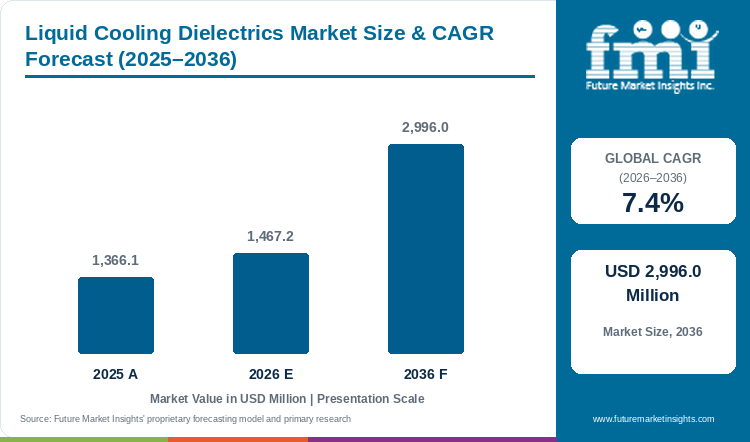
Demand for liquid cooling dielectrics is projected to expand at 7.4% CAGR between 2026 and 2036. Industry value grows from USD 1,366.1 million in 2025 to USD 1,467.2 million in 2026 and is projected to reach USD 2,996.0 million by 2036.
Demand for liquid cooling dielectrics is projected to expand at 7.4% CAGR between 2026 and 2036. Industry value grows from USD 1,366.1 million in 2025 to USD 1,467.2 million in 2026 and is projected to reach USD 2,996.0 million by 2036. Liquid cooling dielectrics are electrically non-conductive fluids which removes heat from servers, battery packs and power electronic parts. Increasing adoption of data center cooling is taking these fluids closer to processors and other electrically active components without creating short circuit. In May 2026, the U.S. Energy Information Administration stated that servers accounted for 7% of commercial-sector electricity use in 2025 and data-center cooling can be up to 2.9 times as energy intensive as other commercial space[1]. Higher heat inside AI racks is therefore widening the use of dielectric liquids.
Regional demand will not move at the same pace because power access and computing investment differs by country. Japan liquid cooling dielectrics market is estimated to expand at 4.1% CAGR through 2036, whereas South Korea is projected at 5.8% CAGR. Increasing investment in thermal management technologies is moving with enterprise computing in Japan and domestic GPU clusters in South Korea. IDC reported in March 2026 that Japan AI infrastructure spending is expected to rise by at least 18% and exceed USD 5.5 billion[2]. In May 2026, OECD.AI reported procurement of 13,000 high-performance GPUs in South Korea, including over 10,000 units for government-led projects[3]. These different routes creates demand for compact cooling, although fluid approval, fire data and hardware compatibility will decide the final purchase.
Key Takeaways
- Higher heat from AI and HPC racks is moving cooling closer to processors and memory components.
- Single-phase dielectric fluids are projected to account for 35.0% in 2026, supported by easier circulation and regular servicing.
- Data center immersion cooling is estimated to hold 46.0% in 2026 as dense racks require shorter heat movement.
- Data centers are expected to lead end use with 48.0% share in 2026 owing to uptime and hardware protection requirement.
- Netherlands is projected at 6.1% CAGR, while South Korea is forecast at 5.8% under different grid and compute programs.
- Notable companies in the liquid cooling dielectrics market include Shell, Chemours, Castrol / BP, ExxonMobil, TotalEnergies, Engineered Fluids, Cargill, and SK Enmove.
Analyst Perspective
“Qualified fluids will move first when AI racks exceed air-cooling limits. Non-fluorinated products will gain demand where supply and approval remain predictable.”
- Nikhil Kaitwade, Principal Consultant, Future Market Insights.
How is the liquid cooling dielectrics market segmented?
Liquid cooling dielectrics market is segmented by fluid type, application, end use, temperature range, sales channel, and region. Single-phase dielectric fluids are projected to account for 35.0% of fluid type demand, while data center immersion cooling is estimated to hold 46.0% of application demand in 2026.
By fluid type: single-phase dielectric fluids, two-phase dielectric fluids, synthetic hydrocarbons, fluorinated fluids, and ester-based dielectrics.
By application: data center immersion cooling, EV electronics cooling, battery thermal management, power electronics, and crypto/HPC cooling.
By end use: data centers, telecom/HPC, automotive/EV, industrial electronics, and energy storage.
By temperature range: standard operating, high-temperature stable, low-viscosity fluids, and fire-safe fluids.
By sales channel: fluid producers direct, cooling system integrators, data center operators, and specialty distributors.
By region: North America, Latin America, Western Europe, Eastern Europe, East Asia, South Asia and Pacific, and Middle East and Africa.
Why does single-phase fluid account for notable fluid type demand?
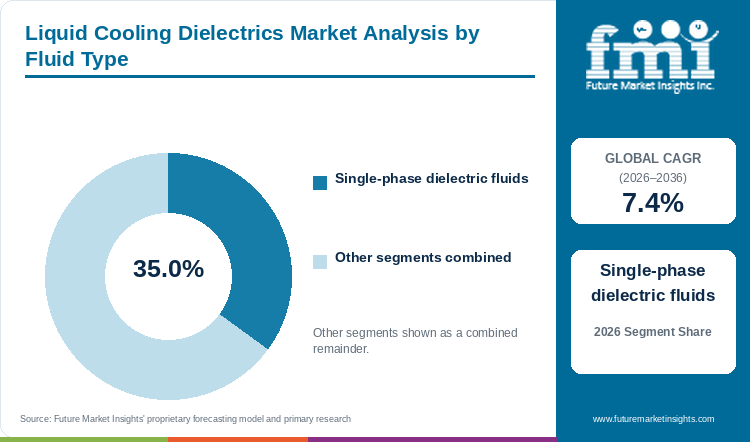
Based on fluid type, single-phase dielectric fluids are projected to account for 35.0% in 2026, supported by simpler circulation systems.
Single-phase dielectric fluids remains in liquid form while taking heat from server components. There is no boiling inside the tank, due to which vapor recovery equipment is not required. The same maintenance advantage is increasing preference for immersion cooling fluids, as the liquid can be filtered, sampled and refilled during regular servicing. In May 2025, Shell stated that its immersion fluids became the first to receive Intel Data Center Certified recognition and can reduce data center energy use by up to 48%[4]. Certification together with easier handling is giving single-phase fluids higher preference in new installations.
- Future Market Insights projects single-phase dielectric fluids to hold 35.0% of fluid type demand in 2026, owing to liquid-only circulation and easier maintenance.
- Filtration and refilling can be carried out without managing a vapor phase. This lowers servicing difficulty and makes single-phase fluids suitable for facilities having regular maintenance schedules.
What supports data center immersion cooling as a preferred application choice?
By application, data center immersion cooling is estimated to hold 46.0% in 2026, owing to direct component-level heat removal.
Servers are placed directly inside dielectric liquid under data center immersion cooling. Heat is removed from processors, memory and power components without carrying it through long air paths. This direct contact is increasing adoption of data center immersion cooling because dense AI and HPC racks can be installed in limited floor space. In February 2026, Chemours and 2CRSi reported successful server qualification for Opteon two-phase immersion fluid[5]. The development joins fluid performance with a complete server platform instead of testing the liquid alone.
- Data center immersion cooling is expected to command 46.0% of application demand in 2026, driven by component-level heat removal.
- Processors, memory and power components releases heat directly into the surrounding liquid. Shorter heat movement supports dense racks where larger air volume is no longer practical.
How do data centers meet changing end-use cooling requirements today?
Data centers are set to lead the end use category with 48.0% share in 2026, driven by uptime requirements.
Continuous cooling is required in data centers for protecting expensive servers and maintaining computing availability. AI and HPC systems are adding more heat inside every rack, whereas downtime can affect a large number of users at once. Demand for high-purity data center thermal management fluids is also increasing as operators needs controlled fluid quality for expensive hardware. In May 2026, Castrol ON PG 25 received OCP Inspired recognition for direct liquid cooling systems[6]. Recognized fluids provides a known reference when operators selects cooling equipment and maintenance procedures, keeping data centers as the largest end-use buyer.
- In 2026, data centers are expected to lead end use with 48.0% share, supported by uptime and platform qualification requirements.
- Uptime and hardware protection receives higher importance from data center operators. Qualified fluids, refill supply and technical support gives data centers stronger buying capacity than other end users.
What are the drivers, restraints, and opportunities in the liquid cooling dielectrics market?
In the liquid cooling dielectrics market, the key driver is AI heat, the key restraint is qualification, and the key opportunity is lower-impact chemistry.
- Driver: Higher processor power expands evaluation of immersion and direct-contact cooling systems that use electrically non-conductive liquids.
- Restraint: Long compatibility tests and changing rules for fluorinated chemistry can delay approval or require replacement planning.
- Opportunity: Qualified hydrocarbon and ester fluids are projected to gain interest where buyers need stable supply and documented lifecycle performance.
AI Heat Moves Cooling Closer
Air cooling becomes difficult when processor power increases inside a limited rack area. More fans and larger air movement also adds electricity use without shortening the heat path. This limitation is moving adoption toward data center liquid cooling toward systems that places the cooling medium next to electrically active parts. In August 2026, Singapore introduced SS 726:2026 for liquid cooling in tropical data centers and stated that liquid cooling can reduce data-center energy consumption by more than 30% compared with traditional air cooling[7]. Shorter heat movement and lower cooling energy is therefore supporting dielectric liquid demand.
Qualification Extends Purchase Decisions
Material qualification is a major restraining factor for liquid cooling dielectrics market. Plastics, cable covers, labels, elastomers and solder materials may react differently after staying inside the fluid for a long period. This concern is influencing fluorochemicals as changing product rules adds uncertainty to fluid availability and replacement planning. UL Solutions stated in September 2025 that UL 2417 evaluates immersion fluids for autoignition temperature, flash point and dielectric breakdown voltage[8]. Suppliers therefore requires safety data along with material compatibility results before a system is approved.
Validated Alternatives Open New Routes
Hydrocarbon and ester fluids are becoming an opportunity where buyers wants non-fluorinated chemistry and stable product supply. These fluids can be used in data centers, power electronics and selected battery systems after material testing. Wider use of electric vehicle fluids is taking dielectric liquids beyond server cooling into another volume application. In February 2025, TotalEnergies integrated Cell-Shield dielectric fluid into an immersion-cooled Renault Mégane E-Tech battery and reported two times faster charging with 6% higher vehicle range[9]. Complete vehicle testing will open further application routes for these products.
Which country CAGRs are profiled in the liquid cooling dielectrics market?
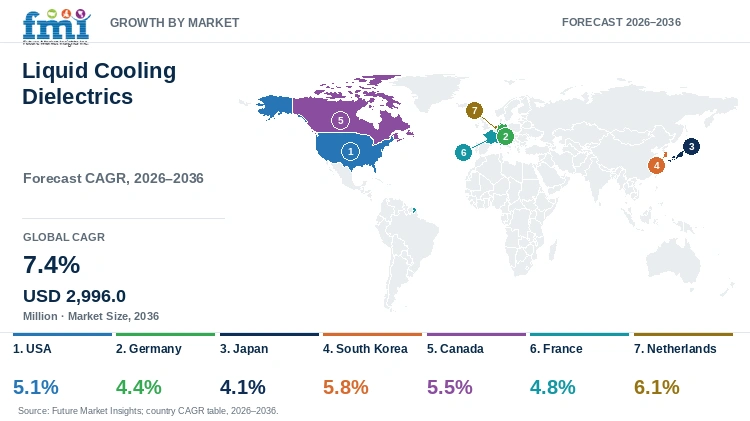
| Country | CAGR |
|---|---|
| USA | 5.1% |
| Germany | 4.4% |
| Japan | 4.1% |
| South Korea | 5.8% |
| Canada | 5.5% |
| France | 4.8% |
| Netherlands | 6.1% |
How do country-level CAGRs compare in the liquid cooling dielectrics market?
Country outlook is firmer where new compute projects meet limits on power connections or facility space.
Public AI programs add demand, while local grid rules decide how quickly dense facilities can enter operation.
- USA projects combine large AI loads with utility interconnection reviews that influence cooling architecture and site timing.
- Germany links data center expansion with energy performance and heat reuse under national policy and facility rules.
- Japan coordinates new compute sites with electricity and telecommunications planning through its watt-bit program.
- South Korea is expanding AI compute resources while addressing power supply and suitable data center locations.
- Canada uses public funding to mobilize domestic AI infrastructure and considers sustainability within project selection.
- France is identifying grid-ready data center sites that can support large AI infrastructure projects.
- Netherlands uses new grid-sharing arrangements to improve access to scarce connection capacity in congestion areas.
Full report country CAGRs cover: North America; Latin America; Western Europe; Eastern Europe; East Asia; South Asia and Pacific; Middle East and Africa.
- The USA liquid cooling dielectrics market is forecast to rise at 5.1% CAGR through 2036. Large AI campuses and high-density server racks are moving cooling decisions to the beginning of data center design. Expansion of data center infrastructure is adding more high-power equipment, due to which immersion and direct-contact cooling is suitable for selected facilities. Lawrence Berkeley National Laboratory estimated in June 2026 that US data centers could account for 11.8% of total electricity use and reach 649 TWh in 2030 under its reference case[10]. Higher electricity use brings higher heat close to the processors and supports qualified dielectric fluid demand.
- Germany is projected to record 4.4% CAGR in liquid cooling dielectrics market through 2036. Data center operators in the country must add computing capacity while considering electricity use and heat management. Expansion of power electronics is adding another source of high heat where liquid cooling can be evaluated after hardware qualification. In March 2026, Federal Ministry for Digital Transformation and Government Modernisation targeted at least two times increase in national data center capacity and at least four times increase in AI and HPC capacity by 2030[11]. Such increase will place more high-power equipment inside German facilities where air systems may reach its limit.
- Japan liquid cooling dielectrics demand is estimated to expand at 4.1% CAGR through 2036. Computing capacity remains concentrated around established hubs and new projects needs coordination with electricity supply. Products supplied through specialty fluids are gaining relevance where compact facilities adds higher processor density and requires qualified heat-transfer liquids. Institute of Energy Economics, Japan reported in its 2026 outlook that global data center electricity consumption increased by 70% after 2020 with expansion of generative AI and cloud services[12]. Japan is using this demand outlook while planning future energy and digital infrastructure.
- South Korea is expected to register 5.8% CAGR in liquid cooling dielectrics demand through 2036. The country has a large semiconductor base and is now adding public AI computing capacity as well. Growth of electronic thermal management materials is supporting local testing of cooling fluids with chips, servers and other electronic systems. In August 2026, Ministry of Science and ICT started construction of the National AI Computing Center in Haenam with a target for installing 15,000 AI chips by 2028[13]. Local access to the electronics supply chain can shorten testing time for complete cooling systems.
- Canada liquid cooling dielectrics market is estimated to expand at 5.5% CAGR through 2036. Colder outdoor temperature does not remove the heat produced inside dense AI racks and large facilities still requires continuous cooling. Expansion of liquid-cooled edge data centers is also creating requirement for qualified fluids, refill supply and service support across long distances. In January 2026, Innovation, Science and Economic Development Canada invited proposals for sovereign AI data centers having planned capacity above 100 MW[14]. Large and distributed computing facilities will therefore influence how dielectric products are supplied in Canada.
- Sales of liquid cooling dielectrics in France are forecast to expand at 4.8% CAGR through 2036. Grid-ready sites are allowing project owners to decide cooling architecture before the server halls are completed. This earlier selection is increasing attention toward data center direct-to-chip coolant fluids as well as dielectric systems for dense AI equipment. In January 2026, Ministry of the Economy identified 63 data center sites, including 26 sites secured by project owners and five fast-track sites having more than 700 MW of connection potential[15]. Fluid demand will rise where these sites installs high-power servers rather than conventional lower-power hardware.
- The Netherlands liquid cooling dielectrics market is projected to grow at 6.1% CAGR through 2036. The country has a mature data center base, but new projects operates under limited grid capacity and strict location planning. Conditions linked with data center power management are encouraging existing facilities to place more computing inside available space while controlling electricity use. Dutch Data Center Association reported in April 2026 that the Netherlands has around 192 colocation and hyperscale data centers and its guide covers about 95% of total national data center capacity[16]. Liquid cooling can increase computing density, whereas electricity connection will still control project timing.
Who are the notable companies in the liquid cooling dielectrics market?
Notable companies include Shell, Chemours, Castrol / BP, ExxonMobil, TotalEnergies, Engineered Fluids, Cargill, and SK Enmove.
Liquid cooling dielectrics market is moderately fragmented with global oil and chemical companies competing with specialist fluid formulators. Shell, Castrol / BP, ExxonMobil and TotalEnergies uses large production and distribution networks, whereas Engineered Fluids and Cargill compete through selected hydrocarbon or ester products. Chemours is mainly associated with two-phase Opteon chemistry and SK Enmove is developing data center and EV battery applications. Some of the prominent players are entering into server qualification, system partnerships and regional supply arrangements in order to increase product adoption.
- Broad fluid platforms: Shell, Castrol / BP, ExxonMobil and TotalEnergies combines dielectric products with international technical and distribution networks.
- Two-phase chemistry: Chemours links Opteon fluid development with manufacturing capacity and server qualification partners.
- Specialist alternatives: Engineered Fluids, Cargill and SK Enmove provides hydrocarbon or ester-based options for selected immersion systems.
Competitive Benchmarking: Liquid Cooling Dielectrics Market
| Company | Single-Phase Depth | Two-Phase Depth | Current Activity | Geographic Reach |
|---|---|---|---|---|
| Shell | High | Medium | High | High |
| Chemours | Low | High | High | High |
| Castrol / BP | High | Low | High | High |
| ExxonMobil | High | Low | High | High |
| TotalEnergies | Medium | Low | Medium | High |
| Engineered Fluids | High | Low | Medium | Medium |
| Cargill | Medium | Low | Medium | High |
| SK Enmove | High | Low | Medium | High |
High indicates broad available capability or reach, Medium indicates available but narrower evidence, and Low indicates limited documented depth. Ratings are comparison points, not product-quality or market-share rankings.
Key Developments in the Liquid Cooling Dielectrics Market
- In March 2025, SK Enmove and SK On presented an immersion cooling system for EV battery packs using optimized fluid flow and wireless battery management[17]. The development expands the application of dielectric fluids in battery thermal management and will create new product demand.
- In October 2025, LG Electronics, SK Enmove and GRC signed an agreement for integrated immersion cooling solutions used in AI data centers[18]. Joint marketing and proof-of-concept work will support commercial testing of complete cooling systems.
- In May 2025, Chemours signed a manufacturing agreement with Navin Fluorine for adding Opteon two-phase immersion fluid capacity from 2026[19]. Additional production is expected to improve product availability for data center projects.
Key Players in the Liquid Cooling Dielectrics Market
Broad Single-Phase Fluid Platforms
- Shell
- Castrol / BP
- ExxonMobil
- TotalEnergies
- SK Enmove
Two-Phase Chemistry Platform
- Chemours
Specialist Hydrocarbon and Ester Platforms
- Engineered Fluids
- Cargill
Liquid Cooling Dielectrics Market - Report scope
| Coverage field | Report scope |
|---|---|
| Market breakdown | Fluid type, application, end use, temperature range, sales channel, and region. |
| Quantitative units | USD million. |
| Market definition | Revenue includes dielectric liquids sold for direct-contact and immersion cooling. Tanks, pumps, heat exchangers, servers, complete systems and non-dielectric coolants are not included in the market value. |
| Regions covered | North America; Latin America; Western Europe; Eastern Europe; East Asia; South Asia and Pacific; Middle East and Africa. |
| Countries covered | USA, Germany, Japan, South Korea, Canada, France, Netherlands, and more than twenty-five additional countries. |
| Forecast period | 2026 to 2036. |
| Proprietary estimates | Forecast values and segment shares are proprietary analytical estimates and are not government statistics or direct measurement of global market share. |
Liquid Cooling Dielectrics Market - Research Methodology
| Method | Approach |
|---|---|
| Primary Research | Primary research includes interviews with fluid manufacturers, cooling system providers, distributors, data center operators, automotive users and industry experts. These interviews covers product selection, price, material compatibility, adoption barriers and approval requirement before regular purchasing. |
| Desk Research | Desk research covers government statistics, standards, regulatory publication, technical literature, company filing and official company announcement. Every source is checked for date and its direct connection with dielectric cooling fluids before it is used in the study. |
| Market Sizing and Forecasting | Market sizing uses baseline value along with historical demand, fluid price, volume indicators, company participation and country conditions. AI investment, new data center capacity, product availability and rules affecting fluorinated chemistry are also considered in the forecast. |
| Data Validation | Public data, company developments, trade information and primary interviews are used for checking market estimates. Company revenue is retained only where it falls within the defined market boundary, which reduces counting of tanks, servers and complete cooling systems. |
Liquid Cooling Dielectrics Market by Segments
Liquid Cooling Dielectrics Market segmented by Fluid Type:
- Single-phase dielectric fluids
- Two-phase dielectric fluids
- Synthetic hydrocarbons
- Fluorinated fluids
- Ester-based dielectrics
Liquid Cooling Dielectrics Market segmented by Application:
- Data center immersion cooling
- EV electronics cooling
- Battery thermal management
- Power electronics
- Crypto/HPC cooling
Liquid Cooling Dielectrics Market segmented by End Use:
- Data centers
- Telecom/HPC
- Automotive/EV
- Industrial electronics
- Energy storage
Liquid Cooling Dielectrics Market segmented by Temperature Range:
- Standard operating
- High-temperature stable
- Low-viscosity fluids
- Fire-safe fluids
Liquid Cooling Dielectrics Market segmented by Sales Channel:
- Fluid producers direct
- Cooling system integrators
- Data center operators
- Specialty distributors
Liquid Cooling Dielectrics Market by Region
- North America
- United States
- Canada
- Latin America
- Brazil
- Mexico
- Argentina
- Chile
- Western Europe
- Germany
- France
- United Kingdom
- Italy
- Spain
- Benelux
- Nordics
- Eastern Europe
- Poland
- Czech Republic
- Romania
- Hungary
- East Asia
- Japan
- South Korea
- South Asia and Pacific
- ASEAN
- Australia and New Zealand
- Middle East and Africa
- GCC Countries
- South Africa
- Türkiye
- Israel
Related coverage: data center cooling; thermal management; electronic thermal management materials; data center infrastructure; specialty fluids; synthetic esters; fluorochemicals; electric vehicle fluids; battery thermal management; power electronics.
Research Sources and Bibliography
- [1] U.S. Energy Information Administration. (2026, May 19). Data center server energy use grows across the commercial building stock. https://www.eia.gov/todayinenergy/detail.php?id=67704
- [2] International Data Corporation. (2026, March 9). Japan AI infrastructure market to exceed USD 5.5 billion in 2026.
- [3] OECD.AI. (2026, May 6). South Korea National AI GPU Infrastructure Initiative.
- [4] Shell Global. (2025, May 13). Shell cooling fluids certified by Intel for use in data centres worldwide, an industry first.
- [5] The Chemours Company. (2026, February 24). Following successful fluid qualification, Chemours and 2CRSi join forces to accelerate deployment of two-phase liquid cooling.
- [6] Castrol. (2026, May 5). Castrol ON advances liquid cooling strategy with OCP Inspired portfolio.
- [7] Infocomm Media Development Authority. (2026, August 27). Singapore launches world’s first liquid cooling standard for data centres in tropical climates. https://www.imda.gov.sg/resources/press-releases-factsheets-and-speeches/singapore-launches-worlds-first-liquid-cooling-standard-for-data-centres-in-tropical-climates
- [8] UL Solutions. (2025, September 25). Immersion cooling fluid certification under UL 2417.
- [9] TotalEnergies Lubrifiants. (2025, February). TotalEnergies fluid solutions for batteries cooled by immersion.
- [10] Lawrence Berkeley National Laboratory. (2026, June). United States Data Center Energy Usage Report: 2025 update. https://eta-publications.lbl.gov/publications/united-states-data-center-energy-2025
- [11] Federal Ministry for Digital Transformation and Government Modernisation. (2026, March 18). Nationale Rechenzentrumsstrategie. https://bmds.bund.de/service/publikationen/nationale-rechenzentrumsstrategie
- [12] Institute of Energy Economics, Japan. (2026). IEEJ Outlook 2026: AI and future of energy demand.
- [13] Ministry of Science and ICT, Republic of Korea. (2026, August 3). National AI Computing Center, a key infrastructure for Korea’s AI Highway, breaks ground in Haenam.
- [14] Innovation, Science and Economic Development Canada. (2026, January 15). Enabling large-scale sovereign AI data centres.
- [15] Ministry of the Economy, Finance and Industrial and Digital Sovereignty. (2026, January 30). Data centre project momentum and identified sites.
- [16] Dutch Data Center Association. (2026, April 8). Datacenter Guide 2026: Complete overview of the Dutch data center sector.
- [17] SK Innovation. (2025, March). SK Enmove and SK On present immersion cooling technology for electric vehicle batteries.
- [18] LG Electronics. (2025, October 28). LG, SK Enmove and GRC sign MOU to advance liquid immersion cooling solutions for AI data centers.
- [19] The Chemours Company. (2025, May 6). Chemours and Navin Fluorine announce agreement to manufacture new liquid cooling product.
- [23] Shell Global. (2026, September 9). Shell and FAW TRUCKS advance immersion cooling battery technology for commercial vehicles.
- [24] Shell Singapore. (2026, April 20). Shell and Keppel to launch advanced immersion liquid cooling testbed for more sustainable data centres.
- [25] Infosys. (2026, February 12). Infosys collaborates with ExxonMobil to advance immersion cooling for sustainable AI infrastructure.
This bibliography includes government, organization and official company sources used in the report. Every source is used for one primary evidence statement only.
This Report Answers
- What is the liquid cooling dielectrics market size during 2026?
- What value is the liquid cooling dielectrics market projected to reach?
- Which fluid type holds a notable Liquid Cooling Dielectrics share?
- Which application holds a notable Liquid Cooling Dielectrics share?
- Which countries show notable Liquid Cooling Dielectrics expansion outlooks?
- Which companies are notable in liquid cooling dielectrics market today?
Frequently Asked Questions
How large is the liquid cooling dielectrics market in 2026?
Future Market Insights estimates that the liquid cooling dielectrics market will reach USD 1,467.2 million in 2026 and total USD 2,996.0 million by 2036.
What CAGR is projected for liquid cooling dielectrics through 2036?
As per FMI analysis, the liquid cooling dielectrics market is projected to grow at 7.4% CAGR from 2026 to 2036, driven by increasing heat from AI and HPC systems.
Which fluid type holds a notable market share in 2026?
Future Market Insights projects single-phase dielectric fluids to hold 35.0% of fluid type demand in 2026, owing to liquid-only circulation and easier maintenance.
Which application holds a notable market share during 2026?
As per FMI analysis, data center immersion cooling is estimated to represent 46.0% of application demand in 2026, supported by direct heat removal from dense server hardware.
Which country has a notable growth outlook through 2036?
FMI analysis predicts the Netherlands market to expand at 6.1% CAGR from 2026 to 2036, driven by demand for dense computing under constrained grid connections.
Who are the key liquid cooling dielectric companies today?
Future Market Insights identifies Shell, Chemours, Castrol / BP, ExxonMobil, TotalEnergies, Engineered Fluids, Cargill and SK Enmove as notable liquid cooling dielectric companies.
Preview the report firsthand - request a free sample
Get SampleGet the brochure for pricing and purchase details.
Get PDFTable of Content
- Key Takeaways
- Market Size and CAGR
- Top Growth Driver
- Fastest Growing Segment
- Leading Region
- Key Companies
- Emerging Opportunities
- Executive Summary
- Global Market Outlook
- Demand-side Trends
- Supply-side Trends
- Technology Roadmap Analysis
- Analysis and Recommendations
- Analyst Perspective (What is happening? Why now? What should investors know?)
- Key Questions Answered
- How large is the market?
- What is the CAGR?
- What are key trends?
- Which region dominates?
- Who are the leaders?
- Market Overview
- Market Coverage / Taxonomy
- Market Definition / Scope / Limitations
- Research Methodology
- Chapter Orientation
- Analytical Lens and Working Hypotheses
- Market Structure, Signals, and Trend Drivers
- Benchmarking and Cross-market Comparability
- Market Sizing, Forecasting, and Opportunity Mapping
- Research Design and Evidence Framework
- Desk Research Programme (Secondary Evidence)
- Expert Input and Fieldwork (Primary Evidence)
- Tooling, Models, and Reference Databases
- Data Engineering and Model Build
- Quality Assurance and Audit Trail
- Market Background
- Market Dynamics (Drivers, Restraints, Opportunity, Trends)
- Scenario Forecast (Optimistic, Likely, Conservative)
- Impact Analysis
- AI Impact
- Sustainability Impact
- Regulatory Impact
- Technology Impact
- Consumer / Buyer Analysis
- Purchase Drivers
- Adoption Barriers
- Buyer Journey
- Opportunity Map Analysis
- Product Life Cycle Analysis
- Supply Chain Analysis
- Investment Feasibility Matrix
- Value Chain Analysis
- PESTLE and Porter's Analysis
- Regulatory Landscape
- Regional Parent Market Outlook
- Production and Consumption Statistics
- Import and Export Statistics
- Global Market Analysis and Forecast, 2021 to 2036
- Historical Market Size Value (USD Million) Analysis, 2021 to 2025
- Current and Future Market Size Value (USD Million) Projections, 2026 to 2036
- Y-o-Y Growth Trend Analysis
- Absolute $ Opportunity Analysis
- Global Market Pricing Analysis, 2021 to 2036
- Global Market Analysis and Forecast, By Fluid Type, 2021 to 2036
- Introduction / Key Findings
- Historical Market Size Value (USD Million) Analysis By Fluid Type, 2021 to 2025
- Current and Future Market Size Value (USD Million) Analysis and Forecast By Fluid Type, 2026 to 2036
- Single-phase dielectric fluids
- Two-phase dielectric fluids
- Synthetic hydrocarbons
- Fluorinated fluids
- Ester-based dielectrics
- Y-o-Y Growth Trend Analysis By Fluid Type, 2021 to 2025
- Absolute $ Opportunity Analysis By Fluid Type, 2026 to 2036
- Global Market Analysis and Forecast, By Application, 2021 to 2036
- Introduction / Key Findings
- Historical Market Size Value (USD Million) Analysis By Application, 2021 to 2025
- Current and Future Market Size Value (USD Million) Analysis and Forecast By Application, 2026 to 2036
- Data center immersion cooling
- EV electronics cooling
- Battery thermal management
- Power electronics
- Crypto/HPC cooling
- Y-o-Y Growth Trend Analysis By Application, 2021 to 2025
- Absolute $ Opportunity Analysis By Application, 2026 to 2036
- Global Market Analysis and Forecast, By End Use, 2021 to 2036
- Introduction / Key Findings
- Historical Market Size Value (USD Million) Analysis By End Use, 2021 to 2025
- Current and Future Market Size Value (USD Million) Analysis and Forecast By End Use, 2026 to 2036
- Data centers
- Telecom/HPC
- Automotive/EV
- Industrial electronics
- Energy storage
- Y-o-Y Growth Trend Analysis By End Use, 2021 to 2025
- Absolute $ Opportunity Analysis By End Use, 2026 to 2036
- Global Market Analysis and Forecast, By Temperature Range, 2021 to 2036
- Introduction / Key Findings
- Historical Market Size Value (USD Million) Analysis By Temperature Range, 2021 to 2025
- Current and Future Market Size Value (USD Million) Analysis and Forecast By Temperature Range, 2026 to 2036
- Standard operating
- High-temperature stable
- Low-viscosity fluids
- Fire-safe fluids
- Y-o-Y Growth Trend Analysis By Temperature Range, 2021 to 2025
- Absolute $ Opportunity Analysis By Temperature Range, 2026 to 2036
- Global Market Analysis and Forecast, By Sales Channel, 2021 to 2036
- Introduction / Key Findings
- Historical Market Size Value (USD Million) Analysis By Sales Channel, 2021 to 2025
- Current and Future Market Size Value (USD Million) Analysis and Forecast By Sales Channel, 2026 to 2036
- Fluid producers direct
- Cooling system integrators
- Data center operators
- Specialty distributors
- Y-o-Y Growth Trend Analysis By Sales Channel, 2021 to 2025
- Absolute $ Opportunity Analysis By Sales Channel, 2026 to 2036
- Global Market Analysis and Forecast, By Region, 2021 to 2036
- Introduction
- Historical Market Size Value (USD Million) Analysis By Region, 2021 to 2025
- Current Market Size Value (USD Million) Analysis and Forecast By Region, 2026 to 2036
- North America
- Latin America
- Western Europe
- Eastern Europe
- East Asia
- South Asia and Pacific
- Middle East and Africa
- Market Attractiveness Analysis By Region
- North America Market Analysis and Forecast, By Country, 2021 to 2036
- Historical Market Size Value (USD Million) Trend Analysis By Market Taxonomy, 2021 to 2025
- Market Size Value (USD Million) Forecast By Market Taxonomy, 2026 to 2036
- By Country
- United States
- Canada
- By Fluid Type
- By Application
- By End Use
- By Temperature Range
- By Sales Channel
- By Country
- Market Attractiveness Analysis
- By Country
- By Fluid Type
- By Application
- By End Use
- By Temperature Range
- By Sales Channel
- Key Takeaways
- Latin America Market Analysis and Forecast, By Country
- Historical Market Size Value (USD Million) Trend Analysis By Market Taxonomy, 2021 to 2025
- Market Size Value (USD Million) Forecast By Market Taxonomy, 2026 to 2036
- By Country
- Brazil
- Mexico
- Argentina
- Chile
- By Fluid Type
- By Application
- By End Use
- By Temperature Range
- By Sales Channel
- By Country
- Market Attractiveness Analysis
- By Country
- By Fluid Type
- By Application
- By End Use
- By Temperature Range
- By Sales Channel
- Key Takeaways
- Western Europe Market Analysis and Forecast, By Country
- Historical Market Size Value (USD Million) Trend Analysis By Market Taxonomy, 2021 to 2025
- Market Size Value (USD Million) Forecast By Market Taxonomy, 2026 to 2036
- By Country
- Germany
- France
- United Kingdom
- Italy
- Spain
- Benelux
- Nordics
- By Fluid Type
- By Application
- By End Use
- By Temperature Range
- By Sales Channel
- By Country
- Market Attractiveness Analysis
- By Country
- By Fluid Type
- By Application
- By End Use
- By Temperature Range
- By Sales Channel
- Key Takeaways
- Eastern Europe Market Analysis and Forecast, By Country
- Historical Market Size Value (USD Million) Trend Analysis By Market Taxonomy, 2021 to 2025
- Market Size Value (USD Million) Forecast By Market Taxonomy, 2026 to 2036
- By Country
- Poland
- Czech Republic
- Romania
- Hungary
- By Fluid Type
- By Application
- By End Use
- By Temperature Range
- By Sales Channel
- By Country
- Market Attractiveness Analysis
- By Country
- By Fluid Type
- By Application
- By End Use
- By Temperature Range
- By Sales Channel
- Key Takeaways
- East Asia Market Analysis and Forecast, By Country
- Historical Market Size Value (USD Million) Trend Analysis By Market Taxonomy, 2021 to 2025
- Market Size Value (USD Million) Forecast By Market Taxonomy, 2026 to 2036
- By Country
- Japan
- South Korea
- By Fluid Type
- By Application
- By End Use
- By Temperature Range
- By Sales Channel
- By Country
- Market Attractiveness Analysis
- By Country
- By Fluid Type
- By Application
- By End Use
- By Temperature Range
- By Sales Channel
- Key Takeaways
- South Asia and Pacific Market Analysis and Forecast, By Country
- Historical Market Size Value (USD Million) Trend Analysis By Market Taxonomy, 2021 to 2025
- Market Size Value (USD Million) Forecast By Market Taxonomy, 2026 to 2036
- By Country
- ASEAN
- Australia and New Zealand
- By Fluid Type
- By Application
- By End Use
- By Temperature Range
- By Sales Channel
- By Country
- Market Attractiveness Analysis
- By Country
- By Fluid Type
- By Application
- By End Use
- By Temperature Range
- By Sales Channel
- Key Takeaways
- Middle East and Africa Market Analysis and Forecast, By Country
- Historical Market Size Value (USD Million) Trend Analysis By Market Taxonomy, 2021 to 2025
- Market Size Value (USD Million) Forecast By Market Taxonomy, 2026 to 2036
- By Country
- GCC Countries
- South Africa
- Türkiye
- Israel
- Related coverage: data center cooling; thermal management; electronic thermal management materials; data center infrastructure; specialty fluids; synthetic esters; fluorochemicals; electric vehicle fluids; battery thermal management; power electronics.
- By Fluid Type
- By Application
- By End Use
- By Temperature Range
- By Sales Channel
- By Country
- Market Attractiveness Analysis
- By Country
- By Fluid Type
- By Application
- By End Use
- By Temperature Range
- By Sales Channel
- Key Takeaways
- Key Countries Market Analysis
- United States
- Pricing Analysis
- Market Share Analysis, 2025
- By Fluid Type
- By Application
- By End Use
- By Temperature Range
- By Sales Channel
- Canada
- Pricing Analysis
- Market Share Analysis, 2025
- By Fluid Type
- By Application
- By End Use
- By Temperature Range
- By Sales Channel
- Mexico
- Pricing Analysis
- Market Share Analysis, 2025
- By Fluid Type
- By Application
- By End Use
- By Temperature Range
- By Sales Channel
- Brazil
- Pricing Analysis
- Market Share Analysis, 2025
- By Fluid Type
- By Application
- By End Use
- By Temperature Range
- By Sales Channel
- Chile
- Pricing Analysis
- Market Share Analysis, 2025
- By Fluid Type
- By Application
- By End Use
- By Temperature Range
- By Sales Channel
- Germany
- Pricing Analysis
- Market Share Analysis, 2025
- By Fluid Type
- By Application
- By End Use
- By Temperature Range
- By Sales Channel
- United Kingdom
- Pricing Analysis
- Market Share Analysis, 2025
- By Fluid Type
- By Application
- By End Use
- By Temperature Range
- By Sales Channel
- Italy
- Pricing Analysis
- Market Share Analysis, 2025
- By Fluid Type
- By Application
- By End Use
- By Temperature Range
- By Sales Channel
- Spain
- Pricing Analysis
- Market Share Analysis, 2025
- By Fluid Type
- By Application
- By End Use
- By Temperature Range
- By Sales Channel
- France
- Pricing Analysis
- Market Share Analysis, 2025
- By Fluid Type
- By Application
- By End Use
- By Temperature Range
- By Sales Channel
- ASEAN
- Pricing Analysis
- Market Share Analysis, 2025
- By Fluid Type
- By Application
- By End Use
- By Temperature Range
- By Sales Channel
- Australia and New Zealand
- Pricing Analysis
- Market Share Analysis, 2025
- By Fluid Type
- By Application
- By End Use
- By Temperature Range
- By Sales Channel
- Japan
- Pricing Analysis
- Market Share Analysis, 2025
- By Fluid Type
- By Application
- By End Use
- By Temperature Range
- By Sales Channel
- South Korea
- Pricing Analysis
- Market Share Analysis, 2025
- By Fluid Type
- By Application
- By End Use
- By Temperature Range
- By Sales Channel
- Poland
- Pricing Analysis
- Market Share Analysis, 2025
- By Fluid Type
- By Application
- By End Use
- By Temperature Range
- By Sales Channel
- Hungary
- Pricing Analysis
- Market Share Analysis, 2025
- By Fluid Type
- By Application
- By End Use
- By Temperature Range
- By Sales Channel
- Türkiye
- Pricing Analysis
- Market Share Analysis, 2025
- By Fluid Type
- By Application
- By End Use
- By Temperature Range
- By Sales Channel
- South Africa
- Pricing Analysis
- Market Share Analysis, 2025
- By Fluid Type
- By Application
- By End Use
- By Temperature Range
- By Sales Channel
- Netherlands
- Pricing Analysis
- Market Share Analysis, 2025
- By Fluid Type
- By Application
- By End Use
- By Temperature Range
- By Sales Channel
- United States
- Market Structure Analysis
- Competition Dashboard
- Competition Benchmarking
- Market Share Analysis of Top Players
- By Regional
- By Fluid Type
- By Application
- By End Use
- By Temperature Range
- By Sales Channel
- Emerging Startups
- Innovation Benchmarking
- Competition Analysis
- Competition Deep Dive
- Shell
- Overview
- Product Portfolio
- Profitability by Market Segments
- Sales Footprint
- Strategy Overview
- Marketing Strategy
- Product Strategy
- Channel Strategy
- Chemours
- Castrol / BP
- ExxonMobil
- TotalEnergies
- Engineered Fluids
- Cargill
- SK Enmove
- Shell
- Case Studies
- Success Stories
- Recent Developments
- Competition Deep Dive
- Assumptions & Acronyms Used


