

- Market Size (2026)
- USD 438.0 Mn
- Forecast (2036)
- USD 3173.3 Mn
- CAGR (2026 to 2036)
- 21.9%
How big is LPCAMM2 Memory Modules Market in 2026?
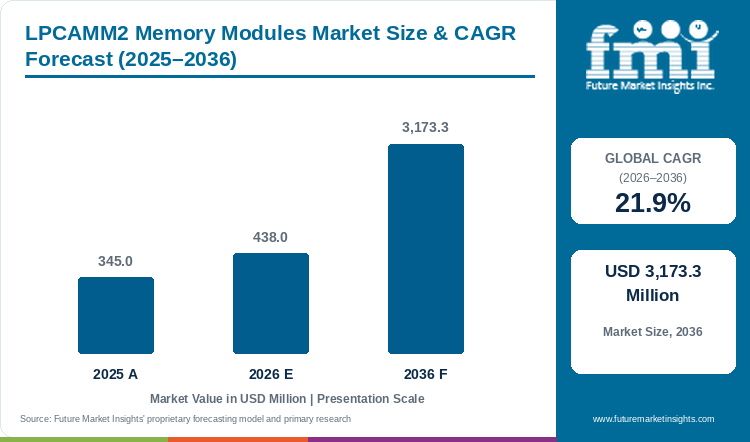
The global LPCAMM2 memory modules market establishes its foundation at USD 345.0 million in 2025, advances to USD 438.0 million in 2026, and is forecast to scale to USD 3,173.3 million by 2036 at a CAGR of 21.9%.
Enterprise notebook OEMs are rapidly replacing legacy dual SO-DIMM slots and non-upgradeable soldered DRAM with LPCAMM2 modules to eliminate motherboard space bottlenecks while delivering the high memory bandwidth required for on-device AI assistants. In 2025, global LPCAMM2 memory module market value totaled USD 345.0 million; the market is forecast to hit a 2026 valuation of USD 438.0 million and a 2036 market size of USD 3,173.3 million at a 21.9% CAGR, generating USD 2,735.3 million in new annual market value. For instance, in September 2025, Micron Technology launched Crucial 8,533 MT/s LPDDR5X LPCAMM2 modules up to 64 GB that deliver 1.5x faster transfer speeds and 61% lower active power consumption in less than half the PCB footprint of dual DDR5 SO-DIMMs [1]. Because of these power and footprint savings, 68.5% of 2026 LPDDR DRAM generation demand is projected to center on LPDDR5X (7,500 - 9,600 MT/s) JEDEC JESD318 Modules deployed across enterprise AI PC systems.
Key Market Trends & Insights
- By LPDDR DRAM generation: Volume availability of monolithic 32-gigabit dies is anticipated to give LPDDR5X (7,500 - 9,600 MT/s) JEDEC JESD318 Modules 68.5% of DRAM generation volume in 2026.
- By module capacity tier: Corporate IT departments specifying larger unified RAM for local copilot inference are forecast to lift 32 GB & 64 GB Dual-Channel AI PC Modules to a 54.2% share in 2026.
- By compression connector interposer: Suppressing capacitive signal reflection above 8,533 MT/s is expected to put Dual-Sided Elastomer / Gold Finger Compression Pads at 62.0% of interposer demand in 2026.
- By host system category: European Union eco-design repairability rules requiring field-replaceable memory are estimated to assign 59.6% of 2026 host system volume to Commercial AI Laptops & Mobile Workstations.
Regional Highlights
- Fastest national growth: Japan is projected to pace analyzed countries at a 24.6% annual rate to 2036 thanks to Hiroshima 1b/1c-nm LPDDR5X wafer fabrication and ultra-thin commercial notebooks.
- Wider regional momentum: Annual growth is forecast to reach 23.9% in Vietnam and 23.3% in Malaysia ahead of 21.5% in South Korea, while 21.3% in the USA and 21.0% in Taiwan reflect steady workstation refreshes.
Market Size & Forecast
Table 1: Market Size and Forecast for the LPCAMM2 Memory Modules Market (USD million and CAGR percentage), 2025 to 2036
| Metric | Value |
|---|---|
| 2025 Market Size | USD 345.0 million |
| Estimated Market Size in 2026 | USD 438.0 million |
| Projected Market Size by 2036 | USD 3,173.3 million |
| CAGR, 2026 to 2036 | 21.9% |
| Added Revenue, 2026 to 2036 | USD 2,735.3 million |
Corporate IT fleet managers have pushed back against soldered laptop memory because soldering LPDDR5X packages directly onto the motherboard forces enterprises to scrap entire mainboards when memory fails or when AI software updates require more RAM. To solve this fleet lifecycle problem without sacrificing high-frequency signal integrity, notebook OEMs are standardizing on JEDEC JESD318 compression sockets across commercial product lines. As a matter of fact, at Lenovo Innovation World in September 2025, Lenovo introduced the ThinkPad P1 Gen 8 mobile workstation featuring up to 64 GB of user-replaceable LPDDR5X LPCAMM2 memory operating at 7,467 MT/s and the ThinkPad X9 Aura Edition [2]. This OEM shift toward serviceable low-power memory directly expands recurring module demand across both factory build-to-order lines and aftermarket semiconductor memory sub-assemblies.
Unit Shipment & Gigabytes-Shipped Sizing
Table 2: Module Unit Shipment and Capacity Sizing for the LPCAMM2 Memory Modules Market (USD million and operational ranges), 2025 to 2036
| Metric | 2025 | 2026 | 2036 |
|---|---|---|---|
| Market size (USD million) | 345.0 | 438.0 | 3,173.3 |
| LPCAMM2 modules shipped globally (million units) | 1.9 to 2.2 | 2.5 to 2.9 | 24.5 to 28.0 |
| Average realized price per module (USD) | 156.8 to 181.6 | 151.0 to 175.2 | 113.3 to 129.5 |
| Total LPDDR capacity shipped on LPCAMM2 (million gigabytes) | 72.0 to 84.0 | 98.0 to 114.0 | 1,350.0 to 1,560.0 |
Operational note: Unit shipment and gigabyte ranges reflect weighted average module capacities climbing from 38.4 GB in 2025-2026 toward 55.0 GB by 2036 across 16 GB to 128 GB SKUs.
Shipment and pricing trends in Table 2 show that even as per-gigabyte DRAM wafer costs decline over the decade, average realized module prices remain resilient above USD 113 because enterprise buyers are migrating from 16 GB boards to 64 GB and 128 GB configurations to run local 30-billion-parameter language models. Consequently, total gigabytes shipped on LPCAMM2 substrates surge more than thirteen-fold by 2036, driving high-layer-count orders for printed circuit board assemblies.
AI PC Fleet & Interposer Socket Economics
Table 3: Host System Penetration and Socket Indicators for the LPCAMM2 Memory Modules Market (USD and percentages), 2025 to 2036
| Metric | 2025 | 2026 | 2036 |
|---|---|---|---|
| Commercial AI laptops & workstations shipped (million units) | 38.0 to 42.0 | 58.0 to 64.0 | 185.0 to 205.0 |
| LPCAMM2 socket penetration in mobile workstations (%) | 14.0% to 16.5% | 19.5% to 22.5% | 58.0% to 64.0% |
| Module BOM allocation per LPCAMM2 workstation (USD) | 165.0 to 190.0 | 160.0 to 185.0 | 125.0 to 145.0 |
| OEM factory BTO vs. aftermarket CRU upgrade share (%) | 86.0% / 14.0% | 84.0% / 16.0% | 72.0% / 28.0% |
Table 4: Host Platform & Interposer Valuation Indicators for the LPCAMM2 Memory Modules Market (USD and percentages), 2026
| Metric | Value | Institutional Reference Basis |
|---|---|---|
| Market size, 2026 | USD 438.0 million | 2026 global module valuation baseline |
| JEDEC JESD318 interposer contact array | 644 pins (LPDDR5X) | JEDEC JESD318B CAMM2 common standard |
| Motherboard area savings vs. dual SO-DIMM | 57.0% to 64.0% | OEM notebook Z-height and PCB area benchmark |
| Commercial AI laptop & workstation share, 2026 | 59.6% (USD 261.0 million allocation) | 59.6% host system segment allocation |
Socket penetration metrics in Tables 3 and 4 reveal a profitable shift in sales channel mix: as the installed base of LPCAMM2-equipped corporate laptops expands, high-margin aftermarket customer-replaceable unit (CRU) upgrades double from 14.0% of revenue in 2025 to 28.0% by 2036. At the same time, the 57.0% to 64.0% motherboard area reduction lets notebook architects widen vapor chambers and route PCIe high-speed interconnects to dual M.2 Gen 5 SSDs.
Analyst Perspective
"Enterprise IT procurement teams refuse to accept disposable soldered-memory laptops when rolling out multi-year commercial AI PC fleets. Memory makers and connector specialists that validate low-crosstalk 8,533 to 9,600 MT/s JESD318B compression modules will capture both OEM factory build-to-order sockets and high-margin enterprise field upgrades."
- Sudip Saha, Principal Consultant, Future Market Insights.
How is the LPCAMM2 memory modules market segmented?
The LPCAMM2 memory modules market is segmented by LPDDR DRAM generation, module capacity tier, compression connector interposer, host system category, and region. In 2026, LPDDR5X (7,500 - 9,600 MT/s) JEDEC JESD318 Modules are expected at 68.5%, 32 GB & 64 GB Dual-Channel AI PC Modules are estimated at 54.2%, Dual-Sided Elastomer / Gold Finger Compression Pads are projected at 62.0%, and Commercial AI Laptops & Mobile Workstations are forecast at 59.6%.
By LPDDR DRAM generation: LPDDR5X (7,500 - 9,600 MT/s) JEDEC JESD318 Modules, LPDDR6 (10,667 - 14,400 MT/s) Next-Gen Modules, and Others.
By module capacity tier: 32 GB & 64 GB Dual-Channel AI PC Modules, 16 GB Mainstream Commercial Notebook Modules, 128 GB Mobile Workstation & Edge Server Modules, and Others.
By compression connector interposer: Dual-Sided Elastomer / Gold Finger Compression Pad, Low-Profile Single-Sided Z-Height (<3.0 mm) Stack, and Others.
By host system category: Commercial AI Laptops & Mobile Workstations, Compact Mini-PCs & Industrial Edge AI Boxes, Low-Power ARM/x86 Cloud Microservers, and Others.
Why do LPDDR5X (7,500 - 9,600 MT/s) JEDEC JESD318 Modules lead the LPDDR DRAM generation segment?
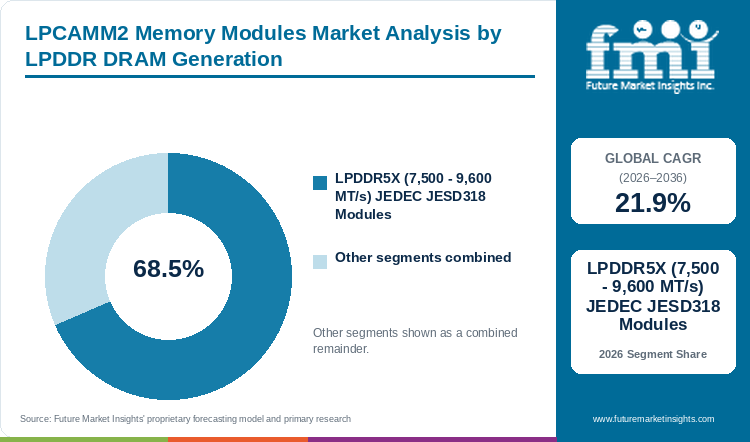
Broad IMC qualification across commercial laptop processors is slated to assign a 68.5% share of the LPDDR DRAM generation segment to LPDDR5X (7,500 - 9,600 MT/s) JEDEC JESD318 Modules in 2026.
Table 5: LPDDR DRAM Generation Share for the LPCAMM2 Memory Modules Market (percentage share), 2026
| LPDDR DRAM Generation | Share (2026) |
|---|---|
| LPDDR5X (7,500 - 9,600 MT/s) JEDEC JESD318 Modules | 68.5% |
| Other Segments Combined | 31.5%* |
| Total | 100.0% |
*Calculated as the balance remaining after deducting the leading segment's reported share from 100.0%.
Table 6: LPDDR DRAM Generation Leadership and Market Growth for the LPCAMM2 Memory Modules Market (segment and CAGR percentage), 2026 to 2036
| Metric | Value |
|---|---|
| Global CAGR (2026 to 2036) | 21.9% |
| Leading Segment | LPDDR5X (7,500 - 9,600 MT/s) JEDEC JESD318 Modules |
Notebook ODM purchasing behavior is locked onto LPDDR5X JESD318 modules because integrated memory controllers on commercial x86 and ARM laptop processors shipped in 2026 are electrically validated for 7,500 to 9,600 MT/s 128-bit signaling rather than unratified LPDDR6 pinouts. In addition to processor compatibility, high 1b-nanometer and 1c-nanometer wafer yields allow DRAM makers to price LPDDR5X LPCAMM2 boards competitively for corporate fleet tenders while protecting onboard power-management ICs with semiconductor encapsulants.
- Mature 1b-nm and 1c-nm wafer yields are predicted to give LPDDR5X (7,500 - 9,600 MT/s) JEDEC JESD318 Modules 68.5% of 2026 motherboard shipments.
- For instance, at MWC 2026 in March 2026, SK hynix introduced its 1c-nanometer sixth-generation 10nm-class LPDDR6 and volume LPDDR5X plus 192 GB SOCAMM2 modular low-power memory solutions [3].
Why do 32 GB & 64 GB Dual-Channel AI PC Modules lead the module capacity tier segment?
Shared CPU-NPU-GPU memory architectures in commercial notebooks are predicted to place 32 GB & 64 GB Dual-Channel AI PC Modules at 54.2% of the module capacity tier segment in 2026.
Enterprise IT hardware standards have migrated away from 16 GB laptops because local retrieval-augmented generation models and background security telemetry contend for the same unified DRAM pool shared by the CPU and neural processing unit. When an on-device AI assistant reserves 8 to 12 gigabytes of unified RAM continuously, 16 GB systems suffer severe paging slowdowns, compelling corporate buyers to specify 32 GB and 64 GB dual-channel LPCAMM2 boards that avoid bulky four-slot SO-DIMM layouts or high-density data center connectors.
- An estimated 54.2% of 2026 capacity-tier demand is expected to center on 32 GB & 64 GB Dual-Channel AI PC Modules while Crucial and Samsung scale dual-channel SKUs with BIWIN.
- In fact, BIWIN Storage Technology's September 2025 LPDDR5 CAMM2 product specifications detail 32 GB and 64 GB LPCAMM2 modules operating at 7,500 to 8,533 MT/s for commercial AI notebooks [4].
What keeps Dual-Sided Elastomer / Gold Finger Compression Pads ahead in the compression connector interposer segment?
Within the compression connector interposer segment, 62.0% of 2026 volume is anticipated to come from Dual-Sided Elastomer / Gold Finger Compression Pads due to low contact inductance.
Motherboard signal-integrity requirements drive the dominance of dual-sided conductive elastomer and gold-plated compression finger interposers because data rates between 8,533 and 9,600 MT/s cannot tolerate the parasitic inductance of long wiping-pin sockets. By clamping the LPCAMM2 substrate flat against a 644-pad land-grid array with integrated grounding shields, these interposers eliminate capacitive stubs and prevent fretting corrosion during mobile drop shock. As a result, notebook ODMs are shifting high-speed socket budgets toward shielded PCB and compression connectors.
- Field-proven cLGA contact reliability across commercial workstations is forecast to assign a 62.0% interposer share to Dual-Sided Elastomer / Gold Finger Compression Pads in 2026.
- For example, at OFC 2025 in March 2025, Amphenol Communications Solutions demonstrated its JEDEC JESD318-compliant cLGA compression contact interposer with integrated shielding that reduces crosstalk [5].
Why do Commercial AI Laptops & Mobile Workstations lead the host system category segment?
Enterprise notebook serviceability programs are projected to place Commercial AI Laptops & Mobile Workstations at 59.6% of the host system category segment in 2026.
Commercial AI laptops and mobile workstations generate the majority of LPCAMM2 demand because enterprise IT buyers willingness to pay a module socket premium is directly tied to three-to-five-year on-site warranty serviceability and battery runtime. When two bulky SO-DIMM slots are replaced with a single flat compression module, internal chassis volume opens up for high-energy-density silicon-anode batteries while field technicians can swap RAM in under five minutes. Consequently, modular workstation adoption is scaling in parallel with edge AI gateways.
- Flagship workstation rollouts are slated to give Commercial AI Laptops & Mobile Workstations 59.6% of host-system module consumption in 2026.
- Specifically, Lenovo unveiled its ThinkPad P1 Gen 9 mobile workstation in March 2026 integrating up to 96 GB of customer-replaceable LPCAMM2 LPDDR5X memory running at 9,600 MT/s [6].
What are the drivers, restraints, and opportunities in the LPCAMM2 memory modules market?
Across the LPCAMM2 memory modules market, on-device AI bandwidth demands and right-to-repair modularity are projected to accelerate OEM adoption, whereas compression clamping tolerances restrain casual retail DIY upgrades and compact edge servers create new opportunities.
- Driver: Enterprise AI PC refresh cycles and European Union eco-design repairability mandates compel OEMs to replace soldered LPDDR5X with socketed LPCAMM2 boards.
- Restraint: Precision screw-clamping torque requirements across 644-pin compression interposers and high quad-channel workstation capacities create mechanical and layout hurdles.
- Opportunity: Deploying wide-temperature 64 GB and 128 GB LPCAMM2 modules into fanless industrial edge AI boxes and cloud microservers opens high-margin embedded sockets.
Growth Analysis and Future Potential: Qualitative Demand Catalysts
Mandatory right-to-repair regulations in Europe and corporate sustainability scoring in North America are compelling PC OEMs to phase out non-upgradeable soldered memory across mainstream commercial laptop lines. When soldered DRAM is replaced by a socketed LPCAMM2 board, enterprises can purchase 32 GB laptops initially and upgrade to 64 GB mid-lifecycle without discarding functional motherboards. For instance, in May 2026, Lenovo completed its 2026 enterprise ThinkPad AI PC portfolio by expanding customer-replaceable memory and battery modules with modular SSD slots to achieve up to 9 out of 10 repairability scores across commercial fleets [7]. This regulatory and procurement push is expanding socketed low-power memory adoption across client fleets connected to edge server platforms.
Risk Assessment of the LPCAMM2 Memory Modules Market: Operational and Formulation Friction
On the other hand, LPCAMM2 adoption in entry-level consumer laptops and ultra-high-capacity 192 GB quad-channel workstations is restrained by precision compression-mounting costs and strict high-frequency PCB impedance rules. Unlike tool-less snap-in SO-DIMM clips, LPCAMM2 boards require controlled screw torque across 644 land-grid contacts and a costly 10-layer high-density interconnect substrate to prevent channel drop-outs. Specifically, Samsung Semiconductor's February 2026 LPDDR5X technical specification notes that sustaining 10.7 Gbps transfer speeds with 25% power savings via Full Dynamic Voltage Frequency Scaling requires tight signal integrity across ultra-thin packages [8]. Because adding a compression interposer increases bill-of-materials cost by several dollars per laptop, budget consumer PCs still default to SO-DIMMs or soldered dynamic random access memory chips.
Commercial Opportunity Analysis: Formulation Differentiation and Value-Add Formats
Memory module manufacturers are capturing new high-margin growth beyond commercial laptops by adapting screw-clamped LPCAMM2 and low-power compression architectures for fanless industrial edge AI boxes and cloud microservers. Conventional vertical DDR5 RDIMMs block airflow in 1U servers and vibrate loose inside factory robotics controllers, whereas flat screw-mounted compression modules withstand high-G shock and cut memory standby power in half. To capture this data center and edge demand, in March 2026, Micron Technology detailed how its 1-gamma (1γ) monolithic 32-gigabit LPDDR5X architecture powers both client LPCAMM2 boards and 192 GB to 256 GB server SOCAMM2 modules that reduce power consumption by 50% [9]. Consequently, module houses that combine wide-temperature screening (-25 to +85 degrees Celsius) with graphene heat spreaders are winning long-lifecycle industrial and microserver sockets.
LPCAMM2 Memory Modules Market by Country (2026 to 2036)
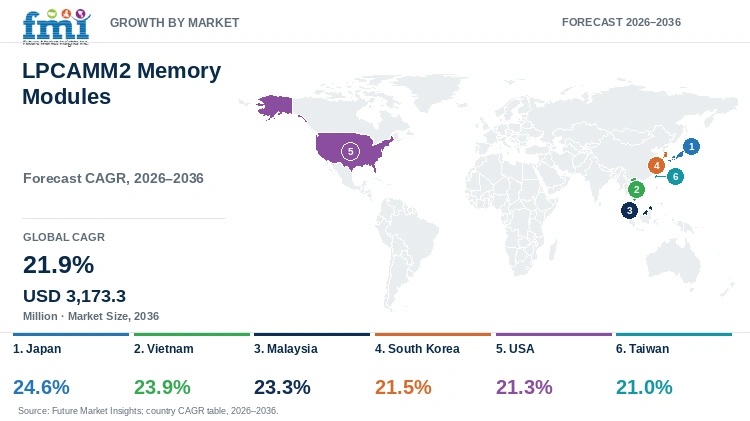
National shipment modeling places Japan at the front of country-level LPCAMM2 memory module expansion with a 24.6% annual rate through 2036, followed by Vietnam at 23.9% and Malaysia at 23.3%. In parallel, South Korea records a 21.5% growth rate while the USA registers 21.3% and Taiwan reaches 21.0% across the forecast period. Upstream LPDDR5X/LPDDR6 wafer fabrication and notebook ODM assembly capacity govern country-level demand.
Table 7: Country CAGR and Primary Growth Levers for the LPCAMM2 Memory Modules Market (CAGR percentage and operational drivers), 2026 to 2036
| Country | CAGR (2026 to 2036) | Primary Growth Lever |
|---|---|---|
| Japan | 24.6% | Hiroshima 1b/1c-nm LPDDR5X wafer fabrication and ultra-light commercial notebook OEM adoption |
| Vietnam | 23.9% | Law on Digital Technology Industry incentives and AI laptop ODM assembly in Bac Ninh and Hai Phong |
| Malaysia | 23.3% | Penang and Kulim backend memory packaging and module SMT lines with enterprise server integration |
| South Korea | 21.5% | Domestic Pyeongtaek and Icheon LPDDR5X/LPDDR6 die production by Samsung and SK hynix |
| USA | 21.3% | Boise memory R&D and enterprise AI PC fleet procurement by Dell and HP under repairability rules |
| Taiwan | 21.0% | Taipei and Hsinchu third-party module manufacturing (ADATA, Kingston) and LOTES interposer production |
Source: Future Market Insights analysis
Japan LPCAMM2 Memory Modules Market Outlook (2026 to 2036)
What distinguishes Japan from other LPCAMM2 markets is the intersection of domestic 1-beta and 1-gamma LPDDR5X wafer fabrication in Hiroshima with a corporate mobile computing culture that demands sub-1-kilogram laptops and rugged factory-automation controllers. Across Japan, the LPCAMM2 memory module market value is projected to climb at a 24.6% annual pace through 2036 on the strength of enterprise notebook refreshes and compact industrial edge deployments. For example, at its September 2026 embedded memory exhibition, ADATA Industrial Japan demonstrated ruggedized LPDDR5X LPCAMM2 modules engineered specifically for Japanese factory-automation controllers and medical imaging carts in compact commercial PCs [10]. Even though high domestic SMT assembly wages limit mass-market consumer notebook manufacturing in Japan, premium industrial and executive laptop sockets sustain strong module pricing.
Key takeaway: In Japan, advanced Hiroshima LPDDR5X wafer output and compact industrial and commercial PC engineering are projected to anchor rapid LPCAMM2 adoption.
Vietnam LPCAMM2 Memory Modules Market Outlook (2026 to 2036)
Unlike Japan or the USA where domestic enterprise consumption drives sales, Vietnam's LPCAMM2 market is shaped by export-oriented notebook ODM factories in Bac Ninh and Hai Phong assembling AI laptops. As a matter of fact, the U.S. International Trade Administration reported in April 2026 that Vietnam's Law on Digital Technology Industry took effect in January 2026 with 150% R&D tax deductions for AI and semiconductor hardware as digital economy revenue heads toward USD 52 billion [11]. Demand for LPCAMM2 memory modules in Vietnam is forecast to advance at a 23.9% yearly rate to 2036, supported by surface-mount assembly and build-to-order laptop fulfillment. However, Vietnamese plants remain reliant on imported DRAM dies.
Key takeaway: In Vietnam, expanding commercial AI laptop ODM assembly clusters and semiconductor module test facilities are forecast to drive bulk factory consumption of LPCAMM2 boards.
Malaysia LPCAMM2 Memory Modules Market Outlook (2026 to 2036)
Malaysia occupies a unique midstream position in the LPCAMM2 value chain as Southeast Asia's primary module substrate assembly and at-speed 8,533 MT/s burn-in testing hub across Penang and Kulim. Commercial LPCAMM2 memory module turnover in Malaysia is anticipated to progress at a 23.3% compound annual clip through 2036 because Micron and SMART Modular backend plants in Penang pair monolithic LPDDR5X packages with PMICs on multilayer substrates. Specifically, Penguin Solutions' January 2026 SMART Modular portfolio documentation details how its Penang manufacturing hubs supply high-reliability low-power modular memory across enterprise and industrial AI platforms [12]. This backend test concentration insulates Malaysia from local consumer PC cyclicality while tying growth to global OEM exports.
Key takeaway: In Malaysia, backend memory module assembly plants in Penang and at-speed LPDDR5X test hubs are anticipated to sustain strong export-driven expansion.
South Korea LPCAMM2 Memory Modules Market Outlook (2026 to 2036)
South Korea anchors the upstream die supply and pricing power of the global LPCAMM2 market through Samsung Electronics and SK hynix megafabs in Pyeongtaek and Icheon. For instance, SK hynix Newsroom's June 2026 LPCAMM2 archive documents how Korean fabricators scaled 7,500 to 9,600 MT/s LPDDR5X compression module production for global AI PC brands across 2025 and 2026 [13]. South Korean LPCAMM2 memory module valuation is expected to rise at a 21.5% annual growth rate through 2036, owing to early transition toward 1c-nanometer LPDDR6 CAMM2 architectures and domestic 10-layer HDI substrate manufacturing. Even when server HBM competes for wafer capacity, premium margins on 64 GB LPCAMM2 SKUs keep Korean module output growing.
Key takeaway: In South Korea, upstream 1b/1c-nm LPDDR5X and LPDDR6 die leadership from Samsung and SK hynix is expected to anchor global high-speed LPCAMM2 production.
USA LPCAMM2 Memory Modules Market Outlook (2026 to 2036)
Unlike Asian contract-assembly hubs, the USA market is shaped by Fortune 500 enterprise AI workstation fleet refreshes and upstream JEDEC JESD318 architectural co-design in Boise and Austin. Specifically, Micron Technology's February 2026 LPCAMM2 specification and joint Lenovo AI PC white paper demonstrate that 1-beta LPDDR5X compression modules operating up to 9,600 Mb/s cut active power by 57% to 61% and standby power by up to 80% while shrinking board volume by 64% [14]. Within the USA, the LPCAMM2 memory module market value is predicted to post a 21.3% yearly growth rate through 2036, driven by corporate IT lifecycle extension programs and Dell and HP workstation rollouts. Crucial's direct U.S. channel distribution further boosts aftermarket upgrades.
Key takeaway: In the USA, enterprise AI workstation fleet refreshes and Crucial aftermarket upgrade kit availability are predicted to sustain high-value module demand.
Taiwan LPCAMM2 Memory Modules Market Outlook (2026 to 2036)
Taiwan's unique role in the LPCAMM2 market stems from the co-location of independent module brands ADATA and Kingston plus socket leader LOTES Co., Ltd. with the Taipei R&D centers of global notebook ODMs. National LPCAMM2 memory modules industry valuation in Taiwan is estimated to increase at a 21.0% annual rate to 2036 since Keelung-based LOTES supplies precision 644-pin compression interposers directly to Compal and Quanta motherboard teams. Confirming this momentum, Taipei-headquartered ADATA Technology reported in October 2026 that third-quarter 2026 consolidated revenue hit a record TWD 53.0 billion (USD 1.65 billion), rising 266% year-over-year as DRAM modules contributed three-quarters of September 2026 sales [15]. Because Taiwanese module houses buy merchant LPDDR5X dies, they prioritize high-margin industrial SKUs.
Key takeaway: In Taiwan, tight co-location of third-party module assemblers and LOTES compression connector plants with notebook ODM design centers is estimated to drive steady commercial growth.
Full report country CAGRs cover: North America; Latin America; Western Europe; Eastern Europe; East Asia; South Asia and Pacific; Middle East and Africa.
Who are the notable companies in the LPCAMM2 memory modules market?
Micron Technology, Inc. (Crucial LPCAMM2), Samsung Electronics Co., Ltd., SK hynix Inc., ADATA Technology Co., Ltd., Kingston Technology Corporation, SMART Modular Technologies (Penguin Solutions), and Amphenol / LOTES Co., Ltd. are the notable companies in the LPCAMM2 memory modules market.
Competitive positioning in the LPCAMM2 memory modules sector divides across vertically integrated LPDDR DRAM fabricators and independent third-party memory module houses. Vertically integrated DRAM makers Micron Technology and Samsung Electronics join SK hynix in controlling monolithic 32-gigabit LPDDR5X die supply and Tier-1 OEM factory build-to-order qualifications. Independent module manufacturers ADATA Technology and Kingston Technology compete with SMART Modular Technologies (Penguin Solutions) across industrial wide-temperature edge systems and enterprise channel upgrades. Meanwhile, Amphenol and LOTES supply the 644-pin JESD318 compression sockets and retention plates.
- Vertically Integrated LPDDR DRAM & Module Fabricators: Micron Technology (Crucial LPCAMM2) and Samsung Electronics join SK hynix in fabricating 1b/1c-nm LPDDR5X and LPDDR6 dies for factory-qualified JESD318 modules.
- Independent Commercial & Industrial Module Specialists: ADATA Technology and Kingston Technology engineer commercial LPCAMM2 upgrade boards while SMART Modular Technologies (Penguin Solutions) builds rugged industrial modules.
- Compression Socket & Interposer Hardware Enablers: Amphenol and LOTES manufacture the JEDEC JESD318 644-pin compression interposers and cLGA/elastomer contacts with thermal cover plates.
Competitive Benchmarking: LPCAMM2 Memory Modules Market
Table 8: Competitive Benchmarking for the LPCAMM2 Memory Modules Market (qualitative capability ratings), 2026
| Company | LPDDR5X / LPDDR6 Die Access | High-Speed SI & PMIC Integration | OEM BTO & Channel Reach | Geographic Reach |
|---|---|---|---|---|
| Micron Technology, Inc. (Crucial LPCAMM2) | High | High | High | High |
| Samsung Electronics Co., Ltd. | High | High | High | High |
| SK hynix Inc. | High | High | High | High |
| ADATA Technology Co., Ltd. | Medium | High | High | High |
| Kingston Technology Corporation | Medium | High | High | High |
| SMART Modular Technologies (Penguin Solutions) | Medium | High | Medium | High |
| Amphenol / LOTES Co., Ltd. | Medium | High | High | High |
Evaluation basis: Capability tiers evaluate captive 1b/1c-nm LPDDR5X and LPDDR6 wafer fabrication versus merchant die sourcing plus 8,533 to 9,600 MT/s PCB impedance control and Tier-1 OEM BTO reach.
Key Developments in the LPCAMM2 Memory Modules Market
- Samsung Electronics expanded commercial availability of its 7,500 to 9,600 MT/s LPDDR5X LPCAMM2 module lineup in January 2026 for next-generation AI PCs and mobile workstations [16].
- ADATA Technology Co., Ltd. launched its ADATA Industrial LPDDR5X CAMM2 (LPCAMM2) module series in March 2026 for rugged edge AI boxes and compact industrial systems [17].
- Amphenol Communications Solutions scaled commercial production of its JEDEC SO-032 and JESD318-compliant 644-pin and 666-pin DDR5/LPDDR5 CAMM2 compression connectors with 0.60 mm and 1.0 mm stack heights supporting up to 128 GB per socket [18].
Key Players in the LPCAMM2 Memory Modules Market
Vertically Integrated LPDDR DRAM & Module Fabricators
- Micron Technology, Inc. (Crucial LPCAMM2)
- Samsung Electronics Co., Ltd.
- SK hynix Inc.
Independent Commercial & Industrial Module Specialists
- ADATA Technology Co., Ltd.
- Kingston Technology Corporation
- SMART Modular Technologies (Penguin Solutions)
Compression Socket & Interposer Hardware Enablers
- Amphenol / LOTES Co., Ltd.
LPCAMM2 Memory Modules Market - Report Scope
Table 9: Report Scope for the LPCAMM2 Memory Modules Market (coverage fields and definitions), 2026 to 2036
| Coverage field | Report scope |
|---|---|
| Market breakdown | LPDDR DRAM Generation; Module Capacity Tier; Compression Connector Interposer; Host System Category; Region |
| Quantitative Units | USD Million |
| Market Definition | Includes commercial supplier revenue from JEDEC JESD318-compliant Low-Power Compression Attached Memory Modules (LPCAMM2) incorporating LPDDR5X and LPDDR6 DRAM packages with onboard PMIC/SPD hubs and matched compression connector interposer kits. Segment Scope Note: Excludes legacy 262-pin SO-DIMMs and directly soldered BGA DRAM chips sold without a compression module substrate. |
| Regions Covered | North America; Latin America; Western Europe; Eastern Europe; East Asia; South Asia and Pacific; Middle East and Africa |
| Countries Covered | Japan, Vietnam, Malaysia, South Korea, USA, Taiwan, and additional countries in the full report |
| Key Companies Covered | Micron Technology, Inc. (Crucial LPCAMM2), Samsung Electronics Co., Ltd., SK hynix Inc., ADATA Technology Co., Ltd., Kingston Technology Corporation, SMART Modular Technologies (Penguin Solutions), Amphenol / LOTES Co., Ltd. |
| Forecast Period | 2026 to 2036 |
| Approach | Primary and secondary research with top-down and bottom-up market triangulation. |
LPCAMM2 Memory Modules Market - Research Methodology
Table 10: Research Methodology for the LPCAMM2 Memory Modules Market (research methods and approach), 2026 edition
| Method | Approach |
|---|---|
| Primary Research | Structured interviews with commercial notebook ODM motherboard architects and enterprise IT hardware procurement directors across Taiwan, South Korea, Japan, and the USA. |
| Secondary Research | Analysis of JEDEC JESD318/JESD318B specifications, DRAM manufacturer datasheets, Lenovo workstation press releases, and government digital trade guides. |
| Market Sizing and Forecasting | Top-down commercial AI PC and mobile workstation memory expenditure models reconciled against bottom-up LPCAMM2 unit shipments and per-gigabyte module ASPs from 2026 to 2036. |
| Country Forecasting Model | Econometric national projections weight LPDDR wafer fabrication capacity and notebook ODM factory shipments across six primary electronics countries. |
| Operational Benchmark Traceability | Unit shipment and PCB footprint savings indicators in Tables 2, 3, and 4 trace to Micron, Samsung, SK hynix, and Lenovo engineering benchmarks. |
| Data Triangulation and Validation | Module valuation estimates are cross-checked against compression interposer socket shipments and OEM laptop BTO attach rates while excluding soldered BGA LPDDR and standard DDR5 SO-DIMMs. |
LPCAMM2 Memory Modules Market by Segments
LPCAMM2 Memory Modules Market segmented by LPDDR DRAM Generation:
- LPDDR5X (7,500 - 9,600 MT/s) JEDEC JESD318 Modules
- LPDDR6 (10,667 - 14,400 MT/s) Next-Gen Modules
- Others
LPCAMM2 Memory Modules Market segmented by Module Capacity Tier:
- 32 GB & 64 GB Dual-Channel AI PC Modules
- 16 GB Mainstream Commercial Notebook Modules
- 128 GB Mobile Workstation & Edge Server Modules
- Others
LPCAMM2 Memory Modules Market segmented by Compression Connector Interposer:
- Dual-Sided Elastomer / Gold Finger Compression Pad
- Low-Profile Single-Sided Z-Height (<3.0 mm) Stack
- Others
LPCAMM2 Memory Modules Market segmented by Host System Category:
- Commercial AI Laptops & Mobile Workstations
- Compact Mini-PCs & Industrial Edge AI Boxes
- Low-Power ARM/x86 Cloud Microservers
- Others
LPCAMM2 Memory Modules Market by Region
- North America
- USA
- Canada
- Latin America
- Brazil
- Mexico
- Argentina
- Chile
- Western Europe
- Germany
- France
- United Kingdom
- Italy
- Spain
- Benelux
- Nordics
- Eastern Europe
- Poland
- Czech Republic
- Romania
- Hungary
- East Asia
- Japan
- South Korea
- Taiwan
- China
- South Asia and Pacific
- Vietnam
- Malaysia
- India
- ASEAN
- Australia and New Zealand
- Middle East and Africa
- GCC Countries
- South Africa
- Türkiye
- Israel
Research Sources and Bibliography
- [1] Micron Technology, Inc. (2025, September 30). Crucial LPCAMM2 Powers AI-Ready Laptops With Breakthrough 8,533MT/s Speeds. Micron Technology Newsroom.
- [2] Lenovo Group Limited. (2025, September 05). Lenovo Innovation World 2025: Enabling Smarter AI for All with Expanding Portfolio of AI Devices, Solutions, and Concepts for Business IT - Lenovo StoryHub. Lenovo StoryHub Pressroom.
- [3] SK hynix Inc. (2026, March 05). SK hynix Unveils Latest AI Memory Solutions at MWC 2026 as a Full Stack AI Memory Creator. SK hynix Newsroom.
- [4] BIWIN Storage Technology Co., Ltd. (2025, September 27). BIWIN LPCAMM2 Memory | LPDDR5 CAMM2. BIWIN Storage Technology.
- [5] Amphenol Communications Solutions. (2025, March 28). Leading the Evolution of Optical Interconnect: Amphenol @ OFC 2025. Amphenol Corporation.
- [6] Lenovo Group Limited. (2026, March 16). Lenovo Unveils Next-Generation High-Performance Workstations and Announces the World's First 1,000Wh/L Silicon-Anode Battery for Notebooks and Workstations - Lenovo StoryHub. Lenovo StoryHub Pressroom.
- [7] Lenovo Group Limited. (2026, May 12). Lenovo Completes 2026 ThinkPad Portfolio with Expanded AI PCs for Mainstream Enterprise Computing - Lenovo StoryHub. Lenovo StoryHub Pressroom.
- [8] Samsung Electronics Co., Ltd. (2026, February 15). LPDDR5X | DRAM | Samsung Semiconductor Global. Samsung Semiconductor Global.
- [9] Micron Technology, Inc. (2026, March 12). SOCAMM2 | Micron Technology Inc. Micron Technology, Inc.
- [10] ADATA Technology Co., Ltd. (2026, September 17). Global Leader In Industrial-grade Memory - ADATA INDUSTRIAL. ADATA Industrial Japan.
- [11] U.S. Department of Commerce, International Trade Administration. (2026, April 23). Vietnam - Digital Economy Chapter. International Trade Administration (trade.gov).
- [12] Penguin Solutions (SMART Modular Technologies). (2026, January 14). Comprehensive Memory Product Portfolio from SMART Modular. Penguin Solutions.
- [13] SK hynix Inc. (2026, June 02). LPCAMM2 - SK hynix Newsroom. SK hynix Newsroom.
- [14] Micron Technology, Inc. (2026, February 10). LPCAMM2 | Micron Technology Inc. Micron Technology, Inc.
- [15] ADATA Technology Co., Ltd. (2026, October 06). ADATA Monthly Sales Report of September 2026 - NEWS | ADATA (United States). ADATA Technology Co., Ltd. Newsroom.
- [16] Samsung Electronics Co., Ltd. (2026, January 18). LPCAMM2 | Module | Samsung Semiconductor Global. Samsung Electronics Co., Ltd.
- [17] ADATA Technology Co., Ltd. (2026, March 15). LPDDR5 CAMM2 - ADATA Industrial. ADATA Industrial.
- [18] Amphenol Communications Solutions. (2025, December 23). DDR5/LPDDR5 CAMM2 Connector | Storage and Server Systems. Amphenol Corporation.
- [19] Crucial (Micron Consumer Products Group). (2026, January 20). Crucial 64GB LPCAMM2 LPDDR5X- 7500 memory | CT64G75C2LP5X. Micron Technology, Inc.
- [20] Crucial (Micron Consumer Products Group). (2026, April 10). LPCAMM2 Memory - A new era in memory. Micron Technology, Inc.
- [21] SK hynix Inc. (2026, April 19). SK hynix Begins Mass Production of 192GB SOCAMM2 'Setting a New Standard for AI Server Memory Performance'. SK hynix Newsroom.
This bibliography is provided for reader reference and is not exhaustive. The full report contains the complete reference list and detailed citations.
This Report Answers
- How large is the LPCAMM2 memory modules market in 2026 and what is forecast for 2036?
- Which AI PC memory bandwidth and repairability pressures drive demand for LPCAMM2 modules?
- Why do LPDDR5X (7,500 - 9,600 MT/s) JEDEC JESD318 Modules lead the DRAM generation segment?
- Why do 32 GB & 64 GB Dual-Channel AI PC Modules lead the capacity tier segment globally?
- How do growth rates differ across Japan, Vietnam, Malaysia, South Korea, the USA, and Taiwan?
- Which leading DRAM fabricators and third-party module or connector suppliers serve this market today?
- What mechanical or PCB impedance factors limit adoption in the LPCAMM2 memory modules market?
- What should notebook OEMs and enterprise IT buyers evaluate before specifying LPCAMM2 modules?
Frequently Asked Questions
How big is the LPCAMM2 memory modules market in 2026, and what is forecast for 2036?
From a 2025 baseline of USD 345.0 million, global LPCAMM2 memory module valuation is estimated to reach USD 438.0 million in 2026 before ten-year expansion lifts 2036 market value to USD 3,173.3 million as enterprise notebooks replace soldered RAM.
What is the CAGR for the LPCAMM2 memory modules market from 2026 to 2036?
Over the 2026 to 2036 window, global LPCAMM2 memory module demand is forecast to compound at 21.9% annually, adding USD 2,735.3 million in yearly market value across OEM build-to-order and channel upgrade lines.
Which LPDDR DRAM generation segment leads the LPCAMM2 memory modules market?
ODM motherboard bills of materials place LPDDR5X (7,500 - 9,600 MT/s) JEDEC JESD318 Modules in the lead at an expected 68.5% share of the LPDDR DRAM generation segment in 2026 due to high 1b-nm and 1c-nm wafer yields.
Which module capacity tier segment leads the LPCAMM2 memory modules market?
Workstation BTO specifications give 32 GB & 64 GB Dual-Channel AI PC Modules an estimated 54.2% share of the module capacity tier segment in 2026 to prevent memory bottlenecks during on-device AI inference.
Which country has a notable growth outlook during the assessment period?
Japan is projected to pace national expansion at a 24.6% annual rate through 2036, supported by Hiroshima 1b/1c-nm LPDDR5X wafer production and ultra-light commercial notebook adoption.
Who are the key players in the market?
Micron Technology, Inc. (Crucial LPCAMM2), Samsung Electronics Co., Ltd., SK hynix Inc., ADATA Technology Co., Ltd., Kingston Technology Corporation, SMART Modular Technologies (Penguin Solutions), and Amphenol / LOTES Co., Ltd. anchor global module and socket supply.
Preview the report firsthand - request a free sample
Get SampleGet the brochure for pricing and purchase details.
Get PDFTable of Content
- Key Takeaways
- Market Size and CAGR
- Top Growth Driver
- Fastest Growing Segment
- Leading Region
- Key Companies
- Emerging Opportunities
- Executive Summary
- Global Market Outlook
- Demand-side Trends
- Supply-side Trends
- Technology Roadmap Analysis
- Analysis and Recommendations
- Analyst Perspective (What is happening? Why now? What should investors know?)
- Key Questions Answered
- How large is the market?
- What is the CAGR?
- What are key trends?
- Which region dominates?
- Who are the leaders?
- Market Overview
- Market Coverage / Taxonomy
- Market Definition / Scope / Limitations
- Research Methodology
- Chapter Orientation
- Analytical Lens and Working Hypotheses
- Market Structure, Signals, and Trend Drivers
- Benchmarking and Cross-market Comparability
- Market Sizing, Forecasting, and Opportunity Mapping
- Research Design and Evidence Framework
- Desk Research Programme (Secondary Evidence)
- Expert Input and Fieldwork (Primary Evidence)
- Tooling, Models, and Reference Databases
- Data Engineering and Model Build
- Quality Assurance and Audit Trail
- Market Background
- Market Dynamics (Drivers, Restraints, Opportunity, Trends)
- Scenario Forecast (Optimistic, Likely, Conservative)
- Impact Analysis
- AI Impact
- Sustainability Impact
- Regulatory Impact
- Technology Impact
- Consumer / Buyer Analysis
- Purchase Drivers
- Adoption Barriers
- Buyer Journey
- Opportunity Map Analysis
- Product Life Cycle Analysis
- Supply Chain Analysis
- Investment Feasibility Matrix
- Value Chain Analysis
- PESTLE and Porter's Analysis
- Regulatory Landscape
- Regional Parent Market Outlook
- Production and Consumption Statistics
- Import and Export Statistics
- Global Market Analysis and Forecast, 2021 to 2036
- Historical Market Size Value (USD Million) Analysis, 2021 to 2025
- Current and Future Market Size Value (USD Million) Projections, 2026 to 2036
- Y-o-Y Growth Trend Analysis
- Absolute $ Opportunity Analysis
- Global Market Pricing Analysis, 2021 to 2036
- Global Market Analysis and Forecast, By LPDDR DRAM Generation, 2021 to 2036
- Introduction / Key Findings
- Historical Market Size Value (USD Million) Analysis By LPDDR DRAM Generation, 2021 to 2025
- Current and Future Market Size Value (USD Million) Analysis and Forecast By LPDDR DRAM Generation, 2026 to 2036
- LPDDR5X (7,500 - 9,600 MT/s) JEDEC JESD318 Modules
- LPDDR6 (10,667 - 14,400 MT/s) Next-Gen Modules
- Others
- Y-o-Y Growth Trend Analysis By LPDDR DRAM Generation, 2021 to 2025
- Absolute $ Opportunity Analysis By LPDDR DRAM Generation, 2026 to 2036
- Global Market Analysis and Forecast, By Module Capacity Tier, 2021 to 2036
- Introduction / Key Findings
- Historical Market Size Value (USD Million) Analysis By Module Capacity Tier, 2021 to 2025
- Current and Future Market Size Value (USD Million) Analysis and Forecast By Module Capacity Tier, 2026 to 2036
- 32 GB & 64 GB Dual-Channel AI PC Modules
- 16 GB Mainstream Commercial Notebook Modules
- 128 GB Mobile Workstation & Edge Server Modules
- Others
- Y-o-Y Growth Trend Analysis By Module Capacity Tier, 2021 to 2025
- Absolute $ Opportunity Analysis By Module Capacity Tier, 2026 to 2036
- Global Market Analysis and Forecast, By Compression Connector Interposer, 2021 to 2036
- Introduction / Key Findings
- Historical Market Size Value (USD Million) Analysis By Compression Connector Interposer, 2021 to 2025
- Current and Future Market Size Value (USD Million) Analysis and Forecast By Compression Connector Interposer, 2026 to 2036
- Dual-Sided Elastomer / Gold Finger Compression Pad
- Low-Profile Single-Sided Z-Height (<3.0 mm) Stack
- Others
- Y-o-Y Growth Trend Analysis By Compression Connector Interposer, 2021 to 2025
- Absolute $ Opportunity Analysis By Compression Connector Interposer, 2026 to 2036
- Global Market Analysis and Forecast, By Host System Category, 2021 to 2036
- Introduction / Key Findings
- Historical Market Size Value (USD Million) Analysis By Host System Category, 2021 to 2025
- Current and Future Market Size Value (USD Million) Analysis and Forecast By Host System Category, 2026 to 2036
- Commercial AI Laptops & Mobile Workstations
- Compact Mini-PCs & Industrial Edge AI Boxes
- Low-Power ARM/x86 Cloud Microservers
- Others
- Y-o-Y Growth Trend Analysis By Host System Category, 2021 to 2025
- Absolute $ Opportunity Analysis By Host System Category, 2026 to 2036
- Global Market Analysis and Forecast, By Region, 2021 to 2036
- Introduction
- Historical Market Size Value (USD Million) Analysis By Region, 2021 to 2025
- Current Market Size Value (USD Million) Analysis and Forecast By Region, 2026 to 2036
- North America
- Latin America
- Western Europe
- Eastern Europe
- East Asia
- South Asia and Pacific
- Middle East and Africa
- Market Attractiveness Analysis By Region
- North America Market Analysis and Forecast, By Country, 2021 to 2036
- Historical Market Size Value (USD Million) Trend Analysis By Market Taxonomy, 2021 to 2025
- Market Size Value (USD Million) Forecast By Market Taxonomy, 2026 to 2036
- By Country
- USA
- Canada
- By LPDDR DRAM Generation
- By Module Capacity Tier
- By Compression Connector Interposer
- By Host System Category
- By Country
- Market Attractiveness Analysis
- By Country
- By LPDDR DRAM Generation
- By Module Capacity Tier
- By Compression Connector Interposer
- By Host System Category
- Key Takeaways
- Latin America Market Analysis and Forecast, By Country
- Historical Market Size Value (USD Million) Trend Analysis By Market Taxonomy, 2021 to 2025
- Market Size Value (USD Million) Forecast By Market Taxonomy, 2026 to 2036
- By Country
- Brazil
- Mexico
- Argentina
- Chile
- By LPDDR DRAM Generation
- By Module Capacity Tier
- By Compression Connector Interposer
- By Host System Category
- By Country
- Market Attractiveness Analysis
- By Country
- By LPDDR DRAM Generation
- By Module Capacity Tier
- By Compression Connector Interposer
- By Host System Category
- Key Takeaways
- Western Europe Market Analysis and Forecast, By Country
- Historical Market Size Value (USD Million) Trend Analysis By Market Taxonomy, 2021 to 2025
- Market Size Value (USD Million) Forecast By Market Taxonomy, 2026 to 2036
- By Country
- Germany
- France
- United Kingdom
- Italy
- Spain
- Benelux
- Nordics
- By LPDDR DRAM Generation
- By Module Capacity Tier
- By Compression Connector Interposer
- By Host System Category
- By Country
- Market Attractiveness Analysis
- By Country
- By LPDDR DRAM Generation
- By Module Capacity Tier
- By Compression Connector Interposer
- By Host System Category
- Key Takeaways
- Eastern Europe Market Analysis and Forecast, By Country
- Historical Market Size Value (USD Million) Trend Analysis By Market Taxonomy, 2021 to 2025
- Market Size Value (USD Million) Forecast By Market Taxonomy, 2026 to 2036
- By Country
- Poland
- Czech Republic
- Romania
- Hungary
- By LPDDR DRAM Generation
- By Module Capacity Tier
- By Compression Connector Interposer
- By Host System Category
- By Country
- Market Attractiveness Analysis
- By Country
- By LPDDR DRAM Generation
- By Module Capacity Tier
- By Compression Connector Interposer
- By Host System Category
- Key Takeaways
- East Asia Market Analysis and Forecast, By Country
- Historical Market Size Value (USD Million) Trend Analysis By Market Taxonomy, 2021 to 2025
- Market Size Value (USD Million) Forecast By Market Taxonomy, 2026 to 2036
- By Country
- Japan
- South Korea
- Taiwan
- China
- By LPDDR DRAM Generation
- By Module Capacity Tier
- By Compression Connector Interposer
- By Host System Category
- By Country
- Market Attractiveness Analysis
- By Country
- By LPDDR DRAM Generation
- By Module Capacity Tier
- By Compression Connector Interposer
- By Host System Category
- Key Takeaways
- South Asia and Pacific Market Analysis and Forecast, By Country
- Historical Market Size Value (USD Million) Trend Analysis By Market Taxonomy, 2021 to 2025
- Market Size Value (USD Million) Forecast By Market Taxonomy, 2026 to 2036
- By Country
- Vietnam
- Malaysia
- India
- ASEAN
- Australia and New Zealand
- By LPDDR DRAM Generation
- By Module Capacity Tier
- By Compression Connector Interposer
- By Host System Category
- By Country
- Market Attractiveness Analysis
- By Country
- By LPDDR DRAM Generation
- By Module Capacity Tier
- By Compression Connector Interposer
- By Host System Category
- Key Takeaways
- Middle East and Africa Market Analysis and Forecast, By Country
- Historical Market Size Value (USD Million) Trend Analysis By Market Taxonomy, 2021 to 2025
- Market Size Value (USD Million) Forecast By Market Taxonomy, 2026 to 2036
- By Country
- GCC Countries
- South Africa
- Türkiye
- Israel
- By LPDDR DRAM Generation
- By Module Capacity Tier
- By Compression Connector Interposer
- By Host System Category
- By Country
- Market Attractiveness Analysis
- By Country
- By LPDDR DRAM Generation
- By Module Capacity Tier
- By Compression Connector Interposer
- By Host System Category
- Key Takeaways
- Key Countries Market Analysis
- USA
- Pricing Analysis
- Market Share Analysis, 2025
- By LPDDR DRAM Generation
- By Module Capacity Tier
- By Compression Connector Interposer
- By Host System Category
- Canada
- Pricing Analysis
- Market Share Analysis, 2025
- By LPDDR DRAM Generation
- By Module Capacity Tier
- By Compression Connector Interposer
- By Host System Category
- Mexico
- Pricing Analysis
- Market Share Analysis, 2025
- By LPDDR DRAM Generation
- By Module Capacity Tier
- By Compression Connector Interposer
- By Host System Category
- Brazil
- Pricing Analysis
- Market Share Analysis, 2025
- By LPDDR DRAM Generation
- By Module Capacity Tier
- By Compression Connector Interposer
- By Host System Category
- Chile
- Pricing Analysis
- Market Share Analysis, 2025
- By LPDDR DRAM Generation
- By Module Capacity Tier
- By Compression Connector Interposer
- By Host System Category
- Germany
- Pricing Analysis
- Market Share Analysis, 2025
- By LPDDR DRAM Generation
- By Module Capacity Tier
- By Compression Connector Interposer
- By Host System Category
- United Kingdom
- Pricing Analysis
- Market Share Analysis, 2025
- By LPDDR DRAM Generation
- By Module Capacity Tier
- By Compression Connector Interposer
- By Host System Category
- Italy
- Pricing Analysis
- Market Share Analysis, 2025
- By LPDDR DRAM Generation
- By Module Capacity Tier
- By Compression Connector Interposer
- By Host System Category
- Spain
- Pricing Analysis
- Market Share Analysis, 2025
- By LPDDR DRAM Generation
- By Module Capacity Tier
- By Compression Connector Interposer
- By Host System Category
- France
- Pricing Analysis
- Market Share Analysis, 2025
- By LPDDR DRAM Generation
- By Module Capacity Tier
- By Compression Connector Interposer
- By Host System Category
- India
- Pricing Analysis
- Market Share Analysis, 2025
- By LPDDR DRAM Generation
- By Module Capacity Tier
- By Compression Connector Interposer
- By Host System Category
- ASEAN
- Pricing Analysis
- Market Share Analysis, 2025
- By LPDDR DRAM Generation
- By Module Capacity Tier
- By Compression Connector Interposer
- By Host System Category
- Australia and New Zealand
- Pricing Analysis
- Market Share Analysis, 2025
- By LPDDR DRAM Generation
- By Module Capacity Tier
- By Compression Connector Interposer
- By Host System Category
- China
- Pricing Analysis
- Market Share Analysis, 2025
- By LPDDR DRAM Generation
- By Module Capacity Tier
- By Compression Connector Interposer
- By Host System Category
- Japan
- Pricing Analysis
- Market Share Analysis, 2025
- By LPDDR DRAM Generation
- By Module Capacity Tier
- By Compression Connector Interposer
- By Host System Category
- South Korea
- Pricing Analysis
- Market Share Analysis, 2025
- By LPDDR DRAM Generation
- By Module Capacity Tier
- By Compression Connector Interposer
- By Host System Category
- Poland
- Pricing Analysis
- Market Share Analysis, 2025
- By LPDDR DRAM Generation
- By Module Capacity Tier
- By Compression Connector Interposer
- By Host System Category
- Hungary
- Pricing Analysis
- Market Share Analysis, 2025
- By LPDDR DRAM Generation
- By Module Capacity Tier
- By Compression Connector Interposer
- By Host System Category
- Türkiye
- Pricing Analysis
- Market Share Analysis, 2025
- By LPDDR DRAM Generation
- By Module Capacity Tier
- By Compression Connector Interposer
- By Host System Category
- South Africa
- Pricing Analysis
- Market Share Analysis, 2025
- By LPDDR DRAM Generation
- By Module Capacity Tier
- By Compression Connector Interposer
- By Host System Category
- Vietnam
- Pricing Analysis
- Market Share Analysis, 2025
- By LPDDR DRAM Generation
- By Module Capacity Tier
- By Compression Connector Interposer
- By Host System Category
- Malaysia
- Pricing Analysis
- Market Share Analysis, 2025
- By LPDDR DRAM Generation
- By Module Capacity Tier
- By Compression Connector Interposer
- By Host System Category
- Taiwan
- Pricing Analysis
- Market Share Analysis, 2025
- By LPDDR DRAM Generation
- By Module Capacity Tier
- By Compression Connector Interposer
- By Host System Category
- USA
- Market Structure Analysis
- Competition Dashboard
- Competition Benchmarking
- Market Share Analysis of Top Players
- By Regional
- By LPDDR DRAM Generation
- By Module Capacity Tier
- By Compression Connector Interposer
- By Host System Category
- Emerging Startups
- Innovation Benchmarking
- Competition Analysis
- Competition Deep Dive
- Micron Technology, Inc. (Crucial LPCAMM2)
- Overview
- Product Portfolio
- Profitability by Market Segments
- Sales Footprint
- Strategy Overview
- Marketing Strategy
- Product Strategy
- Channel Strategy
- Samsung Electronics Co., Ltd.
- SK hynix Inc.
- ADATA Technology Co., Ltd.
- Kingston Technology Corporation
- SMART Modular Technologies (Penguin Solutions)
- Amphenol / LOTES Co., Ltd.
- Micron Technology, Inc. (Crucial LPCAMM2)
- Case Studies
- Success Stories
- Recent Developments
- Competition Deep Dive
- Assumptions & Acronyms Used


