

- Market Size (2026)
- USD 103.4 Bn
- Forecast (2036)
- USD 3645.4 Bn
- CAGR (2026 to 2036)
- 42.8%
AI PC Market Size, Market Forecast and Outlook By FMI
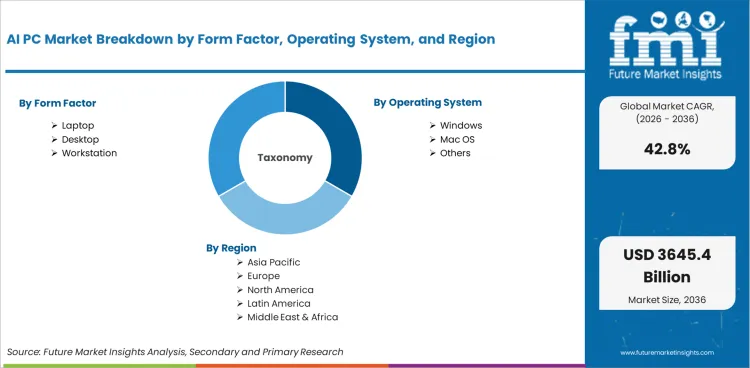
The AI PC market was valued at USD 72.4 billion in 2025. The market is set to reach USD 103.4 billion by 2026-end and grow at a CAGR of 42.8% between 2026-2036 to reach USD 3,645.4 billion by 2036. Laptop will dominate with a 62.3% share, while Windows will lead with a 78.6% share.
Summary of the AI PC Market
- Demand and Growth Drivers
- On-device AI inference demand is accelerating as consumers and enterprises seek AI processing that operates locally without cloud dependency, enabling real-time AI features with lower latency and improved privacy.
- Operating system AI integration by Microsoft (Copilot+) and Apple (Apple Intelligence) is creating a hardware upgrade cycle as AI features require dedicated NPU and GPU hardware not present in existing PC fleets.
- Enterprise productivity AI adoption is driving corporate PC refresh cycles as organizations deploy AI-powered document processing, code generation, and meeting intelligence tools that require local AI acceleration.
- Product and Segment View
- Laptop holds 62.3% of the form factor segment in 2026, supported by consumer and enterprise preference for portable AI-capable devices with on-device inference capabilities.
- Windows accounts for 78.6% of the operating system segment, reflecting the dominance of the Windows ecosystem in enterprise and consumer AI PC deployments.
- GPU compute holds 53.4% of the compute type segment, driven by demand for parallel processing architectures that accelerate AI inference and content generation workloads on local hardware.
- Geography and Competitive Outlook
- Brazil leads country-level growth at 53.7% CAGR, driven by rapid consumer technology adoption, enterprise digitization programs, and strong demand for AI-powered productivity devices.
- USA follows at 52.6% CAGR, supported by large-scale enterprise PC refresh cycles, strong consumer demand for AI-capable devices, and technology industry concentration driving early adoption.
- Competition spans established PC OEMs racing to integrate AI hardware across product lines, chip designers developing AI-optimized processors, and operating system vendors embedding AI capabilities that drive hardware requirements.
- Analyst Opinion
- The AI PC market represents the largest hardware upgrade cycle since the transition to mobile computing. Every major PC OEM is redefining its product portfolio around AI processing capabilities, driven by operating system vendors embedding AI features that require dedicated hardware acceleration. The commercial inflection point arrives when enterprise IT departments begin mandating AI-capable hardware specifications for standard employee deployments, converting AI PCs from early-adopter premium products to baseline procurement requirements. Companies that achieve the best price-performance ratio for on-device AI inference will capture the largest share of this transition.
- NPU integration into mainstream processor architectures is standardizing AI hardware across price tiers, accelerating the transition from premium to mainstream AI PC availability.
- Enterprise deployment cycles are shifting from optional AI PC upgrades to mandatory specifications as AI-powered productivity tools become standard workplace applications.
- Battery life optimization for AI workloads remains a key differentiator for laptop form factors, with efficient NPU architectures providing advantages over GPU-only approaches.
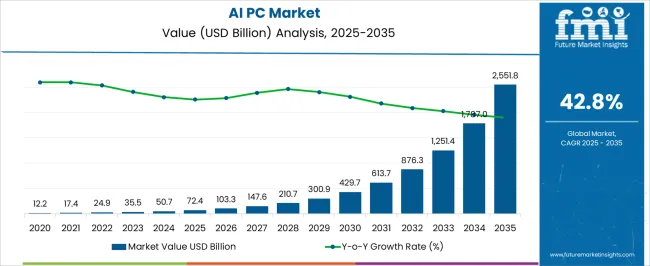
Key Takeaways, Market Size, and Forecast
- The AI PC Market was valued at USD 72.40 billion in 2025.
- By 2036, the AI PC Market is expected to be worth USD 3645.43 billion.
- From 2026 to 2036, the market is projected to expand at a CAGR of 42.8%.
- The market is projected to create an incremental opportunity of USD 3542.04 billion between 2026 and 2036.
- In 2026, laptop is expected to account for 62.3% of the form factor segment, driven by consumer and enterprise demand for portable AI-capable computing with integrated neural processing capabilities.
- Brazil (53.7%) and USA (52.6%) are two of the fastest growing markets in the world.
AI PC Market Definition
The AI PC market includes personal computers with dedicated AI processing hardware, including neural processing units, AI-optimized GPUs, and integrated AI accelerators, designed for on-device AI inference across consumer productivity, content creation, enterprise, and gaming applications.
AI PC Market Inclusions
Market scope covers AI PCs segmented by form factor (laptop, desktop, workstation), operating system (Windows, Mac OS, others), compute type (GPU, NPU, others), and end use (consumers, enterprises). The revenue range extends from 2026 to 2036.
AI PC Market Exclusions
The scope does not include traditional PCs without dedicated AI processing hardware, cloud-only AI computing services, smartphones and tablets, and data center AI servers.
AI PC Market Research Methodology
- Primary Research: FMI analysts conducted interviews with technology vendors, industry practitioners, and domain specialists across key markets.
- Desk Research: Integrated data from industry publications, regulatory databases, and technology vendor disclosures.
- Market Sizing and Forecasting: Bottom-up aggregation across segments and regional adoption curves with cross-validation against industry spending data.
- Data Validation: Cross-checked quarterly against vendor revenue disclosures, industry surveys, and regulatory filings.
Why is the AI PC Market Growing?
- Operating system AI feature integration is creating a hardware-driven upgrade cycle as Windows Copilot+ and Apple Intelligence require dedicated neural processing hardware that is absent from the installed PC base.
- Enterprise AI productivity tool deployment is converting AI PCs from early-adopter devices to standard IT procurement specifications as organizations mandate hardware capable of running local AI inference for document processing, code assistance, and meeting intelligence.
- On-device AI privacy advantages are driving adoption in regulated industries including healthcare, financial services, and government, where local AI processing avoids sending sensitive data to cloud endpoints.
The AI PC market reflects a structural hardware transition driven by software AI capability requirements. Operating system vendors have committed to embedding AI features across productivity, creativity, and system management functions, creating mandatory hardware requirements for dedicated AI processing that cannot be met by current generation PCs without specialized accelerators.
Laptop form factors at 62.3% of the market reflect the dominant computing preference across both consumer and enterprise segments. AI laptop differentiation centers on NPU performance, battery efficiency during AI workloads, and thermal management for sustained AI inference in thin form factors.
The Windows ecosystem at 78.6% of the operating system segment reflects the enterprise and consumer installed base driving AI PC adoption. Microsoft Copilot+ PC requirements establish minimum hardware specifications that define the AI PC category for the Windows ecosystem.
Market Segmentation Analysis
- Laptop holds 62.3% of the form factor segment, supported by consumer and enterprise preference for portable AI-capable devices with on-device inference capabilities.
- Windows at 78.6% leads the operating system segment, reflecting the dominance of the Windows ecosystem in enterprise and consumer AI PC deployments.
- Additional segments contribute to market diversification across applications.
The ai pc market is segmented by form factor (laptop, desktop, workstation), operating system (Windows, Mac OS, others), compute type (GPU, NPU, others), and end use (consumers, enterprises).
Insights into the Laptop Form Factor
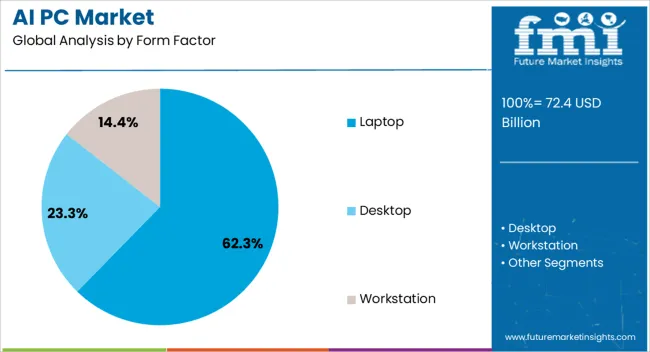
Laptop holds 62.3% of the form factor segment in 2026. AI laptops combine portability with on-device AI inference capabilities, addressing both consumer productivity and enterprise mobility requirements. Thin-and-light form factors with efficient NPU architectures are the fastest-growing sub-category.
Battery life during AI workloads is a critical differentiator, with NPU-based AI processing delivering significantly better power efficiency than GPU-only approaches for sustained inference tasks including document summarization, real-time translation, and image generation.
Insights into the Windows Operating System Segment
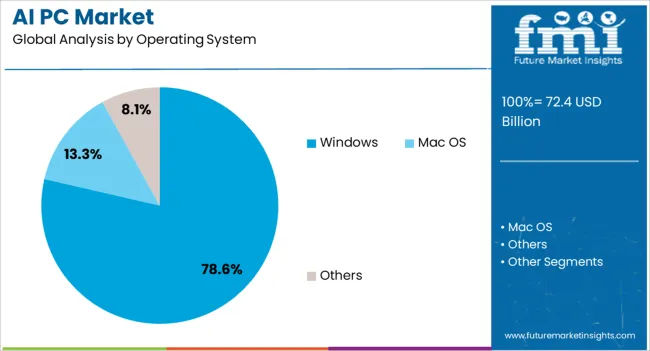
Windows holds 78.6% of the operating system segment in 2026, reflecting the enterprise and consumer installed base driving the AI PC transition. Microsoft Copilot+ PC specifications establish minimum AI hardware requirements that define the category for the Windows ecosystem.
Windows AI features including Copilot integration, Recall, Live Captions, and AI-powered creative tools require NPU hardware with minimum TOPS (tera operations per second) performance thresholds, creating clear procurement specifications for enterprise IT departments.
AI PC Market Drivers, Restraints, and Opportunities
- Operating system AI feature mandates and enterprise productivity tool requirements are the primary structural drivers, creating a hardware upgrade cycle across the global PC installed base.
- AI PC price premiums over traditional PCs constrain consumer adoption velocity, particularly in price-sensitive markets where the value of on-device AI features is not yet established.
- Regulated industry demand for on-device AI processing creates growth opportunities as healthcare, financial services, and government organizations require local AI inference for data privacy compliance.
The AI PC market is shaped by the convergence of software AI capabilities requiring dedicated hardware and the enterprise productivity imperative to deploy AI tools across the workforce.
OS AI Integration as Hardware Upgrade Catalyst
Microsoft and Apple have embedded AI features into their operating systems that require dedicated AI processing hardware. This creates a mandatory upgrade cycle as users and enterprises adopt AI-powered productivity features.
Price Premium and Consumer Value Perception
AI PCs carry price premiums over equivalent traditional PCs, creating adoption friction in consumer segments where the practical value of on-device AI features is still being established through killer applications.
Regulated Industry On-Device AI Demand
Healthcare, financial services, and government organizations require AI processing that keeps sensitive data on local devices. AI PCs with strong on-device inference capabilities address these privacy and compliance requirements without cloud data transmission.
Analysis of AI PC Market by Key Countries
.webp "Top Country Growth Comparison Ai Pc Market Cagr (2026 2036)")
| Country | CAGR |
|---|---|
| Brazil | 53.7% |
| USA | 52.6% |
| UK | 51.6% |
| France | 50.6% |
| Germany | 49.6% |
| India | 48.5% |
| China | 47.5% |
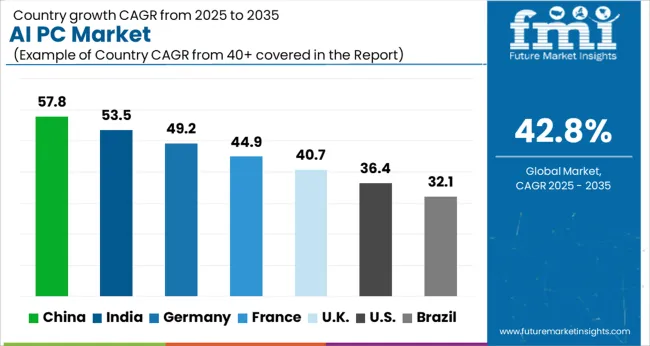
- Brazil leads at 53.7% CAGR through 2036, driven by rapid consumer technology adoption and strong demand for AI-powered computing devices.
- USA at 52.6% CAGR supported by large-scale enterprise PC refresh cycles and technology industry early adoption patterns.
- UK (51.6%) and France (50.6%) maintain growth driven by enterprise digitization and consumer demand for AI-capable devices.
The ai pc market is projected to expand at 42.8% CAGR globally from 2026 to 2036. The analysis covers more than 30 countries, with the leading markets detailed below.
Demand Outlook for AI PC Market in Brazil
Brazil is growing at 53.7% CAGR through 2036, leading country-level growth. Rapid consumer technology adoption, enterprise digitization programs, and government IT modernization are driving AI PC demand across consumer and commercial segments.
- Consumer demand for AI-capable laptops is growing as AI-powered productivity features become available in Portuguese language.
- Enterprise IT modernization programs are including AI PC specifications in procurement standards.
- Education sector digitization creates demand for AI-capable student and teacher computing devices.
Future Outlook for AI PC Market in the USA
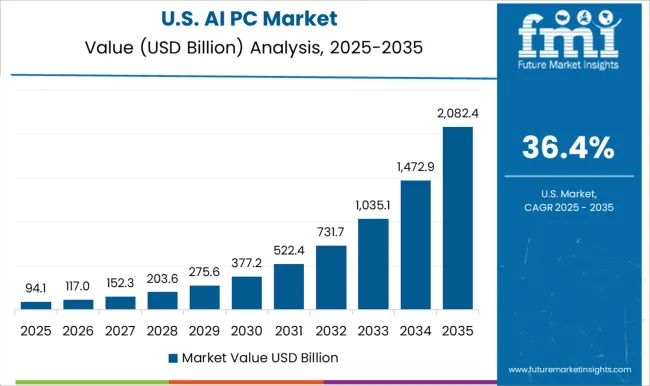
The USA is expanding at 52.6% CAGR through 2036, supported by large-scale enterprise PC refresh cycles, strong consumer demand, and technology industry concentration driving early AI PC adoption.
- Enterprise PC refresh cycles are mandating AI-capable hardware specifications for standard employee deployments.
- Consumer demand for AI-powered creativity and productivity applications drives premium AI PC purchases.
- Technology industry workforce requires high-performance AI workstations for development and content creation.
Opportunity Analysis of AI PC Market in the UK
The UK is growing at 51.6% CAGR through 2036, reflecting enterprise digital transformation investment and consumer demand for AI-capable computing across productivity and creative applications.
- Enterprise digital transformation programs include AI PC procurement in technology refresh budgets.
- Financial services sector requires on-device AI processing for data privacy compliance.
- Creative industry demand for AI-powered content creation drives high-specification AI PC adoption.
In-depth Analysis of AI PC Market in France
France is growing at 50.6% CAGR through 2036, supported by EU digital economy investment, enterprise AI adoption programs, and consumer demand for AI-enabled productivity computing.
- EU digital economy programs support enterprise technology modernization including AI PC deployment.
- Enterprise AI productivity adoption is driving corporate PC specification upgrades.
- Consumer demand for AI-powered features in French language applications supports market growth.
Sales Analysis of AI PC Market in Germany
Germany is growing at 49.6% CAGR through 2036, driven by industrial enterprise IT modernization, strong engineering workstation demand, and EU regulatory compliance driving on-device AI processing adoption.
- Industrial enterprise IT modernization includes AI-capable hardware across engineering and manufacturing functions.
- Data privacy regulations favor on-device AI processing, supporting AI PC adoption in regulated sectors.
- Engineering workstation demand drives high-performance AI PC procurement for design and simulation.
Competitive Landscape and Strategic Positioning
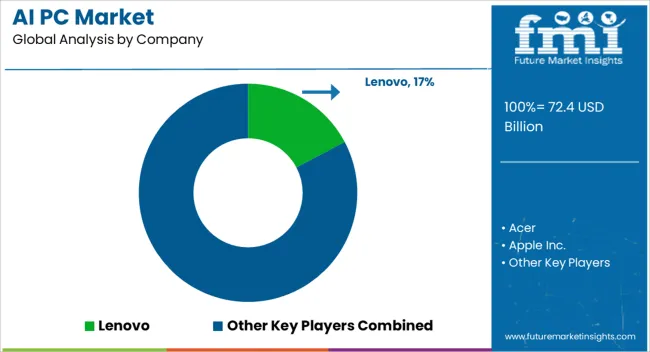
- Lenovo leads through its comprehensive AI PC portfolio spanning consumer, enterprise, and workstation form factors with integrated NPU and AI GPU options across price tiers.
- Dell, HP, and ASUS compete through broad AI PC product lines addressing consumer, commercial, and gaming segments with differentiated AI hardware configurations.
- NVIDIA and Intel are critical component suppliers whose AI processor architectures define performance tiers and AI capability specifications across the market.
Lenovo maintains market leadership through its ThinkPad, IdeaPad, and Legion AI PC portfolios, offering integrated AI processing across enterprise, consumer, and gaming segments. Dell competes through its Latitude, Inspiron, and XPS AI PC lines.
HP offers AI PCs across its EliteBook, Spectre, and OMEN product families. ASUSTeK provides AI-capable devices across its ZenBook, ProArt, and ROG gaming portfolios. Acer and MSI target consumer and gaming segments with AI-accelerated configurations.
Apple competes through its M-series chip architecture with integrated neural engines across MacBook, iMac, and Mac Studio product lines, offering differentiated AI performance within the macOS ecosystem.
Key Companies in the AI PC Market
Key global companies leading the ai pc market include:
- Lenovo (China), Dell Inc. (USA), HP Development Company (USA), and ASUSTeK Computer Inc. (Taiwan) maintain dominant positions through comprehensive AI PC portfolios spanning consumer, enterprise, and workstation segments.
- Apple Inc. (USA), Acer (Taiwan), and GIGA-BYTE Technology (Taiwan) compete through differentiated AI hardware architectures and strong brand positions in consumer and professional segments.
- NVIDIA Corporation (USA), Microsoft Corporation (USA), and Razer Inc. (USA) represent key ecosystem players providing AI processor architectures, operating system AI features, and specialized gaming AI hardware.
Competitive Benchmarking: AI PC Market
| Company | Product Range | AI Hardware | Market Access | Geographic Reach |
|---|---|---|---|---|
| Lenovo | Comprehensive | Advanced | Strong | Global |
| Dell | Comprehensive | Advanced | Strong | Global |
| HP | Comprehensive | Advanced | Strong | Global |
| ASUSTeK | Broad | Advanced | Strong | Global |
| Apple | Premium | Advanced | Strong | Global |
| Acer | Broad | Moderate | Strong | Global |
| MSI | Gaming/Pro | Advanced | Moderate | Global |
| GIGA-BYTE | Gaming/Pro | Advanced | Moderate | Global |
| Razer | Gaming | Advanced | Niche | Global |
| Puget Systems | Workstation | Advanced | Niche | N. America |
Source: Future Market Insights competitive analysis, 2026.
Key Players in the AI PC Market
Major Global Players
- Lenovo
- Acer
- Apple Inc.
- ASUSTeK Computer Inc.
- Dell Inc.
- HP Development Company, L.P
- NVIDIA Corporation
Emerging Players/Startups
- BOXX
- CORSAIR
- GIGA-BYTE Technology Co., Ltd.
- Huawei
- Microsoft
- Micro-Star INT'L CO., LTD.
- Puget Systems
- Razer Inc.
Report Scope and Coverage
| Parameter | Details |
|---|---|
| Quantitative Units | USD 103.39 billion to USD 3645.43 billion, at a CAGR of 42.8% |
| Market Definition | The AI PC market includes personal computers with dedicated AI processing hardware, including neural processing units, AI-optimized GPUs, and integrated AI accelerators, designed for on-device AI inference across consumer productivity, content creation, enterprise, and gaming applications. |
| Regions Covered | North America, Latin America, Europe, East Asia, South Asia and Pacific, Middle East and Africa |
| Countries Covered | Brazil, USA, UK, France, Germany, India, China, 30 plus countries |
| Key Companies Profiled | Lenovo, Acer, Apple Inc., ASUSTeK Computer Inc., Dell Inc., BOXX, CORSAIR, GIGA-BYTE Technology Co., Ltd. |
| Forecast Period | 2026 to 2036 |
| Approach | Hybrid bottom-up and top-down methodology starting with verified industry data, projecting adoption velocity across segments and regions. |
Market Segmentation Analysis
AI PC Market Segmented by Form Factor:
- Laptop
- Desktop
- Workstation
AI PC Market Segmented by Operating System:
- Windows
- Mac OS
- Others
AI PC Market Segmented by Compute Type:
- GPU
- NPU
- Others
AI PC Market Segmented by End Use:
- Consumers
- Enterprises
AI PC Market by Region:
- North America
- USA
- Canada
- Mexico
- Latin America
- Brazil
- Chile
- Rest of Latin America
- Western Europe
- Germany
- UK
- Italy
- Spain
- France
- Nordic
- BENELUX
- Rest of Western Europe
- Eastern Europe
- Russia
- Poland
- Hungary
- Balkan & Baltic
- Rest of Eastern Europe
- East Asia
- China
- Japan
- South Korea
- South Asia and Pacific
- India
- ASEAN
- Australia & New Zealand
- Rest of South Asia and Pacific
- Middle East & Africa
- Kingdom of Saudi Arabia
- Other GCC Countries
- Turkiye
- South Africa
- Other African Union
- Rest of Middle East & Africa
Research Sources and Bibliography
- International Data Corporation. (2025). AI PC Market Tracker: Global Shipment and Revenue Analysis. IDC.
- Semiconductor Industry Association. (2025). AI Processor Architectures for Personal Computing. SIA.
- European Commission. (2024). Digital Decade: AI-Capable Device Adoption Targets. EC.
- USA Department of Commerce. (2025). AI Hardware Supply Chain Assessment. DOC.
- World Economic Forum. (2024). AI-Powered Personal Computing: Economic Impact Assessment. WEF.
This bibliography is provided for reader reference.
This Report Answers
- Estimating the size of the ai pc market and revenue projections from 2026 to 2036.
- Segmentation by form factor (laptop, desktop, workstation).
- Insights about more than 30 markets in the region.
- Analysis of key technology, application, and deployment segments.
- Assessment of the competitive landscape.
- Finding investment opportunities across key segments and regions.
- Tracking regulatory frameworks and industry standards.
Frequently Asked Questions
What is the global market demand for ai pc in 2026?
In 2026, the global ai pc market is expected to be worth USD 103.39 billion.
How big will the ai pc market be in 2036?
By 2036, the market is expected to be worth USD 3645.43 billion.
How much is demand expected to grow between 2026 and 2036?
Between 2026 and 2036, the market is expected to grow at a CAGR of 42.8%.
Which form factor segment is likely to lead globally in 2026?
Laptop is expected to hold 62.3% of the form factor segment in 2026, supported by consumer and enterprise preference for portable AI-capable devices with on-device inference capabilities.
What is causing demand to rise in Brazil?
Brazil is growing at 53.7% CAGR through 2036, driven by rapid consumer technology adoption, enterprise digitization programs, and strong demand for AI-powered productivity devices.
What is causing demand to rise in USA?
USA is expanding at 52.6% CAGR through 2036, supported by large-scale enterprise PC refresh cycles, strong consumer demand for AI-capable devices, and technology industry concentration driving early adoption.
What does this report mean by ai pc market definition?
The AI PC market includes personal computers with dedicated AI processing hardware, including neural processing units, AI-optimized GPUs, and integrated AI accelerators, designed for on-device AI inference across consumer productivity, content creation, enterprise, and gaming applications.
How does FMI make this forecast and validate it?
Forecasting uses a hybrid bottom-up and top-down approach, starting with verified industry data and cross-checking against vendor disclosures and industry spending surveys.
Preview the report firsthand - request a free sample
Get SampleGet the brochure for pricing and purchase details.
Get PDFTable of Content
- Executive Summary
- Global Market Outlook
- Demand-side Trends
- Supply-side Trends
- Technology Roadmap Analysis
- Analysis and Recommendations
- Market Overview
- Market Coverage / Taxonomy
- Market Definition / Scope / Limitations
- Research Methodology
- Chapter Orientation
- Analytical Lens and Working Hypotheses
- Market Structure, Signals, and Trend Drivers
- Benchmarking and Cross-market Comparability
- Market Sizing, Forecasting, and Opportunity Mapping
- Research Design and Evidence Framework
- Desk Research Programme (Secondary Evidence)
- Company Annual and Sustainability Reports
- Peer-reviewed Journals and Academic Literature
- Corporate Websites, Product Literature, and Technical Notes
- Earnings Decks and Investor Briefings
- Statutory Filings and Regulatory Disclosures
- Technical White Papers and Standards Notes
- Trade Journals, Industry Magazines, and Analyst Briefs
- Conference Proceedings, Webinars, and Seminar Materials
- Government Statistics Portals and Public Data Releases
- Press Releases and Reputable Media Coverage
- Specialist Newsletters and Curated Briefings
- Sector Databases and Reference Repositories
- FMI Internal Proprietary Databases and Historical Market Datasets
- Subscription Datasets and Paid Sources
- Social Channels, Communities, and Digital Listening Inputs
- Additional Desk Sources
- Expert Input and Fieldwork (Primary Evidence)
- Primary Modes
- Qualitative Interviews and Expert Elicitation
- Quantitative Surveys and Structured Data Capture
- Blended Approach
- Why Primary Evidence is Used
- Field Techniques
- Interviews
- Surveys
- Focus Groups
- Observational and In-context Research
- Social and Community Interactions
- Stakeholder Universe Engaged
- C-suite Leaders
- Board Members
- Presidents and Vice Presidents
- R&D and Innovation Heads
- Technical Specialists
- Domain Subject-matter Experts
- Scientists
- Physicians and Other Healthcare Professionals
- Governance, Ethics, and Data Stewardship
- Research Ethics
- Data Integrity and Handling
- Primary Modes
- Tooling, Models, and Reference Databases
- Desk Research Programme (Secondary Evidence)
- Data Engineering and Model Build
- Data Acquisition and Ingestion
- Cleaning, Normalisation, and Verification
- Synthesis, Triangulation, and Analysis
- Quality Assurance and Audit Trail
- Market Background
- Market Dynamics
- Drivers
- Restraints
- Opportunity
- Trends
- Scenario Forecast
- Demand in Optimistic Scenario
- Demand in Likely Scenario
- Demand in Conservative Scenario
- Opportunity Map Analysis
- Product Life Cycle Analysis
- Supply Chain Analysis
- Investment Feasibility Matrix
- Value Chain Analysis
- PESTLE and Porter’s Analysis
- Regulatory Landscape
- Regional Parent Market Outlook
- Production and Consumption Statistics
- Import and Export Statistics
- Market Dynamics
- Global Market Analysis 2021 to 2025 and Forecast, 2026 to 2036
- Historical Market Size Value (USD Million) Analysis, 2021 to 2025
- Current and Future Market Size Value (USD Million) Projections, 2026 to 2036
- Y-o-Y Growth Trend Analysis
- Absolute $ Opportunity Analysis
- Global Market Pricing Analysis 2021 to 2025 and Forecast 2026 to 2036
- Global Market Analysis 2021 to 2025 and Forecast 2026 to 2036, By Form Factor
- Introduction / Key Findings
- Historical Market Size Value (USD Million) Analysis By Form Factor , 2021 to 2025
- Current and Future Market Size Value (USD Million) Analysis and Forecast By Form Factor , 2026 to 2036
- Laptop
- Desktop
- Workstation
- Laptop
- Y-o-Y Growth Trend Analysis By Form Factor , 2021 to 2025
- Absolute $ Opportunity Analysis By Form Factor , 2026 to 2036
- Global Market Analysis 2021 to 2025 and Forecast 2026 to 2036, By Operating System
- Introduction / Key Findings
- Historical Market Size Value (USD Million) Analysis By Operating System, 2021 to 2025
- Current and Future Market Size Value (USD Million) Analysis and Forecast By Operating System, 2026 to 2036
- Windows
- Mac OS
- Others
- Windows
- Y-o-Y Growth Trend Analysis By Operating System, 2021 to 2025
- Absolute $ Opportunity Analysis By Operating System, 2026 to 2036
- Global Market Analysis 2021 to 2025 and Forecast 2026 to 2036, By Compute Type
- Introduction / Key Findings
- Historical Market Size Value (USD Million) Analysis By Compute Type, 2021 to 2025
- Current and Future Market Size Value (USD Million) Analysis and Forecast By Compute Type, 2026 to 2036
- GPU
- NPU
- Others
- GPU
- Y-o-Y Growth Trend Analysis By Compute Type, 2021 to 2025
- Absolute $ Opportunity Analysis By Compute Type, 2026 to 2036
- Global Market Analysis 2021 to 2025 and Forecast 2026 to 2036, By End Use
- Introduction / Key Findings
- Historical Market Size Value (USD Million) Analysis By End Use, 2021 to 2025
- Current and Future Market Size Value (USD Million) Analysis and Forecast By End Use, 2026 to 2036
- Consumers
- Enterprises
- Consumers
- Y-o-Y Growth Trend Analysis By End Use, 2021 to 2025
- Absolute $ Opportunity Analysis By End Use, 2026 to 2036
- Global Market Analysis 2021 to 2025 and Forecast 2026 to 2036, By Region
- Introduction
- Historical Market Size Value (USD Million) Analysis By Region, 2021 to 2025
- Current Market Size Value (USD Million) Analysis and Forecast By Region, 2026 to 2036
- North America
- Latin America
- Western Europe
- Eastern Europe
- East Asia
- South Asia and Pacific
- Middle East & Africa
- Market Attractiveness Analysis By Region
- North America Market Analysis 2021 to 2025 and Forecast 2026 to 2036, By Country
- Historical Market Size Value (USD Million) Trend Analysis By Market Taxonomy, 2021 to 2025
- Market Size Value (USD Million) Forecast By Market Taxonomy, 2026 to 2036
- By Country
- USA
- Canada
- Mexico
- By Form Factor
- By Operating System
- By Compute Type
- By End Use
- By Country
- Market Attractiveness Analysis
- By Country
- By Form Factor
- By Operating System
- By Compute Type
- By End Use
- Key Takeaways
- Latin America Market Analysis 2021 to 2025 and Forecast 2026 to 2036, By Country
- Historical Market Size Value (USD Million) Trend Analysis By Market Taxonomy, 2021 to 2025
- Market Size Value (USD Million) Forecast By Market Taxonomy, 2026 to 2036
- By Country
- Brazil
- Chile
- Rest of Latin America
- By Form Factor
- By Operating System
- By Compute Type
- By End Use
- By Country
- Market Attractiveness Analysis
- By Country
- By Form Factor
- By Operating System
- By Compute Type
- By End Use
- Key Takeaways
- Western Europe Market Analysis 2021 to 2025 and Forecast 2026 to 2036, By Country
- Historical Market Size Value (USD Million) Trend Analysis By Market Taxonomy, 2021 to 2025
- Market Size Value (USD Million) Forecast By Market Taxonomy, 2026 to 2036
- By Country
- Germany
- UK
- Italy
- Spain
- France
- Nordic
- BENELUX
- Rest of Western Europe
- By Form Factor
- By Operating System
- By Compute Type
- By End Use
- By Country
- Market Attractiveness Analysis
- By Country
- By Form Factor
- By Operating System
- By Compute Type
- By End Use
- Key Takeaways
- Eastern Europe Market Analysis 2021 to 2025 and Forecast 2026 to 2036, By Country
- Historical Market Size Value (USD Million) Trend Analysis By Market Taxonomy, 2021 to 2025
- Market Size Value (USD Million) Forecast By Market Taxonomy, 2026 to 2036
- By Country
- Russia
- Poland
- Hungary
- Balkan & Baltic
- Rest of Eastern Europe
- By Form Factor
- By Operating System
- By Compute Type
- By End Use
- By Country
- Market Attractiveness Analysis
- By Country
- By Form Factor
- By Operating System
- By Compute Type
- By End Use
- Key Takeaways
- East Asia Market Analysis 2021 to 2025 and Forecast 2026 to 2036, By Country
- Historical Market Size Value (USD Million) Trend Analysis By Market Taxonomy, 2021 to 2025
- Market Size Value (USD Million) Forecast By Market Taxonomy, 2026 to 2036
- By Country
- China
- Japan
- South Korea
- By Form Factor
- By Operating System
- By Compute Type
- By End Use
- By Country
- Market Attractiveness Analysis
- By Country
- By Form Factor
- By Operating System
- By Compute Type
- By End Use
- Key Takeaways
- South Asia and Pacific Market Analysis 2021 to 2025 and Forecast 2026 to 2036, By Country
- Historical Market Size Value (USD Million) Trend Analysis By Market Taxonomy, 2021 to 2025
- Market Size Value (USD Million) Forecast By Market Taxonomy, 2026 to 2036
- By Country
- India
- ASEAN
- Australia & New Zealand
- Rest of South Asia and Pacific
- By Form Factor
- By Operating System
- By Compute Type
- By End Use
- By Country
- Market Attractiveness Analysis
- By Country
- By Form Factor
- By Operating System
- By Compute Type
- By End Use
- Key Takeaways
- Middle East & Africa Market Analysis 2021 to 2025 and Forecast 2026 to 2036, By Country
- Historical Market Size Value (USD Million) Trend Analysis By Market Taxonomy, 2021 to 2025
- Market Size Value (USD Million) Forecast By Market Taxonomy, 2026 to 2036
- By Country
- Kingdom of Saudi Arabia
- Other GCC Countries
- Turkiye
- South Africa
- Other African Union
- Rest of Middle East & Africa
- By Form Factor
- By Operating System
- By Compute Type
- By End Use
- By Country
- Market Attractiveness Analysis
- By Country
- By Form Factor
- By Operating System
- By Compute Type
- By End Use
- Key Takeaways
- Key Countries Market Analysis
- USA
- Pricing Analysis
- Market Share Analysis, 2025
- By Form Factor
- By Operating System
- By Compute Type
- By End Use
- Canada
- Pricing Analysis
- Market Share Analysis, 2025
- By Form Factor
- By Operating System
- By Compute Type
- By End Use
- Mexico
- Pricing Analysis
- Market Share Analysis, 2025
- By Form Factor
- By Operating System
- By Compute Type
- By End Use
- Brazil
- Pricing Analysis
- Market Share Analysis, 2025
- By Form Factor
- By Operating System
- By Compute Type
- By End Use
- Chile
- Pricing Analysis
- Market Share Analysis, 2025
- By Form Factor
- By Operating System
- By Compute Type
- By End Use
- Germany
- Pricing Analysis
- Market Share Analysis, 2025
- By Form Factor
- By Operating System
- By Compute Type
- By End Use
- UK
- Pricing Analysis
- Market Share Analysis, 2025
- By Form Factor
- By Operating System
- By Compute Type
- By End Use
- Italy
- Pricing Analysis
- Market Share Analysis, 2025
- By Form Factor
- By Operating System
- By Compute Type
- By End Use
- Spain
- Pricing Analysis
- Market Share Analysis, 2025
- By Form Factor
- By Operating System
- By Compute Type
- By End Use
- France
- Pricing Analysis
- Market Share Analysis, 2025
- By Form Factor
- By Operating System
- By Compute Type
- By End Use
- India
- Pricing Analysis
- Market Share Analysis, 2025
- By Form Factor
- By Operating System
- By Compute Type
- By End Use
- ASEAN
- Pricing Analysis
- Market Share Analysis, 2025
- By Form Factor
- By Operating System
- By Compute Type
- By End Use
- Australia & New Zealand
- Pricing Analysis
- Market Share Analysis, 2025
- By Form Factor
- By Operating System
- By Compute Type
- By End Use
- China
- Pricing Analysis
- Market Share Analysis, 2025
- By Form Factor
- By Operating System
- By Compute Type
- By End Use
- Japan
- Pricing Analysis
- Market Share Analysis, 2025
- By Form Factor
- By Operating System
- By Compute Type
- By End Use
- South Korea
- Pricing Analysis
- Market Share Analysis, 2025
- By Form Factor
- By Operating System
- By Compute Type
- By End Use
- Russia
- Pricing Analysis
- Market Share Analysis, 2025
- By Form Factor
- By Operating System
- By Compute Type
- By End Use
- Poland
- Pricing Analysis
- Market Share Analysis, 2025
- By Form Factor
- By Operating System
- By Compute Type
- By End Use
- Hungary
- Pricing Analysis
- Market Share Analysis, 2025
- By Form Factor
- By Operating System
- By Compute Type
- By End Use
- Kingdom of Saudi Arabia
- Pricing Analysis
- Market Share Analysis, 2025
- By Form Factor
- By Operating System
- By Compute Type
- By End Use
- Turkiye
- Pricing Analysis
- Market Share Analysis, 2025
- By Form Factor
- By Operating System
- By Compute Type
- By End Use
- South Africa
- Pricing Analysis
- Market Share Analysis, 2025
- By Form Factor
- By Operating System
- By Compute Type
- By End Use
- USA
- Market Structure Analysis
- Competition Dashboard
- Competition Benchmarking
- Market Share Analysis of Top Players
- By Regional
- By Form Factor
- By Operating System
- By Compute Type
- By End Use
- Competition Analysis
- Competition Deep Dive
- Lenovo
- Overview
- Product Portfolio
- Profitability by Market Segments (Product/Age /Sales Channel/Region)
- Sales Footprint
- Strategy Overview
- Marketing Strategy
- Product Strategy
- Channel Strategy
- Acer
- Apple Inc.
- ASUSTeK Computer Inc.
- BOXX
- CORSAIR
- Dell Inc.
- GIGA-BYTE Technology Co., Ltd.
- HP Development Company, L.P
- Huawei
- Microsoft
- Micro-Star INT'L CO., LTD.
- NVIDIA Corporation
- Puget Systems
- Razer Inc.
- Lenovo
- Competition Deep Dive
- Assumptions & Acronyms Used


