

- Industry Size (2026)
- USD 8003.2 Mn
- Forecast (2036)
- USD 13413.7 Mn
- CAGR (2026 to 2036)
- 5.3%
Malted Milk Powder Market Size, Market Forecast and Outlook By FMI
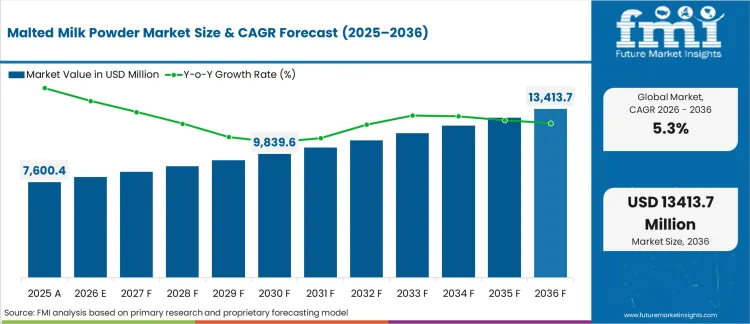
The Malted Milk Powder market was valued at USD 7592.6 million in 2025, projected to reach USD 8003.2 million in 2026, and is forecast to expand to USD 13413.7 million by 2036 at a 5.3% CAGR. Malted milk powder, a blend of malted barley extract, wheat flour, and whole milk solids that delivers a distinctive malt flavour alongside significant carbohydrate and protein content, is a foundational ingredient across beverage, confectionery, bakery, and nutritional supplement manufacturing globally. Sustained demand from established beverage brands in Asia and Latin America, combined with growing ingredient application in nutraceutical formulations, anchors the market's steady compound growth trajectory through the forecast period.
Absolute dollar growth of USD 5410.5 million across the forecast period reflects a market where volume stability in mature category applications is augmented by premiumisation in specialty bakery and functional nutrition segments. FMI is of the opinion that the nutraceutical end use category, accounting for 22.4% of End Use Industry demand in 2026, will record above-average growth as food manufacturers reformulate established health drink and meal replacement formats with malt-derived carbohydrate-protein matrices that appeal to consumers seeking familiar taste profiles in functional nutrition contexts. The B2B distribution channel's 62.0% demand share in 2026 reflects the ingredient-use dominance of the market relative to branded consumer retail formats.
Summary of Malted Milk Powder Market
- Malted Milk Powder Market Definition
- The Malted Milk Powder market covers spray-dried and drum-dried powder blends of malted barley extract, wheat flour, and milk solids serving beverage, bakery, confectionery, dairy, and nutraceutical manufacturing applications globally.
- Demand Drivers in the Market
- Established branded malted health drink categories in India, Southeast Asia, and Latin America sustain large-volume ingredient procurement demand from multinational beverage manufacturers that reformulate continuously to maintain taste profile consistency.
- Growing functional nutrition interest in malted carbohydrate-protein formats drives ingredient specification upgrades in meal replacement, sports recovery, and paediatric nutrition product lines across North America and Europe.
- Bakery and confectionery manufacturers in Japan and Europe are incorporating malted milk powder in premium product lines that target adult consumer interest in familiar nostalgic flavour profiles combined with functional nutritional attributes.
- Key Segments Analyzed in the FMI Report
- Barley Type holds 29.2% of Type segment demand in 2026, reflecting the traditional formulation dominance of barley malt in established beverage brand recipes across Asia and Latin America.
- Beverages account for 31.4% of End Use Industry demand in 2026, driven by large-volume ingredient procurement from branded malted health drink manufacturers in high-consumption markets.
- B2B channel commands 62.0% of Distribution Channel demand in 2026, reflecting the ingredient-use dominance of the market relative to consumer retail formats.
- Analyst Opinion at FMI
- Nandini Roy Choudhury, Principal Consultant for Food & Beverage is of the opinion that the Malted Milk Powder market's mid-single-digit growth trajectory through 2036 is structurally anchored by the difficulty of reformulating out of malt-based flavour profiles in established consumer beverage brands, giving ingredient manufacturers more pricing leverage than standard commodity inputs. However, pressure from alternative functional beverage formats in premium urban segments creates substitution risk in the highest-margin beverage application tiers that manufacturers should quantify in strategic planning.
- Strategic Implications / Executive Takeaways
- Malted milk powder producers should invest in high-protein and low-sugar specification variants to qualify for premium sports nutrition and adult wellness beverage formulation contracts where standard malt grades do not meet ingredient specification requirements.
- Ingredient manufacturers targeting the India and Southeast Asia beverage market should establish dedicated technical service teams that assist beverage brand manufacturers with malt blend reformulation to meet evolving regulatory sugar and micronutrient labelling requirements.
- Confectionery and bakery manufacturers expanding into premium malt-flavoured product lines in Japan and Germany should secure long-term ingredient supply agreements early, as specialty barley malt supply is constrained by limited high-quality malting barley cultivation geographies.
As per FMI, India leads country-level CAGR at 8.1% through 2036, driven by a large and growing branded malted health drink category, expanding modern retail distribution infrastructure, and rising household incomes that increase per capita beverage expenditure. Brazil follows at 6.8%, supported by malted beverage brand expansion in urban centres and growing bakery manufacturing demand. Japan registers 7.6% growth, anchored by a mature functional food manufacturing sector that applies malted milk ingredients in premium confectionery and meal supplement formats. China advances at 6.1%, driven by rapid expansion in infant and paediatric nutrition categories where malted milk is a key formulation ingredient. The USA grows at 5.9%, supported by stable B2B ingredient demand across established confectionery and bakery manufacturers.
Malted Milk Powder Market Definition
The Malted Milk Powder market encompasses the production, processing, and commercial supply of spray-dried or drum-dried powder blends combining malted barley extract, wheat flour, and milk solids. The product serves as a flavouring ingredient, carbohydrate-protein matrix, and functional beverage base across beverage, bakery, confectionery, dairy, and nutraceutical manufacturing applications globally.
Malted Milk Powder Market Inclusions
Market scope covers global and regional revenue estimates for malted milk powder across all grain types, end-use industries, and distribution channels. The forecast period spans 2026 to 2036, with country-level CAGR analysis. Pricing dynamics by grain type, application segment premiums, and B2B versus B2C channel mix analysis are incorporated as supplementary dimensions.
Malted Milk Powder Market Exclusions
Plain malted barley extract without milk solids integration is excluded from malted milk powder market sizing. Finished branded consumer beverages, confectionery end-products, and bakery items incorporating malted milk powder as an ingredient are not included in the ingredient market valuation. Malt vinegar, beer malt, and distilling malt fall entirely outside the defined scope.
Malted Milk Powder Market Research Methodology
- Primary Research: Primary Research: FMI analysts conducted interviews with procurement managers at major beverage manufacturers, ingredient buyers at confectionery companies, and category heads at malt processing firms across India, the United States, Brazil, Japan, and China.
- Desk Research: Desk Research: FAO cereal production statistics, national dairy sector reports, branded malted beverage company annual reports, and ingredient trade association publications were reviewed alongside institutional investor presentations.
- Market-Sizing and Forecasting: Market-Sizing and Forecasting: A bottom-up model aggregates production volumes from malt processing facilities, weighted against application-specific pricing benchmarks and end-use demand forecasts by region and industry.
- Data Validation and Update Cycle: Data Validation and Update Cycle: Projections were cross-validated against branded malted beverage revenue data from company disclosures and national food manufacturing output statistics from government statistical agencies.
Malted Milk Powder Market Key Takeaways
| Metric | Details |
|---|---|
| Industry Size (2026) | USD 8003.2 Million |
| Industry Value (2036) | USD 13413.7 Million |
| CAGR (2026-2036) | 5.3% |
| Source | Future Market Insights, 2026 |
Key Industry Highlights
Advancements in Spray-Drying and Powder Production Technologies Bolstering the Market
Innovations in spray-drying and powder production technology have transformed the milk powder sector by increasing product quality, efficiency, and adaptability. Spray-drying is a key method in the production of milk powder that converts liquid malted milk into a dry, fine powder by quick drying with hot air.
Some of the most recent advancements in this technology are greater thermal efficiency, reduced energy usage, and consistent particle size distribution. Manufacturers have been able to expand output while preserving product quality. This has made malted milk powder more accessible to a large consumer base.
One of the most significant advances in the field of spray drying is the use of multiple-stage drying methods. Multi-stage spray-drying reduces the danger of heat damage to milk powder's delicate tastes and nutrients by removing moisture in an equal and progressive manner. This method has enhanced the end product's popularity among consumers by preserving its natural sweetness, malted taste, and nutritional value.
Furthermore, enhanced atomization techniques, such as rotary and ultrasonic atomizers, have enabled greater control over droplet size, resulting in powders with higher solubility and smoother texture. Such powders are very useful in applications where instant dissolvability is critical, such as in beverages or infant formulas.
The development of energy-efficient spray-drying technology has also been a major changer. Manufacturers are progressively using systems that use waste heat recovery, improved airflow, and low-energy drying cycles to cut operating costs and environmental effects.
These solutions not only save energy usage but also align with the rising need for sustainable manufacturing processes, assisting firms in meeting environmental compliance regulations and appealing to eco-conscious consumers. Furthermore, advancements such as spray-drying towers with integrated control systems allow for real-time monitoring of temperature, humidity, and airflow, resulting in constant output quality and reduced waste.
Increasing Popularity of Malt-Based Drinks among All Age Groups Driving Market Growth
The increased popularity of malt-based beverages among people of all ages has emerged as a significant driver of the malted milk powder sector. Malt-based drinks, previously considered a healthy beverage for young ones, have evolved into a well-known product that caters to a diverse spectrum of client interests and lifestyles.
All these factors, from the distinct flavor of malt-based beverages to their nutritional benefits and versatility, have led them to become very popular among diverse spectrums of demographics. This type of milk powder, naturally rich in proteins, carbs, vitamins (such as vitamin D and the B-complex), and minerals such as calcium and phosphorus, forms the base of these beverages.
These nutrients play a role in energy metabolism, hence general well-being. Parents find malt-based beverages as a convenient way to add to their children's diets to ensure them sufficient nutrition during the early years of life. Old people and the aged view these drinks as a supply of easily digested nourishment to meet their needs.
Malted beverages have gained popularity among adults as a quick energy alternative to tea and coffee. Malt-based beverages have been developed in low-sugar, high-protein, and fiber formulations to cater to fitness enthusiasts and individuals with special dietary needs as these brands often contain additional active ingredients such as probiotics, omega-3 fatty Acids, or herbal extracts, and are also suitable for a number of consumers looking for health benefits.
Increasing Consumer Preference for Convenient and Nutritionally Enriched Products Shapes the Market
Increasing consumer demand for convenient and nutritious products has emerged as a powerful driver for the malted milk market. In today’s fast-paced world, consumers are constantly looking for solutions that fit into their busy lifestyles and offer important health benefits. Malted milk powder satisfies this goal by offering a versatile, quick-to-prepare, nutrient-dense product that appeals to a wide spectrum of customers. The combination of convenience, flavor, and health benefits has made it a household, office, and on-the-go need, boosting its popularity across several nations and consumer categories.
With an increasing emphasis on health and wellbeing, people are looking for items that provide critical elements including proteins, vitamins, minerals, and carbs. This type of milk powder, which is high in calcium, vitamin D, B-complex vitamins, and natural energy sources, meets these requirements adequately.
The quest for on-the-go sustenance has increased the popularity of malted milk powder. Consumers, particularly working professionals, students, and fitness enthusiasts, are turning to portable and ready-to-eat options to help them maintain their dietary habits despite demanding schedules. Single-serve sachets, ready-to-drink malted milk drinks, and pre-mixed powders address this requirement by offering convenience without sacrificing quality.
2021 to 2025 Global Malted Milk Powder Sales Analysis Compared to Demand Forecasts for 2026 to 2036
Global sales increased at a CAGR of 4.8% from 2021 to 2025. For the next ten years (2026 to 2036), projections are that expenditure on such products will rise at 5.3% CAGR.
Between 2021 and 2025 owing to its association with health and nutrition, which gained heightened importance during the historical period. It’s high in key nutrients and simple to include in everyday meals and has gained popularity as a home pantry staple. Sales through e-commerce channels increased while lockdowns and social distancing techniques restricted access to traditional retail stores.
Product formulation innovations, such as low-sugar, fortified, and plant-based variations, have helped to attract a larger consumer base, including health-conscious people and those with dietary restrictions. Furthermore, expanding urbanization and the development of organized retail outlets in emerging economies increased sales throughout this period.
From the year 2026 to 2036, the expansion of the global market is projected to be driven by worries about food security in the region brought on by population growth, particularly in developing nations like China and India. On the other hand, advancements in spray-drying and powder processing technologies will enhance product quality, shelf-life, and affordability, further boosting consumer adoption.
Market Concentration
Tier 1 companies are the essential factors in the market for malted milk powder, accounting for a significant share of the global market. These industry leaders are at the cutting edge of innovation, continually establishing trends with their superior research and development skills.
These companies have a worldwide presence and very strong malt-based beverages for different age groups and regions. Such companies have a strong emphasis on sustainability, sophisticated spray-drying technologies, and product fortification with vitamins, minerals, and probiotics, all of which contribute to their market leadership. Some of the tier 1 companies are Unilever, Nestlé S.A., and Associated British Foods.
Tier 2 Companies are the regional players with adequate market coverage and are known for offering niche products. They are typically more localized and address specific issues of more general ones.
Tier 3 Companies are smaller players who are usually limited to the local or regional areas. They tend to service localized areas and do not possess the same level of research & development as bigger companies but are nonetheless helpful in satisfying local needs. Local players producing malted milk powder with heritage grains or organically sourced barley cater to consumers seeking authenticity and traditional values in their food choices.
Country-wise Insights
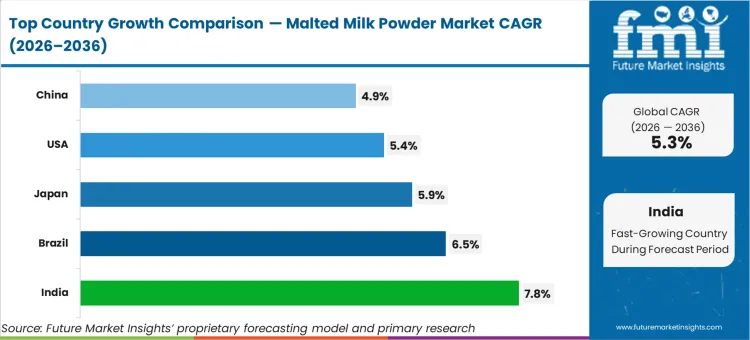
The following table shows the estimated growth rates of the top three territories. China and Japan are set to exhibit high consumption, recording CAGRs of 4.9% and 5.9%, respectively, through 2036.
.webp "Top Country Growth Comparison Malted Milk Powder Market Cagr (2026 2036)")
| Countries | CAGR |
|---|---|
| The USA | 5.4% |
| Brazil | 6.5% |
| India | 7.8% |
| Japan | 5.9% |
| China | 4.9% |
Source: Future Market Insights proprietary forecasting model and primary research
Growing Popularity in Culinary Applications is Surging in the USA
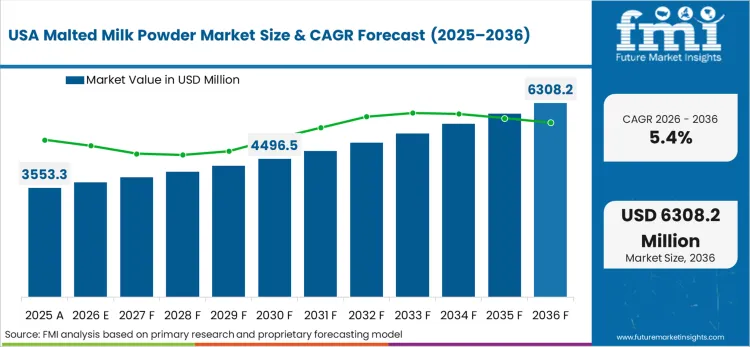
The demand for malted milk powder in the United States is expanding as it is used in culinary applications other than conventional drinks. As the American culinary landscape welcomes inventiveness and fusion cuisine, malted milk powder has become a popular component in sweets, baked products, and gourmet dishes.
It is known for its distinct flavor profile, which includes a rich, nutty sweetness and subtle malt overtones, and is used to add depth and complexity to a variety of items such as cookies, cakes, ice cream, and milkshakes. Chefs and amateur bakers alike are experimenting with malted milk powder to create innovative recipes that capitalize on its propensity to increase flavor and texture.
The rise of artisanal and craft food trends, combined with consumer preferences for nostalgic flavors, has accelerated its adoption; additionally, social media platforms and food blogs highlighting recipes featuring malted milk powder are increasing its appeal, making it a versatile and trendy choice for American kitchens.
Emphasis on Sustainability and Organic Production is Boosting the Market in Germany.
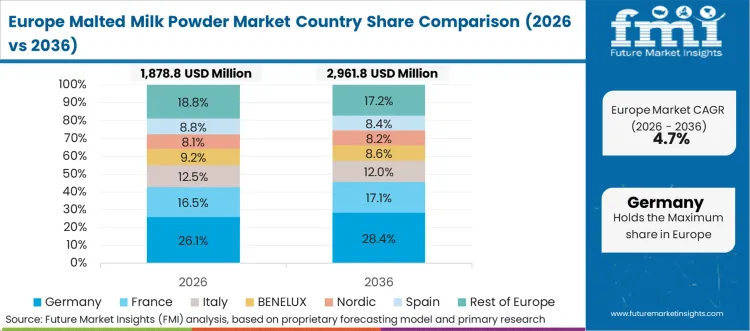
German companies are succeeding by matching their manufacturing techniques with the country's strong emphasis on sustainability and organic products. German customers are particularly sensitive to their environmental effects and the quality of the food they consume, which drives demand for malted milk powder manufactured from sustainably sourced components and processed using environmentally friendly processes.
Manufacturers are responding by investing in renewable energy for their production facilities, employing low-waste processing processes, and providing organic-certified products free of artificial chemicals and preservatives.
Furthermore, there is a major emphasis on traceability, with enterprises providing detailed information about the sources of fundamental commodities like barley and milk. These initiatives not only meet German statutory requirements and customer preferences but also position enterprises as European market leaders, allowing them to charge higher prices while establishing strong brand loyalty.
Category-Wise Insights
Barley’s Ascendancy Driven by Nutritional Superiority and Versatility
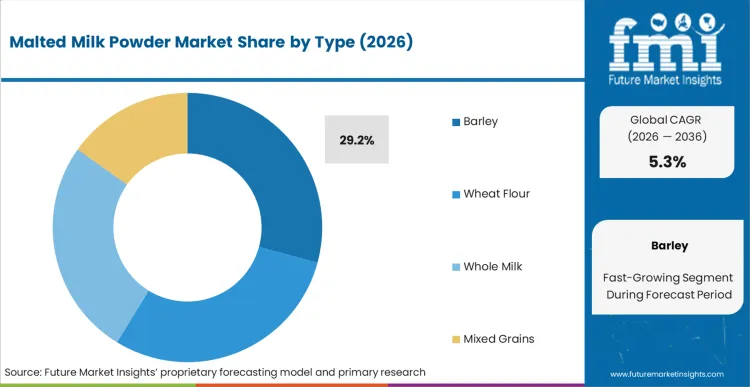
| Segment | Value Share (2026) |
|---|---|
| Barley (By Type) | 29.2% |
Barley has become the most popular kind on the global market due to its numerous applications, natural sweetness, nutty flavor, and high nutritional fiber content, making it a popular option among health-conscious consumers.
Interestingly, unlike other varieties, lentils contain beta-glucans, known to support heart health and boost digestion; this has made it increasingly popular among functional food enthusiasts and, with its corresponding sugar-free plant-based snacks, has driven demand for high again, especially in areas where consumers adopt healthier lifestyles; and the adaptability of barley to production methods enables cost-effective production without compromising on quality. It provides them a competitive advantage over other options like wheat flour or blended rice. The combination of nutritional advantages, flavor, and processing flexibility has cemented barley's position as a market leader.
Beverages Leading the Market with Innovation and Consumer Demand in the Global Market
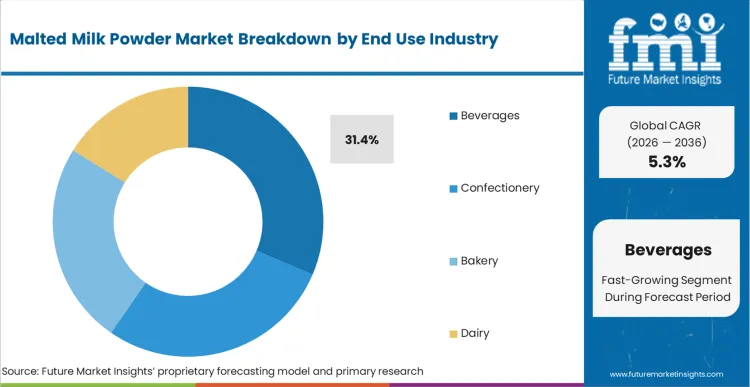
| Segment | Value Share (2026) |
|---|---|
| Beverages (By End Use Industry) | 31.4% |
Beverages dominated the market globally, fueled by their massive application in the traditional and novel formulations of beverages. This powdered milk has been a classic addition to malted beverages for generations, appreciated for its rich taste and nutritional properties. The category has, however, evolved more recently with ready-to-drink malted beverages, protein drinks, and healthy drink mixes addressing busy lifestyles and wellness-conscious consumers.
The ability to adapt to hot and cold beverage applications, such as malted hot chocolates and milk-based energy drinks, has helped to improve its position in the market. The increased popularity of plant-based and fortified beverages has broadened its usage, making it a necessary ingredient in both dairy and non-dairy products. This adaptability, along with the potential to improve flavor and give functional advantages, has resulted in beverages being the biggest end-use industry throughout the projection period.
Competition Outlook
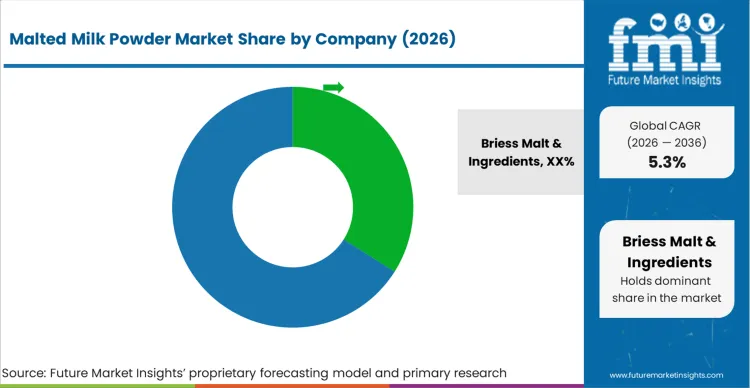
The competition landscape of the malted milk powder market is intense. Nestlé S.A., Cliff Foods, and Associated British Foods companies lead the industry owing to their significant R&D spending, cutting-edge product advancements, and powerful distribution networks. They concentrate on creating fortified and health-focused formulations, such as low-sugar and plant-based malted milk powders, to meet different customer expectations while preserving outstanding quality and manufacturing efficiency.
To increase sales, companies are using a variety of techniques, including strategic and vertical acquisitions. Nestlé S.A., for example, has made significant investments in clean-label and organic food development in response to changing customer preferences. Collaborations with retailers and investments in e-commerce platforms have also become critical tactics for manufacturers, allowing them to expand their reach and profit on the rising desire for easy spending options.
For instance:
- Nestlé released a low-sugar version of its famous malted milk powder line, aimed at health-conscious consumers and addressing growing worries about sugar consumption. The product is supplemented with vitamins and minerals to meet the rising demand for functional foods. The company has introduced a plant-based malted milk powder to appeal to vegan and lactose-intolerant customers.
- Ovaltine introduced a high-protein malted milk powder aimed at athletes and fitness enthusiasts. This formulation combines the nutritional advantages of malt with additional protein, catering to the increasing demand for sports nutrition products.
- Horlicks (Unilever) a malted milk powder supplemented with probiotics and prebiotics to promote digestive health. This new product reflects consumers' growing interest in gut health and functional nutrition. The firm has created single-serve sachets for the ease of on-the-go consumption.
Leading Brands
- Briess Malt & Ingredients
- Unilever(Horlicks)
- Imperial Malts Ltd.
- Cliff Foods
- Muntons plc
- Nestlé S.A.
- Larissa Veronica
- Hoosier Hill Farm
- Custom Food Group
- Associated British Foods (Ovaltine)
- Others
Scope of the Report
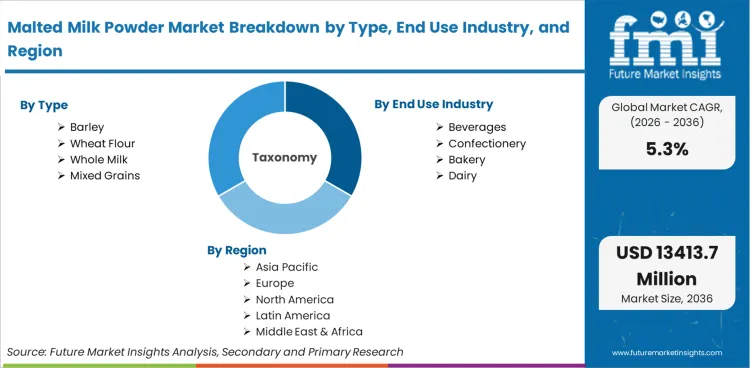
| Metric | Value |
|---|---|
| Quantitative Units | USD 8003.2 Million to USD 13413.7 Million, at a CAGR of 5.3% |
| Market Definition | Spray-dried and drum-dried powder blends of malted barley extract, wheat flour, and milk solids serving beverage, bakery, confectionery, dairy, and nutraceutical manufacturing applications. |
| Type Segmentation | Barley, Wheat Flour, Whole Milk, Mixed Grains |
| End Use Industry | Beverages, Confectionery, Bakery, Dairy, Nutraceutical |
| Distribution Channel | B2B, B2C (Hypermarkets/Supermarkets) |
| Regions Covered | North America, Latin America, Europe, East Asia, South Asia, Oceania, Middle East & Africa |
| Countries Covered | USA, Brazil, India, Japan, China, and 40 plus countries |
| Key Companies Profiled | Briess Malt & Ingredients, Unilever (Horlicks), Imperial Malts Ltd., Cliff Foods, Muntons plc, Nestle S.A., Hoosier Hill Farm, Custom Food Group, Associated British Foods (Ovaltine), Glanbia Nutritionals, Epi Ingredients |
| Forecast Period | 2026 to 2036 |
| Approach | Bottom-up aggregation of malt processing facility production volumes, weighted against application-specific pricing benchmarks and end-use demand forecasts by region |
Key Segments of the Report
By Type:
As per Type, the industry has been categorized into Wheat Flour, Barley, Whole Milk, and Mixed Grains.
By End Use Industry:
As per End Use Industry, the industry has been categorized into Beverages, Confectionery, Bakery, and Dairy.
By Distribution Channel:
As per the Distribution Channel, the industry has been categorized into B2B and B2C.
By Region:
Industry analysis has been carried out in key countries of North America, Latin America, Western Europe, Eastern Europe, East Asia, South Asia & Pacific, Central Asia, Russia and Belarus, Balkan & Baltics, and the Middle East & Africa.
Bibliography
- 1. Food and Agriculture Organization of the United Nations. (2024). Cereals and Grains: Global Supply and Trade Statistics. FAO.
- 2. Codex Alimentarius Commission. (2024). Standard for Malted Dried Milks: Codex STAN 83-1981 (Amended). FAO/WHO.
- 3. European Commission. (2024). Agricultural Market Situation for Cereals and Malt: Quarterly Report. European Commission Directorate-General for Agriculture.
- 4. Ministry of Food Processing Industries, Government of India. (2024). Annual Survey of Industries: Food and Beverage Processing Sector. Government of India.
- 5. USDA Agricultural Research Service. (2024). Malting Barley Quality Evaluation and Variety Performance. USDA ARS National Small Grains Collection.
This bibliography is provided for reader reference. The full FMI report contains the complete reference list with primary research documentation.
Frequently Asked Questions
How large is the Malted Milk Powder market in 2026?
The Malted Milk Powder market is estimated at USD 8003.2 million in 2026.
What will the Malted Milk Powder market reach by 2036?
The Malted Milk Powder market is projected to reach USD 13413.7 million by 2036.
What CAGR is projected?
The Malted Milk Powder market is expected to grow at a CAGR of 5.3% from 2026 to 2036.
Which Type segment leads in 2026?
Barley holds 29.2% of Type segment demand in 2026, reflecting the traditional formulation dominance of barley malt in established beverage brand recipes.
Which End Use Industry is largest in 2026?
Beverages account for 31.4% of End Use Industry demand in 2026, driven by large-volume ingredient procurement from branded malted health drink manufacturers.
Which Distribution Channel dominates in 2026?
B2B channel commands 62.0% of Distribution Channel demand in 2026, reflecting the ingredient-use dominance of the market relative to consumer retail formats.
Which country grows fastest?
India is projected to grow at an 8.1% CAGR through 2036, driven by a large branded malted health drink category and expanding modern retail distribution infrastructure.
What is excluded from this report?
Plain malted barley extract without milk solids integration, finished consumer beverage products, confectionery end-products, malt vinegar, beer malt, and distilling malt are excluded from this report.
How does FMI build this forecast?
FMI applies a bottom-up model aggregating malt processing facility production volumes, weighted against application-specific pricing benchmarks and end-use demand forecasts by region, cross-validated against branded beverage company revenue disclosures.
Preview the report firsthand - request a free sample
Get SampleGet the brochure for pricing and purchase details.
Get PDFTable of Content
- Executive Summary
- Global Market Outlook
- Demand-side Trends
- Supply-side Trends
- Technology Roadmap Analysis
- Analysis and Recommendations
- Market Overview
- Market Coverage / Taxonomy
- Market Definition / Scope / Limitations
- Research Methodology
- Chapter Orientation
- Analytical Lens and Working Hypotheses
- Market Structure, Signals, and Trend Drivers
- Benchmarking and Cross-market Comparability
- Market Sizing, Forecasting, and Opportunity Mapping
- Research Design and Evidence Framework
- Desk Research Programme (Secondary Evidence)
- Company Annual and Sustainability Reports
- Peer-reviewed Journals and Academic Literature
- Corporate Websites, Product Literature, and Technical Notes
- Earnings Decks and Investor Briefings
- Statutory Filings and Regulatory Disclosures
- Technical White Papers and Standards Notes
- Trade Journals, Industry Magazines, and Analyst Briefs
- Conference Proceedings, Webinars, and Seminar Materials
- Government Statistics Portals and Public Data Releases
- Press Releases and Reputable Media Coverage
- Specialist Newsletters and Curated Briefings
- Sector Databases and Reference Repositories
- FMI Internal Proprietary Databases and Historical Market Datasets
- Subscription Datasets and Paid Sources
- Social Channels, Communities, and Digital Listening Inputs
- Additional Desk Sources
- Expert Input and Fieldwork (Primary Evidence)
- Primary Modes
- Qualitative Interviews and Expert Elicitation
- Quantitative Surveys and Structured Data Capture
- Blended Approach
- Why Primary Evidence is Used
- Field Techniques
- Interviews
- Surveys
- Focus Groups
- Observational and In-context Research
- Social and Community Interactions
- Stakeholder Universe Engaged
- C-suite Leaders
- Board Members
- Presidents and Vice Presidents
- R&D and Innovation Heads
- Technical Specialists
- Domain Subject-matter Experts
- Scientists
- Physicians and Other Healthcare Professionals
- Governance, Ethics, and Data Stewardship
- Research Ethics
- Data Integrity and Handling
- Primary Modes
- Tooling, Models, and Reference Databases
- Desk Research Programme (Secondary Evidence)
- Data Engineering and Model Build
- Data Acquisition and Ingestion
- Cleaning, Normalisation, and Verification
- Synthesis, Triangulation, and Analysis
- Quality Assurance and Audit Trail
- Market Background
- Market Dynamics
- Drivers
- Restraints
- Opportunity
- Trends
- Scenario Forecast
- Demand in Optimistic Scenario
- Demand in Likely Scenario
- Demand in Conservative Scenario
- Opportunity Map Analysis
- Product Life Cycle Analysis
- Supply Chain Analysis
- Investment Feasibility Matrix
- Value Chain Analysis
- PESTLE and Porter’s Analysis
- Regulatory Landscape
- Regional Parent Market Outlook
- Production and Consumption Statistics
- Import and Export Statistics
- Market Dynamics
- Global Market Analysis 2021 to 2025 and Forecast, 2026 to 2036
- Historical Market Size Value (USD Million) Analysis, 2021 to 2025
- Current and Future Market Size Value (USD Million) Projections, 2026 to 2036
- Y-o-Y Growth Trend Analysis
- Absolute $ Opportunity Analysis
- Global Market Pricing Analysis 2021 to 2025 and Forecast 2026 to 2036
- Global Market Analysis 2021 to 2025 and Forecast 2026 to 2036, By Type
- Introduction / Key Findings
- Historical Market Size Value (USD Million) Analysis By Type , 2021 to 2025
- Current and Future Market Size Value (USD Million) Analysis and Forecast By Type , 2026 to 2036
- Barley
- Wheat Flour
- Whole Milk
- Mixed Grains
- Barley
- Y-o-Y Growth Trend Analysis By Type , 2021 to 2025
- Absolute $ Opportunity Analysis By Type , 2026 to 2036
- Global Market Analysis 2021 to 2025 and Forecast 2026 to 2036, By End Use Industry
- Introduction / Key Findings
- Historical Market Size Value (USD Million) Analysis By End Use Industry, 2021 to 2025
- Current and Future Market Size Value (USD Million) Analysis and Forecast By End Use Industry, 2026 to 2036
- Beverages
- Confectionery
- Bakery
- Dairy
- Beverages
- Y-o-Y Growth Trend Analysis By End Use Industry, 2021 to 2025
- Absolute $ Opportunity Analysis By End Use Industry, 2026 to 2036
- Global Market Analysis 2021 to 2025 and Forecast 2026 to 2036, By Distribution Channel
- Introduction / Key Findings
- Historical Market Size Value (USD Million) Analysis By Distribution Channel, 2021 to 2025
- Current and Future Market Size Value (USD Million) Analysis and Forecast By Distribution Channel, 2026 to 2036
- B2B
- B2C
- B2B
- Y-o-Y Growth Trend Analysis By Distribution Channel, 2021 to 2025
- Absolute $ Opportunity Analysis By Distribution Channel, 2026 to 2036
- Global Market Analysis 2021 to 2025 and Forecast 2026 to 2036, By Region
- Introduction
- Historical Market Size Value (USD Million) Analysis By Region, 2021 to 2025
- Current Market Size Value (USD Million) Analysis and Forecast By Region, 2026 to 2036
- North America
- Latin America
- Western Europe
- Eastern Europe
- East Asia
- South Asia and Pacific
- Middle East & Africa
- Market Attractiveness Analysis By Region
- North America Market Analysis 2021 to 2025 and Forecast 2026 to 2036, By Country
- Historical Market Size Value (USD Million) Trend Analysis By Market Taxonomy, 2021 to 2025
- Market Size Value (USD Million) Forecast By Market Taxonomy, 2026 to 2036
- By Country
- USA
- Canada
- Mexico
- By Type
- By End Use Industry
- By Distribution Channel
- By Country
- Market Attractiveness Analysis
- By Country
- By Type
- By End Use Industry
- By Distribution Channel
- Key Takeaways
- Latin America Market Analysis 2021 to 2025 and Forecast 2026 to 2036, By Country
- Historical Market Size Value (USD Million) Trend Analysis By Market Taxonomy, 2021 to 2025
- Market Size Value (USD Million) Forecast By Market Taxonomy, 2026 to 2036
- By Country
- Brazil
- Chile
- Rest of Latin America
- By Type
- By End Use Industry
- By Distribution Channel
- By Country
- Market Attractiveness Analysis
- By Country
- By Type
- By End Use Industry
- By Distribution Channel
- Key Takeaways
- Western Europe Market Analysis 2021 to 2025 and Forecast 2026 to 2036, By Country
- Historical Market Size Value (USD Million) Trend Analysis By Market Taxonomy, 2021 to 2025
- Market Size Value (USD Million) Forecast By Market Taxonomy, 2026 to 2036
- By Country
- Germany
- UK
- Italy
- Spain
- France
- Nordic
- BENELUX
- Rest of Western Europe
- By Type
- By End Use Industry
- By Distribution Channel
- By Country
- Market Attractiveness Analysis
- By Country
- By Type
- By End Use Industry
- By Distribution Channel
- Key Takeaways
- Eastern Europe Market Analysis 2021 to 2025 and Forecast 2026 to 2036, By Country
- Historical Market Size Value (USD Million) Trend Analysis By Market Taxonomy, 2021 to 2025
- Market Size Value (USD Million) Forecast By Market Taxonomy, 2026 to 2036
- By Country
- Russia
- Poland
- Hungary
- Balkan & Baltic
- Rest of Eastern Europe
- By Type
- By End Use Industry
- By Distribution Channel
- By Country
- Market Attractiveness Analysis
- By Country
- By Type
- By End Use Industry
- By Distribution Channel
- Key Takeaways
- East Asia Market Analysis 2021 to 2025 and Forecast 2026 to 2036, By Country
- Historical Market Size Value (USD Million) Trend Analysis By Market Taxonomy, 2021 to 2025
- Market Size Value (USD Million) Forecast By Market Taxonomy, 2026 to 2036
- By Country
- China
- Japan
- South Korea
- By Type
- By End Use Industry
- By Distribution Channel
- By Country
- Market Attractiveness Analysis
- By Country
- By Type
- By End Use Industry
- By Distribution Channel
- Key Takeaways
- South Asia and Pacific Market Analysis 2021 to 2025 and Forecast 2026 to 2036, By Country
- Historical Market Size Value (USD Million) Trend Analysis By Market Taxonomy, 2021 to 2025
- Market Size Value (USD Million) Forecast By Market Taxonomy, 2026 to 2036
- By Country
- India
- ASEAN
- Australia & New Zealand
- Rest of South Asia and Pacific
- By Type
- By End Use Industry
- By Distribution Channel
- By Country
- Market Attractiveness Analysis
- By Country
- By Type
- By End Use Industry
- By Distribution Channel
- Key Takeaways
- Middle East & Africa Market Analysis 2021 to 2025 and Forecast 2026 to 2036, By Country
- Historical Market Size Value (USD Million) Trend Analysis By Market Taxonomy, 2021 to 2025
- Market Size Value (USD Million) Forecast By Market Taxonomy, 2026 to 2036
- By Country
- Kingdom of Saudi Arabia
- Other GCC Countries
- Turkiye
- South Africa
- Other African Union
- Rest of Middle East & Africa
- By Type
- By End Use Industry
- By Distribution Channel
- By Country
- Market Attractiveness Analysis
- By Country
- By Type
- By End Use Industry
- By Distribution Channel
- Key Takeaways
- Key Countries Market Analysis
- USA
- Pricing Analysis
- Market Share Analysis, 2025
- By Type
- By End Use Industry
- By Distribution Channel
- Canada
- Pricing Analysis
- Market Share Analysis, 2025
- By Type
- By End Use Industry
- By Distribution Channel
- Mexico
- Pricing Analysis
- Market Share Analysis, 2025
- By Type
- By End Use Industry
- By Distribution Channel
- Brazil
- Pricing Analysis
- Market Share Analysis, 2025
- By Type
- By End Use Industry
- By Distribution Channel
- Chile
- Pricing Analysis
- Market Share Analysis, 2025
- By Type
- By End Use Industry
- By Distribution Channel
- Germany
- Pricing Analysis
- Market Share Analysis, 2025
- By Type
- By End Use Industry
- By Distribution Channel
- UK
- Pricing Analysis
- Market Share Analysis, 2025
- By Type
- By End Use Industry
- By Distribution Channel
- Italy
- Pricing Analysis
- Market Share Analysis, 2025
- By Type
- By End Use Industry
- By Distribution Channel
- Spain
- Pricing Analysis
- Market Share Analysis, 2025
- By Type
- By End Use Industry
- By Distribution Channel
- France
- Pricing Analysis
- Market Share Analysis, 2025
- By Type
- By End Use Industry
- By Distribution Channel
- India
- Pricing Analysis
- Market Share Analysis, 2025
- By Type
- By End Use Industry
- By Distribution Channel
- ASEAN
- Pricing Analysis
- Market Share Analysis, 2025
- By Type
- By End Use Industry
- By Distribution Channel
- Australia & New Zealand
- Pricing Analysis
- Market Share Analysis, 2025
- By Type
- By End Use Industry
- By Distribution Channel
- China
- Pricing Analysis
- Market Share Analysis, 2025
- By Type
- By End Use Industry
- By Distribution Channel
- Japan
- Pricing Analysis
- Market Share Analysis, 2025
- By Type
- By End Use Industry
- By Distribution Channel
- South Korea
- Pricing Analysis
- Market Share Analysis, 2025
- By Type
- By End Use Industry
- By Distribution Channel
- Russia
- Pricing Analysis
- Market Share Analysis, 2025
- By Type
- By End Use Industry
- By Distribution Channel
- Poland
- Pricing Analysis
- Market Share Analysis, 2025
- By Type
- By End Use Industry
- By Distribution Channel
- Hungary
- Pricing Analysis
- Market Share Analysis, 2025
- By Type
- By End Use Industry
- By Distribution Channel
- Kingdom of Saudi Arabia
- Pricing Analysis
- Market Share Analysis, 2025
- By Type
- By End Use Industry
- By Distribution Channel
- Turkiye
- Pricing Analysis
- Market Share Analysis, 2025
- By Type
- By End Use Industry
- By Distribution Channel
- South Africa
- Pricing Analysis
- Market Share Analysis, 2025
- By Type
- By End Use Industry
- By Distribution Channel
- USA
- Market Structure Analysis
- Competition Dashboard
- Competition Benchmarking
- Market Share Analysis of Top Players
- By Regional
- By Type
- By End Use Industry
- By Distribution Channel
- Competition Analysis
- Competition Deep Dive
- Briess Malt & Ingredients
- Overview
- Product Portfolio
- Profitability by Market Segments (Product/Age /Sales Channel/Region)
- Sales Footprint
- Strategy Overview
- Marketing Strategy
- Product Strategy
- Channel Strategy
- Unilever(Horlicks)
- Imperial Malts Ltd.
- Cliff Foods
- Muntons plc
- Nestlé S.A.
- Larissa Veronica
- Hoosier Hill Farm
- Custom Food Group
- Associated British Foods (Ovaltine)
- Others
- Briess Malt & Ingredients
- Competition Deep Dive
- Assumptions & Acronyms Used


