

- Market Size (2026)
- USD 640.7 Mn
- Forecast (2036)
- USD 1063.7 Mn
- CAGR (2026 to 2036)
- 5.2%
How big is Marble Polishing Compounds Market in 2026?
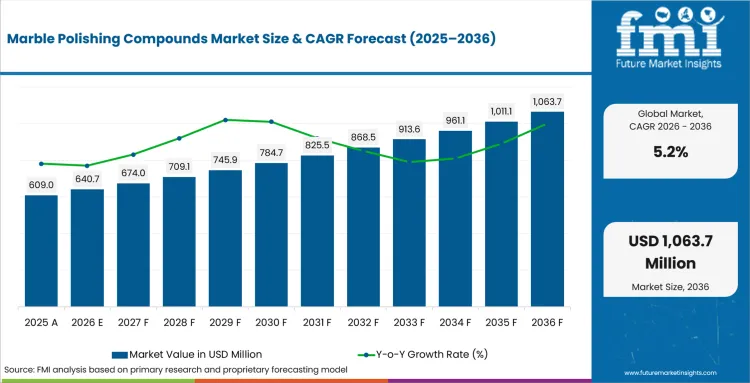
USD 640.7 million in 2026 and USD 1,063.7 million by 2036 at a 5.2% CAGR.
Demand for marble polishing compounds is projected to expand at 5.2% CAGR between 2026 and 2036, increasing valuation from USD 640.7 million in 2026 to USD 1063.7 million by 2036. Recurring restoration combines surface diagnosis with honing and controlled chemical polishing across installed marble floors. Natural Stone Institute published its restoration and maintenance chapter in January 2025 to cover equipment and troubleshooting alongside restorative processes. Floor grinding equipment supports preparation for chemical treatment across occupied commercial properties with recurring marble restoration needs. Localized gloss recovery avoids replacement of sound stone and reduces disruption across busy commercial interiors.
Country purchasing routes differ as protected properties require mockups and documented methods for floor work. Historic-project guidance connects qualification records with final treatment decisions across protected and occupied commercial interiors. GSA updated its historic marble procedure in June 2026 and required qualified contractors alongside approved test patches. Stone processing machinery supports preparation; United States projects emphasize approvals and German routes rely on documented specialist skills. Italian conservation programs stage hard surface flooring work around public access, and Spanish standards connect damage assessment with treatment planning. Local approvals and technical service determine which compound reaches recurring use following complete mechanical preparation.
Key Takeaways of Marble Polishing Compounds Market
- Recurring restoration renews worn marble without replacing structurally sound surfaces across occupied commercial properties worldwide.
- Oxalic acid compounds are expected to hold 27.0% share in 2026 due to marble compatibility.
- Powder is projected to represent 38.0% share in 2026 owing to adjustable dosing across projects.
- Marble floors are anticipated to account for 34.0% share in 2026 supported by recurring wear.
- Surface variability and technician skill remain material barriers as earlier coatings obscure unfamiliar marble grades.
- Tenax, FILA Solutions, StonePro, MB Stone Care, AKEMI, Bellinzoni, GranQuartz, and Rust-Oleum’s Miracle Sealants compete through portfolio breadth, specialist formats, guidance, and professional distribution.
Analyst Perspective
"Marble polishing compounds earn repeat orders through predictable gloss recovery across stone grades and controlled machine routines. Restoration firms need guidance separating cleaning and honing from chemical polishing across occupied commercial floor projects. Reliable trial quantities and local troubleshooting reduce failed mockups without encouraging treatment on marble requiring deeper repair."
- Nikhil Kaitwade, Principal Analyst, Future Market Insights
How is the Marble Polishing Compounds Market segmented?
The marble polishing compounds industry is segmented by compound type, form, application, user type, sales channel, and region.
The market is segmented by compound type, form, application, user type, sales channel, and region. Compound type covers oxalic acid, tin oxide, aluminum oxide, diamond formulations, and crystallizers for varied marble conditions. Form separates powders, pastes, liquids, and ready-to-use pads or creams according to established technician routines. Applications include floors, countertops, monuments, restoration work, and commercial stone care across occupied commercial properties. User types include contractors, fabricators, facility teams, and retail users; sales channels separately cover distributors, manufacturers, retailers, e-commerce platforms, and facility suppliers. Abrasive products support preparation, and regular scheduled cleaning preserves floor condition between periodic chemical polishing cycles.
What makes the oxalic acid compounds segment central to the compound type category?
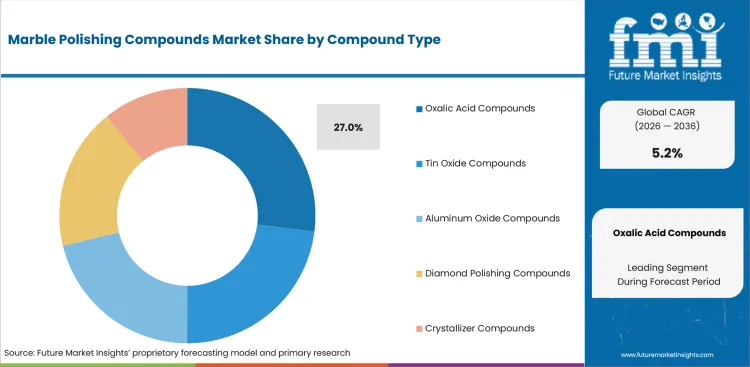
Oxalic acid compounds suit calcium-rich marble that reaches a fine honed finish for controlled chemical gloss recovery on installed floors. Restoration crews manage dwell time and neutralization to limit color variation across adjoining commercial floor sections. StonePro limits its oxalic acid powder to qualified professionals, and existing construction chemicals or sealers require compatibility review to prevent uneven onsite treatment reactions.
- By compound type, oxalic acid compounds are estimated to hold 27.0% share in 2026 owing to established calcium-rich marble compatibility. Restoration firms recover reflectivity following fine honing without repeating costly abrasive stages across broad floors. Familiar neutralization procedures support predictable labor planning and material estimates across recurring professional maintenance contracts.
- Hotels and public buildings select oxalic systems for short closures requiring visible gloss recovery across circulation areas. Unusual marble grades require controlled trials; concentrated slurry otherwise produces uneven appearance and expensive corrective passes. Regional specialist stone distributors support adoption through trial quantities and matched neutralizers suited to documented project conditions.
Why does the powder segment lead the form category?
Powder gives technicians direct slurry control across localized repairs and broad marble-floor restoration projects onsite. Crews adjust dosing for wear levels and machine response without transporting prepared liquids between sites. StonePro describes its 5X powder as a final or maintenance polish for marble and limestone. Floor care chemicals address routine soil while powder handles gloss recovery through mixing and controlled neutralization.
- Powder is set to lead the form category with 38.0% share in 2026 due to flexible dosing across projects. Contractors divide compact containers among sites with different wear levels and limit unused slurry efficiently. The format supports consistent inventory planning across restoration crews handling varied finish targets and closure schedules.
- Teams operating green floor care systems use powder for spot correction across several installed marble grades. Specialist distributors stock compact containers but mixing consistency and dust control require practical technician instruction onsite. Clear dosing guidance supports repeat purchases across regional crews handling changing surfaces and varied commercial project sizes nationwide.
How does the marble floors segment support the application category?
Marble floors generate recurring compound use as foot traffic reduces gloss across lobbies and corridors. Maintenance planners divide broad surfaces into treatment zones that fit access schedules and closure periods. Bellinzoni positions Super Crystal powder for restoration and routine gloss maintenance in high-traffic marble areas. Construction flooring formulations help technicians identify coatings and repair layers during planning for chemical polishing.
- The marble floors segment is likely to capture 38.0% share in 2026 attributable to recurring traffic-related gloss loss. Standardized machine passes support planned treatment across occupied properties and make clear technical instructions commercially valuable. Reliable stock helps contractors complete zoned work within scheduled closures without disrupting adjoining busy circulation areas.
- Hotels and museums use compounds alongside offices and transport buildings to renew installed marble without costly replacement. Cracks and deep damage require repair or mechanical grinding rather than chemical polishing alone on affected surfaces. Facility teams separate structural work from surface-care budgets and approve compounds for clearly defined finish problems.
What supports the floor restoration contractors segment in the user type category?
Floor restoration contractors control compound choice through diagnosis and machine sequencing across each commercial site. Their inspection determines whether wear requires cleaning and honing or chemical polishing with controlled neutralization. FILA Solutions trained Spanish polishing professionals in June 2025 through surface-specific demonstrations and application guidance. Applied instruction reduces failed initial treatments on unfamiliar marble grades and existing finishes during projects.
- Based on user type, floor restoration contractors are projected to account for 34.0% share in 2026 due to treatment-sequencing control. Their recommendations carry commercial weight as one accountable crew combines product and equipment decisions directly. The combined responsibility supports repeat orders across properties following documented maintenance plans and established customer finish specifications.
- Specialist contractors purchase repeatedly across commercial projects involving different stone grades and finish targets annually. Smaller firms face machine costs and uneven training access that restrict unfamiliar compound formulation trials. Distributors widen professional use through equipment rental and practical instruction tied to verified local surface conditions and technician application experience.
What drives the stone care distributors segment in the sales channel category?
Stone-care distributors combine compounds with floor cleaning machines and compatibility advice across regional restoration networks. Delayed compound deliveries extend building closures and raise labor costs during time-sensitive commercial restoration projects. FILA Solutions connects qualified dealers with training and technical assistance through its regional professional network. Local service converts broad availability into repeat purchasing among restoration firms managing recurring maintenance programs.
- In 2026, stone care distributors are expected to lead the sales channel category with 39.0% share because contractors need finish-specific compatibility guidance. Specialist accounts supply compounds and pads alongside cleaners and neutralizers during complete restoration project work. Consolidated sourcing reduces costly delays during urgent replacement needs across active sites and scheduled closures.
- Regional distributors support professional use through immediate stock and compatibility advice during limited project closure periods. Specialist counters retain value through troubleshooting and practical substitution despite competition from expanding digital retail channels. Accessible local guidance helps contractors test unfamiliar compounds without committing prematurely to unsuitable product orders across regional markets.
What are the drivers, restraints, and opportunities in the Marble Polishing Compounds Market?
Documented wet methods support compound demand while variable marble finishes slow substitution and service-backed distribution strengthens repeat professional purchasing.
- Driver: Exposure controls favor compounds that fit documented wet polishing and complete professional work plans.
- Restraint: Variable marble grades require testing that raises labor costs and delays complete treatment approval.
- Opportunity: Training and local trial stock convert technical guidance into repeat purchasing across professional accounts.
Respirable-silica controls increase the value of compounds that complete gloss recovery without unnecessary abrasive passes. Grinding releases fine mineral dust during surface preparation and increases the burden on restoration crews. OSHA issued an April 2025 citation involving marble polishing; one worker faced exposure to 186 micrograms of respirable silica per cubic meter. Contractors therefore prefer treatment plans that limit repeat grinding and pair chemical polishing with documented wet methods across occupied commercial sites.
Uncertain coatings and earlier treatments make compound substitution risky across marble floors with mixed repair histories. Project teams must identify the finish and test representative areas prior to approving an unfamiliar formula. Natural Stone Institute published its Stone Selection chapter in January 2025 with guidance on finish definitions alongside samples and mockups. Finish checks protect valuable interiors but extend labor time and delay wider compound use across complete commercial floors.
Training and local trial stock give specialist distributors a practical route to repeat professional orders. Restoration firms need instruction that separates correctable gloss loss from deeper damage requiring mechanical repair. StonePro’s three-day restoration bootcamp trains professionals in powder and compound polishing within broader floor-maintenance work. Distributors combining small test quantities with hands-on support help contractors select suitable chemistry and reduce failed first applications across unfamiliar marble surfaces and existing finishes.
Which country CAGRs are profiled in the Marble Polishing Compounds Market?
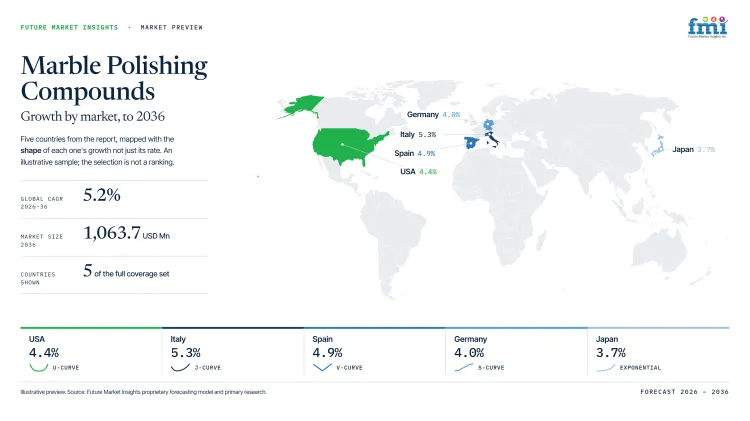
| Country | CAGR |
|---|---|
| United States | 4.4% |
| Germany | 4.0% |
| Japan | 3.7% |
| Italy | 5.3% |
| Spain | 4.9% |
How do country-level CAGRs compare in the Marble Polishing Compounds Market?
The forecasts form a gradual progression across countries with established stone trades and restoration routes. Italy and Spain remain closely aligned through heritage work and application skills across protected interiors. A break separates Spain from the United States as property cycles and approval routes differ. United States and German outlooks remain close despite different service structures and project qualification practices. Germany and Japan form a narrow pair but distributor access shapes distinct local commercial routes. Commercial conversion depends on specialist access and reliable support across protected interiors and marble floors.
- Italy’s outlook reflects phased heritage programs and specialist stone trades working across protected public interiors.
- Spain combines formal restoration standards with stone skills that support treatment planning across protected surfaces.
- The United States relies on recurring commercial maintenance and service networks across high-value marble interiors.
- Germany links planned conservation programs with documented specialist selection across museums and major historic properties.
- Japan connects formal skill evaluation with careful treatment approval across restoration projects and heritage interiors.
Comparable CAGRs produce different entry conditions as channel access and project approval determine commercial conversion. The full report provides country-level CAGR analysis across North America, Latin America, Europe, East Asia, South Asia, Oceania and the Middle East and Africa.
Country-wise Analysis
- American preservation projects require approved mockups and contractor methods during treatment planning for protected historic marble. Marble polishing compound sales in the United States are forecast to expand at 4.4% CAGR by 2036, supported by commercial maintenance and specialist distribution. Public grant programs connect restoration funding with qualified execution routes and documented contractor selection requirements for funded work. The commission reported in October 2025 that a USD 35,000 grant had funded stone repair and marble replacement at one landmark property. Specialist distributors provide products and training but fragmented service coverage raises travel costs and demands dependable replacement stock.
- German marble restoration relies on specialist trades and specifications separating conservation work from routine cleaning. Germany is estimated to post 4.0% CAGR over the forecast period, shaped by conservation work and trade qualification. Major protected properties require staged treatment around public access and related restoration tasks across occupied interiors. SPSG reported in March 2025 that restoration of the Marble Hall floor at Potsdam’s New Palace was complete. Regional distributors shorten service distance around conservation clusters but formal tendering can lengthen qualification and ordering cycles. Restoration firms require documented mockups for unfamiliar chemistry across protected marble floors during project approval.
- Japanese stone work increasingly follows registered skill pathways that document professional experience and technical capability. The Japanese marble polishing compounds sector is projected to record 3.7% CAGR during the assessment period, supported by skill evaluation and approval. The national construction system now recognizes stone skills through a defined professional evaluation route nationwide. Japan’s infrastructure ministry added stone-construction workers to CCUS evaluation in October 2025 with four formal skill levels. Local equipment dealers support compact urban projects but imported specialty compounds face longer replenishment cycles. Contractors balance finish quality against stock reliability and practical technician training across demanding regional markets.
- Italian conservation projects stage work around visitor access and protection requirements for historic interior finishes. Marble polishing compound demand in Italy is forecast to rise at 5.3% CAGR over the forecast period, linked to heritage work and stone trades. Museum programs provide recurring work but restrict treatment windows around operations and protected collections onsite. Veneto’s museum authority reported in March 2025 that restoration at Ca’ d’Oro covered marble elements and Venetian floors during continued access to the museum. Italy’s stone-working base supports distributor access across restoration clusters but conservator approval and mockups can delay unfamiliar compounds on protected floors.
- Spanish natural-stone restoration follows competency standards covering damage assessment and treatment planning across professional projects. Adoption of marble polishing compounds in Spain is estimated to expand at 4.9% CAGR through 2036, aided by planning and stone skills. National training standards give contractors a common route for selecting interventions across damaged natural-stone surfaces. Spain’s state gazette published restoration competency updates in April 2026 covering condition reports and formal treatment proposals. Regional stone clusters provide equipment and distribution access but smaller contractors face uneven advanced training. Commercial adoption therefore depends on clear diagnosis and reliable local supply for corrective restoration work.
Who are the notable companies in the Marble Polishing Compounds Market?
Tenax S.p.A., FILA Solutions S.p.A. SB, StonePro, MB Stone Care & Supply LLC, AKEMI GmbH, Bellinzoni S.r.l., GranQuartz, L.P., and Rust-Oleum Corporation (Miracle Sealants) are the notable companies shaping the market.
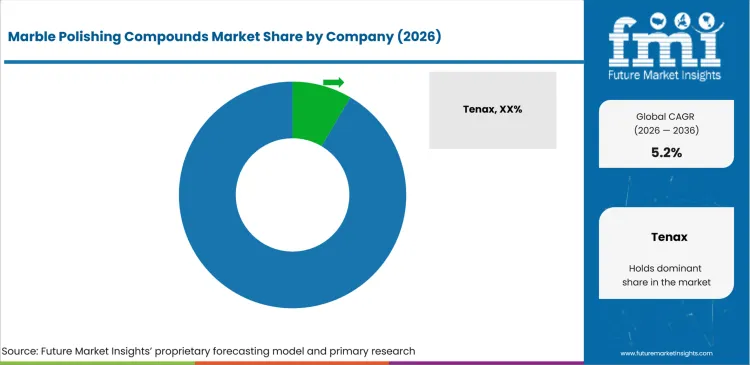
The competitive field remains fragmented across surface-care groups and regional restoration specialists serving distinct professional channels worldwide. No single portfolio covers every compound chemistry and delivery form with equal technical depth across all regions. Specialist brands enter through defined finish problems supported by local troubleshooting and practical contractor guidance. International groups compete through broad stone-treatment ranges and regional specialists emphasize focused powders and restoration support. Concrete polishing materials offer adjacent channel access but cannot replace marble-specific chemistry during final treatment.
- Tenax and FILA Solutions compete through broad stone-treatment portfolios and international technical networks across professional restoration markets worldwide. Their scale connects compounds with preparation and application support; local technicians translate broad ranges into repeatable routines for specific marble grades onsite.
- StonePro and MB Stone Care focus on restoration workflows through established North American professional distributor channels nationwide. Their powders address etching and uneven wear as accessible training supports field application and practical troubleshooting for professional contractor accounts across regional markets.
- AKEMI and Bellinzoni combine stone-treatment depth with international reach as GranQuartz and Rust-Oleum’s Miracle Sealants strengthen specialist distribution channels. Their formats serve professional and retail routes but advantage depends on equipment compatibility and clear surface application limits across professional stone-care accounts.
Competitive Benchmarking: Marble Polishing Compounds Market
| Company | Marble Compound Breadth | Restoration Workflow Support | Professional Channel Coverage | Geographic Reach |
|---|---|---|---|---|
| Tenax S.p.A. | High | High | High | Global and multi-region |
| FILA Solutions S.p.A. SB | High | High | High | Global and multi-region |
| StonePro | High | High | Medium | North America |
| MB Stone Care & Supply LLC | Medium | High | Medium | North America |
| AKEMI GmbH | Medium | High | High | Global and multi-region |
| Bellinzoni S.r.l. | High | High | Medium | Global and multi-region |
| GranQuartz, L.P. | Low | Medium | High | North America |
| Rust-Oleum Corporation (Miracle Sealants) | Medium | Medium | High | North America |
Key Developments in the Marble Polishing Compounds Market
- In May 2025, FILA Solutions introduced ULTRASHINE FLOOR as a ready-to-use crystallization product for polished marble and limestone. Technicians apply the product following final honing with a rotary machine and white pad; the prepared format reduces mixing during onsite treatment.
- In June 2025, FILA Solutions entered a technical partnership with Margraf covering natural-stone protection and maintenance across the material lifecycle. The agreement connected FILA’s surface-treatment expertise with Margraf’s marble production and project channels during selection and installation planning.
- In September 2025, Tenax announced live product applications for Marmomac through an outdoor demonstration area staffed by company technicians. Stone professionals could observe treatment methods and discuss application choices under practical conditions with direct technical guidance.
- In June 2025, AKEMI documented natural-stone surface renovation at Vienna’s listed Hotel Almanac through an application engineer’s project account. The work placed technical guidance inside an occupied heritage property with strict scheduling and finish-protection requirements.
Marble Polishing Compounds Market - Report Scope
| Coverage field | Report scope |
|---|---|
| Market breakdown | Compound type, form, application, user type, sales channel, and region. |
| Quantitative Units | Revenue in USD million and CAGR in %. |
| Market Definition | Compounds and prepared polishing agents used to restore or maintain gloss on marble surfaces across professional and retail workflows. |
| Regions Covered | North America, Latin America, Western Europe, Eastern Europe, East Asia, South Asia and Pacific, and Middle East and Africa. |
| Countries Covered | 30+ countries including the United States, Germany, Japan, Italy, Spain, China, India, Canada, France, and the United Kingdom. |
| Key Companies Profiled | Tenax S.p.A., FILA Solutions S.p.A. SB, StonePro, MB Stone Care & Supply LLC, AKEMI GmbH, Bellinzoni S.r.l., GranQuartz, L.P., and Rust-Oleum Corporation (Miracle Sealants). |
| Forecast Period | 2026 to 2036. |
| Approach | Hybrid bottom-up and top-down market sizing supported by primary interviews and official desk research. |
Marble Polishing Compounds Market - Research Methodology
| Method | Approach |
|---|---|
| Primary Research | FMI analysts gathered input from manufacturers, service providers, technology developers, distributors, end users, procurement teams, and subject-matter experts. Interviews examined purchasing decisions, product or service evaluation, adoption barriers, approval requirements, pricing considerations, and expectations for technical or commercial support. Respondents were also asked what evidence is required before a trial, pilot, or initial order develops into regular purchasing. |
| Desk Research | Desk research covered government statistics, regulatory publications, trade data, industry associations, technical literature, standards, company filings, product information, and official corporate announcements. Sources were reviewed for relevance, publication date, geographic coverage, and consistency with the defined market scope. Claims relating to performance, applications, approvals, capacity, investment, and commercial activity were retained only when supported by credible public evidence. |
| Market Sizing and Forecasting | The market model combined the baseline value with historical performance, segment structure, pricing and volume indicators, adoption levels, company participation, and country-level demand conditions. Forecast assumptions considered economic activity, investment trends, regulatory developments, technology adoption, purchasing cycles, supply availability, and barriers to wider market use. Segment and regional estimates were reconciled before the final market total was calculated. |
| Data Validation | Estimates were checked against multiple independent indicators, including public data, company activity, trade patterns, industry developments, and findings from primary interviews. Validation also tested whether products, services, applications, and company revenues fell within the defined market boundaries. Adjacent categories, unsupported claims, overlapping revenues, and activities without direct market relevance were excluded to reduce double counting and maintain consistency across segments and countries. |
Marble Polishing Compounds Market by Segments
Marble Polishing Compounds Market segmented by Compound Type:
- Oxalic Acid Compounds
- Tin Oxide Compounds
- Aluminum Oxide Compounds
- Diamond Polishing Compounds
- Crystallizer Compounds
Marble Polishing Compounds Market segmented by Form:
- Powder
- Paste
- Liquid
- Ready-to-use Pads / Creams
Marble Polishing Compounds Market segmented by Application:
- Marble Floors
- Countertops
- Monuments
- Restoration / Maintenance
- Commercial Stone Care
Marble Polishing Compounds Market segmented by User Type:
- Floor Restoration Contractors
- Stone Fabricators
- Janitorial / Facility Service
- Retail / DIY Users
Marble Polishing Compounds Market segmented by Sales Channel:
- Stone Care Distributors
- Direct Manufacturer
- Retail / E-commerce
- Facility Supply
Marble Polishing Compounds Market by Region:
- North America
- United States
- Canada
- Latin America
- Brazil
- Mexico
- Argentina
- Chile
- Western Europe
- Germany
- France
- United Kingdom
- Italy
- Spain
- Benelux
- Nordics
- Eastern Europe
- Poland
- Czech Republic
- Romania
- Hungary
- East Asia
- China
- Japan
- South Korea
- South Asia and Pacific
- India
- ASEAN
- Australia and New Zealand
- Middle East and Africa
- GCC Countries
- South Africa
- Türkiye
- Israel
Research Sources and Bibliography
- Natural Stone Institute. (2025, January 8). Dimension Stone Design Manual DSDM Chapter 21 - Restoration and Maintenance.
- USA General Services Administration. (2026, June 11). Cleaning and repolishing of interior historic marble.
- StonePro. (n.d.). Oxalic Acid - Polishing Powder.
- StonePro. (n.d.). 5X Polishing Powder.
- Bellinzoni. (n.d.). Super Crystal powder marble.
- FILA Solutions. (2025, June 13). Jornada técnica en Abrasivos Novelda: FILA Solutions comparte con la Asociación de Pulidores sus claves para el cuidado profesional de las superficies.
- FILA Solutions. (n.d.). FILAGROUP | FILA Solutions.
- Occupational Safety and Health Administration. (2025, April 9). Dreams Of Stone Llc | Occupational Safety and Health Administration.
- Natural Stone Institute. (2025, January 8). Dimension Stone Design Manual DSDM Chapter 03 - Stone Selection.
- StonePro. (n.d.). Stone Restoration Bootcamp.
- New York City Landmarks Preservation Commission. (2025, October 20). LPC Awards New Grants to Landmark Buildings Citywide, Announces Completion of Restoration Projects for Three Properties in Alice and Agate Courts Historic District, the Latest in a Series of Grant-Funded Work With Transformative Impact in the Bedford-Stuyvesant Neighborhood.
- Stiftung Preußische Schlösser und Gärten Berlin-Brandenburg. (2025, March 12). Großes Schloss, große Baustelle.
- Ministry of Land, Infrastructure, Transport and Tourism. (2025, October 24).
- Direzione regionale Musei nazionali Veneto. (2025, March 26). RESTAURO E RIALLESTIMENTO DELLA GALLERIA GIORGIO FRANCHETTI ALLA CA’ D’ORO Avanzamento lavori.
- Agencia Estatal Boletín Oficial del Estado. (2026, April 24). Orden EFD/374/2026, de 14 de abril, por la que se actualizan determinados estándares de competencias profesionales de las familias profesionales Agraria; Artes Gráficas; Electricidad y Electrónica; Energía y Agua; Edificación y Obra Civil; Fabricación Mecánica; Industrias Extractivas; Madera, Mueble y Corcho; Química; Seguridad y Medio Ambiente; Servicios Socioculturales y a la Comunidad; Textil, Confección y Piel; Transporte y Mantenimiento de Vehículos; y Vidrio y Cerámica recogidos en el Catálogo Nacional de Estándares de Competencias Profesionales.
- Rust-Oleum. (2026, April 21). Miracle Sealants - Water Ring & Etch Remover.
- Rust-Oleum. (2025, October 10). Miracle Sealants Stone Polish.
- FILA Solutions. (2025, May 28). Bring Back the Brilliance: Introducing ULTRASHINE FLOOR by FILA Solutions.
- FILA Solutions. (2025, June 6). Margraf elige a FILA Solutions como socio técnico estratégico para reforzar su apuesta por la excelencia global.
- Tenax. (2025, September 23-26). Marmomac 2025.
- AKEMI. (2025, June). Hotel successfully renovated.
This bibliography is provided for reader reference and is not exhaustive. The full report contains the complete reference list and detailed citations
This Report Answers
- How large is the global Marble Polishing Compounds market, and what is its growth outlook?
- What factors are driving demand for marble polishing compounds across construction, renovation, and restoration projects?
- How do key product, application, and end-use segments position themselves within the market?
- How do market growth rates, demand trends, and opportunities compare across major countries?
- What technical, operational, and cost-related barriers affect marble restoration and polishing activities?
- How is the competitive structure of the Marble Polishing Compounds market evolving?
- Which leading companies are introducing new products, partnerships, and strategic developments in the market?
- What are the commercial implications of changing customer requirements, technology advances, and industry trends?
Frequently Asked Questions
How big is the Marble Polishing Compounds Market in 2026?
The marble polishing compounds market is valued at USD 640.7 million in 2026 and is forecast to reach USD 1063.7 million by 2036. Growth is supported by recurring restoration that combines surface diagnosis with honing and controlled chemical polishing across installed marble floors worldwide.
What is the CAGR of the Marble Polishing Compounds Market from 2026 to 2036?
The marble polishing compounds market grows at a CAGR of 5.2% between 2026 and 2036, supported by localized gloss recovery that avoids replacement of sound stone and reduces disruption across busy commercial interiors and occupied properties.
Which compound type leads the Marble Polishing Compounds Market?
Oxalic acid compounds account for 27.0% of the marble polishing compounds market by compound type in 2026, driven by established calcium-rich marble compatibility that lets restoration crews recover reflectivity following fine honing without repeating costly abrasive stages.
How much will the Marble Polishing Compounds Market add between 2026 and 2036?
The marble polishing compounds market is set to add USD 423.0 million between 2026 and 2036, growing from USD 640.7 million to USD 1,063.7 million as documented restoration and maintenance programs extend across marble floors, countertops and monuments worldwide.
Who are the leading companies in the Marble Polishing Compounds Market?
Eight companies lead the marble polishing compounds market consistently, including Tenax, FILA Solutions, StonePro, MB Stone Care, AKEMI, Bellinzoni, GranQuartz and Rust-Oleum's Miracle Sealants, competing through marble compound breadth, restoration workflow support and professional channel coverage worldwide.
Preview the report firsthand - request a free sample
Get SampleGet the brochure for pricing and purchase details.
Get PDFTable of Content
- Key Takeaways
- Market Size and CAGR
- Top Growth Driver
- Fastest Growing Segment
- Leading Region
- Key Companies
- Emerging Opportunities
- Executive Summary
- Global Market Outlook
- Demand-side Trends
- Supply-side Trends
- Technology Roadmap Analysis
- Analysis and Recommendations
- Analyst Perspective (What is happening? Why now? What should investors know?)
- Key Questions Answered
- How large is the market?
- What is the CAGR?
- What are key trends?
- Which region dominates?
- Who are the leaders?
- Market Overview
- Market Coverage / Taxonomy
- Market Definition / Scope / Limitations
- Research Methodology
- Chapter Orientation
- Analytical Lens and Working Hypotheses
- Market Structure, Signals, and Trend Drivers
- Benchmarking and Cross-market Comparability
- Market Sizing, Forecasting, and Opportunity Mapping
- Research Design and Evidence Framework
- Desk Research Programme (Secondary Evidence)
- Expert Input and Fieldwork (Primary Evidence)
- Tooling, Models, and Reference Databases
- Data Engineering and Model Build
- Quality Assurance and Audit Trail
- Market Background
- Market Dynamics (Drivers, Restraints, Opportunity, Trends)
- Scenario Forecast (Optimistic, Likely, Conservative)
- Impact Analysis
- AI Impact
- Sustainability Impact
- Regulatory Impact
- Technology Impact
- Consumer / Buyer Analysis
- Purchase Drivers
- Adoption Barriers
- Buyer Journey
- Opportunity Map Analysis
- Product Life Cycle Analysis
- Supply Chain Analysis
- Investment Feasibility Matrix
- Value Chain Analysis
- PESTLE and Porter's Analysis
- Regulatory Landscape
- Regional Parent Market Outlook
- Production and Consumption Statistics
- Import and Export Statistics
- Global Market Analysis and Forecast, 2021 to 2036
- Historical Market Size Value (USD Million) Analysis, 2021 to 2025
- Current and Future Market Size Value (USD Million) Projections, 2026 to 2036
- Y-o-Y Growth Trend Analysis
- Absolute $ Opportunity Analysis
- Global Market Pricing Analysis, 2021 to 2036
- Global Market Analysis and Forecast, By Compound Type, 2021 to 2036
- Introduction / Key Findings
- Historical Market Size Value (USD Million) Analysis By Compound Type, 2021 to 2025
- Current and Future Market Size Value (USD Million) Analysis and Forecast By Compound Type, 2026 to 2036
- Oxalic Acid Compounds
- Tin Oxide Compounds
- Aluminum Oxide Compounds
- Diamond Polishing Compounds
- Crystallizer Compounds
- Oxalic Acid Compounds
- Y-o-Y Growth Trend Analysis By Compound Type, 2021 to 2025
- Absolute $ Opportunity Analysis By Compound Type, 2026 to 2036
- Global Market Analysis and Forecast, By Form, 2021 to 2036
- Introduction / Key Findings
- Historical Market Size Value (USD Million) Analysis By Form, 2021 to 2025
- Current and Future Market Size Value (USD Million) Analysis and Forecast By Form, 2026 to 2036
- Powder
- Paste
- Liquid
- Ready-to-use Pads / Creams
- Powder
- Y-o-Y Growth Trend Analysis By Form, 2021 to 2025
- Absolute $ Opportunity Analysis By Form, 2026 to 2036
- Global Market Analysis and Forecast, By Application, 2021 to 2036
- Introduction / Key Findings
- Historical Market Size Value (USD Million) Analysis By Application, 2021 to 2025
- Current and Future Market Size Value (USD Million) Analysis and Forecast By Application, 2026 to 2036
- Marble Floors
- Countertops
- Monuments
- Restoration / Maintenance
- Commercial Stone Care
- Marble Floors
- Y-o-Y Growth Trend Analysis By Application, 2021 to 2025
- Absolute $ Opportunity Analysis By Application, 2026 to 2036
- Global Market Analysis and Forecast, By User Type, 2021 to 2036
- Introduction / Key Findings
- Historical Market Size Value (USD Million) Analysis By User Type, 2021 to 2025
- Current and Future Market Size Value (USD Million) Analysis and Forecast By User Type, 2026 to 2036
- Floor Restoration Contractors
- Stone Fabricators
- Janitorial / Facility Service
- Retail / DIY Users
- Floor Restoration Contractors
- Y-o-Y Growth Trend Analysis By User Type, 2021 to 2025
- Absolute $ Opportunity Analysis By User Type, 2026 to 2036
- Global Market Analysis and Forecast, By Sales Channel, 2021 to 2036
- Introduction / Key Findings
- Historical Market Size Value (USD Million) Analysis By Sales Channel, 2021 to 2025
- Current and Future Market Size Value (USD Million) Analysis and Forecast By Sales Channel, 2026 to 2036
- Stone Care Distributors
- Direct Manufacturer
- Retail / E-commerce
- Facility Supply
- Stone Care Distributors
- Y-o-Y Growth Trend Analysis By Sales Channel, 2021 to 2025
- Absolute $ Opportunity Analysis By Sales Channel, 2026 to 2036
- Global Market Analysis and Forecast, By Region, 2021 to 2036
- Introduction
- Historical Market Size Value (USD Million) Analysis By Region, 2021 to 2025
- Current Market Size Value (USD Million) Analysis and Forecast By Region, 2026 to 2036
- North America
- Latin America
- Western Europe
- Eastern Europe
- East Asia
- South Asia and Pacific
- Middle East & Africa
- Market Attractiveness Analysis By Region
- North America Market Analysis and Forecast, By Country, 2021 to 2036
- Historical Market Size Value (USD Million) Trend Analysis By Market Taxonomy, 2021 to 2025
- Market Size Value (USD Million) Forecast By Market Taxonomy, 2026 to 2036
- By Country
- USA
- Canada
- By Compound Type
- By Form
- By Application
- By User Type
- By Sales Channel
- By Country
- Market Attractiveness Analysis
- By Country
- By Compound Type
- By Form
- By Application
- By User Type
- By Sales Channel
- Key Takeaways
- Latin America Market Analysis and Forecast, By Country
- Historical Market Size Value (USD Million) Trend Analysis By Market Taxonomy, 2021 to 2025
- Market Size Value (USD Million) Forecast By Market Taxonomy, 2026 to 2036
- By Country
- Brazil
- Mexico
- Chile
- Rest of Latin America
- By Compound Type
- By Form
- By Application
- By User Type
- By Sales Channel
- By Country
- Market Attractiveness Analysis
- By Country
- By Compound Type
- By Form
- By Application
- By User Type
- By Sales Channel
- Key Takeaways
- Western Europe Market Analysis and Forecast, By Country
- Historical Market Size Value (USD Million) Trend Analysis By Market Taxonomy, 2021 to 2025
- Market Size Value (USD Million) Forecast By Market Taxonomy, 2026 to 2036
- By Country
- Germany
- UK
- Italy
- Spain
- France
- Nordic
- BENELUX
- Rest of Western Europe
- By Compound Type
- By Form
- By Application
- By User Type
- By Sales Channel
- By Country
- Market Attractiveness Analysis
- By Country
- By Compound Type
- By Form
- By Application
- By User Type
- By Sales Channel
- Key Takeaways
- Eastern Europe Market Analysis and Forecast, By Country
- Historical Market Size Value (USD Million) Trend Analysis By Market Taxonomy, 2021 to 2025
- Market Size Value (USD Million) Forecast By Market Taxonomy, 2026 to 2036
- By Country
- Russia
- Poland
- Hungary
- Balkan & Baltic
- Rest of Eastern Europe
- By Compound Type
- By Form
- By Application
- By User Type
- By Sales Channel
- By Country
- Market Attractiveness Analysis
- By Country
- By Compound Type
- By Form
- By Application
- By User Type
- By Sales Channel
- Key Takeaways
- East Asia Market Analysis and Forecast, By Country
- Historical Market Size Value (USD Million) Trend Analysis By Market Taxonomy, 2021 to 2025
- Market Size Value (USD Million) Forecast By Market Taxonomy, 2026 to 2036
- By Country
- China
- Japan
- South Korea
- By Compound Type
- By Form
- By Application
- By User Type
- By Sales Channel
- By Country
- Market Attractiveness Analysis
- By Country
- By Compound Type
- By Form
- By Application
- By User Type
- By Sales Channel
- Key Takeaways
- South Asia and Pacific Market Analysis and Forecast, By Country
- Historical Market Size Value (USD Million) Trend Analysis By Market Taxonomy, 2021 to 2025
- Market Size Value (USD Million) Forecast By Market Taxonomy, 2026 to 2036
- By Country
- India
- ASEAN
- Australia & New Zealand
- Rest of South Asia and Pacific
- By Compound Type
- By Form
- By Application
- By User Type
- By Sales Channel
- By Country
- Market Attractiveness Analysis
- By Country
- By Compound Type
- By Form
- By Application
- By User Type
- By Sales Channel
- Key Takeaways
- Middle East & Africa Market Analysis and Forecast, By Country
- Historical Market Size Value (USD Million) Trend Analysis By Market Taxonomy, 2021 to 2025
- Market Size Value (USD Million) Forecast By Market Taxonomy, 2026 to 2036
- By Country
- Kingdom of Saudi Arabia
- Other GCC Countries
- Türkiye
- South Africa
- Other African Union
- Rest of Middle East & Africa
- By Compound Type
- By Form
- By Application
- By User Type
- By Sales Channel
- By Country
- Market Attractiveness Analysis
- By Country
- By Compound Type
- By Form
- By Application
- By User Type
- By Sales Channel
- Key Takeaways
- Key Countries Market Analysis
- USA
- Pricing Analysis
- Market Share Analysis, 2025
- By Compound Type
- By Form
- By Application
- By User Type
- By Sales Channel
- Canada
- Pricing Analysis
- Market Share Analysis, 2025
- By Compound Type
- By Form
- By Application
- By User Type
- By Sales Channel
- Mexico
- Pricing Analysis
- Market Share Analysis, 2025
- By Compound Type
- By Form
- By Application
- By User Type
- By Sales Channel
- Brazil
- Pricing Analysis
- Market Share Analysis, 2025
- By Compound Type
- By Form
- By Application
- By User Type
- By Sales Channel
- Chile
- Pricing Analysis
- Market Share Analysis, 2025
- By Compound Type
- By Form
- By Application
- By User Type
- By Sales Channel
- Germany
- Pricing Analysis
- Market Share Analysis, 2025
- By Compound Type
- By Form
- By Application
- By User Type
- By Sales Channel
- UK
- Pricing Analysis
- Market Share Analysis, 2025
- By Compound Type
- By Form
- By Application
- By User Type
- By Sales Channel
- Italy
- Pricing Analysis
- Market Share Analysis, 2025
- By Compound Type
- By Form
- By Application
- By User Type
- By Sales Channel
- Spain
- Pricing Analysis
- Market Share Analysis, 2025
- By Compound Type
- By Form
- By Application
- By User Type
- By Sales Channel
- France
- Pricing Analysis
- Market Share Analysis, 2025
- By Compound Type
- By Form
- By Application
- By User Type
- By Sales Channel
- India
- Pricing Analysis
- Market Share Analysis, 2025
- By Compound Type
- By Form
- By Application
- By User Type
- By Sales Channel
- ASEAN
- Pricing Analysis
- Market Share Analysis, 2025
- By Compound Type
- By Form
- By Application
- By User Type
- By Sales Channel
- Australia & New Zealand
- Pricing Analysis
- Market Share Analysis, 2025
- By Compound Type
- By Form
- By Application
- By User Type
- By Sales Channel
- China
- Pricing Analysis
- Market Share Analysis, 2025
- By Compound Type
- By Form
- By Application
- By User Type
- By Sales Channel
- Japan
- Pricing Analysis
- Market Share Analysis, 2025
- By Compound Type
- By Form
- By Application
- By User Type
- By Sales Channel
- South Korea
- Pricing Analysis
- Market Share Analysis, 2025
- By Compound Type
- By Form
- By Application
- By User Type
- By Sales Channel
- Russia
- Pricing Analysis
- Market Share Analysis, 2025
- By Compound Type
- By Form
- By Application
- By User Type
- By Sales Channel
- Poland
- Pricing Analysis
- Market Share Analysis, 2025
- By Compound Type
- By Form
- By Application
- By User Type
- By Sales Channel
- Hungary
- Pricing Analysis
- Market Share Analysis, 2025
- By Compound Type
- By Form
- By Application
- By User Type
- By Sales Channel
- Kingdom of Saudi Arabia
- Pricing Analysis
- Market Share Analysis, 2025
- By Compound Type
- By Form
- By Application
- By User Type
- By Sales Channel
- Türkiye
- Pricing Analysis
- Market Share Analysis, 2025
- By Compound Type
- By Form
- By Application
- By User Type
- By Sales Channel
- South Africa
- Pricing Analysis
- Market Share Analysis, 2025
- By Compound Type
- By Form
- By Application
- By User Type
- By Sales Channel
- USA
- Market Structure Analysis
- Competition Dashboard
- Competition Benchmarking
- Market Share Analysis of Top Players
- By Regional
- By Compound Type
- By Form
- By Application
- By User Type
- By Sales Channel
- Emerging Startups
- Innovation Benchmarking
- Competition Analysis
- Competition Deep Dive
- Tenax
- Overview
- Product Portfolio
- Profitability by Market Segments
- Sales Footprint
- Strategy Overview
- Marketing Strategy
- Product Strategy
- Channel Strategy
- FILA Solutions
- Stone Pro
- MB Stone Care
- Akemi
- Bellinzoni
- GranQuartz
- KGS Diamond
- Laticrete
- Miracle Sealants
- Tenax
- Case Studies
- Success Stories
- Recent Developments
- Competition Deep Dive
- Assumptions & Acronyms Used


