

- Market Size (2026)
- USD 344.7 Mn
- Forecast (2036)
- USD 831.1 Mn
- CAGR (2026 to 2036)
- 9.2%
How big is Maritozzi Market in 2026?
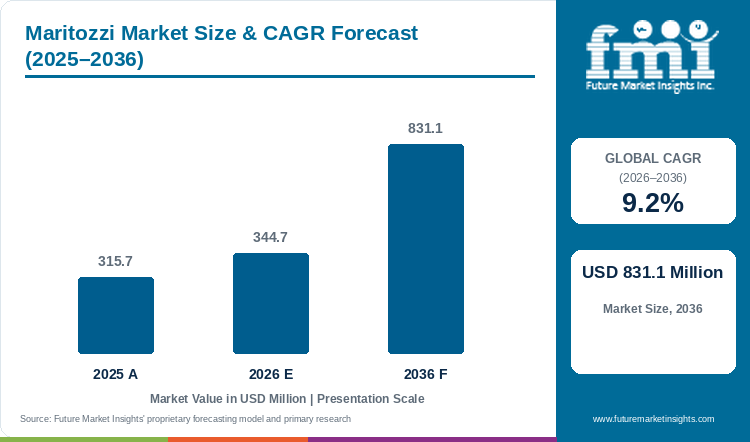
Accounting for USD 315.7 million in 2025 and rising to USD 344.7 million in 2026, the maritozzi market is projected to expand to USD 831.1 million by 2036, advancing at a CAGR of 9.2%.
Strong café and supermarket demand for cream-filled pastries from Italy is turning maritozzi from a regional Rome breakfast specialty into an international bakery category. The global maritozzi industry valuation stood at USD 315.7 million in 2025 and is estimated to reach USD 344.7 million in 2026, before advancing to USD 831.1 million by 2036 at a 9.2% CAGR. Hotel cafés and grocery chains are adopting prefilled blast-frozen buns that thaw in three hours under refrigeration, while Classic / Original is estimated to capture a 40.0% share of the product type segment in 2026 due to strong shopper preference for traditional whipped cream inside a soft brioche roll. Out-of-home coffee and breakfast habits remain a major growth foundation, supported by a January 2026 Federazione Italiana Pubblici Esercizi (FIPE) report showing that 152,000 coffee bars in Italy recorded nearly 6,000 million visits in 2025 with breakfast generating 44% of traffic [1]. Specialist pastry brands are also broadening consumer familiarity through dedicated retail shops and seasonal flavors, such as Iginio Massari operating his Maritz maritozzo store in Milan and releasing raspberry-and-lemon editions in February 2026. At the same time, continuous refrigeration requirements and cream separation after thawing remain significant operational hurdles, keeping category growth slightly below ambient enriched brioche loaves and rolls expanding at an 11.6% CAGR.
Key Market Trends & Insights
- By product type: Classic / Original is projected to account for a 40.0% share in 2026 because whipped white cream inside an enriched Rome bun is the standard item for first-time buyers.
- By claim / nature: Conventional is predicted to record a 51.0% share in 2026 owing to egg-and-butter brioche softness and dairy whipping-cream stability.
- By format: Frozen is forecast to register a 30.0% share in 2026 driven by blast-frozen prefilled buns that separate factory piping from store-level thawing.
- By packaging format: Multipack is estimated to hold a 31.0% share in 2026 supported by two-piece and four-piece retail boxes and 16-count foodservice trays.
- By sales channel: Supermarkets & Hypermarkets are expected to hold a 27.0% share in 2026 supported by frozen-dessert cabinet space and chilled in-store patisserie counters.
Regional Highlights
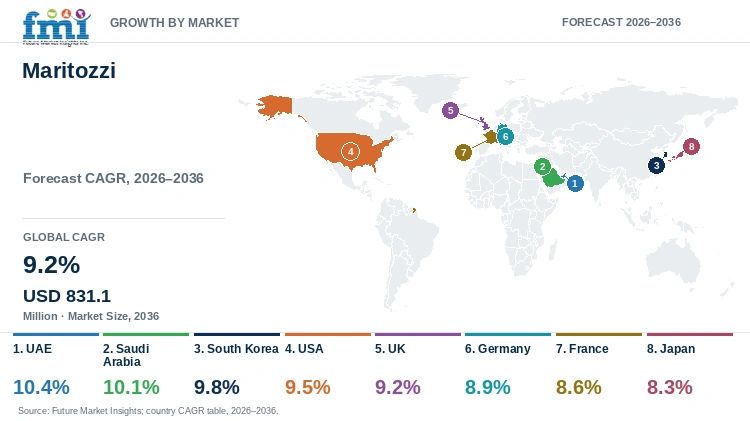
- Top national expansion: The UAE is projected to lead major national markets at a 10.4% CAGR through 2036 driven by Italy-inspired hotel patisserie menus and luxury mall cafés.
- Broader country progression: Saudi Arabia is expected to expand at a 10.1% CAGR ahead of South Korea at 9.8% and the USA at 9.5%, while Japan is forecast to register an 8.3% CAGR.
Market Size & Forecast
Table 1: Market Size and Forecast for the Maritozzi Market (USD million and CAGR percentage), 2025 to 2036
| Metric | Value |
|---|---|
| 2025 Market Size | USD 315.7 million |
| Estimated Market Size in 2026 | USD 344.7 million |
| Projected Market Size by 2036 | USD 831.1 million |
| CAGR, 2026 to 2036 | 9.2% |
| Added Revenue, 2026 to 2036 | USD 486.4 million |
Specialty coffee chains and supermarket frozen-food buyers face practical handling challenges when shipping and thawing whipped-cream-filled brioche buns. If ice crystals damage dairy fat during freezing or if thawed buns sit above 4 degrees Celsius, liquid separates from the cream and makes the bottom brioche crust soggy. Food-science advances are helping commercial bakers solve this stability problem, as shown by a January 2026 Food Chemistry study indexed on PubMed reporting that specialized sucrose-ester emulsifiers improve fat stability in pre-whipped creams and raise whipping volume from 70.76% to 96.63% [2]. Commercial patisserie suppliers are pairing stabilized dairy and whipped topping concentrate blends with blast-frozen brioche buns so cafés can thaw exact daily quantities without cream weeping.
Patisserie-Counter and Frozen-Portion Volume Sizing
Table 2: Patisserie-Counter and Frozen-Portion Volume Sizing for the Maritozzi Market (USD million and operational ranges), 2025 to 2036
| Metric | 2025 | 2026 | 2036 |
|---|---|---|---|
| Market size (USD million) | 315.7 | 344.7 | 831.1 |
| Commercial maritozzi volume (million buns) | 142.0 to 162.0 | 155.0 to 176.0 | 355.0 to 405.0 |
| Frozen & chilled multipack boxes (million) | 26.0 to 30.0 | 28.5 to 33.0 | 68.0 to 78.0 |
| Average wholesale price per filled bun (USD) | 1.9 to 2.2 | 2.0 to 2.3 | 2.1 to 2.4 |
Operational note: Bun-volume and multipack ranges reconcile 60-gram single-portion frozen retail boxes and four-piece Japan frozen sets as well as 16-piece foodservice thaw-and-serve cases.
Supermarket and restaurant sales of maritozzi outside Rome coffee bars require protecting the clean look of a golden dome bun filled with smooth white cream. Producers expanding frozen export lines model their cold-chain trays on ready-to-eat tiramisu packs so the box lid never smears the cream surface.
Per Capita & Patisserie/Retail Outlet Sizing
Table 3: Per Capita and Outlet Spending Indicators for the Maritozzi Market (USD), 2025 to 2036
| Metric | 2025 | 2026 | 2036 |
|---|---|---|---|
| World population (million) | 8,200.0 | 8,300.0 | 9,000.0 |
| Spend per 1,000 people (USD) | 38.5 | 41.5 | 92.3 |
| Annual spend per stocking outlet (USD) | 3,400.0 to 3,950.0 | 3,650.0 to 4,250.0 | 7,200.0 to 8,300.0 |
| Frozen & chilled prefilled share (%) | 54.0% to 58.0% | 56.0% to 60.0% | 65.0% to 69.0% |
Table 4: Outlet & Channel Spending Indicators for the Maritozzi Market (USD and percentages), 2026
| Metric | Value | Institutional Reference Basis |
|---|---|---|
| Market size, 2026 | USD 344.7 million | 2026 global revenue baseline |
| Stocking grocery, cafe & hotel outlets | 88,000 outlets | Supermarket frozen cabinets and hotel patisseries |
| Market spend per stocking outlet | USD 3,917.0 | Annualized wholesale maritozzi procurement |
| Supermarkets & hypermarkets revenue, 2026 | USD 93.1 million | 27.0% sales channel segment allocation |
Retail growth outside specialty pastry districts depends on single-serve and four-piece freezer boxes that defrost cleanly inside home refrigerators. Bakers preventing cream collapse during freeze-thaw shipping blend dairy cream with imitation whipped cream stabilizers so the filling holds a smooth edge after three hours of thawing.
Analyst Perspective
"Maritozzi become a steady supermarket and coffee-chain product only when suppliers keep the brioche roll soft and the whipped-cream filling firm after frozen transport and refrigerator thawing. Producers that supply prefilled thaw-and-serve cases with clear three-hour defrost rules and complete dairy-wheat-egg allergen labels will win multi-site hotel and grocery contracts."
- Nandini Roy Choudhury, Principal Consultant, Future Market Insights.
How is the maritozzi market segmented?
The maritozzi market is segmented by product type, claim / nature, format, packaging format, and sales channel. In 2026, Classic / Original is projected at 40.0%, Conventional at 51.0%, Frozen at 30.0%, Multipack at 31.0%, and Supermarkets & Hypermarkets at 27.0%.
By product type: Classic / Original, Whole Grain & Seeded, Flavored & Filled, Mini & Snacking Formats, and Premium / Artisan.
By claim / nature: Conventional, Clean Label, Organic, Gluten-Free, and High-Protein / Fortified.
By format: Frozen, Fresh, Ambient Packaged, Chilled, and Par-Baked / Thaw-and-Serve.
By packaging format: Multipack, Single-Serve, Family / Loaf Pack, and Bulk Foodservice.
By sales channel: Supermarkets & Hypermarkets, Artisan & Specialty Bakeries, Convenience & Forecourt, Online & DTC, and Foodservice Distributors.
Why does Classic / Original lead the product type category?
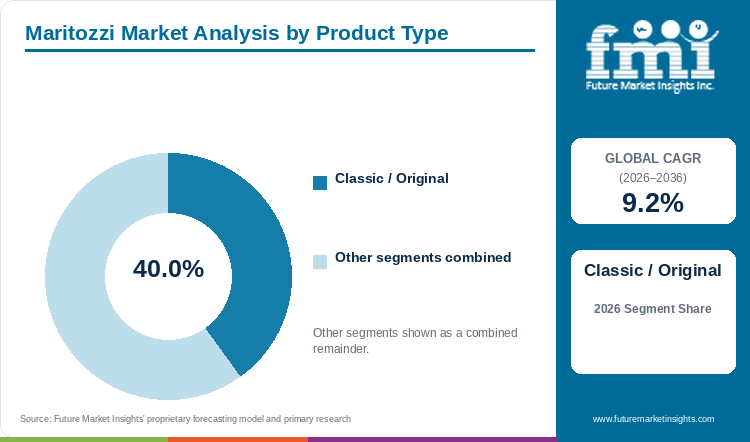
Classic / Original is projected to account for a 40.0% share of the product type segment in 2026, supported by authentic Rome whipped-cream identity and baseline café orders.
Table 5: Product Type Share for the Maritozzi Market (percentage share), 2026
| Product Type | Share (2026) |
|---|---|
| Classic / Original | 40.0% |
| Other Segments Combined* | 60.0% |
| Total | 100.0% |
*Calculated as the balance remaining after deducting the leading segment's reported share from 100.0%.
Table 6: Product Type Leadership and Market Growth for the Maritozzi Market (segment and CAGR percentage), 2026 to 2036
| Metric | Value |
|---|---|
| Global CAGR (2026 to 2036) | 9.2% |
| Leading Segment | Classic / Original |
A split golden brioche bun generously filled with lightly sweetened whipped cream creates the unmistakable look that sets a maritozzo apart from standard cream puffs or doughnuts. Specialty cafés build repeat customer habits with the classic vanilla-cream recipe before rotating seasonal pistachio or lotus seed and red bean paste fillings.
- Classic / Original is projected to account for a 40.0% share in 2026 because the traditional Rome cream bun anchors both first-time retail trial and hotel breakfast menus.
- Even when leading pastry chefs introduce holiday specials, they build on the classic split-bun shape, as seen in February 2026 when Iginio Massari released a limited-edition San Valentino Maritozzo layered with melampo jam and raspberry mousse with candied lemon [3].
Why does Conventional define the largest claim / nature segment?
Conventional is predicted to record a 51.0% share of the claim / nature segment in 2026, driven by egg-enriched brioche softness and dairy cream whipping stability.
Soft brioche texture at 4 degrees Celsius requires strong wheat flour and whole eggs with butter and 35%-fat dairy whipping cream. While urban bakeries test plant-based options with eggless cakes and dairy-free pastries, conventional wheat-and-dairy recipes remain the cost and taste benchmark across commercial lines.
- Conventional is predicted to record a 51.0% share in 2026 owing to firmer foam stability in dairy cream and lower ingredient costs.
- Foodservice operators stocking conventional dairy-cream buns follow strict 4-degree-Celsius chilled cabinet rules to protect cream freshness during morning and afternoon counter service.
What keeps Frozen ahead by format?
Frozen is forecast to register a 30.0% share of the format segment in 2026, supported by blast-frozen prefilled buns that remove store-level piping work and daily waste.
Because freshly piped whipped cream softens within hours in warm pastry cases, blast-freezing prefilled buns at the bakery lets supermarkets and restaurants ship maritozzi across long distances. Kitchens store cartons next to frozen pastries and thaw only the exact count needed for morning or dessert service.
- Frozen is forecast to register a 30.0% share in 2026 resulting from long freezer shelf life and zero back-of-house piping labor.
- Portion-controlled thaw-and-serve pastries have become a major waste-reduction tool for operators, as Rich Products noted in October 2026 when detailing how smaller thaw-and-serve treats boost shopper trial while cutting store waste [4].
Why does Multipack lead the packaging format category?
Multipack is estimated to hold a 31.0% share of the packaging format segment in 2026, attributable to protective multi-cavity plastic trays and household sharing.
Molded plastic trays holding two or four frozen maritozzi stop the exposed whipped-cream top from touching the box lid during grocery shipping and home freezer storage. Multi-piece boxes also lower per-bun shipping costs for online bakery gifts and supermarket freezer doors.
- Multipack is estimated to hold a 31.0% share in 2026 supported by lower per-bun packaging cost and higher family checkout spend.
- Foodservice wholesalers also rely on 16-count compartmentalized freezer trays to supply hotel banquets and casual-dining restaurant chains.
What gives Supermarkets & Hypermarkets the leading position in sales channel?
Supermarkets & Hypermarkets are expected to hold a 27.0% share of the sales channel segment in 2026, reinforced by glass-door frozen-dessert aisles and chilled bakery counters.
Large grocery chains stock boxed frozen maritozzi next to gelato and frozen éclairs while using chilled in-store bakery cases for ready-to-eat two-packs. Supermarket cold-chain delivery reaches suburban shoppers who rarely visit city-center Italian pastry shops.
- Supermarkets & Hypermarkets are expected to hold a 27.0% share in 2026 driven by high freezer-aisle visibility and regular weekly grocery shopping.
- European and UK supermarkets also partner with commercial cake manufacturers to run seasonal patisserie promotions in chilled bakery aisles.
What are the drivers, restraints, and opportunities in the maritozzi market?
In the maritozzi market, visual café counter appeal and blast-frozen thaw-and-serve formats drive adoption, whereas cream separation and cold-chain allergen rules restrain scale, and summer gelato-filled extensions open all-day dining occasions.
- Driver: Strong visual counter appeal and chef flavor partnerships turn traditional Rome cream buns into high-margin café and retail bakery items.
- Restraint: Whipped-cream separation after thawing, strict 4-degree-Celsius display rules, and multi-allergen labeling rules raise unit handling costs.
- Opportunity: Prefilled 16-piece foodservice cases and chilled gelato-filled summer versions expand sales across hotels and frozen grocery aisles.
Growth Analysis and Future Potential: Qualitative Demand Catalysts
Coffee-shop chains and specialty grocers use eye-catching filled pastries to set their morning and afternoon counters apart from standard muffins and doughnuts. The wide white cream front of a maritozzo gives bakers a clean surface for pistachio and berry toppings that justify higher retail prices. Future Market Insights notes that patisserie suppliers often finish cream tops with edible glitter and luster dusts or chopped nuts for seasonal promotions. Monthly chef partnerships also keep café customers coming back, as seen when Hong Kong patisserie shop TOZZO ran its five-month Desserts with a Good Cause guest-chef maritozzo series from March to July 2025. Limited-time flavor calendars turn initial social-media interest into repeat café visits when paired with soft brioche dough.
Risk Assessment of the Maritozzi Market: Operational and Formulation Friction
Short post-thaw shelf life and strict food-safety temperature rules are the main hurdles stopping maritozzi from matching ambient cake distribution. Once a frozen maritozzo thaws in a refrigerator for three hours, it cannot be refrozen and must be sold within a short chilled window before the cream separates or picks up refrigerator odors. Artisan bakeries that ferment and pipe fresh dough by hand face similar waste risks, which is why Berlin bakery TiramiGiù restricts its handmade maritozzi baking to once-weekly Thursday batches [5]. Bakers adding cocoa or nut-paste fillings paired with chocolate couverture glazes must also manage European Regulation (EU) No 1169/2011 and UK PPDS allergen labeling costs. Smaller coffee shops therefore avoid daily fresh assembly unless prefilled frozen buns let staff thaw a few pieces at a time.
Commercial Opportunity Analysis: Formulation Differentiation and Value-Add Formats
Hotel catering kitchens and supermarket freezer aisles need ready-to-serve prefilled buns that require no pastry-bag piping on site. Producers that blast-freeze 60-gram retail buns and 16-piece foodservice trays let staff move exact daily quantities into a walk-in cooler three hours before service. Warm or chilled brioche buns paired with gelato and fruit creams also extend the pastry from a morning cappuccino pairing into an evening restaurant dessert. Frozen-dessert groups in North America and Europe are actively acquiring specialty bakeries to expand their in-store bakery and foodservice cold-chain reach. Suppliers that guarantee dry bottom crusts and protective plastic collars after thawing are well placed to win national supermarket and hotel contracts.
Maritozzi Market by Country (2026 to 2036)
As per FMI, the UAE is projected to lead maritozzi market expansion across major national markets at a 10.4% CAGR through 2036, whereas Japan is forecast to progress at an 8.3% CAGR. Sales growth across Gulf hospitality venues, East Asia coffee-shop networks, and Europe or North America retail aisles depends on cold-chain distribution and simple thaw-and-serve handling.
Table 7: Country CAGR and Primary Growth Levers for the Maritozzi Market (CAGR percentage and operational drivers), 2026 to 2036
| Country | CAGR (2026 to 2036) | Primary Growth Lever |
|---|---|---|
| UAE | 10.4% | Italy-inspired luxury hospitality dessert menus and high-margin mall patisserie counters |
| Saudi Arabia | 10.1% | Riyadh quick-commerce bakery delivery apps and Arabic allergen-labeled imports |
| South Korea | 9.8% | KRW 3.7 trillion coffee-shop channel across 106,452 cafés adopting cream-bun pairings |
| USA | 9.5% | 16-piece foodservice thaw-and-serve frozen cases and coastal specialty bakery counters |
| UK | 9.2% | Plant-based and pistachio artisan patisserie variants and supermarket specialty cake trials |
| Germany | 8.9% | Urban slow-fermentation bakeries and frozen retail dessert cabinet expansion |
| France | 8.6% | National frozen-food retail chains merchandising 60-gram single-serve boxes |
| Japan | 8.3% | Frozen four-piece flavored multipacks and convenience-store chilled cream-bun replenishment |
Source: Future Market Insights analysis
UAE Maritozzi Market Outlook (2026 to 2036)
Unlike European markets where maritozzi are eaten mainly as morning bar pastries, the UAE positions the Rome cream bun as a plated restaurant dessert and luxury mall café specialty across Dubai and Abu Dhabi. Demand in the UAE is projected to expand at a 10.4% CAGR from 2026 to 2036. Hospitality group Antonia from Italy expanded its authentic Rome bakery and restaurant network to five UAE locations across Abu Dhabi and Mall of the Emirates in Dubai during 2025 [6]. High dining spend and busy air-conditioned mall cafés support premium prices for imported blast-frozen buns from Italy, though 40-degree-Celsius summer heat requires continuous refrigerated van delivery and chilled display cases.
Key takeaway: In the UAE, fine-dining dessert menus and luxury mall café counters are projected to drive the fastest national growth rate through 2036.
Saudi Arabia Maritozzi Market Outlook (2026 to 2036)
Whereas Western European shoppers buy maritozzi at neighborhood walk-in patisseries, Saudi Arabia expands adoption through rapid-delivery grocery apps and specialty coffee lounges across Riyadh and Jeddah. Sales in Saudi Arabia are expected to advance at a 10.1% CAGR between 2026 and 2036. Quick-commerce delivery apps such as Ninja deliver chilled cream-filled maritozzi from Riyadh artisan bakeries like Baba Khabbaz directly to households and evening gatherings within 30 minutes. At the same time, commercial importers bringing frozen foodservice cases from Italy must meet Food and Drug Authority rules in Saudi Arabia requiring full Arabic ingredient labels and verified Halal dairy certificates before national port customs clearance.
Key takeaway: In Saudi Arabia, quick-commerce bakery delivery apps and Arabic labeling compliance are expected to govern specialty café and retail expansion.
South Korea Maritozzi Market Outlook (2026 to 2036)
South Korea has one of the world's densest specialty coffee-shop markets, turning visually appealing cream buns into popular espresso pairings across Seoul and Busan. Industry data released by South Korea's Ministry of Agriculture, Food and Rural Affairs (MAFRA) in August 2026 showed that the domestic coffee market exceeded KRW 3.7 trillion across 106,452 coffee shops, representing 13.4% of all foodservice outlets [7]. Because independent and franchise cafés rotate seasonal matcha and strawberry cream buns to attract younger urban shoppers, prefilled frozen maritozzi gain fast café distribution while national dairy-allergen rules require strict import label checks. The market in South Korea is forecast to record a 9.8% CAGR through 2036.
Key takeaway: In South Korea, an expansive 106,452-outlet coffee-shop network and seasonal cream-flavor rotations are forecast to propel café and retail adoption.
USA Maritozzi Market Outlook (2026 to 2036)
Demand in the USA splits between artisan Rome-style pastry counters in coastal cities like New York and Chicago and ready-to-thaw frozen foodservice cases shipped to hotels and casual-dining restaurants nationwide. The market in the USA is anticipated to progress at a 9.5% CAGR over the 2026 to 2036 forecast period. Foodservice importers such as Donna Italia supply 16-piece prefilled blast-frozen maritozzi cartons that allow hotel banquet kitchens and Italian restaurant chains to thaw exact daily servings in three hours without hiring pastry chefs. However, state retail food codes aligned with U.S. Food and Drug Administration temperature rules require strict 41-degree-Fahrenheit chilled holding logs for dairy-filled pastries.
Key takeaway: In the USA, prefilled 16-piece foodservice frozen cases and coastal specialty café menus are anticipated to drive commercial distribution growth.
UK Maritozzi Market Outlook (2026 to 2036)
What sets the UK market apart is early recipe diversification, where London specialty bakeries sell vegan and dairy-free pistachio-cream maritozzi beside classic dairy-cream buns. Independent Rome-style bakeries and high-street café chains in London and Manchester use generously piped pistachio and berry maritozzi as afternoon coffee-break treats that lift average café check sizes. Because national Prepacked for Direct Sale (PPDS) allergen laws add label-printing work for small coffee shops that box fresh cream buns on site, wider supermarket bakery growth favors factory-packed chilled two-packs with pre-printed wheat and dairy allergen warnings. The market in the UK is predicted to register a 9.2% CAGR from 2026 to 2036.
Key takeaway: In the UK, plant-based and pistachio recipe varieties paired with factory-labeled chilled retail packs are predicted to support steady specialty and grocery growth.
Germany Maritozzi Market Outlook (2026 to 2036)
Germany pairs a long-standing household fondness for cream-filled yeast cakes like Bienenstich with rising city demand for authentic Rome-style pasticceria across Berlin and Munich. Revenue in Germany is projected to grow at an 8.9% CAGR between 2026 and 2036. Because urban artisan bakeries such as Berlin's TiramiGiù can only bake small weekly batches due to slow sourdough fermentation and manual cream piping, national supermarket and hypermarket frozen-dessert aisles offer the main route for scaling imported prefilled maritozzi from Italy. Frozen retail cartons sold in domestic grocery stores across Germany must carry clear local-language dairy and gluten allergen declarations under European Union retail food information rules.
Key takeaway: In Germany, shopper familiarity with cream-filled yeast pastries and frozen retail cabinet expansion are projected to overcome small artisan batch limits.
France Maritozzi Market Outlook (2026 to 2036)
France provides a clear model for supermarket maritozzi sales because national frozen-food retail chains sell single-serve Rome-style cream buns directly to city and suburban households. The market in France is estimated to expand at an 8.6% CAGR from 2026 to 2036. Specialty frozen retailer Picard stocks an authentic 60-gram Rome whipped-cream maritozzo filled with 38.5% sweetened cream in its Roma Amor range that thaws in three hours inside a home refrigerator [8]. While dedicated frozen-food stores give patisserie suppliers from Italy direct household freezer access across France, strong shelf competition from domestic choux buns and brioche tropezienne requires disciplined price-per-gram retail cabinet positioning across urban grocery stores.
Key takeaway: In France, dedicated frozen-food retail chains and European premium dessert manufacturers are estimated to anchor household and foodservice sales.
Japan Maritozzi Market Outlook (2026 to 2036)
Following its nationwide convenience-store maritozzi wave in 2021, Japan has settled into a steady repeat-buying market built around frozen four-piece gift boxes and local fruit or sweet bean-cream flavors. Regional commercial bakeries such as Kobe Belle sell frozen four-piece maritozzi sets filled with orange-peel cream and Hokkaido azuki sweet-bean whipped cream for online home delivery and retail freezers. Because major convenience-store chains in Japan rotate chilled dessert items every few weeks, sustained volume through 2036 relies on frozen multipack home delivery and hotel dessert buffets instead of short-lived single-serve convenience promotions. The market in Japan is therefore slated to advance at an 8.3% CAGR through 2036.
Key takeaway: In Japan, frozen four-piece flavored multipacks and local citrus and azuki-cream recipes are slated to sustain repeat household and hotel demand.
Full report country CAGRs cover: North America; Latin America; Western Europe; Eastern Europe; East Asia; South Asia and Pacific; Middle East and Africa.
Who are the notable companies in the maritozzi market?
Rich Products, Sara Lee Frozen Bakery, Dessert Holdings, Mademoiselle Desserts (Emmi Desserts), Finsbury Food Group, Premier Foods, McKee Foods, Hostess Brands (The J.M. Smucker Co.), Bauli Group, and Dr. Oetker are the notable companies in the maritozzi market.
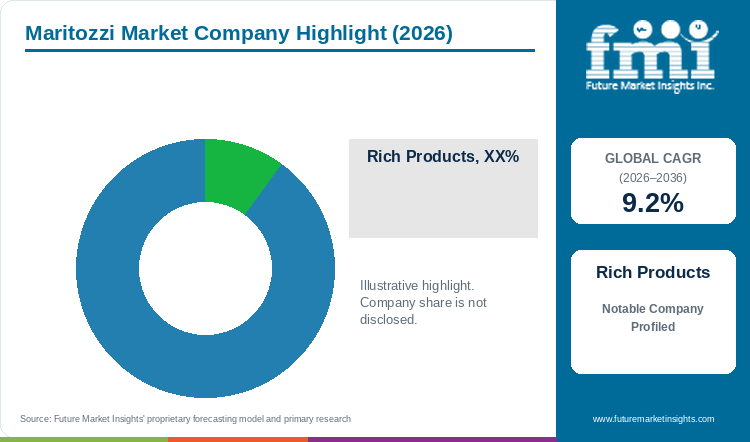
Supply-side participation across the maritozzi market covers specialized frozen-dessert producers and packaged sweet-bakery groups. Rich Products and Sara Lee Frozen Bakery as well as Dessert Holdings and Mademoiselle Desserts with Finsbury Food Group run blast-frozen patisserie and whipping-cream plants that serve foodservice and in-store bakery counters. Premier Foods and McKee Foods along with Hostess Brands and Bauli Group manage national packaged sweet-bakery distribution networks, while Dr. Oetker supplies dessert preparation and pastry-cream stabilizers.
- Frozen Foodservice & Premium-Dessert Manufacturers: Rich Products and Sara Lee Frozen Bakery as well as Dessert Holdings and Mademoiselle Desserts with Finsbury Food Group supply thaw-and-serve pastries and finishing creams.
- Packaged Sweet-Bakery & Snack Distribution Platforms: Premier Foods and McKee Foods along with Hostess Brands and Bauli Group operate national grocery cake and sweet-bakery routes.
- Baking & Dessert Preparation Systems: Dr. Oetker formulates professional and household pastry creams and classic cake mixes.
Competitive Benchmarking: Maritozzi Market
Table 8: Competitive Benchmarking for the Maritozzi Market (qualitative capability ratings), 2026
| Company | Frozen Pastry Route | Packaged Sweet-Bakery Fit | Filling / Decoration Adjacency | Geographic Reach |
|---|---|---|---|---|
| Rich Products | High | Medium | High | Global foodservice and in-store bakery channels across 100+ countries |
| Sara Lee Frozen Bakery | High | Medium | Medium | United States and Canada foodservice and retail in-store bakeries |
| Dessert Holdings | High | Medium | High | North America retail in-store bakery and foodservice dessert networks |
| Mademoiselle Desserts | High | Medium | High | France and UK with Europe foodservice/retail under Emmi Desserts |
| Finsbury Food Group | Medium | High | Medium | UK and Europe supermarket bakery and DTC snacking channels |
| Premier Foods | Unscored | High | Medium | UK grocery leader with expanding international Mr Kipling cake reach |
| McKee Foods | Unscored | High | Medium | United States supermarket and convenience multipack snack-cake distribution |
| Hostess Brands | Unscored | High | Medium | North America sweet baked goods network under The J.M. Smucker Co. |
| Bauli Group | Medium | High | High | Italy and international sweet-bakery and patisserie markets |
| Dr. Oetker | Unscored | Medium | High | Germany and Europe with international baking and dessert-cream markets |
Scoring basis: Frozen Pastry Route evaluates documented blast-frozen and thaw-and-serve patisserie manufacturing. Packaged Sweet-Bakery Fit and Filling / Decoration Adjacency assess retail multipack execution and stabilized whipping-cream or pastry-filling systems.
Key Developments in the Maritozzi Market
- Rich Products introduced natural-color Bettercreme and Buttrcreme whipping and finishing creams with thaw-and-serve bakery formats at IDDBA in June 2026 [9].
- Finsbury Food Group acquired UK portioned meringue and sweet-snack brand Flower & White in April 2026 to broaden its retail and direct-to-consumer dessert range [10].
- Bauli Group partnered with chef Bruno Barbieri in October 2025 to expand its Motta premium sweet-bakery and patisserie line in Italy.
Key Players in the Maritozzi Market
Frozen Foodservice and Premium-Dessert Manufacturing
- Rich Products
- Sara Lee Frozen Bakery
- Dessert Holdings
- Mademoiselle Desserts
- Finsbury Food Group
Packaged Sweet-Bakery and Snack Distribution
- Premier Foods
- McKee Foods
- Hostess Brands
- Bauli Group
Baking and Dessert Preparation Systems
- Dr. Oetker
Maritozzi Market - Report Scope
Table 9: Report Scope for the Maritozzi Market (coverage fields and definitions), 2026 to 2036
| Coverage field | Report scope |
|---|---|
| Market breakdown | Product Type; Claim / Nature; Format; Packaging Format; Sales Channel |
| Quantitative Units | USD Million |
| Market Definition | Includes commercial revenue from identifiable Rome-style split enriched brioche buns filled with whipped cream, pastry cream, or gelato/flavored creams sold through retail, online, and foodservice channels. Category Scope Note: Excludes unfilled brioche buns, choux cream puffs, standard jam doughnuts, and downstream restaurant beverage bundle markups. |
| Regions Covered | North America; Latin America; Western Europe; Eastern Europe; East Asia; South Asia and Pacific; Middle East and Africa |
| Countries Covered | UAE, Saudi Arabia, South Korea, USA, UK, Germany, France, Japan, and additional countries in the full report |
| Key Companies Covered | Rich Products, Sara Lee Frozen Bakery, Dessert Holdings, Mademoiselle Desserts, Finsbury Food Group, Premier Foods, McKee Foods, Hostess Brands, Bauli Group, Dr. Oetker |
| Forecast Period | 2026 to 2036 |
| Approach | Primary and secondary research with top-down and bottom-up market triangulation. |
Maritozzi Market - Research Methodology
Table 10: Research Methodology for the Maritozzi Market (research methods and approach), 2026 edition
| Method | Approach |
|---|---|
| Primary Research | Structured interviews with supermarket frozen-dessert buyers, patisserie operators, hotel executive pastry chefs, and cold-chain bakery distributors to verify thaw-and-serve rules, cream stability, and case pricing. |
| Secondary Research | Review of PubMed dairy emulsion studies, US FDA Food Code Supplements, UK FSA PPDS and EU 1169/2011 allergen rules, South Korea MAFRA coffee-channel reports, and corporate filings. |
| Market Sizing and Forecasting | Top-down specialty patisserie and frozen sweet-bakery expenditure models reconciled against bottom-up retail box facings, 16-piece foodservice case volumes, and café counter sales from 2026 to 2036. |
| Country Forecasting Model | Country projections weight specialty coffee-shop density, hospitality footprint, frozen-dessert retail cabinet access, and local allergen labeling compliance across eight national markets. |
| Operational Benchmark Traceability | Bun-volume and stocking-outlet indicators in Tables 2, 3, and 4 trace to Picard 60-gram retail specifications, Donna Italia 16-count foodservice cases, FIPE bar statistics, and MAFRA café registries. |
| Data Triangulation and Validation | Demand estimates are cross-checked against commercial frozen-dessert distributor catalogs and patisserie store counts while excluding unfilled brioche burger buns and general bakery cream cakes. |
Maritozzi Market by Segments
Maritozzi Market segmented by Product Type:
- Classic / Original
- Whole Grain & Seeded
- Flavored & Filled
- Mini & Snacking Formats
- Premium / Artisan
Maritozzi Market segmented by Claim / Nature:
- Conventional
- Clean Label
- Organic
- Gluten-Free
- High-Protein / Fortified
Maritozzi Market segmented by Format:
- Frozen
- Fresh
- Ambient Packaged
- Chilled
- Par-Baked / Thaw-and-Serve
Maritozzi Market segmented by Packaging Format:
- Multipack
- Single-Serve
- Family / Loaf Pack
- Bulk Foodservice
Maritozzi Market segmented by Sales Channel:
- Supermarkets & Hypermarkets
- Artisan & Specialty Bakeries
- Convenience & Forecourt
- Online & DTC
- Foodservice Distributors
Maritozzi Market by Region
- North America
- United States
- Canada
- Latin America
- Brazil
- Mexico
- Argentina
- Chile
- Western Europe
- Germany
- France
- United Kingdom
- Italy
- Spain
- Benelux
- Nordics
- Eastern Europe
- Poland
- Czech Republic
- Romania
- Hungary
- East Asia
- China
- Japan
- South Korea
- South Asia and Pacific
- India
- ASEAN
- Australia and New Zealand
- Middle East and Africa
- GCC Countries
- South Africa
- Türkiye
- Israel
Research Sources and Bibliography
- [1] Comunicaffè International / FIPE. (2026, January 19). Fipe: Italian bars are valued nearly EUR 24,000 million with an average bill of EUR 4.20 across 6,000 million visits. Federazione Italiana Pubblici Esercizi Bar Report.
- [2] Food Chemistry / PubMed. (2026, January 1). Interfacial perspective: Modulation of fat crystallization behavior and stability of pre-whipped emulsions by sucrose esters with tailored HLB values. Food Chemistry, 498(Pt 1), 147101 (PMID 41259862).
- [3] Globe Styles / Iginio Massari Alta Pasticceria. (2026, February 6). Iginio Massari San Valentino 2026: cremino, crostata e maritozzo in limited edition. Iginio Massari Retail Collection.
- [4] Rich Products Corporation. (2026, October 6). Why Smaller Treats Are Having a Big Moment Across In-Store Bakery and Foodservice. Rich Products Corporation.
- [5] TiramiGiù Berlin. (2025, July 2). Our Maritozzi: a Love Story That Rises Slowly in Weekly Artisan Berlin Production. TiramiGiù Bakery Berlin.
- [6] Antonia Restaurants UAE. (2025, November 10). Antonia UAE Expansion to Five Venues Including Mall of the Emirates in Dubai and Abu Dhabi Hospitality Concepts. Antonia Restaurants Abu Dhabi & Dubai.
- [7] Korea JoongAng Daily / MAFRA. (2026, August 11). Korea's coffee market estimated at 3.7 trillion won across 106,452 cafes in MAFRA industry study. Ministry of Agriculture, Food and Rural Affairs Data.
- [8] Picard Surgelés. (2026, September 28). Les spécialités italiennes à déguster : collection Roma Amor et maritozzo à la crème fouettée. Picard Surgelés France.
- [9] Rich Products Corporation. (2026, June 3). From Natural Colors to Next-Gen Beverages, Rich Products Puts Bettercreme and Buttrcreme Innovation on Display at IDDBA 2026. Rich Products Corporation.
- [10] Finsbury Food Group. (2026, April 30). Finsbury Food Group Acquires Flower & White to Boost DTC and Portioned Sweet Snacking Growth. Finsbury Food Group Corporate Release.
This bibliography is provided for reader reference and is not exhaustive. The full report contains the complete reference list and detailed citations.
This Report Answers
- What is the valuation of the maritozzi market in 2026 and its projected size by 2036?
- How does blast-frozen prefilled thaw-and-serve technology support supermarket and café adoption?
- Why does Classic / Original capture 40.0% of the Product Type segment in 2026?
- Why does Conventional lead the Claim / Nature segment at 51.0%?
- How do growth rates compare across the UAE and Saudi Arabia as well as South Korea and France?
- Which companies supply frozen patisserie and whipping-cream systems versus packaged sweet baked goods?
- What defrosting, cream-stability, and allergen-labeling hurdles restrict fresh counter distribution?
- What specifications should retail and hospitality buyers test before approving a maritozzi supplier?
Frequently Asked Questions
How big is the maritozzi market in 2026, and what is forecast for 2036?
According to FMI, the global maritozzi market is estimated to reach USD 344.7 million in 2026 from USD 315.7 million in 2025. The market is projected to achieve USD 831.1 million by 2036 as supermarkets and hospitality chains adopt prefilled frozen and chilled cream buns.
What is the projected maritozzi market CAGR from 2026 to 2036?
Future Market Insights projects a 9.2% compound annual growth rate between 2026 and 2036, generating USD 486.4 million in incremental revenue across retail and foodservice routes.
Which product type segment leads the maritozzi market?
Classic / Original is projected to account for a 40.0% share of the product type segment in 2026 because whipped dairy cream inside an enriched Rome brioche bun establishes the category benchmark.
Which claim / nature segment accounts for the largest share?
Conventional is predicted to record a 51.0% share of the claim / nature segment in 2026 owing to reliable egg-and-butter brioche softness and dairy cream whipping stability.
Which evaluated countries have the fastest market growth?
The UAE leads at a 10.4% CAGR through 2036, followed by Saudi Arabia at 10.1% and South Korea at 9.8%, supported by luxury hospitality menus and high-density specialty coffee chains.
Who are the notable companies in the maritozzi market?
Rich Products and Sara Lee Frozen Bakery lead frozen supply with Dessert Holdings and Mademoiselle Desserts as well as Finsbury Food Group. Meanwhile, Premier Foods and McKee Foods with Hostess Brands and Bauli Group as well as Dr. Oetker anchor packaged bakery and dessert preparation routes.
Preview the report firsthand - request a free sample
Get SampleGet the brochure for pricing and purchase details.
Get PDFTable of Content
- Key Takeaways
- Market Size and CAGR
- Top Growth Driver
- Fastest Growing Segment
- Leading Region
- Key Companies
- Emerging Opportunities
- Executive Summary
- Global Market Outlook
- Demand-side Trends
- Supply-side Trends
- Technology Roadmap Analysis
- Analysis and Recommendations
- Analyst Perspective (What is happening? Why now? What should investors know?)
- Key Questions Answered
- How large is the market?
- What is the CAGR?
- What are key trends?
- Which region dominates?
- Who are the leaders?
- Market Overview
- Market Coverage / Taxonomy
- Market Definition / Scope / Limitations
- Research Methodology
- Chapter Orientation
- Analytical Lens and Working Hypotheses
- Market Structure, Signals, and Trend Drivers
- Benchmarking and Cross-market Comparability
- Market Sizing, Forecasting, and Opportunity Mapping
- Research Design and Evidence Framework
- Desk Research Programme (Secondary Evidence)
- Expert Input and Fieldwork (Primary Evidence)
- Tooling, Models, and Reference Databases
- Data Engineering and Model Build
- Quality Assurance and Audit Trail
- Market Background
- Market Dynamics (Drivers, Restraints, Opportunity, Trends)
- Scenario Forecast (Optimistic, Likely, Conservative)
- Impact Analysis
- AI Impact
- Sustainability Impact
- Regulatory Impact
- Technology Impact
- Consumer / Buyer Analysis
- Purchase Drivers
- Adoption Barriers
- Buyer Journey
- Opportunity Map Analysis
- Product Life Cycle Analysis
- Supply Chain Analysis
- Investment Feasibility Matrix
- Value Chain Analysis
- PESTLE and Porter's Analysis
- Regulatory Landscape
- Regional Parent Market Outlook
- Production and Consumption Statistics
- Import and Export Statistics
- Global Market Analysis and Forecast, 2021 to 2036
- Historical Market Size Value (USD Million) Analysis, 2021 to 2025
- Current and Future Market Size Value (USD Million) Projections, 2026 to 2036
- Y-o-Y Growth Trend Analysis
- Absolute $ Opportunity Analysis
- Global Market Pricing Analysis, 2021 to 2036
- Global Market Analysis and Forecast, By Product Type, 2021 to 2036
- Introduction / Key Findings
- Historical Market Size Value (USD Million) Analysis By Product Type, 2021 to 2025
- Current and Future Market Size Value (USD Million) Analysis and Forecast By Product Type, 2026 to 2036
- Classic / Original
- Whole Grain & Seeded
- Flavored & Filled
- Mini & Snacking Formats
- Premium / Artisan
- Y-o-Y Growth Trend Analysis By Product Type, 2021 to 2025
- Absolute $ Opportunity Analysis By Product Type, 2026 to 2036
- Global Market Analysis and Forecast, By Claim / Nature, 2021 to 2036
- Introduction / Key Findings
- Historical Market Size Value (USD Million) Analysis By Claim / Nature, 2021 to 2025
- Current and Future Market Size Value (USD Million) Analysis and Forecast By Claim / Nature, 2026 to 2036
- Conventional
- Clean Label
- Organic
- Gluten-Free
- High-Protein / Fortified
- Y-o-Y Growth Trend Analysis By Claim / Nature, 2021 to 2025
- Absolute $ Opportunity Analysis By Claim / Nature, 2026 to 2036
- Global Market Analysis and Forecast, By Format, 2021 to 2036
- Introduction / Key Findings
- Historical Market Size Value (USD Million) Analysis By Format, 2021 to 2025
- Current and Future Market Size Value (USD Million) Analysis and Forecast By Format, 2026 to 2036
- Frozen
- Fresh
- Ambient Packaged
- Chilled
- Par-Baked / Thaw-and-Serve
- Y-o-Y Growth Trend Analysis By Format, 2021 to 2025
- Absolute $ Opportunity Analysis By Format, 2026 to 2036
- Global Market Analysis and Forecast, By Packaging Format, 2021 to 2036
- Introduction / Key Findings
- Historical Market Size Value (USD Million) Analysis By Packaging Format, 2021 to 2025
- Current and Future Market Size Value (USD Million) Analysis and Forecast By Packaging Format, 2026 to 2036
- Multipack
- Single-Serve
- Family / Loaf Pack
- Bulk Foodservice
- Y-o-Y Growth Trend Analysis By Packaging Format, 2021 to 2025
- Absolute $ Opportunity Analysis By Packaging Format, 2026 to 2036
- Global Market Analysis and Forecast, By Sales Channel, 2021 to 2036
- Introduction / Key Findings
- Historical Market Size Value (USD Million) Analysis By Sales Channel, 2021 to 2025
- Current and Future Market Size Value (USD Million) Analysis and Forecast By Sales Channel, 2026 to 2036
- Supermarkets & Hypermarkets
- Artisan & Specialty Bakeries
- Convenience & Forecourt
- Online & DTC
- Foodservice Distributors
- Y-o-Y Growth Trend Analysis By Sales Channel, 2021 to 2025
- Absolute $ Opportunity Analysis By Sales Channel, 2026 to 2036
- Global Market Analysis and Forecast, By Region, 2021 to 2036
- Introduction
- Historical Market Size Value (USD Million) Analysis By Region, 2021 to 2025
- Current Market Size Value (USD Million) Analysis and Forecast By Region, 2026 to 2036
- North America
- Latin America
- Western Europe
- Eastern Europe
- East Asia
- South Asia and Pacific
- Middle East and Africa
- Market Attractiveness Analysis By Region
- North America Market Analysis and Forecast, By Country, 2021 to 2036
- Historical Market Size Value (USD Million) Trend Analysis By Market Taxonomy, 2021 to 2025
- Market Size Value (USD Million) Forecast By Market Taxonomy, 2026 to 2036
- By Country
- United States
- Canada
- By Product Type
- By Claim / Nature
- By Format
- By Packaging Format
- By Sales Channel
- By Country
- Market Attractiveness Analysis
- By Country
- By Product Type
- By Claim / Nature
- By Format
- By Packaging Format
- By Sales Channel
- Key Takeaways
- Latin America Market Analysis and Forecast, By Country
- Historical Market Size Value (USD Million) Trend Analysis By Market Taxonomy, 2021 to 2025
- Market Size Value (USD Million) Forecast By Market Taxonomy, 2026 to 2036
- By Country
- Brazil
- Mexico
- Argentina
- Chile
- By Product Type
- By Claim / Nature
- By Format
- By Packaging Format
- By Sales Channel
- By Country
- Market Attractiveness Analysis
- By Country
- By Product Type
- By Claim / Nature
- By Format
- By Packaging Format
- By Sales Channel
- Key Takeaways
- Western Europe Market Analysis and Forecast, By Country
- Historical Market Size Value (USD Million) Trend Analysis By Market Taxonomy, 2021 to 2025
- Market Size Value (USD Million) Forecast By Market Taxonomy, 2026 to 2036
- By Country
- Germany
- France
- United Kingdom
- Italy
- Spain
- Benelux
- Nordics
- By Product Type
- By Claim / Nature
- By Format
- By Packaging Format
- By Sales Channel
- By Country
- Market Attractiveness Analysis
- By Country
- By Product Type
- By Claim / Nature
- By Format
- By Packaging Format
- By Sales Channel
- Key Takeaways
- Eastern Europe Market Analysis and Forecast, By Country
- Historical Market Size Value (USD Million) Trend Analysis By Market Taxonomy, 2021 to 2025
- Market Size Value (USD Million) Forecast By Market Taxonomy, 2026 to 2036
- By Country
- Poland
- Czech Republic
- Romania
- Hungary
- By Product Type
- By Claim / Nature
- By Format
- By Packaging Format
- By Sales Channel
- By Country
- Market Attractiveness Analysis
- By Country
- By Product Type
- By Claim / Nature
- By Format
- By Packaging Format
- By Sales Channel
- Key Takeaways
- East Asia Market Analysis and Forecast, By Country
- Historical Market Size Value (USD Million) Trend Analysis By Market Taxonomy, 2021 to 2025
- Market Size Value (USD Million) Forecast By Market Taxonomy, 2026 to 2036
- By Country
- China
- Japan
- South Korea
- By Product Type
- By Claim / Nature
- By Format
- By Packaging Format
- By Sales Channel
- By Country
- Market Attractiveness Analysis
- By Country
- By Product Type
- By Claim / Nature
- By Format
- By Packaging Format
- By Sales Channel
- Key Takeaways
- South Asia and Pacific Market Analysis and Forecast, By Country
- Historical Market Size Value (USD Million) Trend Analysis By Market Taxonomy, 2021 to 2025
- Market Size Value (USD Million) Forecast By Market Taxonomy, 2026 to 2036
- By Country
- India
- ASEAN
- Australia and New Zealand
- By Product Type
- By Claim / Nature
- By Format
- By Packaging Format
- By Sales Channel
- By Country
- Market Attractiveness Analysis
- By Country
- By Product Type
- By Claim / Nature
- By Format
- By Packaging Format
- By Sales Channel
- Key Takeaways
- Middle East and Africa Market Analysis and Forecast, By Country
- Historical Market Size Value (USD Million) Trend Analysis By Market Taxonomy, 2021 to 2025
- Market Size Value (USD Million) Forecast By Market Taxonomy, 2026 to 2036
- By Country
- GCC Countries
- South Africa
- Türkiye
- Israel
- By Product Type
- By Claim / Nature
- By Format
- By Packaging Format
- By Sales Channel
- By Country
- Market Attractiveness Analysis
- By Country
- By Product Type
- By Claim / Nature
- By Format
- By Packaging Format
- By Sales Channel
- Key Takeaways
- Key Countries Market Analysis
- United States
- Pricing Analysis
- Market Share Analysis, 2025
- By Product Type
- By Claim / Nature
- By Format
- By Packaging Format
- By Sales Channel
- Canada
- Pricing Analysis
- Market Share Analysis, 2025
- By Product Type
- By Claim / Nature
- By Format
- By Packaging Format
- By Sales Channel
- Mexico
- Pricing Analysis
- Market Share Analysis, 2025
- By Product Type
- By Claim / Nature
- By Format
- By Packaging Format
- By Sales Channel
- Brazil
- Pricing Analysis
- Market Share Analysis, 2025
- By Product Type
- By Claim / Nature
- By Format
- By Packaging Format
- By Sales Channel
- Chile
- Pricing Analysis
- Market Share Analysis, 2025
- By Product Type
- By Claim / Nature
- By Format
- By Packaging Format
- By Sales Channel
- Germany
- Pricing Analysis
- Market Share Analysis, 2025
- By Product Type
- By Claim / Nature
- By Format
- By Packaging Format
- By Sales Channel
- United Kingdom
- Pricing Analysis
- Market Share Analysis, 2025
- By Product Type
- By Claim / Nature
- By Format
- By Packaging Format
- By Sales Channel
- Italy
- Pricing Analysis
- Market Share Analysis, 2025
- By Product Type
- By Claim / Nature
- By Format
- By Packaging Format
- By Sales Channel
- Spain
- Pricing Analysis
- Market Share Analysis, 2025
- By Product Type
- By Claim / Nature
- By Format
- By Packaging Format
- By Sales Channel
- France
- Pricing Analysis
- Market Share Analysis, 2025
- By Product Type
- By Claim / Nature
- By Format
- By Packaging Format
- By Sales Channel
- India
- Pricing Analysis
- Market Share Analysis, 2025
- By Product Type
- By Claim / Nature
- By Format
- By Packaging Format
- By Sales Channel
- ASEAN
- Pricing Analysis
- Market Share Analysis, 2025
- By Product Type
- By Claim / Nature
- By Format
- By Packaging Format
- By Sales Channel
- Australia and New Zealand
- Pricing Analysis
- Market Share Analysis, 2025
- By Product Type
- By Claim / Nature
- By Format
- By Packaging Format
- By Sales Channel
- China
- Pricing Analysis
- Market Share Analysis, 2025
- By Product Type
- By Claim / Nature
- By Format
- By Packaging Format
- By Sales Channel
- Japan
- Pricing Analysis
- Market Share Analysis, 2025
- By Product Type
- By Claim / Nature
- By Format
- By Packaging Format
- By Sales Channel
- South Korea
- Pricing Analysis
- Market Share Analysis, 2025
- By Product Type
- By Claim / Nature
- By Format
- By Packaging Format
- By Sales Channel
- Poland
- Pricing Analysis
- Market Share Analysis, 2025
- By Product Type
- By Claim / Nature
- By Format
- By Packaging Format
- By Sales Channel
- Hungary
- Pricing Analysis
- Market Share Analysis, 2025
- By Product Type
- By Claim / Nature
- By Format
- By Packaging Format
- By Sales Channel
- Türkiye
- Pricing Analysis
- Market Share Analysis, 2025
- By Product Type
- By Claim / Nature
- By Format
- By Packaging Format
- By Sales Channel
- South Africa
- Pricing Analysis
- Market Share Analysis, 2025
- By Product Type
- By Claim / Nature
- By Format
- By Packaging Format
- By Sales Channel
- UAE
- Pricing Analysis
- Market Share Analysis, 2025
- By Product Type
- By Claim / Nature
- By Format
- By Packaging Format
- By Sales Channel
- Saudi Arabia
- Pricing Analysis
- Market Share Analysis, 2025
- By Product Type
- By Claim / Nature
- By Format
- By Packaging Format
- By Sales Channel
- United States
- Market Structure Analysis
- Competition Dashboard
- Competition Benchmarking
- Market Share Analysis of Top Players
- By Regional
- By Product Type
- By Claim / Nature
- By Format
- By Packaging Format
- By Sales Channel
- Emerging Startups
- Innovation Benchmarking
- Competition Analysis
- Competition Deep Dive
- Rich Products
- Overview
- Product Portfolio
- Profitability by Market Segments
- Sales Footprint
- Strategy Overview
- Marketing Strategy
- Product Strategy
- Channel Strategy
- Sara Lee Frozen Bakery
- Dessert Holdings
- Mademoiselle Desserts
- Finsbury Food Group
- Premier Foods
- McKee Foods
- Hostess Brands
- Bauli Group
- Dr. Oetker
- Rich Products
- Case Studies
- Success Stories
- Recent Developments
- Competition Deep Dive
- Assumptions & Acronyms Used


