

- Market Size (2026)
- USD 310.7 Mn
- Forecast (2036)
- USD 890.2 Mn
- CAGR (2026 to 2036)
- 11.1%
How big is Lotus Seed & Red Bean Paste Market in 2026?
Demand for lotus seed and red bean paste is projected to expand at 11.1% CAGR between 2026 and 2036. Industry value grows from USD 279.7 million in 2025 to USD 310.7 million in 2026 and is projected to reach USD 890.2 million by 2036.
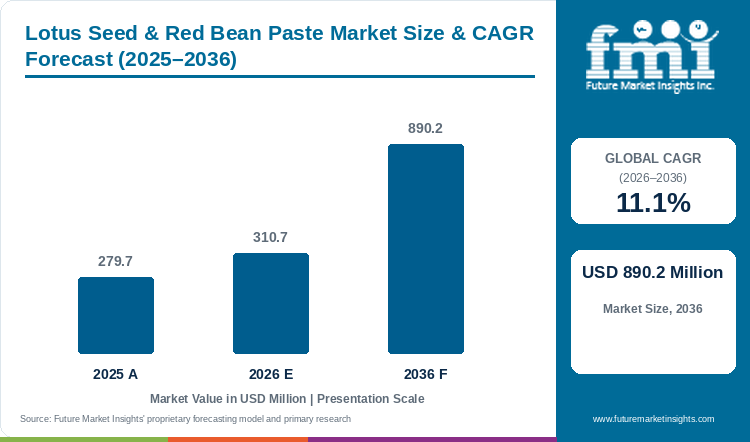
Lotus seed and red bean paste has gained wider application in breads, buns, pastry and other sweet bakery products. The global lotus seed and red bean paste market was valued at USD 279.7 million in 2025 and is projected to grow from USD 310.7 million in 2026 to USD 890.2 million by 2036, at 11.1% CAGR from 2026 to 2036. As per FMI, standard grade accounted for 41.0% of product type demand in 2026, owing to its wider use across commercial bakery formulations. In May 2026, CSM Ingredients introduced four Creami formats covering smooth, structured, crunchy and bake-stable fillings.[1] Standardized paste and dry bases are gaining importance to maintain consistent solids and processing behavior across production runs. Growing visitor activity and foodservice innovation are supporting different Asian-inspired filled products across hotels, bakeries and foodservice menus.
Key Market Trends & Insights
- By product type, standard grade accounted for 41.0% of demand in 2026, owing to broad application across bread, buns and pastry products.
- By form, powder / dry held the leading 45.0% share in 2026. Lower moisture and controlled hydration makes the format suitable for standardized bakery production.
- By application, bread and rolls represented 33.0% of demand in 2026, as enclosed dough supports measured filling and reduces leakage during baking.
- By claim, conventional formulations held 52.0% share in 2026 due to wider adjustment of sweeteners, solids and texturizers according to application.
- By sales channel, direct to industrial bakeries accounted for 56.0% in 2026, supported by joint technical qualification and repeatable line trials.
Regional Highlights
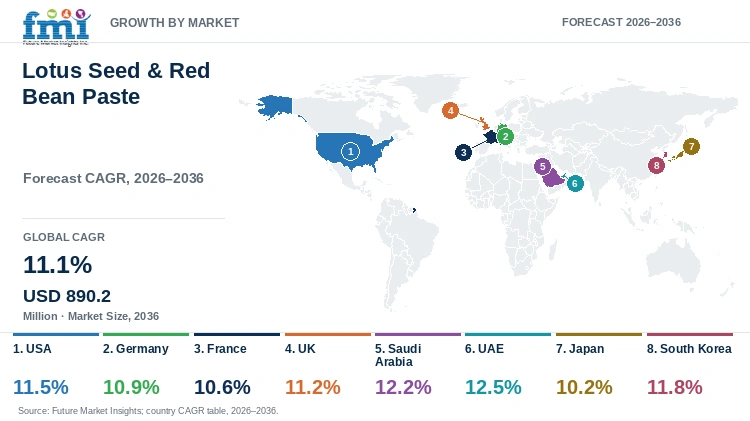
- Fastest-growing profiled country: UAE (12.5% CAGR, 2026 to 2036).
- By country: Saudi Arabia at 12.2% and South Korea at 11.8% follow, whereas Japan records the lowest profiled CAGR at 10.2%.
Market Size & Forecast
Table 1: Market Size and Forecast for the Lotus Seed & Red Bean Paste Market (USD million and growth multiple), 2025 to 2036
| Metric | Value |
|---|---|
| 2025 Market Size | USD 279.7 million |
| Estimated Market Size in 2026 | USD 310.7 million |
| Projected Market Size by 2036 | USD 890.2 million |
| CAGR, 2026 to 2036 | 11.1% |
| Added Revenue, 2026 to 2036 | USD 579.5 million |
| Market Expansion Multiple | 2.86 times |
Calculation basis: Added revenue is USD 579.5 million between 2026 and 2036. Market value in 2036 is 2.86 times the value recorded for 2026.
Processing-linked demand for lotus seed and red bean paste depends on bean availability, bakery manufacturing and familiarity with filled sweet products. South Korea produced 156 thousand tonnes of beans in 2025, increasing by 0.8% from 2024.[12] This raw material base supports local preparation of bean paste, whereas seasonal breads and rice cakes creates repeated product demand. UK output of food products, beverages and tobacco increased by 1.7% during the three months to May 2026.[10] Active food manufacturing provides more production lines where ready paste and dry bases can be tested. Germany recorded 3,176,665 foreign residents with Asian citizenship at the end of 2025.[8] The U.S. also recorded 26.8 million Asian alone-or-in-combination residents in 2024.[7] These figures does not measure paste sales directly; however, raw material availability, food production and familiar consumer groups are expected to support wider commercial use.
Processing and Demand Readiness Indicators
Table 2: Processing and Demand Readiness Indicators for the Lotus Seed & Red Bean Paste Market (tonnes, people, visitors, and percentage change), mixed reporting years from 2024 to 2026
| Indicator | Data Point | Why It Matters | Source |
|---|---|---|---|
| Japan azuki production | 45,100 tonnes in 2025; 46,700 tonnes in 2024 | Shows the raw-bean base available for paste processing and the need to control solids when crop output changes. | [3] |
| South Korea bean production | 156 thousand tonnes in 2025; up 0.8% | Supports local ingredient availability and repeated use in bakery and traditional sweet products. | [12] |
| Dubai overnight visitors | 19.59 million in 2025; up 5% | Creates foodservice occasions for rotating filled buns, pastry and dessert menus. | [2] |
| U.S. Asian population | 26.8 million in 2024 | Identifies a large consumer base with potential familiarity with bean-based sweets. | [7] |
| Germany residents with Asian citizenship | 3,176,665 at end-2025 | Supports demand trials beyond specialist channels when bakery formats are localized. | [8] |
| UK food manufacturing output | Up 1.7% in the three months to May 2026 | Indicates active production conditions for ready-to-dose bakery fillings. | [10] |
Basis: Production, visitor and population figures represents external demand conditions and are not direct measures of market revenue. Market values and CAGRs remain report estimates.
Analyst Perspective
“Dry bases will gain industrial demand as bakeries control hydration, sweetness and filling weight across different products. Ready paste will remain preferred where short preparation and stable post-bake texture decides repeat commercial purchase.”
- Nandini Roy Choudhury, Principal Consultant, Future Market Insights.
How is the lotus seed & red bean paste market segmented?
The lotus seed and red bean paste market is segmented by five primary commercial axes and region: product type, form, application, claim, sales channel, and region. Standard grade is projected at 41.0% of product type demand, powder / dry at 45.0% of form demand, and bread and rolls at 33.0% of application demand in 2026.
According to FMI, lotus seed and red bean paste market is segmented on the basis of product type, form, application, claim, sales channel and region. Product type includes standard, premium, organic certified and clean-label grades, whereas form includes powder / dry, liquid, paste / semi-solid and granules / pieces. On the basis of application, the market is divided into bread and rolls, cakes and muffins, biscuits and cookies, viennoiserie and pastry, and other bakery and snack products. Claim and sales channel further separates conventional and certified formulations and the way these products reaches industrial bakeries, distributors, foodservice users and online B2B buyers.
What makes standard grade central to the product type category?
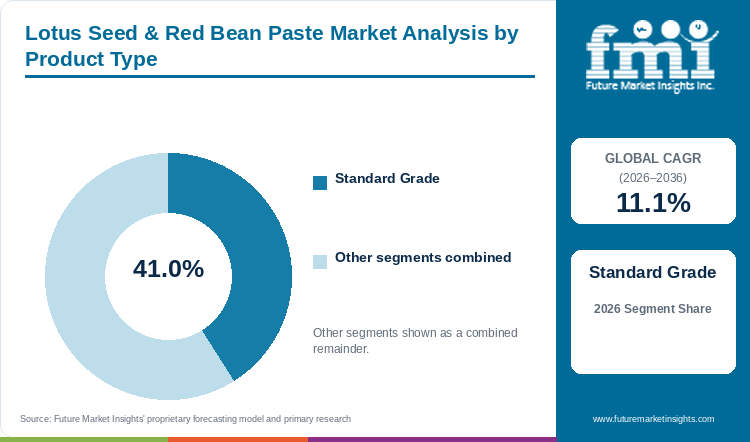
Standard grade is projected to account for 41.0% of product type revenue in 2026, supported by broad commercial recipe compatibility.
Table 3: Product Type Share for the Lotus Seed & Red Bean Paste Market (percentage share), 2026
| Product Type | Share (2026) |
|---|---|
| Standard Grade | 41.0% |
| Other Segments Combined | 59.0%* |
| Total | 100.0% |
*Calculated as the balance remaining after deducting the leading segment's reported share from 100.0%.
Table 4: Product Type Leadership and Market Growth for the Lotus Seed & Red Bean Paste Market (segment and CAGR percentage), 2026 to 2036
| Metric | Value |
|---|---|
| Global CAGR (2026 to 2036) | 11.1% |
| Leading Segment | Standard Grade |
In the FMI report, standard grade is widely used by industrial bakeries owing to broad recipe fit and comparatively lower formulation restriction. Standard lotus seed and red bean paste allows manufacturers to adjust sweetness, color, particle size and viscosity for bread, bun and pastry products. Availability of standard grade at suitable specification and price is expected to support repeat demand during the forecast period.
- Standard grade holds 41.0% share in 2026. Its position reflects broad fit with commercial recipes and lower specification complexity than certified alternatives.
- Industrial orders depend on repeatable viscosity, color, sweetness, and post-bake texture across production batches.
Why does powder / dry lead the Form category?
By form, powder / dry is estimated to capture 45.0% of demand in 2026, driven by storage efficiency and controllable reconstitution.
FMI research indicates powder / dry lotus seed and red bean paste is preferred where manufacturers requires controlled storage and measured hydration near the production line. The format carries lower water content and can be added according to required sweetness and viscosity. Variation in raw bean supply increases the importance of standardized dry solids for industrial processing.
- Powder / dry holds 45.0% share in 2026. Storage efficiency and controllable reconstitution support its use across standardized bakery processes.
- Dry solids support controlled storage and measured hydration when plants prepare fillings close to the production line.
How does bread and rolls anchor the Application category?
With an estimated 33.0% share in 2026, bread and rolls leads application demand, underpinned by enclosed dough portioning repeatability.
As noted by FMI, bread and rolls is projected to account for 33.0% of application demand in 2026 owing to established use of enclosed sweet fillings. The dough protects the filling and provides a clear depositing point before baking. In June 2026, Dawn Foods expanded its Delicream range with three ready-to-use fillings for doughnuts, croissants, cakes, pastries and layered desserts. [4] Availability of ready-to-use filling with smooth piping and stable structure is expected to support the application growth.
- Bread and rolls holds 33.0% share in 2026. Filled buns and related products combine familiar consumption occasions with scalable depositing processes.
- Enclosed dough protects the filling and gives high-throughput lines a clear portioning point before baking.
What supports Conventional in the Claim category?
Conventional formulations are anticipated to contribute 52.0% of claim revenue in 2026, owing to flexible ingredient adjustment without certification restrictions.
As per the analysis from FMI, conventional formulations are widely used as suppliers can balance bean or lotus solids with sweeteners and texturizers according to application requirement. This wider formulation window helps manufacturers manage viscosity, sweetness and bake behavior without additional certification cost. In January 2026, Puratos acquired Vör Foods, a U.S. producer of clean-label nut pastes and nut-based fillings. [5] However, conventional products will retain demand owing to flexible formulation and wider raw material availability.
- Conventional holds 52.0% share in 2026. It retains the broadest formulation latitude and avoids the incremental sourcing constraints attached to certified claims.
- Conventional recipes allow broader adjustment of sweeteners and texturizers before a buyer adds claim restrictions.
Why does direct to industrial bakeries lead the sales channel category?
Direct to industrial bakeries is set to command 56.0% of sales channel revenue in 2026, reinforced by joint line qualification.
FMI data suggests direct sales to industrial bakeries supports product trials, viscosity adjustment and repeat supply contracts. Industrial lines requires the filling to pass through pumps and depositors and retain texture after baking. In November 2025, CSM Ingredients opened a customer-focused product development centre in Cheshire with a test bakery and customer-experience facilities. [6] Such application centres brings suppliers and bakeries closer to actual production requirement.
- Direct to industrial bakeries holds 56.0% share in 2026. Technical qualification and repeat contract volumes make direct supplier-bakery coordination commercially important.
- Direct technical contact shortens line trials when viscosity or deposit weight needs adjustment during production.
What are the drivers, restraints, and opportunities in the lotus seed & red bean paste market?
Cross-cultural bakery adoption supports demand while crop and process variability raise qualification risk, and clean-label industrial formats create a route to higher-value growth.
- Driver: Industrial bakers are adding culturally familiar sweet flavors while seeking ready-to-dose inputs that reduce in-house preparation.
- Restraint: Natural raw-material variation and moisture-sensitive processing can lengthen qualification and raise waste risk.
- Opportunity: Clean-label and certified dry-format formulations can widen adoption when suppliers tune flavor and process performance for local bakeries.
Culturally Familiar Flavors Support Bakery Demand
Increasing use of culturally familiar sweet flavors in bread, rolls and pastry is driving demand for lotus seed and red bean paste. USDA Economic Research Service reported in June 2026 that food away from home represented 56.3% of total food spending in 2025, reaching $2.51 trillion.[16] Industrial bakeries are preferring ready paste and measured dry bases as it reduces cooking work and gives more consistent depositing. The filling must move through equipment and retain its texture during baking, due to which bake-stable formats are gaining importance. Ready paste supports shorter preparation, whereas dry material allows manufacturers to set hydration and sweetness. Wider application of these formats is expected to drive the lotus seed and red bean paste market growth.
Raw-Material Variation Lengthens Formulation Qualification
Natural variation in lotus seed and red bean raw material can change cooking time, color, solids and paste yield. In June 2026, Puratos opened a research center in Belgium to tackle ingredient variability and industrial bakery performance.[14] Such variation requires processors to adjust water and cooking conditions before the filling reaches bakery line. Higher testing requirement and inconsistent lots may increase waste and extend product approval time. Small suppliers may also face difficulty in maintaining similar texture across different harvest cycles. These factors may hamper the growth of lotus seed and red bean paste market during the forecast period.
Clean-Label Formats Create Higher-Value Growth Routes
Clean-label, organic and dry-format fillings are creating growth opportunities for manufacturers. In March 2026, AGRANA completed the Mercator-Emba acquisition and added syrups, dessert toppings and wider foodservice access to its Food and Beverage Solutions business. [13] Expansion of preparation and topping portfolios indicates growing demand for application-ready ingredients across bakery and foodservice. Suppliers that offers documented ingredients with suitable depositability, shelf behavior and post-bake texture can cater to premium product development. This is expected to create new avenues for lotus seed and red bean paste market.
Which country CAGRs are profiled in the lotus seed & red bean paste market?
Table 5: Country CAGR Comparison for the Lotus Seed & Red Bean Paste Market (CAGR percentage), 2026 to 2036
| Country | CAGR |
|---|---|
| USA | 11.5% |
| Germany | 10.9% |
| France | 10.6% |
| UK | 11.2% |
| Saudi Arabia | 12.2% |
| UAE | 12.5% |
| Japan | 10.2% |
| South Korea | 11.8% |
How do country-level CAGRs compare in the lotus seed & red bean paste market?
An FMI analyst notes that country outlooks differ owing to bakery familiarity, foodservice demand and industrial purchasing routes. The UAE and Saudi Arabia are witnessing higher expansion through hospitality and international menus, whereas Japan and France place more importance on sensory quality and established bakery standards. Full report country CAGRs cover: North America; Latin America; Western Europe; Eastern Europe; East Asia; South Asia and Pacific; Middle East and Africa.
Country-wise Analysis
- By 2036, the USA is projected to grow at 11.5% CAGR, supported by national bakery programs testing Asian-inspired fillings. The U.S. Census Bureau estimated 26.8 million Asian alone-or-in-combination residents in 2024, including 5.8 million people of Chinese descent and 2.2 million of Korean descent. [7] The figures do not measure ingredient sales, but they identify a broad consumer base familiar with bean-based sweets. National launches still require one sensory profile to hold across plants and distribution regions. Paste and dry formats can help by fixing solids, sweetness, and deposit weight. Adoption therefore depends on converting cultural recognition into a repeatable bakery specification.
- Germany lotus seed and red bean paste market is anticipated to expand at 10.9% CAGR through 2036 owing to established bakery production and a diverse consumer base. Germany recorded 3,176,665 foreign residents with Asian citizenship at the end of 2025. [8] Wider exposure to Asian flavor profiles is encouraging bakeries to test bean and lotus fillings in local formats. German manufacturers also requires stable ingredient, allergen, viscosity and baking specification. Availability of dry bases and ready paste is expected to support product adoption over the assessment period.
- Demand for lotus seed and red bean paste in France is forecast to rise at 10.6% CAGR over the forecast period. INSEE reported in June 2026 that immigrants represented 11.6% of France population in 2025. [9] Cross-cultural food demand along with strong pastry consumption is increasing scope for new sweet filling flavors. French pastry exposes color, smoothness and sweetness more clearly, due to which finer paste and controlled sugar level are preferred. Premium sensory properties with stable freezing and baking performance is likely to fuel the France market growth.
- The UK lotus seed and red bean paste market is expected to progress at 11.2% CAGR between 2026 and 2036, supported by manufactured bakery products and specialist distributor trials. The Office for National Statistics reported that output of food products, beverages and tobacco increased by 1.7% during the three months to May 2026. [10] Current food manufacturing activity provides scope for filled bakery products with new flavors. Bake-stable fillings can reduce leakage and rework during production. Increasing use of ready-to-dose filling formats is anticipated to support the UK market revenue growth.
- Sales of lotus seed and red bean paste in Saudi Arabia are forecast to expand at 12.2% CAGR through 2036 owing to hospitality and foodservice demand. The General Authority for Statistics published Tourism Establishments Statistics for the first quarter of 2026, providing a current national measure of accommodation activity. [11] Hotels and bakery foodservice users requires ingredients that can be stored through longer replenishment cycles. Dry bases reduce shipped water, while ready pastes shorten kitchen preparation. Suitable pack size and distributor inventory is expected to drive repeat demand in Saudi Arabia.
- Adoption of lotus seed and red bean paste in the UAE is estimated to expand at 12.5% CAGR through 2036, supported by international visitors and premium bakery menus. Dubai Department of Economy and Tourism reported 19.59 million international overnight visitors in 2025, up 5% from 2024.[2] Foodservice users frequently rotate buns, pastry and dessert products, which creates demand for fillings that are ready to use and easy to replace. Regional inventory reduces the risk of limited stock during menu trials. Formulations that works in premium pastry as well as higher-volume bakery lines provides distributors with wider application. These factors are anticipated to propel the UAE market growth.
- In Japan, demand for lotus seed and red bean paste is predicted to advance at 10.2% CAGR through 2036 owing to established familiarity with azuki fillings. In February 2026, Japan's Ministry of Agriculture, Forestry and Fisheries reported 2025 azuki production at 45,100 tonnes compared to 46,700 tonnes in 2024.[3] Japanese consumers and processors compare sweetness, color, particle size and mouthfeel closely. Premium differentiation therefore depends on retaining these properties through different harvest cycles while maintaining industrial line performance. Increasing demand for refined texture and stable sensory quality is expected to support the Japan market growth.
- South Korea lotus seed and red bean paste market is estimated to post 11.8% CAGR over the forecast period, reinforced by familiarity with bean-based sweet fillings and quick bakery rotation. Statistics Korea reported that national bean production increased by 0.8% to 156 thousand tonnes in 2025. [12] Standardized paste and dry formats can reduce preparation between outlets and maintain similar sweetness in seasonal products. Local distribution also supports shorter replenishment time. Repeat use based on texture, pack efficiency and reliable delivery is likely to fuel market growth.
Who are the notable companies in the lotus seed & red bean paste market?
Barry Callebaut, Puratos, Dawn Foods, Zeelandia, CSM Ingredients, Bakels, AGRANA, Zentis, Fabbri 1905, and Irca Group are the notable companies profiled in this market.
The competitive field is best understood through transferable filling capability rather than a claim that every profiled company sells the same lotus seed or red bean formulation. Barry Callebaut and Puratos bring large-scale bakery application networks. Dawn Foods and Zeelandia add filling systems plus direct support for industrial bakers. AGRANA and Zentis are strong in fruit or paste-style preparations that require similar control of solids and processing stability. Bakels contributes industrial bakery formulation support. CSM Ingredients, Fabbri 1905, and Irca Group have pastry-oriented filling platforms. Their creams and pastes can address premium or specialty briefs. The commercial advantage comes from adapting those capabilities to a culturally specific ingredient while maintaining line performance.
- Industrial formulation platforms: Barry Callebaut, Puratos, Dawn Foods, and Zeelandia compete on application support, process adaptation, and broad bakery customer access.
- Preparation and industrial process specialists: AGRANA, Zentis, and Bakels contribute preparation experience, solids control, and industrial formulation capability.
- Premium pastry specialists: CSM Ingredients, Fabbri 1905, and Irca Group compete through texture variety, ready-to-use formats, and claim-led pastry formulation breadth.
Competitive Benchmarking: Lotus Seed & Red Bean Paste Market
Table 6: Competitive Benchmarking for the Lotus Seed & Red Bean Paste Market (qualitative capability ratings), 2026
| Company | Filling breadth | Process adaptability | Formulation flexibility | Geographic reach |
|---|---|---|---|---|
| Barry Callebaut | High | High | High | High |
| Puratos | High | High | High | High |
| Dawn Foods | High | High | High | High |
| Zeelandia | High | High | High | Medium |
| CSM Ingredients | High | High | High | Medium |
| Bakels | Medium | High | Medium | High |
| AGRANA | Medium | High | Medium | High |
| Zentis | High | High | Medium | Medium |
| Fabbri 1905 | High | Medium | Medium | Medium |
| Irca Group | High | High | High | High |
Scoring basis: Bakery Filling Breadth measures documented coverage across multiple filling architectures. Relevant formats include pastes, creams, and fruit systems. Industrial Process Adaptability measures documented evidence of process fit. Relevant evidence includes bake or freeze stability plus line trials and industrial technical support. Claim / Formulation Flexibility measures documented ability to support specific formulation choices. These include clean-label or plant-based recipes plus reduced-sugar and organic options. High indicates broad documented capability. Medium indicates credible but narrower coverage. Low would indicate a documented limitation, while unavailable public information would be left unscored. Ratings describe transferable capabilities relevant to this market and are not rankings by revenue.
Key Developments in the Lotus Seed & Red Bean Paste Market
- In June 2026, Dawn Foods expanded its Delicream range with three ready-to-use fillings designed for doughnuts, croissants, cakes, pastries, and layered desserts.
- In May 2026, CSM Ingredients launched Creami with smooth, structured, crunchy, and bake-stable filling options for bakery and pastry users.
- In March 2026, AGRANA completed the Mercator-Emba acquisition, adding syrups, dessert toppings, and foodservice access to its Food and Beverage Solutions business.
- In January 2026, Puratos acquired Vör Foods, adding clean-label nut pastes and nut-based fillings plus a U.S. production site.
Key Players in the Lotus Seed & Red Bean Paste Market
Industrial Bakery Formulation and Co-development Platforms
- Barry Callebaut
- Puratos
- Dawn Foods
- Zeelandia
Preparation and Industrial Process Specialists
- AGRANA
- Zentis
- Bakels
Premium Pastry Filling and Texture Specialists
- CSM Ingredients
- Fabbri 1905
- Irca Group
Lotus Seed & Red Bean Paste Market - Report Scope
Table 7: Report Scope for the Lotus Seed & Red Bean Paste Market (coverage fields and definitions), 2026 to 2036
| Coverage field | Report scope |
|---|---|
| Market breakdown | Product Type, Form, Application, Claim, and Sales Channel |
| Quantitative Units | USD Million |
| Market Definition | Revenue from lotus seed and red bean paste ingredients sold within the stated segmentation universe for bakery and snack applications. Downstream finished-product revenue plus adjacent or substitute ingredient revenue are excluded. |
| Regions Covered | North America; Latin America; Western Europe; Eastern Europe; East Asia; South Asia and Pacific; Middle East and Africa |
| Countries Covered | USA, Germany, France, UK, Saudi Arabia, UAE, Japan, South Korea, and more than twenty-two additional countries in the full report |
| Key Companies Profiled | Barry Callebaut, Puratos, Dawn Foods, Zeelandia, CSM Ingredients, Bakels, AGRANA, Zentis, Fabbri 1905, Irca Group |
| Forecast Period | 2026 to 2036 |
| Approach | A hybrid bottom-up and top-down sizing approach that reconciles supplier revenue, channel participation, application consumption, and country demand within the defined revenue boundary. |
Lotus Seed & Red Bean Paste Market - Research Methodology
Table 8: Research Methodology for the Lotus Seed & Red Bean Paste Market (research methods and approach), 2026 edition
| Method | Approach |
|---|---|
| Primary Research | FMI analysts gathered input from manufacturers, service providers, technology developers, distributors, end users, procurement teams, and subject-matter experts. Interviews examined purchasing decisions, product or service evaluation, adoption barriers, approval requirements, pricing considerations, and expectations for technical or commercial support. Respondents were also asked what evidence is required before a trial, pilot, or initial order develops into regular purchasing. |
| Desk Research | Desk research covered government statistics, regulatory publications, trade data, industry associations, technical literature, standards, company filings, product information, and official corporate announcements. Sources were reviewed for relevance, publication date, geographic coverage, and consistency with the defined market scope. Claims relating to performance, applications, approvals, capacity, investment, and commercial activity were retained only when supported by credible public evidence. |
| Market Sizing and Forecasting | The market model combined the baseline value with historical performance, segment structure, pricing and volume indicators, adoption levels, company participation, and country-level demand conditions. Forecast assumptions considered economic activity, investment trends, regulatory developments, technology adoption, purchasing cycles, supply availability, and barriers to wider market use. Segment and regional estimates were reconciled before the final market total was calculated. |
| Data Validation | Estimates were checked against multiple independent indicators, including public data, company activity, trade patterns, industry developments, and findings from primary interviews. Validation also tested whether products, services, applications, and company revenues fell within the defined market boundaries. Adjacent categories, unsupported claims, overlapping revenues, and activities without direct market relevance were excluded to reduce double counting and maintain consistency across segments and countries. |
Lotus Seed & Red Bean Paste Market by Segments
Lotus Seed & Red Bean Paste Market segmented by Product Type:
- Standard Grade
- Premium / Specialty Grade
- Organic Certified
- Clean Label Grade
Lotus Seed & Red Bean Paste Market segmented by Form:
- Powder / Dry
- Liquid
- Paste / Semi-Solid
- Granules / Pieces
Lotus Seed & Red Bean Paste Market segmented by Application:
- Bread & Rolls
- Cakes & Muffins
- Biscuits & Cookies
- Viennoiserie & Pastry
- Other Bakery & Snacks
Lotus Seed & Red Bean Paste Market segmented by Claim:
- Conventional
- Clean Label
- Organic
- Non-GMO / Identity Preserved
Lotus Seed & Red Bean Paste Market segmented by Sales Channel:
- Direct to Industrial Bakeries
- Ingredient Distributors
- Foodservice & Artisan Supply
- Online B2B
Lotus Seed & Red Bean Paste Market by Region
- North America
- United States
- Canada
- Latin America
- Brazil
- Mexico
- Argentina
- Chile
- Western Europe
- Germany
- France
- United Kingdom
- Italy
- Spain
- Benelux
- Nordics
- Eastern Europe
- Poland
- Czech Republic
- Romania
- Hungary
- East Asia
- China
- Japan
- South Korea
- South Asia and Pacific
- India
- ASEAN
- Australia and New Zealand
- Middle East and Africa
- GCC Countries
- South Africa
- Türkiye
- Israel
Research Sources and Bibliography
- [1] CSM Ingredients. (2026, May 12). CSM Ingredients launches Creami, a comprehensive range of indulgent fillings for bakery, pastry and confectionery professionals.
- [2] Dubai Department of Economy and Tourism. (2026, February 9). Dubai welcomes 19.59 million visitors in third record year.
- [3] Ministry of Agriculture, Forestry and Fisheries, Japan. (2026, February 27). Azuki, kidney bean and peanut crop area, yield and harvest series.
- [4] Dawn Foods. (2026, June 2). Dawn Foods expands Delicream range with three new flavours.
- [5] Puratos. (2026, January 21). Puratos acquires Vör Foods, accelerating U.S. nut-based innovation.
- [6] CSM Ingredients. (2025, November 18). CSM Ingredients opens new customer-focused product development centre in the UK.
- [7] U.S. Census Bureau. (2026, April 21). Asian American and Pacific Islander Heritage Month: May 2026.
- [8] German Federal Statistical Office. (2026, April 2). Foreign population by place of birth and selected citizenships.
- [9] INSEE. (2026, June 4). Immigrant and foreign population in France: Annual data from 1921 to 2025.
- [10] Office for National Statistics. (2026, July 16). Index of Production, UK: May 2026.
- [11] General Authority for Statistics, Saudi Arabia. (2026). Tourism Establishments Statistics: Q1 2026.
- [12] Statistics Korea. (2025, December 24). Final results of cultivated area and production of beans in 2025.
- [13] AGRANA. (2026). Outlook 2026/27.
- [14] Puratos. (2026, June 15). Puratos opens new research center to tackle flour variability.
- [15] CSM Ingredients. (2026, March 10). CSM Ingredients launches Tiger Granulat.
- [16] U.S. Department of Agriculture, Economic Research Service. (2026, June 11). Food Expenditure Series: 2025 food spending data.
This bibliography is provided for reader reference. The full report contains the complete reference list and detailed citations.
This Report Answers
- What is Lotus Seed & Red Bean Paste Market worth during 2026?
- What value is Lotus Seed & Red Bean Paste Market projected by 2036?
- Which product type holds notable Lotus Seed & Red Bean Paste Market share?
- Which form holds notable Lotus Seed & Red Bean Paste Market share?
- Which countries have notable Lotus Seed & Red Bean Paste Market growth?
- Which companies are notable in Lotus Seed & Red Bean Paste Market today?
Frequently Asked Questions
How large is the Lotus Seed & Red Bean Paste Market in 2026?
The market is valued at USD 310.7 million in 2026, up from USD 279.7 million in 2025, and is projected to reach USD 890.2 million by 2036.
What CAGR is projected for the market over the forecast period?
As per FMI analysis, the market is projected to grow at 11.1% CAGR from 2026 to 2036.
Which product type leads the market in 2026?
Standard grade is projected to hold 41.0% of product type demand in 2026 due to broad recipe fit and lower certification constraints.
Which form holds a leading market share in 2026?
Powder / dry is estimated to account for 45.0% of form demand in 2026 owing to storage efficiency and controlled hydration.
Which country has a notable growth outlook through 2036?
FMI analysis predicts the UAE market to expand at 12.5% CAGR from 2026 to 2036, supported by hospitality and international foodservice demand.
Who are the key players in the market?
Key participants include Barry Callebaut, Puratos, Dawn Foods, Zeelandia, CSM Ingredients, Bakels, AGRANA, Zentis, Fabbri 1905, and Irca Group.
Preview the report firsthand - request a free sample
Get SampleGet the brochure for pricing and purchase details.
Get PDFTable of Content
- Key Takeaways
- Market Size and CAGR
- Top Growth Driver
- Fastest Growing Segment
- Leading Region
- Key Companies
- Emerging Opportunities
- Executive Summary
- Global Market Outlook
- Demand-side Trends
- Supply-side Trends
- Technology Roadmap Analysis
- Analysis and Recommendations
- Analyst Perspective (What is happening? Why now? What should investors know?)
- Key Questions Answered
- How large is the market?
- What is the CAGR?
- What are key trends?
- Which region dominates?
- Who are the leaders?
- Market Overview
- Market Coverage / Taxonomy
- Market Definition / Scope / Limitations
- Research Methodology
- Chapter Orientation
- Analytical Lens and Working Hypotheses
- Market Structure, Signals, and Trend Drivers
- Benchmarking and Cross-market Comparability
- Market Sizing, Forecasting, and Opportunity Mapping
- Research Design and Evidence Framework
- Desk Research Programme (Secondary Evidence)
- Expert Input and Fieldwork (Primary Evidence)
- Tooling, Models, and Reference Databases
- Data Engineering and Model Build
- Quality Assurance and Audit Trail
- Market Background
- Market Dynamics (Drivers, Restraints, Opportunity, Trends)
- Scenario Forecast (Optimistic, Likely, Conservative)
- Impact Analysis
- AI Impact
- Sustainability Impact
- Regulatory Impact
- Technology Impact
- Consumer / Buyer Analysis
- Purchase Drivers
- Adoption Barriers
- Buyer Journey
- Opportunity Map Analysis
- Product Life Cycle Analysis
- Supply Chain Analysis
- Investment Feasibility Matrix
- Value Chain Analysis
- PESTLE and Porter's Analysis
- Regulatory Landscape
- Regional Parent Market Outlook
- Production and Consumption Statistics
- Import and Export Statistics
- Global Market Analysis and Forecast, 2021 to 2036
- Historical Market Size Value (USD Million) Analysis, 2021 to 2025
- Current and Future Market Size Value (USD Million) Projections, 2026 to 2036
- Y-o-Y Growth Trend Analysis
- Absolute $ Opportunity Analysis
- Global Market Pricing Analysis, 2021 to 2036
- Global Market Analysis and Forecast, By Product Type, 2021 to 2036
- Introduction / Key Findings
- Historical Market Size Value (USD Million) Analysis By Product Type, 2021 to 2025
- Current and Future Market Size Value (USD Million) Analysis and Forecast By Product Type, 2026 to 2036
- Standard Grade
- Premium / Specialty Grade
- Organic Certified
- Clean Label Grade
- Y-o-Y Growth Trend Analysis By Product Type, 2021 to 2025
- Absolute $ Opportunity Analysis By Product Type, 2026 to 2036
- Global Market Analysis and Forecast, By Form, 2021 to 2036
- Introduction / Key Findings
- Historical Market Size Value (USD Million) Analysis By Form, 2021 to 2025
- Current and Future Market Size Value (USD Million) Analysis and Forecast By Form, 2026 to 2036
- Powder / Dry
- Liquid
- Paste / Semi-Solid
- Granules / Pieces
- Y-o-Y Growth Trend Analysis By Form, 2021 to 2025
- Absolute $ Opportunity Analysis By Form, 2026 to 2036
- Global Market Analysis and Forecast, By Application, 2021 to 2036
- Introduction / Key Findings
- Historical Market Size Value (USD Million) Analysis By Application, 2021 to 2025
- Current and Future Market Size Value (USD Million) Analysis and Forecast By Application, 2026 to 2036
- Bread & Rolls
- Cakes & Muffins
- Biscuits & Cookies
- Viennoiserie & Pastry
- Other Bakery & Snacks
- Y-o-Y Growth Trend Analysis By Application, 2021 to 2025
- Absolute $ Opportunity Analysis By Application, 2026 to 2036
- Global Market Analysis and Forecast, By Claim, 2021 to 2036
- Introduction / Key Findings
- Historical Market Size Value (USD Million) Analysis By Claim, 2021 to 2025
- Current and Future Market Size Value (USD Million) Analysis and Forecast By Claim, 2026 to 2036
- Conventional
- Clean Label
- Organic
- Non-GMO / Identity Preserved
- Y-o-Y Growth Trend Analysis By Claim, 2021 to 2025
- Absolute $ Opportunity Analysis By Claim, 2026 to 2036
- Global Market Analysis and Forecast, By Sales Channel, 2021 to 2036
- Introduction / Key Findings
- Historical Market Size Value (USD Million) Analysis By Sales Channel, 2021 to 2025
- Current and Future Market Size Value (USD Million) Analysis and Forecast By Sales Channel, 2026 to 2036
- Direct to Industrial Bakeries
- Ingredient Distributors
- Foodservice & Artisan Supply
- Online B2B
- Y-o-Y Growth Trend Analysis By Sales Channel, 2021 to 2025
- Absolute $ Opportunity Analysis By Sales Channel, 2026 to 2036
- Global Market Analysis and Forecast, By Region, 2021 to 2036
- Introduction
- Historical Market Size Value (USD Million) Analysis By Region, 2021 to 2025
- Current Market Size Value (USD Million) Analysis and Forecast By Region, 2026 to 2036
- North America
- Latin America
- Western Europe
- Eastern Europe
- East Asia
- South Asia and Pacific
- Middle East and Africa
- Market Attractiveness Analysis By Region
- North America Market Analysis and Forecast, By Country, 2021 to 2036
- Historical Market Size Value (USD Million) Trend Analysis By Market Taxonomy, 2021 to 2025
- Market Size Value (USD Million) Forecast By Market Taxonomy, 2026 to 2036
- By Country
- United States
- Canada
- By Product Type
- By Form
- By Application
- By Claim
- By Sales Channel
- By Country
- Market Attractiveness Analysis
- By Country
- By Product Type
- By Form
- By Application
- By Claim
- By Sales Channel
- Key Takeaways
- Latin America Market Analysis and Forecast, By Country
- Historical Market Size Value (USD Million) Trend Analysis By Market Taxonomy, 2021 to 2025
- Market Size Value (USD Million) Forecast By Market Taxonomy, 2026 to 2036
- By Country
- Brazil
- Mexico
- Argentina
- Chile
- By Product Type
- By Form
- By Application
- By Claim
- By Sales Channel
- By Country
- Market Attractiveness Analysis
- By Country
- By Product Type
- By Form
- By Application
- By Claim
- By Sales Channel
- Key Takeaways
- Western Europe Market Analysis and Forecast, By Country
- Historical Market Size Value (USD Million) Trend Analysis By Market Taxonomy, 2021 to 2025
- Market Size Value (USD Million) Forecast By Market Taxonomy, 2026 to 2036
- By Country
- Germany
- France
- United Kingdom
- Italy
- Spain
- Benelux
- Nordics
- By Product Type
- By Form
- By Application
- By Claim
- By Sales Channel
- By Country
- Market Attractiveness Analysis
- By Country
- By Product Type
- By Form
- By Application
- By Claim
- By Sales Channel
- Key Takeaways
- Eastern Europe Market Analysis and Forecast, By Country
- Historical Market Size Value (USD Million) Trend Analysis By Market Taxonomy, 2021 to 2025
- Market Size Value (USD Million) Forecast By Market Taxonomy, 2026 to 2036
- By Country
- Poland
- Czech Republic
- Romania
- Hungary
- By Product Type
- By Form
- By Application
- By Claim
- By Sales Channel
- By Country
- Market Attractiveness Analysis
- By Country
- By Product Type
- By Form
- By Application
- By Claim
- By Sales Channel
- Key Takeaways
- East Asia Market Analysis and Forecast, By Country
- Historical Market Size Value (USD Million) Trend Analysis By Market Taxonomy, 2021 to 2025
- Market Size Value (USD Million) Forecast By Market Taxonomy, 2026 to 2036
- By Country
- China
- Japan
- South Korea
- By Product Type
- By Form
- By Application
- By Claim
- By Sales Channel
- By Country
- Market Attractiveness Analysis
- By Country
- By Product Type
- By Form
- By Application
- By Claim
- By Sales Channel
- Key Takeaways
- South Asia and Pacific Market Analysis and Forecast, By Country
- Historical Market Size Value (USD Million) Trend Analysis By Market Taxonomy, 2021 to 2025
- Market Size Value (USD Million) Forecast By Market Taxonomy, 2026 to 2036
- By Country
- India
- ASEAN
- Australia and New Zealand
- By Product Type
- By Form
- By Application
- By Claim
- By Sales Channel
- By Country
- Market Attractiveness Analysis
- By Country
- By Product Type
- By Form
- By Application
- By Claim
- By Sales Channel
- Key Takeaways
- Middle East and Africa Market Analysis and Forecast, By Country
- Historical Market Size Value (USD Million) Trend Analysis By Market Taxonomy, 2021 to 2025
- Market Size Value (USD Million) Forecast By Market Taxonomy, 2026 to 2036
- By Country
- GCC Countries
- South Africa
- Türkiye
- Israel
- By Product Type
- By Form
- By Application
- By Claim
- By Sales Channel
- By Country
- Market Attractiveness Analysis
- By Country
- By Product Type
- By Form
- By Application
- By Claim
- By Sales Channel
- Key Takeaways
- Key Countries Market Analysis
- United States
- Pricing Analysis
- Market Share Analysis, 2025
- By Product Type
- By Form
- By Application
- By Claim
- By Sales Channel
- Canada
- Pricing Analysis
- Market Share Analysis, 2025
- By Product Type
- By Form
- By Application
- By Claim
- By Sales Channel
- Mexico
- Pricing Analysis
- Market Share Analysis, 2025
- By Product Type
- By Form
- By Application
- By Claim
- By Sales Channel
- Brazil
- Pricing Analysis
- Market Share Analysis, 2025
- By Product Type
- By Form
- By Application
- By Claim
- By Sales Channel
- Chile
- Pricing Analysis
- Market Share Analysis, 2025
- By Product Type
- By Form
- By Application
- By Claim
- By Sales Channel
- Germany
- Pricing Analysis
- Market Share Analysis, 2025
- By Product Type
- By Form
- By Application
- By Claim
- By Sales Channel
- United Kingdom
- Pricing Analysis
- Market Share Analysis, 2025
- By Product Type
- By Form
- By Application
- By Claim
- By Sales Channel
- Italy
- Pricing Analysis
- Market Share Analysis, 2025
- By Product Type
- By Form
- By Application
- By Claim
- By Sales Channel
- Spain
- Pricing Analysis
- Market Share Analysis, 2025
- By Product Type
- By Form
- By Application
- By Claim
- By Sales Channel
- France
- Pricing Analysis
- Market Share Analysis, 2025
- By Product Type
- By Form
- By Application
- By Claim
- By Sales Channel
- India
- Pricing Analysis
- Market Share Analysis, 2025
- By Product Type
- By Form
- By Application
- By Claim
- By Sales Channel
- ASEAN
- Pricing Analysis
- Market Share Analysis, 2025
- By Product Type
- By Form
- By Application
- By Claim
- By Sales Channel
- Australia and New Zealand
- Pricing Analysis
- Market Share Analysis, 2025
- By Product Type
- By Form
- By Application
- By Claim
- By Sales Channel
- China
- Pricing Analysis
- Market Share Analysis, 2025
- By Product Type
- By Form
- By Application
- By Claim
- By Sales Channel
- Japan
- Pricing Analysis
- Market Share Analysis, 2025
- By Product Type
- By Form
- By Application
- By Claim
- By Sales Channel
- South Korea
- Pricing Analysis
- Market Share Analysis, 2025
- By Product Type
- By Form
- By Application
- By Claim
- By Sales Channel
- Poland
- Pricing Analysis
- Market Share Analysis, 2025
- By Product Type
- By Form
- By Application
- By Claim
- By Sales Channel
- Hungary
- Pricing Analysis
- Market Share Analysis, 2025
- By Product Type
- By Form
- By Application
- By Claim
- By Sales Channel
- Türkiye
- Pricing Analysis
- Market Share Analysis, 2025
- By Product Type
- By Form
- By Application
- By Claim
- By Sales Channel
- South Africa
- Pricing Analysis
- Market Share Analysis, 2025
- By Product Type
- By Form
- By Application
- By Claim
- By Sales Channel
- Saudi Arabia
- Pricing Analysis
- Market Share Analysis, 2025
- By Product Type
- By Form
- By Application
- By Claim
- By Sales Channel
- UAE
- Pricing Analysis
- Market Share Analysis, 2025
- By Product Type
- By Form
- By Application
- By Claim
- By Sales Channel
- United States
- Market Structure Analysis
- Competition Dashboard
- Competition Benchmarking
- Market Share Analysis of Top Players
- By Regional
- By Product Type
- By Form
- By Application
- By Claim
- By Sales Channel
- Emerging Startups
- Innovation Benchmarking
- Competition Analysis
- Competition Deep Dive
- Barry Callebaut
- Overview
- Product Portfolio
- Profitability by Market Segments
- Sales Footprint
- Strategy Overview
- Marketing Strategy
- Product Strategy
- Channel Strategy
- Puratos
- Dawn Foods
- Zeelandia
- CSM Ingredients
- Bakels
- AGRANA
- Zentis
- Fabbri 1905
- Irca Group
- Barry Callebaut
- Case Studies
- Success Stories
- Recent Developments
- Competition Deep Dive
- Assumptions & Acronyms Used


