

- Market Size (2026)
- USD 304.5 Mn
- Forecast (2036)
- USD 505.5 Mn
- CAGR (2026 to 2036)
- 5.2%
How big is Challah Market in 2026?
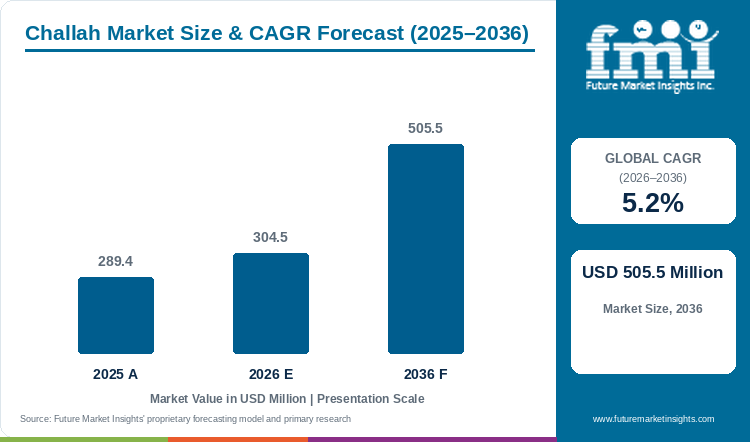
The global challah market evolved from a 2025 valuation of USD 289.4 million to USD 304.5 million in 2026, and is set to achieve USD 505.5 million by 2036, reflecting a 5.2% CAGR.
Recurring weekend religious observance and commercial foodservice menu adoption of soft egg-enriched buns are the primary variables shaping demand expansion in the global challah market. Unlike everyday sandwich loaves that sell evenly from Monday through Sunday, kosher braided bread demand concentrates heavily between Thursday morning and Friday afternoon. As a matter of fact, in August 2025, dietary guidance published by Chabad.org reaffirmed that every observant household table requires two complete braided loaves (lechem mishneh) for Friday evening and Saturday Sabbath meals [1]. Because of this non-discretionary weekly buying habit, Classic / original braided loaves are projected to capture 44.6% of product type demand in 2026 when supermarket bakeries merchandise six-strand loaves near artisan bread counters. In 2025 global challah market value stood at USD 289.4 million before reaching USD 304.5 million in 2026, and it climbs at a 5.2% annual rate toward USD 505.5 million by 2036 (creating USD 201.0 million in incremental market value). However, issues such as Saturday afternoon crumb staling and strict sesame allergen washdown rules continue to restrain ambient route radius for local commissaries.
Key Market Trends & Insights
- By product type: Classic / original braided loaves are projected to capture 44.6% in 2026 because traditional six-strand and three-strand loaves fulfill weekly Shabbat table blessings without flavor rejection.
- By claim / nature: Dairy-free kosher parve egg recipes allow the Conventional segment to command an estimated 58.4% in 2026 for pairing with Friday brisket and poultry meals.
- By format: Same-day Friday shopper preference for glossy egg-washed crusts and pillowy crumb elasticity keeps Fresh loaves at an expected 46.2% in 2026.
- By packaging format: Multipack configurations are forecast to generate 38.5% in 2026 owing to two-loaf Shabbat bundles and multi-count challah slider roll bags.
- By sales channel: Supermarkets & hypermarkets are anticipated to account for 43.8% in 2026 through dedicated kosher bakery tables and thaw-and-serve display racks.
Regional Highlights
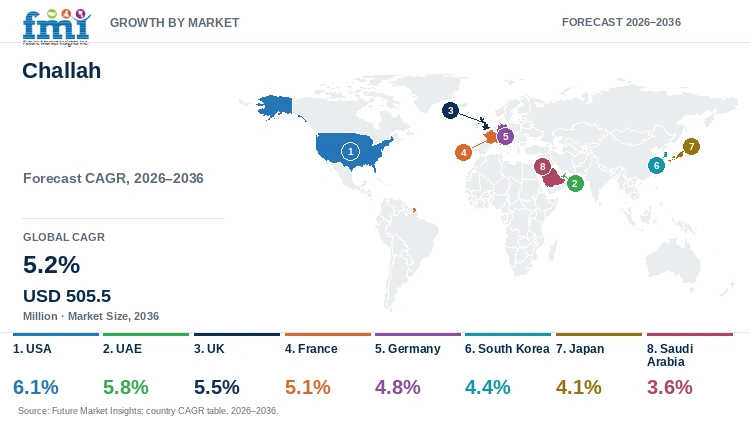
- Top national expansion: The USA is projected to lead profiled country growth at a 6.1% CAGR through 2036 under nationwide supermarket slack-out rollouts and foodservice bun adoption.
- Broader country progression: The UAE is expected to expand at a 5.8% CAGR ahead of the UK at 5.5% and France at 5.1%, while Saudi Arabia is forecast to advance at a 3.6% yearly pace.
Market Size & Forecast
Table 1: Market Size and Forecast for the Challah Market (USD million and CAGR percentage), 2025 to 2036
| Metric | Value |
|---|---|
| 2025 Market Size | USD 289.4 million |
| Estimated Market Size in 2026 | USD 304.5 million |
| Projected Market Size by 2036 | USD 505.5 million |
| CAGR, 2026 to 2036 | 5.2% |
| Added Revenue, 2026 to 2036 | USD 201.0 million |
High Thursday-to-Friday retail demand concentration places a heavy operational load on regional kosher commissaries and supermarket in-store bakeries. When more than 65% of weekly unit volume sells within a 36-hour window before Friday sunset, local scratch bakeries struggle to braid enough fresh loaves without suffering Saturday staling write-offs. This generates a need for blast-frozen thaw-and-serve distribution models that allow suburban grocers to slack out braided loaves on Thursday night. For instance, in July 2025, Baking Business reported that Zaro's Family Bakery expanded its Bronx wholesale bakery operations to ship hand-braided kosher challah into Walmart and ShopRite supermarkets across the USA [2]. As a result, national grocery chains now combine local fresh deliveries with frozen bakery slack-out cartons to eliminate Friday afternoon stockouts and protect store margins.
Ceremonial Household and Wholesale Loaf Sizing
Table 2: Ceremonial Household and Wholesale Loaf Sizing for the Challah Market (USD million and operational ranges), 2025 to 2036
| Metric | 2025 | 2026 | 2036 |
|---|---|---|---|
| Market size (USD million) | 289.4 | 304.5 | 505.5 |
| Core observant & specialty buyer pool (million households) | 3.6 to 4.1 | 3.7 to 4.2 | 4.4 to 5.0 |
| Commercial challah units sold annually (million packs) | 64.3 to 70.5 | 66.8 to 73.2 | 96.0 to 105.3 |
| Average wholesale/retail realization per pack (USD) | 4.1 to 4.5 | 4.2 to 4.6 | 4.8 to 5.3 |
Operational note: Household and unit ranges reconcile Institute for Jewish Policy Research and World Jewish Congress demographic baselines against 52 weekly two-loaf Shabbat procurement cycles and High Holiday round-challah peaks.
Packaging moisture condensation and crust flaking represent major technical challenges that directly impact repeat retail purchases of braided egg bread. If warm loaves are sealed inside polypropylene bags before internal crumb temperatures drop, trapped steam softens the glossy egg-washed braid and accelerates mold growth. To prevent this quality loss, commercial tunnel-oven operators hold proofing relative humidity near 78% and enforce a 45-minute ambient rack cooldown prior to bagging. Consequently, grocery category managers can display braided Shabbat loaves beside everyday bakery products on front-of-store tables to lift weekend basket value without crust peeling.
Per Capita & Kosher Bakery Channel Sizing
Table 3: Per Capita and Bakery Channel Spending Indicators for the Challah Market (USD and percentages), 2025 to 2036
| Metric | 2025 | 2026 | 2036 |
|---|---|---|---|
| World population (billion) | 8.2 | 8.3 | 9.0 |
| Spend per 1,000 people (USD) | 35.3 | 36.7 | 56.2 |
| Annual challah spend per core buyer household (USD) | 70.6 to 80.4 | 72.5 to 82.3 | 101.1 to 114.9 |
| Kosher-certified parve production share (%) | 76.0% to 80.0% | 77.0% to 81.0% | 81.0% to 85.0% |
Table 4: Bakery Facility & Retail Channel Spending Indicators for the Challah Market (USD and percentages), 2026
| Metric | Value | Institutional Reference Basis |
|---|---|---|
| Market size, 2026 | USD 304.5 million | 2026 global revenue baseline |
| Commercial kosher & specialty retail nodes | 42,500 stores | Global supermarket & kosher bakery store base |
| Average annual challah turnover per store | USD 7,164.7 | Annualized retail and in-store bakery realization |
| Supermarket & hypermarket channel revenue, 2026 | USD 133.4 million | 43.8% sales-channel segment allocation |
Strict kosher dietary laws prohibiting the mixing of meat and dairy at the same meal govern commercial ingredient selection across the challah industry. Because Friday evening Sabbath dinners traditionally center on roasted poultry or beef brisket, any bread containing butter or whey is disqualified from observant meat tables. This generates a need for kosher parve dough formulations that replace dairy fats with liquid whole egg and neutral vegetable oil while using high-protein spring wheat flour to hold six-strand braid definition. As a result, bakery formulators routinely match the soft crumb tenderness of brioche loaves while maintaining dairy-free parve certification that unlocks institutional and supermarket kosher accounts.
Analyst Perspective
"Repeat supermarket orders in the challah category depend on placing a glossy, hand-braided kosher parve loaf on the table before Friday noon without suffering Saturday stale write-offs. Wholesale bakeries that combine blast-frozen thaw-and-serve loaves with multipack challah burger and slider buns capture Tuesday-through-Sunday grocery turnover beyond ceremonial weekend peaks."
- Nandini Roy Choudhury, Principal Consultant, Future Market Insights.
How is the challah market segmented?
The challah market is segmented by product type, claim / nature, format, packaging format, and sales channel. In 2026, Classic / original stands at 44.6%, conventional at 58.4%, fresh at 46.2%, multipack at 38.5%, and supermarkets & hypermarkets at 43.8%.
By product type: Classic / original; whole grain & seeded; flavored & filled; mini & snacking formats; and premium / artisan.
By claim / nature: Conventional; clean label; organic; gluten-free; and high-protein / fortified.
By format: Fresh; frozen; ambient packaged; chilled; and par-baked / thaw-and-serve.
By packaging format: Multipack; single-serve; family / loaf pack; and bulk foodservice.
By sales channel: Supermarkets & hypermarkets; artisan & specialty bakeries; convenience & forecourt; online & DTC; and foodservice distributors.
Why does Classic / original lead the product type category?
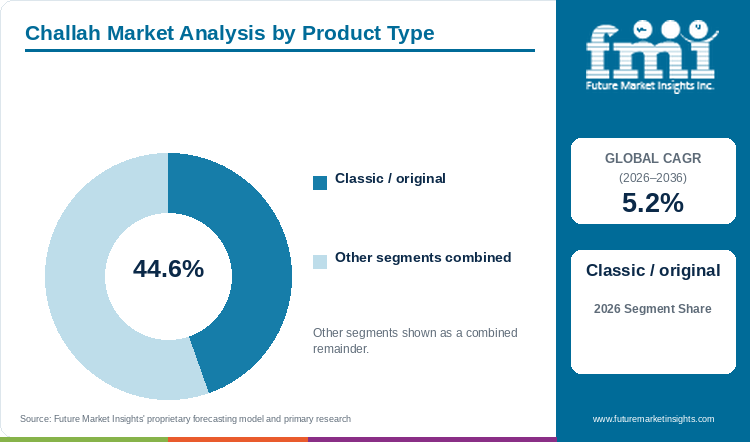
Classic / original braided loaves are projected to capture 44.6% of product type demand in 2026 due to weekly Shabbat table rituals and Sunday French-toast preparation.
Table 5: Product Type Share for the Challah Market (percentage share), 2026
| Product Type | Share (2026) |
|---|---|
| Classic / original | 44.6% |
| Other Segments Combined | 55.4%* |
| Total | 100.0% |
*Calculated as the balance remaining after deducting the leading segment's reported share from 100.0%.
Table 6: Product Type Leadership and Market Growth for the Challah Market (segment and CAGR percentage), 2026 to 2036
| Metric | Value |
|---|---|
| Global CAGR (2026 to 2036) | 5.2% |
| Leading Segment | Classic / original |
Household meal pairing versatility and high-speed bakery line efficiency explain why unstuffed plain and sesame-topped braids anchor category volume. Observant families favor a neutral golden braided loaf for Friday evening blessings so sweet chocolate or cinnamon fillings never clash with savory chicken soup and roasted meat courses. In addition to this, unfilled dough batches run continuously on automated divider-rounders beside sourdough breads without sticky fruit-inclusion changeovers.
- Classic / original is projected to secure 44.6% of product type revenue in 2026 by serving both Friday ceremonial meals and thick-cut weekend French toast.
- For instance, in February 2025, commercial bakery catalogs updated by Angel Bakeries confirmed that traditional braided Shabbat loaves anchor daily kosher production ahead of seasonal autumn holiday variants [3].
What sustains Conventional within the claim / nature category?
Conventional formulations are estimated to command 58.4% of the claim / nature category in 2026 through kosher parve egg-and-wheat dough economics.
Dough tensile strength during six-strand braiding and per-loaf ingredient cost control keep standard enriched wheat formulations at the center of commercial production. Refined bread flour combined with liquid whole egg builds elastic gluten strands that withstand mechanical plaiting tension without tearing inside the proofer. By contrast, specialty grain-free alternatives require xanthan binders and segregated rooms using gluten-free bakery premix batches at nearly double the unit ingredient cost.
- Procurement behavior across kosher grocers places Conventional at an estimated 58.4% of the claim / nature segment in 2026 because dairy-free parve loaves pair legally with meat and poultry meals.
- As a matter of fact, in January 2025, Edition 5 Food Allergen Labeling Guidance issued by the U.S. Food and Drug Administration tightened package declarations for wheat and egg as well as sesame across retail bakery bags [4].
How does Fresh retain the leading format position?
Fresh loaves are expected to hold 46.2% of format demand in 2026 owing to same-day Friday table service and tactile crust inspection.
Immediate Friday evening table consumption and shopper preference for soft, aromatic loaves drive strong retail velocity for freshly baked braided bread. Friday morning grocery buyers press loaf sides and inspect egg-wash shine before placing challah in their baskets, rewarding neighborhood commissaries that deliver within 14 hours of baking. To avoid afternoon stockouts in distant stores, multi-state grocery chains supplement local fresh racks with par-baked bread and frozen thaw-and-serve cases.
- Fresh loaves are expected to hold 46.2% of format sales in 2026 because immediate Friday table readiness and soft crumb elasticity reward short bake-to-shelf intervals.
- For example, in July 2025, Baking Business documented how Zaro's Family Bakery pairs manual braiding with controlled post-bake rack cooling to protect crust gloss across fresh and frozen wholesale accounts [5].
Why does Multipack lead the packaging format category?
Multipack configurations are forecast to account for 38.5% of packaging format demand in 2026 through twin-loaf Shabbat bundles and multi-count roll bags.
Ceremonial two-loaf table customs and weekday family sandwich preparation make multi-unit bagging the primary revenue engine for commercial challah bakers. Because traditional Shabbat observance requires two intact loaves at each meal, twin-pack braided loaves and six-to-eight count challah knot bags serve as the standard retail unit for observant households. In addition to this, multi-count burger and hot-dog roll trays packaged in high-clarity bread bags extend bakery line utilization into weekday barbecue and deli occasions.
- Two-loaf family bundles and eight-count dinner roll trays enable Multipack to generate a forecast 38.5% of packaging format volume in 2026.
- To cater to this demand, in April 2025, Zaro's Family Bakery relaunched its kosher Multipack Challah Hamburger Buns and Challah Hot Dog Rolls through the Specialty Food Association for summer cookout retail [6].
What supports Supermarkets & hypermarkets in sales channel?
Supermarkets & hypermarkets are anticipated to capture 43.8% of sales channel revenue in 2026 through consolidated weekly grocery trips and in-store kosher tables.
One-stop weekly meal shopping and dedicated in-store kosher bakery tables give full-line grocery chains a decisive channel advantage over standalone bake shops. Regional supermarket banners merchandise kosher-certified braided loaves beside grape juice and rotisserie poultry so families complete Shabbat preparation in a single trip. Store bakery managers also control Friday evening shrink by thawing frozen braided stock in measured Thursday night batches.
- Supermarkets & hypermarkets are anticipated to represent 43.8% of sales channel turnover in 2026 through nationwide wholesale slack-out programs.
- For instance, in June 2025, Kayco expanded its Manischewitz kosher specialty portfolio at the Summer Fancy Food Show to support year-round supermarket freezer and bakery table merchandising [7].
What are the drivers, restraints, and opportunities in the challah market?
Recurring weekly Shabbat observance and foodservice bun adoption propel challah volume, whereas Friday post-sunset staling write-offs and sesame allergen rules restrain margins and blast-frozen slack-out loaves unlock non-metro grocery growth.
- Driver: Fifty-two weekly two-loaf Shabbat purchases combined with casual-dining adoption of egg-enriched challah burger buns generate predictable baseline volume.
- Restraint: Steep Saturday markdown write-offs on unsold Friday loaves and mandatory egg or sesame allergen segregation raise plant operating costs.
- Opportunity: Cryogenic blast-frozen thaw-and-serve loaves and pre-sliced French-toast packs expand supermarket distribution beyond urban kosher corridors.
Growth Analysis and Future Potential: Qualitative Demand Catalysts
Religious dietary observance creates a non-discretionary 52-week repurchase cadence that insulates challah bakers from promotional price wars seen in sweet pastries. Observant families purchase two whole braided loaves every Thursday or Friday and switch to round honey-and-raisin coiled loaves during autumn Rosh Hashanah holidays. In March 2025, demographic research from the Institute for Jewish Policy Research documented 955,000 Israel-connected diaspora residents across the USA and Europe who sustain weekly braided Shabbat loaf demand [8]. Besides this ceremonial baseline, casual-dining diner and brunch chains specify thick-sliced challah for caramelized French toast and gourmet brisket sandwiches.
Risk Assessment of the Challah Market: Operational and Formulation Friction
Extreme Friday demand concentration and multi-allergen cross-contact rules create acute operational friction for commercial wholesale bakeries. Any fresh braided loaf still sitting on a grocery table after Friday sunset faces 50% to 100% Saturday clearance losses. In addition to this, mandatory food-information rules updated by the European Commission in March 2025 require bolded ingredient disclosures for gluten-containing wheat and egg as well as sesame across prepacked bakery labels [9]. Similarly, in March 2025, updated FDA allergen guidance in the USA forced bakeries running sesame-seeded challah to operate dedicated seeding conveyors or perform validated wet-wash changeovers before baking plain loaves [10]. When cage-free liquid egg prices surge, casual weekday buyers often substitute standard packaged bread loaves.
Commercial Opportunity Analysis: Formulation Differentiation and Value-Add Formats
Suburban grocery expansion outside traditional urban kosher corridors depends on eliminating Friday afternoon stockouts and Saturday staling waste. Cryogenic shock-freezing paired with maltogenic amylase anti-staling systems preserves soft crumb elasticity across 90-day frozen storage so store clerks can slack out exact display quantities on Thursday night. At the same time, artisanal ingredient transparency is attracting specialty bakery shoppers. For instance, in April 2025, regional artisan franchise Breadsmith marketed scratch-baked braided and holiday coiled challah formulated with clean label flour to capture ingredient-conscious weekend buyers [11]. Pre-sliced French-toast loaves and four-pack parve slider buns further convert a Friday ceremonial bread into a seven-day grocery staple.
Challah Market by Country (2026 to 2036)
As per FMI, the USA is projected to lead challah expansion across profiled countries at a 6.1% CAGR through 2036, whereas Saudi Arabia is forecast to progress at a 3.6% annual pace. Commercial performance across international grocery and hospitality markets depends on metropolitan observant household density and frozen slack-out grocery logistics along with statutory allergen labeling rules.
Table 7: Country CAGR and Primary Growth Levers for the Challah Market (CAGR percentage and operational drivers), 2026 to 2036
| Country | CAGR (2026 to 2036) | Primary Growth Lever |
|---|---|---|
| USA | 6.1% | Nationwide supermarket frozen slack-out rollouts and foodservice challah bun adoption |
| UAE | 5.8% | Kosher-certified Dubai and Abu Dhabi hotel catering and expatriate retail expansion |
| UK | 5.5% | North London and Manchester kosher retail density paired with PPDS allergen labeling |
| France | 5.1% | Parisian and urban kosher boulangerie demand with prepacked hypermarket aisles |
| Germany | 4.8% | Berlin, Munich, and Frankfurt urban community supply and frozen bake-off replenishment |
| South Korea | 4.4% | Seoul expatriate catering and artisanal cafe adoption of braided egg-bread loaves |
| Japan | 4.1% | Tokyo and Kobe specialty hotel orders and premium braided French-toast bread trials |
| Saudi Arabia | 3.6% | International compound and hospitality pastry procurement under SFDA food rules |
Source: Future Market Insights analysis
USA Challah Market Outlook (2026 to 2036)
Wholesale and retail challah demand across the USA climbs at a projected 6.1% compound annual growth rate from 2026 to 2036 through nationwide supermarket slack-out rollouts and foodservice sandwich-bun adoption. Unlike single-city European bakery models, the USA combines high-volume New York wholesale kosher commissaries with coast-to-coast grocery freezer distribution. For instance, in July 2025, Baking Business reported that fourth-generation Zaro's Family Bakery scaled wholesale shipments of hand-braided kosher challah into Walmart and ShopRite supermarkets across the USA [2]. Regional scratch franchises such as Breadsmith also bake Friday braided loaves across suburban storefronts [11], though federal FDA sesame and egg allergen rules mandate dedicated seeding conveyors on shared bakery lines.
Key takeaway: In the USA, nationwide supermarket slack-out distribution and everyday challah sandwich bun extensions anchor commercial volume growth.
UAE Challah Market Outlook (2026 to 2036)
Luxury hotel banqueting and expatriate diplomatic catering across Dubai and Abu Dhabi shape demand in the UAE rather than neighborhood walk-in retail bakeries. Specifically, October 2026 official destination listings updated by Visit Dubai highlighted glatt kosher fine-dining and hospitality catering operations serving international business travelers at venues such as Armani/Kaf inside Burj Khalifa [12]. Driven by conference resort catering and gourmet supermarket freezer listings, challah turnover in the UAE is expected to rise at a 5.8% CAGR between 2026 and 2036. However, because weekday retail footfall cannot justify continuous tunnel ovens locally, hospitality buyers rely on Dubai Municipality-registered frozen container shipments carrying bilingual expiry dates.
Key takeaway: In the UAE, kosher-certified luxury hotel banqueting and expatriate catering networks drive frozen braided challah imports.
UK Challah Market Outlook (2026 to 2036)
Dense clustering of observant households in North London and Greater Manchester combines with national supermarket private-label braided loaves to anchor weekly volume in the UK. Commercial challah expenditure across the UK rises at an estimated 5.5% CAGR over the 2026 to 2036 forecast window across kosher bakeries and major grocery banners. For instance, an October 2025 Institute for Jewish Policy Research survey of over 4,800 adult respondents in the UK confirmed stable synagogue attendance and strong Friday communal observance [13]. In addition to this, the October 2026 USDA Foreign Agricultural Service UK Retail Foods Annual noted that store-brand grocery lines reached 52.2% of spending in the UK, pressuring kosher bakers on Thursday slack-out pricing [14].
Key takeaway: In the UK, concentrated North London and Manchester community purchasing paired with supermarket specialty listings sustains steady Friday turnover.
France Challah Market Outlook (2026 to 2036)
Western Europe's largest observant community anchors weekly Sabbath loaf demand in France while domestic butter brioche competes fiercely for non-ceremonial weekend breakfast occasions. According to community profiles updated by the World Jewish Congress in February 2025, the Jewish population in France stands at approximately 440,000 residents centered in Paris and Marseille with extensive kosher boulangerie networks [15]. Because observant households in France strictly separate weekday dairy brioche from meat-meal Sabbath bread, wholesale bakery suppliers must certify zero dairy butter cross-contact across shared spiral dough mixers and rack ovens. Supported by Beth Din-supervised boulangeries and urban hypermarket kosher aisles, challah revenue in France is forecast to grow at a 5.1% CAGR through 2036.
Key takeaway: In France, strict kosher parve separation from dairy brioche across Parisian boulangeries and urban hypermarkets guides recurring weekly sales.
Germany Challah Market Outlook (2026 to 2036)
Challah demand in Germany is slated to expand at a 4.8% CAGR from 2026 to 2036 on account of scheduled frozen bake-off deliveries into urban community centers and specialty grocers. Municipal community hubs across Berlin and Frankfurt as well as Munich structure weekly distribution in Germany around pre-ordered Thursday drops rather than dense street-corner kosher bakeries. In February 2025, demographic profiles updated by the World Jewish Congress documented roughly 118,000 affiliated community members in Germany supported by kosher delicatessens and institutional catering kitchens [16]. However, limited standalone kosher scratch-bakery capacity outside Berlin and Frankfurt compels retail buyers in Germany to stock prepacked frozen braided loaves carrying mandatory EU wheat and sesame allergen disclosures.
Key takeaway: In Germany, municipal community clustering in major urban centers favors frozen thaw-and-serve and par-baked challah distribution.
South Korea Challah Market Outlook (2026 to 2036)
Boutique Seoul bakery cafes and international hospitality kitchens drive demand in South Korea by positioning braided egg bread as a rich brunch toast carrier in addition to expatriate Shabbat catering. In February 2025, country documentation from the World Jewish Congress noted an active expatriate community in Seoul's Yongsan and Itaewon districts that organizes weekly Sabbath dining and holiday hospitality across South Korea [17]. Commercial challah turnover in South Korea is predicted to climb at a 4.4% annual rate between 2026 and 2036 with urban cafes menuing thick-sliced braided French toast and gourmet sandwiches. Even so, imported frozen loaves and local artisan batches in South Korea must carry strict food-safety allergen labels declaring egg and wheat inputs.
Key takeaway: In South Korea, Seoul expatriate catering and specialty café brunch menus support targeted small-batch and frozen challah supply.
Japan Challah Market Outlook (2026 to 2036)
Everyday toast consumption in Japan centers on soft rectangular shokupan milk bread, confining braided challah to five-star hotel banquet kitchens and expatriate community centers in Tokyo and Kobe. Commercial challah sales in Japan are anticipated to progress at a 4.1% CAGR over 2026 to 2036 owing to luxury diplomatic hospitality orders and boutique Tokyo boulangerie trials of mini braided loaves. For instance, in February 2025, institutional profiles updated by the World Jewish Congress highlighted established community infrastructure in Tokyo and Kobe that coordinates kosher bread baking and imported food distribution across Japan [18]. High small-lot chilled freight costs encourage hotel buyers in Japan to consolidate blast-frozen kosher parve dough shipments under strict egg and wheat allergen labeling rules.
Key takeaway: In Japan, Tokyo and Kobe expatriate hospitality orders paired with boutique bakery trials sustain specialized frozen and artisan challah demand.
Saudi Arabia Challah Market Outlook (2026 to 2036)
International diplomatic compounds and luxury Red Sea or Riyadh hotel pastry kitchens account for commercial braided egg-bread procurement in Saudi Arabia in the absence of domestic kosher retail counters. To illustrate, in June 2025 the Saudi Food and Drug Authority (SFDA) announced mandatory food technical regulations effective July 2025 requiring commercial food establishments across Saudi Arabia to display comprehensive nutritional and ingredient transparency on physical and digital menus [19]. Specialty foodservice importers supplying Riyadh and Jeddah five-star hotel banquet kitchens must maintain uninterrupted sub-zero cold-chain logs and complete bilingual ingredient declarations on every master carton. Under these hotel catering specifications, commercial challah activity in Saudi Arabia progresses at a measured 3.6% annual pace through 2036.
Key takeaway: In Saudi Arabia, international hospitality pastry procurement and strict SFDA food transparency rules govern niche frozen braided bread imports.
Full report country CAGRs cover: North America; Latin America; Western Europe; Eastern Europe; East Asia; South Asia and Pacific; Middle East and Africa.
Who are the notable companies in the challah market?
Angel Bakeries, Zaro's Family Bakery, Kayco (Manischewitz), Breadsmith, Stern's Bakery, Green's Bakery, Grupo Bimbo, Flowers Foods, Lantmännen Unibake, and Vandemoortele are the notable companies in the challah market.
FMI analysis indicates that supplier positioning across the challah sector divides between certified kosher wholesale commissaries and regional scratch-bakery franchises as well as multinational bake-off bread groups. Dedicated kosher bakers anchor Thursday and Friday supermarket table deliveries and national frozen slack-out programs through strict rabbinical parve oversight and six-strand braiding lines. Large commercial baking groups utilize direct-store-delivery routes and enriched-dough plants along with European frozen bake-off hubs to supply supermarket chains and foodservice operators.
- Dedicated Kosher & Wholesale Challah Bakers: Angel Bakeries and Zaro's Family Bakery; Kayco (Manischewitz) and Stern's Bakery along with Green's Bakery manufacture certified kosher parve braided loaves and multipack challah rolls.
- Artisanal & Enriched Retail Bread Specialists: Breadsmith and Grupo Bimbo (including Bimbo Bakeries USA and St Pierre Groupe) as well as Flowers Foods operate high-velocity retail bakery routes and specialty braided and enriched loaf lines.
- Frozen & Bake-Off Bakery Platforms: Lantmännen Unibake and Vandemoortele operate multi-country blast-frozen and par-baked specialty bread manufacturing and cold-chain distribution infrastructure.
Competitive Benchmarking: Challah Market
Table 8: Competitive Benchmarking for the Challah Market (qualitative capability ratings), 2026
| Company | Kosher & Braided Challah Breadth | Frozen / Slack-Out Capability | Supermarket & Foodservice Access | Geographic Reach |
|---|---|---|---|---|
| Angel Bakeries | High | High | High | Israel and international kosher export channels |
| Zaro's Family Bakery | High | High | High | USA nationwide retail and wholesale |
| Kayco (Manischewitz) | High | High | High | USA, Canada, and international kosher retail |
| Breadsmith | High | Medium | Medium | USA regional artisan bakery franchises |
| Stern's Bakery | High | Medium | High | USA kosher retail and supermarket in-store tables |
| Green's Bakery | High | Medium | High | USA and international kosher specialty distribution |
| Grupo Bimbo | Medium | High | High | North America, Europe, Latin America, and global retail |
| Flowers Foods | Medium | Medium | High | USA nationwide direct-store-delivery grocery network |
| Lantmännen Unibake | Medium | High | High | Europe, North America, and international bake-off channels |
| Vandemoortele | Medium | High | High | Western and Central Europe and North America foodservice |
Scoring basis: Capability tiers evaluate documented kosher parve braided challah SKU range and blast-frozen thaw-and-serve shelf stability. Channel and geographic ratings reflect verified supermarket in-store bakery listings and multi-region cold-chain distribution networks.
Key Developments in the Challah Market
- Zaro's Family Bakery expanded its wholesale hand-braided kosher challah and challah roll distribution across major national supermarket banners in the USA including Walmart and ShopRite as well as Albertsons in July 2025 [2].
- Kayco showcased its frozen Manischewitz braided challah line and expanded kosher specialty products at the Summer Fancy Food Show in June 2025 to accelerate supermarket slack-out adoption [7].
- Lantmännen reported in February 2026 that it invested close to SEK 3 billion over two years in food production and grain infrastructure including increased commercial bakery capacity in Örebro [20].
Key Players in the Challah Market
Dedicated Kosher & Wholesale Challah Bakers
- Angel Bakeries
- Zaro's Family Bakery
- Kayco (Manischewitz)
- Stern's Bakery
- Green's Bakery
Artisanal & Enriched Retail Bread Specialists
- Breadsmith
- Grupo Bimbo
- Flowers Foods
Frozen & Bake-Off Bakery Platforms
- Lantmännen Unibake
- Vandemoortele
Challah Market - Report Scope
Table 9: Report Scope for the Challah Market (coverage fields and definitions), 2026 to 2036
| Coverage field | Report scope |
|---|---|
| Market breakdown | Product Type; Claim / Nature; Format; Packaging Format; Sales Channel |
| Quantitative Units | USD Million |
| Market Definition | Includes commercial bakery and wholesale supplier revenue from braided, coiled, and roll-format challah breads sold through retail and foodservice channels. Category Scope Note: Excludes unbraided generic dairy brioche, Hawaiian sweet rolls, thick-sliced white Texas toast loaves, upstream raw dietary fiber ingredients, and downstream restaurant sandwich plate prices. |
| Regions Covered | North America; Latin America; Western Europe; Eastern Europe; East Asia; South Asia and Pacific; Middle East and Africa |
| Countries Covered | USA, UAE, UK, France, Germany, South Korea, Japan, Saudi Arabia, and additional countries in the full report |
| Key Companies Covered | Angel Bakeries, Zaro's Family Bakery, Kayco (Manischewitz), Breadsmith, Stern's Bakery, Green's Bakery, Grupo Bimbo, Flowers Foods, Lantmännen Unibake, Vandemoortele |
| Forecast Period | 2026 to 2036 |
| Approach | Primary and secondary research with top-down and bottom-up market triangulation. |
Challah Market - Research Methodology
Table 10: Research Methodology for the Challah Market (research methods and approach), 2026 edition
| Method | Approach |
|---|---|
| Primary Research | Structured interviews with kosher wholesale bakery directors, rabbinical kashrut supervisors, supermarket in-store bakery buyers, and cold-chain foodservice distributors to validate Friday sell-through and slack-out shrink rates. |
| Secondary Research | Analysis of Institute for Jewish Policy Research and World Jewish Congress demographic studies, FDA and EU allergen labeling mandates, USDA Foreign Agricultural Service country reports, and trade disclosures in Baking Business. |
| Market Sizing and Forecasting | Top-down specialty and ethnic bakery expenditure models reconciled against bottom-up weekly two-loaf Shabbat household consumption and multipack challah roll volumes from 2025 to 2036. |
| Country Forecasting Model | Econometric national projections weight observant household density, kosher supermarket table penetration, frozen slack-out logistics, and statutory allergen labeling rules across eight country markets. |
| Operational Benchmark Traceability | Household pool and per-store turnover indicators in Tables 2, 3, and 4 trace to JPR and WJC demographic cohorts, Chabad two-loaf Shabbat norms, and Zaro's wholesale distribution benchmarks. |
| Data Triangulation and Validation | Revenue estimates are cross-checked against commercial kosher bakery production capacities and supermarket category sales while excluding unbraided brioche, sweet rolls, and Texas toast loaves. |
Challah Market by Segments
Challah Market segmented by Product Type:
- Classic / original
- Whole grain & seeded
- Flavored & filled
- Mini & snacking formats
- Premium / artisan
Challah Market segmented by Claim / Nature:
- Conventional
- Clean label
- Organic
- Gluten-free
- High-protein / fortified
Challah Market segmented by Format:
- Fresh
- Frozen
- Ambient packaged
- Chilled
- Par-baked / thaw-and-serve
Challah Market segmented by Packaging Format:
- Multipack
- Single-serve
- Family / loaf pack
- Bulk foodservice
Challah Market segmented by Sales Channel:
- Supermarkets & hypermarkets
- Artisan & specialty bakeries
- Convenience & forecourt
- Online & DTC
- Foodservice distributors
Challah Market by Region
- North America
- United States
- Canada
- Latin America
- Brazil
- Mexico
- Argentina
- Chile
- Western Europe
- Germany
- France
- United Kingdom
- Italy
- Spain
- Benelux
- Nordics
- Eastern Europe
- Poland
- Czech Republic
- Romania
- Hungary
- East Asia
- China
- Japan
- South Korea
- South Asia and Pacific
- India
- ASEAN
- Australia and New Zealand
- Middle East and Africa
- GCC Countries
- South Africa
- Türkiye
- Israel
Research Sources and Bibliography
- [1] Chabad.org. (2025, August 11). 25 Shabbat Facts Every Jew Should Know. Chabad-Lubavitch Media Center.
- [2] Sosland Publishing Company. (2025, July 10). From New York to the nation — Zaro's Family Bakery takes its wholesale business nationwide. Baking Business.
- [3] Angel Bakeries. (2025, February 14). Angel Bakeries: Israel's Best-Loved Bakeries. Salomon A. Angel Ltd.
- [4] U.S. Food and Drug Administration. (2025, January 6). Questions and Answers Regarding Food Allergen Labeling (Edition 5). U.S. Department of Health and Human Services.
- [5] Sosland Publishing Company. (2025, July 9). Zaro's Family Bakery innovates with award-winning products. Baking Business.
- [6] Specialty Food Association & Zaro's Family Bakery. (2025, April 3). By Popular Demand – Zaro's Family Bakery Brings Back Challah Hamburger Buns & Challah Hot Dog Rolls. Specialty Food Association Newsroom.
- [7] Specialty Food Association & Kayco. (2025, June 27). Kayco Unveils New Manischewitz® Brand Soup Line and Kosher Hot Dogs. Specialty Food Association Newsroom.
- [8] Staetsky, D. (2025, March 17). Israelis abroad: Transformation of the Jewish Diaspora?. Institute for Jewish Policy Research (JPR).
- [9] European Commission. (2025, March 12). Mandatory food information. Directorate-General for Health and Food Safety.
- [10] U.S. Food and Drug Administration. (2025, March 26). Frequently Asked Questions: Food Allergen Labeling Guidance for Industry. U.S. Department of Health and Human Services.
- [11] Breadsmith Franchising, Inc. (2025, April 18). Challah | Breadsmith. Breadsmith Artisanal Bakery Catalog.
- [12] Dubai Department of Economy and Tourism. (2026, October 21). Armani/Kaf - Kosher Fine Dining at Armani Hotel Dubai. Visit Dubai Official Portal.
- [13] Boyd, J. (2025, October 6). Two years after the October 7 attacks: British Jewish views on antisemitism, Israel and Jewish life. Institute for Jewish Policy Research (JPR).
- [14] USDA Foreign Agricultural Service. (2026, October 1). United Kingdom: Retail Foods Annual. Global Agricultural Information Network (GAIN).
- [15] World Jewish Congress. (2025, February 10). Community in France - World Jewish Congress. World Jewish Congress Community Directory.
- [16] World Jewish Congress. (2025, February 10). Community in Germany - World Jewish Congress. World Jewish Congress Community Directory.
- [17] World Jewish Congress. (2025, February 10). Community in Korea (Republic of) - World Jewish Congress. World Jewish Congress Community Directory.
- [18] World Jewish Congress. (2025, February 10). Community in Japan - World Jewish Congress. World Jewish Congress Community Directory.
- [19] Saudi Food and Drug Authority (SFDA). (2025, June 18). SFDA to Implement New Food Rules for Transparency and Consumer Health. Kingdom of Saudi Arabia SFDA Regulatory Portal.
- [20] Lantmännen. (2026, February 11). Strong finish and stable result for Lantmännen 2025 – all time high dividend proposed to Swedish farmers. Lantmännen Corporate Newsroom.
- [21] Vandemoortele NV. (2025, February 14). Vandemoortele acquires Lizzi in Italy, a specialty player in frozen Bakery. Vandemoortele Corporate Press Releases.
- [22] Flowers Foods, Inc. (2025, February 21). FLOWERS FOODS, INC. COMPLETES ACQUISITION OF SIMPLE MILLS. Flowers Foods Investor Relations.
- [23] Grupo Bimbo S.A.B. de C.V. (2025, July 29). We are committed to removing artificial colorants from all our products by the end of 2026. Grupo Bimbo Corporate Communications.
This bibliography is provided for reader reference and is not exhaustive. The full report contains the complete reference list and detailed citations.
This Report Answers
- How large is the challah market in 2026 and what is forecast for 2036?
- Which weekly Shabbat and holiday purchasing pressures support demand for challah?
- Why does Classic / original lead the product type category?
- Why does conventional kosher parve lead the claim / nature category globally?
- How do growth rates differ between the USA and the UAE as well as the UK?
- Which leading bakeries supply certified kosher challah and frozen slack-out loaves today?
- What operational staling and allergen labeling barriers limit supplier switching in the challah market?
- What should supermarket and foodservice buyers evaluate before selecting a challah supplier?
Frequently Asked Questions
How big is the challah market in 2026, and what is forecast for 2036?
According to FMI, global challah sales are estimated to reach USD 304.5 million in 2026 from a 2025 baseline of USD 289.4 million. Revenue is forecast to hit USD 505.5 million by 2036 as grocery chains scale frozen slack-out kosher bakery tables.
What is the CAGR for the challah market from 2026 to 2036?
Future Market Insights projects a 5.2% compound annual growth rate from 2026 through 2036, generating USD 201.0 million in added bakery turnover across supermarket and foodservice channels.
Which product type segment leads the challah market?
Classic / original braided loaves are projected to capture 44.6% of product type demand in 2026 because observant households place two traditional unstuffed loaves on the table at every Friday and Saturday Shabbat meal.
Which claim / nature segment leads the challah market?
Conventional kosher parve recipes are estimated to secure 58.4% of claim / nature demand in 2026 so observant families can serve braided loaves with Friday meat dinners.
Which country has a notable growth outlook during the assessment period?
The USA is projected to lead national growth at a 6.1% CAGR through 2036 through coast-to-coast supermarket wholesale rollouts and foodservice adoption of challah burger buns.
Who are the key players in the market?
Angel Bakeries; Zaro's Family Bakery; Kayco (Manischewitz); Breadsmith; Stern's Bakery; Green's Bakery; Grupo Bimbo; Flowers Foods; Lantmännen Unibake; and Vandemoortele supply commercial retail and hospitality accounts.
Preview the report firsthand - request a free sample
Get SampleGet the brochure for pricing and purchase details.
Get PDFTable of Content
- Key Takeaways
- Market Size and CAGR
- Top Growth Driver
- Fastest Growing Segment
- Leading Region
- Key Companies
- Emerging Opportunities
- Executive Summary
- Global Market Outlook
- Demand-side Trends
- Supply-side Trends
- Technology Roadmap Analysis
- Analysis and Recommendations
- Analyst Perspective (What is happening? Why now? What should investors know?)
- Key Questions Answered
- How large is the market?
- What is the CAGR?
- What are key trends?
- Which region dominates?
- Who are the leaders?
- Market Overview
- Market Coverage / Taxonomy
- Market Definition / Scope / Limitations
- Research Methodology
- Chapter Orientation
- Analytical Lens and Working Hypotheses
- Market Structure, Signals, and Trend Drivers
- Benchmarking and Cross-market Comparability
- Market Sizing, Forecasting, and Opportunity Mapping
- Research Design and Evidence Framework
- Desk Research Programme (Secondary Evidence)
- Expert Input and Fieldwork (Primary Evidence)
- Tooling, Models, and Reference Databases
- Data Engineering and Model Build
- Quality Assurance and Audit Trail
- Market Background
- Market Dynamics (Drivers, Restraints, Opportunity, Trends)
- Scenario Forecast (Optimistic, Likely, Conservative)
- Impact Analysis
- AI Impact
- Sustainability Impact
- Regulatory Impact
- Technology Impact
- Consumer / Buyer Analysis
- Purchase Drivers
- Adoption Barriers
- Buyer Journey
- Opportunity Map Analysis
- Product Life Cycle Analysis
- Supply Chain Analysis
- Investment Feasibility Matrix
- Value Chain Analysis
- PESTLE and Porter's Analysis
- Regulatory Landscape
- Regional Parent Market Outlook
- Production and Consumption Statistics
- Import and Export Statistics
- Global Market Analysis and Forecast, 2021 to 2036
- Historical Market Size Value (USD Million) Analysis, 2021 to 2025
- Current and Future Market Size Value (USD Million) Projections, 2026 to 2036
- Y-o-Y Growth Trend Analysis
- Absolute $ Opportunity Analysis
- Global Market Pricing Analysis, 2021 to 2036
- Global Market Analysis and Forecast, By Product Type, 2021 to 2036
- Introduction / Key Findings
- Historical Market Size Value (USD Million) Analysis By Product Type, 2021 to 2025
- Current and Future Market Size Value (USD Million) Analysis and Forecast By Product Type, 2026 to 2036
- Classic / original
- Whole grain & seeded
- Flavored & filled
- Mini & snacking formats
- Premium / artisan
- Y-o-Y Growth Trend Analysis By Product Type, 2021 to 2025
- Absolute $ Opportunity Analysis By Product Type, 2026 to 2036
- Global Market Analysis and Forecast, By Claim / Nature, 2021 to 2036
- Introduction / Key Findings
- Historical Market Size Value (USD Million) Analysis By Claim / Nature, 2021 to 2025
- Current and Future Market Size Value (USD Million) Analysis and Forecast By Claim / Nature, 2026 to 2036
- Conventional
- Clean label
- Organic
- Gluten-free
- High-protein / fortified
- Y-o-Y Growth Trend Analysis By Claim / Nature, 2021 to 2025
- Absolute $ Opportunity Analysis By Claim / Nature, 2026 to 2036
- Global Market Analysis and Forecast, By Format, 2021 to 2036
- Introduction / Key Findings
- Historical Market Size Value (USD Million) Analysis By Format, 2021 to 2025
- Current and Future Market Size Value (USD Million) Analysis and Forecast By Format, 2026 to 2036
- Fresh
- Frozen
- Ambient packaged
- Chilled
- Par-baked / thaw-and-serve
- Y-o-Y Growth Trend Analysis By Format, 2021 to 2025
- Absolute $ Opportunity Analysis By Format, 2026 to 2036
- Global Market Analysis and Forecast, By Packaging Format, 2021 to 2036
- Introduction / Key Findings
- Historical Market Size Value (USD Million) Analysis By Packaging Format, 2021 to 2025
- Current and Future Market Size Value (USD Million) Analysis and Forecast By Packaging Format, 2026 to 2036
- Multipack
- Single-serve
- Family / loaf pack
- Bulk foodservice
- Y-o-Y Growth Trend Analysis By Packaging Format, 2021 to 2025
- Absolute $ Opportunity Analysis By Packaging Format, 2026 to 2036
- Global Market Analysis and Forecast, By Sales Channel, 2021 to 2036
- Introduction / Key Findings
- Historical Market Size Value (USD Million) Analysis By Sales Channel, 2021 to 2025
- Current and Future Market Size Value (USD Million) Analysis and Forecast By Sales Channel, 2026 to 2036
- Supermarkets & hypermarkets
- Artisan & specialty bakeries
- Convenience & forecourt
- Online & DTC
- Foodservice distributors
- Y-o-Y Growth Trend Analysis By Sales Channel, 2021 to 2025
- Absolute $ Opportunity Analysis By Sales Channel, 2026 to 2036
- Global Market Analysis and Forecast, By Region, 2021 to 2036
- Introduction
- Historical Market Size Value (USD Million) Analysis By Region, 2021 to 2025
- Current Market Size Value (USD Million) Analysis and Forecast By Region, 2026 to 2036
- North America
- Latin America
- Western Europe
- Eastern Europe
- East Asia
- South Asia and Pacific
- Middle East and Africa
- Market Attractiveness Analysis By Region
- North America Market Analysis and Forecast, By Country, 2021 to 2036
- Historical Market Size Value (USD Million) Trend Analysis By Market Taxonomy, 2021 to 2025
- Market Size Value (USD Million) Forecast By Market Taxonomy, 2026 to 2036
- By Country
- United States
- Canada
- By Product Type
- By Claim / Nature
- By Format
- By Packaging Format
- By Sales Channel
- By Country
- Market Attractiveness Analysis
- By Country
- By Product Type
- By Claim / Nature
- By Format
- By Packaging Format
- By Sales Channel
- Key Takeaways
- Latin America Market Analysis and Forecast, By Country
- Historical Market Size Value (USD Million) Trend Analysis By Market Taxonomy, 2021 to 2025
- Market Size Value (USD Million) Forecast By Market Taxonomy, 2026 to 2036
- By Country
- Brazil
- Mexico
- Argentina
- Chile
- By Product Type
- By Claim / Nature
- By Format
- By Packaging Format
- By Sales Channel
- By Country
- Market Attractiveness Analysis
- By Country
- By Product Type
- By Claim / Nature
- By Format
- By Packaging Format
- By Sales Channel
- Key Takeaways
- Western Europe Market Analysis and Forecast, By Country
- Historical Market Size Value (USD Million) Trend Analysis By Market Taxonomy, 2021 to 2025
- Market Size Value (USD Million) Forecast By Market Taxonomy, 2026 to 2036
- By Country
- Germany
- France
- United Kingdom
- Italy
- Spain
- Benelux
- Nordics
- By Product Type
- By Claim / Nature
- By Format
- By Packaging Format
- By Sales Channel
- By Country
- Market Attractiveness Analysis
- By Country
- By Product Type
- By Claim / Nature
- By Format
- By Packaging Format
- By Sales Channel
- Key Takeaways
- Eastern Europe Market Analysis and Forecast, By Country
- Historical Market Size Value (USD Million) Trend Analysis By Market Taxonomy, 2021 to 2025
- Market Size Value (USD Million) Forecast By Market Taxonomy, 2026 to 2036
- By Country
- Poland
- Czech Republic
- Romania
- Hungary
- By Product Type
- By Claim / Nature
- By Format
- By Packaging Format
- By Sales Channel
- By Country
- Market Attractiveness Analysis
- By Country
- By Product Type
- By Claim / Nature
- By Format
- By Packaging Format
- By Sales Channel
- Key Takeaways
- East Asia Market Analysis and Forecast, By Country
- Historical Market Size Value (USD Million) Trend Analysis By Market Taxonomy, 2021 to 2025
- Market Size Value (USD Million) Forecast By Market Taxonomy, 2026 to 2036
- By Country
- China
- Japan
- South Korea
- By Product Type
- By Claim / Nature
- By Format
- By Packaging Format
- By Sales Channel
- By Country
- Market Attractiveness Analysis
- By Country
- By Product Type
- By Claim / Nature
- By Format
- By Packaging Format
- By Sales Channel
- Key Takeaways
- South Asia and Pacific Market Analysis and Forecast, By Country
- Historical Market Size Value (USD Million) Trend Analysis By Market Taxonomy, 2021 to 2025
- Market Size Value (USD Million) Forecast By Market Taxonomy, 2026 to 2036
- By Country
- India
- ASEAN
- Australia and New Zealand
- By Product Type
- By Claim / Nature
- By Format
- By Packaging Format
- By Sales Channel
- By Country
- Market Attractiveness Analysis
- By Country
- By Product Type
- By Claim / Nature
- By Format
- By Packaging Format
- By Sales Channel
- Key Takeaways
- Middle East and Africa Market Analysis and Forecast, By Country
- Historical Market Size Value (USD Million) Trend Analysis By Market Taxonomy, 2021 to 2025
- Market Size Value (USD Million) Forecast By Market Taxonomy, 2026 to 2036
- By Country
- GCC Countries
- South Africa
- Türkiye
- Israel
- By Product Type
- By Claim / Nature
- By Format
- By Packaging Format
- By Sales Channel
- By Country
- Market Attractiveness Analysis
- By Country
- By Product Type
- By Claim / Nature
- By Format
- By Packaging Format
- By Sales Channel
- Key Takeaways
- Key Countries Market Analysis
- United States
- Pricing Analysis
- Market Share Analysis, 2025
- By Product Type
- By Claim / Nature
- By Format
- By Packaging Format
- By Sales Channel
- Canada
- Pricing Analysis
- Market Share Analysis, 2025
- By Product Type
- By Claim / Nature
- By Format
- By Packaging Format
- By Sales Channel
- Mexico
- Pricing Analysis
- Market Share Analysis, 2025
- By Product Type
- By Claim / Nature
- By Format
- By Packaging Format
- By Sales Channel
- Brazil
- Pricing Analysis
- Market Share Analysis, 2025
- By Product Type
- By Claim / Nature
- By Format
- By Packaging Format
- By Sales Channel
- Chile
- Pricing Analysis
- Market Share Analysis, 2025
- By Product Type
- By Claim / Nature
- By Format
- By Packaging Format
- By Sales Channel
- Germany
- Pricing Analysis
- Market Share Analysis, 2025
- By Product Type
- By Claim / Nature
- By Format
- By Packaging Format
- By Sales Channel
- United Kingdom
- Pricing Analysis
- Market Share Analysis, 2025
- By Product Type
- By Claim / Nature
- By Format
- By Packaging Format
- By Sales Channel
- Italy
- Pricing Analysis
- Market Share Analysis, 2025
- By Product Type
- By Claim / Nature
- By Format
- By Packaging Format
- By Sales Channel
- Spain
- Pricing Analysis
- Market Share Analysis, 2025
- By Product Type
- By Claim / Nature
- By Format
- By Packaging Format
- By Sales Channel
- France
- Pricing Analysis
- Market Share Analysis, 2025
- By Product Type
- By Claim / Nature
- By Format
- By Packaging Format
- By Sales Channel
- India
- Pricing Analysis
- Market Share Analysis, 2025
- By Product Type
- By Claim / Nature
- By Format
- By Packaging Format
- By Sales Channel
- ASEAN
- Pricing Analysis
- Market Share Analysis, 2025
- By Product Type
- By Claim / Nature
- By Format
- By Packaging Format
- By Sales Channel
- Australia and New Zealand
- Pricing Analysis
- Market Share Analysis, 2025
- By Product Type
- By Claim / Nature
- By Format
- By Packaging Format
- By Sales Channel
- China
- Pricing Analysis
- Market Share Analysis, 2025
- By Product Type
- By Claim / Nature
- By Format
- By Packaging Format
- By Sales Channel
- Japan
- Pricing Analysis
- Market Share Analysis, 2025
- By Product Type
- By Claim / Nature
- By Format
- By Packaging Format
- By Sales Channel
- South Korea
- Pricing Analysis
- Market Share Analysis, 2025
- By Product Type
- By Claim / Nature
- By Format
- By Packaging Format
- By Sales Channel
- Poland
- Pricing Analysis
- Market Share Analysis, 2025
- By Product Type
- By Claim / Nature
- By Format
- By Packaging Format
- By Sales Channel
- Hungary
- Pricing Analysis
- Market Share Analysis, 2025
- By Product Type
- By Claim / Nature
- By Format
- By Packaging Format
- By Sales Channel
- Türkiye
- Pricing Analysis
- Market Share Analysis, 2025
- By Product Type
- By Claim / Nature
- By Format
- By Packaging Format
- By Sales Channel
- South Africa
- Pricing Analysis
- Market Share Analysis, 2025
- By Product Type
- By Claim / Nature
- By Format
- By Packaging Format
- By Sales Channel
- UAE
- Pricing Analysis
- Market Share Analysis, 2025
- By Product Type
- By Claim / Nature
- By Format
- By Packaging Format
- By Sales Channel
- Saudi Arabia
- Pricing Analysis
- Market Share Analysis, 2025
- By Product Type
- By Claim / Nature
- By Format
- By Packaging Format
- By Sales Channel
- United States
- Market Structure Analysis
- Competition Dashboard
- Competition Benchmarking
- Market Share Analysis of Top Players
- By Regional
- By Product Type
- By Claim / Nature
- By Format
- By Packaging Format
- By Sales Channel
- Emerging Startups
- Innovation Benchmarking
- Competition Analysis
- Competition Deep Dive
- Angel Bakeries
- Overview
- Product Portfolio
- Profitability by Market Segments
- Sales Footprint
- Strategy Overview
- Marketing Strategy
- Product Strategy
- Channel Strategy
- Zaro's Family Bakery
- Kayco (Manischewitz)
- Breadsmith
- Stern's Bakery
- Green's Bakery
- Grupo Bimbo
- Flowers Foods
- Lantmännen Unibake
- Vandemoortele
- Angel Bakeries
- Case Studies
- Success Stories
- Recent Developments
- Competition Deep Dive
- Assumptions & Acronyms Used


