

- Industry Size (2026)
- USD 1.52 Bn
- Forecast (2036)
- USD 3.43 Bn
- CAGR (2026 to 2036)
- 8.5%
Egg Free Premix Market Size, Market Forecast and Outlook By FMI
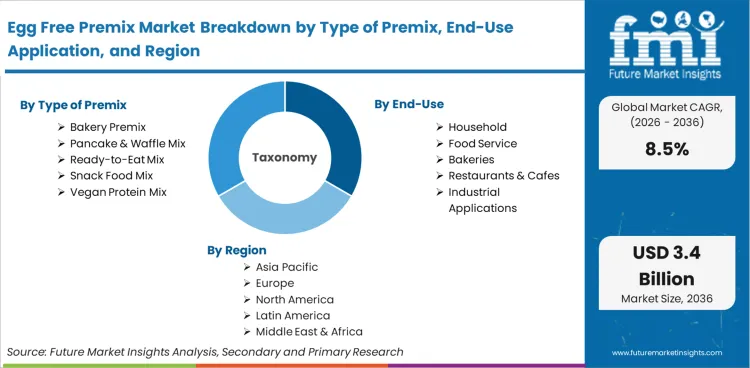
In 2025, the egg free premix market was valued at USD 1.40 billion. Based on Future Market Insights' analysis, demand for egg free premix is estimated to grow to USD 1.52 billion in 2026 and USD 3.43 billion by 2036. FMI projects a CAGR of 8.5% during the forecast period.
Absolute dollar growth of USD 1.91 billion over the decade reflects a market where ingredient technology advancement is unlocking egg replacement across an expanding range of bakery formats that previously required egg functionality for structural integrity. In February 2026, Tate and Lyle highlighted the strategic integration of CP Kelco, launching new mouthfeel chassis solutions tailored for egg reduction in bakery and dressing applications, focusing on replicating the structural role of eggs while meeting rising demand for plant-based and clean-label formulations, a product innovation that directly addresses the primary technical barrier to egg free premix adoption in premium bakery applications. [1]
Summary of Egg Free Premix Market
- Egg Free Premix Market Definition
- The market covers globally distributed pre-blended dry ingredient mixtures for bakery, pancake, waffle, snack, and vegan protein products formulated without egg or egg-derived ingredients, incorporating enzyme systems, hydrocolloids, and plant proteins to replicate egg functionality.
- Demand Drivers in the Market
- Tate and Lyle's February 2026 CP Kelco integration mouthfeel chassis launch specifically addresses egg structural replication in bakery and dressing applications, removing a key formulation barrier that previously limited egg-free premix quality parity with conventional egg-containing products.
- Novonesis' 33 new product launches in 2025 including advanced enzyme systems designed to replace egg functionality in industrial baking confirms that the ingredient technology supply chain for egg free premix formulation is expanding in depth and performance capability.
- Kerry Group's 5% bakery volume growth driven by enzyme-based and biofermentation taste solutions enabling significant egg reduction in commercial recipes confirms that large-scale foodservice and industrial bakery customers are actively converting to egg-reduced and egg-free formulations.
- Key Segments Analyzed in the FMI Report
- Type of Premix: Bakery Premix leads at 30.0% share, reflecting the highest technical complexity of egg replacement in bread, cake, and muffin applications and the largest commercial volume opportunity.
- End-Use Application: Household captures 35.0% of demand as the leading application, reflecting direct-to-consumer plant-based baking adoption and the strong vegan household cooking culture driving online retail channel premix procurement.
- Distribution Channel: Online Retail accounts for 25.0% of distribution volume, reflecting the specialty food and vegan ingredient procurement patterns of the primary household buyer base.
- Analyst Opinion at FMI
- Nandini Roy Choudhury, Principal Consultant for Food & Beverage Industry at Future Market Insights, opines, "In the updated version of the Egg Free Premix Market Report for 2026 to 2036, CXOs will find that the market's 8.5% CAGR is being driven by a technology push from the ingredient supplier side that is operating faster than consumer demand pull alone would generate. The Tate and Lyle CP Kelco mouthfeel chassis launch and Novonesis enzyme system pipeline together represent a step-change in egg functionality replication capability that is eliminating the quality gap between egg-free and conventional premix products. The critical commercial implication is that industrial bakery customers who previously rejected egg-free premix on quality grounds are now re-evaluating given both the technology improvement and the structural egg supply chain cost exposure they experienced during recent avian influenza-driven egg price volatility."
- Strategic Implications / Executive Takeaways
- Integrate Tate and Lyle CP Kelco mouthfeel chassis and Novonesis enzyme system technologies into premium egg free bakery premix formulations to close the quality gap with conventional egg-containing products and access the industrial bakery customer segment.
- Develop China-specific egg free premix product lines distributed through e-commerce channels to capture the 11.5% CAGR growth driven by vegan food culture expansion and online food ingredient procurement.
- Target foodservice and industrial bakery procurement channels with egg supply chain cost stability messaging, positioning egg-free premix as a structural input cost hedge against avian influenza-driven egg price volatility.
- Methodology
- Validated through primary interviews with egg free premix manufacturers, specialty bakery formulators, and vegan brand managers.
- Zero reliance on speculative third-party market research reports.
- Based on plant-based food industry association data, enzyme supplier financial disclosures, and e-commerce food channel sales records.
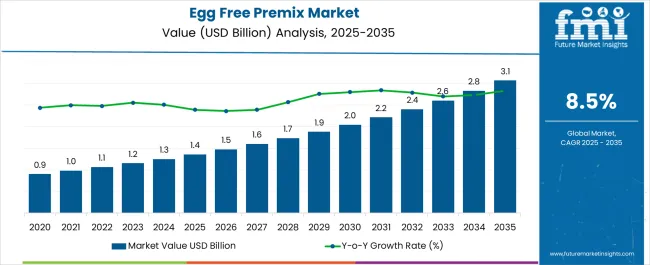
China leads regional growth at an 11.5% CAGR through 2036, driven by expanding vegan and plant-based food culture, rapid e-commerce food ingredient channel growth, and growing commercial bakery adoption of egg-free formulations for export-oriented production. Japan holds the largest individual country value at USD 0.931 billion in 2026, reflecting deep functional food premix culture and established allergy-friendly bakery product demand. The United States generates USD 0.553 billion in 2026 demand, anchored by vegan bakery retail, foodservice egg-free menu expansion, and household plant-based baking adoption. South Korea contributes USD 0.044 billion. Bakery Premix leads type at 30.0% share, Household end-use application captures 35.0%, and Online Retail accounts for 25.0% of distribution volume.
Egg Free Premix Market Definition
The egg free premix market comprises the global production, formulation, and distribution of pre-blended dry ingredient mixtures designed to produce bakery, pancake, waffle, snack, and vegan protein products without the inclusion of egg or egg-derived ingredients. Egg free premixes incorporate functional ingredient systems including enzyme preparations, hydrocolloids, plant proteins, starches, and leavening agents engineered to replicate the structural, emulsifying, binding, and foaming properties that eggs provide in conventional recipes. The market spans household consumer formats, food service bulk formats, industrial bakery premix blends, and specialty vegan protein mix applications.
Egg Free Premix Market Inclusions
The report includes global and regional market sizes by volume and value with a 10-year forecast from 2026 to 2036. Coverage spans segmental breakdowns by premix type (Bakery, Pancake and Waffle, Ready-to-Eat, Snack Food, Vegan Protein Mix), end-use application (Household, Food Service, Bakeries, Restaurants and Cafes, Industrial Applications), and distribution channel (Online Retail, Supermarkets and Hypermarkets, Specialty Stores, Convenience Stores, Direct Sales).
Egg Free Premix Market Exclusions
The scope excludes conventional premix products containing egg or egg-derived ingredients even when marketed as reduced-egg formulations. Liquid egg replacer products and standalone egg substitute ingredients not blended into premix format are excluded. Industrial bakery mixes for commercial bakery production where egg-free status is not a primary product specification and final product labeling claim are outside scope.
Egg Free Premix Market Research Methodology
- Primary Research: Interviews were conducted with egg free premix manufacturers, specialty bakery ingredient formulators, vegan food brand managers, food service procurement specialists, and retail channel buyers across the United States, Germany, the United Kingdom, China, and Japan.
- Desk Research: Production data from plant-based food industry association reports, vegan bakery market publications, enzyme system supplier annual reports from Novonesis and Kerry Group, hydrocolloid ingredient market data from Tate and Lyle, and e-commerce food ingredient channel sales statistics supported volume benchmarking.
- Market-Sizing and Forecasting: A hybrid top-down and bottom-up model was applied. Demand was reconstructed from specialty bakery retail channel sales, foodservice egg-free menu adoption data, household vegan baking product procurement records, and industrial bakery premix ingredient volumes, then validated against enzyme system and hydrocolloid supplier production capacity data.
- Data Validation and Update Cycle: Outputs undergo anomaly screening, cross-validation against plant-based food industry association data and specialty ingredient supplier financial disclosures, and structured peer review prior to release.
Why is the Egg Free Premix Market Growing?
The Egg Free Premix market is experiencing notable growth, driven by increasing consumer preference for plant-based and allergen-free bakery products. The rising awareness of egg allergies and dietary restrictions has catalyzed demand in both developed and emerging markets. The market is also being influenced by the expansion of modern retail and online distribution channels, which have facilitated easier access to premixes for households and small-scale bakeries.
In addition, the trend toward convenient, ready-to-use formulations has encouraged adoption, allowing consumers to prepare baked goods without compromising quality or taste. Advancements in food technology and ingredient innovation have also contributed to the creation of high-performance premixes that mimic the properties of traditional eggs, supporting consistent texture, volume, and flavor in baked products.
As more consumers seek healthier, sustainable, and ethical alternatives, the Egg Free Premix market is positioned to witness continued expansion, with opportunities emerging in both urban and semi-urban regions where convenience-driven consumption is rising The growing focus on functional and clean-label bakery offerings is further expected to strengthen market adoption in the coming years.
Segmental Analysis
The egg free premix market is segmented by type of premix, end-use application, distribution channel, ingredient composition, consumer demographics, and geographic regions. By type of premix, egg free premix market is divided into Bakery Premix, Pancake & Waffle Mix, Ready-to-Eat Mix, Snack Food Mix, and Vegan Protein Mix. In terms of end-use application, egg free premix market is classified into Household, Food Service, Bakeries, Restaurants & Cafes, and Industrial Applications. Based on distribution channel, egg free premix market is segmented into Online Retail, Supermarkets/Hypermarkets, Specialty Stores, Convenience Stores, and Direct Sales. By ingredient composition, egg free premix market is segmented into Plant-Based Proteins, Flours (E.g., Almond, Coconut), Starches (E.g., Potato, Tapioca), Stabilizers And Emulsifiers, and Natural Flavorings. By consumer demographics, egg free premix market is segmented into Age Group and Dietary Preference. Regionally, the egg free premix industry is classified into North America, Latin America, Western Europe, Eastern Europe, Balkan & Baltic Countries, Russia & Belarus, Central Asia, East Asia, South Asia & Pacific, and the Middle East & Africa.
Insights into the Bakery Premix Segment
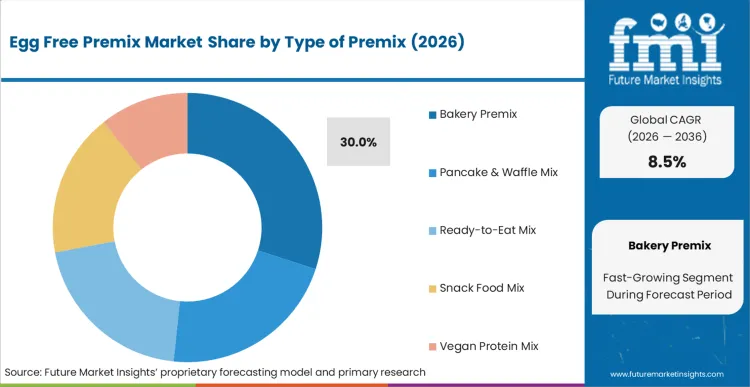
The bakery premix type is projected to account for 30.00% of the Egg Free Premix market revenue share in 2026, making it the leading segment in the type category. This dominance is attributed to its versatility, enabling the preparation of a wide variety of baked goods while maintaining consistent quality and texture without using eggs. Growth has been supported by increasing demand from both commercial bakers and household users seeking convenience and time efficiency.
The segment benefits from ongoing innovation in egg replacers and binding agents that improve product performance, making egg-free bakery products comparable to traditional recipes. Rising awareness of vegan and allergen-free diets has further strengthened adoption.
The wide applicability of bakery premixes in cakes, muffins, and pastries, combined with the convenience of ready-to-use formulations, has reinforced the preference for this segment As consumer demand for clean-label and ethical products continues to grow, bakery premixes are expected to maintain their leadership position, supported by sustained innovation and wider retail availability.
Insights into the Household End-Use Segment
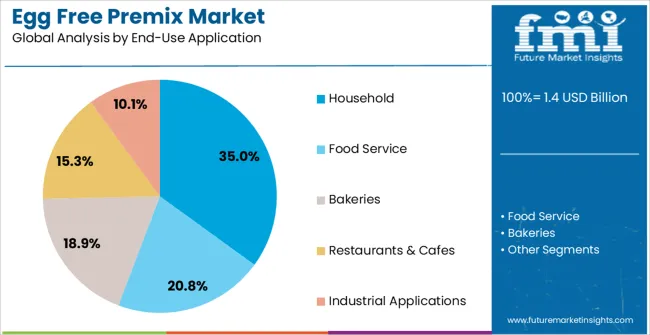
The household end-use application is anticipated to hold 35.00% of the Egg Free Premix market revenue in 2026, establishing it as the largest consumer segment. This growth has been driven by the increasing popularity of at-home baking, which is being fueled by the convenience of ready-to-use premixes and the rising interest in allergen-free and vegan lifestyles.
Consumers are seeking solutions that allow them to create high-quality baked goods without eggs, supporting consistent product performance in domestic kitchens. The segment’s expansion is also being aided by the proliferation of small kitchen appliances and growing cooking literacy among households, which encourages experimentation with new recipes and dietary alternatives.
Furthermore, easy-to-follow packaging and pre-measured formulations have enhanced consumer confidence and adoption The rising focus on healthy and sustainable eating habits, coupled with the flexibility offered by household premixes for varied recipe applications, is expected to sustain the segment’s market leadership in the near future.
Insights into the Online Retail Distribution Channel Segment
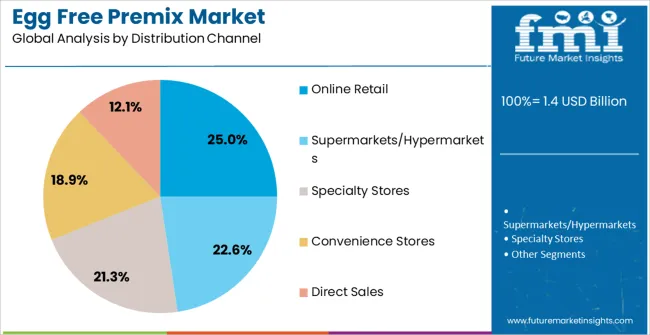
The online retail distribution channel is projected to account for 25.00% of the Egg Free Premix market revenue in 2026, emerging as a key growth driver. The increasing penetration of e-commerce platforms has enabled convenient access to a wide variety of premix products, including premium and specialty offerings that may not be widely available in traditional retail stores. This channel has facilitated direct engagement with consumers seeking niche, allergen-free, or vegan baking solutions.
Growth has been supported by the ability to provide detailed product information, recipe guidance, and customer reviews, enhancing buyer confidence and repeat purchases. The online channel also allows manufacturers to reach geographically dispersed markets efficiently, reducing logistical challenges associated with perishable or specialty products.
The flexibility to offer subscription models, bulk packs, and promotional discounts has further strengthened adoption As digital literacy and e-commerce adoption continue to rise globally, the online retail channel is expected to play a critical role in sustaining the Egg Free Premix market’s growth and accessibility.
Market Overview
Egg Free Premix Market: Marching into the Era of Vegan Culture
In recent years, the global food industry has been undergoing radical upheaval, on the account of emergence of disruptive trends and technologies. With the rise of vegan culture, meatless meat has grown in popularity, plant-based products are making tremendous strides, and many of concerns about meat production are applied to eggs as strongly.
Over the years, eggs continue to ride on versatility quotient; used as a bakery ingredient, and in custards, omelets, and deviled eggs. However, as vegan or plant-based products continue to gain increasing momentum, demand for egg substitutes for individual recipes is moving on an upward swing.
Additionally, due to sprung in number of working population, hectic schedules, and changing lifestyles, demand for convenience, number of meals-to-go hitting the shelves, and replacement of traditional meals by all-day snacking have been growing on a significant pace.
In line with rising popularity of egg-free products and rapid emergence of ‘on-the-go’ trend, Future Market Insights, in its new study, explores the development of the egg free premix market. It discusses growth and innovation trends in ready-to-mix food market in general and egg free premix market in particular, while evaluating opportunities and challenges in numerous regional markets.
Analysis of Egg Free Premix Market By Key Countries
.webp "Top Country Growth Comparison Egg Free Premix Market Cagr (2026 2036)")
| Country | CAGR |
|---|---|
| China | 11.5% |
| India | 10.6% |
| Germany | 9.8% |
| Brazil | 8.9% |
| USA | 8.1% |
| UK | 7.2% |
| Japan | 6.4% |
Source: FMI analysis based on primary research and proprietary forecasting model
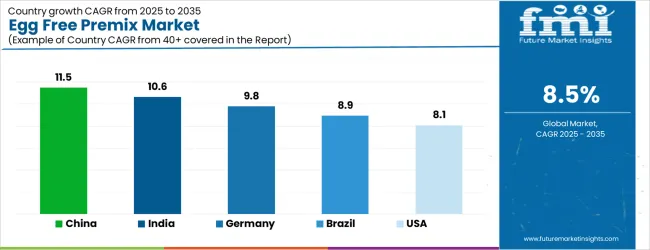
The Egg Free Premix Market is expected to register a CAGR of 8.5% during the forecast period, exhibiting varied country level momentum. China leads with the highest CAGR of 11.5%, followed by India at 10.6%. Developed markets such as Germany, France, and the UK continue to expand steadily, while the USA is likely to grow at consistent rates. Japan posts the lowest CAGR at 6.4%, yet still underscores a broadly positive trajectory for the global Egg Free Premix Market. In 2024, Germany held a dominant revenue in the Western Europe market and is expected to grow with a CAGR of 9.8%. The USA Egg Free Premix Market is estimated to be valued at USD 473.2 million in 2025 and is anticipated to reach a valuation of USD 473.2 million by 2035. Sales are projected to rise at a CAGR of 0.0% over the forecast period between 2025 and 2035. While Japan and South Korea markets are estimated to be valued at USD 71.4 million and USD 39.3 million respectively in 2025.
Key Players in the Egg Free Premix Market
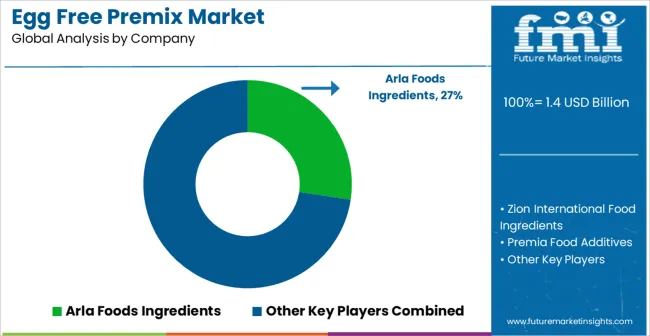
- Arla Foods Ingredients
- Zion International Food Ingredients
- Premia Food Additives
- Swiss Bake Ingredients
- Crust n Crumb Food Ingredients
- HARSHA ENTERPRISES
- The Blue Ingredients
- Bunge
- Puratos Group
Recent Developments
The report includes full coverage of key trends from competitive benchmarking. Some of the recent developments covered in the reports:
- In February 2026, Tate and Lyle highlighted the strategic integration of CP Kelco, launching new mouthfeel chassis solutions tailored for egg reduction in bakery and dressing applications, replicating egg structural roles while meeting clean-label and plant-based formulation demands. [1]
- In February 2026, Novonesis reported robust 2025 bakery segment growth driven by 33 new product launches including advanced enzyme systems specifically designed to replace egg functionality in industrial baking, improving crumb structure and shelf-life stability. [2]
- In February 2026, Kerry Group reported 5% volume growth in its bakery segment for 2025, fuelled by commercialisation of enzyme-based systems and biofermentation-derived taste solutions enabling significant egg reduction in high-volume commercial recipes. [3]
Scope of the Report
| Metric | Value |
|---|---|
| Quantitative Units | USD 1.52 billion (2026) to USD 3.43 billion (2036), at a CAGR of 8.5% |
| Market Definition | The egg free premix market covers globally distributed pre-blended dry ingredient mixtures for bakery, pancake, waffle, snack, and vegan protein products formulated without egg or egg-derived ingredients, using enzyme systems, hydrocolloids, and plant proteins to replicate egg functionality. |
| Type of Premix | Bakery Premix, Pancake and Waffle Mix, Ready-to-Eat Mix, Snack Food Mix, Vegan Protein Mix |
| End-Use Application | Household, Food Service, Bakeries, Restaurants and Cafes, Industrial Applications |
| Distribution Channel | Online Retail, Supermarkets and Hypermarkets, Specialty Stores, Convenience Stores, Direct Sales |
| Regions Covered | North America, Latin America, Europe, East Asia, South Asia, Oceania, Middle East and Africa |
| Countries Covered | United States, Germany, United Kingdom, France, China, Japan, South Korea, India, Australia, Brazil and 40 plus countries |
| Key Companies Profiled | Arla Foods Ingredients, Zion International Food Ingredients, Premia Food Additives, Swiss Bake Ingredients, Crust n Crumb Food Ingredients, The Blue Ingredients, Bunge, Puratos Group, Archer Daniels Midland Company, Cargill Incorporated, Roquette Freres |
| Forecast Period | 2026 to 2036 |
| Approach | Hybrid top-down and bottom-up market modeling validated through primary interviews with premix manufacturers and specialty bakery formulators, supported by plant-based industry association data and enzyme supplier financial disclosures |
Egg Free Premix Market by Segments
Type of Premix:
- Bakery Premix
- Pancake & Waffle Mix
- Ready-to-Eat Mix
- Snack Food Mix
- Vegan Protein Mix
End-Use Application:
- Household
- Food Service
- Bakeries
- Restaurants & Cafes
- Industrial Applications
Distribution Channel:
- Online Retail
- Supermarkets/Hypermarkets
- Specialty Stores
- Convenience Stores
- Direct Sales
Ingredient Composition:
- Plant-Based Proteins
- Flours (E.g., Almond, Coconut)
- Starches (E.g., Potato, Tapioca)
- Stabilizers And Emulsifiers
- Natural Flavorings
Consumer Demographics:
- Age Group
- Dietary Preference
Region:
- North America
- USA
- Canada
- Mexico
- Latin America
- Brazil
- Chile
- Rest of Latin America
- Western Europe
- Germany
- UK
- Italy
- Spain
- France
- Nordic
- BENELUX
- Rest of Western Europe
- Eastern Europe
- Russia
- Poland
- Hungary
- Balkan & Baltic
- Rest of Eastern Europe
- East Asia
- China
- Japan
- South Korea
- South Asia and Pacific
- India
- ASEAN
- Australia & New Zealand
- Rest of South Asia and Pacific
- Middle East & Africa
- Kingdom of Saudi Arabia
- Other GCC Countries
- Turkiye
- South Africa
- Other African Union
- Rest of Middle East & Africa
Bibliography
- [1] Tate and Lyle. (2026). Tate and Lyle results for six months to 30 September 2025: CP Kelco integration and mouthfeel chassis for egg reduction. February 2026.
- [2] GlobeNewsWire / Novonesis. (2026). Novonesis delivered strong organic sales growth of 7% in 2025 including 33 new bakery enzyme product launches. February 2026.
- [3] Food Ingredients First / Kerry Group. (2026). Kerry taste innovation FY2025: 5% bakery volume growth from enzyme and biofermentation systems. February 2026.
- [4] Good Food Institute. (2025). Plant-Based Food Industry State of the Industry Report 2025. GFI, Washington DC.
This Report Addresses
- Market intelligence to enable structured formulation, ingredient sourcing, and channel strategy decisions across household, foodservice, bakery, and industrial egg free premix segments
- Market size estimation and 10-year revenue forecasts from 2026 to 2036, supported by validated plant-based industry data and enzyme supplier financial benchmarks
- Growth opportunity mapping across premix type, end-use application, and distribution channel segments with emphasis on mouthfeel technology integration, China e-commerce expansion, and industrial bakery conversion
- Segment and regional revenue forecasts covering bakery, pancake, waffle, snack, and vegan protein premix types across household, foodservice, and industrial channels in 40 plus countries
- Competition strategy assessment including enzyme system integration, China-specific product development, and egg supply chain cost stability positioning for industrial bakery customers
- Regulatory impact analysis covering vegan and plant-based labeling standards, egg-free allergen claim frameworks, and clean-label ingredient documentation requirements
- Technology innovation tracking covering enzyme-based egg replacement systems, hydrocolloid mouthfeel replication, and plant protein structural functionality developments
- Market report delivery in PDF, Excel, PPT, and interactive dashboard formats for executive and operational use
Frequently Asked Questions
How large is the demand for Egg Free Premix in the global market in 2026?
Demand for Egg Free Premix in the global market is estimated to be valued at USD 1.52 billion in 2026.
What will the market size of Egg Free Premix be by 2036?
Market size for Egg Free Premix is projected to reach USD 3.43 billion by 2036.
What is the expected CAGR for the Egg Free Premix Market between 2026 and 2036?
Demand for Egg Free Premix is expected to grow at a CAGR of 8.5% between 2026 and 2036.
Which Type of Premix leads the Egg Free Premix Market in 2026?
Bakery Premix leads at 30.0% type share, reflecting the highest technical complexity of egg replacement in bread, cake, and muffin applications and the largest commercial volume opportunity.
Which End-Use Application dominates the Egg Free Premix Market?
Household captures 35.0% of demand as the leading application, driven by direct-to-consumer plant-based baking adoption and vegan household cooking culture.
What is driving China's growth in the Egg Free Premix Market?
China leads regional growth at an 11.5% CAGR through 2036, driven by expanding vegan food culture, rapid e-commerce food ingredient growth, and commercial bakery adoption of egg-free formulations.
What is the United States market value for Egg Free Premix in 2026?
The United States generates USD 0.553 billion in 2026 demand, anchored by vegan bakery retail, foodservice egg-free menu expansion, and household plant-based baking adoption.
What does Tate and Lyle's CP Kelco mouthfeel chassis mean for egg replacement?
The February 2026 launch specifically addresses egg structural replication in bakery applications, removing a key formulation barrier that previously limited quality parity between egg-free and conventional egg-containing premix products.
What is included in the scope of this report?
Scope covers pre-blended dry ingredient mixtures for bakery, pancake, waffle, snack, and vegan protein products formulated without egg or egg-derived ingredients across household, foodservice, and industrial applications.
What is excluded from this report's scope?
Conventional premixes containing egg ingredients, liquid egg replacer products not in premix format, and industrial mixes where egg-free status is not a primary product specification are excluded.
How does FMI validate its Egg Free Premix Market forecast?
The forecast uses a hybrid model validated through primary interviews with premix manufacturers and bakery formulators, cross-checked against plant-based industry association data and enzyme supplier financial disclosures.
Preview the report firsthand - request a free sample
Get SampleGet the brochure for pricing and purchase details.
Get PDFTable of Content
- Executive Summary
- Global Market Outlook
- Demand-side Trends
- Supply-side Trends
- Technology Roadmap Analysis
- Analysis and Recommendations
- Market Overview
- Market Coverage / Taxonomy
- Market Definition / Scope / Limitations
- Research Methodology
- Chapter Orientation
- Analytical Lens and Working Hypotheses
- Market Structure, Signals, and Trend Drivers
- Benchmarking and Cross-market Comparability
- Market Sizing, Forecasting, and Opportunity Mapping
- Research Design and Evidence Framework
- Desk Research Programme (Secondary Evidence)
- Company Annual and Sustainability Reports
- Peer-reviewed Journals and Academic Literature
- Corporate Websites, Product Literature, and Technical Notes
- Earnings Decks and Investor Briefings
- Statutory Filings and Regulatory Disclosures
- Technical White Papers and Standards Notes
- Trade Journals, Industry Magazines, and Analyst Briefs
- Conference Proceedings, Webinars, and Seminar Materials
- Government Statistics Portals and Public Data Releases
- Press Releases and Reputable Media Coverage
- Specialist Newsletters and Curated Briefings
- Sector Databases and Reference Repositories
- FMI Internal Proprietary Databases and Historical Market Datasets
- Subscription Datasets and Paid Sources
- Social Channels, Communities, and Digital Listening Inputs
- Additional Desk Sources
- Expert Input and Fieldwork (Primary Evidence)
- Primary Modes
- Qualitative Interviews and Expert Elicitation
- Quantitative Surveys and Structured Data Capture
- Blended Approach
- Why Primary Evidence is Used
- Field Techniques
- Interviews
- Surveys
- Focus Groups
- Observational and In-context Research
- Social and Community Interactions
- Stakeholder Universe Engaged
- C-suite Leaders
- Board Members
- Presidents and Vice Presidents
- R&D and Innovation Heads
- Technical Specialists
- Domain Subject-matter Experts
- Scientists
- Physicians and Other Healthcare Professionals
- Governance, Ethics, and Data Stewardship
- Research Ethics
- Data Integrity and Handling
- Primary Modes
- Tooling, Models, and Reference Databases
- Desk Research Programme (Secondary Evidence)
- Data Engineering and Model Build
- Data Acquisition and Ingestion
- Cleaning, Normalisation, and Verification
- Synthesis, Triangulation, and Analysis
- Quality Assurance and Audit Trail
- Market Background
- Market Dynamics
- Drivers
- Restraints
- Opportunity
- Trends
- Scenario Forecast
- Demand in Optimistic Scenario
- Demand in Likely Scenario
- Demand in Conservative Scenario
- Opportunity Map Analysis
- Product Life Cycle Analysis
- Supply Chain Analysis
- Investment Feasibility Matrix
- Value Chain Analysis
- PESTLE and Porter’s Analysis
- Regulatory Landscape
- Regional Parent Market Outlook
- Production and Consumption Statistics
- Import and Export Statistics
- Market Dynamics
- Global Market Analysis 2021 to 2025 and Forecast, 2026 to 2036
- Historical Market Size Value (USD Million) Analysis, 2021 to 2025
- Current and Future Market Size Value (USD Million) Projections, 2026 to 2036
- Y-o-Y Growth Trend Analysis
- Absolute $ Opportunity Analysis
- Global Market Pricing Analysis 2021 to 2025 and Forecast 2026 to 2036
- Global Market Analysis 2021 to 2025 and Forecast 2026 to 2036, By Type of Premix
- Introduction / Key Findings
- Historical Market Size Value (USD Million) Analysis By Type of Premix , 2021 to 2025
- Current and Future Market Size Value (USD Million) Analysis and Forecast By Type of Premix , 2026 to 2036
- Bakery Premix
- Pancake & Waffle Mix
- Ready-to-Eat Mix
- Snack Food Mix
- Vegan Protein Mix
- Bakery Premix
- Y-o-Y Growth Trend Analysis By Type of Premix , 2021 to 2025
- Absolute $ Opportunity Analysis By Type of Premix , 2026 to 2036
- Global Market Analysis 2021 to 2025 and Forecast 2026 to 2036, By End-Use Application
- Introduction / Key Findings
- Historical Market Size Value (USD Million) Analysis By End-Use Application, 2021 to 2025
- Current and Future Market Size Value (USD Million) Analysis and Forecast By End-Use Application, 2026 to 2036
- Household
- Food Service
- Bakeries
- Restaurants & Cafes
- Industrial Applications
- Household
- Y-o-Y Growth Trend Analysis By End-Use Application, 2021 to 2025
- Absolute $ Opportunity Analysis By End-Use Application, 2026 to 2036
- Global Market Analysis 2021 to 2025 and Forecast 2026 to 2036, By Distribution Channel
- Introduction / Key Findings
- Historical Market Size Value (USD Million) Analysis By Distribution Channel, 2021 to 2025
- Current and Future Market Size Value (USD Million) Analysis and Forecast By Distribution Channel, 2026 to 2036
- Online Retail
- Supermarkets/Hypermarkets
- Specialty Stores
- Convenience Stores
- Direct Sales
- Online Retail
- Y-o-Y Growth Trend Analysis By Distribution Channel, 2021 to 2025
- Absolute $ Opportunity Analysis By Distribution Channel, 2026 to 2036
- Global Market Analysis 2021 to 2025 and Forecast 2026 to 2036, By Region
- Introduction
- Historical Market Size Value (USD Million) Analysis By Region, 2021 to 2025
- Current Market Size Value (USD Million) Analysis and Forecast By Region, 2026 to 2036
- North America
- Latin America
- Western Europe
- Eastern Europe
- East Asia
- South Asia and Pacific
- Middle East & Africa
- Market Attractiveness Analysis By Region
- North America Market Analysis 2021 to 2025 and Forecast 2026 to 2036, By Country
- Historical Market Size Value (USD Million) Trend Analysis By Market Taxonomy, 2021 to 2025
- Market Size Value (USD Million) Forecast By Market Taxonomy, 2026 to 2036
- By Country
- USA
- Canada
- Mexico
- By Type of Premix
- By End-Use Application
- By Distribution Channel
- By Country
- Market Attractiveness Analysis
- By Country
- By Type of Premix
- By End-Use Application
- By Distribution Channel
- Key Takeaways
- Latin America Market Analysis 2021 to 2025 and Forecast 2026 to 2036, By Country
- Historical Market Size Value (USD Million) Trend Analysis By Market Taxonomy, 2021 to 2025
- Market Size Value (USD Million) Forecast By Market Taxonomy, 2026 to 2036
- By Country
- Brazil
- Chile
- Rest of Latin America
- By Type of Premix
- By End-Use Application
- By Distribution Channel
- By Country
- Market Attractiveness Analysis
- By Country
- By Type of Premix
- By End-Use Application
- By Distribution Channel
- Key Takeaways
- Western Europe Market Analysis 2021 to 2025 and Forecast 2026 to 2036, By Country
- Historical Market Size Value (USD Million) Trend Analysis By Market Taxonomy, 2021 to 2025
- Market Size Value (USD Million) Forecast By Market Taxonomy, 2026 to 2036
- By Country
- Germany
- UK
- Italy
- Spain
- France
- Nordic
- BENELUX
- Rest of Western Europe
- By Type of Premix
- By End-Use Application
- By Distribution Channel
- By Country
- Market Attractiveness Analysis
- By Country
- By Type of Premix
- By End-Use Application
- By Distribution Channel
- Key Takeaways
- Eastern Europe Market Analysis 2021 to 2025 and Forecast 2026 to 2036, By Country
- Historical Market Size Value (USD Million) Trend Analysis By Market Taxonomy, 2021 to 2025
- Market Size Value (USD Million) Forecast By Market Taxonomy, 2026 to 2036
- By Country
- Russia
- Poland
- Hungary
- Balkan & Baltic
- Rest of Eastern Europe
- By Type of Premix
- By End-Use Application
- By Distribution Channel
- By Country
- Market Attractiveness Analysis
- By Country
- By Type of Premix
- By End-Use Application
- By Distribution Channel
- Key Takeaways
- East Asia Market Analysis 2021 to 2025 and Forecast 2026 to 2036, By Country
- Historical Market Size Value (USD Million) Trend Analysis By Market Taxonomy, 2021 to 2025
- Market Size Value (USD Million) Forecast By Market Taxonomy, 2026 to 2036
- By Country
- China
- Japan
- South Korea
- By Type of Premix
- By End-Use Application
- By Distribution Channel
- By Country
- Market Attractiveness Analysis
- By Country
- By Type of Premix
- By End-Use Application
- By Distribution Channel
- Key Takeaways
- South Asia and Pacific Market Analysis 2021 to 2025 and Forecast 2026 to 2036, By Country
- Historical Market Size Value (USD Million) Trend Analysis By Market Taxonomy, 2021 to 2025
- Market Size Value (USD Million) Forecast By Market Taxonomy, 2026 to 2036
- By Country
- India
- ASEAN
- Australia & New Zealand
- Rest of South Asia and Pacific
- By Type of Premix
- By End-Use Application
- By Distribution Channel
- By Country
- Market Attractiveness Analysis
- By Country
- By Type of Premix
- By End-Use Application
- By Distribution Channel
- Key Takeaways
- Middle East & Africa Market Analysis 2021 to 2025 and Forecast 2026 to 2036, By Country
- Historical Market Size Value (USD Million) Trend Analysis By Market Taxonomy, 2021 to 2025
- Market Size Value (USD Million) Forecast By Market Taxonomy, 2026 to 2036
- By Country
- Kingdom of Saudi Arabia
- Other GCC Countries
- Turkiye
- South Africa
- Other African Union
- Rest of Middle East & Africa
- By Type of Premix
- By End-Use Application
- By Distribution Channel
- By Country
- Market Attractiveness Analysis
- By Country
- By Type of Premix
- By End-Use Application
- By Distribution Channel
- Key Takeaways
- Key Countries Market Analysis
- USA
- Pricing Analysis
- Market Share Analysis, 2025
- By Type of Premix
- By End-Use Application
- By Distribution Channel
- Canada
- Pricing Analysis
- Market Share Analysis, 2025
- By Type of Premix
- By End-Use Application
- By Distribution Channel
- Mexico
- Pricing Analysis
- Market Share Analysis, 2025
- By Type of Premix
- By End-Use Application
- By Distribution Channel
- Brazil
- Pricing Analysis
- Market Share Analysis, 2025
- By Type of Premix
- By End-Use Application
- By Distribution Channel
- Chile
- Pricing Analysis
- Market Share Analysis, 2025
- By Type of Premix
- By End-Use Application
- By Distribution Channel
- Germany
- Pricing Analysis
- Market Share Analysis, 2025
- By Type of Premix
- By End-Use Application
- By Distribution Channel
- UK
- Pricing Analysis
- Market Share Analysis, 2025
- By Type of Premix
- By End-Use Application
- By Distribution Channel
- Italy
- Pricing Analysis
- Market Share Analysis, 2025
- By Type of Premix
- By End-Use Application
- By Distribution Channel
- Spain
- Pricing Analysis
- Market Share Analysis, 2025
- By Type of Premix
- By End-Use Application
- By Distribution Channel
- France
- Pricing Analysis
- Market Share Analysis, 2025
- By Type of Premix
- By End-Use Application
- By Distribution Channel
- India
- Pricing Analysis
- Market Share Analysis, 2025
- By Type of Premix
- By End-Use Application
- By Distribution Channel
- ASEAN
- Pricing Analysis
- Market Share Analysis, 2025
- By Type of Premix
- By End-Use Application
- By Distribution Channel
- Australia & New Zealand
- Pricing Analysis
- Market Share Analysis, 2025
- By Type of Premix
- By End-Use Application
- By Distribution Channel
- China
- Pricing Analysis
- Market Share Analysis, 2025
- By Type of Premix
- By End-Use Application
- By Distribution Channel
- Japan
- Pricing Analysis
- Market Share Analysis, 2025
- By Type of Premix
- By End-Use Application
- By Distribution Channel
- South Korea
- Pricing Analysis
- Market Share Analysis, 2025
- By Type of Premix
- By End-Use Application
- By Distribution Channel
- Russia
- Pricing Analysis
- Market Share Analysis, 2025
- By Type of Premix
- By End-Use Application
- By Distribution Channel
- Poland
- Pricing Analysis
- Market Share Analysis, 2025
- By Type of Premix
- By End-Use Application
- By Distribution Channel
- Hungary
- Pricing Analysis
- Market Share Analysis, 2025
- By Type of Premix
- By End-Use Application
- By Distribution Channel
- Kingdom of Saudi Arabia
- Pricing Analysis
- Market Share Analysis, 2025
- By Type of Premix
- By End-Use Application
- By Distribution Channel
- Turkiye
- Pricing Analysis
- Market Share Analysis, 2025
- By Type of Premix
- By End-Use Application
- By Distribution Channel
- South Africa
- Pricing Analysis
- Market Share Analysis, 2025
- By Type of Premix
- By End-Use Application
- By Distribution Channel
- USA
- Market Structure Analysis
- Competition Dashboard
- Competition Benchmarking
- Market Share Analysis of Top Players
- By Regional
- By Type of Premix
- By End-Use Application
- By Distribution Channel
- Competition Analysis
- Competition Deep Dive
- Arla Foods Ingredients
- Overview
- Product Portfolio
- Profitability by Market Segments (Product/Age /Sales Channel/Region)
- Sales Footprint
- Strategy Overview
- Marketing Strategy
- Product Strategy
- Channel Strategy
- Zion International Food Ingredients
- Premia Food Additives
- Swiss Bake Ingredients
- Crust n Crumb Food Ingredients
- HARSHA ENTERPRISES
- The Blue Ingredients
- Bunge
- Puratos Group
- Arla Foods Ingredients
- Competition Deep Dive
- Assumptions & Acronyms Used


