

- Market Size (2026)
- USD 452.8 Mn
- Forecast (2036)
- USD 683.3 Mn
- CAGR (2026 to 2036)
- 4.2%
How big is Metal Feeler Gauge Market in 2026?
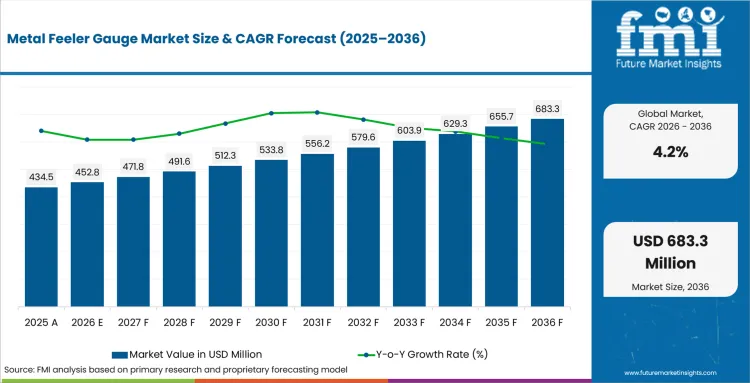
USD 452.8 million in 2026 and USD 683.3 million by 2036 at a 4.2% CAGR.
Sales of metal feeler gauges are estimated to rise at 4.2% CAGR through 2036, increasing valuation from USD 452.8 million in 2026 to USD 683.3 million by 2036. Workshop accuracy depends on a traceable dimensional chain that connects master standards with portable tools used during adjustment work. NIST reported in March 2025 that calibrated gage blocks carry accurate size standards into thousands of manufacturing sites and machine shops. The traceability requirement strengthens demand for readable markings and controlled leaf thickness across calibration equipment used during production and maintenance routines.
Automotive workshops use feeler gauges during valve clearance and spark plug work that cannot be judged reliably by sight. Manufacturing plants use the same tools during machine setup to confirm gaps before adjustment or assembly continues. The U.S. Bureau of Labor Statistics reported in May 2026 that 704,640 automotive service technicians and mechanics worked during May 2025. The technician workforce sustains a wide distribution route for automotive repair services and routine replacement of worn gauge sets. Garage service operations favor portable gauges for immediate readings, but inconsistent storage and insertion pressure reduce repeatability across shared tool inventories. Facilities with formal tool checks remove damaged leaves earlier and preserve more consistent readings across shared kits.
Key Takeaways of Metal Feeler Gauge Market
- Recurring clearance checks across vehicle servicing and machine setup support replacement demand for portable metal feeler gauge sets.
- Stainless steel is expected to account for 48.0% by material in 2026 owing to corrosion resistance and repeatable leaf stiffness.
- Direct sales are projected to represent 39.0% share in 2026 supported by specification control and account service.
- Automotive industry is anticipated to capture 36.0% of end-user revenue in 2026 reflecting frequent engine and component clearance checks.
- Poor storage and excessive insertion force reduce measurement reliability through bent leaves with damaged markings or surface corrosion.
- Mitutoyo Corporation and Starrett focus on metrology support while professional workshop brands compete through technician access and application breadth.
Analyst Perspective
“Metal feeler gauges retain a practical role by confirming narrow clearances at the component without power or setup time. Standard sets compete through price and availability, yet premium ranges need traceable thickness and durable markings alongside corrosion resistance and restricted-access blade designs. Manufacturers that document those attributes can earn repeat orders from controlled maintenance programs instead of relying on a larger blade count.”
- Nikhil Kaitwade, Principal Analyst, Future Market Insights
How is the Metal Feeler Gauge Market segmented?
The metal feeler gauge industry is segmented by product type, application, end user, distribution channel, material, and region.
The segmentation framework separates gauge design from operating use, customer setting, sales route, material choice, and geographic demand conditions. Product type distinguishes straight, tapered, offset, brass, and specialty forms according to blade geometry and access requirements. Application tracks clearance tasks across automotive maintenance, industrial machinery, aerospace engineering, fabrication, and power-generation work. End user identifies the organization responsible for tool control, technician training, replacement budgets, and measurement accountability. Distribution channel separates direct accounts, industrial distributors, online retail, tool stores, and catalogue-based purchasing routes. Material compares stainless steel with carbon steel, brass, titanium, and composite alternatives used under different contact conditions. Regional analysis examines how service networks, calibration expectations, workshop practices, and replacement access affect commercial demand.
How do maintenance teams evaluate stainless steel feeler gauges by product type?
Straight and folding leaf sets serve different access conditions across engines and industrial assemblies during routine maintenance work. Thickness range matters, but blade geometry determines whether a technician can reach the gap without bending the leaf. ISO published ISO 14405-1 in 2025 to define dimensional tolerancing requirements for linear sizes across engineering applications. The standard supports clear thickness specifications across measuring tools that depend on controlled linear dimensions. Dimensional metrology systems provide a related route for organizations requiring traceable checks beside portable clearance measurement.
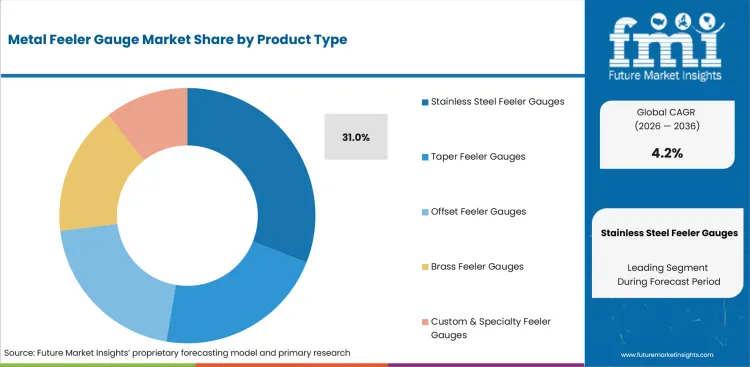
- Stainless steel feeler gauges are set to lead the product type category with 31.0% share in 2026, supported by broad availability across standard thickness ranges. Clear etching and consistent leaf finish support repeat orders across mixed maintenance environments and daily workshop handling. Commercial strength depends on dimensional consistency and durable markings rather than blade quantity alone across professional programs.
- Engineering teams favor stainless sets for routine checks exposed to oil and humid storage conditions. Clear markings shorten blade selection during repeated adjustments, and corrosion resistance protects leaf condition between service events. Adoption weakens across facilities that retain damaged leaves without scheduled comparison against a trusted dimensional reference and documented replacement rules.
What supports automotive maintenance within the application category?
Automotive maintenance uses feeler gauges for valve lash and spark plug gaps that require direct confirmation at the component. Restricted engine-bay access makes blade angle and length commercially relevant beside thickness coverage during routine service. The U.S. Bureau of Labor Statistics reported in May 2026 that repair and maintenance businesses employed 254,270 automotive service technicians during May 2025. The workforce supports recurring tool replacement across independent garages and service networks with dealership workshops. Automotive spark plug systems preserve a familiar clearance workflow that favors immediate physical readings across vehicle platforms.
- By application, automotive maintenance is forecast to represent 34.0% in 2026 driven by recurring service intervals and immediate physical verification. Rapid readings reduce setup time during mechanical adjustments across busy service bays and recurring repair schedules. The position rests on frequent use across common repair tasks within professional workshops rather than occasional specialist inspection.
- Independent garages favor compact sets that travel between service bays and cover several vehicle platforms during daily repair work. Rounded blade ends and readable markings reduce handling errors across repeated spark plug and valve adjustments. Wider adoption depends on dependable local replacement for contaminated or bent leaves within shared workshop inventories.
Why does automotive industry account for the largest end-user share?
Automotive manufacturers and service networks maintain standardized toolkits for narrow clearance checks across engines and mechanical assemblies. Electronic diagnostics identify faults before technicians begin physical adjustments inside modern service bays and dealership networks. Snap-on introduced its third-generation TRITON scan tool in May 2025 with guided component tests and manufacturer-level diagnostic coverage. The platform narrows electronic fault searches while manual gauges retain a separate role during direct valve and bearing adjustments. Test and measurement sensors provide a related comparison for recorded inspection workflows across production sites.
- Based on end user, the automotive industry is projected to account for 36.0% in 2026 owing to repeated clearance checks across manufacturing and service networks. Manual gauges remain practical for localized adjustments that lack installed sensors across multiple service locations. The position benefits from established technician routines and controlled replacement of damaged tools across larger workshop networks.
- Automotive organizations standardize blade ranges to reduce measurement variation across technicians and service locations during repeated service work. Common sets simplify training and allow supervisors to define consistent replacement rules across large workshop networks. Repeated misuse can damage thin leaves without obvious early warning, so expansion depends on controlled insertion force and recorded tool condition.
How does direct sales shape the distribution-channel category?
Large industrial accounts combine gauge replenishment with calibration support and standardized purchasing across several facilities. Direct relationships matter across multi-plant programs that require one technical specification to remain consistent across locations. Mitutoyo opened an 11,200-square-foot Lakeland Metrology Service Center in May 2026 with calibration and applications support for regional manufacturers. The expansion gives nearby plants one route for training and documented measurement support beside routine tool ordering. Instrument calibration services provide a related comparison for accounts that require recurring support beyond catalogue purchases.
- Direct sales are projected to hold 39.0% share in 2026, attributable to specification control and account-level technical support. Large users standardize blade ranges across maintenance teams through repeat ordering and scheduled replenishment across multiple plants. The channel handles technical questions involving certificates and specialized material choices within multi-plant programs across several operating sites.
- Industrial organizations use direct agreements for scheduled replenishment and consolidated technical questions across several operating locations. Account-level support helps engineering teams maintain one approved thickness range and certificate requirement across plants. The channel loses its advantage for commodity sets that require no documentation and receive faster local replacement through established distributors.
What keeps stainless steel ahead within the material category?
Stainless steel combines thin-section flexibility with corrosion resistance across routine workshop storage and repeated handling. Corrosion and embedded contamination can change insertion feel across very narrow gaps, making surface condition commercially important. ISO published ISO 18971 in 2026 to standardize monitoring of stainless-steel corrosion states in industrial cooling water. The standard reinforces the wider engineering need to track surface degradation across stainless components exposed to moisture. Material selection directly affects service life and measurement confidence across reusable gauge sets in shared workshop inventories.
- In 2026, stainless steel is expected to lead the material category with 48.0% share reinforced by corrosion resistance and repeatable leaf stiffness. Broad thickness coverage and resilient leaf edges support repeated use across maintenance routines and repair work. The position reflects practical service life rather than universal suitability across every operating condition and material restriction.
- Maintenance teams select stainless steel for reusable sets exposed to oil and intermittent moisture during normal service work. The material supports frequent handling without specialized storage across most automotive and machinery settings with repeated handling. Material choice changes contact risk and acceptable measurement conditions, so brass options gain preference near magnetic equipment or sensitive surfaces.
What are the drivers, restraints, and opportunities in the Metal Feeler Gauge Market?
Recurring clearance checks support replacement demand, damaged leaves limit measurement confidence, traceable and specialized formats support premium applications.
- Driver: Installed vehicles and machinery create recurring clearance checks across maintenance schedules and repair events.
- Restraint: Corrosion and bent leaves reduce measurement confidence across poorly controlled storage and replacement routines.
- Opportunity: Traceable sets and specialized blade designs support higher-value applications across controlled maintenance environments with documented verification requirements.
Industrial machinery maintenance sustains repeat use of portable gap gauges through adjustments that require a direct reading at the component. The U.S. Bureau of Labor Statistics reported in May 2026 that 541,070 people worked in industrial machinery installation and repair occupations during May 2025. The workforce defines a broad operating base for gauges used during setup and repair across industrial facilities. Incorrect gaps can raise wear and reduce equipment performance, making plain bearing maintenance another routine clearance task.
Corroded or bent leaves weaken measurement confidence across facilities that lack formal inspection and replacement routines. Surface contamination changes insertion feel, and technicians can apply different pressure to the same gap. Starrett reported in February 2025 that its wireless data-collection test reduced recording time to 6.6 seconds per part with no entry errors. Recorded systems gain an advantage in documented inspection programs that require traceable and repeatable results. Manual gauges remain suitable for quick localized checks, provided tool condition and replacement rules are controlled.
Traceable sets and specialized blade formats support premium positions across maintenance programs with defined tolerance requirements. Long blades reach restricted assemblies, whereas brass blades serve nonmagnetic or spark-sensitive work near electrical equipment. INSIZE added digital gap gauges to its official new-product program in April 2025 for industrial users. The launch expanded the choice between manual and electronic clearance tools across industrial applications and maintenance teams. Manual-gauge manufacturers can defend higher prices through calibration certificates, protected packaging, and application-specific geometry rather than larger blade counts.
Which country CAGRs are profiled in the Metal Feeler Gauge Market?
| Country | CAGR |
|---|---|
| Germany | 5.5% |
| USA | 5.0% |
| South Korea | 4.6% |
| Brazil | 4.2% |
| UK | 3.8% |
| Japan | 3.4% |
| Canada | 2.9% |
How do country-level CAGRs compare in the Metal Feeler Gauge Market?
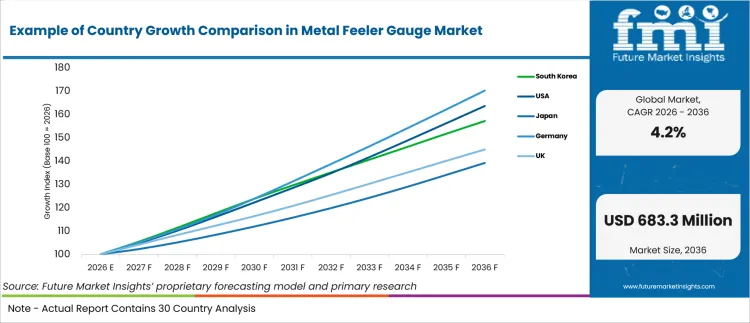
The profiled rates form a gradual progression across a 2.6-percentage-point range rather than isolated growth tiers. Germany and the USA remain closely aligned through broad industrial maintenance and automotive service networks. South Korea and Brazil track near the global rate through different operating routes involving connected manufacturing and independent workshops. The UK and Japan reflect mature service systems with tighter replacement discipline across national workshop networks. Canada faces a wider geographic service burden that slows specialist inventory coverage outside major cities. Similar rates describe different commercial routes with distinct service requirements and replacement economics across each profiled market.
- Germany benefits from dense machinery production and maintenance clusters that support repeated setup checks across industrial facilities.
- The USA combines a broad technician workforce with established tool distribution across automotive repair and industrial maintenance locations.
- South Korea links dense vehicle ownership with connected manufacturing networks that support standardized maintenance tools across major industrial regions.
- Brazil relies more heavily on independent workshops and distributor access, while price sensitivity favors standard sets over calibrated premium formats.
- The UK combines regulated vehicle inspection with dependable professional-tool channels that support replacement purchases across national workshop networks.
- Japan emphasizes disciplined inspection routines and consistent tool quality, while technician shortages restrict inventory expansion beyond established service centers.
- Canada requires portable tools across a broad vehicle base, but long delivery distances raise replacement costs for specialized configurations.
Distributor reach and calibration expectations vary across countries, so comparable CAGRs produce different entry conditions. The full report provides country-level CAGR analysis across North America, Latin America, Europe, East Asia, South Asia, Oceania and the Middle East and Africa.
Country-wise Analysis
- Germany combines dense machinery production with regional maintenance clusters that use portable gauges during setup and repair work. The German metal feeler gauge sector is projected to record 5.5% CAGR during the assessment period, underpinned by machinery production and industrial maintenance activity. Industrial distributors provide established access to standard and calibrated sets across major manufacturing centers and controlled maintenance programs. Destatis reported in December 2025 that Germany had 209,815 manufacturing legal units and 7.47 million manufacturing employees during 2024. The industrial base supports repeat demand, but strict documentation raises the qualification burden for sets without traceable thickness records across controlled programs.
- The USA supports feeler-gauge distribution through extensive automotive service employment and industrial maintenance networks across several states. The U.S. Bureau of Labor Statistics reported in May 2026 that repair and maintenance businesses employed 254,270 automotive service technicians during May 2025. Metal feeler gauge demand in the USA is projected to grow at 5.0% CAGR by 2036, supported by frequent repair activity and broad tool distribution. Franchise tool channels and industrial distributors give workshops wide access across metropolitan and regional service locations. Variable calibration practices reduce consistency across independent garages, so premium sets need clear replacement rules and accessible verification services.
- South Korea combines dense vehicle ownership with connected manufacturing networks that favor standardized maintenance tools across major industrial regions. South Korea's metal feeler gauge outlook is anticipated to advance at 4.6% CAGR over the assessment period, reinforced by recurring vehicle maintenance and compact service networks. The Ministry of Land reported in January 2026 that registered vehicles reached 26.515 million at the end of 2025. Connected distributor routes provide efficient access to professional sets across manufacturing clusters and urban service centers. Strong domestic manufacturing supports repeat purchases, but investment in digital inspection raises substitution pressure for manual measurements requiring recorded data across larger plants.
- Brazil relies on independent workshops and regional distributors that balance price with practical coverage across mixed vehicle fleets. Regional wholesaler networks make standard sets available across major cities and established automotive service corridors. ANFAVEA reported in January 2025 that combined new and used vehicle sales reached 14.2 million units during 2024. Metal feeler gauge demand in Brazil is predicted to advance at 4.2% CAGR through 2036, influenced by recurring vehicle maintenance and distributor-led access. Import exposure and currency-sensitive pricing limit premium calibrated sets outside specialized industrial accounts, despite broad demand for basic workshop formats. Local inventory depth often determines whether uncommon thickness ranges reach workshops without long replacement delays or costly special orders.
- The UK combines regulated vehicle inspections with broad access to professional tool distributors and national replacement channels. The Department for Transport reported in April 2026 that 42.3 million vehicles held licences at the end of 2025. Established catalogue and online channels provide dependable access across workshop networks and industrial maintenance locations. Metal feeler gauge sales in the UK are forecast to expand at 3.8% CAGR by 2036, linked to routine repair activity and regulated inspection schedules. Large vehicle volume supports recurring purchases, but electronic diagnostics reduce spending on expanded manual tool ranges across newer service programs. Premium ranges need clear calibration documents to justify higher pricing within controlled fleet and industrial maintenance contracts.
- Japan requires scheduled vehicle inspection and careful maintenance records across private and commercial fleets throughout the country. Adoption of metal feeler gauges in Japan is estimated to expand at 3.4% CAGR through 2036, attributable to disciplined service routines and documented inspection practices. National distributors provide access to precision hand tools across industrial centers and established service regions. The Ministry of Land updated inspection guidance in July 2025 with 29 annual items and 60 biennial items for private passenger vehicles. Quality expectations support calibrated sets, but technician shortages restrict inventory expansion and responsive service outside major urban centers. Compact ranges with clear markings fit workshops that value consistency across repeated inspection and adjustment tasks.
- Canada combines a large registered vehicle base with long service distances outside major metropolitan and industrial areas. National distributors provide online ordering and regional branch fulfillment across established automotive and industrial service centers. Metal feeler gauge sales in Canada are estimated to post 2.9% CAGR over the forecast period, shaped by routine fleet maintenance across widely dispersed locations. Statistics Canada reported in October 2025 that 26.8 million road motor vehicles were registered during 2024. Broad geography favors portable gauges, but remote delivery costs limit rapid replacement for specialized configurations and uncommon thickness ranges. Service partners need dependable stock visibility across regional branches to support premium calibrated sets without long delays.
Who are the notable companies in the Metal Feeler Gauge Market?
Mitutoyo Corporation, Starrett, Snap-on Incorporated, FACOM, Proto Industrial Tools, Laser Tools, RS PRO, and INSIZE are the notable companies assessed in this market.
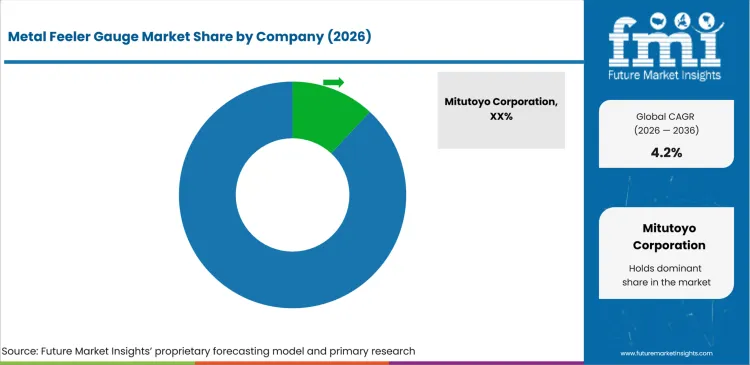
The competitive landscape remains fragmented across precision-metrology specialists and professional workshop brands with different routes to customer trust. Established forming and etching methods keep entry barriers relatively low for standard folding sets sold through broad industrial channels. Calibrated stock and restricted-access blade geometry create a narrower field that requires documented tolerances and dependable service support. Metrology specialists compete through measurement credibility, workshop brands rely on technician access and application breadth across service networks. Distributor labels compete through inventory availability and lower pricing across routine industrial channels and online purchasing platforms. Digital comparators and IoT equipment maintenance systems pressure manual tools in recorded inspection programs, yet direct clearance checks preserve a practical role across many maintenance tasks.
- Mitutoyo Corporation and Starrett provide broad gage portfolios with calibration-oriented service routes for industrial accounts. Starrett operates as a MiddleGround Capital portfolio company following the completed June 2024 transaction and subsequent operating integration. Their commercial advantage depends on traceable dimensional support and dependable service access rather than portfolio breadth alone.
- Snap-on Incorporated and FACOM join Proto Industrial Tools with Laser Tools across professional workshop channels. Their portfolios emphasize technician access and application-specific hand tools for recurring automotive and machinery work. Selection depends on blade geometry and replacement availability across the tasks supported by each brand.
- RS PRO and INSIZE compete through broad catalogue access with standard and specialty gauge formats across industrial channels. Their entry advantage rests on distributor reach and range coverage for routine orders across established purchasing routes. Premium positioning requires clear thickness documentation and protected packaging across thin stock or roll formats.
Competitive Benchmarking: Metal Feeler Gauge Market
| Company | Core Technology Depth | Application Engineering | Calibration and Service Support | Geographic Reach |
|---|---|---|---|---|
| Mitutoyo Corporation | Medium | Medium | High | Global |
| Starrett | High | High | High | Global |
| Snap-on Incorporated | Medium | High | Medium | Multi-country |
| FACOM | Medium | Medium | Medium | Europe and selected international markets |
| Proto Industrial Tools | Low | Low | Medium | North America and selected international markets |
| Laser Tools | High | High | Medium | UK and distributor markets |
| RS PRO | Low | Low | High | Global RS distribution network |
| INSIZE | High | Medium | Medium | Global regional network |
Key Developments in the Metal Feeler Gauge Market
- In April 2026, INSIZE added the 4601 feeler gauge to its official new-product program and dimensional-metrology catalogue. The launch expanded its conventional folding-set range for workshops that require standard thickness coverage and immediate physical readings. International catalogue visibility improves distributor access across industrial markets and regional maintenance channels for routine orders. Established brands must defend pricing through verified tolerances and dependable replenishment rather than electronic features unavailable in basic leaf sets.
- In April 2026, INSIZE introduced the 4602 feeler gauge through the same official new-product program. The separate code widened portfolio choice for industrial accounts using different blade ranges or maintenance specifications. Multiple standard configurations simplify range matching across plants with established clearance procedures and controlled maintenance routines. The addition increases competitive pressure on established brands that rely on catalogue breadth without documented accuracy or responsive replacement support.
- In December 2025, INSIZE added 4629 feeler gauge stocks to its official new-products list and current measuring-tool range. Cut-to-length stock supports fabrication and maintenance teams working with clearances beyond the reach of standard folding leaves. The format expands application coverage across restricted assemblies without requiring a complete custom set efficiently. Commercial performance depends on controlled thickness and protective handling during cutting and storage across industrial maintenance environments.
- In August 2025, INSIZE launched 4621 feeler gauge rolls through its official new-product program and international catalogue. Roll formats serve teams that cut repeated lengths for machinery setup and custom fixtures across industrial facilities. The format can reduce material waste across recurring applications and widen available thickness choices for specialized maintenance work. Competition in this niche depends on documented accuracy and packaging that protects thin stock from deformation during transport and storage.
Metal Feeler Gauge Market - Report Scope
| Coverage field | Report scope |
|---|---|
| Market breakdown | Product type, application, end user, distribution channel, material, and region. |
| Market Definition | Precision leaf gauges, sets, strips, and specialty forms used to measure narrow physical clearances across automotive, industrial, aerospace, fabrication, and maintenance work. |
| Regions Covered | North America, Latin America, Western Europe, Eastern Europe, East Asia, South Asia and Pacific, and Middle East and Africa. |
| Countries Covered | Germany, USA, South Korea, Brazil, UK, Japan, and Canada. |
| Key Companies Profiled | Mitutoyo Corporation, Starrett, Snap-on Incorporated, FACOM, Proto Industrial Tools, Laser Tools, RS PRO, and INSIZE. |
| Forecast Period | 2026 to 2036. |
| Approach | Hybrid bottom-up and top-down market sizing supported by primary interviews and official desk research. |
Metal Feeler Gauge Market - Research Methodology
| Method | Approach |
|---|---|
| Primary Research | FMI analysts gathered input from manufacturers, service providers, technology developers, distributors, end users, procurement teams, and subject-matter experts. Interviews examined purchasing decisions, product or service evaluation, adoption barriers, approval requirements, pricing considerations, and expectations for technical or commercial support. Respondents were also asked what evidence is required before a trial, pilot, or initial order develops into regular purchasing. |
| Desk Research | Desk research covered government statistics, regulatory publications, trade data, industry associations, technical literature, standards, company filings, product information, and official corporate announcements. Sources were reviewed for relevance, publication date, geographic coverage, and consistency with the defined market scope. Claims relating to performance, applications, approvals, capacity, investment, and commercial activity were retained only when supported by credible public evidence. |
| Market Sizing and Forecasting | The market model combined the baseline value with historical performance, segment structure, pricing and volume indicators, adoption levels, company participation, and country-level demand conditions. Forecast assumptions considered economic activity, investment trends, regulatory developments, technology adoption, purchasing cycles, supply availability, and barriers to wider market use. Segment and regional estimates were reconciled before the final market total was calculated. |
| Data Validation | Estimates were checked against multiple independent indicators, including public data, company activity, trade patterns, industry developments, and findings from primary interviews. Validation also tested whether products, services, applications, and company revenues fell within the defined market boundaries. Adjacent categories, unsupported claims, overlapping revenues, and activities without direct market relevance were excluded to reduce double counting and maintain consistency across segments and countries. |
Metal Feeler Gauge Market by Segments
Metal Feeler Gauge Market segmented by Product Type:
- Stainless Steel Feeler Gauges
- Straight Blade Feeler Gauges
- Precision Stainless Steel Gauges
- Taper Feeler Gauges
- Single Taper Gauges
- Double Taper Gauges
- Offset Feeler Gauges
- Angled Offset Gauges
- Double Offset Gauges
- Brass Feeler Gauges
- Non-Magnetic Gauges
- Spark-Resistant Gauges
- Custom and Specialty Feeler Gauges
- Metric Feeler Gauges
- Imperial Feeler Gauges
Metal Feeler Gauge Market segmented by Application:
- Automotive Maintenance
- Engine Valve Clearance
- Spark Plug Gap Inspection
- Industrial Machinery
- Machine Alignment
- Equipment Maintenance
- Aerospace Engineering
- Aircraft Engine Inspection
- Component Assembly
- Manufacturing and Fabrication
- Quality Inspection
- Precision Measurement
- Power Generation
- Turbine Maintenance
- Generator Inspection
Metal Feeler Gauge Market segmented by End User:
- Automotive Industry
- Vehicle Manufacturers
- Automotive Service Centers
- Industrial Manufacturing
- Machinery Manufacturers
- Fabrication Workshops
- Aerospace and Defense
- Aircraft OEMs
- MRO Facilities
- Energy and Utilities
- Power Plants
- Oil and Gas Facilities
- Research and Educational Institutes
- Engineering Laboratories
- Technical Institutions
Metal Feeler Gauge Market segmented by Distribution Channel:
- Direct Sales
- OEM Supply Contracts
- Industrial Sales Teams
- Industrial Distributors
- Authorized Distributors
- Regional Wholesalers
- Online Retail
- E-commerce Platforms
- Manufacturer Websites
- Tool and Hardware Stores
- Specialty Tool Stores
- Industrial Supply Stores
- Catalog Sales
- Mail Order Suppliers
- B2B Purchasing Catalogs
Metal Feeler Gauge Market segmented by Material:
- Stainless Steel
- 301 Stainless Steel
- 304 Stainless Steel
- Carbon Steel
- High Carbon Steel
- Hardened Steel
- Brass
- Phosphor Bronze
- Brass Alloy
- Titanium
- Commercial Grade Titanium
- Titanium Alloy
- Composite Materials
- Polymer Composite
- Fiber Reinforced Composite
Metal Feeler Gauge Market by Region:
- North America
- United States
- Canada
- Latin America
- Brazil
- Mexico
- Argentina
- Chile
- Western Europe
- Germany
- France
- United Kingdom
- Italy
- Spain
- Benelux
- Nordics
- Eastern Europe
- Poland
- Czech Republic
- Romania
- Hungary
- East Asia
- China
- Japan
- South Korea
- South Asia and Pacific
- India
- ASEAN
- Australia and New Zealand
- Middle East and Africa
- GCC Countries
- South Africa
- Türkiye
- Israel
Research Sources and Bibliography
- National Institute of Standards and Technology. (2025, March 17).
- U.S. Bureau of Labor Statistics. (2026, May 15).
- German Federal Statistical Office. (2025, December 1).
- Ministry of Land, Infrastructure and Transport. (2026, January 29).
- ANFAVEA. (2025, January 14).
- Department for Transport. (2026, April 29).
- Ministry of Land, Infrastructure, Transport and Tourism. (2025, July 8).
- Statistics Canada. (2025, October 17).
- International Organization for Standardization. (2025).
- Snap-on Incorporated. (2025, May 15)
- MiddleGround Capital. (2024, June 5).
- Mitutoyo America Corporation. (2026, May 14).
- International Organization for Standardization. (2026).
- The L.S. Starrett Company. (2025, February 1).
- Snap-on Incorporated. (2026).
- RS Components Ltd. (2026).
This bibliography is provided for reader reference and is not exhaustive. The full report contains the complete reference list and detailed citations
This Report Answers
- How large is the metal feeler gauge market in 2026 and 2036?
- Which maintenance workflows create recurring demand for manual clearance measurement?
- Why does stainless steel retain a major material position in 2026?
- How does automotive maintenance influence application demand across professional workshops?
- Why does direct sales account for a substantial distribution-channel share in 2026?
- How do country growth routes differ across the seven profiled markets?
- Which companies provide precision gages or professional workshop feeler gauge sets?
- What limits measurement reliability across corroded or deformed gauge leaves?
- How do traceable and specialized sets create higher-value commercial routes?
Frequently Asked Questions
How big is the Metal Feeler Gauge Market in 2026?
The metal feeler gauge market is valued at USD 452.8 million in 2026 and is forecast to reach USD 683.3 million by 2036. Growth is supported by recurring clearance checks across automotive service and industrial machinery maintenance that sustain replacement demand for portable leaf gauge sets across professional workshops and controlled maintenance programs.
What is the CAGR of the Metal Feeler Gauge Market from 2026 to 2036?
The metal feeler gauge market grows at a CAGR of 4.2% between 2026 and 2036, supported by installed vehicle fleets and industrial machinery that create recurring setup and adjustment checks, sustaining steady replacement demand for portable gauge sets across automotive service networks and industrial maintenance facilities worldwide.
Which material leads the Metal Feeler Gauge Market?
Stainless steel accounts for 48.0% of the metal feeler gauge market by material in 2026, driven by its corrosion resistance and repeatable leaf stiffness that support frequent handling across automotive and industrial maintenance environments where oil exposure and intermittent moisture reduce the service life of alternative materials.
How much will the Metal Feeler Gauge Market add between 2026 and 2036?
The metal feeler gauge market is set to add USD 230.5 million between 2026 and 2036, growing from USD 452.8 million to USD 683.3 million as recurring clearance verification requirements across vehicle servicing and industrial machinery setup sustain replacement purchasing across professional workshops and controlled maintenance programs globally.
Who are the leading companies in the Metal Feeler Gauge Market?
Eight companies lead the metal feeler gauge market, including Mitutoyo Corporation, Starrett, Snap-on Incorporated, FACOM, Proto Industrial Tools, Laser Tools, RS PRO, and INSIZE, competing through calibration-oriented metrology support, application-specific blade geometry, and broad catalogue access across automotive workshop and industrial maintenance channels worldwide.
Preview the report firsthand - request a free sample
Get SampleGet the brochure for pricing and purchase details.
Get PDFTable of Content
- Key Takeaways
- Market Size and CAGR
- Top Growth Driver
- Fastest Growing Segment
- Leading Region
- Key Companies
- Emerging Opportunities
- Executive Summary
- Global Market Outlook
- Demand-side Trends
- Supply-side Trends
- Technology Roadmap Analysis
- Analysis and Recommendations
- Analyst Perspective (What is happening? Why now? What should investors know?)
- Key Questions Answered
- How large is the market?
- What is the CAGR?
- What are key trends?
- Which region dominates?
- Who are the leaders?
- Market Overview
- Market Coverage / Taxonomy
- Market Definition / Scope / Limitations
- Research Methodology
- Chapter Orientation
- Analytical Lens and Working Hypotheses
- Market Structure, Signals, and Trend Drivers
- Benchmarking and Cross-market Comparability
- Market Sizing, Forecasting, and Opportunity Mapping
- Research Design and Evidence Framework
- Desk Research Programme (Secondary Evidence)
- Expert Input and Fieldwork (Primary Evidence)
- Tooling, Models, and Reference Databases
- Data Engineering and Model Build
- Quality Assurance and Audit Trail
- Market Background
- Market Dynamics (Drivers, Restraints, Opportunity, Trends)
- Scenario Forecast (Optimistic, Likely, Conservative)
- Impact Analysis
- AI Impact
- Sustainability Impact
- Regulatory Impact
- Technology Impact
- Consumer / Buyer Analysis
- Purchase Drivers
- Adoption Barriers
- Buyer Journey
- Opportunity Map Analysis
- Product Life Cycle Analysis
- Supply Chain Analysis
- Investment Feasibility Matrix
- Value Chain Analysis
- PESTLE and Porter's Analysis
- Regulatory Landscape
- Regional Parent Market Outlook
- Production and Consumption Statistics
- Import and Export Statistics
- Global Market Analysis and Forecast, 2021 to 2036
- Historical Market Size Value (USD Million) Analysis, 2021 to 2025
- Current and Future Market Size Value (USD Million) Projections, 2026 to 2036
- Y-o-Y Growth Trend Analysis
- Absolute $ Opportunity Analysis
- Global Market Pricing Analysis, 2021 to 2036
- Global Market Analysis and Forecast, By Product Type, 2021 to 2036
- Introduction / Key Findings
- Historical Market Size Value (USD Million) Analysis By Product Type, 2021 to 2025
- Current and Future Market Size Value (USD Million) Analysis and Forecast By Product Type, 2026 to 2036
- Stainless Steel Feeler Gauges
- Straight Blade Feeler Gauges
- Precision Stainless Steel Gauges
- Taper Feeler Gauges
- Single Taper Gauges
- Double Taper Gauges
- Offset Feeler Gauges
- Angled Offset Gauges
- Double Offset Gauges
- Brass Feeler Gauges
- Non-Magnetic Gauges
- Spark-Resistant Gauges
- Custom & Specialty Feeler Gauges
- Metric Feeler Gauges
- Imperial Feeler Gauges
- Stainless Steel Feeler Gauges
- Y-o-Y Growth Trend Analysis By Product Type, 2021 to 2025
- Absolute $ Opportunity Analysis By Product Type, 2026 to 2036
- Global Market Analysis and Forecast, By Application, 2021 to 2036
- Introduction / Key Findings
- Historical Market Size Value (USD Million) Analysis By Application, 2021 to 2025
- Current and Future Market Size Value (USD Million) Analysis and Forecast By Application, 2026 to 2036
- Automotive Maintenance
- Engine Valve Clearance
- Spark Plug Gap Inspection
- Industrial Machinery
- Machine Alignment
- Equipment Maintenance
- Aerospace Engineering
- Aircraft Engine Inspection
- Component Assembly
- Manufacturing & Fabrication
- Quality Inspection
- Precision Measurement
- Power Generation
- Turbine Maintenance
- Generator Inspection
- Automotive Maintenance
- Y-o-Y Growth Trend Analysis By Application, 2021 to 2025
- Absolute $ Opportunity Analysis By Application, 2026 to 2036
- Global Market Analysis and Forecast, By End User, 2021 to 2036
- Introduction / Key Findings
- Historical Market Size Value (USD Million) Analysis By End User, 2021 to 2025
- Current and Future Market Size Value (USD Million) Analysis and Forecast By End User, 2026 to 2036
- Automotive Industry
- Vehicle Manufacturers
- Automotive Service Centers
- Industrial Manufacturing
- Machinery Manufacturers
- Fabrication Workshops
- Aerospace & Defense
- Aircraft OEMs
- MRO Facilities
- Energy & Utilities
- Power Plants
- Oil & Gas Facilities
- Research & Educational Institutes
- Engineering Laboratories
- Technical Institutions
- Automotive Industry
- Y-o-Y Growth Trend Analysis By End User, 2021 to 2025
- Absolute $ Opportunity Analysis By End User, 2026 to 2036
- Global Market Analysis and Forecast, By Distribution Channel, 2021 to 2036
- Introduction / Key Findings
- Historical Market Size Value (USD Million) Analysis By Distribution Channel, 2021 to 2025
- Current and Future Market Size Value (USD Million) Analysis and Forecast By Distribution Channel, 2026 to 2036
- Direct Sales
- OEM Supply Contracts
- Industrial Sales Teams
- Industrial Distributors
- Authorized Distributors
- Regional Wholesalers
- Online Retail
- E-commerce Platforms
- Manufacturer Websites
- Tool & Hardware Stores
- Specialty Tool Stores
- Industrial Supply Stores
- Catalog Sales
- Mail Order Suppliers
- B2B Procurement Catalogs
- Direct Sales
- Y-o-Y Growth Trend Analysis By Distribution Channel, 2021 to 2025
- Absolute $ Opportunity Analysis By Distribution Channel, 2026 to 2036
- Global Market Analysis and Forecast, By Material, 2021 to 2036
- Introduction / Key Findings
- Historical Market Size Value (USD Million) Analysis By Material, 2021 to 2025
- Current and Future Market Size Value (USD Million) Analysis and Forecast By Material, 2026 to 2036
- Stainless Steel
- 301 Stainless Steel
- 304 Stainless Steel
- Carbon Steel
- High Carbon Steel
- Hardened Steel
- Brass
- Phosphor Bronze
- Brass Alloy
- Titanium
- Commercial Grade Titanium
- Titanium Alloy
- Composite Materials
- Polymer Composite
- Fiber Reinforced Composite
- Stainless Steel
- Y-o-Y Growth Trend Analysis By Material, 2021 to 2025
- Absolute $ Opportunity Analysis By Material, 2026 to 2036
- Global Market Analysis and Forecast, By Region, 2021 to 2036
- Introduction
- Historical Market Size Value (USD Million) Analysis By Region, 2021 to 2025
- Current Market Size Value (USD Million) Analysis and Forecast By Region, 2026 to 2036
- North America
- Latin America
- Western Europe
- Eastern Europe
- East Asia
- South Asia and Pacific
- Middle East & Africa
- Market Attractiveness Analysis By Region
- North America Market Analysis and Forecast, By Country, 2021 to 2036
- Historical Market Size Value (USD Million) Trend Analysis By Market Taxonomy, 2021 to 2025
- Market Size Value (USD Million) Forecast By Market Taxonomy, 2026 to 2036
- By Country
- USA
- Canada
- By Product Type
- By Application
- By End User
- By Distribution Channel
- By Material
- By Country
- Market Attractiveness Analysis
- By Country
- By Product Type
- By Application
- By End User
- By Distribution Channel
- By Material
- Key Takeaways
- Latin America Market Analysis and Forecast, By Country
- Historical Market Size Value (USD Million) Trend Analysis By Market Taxonomy, 2021 to 2025
- Market Size Value (USD Million) Forecast By Market Taxonomy, 2026 to 2036
- By Country
- Brazil
- Mexico
- Chile
- Rest of Latin America
- By Product Type
- By Application
- By End User
- By Distribution Channel
- By Material
- By Country
- Market Attractiveness Analysis
- By Country
- By Product Type
- By Application
- By End User
- By Distribution Channel
- By Material
- Key Takeaways
- Western Europe Market Analysis and Forecast, By Country
- Historical Market Size Value (USD Million) Trend Analysis By Market Taxonomy, 2021 to 2025
- Market Size Value (USD Million) Forecast By Market Taxonomy, 2026 to 2036
- By Country
- Germany
- UK
- Italy
- Spain
- France
- Nordic
- BENELUX
- Rest of Western Europe
- By Product Type
- By Application
- By End User
- By Distribution Channel
- By Material
- By Country
- Market Attractiveness Analysis
- By Country
- By Product Type
- By Application
- By End User
- By Distribution Channel
- By Material
- Key Takeaways
- Eastern Europe Market Analysis and Forecast, By Country
- Historical Market Size Value (USD Million) Trend Analysis By Market Taxonomy, 2021 to 2025
- Market Size Value (USD Million) Forecast By Market Taxonomy, 2026 to 2036
- By Country
- Russia
- Poland
- Hungary
- Balkan & Baltic
- Rest of Eastern Europe
- By Product Type
- By Application
- By End User
- By Distribution Channel
- By Material
- By Country
- Market Attractiveness Analysis
- By Country
- By Product Type
- By Application
- By End User
- By Distribution Channel
- By Material
- Key Takeaways
- East Asia Market Analysis and Forecast, By Country
- Historical Market Size Value (USD Million) Trend Analysis By Market Taxonomy, 2021 to 2025
- Market Size Value (USD Million) Forecast By Market Taxonomy, 2026 to 2036
- By Country
- China
- Japan
- South Korea
- By Product Type
- By Application
- By End User
- By Distribution Channel
- By Material
- By Country
- Market Attractiveness Analysis
- By Country
- By Product Type
- By Application
- By End User
- By Distribution Channel
- By Material
- Key Takeaways
- South Asia and Pacific Market Analysis and Forecast, By Country
- Historical Market Size Value (USD Million) Trend Analysis By Market Taxonomy, 2021 to 2025
- Market Size Value (USD Million) Forecast By Market Taxonomy, 2026 to 2036
- By Country
- India
- ASEAN
- Australia & New Zealand
- Rest of South Asia and Pacific
- By Product Type
- By Application
- By End User
- By Distribution Channel
- By Material
- By Country
- Market Attractiveness Analysis
- By Country
- By Product Type
- By Application
- By End User
- By Distribution Channel
- By Material
- Key Takeaways
- Middle East & Africa Market Analysis and Forecast, By Country
- Historical Market Size Value (USD Million) Trend Analysis By Market Taxonomy, 2021 to 2025
- Market Size Value (USD Million) Forecast By Market Taxonomy, 2026 to 2036
- By Country
- Kingdom of Saudi Arabia
- Other GCC Countries
- Türkiye
- South Africa
- Other African Union
- Rest of Middle East & Africa
- By Product Type
- By Application
- By End User
- By Distribution Channel
- By Material
- By Country
- Market Attractiveness Analysis
- By Country
- By Product Type
- By Application
- By End User
- By Distribution Channel
- By Material
- Key Takeaways
- Key Countries Market Analysis
- USA
- Pricing Analysis
- Market Share Analysis, 2025
- By Product Type
- By Application
- By End User
- By Distribution Channel
- By Material
- Canada
- Pricing Analysis
- Market Share Analysis, 2025
- By Product Type
- By Application
- By End User
- By Distribution Channel
- By Material
- Mexico
- Pricing Analysis
- Market Share Analysis, 2025
- By Product Type
- By Application
- By End User
- By Distribution Channel
- By Material
- Brazil
- Pricing Analysis
- Market Share Analysis, 2025
- By Product Type
- By Application
- By End User
- By Distribution Channel
- By Material
- Chile
- Pricing Analysis
- Market Share Analysis, 2025
- By Product Type
- By Application
- By End User
- By Distribution Channel
- By Material
- Germany
- Pricing Analysis
- Market Share Analysis, 2025
- By Product Type
- By Application
- By End User
- By Distribution Channel
- By Material
- UK
- Pricing Analysis
- Market Share Analysis, 2025
- By Product Type
- By Application
- By End User
- By Distribution Channel
- By Material
- Italy
- Pricing Analysis
- Market Share Analysis, 2025
- By Product Type
- By Application
- By End User
- By Distribution Channel
- By Material
- Spain
- Pricing Analysis
- Market Share Analysis, 2025
- By Product Type
- By Application
- By End User
- By Distribution Channel
- By Material
- France
- Pricing Analysis
- Market Share Analysis, 2025
- By Product Type
- By Application
- By End User
- By Distribution Channel
- By Material
- India
- Pricing Analysis
- Market Share Analysis, 2025
- By Product Type
- By Application
- By End User
- By Distribution Channel
- By Material
- ASEAN
- Pricing Analysis
- Market Share Analysis, 2025
- By Product Type
- By Application
- By End User
- By Distribution Channel
- By Material
- Australia & New Zealand
- Pricing Analysis
- Market Share Analysis, 2025
- By Product Type
- By Application
- By End User
- By Distribution Channel
- By Material
- China
- Pricing Analysis
- Market Share Analysis, 2025
- By Product Type
- By Application
- By End User
- By Distribution Channel
- By Material
- Japan
- Pricing Analysis
- Market Share Analysis, 2025
- By Product Type
- By Application
- By End User
- By Distribution Channel
- By Material
- South Korea
- Pricing Analysis
- Market Share Analysis, 2025
- By Product Type
- By Application
- By End User
- By Distribution Channel
- By Material
- Russia
- Pricing Analysis
- Market Share Analysis, 2025
- By Product Type
- By Application
- By End User
- By Distribution Channel
- By Material
- Poland
- Pricing Analysis
- Market Share Analysis, 2025
- By Product Type
- By Application
- By End User
- By Distribution Channel
- By Material
- Hungary
- Pricing Analysis
- Market Share Analysis, 2025
- By Product Type
- By Application
- By End User
- By Distribution Channel
- By Material
- Kingdom of Saudi Arabia
- Pricing Analysis
- Market Share Analysis, 2025
- By Product Type
- By Application
- By End User
- By Distribution Channel
- By Material
- Türkiye
- Pricing Analysis
- Market Share Analysis, 2025
- By Product Type
- By Application
- By End User
- By Distribution Channel
- By Material
- South Africa
- Pricing Analysis
- Market Share Analysis, 2025
- By Product Type
- By Application
- By End User
- By Distribution Channel
- By Material
- USA
- Market Structure Analysis
- Competition Dashboard
- Competition Benchmarking
- Market Share Analysis of Top Players
- By Regional
- By Product Type
- By Application
- By End User
- By Distribution Channel
- By Material
- Emerging Startups
- Innovation Benchmarking
- Competition Analysis
- Competition Deep Dive
- Mitutoyo Corporation
- Overview
- Product Portfolio
- Profitability by Market Segments
- Sales Footprint
- Strategy Overview
- Marketing Strategy
- Product Strategy
- Channel Strategy
- Starrett
- Snap-on Incorporated
- SKF Group
- FACOM
- Proto Industrial Tools
- Wiha Tools
- Laser Tools
- RS PRO
- Teng Tools
- Others
- Mitutoyo Corporation
- Case Studies
- Success Stories
- Recent Developments
- Competition Deep Dive
- Assumptions & Acronyms Used


