

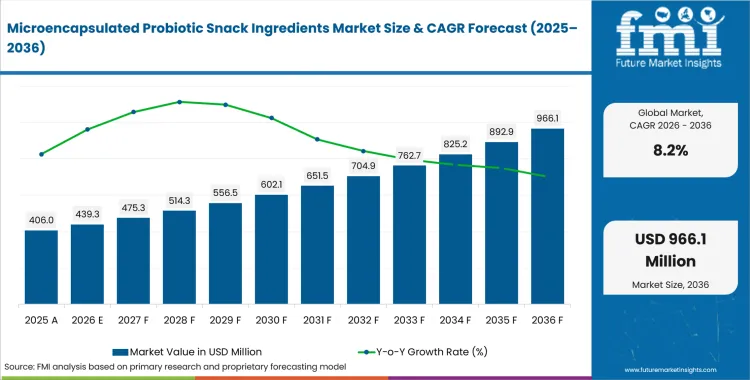
- Market Size (2026)
- USD 439.3 Mn
- Forecast (2036)
- USD 966.1 Mn
- CAGR (2026 to 2036)
- 8.2%
How big is Microencapsulated Probiotic Snack Ingredients Market in 2026?
USD 439.3 million in 2026 and USD 966.1 million by 2036 at an 8.2% CAGR.
Demand for microencapsulated probiotic snack ingredients is projected to expand at 8.2% CAGR between 2026 and 2036, increasing valuation from USD 439.3 million in 2026 to USD 966.1 million by 2036. Ambient snacks create regular probiotic use without adding refrigerated distribution across established retail storage channels. The category was valued at USD 406.0 million in 2025 and now depends on viable cultures surviving processing and storage. The NIH Office of Dietary Supplements updated its probiotics fact sheet in March 2025 and identified nutrition bars and cereals among foods formulated with added probiotics. Food encapsulation therefore determines whether cultures remain viable across dry matrices and ambient distribution throughout the declared shelf life. Probiotic ingredients require strain-specific evidence; higher colony counts alone do not establish stronger consumer benefits.
United States launch plans often use established GRAS routes, but European launches face tighter limits on probiotic wording and health claims. In April 2025, the FDA closed GRN 1218 without questions for Bacillus subtilis NRRL 68054 in conventional foods at up to 1 x 10^10 CFU per serving. The decision does not authorize every strain or finished snack, but it demonstrates how a defined safety dossier opens several food applications. Japanese brands follow a separate notification route for foods with function claims and remain responsible for scientific support. Healthy snacks therefore need country-specific claim files that align product wording with strain evidence and finished-product stability. Functional food ingredients gain commercial value as technical and regulatory evidence reaches reviewers through one coordinated development file.
Key Takeaways
- Snack brands support demand by using ambient probiotic formats that fit familiar eating routines and established retail channels.
- By product type, proteins are forecast to represent 23.0% share in 2026 due to their combined contribution to cell protection and snack structure.
- Plant sources are estimated to hold 29.0% share in 2026 within the source category, supported by dairy-free positioning and compatibility with several carrier systems.
- Bakery is projected to account for 27.0%% share in 2026 owing to heat-processed snack volumes and ambient distribution.
- Heat exposure, moisture migration and restricted benefit claims remain the main barriers to broader use across shelf-stable snack formats.
- Competition centers on AnaBio Technologies, Novonesis, Kerry, Probi, IFF, Lallemand Health Solutions, ADM and Balchem across strain portfolios, protection systems and finished-food development support.
Analyst Perspective
“Microencapsulation earns its place in a snack formula through verified survival across mixing, heat exposure and the complete ambient shelf life. Clinical evidence supports the strain, but the commercial decision rests on viable counts in the finished bar or baked product. Developers that test carrier, recipe and package together can reduce reformulation and support a clearer national claim strategy.”
- Nandini Roy Choudhury, Principal Analyst, Future Market Insights
How is the Microencapsulated Probiotic Snack Ingredients Market segmented?
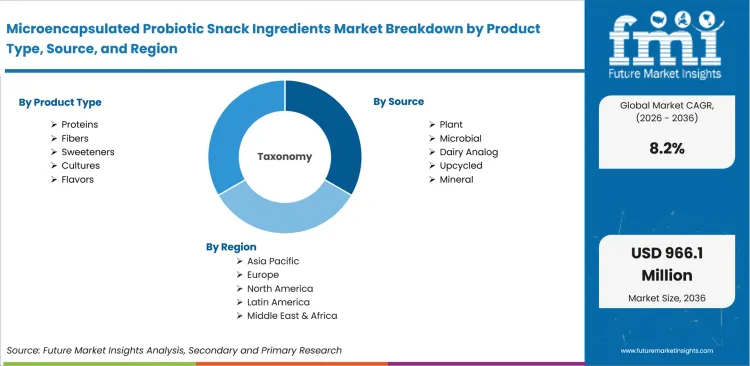
The microencapsulated probiotic snack ingredients industry is segmented by product type, source, application, end user, and region.
The taxonomy separates product type according to the ingredient function carried within or alongside each protective system. Source distinguishes plant, microbial, dairy analog, upcycled and mineral origins that affect label positioning and processing compatibility. Application separates bakery, beverage, snack, infant nutrition and ready-meal routes with different heat and moisture conditions. End user identifies the organization responsible for formulation and validation across commercial production and launch decisions. Regional analysis compares ingredient approval and claim language alongside manufacturing support across national launch markets. Plant-based food ingredients provide useful context for dairy-free carrier selection and allergen-aware product positioning choices. Dietary fiber ingredients explain additional carrier choices that support dry texture and moisture control in shelf-stable snacks.
Why do proteins support product type demand in the Microencapsulated Probiotic Snack Ingredients Market?
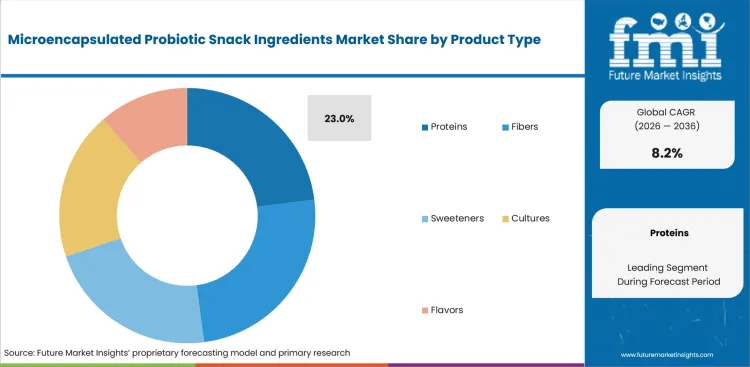
Protein carriers can protect probiotic cells and contribute structure inside bars or concentrated nutrition snacks. A peer-reviewed study published in July 2025 found that pea-protein microcapsules maintained substantially higher Lacticaseibacillus rhamnosus GG viability during simulated digestion than unprotected cells. The result supports protein matrices as functional carriers rather than simple nutritional additions within finished snack systems. Digestive performance does not prove commercial snack stability, so probiotic strains require process testing through mixing and storage across the declared shelf life.
- By product type, proteins are forecast to represent 23.0% share in 2026 driven by their combined role in cell protection and snack structure. Protein matrices can support powders or coated inclusions across nutrition bars without requiring a separate carrier. Formulators must confirm allergen labeling and sensory effects across every finished recipe during commercial process validation.
- Food manufacturers are expected to favor protein carriers in bars and nutrition bites that already contain concentrated protein systems. The established formulation base can reduce reformulation effort and simplify ingredient declarations across related snack lines. Adoption becomes less attractive in acidic or low-protein formats that need another wall material for consistent viability protection.
Why does plant remain central to source demand?
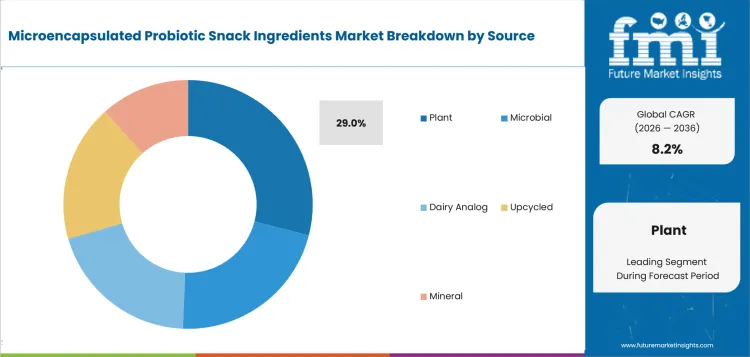
Plant-derived systems align with dairy-free formulas and familiar ingredient panels across several commercial snack formats. In May 2025, Probi and Nomura Dairy introduced a carrot juice fermented with LP299V in Japan. The launch shows that a plant base can carry a documented probiotic through a commercial food format built around local taste. Beverage performance does not establish shelf stability in bars or baked products, so dry functional foods require separate moisture and package validation.
- Plant is likely to capture 29.0% share in 2026 attributable to dairy-free positioning and compatibility with several plant-derived carriers. The category gives product developers formulation flexibility across vegan snack lines and different regional labeling preferences. Commercial performance depends on repeatable barrier properties rather than plant origin or label positioning by itself.
- Plant-source adoption is anticipated to rise among brands extending gut health supplements into vegan or allergen-aware snack formats. Established plant-ingredient purchasing routes support pea and rice carriers without creating entirely new qualification processes. Variation in crop composition remains a material issue for formulators requiring repeatable protection across commercial production batches.
How does bakery create application demand for protected probiotic ingredients?
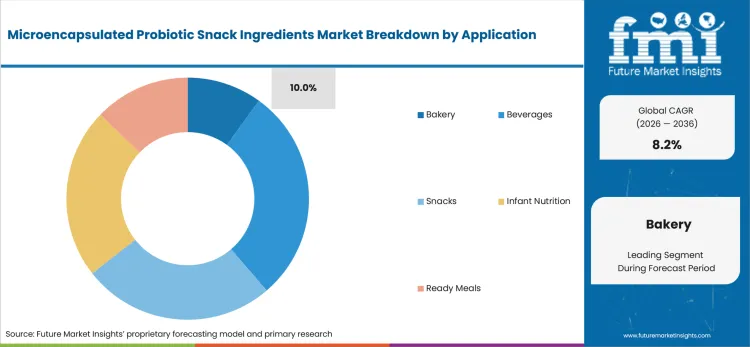
Bakery applications expose probiotics to mixing pressure and baking heat during the same production route. Residual moisture and storage conditions create separate viability risks throughout the declared commercial shelf life. The FDA closed GRN 1231 without questions in July 2025 for Bacillus velezensis PTA-127359 in baked goods and snack foods up to 2 x 10^9 CFU per serving. The closure establishes a current conventional-food safety route for one clearly defined bacterial probiotic strain. Bakery ingredients require process-specific evidence for viable counts alongside texture and flavor performance in finished products.
- The application category is forecast to be led by bakery at 27.0%% share in 2026 due to ambient snack volumes and the need for protected cultures in heat-processed products. Breads and biscuits provide commercial placement routes through dough systems or protected fillings and surface coatings. Post-bake inclusions reduce direct exposure to peak oven temperatures during full-scale commercial snack manufacturing operations.
- Commercial bakeries are likely to test protected probiotics in premium bars, cookies and portioned nutrition products with controlled moisture. Portioned bakery formats support clear serving sizes and repeat purchasing across familiar retail channels and everyday consumption occasions. Adoption slows if cell survival requires refrigeration or creates texture changes that conflict with established production lines and consumer expectations.
Why do food manufacturers account for the largest end user share?
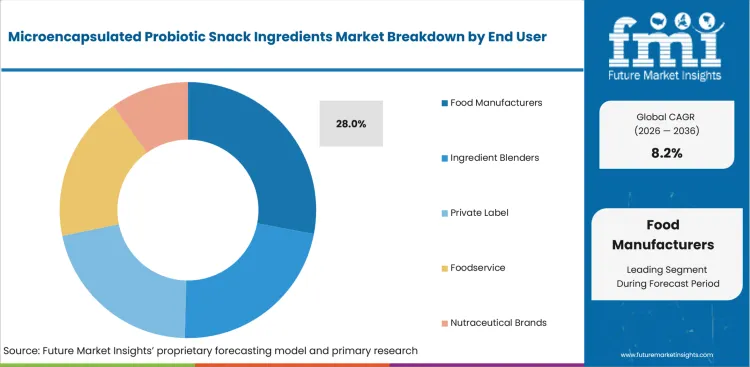
Food manufacturers control strain selection and carrier choice across production trials and label review for every finished commercial snack. In June 2025, the FDA closed GRN 1221 without questions for Heyndrickxia coagulans NRRL B-67744 across baked goods and snack foods at up to 2 x 10^9 CFU per serving. The closure gives manufacturers a current safety reference for one defined culture and several conventional food uses. Finished-product teams must prove viable counts and acceptable sensory performance across the intended package and storage period.
- Food manufacturers are projected to hold 28.0% share in 2026 owing to their control over recipe design and commercialization decisions. They determine whether a probiotic system fits mixing and baking operations alongside coating or packaging requirements. Their position reflects decision authority across development stages rather than ingredient purchasing volume by itself.
- Large snack producers are expected to adopt protected cultures through controlled pilots that measure viable counts, sensory stability and line performance together. Contract laboratories and ingredient partners can shorten commercial evaluation cycles through coordinated process trials and stability testing. Each strain-carrier combination requires evidence across the intended package and storage environment, which raises testing costs for smaller manufacturers.
Why is North America a priority region for commercial development?
North American food companies use established ingredient safety pathways and a broad contract-manufacturing network for functional snacks. In August 2025, the FDA closed GRN 1243 without questions for a Bacillus coagulans spore preparation covering several conventional snack applications. The safety route includes baked goods and plant-protein products alongside snack foods for one defined strain. Canadian and United States launch routes require separate safety and label documentation, which fragments regional commercialization.
- North America is set to lead the region category with 36.0% share in 2026 due to established development teams and diverse snack manufacturing capacity. The region supports rapid concept testing across nutrition bars and baked snacks through established pilot networks. Food developers need country-specific reviews rather than treating North America as one uniform launch route for protected cultures.
- Brands across the United States and Canada are likely to favor strains that tolerate ambient distribution and high-volume processing. Local co-manufacturing reduces initial capital requirements and supports short pilot runs during early commercial development programs. Adoption risk remains concentrated in claim substantiation, end-of-shelf-life viability and transfer of laboratory results into commercial snack lines.
What are the drivers, restraints, and opportunities in the Microencapsulated Probiotic Snack Ingredients Market?
Protected cultures gain demand as brands expand functional snacks, but processing stress limits reliable viability and market-specific claim routes reward complete validation packages.
- Driver: Snack brands need stable probiotic delivery across ambient formats that fit familiar eating routines and established retail channels.
- Restraint: Heat exposure, moisture migration and restricted benefit claims materially limit formulation freedom across snack categories and national markets.
- Opportunity: Culture developers can combine strain evidence with protection data to support clearer product concepts and shorter commercial trials.
Regulatory clearance for defined probiotic strains expands formulation options across familiar snack and confectionery formats. In March 2025, the FDA closed GRN 1205 without questions for Lactiplantibacillus plantarum DR7 in confectionery snacks and chewing gum at up to 1 x 10^10 CFU per serving. The closure gives formulators a specific conventional-food route, but it does not prove survival through processing or storage. Ingredient companies convert regulatory access into repeat business through end-of-shelf-life viability data and format-specific carrier guidance.
Health-claim restrictions materially slow commercialization; technical stability cannot authorize broad probiotic benefit statements across national food labels. France’s DGCCRF updated its nutrition and health claims guidance in November 2025 and stated that microorganism health claims had been rejected under the European framework. Snack brands therefore have a narrow route between naming a culture and communicating a permitted benefit. Early regulatory review reduces late packaging changes and regional relaunch costs that weaken the business case.
A well-defined strain dossier gives snack developers a practical basis for targeting one consumer need instead of using a broad probiotic message. In July 2025, Novonesis announced a BB-12 review that consolidated more than 400 publications and 200 clinical studies. The evidence package helps formulation teams select target users and permitted wording with greater precision. Culture developers can pair that documentation with processing data to build stronger and more focused customer trials. Clinical evidence does not establish survival inside baked snacks, so finished-product processing and shelf-life validation remain mandatory.
Which country CAGRs are profiled in the Microencapsulated Probiotic Snack Ingredients Market?
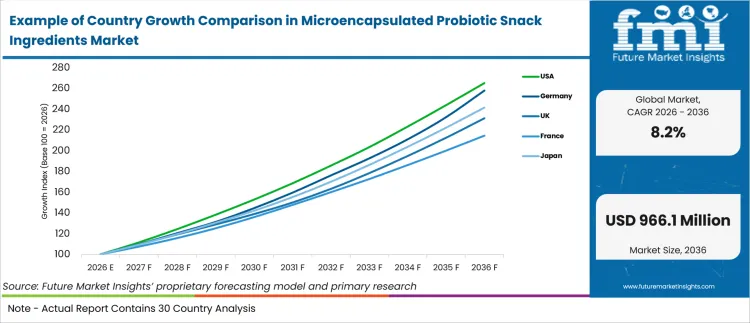
| Country | CAGR |
|---|---|
| India | 11.1% |
| United States | 10.3% |
| United Kingdom | 9.4% |
| Germany | 8.6% |
| Japan | 7.8% |
| France | 7.0% |
How do country-level CAGRs compare in the Microencapsulated Probiotic Snack Ingredients Market?
The country forecasts form a gradual progression from India at 11.1% to France at 7.0% with no single break separating mature and developing markets. The spacing reflects different combinations of food-processing scale, functional-claim rules and access to formulation support. India and the United States offer broad manufacturing routes under different ingredient qualification and claim-review systems. The United Kingdom, Germany and France place greater weight on claim wording within a shared European framework. Japan combines a formal notification route with strong local preferences for fermented foods and convenient nutrition formats. Similar CAGRs therefore conceal distinct commercialization routes and materially different evidence burdens for ingredient companies seeking national launches.
- India combines a broad food-processing base with an expanding approval route, but smaller brands often lack specialized stability testing for protected cultures.
- The United States offers several conventional-food safety routes, but retailer standards and finished-product evidence can extend commercial qualification timelines.
- The United Kingdom combines strong snack development capability with advertising and nutrient-profile rules that influence recipes as well as launch messaging.
- Germany offers advanced food production and technical evaluation capacity, but restricted probiotic wording narrows communication across mainstream snack labels.
- Japan supports function-claim foods through a defined notification route, and local evidence remains necessary for the exact finished product and label.
- France combines established bakery distribution with active label enforcement, which raises the value of precise strain records and permitted benefit language.
Comparable CAGRs can produce different entry conditions as national requirements shape manufacturing decisions and launch schedules. Approval routes, formulation support and permitted claims directly influence investment priorities across every profiled national market. The full report provides country-level CAGR analysis across North America, Latin America, Europe, East Asia, South Asia, Oceania and the Middle East and Africa.
Country-wise Analysis
- Indian probiotic snack projects using non-specified ingredients or claims that require approval must complete the relevant FSSAI route for commercial manufacture. In May 2026, FSSAI directed companies to use the ePAAS portal from June 1 for prior approval and risk assessment covering products and ingredients as well as related claims. The single-window route gives food manufacturers a defined process for non-specified ingredients and claim review. By 2036, India’s microencapsulated probiotic snack ingredients market is projected to grow at 11.1% CAGR. Packaged-food development and demand for protected cultures in ambient formats support the national commercial outlook. Local laboratories and toll processors can support formulation trials across major production clusters and shorten early development schedules. Smaller brands face material friction from dossier costs and end-of-shelf-life testing across every intended snack format.
- United States food developers use public GRAS records and a broad pilot-manufacturing network for conventional-food ingredients. Adoption of microencapsulated probiotic snack ingredients in the United States is estimated to expand at 10.3% CAGR through 2036, aided by established ingredient evaluation routes and functional-snack development. In May 2025, the FDA closed GRN 1214 without questions for a Bacillus clausii spore preparation covering baked goods and plant-protein products alongside snack foods. The closure gives formulators a recent safety reference for one defined strain across common snack applications. Co-manufacturers reduce initial investment through short production runs and coordinated packaging trials for new concepts. Finished-product evidence remains mandatory; strain-level safety does not prove viability or claim compliance across every commercial snack format.
- United Kingdom snack developers work with specialist co-manufacturers and testing laboratories across a mature packaged-food sector. The Department of Health and Social Care updated the Great Britain nutrition and health claims register in May 2026. The register applies across Great Britain but excludes Northern Ireland, which requires separate regulatory review for national launches. The United Kingdom’s microencapsulated probiotic snack ingredients outlook is anticipated to advance at 9.4% CAGR over the assessment period, shaped by premium nutrition formats and mature co-manufacturing support. Local formulation partners can adapt recipes without rebuilding the complete production route for every concept. Regulatory separation increases review work for labels and commercial communications that span all four nations.
- German food manufacturers combine advanced processing equipment with laboratories that evaluate culture identity, stability and finished-product quality. Microencapsulated probiotic snack ingredients sales in Germany are forecast to expand at 8.6% CAGR by 2036, underpinned by technical food manufacturing and specialist formulation support. Verbraucherzentrale updated its guidance for foods containing special bacterial cultures in May 2026 and explained that unapproved health statements cannot be used. The official guidance creates a clear compliance boundary for mainstream snack launches containing named probiotic cultures. Regional ingredient specialists can shorten bakery and bar validation through local technical support and production trials. Claim wording creates material friction for brands communicating product value without unsupported probiotic promises across mainstream snack labels.
- Japan uses a public notification database for foods with function claims, which makes product documentation visible during commercial development. In April 2025, the Consumer Affairs Agency renewed the database used for new filings and later product updates. The Japanese microencapsulated probiotic snack ingredients sector is projected to record 7.8% CAGR during the assessment period, linked to familiar fermented foods and precise functional-product development. The renewed system gives brands a defined filing route for documented strains and finished products. Local beverage and snack partners can adapt flavors and serving formats to established regional preferences. Foreign ingredient companies face friction if global evidence lacks Japanese documentation or does not match the final food format.
- French functional snacks must align ingredient statements and health wording with national enforcement of European claim rules. In June 2025, DGCCRF published food-label guidance and explained that official controls compare label information with actual product composition. The enforcement route makes accurate ingredient declarations and permitted claim wording part of early commercialization planning. France’s microencapsulated probiotic snack ingredients market is estimated to post 7.0% CAGR over the forecast period, attributable to premium bakery formats and established food-manufacturing capability. French bakeries and specialty retailers provide an entry route for portioned ambient products across established regional channels. Claim limits and format-specific validation costs remain material commercial frictions for every proposed strain-carrier combination.
Who are the notable companies in the Microencapsulated Probiotic Snack Ingredients Market?
AnaBio Technologies, Novonesis, Kerry, Probi, IFF, Lallemand Health Solutions, ADM and Balchem are the notable companies shaping this market.
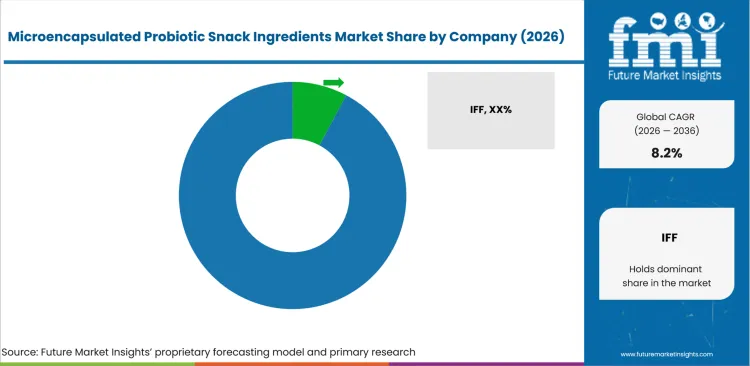
Competition separates dedicated encapsulation specialists from companies centered on probiotic strains and broader food development. AnaBio Technologies and Balchem contribute protection systems for sensitive ingredients used in bakery and ambient foods. Novonesis and Kerry combine documented cultures with technical application support, while Probi and IFF cover additional commercial food and beverage routes. In May 2026, IFF outlined stability design from fermentation through storage and final use for matrix-encapsulated probiotics. The framework shows that shelf-life planning begins during culture production rather than at final package selection. Lallemand Health Solutions combines probiotic manufacturing with encapsulation capacity, while ADM adds microbiome research and food formulation resources. Manufacturers should compare process severity, permitted claims and viable counts at the end of shelf life.
- AnaBio Technologies and Balchem provide complementary protection systems for sensitive ingredients used across commercial food production. Their clearest fit involves manufacturers requiring carrier design and application support for bakery, confectionery or ambient snack formats with demanding storage and package conditions.
- Novonesis and Kerry compete alongside Probi and IFF through documented probiotic cultures supported by food or beverage application expertise. Their commercial advantage depends on connecting strain evidence with processing tolerance and finished-product stability rather than treating cultures as interchangeable inputs.
- Lallemand Health Solutions combines probiotic production with dedicated formulation and encapsulation capacity for demanding delivery formats. ADM began a probiotic research partnership with the University of Oxford in November 2025, adding current clinical work to its microbiome evidence base. Manufacturers should compare each company against the processing stress and shelf-life conditions of the intended snack.
Competitive Benchmarking: Microencapsulated Probiotic Snack Ingredients Market
| Company | Probiotic Culture Portfolio | Encapsulation and Shelf-Life Support | Food and Snack Formulation Support | Geographic Reach |
|---|---|---|---|---|
| AnaBio Technologies | Low | High | High | Nine international markets |
| Novonesis | High | Medium | Medium | Global |
| Kerry | Medium | Medium | High | Global |
| Probi | High | Low | Medium | Europe, North America and Asia Pacific |
| IFF | High | High | High | Global |
| Lallemand Health Solutions | High | High | Medium | Global |
| ADM | High | Medium | High | Global |
| Balchem | Low | High | High | Global |
Key Developments in the Microencapsulated Probiotic Snack Ingredients Market
- In February 2026, Lallemand Health Solutions expanded its Saint-Simon production site through a new formulation area and an additional encapsulation line. The investment strengthens formulation and encapsulation capacity for live microorganisms while supporting the company’s existing food-industry activity. Food developers gain a more integrated technical route between culture production and protected delivery across demanding commercial formats. Snack projects require application trials that confirm viable counts across processing and the complete declared storage period.
- In December 2025, Balchem announced a high-capacity microencapsulation facility for food ingredients in Orange County within New York. The plant is expected to open in 2027 and increase capacity for technologies used mainly in bakery and confectionery products. The development expands domestic protection capacity for sensitive food ingredients and gives snack manufacturers another scale-up route. The announced systems cover broader food actives rather than probiotics alone, so probiotic projects require separate strain-specific trials.
- In November 2025, Probi expanded its portfolio into sports and active nutrition through an LP299V-based probiotic solution. The launch adds a documented culture route for developers serving endurance, vitality and digestive-comfort needs. Compact nutrition products provide a relevant route for the new positioning across active consumer routines. Commercial snack projects require viable-count testing through mixing, storage and the complete shelf life of the intended retail package.
- In December 2025, AnaBio Technologies reported that probiotic snacks and beverages using its technology had entered nine international markets within major innovation clusters. The expansion demonstrates commercial use across several countries rather than one local product or a single protected format. Wider geographic availability gives food manufacturers stronger commercial references for evaluating ambient probiotic concepts across several retail regions. Each snack launch requires country-specific claim review and finished-product stability testing under its actual processing and packaging conditions.
Key Players in the Microencapsulated Probiotic Snack Ingredients Market
Encapsulation and Delivery Specialists
- AnaBio Technologies
- Balchem
Probiotic Culture and Formulation Companies
- Novonesis
- Kerry
- Probi
- IFF
Diversified Nutrition and Health Ingredient Providers
- Lallemand Health Solutions
- ADM
Microencapsulated Probiotic Snack Ingredients Market - Report Scope
| Coverage field | Report scope |
|---|---|
| Market breakdown | Product type, source, application, end user, and region. |
| Quantitative Units | Revenue in USD Million, CAGR in %. |
| Market Definition | Ingredients that combine live probiotic cultures with microencapsulation or protective delivery systems for use in commercial snack foods. The scope includes ingredient revenue tied to product type, source, application, end user and region. |
| Regions Covered | North America, Latin America, Europe, East Asia, South Asia and Pacific, and Middle East and Africa. |
| Countries Covered | India, United States, United Kingdom, Germany, Japan and France, with more than 30 countries included in the full report. |
| Key Companies Profiled | AnaBio Technologies, Novonesis, Kerry, Probi, IFF, Lallemand Health Solutions, ADM and Balchem. |
| Forecast Period | 2026 to 2036. |
| Approach | Hybrid bottom-up and top-down market sizing supported by primary interviews and official desk research. |
Microencapsulated Probiotic Snack Ingredients Market - Research Methodology
| Method | Approach |
|---|---|
| Primary Research | FMI analysts gathered input from manufacturers, service providers, technology developers, distributors, end users, sourcing teams, and subject-matter experts. Interviews examined purchasing decisions, product or service evaluation, adoption barriers, approval requirements, pricing considerations, and expectations for technical or commercial support. Respondents were also asked what evidence is required before a trial, pilot, or initial order develops into regular purchasing. |
| Desk Research | Desk research covered government statistics, regulatory publications, trade data, industry associations, technical literature, standards, company filings, product information, and official corporate announcements. Sources were reviewed for relevance, publication date, geographic coverage, and consistency with the defined market scope. Claims relating to performance, applications, approvals, capacity, investment, and commercial activity were retained only when supported by credible public evidence. |
| Market Sizing and Forecasting | The market model combined the baseline value with historical performance, segment structure, pricing and volume indicators, adoption levels, company participation, and country-level demand conditions. Forecast assumptions considered economic activity, investment trends, regulatory developments, technology adoption, purchasing cycles, supply availability, and barriers to wider market use. Segment and regional estimates were reconciled before the final market total was calculated. |
| Data Validation | Estimates were checked against multiple independent indicators, including public data, company activity, trade patterns, industry developments, and findings from primary interviews. Validation also tested whether products, services, applications, and company revenues fell within the defined market boundaries. Adjacent categories, unsupported claims, overlapping revenues, and activities without direct market relevance were excluded to reduce double counting and maintain consistency across segments and countries. |
Microencapsulated Probiotic Snack Ingredients Market by Segments
Microencapsulated Probiotic Snack Ingredients Market segmented by Product Type:
- Proteins
- Fibers
- Sweeteners
- Cultures
- Flavors
Microencapsulated Probiotic Snack Ingredients Market segmented by Source:
- Plant
- Microbial
- Dairy Analog
- Upcycled
- Mineral
Microencapsulated Probiotic Snack Ingredients Market segmented by Application:
- Bakery
- Beverages
- Snacks
- Infant Nutrition
- Ready Meals
Microencapsulated Probiotic Snack Ingredients Market segmented by End User:
- Food Manufacturers
- Beverage Manufacturers
- Foodservice Operators
- Contract Manufacturers
- Retail Brands
Microencapsulated Probiotic Snack Ingredients Market segmented by Region:
- North America
- Europe
- East Asia
- South Asia and Pacific
- Latin America
- Middle East and Africa
Microencapsulated Probiotic Snack Ingredients Market by Region:
- North America
- United States
- Canada
- Mexico
- Latin America
- Brazil
- Chile
- Rest of Latin America
- Western Europe
- Germany
- UK
- Italy
- Spain
- France
- Nordic
- BENELUX
- Rest of Western Europe
- Eastern Europe
- Russia
- Poland
- Hungary
- Balkan and Baltic
- Rest of Eastern Europe
- East Asia
- China
- Japan
- South Korea
- South Asia and Pacific
- India
- ASEAN
- Australia and New Zealand
- Rest of South Asia and Pacific
- Middle East and Africa
- Kingdom of Saudi Arabia
- Other GCC Countries
- Turkiye
- South Africa
- Other African Union
- Rest of Middle East and Africa
Research Sources and Bibliography
- National Institutes of Health Office of Dietary Supplements. (2025, March 25). Probiotics: Fact sheet for health professionals.
- USA Food and Drug Administration. (2025, April 29). Bacillus subtilis NRRL 68054 (GRN No. 1218).
- Saiz-Gonzalo, G., Arroyo-Moreno, S., McSweeney, S., & Bleiel, S. B. (2025, July 31). Pea protein microencapsulation improves probiotic survival during gastrointestinal digestion. International Journal of Food Science and Technology, 60(2), vvaf154.
- Probi. (2025, May 7). Nomura Dairy and Probi introduce probiotic-enhanced carrot juice to Japan.
- USA Food and Drug Administration. (2025, July 11). Bacillus velezensis PTA-127359 (GRN No. 1231).
- USA Food and Drug Administration. (2025, June 9). Heyndrickxia coagulans NRRL B-67744 (GRN No. 1221).
- USA Food and Drug Administration. (2025, August 21). Bacillus coagulans M2017813 spore preparation (GRN No. 1243).
- USA Food and Drug Administration. (2025, March 24). Lactiplantibacillus plantarum DR7 (GRN No. 1205).
- Direction générale de la concurrence, de la consommation et de la répression des fraudes. (2025, November 10). Allégations nutritionnelles et de santé : ne vous faites pas avoir !
- Novonesis. (2025, July 8). New Landmark Scientific Review on the BB-12™ Probiotic Strain Published.
- Food Safety and Standards Authority of India. (2026, May 6). Implementing the process for prior approval and risk assessment through the single window system (ePAAS) - reg.
- USA Food and Drug Administration. (2025, May 7). Bacillus clausii UBBC-07 spore preparation (GRN No. 1214).
- Department of Health and Social Care. (2026, May 19). Great Britain nutrition and health claims (NHC) register.
- Verbraucherzentrale. (2026, May 20). Lebensmittel mit speziellen Bakterienkulturen (früher: "Probiotika").
- Consumer Affairs Agency. (2025, April 1).
- Direction générale de la concurrence, de la consommation et de la répression des fraudes. (2025, June 30). Produits alimentaires : que nous apprennent les étiquettes ?
- IFF. (2026, May 8). From Lab to Shelf: How IFF Designs Stability into Probiotics.
- ADM. (2025, November 5). ADM Partners with University of Oxford to Study Link Between Gut Microbiome and Emotional and Cognitive Wellbeing in Women During Early Menopause.
- Lallemand Health Solutions. (2026, February 11). The Saint-Simon Production Plant Continues to Invest.
- Balchem. (2025, December 10). Balchem Announces New Microencapsulation Manufacturing Facility.
- Probi. (2025, November 19). Probi expands its probiotic offering with two new areas: Sports & Active Nutrition and Pets.
- AnaBio Technologies. (2025, December 9). Innovation is in our DNA - and so are the world’s top hubs!
- Kerry Group. (2025, June 4). GLP-1 users report improved quality of life when consuming Kerry Group’s BC30™ Probiotic.
This bibliography is provided for reader reference and is not exhaustive. The full report contains the complete reference list and detailed citations
This Report Answers
- How large is the microencapsulated probiotic snack ingredients market in 2026 and 2036?
- Which formulation pressures support investment in protected probiotic cultures for shelf-stable snacks?
- Why do proteins account for the notable product type share in 2026?
- How does plant source selection influence formulation and label positioning?
- Why does bakery create a practical route for microencapsulated cultures?
- How do country growth rates differ across India and the United States alongside Europe and Japan?
- Which companies provide probiotic strains, protection technology or food formulation support?
- What limits viable counts and permitted benefit communication across finished snacks?
- How should brand owners compare culture evidence with process-specific stability data?
Frequently Asked Questions
How big is the Microencapsulated Probiotic Snack Ingredients Market in 2026?
The microencapsulated probiotic snack ingredients market is valued at USD 439.3 million in 2026 and is forecast to reach USD 966.1 million by 2036. Growth reflects ambient snacks enabling regular probiotic use without adding refrigerated distribution across established retail storage channels and everyday consumer eating routines.
What is the CAGR of the Microencapsulated Probiotic Snack Ingredients Market from 2026 to 2036?
The microencapsulated probiotic snack ingredients market grows at a CAGR of 8.2% between 2026 and 2036, supported by snack brands needing stable probiotic delivery across ambient formats that fit familiar eating routines and established retail distribution channels worldwide.
Which source leads the Microencapsulated Probiotic Snack Ingredients Market?
Plant sources account for 29.0% of the microencapsulated probiotic snack ingredients market by source in 2026, supported by dairy-free positioning and compatibility with several carrier systems that give product developers formulation flexibility across vegan snack lines.
How much will the Microencapsulated Probiotic Snack Ingredients Market add between 2026 and 2036?
The microencapsulated probiotic snack ingredients market is set to add USD 526.8 million between 2026 and 2036, growing from USD 439.3 million to USD 966.1 million as protected culture systems extend across a widening base of ambient snack manufacturing formats.
Who are the leading companies in the Microencapsulated Probiotic Snack Ingredients Market?
Five companies lead the microencapsulated probiotic snack ingredients market, including AnaBio Technologies, Novonesis, Kerry, Probi, and IFF, competing through strain portfolios, protection systems, and finished-food development support across bakery and ambient snack applications.
Preview the report firsthand - request a free sample
Get SampleGet the brochure for pricing and purchase details.
Get PDFTable of Content
- Key Takeaways
- Market Size and CAGR
- Top Growth Driver
- Fastest Growing Segment
- Leading Region
- Key Companies
- Emerging Opportunities
- Executive Summary
- Global Market Outlook
- Demand-side Trends
- Supply-side Trends
- Technology Roadmap Analysis
- Analysis and Recommendations
- Analyst Perspective (What is happening? Why now? What should investors know?)
- Key Questions Answered
- How large is the market?
- What is the CAGR?
- What are key trends?
- Which region dominates?
- Who are the leaders?
- Market Overview
- Market Coverage / Taxonomy
- Market Definition / Scope / Limitations
- Research Methodology
- Chapter Orientation
- Analytical Lens and Working Hypotheses
- Market Structure, Signals, and Trend Drivers
- Benchmarking and Cross-market Comparability
- Market Sizing, Forecasting, and Opportunity Mapping
- Research Design and Evidence Framework
- Desk Research Programme (Secondary Evidence)
- Expert Input and Fieldwork (Primary Evidence)
- Tooling, Models, and Reference Databases
- Data Engineering and Model Build
- Quality Assurance and Audit Trail
- Market Background
- Market Dynamics (Drivers, Restraints, Opportunity, Trends)
- Scenario Forecast (Optimistic, Likely, Conservative)
- Impact Analysis
- AI Impact
- Sustainability Impact
- Regulatory Impact
- Technology Impact
- Consumer / Buyer Analysis
- Purchase Drivers
- Adoption Barriers
- Buyer Journey
- Opportunity Map Analysis
- Product Life Cycle Analysis
- Supply Chain Analysis
- Investment Feasibility Matrix
- Value Chain Analysis
- PESTLE and Porter's Analysis
- Regulatory Landscape
- Regional Parent Market Outlook
- Production and Consumption Statistics
- Import and Export Statistics
- Global Market Analysis and Forecast, 2021 to 2036
- Historical Market Size Value (USD Million) Analysis, 2021 to 2025
- Current and Future Market Size Value (USD Million) Projections, 2026 to 2036
- Y-o-Y Growth Trend Analysis
- Absolute $ Opportunity Analysis
- Global Market Pricing Analysis, 2021 to 2036
- Global Market Analysis and Forecast, By Product Type, 2021 to 2036
- Introduction / Key Findings
- Historical Market Size Value (USD Million) Analysis By Product Type, 2021 to 2025
- Current and Future Market Size Value (USD Million) Analysis and Forecast By Product Type, 2026 to 2036
- Proteins
- Fibers
- Sweeteners
- Cultures
- Flavors
- Proteins
- Y-o-Y Growth Trend Analysis By Product Type, 2021 to 2025
- Absolute $ Opportunity Analysis By Product Type, 2026 to 2036
- Global Market Analysis and Forecast, By Source, 2021 to 2036
- Introduction / Key Findings
- Historical Market Size Value (USD Million) Analysis By Source, 2021 to 2025
- Current and Future Market Size Value (USD Million) Analysis and Forecast By Source, 2026 to 2036
- Plant
- Microbial
- Dairy Analog
- Upcycled
- Mineral
- Plant
- Y-o-Y Growth Trend Analysis By Source, 2021 to 2025
- Absolute $ Opportunity Analysis By Source, 2026 to 2036
- Global Market Analysis and Forecast, By Application, 2021 to 2036
- Introduction / Key Findings
- Historical Market Size Value (USD Million) Analysis By Application, 2021 to 2025
- Current and Future Market Size Value (USD Million) Analysis and Forecast By Application, 2026 to 2036
- Bakery
- Beverages
- Snacks
- Infant Nutrition
- Ready Meals
- Bakery
- Y-o-Y Growth Trend Analysis By Application, 2021 to 2025
- Absolute $ Opportunity Analysis By Application, 2026 to 2036
- Global Market Analysis and Forecast, By End User, 2021 to 2036
- Introduction / Key Findings
- Historical Market Size Value (USD Million) Analysis By End User, 2021 to 2025
- Current and Future Market Size Value (USD Million) Analysis and Forecast By End User, 2026 to 2036
- Food Manufacturers
- Ingredient Blenders
- Private Label
- Foodservice
- Nutraceutical Brands
- Food Manufacturers
- Y-o-Y Growth Trend Analysis By End User, 2021 to 2025
- Absolute $ Opportunity Analysis By End User, 2026 to 2036
- Global Market Analysis and Forecast, By Region, 2021 to 2036
- Introduction
- Historical Market Size Value (USD Million) Analysis By Region, 2021 to 2025
- Current Market Size Value (USD Million) Analysis and Forecast By Region, 2026 to 2036
- North America
- Latin America
- Western Europe
- Eastern Europe
- East Asia
- South Asia and Pacific
- Middle East & Africa
- Market Attractiveness Analysis By Region
- North America Market Analysis and Forecast, By Country, 2021 to 2036
- Historical Market Size Value (USD Million) Trend Analysis By Market Taxonomy, 2021 to 2025
- Market Size Value (USD Million) Forecast By Market Taxonomy, 2026 to 2036
- By Country
- USA
- Canada
- By Product Type
- By Source
- By Application
- By End User
- By Country
- Market Attractiveness Analysis
- By Country
- By Product Type
- By Source
- By Application
- By End User
- Key Takeaways
- Latin America Market Analysis and Forecast, By Country
- Historical Market Size Value (USD Million) Trend Analysis By Market Taxonomy, 2021 to 2025
- Market Size Value (USD Million) Forecast By Market Taxonomy, 2026 to 2036
- By Country
- Brazil
- Mexico
- Chile
- Rest of Latin America
- By Product Type
- By Source
- By Application
- By End User
- By Country
- Market Attractiveness Analysis
- By Country
- By Product Type
- By Source
- By Application
- By End User
- Key Takeaways
- Western Europe Market Analysis and Forecast, By Country
- Historical Market Size Value (USD Million) Trend Analysis By Market Taxonomy, 2021 to 2025
- Market Size Value (USD Million) Forecast By Market Taxonomy, 2026 to 2036
- By Country
- Germany
- UK
- Italy
- Spain
- France
- Nordic
- BENELUX
- Rest of Western Europe
- By Product Type
- By Source
- By Application
- By End User
- By Country
- Market Attractiveness Analysis
- By Country
- By Product Type
- By Source
- By Application
- By End User
- Key Takeaways
- Eastern Europe Market Analysis and Forecast, By Country
- Historical Market Size Value (USD Million) Trend Analysis By Market Taxonomy, 2021 to 2025
- Market Size Value (USD Million) Forecast By Market Taxonomy, 2026 to 2036
- By Country
- Russia
- Poland
- Hungary
- Balkan & Baltic
- Rest of Eastern Europe
- By Product Type
- By Source
- By Application
- By End User
- By Country
- Market Attractiveness Analysis
- By Country
- By Product Type
- By Source
- By Application
- By End User
- Key Takeaways
- East Asia Market Analysis and Forecast, By Country
- Historical Market Size Value (USD Million) Trend Analysis By Market Taxonomy, 2021 to 2025
- Market Size Value (USD Million) Forecast By Market Taxonomy, 2026 to 2036
- By Country
- China
- Japan
- South Korea
- By Product Type
- By Source
- By Application
- By End User
- By Country
- Market Attractiveness Analysis
- By Country
- By Product Type
- By Source
- By Application
- By End User
- Key Takeaways
- South Asia and Pacific Market Analysis and Forecast, By Country
- Historical Market Size Value (USD Million) Trend Analysis By Market Taxonomy, 2021 to 2025
- Market Size Value (USD Million) Forecast By Market Taxonomy, 2026 to 2036
- By Country
- India
- ASEAN
- Australia & New Zealand
- Rest of South Asia and Pacific
- By Product Type
- By Source
- By Application
- By End User
- By Country
- Market Attractiveness Analysis
- By Country
- By Product Type
- By Source
- By Application
- By End User
- Key Takeaways
- Middle East & Africa Market Analysis and Forecast, By Country
- Historical Market Size Value (USD Million) Trend Analysis By Market Taxonomy, 2021 to 2025
- Market Size Value (USD Million) Forecast By Market Taxonomy, 2026 to 2036
- By Country
- Kingdom of Saudi Arabia
- Other GCC Countries
- Türkiye
- South Africa
- Other African Union
- Rest of Middle East & Africa
- By Product Type
- By Source
- By Application
- By End User
- By Country
- Market Attractiveness Analysis
- By Country
- By Product Type
- By Source
- By Application
- By End User
- Key Takeaways
- Key Countries Market Analysis
- USA
- Pricing Analysis
- Market Share Analysis, 2025
- By Product Type
- By Source
- By Application
- By End User
- Canada
- Pricing Analysis
- Market Share Analysis, 2025
- By Product Type
- By Source
- By Application
- By End User
- Mexico
- Pricing Analysis
- Market Share Analysis, 2025
- By Product Type
- By Source
- By Application
- By End User
- Brazil
- Pricing Analysis
- Market Share Analysis, 2025
- By Product Type
- By Source
- By Application
- By End User
- Chile
- Pricing Analysis
- Market Share Analysis, 2025
- By Product Type
- By Source
- By Application
- By End User
- Germany
- Pricing Analysis
- Market Share Analysis, 2025
- By Product Type
- By Source
- By Application
- By End User
- UK
- Pricing Analysis
- Market Share Analysis, 2025
- By Product Type
- By Source
- By Application
- By End User
- Italy
- Pricing Analysis
- Market Share Analysis, 2025
- By Product Type
- By Source
- By Application
- By End User
- Spain
- Pricing Analysis
- Market Share Analysis, 2025
- By Product Type
- By Source
- By Application
- By End User
- France
- Pricing Analysis
- Market Share Analysis, 2025
- By Product Type
- By Source
- By Application
- By End User
- India
- Pricing Analysis
- Market Share Analysis, 2025
- By Product Type
- By Source
- By Application
- By End User
- ASEAN
- Pricing Analysis
- Market Share Analysis, 2025
- By Product Type
- By Source
- By Application
- By End User
- Australia & New Zealand
- Pricing Analysis
- Market Share Analysis, 2025
- By Product Type
- By Source
- By Application
- By End User
- China
- Pricing Analysis
- Market Share Analysis, 2025
- By Product Type
- By Source
- By Application
- By End User
- Japan
- Pricing Analysis
- Market Share Analysis, 2025
- By Product Type
- By Source
- By Application
- By End User
- South Korea
- Pricing Analysis
- Market Share Analysis, 2025
- By Product Type
- By Source
- By Application
- By End User
- Russia
- Pricing Analysis
- Market Share Analysis, 2025
- By Product Type
- By Source
- By Application
- By End User
- Poland
- Pricing Analysis
- Market Share Analysis, 2025
- By Product Type
- By Source
- By Application
- By End User
- Hungary
- Pricing Analysis
- Market Share Analysis, 2025
- By Product Type
- By Source
- By Application
- By End User
- Kingdom of Saudi Arabia
- Pricing Analysis
- Market Share Analysis, 2025
- By Product Type
- By Source
- By Application
- By End User
- Türkiye
- Pricing Analysis
- Market Share Analysis, 2025
- By Product Type
- By Source
- By Application
- By End User
- South Africa
- Pricing Analysis
- Market Share Analysis, 2025
- By Product Type
- By Source
- By Application
- By End User
- USA
- Market Structure Analysis
- Competition Dashboard
- Competition Benchmarking
- Market Share Analysis of Top Players
- By Regional
- By Product Type
- By Source
- By Application
- By End User
- Emerging Startups
- Innovation Benchmarking
- Competition Analysis
- Competition Deep Dive
- IFF
- Overview
- Product Portfolio
- Profitability by Market Segments
- Sales Footprint
- Strategy Overview
- Marketing Strategy
- Product Strategy
- Channel Strategy
- Kerry
- Cargill
- Lallemand
- ADM
- Givaudan
- Novonesis
- Balchem
- IFF
- Case Studies
- Success Stories
- Recent Developments
- Competition Deep Dive
- Assumptions & Acronyms Used


