

- Market Size (2026)
- USD 738.1 Mn
- Forecast (2036)
- USD 1248.9 Mn
- CAGR (2026 to 2036)
- 5.4%
How big is Microneedling Rollers & Pens Market in 2026?
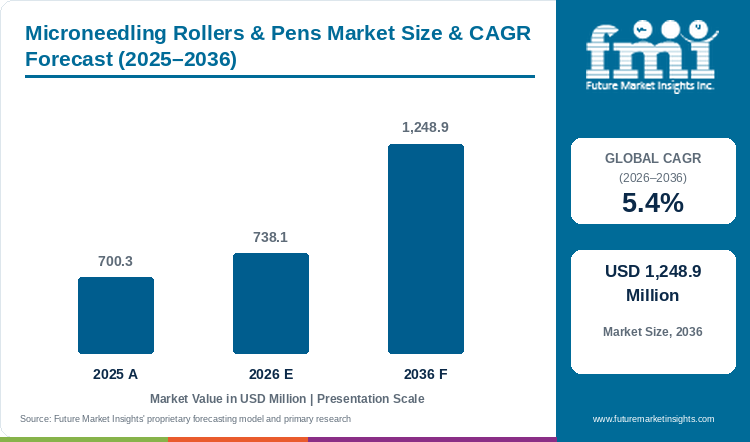
USD 738.1 Million in 2026 and USD 1,248.9 Million by 2036 at a 5.4% CAGR.
Spending on microneedling rollers and pens is estimated at USD 700.3 Million in 2025 and USD 738.1 Million in 2026, as per FMI. Revenue is projected to reach USD 1,248.9 Million by 2036 at a 5.4% CAGR, opening USD 510.8 Million of new sales for device suppliers. The FDA’s October 2025 microneedling guidance distinguishes authorized medical devices from shorter, blunt-needle products sold for surface use, making intended use central to the route to market [1].
Consumer rollers and professional powered pens do not reach the buyer through the same decision. Clinics need a device that fits authorized indications, practitioner requirements and infection-control procedures. Home users need clear limits on what the product is intended to do. Suppliers that match the device and its claims to the setting can build repeat business in consumables and support; unclear positioning makes both qualification and customer expectations harder to manage.
Analysts at FMI see product-specific regulatory progress as a stronger commercial signal than a broad beauty-device launch. The FDA cleared XCELLARISPRO TWIST in March 2025 and SkinStylus SteriLock MicroSystem in February 2026 [2] [3]. Those decisions support the named systems and their authorized uses. Suppliers seeking professional accounts will need similarly precise documentation, dependable cartridge supply and training that fits local practice.
Key Takeaways
- Demand is driven by persistent interest in skin resurfacing for acne scars, wrinkles and texture. The commercial effect is stronger where device design can bridge consumer convenience with professional control.
- Advanced multi-mode devices lead Device Type with 38.0% in 2026 because adjustable operating choices and controlled treatment settings create more differentiation than basic rollers.
- At-home leads Use Setting with 58.0% in 2026 as consumers value convenience and repeat access. The segment is constrained when deeper penetration or medical claims move use into regulated settings.
- Rechargeable cordless leads Power Source with 52.0% in 2026 because portability improves hand positioning and removes cable management from repeated facial treatment routines.
- The main purchasing friction is the safety and regulatory boundary around penetration depth, infection control and operator competence. These factors can narrow eligible channels even when end-user interest is high.
- Therabody, FOREO, CurrentBody, Dyson, Ya-Man, Conair, NuFACE, Panasonic, SharkNinja and Philips are the profiled companies. Public evidence shows different levels of adjacency to needle-based skin treatment, rather than a uniform in-scope roller or pen offering.
Analyst Perspective
“Revenue conversion depends less on interest in skin rejuvenation than on whether device claims, needle depth and operator requirements fit the legal channel of sale and use.”
- Rahul Pandita, Principal Consultant, FMI
How is the microneedling rollers & pens market segmented?
The market is segmented by Device Type, Use Setting, Power Source, Price Band and Sales Channel.
Device Type comprises Advanced multi-mode devices, Entry consumer devices and Professional-grade devices. Use Setting includes At-home, Professional & clinic and Hybrid prosumer. Power Source covers Rechargeable cordless, Corded and Battery. Price Band includes Entry (below USD 100), Mid (USD 100-300) and Premium (above USD 300). Sales Channel covers E-commerce & DTC, Specialty beauty & electronics, Professional distribution and Department stores.
What makes Advanced multi-mode devices central to the Device Type category?
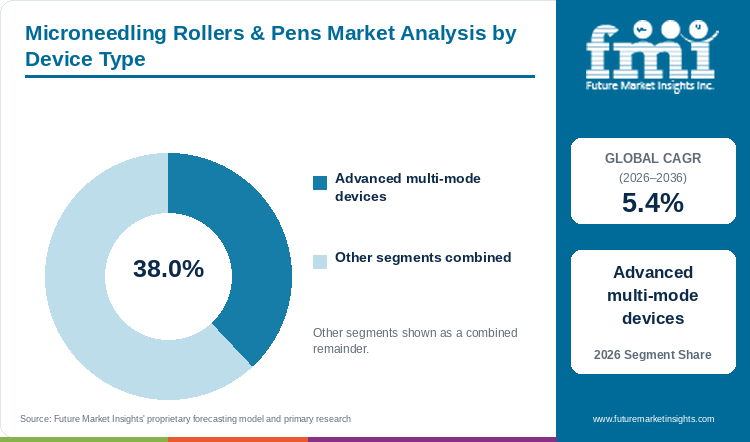
Advanced multi-mode devices hold 38.0% of Device Type demand in 2026.
Advanced multi-mode devices combine configurable treatment behavior with a more controlled user experience. In powered systems, adjustable depth or speed can change how a device is positioned for different indications and operator skill levels. This flexibility supports higher perceived utility than a fixed roller while stopping short of assuming that every feature is appropriate for home use. The segment benefits when buyers can see clear controls, cartridge discipline and evidence tied to the intended treatment setting.
- Advanced multi-mode devices hold 38.0% of Device Type demand in 2026. Their advantage comes from configurable treatment control and the ability to support multiple user workflows within one hardware platform.
- In March 2025, the FDA cleared XCELLARISPRO TWIST as a powered microneedling device [2]. The decision illustrates continued product-specific regulatory activity in professional pen systems.
Why does At-home lead the Use Setting category?
At-home accounts for 58.0% of Use Setting demand in 2026.
At-home use lowers appointment friction and allows consumers to place skin-device routines around their own schedules. The addressable offer is broadest for products positioned around superficial appearance and exfoliation rather than deeper tissue effects. The FDA explicitly distinguishes shallow cosmetic microneedling products from medical devices and notes that such products are more commonly sold for home use. [1] That boundary supports volume in home channels while also limiting how far sellers can extend claims without changing regulatory obligations.
- At-home accounts for 58.0% of Use Setting demand in 2026. Convenience and repeat access support the lead, while deeper treatments remain more dependent on trained professional use.
- In September 2026, CurrentBody introduced its Series 3 LED mask within a growing at-home beauty-device portfolio. The product is outside microneedling roller and pen revenue, yet it shows how consumers are being trained to purchase configurable skincare hardware through direct digital channels. [4]
How does Rechargeable cordless shape the Power Source category?
Rechargeable cordless holds 52.0% of Power Source demand in 2026.
Cordless power removes cable drag during repeated passes across facial contours and gives users more freedom over hand angle. That matters for powered pens because treatment control is partly ergonomic. Rechargeable systems also fit repeat-use routines better than disposable-battery architectures when the device is used frequently. The commercial value is not simply portability. It is the combination of portable handling, repeat charging and a product architecture that can support replaceable treatment components without forcing the buyer to replace the main device.
- Rechargeable cordless holds 52.0% of Power Source demand in 2026. The segment benefits from portable handling and lower recurring friction for repeat users.
- In February 2026, the FDA cleared Esthetic Medical’s SkinStylus SteriLock MicroSystem as a powered microneedle device. The clearance adds another motorized pen platform to the regulated category and reinforces the importance of compact powered architectures. [3]
Why does Entry (below USD 100) lead the Price Band category?
Entry (below USD 100) leads Price Band with 43.0% in 2026.
Entry pricing widens trial by reducing the amount a consumer must commit before deciding whether microneedling fits a skincare routine. Simple rollers and shallow-use products can be easier to position at this price than clinically oriented powered systems. The trade-off is reduced feature depth and less room for validated controls. Sellers therefore compete on ease of use and perceived routine value, while buyers must still distinguish superficial cosmetic use from devices intended to create deeper tissue effects.
- Entry (below USD 100) leads Price Band with 43.0% in 2026. Lower upfront cost expands trial and supports simple tools that do not carry the hardware burden of professional powered pens.
- In October 2025, the FDA emphasized that short-needle or blunt products limited to superficial appearance or exfoliation claims may fall outside medical-device regulation. That distinction helps explain why simple home products can compete at lower price points without proving the locked share itself. [1]
What keeps E-commerce & DTC ahead in the Sales Channel category?
E-commerce & DTC holds 40.0% of Sales Channel demand in 2026.
Digital channels give buyers immediate access to device specifications, tutorials and customer feedback before purchase. They also let suppliers explain cartridge replacement and aftercare without relying on a clinic consultation. This is particularly useful for home-oriented beauty hardware, where buyers may compare several technologies in one session. The weakness is trust. Ambiguous claims or poor differentiation between superficial products and medical-use devices can create confusion, so suppliers that use direct channels still need disciplined product education and precise claims.
- E-commerce & DTC holds 40.0% of Sales Channel demand in 2026. Searchable assortments and direct education help consumers compare device formats before committing to a routine.
- In August 2025, Therabody launched a curated wellness and beauty assortment on Ulta.com and announced expansion to more than 300 Ulta Beauty stores. The move is outside microneedling revenue, but it shows how beauty-device brands combine digital discovery with selective physical retail. [5]
What are the drivers, restraints and opportunities in the microneedling rollers & pens market?
Demand is supported by repeat interest in minimally invasive skin resurfacing, while safety and operator requirements restrict some channels and safer cordless platforms with stronger cartridge controls create room for product differentiation.
- Driver: Demand for scar, wrinkle and texture improvement supports continued purchasing across home and professional skin-device routines.
- Restraint: Penetration depth, infection control and practitioner eligibility can delay adoption or push devices into narrower regulated channels.
- Opportunity: Suppliers can convert interest into revenue through controlled cordless pens, single-use needle systems and evidence aligned with the intended use setting.
Clinical relevance remains the strongest demand mechanism. A May 2026 systematic review and meta-analysis covered 11 studies with 713 participants and found microneedling broadly comparable with chemical peels for atrophic acne scars, with a higher likelihood of achieving any improvement in the pooled microneedling analysis. [6] The U.S. FDA also lists authorized uses for facial acne scars, facial wrinkles and abdominal scars in adults aged 22 and older. [1] These facts sustain buyer interest in needle-based resurfacing. Device revenue rises when consumers or clinicians can connect the hardware to a defined appearance goal and a repeat treatment pathway.
Safety and practitioner scope constrain the route to market. The FDA’s October 2025 guidance requires a new cartridge for each patient and each treatment session [1]. France’s 2025 and 2026 guidance restricts skin-breaching microneedling by estheticians [7] [8]. Dubai’s March 2025 inspection checklist also treats microneedling as distinct from ordinary salon beauty services [9]. Suppliers need to align device claims, operator qualifications and hygiene support with the setting before expanding distribution.
The clearest opportunity is a better bridge between convenience and controlled use. Suppliers can improve portable pens with simple depth settings, clear treatment boundaries and single-use cartridge logic. Professional distributors can add training and traceability rather than competing only on hardware price. Consumer sellers can separate shallow cosmetic tools from medical-use claims more explicitly. The opportunity becomes revenue when better controls reduce buyer uncertainty without implying that every use belongs in an at-home channel. Companies that document cleaning, cartridge replacement and intended-use limits are better placed to earn repeat purchase and distributor confidence.
Which country CAGRs are profiled in the microneedling rollers & pens market?
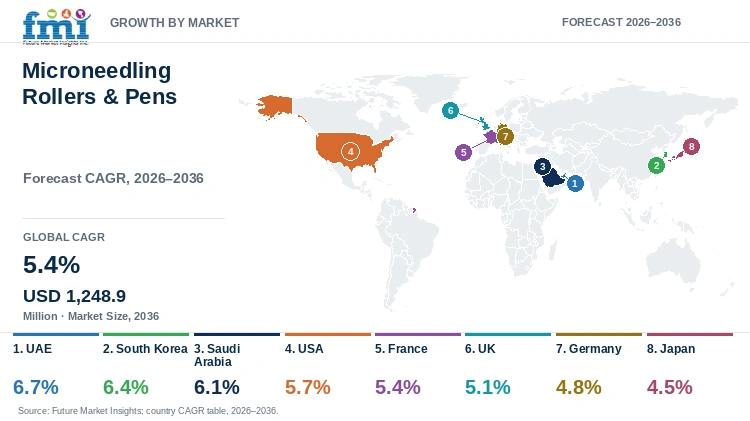
The following country CAGRs are profiled for 2026 to 2036.
| Country | CAGR |
|---|---|
| UAE | 6.7% |
| South Korea | 6.4% |
| Saudi Arabia | 6.1% |
| USA | 5.7% |
| France | 5.4% |
| UK | 5.1% |
| Germany | 4.8% |
| Japan | 4.5% |
How do country-level CAGRs compare in the microneedling rollers & pens market?
The profiled CAGRs range from 4.5% to 6.7%, a spread of 2.2 percentage points. UAE and South Korea form the fastest-growth band, followed by Saudi Arabia and the USA. France sits close to the global forecast rate, while the UK, Germany and Japan expand more moderately. These rates describe expected pace rather than absolute country market size. A smaller market can post a faster CAGR than a larger one.
- UAE: Depth-based practitioner rules create a clear distinction between shallow micro-needling and procedures treated as mesotherapy.
- South Korea: A formal MFDS quality guideline and a strong beauty-export ecosystem support product-development capability and export-oriented channels.
- Saudi Arabia: Medical-device sales depend on licensed establishment roles that include local manufacturers, authorized representatives and importer-distributors.
- USA: FDA classification and 510(k) activity make regulatory evidence central for powered pens that affect living tissue.
- France: Skin-breaching microneedling is restricted for estheticians, which shifts deeper procedures toward qualified health professionals or other permitted frameworks.
- UK: Policy work on non-surgical cosmetic licensing keeps training and penetration depth visible in supplier and practitioner decisions.
- Germany: Berlin guidance distinguishes microneedling at or below 0.5 mm from deeper needling and roller use, with hygiene oversight also relevant.
- Japan: A mature home beauty-device culture sits alongside a formal medical-device approval environment, which can moderate growth while keeping product expectations high.
These profiles describe eight country growth paths only. They should not be read as a rank of market size or supplier share. Country coverage is limited to USA, Germany, France, UK, Saudi Arabia, UAE, Japan and South Korea.
Country-wise Analysis
- The UAE offers the fastest profiled growth, at a 6.7% CAGR through 2036, with professional channel qualification shaping access. DHA’s March 2025 inspection checklist includes microneedling within non-surgical cosmetic services [9]. Suppliers need a clear intended-use position and support that fits the licensed facility and practitioner. Distributors able to coordinate product documentation and training can add more value than simple device availability.
- South Korea’s export-oriented beauty industry gives device makers established international channels, supporting a 6.4% CAGR through 2036. Korea.net reported cosmetics exports of USD 11.4 billion in 2025, while FDA recorded the Korean CODE-X powered microneedle system’s clearance in May 2026 [10] [11]. The two signals cover different products. Microneedling suppliers still need their own destination-specific evidence and support to turn channel reach into professional orders.
- Saudi Arabia’s licensed-establishment framework makes local representation part of the sales process, with a 6.1% CAGR forecast through 2036. SFDA’s March 2025 establishment information distinguishes roles including manufacturers, authorized representatives and importer-distributors [12]. Professional-device suppliers should make those responsibilities clear before placing equipment. Reliable consumable supply and post-market support can then help distributors build continuing relationships with clinics.
- The USA separates medical microneedling from superficial consumer tools, while sales are forecast at a 5.7% CAGR through 2036. FDA’s October 2025 guidance says no microneedling medical devices are authorized for over-the-counter sale [1]. Suppliers therefore need to align claims and distribution with the actual device. Professional pen systems can compete through documented indications and cartridge practices, while home products need clear limits on intended use.
- Practitioner eligibility shapes France’s 5.4% CAGR outlook through 2036. The DGCCRF’s February 2026 guidance states that skin-penetrating microneedling is prohibited to estheticians in ordinary aesthetic practice [8]. Suppliers serving deeper procedures need to reach appropriate professional channels and match product support to that setting. Consumer-facing availability alone will not create a lawful route for a medical-use pen.
- England’s proposed oversight of non-surgical procedures is raising expectations for documentation, with the UK market forecast at a 5.1% CAGR through 2036. The government’s August 2025 consultation response discusses microneedling and the role of penetration depth in risk classification [13]. It does not settle every final procedure rule. Suppliers can prepare by keeping device specifications, training and intended-use records clear for professional buyers.
- Germany’s broad online channel creates access to home beauty tools, supporting a 4.8% CAGR through 2036. Destatis recorded recent online purchases by 70% of people aged 16 to 74 in 2025 [14]. Microneedling sellers should use that reach carefully: shoppers need to understand whether a product is a superficial cosmetic tool or intended for professional treatment. Precise device descriptions and suitable distribution remain central to conversion.
- Japan’s established non-needle beauty devices compete for the same household budget, and microneedling revenue is forecast at a 4.5% CAGR through 2036. Panasonic announced its Vitalift Kassa facial EMS update in March 2025 [15]. That adjacent launch raises expectations for handling and routine support without contributing microneedling revenue. New suppliers need a clear reason for buyers to choose a needle-based tool and documentation that fits the intended use.
Who are the notable companies in the microneedling rollers & pens market?
Therabody, FOREO, CurrentBody, Dyson, Ya-Man, Conair, NuFACE, Panasonic, SharkNinja and Philips are the notable companies profiled in this market.
The profiled company set is heterogeneous. FOREO, CurrentBody and Ya-Man have documented needle-adjacent skin products, but their cited patches or micro-spicule cosmetics sit outside the roller and pen revenue boundary. Therabody, NuFACE, Panasonic and SharkNinja compete more broadly for at-home facial-device spending through non-needle technologies. Conair and Philips have facial cleansing portfolios, while Dyson’s public beauty activity is centered on hair care. Public evidence reviewed through the publication cutoff does not substantiate an in-scope microneedling roller or pen product for every profiled company. Competitive interpretation should therefore focus on channel capability, consumer-device ecosystems and adjacent skin-treatment know-how rather than assuming equivalent in-scope participation.
- Needle-adjacent skin-treatment brands: FOREO, CurrentBody and Ya-Man have documented dissolving microneedle patches or micro-spicule skincare. These products are excluded from market revenue because they are not rollers or pen-format devices.
- At-home facial-device ecosystem brands: Therabody, NuFACE, Panasonic and SharkNinja sell or promote facial-device platforms that compete for the same consumer attention and routine time, even when their technologies are non-needle.
- Broader personal-care technology brands: Dyson, Conair and Philips have established consumer-device channels, but reviewed public evidence did not verify an in-scope microneedling roller or pen product by the publication cutoff.
Competitive Benchmarking: Microneedling Rollers & Pens Market
| Company | Documented needle-based treatment activity | At-home facial-device platform | Professional channel evidence | Geographic Reach |
|---|---|---|---|---|
| Therabody | Unscored | High | Unscored | In-scope roller/pen reach not verified; broad beauty and wellness channels documented. [5] |
| FOREO | Medium | High | Unscored | In-scope roller/pen reach not verified; international consumer skincare channels documented. [16] |
| CurrentBody | Medium | High | Unscored | In-scope roller/pen reach not verified; international beauty-device e-commerce documented. [17] [4] |
| Dyson | Unscored | Unscored | Unscored | In-scope roller/pen reach not verified; reviewed beauty activity is centered on hair care. [18] |
| Ya-Man | Medium | High | Medium | In-scope roller/pen reach not verified; Japan-led home beauty and salon-adjacent products documented. [19] |
| Conair | Unscored | Medium | Unscored | In-scope roller/pen reach not verified; U.S. facial-cleansing retail activity documented. [20] |
| NuFACE | Unscored | High | High | In-scope roller/pen reach not verified; consumer and spa microcurrent channels documented. [21] |
| Panasonic | Unscored | High | Unscored | In-scope roller/pen reach not verified; Japan facial-device activity documented. [15] |
| SharkNinja | Unscored | High | Unscored | In-scope roller/pen reach not verified; at-home facial-device activity documented. [22] |
| Philips | Unscored | Medium | Unscored | In-scope roller/pen reach not verified; facial-cleansing product activity documented. [23] |
Scoring basis: Documented needle-based treatment activity measures public evidence of needle or micro-needle skincare capability, with Medium reflecting adjacent patch or micro-spicule activity rather than an in-scope roller or pen. At-home facial-device platform measures the breadth of documented consumer facial hardware, with High indicating a substantial current platform and Medium a narrower or legacy offer. Professional channel evidence measures documented use in spas or salon-oriented channels, with High indicating broad verified professional distribution and Medium narrower evidence. Low is reserved for a documented limitation; unavailable public information is left unscored.
Key Developments in the Microneedling Rollers & Pens Market
- In February 2026, the FDA cleared Esthetic Medical’s SkinStylus SteriLock MicroSystem [3]. The decision added a named powered system to the regulated microneedling category. Professional buyers still need to assess its authorized indications, consumables and operator requirements for their own setting.
- In March 2025, Dermaroller GmbH received FDA 510(k) clearance for the XCELLARISPRO TWIST microneedling device. The clearance gave a specialist microneedling supplier a documented route into the U.S. powered-device category and highlighted continued investment in professional pen architectures. [2]
- In May 2026, Woorhi Mechatronics received FDA 510(k) clearance for the Automatic Micro Needle System CODE-X. The South Korean applicant’s clearance adds to the evidence of export-oriented device development and gives U.S. professional buyers another regulated powered microneedle option to evaluate. [11]
Key Players in the Microneedling Rollers & Pens Market
Needle-adjacent skin-treatment platforms
- FOREO
- CurrentBody
- Ya-Man
At-home facial-device ecosystems
- Therabody
- NuFACE
- Panasonic
- SharkNinja
Broader personal-care technology portfolios
- Dyson
- Conair
- Philips
Microneedling Rollers & Pens Market - Report Scope
| Coverage field | Report scope |
|---|---|
| Market breakdown | Device Type; Use Setting; Power Source; Price Band; Sales Channel; Region |
| Quantitative Units | USD Million |
| Market Definition | Revenue includes manual microneedling rollers and pen-format microneedling devices sold as standalone units or device kits. Procedure fees, replacement consumables sold separately, dissolving microneedle patches, topical micro-spicule cosmetics, non-needle facial tools and energy-based systems outside roller or pen form factors are excluded. |
| Regions Covered | North America; Latin America; Western Europe; Eastern Europe; East Asia; South Asia and Pacific; Middle East and Africa |
| Countries Covered | USA, Germany, France, UK, Saudi Arabia, UAE, Japan, South Korea |
| Key Companies Profiled | Therabody, FOREO, CurrentBody, Dyson, Ya-Man, Conair, NuFACE, Panasonic, SharkNinja, Philips |
| Forecast Period | 2026 to 2036 |
| Approach | Primary and secondary research with market triangulation. |
Microneedling Rollers & Pens Market - Research Methodology
| Method | Approach |
|---|---|
| Primary Research | FMI analysts gathered input from manufacturers, service providers, technology developers, distributors, end users, procurement teams and subject-matter experts. Interviews examined purchasing decisions, product or service evaluation, adoption barriers, approval requirements, pricing considerations and expectations for technical or commercial support. Respondents were also asked what evidence is required before a trial, pilot, or initial order develops into regular purchasing. |
| Desk Research | Desk research covered government statistics, regulatory publications, trade data, industry associations, technical literature, standards, company filings, product information and official corporate announcements. Sources were reviewed for relevance, publication date, geographic coverage and consistency with the defined market scope. Claims relating to performance, applications, approvals, capacity, investment and commercial activity were retained only when supported by credible public evidence. |
| Market Sizing and Forecasting | The market model combined the baseline value with historical performance, segment structure, pricing and volume indicators, adoption levels, company participation and country-level demand conditions. Forecast assumptions considered economic activity, investment trends, regulatory developments, technology adoption, purchasing cycles, supply availability and barriers to wider market use. Segment and regional estimates were reconciled before the final market total was calculated. |
| Data Validation | Estimates were checked against multiple independent indicators, including public data, company activity, trade patterns, industry developments and findings from primary interviews. Validation also tested whether products, services, applications and company revenues fell within the defined market boundaries. Adjacent categories, unsupported claims, overlapping revenues and activities without direct market relevance were excluded to reduce double counting and maintain consistency across segments and countries. |
Microneedling Rollers & Pens Market by Segments
Microneedling Rollers & Pens Market segmented by Device Type:
- Advanced multi-mode devices
- Entry consumer devices
- Professional-grade devices
Microneedling Rollers & Pens Market segmented by Use Setting:
- At-home
- Professional & clinic
- Hybrid prosumer
Microneedling Rollers & Pens Market segmented by Power Source:
- Rechargeable cordless
- Corded
- Battery
Microneedling Rollers & Pens Market segmented by Price Band:
- Entry (below USD 100)
- Mid (USD 100-300)
- Premium (above USD 300)
Microneedling Rollers & Pens Market segmented by Sales Channel:
- E-commerce & DTC
- Specialty beauty & electronics
- Professional distribution
- Department stores
Microneedling Rollers & Pens Market by Region:
- North America
- United States
- Canada
- Latin America
- Brazil
- Mexico
- Argentina
- Chile
- Western Europe
- Germany
- France
- United Kingdom
- Italy
- Spain
- Benelux
- Nordics
- Eastern Europe
- Poland
- Czech Republic
- Romania
- Hungary
- East Asia
- China
- Japan
- South Korea
- South Asia and Pacific
- India
- ASEAN
- Australia and New Zealand
- Middle East and Africa
- GCC Countries
- South Africa
- Türkiye
- Israel
Research Sources and Bibliography
- [1] U.S. Food and Drug Administration (2025, October 15). Microneedling Devices.
- [2] U.S. Food and Drug Administration (2025, March 6). 510(k) Premarket Notification K241790: XCELLARISPRO TWIST microneedling device.
- [3] U.S. Food and Drug Administration (2026, February 19). 510(k) Premarket Notification K253002: SkinStylus SteriLock MicroSystem.
- [4] CurrentBody (2026, September 10). Which CurrentBody mask is right for you?.
- [5] Therabody (2025, August 5). Therabody Brings Science-Backed Wellness to Ulta Beauty -The Nation’s Largest Beauty Retailer.
- [6] Agu-Jefferson et al. (2026, May 11). Microneedling Versus Chemical Peels for Atrophic Acne Scars: A Systematic Review and Meta-Analysis.
- [7] French Ministry of Health (2025, January 6). Injections et autres pratiques perforant la peau.
- [8] DGCCRF, France (2026, February 19). FAQ - Encadrement des soins esthétiques et de la coiffure.
- [9] Dubai Health Authority (2025, March 24). Non-Surgical Cosmetic Procedures: Random Checklist, version 2.
- [10] Korea.net (2026, May 26). Cosmetics surplus breaks USD 10B, exports ranked 2nd worldwide.
- [11] U.S. Food and Drug Administration (2026, May 13). 510(k) Premarket Notification K252591: Automatic Micro Needle System (CODE-X).
- [12] Saudi Food and Drug Authority (2025, March 5). Licensed Establishments List.
- [13] UK Department of Health and Social Care (2025, August 7). The licensing of non-surgical cosmetic procedures in England: consultation response.
- [14] Destatis (2026, April 20). Internet use and online shopping over time: 2025 results.
- [15] Panasonic (2025, March 25). Vitalift Kassa EH-SP86 Launch Announcement.
- [16] FOREO (n.d.). FAQ™ Microneedling Patches for Under Eyes. Current page, accessed 6 October 2026.
- [17] CurrentBody (n.d.). RF Microneedling Treatment | At Home Microneedling with Radio Frequency. Current page, accessed 6 October 2026.
- [18] Dyson (n.d.). Dyson Hair Care. Current page, accessed 6 October 2026.
- [19] YA-MAN (n.d.). Medi Lift Needle Lift Cream. Current page, accessed 6 October 2026.
- [20] Conair (n.d.). True Glow® Skincare Collection. Current page, accessed 6 October 2026.
- [21] NuFACE (n.d.). Devices 2026. Current page, accessed 6 October 2026.
- [22] SharkNinja (2025, September 29). Shark Beauty Redefines the At-Home Facial With Shark™ FacialPro™ Glow and Shark™ DePuffi™.
- [23] Philips (n.d.). View and compare Facial cleansing products. Current page, accessed 6 October 2026.
"This bibliography is provided for reader reference and is not exhaustive. The full report contains the complete reference list and detailed citations."
This Report Answers
- How big is the Microneedling Rollers & Pens Market in 2026 and what is forecast for 2036?
- Which industry pressures support demand for microneedling rollers & pens?
- Why do Advanced multi-mode devices lead the Device Type category?
- Why does At-home lead the Use Setting category?
- How do profiled country growth rates differ through 2036?
- Which companies supply or participate in relevant microneedling and adjacent beauty-device categories?
- What limits adoption or supplier switching in microneedling rollers & pens?
- What should buyers evaluate before purchasing a microneedling roller or pen?
Frequently Asked Questions
How big is the Microneedling Rollers & Pens Market in 2026, and what is forecast for 2036?
The market is valued at USD 738.1 Million in 2026 and is forecast to reach USD 1,248.9 Million by 2036. The increase reflects growth across both consumer and professional device routes, with different regulatory limits by depth and intended use.
What is the CAGR for the Microneedling Rollers & Pens Market from 2026 to 2036?
The market is forecast to grow at a 5.4% CAGR from 2026 to 2036. Growth is supported by sustained interest in skin resurfacing while safety rules keep professional and at-home use from converging completely.
Which segment leads Device Type in 2026?
Advanced multi-mode devices lead Device Type with a 38.0% share in 2026. Configurable treatment controls give these platforms more flexibility than fixed entry devices while supporting differentiated professional or prosumer workflows.
Which segment leads Use Setting in 2026?
At-home leads Use Setting with a 58.0% share in 2026. Convenience supports the category, although deeper penetration and medical claims can move use into regulated professional settings.
Which profiled countries have the highest growth rates?
UAE has the highest profiled CAGR at 6.7%, followed by South Korea at 6.4% and Saudi Arabia at 6.1% from 2026 to 2036. These growth rates indicate pace and should not be interpreted as country market-size rankings.
Which companies are active in the Microneedling Rollers & Pens Market?
The profiled companies are Therabody, FOREO, CurrentBody, Dyson, Ya-Man, Conair, NuFACE, Panasonic, SharkNinja and Philips. Public evidence varies from needle-adjacent skincare to broader facial-device platforms, and reviewed sources do not verify an in-scope roller or pen for every company.
Preview the report firsthand - request a free sample
Get SampleGet the brochure for pricing and purchase details.
Get PDFTable of Content
- Key Takeaways
- Market Size and CAGR
- Top Growth Driver
- Fastest Growing Segment
- Leading Region
- Key Companies
- Emerging Opportunities
- Executive Summary
- Global Market Outlook
- Demand-side Trends
- Supply-side Trends
- Technology Roadmap Analysis
- Analysis and Recommendations
- Analyst Perspective (What is happening? Why now? What should investors know?)
- Key Questions Answered
- How large is the market?
- What is the CAGR?
- What are key trends?
- Which region dominates?
- Who are the leaders?
- Market Overview
- Market Coverage / Taxonomy
- Market Definition / Scope / Limitations
- Research Methodology
- Chapter Orientation
- Analytical Lens and Working Hypotheses
- Market Structure, Signals, and Trend Drivers
- Benchmarking and Cross-market Comparability
- Market Sizing, Forecasting, and Opportunity Mapping
- Research Design and Evidence Framework
- Desk Research Programme (Secondary Evidence)
- Expert Input and Fieldwork (Primary Evidence)
- Tooling, Models, and Reference Databases
- Data Engineering and Model Build
- Quality Assurance and Audit Trail
- Market Background
- Market Dynamics (Drivers, Restraints, Opportunity, Trends)
- Scenario Forecast (Optimistic, Likely, Conservative)
- Impact Analysis
- AI Impact
- Sustainability Impact
- Regulatory Impact
- Technology Impact
- Consumer / Buyer Analysis
- Purchase Drivers
- Adoption Barriers
- Buyer Journey
- Opportunity Map Analysis
- Product Life Cycle Analysis
- Supply Chain Analysis
- Investment Feasibility Matrix
- Value Chain Analysis
- PESTLE and Porter's Analysis
- Regulatory Landscape
- Regional Parent Market Outlook
- Production and Consumption Statistics
- Import and Export Statistics
- Global Market Analysis and Forecast, 2021 to 2036
- Historical Market Size Value (USD Million) Analysis, 2021 to 2025
- Current and Future Market Size Value (USD Million) Projections, 2026 to 2036
- Y-o-Y Growth Trend Analysis
- Absolute $ Opportunity Analysis
- Global Market Pricing Analysis, 2021 to 2036
- Global Market Analysis and Forecast, By Device Type, 2021 to 2036
- Introduction / Key Findings
- Historical Market Size Value (USD Million) Analysis By Device Type, 2021 to 2025
- Current and Future Market Size Value (USD Million) Analysis and Forecast By Device Type, 2026 to 2036
- Advanced multi-mode devices
- Entry consumer devices
- Professional-grade devices
- Y-o-Y Growth Trend Analysis By Device Type, 2021 to 2025
- Absolute $ Opportunity Analysis By Device Type, 2026 to 2036
- Global Market Analysis and Forecast, By Use Setting, 2021 to 2036
- Introduction / Key Findings
- Historical Market Size Value (USD Million) Analysis By Use Setting, 2021 to 2025
- Current and Future Market Size Value (USD Million) Analysis and Forecast By Use Setting, 2026 to 2036
- At-home
- Professional & clinic
- Hybrid prosumer
- Y-o-Y Growth Trend Analysis By Use Setting, 2021 to 2025
- Absolute $ Opportunity Analysis By Use Setting, 2026 to 2036
- Global Market Analysis and Forecast, By Power Source, 2021 to 2036
- Introduction / Key Findings
- Historical Market Size Value (USD Million) Analysis By Power Source, 2021 to 2025
- Current and Future Market Size Value (USD Million) Analysis and Forecast By Power Source, 2026 to 2036
- Rechargeable cordless
- Corded
- Battery
- Y-o-Y Growth Trend Analysis By Power Source, 2021 to 2025
- Absolute $ Opportunity Analysis By Power Source, 2026 to 2036
- Global Market Analysis and Forecast, By Price Band, 2021 to 2036
- Introduction / Key Findings
- Historical Market Size Value (USD Million) Analysis By Price Band, 2021 to 2025
- Current and Future Market Size Value (USD Million) Analysis and Forecast By Price Band, 2026 to 2036
- Entry (below USD 100)
- Mid (USD 100-300)
- Premium (above USD 300)
- Y-o-Y Growth Trend Analysis By Price Band, 2021 to 2025
- Absolute $ Opportunity Analysis By Price Band, 2026 to 2036
- Global Market Analysis and Forecast, By Sales Channel, 2021 to 2036
- Introduction / Key Findings
- Historical Market Size Value (USD Million) Analysis By Sales Channel, 2021 to 2025
- Current and Future Market Size Value (USD Million) Analysis and Forecast By Sales Channel, 2026 to 2036
- E-commerce & DTC
- Specialty beauty & electronics
- Professional distribution
- Department stores
- Y-o-Y Growth Trend Analysis By Sales Channel, 2021 to 2025
- Absolute $ Opportunity Analysis By Sales Channel, 2026 to 2036
- Global Market Analysis and Forecast, By Region, 2021 to 2036
- Introduction
- Historical Market Size Value (USD Million) Analysis By Region, 2021 to 2025
- Current Market Size Value (USD Million) Analysis and Forecast By Region, 2026 to 2036
- North America
- Latin America
- Western Europe
- Eastern Europe
- East Asia
- South Asia and Pacific
- Middle East and Africa
- Market Attractiveness Analysis By Region
- North America Market Analysis and Forecast, By Country, 2021 to 2036
- Historical Market Size Value (USD Million) Trend Analysis By Market Taxonomy, 2021 to 2025
- Market Size Value (USD Million) Forecast By Market Taxonomy, 2026 to 2036
- By Country
- United States
- Canada
- By Device Type
- By Use Setting
- By Power Source
- By Price Band
- By Sales Channel
- By Country
- Market Attractiveness Analysis
- By Country
- By Device Type
- By Use Setting
- By Power Source
- By Price Band
- By Sales Channel
- Key Takeaways
- Latin America Market Analysis and Forecast, By Country
- Historical Market Size Value (USD Million) Trend Analysis By Market Taxonomy, 2021 to 2025
- Market Size Value (USD Million) Forecast By Market Taxonomy, 2026 to 2036
- By Country
- Brazil
- Mexico
- Argentina
- Chile
- By Device Type
- By Use Setting
- By Power Source
- By Price Band
- By Sales Channel
- By Country
- Market Attractiveness Analysis
- By Country
- By Device Type
- By Use Setting
- By Power Source
- By Price Band
- By Sales Channel
- Key Takeaways
- Western Europe Market Analysis and Forecast, By Country
- Historical Market Size Value (USD Million) Trend Analysis By Market Taxonomy, 2021 to 2025
- Market Size Value (USD Million) Forecast By Market Taxonomy, 2026 to 2036
- By Country
- Germany
- France
- United Kingdom
- Italy
- Spain
- Benelux
- Nordics
- By Device Type
- By Use Setting
- By Power Source
- By Price Band
- By Sales Channel
- By Country
- Market Attractiveness Analysis
- By Country
- By Device Type
- By Use Setting
- By Power Source
- By Price Band
- By Sales Channel
- Key Takeaways
- Eastern Europe Market Analysis and Forecast, By Country
- Historical Market Size Value (USD Million) Trend Analysis By Market Taxonomy, 2021 to 2025
- Market Size Value (USD Million) Forecast By Market Taxonomy, 2026 to 2036
- By Country
- Poland
- Czech Republic
- Romania
- Hungary
- By Device Type
- By Use Setting
- By Power Source
- By Price Band
- By Sales Channel
- By Country
- Market Attractiveness Analysis
- By Country
- By Device Type
- By Use Setting
- By Power Source
- By Price Band
- By Sales Channel
- Key Takeaways
- East Asia Market Analysis and Forecast, By Country
- Historical Market Size Value (USD Million) Trend Analysis By Market Taxonomy, 2021 to 2025
- Market Size Value (USD Million) Forecast By Market Taxonomy, 2026 to 2036
- By Country
- China
- Japan
- South Korea
- By Device Type
- By Use Setting
- By Power Source
- By Price Band
- By Sales Channel
- By Country
- Market Attractiveness Analysis
- By Country
- By Device Type
- By Use Setting
- By Power Source
- By Price Band
- By Sales Channel
- Key Takeaways
- South Asia and Pacific Market Analysis and Forecast, By Country
- Historical Market Size Value (USD Million) Trend Analysis By Market Taxonomy, 2021 to 2025
- Market Size Value (USD Million) Forecast By Market Taxonomy, 2026 to 2036
- By Country
- India
- ASEAN
- Australia and New Zealand
- By Device Type
- By Use Setting
- By Power Source
- By Price Band
- By Sales Channel
- By Country
- Market Attractiveness Analysis
- By Country
- By Device Type
- By Use Setting
- By Power Source
- By Price Band
- By Sales Channel
- Key Takeaways
- Middle East and Africa Market Analysis and Forecast, By Country
- Historical Market Size Value (USD Million) Trend Analysis By Market Taxonomy, 2021 to 2025
- Market Size Value (USD Million) Forecast By Market Taxonomy, 2026 to 2036
- By Country
- GCC Countries
- South Africa
- Türkiye
- Israel
- By Device Type
- By Use Setting
- By Power Source
- By Price Band
- By Sales Channel
- By Country
- Market Attractiveness Analysis
- By Country
- By Device Type
- By Use Setting
- By Power Source
- By Price Band
- By Sales Channel
- Key Takeaways
- Key Countries Market Analysis
- United States
- Pricing Analysis
- Market Share Analysis, 2025
- By Device Type
- By Use Setting
- By Power Source
- By Price Band
- By Sales Channel
- Canada
- Pricing Analysis
- Market Share Analysis, 2025
- By Device Type
- By Use Setting
- By Power Source
- By Price Band
- By Sales Channel
- Mexico
- Pricing Analysis
- Market Share Analysis, 2025
- By Device Type
- By Use Setting
- By Power Source
- By Price Band
- By Sales Channel
- Brazil
- Pricing Analysis
- Market Share Analysis, 2025
- By Device Type
- By Use Setting
- By Power Source
- By Price Band
- By Sales Channel
- Chile
- Pricing Analysis
- Market Share Analysis, 2025
- By Device Type
- By Use Setting
- By Power Source
- By Price Band
- By Sales Channel
- Germany
- Pricing Analysis
- Market Share Analysis, 2025
- By Device Type
- By Use Setting
- By Power Source
- By Price Band
- By Sales Channel
- United Kingdom
- Pricing Analysis
- Market Share Analysis, 2025
- By Device Type
- By Use Setting
- By Power Source
- By Price Band
- By Sales Channel
- Italy
- Pricing Analysis
- Market Share Analysis, 2025
- By Device Type
- By Use Setting
- By Power Source
- By Price Band
- By Sales Channel
- Spain
- Pricing Analysis
- Market Share Analysis, 2025
- By Device Type
- By Use Setting
- By Power Source
- By Price Band
- By Sales Channel
- France
- Pricing Analysis
- Market Share Analysis, 2025
- By Device Type
- By Use Setting
- By Power Source
- By Price Band
- By Sales Channel
- India
- Pricing Analysis
- Market Share Analysis, 2025
- By Device Type
- By Use Setting
- By Power Source
- By Price Band
- By Sales Channel
- ASEAN
- Pricing Analysis
- Market Share Analysis, 2025
- By Device Type
- By Use Setting
- By Power Source
- By Price Band
- By Sales Channel
- Australia and New Zealand
- Pricing Analysis
- Market Share Analysis, 2025
- By Device Type
- By Use Setting
- By Power Source
- By Price Band
- By Sales Channel
- China
- Pricing Analysis
- Market Share Analysis, 2025
- By Device Type
- By Use Setting
- By Power Source
- By Price Band
- By Sales Channel
- Japan
- Pricing Analysis
- Market Share Analysis, 2025
- By Device Type
- By Use Setting
- By Power Source
- By Price Band
- By Sales Channel
- South Korea
- Pricing Analysis
- Market Share Analysis, 2025
- By Device Type
- By Use Setting
- By Power Source
- By Price Band
- By Sales Channel
- Poland
- Pricing Analysis
- Market Share Analysis, 2025
- By Device Type
- By Use Setting
- By Power Source
- By Price Band
- By Sales Channel
- Hungary
- Pricing Analysis
- Market Share Analysis, 2025
- By Device Type
- By Use Setting
- By Power Source
- By Price Band
- By Sales Channel
- Türkiye
- Pricing Analysis
- Market Share Analysis, 2025
- By Device Type
- By Use Setting
- By Power Source
- By Price Band
- By Sales Channel
- South Africa
- Pricing Analysis
- Market Share Analysis, 2025
- By Device Type
- By Use Setting
- By Power Source
- By Price Band
- By Sales Channel
- UAE
- Pricing Analysis
- Market Share Analysis, 2025
- By Device Type
- By Use Setting
- By Power Source
- By Price Band
- By Sales Channel
- Saudi Arabia
- Pricing Analysis
- Market Share Analysis, 2025
- By Device Type
- By Use Setting
- By Power Source
- By Price Band
- By Sales Channel
- United States
- Market Structure Analysis
- Competition Dashboard
- Competition Benchmarking
- Market Share Analysis of Top Players
- By Regional
- By Device Type
- By Use Setting
- By Power Source
- By Price Band
- By Sales Channel
- Emerging Startups
- Innovation Benchmarking
- Competition Analysis
- Competition Deep Dive
- Therabody
- Overview
- Product Portfolio
- Profitability by Market Segments
- Sales Footprint
- Strategy Overview
- Marketing Strategy
- Product Strategy
- Channel Strategy
- FOREO
- CurrentBody
- Dyson
- Ya-Man
- Conair
- NuFACE
- Panasonic
- SharkNinja
- Philips
- Therabody
- Case Studies
- Success Stories
- Recent Developments
- Competition Deep Dive
- Assumptions & Acronyms Used


