

- Market Size (2026)
- USD 882.7 Mn
- Forecast (2036)
- USD 1610.9 Mn
- CAGR (2026 to 2036)
- 6.2%
How big is Post-Procedure Skincare Market in 2026?
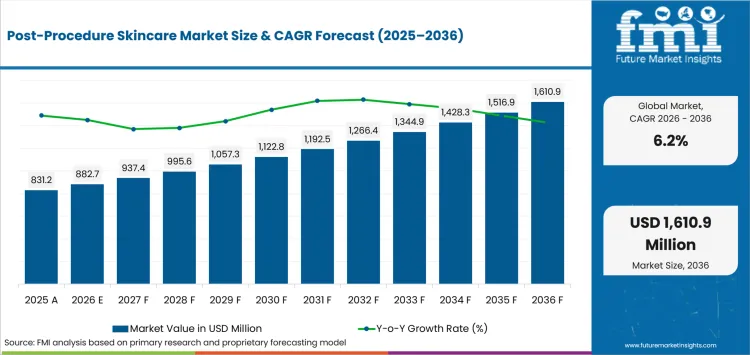
USD 882.7 million in 2026 and USD 1,610.9 million by 2036 at a 6.2% CAGR.
The post-procedure skincare market is projected to rise from USD 882.7 million in 2026 to USD 1610.9 million by 2036 at a 6.2% CAGR. Recovery demand follows the treatment event as procedures using aesthetic medical devices or resurfacing techniques shift product choice toward gentler cleansing and barrier support. The American Society of Plastic Surgeons reported in June 2025 that minimally invasive treatments increased 1.5% during 2024. That procedure base gives recovery-focused skincare a recurring recommendation point instead of relying on routine beauty replacement cycles.
Country conversion depends on clinic control of aftercare and the ease of retail replenishment around dermatology devices used in treatment settings. South Korea illustrates concentrated professional traffic: its Ministry of Health and Welfare reported 2.01 million foreign patients during 2025. Dermatology accounted for 1.313 million visits, giving practitioners frequent opportunities to specify recovery products at discharge and route patients toward retail or digital refills.
Key Takeaways of Post-Procedure Skincare Market
- Procedure-linked barrier disruption turns aesthetic treatment into a defined recovery purchase occasion for gentle cleansing, moisturization and photoprotection.
- In 2026, core - classic lines are expected to lead product type with 40.0% share because basic recovery steps fit many procedures.
- By nature, conventional products are estimated to hold 46.0% in 2026 owing to flexible formulation and familiar consumer use.
- Cream & balm formats are projected to hold 27.0% share in 2026 owing to emollient textures that fit barrier-support routines.
- Formulation tolerance restrains adoption because compromised skin narrows acceptable ingredients and raises the cost of clear procedure-specific use guidance.
- Some of the key players in this market include L’Oréal Groupe, Beiersdorf, Amorepacific, The Estée Lauder Companies, Kao Corporation, Revance, Galderma, and Laboratoires Pierre Fabre.
Analyst Perspective
"Clinics should compare post-procedure skincare by recovery-stage fit and tolerability evidence before weighing unit price or retail margin. Repeat revenue is strongest when the recommended regimen supports skin barrier repair and patients can refill it through familiar pharmacy or digital channels."
- Rahul Pandita, Principal Consultant, Future Market Insights
How is the Post-Procedure Skincare Market segmented?
The market is segmented by product type, nature, format, price positioning and sales channel.
Product type includes core - classic lines, targeted treatment lines, sensitive & gentle lines, premium & clinical lines and kits & sets. Nature covers conventional, vegan & cruelty-free, natural & organic, dermocosmetic / clinical and fragrance-free & sensitive. Formats include cream & balm, liquid & serum, stick & solid, spray & mist, sheet & patch and powder. Price positioning spans masstige, mass, premium and professional products across recovery routines. Sales channels include e-commerce & DTC, specialty beauty retail, pharmacies & drugstores, supermarkets & hypermarkets and salons & spas.
What drives e-commerce & DTC in the sales channel category?
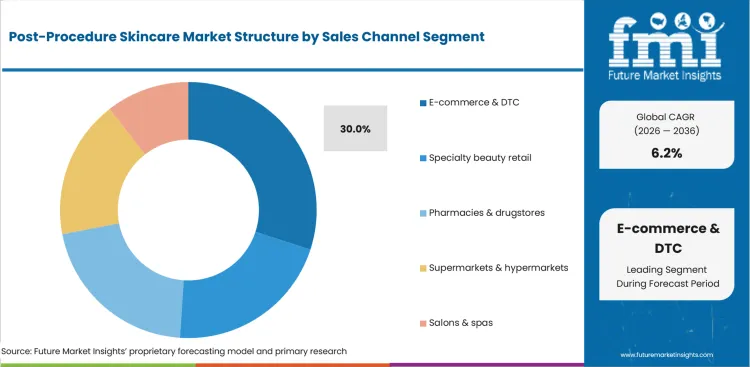
E-commerce and DTC address the refill gap once patients leave clinics and need the same recovery products without another appointment or specialist retail trip.
- E-commerce & DTC is set to lead the sales channel with 30.0% share in 2026 due to fast replenishment after professional recommendation.
- Clinique entered Amazon Mexico's Premium Beauty store in August 2025 with dermatologist-guided skincare and nationwide delivery. That channel gives recovering consumers repeated visibility for repairing skin care treatments and lets them reorder a familiar routine before starter products run out. Fast nationwide delivery is especially useful during short recovery windows that do not justify another clinic visit.
What makes core - classic lines central to the product type category?
Core - classic lines cover recovery steps used across lasers and peels without requiring treatment-specific active ingredients. Amorepacific announced AESTURA's Canadian Sephora launch in July 2025, extending its sensitive-skin range into a specialist beauty channel. The range placed cleansers and serums beside cream and mist formats for sensitive skin during recovery.
- Based on product type, core - classic lines are projected to account for 40.0% in 2026 due to broad protocol fit across varied treatment intensity.
- Clinics can match a simple cleanser-and-moisturizer routine to sensitive skin solutions while consumers replenish familiar products after the initial recovery visit without learning a new regimen.
How does cream & balm support the format category?
Cream and balm formats give recently treated skin a familiar application method with enough residence time for moisturization and surface protection. Their localized use also avoids device-specific dosing and complicated application steps during short recovery routines.
- In 2026, cream & balm is expected to lead format with 27.0% share because familiar textures support localized barrier care without complex dosing.
- The Estée Lauder Companies reported in March 2025 that a facial night cream was studied after glycolic peels and IPL without tolerance concerns. That evidence gives practitioners a reference point for placing creams within redness relief skincare routines during early recovery.
What supports masstige in the price positioning category?
Masstige products occupy a useful price band for consumers seeking professional-style reassurance without paying clinic-exclusive prices throughout recovery. Kao expanded Curél into German and French pharmacies in January 2025, giving sensitive skincare a specialist advice channel. The launch placed ceramide-based sensitive skincare inside a channel built around specialist advice and repeat pharmacy access.
- By price positioning, masstige is estimated to hold 30.0% in 2026 owing to accessible pricing across several weeks of routine use.
- Pharmacy visibility can reinforce sun care products and barrier guidance while preserving enough price headroom for differentiated textures and sensitive-skin positioning across a complete post-procedure recovery cycle.
What are the drivers, restraints and opportunities in the Post-Procedure Skincare Market?
Procedure volume and recovery-stage barrier needs support demand, although formulation tolerance narrows product choice and clinic-to-home regimen continuity offers the clearest commercial opening.
- Driver: More consumers considering cosmetic procedures increase the number of treatment events that can generate a defined aftercare recommendation.
- Restraint: Compromised skin limits acceptable actives and raises the burden of proving that a formula fits the correct recovery stage.
- Opportunity: Procedure-linked starter regimens can transfer professional recommendations into repeat purchases through pharmacy, specialty retail and digital replenishment.
Procedure Volume Expands the Recommendation Window
A treatment visit becomes commercially useful for skincare once the practitioner specifies the recovery routine at discharge. The American Society for Dermatologic Surgery reported in July 2025 that 70% of surveyed consumers were considering a cosmetic procedure. Dermatologists ranked as the leading influencers for procedures and skincare choices, giving facial injectables and related treatments a direct professional route into recommended recovery products.
Tolerance Requirements Narrow Immediate Product Choice
Product qualification becomes harder as recently treated skin reacts differently from intact skin and clinics vary the timing of active ingredients. The FDA launched a real-time cosmetic adverse-event dashboard in September 2025 that includes serious reports submitted under MoCRA. Greater safety visibility raises the commercial cost of vague compatibility claims and pushes clinics toward clearer recovery-stage instructions for general skincare inside a cosmetic surgery products recovery protocol.
Clinic-to-Home Regimens Extend the Revenue Window
A procedure-linked skincare range earns more revenue by covering preparation, immediate recovery and home maintenance under one clinical narrative. Galderma launched Alastin in China in September 2025 with full-spectrum care spanning pre-treatment preparation to post-treatment recovery and maintenance. That model gives the broader skincare market a practical route to extend professional trust into repeat retail purchases without treating every procedure as having identical aftercare needs.
Which country CAGRs are profiled in the Post-Procedure Skincare Market?
| Country | CAGR |
|---|---|
| United Arab Emirates | 7.6% |
| South Korea | 7.3% |
| Saudi Arabia | 7.0% |
| United States | 6.6% |
| United Kingdom | 6.3% |
How do country-level CAGRs compare in the Post-Procedure Skincare Market?
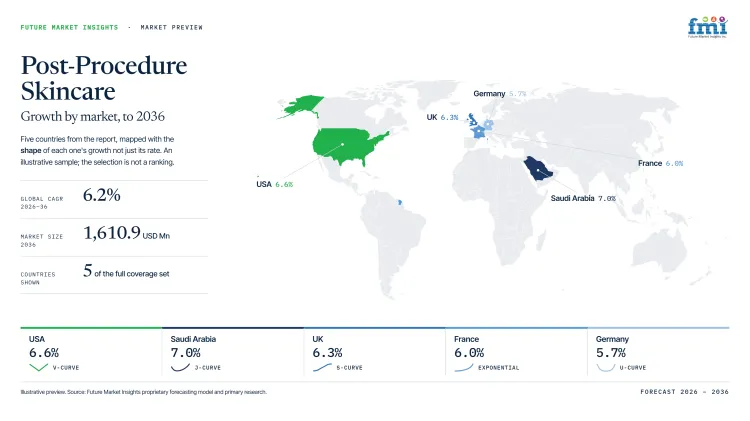
The growth rates span 1.3 percentage points from the United Arab Emirates at 7.6% to the United Kingdom at 6.3%. Gulf markets form the upper group as private aesthetic clinics pair premium procedures with fast replenishment. South Korea follows closely as dense dermatology traffic directly shortens treatment-to-retail conversion.
- United Arab Emirates growth reflects private-clinic density and premium digital access across Dubai.
- South Korea converts dense dermatology traffic into retail replenishment across Seoul clinics.
- Saudi Arabia pairs clinic expansion with stricter imported-cosmetic registration and claims oversight.
- United States growth draws on procedure scale despite fragmented clinic protocols nationwide.
- United Kingdom demand advances beside pharmacy access and licensing reform across England.
Similar CAGRs can produce different entry economics as procedure mix varies locally. The full report provides country-level CAGR analysis across North America, Latin America, Europe, East Asia, South Asia, Oceania and the Middle East and Africa.
Country-wise Analysis
- Dense private-clinic networks in Dubai and Abu Dhabi give the United Arab Emirates a steady recommendation base for premium recovery skincare used by local and medical-tourism patients. The market is forecast to rise at 7.6% CAGR over the forecast period, driven by frequent post-treatment guidance at the point of discharge. In June 2025, Dubai Health Authority restricted invasive skin-opening procedures to licensed plastic surgeons and reinforced facility compliance around treatment scope. This regulatory tightening raises the credibility threshold for brands, making recovery-stage instructions, clinician education and e-commerce refill routes important for sustaining the same regimen beyond the clinic.
- In South Korea, Seoul’s treatment districts connect dermatology clinics, specialist beauty stores and high-frequency digital commerce within a short conversion path. Post-procedure skincare sales are forecast to expand at 7.3% CAGR by 2036, attributable to clinic traffic that quickly feeds retail replenishment. The Ministry of Food and Drug Safety reported in May 2026 that Korea’s 2025 cosmetics trade surplus exceeded USD 10 billion and ranked the country second worldwide in cosmetics exports. That manufacturing and distribution depth supports rapid availability, but short product cycles increase the need for sharper barrier-claim differentiation and stronger professional education across crowded skincare shelves.
- Saudi Arabia’s 7.0% CAGR outlook through 2036 rests on broader private aesthetic access in Riyadh and Jeddah, where laser and injectable appointments often include premium skincare recommendations. Imported dermocosmetics benefit from clinician endorsement; however, launch timing can be held back by registration preparation and claims review. In December 2025, the Saudi Food and Drug Authority described expanded digital oversight of cosmetic safety regulation, turning local compliance readiness into a practical entry requirement. National pharmacy visibility then supports repeat purchase across major cities, provided brands maintain disciplined claims and procedure-specific recovery instructions.
- The United States is projected to record 6.6% CAGR during the assessment period, supported by large procedure volumes, national specialty retail and established e-commerce refill routes. Treatment scale creates recurring aftercare openings, yet fragmented clinic protocols across states and provider types make consistency harder to achieve. The FDA reported in March 2025 that cosmetic manufacturers and processors must register facilities while responsible persons must list marketed products under MoCRA. As a result, brands need clear ingredient documentation and recovery-stage instructions so broad distribution can translate into dependable professional recommendation and repeat purchase.
- The United Kingdom’s post-procedure skincare outlook is anticipated to advance at 6.3% CAGR over the assessment period, with pharmacy and online channels helping patients replenish recovery products outside the clinic. England’s developing licensing model still leaves non-surgical cosmetic practices under uneven standards, so brands cannot assume one uniform provider protocol. The Department of Health and Social Care reported in August 2025 that its licensing consultation received more than 11,800 responses and showed broad support for regulation. Safety-led instructions and training materials therefore help national brands serve fragmented clinic-to-home routes without turning cosmetic recovery guidance into medical claims.
Who are the notable companies in the Post-Procedure Skincare Market?
L’Oréal Groupe, Beiersdorf, Amorepacific, The Estée Lauder Companies, Kao Corporation, Revance, Galderma and Laboratoires Pierre Fabre are the notable companies serving this market.
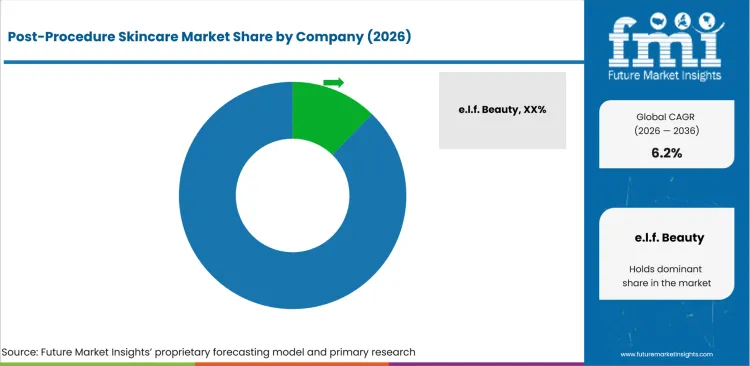
Competition is split between medical-aesthetics skincare platforms, multinational dermocosmetic groups and consumer brands with dermatologist-led research or pharmacy access. Entry barriers come from clinical credibility and recovery-format coverage as much as corporate scale because clinics need evidence that products fit treatment timing.
- L’Oréal Groupe, Beiersdorf and Amorepacific pair large skincare portfolios with dermatology research, pharmacy access or clinician-linked dermocosmetic programs.
- The Estée Lauder Companies, Kao Corporation and Revance compete on clinical skincare research, sensitive-skin science or integrated aesthetics-and-skincare platforms.
- Galderma and Laboratoires Pierre Fabre focus directly on procedure-linked care with peri-procedural skincare programs and medically anchored dermocosmetic development.
Competitive Benchmarking: Post-Procedure Skincare Market
| Company | Recovery-Relevant Portfolio Breadth | Professional Integration Depth | Recovery Format Breadth | Geographic Reach |
|---|---|---|---|---|
| L’Oréal Groupe | High | High | High | Global |
| Beiersdorf | Medium | Medium | High | Global |
| Amorepacific | Medium | High | High | Asia, North America, Europe and Oceania |
| The Estée Lauder Companies | Medium | High | High | Global |
| Kao Corporation | Medium | Medium | Medium | Asia, Europe and North America |
| Revance | Medium | High | Medium | North America and selected international markets |
| Galderma | High | High | High | Americas, Europe, Asia-Pacific and Middle East |
| Laboratoires Pierre Fabre | High | High | High | Europe, Americas, Asia and Oceania |
Key Developments in the Post-Procedure Skincare Market
- In April 2026, Galderma launched ALASTIN Signature Practices with selected USA dermatology and medical-aesthetics clinics that integrate peri-procedural skincare into treatment planning and patient care.
- In June 2025, L’Oréal Groupe signed an agreement to acquire a majority stake in Medik8 and strengthen its premium science-backed skincare portfolio with a brand rooted in professional channels.
- In February 2025, Amorepacific launched AESTURA in more than 400 Sephora USA locations and online with a dermatologist-linked sensitive-skin range built around barrier care.
Key Players in the Post-Procedure Skincare Market
Dermatology and Dermocosmetic Platforms
- L’Oréal Groupe
- Beiersdorf
- Amorepacific
Prestige and Integrated Skincare Platforms
- The Estée Lauder Companies
- Kao Corporation
- Revance
Medical-Aesthetics and Pharmacy Specialists
- Galderma
- Laboratoires Pierre Fabre
Post-Procedure Skincare Market - Report Scope
| Coverage field | Report scope |
|---|---|
| Market breakdown | By product type, nature, format, price positioning, sales channel and region. |
| Quantitative Units | Revenue in USD million and CAGR in %. |
| Market Definition | Topical skincare used before or during recovery from aesthetic and dermatologic procedures for cleansing, hydration, barrier care, soothing or photoprotection. |
| Regions Covered | North America, Latin America, Europe, East Asia, South Asia and Pacific, and Middle East and Africa. |
| Countries Covered | United Arab Emirates, South Korea, Saudi Arabia, United States, United Kingdom, and 20+ countries included in the full report. |
| Key Companies Profiled | L’Oréal Groupe, Beiersdorf, Amorepacific, The Estée Lauder Companies, Kao Corporation, Revance, Galderma, and Laboratoires Pierre Fabre. |
| Forecast Period | 2026 to 2036. |
| Approach | Primary and secondary research with market triangulation. |
Post-Procedure Skincare Market - Research Methodology
| Method | Approach |
|---|---|
| Primary Research | FMI analysts gathered input from manufacturers, service providers, technology developers, distributors, end users, procurement teams, and subject-matter experts. Interviews examined purchasing decisions, product or service evaluation, adoption barriers, approval requirements, pricing considerations, and expectations for technical or commercial support. Respondents were also asked what evidence is required before a trial, pilot, or initial order develops into regular purchasing. |
| Desk Research | Desk research covered government statistics, regulatory publications, trade data, industry associations, technical literature, standards, company filings, product information, and official corporate announcements. Sources were reviewed for relevance, publication date, geographic coverage, and consistency with the defined market scope. Claims relating to performance, applications, approvals, capacity, investment, and commercial activity were retained only when supported by credible public evidence. |
| Market Sizing and Forecasting | The market model combined the baseline value with historical performance, segment structure, pricing and volume indicators, adoption levels, company participation, and country-level demand conditions. Forecast assumptions considered economic activity, investment trends, regulatory developments, technology adoption, purchasing cycles, supply availability, and barriers to wider market use. Segment and regional estimates were reconciled before the final market total was calculated. |
| Data Validation | Estimates were checked against multiple independent indicators, including public data, company activity, trade patterns, industry developments, and findings from primary interviews. Validation also tested whether products, services, applications, and company revenues fell within the defined market boundaries. Adjacent categories, unsupported claims, overlapping revenues, and activities without direct market relevance were excluded to reduce double counting and maintain consistency across segments and countries. |
Post-Procedure Skincare Market by Segments
Post-Procedure Skincare Market segmented by Product Type:
- Core - classic lines
- Targeted treatment lines
- Sensitive & gentle lines
- Premium & clinical lines
- Kits & sets
Post-Procedure Skincare Market segmented by Nature:
- Conventional
- Vegan & cruelty-free
- Natural & organic
- Dermocosmetic / clinical
- Fragrance-free & sensitive
Post-Procedure Skincare Market segmented by Format:
- Cream & balm
- Liquid & serum
- Stick & solid
- Spray & mist
- Sheet & patch
- Powder
Post-Procedure Skincare Market segmented by Price Positioning:
- Masstige
- Mass
- Premium
- Professional
Post-Procedure Skincare Market segmented by Sales Channel:
- E-commerce & DTC
- Specialty beauty retail
- Pharmacies & drugstores
- Supermarkets & hypermarkets
- Salons & spas
Post-Procedure Skincare Market by Region:
- North America
- United States
- Canada
- Latin America
- Brazil
- Mexico
- Argentina
- Chile
- Western Europe
- Germany
- France
- United Kingdom
- Italy
- Spain
- Benelux
- Nordics
- Eastern Europe
- Poland
- Czech Republic
- Romania
- Hungary
- East Asia
- China
- Japan
- South Korea
- South Asia and Pacific
- India
- ASEAN
- Australia and New Zealand
- Middle East and Africa
- GCC Countries
- South Africa
- Türkiye
- Israel
Research Sources and Bibliography
- American Society of Plastic Surgeons. (2025, June 25). Interest in aesthetic health remained consistent despite economic uncertainty in 2024, according to new report from American Society of Plastic Surgeons.
- Republic of Korea Ministry of Health and Welfare. (2026, April 24). 2025년 외국인 환자 유치 200만 돌파 아시아 의료관광 ‘중심국가’ 도약.
- Amorepacific. (2025, July 25). AESTURA, Korea’s #1 Dermatologist-Recommended Dermocosmetic Brand for Sensitive Skin Launches Exclusively at Sephora Canada.
- The Estée Lauder Companies. (2025, March 31). The Estée Lauder Companies shares new findings at the American Academy of Dermatology.
- Kao Corporation. (2025, January 8). Kao accelerates skin care growth with launch of Curél in Germany and France.
- The Estée Lauder Companies. (2025, August 11). Clinique launches in the Amazon.com.mx Premium Beauty store.
- American Society for Dermatologic Surgery. (2025, July 28). Dermatologists top the list as key influencers in patients’ cosmetic procedure decisions.
- USA Food and Drug Administration. (2025, September 12). FDA launches real-time adverse event reporting dashboard for cosmetic products.
- Galderma. (2025, September 10). Galderma launches Alastin in China, supporting the skin’s natural regenerative abilities in a rapidly expanding market.
- Dubai Health Authority. (2025, June 4). External circular: Updates of standards for non-surgical cosmetic procedures, version 2.1.
- Ministry of Food and Drug Safety. (2026, May 22). ’25년 화장품 무역수지 흑자 첫 100억 달러 돌파, 세계 2위 화장품 수출국 달성.
- Saudi Food and Drug Authority. (2025, December 14). SFDA leads digital transformation in drug and cosmetic safety regulation.
- USA Food and Drug Administration. (2025, March 13). FDA provides summary data on the registration and listing of cosmetic product facilities and products.
- Department of Health and Social Care. (2025, August 7). The licensing of non-surgical cosmetic procedures in England: Consultation response.
- Galderma. (2026, April 7). Galderma debuts ALASTIN Signature Practices in partnership with leading aesthetic practices to elevate regenerative, peri-procedural skincare.
- L’Oréal Groupe. (2025, June 9). L’Oréal Groupe to acquire a majority stake in Medik8.
- Amorepacific. (2025, January 24). AESTURA, Korea’s #1 Dermatologist-Recommended Dermocosmetic Brand Launches Exclusively at Sephora.
- L’Oréal Groupe. (2025, December 8). L’Oréal Groupe to reinforce its strategic investment in Galderma with an additional 10% bringing its total participation to 20%.
- Beiersdorf. (2025, December 11). Beiersdorf launches Eucerin in Japan.
- Amorepacific. (2026, August 10). AESTURA named Korea’s No. 1 derma skincare brand by Euromonitor.
- The Estée Lauder Companies. (2025, January 28). The Ordinary announces its official launch in Amazon Premium Beauty.
- Kao Corporation. (2026, June 2). Kao Accelerates Skin Care Growth in EMEA with Launch of Japan’s Leading Sensitive Skincare Brand Curél in the Netherlands.
- Galderma. (2026, July 20). Galderma launches Alastin® in Japan and key markets across Asia Pacific, expanding its footprint in the region.
- Laboratoires Pierre Fabre. (2026, February 20). Pierre Fabre Laboratories is exploring the potential of Artificial Intelligence to launch a new generation of clinical studies in dermo-cosmetics.
- Revance. (2025, March 31). Crown Laboratories now operates under the name Revance.
This bibliography is provided for reader reference and is not exhaustive. The full report contains the complete reference list and detailed citations.
This Report Answers
- How large is the post-procedure skincare market in 2026 and 2036?
- Which procedure and recovery conditions support post-procedure skincare demand?
- Why do core - classic lines lead product type?
- Why do cream & balm formats lead recovery routines?
- How does e-commerce support clinic-to-home replenishment after aesthetic procedures?
- How do growth rates differ across the five profiled countries?
- Which companies have the strongest professional or barrier-care positions?
- Which formulation and protocol constraints limit repeat adoption?
Frequently Asked Questions
How big is the Post-Procedure Skincare Market in 2026?
The post-procedure skincare market is valued at USD 882.7 million in 2026 and is projected to reach USD 1,610.9 million by 2036. Procedure-linked recovery needs increase demand for gentle barrier care that patients can continue after leaving the treatment setting.
What is the CAGR of the Post-Procedure Skincare Market from 2026 to 2036?
The post-procedure skincare market is projected to grow at a CAGR of 6.2% between 2026 and 2036. Aesthetic procedure volume and stronger professional attention to recovery-stage skincare support repeat demand across clinic and consumer channels.
Which product type leads the Post-Procedure Skincare Market?
The core - classic lines segment is expected to hold 40.0% of the post-procedure skincare market in 2026, driven by broad compatibility across common recovery routines. Gentle cleansing and moisturization apply across varied procedures without requiring treatment-specific active ingredients during recovery.
Which countries are projected to record the significant growth in the Post-Procedure Skincare Market?
The United Arab Emirates is projected to grow at 7.6% CAGR, followed by South Korea at 7.3% and Saudi Arabia at 7.0% through 2036. Private aesthetic clinics and fast replenishment channels support higher growth across these procedure-intensive national markets.
Which companies are active in the Post-Procedure Skincare Market?
Key companies operating in the post-procedure skincare market include L’Oréal Groupe, Beiersdorf, Amorepacific, The Estée Lauder Companies, Kao Corporation, Revance, Galderma, and Laboratoires Pierre Fabre. Professional integration and dermocosmetic research distinguish their positions, while international channel reach determines how easily patients can refill recommended routines.
Preview the report firsthand - request a free sample
Get SampleGet the brochure for pricing and purchase details.
Get PDFTable of Content
- Key Takeaways
- Market Size and CAGR
- Top Growth Driver
- Fastest Growing Segment
- Leading Region
- Key Companies
- Emerging Opportunities
- Executive Summary
- Global Market Outlook
- Demand-side Trends
- Supply-side Trends
- Technology Roadmap Analysis
- Analysis and Recommendations
- Analyst Perspective (What is happening? Why now? What should investors know?)
- Key Questions Answered
- How large is the market?
- What is the CAGR?
- What are key trends?
- Which region dominates?
- Who are the leaders?
- Market Overview
- Market Coverage / Taxonomy
- Market Definition / Scope / Limitations
- Research Methodology
- Chapter Orientation
- Analytical Lens and Working Hypotheses
- Market Structure, Signals, and Trend Drivers
- Benchmarking and Cross-market Comparability
- Market Sizing, Forecasting, and Opportunity Mapping
- Research Design and Evidence Framework
- Desk Research Programme (Secondary Evidence)
- Expert Input and Fieldwork (Primary Evidence)
- Tooling, Models, and Reference Databases
- Data Engineering and Model Build
- Quality Assurance and Audit Trail
- Market Background
- Market Dynamics (Drivers, Restraints, Opportunity, Trends)
- Scenario Forecast (Optimistic, Likely, Conservative)
- Impact Analysis
- AI Impact
- Sustainability Impact
- Regulatory Impact
- Technology Impact
- Consumer / Buyer Analysis
- Purchase Drivers
- Adoption Barriers
- Buyer Journey
- Opportunity Map Analysis
- Product Life Cycle Analysis
- Supply Chain Analysis
- Investment Feasibility Matrix
- Value Chain Analysis
- PESTLE and Porter's Analysis
- Regulatory Landscape
- Regional Parent Market Outlook
- Production and Consumption Statistics
- Import and Export Statistics
- Global Market Analysis and Forecast, 2021 to 2036
- Historical Market Size Value (USD Million) Analysis, 2021 to 2025
- Current and Future Market Size Value (USD Million) Projections, 2026 to 2036
- Y-o-Y Growth Trend Analysis
- Absolute $ Opportunity Analysis
- Global Market Pricing Analysis, 2021 to 2036
- Global Market Analysis and Forecast, By Product Type, 2021 to 2036
- Introduction / Key Findings
- Historical Market Size Value (USD Million) Analysis By Product Type, 2021 to 2025
- Current and Future Market Size Value (USD Million) Analysis and Forecast By Product Type, 2026 to 2036
- Core / classic lines
- Targeted treatment lines
- Sensitive & gentle lines
- Premium & clinical lines
- Kits & sets
- Core / classic lines
- Y-o-Y Growth Trend Analysis By Product Type, 2021 to 2025
- Absolute $ Opportunity Analysis By Product Type, 2026 to 2036
- Global Market Analysis and Forecast, By Nature, 2021 to 2036
- Introduction / Key Findings
- Historical Market Size Value (USD Million) Analysis By Nature, 2021 to 2025
- Current and Future Market Size Value (USD Million) Analysis and Forecast By Nature, 2026 to 2036
- Conventional
- Vegan & cruelty-free
- Natural & organic
- Dermocosmetic / clinical
- Fragrance-free & sensitive
- Conventional
- Y-o-Y Growth Trend Analysis By Nature, 2021 to 2025
- Absolute $ Opportunity Analysis By Nature, 2026 to 2036
- Global Market Analysis and Forecast, By Format, 2021 to 2036
- Introduction / Key Findings
- Historical Market Size Value (USD Million) Analysis By Format, 2021 to 2025
- Current and Future Market Size Value (USD Million) Analysis and Forecast By Format, 2026 to 2036
- Cream & balm
- Liquid & serum
- Stick & solid
- Spray & mist
- Sheet & patch
- Powder
- Cream & balm
- Y-o-Y Growth Trend Analysis By Format, 2021 to 2025
- Absolute $ Opportunity Analysis By Format, 2026 to 2036
- Global Market Analysis and Forecast, By Price Positioning, 2021 to 2036
- Introduction / Key Findings
- Historical Market Size Value (USD Million) Analysis By Price Positioning, 2021 to 2025
- Current and Future Market Size Value (USD Million) Analysis and Forecast By Price Positioning, 2026 to 2036
- Masstige
- Mass
- Premium
- Professional
- Masstige
- Y-o-Y Growth Trend Analysis By Price Positioning, 2021 to 2025
- Absolute $ Opportunity Analysis By Price Positioning, 2026 to 2036
- Global Market Analysis and Forecast, By Sales Channel, 2021 to 2036
- Introduction / Key Findings
- Historical Market Size Value (USD Million) Analysis By Sales Channel, 2021 to 2025
- Current and Future Market Size Value (USD Million) Analysis and Forecast By Sales Channel, 2026 to 2036
- E-commerce & DTC
- Specialty beauty retail
- Pharmacies & drugstores
- Supermarkets & hypermarkets
- Salons & spas
- E-commerce & DTC
- Y-o-Y Growth Trend Analysis By Sales Channel, 2021 to 2025
- Absolute $ Opportunity Analysis By Sales Channel, 2026 to 2036
- Global Market Analysis and Forecast, By Region, 2021 to 2036
- Introduction
- Historical Market Size Value (USD Million) Analysis By Region, 2021 to 2025
- Current Market Size Value (USD Million) Analysis and Forecast By Region, 2026 to 2036
- North America
- Latin America
- Western Europe
- Eastern Europe
- East Asia
- South Asia and Pacific
- Middle East & Africa
- Market Attractiveness Analysis By Region
- North America Market Analysis and Forecast, By Country, 2021 to 2036
- Historical Market Size Value (USD Million) Trend Analysis By Market Taxonomy, 2021 to 2025
- Market Size Value (USD Million) Forecast By Market Taxonomy, 2026 to 2036
- By Country
- USA
- Canada
- By Product Type
- By Nature
- By Format
- By Price Positioning
- By Sales Channel
- By Country
- Market Attractiveness Analysis
- By Country
- By Product Type
- By Nature
- By Format
- By Price Positioning
- By Sales Channel
- Key Takeaways
- Latin America Market Analysis and Forecast, By Country
- Historical Market Size Value (USD Million) Trend Analysis By Market Taxonomy, 2021 to 2025
- Market Size Value (USD Million) Forecast By Market Taxonomy, 2026 to 2036
- By Country
- Brazil
- Mexico
- Chile
- Rest of Latin America
- By Product Type
- By Nature
- By Format
- By Price Positioning
- By Sales Channel
- By Country
- Market Attractiveness Analysis
- By Country
- By Product Type
- By Nature
- By Format
- By Price Positioning
- By Sales Channel
- Key Takeaways
- Western Europe Market Analysis and Forecast, By Country
- Historical Market Size Value (USD Million) Trend Analysis By Market Taxonomy, 2021 to 2025
- Market Size Value (USD Million) Forecast By Market Taxonomy, 2026 to 2036
- By Country
- Germany
- UK
- Italy
- Spain
- France
- Nordic
- BENELUX
- Rest of Western Europe
- By Product Type
- By Nature
- By Format
- By Price Positioning
- By Sales Channel
- By Country
- Market Attractiveness Analysis
- By Country
- By Product Type
- By Nature
- By Format
- By Price Positioning
- By Sales Channel
- Key Takeaways
- Eastern Europe Market Analysis and Forecast, By Country
- Historical Market Size Value (USD Million) Trend Analysis By Market Taxonomy, 2021 to 2025
- Market Size Value (USD Million) Forecast By Market Taxonomy, 2026 to 2036
- By Country
- Russia
- Poland
- Hungary
- Balkan & Baltic
- Rest of Eastern Europe
- By Product Type
- By Nature
- By Format
- By Price Positioning
- By Sales Channel
- By Country
- Market Attractiveness Analysis
- By Country
- By Product Type
- By Nature
- By Format
- By Price Positioning
- By Sales Channel
- Key Takeaways
- East Asia Market Analysis and Forecast, By Country
- Historical Market Size Value (USD Million) Trend Analysis By Market Taxonomy, 2021 to 2025
- Market Size Value (USD Million) Forecast By Market Taxonomy, 2026 to 2036
- By Country
- China
- Japan
- South Korea
- By Product Type
- By Nature
- By Format
- By Price Positioning
- By Sales Channel
- By Country
- Market Attractiveness Analysis
- By Country
- By Product Type
- By Nature
- By Format
- By Price Positioning
- By Sales Channel
- Key Takeaways
- South Asia and Pacific Market Analysis and Forecast, By Country
- Historical Market Size Value (USD Million) Trend Analysis By Market Taxonomy, 2021 to 2025
- Market Size Value (USD Million) Forecast By Market Taxonomy, 2026 to 2036
- By Country
- India
- ASEAN
- Australia & New Zealand
- Rest of South Asia and Pacific
- By Product Type
- By Nature
- By Format
- By Price Positioning
- By Sales Channel
- By Country
- Market Attractiveness Analysis
- By Country
- By Product Type
- By Nature
- By Format
- By Price Positioning
- By Sales Channel
- Key Takeaways
- Middle East & Africa Market Analysis and Forecast, By Country
- Historical Market Size Value (USD Million) Trend Analysis By Market Taxonomy, 2021 to 2025
- Market Size Value (USD Million) Forecast By Market Taxonomy, 2026 to 2036
- By Country
- Kingdom of Saudi Arabia
- Other GCC Countries
- Türkiye
- South Africa
- Other African Union
- Rest of Middle East & Africa
- By Product Type
- By Nature
- By Format
- By Price Positioning
- By Sales Channel
- By Country
- Market Attractiveness Analysis
- By Country
- By Product Type
- By Nature
- By Format
- By Price Positioning
- By Sales Channel
- Key Takeaways
- Key Countries Market Analysis
- USA
- Pricing Analysis
- Market Share Analysis, 2025
- By Product Type
- By Nature
- By Format
- By Price Positioning
- By Sales Channel
- Canada
- Pricing Analysis
- Market Share Analysis, 2025
- By Product Type
- By Nature
- By Format
- By Price Positioning
- By Sales Channel
- Mexico
- Pricing Analysis
- Market Share Analysis, 2025
- By Product Type
- By Nature
- By Format
- By Price Positioning
- By Sales Channel
- Brazil
- Pricing Analysis
- Market Share Analysis, 2025
- By Product Type
- By Nature
- By Format
- By Price Positioning
- By Sales Channel
- Chile
- Pricing Analysis
- Market Share Analysis, 2025
- By Product Type
- By Nature
- By Format
- By Price Positioning
- By Sales Channel
- Germany
- Pricing Analysis
- Market Share Analysis, 2025
- By Product Type
- By Nature
- By Format
- By Price Positioning
- By Sales Channel
- UK
- Pricing Analysis
- Market Share Analysis, 2025
- By Product Type
- By Nature
- By Format
- By Price Positioning
- By Sales Channel
- Italy
- Pricing Analysis
- Market Share Analysis, 2025
- By Product Type
- By Nature
- By Format
- By Price Positioning
- By Sales Channel
- Spain
- Pricing Analysis
- Market Share Analysis, 2025
- By Product Type
- By Nature
- By Format
- By Price Positioning
- By Sales Channel
- France
- Pricing Analysis
- Market Share Analysis, 2025
- By Product Type
- By Nature
- By Format
- By Price Positioning
- By Sales Channel
- India
- Pricing Analysis
- Market Share Analysis, 2025
- By Product Type
- By Nature
- By Format
- By Price Positioning
- By Sales Channel
- ASEAN
- Pricing Analysis
- Market Share Analysis, 2025
- By Product Type
- By Nature
- By Format
- By Price Positioning
- By Sales Channel
- Australia & New Zealand
- Pricing Analysis
- Market Share Analysis, 2025
- By Product Type
- By Nature
- By Format
- By Price Positioning
- By Sales Channel
- China
- Pricing Analysis
- Market Share Analysis, 2025
- By Product Type
- By Nature
- By Format
- By Price Positioning
- By Sales Channel
- Japan
- Pricing Analysis
- Market Share Analysis, 2025
- By Product Type
- By Nature
- By Format
- By Price Positioning
- By Sales Channel
- South Korea
- Pricing Analysis
- Market Share Analysis, 2025
- By Product Type
- By Nature
- By Format
- By Price Positioning
- By Sales Channel
- Russia
- Pricing Analysis
- Market Share Analysis, 2025
- By Product Type
- By Nature
- By Format
- By Price Positioning
- By Sales Channel
- Poland
- Pricing Analysis
- Market Share Analysis, 2025
- By Product Type
- By Nature
- By Format
- By Price Positioning
- By Sales Channel
- Hungary
- Pricing Analysis
- Market Share Analysis, 2025
- By Product Type
- By Nature
- By Format
- By Price Positioning
- By Sales Channel
- Kingdom of Saudi Arabia
- Pricing Analysis
- Market Share Analysis, 2025
- By Product Type
- By Nature
- By Format
- By Price Positioning
- By Sales Channel
- Türkiye
- Pricing Analysis
- Market Share Analysis, 2025
- By Product Type
- By Nature
- By Format
- By Price Positioning
- By Sales Channel
- South Africa
- Pricing Analysis
- Market Share Analysis, 2025
- By Product Type
- By Nature
- By Format
- By Price Positioning
- By Sales Channel
- USA
- Market Structure Analysis
- Competition Dashboard
- Competition Benchmarking
- Market Share Analysis of Top Players
- By Regional
- By Product Type
- By Nature
- By Format
- By Price Positioning
- By Sales Channel
- Emerging Startups
- Innovation Benchmarking
- Competition Analysis
- Competition Deep Dive
- e.l.f. Beauty
- Overview
- Product Portfolio
- Profitability by Market Segments
- Sales Footprint
- Strategy Overview
- Marketing Strategy
- Product Strategy
- Channel Strategy
- Amorepacific
- Estee Lauder Companies
- Beiersdorf
- Coty
- Shiseido
- Procter & Gamble
- L'Oreal
- Unilever
- Kao Corporation
- e.l.f. Beauty
- Case Studies
- Success Stories
- Recent Developments
- Competition Deep Dive
- Assumptions & Acronyms Used


