

- Market Size (2026)
- USD 240.6 Mn
- Forecast (2036)
- USD 940.0 Mn
- CAGR (2026 to 2036)
- 14.6%
Microplastic Coagulants Market Size, Market Forecast and Outlook By FMI
USD 240.6 million in 2026 and USD 940.0 million by 2036 at a 14.6% CAGR.
The microplastic coagulants market is expected to grow from USD 209.9 million in 2025 to USD 940.0 million by 2036. Demand is expected to be driven by wastewater monitoring rules and membrane pretreatment needs. Cationic polymers are forecast to represent 41.0% share in 2026 due to charge control in fine particle capture. Municipal wastewater is expected to hold 48.0% share in 2026 with plants forming the main interception point.
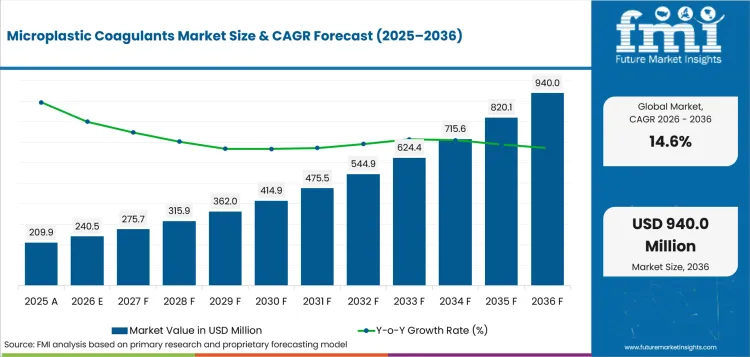
| Metric | Value |
|---|---|
| 2026 Market Size | USD 240.6 million |
| 2036 Market Size | USD 940.0 million |
| Forecast CAGR | 14.6% from 2026 to 2036 |
| Leading Coagulant Type | Cationic Polymers |
| Cationic Polymers Share in 2026 | 41.0% |
| Leading Application | Municipal Wastewater |
| Municipal Wastewater Share in 2026 | 48.0% |
| Fastest-growing Country | India |
| India CAGR | 17.1% by 2036 |
| Market Signal | Commercial Impact |
|---|---|
| Demand and Growth Drivers | Demand for microplastic coagulants is increasing as wastewater treatment facilities strengthen particle removal to comply with emerging monitoring and discharge regulations.
|
| Product and Segment View | Cationic polymers, municipal wastewater treatment, tertiary polishing, utilities, and chemical-plus-service programs lead their respective market segments.
|
| Geography and Growth Outlook | India, China, and South Korea are expected to drive market expansion through wastewater treatment investments and stricter environmental standards.
|
| Competitive Landscape | Competition is shifting toward polymer performance, dosing expertise, and service-led water treatment solutions.
|
| Analyst Perspective | Microplastic coagulants are evolving from standalone treatment chemicals into service-driven wastewater management solutions.
- Nikhil Kaitwade, Principal Analyst at FMI |
Regulatory attention is making microplastic capture a treatment design issue. EPA added microplastics to its draft Sixth Contaminant Candidate List in April 2026. The revised EU urban wastewater rules entered into force in January 2025 and brought monitoring duties into municipal planning. These steps support chemical programs that create larger flocs and help operators measure removal before heavier filtration spending.
Which factors support expansion in the microplastic coagulants market?
Finished chemical supply and service-backed dosing programs support market value across municipal and industrial water channels.
- Market expansion is supported by service‑backed chemical supply models, where finished coagulants are bundled with dosing optimization across municipal and industrial water treatment plants.
- Revenue growth is driven by utilities transitioning from pilot trials to long‑term procurement contracts, expanding adoption beyond monitoring‑only programs.
- Market value scales as supplier‑led performance validation reduces buyer risk and accelerates approval at the plant level.
- Growth momentum is reinforced by value‑based pricing structures, where technical support and dosing efficiency offset downstream sludge handling costs.
Why is the microplastic coagulants market growing?
Wastewater plants are being pushed to show clearer particle capture before regulators set stricter limits.
One of the primary demand drivers are municipal treatment plants that already use clarification and polishing chemistry. UN-Water reported in August 2024 that 42.0% of household wastewater was not safely treated in 2022. This equaled 113 billion m3 released with inadequate or no treatment. That gap explains why operators need chemical options that can fit existing plants before major filtration upgrades.
Regulation is creating a second route through monitoring. EPA’s April 2026 draft CCL 6 includes microplastics among four contaminant groups. The European Commission’s December 2024 update placed microplastic monitoring inside revised urban wastewater rules. Coagulants benefit when buyers need a testable first step before larger filtration upgrades.
How is the microplastic coagulants market segmented?
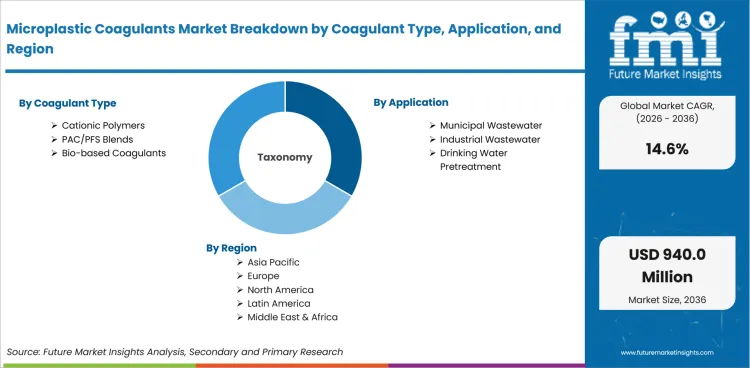
The microplastic coagulants industry is segmented by coagulant type and application. Treatment step, end use and sales model complete the structure.
- Cationic Polymers are projected to secure 41.0% share in 2026 through charge neutralization and particle bridging performance.
- Municipal Wastewater is expected to account for 48.0% share in 2026 through public treatment plant testing.
- Tertiary Polishing is anticipated to hold 44.0% share in 2026 with operators adding capture after biological treatment.
- Utilities are forecast to represent 52.0% share in 2026 through regulated discharge planning.
- Chemical + Service Program is projected to capture 57.0% share in 2026 through jar testing and dosing support.
Which coagulant type leads the microplastic coagulants market?
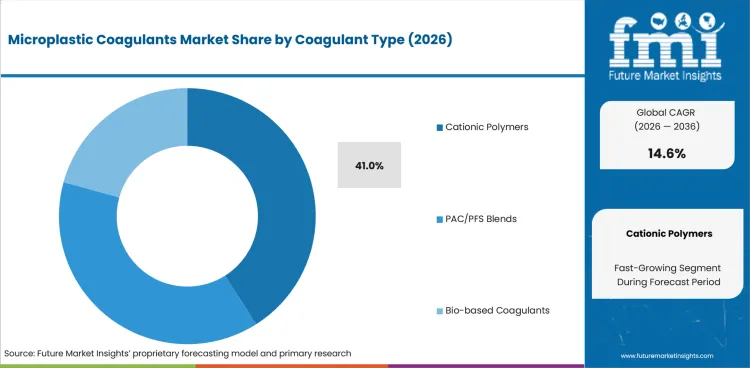
- Cationic Polymers are projected to account for 41.0% share in 2026 through floc growth and particle bridging.
- PAC/PFS blends remain useful in plants that prefer familiar aluminum or iron salt platforms.
Which application leads the microplastic coagulants market?
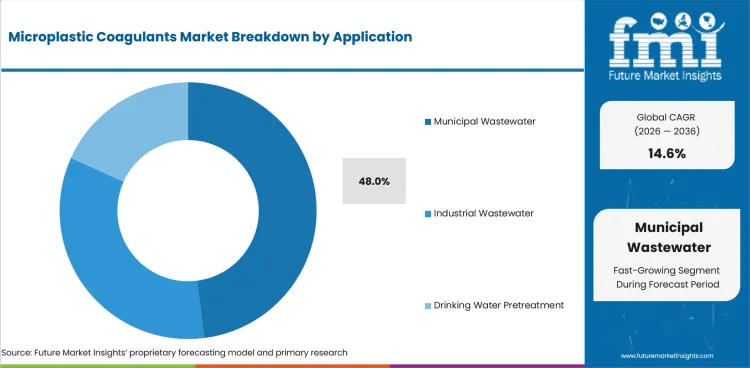
- Municipal Wastewater is expected to hold 48.0% share in 2026 with mixed fibers and fragments entering public sewers.
- Industrial wastewater gains value where textile and plastics effluent creates particle control needs.
Which treatment step leads the microplastic coagulants market?
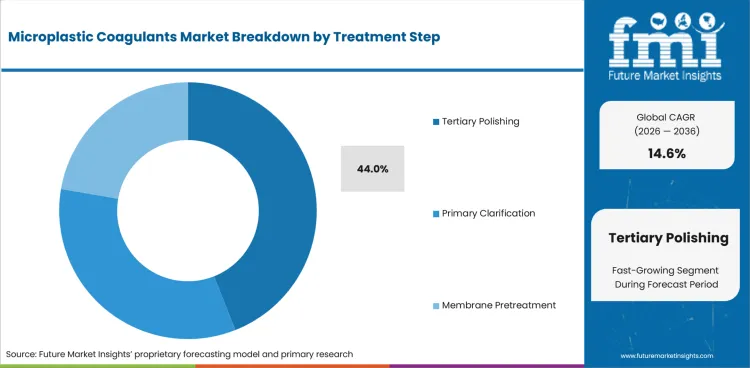
- Tertiary Polishing is anticipated to hold 44.0% share in 2026 through post-biological treatment capture.
- Membrane pretreatment gains use when operators need to reduce fouling before reuse systems.
Which end use leads the microplastic coagulants market?
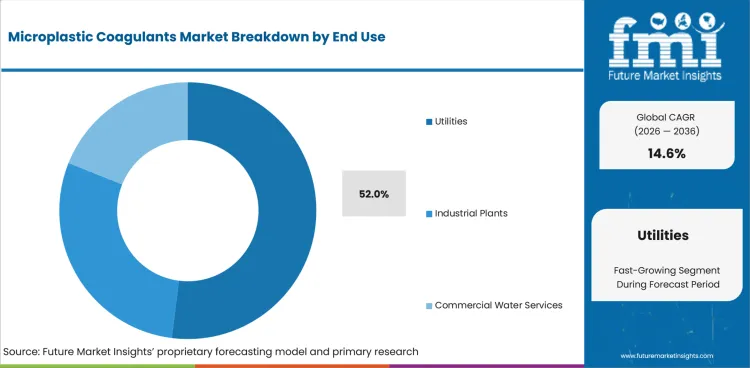
- Utilities are projected to account for 52.0% share in 2026 through public wastewater monitoring needs.
- Industrial plants are expected to increase testing where discharge permits and reuse economics justify service programs.
Which sales model leads the microplastic coagulants market?
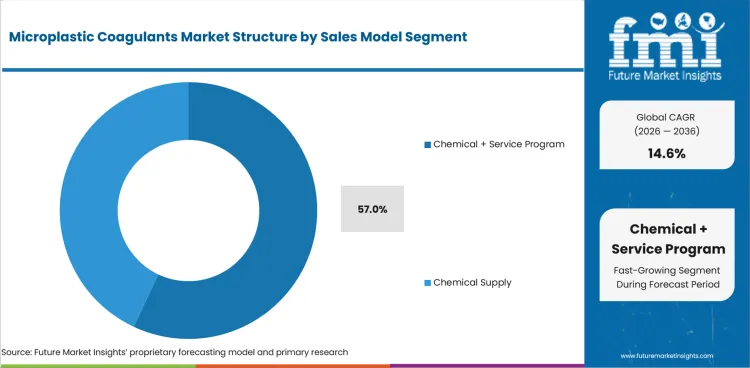
- Chemical + Service Program is expected to hold 57.0% share in 2026 through field testing and dosing support.
- Chemical supply remains relevant for plants that already have in-house treatment chemistry expertise.
What supports growth and what limits the microplastic coagulants market?
Monitoring rules and membrane protection support growth while sludge burden limits faster adoption.
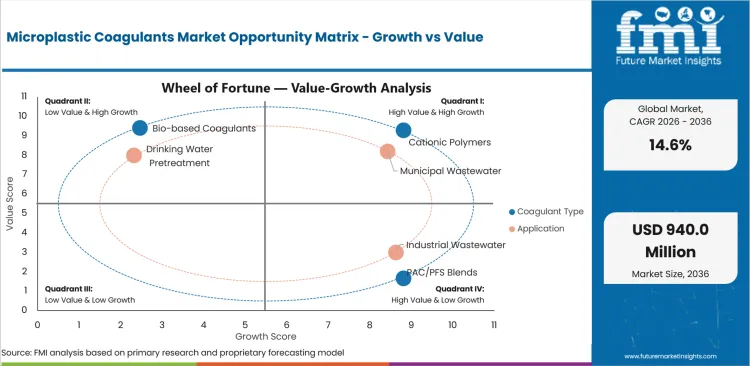
- Driver: Microplastic monitoring rules are creating demand for chemical capture methods that fit existing plant layouts.
- Driver: Membrane fouling risk is expected to support pretreatment demand in reuse facilities that protect high-cost filtration assets.
- Restraint: Sludge management limits adoption when higher coagulant doses raise solids handling requirements.
- Opportunity: Bio-based coagulants can gain trials where buyers want lower residual risk and easier sludge messaging.
Microplastic Coagulants Market Demand Outlook
Demand outlook is moving toward treatment chemicals that can prove removal without large plant redesign. EPA’s March 2026 microplastics research page notes that particle size and density vary widely. Particle composition adds another measurement challenge. This favors site trials that show capture under real water chemistry. Buyers are expected to select products that combine removal proof with clear sludge guidance.
Membrane Pretreatment and Service Program Analysis
Reuse projects make microplastic coagulants more relevant before membrane systems. Operators want fewer suspended particles before filtration to reduce cleaning and downtime costs. The membrane chemicals market is a useful adjacent reference for buyers comparing pretreatment and cleaning cost exposure. Service-backed coagulants can reduce trial risk when the supplier manages jar testing and dose adjustment.
Sludge Burden and Compliance Restraints
The main restraint is that microplastic capture moves particles into solids. The European Commission’s revised wastewater rules emphasize monitoring and circularity. This makes sludge handling part of the chemical selection decision. Suppliers with dose-efficient chemistry and clear biosolids guidance should face fewer objections during tender review.
Who are the leading companies in the microplastic coagulants market?
Global water-chemistry suppliers compete with regional service firms through polymer know-how and plant testing support.
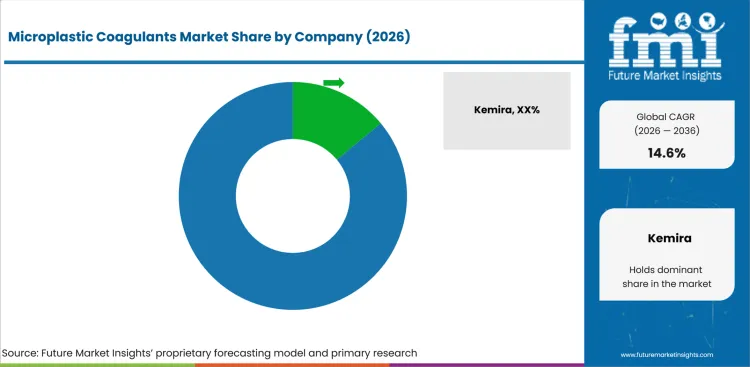
- Kemira and SNF lead through coagulant portfolios and polymer chemistry depth.
- Solenis and Ecolab compete through industrial service programs and dosing control.
- Veolia Water Technologies and SUEZ gain access through water service and treatment project relationships.
- Regional chemical suppliers compete on price but need stronger microplastic testing support to win service contracts.
Competition is shaped by how well suppliers combine chemistry with field proof. Buyers do not only compare the price per kilogram. They review jar-test results and floc strength first. Sludge outcome and service response then guide repeat supply awards. Kemira’s February 2025 water expansion in North America supports its position in municipal treatment chemistry. Solenis added service depth through acquisitions in 2024.
Companies best positioned in this market are those with chemistry breadth and plant-level technical teams. Suppliers that can prove removal without making sludge management harder should gain more repeat utility and industrial contracts.
How do top microplastic coagulants companies compare?
| Company | Coagulant Portfolio Depth | Service and Testing Capability | Municipal Channel Reach | Industrial Channel Reach | Geographic Footprint |
|---|---|---|---|---|---|
| Kemira | Very Strong | Strong | Very Strong | Strong | Global |
| SNF | Very Strong | Strong | Strong | Very Strong | Global |
| Solenis | Strong | Very Strong | Strong | Very Strong | Global |
| Ecolab (Nalco Water) | Strong | Very Strong | Moderate | Very Strong | Global |
| Veolia Water Technologies | Moderate | Strong | Very Strong | Strong | Global |
| SUEZ | Moderate | Strong | Very Strong | Moderate | Europe and global projects |
| Kurita Water Industries | Strong | Strong | Moderate | Very Strong | Asia and global industrial accounts |
| BASF | Strong | Moderate | Moderate | Strong | Global |
| Feralco | Strong | Moderate | Strong | Moderate | Europe |
| USALCO | Strong | Moderate | Strong | Moderate | United States |
Who are the key players in the microplastic coagulants market?
- Kemira
- SNF
- Solenis
- Ecolab (Nalco Water)
- Veolia Water Technologies
- SUEZ
- Kurita Water Industries
- BASF
- Feralco
- USALCO
Which countries are growing fastest in the microplastic coagulants market?
India 17.1% CAGR, China 16.3% CAGR, South Korea 14.9% CAGR, United Kingdom 14.4% CAGR, United States 13.9% CAGR, France 13.7% CAGR, Germany 13.2% CAGR, and Japan 12.8% CAGR by 2036.
.webp "Top Country Growth Comparison Microplastic Coagulants Market Cagr (2026 2036)")
| Country | CAGR |
|---|---|
| India | 17.1% |
| China | 16.3% |
| South Korea | 14.9% |
| United Kingdom | 14.4% |
| United States | 13.9% |
| France | 13.7% |
| Germany | 13.2% |
| Japan | 12.8% |
Source: Future Market Insights, 2026.
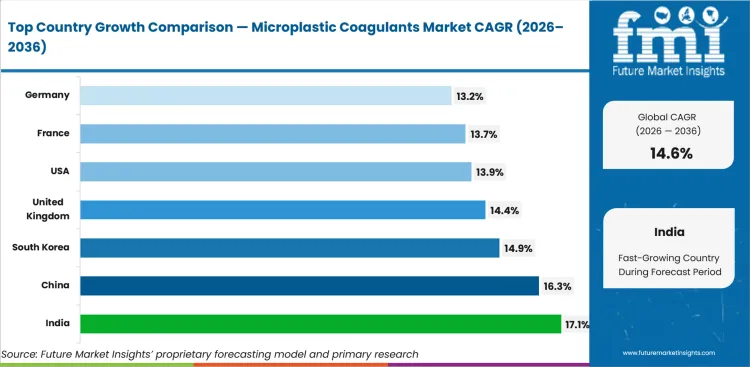
How do country-level CAGRs compare in the microplastic coagulants market?
India leads country growth while Japan records the most cautious expansion outlook among profiled markets.
- India is forecast to record 17.1% CAGR by 2036 with sewage treatment capacity additions and river cleanup procurement.
- China is forecast to record 16.3% CAGR by 2036 with reuse targets and industrial discharge control supporting plant-level trials.
- South Korea is forecast to record 14.9% CAGR by 2036 through industrial water quality needs and smart plant programs.
- United Kingdom is forecast to record 14.4% CAGR by 2036 with AMP8 spending and storm overflow upgrades shaping procurement.
- United States is forecast to record 13.9% CAGR by 2036 through EPA contaminant review and large wastewater treatment volume.
- France is forecast to record 13.7% CAGR by 2036 through municipal treatment depth and water service operator scale.
- Germany is forecast to record 13.2% CAGR by 2036 with mature treatment systems and fourth-stage planning guiding trials.
- Japan is forecast to record 12.8% CAGR by 2036 through careful qualification and industrial water polishing demand.
What is driving the microplastic coagulants market in India?
A 17.1% CAGR by 2036 reflects sewage capacity additions and river cleanup procurement.
Country Market Snapshot Table
| Parameter | Value |
|---|---|
| Market Size in 2025 (Value) | USD 25.6 million |
| Market Size in 2026 (Value) | USD 30.0 million |
| Market Forecast in 2036 (Value) | USD 145.4 million |
| CAGR (2026 to 2036) | 17.1% |
| Years Considered | 2021 to 2036 |
| Base Year | 2025 |
| Forecast Period | 2026 to 2036 |
| Units Considered | Value (USD million) |
| Leading Sub-Region | Ganga Basin and large city sewerage corridors |
India Microplastic Coagulants Market Outlook
India has the fastest growth outlook among the selected countries. New treatment assets create entry points for coagulant dosing during design and commissioning.
City programs are expected to test chemistry first in visible river and reuse projects. Suppliers need plant-level proof that removal improves without raising sludge cost sharply.
Key Growth Drivers
- Ganga Basin projects create new dosing points for municipal wastewater. The Ministry of Jal Shakti reported 216 sanctioned sewerage projects for 6,560 MLD of treatment capacity in December 2025.
- Recent project completions support near-term trial demand. The Ministry of Jal Shakti reported in April 2026 that 18 projects added 538.03 MLD during FY 2025 to 2026.
- Industrial clusters are expected to increase pretreatment purchases under tighter state pollution board checks.
- City reuse plans are likely to support membrane pretreatment chemistry before tertiary filtration.
Key Restraints
- Budget use can delay new treatment programs. A March 2026 parliamentary release reported 86.06% utilization of the revised estimate during 2024 to 2025.
- Municipal buyers often choose alum or PAC before premium polymer blends when project budgets are tight.
- Underused treatment assets can lower chemical consumption even after capacity is installed.
What makes India unique
India is unique due to a large project pipeline that can include microplastic capture during new plant design.
Key Companies
- Ion Exchange India Ltd.
- Thermax Ltd.
- VA Tech Wabag Ltd.
- Solenis India
- Ecolab India
- SNF India
- Kemira
Sales & Marketing Channels
- Municipal utility tenders
- Industrial direct sales
- Engineering consultant specifications
- Chemical distributor networks
- Pilot projects at treatment works
- Chemical plus service contracts
Country Segment Breakdown Table
| Segment | Sub-Segments |
|---|---|
| By Coagulant Type | Cationic Polymers · PAC/PFS Blends · Bio-based Coagulants · Other |
| By Application | Municipal Wastewater · Industrial Wastewater · Stormwater / Runoff · Drinking Water Pretreatment |
| By Treatment Step | Primary Clarification · Tertiary Polishing · Membrane Pretreatment |
| By End Use | Utilities · Industrial Plants · Commercial Water Services · Pilot Projects |
| By Sales Model | Chemical Supply · Chemical + Service Program |
| Key Sub-Regions Covered | Major wastewater corridors · industrial parks · reuse projects · utility upgrade areas |
Frequently Asked Questions
How fast is India microplastic coagulants market growing?
Demand in India is projected to grow at 17.1% CAGR from 2026 to 2036.
Who leads India microplastic coagulants market?
Ion Exchange India Ltd. and Thermax Ltd. lead local supplier access. VA Tech Wabag Ltd. and Solenis India compete through water treatment chemistry and service programs.
What is driving adoption in India microplastic coagulants market?
17.1% CAGR reflects sewage capacity additions and river cleanup procurement
How fast is the microplastic coagulants market growing in China?
A 16.3% CAGR by 2036 is supported by reuse targets and industrial discharge control.
Country Market Snapshot Table
| Parameter | Value |
|---|---|
| Market Size in 2025 (Value) | USD 32.7 million |
| Market Size in 2026 (Value) | USD 38.0 million |
| Market Forecast in 2036 (Value) | USD 172.0 million |
| CAGR (2026 to 2036) | 16.3% |
| Years Considered | 2021 to 2036 |
| Base Year | 2025 |
| Forecast Period | 2026 to 2036 |
| Units Considered | Value (USD million) |
| Leading Sub-Region | Yangtze River Delta and industrial park reuse corridors |
China Microplastic Coagulants Market Outlook
China offers the largest scale route for microplastic coagulants among selected markets. Municipal reuse and industrial park treatment create broad demand for low-dose capture chemistry.
Buyers are expected to prioritize cost and local proof. Suppliers that can show floc strength at large plant scale should gain more pilot-to-contract movement.
Key Growth Drivers
- Low-carbon sewage policy supports treatment upgrades. Gov.cn reported in January 2024 that China planned 100 exemplary low-carbon sewage treatment plants by 2025.
- Reuse planning creates pretreatment demand. Gov.cn reported in January 2024 that water-scarce prefecture cities targeted over 25% recycled water use by 2025.
- Industrial parks are expected to test microplastic coagulants where textile and plastics effluent creates particle risk.
- Provincial engineering channels can move proven chemical programs into repeat public tenders.
Key Restraints
- Large public tenders can keep price pressure high. The USA International Trade Administration cited 45,000 km of planned sewage collection network work in September 2025.
- Local evidence remains necessary before buyers accept premium polymers over established inorganic coagulants.
- Some industrial buyers may delay adoption until discharge permits name particle monitoring more directly.
What makes China unique
China is unique due to its scale and the role of industrial parks in wastewater reuse programs.
Key Companies
- Kemira
- SNF
- Solenis
- Kurita Water Industries
- Beijing Enterprises Water Group
- OriginWater
- China Everbright Water
Sales & Marketing Channels
- Municipal utility tenders
- Industrial direct sales
- Engineering consultant specifications
- Chemical distributor networks
- Pilot projects at treatment works
- Chemical plus service contracts
Country Segment Breakdown Table
| Segment | Sub-Segments |
|---|---|
| By Coagulant Type | Cationic Polymers · PAC/PFS Blends · Bio-based Coagulants · Other |
| By Application | Municipal Wastewater · Industrial Wastewater · Stormwater / Runoff · Drinking Water Pretreatment |
| By Treatment Step | Primary Clarification · Tertiary Polishing · Membrane Pretreatment |
| By End Use | Utilities · Industrial Plants · Commercial Water Services · Pilot Projects |
| By Sales Model | Chemical Supply · Chemical + Service Program |
| Key Sub-Regions Covered | Major wastewater corridors · industrial parks · reuse projects · utility upgrade areas |
Frequently Asked Questions
How fast is China microplastic coagulants market growing?
Demand in China is projected to grow at 16.3% CAGR from 2026 to 2036.
Who leads China microplastic coagulants market?
Kemira and SNF lead local supplier access. Solenis and Kurita Water Industries compete through water treatment chemistry and service programs.
What is driving adoption in China microplastic coagulants market?
16.3% CAGR by 2036 is supported by reuse targets and industrial discharge control
What is the microplastic coagulants market outlook in South Korea?
A 14.9% CAGR by 2036 reflects industrial water quality needs and smart plant programs.
Country Market Snapshot Table
| Parameter | Value |
|---|---|
| Market Size in 2025 (Value) | USD 13.9 million |
| Market Size in 2026 (Value) | USD 16.0 million |
| Market Forecast in 2036 (Value) | USD 64.2 million |
| CAGR (2026 to 2036) | 14.9% |
| Years Considered | 2021 to 2036 |
| Base Year | 2025 |
| Forecast Period | 2026 to 2036 |
| Units Considered | Value (USD million) |
| Leading Sub-Region | Seoul Capital Area and semiconductor water clusters |
South Korea Microplastic Coagulants Market Outlook
South Korea is a quality-focused market with limited interest in bulk chemical switching. Electronics and chemical plants create demand where particle control affects downstream water reliability.
Public water digitization is expected to support dosing control. Suppliers need service teams that can document performance during qualification trials.
Key Growth Drivers
- Smart water programs support better dosing control. Korea’s environment ministry said smart purification systems were being expanded to 43 metropolitan facilities in 2024.
- Industrial incident control supports wastewater monitoring. The ministry secured KRW 6.6 billion in 2025 for a Daegu water pollution control center.
- Electronics manufacturing is expected to support membrane pretreatment demand through strict process-water needs.
- Industrial service teams are likely to gain preference when buyers need repeat sampling and stable dose control.
Key Restraints
- Mature systems limit broad replacement demand. Korea’s 2024 policy focus on 43 metropolitan facilities shows upgrades are targeted and selective.
- Qualification expectations raise barriers for suppliers without Korean test evidence.
- Smaller geography limits municipal chemical volume compared with China or India.
What makes South Korea unique
South Korea is unique due to high-spec industrial water demand and strong expectations for treatment reliability.
Key Companies
- Kurita Hansu Co. Ltd.
- Ecolab Korea
- Veolia Korea
- Kemira
- SNF Korea
- Solenis
- Kolon Water & Energy
Sales & Marketing Channels
- Municipal utility tenders
- Industrial direct sales
- Engineering consultant specifications
- Chemical distributor networks
- Pilot projects at treatment works
- Chemical plus service contracts
Country Segment Breakdown Table
| Segment | Sub-Segments |
|---|---|
| By Coagulant Type | Cationic Polymers · PAC/PFS Blends · Bio-based Coagulants · Other |
| By Application | Municipal Wastewater · Industrial Wastewater · Stormwater / Runoff · Drinking Water Pretreatment |
| By Treatment Step | Primary Clarification · Tertiary Polishing · Membrane Pretreatment |
| By End Use | Utilities · Industrial Plants · Commercial Water Services · Pilot Projects |
| By Sales Model | Chemical Supply · Chemical + Service Program |
| Key Sub-Regions Covered | Major wastewater corridors · industrial parks · reuse projects · utility upgrade areas |
Frequently Asked Questions
How fast is South Korea microplastic coagulants market growing?
Demand in South Korea is projected to grow at 14.9% CAGR from 2026 to 2036.
Who leads South Korea microplastic coagulants market?
Kurita Hansu Co. Ltd. and Ecolab Korea lead local supplier access. Veolia Korea and Kemira compete through water treatment chemistry and service programs.
What is driving adoption in South Korea microplastic coagulants market?
14.9% CAGR reflects industrial water quality needs and smart plant programs
How is the microplastic coagulants market performing in the United Kingdom?
A 14.4% CAGR by 2036 is supported by AMP8 spending and storm overflow upgrades.
Country Market Snapshot Table
| Parameter | Value |
|---|---|
| Market Size in 2025 (Value) | USD 18.8 million |
| Market Size in 2026 (Value) | USD 21.5 million |
| Market Forecast in 2036 (Value) | USD 82.5 million |
| CAGR (2026 to 2036) | 14.4% |
| Years Considered | 2021 to 2036 |
| Base Year | 2025 |
| Forecast Period | 2026 to 2036 |
| Units Considered | Value (USD million) |
| Leading Sub-Region | England AMP8 wastewater and storm overflow programs |
United Kingdom Microplastic Coagulants Market Outlook
The United Kingdom routes water investment through regulated price review cycles. This gives coagulant suppliers a structured path through framework procurement and treatment works trials.
Buyer scrutiny is high due to customer bills and environmental performance. Suppliers must show removal value without adding large sludge or operating cost burdens.
Key Growth Drivers
- AMP8 creates a planned spending channel for treatment works. A December 2025 government progress report said over GBP 10 billion was allocated for about 2,500 storm overflow upgrades.
- Performance oversight supports solids capture work. The Environment Agency reported in November 2025 that about 6,000 overflows would be investigated for future upgrades.
- Consulting engineers are expected to include particle capture in wider polishing and stormwater design reviews.
- Chemical plus service programs should gain preference where utilities need site-level jar testing before tender awards.
Key Restraints
- Affordability remains a barrier. Ofwat’s PR24 process sets the price and service package for the 2025 to 2030 period.
- Microplastic removal still competes with phosphorus and storm overflow priorities in utility programs.
- Water companies may delay premium chemistry if sludge disposal cost is not clearly controlled.
What makes United Kingdom unique
The United Kingdom is unique due to AMP procurement windows and strong public scrutiny of wastewater performance.
Key Companies
- Kemira
- Solenis
- Ecolab (Nalco Water)
- SNF
- Veolia Water Technologies
- WCS Group
- Feralco
Sales & Marketing Channels
- Municipal utility tenders
- Industrial direct sales
- Engineering consultant specifications
- Chemical distributor networks
- Pilot projects at treatment works
- Chemical plus service contracts
Country Segment Breakdown Table
| Segment | Sub-Segments |
|---|---|
| By Coagulant Type | Cationic Polymers · PAC/PFS Blends · Bio-based Coagulants · Other |
| By Application | Municipal Wastewater · Industrial Wastewater · Stormwater / Runoff · Drinking Water Pretreatment |
| By Treatment Step | Primary Clarification · Tertiary Polishing · Membrane Pretreatment |
| By End Use | Utilities · Industrial Plants · Commercial Water Services · Pilot Projects |
| By Sales Model | Chemical Supply · Chemical + Service Program |
| Key Sub-Regions Covered | Major wastewater corridors · industrial parks · reuse projects · utility upgrade areas |
Frequently Asked Questions
How fast is United Kingdom microplastic coagulants market growing?
Demand in United Kingdom is projected to grow at 14.4% CAGR from 2026 to 2036.
Who leads United Kingdom microplastic coagulants market?
Kemira and Solenis lead local supplier access. Ecolab (Nalco Water) and SNF compete through water treatment chemistry and service programs.
What is driving adoption in United Kingdom microplastic coagulants market?
14.4% CAGR by 2036 is supported by AMP8 spending and storm overflow upgrades
What is the microplastic coagulants market outlook in the United States?
A 13.9% CAGR by 2036 reflects regulatory review and large wastewater treatment volume.
Country Market Snapshot Table
| Parameter | Value |
|---|---|
| Market Size in 2025 (Value) | USD 47.4 million |
| Market Size in 2026 (Value) | USD 54.0 million |
| Market Forecast in 2036 (Value) | USD 198.4 million |
| CAGR (2026 to 2036) | 13.9% |
| Years Considered | 2021 to 2036 |
| Base Year | 2025 |
| Forecast Period | 2026 to 2036 |
| Units Considered | Value (USD million) |
| Leading Sub-Region | Great Lakes and Californian reuse corridors |
United States Microplastic Coagulants Market Outlook
The United States is moving from research attention toward formal contaminant review. EPA’s draft CCL 6 gives utilities a reason to watch microplastic monitoring in drinking water planning.
Municipal wastewater creates the practical channel for early use. Suppliers need clear jar-test evidence and biosolids guidance before utilities commit recurring chemical budgets.
Key Growth Drivers
- Regulatory review is expected to raise utility attention. EPA’s April 2026 draft CCL 6 includes 75 chemicals and 4 chemical groups including microplastics.
- Municipal scale supports chemical trial volume. EPA stated in November 2025 that USA wastewater treatment facilities process about 34 billion gallons of wastewater every day.
- Industrial users are likely to test coagulants for discharge control where plastics and packaging residues create visible particle risk.
- Reuse projects in dry regions are expected to support pretreatment chemistry before membrane systems.
Key Restraints
- Biosolids rules can slow high-dose programs. EPA stated in September 2025 that beneficially used biosolids must meet federal and local requirements.
- Utility buyers need proof that microplastic capture does not increase sludge handling risk.
- Procurement cycles may delay adoption until monitoring methods become more standardized.
What makes United States unique
The United States is unique due to EPA contaminant review and a large municipal wastewater treatment base.
Key Companies
- Kemira
- SNF
- Solenis
- Ecolab (Nalco Water)
- Veolia Water Technologies
- USALCO
- Chemtrade
Sales & Marketing Channels
- Municipal utility tenders
- Industrial direct sales
- Engineering consultant specifications
- Chemical distributor networks
- Pilot projects at treatment works
- Chemical plus service contracts
Country Segment Breakdown Table
| Segment | Sub-Segments |
|---|---|
| By Coagulant Type | Cationic Polymers · PAC/PFS Blends · Bio-based Coagulants · Other |
| By Application | Municipal Wastewater · Industrial Wastewater · Stormwater / Runoff · Drinking Water Pretreatment |
| By Treatment Step | Primary Clarification · Tertiary Polishing · Membrane Pretreatment |
| By End Use | Utilities · Industrial Plants · Commercial Water Services · Pilot Projects |
| By Sales Model | Chemical Supply · Chemical + Service Program |
| Key Sub-Regions Covered | Major wastewater corridors · industrial parks · reuse projects · utility upgrade areas |
Frequently Asked Questions
How fast is United States microplastic coagulants market growing?
Demand in United States is projected to grow at 13.9% CAGR from 2026 to 2036.
Who leads United States microplastic coagulants market?
Kemira and SNF lead local supplier access. Solenis and Ecolab (Nalco Water) compete through water treatment chemistry and service programs.
What is driving adoption in United States microplastic coagulants market?
13.9% CAGR reflects regulatory review and large wastewater treatment volume
How is the microplastic coagulants market growing in France?
A 13.7% CAGR by 2036 is supported by municipal treatment depth and water service operators.
Country Market Snapshot Table
| Parameter | Value |
|---|---|
| Market Size in 2025 (Value) | USD 21.1 million |
| Market Size in 2026 (Value) | USD 24.0 million |
| Market Forecast in 2036 (Value) | USD 86.7 million |
| CAGR (2026 to 2036) | 13.7% |
| Years Considered | 2021 to 2036 |
| Base Year | 2025 |
| Forecast Period | 2026 to 2036 |
| Units Considered | Value (USD million) |
| Leading Sub-Region | Ile-de-France and national water service operator networks |
France Microplastic Coagulants Market Outlook
France combines EU policy pressure with a large water service operator ecosystem. This creates a practical route for testing coagulants across multiple plants under similar operating protocols.
Buyers are expected to start with municipal polishing and industrial pretreatment. Service-led adoption should matter more than spot chemical purchases.
Key Growth Drivers
- Municipal treatment coverage gives suppliers a broad entry route. SDES reported in May 2026 that collective wastewater service covers about 82% of the French population.
- Plant count supports site-level testing. SDES reported in May 2026 that 6% of treatment plants represent 80% of total treatment capacity.
- Large operators are expected to scale successful coagulant trials across regional service contracts.
- EU microplastic monitoring requirements are likely to support measured trial programs before wider adoption.
Key Restraints
- Wastewater spending must compete with broader system costs. SDES reported in June 2026 that wastewater management spending reached EUR 17 billion in 2023.
- Energy neutrality and sludge recovery goals can limit high-dose chemical programs.
- Public buyers need evidence that particle capture does not worsen biosolids handling.
What makes France unique
France is unique due to large water operators that can turn a successful trial into a repeat service program.
Key Companies
- Veolia Water Technologies
- SUEZ
- Kemira
- SNF
- Solenis
- Arkema
- Kurita Water Industries
Sales & Marketing Channels
- Municipal utility tenders
- Industrial direct sales
- Engineering consultant specifications
- Chemical distributor networks
- Pilot projects at treatment works
- Chemical plus service contracts
Country Segment Breakdown Table
| Segment | Sub-Segments |
|---|---|
| By Coagulant Type | Cationic Polymers · PAC/PFS Blends · Bio-based Coagulants · Other |
| By Application | Municipal Wastewater · Industrial Wastewater · Stormwater / Runoff · Drinking Water Pretreatment |
| By Treatment Step | Primary Clarification · Tertiary Polishing · Membrane Pretreatment |
| By End Use | Utilities · Industrial Plants · Commercial Water Services · Pilot Projects |
| By Sales Model | Chemical Supply · Chemical + Service Program |
| Key Sub-Regions Covered | Major wastewater corridors · industrial parks · reuse projects · utility upgrade areas |
Frequently Asked Questions
How fast is France microplastic coagulants market growing?
Demand in France is projected to grow at 13.7% CAGR from 2026 to 2036.
Who leads France microplastic coagulants market?
Veolia Water Technologies and SUEZ lead local supplier access. Kemira and SNF compete through water treatment chemistry and service programs.
What is driving adoption in France microplastic coagulants market?
13.7% CAGR by 2036 is supported by municipal treatment depth and water service operators
How fast is the microplastic coagulants market expanding in Germany?
A 13.2% CAGR by 2036 reflects mature treatment systems and fourth-stage planning.
Country Market Snapshot Table
| Parameter | Value |
|---|---|
| Market Size in 2025 (Value) | USD 24.7 million |
| Market Size in 2026 (Value) | USD 28.0 million |
| Market Forecast in 2036 (Value) | USD 96.7 million |
| CAGR (2026 to 2036) | 13.2% |
| Years Considered | 2021 to 2036 |
| Base Year | 2025 |
| Forecast Period | 2026 to 2036 |
| Units Considered | Value (USD million) |
| Leading Sub-Region | North Rhine-Westphalia and industrial wastewater clusters |
Germany Microplastic Coagulants Market Outlook
Germany has a mature wastewater base and strong process discipline. This supports careful validation for microplastic capture before buyers change established coagulant routines.
Suppliers must prove compatibility with nutrient removal and sludge handling. The strongest route is through tertiary polishing and fourth-stage upgrade planning.
Key Growth Drivers
- Germany has a large connected treatment base. BMUKN reported in February 2026 that around 97% of the population is connected to the public sewage system.
- Plant depth supports trial options. BMUKN also reported in February 2026 that wastewater is treated in around 9,000 treatment plants.
- Industrial users in chemicals and manufacturing are expected to value stable discharge compliance.
- Fourth-stage planning should create demand for upstream particle capture before advanced treatment.
Key Restraints
- Mature systems make replacement harder. BMUKN states that certain plants must add a fourth treatment stage by 2045 under EU Directive 2024/3019.
- Sludge treatment and resource recovery expectations can constrain high-dose polymer programs.
- Buyers often require long performance records before changing established dosing routines.
What makes Germany unique
Germany is unique due to strict dosing control and sludge outcome expectations.
Key Companies
- Kemira
- SNF
- Solenis
- Kurita Water Industries
- Veolia Water Technologies
- BASF
- Feralco
Sales & Marketing Channels
- Municipal utility tenders
- Industrial direct sales
- Engineering consultant specifications
- Chemical distributor networks
- Pilot projects at treatment works
- Chemical plus service contracts
Country Segment Breakdown Table
| Segment | Sub-Segments |
|---|---|
| By Coagulant Type | Cationic Polymers · PAC/PFS Blends · Bio-based Coagulants · Other |
| By Application | Municipal Wastewater · Industrial Wastewater · Stormwater / Runoff · Drinking Water Pretreatment |
| By Treatment Step | Primary Clarification · Tertiary Polishing · Membrane Pretreatment |
| By End Use | Utilities · Industrial Plants · Commercial Water Services · Pilot Projects |
| By Sales Model | Chemical Supply · Chemical + Service Program |
| Key Sub-Regions Covered | Major wastewater corridors · industrial parks · reuse projects · utility upgrade areas |
Frequently Asked Questions
How fast is Germany microplastic coagulants market growing?
Demand in Germany is projected to grow at 13.2% CAGR from 2026 to 2036.
Who leads Germany microplastic coagulants market?
Kemira and SNF lead local supplier access. Solenis and Kurita Water Industries compete through water treatment chemistry and service programs.
What is driving adoption in Germany microplastic coagulants market?
13.2% CAGR reflects mature treatment systems and fourth-stage planning
What is the microplastic coagulants market forecast for Japan?
A 12.8% CAGR by 2036 reflects careful qualification and industrial water polishing demand.
Country Market Snapshot Table
| Parameter | Value |
|---|---|
| Market Size in 2025 (Value) | USD 17.7 million |
| Market Size in 2026 (Value) | USD 20.0 million |
| Market Forecast in 2036 (Value) | USD 66.7 million |
| CAGR (2026 to 2036) | 12.8% |
| Years Considered | 2021 to 2036 |
| Base Year | 2025 |
| Forecast Period | 2026 to 2036 |
| Units Considered | Value (USD million) |
| Leading Sub-Region | Tokyo Bay and precision manufacturing water corridors |
Japan Microplastic Coagulants Market Outlook
Japan is a precision-use market with cautious public plant qualification. Microplastic coagulants must show steady performance before operators change known chemistry.
Industrial demand gives Japan a stronger early route than broad municipal substitution. Membrane protection and plant reliability should guide supplier selection.
Key Growth Drivers
- High treatment maturity supports controlled trials. MLIT materials reported in November 2025 that Japan’s sewage treatment coverage rate reached 99.8% in 2006.
- Water and sewerage systems are planned together in Japanese utility work. MLIT’s July 2025 study notes that water supply development and wastewater facilities are interrelated.
- Precision manufacturing is expected to support membrane pretreatment use where particle control affects process reliability.
- Local service partners can help foreign suppliers pass long qualification cycles.
Key Restraints
- Conservative public approval slows new chemistry uptake. MLIT’s July 2025 study notes that integrated utility work needs careful review of system effects.
- Aging infrastructure budgets may prioritize renewal before emerging contaminant treatment.
- Buyers may reject new coagulants without clear records on dose stability and sludge behavior.
What makes Japan unique
Japan is unique due to strict expectations for reliable operation and documentation.
Key Companies
- Kurita Water Industries
- Organo Corporation
- Mitsubishi Chemical Aqua Solutions
- Ecolab Japan
- Veolia Japan
- SNF
- Kemira
Sales & Marketing Channels
- Municipal utility tenders
- Industrial direct sales
- Engineering consultant specifications
- Chemical distributor networks
- Pilot projects at treatment works
- Chemical plus service contracts
Country Segment Breakdown Table
| Segment | Sub-Segments |
|---|---|
| By Coagulant Type | Cationic Polymers · PAC/PFS Blends · Bio-based Coagulants · Other |
| By Application | Municipal Wastewater · Industrial Wastewater · Stormwater / Runoff · Drinking Water Pretreatment |
| By Treatment Step | Primary Clarification · Tertiary Polishing · Membrane Pretreatment |
| By End Use | Utilities · Industrial Plants · Commercial Water Services · Pilot Projects |
| By Sales Model | Chemical Supply · Chemical + Service Program |
| Key Sub-Regions Covered | Major wastewater corridors · industrial parks · reuse projects · utility upgrade areas |
Frequently Asked Questions
How fast is Japan microplastic coagulants market growing?
Demand in Japan is projected to grow at 12.8% CAGR from 2026 to 2036.
Who leads Japan microplastic coagulants market?
Kurita Water Industries and Organo Corporation lead local supplier access. Mitsubishi Chemical Aqua Solutions and Ecolab Japan focus on water treatment chemistry and service programs.
What is driving adoption in Japan microplastic coagulants market?
The adoption is expected to rise at 12.8% CAGR which reflects careful qualification and industrial water polishing demand.
Microplastic Coagulants Market - Scope & Definition
| Scope Element | Definition |
|---|---|
| Market Definition | Chemical products and service programs used to aggregate microplastic particles in water and wastewater streams. |
| Included Products | Cationic polymers, PAC/PFS blends, bio-based coagulants, and blended aids used in clarification and polishing. |
| Included Applications | Municipal wastewater, industrial wastewater, stormwater or runoff, and drinking water pretreatment. |
| Included Treatment Steps | Primary clarification, tertiary polishing, and membrane pretreatment. |
| Excluded Items | Filtration membranes, activated carbon media, electrocoagulation equipment, sensors, test kits, and sludge disposal services. |
Microplastic Coagulants Market - Research Methodology
| Research Step | Method Used |
|---|---|
| Primary Research | FMI analysts reviewed inputs from utility operators, industrial water managers, chemical suppliers, and water engineering consultants. |
| Desk Research | Research covered regulator pages, wastewater program data, technical papers, supplier portfolios, and company development releases. |
| Market Sizing | The model used coagulant use intensity, microplastic treatment pilots, country wastewater investment, and service program conversion. |
| Forecast Validation | Forecasts were checked against wastewater capacity, regulatory monitoring signals, and supplier activity in coagulants and polymers. |
Microplastic Coagulants Market Breakdown by Core Segments and Region
Microplastic Coagulants Market Segmented by Coagulant Type
- Cationic Polymers
- PAC/PFS Blends
- Bio-based Coagulants
- Other
Microplastic Coagulants Market Segmented by Application
- Municipal Wastewater
- Industrial Wastewater
- Stormwater / Runoff
- Drinking Water Pretreatment
Microplastic Coagulants Market Segmented by Treatment Step
- Primary Clarification
- Tertiary Polishing
- Membrane Pretreatment
Microplastic Coagulants Market Segmented by End Use
- Utilities
- Industrial Plants
- Commercial Water Services
- Pilot Projects
Microplastic Coagulants Market Segmented by Sales Model
- Chemical Supply
- Chemical + Service Program
Microplastic Coagulants Market by Region
- North America
- Latin America
- Western Europe
- Eastern Europe
- East Asia
- South Asia and Pacific
- Middle East and Africa
Research Sources and Bibliography
- United Nations Water. (2024, August 25). Progress on Wastewater Treatment - 2024 Update. UN-Water.
- USA Environmental Protection Agency. (2026, March 19). Microplastics Research. USA EPA.
- USA Environmental Protection Agency. (2026, April 2). Draft Contaminant Candidate List 6 - CCL 6. USA EPA.
- USA Environmental Protection Agency. (2025, November 12). Sources and Solutions: Wastewater. USA EPA.
- USA Environmental Protection Agency. (2025, September 26). Basic Information about Sewage Sludge and Biosolids. USA EPA.
- European Commission. (2024, December 20). New rules for more thorough and cost-effective urban wastewater management enter into force. European Commission.
- European Commission. (2025). Urban wastewater. European Commission.
- Department for Environment, Food & Rural Affairs. (2025, December). Progress report on the storm overflows discharge reduction plan. GOV.UK.
- Water Services Regulation Authority. (2025, February). PR24 final determinations: Expenditure allowances. Ofwat.
- Federal Ministry for the Environment, Climate Action, Nature Conservation and Nuclear Safety. (2026, February 11). General information on waste water treatment plants. BMUKN.
- Service des donnees et etudes statistiques. (2026, May 5). L’assainissement collectif en 2023: equipements et conformite a la reglementation. SDES.
- Service des donnees et etudes statistiques. (2026, June 12). Gestion de l’eau et assainissement. SDES.
- Government of China. (2024, January 12). Guideline cleans up pollutants. Gov.cn.
- USA International Trade Administration. (2025, September 25). China - Environmental Technology. USA Department of Commerce.
- Ministry of Jal Shakti. (2025, December 30). Achievements of the DoWR, RD & GR for the year 2025. Press Information Bureau.
- Press Information Bureau. (2026, March 17). Press release on the 257th and 258th report of the Standing Committee. Government of India.
- Ministry of Environment. (2024). Ministry of Environment, 2024 major policy. Republic of Korea.
- Ministry of Environment. (2025, January 23). Fully committed to establishing a system for water pollution incidents. Republic of Korea.
- Ministry of Land, Infrastructure, Transport and Tourism. (2025, July 9). FY 2024 study of international cooperation in the water supply sector. MLIT.
- Ministry of Land, Infrastructure, Transport and Tourism. (2025, November 18). The 4th General Meeting of Asia Wastewater Management Partnership. MLIT.
- Kemira. (2025, February 4). Kemira continues to expand in water in North America. Kemira.
- BASF. (2024, November 4). BASF closes divestiture of flocculant mining business to Solenis. BASF.
- Solenis. (2024, June 12). Solenis acquires Lilleborg from Orkla. Solenis.
- Solenis. (2024, June 10). Solenis acquires Aqua ChemPacs. Solenis.
The bibliography is provided for reader reference and uses primary government, regulator, official trade, and company development sources.
This Report Answers
- What is the current and future value of the Microplastic Coagulants Market from 2026 to 2036?
- Which coagulant types are projected to lead microplastic removal chemistry demand in 2026?
- Why are municipal wastewater applications expected to dominate early commercial demand?
- How do wastewater monitoring rules influence chemical capture and tertiary polishing?
- Which countries are expected to record the fastest growth in microplastic coagulant use?
- What restraints limit adoption of microplastic coagulants in utilities and industrial plants?
- Which companies have the strongest evidence and portfolio fit for microplastic coagulant programs?
- How does the forecast methodology connect wastewater capacity and regulatory monitoring?
- What role do chemical service programs play in recurring supply contracts?
Frequently Asked Questions
What is the global market demand for Microplastic Coagulants Market in 2026?
In 2026, the global Microplastic Coagulants Market is expected to be worth USD 240.6 million with utilities leading early demand.
What will the Microplastic Coagulants Market be worth by 2036?
By 2036, the Microplastic Coagulants Market is projected to reach USD 940.0 million due to monitoring and polishing needs.
What is the forecast CAGR for the Microplastic Coagulants Market?
The Microplastic Coagulants Market is forecast to expand at 14.6% CAGR from 2026 to 2036 across global demand.
Which coagulant type is projected to lead in 2026?
Cationic Polymers are projected to lead By Coagulant Type with 41.0% share in 2026 due to particle bridging strength.
Which application is expected to lead the market in 2026?
Municipal Wastewater is expected to lead By Application with 48.0% share in 2026 due to mixed plastic particles entering public plants.
Which country is expected to grow fastest?
India is projected to record the fastest pace at 17.1% CAGR by 2036 due to sewage treatment capacity additions.
What does the Microplastic Coagulants Market include?
The market includes cationic polymers and PAC/PFS blends. Bio-based coagulants are included when used to aggregate microplastics in treated water streams.
How was the market forecast built?
The forecast used wastewater treatment demand and coagulant dosing intensity. Country project pipelines were then checked against expected movement from pilots into service programs.
Which coagulant is best for municipal microplastic removal?
Cationic polymers are often best for municipal testing when plants need strong floc formation. PAC/PFS blends remain useful where operators prefer familiar inorganic chemistry.
What are the main disadvantages of microplastic coagulants?
The main disadvantages are added sludge volume and dose sensitivity. Plant testing is needed to prevent higher cost without better removal.
Preview the report firsthand - request a free sample
Get SampleGet the brochure for pricing and purchase details.
Get PDFTable of Content
- Key Takeaways
- Market Size and CAGR
- Top Growth Driver
- Fastest Growing Segment
- Leading Region
- Key Companies
- Emerging Opportunities
- Executive Summary
- Global Market Outlook
- Demand-side Trends
- Supply-side Trends
- Technology Roadmap Analysis
- Analysis and Recommendations
- Analyst Perspective (What is happening? Why now? What should investors know?)
- Key Questions Answered
- How large is the market?
- What is the CAGR?
- What are key trends?
- Which region dominates?
- Who are the leaders?
- Market Overview
- Market Coverage / Taxonomy
- Market Definition / Scope / Limitations
- Research Methodology
- Chapter Orientation
- Analytical Lens and Working Hypotheses
- Market Structure, Signals, and Trend Drivers
- Benchmarking and Cross-market Comparability
- Market Sizing, Forecasting, and Opportunity Mapping
- Research Design and Evidence Framework
- Desk Research Programme (Secondary Evidence)
- Expert Input and Fieldwork (Primary Evidence)
- Tooling, Models, and Reference Databases
- Data Engineering and Model Build
- Quality Assurance and Audit Trail
- Market Background
- Market Dynamics (Drivers, Restraints, Opportunity, Trends)
- Scenario Forecast (Optimistic, Likely, Conservative)
- Impact Analysis
- AI Impact
- Sustainability Impact
- Regulatory Impact
- Technology Impact
- Consumer / Buyer Analysis
- Purchase Drivers
- Adoption Barriers
- Buyer Journey
- Opportunity Map Analysis
- Product Life Cycle Analysis
- Supply Chain Analysis
- Investment Feasibility Matrix
- Value Chain Analysis
- PESTLE and Porter's Analysis
- Regulatory Landscape
- Regional Parent Market Outlook
- Production and Consumption Statistics
- Import and Export Statistics
- Global Market Analysis and Forecast, 2021 to 2036
- Historical Market Size Value (USD Million) Analysis, 2021 to 2025
- Current and Future Market Size Value (USD Million) Projections, 2026 to 2036
- Y-o-Y Growth Trend Analysis
- Absolute $ Opportunity Analysis
- Global Market Pricing Analysis, 2021 to 2036
- Global Market Analysis and Forecast, By Coagulant Type, 2021 to 2036
- Introduction / Key Findings
- Historical Market Size Value (USD Million) Analysis By Coagulant Type, 2021 to 2025
- Current and Future Market Size Value (USD Million) Analysis and Forecast By Coagulant Type, 2026 to 2036
- Cationic Polymers
- PAC/PFS Blends
- Bio-based Coagulants
- Cationic Polymers
- Y-o-Y Growth Trend Analysis By Coagulant Type, 2021 to 2025
- Absolute $ Opportunity Analysis By Coagulant Type, 2026 to 2036
- Global Market Analysis and Forecast, By Application, 2021 to 2036
- Introduction / Key Findings
- Historical Market Size Value (USD Million) Analysis By Application, 2021 to 2025
- Current and Future Market Size Value (USD Million) Analysis and Forecast By Application, 2026 to 2036
- Municipal Wastewater
- Industrial Wastewater
- Drinking Water Pretreatment
- Stormwater / Runoff
- Municipal Wastewater
- Y-o-Y Growth Trend Analysis By Application, 2021 to 2025
- Absolute $ Opportunity Analysis By Application, 2026 to 2036
- Global Market Analysis and Forecast, By Treatment Step, 2021 to 2036
- Introduction / Key Findings
- Historical Market Size Value (USD Million) Analysis By Treatment Step, 2021 to 2025
- Current and Future Market Size Value (USD Million) Analysis and Forecast By Treatment Step, 2026 to 2036
- Tertiary Polishing
- Primary Clarification
- Membrane Pretreatment
- Tertiary Polishing
- Y-o-Y Growth Trend Analysis By Treatment Step, 2021 to 2025
- Absolute $ Opportunity Analysis By Treatment Step, 2026 to 2036
- Global Market Analysis and Forecast, By End Use, 2021 to 2036
- Introduction / Key Findings
- Historical Market Size Value (USD Million) Analysis By End Use, 2021 to 2025
- Current and Future Market Size Value (USD Million) Analysis and Forecast By End Use, 2026 to 2036
- Utilities
- Industrial Plants
- Commercial Water Services
- Utilities
- Y-o-Y Growth Trend Analysis By End Use, 2021 to 2025
- Absolute $ Opportunity Analysis By End Use, 2026 to 2036
- Global Market Analysis and Forecast, By Sales Model, 2021 to 2036
- Introduction / Key Findings
- Historical Market Size Value (USD Million) Analysis By Sales Model, 2021 to 2025
- Current and Future Market Size Value (USD Million) Analysis and Forecast By Sales Model, 2026 to 2036
- Chemical + Service Program
- Chemical Supply
- Chemical + Service Program
- Y-o-Y Growth Trend Analysis By Sales Model, 2021 to 2025
- Absolute $ Opportunity Analysis By Sales Model, 2026 to 2036
- Global Market Analysis and Forecast, By Region, 2021 to 2036
- Introduction
- Historical Market Size Value (USD Million) Analysis By Region, 2021 to 2025
- Current Market Size Value (USD Million) Analysis and Forecast By Region, 2026 to 2036
- North America
- Latin America
- Western Europe
- Eastern Europe
- East Asia
- South Asia and Pacific
- Middle East & Africa
- Market Attractiveness Analysis By Region
- North America Market Analysis and Forecast, By Country, 2021 to 2036
- Historical Market Size Value (USD Million) Trend Analysis By Market Taxonomy, 2021 to 2025
- Market Size Value (USD Million) Forecast By Market Taxonomy, 2026 to 2036
- By Country
- USA
- Canada
- Mexico
- By Coagulant Type
- By Application
- By Treatment Step
- By End Use
- By Sales Model
- By Country
- Market Attractiveness Analysis
- By Country
- By Coagulant Type
- By Application
- By Treatment Step
- By End Use
- By Sales Model
- Key Takeaways
- Latin America Market Analysis and Forecast, By Country
- Historical Market Size Value (USD Million) Trend Analysis By Market Taxonomy, 2021 to 2025
- Market Size Value (USD Million) Forecast By Market Taxonomy, 2026 to 2036
- By Country
- Brazil
- Chile
- Rest of Latin America
- By Coagulant Type
- By Application
- By Treatment Step
- By End Use
- By Sales Model
- By Country
- Market Attractiveness Analysis
- By Country
- By Coagulant Type
- By Application
- By Treatment Step
- By End Use
- By Sales Model
- Key Takeaways
- Western Europe Market Analysis and Forecast, By Country
- Historical Market Size Value (USD Million) Trend Analysis By Market Taxonomy, 2021 to 2025
- Market Size Value (USD Million) Forecast By Market Taxonomy, 2026 to 2036
- By Country
- Germany
- UK
- Italy
- Spain
- France
- Nordic
- BENELUX
- Rest of Western Europe
- By Coagulant Type
- By Application
- By Treatment Step
- By End Use
- By Sales Model
- By Country
- Market Attractiveness Analysis
- By Country
- By Coagulant Type
- By Application
- By Treatment Step
- By End Use
- By Sales Model
- Key Takeaways
- Eastern Europe Market Analysis and Forecast, By Country
- Historical Market Size Value (USD Million) Trend Analysis By Market Taxonomy, 2021 to 2025
- Market Size Value (USD Million) Forecast By Market Taxonomy, 2026 to 2036
- By Country
- Russia
- Poland
- Hungary
- Balkan & Baltic
- Rest of Eastern Europe
- By Coagulant Type
- By Application
- By Treatment Step
- By End Use
- By Sales Model
- By Country
- Market Attractiveness Analysis
- By Country
- By Coagulant Type
- By Application
- By Treatment Step
- By End Use
- By Sales Model
- Key Takeaways
- East Asia Market Analysis and Forecast, By Country
- Historical Market Size Value (USD Million) Trend Analysis By Market Taxonomy, 2021 to 2025
- Market Size Value (USD Million) Forecast By Market Taxonomy, 2026 to 2036
- By Country
- China
- Japan
- South Korea
- By Coagulant Type
- By Application
- By Treatment Step
- By End Use
- By Sales Model
- By Country
- Market Attractiveness Analysis
- By Country
- By Coagulant Type
- By Application
- By Treatment Step
- By End Use
- By Sales Model
- Key Takeaways
- South Asia and Pacific Market Analysis and Forecast, By Country
- Historical Market Size Value (USD Million) Trend Analysis By Market Taxonomy, 2021 to 2025
- Market Size Value (USD Million) Forecast By Market Taxonomy, 2026 to 2036
- By Country
- India
- ASEAN
- Australia & New Zealand
- Rest of South Asia and Pacific
- By Coagulant Type
- By Application
- By Treatment Step
- By End Use
- By Sales Model
- By Country
- Market Attractiveness Analysis
- By Country
- By Coagulant Type
- By Application
- By Treatment Step
- By End Use
- By Sales Model
- Key Takeaways
- Middle East & Africa Market Analysis and Forecast, By Country
- Historical Market Size Value (USD Million) Trend Analysis By Market Taxonomy, 2021 to 2025
- Market Size Value (USD Million) Forecast By Market Taxonomy, 2026 to 2036
- By Country
- Kingdom of Saudi Arabia
- Other GCC Countries
- Türkiye
- South Africa
- Other African Union
- Rest of Middle East & Africa
- By Coagulant Type
- By Application
- By Treatment Step
- By End Use
- By Sales Model
- By Country
- Market Attractiveness Analysis
- By Country
- By Coagulant Type
- By Application
- By Treatment Step
- By End Use
- By Sales Model
- Key Takeaways
- Key Countries Market Analysis
- USA
- Pricing Analysis
- Market Share Analysis, 2025
- By Coagulant Type
- By Application
- By Treatment Step
- By End Use
- By Sales Model
- Canada
- Pricing Analysis
- Market Share Analysis, 2025
- By Coagulant Type
- By Application
- By Treatment Step
- By End Use
- By Sales Model
- Mexico
- Pricing Analysis
- Market Share Analysis, 2025
- By Coagulant Type
- By Application
- By Treatment Step
- By End Use
- By Sales Model
- Brazil
- Pricing Analysis
- Market Share Analysis, 2025
- By Coagulant Type
- By Application
- By Treatment Step
- By End Use
- By Sales Model
- Chile
- Pricing Analysis
- Market Share Analysis, 2025
- By Coagulant Type
- By Application
- By Treatment Step
- By End Use
- By Sales Model
- Germany
- Pricing Analysis
- Market Share Analysis, 2025
- By Coagulant Type
- By Application
- By Treatment Step
- By End Use
- By Sales Model
- UK
- Pricing Analysis
- Market Share Analysis, 2025
- By Coagulant Type
- By Application
- By Treatment Step
- By End Use
- By Sales Model
- Italy
- Pricing Analysis
- Market Share Analysis, 2025
- By Coagulant Type
- By Application
- By Treatment Step
- By End Use
- By Sales Model
- Spain
- Pricing Analysis
- Market Share Analysis, 2025
- By Coagulant Type
- By Application
- By Treatment Step
- By End Use
- By Sales Model
- France
- Pricing Analysis
- Market Share Analysis, 2025
- By Coagulant Type
- By Application
- By Treatment Step
- By End Use
- By Sales Model
- India
- Pricing Analysis
- Market Share Analysis, 2025
- By Coagulant Type
- By Application
- By Treatment Step
- By End Use
- By Sales Model
- ASEAN
- Pricing Analysis
- Market Share Analysis, 2025
- By Coagulant Type
- By Application
- By Treatment Step
- By End Use
- By Sales Model
- Australia & New Zealand
- Pricing Analysis
- Market Share Analysis, 2025
- By Coagulant Type
- By Application
- By Treatment Step
- By End Use
- By Sales Model
- China
- Pricing Analysis
- Market Share Analysis, 2025
- By Coagulant Type
- By Application
- By Treatment Step
- By End Use
- By Sales Model
- Japan
- Pricing Analysis
- Market Share Analysis, 2025
- By Coagulant Type
- By Application
- By Treatment Step
- By End Use
- By Sales Model
- South Korea
- Pricing Analysis
- Market Share Analysis, 2025
- By Coagulant Type
- By Application
- By Treatment Step
- By End Use
- By Sales Model
- Russia
- Pricing Analysis
- Market Share Analysis, 2025
- By Coagulant Type
- By Application
- By Treatment Step
- By End Use
- By Sales Model
- Poland
- Pricing Analysis
- Market Share Analysis, 2025
- By Coagulant Type
- By Application
- By Treatment Step
- By End Use
- By Sales Model
- Hungary
- Pricing Analysis
- Market Share Analysis, 2025
- By Coagulant Type
- By Application
- By Treatment Step
- By End Use
- By Sales Model
- Kingdom of Saudi Arabia
- Pricing Analysis
- Market Share Analysis, 2025
- By Coagulant Type
- By Application
- By Treatment Step
- By End Use
- By Sales Model
- Türkiye
- Pricing Analysis
- Market Share Analysis, 2025
- By Coagulant Type
- By Application
- By Treatment Step
- By End Use
- By Sales Model
- South Africa
- Pricing Analysis
- Market Share Analysis, 2025
- By Coagulant Type
- By Application
- By Treatment Step
- By End Use
- By Sales Model
- USA
- Market Structure Analysis
- Competition Dashboard
- Competition Benchmarking
- Market Share Analysis of Top Players
- By Regional
- By Coagulant Type
- By Application
- By Treatment Step
- By End Use
- By Sales Model
- Emerging Startups
- Innovation Benchmarking
- Competition Analysis
- Competition Deep Dive
- Kemira
- Overview
- Product Portfolio
- Profitability by Market Segments (Product/Region/Sales Channel)
- Sales Footprint
- Strategy Overview
- Marketing Strategy
- Product Strategy
- Channel Strategy
- SNF
- Solenis
- Ecolab (Nalco Water)
- Veolia Water Technologies
- SUEZ
- Kurita Water Industries
- BASF
- Kemira
- Case Studies
- Success Stories
- Recent Developments
- Competition Deep Dive
- Assumptions & Acronyms Used


