

- Market Size (2026)
- USD 490.0 Mn
- Forecast (2036)
- USD 14173.0 Mn
- CAGR (2026 to 2036)
- 40.0%
How big is Middle-Mile Autonomous Delivery (B2B Road) Market in 2026?
USD 490.0 million in 2026 and USD 14,173.0 million by 2036 at a 40.0% CAGR.
Sales in middle-mile autonomous delivery (B2B road) market is projected to expand at 40.0% CAGR from 2026 to 2036, pushing valuation from USD 490.0 million in 2026 to USD 14,173.0 million by 2036. Industry expansion is driven by repeated freight movements between facilities with controlled loading points and planned departure windows. Gatik reported in January 2026 that its fleet had completed more than 60,000 fully driverless commercial orders since mid-2025. The operating record shows that autonomous trucks can move beyond demonstration work once route design and service responsibility are stable. Commercial growth therefore depends on converting tested corridors into recurring capacity contracts with measurable delivery performance.
Country readiness differs across operating models because freight networks and approval systems solve different commercial problems. China has established extensive commercial mileage through series-produced autonomous trucks, whereas Japan is coordinating manufacturers and infrastructure operators around expressway relay routes. Loading bays and gate procedures still determine daily uptime in both markets, which links vehicle performance with automated material handling systems inside each facility. Einride reported in October 2025 that it had raised about USD 100 million to expand autonomous freight deployments and technology development. The investment shows why route expansion requires capital for vehicles, remote operations, and customer integration rather than software alone.
-market-value-analysis.webp "Middle Mile Autonomous Delivery (b2b Road) Market Value Analysis")
Key Takeaways of Middle-Mile Autonomous Delivery (B2B Road) Market
- Demand for middle-mile autonomous delivery is driven by repeated facility routes that give freight programs a measurable commercial task before broader road coverage is attempted.
- By vehicle type, L4 box trucks are expected to lead with 44.0% share in 2026, owing to their fit with regional distribution loads.
- Retail store replenishment is the dominant application segment, projected to hold 38.0% share in 2026, led by fixed receiving schedules.
- Vehicles are estimated to lead the component category with 52.0% share in 2026, due to complete platform and sensor costs.
- Transport-as-a-service is anticipated to lead the business model segment with 46.0% share in 2026, aided by managed fleet operations and contract simplicity.
- China, the United States, Japan, and Germany/Eastern Europe are expected to follow distinct adoption paths, shaped by series production and national logistics networks, state permits within federal rules, expressway relay testing, and uneven verified deployment despite substantial freight activity.
- Competition centers on Gatik, Einride, Isuzu Motors, MAN Truck & Bus, Inceptio Technology, and Pony.ai, with vendors differentiating through medium-duty regional freight service, electric vehicles paired with managed operations, and truck automation systems built with commercial vehicle partners.
Analyst Perspective
"The autonomous trucking market is moving from technology demonstrations to operational validation, where consistent service delivery matters more than isolated driverless runs. Fleet operators are evaluating deployments on route repeatability, remote supervision, and recovery capability under everyday operating conditions. Commercial expansion will depend on scalable operating models that balance dedicated autonomous assets with the flexibility required for changing freight demand."
- Nikhil Kaitwade, Principal Analyst at Future Market Insights
Source: FMI's proprietary forecasting model and primary research
How is the Middle-Mile Autonomous Delivery (B2B road) Market segmented?
The middle-mile autonomous delivery (B2B road) market is segmented by vehicle type, application, component, end-use, business model, and region for detailed commercial analysis.
The segmentation framework connects each vehicle configuration with a defined freight task and the service contract used to operate it. Vehicle type separates L4 box trucks from autonomous vans and heavier platforms that serve different cargo duties. Application analysis distinguishes store replenishment from distribution center transfers and parcel movements with separate timing needs. Component analysis separates complete vehicles from autonomy software and fleet operations that remain active during commercial service. End-use and business model analysis connect route ownership with the industries purchasing completed freight capacity. Regional analysis compares approval pathways with freight density so route economics remain tied to operating readiness. The framework gives readers a practical logistics 4.0 view of vehicle readiness and route economics throughout the report.
What supports demand for L4 box trucks within the vehicle type category?
-market-analysis-by-vehicle-type.webp "Middle Mile Autonomous Delivery (b2b Road) Market Analysis By Vehicle Type")
Medium-duty box trucks carry more freight than a van without requiring the road space of a tractor-trailer combination. Gatik reported in March 2025 that NVIDIA DRIVE AGX would be integrated across its Class 6 and class 7 truck platforms. The announced configuration connects computing capacity with a vehicle class used for distribution center and retail transfers. Production readiness therefore affects route expansion alongside software validation and customer planning for recurring freight capacity.
- By vehicle type, L4 box trucks are estimated to hold 44.0% share in 2026, supported by cargo capacity that fits repeated regional transfers. Their enclosed bodies can handle store inventory and packaged food without the road footprint of a tractor-trailer. The format gives distribution networks a practical unit for lanes that run several times each day.
- Retail distribution networks are purchasing medium-duty autonomous capacity for repeated routes between warehouses and stores. Fixed loading points make vehicle inspection and charging easier to schedule within an established distribution plan. Route managers still evaluate connected vehicle technology and roadside recovery procedures before approving unattended daily service. Commercial acceptance depends on evidence that delays can be managed without disrupting planned inventory movements.
How does retail store replenishment influence purchasing within the application category?
-market-analysis-by-application.webp "Middle Mile Autonomous Delivery (b2b Road) Market Analysis By Application")
Store replenishment offers a clear commercial task because both route endpoints belong to a managed distribution network. Gatik reported in September 2025 that its expanded Loblaw agreement covered 50 autonomous trucks and more than 300 stores in the Greater Toronto Area. The route structure differs from last mile delivery because freight remains inside a planned business network rather than moving to individual consumers.
- In 2026, retail store replenishment is expected to represent 38.0% share, attributable to frequent transfers between distribution centers and outlets. Store networks can set receiving windows and confirm dock access before autonomous service enters the daily schedule. Scheduled receiving controls reduce route variation and help operations teams protect shelf availability without carrying excess inventory.
- Grocery and consumer goods companies are using autonomous trucks on regional lanes that repeat throughout the week. Demand depends on delivery consistency and inventory timing rather than the novelty of driverless vehicle operation. Programs linked with e-commerce logistics can compare transport data with receiving schedules before extending service to nearby stores. Shared transport visibility supports disciplined expansion across nearby facilities with similar route and receiving conditions.
How is transport-as-a-service positioned within the business model category?
-market-analysis-by-business-model.webp "Middle Mile Autonomous Delivery (b2b Road) Market Analysis By Business Model")
Managed capacity allows a company to purchase freight movement without building an internal autonomous operations team. Einride reported in May 2026 that two L4 autonomous electric trucks would move goods between EASE Logistics warehouses in Ohio. The deployment combines two vehicles with operational data collection across company property and nearby public roads. A software defined vehicle model still needs clear responsibility for dispatch and incident response throughout regular operations.
- Transport-as-a-service is projected to hold 46.0% share in 2026, aided by customers seeking one contract for vehicles and remote operations. The model converts a complex technology purchase into a freight capacity decision with measurable service requirements. Contract terms still need defined service levels for dispatch and incident response during regular route operations.
- Manufacturers and retailers are favoring managed contracts on early driverless lanes since internal teams may lack autonomous fleet expertise. A service provider can coordinate vehicle maintenance and remote supervision within one operating plan for each route. Customers retain control over route requirements and performance targets through service-level terms and scheduled operating reviews. The contract structure reduces coordination gaps between the vehicle platform and the driving system during daily operations.
What are the drivers, restraints, and opportunities in the Middle-Mile Autonomous Delivery (B2B road) Market?
Repeated facility routes support adoption; public-road approval lengthens deployment plans; managed service contracts create a commercial opening.
- Driver: Repeated freight loops reduce operating variation and create a measurable case for commercial driverless service.
- Restraint: Vehicle rules and road-access approvals can extend schedules for routes that cross several jurisdictions.
- Opportunity: Managed operations can combine vehicle supply and remote control under one accountable service contract.
Repeated facility routes are a factor supporting growth because they give operators stable departure points and known freight demand. Gatik reported in June 2026 that its multi-year PepsiCo agreement covered driverless freight operations across Texas, Arizona, and Arkansas. The program links a defined regional network with a customer that can set loading and receiving procedures across its facilities. Route providers gain a stronger commercial case after daily service performance can be measured against an existing transport schedule.
Regulatory design is a factor limiting growth because vehicle standards were written around human controls and conventional driving positions. NHTSA reported in September 2025 that it had launched three rulemakings for vehicles with automated driving systems and no manual controls. The federal action shows why autonomous vehicles need updated safety standards alongside state road-access requirements. A route can therefore remain commercially delayed even after the driving system performs reliably during controlled testing.
Independent inspection methods create an emerging opportunity for commercial scale by giving customers a clearer basis for safety review. Gatik reported in March 2026 that it had joined the NVIDIA Halos AI Systems Inspection Lab ecosystem and planned hundreds of driverless trucks by the end of 2026, supported by inspection methods developed through the lab. The development connects fleet growth with third-party inspection methods designed for AI-driven physical systems and commercial operations. Commercial confidence improves when route expansion is supported by repeatable validation rather than company claims alone.
Which country CAGRs are profiled in the Middle-Mile Autonomous Delivery (B2B Road) Market?
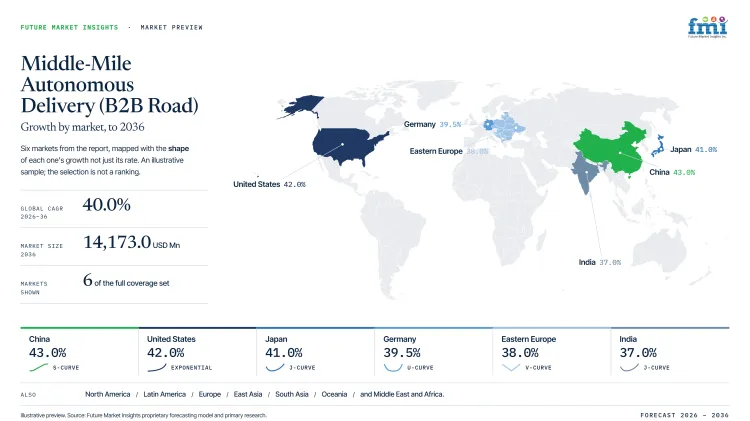
| Country | CAGR |
|---|---|
| China | 43.0% |
| United States | 42.0% |
| Japan | 41.0% |
| Germany | 39.5% |
| Eastern Europe | 38.0% |
| India | 37.0% |
How do country-level CAGRs compare in the Middle-Mile Autonomous Delivery (B2B Road) Market?
The listed markets remain within a six-point CAGR range, which indicates broadly strong growth across the countries covered. China, the United States and Japan form the leading cluster with relatively small differences in projected expansion. Germany sits between the leading markets and the group represented by Eastern Europe and India. The Eastern Europe figure reflects a regional average and may conceal wider variation across its individual national markets.
- China leads the comparison, while the United States and Japan remain close enough to indicate similar market momentum.
- Germany records a moderate gap from the leading cluster and occupies a clear middle position within the comparison.
- Eastern Europe and India report slower growth than the other markets, yet both retain substantial long-term expansion potential.
- The six-point spread shows meaningful differences without separating the markets into sharply defined high-growth and low-growth categories.
These differences influence market entry timing and the pace at which autonomous freight services can reach commercial scale. The full report provides country-level CAGR analysis across North America; Latin America; Europe; East Asia; South Asia; Oceania; and the Middle East and Africa.
Country-wise Insights
- China has a commercial base built around series-produced autonomous trucks used across several line-haul logistics networks. The market is forecast to rise at 43.0% CAGR over the forecast period, driven by established freight corridors and vehicle manufacturing partnerships. Inceptio Technology reported in July 2025 that its autonomous driving system had surpassed 200 million commercial operating kilometers. The mileage shows that fleet data is available across routine logistics work rather than isolated demonstrations. National logistics companies can therefore evaluate fuel use and operating consistency across broad route networks. Vehicle developers still need clear responsibility for remote support and incident response across every approved operating corridor.
- The United States combines commercial driverless freight operations with road-access rules that still vary by state. Adoption in the United States is estimated to expand at 42.0% CAGR through 2036, supported by regional distribution networks and active commercial contracts. Gatik reported in January 2026 that its trucks had completed more than 10,000 fully driverless miles on public roads across several logistics networks. The record applies directly to repeated B2B routes between warehouses, distribution centers, and stores. Commercial expansion still requires federal safety compliance plus state permits and local incident plans for every corridor. Shippers comparing providers should examine whether one operating model can maintain route accountability across several jurisdictions.
- Japan is shaping autonomous freight around expressway relay points supported by coordinated infrastructure and public operating programs. By 2036, Japan is projected to grow at 41.0% CAGR, underpinned by government-backed demonstrations and truck manufacturer participation. UD Trucks reported in October 2025 that four truck manufacturers joined the final demonstration phase for Level 4 expressway operations, which ran through December 2025. The program connects automated lane changes and remote monitoring with planned relay-area operations on expressway routes. Logistics groups therefore gain a defined model for transferring freight between long-haul routes and local drivers.
- Germany has a truck engineering base and a defined legal framework for autonomous motorway operations between logistics hubs. The German market sector is projected to record 39.5% CAGR during the forecast period, reinforced by freight demand and engineering programs for defined routes. MAN Truck & Bus reported in May 2025 that twelve ATLAS-L4 partners and about 150 engineers completed a three-year autonomous truck program. The project applied German autonomous-driving law to hub-to-hub motorway traffic and produced evidence for future series applications.;
- Eastern Europe combines cross-border road freight with national approval systems that do not yet provide one regional path for driverless truck service. The region is estimated to post 38.0% CAGR by 2036, aided by demand for more predictable depot-to-depot movements. Commercial programs remain more likely to start on domestic routes with fixed terminals than on multi-country lanes requiring several permits. Logistics groups should separate freight volume from deployment readiness during investment reviews.
- India requires technical and operating evidence before driverless freight can enter routine public-road service under mixed traffic conditions. In India, demand is predicted to advance at 37.0% CAGR between 2026 and 2036, shaped by logistics growth and the need for route validation under local road conditions. Early commercial work should focus on controlled depot links with consistent loading procedures and limited route variation. Truck developers need to prove sensing performance, remote intervention, and roadside recovery before broader deployment can support recurring freight schedules.
Who are the notable companies in the Middle-Mile Autonomous Delivery (B2B road) Market?
Notable companies active in the market include Gatik, Einride, Isuzu Motors, MAN Truck & Bus, Inceptio Technology, and Pony.ai.
-market-analysis-by-company.webp "Middle Mile Autonomous Delivery (b2b Road) Market Analysis By Company")
The competitive field combines route operators with truck manufacturers and autonomous driving developers serving different commercial roles. Gatik and Einride sell completed freight operations that combine vehicles with remote support and route management. Isuzu Motors and MAN Truck & Bus contribute vehicle engineering for medium-duty and heavy-duty autonomous freight applications. Inceptio Technology and Pony.ai develop truck automation systems with commercial vehicle partners serving freight networks across China. Commercial differentiation depends on evidence from repeated freight service rather than isolated technical demonstrations or prototype testing. Companies applying AI in transportation still need clear incident management and customer integration before a route can enter routine operations.
- Gatik combines medium-duty vehicle integration with commercial driverless operations across regional retail and consumer goods networks. Isuzu Motors supports the vehicle platform relationship, which links production planning with a defined middle-mile operating model. The relationship gives freight customers one path from vehicle engineering to recurring route operations under defined service responsibility.
- Einride combines purpose-built electric vehicles with remote operations and managed freight contracts for repeated facility routes. The company has documented public-road and facility deployments in Europe and the United States, giving customers several operating settings for comparison. The model suits companies that prefer contracted capacity over an internal autonomous operations function during initial deployment.
- MAN Truck & Bus develops autonomous heavy-duty engineering for hub-to-hub routes serving German freight networks and testing programs. Its work is relevant to transport groups that need conventional truck manufacturing capability alongside defined-route automation research. The program gives fleet owners a vehicle-led route toward testing commercial operations under familiar truck service structures.
- Inceptio Technology and Pony.ai develop autonomous truck systems for several commercial freight networks across China. Their operating evidence and manufacturer partnerships give logistics companies a basis for comparing series production with driverless route development. Both companies connect software development with truck platforms used in routine freight operations rather than isolated prototypes.
Competitive Benchmarking: Middle-Mile Autonomous Delivery (B2B Road) Market
| Company | Repeated-Route Operations | Vehicle Integration | Remote Operations | Commercial Freight Evidence | Geographic Reach |
|---|---|---|---|---|---|
| Gatik | High | High | High | High | United States and Canada |
| Einride | High | Medium | High | High | Europe and the United States |
| Isuzu Motors | Medium | High | Low | Medium | Japan and North America |
| MAN Truck & Bus | Medium | High | Low | Medium | Europe |
| Inceptio Technology | High | High | Medium | High | China |
| Pony.ai | High | High | Medium | High | China |
Scoring basis: High indicates repeated official evidence across commercial operations and the named market-specific capability. Medium indicates verified participation in the capability with narrower evidence of commercial deployment or geographic reach. Low indicates limited official evidence for the named capability within the defined middle-mile autonomous freight market.
Source: Future Market Insights
Key Developments in the Middle-Mile Autonomous Delivery (B2B Road) Market
- In November 2025, Pony.ai announced fourth-generation autonomous trucks developed with SANY Truck and Dongfeng Liuzhou Motor. The program established a thousand-unit production design for two battery-electric autonomous truck models intended for commercial freight service. Pony.ai stated that the autonomy kit could reduce vehicle bill-of-materials cost by about 70% versus its prior generation.
- In September 2025, Einride operated a fully autonomous heavy-duty vehicle on a public road at the Port of Antwerp-Bruges under Belgium’s regulatory framework. The demonstration connected public-road permission with a complex port setting that handles planned freight flows.
- In July 2025, Gatik introduced Arena a simulation platform built with NVIDIA Cosmos world foundation models. Arena creates structured synthetic driving environments for training and validating autonomous truck systems against routine and rare events. The platform addresses rare road events that are expensive or unsafe to collect through public-road testing alone.
- In January 2025, Pony.ai received approval for autonomous truck platooning tests on cross-provincial highways across the Beijing-Tianjin-Hebei region. Pony.ai reported more than 45,000 kilometers of service and nearly 500 TEUs of freight orders on its existing regional corridor.
Key Players in the Middle-Mile Autonomous Delivery (B2B Road) Market
Commercial freight operators and service managers
- Gatik
- Einride
Vehicle and platform manufacturers
- Isuzu Motors
- MAN Truck & Bus
Autonomous driving system developers
- Inceptio Technology
- Pony.ai
Middle-Mile Autonomous Delivery (B2B Road) Market - Report Scope
-market-breakdown-by-vehicle-type,-application,-and-region.webp "Middle Mile Autonomous Delivery (b2b Road) Market Breakdown By Vehicle Type, Application, And Region")
| Coverage field | Report scope |
|---|---|
| Market breakdown | Vehicle type, application, component, end-use, business model, and region. |
| Quantitative Units | Revenue in USD Million, CAGR in %. |
| Market Definition | Autonomous road vehicles and operating services used for repeated business-to-business freight movement between distribution centers, warehouses, plants, stores, and other managed facilities. |
| Regions Covered | North America, Latin America, Europe, East Asia, South Asia, Oceania, and Middle East and Africa. |
| Countries Covered | China, United States, Japan, Germany, and India within the regional model. |
| Key Companies Profiled | Gatik, Einride, Isuzu Motors, MAN Truck & Bus, Inceptio Technology, and Pony.ai. |
| Forecast Period | 2026 to 2036. |
| Approach | Hybrid bottom-up and top-down market sizing supported by primary interviews and official desk research. |
Source: Future Market Insights analysis driven by proprietary forecasting models and primary research
Middle-Mile Autonomous Delivery (B2B Road) Market - Research Methodology
| Method | Approach |
|---|---|
| Primary Research | FMI analysts gathered input from manufacturers, service providers, technology developers, distributors, end users, procurement teams, and subject-matter experts. Interviews examined purchasing decisions, product or service evaluation, adoption barriers, approval requirements, pricing considerations, and expectations for technical or commercial support. Respondents were also asked what evidence is required before a trial, pilot, or initial order develops into regular purchasing. |
| Desk Research | Desk research covered government statistics, regulatory publications, trade data, industry associations, technical literature, standards, company filings, product information, and official corporate announcements. Sources were reviewed for relevance, publication date, geographic coverage, and consistency with the defined market scope. Claims relating to performance, applications, approvals, capacity, investment, and commercial activity were retained only when supported by credible public evidence. |
| Market Sizing and Forecasting | The market model combined the baseline value with historical performance, segment structure, pricing and volume indicators, adoption levels, company participation, and country-level demand conditions. Forecast assumptions considered economic activity, investment trends, regulatory developments, technology adoption, purchasing cycles, supply availability, and barriers to wider market use. Segment and regional estimates were reconciled before the final market total was calculated. |
| Data Validation | Estimates were checked against multiple independent indicators, including public data, company activity, trade patterns, industry developments, and findings from primary interviews. Validation also tested whether products, services, applications, and company revenues fell within the defined market boundaries. Adjacent categories, unsupported claims, overlapping revenues, and activities without direct market relevance were excluded to reduce double counting and maintain consistency across segments and countries. |
Source: Future Market Insights (FMI) analysis, based on proprietary forecasting model and primary research
Middle-Mile Autonomous Delivery (B2B Road) Market by Segments
Middle-Mile Autonomous Delivery (B2B Road) Market segmented by Vehicle Type:
- L4 box trucks
- Autonomous vans
- Small road pods
- Retrofit autonomy kits
Middle-Mile Autonomous Delivery (B2B Road) Market segmented by Application:
- Retail store replenishment
- Distribution center-to-distribution center shuttles
- Parcel middle-mile
- Food distribution
Middle-Mile Autonomous Delivery (B2B Road) Market segmented by Component:
- Vehicles
- Autonomy software
- Fleet operations
Middle-Mile Autonomous Delivery (B2B Road) Market segmented by End-use:
- Retail and grocery
- Parcel carriers
- Third-party logistics providers
- Food service
Middle-Mile Autonomous Delivery (B2B Road) Market segmented by Business Model:
- Transport-as-a-service
- Direct ownership
- Subscription
- Pilot programs
Middle-Mile Autonomous Delivery (B2B Road) Market by Region:
- North America
- United States
- Canada
- Latin America
- Brazil
- Mexico
- Argentina
- Europe
- Germany
- United Kingdom
- France
- Italy
- Spain
- Poland
- East Asia
- China
- Japan
- South Korea
- South Asia
- India
- Thailand
- Indonesia
- Oceania
- Australia
- New Zealand
- Middle East and Africa
- GCC Countries
- South Africa
- Türkiye
Research Sources and Bibliography
- Gatik. (2026, January 27). Gatik Becomes First USA Company to Operate Fully Driverless Trucks at Scale for Commercial Deliveries.
- Einride. (2025, October 1). Einride has Raised $100 Million to Accelerate Autonomous Freight and Expand Global Operations.
- Gatik. (2025, March 18). Gatik to Accelerate Mass Production of SAE Level 4 (L4) Production-Ready Autonomous Trucks, Built on NVIDIA In-Vehicle Compute.
- Gatik. (2025, September 23). Gatik and Loblaw Ink 5-year Expansion Deal to Scale AI-Powered Autonomous Trucking Solution Across Regional Distribution Networks in the Greater Toronto Area.
- Einride. (2026, May 18). Einride, EASE Logistics, DriveOhio, and INDOT Announce Deployment of Autonomous Electric Trucks.
- Gatik. (2026, June 8). PepsiCo and Gatik Announce Multi-Year Agreement to Deploy Autonomous Freight in North America.
- National Highway Traffic Safety Administration. (2025, September 4). Trump’s Transportation Secretary Sean P. Duffy Advances AV Framework with Plans to Modernize Safety Standards.
- Gatik. (2026, March 16). Gatik Joins NVIDIA Halos AI Systems Inspection Lab to Support the Scaling of Driverless Freight Operations Across North America.
- Inceptio Technology. (2025, July 8). Inceptio Hosts 2025 Autoware Foundation China Meetup - Showcases Latest Autonomous Trucking Innovations.
- UD Trucks. (2025, October 21). Commencement of Demonstration Tests for the Social Implementation of Level 4 Autonomous Driving Trucks.
- Pony AI Inc. (2025, November 19). PONY AI Inc. Announces Gen-4 Autonomous Trucks, Set for Mass Production and Deployment in 2026.
- Einride. (2025, September 16). Einride operates first ever fully autonomous heavy-duty truck on a public road in Belgium at the Port of Antwerp-Bruges.
- Gatik. (2025, July 29). Gatik Unveils Arena: Next-Generation Simulation Platform to Accelerate Commercialization of Its Autonomous Trucking Solution, Built on NVIDIA Cosmos.
- Pony AI Inc. (2025, January 15). Pony AI Inc. Becomes the First Company in China Approved for Autonomous Truck Platooning Tests.
- MAN Truck & Bus. (2025, May 8). Goal achieved: the driverless truck on the road becomes reality.
This bibliography is provided for reader reference and is not exhaustive. The full report contains the complete reference list and detailed citations
This Report Answers
- What market value is estimated for 2026 and forecast for 2036?
- How do vehicle type shares compare across the profiled configurations in 2026?
- How do retail replenishment routes support commercial adoption?
- Which business model reduces the need for an internal autonomous operations team?
- How do country growth rates compare across the profiled markets?
- Which regulatory issues can delay public-road deployment?
- How do remote operations affect route economics and service accountability?
- Which companies provide verified vehicle, software, or managed freight capabilities?
- What operational evidence should executives review before expanding a route?
Frequently Asked Questions
What is driving growth in the Middle-Mile Autonomous Delivery (B2B Road) Market?
Repeated facility routes reduce operating variation and support measurable service standards for autonomous freight. Commercial contracts convert proven corridors into recurring capacity with clear responsibility for daily operations.
Who are the key players in the Middle-Mile Autonomous Delivery (B2B Road) Market?
Gatik and Einride manage autonomous freight operations across repeated routes. Isuzu Motors and MAN Truck & Bus provide vehicle platforms while Inceptio Technology and Pony.ai develop driving systems.
What is a notable restraint in the Middle-Mile Autonomous Delivery (B2B Road) Market?
Public-road approval can extend deployment schedules across routes involving several authorities. Vehicle standards and local permits must align before routine driverless freight service begins.
Why should executives track the Middle-Mile Autonomous Delivery (B2B Road) Market?
The market can change freight costs and operating models on repeated distribution routes. Verified daily performance helps executives separate scalable commercial service from limited demonstrations.
What business problem does the Middle-Mile Autonomous Delivery (B2B Road) Market address?
Autonomous middle-mile services move freight between managed facilities with planned loading procedures. The model supports frequent routes facing labor pressure, schedule constraints, and recurring inventory needs.
What should logistics executives evaluate in the Middle-Mile Autonomous Delivery (B2B Road) Market?
Logistics executives should assess route stability and facility readiness before unattended operations expand. Remote intervention and roadside recovery need equal attention during contract design.
What limits return on investment in the Middle-Mile Autonomous Delivery (B2B Road) Market?
Low route use weakens vehicle economics where equipment and supervision costs remain fixed. Delayed approvals or unclear operating responsibility can extend the payback period beyond the original investment case.
What supports long-term commercial confidence in the Middle-Mile Autonomous Delivery (B2B Road) Market?
Documented daily operations show how autonomous trucks perform across repeated freight schedules. Clear safety evidence and accountable service management make route expansion decisions more defensible.
Preview the report firsthand - request a free sample
Get SampleGet the brochure for pricing and purchase details.
Get PDFTable of Content
- Key Takeaways
- Market Size and CAGR
- Top Growth Driver
- Fastest Growing Segment
- Leading Region
- Key Companies
- Emerging Opportunities
- Executive Summary
- Global Market Outlook
- Demand-side Trends
- Supply-side Trends
- Technology Roadmap Analysis
- Analysis and Recommendations
- Analyst Perspective (What is happening? Why now? What should investors know?)
- Key Questions Answered
- How large is the market?
- What is the CAGR?
- What are key trends?
- Which region dominates?
- Who are the leaders?
- Market Overview
- Market Coverage / Taxonomy
- Market Definition / Scope / Limitations
- Research Methodology
- Chapter Orientation
- Analytical Lens and Working Hypotheses
- Market Structure, Signals, and Trend Drivers
- Benchmarking and Cross-market Comparability
- Market Sizing, Forecasting, and Opportunity Mapping
- Research Design and Evidence Framework
- Desk Research Programme (Secondary Evidence)
- Expert Input and Fieldwork (Primary Evidence)
- Tooling, Models, and Reference Databases
- Data Engineering and Model Build
- Quality Assurance and Audit Trail
- Market Background
- Market Dynamics (Drivers, Restraints, Opportunity, Trends)
- Scenario Forecast (Optimistic, Likely, Conservative)
- Impact Analysis
- AI Impact
- Sustainability Impact
- Regulatory Impact
- Technology Impact
- Consumer / Buyer Analysis
- Purchase Drivers
- Adoption Barriers
- Buyer Journey
- Opportunity Map Analysis
- Product Life Cycle Analysis
- Supply Chain Analysis
- Investment Feasibility Matrix
- Value Chain Analysis
- PESTLE and Porter's Analysis
- Regulatory Landscape
- Regional Parent Market Outlook
- Production and Consumption Statistics
- Import and Export Statistics
- Global Market Analysis and Forecast, 2021 to 2036
- Historical Market Size Value (USD Mn) Analysis, 2021 to 2025
- Current and Future Market Size Value (USD Mn) Projections, 2026 to 2036
- Y-o-Y Growth Trend Analysis
- Absolute $ Opportunity Analysis
- Global Market Pricing Analysis, 2021 to 2036
- Global Market Analysis and Forecast, By Vehicle Type, 2021 to 2036
- Introduction / Key Findings
- Historical Market Size Value (USD Mn) Analysis By Vehicle Type, 2021 to 2025
- Current and Future Market Size Value (USD Mn) Analysis and Forecast By Vehicle Type, 2026 to 2036
- L4 box trucks
- Autonomous vans
- Small road pods
- Retrofit autonomy kits
- L4 box trucks
- Y-o-Y Growth Trend Analysis By Vehicle Type, 2021 to 2025
- Absolute $ Opportunity Analysis By Vehicle Type, 2026 to 2036
- Global Market Analysis and Forecast, By Application, 2021 to 2036
- Introduction / Key Findings
- Historical Market Size Value (USD Mn) Analysis By Application, 2021 to 2025
- Current and Future Market Size Value (USD Mn) Analysis and Forecast By Application, 2026 to 2036
- Retail store replenishment
- DC-to-DC shuttles
- Parcel middle-mile
- Food distribution
- Retail store replenishment
- Y-o-Y Growth Trend Analysis By Application, 2021 to 2025
- Absolute $ Opportunity Analysis By Application, 2026 to 2036
- Global Market Analysis and Forecast, By Component, 2021 to 2036
- Introduction / Key Findings
- Historical Market Size Value (USD Mn) Analysis By Component, 2021 to 2025
- Current and Future Market Size Value (USD Mn) Analysis and Forecast By Component, 2026 to 2036
- Vehicles
- Autonomy software
- Fleet operations
- Vehicles
- Y-o-Y Growth Trend Analysis By Component, 2021 to 2025
- Absolute $ Opportunity Analysis By Component, 2026 to 2036
- Global Market Analysis and Forecast, By End-use, 2021 to 2036
- Introduction / Key Findings
- Historical Market Size Value (USD Mn) Analysis By End-use, 2021 to 2025
- Current and Future Market Size Value (USD Mn) Analysis and Forecast By End-use, 2026 to 2036
- Retail & grocery
- Parcel carriers
- 3PL
- Food service
- Retail & grocery
- Y-o-Y Growth Trend Analysis By End-use, 2021 to 2025
- Absolute $ Opportunity Analysis By End-use, 2026 to 2036
- Global Market Analysis and Forecast, By Business Model, 2021 to 2036
- Introduction / Key Findings
- Historical Market Size Value (USD Mn) Analysis By Business Model, 2021 to 2025
- Current and Future Market Size Value (USD Mn) Analysis and Forecast By Business Model, 2026 to 2036
- Transport-as-a-service
- Direct
- Subscription
- Pilot programs
- Transport-as-a-service
- Y-o-Y Growth Trend Analysis By Business Model, 2021 to 2025
- Absolute $ Opportunity Analysis By Business Model, 2026 to 2036
- Global Market Analysis and Forecast, By Region, 2021 to 2036
- Introduction
- Historical Market Size Value (USD Mn) Analysis By Region, 2021 to 2025
- Current Market Size Value (USD Mn) Analysis and Forecast By Region, 2026 to 2036
- North America
- Latin America
- Western Europe
- Eastern Europe
- East Asia
- South Asia and Pacific
- Middle East & Africa
- Market Attractiveness Analysis By Region
- North America Market Analysis and Forecast, By Country, 2021 to 2036
- Historical Market Size Value (USD Mn) Trend Analysis By Market Taxonomy, 2021 to 2025
- Market Size Value (USD Mn) Forecast By Market Taxonomy, 2026 to 2036
- By Country
- USA
- Canada
- By Vehicle Type
- By Application
- By Component
- By End-use
- By Business Model
- By Country
- Market Attractiveness Analysis
- By Country
- By Vehicle Type
- By Application
- By Component
- By End-use
- By Business Model
- Key Takeaways
- Latin America Market Analysis and Forecast, By Country
- Historical Market Size Value (USD Mn) Trend Analysis By Market Taxonomy, 2021 to 2025
- Market Size Value (USD Mn) Forecast By Market Taxonomy, 2026 to 2036
- By Country
- Brazil
- Mexico
- Chile
- Rest of Latin America
- By Vehicle Type
- By Application
- By Component
- By End-use
- By Business Model
- By Country
- Market Attractiveness Analysis
- By Country
- By Vehicle Type
- By Application
- By Component
- By End-use
- By Business Model
- Key Takeaways
- Western Europe Market Analysis and Forecast, By Country
- Historical Market Size Value (USD Mn) Trend Analysis By Market Taxonomy, 2021 to 2025
- Market Size Value (USD Mn) Forecast By Market Taxonomy, 2026 to 2036
- By Country
- Germany
- UK
- Italy
- Spain
- France
- Nordic
- BENELUX
- Rest of Western Europe
- By Vehicle Type
- By Application
- By Component
- By End-use
- By Business Model
- By Country
- Market Attractiveness Analysis
- By Country
- By Vehicle Type
- By Application
- By Component
- By End-use
- By Business Model
- Key Takeaways
- Eastern Europe Market Analysis and Forecast, By Country
- Historical Market Size Value (USD Mn) Trend Analysis By Market Taxonomy, 2021 to 2025
- Market Size Value (USD Mn) Forecast By Market Taxonomy, 2026 to 2036
- By Country
- Russia
- Poland
- Hungary
- Balkan & Baltic
- Rest of Eastern Europe
- By Vehicle Type
- By Application
- By Component
- By End-use
- By Business Model
- By Country
- Market Attractiveness Analysis
- By Country
- By Vehicle Type
- By Application
- By Component
- By End-use
- By Business Model
- Key Takeaways
- East Asia Market Analysis and Forecast, By Country
- Historical Market Size Value (USD Mn) Trend Analysis By Market Taxonomy, 2021 to 2025
- Market Size Value (USD Mn) Forecast By Market Taxonomy, 2026 to 2036
- By Country
- China
- Japan
- South Korea
- By Vehicle Type
- By Application
- By Component
- By End-use
- By Business Model
- By Country
- Market Attractiveness Analysis
- By Country
- By Vehicle Type
- By Application
- By Component
- By End-use
- By Business Model
- Key Takeaways
- South Asia and Pacific Market Analysis and Forecast, By Country
- Historical Market Size Value (USD Mn) Trend Analysis By Market Taxonomy, 2021 to 2025
- Market Size Value (USD Mn) Forecast By Market Taxonomy, 2026 to 2036
- By Country
- India
- ASEAN
- Australia & New Zealand
- Rest of South Asia and Pacific
- By Vehicle Type
- By Application
- By Component
- By End-use
- By Business Model
- By Country
- Market Attractiveness Analysis
- By Country
- By Vehicle Type
- By Application
- By Component
- By End-use
- By Business Model
- Key Takeaways
- Middle East & Africa Market Analysis and Forecast, By Country
- Historical Market Size Value (USD Mn) Trend Analysis By Market Taxonomy, 2021 to 2025
- Market Size Value (USD Mn) Forecast By Market Taxonomy, 2026 to 2036
- By Country
- Kingdom of Saudi Arabia
- Other GCC Countries
- Türkiye
- South Africa
- Other African Union
- Rest of Middle East & Africa
- By Vehicle Type
- By Application
- By Component
- By End-use
- By Business Model
- By Country
- Market Attractiveness Analysis
- By Country
- By Vehicle Type
- By Application
- By Component
- By End-use
- By Business Model
- Key Takeaways
- Key Countries Market Analysis
- USA
- Pricing Analysis
- Market Share Analysis, 2025
- By Vehicle Type
- By Application
- By Component
- By End-use
- By Business Model
- Canada
- Pricing Analysis
- Market Share Analysis, 2025
- By Vehicle Type
- By Application
- By Component
- By End-use
- By Business Model
- Mexico
- Pricing Analysis
- Market Share Analysis, 2025
- By Vehicle Type
- By Application
- By Component
- By End-use
- By Business Model
- Brazil
- Pricing Analysis
- Market Share Analysis, 2025
- By Vehicle Type
- By Application
- By Component
- By End-use
- By Business Model
- Chile
- Pricing Analysis
- Market Share Analysis, 2025
- By Vehicle Type
- By Application
- By Component
- By End-use
- By Business Model
- Germany
- Pricing Analysis
- Market Share Analysis, 2025
- By Vehicle Type
- By Application
- By Component
- By End-use
- By Business Model
- UK
- Pricing Analysis
- Market Share Analysis, 2025
- By Vehicle Type
- By Application
- By Component
- By End-use
- By Business Model
- Italy
- Pricing Analysis
- Market Share Analysis, 2025
- By Vehicle Type
- By Application
- By Component
- By End-use
- By Business Model
- Spain
- Pricing Analysis
- Market Share Analysis, 2025
- By Vehicle Type
- By Application
- By Component
- By End-use
- By Business Model
- France
- Pricing Analysis
- Market Share Analysis, 2025
- By Vehicle Type
- By Application
- By Component
- By End-use
- By Business Model
- India
- Pricing Analysis
- Market Share Analysis, 2025
- By Vehicle Type
- By Application
- By Component
- By End-use
- By Business Model
- ASEAN
- Pricing Analysis
- Market Share Analysis, 2025
- By Vehicle Type
- By Application
- By Component
- By End-use
- By Business Model
- Australia & New Zealand
- Pricing Analysis
- Market Share Analysis, 2025
- By Vehicle Type
- By Application
- By Component
- By End-use
- By Business Model
- China
- Pricing Analysis
- Market Share Analysis, 2025
- By Vehicle Type
- By Application
- By Component
- By End-use
- By Business Model
- Japan
- Pricing Analysis
- Market Share Analysis, 2025
- By Vehicle Type
- By Application
- By Component
- By End-use
- By Business Model
- South Korea
- Pricing Analysis
- Market Share Analysis, 2025
- By Vehicle Type
- By Application
- By Component
- By End-use
- By Business Model
- Russia
- Pricing Analysis
- Market Share Analysis, 2025
- By Vehicle Type
- By Application
- By Component
- By End-use
- By Business Model
- Poland
- Pricing Analysis
- Market Share Analysis, 2025
- By Vehicle Type
- By Application
- By Component
- By End-use
- By Business Model
- Hungary
- Pricing Analysis
- Market Share Analysis, 2025
- By Vehicle Type
- By Application
- By Component
- By End-use
- By Business Model
- Kingdom of Saudi Arabia
- Pricing Analysis
- Market Share Analysis, 2025
- By Vehicle Type
- By Application
- By Component
- By End-use
- By Business Model
- Türkiye
- Pricing Analysis
- Market Share Analysis, 2025
- By Vehicle Type
- By Application
- By Component
- By End-use
- By Business Model
- South Africa
- Pricing Analysis
- Market Share Analysis, 2025
- By Vehicle Type
- By Application
- By Component
- By End-use
- By Business Model
- USA
- Market Structure Analysis
- Competition Dashboard
- Competition Benchmarking
- Market Share Analysis of Top Players
- By Regional
- By Vehicle Type
- By Application
- By Component
- By End-use
- By Business Model
- Emerging Startups
- Innovation Benchmarking
- Competition Analysis
- Competition Deep Dive
- Gatik (US-CA)
- Overview
- Product Portfolio
- Profitability by Market Segments
- Sales Footprint
- Strategy Overview
- Marketing Strategy
- Product Strategy
- Channel Strategy
- Clevon (EE)
- Udelv (US)
- Gatik (US-CA)
- Case Studies
- Success Stories
- Recent Developments
- Competition Deep Dive
- Assumptions & Acronyms Used


