

- Market Size (2026)
- USD 14.6 Bn
- Forecast (2036)
- USD 24.9 Bn
- CAGR (2026 to 2036)
- 5.5%
How big is Mobile Computers Market in 2026?
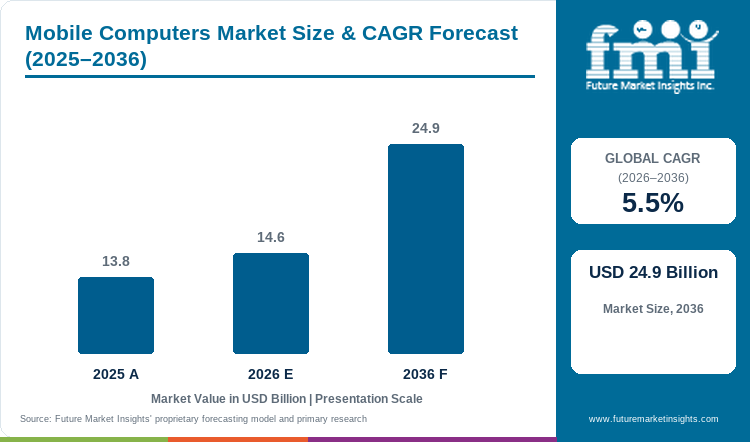
USD 14.6 billion in 2026 and USD 24.9 billion by 2036 at a 5.5% CAGR.
Demand for mobile computers is projected to expand at a CAGR of 5.5% between 2026 and 2036, increasing from USD 13.8 billion in 2025 to USD 14.6 billion in 2026 and reaching USD 24.9 billion by 2036. Key challenge for retailers and warehouse operators is the growing need to upgrade legacy devices that cannot efficiently support emerging data-capture standards and long software lifecycles. GS1's July 2026 guidance calls for retail scanners to process GS1-compliant 2D barcodes and identifies scanner upgrades as a key migration requirement. Mobile computer fleets share the same imaging needs across store operations and fulfillment workflows.
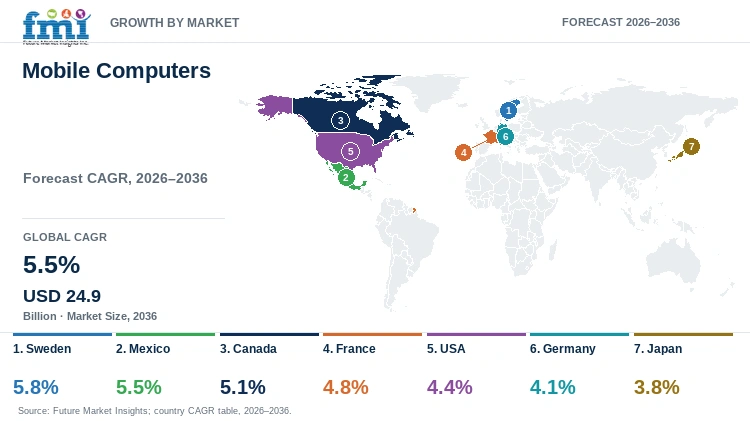
Germany is projected to grow at 4.1% CAGR through 2036 while Japan is projected at 3.8% CAGR. GS1 Germany reported in March 2026 that dm tested 2D codes before wider deployment. The pilot gives German retailers direct compatibility evidence for scanner and host-system changes during migration. GS1 Japan documents three scanning modes for mixed 1D and 2D retail use before 2027. Japanese fleet qualification therefore requires staged compatibility tests across scanning syntax and host-system behavior.
Key Takeaways
- Frontline teams are replacing fragmented tools because mobile computers keep scanning and enterprise applications available throughout shifts.
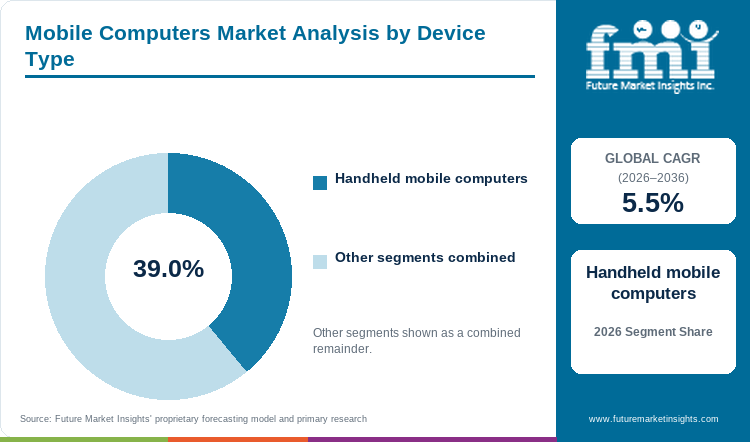
- By device type, handheld mobile computers are estimated to hold 39.0% in 2026 because portable scanning supports frontline tasks.
- In 2026, Android is expected to lead operating system demand with 57.0% share because enterprise management tools support distributed fleets.
- By end use, warehousing and logistics is forecast to represent 31.0% in 2026 because physical movements require task-level capture.
- Application migration and wireless validation can delay fleet approval because replacement changes accessories and long-term support.
- Key players in the mobile computers market include Zebra Technologies and Brady Corporation alongside Datalogic and Panasonic Connect. Getac and Nordalp GmbH also compete with CipherLab and Unitech across rugged and AIDC mobile-computing routes. Bluebird Inc. and UROVO complete the named competitive set across retail and logistics enterprise mobility workflows.
Analyst Perspective
"Mobile computer buyers treat lifecycle support as a device specification because workflow interruptions erase savings. Application compatibility and service continuity can shorten approval cycles without disrupting established frontline work."
- Sudip saha, Principal Consultant, Future Market Insights
How is the mobile computers market segmented?
The mobile computers market is segmented by Device Type, Operating System, End Use, Ruggedness, Sales Channel, and Region.
The mobile computers market is segmented by device type, operating system, end use, ruggedness, sales channel, and region. Device type includes handheld computers, vehicle-mounted computers, wearables, rugged tablets, and barcode scanning terminals while operating system covers Android, Windows, Linux - embedded, and proprietary platforms. End use includes warehousing and logistics, retail, manufacturing, healthcare, transportation, and field service while ruggedness includes rugged, general-duty, ultra-rugged, and hazardous-environment devices and sales channel covers VAR - system integrators, OEM direct, industrial distributors, and e-commerce - catalog routes.
How does portable scanning support handheld selection within the device-type category?
Handheld devices keep scanning and application access with the worker during receiving and inventory tasks. This mobility also lets barcode scanners share cradles and batteries with a managed device family instead of requiring fixed stations.
- Based on device type, handheld mobile computers are projected to account for 39.0% in 2026, driven by portable scanning in frontline workflows.
- UROVO launched an upgraded DT50 mobile computer in May 2026 for retail and logistics workflows requiring continuous enterprise data capture.
How does device management support Android selection within the operating-system category?
Android gives mobility teams a common application and security layer for purpose-built devices used in frontline operations. Enterprise mobility programs also benefit when enrollment policies remain consistent during replacement of older handheld fleets.
- By operating system, Android is estimated to hold 57.0% in 2026, enabled by enterprise management tools and long device-support programs.
- Unitech confirmed SOTI MobiControl certification for its Android 15 EA660 in August 2026 after compatibility validation for enterprise device management in distributed fleets.
How do repeated scan events support warehousing and logistics within the end-use category?
Warehouse workers record receiving and picking events close to the physical task so delays become visible immediately. Intralogistics automation increases that requirement because mobile exceptions still need a worker-facing device beside automated material movement.
- In 2026, warehousing and logistics is expected to lead end use with 31.0% share, attributable to repeated scan-intensive inventory and fulfillment activity.
- CipherLab launched the RK96 Cold Storage Mobile Computer in April 2026 for freezer warehouses requiring reliable scanning under subzero conditions.
How does repair downtime shape rugged-device selection within the ruggedness category?
Rugged devices protect uptime when drops and contamination are routine operating conditions rather than exceptional events. Cold chain monitoring also raises the value of sealed hardware when mobile work moves between ambient and refrigerated zones.
- By ruggedness, rugged devices are forecast to represent 47.0% in 2026, influenced by fleet economics that penalize repeated failure and repair downtime.
- Getac launched the fully rugged G140 tablet in April 2026 for field users requiring mobile edge computing in demanding field environments.
How do deployment services shape system-integrator selection within the sales-channel category?
Large deployments need staging and application configuration before devices reach frontline users at multiple operating sites. Mobile device management becomes part of channel value when integrators also coordinate enrollment and lifecycle support across multiple sites.
- VAR - system integrators are likely to capture 37.0% share in 2026, enabled by deployment services that reduce application and rollout risk.
- Zebra expanded its India partner strategy in May 2026 while PartnerConnect continued supporting more than 10,000 channel partners globally.
What are the drivers, restraints and opportunities in the Mobile Computers Market?
Frontline data capture supports replacement while integration delays approval and workflow software opens new deployment routes.
- Driver: Richer barcode data and transaction density increase demand for managed mobile capture during frontline work.
- Restraint: Existing applications and scanner settings extend validation during migration to new mobile hardware or formats.
- Opportunity: Device makers can pair mobile hardware with workflow software that removes manual inspection from daily operations.
Frontline transaction density becomes a device driver when each physical movement must create an accurate enterprise record without returning to a fixed terminal. GS1 stated in its May 2026 retail systems playbook that 2D migration may require equipment upgrades when scanners are not already image based. Retail automation places new scanning and host-system requirements beside established checkout and inventory processes that already run under tight uptime targets. Mobile computers can absorb those requirements while supporting applications and communications on the same managed endpoint. Buyers still need proof that scan performance and battery life remain stable during normal shift conditions before a refresh converts into fleet demand.
Fleet replacement can stall when a new device cannot reproduce the application behavior and barcode handling already approved in production. GS1 solution-provider guidance requires readiness for compliant 2D barcode processing and compatible system behavior under the Ambition 2027 program. Industrial barcode scanners face the same host-system constraint when richer data must move cleanly from the read event into enterprise software. Operations teams test device enrollment and wireless coverage before approving a broader rollout at distributed production sites. Accessory replacement and long support windows add another approval step because a cheap endpoint can become expensive when docks or batteries expire early.
Workflow-specific software gives device suppliers a practical route to expand revenue without relying on a general fleet refresh. Datalogic and Pensa Systems announced a June 2026 partnership that brings visual AI capabilities to mobile computers used from store shelves to warehouse areas. RFID systems can add another data-capture route when tagged assets require faster inventory checks than barcode-only processes allow. The revenue route pairs durable endpoints with software that removes a measurable inspection or inventory task from daily operations. Enterprise buyers are more likely to scale the deployment after pilots show fewer audits or faster exception handling within the existing application environment.
Which country CAGRs are profiled in the Mobile Computers Market?
| Country | CAGR |
|---|---|
| Sweden | 5.8% |
| Mexico | 5.5% |
| Canada | 5.1% |
| France | 4.8% |
| USA | 4.4% |
| Germany | 4.1% |
| Japan | 3.8% |
How do country-level CAGRs compare in the Mobile Computers Market?
The country CAGRs span two percentage points from Sweden at 5.8% to Japan at 3.8%. Different replacement conditions explain the spacing because mature fleets can produce revenue at lower growth rates. Channel reach and application support determine how quickly a projected need becomes an approved device refresh.
- Sweden values ergonomic mobile workflows because labor constraints make frontline productivity easier to justify.
- Mexico needs offline operation and repair coverage because device fleets extend beyond industrial corridors.
- Canada values broad service availability because dispersed sites increase device-failure and replacement-part costs nationally.
- France emphasizes interoperability because logistics operators connect mobile endpoints with established transport planning systems.
- USA fleets reward scalable management and national service because large organizations standardize devices nationally.
- Germany emphasizes long support windows because industrial users protect validated warehouse and manufacturing applications.
- Japan gives stable software support greater weight because device standards remain in service longer.
Comparable CAGRs produce different entry conditions because local workflow and service requirements shape deployment economics. The full report provides country-level CAGR analysis across North America and Latin America alongside Western Europe and Eastern Europe. Coverage also includes East Asia and South Asia and Pacific alongside the Middle East and Africa.
Country-wise Analysis
- Swedish enterprises use portable-device data in digital operating processes that depend on mobile access away from fixed workstations. Mobile computer sales in Sweden are forecast to expand at 5.8% CAGR by 2036, supported by enterprise use of portable-device data in digital operations. Statistics Sweden reported that 21.0% of enterprises used location data from portable devices for analytics in 2025. Enterprise mobility programs can build on that installed behavior when warehouse or service teams replace general devices with managed mobile computers. Smaller fleets still require scalable support because high on-site service costs can weaken the economics of specialized deployments over time.
- Mexican retail and logistics operators need endpoints that keep scanning reliable when network quality and support vary by location. Mobile computer demand in Mexico is forecast to rise at 5.5% CAGR over the forecast period, reinforced by the shift toward GS1 2D barcode processing at retail points of sale. GS1 Mexico updated transition guidance in May 2025 and targets 2D reading by the end of 2027. Suppliers can address this requirement with durable Android devices that retain offline application functions during network interruptions. Spanish-language service and repair coverage determine whether pilots can expand beyond major distribution and manufacturing clusters across Mexico.
- Canadian deployments span retail and field operations where device support must remain practical over long distances and multiple provinces. Canada's mobile computers outlook is anticipated to advance at 5.1% CAGR over the assessment period, supported by barcode migration in regulated and general retail channels. GS1 Canada states that pharmacy retailers and hospital pharmacies had a December 2025 timeline for implementing 2D barcodes while grocery targets the global 2027 ambition. Field service management also increases the value of connected mobile endpoints that operate beyond fixed facilities and depot networks. Suppliers still need repair logistics and accessory availability that can support remote sites without long device outages.
- French retail and logistics users are preparing for migration from linear barcodes toward GS1-compliant 2D carriers. France is estimated to post 4.8% CAGR over the forecast period, shaped by interoperability linking scanners with checkout and enterprise systems. GS1 France states that retailers are expected to read approved 2D codes at checkout by end of 2027. Mobile-computing suppliers therefore need interfaces that preserve process data while devices enter established workflows. Local implementation support remains important because scanner readiness does not resolve application mapping and interface testing. Device-management requirements remain part of migration decisions for distributed French fleets with established application policies.
- USA retailers are preparing scanning environments for 2D codes that carry more structured product data than conventional linear symbols. Mobile computer demand in the USA is forecast to rise at 4.4% CAGR over the forecast period, linked to replacement work that must capture new barcode formats without disrupting store applications. GS1 US advises retailers to install Sunrise-capable optical scanners that can extract GTIN data from compliant 2D codes. Mobile point-of-sale devices add pressure for wireless application access beside the scanning task during store modernization. National fleet approvals still depend on migration tools and service coverage that preserve established device policies during phased conversions.
- German retailers are testing 2D code processing inside checkout environments before considering broader deployment. Mobile computer sales in Germany are forecast to expand at 4.1% CAGR by 2036, linked to scanner readiness beside industrial fleets. GS1 Germany reported in March 2026 that dm was piloting 2D code processing in stores under standards transition. Device suppliers must prove host-system compatibility and management-tool continuity before fleet replacement can scale beyond controlled trials. Integration support therefore remains central to refresh programs for established warehouse and manufacturing systems. Long support windows protect validated industrial applications across established fleets during scheduled mobile-computing hardware replacement cycles.
- Japanese mobile-computing deployments emphasize predictable application behavior before a device becomes a standard endpoint. Adoption of mobile computers in Japan is estimated to expand at 3.8% CAGR through 2036, influenced by retail migration that must process several GS1 syntax modes in one operating environment. GS1 Japan documents three scanning modes expected during mixed 1D and 2D use before the 2027 ambition date. Retail IT teams favor staged scanner and host validation before enterprise hardware standards change. Retail automation remains dependent on controlled application mapping during migration steps and device refresh. Stable accessories and operating-system support can reduce qualification work during scheduled enterprise fleet replacement.
Who are the notable companies in the Mobile Computers Market?
Zebra Technologies, Brady Corporation, Datalogic, Panasonic Connect, Getac, Nordalp GmbH, CipherLab, Unitech, Bluebird Inc., and UROVO.
Competition spans enterprise mobility platforms and rugged field systems alongside specialist AIDC devices for frontline workflows. Brady Corporation carries the former Honeywell Productivity Solutions and Services business, while Nordalp GmbH serves Handheld’s former industrial rugged-computing route. Multi-site fleet approval requires hardware durability plus operating-system support and documented deployment services from suppliers.
- Zebra Technologies and Brady Corporation cover broad data-capture workflows while Datalogic adds enterprise scanning integration.
- Panasonic Connect and Getac emphasize rugged field computing while Nordalp GmbH serves industrial handheld deployments.
- CipherLab and Unitech provide focused AIDC portfolios while Bluebird Inc. and UROVO target retail and warehouse deployments.
Competitive Benchmarking: Mobile Computers Market
| Company | Mobile Workflow Breadth | Rugged Deployment Depth | Fleet Software and Integration | Geographic Reach |
|---|---|---|---|---|
| Zebra Technologies | High | High | High | Global |
| Brady Corporation | High | Medium | High | Global |
| Datalogic | High | High | High | Europe, North America, Asia-Pacific, Latin America |
| Panasonic Connect | Medium | High | High | North America, Europe, Japan, Asia-Pacific |
| Getac | Medium | High | Medium | North America, Europe, Asia-Pacific |
| Nordalp GmbH | Medium | High | Medium | Europe and international industrial markets |
| CipherLab | Medium | High | Medium | Asia-Pacific, Europe, North America, Latin America |
| Unitech | Medium | High | Medium | Asia-Pacific, Europe, North America, Latin America |
| Bluebird Inc. | Medium | Medium | Medium | Asia-Pacific, Europe, North America, Middle East |
| UROVO | Medium | Medium | Medium | Asia-Pacific, Europe, Americas, Middle East |
Scoring basis: High requires broad official evidence while Medium marks narrower and Low limited capability. Geographic reach documents operating regions and remains separate from the three rated capability criteria.
Key Developments in the Mobile Computers Market
- In August 2026, Brady Corporation completed its Honeywell Productivity Solutions and Services acquisition covering mobile computing and workflow software.
- In June 2026, Bluebird Inc. launched the S10 RFID handheld computer combining enterprise mobility with long-range RFID data capture.
- In May 2026, Panasonic Connect launched Tough Command using TOUGHBOOK devices as fleet hubs for field data collection.
Key Players in the Mobile Computers Market
Enterprise mobility platforms
- Zebra Technologies
- Brady Corporation
- Datalogic
Rugged field computing
- Panasonic Connect
- Getac
- Nordalp GmbH
AIDC mobile-computing providers
- CipherLab
- Unitech
- Bluebird Inc.
- UROVO
Mobile Computers Market - Report Scope
| Coverage field | Report scope |
|---|---|
| Market breakdown | By device type, operating system, end use, ruggedness, sales channel, and region. |
| Quantitative Units | USD billion. |
| Market Definition | Purpose-built enterprise mobile computers used for frontline data capture and application access are included across handheld, mounted, wearable, tablet, and terminal form factors. |
| Regions Covered | North America, Latin America, Western Europe, Eastern Europe, East Asia, South Asia and Pacific, and Middle East and Africa. |
| Countries Covered | Sweden, Mexico, Canada, France, USA, Germany, Japan, and 20+ countries included in the full report. |
| Key Companies Profiled | Zebra Technologies, Brady Corporation, Datalogic, Panasonic Connect, Getac, Nordalp GmbH, CipherLab, Unitech, Bluebird Inc., and UROVO. |
| Forecast Period | 2026 to 2036. |
| Approach | Primary and secondary research with market triangulation. |
Mobile Computers Market - Research Methodology
| Method | Approach |
|---|---|
| Primary Research | FMI analysts gathered input from manufacturers, service providers, technology developers, distributors, end users, procurement teams, and subject-matter experts. Interviews examined purchasing decisions, product or service evaluation, adoption barriers, approval requirements, pricing considerations, and expectations for technical or commercial support. Respondents were also asked what evidence is required before a trial, pilot, or initial order develops into regular purchasing. |
| Desk Research | Desk research covered government statistics, regulatory publications, trade data, industry associations, technical literature, standards, company filings, product information, and official corporate announcements. Sources were reviewed for relevance, publication date, geographic coverage, and consistency with the defined market scope. Claims relating to performance, applications, approvals, capacity, investment, and commercial activity were retained only when supported by credible public evidence. |
| Market Sizing and Forecasting | The market model combined the baseline value with historical performance, segment structure, pricing and volume indicators, adoption levels, company participation, and country-level demand conditions. Forecast assumptions considered economic activity, investment trends, regulatory developments, technology adoption, purchasing cycles, supply availability, and barriers to wider market use. Segment and regional estimates were reconciled before the final market total was calculated. |
| Data Validation | Estimates were checked against multiple independent indicators, including public data, company activity, trade patterns, industry developments, and findings from primary interviews. Validation also tested whether products, services, applications, and company revenues fell within the defined market boundaries. Adjacent categories, unsupported claims, overlapping revenues, and activities without direct market relevance were excluded to reduce double counting and maintain consistency across segments and countries. |
Mobile Computers Market by Segments
Mobile Computers Market segmented by Device Type:
- Handheld mobile computers
- Vehicle-mounted computers
- Wearable computers
- Rugged tablets
- Barcode scanning terminals
Mobile Computers Market segmented by Operating System:
- Android
- Windows
- Linux - embedded
- Proprietary OS
Mobile Computers Market segmented by End Use:
- Warehousing and logistics
- Retail
- Manufacturing
- Healthcare
- Transportation and field service
Mobile Computers Market segmented by Ruggedness:
- Rugged
- General duty
- Ultra-rugged
- Hazardous environment
Mobile Computers Market segmented by Sales Channel:
- VAR - system integrators
- OEM direct
- Industrial distributors
- E-commerce - catalog
Mobile Computers Market by Region:
- North America
- United States
- Canada
- Latin America
- Brazil
- Mexico
- Chile
- Rest of Latin America
- Western Europe
- Germany
- United Kingdom
- Italy
- Spain
- France
- Nordics
- Benelux
- Rest of Western Europe
- Eastern Europe
- Russia
- Poland
- Hungary
- Balkan and Baltic States
- Rest of Eastern Europe
- East Asia
- China
- Japan
- South Korea
- South Asia and Pacific
- India
- ASEAN
- Australia and New Zealand
- Rest of South Asia and Pacific
- Middle East and Africa
- Kingdom of Saudi Arabia
- Other GCC Countries
- Türkiye
- South Africa
- Other African Union Countries
- Rest of Middle East and Africa
Research Sources and Bibliography
- GS1. (2026, July). Migration to a single GS1 conformant 2D barcode for retailer private label and in-store labelled products.
- GS1 Germany. (2026, March 5). dm macht Kassen fit für 2D-Codes.
- UROVO. (2026, May 14). UROVO Launches Its Upgraded Flagship DT50: A 20% Performance Leap for the Next Generation of Enterprise Mobility.
- Unitech Electronics. (2026, August 20). Unitech EA660 with Android 15 Is Now SOTI MobiControl Certified!
- CipherLab. (2026, April 16). CipherLab Debuts RK96 Cold Storage Mobile Computer to Redefine Productivity in Extreme Environments.
- Getac. (2026, April 23). Getac redefines Rugged Mobility with launch of G140 Copilot+ PC, powered by AMD Technology.
- Zebra Technologies. (2026, May 6). Zebra Technologies Scales India Partner Ecosystem to Reach Manufacturing and Retail SMBs.
- GS1. (2026, May). GS1 2D Barcode Playbook for Retail POS Host and Backend Systems Guide.
- GS1. (2025, April). Solution provider 2D readiness.
- Datalogic. (2026, June 4). Datalogic and Pensa Systems bring AI-powered Visual capabilities to Mobile Computers across the Retail Supply Chain.
- GS1 US. (n.d.). What is GS1 Sunrise 2027? Retrieved September 17, 2026.
- GS1 Canada. (n.d.). 2D Barcodes. Retrieved September 17, 2026.
- GS1 France. (2023, September 26). Communauté d’Intérêt PGC dédiée au QR Code augmenté GS1.
- GS1 Mexico. (2025, May 29). Códigos de Barras 2D con tecnología GS1.
- GS1 Japan. (n.d.). 2D in Retail 概要. Retrieved September 17, 2026.
- Statistics Sweden. (2025, November 6). Significant increase in AI usage among enterprises in 2025.
- Brady Corporation. (2026, August 3). Brady Corporation Completes Transformational Acquisition of Honeywell Technologies’ Productivity Solutions and Services Business, Creating Leading Industrial Technology Company.
- Bluebird Inc. (2026, June 11). Bluebird Unveils the S10 RFID.
- Panasonic Connect North America. (2026, May 19). Panasonic Connect Launches Tough Command™ to Unify and Power Connected Fleets.
- Zebra Technologies Corporation. (2026, September 2). University Health Deploys Zebra Mobile Devices to Reduce Callback Times and Modernize Workflows.
- Brady Corporation. (2026, April 20). Acquisition of Honeywell Productivity Solutions and Services (PSS) - Investor Presentation.
- Datalogic. (2026, June 18). Falcon X60/65: BUILT FOR HARD WORK, HEAVY INPUT & THE HIGHEST SHELVES.
- Getac. (2026, June 3). Getac’s new 8-inch ZX80W and ZX80W-EX tablets blend Windows 11 functionality with energy-efficient fanless design, for all-day productivity in the field.
- Nordalp. (2026, January 21). NEW: Nordalp X21 Pro.
- CipherLab. (2026, February 6). CipherLab Launches Taiwan Excellence 2026 Award-Winning RK96 Industrial Mobile Computer to Redefine Warehouse Efficiency.
- Unitech Electronics. (2026, July 29). Unitech EA530 Series Is Now Android Enterprise Recommended!.
- Bluebird Inc. (2026, August 12). Bluebird Redefines Enterprise Mobility with X40: The Perfect Fusion of Design, Performance, and Durability.
- UROVO. (2026, January 27). UROVO Unveils DT630: The Enterprise-grade Smartphone Terminal That Redefines Frontline Mobility at NRF 2026.
- Unitech Electronics. (2026, March 24). RT112 and HT330 are now equipped with the StayLinked SmartTE feature!
- CipherLab. (2026, January 9). Partner Tech and CipherLab Announce U.S. Partnership to Deliver AI-Powered Smart Retail Solutions.
- Nordalp. (2026, May 26). Review and outlook from Nordalp: A successful start has been achieved!.
- Nordalp. (2026, September 10). Nordalp introduces the new RT8 Pro - a rugged 8-inch Android tablet with 5G.
- Datalogic. (2026, June 23). Skorpio X40/45: THE NEXT-GENERATION KEY-BASED MOBILE COMPUTER BUILT FOR ALL-DAY OPERATIONS.
- Getac. (2026, February 24). Getac Brings AI-powered Rugged Computing Portfolio to India with Launch of Four New Devices.
- Newland AIDC EMEA. (2026, June 8). Newland AIDC EMEA Announces the Launch of the MT95 Kambur Pro III.
- Chainway. (2026, January 15). Chainway at NRF 2026: Latest Mobile Terminals and RFID Solutions for Smart Retail.
This bibliography is provided for reader reference and is not exhaustive. The full report contains the complete reference list and detailed citations.
This Report Answers
- How large is the mobile computers market in 2026 and 2036?
- Which operating changes are supporting replacement of enterprise mobile-computing fleets?
- Why do handheld mobile computers hold the largest device-type share?
- How does Android affect enterprise application and fleet-management replacement decisions?
- Why does warehousing and logistics hold the largest end-use share?
- How do Sweden and Japan compare on projected mobile-computer growth?
- Which integration and lifecycle conditions can delay mobile-computer fleet replacement?
- Which companies cover broad enterprise mobility and rugged field-computing routes?
Frequently Asked Questions
How big is the mobile computers market in 2026?
The mobile computers market is valued at USD 14.6 billion in 2026 and projected to reach USD 24.9 billion by 2036. Replacement demand grows when frontline teams need managed data capture without returning to fixed workstations.
What CAGR is projected for mobile computers from 2026 to 2036?
The mobile computers market is projected to grow at 5.5% CAGR between 2026 and 2036. Fleet replacement and richer scanning requirements support expansion when enterprise applications remain fully compatible.
Which device type leads the mobile computers market?
The handheld mobile computers segment is expected to hold 39.0% of device type demand in 2026 because portable scanning covers frontline workflows. Managed handhelds keep receiving and inventory tasks available without returning workers to fixed terminals.
Which operating system holds the largest mobile-computing share?
The Android segment is estimated to hold 57.0% of operating system demand in 2026 because enterprise management tools support fleets. Long software-support windows reduce migration risk during scheduled device replacement in distributed enterprise operations.
Which countries record the highest projected mobile-computer growth?
Sweden is projected to grow at 5.8% CAGR followed by Mexico at 5.5% and Canada at 5.1% through 2036. Local service coverage and operating requirements affect the pace of fleet approval decisions nationally.
Which companies are active in the mobile computers market?
Zebra Technologies and Brady Corporation provide broad enterprise mobility portfolios alongside Datalogic and Panasonic Connect. Getac and Nordalp GmbH cover rugged routes alongside CipherLab and Unitech in AIDC workflows, and Bluebird Inc. and UROVO serve retail and logistics mobility deployments.
Preview the report firsthand - request a free sample
Get SampleGet the brochure for pricing and purchase details.
Get PDFTable of Content
- Key Takeaways
- Market Size and CAGR
- Top Growth Driver
- Fastest Growing Segment
- Leading Region
- Key Companies
- Emerging Opportunities
- Executive Summary
- Global Market Outlook
- Demand-side Trends
- Supply-side Trends
- Technology Roadmap Analysis
- Analysis and Recommendations
- Analyst Perspective (What is happening? Why now? What should investors know?)
- Key Questions Answered
- How large is the market?
- What is the CAGR?
- What are key trends?
- Which region dominates?
- Who are the leaders?
- Market Overview
- Market Coverage / Taxonomy
- Market Definition / Scope / Limitations
- Research Methodology
- Chapter Orientation
- Analytical Lens and Working Hypotheses
- Market Structure, Signals, and Trend Drivers
- Benchmarking and Cross-market Comparability
- Market Sizing, Forecasting, and Opportunity Mapping
- Research Design and Evidence Framework
- Desk Research Programme (Secondary Evidence)
- Expert Input and Fieldwork (Primary Evidence)
- Tooling, Models, and Reference Databases
- Data Engineering and Model Build
- Quality Assurance and Audit Trail
- Market Background
- Market Dynamics (Drivers, Restraints, Opportunity, Trends)
- Scenario Forecast (Optimistic, Likely, Conservative)
- Impact Analysis
- AI Impact
- Sustainability Impact
- Regulatory Impact
- Technology Impact
- Consumer / Buyer Analysis
- Purchase Drivers
- Adoption Barriers
- Buyer Journey
- Opportunity Map Analysis
- Product Life Cycle Analysis
- Supply Chain Analysis
- Investment Feasibility Matrix
- Value Chain Analysis
- PESTLE and Porter's Analysis
- Regulatory Landscape
- Regional Parent Market Outlook
- Production and Consumption Statistics
- Import and Export Statistics
- Global Market Analysis and Forecast, 2021 to 2036
- Historical Market Size Value (USD Billion) Analysis, 2021 to 2025
- Current and Future Market Size Value (USD Billion) Projections, 2026 to 2036
- Y-o-Y Growth Trend Analysis
- Absolute $ Opportunity Analysis
- Global Market Pricing Analysis, 2021 to 2036
- Global Market Analysis and Forecast, By Device Type, 2021 to 2036
- Introduction / Key Findings
- Historical Market Size Value (USD Billion) Analysis By Device Type, 2021 to 2025
- Current and Future Market Size Value (USD Billion) Analysis and Forecast By Device Type, 2026 to 2036
- Handheld mobile computers
- Vehicle-mounted computers
- Wearable computers
- Rugged tablets
- Barcode scanning terminals
- Y-o-Y Growth Trend Analysis By Device Type, 2021 to 2025
- Absolute $ Opportunity Analysis By Device Type, 2026 to 2036
- Global Market Analysis and Forecast, By Operating System, 2021 to 2036
- Introduction / Key Findings
- Historical Market Size Value (USD Billion) Analysis By Operating System, 2021 to 2025
- Current and Future Market Size Value (USD Billion) Analysis and Forecast By Operating System, 2026 to 2036
- Android
- Windows
- Linux - embedded
- Proprietary OS
- Y-o-Y Growth Trend Analysis By Operating System, 2021 to 2025
- Absolute $ Opportunity Analysis By Operating System, 2026 to 2036
- Global Market Analysis and Forecast, By End Use, 2021 to 2036
- Introduction / Key Findings
- Historical Market Size Value (USD Billion) Analysis By End Use, 2021 to 2025
- Current and Future Market Size Value (USD Billion) Analysis and Forecast By End Use, 2026 to 2036
- Warehousing and logistics
- Retail
- Manufacturing
- Healthcare
- Transportation and field service
- Y-o-Y Growth Trend Analysis By End Use, 2021 to 2025
- Absolute $ Opportunity Analysis By End Use, 2026 to 2036
- Global Market Analysis and Forecast, By Ruggedness, 2021 to 2036
- Introduction / Key Findings
- Historical Market Size Value (USD Billion) Analysis By Ruggedness, 2021 to 2025
- Current and Future Market Size Value (USD Billion) Analysis and Forecast By Ruggedness, 2026 to 2036
- Rugged
- General duty
- Ultra-rugged
- Hazardous environment
- Y-o-Y Growth Trend Analysis By Ruggedness, 2021 to 2025
- Absolute $ Opportunity Analysis By Ruggedness, 2026 to 2036
- Global Market Analysis and Forecast, By Sales Channel, 2021 to 2036
- Introduction / Key Findings
- Historical Market Size Value (USD Billion) Analysis By Sales Channel, 2021 to 2025
- Current and Future Market Size Value (USD Billion) Analysis and Forecast By Sales Channel, 2026 to 2036
- VAR - system integrators
- OEM direct
- Industrial distributors
- E-commerce - catalog
- Y-o-Y Growth Trend Analysis By Sales Channel, 2021 to 2025
- Absolute $ Opportunity Analysis By Sales Channel, 2026 to 2036
- Global Market Analysis and Forecast, By Region, 2021 to 2036
- Introduction
- Historical Market Size Value (USD Billion) Analysis By Region, 2021 to 2025
- Current Market Size Value (USD Billion) Analysis and Forecast By Region, 2026 to 2036
- North America
- Latin America
- Western Europe
- Eastern Europe
- East Asia
- South Asia and Pacific
- Middle East and Africa
- Market Attractiveness Analysis By Region
- North America Market Analysis and Forecast, By Country, 2021 to 2036
- Historical Market Size Value (USD Billion) Trend Analysis By Market Taxonomy, 2021 to 2025
- Market Size Value (USD Billion) Forecast By Market Taxonomy, 2026 to 2036
- By Country
- United States
- Canada
- By Device Type
- By Operating System
- By End Use
- By Ruggedness
- By Sales Channel
- By Country
- Market Attractiveness Analysis
- By Country
- By Device Type
- By Operating System
- By End Use
- By Ruggedness
- By Sales Channel
- Key Takeaways
- Latin America Market Analysis and Forecast, By Country
- Historical Market Size Value (USD Billion) Trend Analysis By Market Taxonomy, 2021 to 2025
- Market Size Value (USD Billion) Forecast By Market Taxonomy, 2026 to 2036
- By Country
- Brazil
- Mexico
- Chile
- Rest of Latin America
- By Device Type
- By Operating System
- By End Use
- By Ruggedness
- By Sales Channel
- By Country
- Market Attractiveness Analysis
- By Country
- By Device Type
- By Operating System
- By End Use
- By Ruggedness
- By Sales Channel
- Key Takeaways
- Western Europe Market Analysis and Forecast, By Country
- Historical Market Size Value (USD Billion) Trend Analysis By Market Taxonomy, 2021 to 2025
- Market Size Value (USD Billion) Forecast By Market Taxonomy, 2026 to 2036
- By Country
- Germany
- United Kingdom
- Italy
- Spain
- France
- Nordics
- Benelux
- Rest of Western Europe
- By Device Type
- By Operating System
- By End Use
- By Ruggedness
- By Sales Channel
- By Country
- Market Attractiveness Analysis
- By Country
- By Device Type
- By Operating System
- By End Use
- By Ruggedness
- By Sales Channel
- Key Takeaways
- Eastern Europe Market Analysis and Forecast, By Country
- Historical Market Size Value (USD Billion) Trend Analysis By Market Taxonomy, 2021 to 2025
- Market Size Value (USD Billion) Forecast By Market Taxonomy, 2026 to 2036
- By Country
- Russia
- Poland
- Hungary
- Balkan and Baltic States
- Rest of Eastern Europe
- By Device Type
- By Operating System
- By End Use
- By Ruggedness
- By Sales Channel
- By Country
- Market Attractiveness Analysis
- By Country
- By Device Type
- By Operating System
- By End Use
- By Ruggedness
- By Sales Channel
- Key Takeaways
- East Asia Market Analysis and Forecast, By Country
- Historical Market Size Value (USD Billion) Trend Analysis By Market Taxonomy, 2021 to 2025
- Market Size Value (USD Billion) Forecast By Market Taxonomy, 2026 to 2036
- By Country
- China
- Japan
- South Korea
- By Device Type
- By Operating System
- By End Use
- By Ruggedness
- By Sales Channel
- By Country
- Market Attractiveness Analysis
- By Country
- By Device Type
- By Operating System
- By End Use
- By Ruggedness
- By Sales Channel
- Key Takeaways
- South Asia and Pacific Market Analysis and Forecast, By Country
- Historical Market Size Value (USD Billion) Trend Analysis By Market Taxonomy, 2021 to 2025
- Market Size Value (USD Billion) Forecast By Market Taxonomy, 2026 to 2036
- By Country
- India
- ASEAN
- Australia and New Zealand
- Rest of South Asia and Pacific
- By Device Type
- By Operating System
- By End Use
- By Ruggedness
- By Sales Channel
- By Country
- Market Attractiveness Analysis
- By Country
- By Device Type
- By Operating System
- By End Use
- By Ruggedness
- By Sales Channel
- Key Takeaways
- Middle East and Africa Market Analysis and Forecast, By Country
- Historical Market Size Value (USD Billion) Trend Analysis By Market Taxonomy, 2021 to 2025
- Market Size Value (USD Billion) Forecast By Market Taxonomy, 2026 to 2036
- By Country
- Kingdom of Saudi Arabia
- Other GCC Countries
- Türkiye
- South Africa
- Other African Union Countries
- Rest of Middle East and Africa
- By Device Type
- By Operating System
- By End Use
- By Ruggedness
- By Sales Channel
- By Country
- Market Attractiveness Analysis
- By Country
- By Device Type
- By Operating System
- By End Use
- By Ruggedness
- By Sales Channel
- Key Takeaways
- Key Countries Market Analysis
- United States
- Pricing Analysis
- Market Share Analysis, 2025
- By Device Type
- By Operating System
- By End Use
- By Ruggedness
- By Sales Channel
- Canada
- Pricing Analysis
- Market Share Analysis, 2025
- By Device Type
- By Operating System
- By End Use
- By Ruggedness
- By Sales Channel
- Mexico
- Pricing Analysis
- Market Share Analysis, 2025
- By Device Type
- By Operating System
- By End Use
- By Ruggedness
- By Sales Channel
- Brazil
- Pricing Analysis
- Market Share Analysis, 2025
- By Device Type
- By Operating System
- By End Use
- By Ruggedness
- By Sales Channel
- Chile
- Pricing Analysis
- Market Share Analysis, 2025
- By Device Type
- By Operating System
- By End Use
- By Ruggedness
- By Sales Channel
- Germany
- Pricing Analysis
- Market Share Analysis, 2025
- By Device Type
- By Operating System
- By End Use
- By Ruggedness
- By Sales Channel
- United Kingdom
- Pricing Analysis
- Market Share Analysis, 2025
- By Device Type
- By Operating System
- By End Use
- By Ruggedness
- By Sales Channel
- Italy
- Pricing Analysis
- Market Share Analysis, 2025
- By Device Type
- By Operating System
- By End Use
- By Ruggedness
- By Sales Channel
- Spain
- Pricing Analysis
- Market Share Analysis, 2025
- By Device Type
- By Operating System
- By End Use
- By Ruggedness
- By Sales Channel
- France
- Pricing Analysis
- Market Share Analysis, 2025
- By Device Type
- By Operating System
- By End Use
- By Ruggedness
- By Sales Channel
- India
- Pricing Analysis
- Market Share Analysis, 2025
- By Device Type
- By Operating System
- By End Use
- By Ruggedness
- By Sales Channel
- ASEAN
- Pricing Analysis
- Market Share Analysis, 2025
- By Device Type
- By Operating System
- By End Use
- By Ruggedness
- By Sales Channel
- Australia and New Zealand
- Pricing Analysis
- Market Share Analysis, 2025
- By Device Type
- By Operating System
- By End Use
- By Ruggedness
- By Sales Channel
- China
- Pricing Analysis
- Market Share Analysis, 2025
- By Device Type
- By Operating System
- By End Use
- By Ruggedness
- By Sales Channel
- Japan
- Pricing Analysis
- Market Share Analysis, 2025
- By Device Type
- By Operating System
- By End Use
- By Ruggedness
- By Sales Channel
- South Korea
- Pricing Analysis
- Market Share Analysis, 2025
- By Device Type
- By Operating System
- By End Use
- By Ruggedness
- By Sales Channel
- Russia
- Pricing Analysis
- Market Share Analysis, 2025
- By Device Type
- By Operating System
- By End Use
- By Ruggedness
- By Sales Channel
- Poland
- Pricing Analysis
- Market Share Analysis, 2025
- By Device Type
- By Operating System
- By End Use
- By Ruggedness
- By Sales Channel
- Hungary
- Pricing Analysis
- Market Share Analysis, 2025
- By Device Type
- By Operating System
- By End Use
- By Ruggedness
- By Sales Channel
- Kingdom of Saudi Arabia
- Pricing Analysis
- Market Share Analysis, 2025
- By Device Type
- By Operating System
- By End Use
- By Ruggedness
- By Sales Channel
- Türkiye
- Pricing Analysis
- Market Share Analysis, 2025
- By Device Type
- By Operating System
- By End Use
- By Ruggedness
- By Sales Channel
- South Africa
- Pricing Analysis
- Market Share Analysis, 2025
- By Device Type
- By Operating System
- By End Use
- By Ruggedness
- By Sales Channel
- Sweden
- Pricing Analysis
- Market Share Analysis, 2025
- By Device Type
- By Operating System
- By End Use
- By Ruggedness
- By Sales Channel
- United States
- Market Structure Analysis
- Competition Dashboard
- Competition Benchmarking
- Market Share Analysis of Top Players
- By Regional
- By Device Type
- By Operating System
- By End Use
- By Ruggedness
- By Sales Channel
- Emerging Startups
- Innovation Benchmarking
- Competition Analysis
- Competition Deep Dive
- Zebra Technologies
- Overview
- Product Portfolio
- Profitability by Market Segments
- Sales Footprint
- Strategy Overview
- Marketing Strategy
- Product Strategy
- Channel Strategy
- Brady Corporation
- Datalogic
- Panasonic Connect
- Getac
- Nordalp GmbH
- CipherLab
- Unitech
- Bluebird Inc.
- UROVO
- Zebra Technologies
- Case Studies
- Success Stories
- Recent Developments
- Competition Deep Dive
- Assumptions & Acronyms Used


