

- Market Size (2026)
- USD 2.9 Bn
- Forecast (2036)
- USD 5.4 Bn
- CAGR (2026 to 2036)
- 6.5%
How big is Moisture Curing Adhesive Market in 2026?
USD 2.9 billion in 2026 and USD 5.4 billion by 2036 at a 6.5% CAGR.
Sales of moisture curing adhesive are estimated to rise at 6.5% CAGR through 2036, increasing valuation from USD 2.9 billion in 2026 to USD 5.4 billion by 2036. Industrial assembly programs convert that outlook into recurring industrial adhesives orders when one-part bonding removes process steps without weakening bond performance. Henkel installed an additional buffer press at its Mentor site in November 2025 to reclaim SMP adhesive material that cures after atmospheric moisture exposure. The change reduces material loss during manufacturing and improves repeat-supply economics for moisture-reactive formulations.
Construction and factory assembly impose different service demands across the five profiled countries. USA construction spending reached a USD 2,166.5 billion annual rate in June 2026, giving construction adhesives a large specification base despite softer year-on-year activity. Mexico depends more on export vehicle programs while Germany and Japan use documentation-heavy industrial or professional workflows. These differences change qualification cost and the local support required for repeat orders.
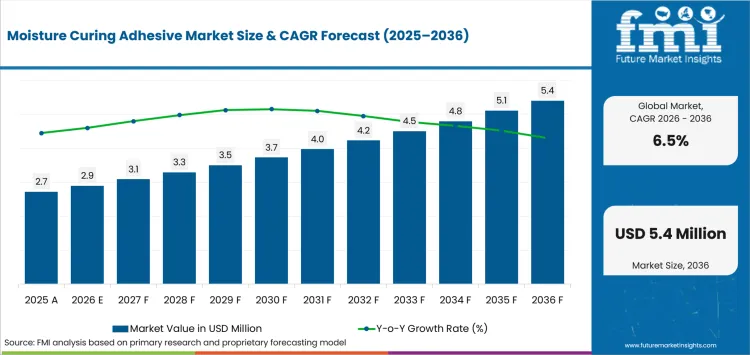
Key Takeaways of Moisture-Curing Adhesive Market
- Demand rises as moisture-curing systems remove assembly or mixing steps without sacrificing durable adhesion across construction and industrial applications.
- Based on chemistry, PU moisture curing adhesives are projected to account for 36.0% in 2026 due to their fit across elastic field bonds and reactive industrial formats.
- In 2026, one-component products are expected to lead form with 48.0% share because ready-to-apply formats remove onsite proportioning and mixing.
- By substrate, metals are forecast to represent 24.0% in 2026 driven by repeated use in transportation assemblies and movement-tolerant building joints.
- Qualification slows when humidity or surface condition changes cure behavior enough to disrupt handling time and final adhesion during routine use.
- Henkel, Sika, H.B. Fuller, Bostik, Wacker Chemie, Tremco CPG, Mapei and Dow are some notable players across formulated adhesives and technology platforms.
Analyst Perspective
"Moisture-curing adhesive selection starts with the humidity and joint depth that govern cure during production or field use. Strong commercial offers pair reliable early handling with documented surface preparation and local technical support that shortens qualification without weakening bond durability."
- Nikhil Kaitwade, Principal Consultant, Future Market Insights
How is the Moisture-Curing Adhesive Market segmented?
The moisture curing adhesive market is segmented by chemistry, form, substrate, end use, sales channel and region.
Chemistry covers PU moisture curing adhesives, silane-modified polymers, cyanoacrylates, MS polymer adhesives and hybrid sealant-adhesives. Form includes one-component, two-component, hot melt moisture cure and cartridge or sausage packs. Substrates include metals, plastics, wood, glass/ceramics and concrete or masonry. End uses are construction, automotive, packaging, woodworking and electronics. Sales channels are direct industrial supply, distribution, retail or trade packs and OEM programs.
Why do PU moisture curing adhesives lead the chemistry category?
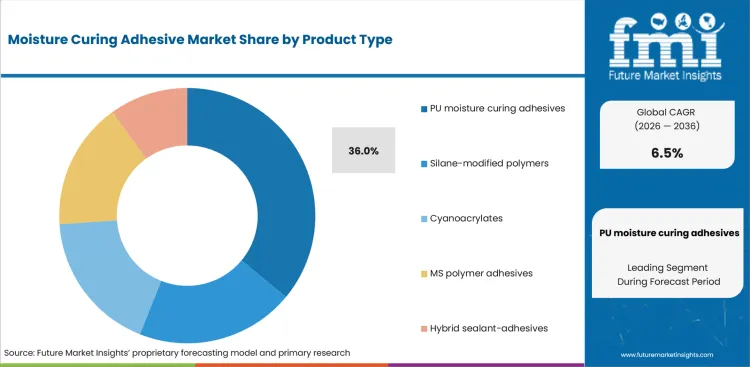
PU moisture curing adhesives combine one-part handling with a polyurethane cure path that fits field installation and factory assembly. Mapei highlighted Ultrabond Eco P16 at Klimahouse in January 2026 as a one-component moisture-curing polyurethane adhesive for dry radiant panel systems, giving polyurethane adhesives a direct construction route.
- Based on chemistry, PU moisture curing adhesives are projected to account for 36.0% in 2026 due to use across elastic field bonds and reactive industrial formats.
- Woodworking plants using wood adhesives qualify bond-line thickness and surface condition during repeat-order qualification. Line engineers separately verify open time and green strength against production speed.
Why does one-component lead the form category?
One-component products eliminate ratio control at application and reduce operator steps during cartridge use or automated dispensing, although cure depth remains tied to moisture reaching the bond line.
- In 2026, one-component products are expected to lead form with 48.0% share because ready-to-apply formats reduce metering errors in MS polymer dispensing.
- Mapei launched Ultrabond PB System H in November 2025 with a one-component hybrid adhesive for structural bonding of ventilated façades. The format reduces metering work at installation, although contractors need cure and surface-preparation data for repeat specification across façade panels exposed to changing site temperatures.
Why do metals lead the substrate category?
Metal joints expose surface-preparation risk because coatings and contamination can weaken adhesion during final cure. Henkel launched Loctite MS 9650 in December 2025 as a moisture-curing silane-modified adhesive that bonds metal alongside glass and plastics. That substrate range matters in vehicle assemblies joining dissimilar materials within one joint.
- The substrate category is forecast to be led by metals at 24.0% share in 2026 due to repeated use in rigid assemblies that need movement tolerance.
- Transportation engineers document the exact alloy and coating during automotive adhesives qualification, as surface preparation and rework risk determine whether laboratory strength converts into repeat production programs.
Why does construction lead the end use category?
Construction work combines porous and nonporous surfaces with field humidity that changes across sites and seasons during installation. Professional crews therefore value ready-to-use formats that tolerate practical site variation without adding onsite mixing steps.
- Construction is projected to hold 31.0% share in 2026 owing to ready-to-use elastic bonds used across flooring and panels plus windows and general assembly.
- The USA Census Bureau reported 1.427 million housing starts at an annual rate in June 2026, sustaining construction sealants and moisture-curing adhesives in active specification cycles. Contractors repeat orders once primer choice and cure time match the substrate, so local stock and field guidance influence installation reliability.
What are the drivers, restraints and opportunities in the Moisture Curing Adhesive Market?
One-part multi-substrate bonding reduces assembly steps while variable cure conditions slow qualification and hybrid chemistries broaden formulation choices for construction and industrial applications.
- Driver: Industrial assemblers and construction crews adopt moisture-curing bonds as one-part application removes fastening or mixing steps without compromising cycle time or durability.
- Restraint: New-build project cycles and cure sensitivity can delay conversion despite laboratory bond performance meeting the intended application requirements.
- Opportunity: Hybrid and silane-modified systems give formulators a lower-isocyanate route while preserving one-component handling across construction and industrial assembly.
Factory Lines Reward Process Fit
Production engineers choose moisture-curing adhesives as one-part handling removes a fastening or mixing step without increasing rework. The USA Census Bureau reported USD 656.5 billion in new manufactured-goods orders for June 2026, giving electronics adhesives a large factory workload in which assembly materials compete for qualification. Adhesive orders follow once green strength and dispensing behavior meet line-speed targets under the plant’s actual humidity window.
New-Build Cycles Limit Field Conversion
Cure sensitivity requires climate-specific substrate data plus local technical support for renovation or industrial applications to offset uneven new-build demand without extending qualification timelines. Japan’s MLIT reported in April 2026 that fiscal 2025 housing starts declined across owner-occupied and rental categories nationwide. For-sale housing also fell from the prior year, reducing specification points for moisture-curing construction adhesives across new projects.
Hybrid Supply Expands Formulation Choices
Hybrid systems give formulators a one-component route for elastic bonding in construction joints without conventional polyurethane chemistry. Commercial conversion requires open-time and cure data matched to the intended equipment, particularly for accounts already using silicone adhesives at required cycle times. Wacker Chemie began hybrid-polymer production at Nünchritz in May 2025 for binders used in construction and assembly adhesives, giving formulators another route beside reactive hot melt systems.
Which country CAGRs are profiled in the Moisture Curing Adhesive Market?
| Country | CAGR |
|---|---|
| Mexico | 6.3% |
| USA | 5.9% |
| France | 5.5% |
| Germany | 5.4% |
| Japan | 5.0% |
How do country-level CAGRs compare in the Moisture Curing Adhesive Market?
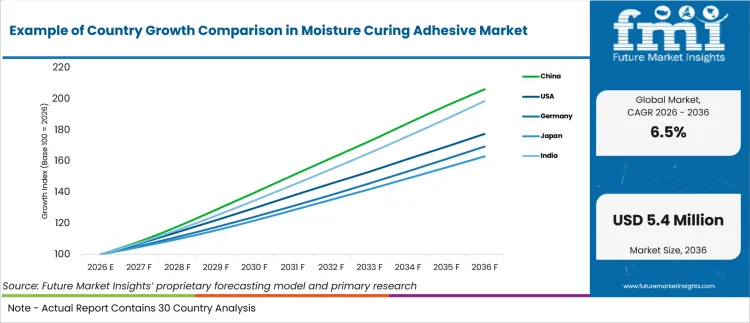
The 1.3-percentage-point spread forms a narrow growth band across five profiled countries. Mexico and the USA convert demand via vehicle programs or contractor channels. France and Germany depend on renovation and documented work practices. Japan combines mature construction with demanding industrial qualification, so service matters more than CAGR gaps alone.
- Mexico converts vehicle-assembly demand via OEM approval and North American supply continuity.
- USA orders depend on distributor reach across industrial accounts and weather-exposed contractor work.
- France relies on renovation channels as housing authorization remains below its five-year norm.
- Germany rewards documented work instructions and installer compliance across specification-led construction accounts.
- Japan favors repeatable industrial processes and selective renovation over broad new-build volume.
Comparable CAGRs produce different service costs and qualification timelines within this narrow forecast spread. The full report provides country-level CAGR analysis across North America, Latin America, Europe, East Asia, South Asia, Oceania and the Middle East and Africa.
Country-wise Analysis
- Mexico’s export-oriented light-vehicle plants concentrate adhesive qualification inside OEM programs, and INEGI reported 342,926 vehicles produced plus 306,288 exported in May 2026 across the national manufacturing base for regional vehicle assembly programs. Moisture curing adhesive sales in Mexico are forecast to expand at 6.3% CAGR by 2036, supported by assembly programs requiring regional inventory plus metal-to-plastic bonding data and fast application support during local line trials. Platform approval cycles can delay switching during vehicle launches, rewarding formulators that combine local application engineers with stable supply and documented substrate performance across tightly scheduled North American production programs and new platform launches.
- USA demand spans controlled industrial lines and a contractor channel that needs local stock plus products able to tolerate wider temperature and humidity variation across field installation conditions and seasonal project schedules. The USA Census Bureau reported 628,000 new single-family home sales at an annual rate in June 2026 with 9.3 months of supply, sustaining project turnover that keeps professional distributors active across housing-related applications. The USA moisture curing adhesive sector is projected to record 5.9% CAGR during the assessment period, but weather variation and requalification costs favor companies providing trials, contractor training and dependable replenishment across construction corridors.
- French distributors serve a renovation-heavy construction mix where pack availability and low-emission specifications matter more than broad new-build volume across professional channels serving existing buildings with varied substrate histories and repair needs. Adoption of moisture curing adhesives in France is estimated to expand at 5.5% CAGR through 2036, aided by professional distribution that reaches flooring and façade refurbishment programs through established local contractor and installer networks. SDES reported 376,241 dwellings authorized from July 2025 through June 2026 at 8.0% below the five-year average, so project timing rewards cost-disciplined products with documented surface compatibility and technical support during refurbishment qualification.
- German professional users demand documented work instructions and chemical compliance in specification-led accounts, and Destatis reported 21,800 dwellings permitted in March 2026 across new and existing buildings in active regional professional construction programs. Strong technical competence and established professional distribution give adhesive manufacturers a clear qualification route across construction and industrial work that depends on repeatable cure data and formal approval before routine product substitution begins. Germany is estimated to post 5.4% CAGR over the forecast period, but strict documentation and installer requirements favor lower-friction formulations backed by clear EHS guidance and local application support across regulated professional accounts.
- Japanese industrial assemblers place high weight on repeatable cure windows and documented surface preparation, as mature housing activity shifts construction work toward selective replacement and higher-specification projects across domestic renovation and retrofit programs. Japan’s moisture curing adhesive outlook is anticipated to advance at 5.0% CAGR over the assessment period, aided by process discipline that helps manufacturers validate cure consistency for repeat production programs across qualified industrial accounts. MLIT reported 165,271 long-life housing certifications for fiscal 2025 equal to 23.2% of new housing starts, but documentation makes entry selective for companies without application-specific evidence and technical service plus reliable supply.
Who are the notable companies in the Moisture Curing Adhesive Market?
Henkel, Sika, H.B. Fuller, Bostik, Wacker Chemie, Tremco CPG, Mapei and Dow are the notable companies profiled in this market.
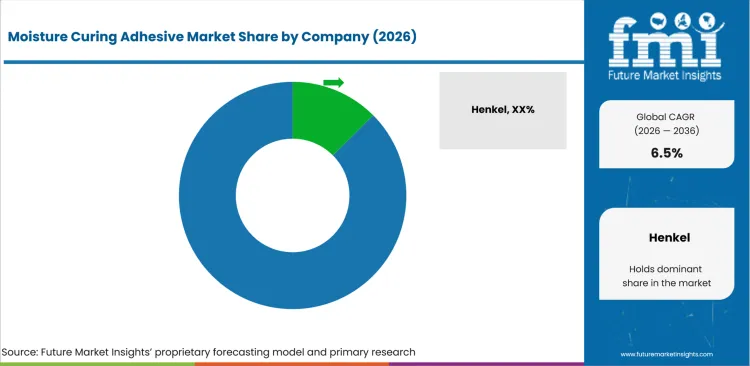
Competition is fragmented across factory-qualified assembly and professional construction channels that require different cure data and service models. OEM entry requires repeated line trials and controlled dispensing data for a formulation to gain routine production status. Contractor channels put more weight on local stock and field application support across changing substrate and weather conditions. Formulation breadth matters for companies documenting cure behavior across the substrates and humidity ranges used by target accounts.
- Industrial qualification platforms: Henkel, Sika and H.B. Fuller serve factory or construction bonding programs that require technical trials and documented application support.
- Professional construction routes: Bostik, Tremco CPG and Mapei compete on contractor access, application guidance and established distribution across building-envelope work.
- Silane and silicone technology platforms: Wacker Chemie and Dow influence moisture-reactive formulation choices, although raw binder sales remain outside the finished-adhesive revenue boundary.
Competitive Benchmarking: Moisture Curing Adhesive Market
| Company | Moisture-cure formulation breadth | High-speed / OEM application capability | Hybrid / low-isocyanate pathway | Geographic Reach |
|---|---|---|---|---|
| Henkel | Low | Medium | Medium | North America and Europe industrial markets |
| Sika | High | High | High | Global construction and transportation markets |
| H.B. Fuller | Low | Medium | Medium | North America and IMEA industrial markets |
| Bostik | High | Medium | High | North America and international distribution |
| Wacker Chemie | High | Low | High | Global technical and sales network |
| Tremco CPG | Medium | Medium | High | North America with international building-envelope access |
| Mapei | Medium | Low | Medium | Europe and international construction markets |
| Dow | Medium | High | Medium | Global materials network |
Key Developments in the Moisture Curing Adhesive Market
- In February 2026, Sika agreed to acquire Turkey-based Akkim to add adhesive and sealant production capacity plus wider distribution, with closing expected in the third quarter subject to regulatory approvals.
- In November 2025, Bostik placed professional sealants and adhesives on Amazon in the USA, adding a digital retail route for contractor purchases.
- In October 2025, Bostik introduced OB1 multi-surface construction sealant and adhesive in the USA for metals and wood alongside glass, plastics and ceramics.
Key Players in the Moisture Curing Adhesive Market
Multi-Industry Formulated Adhesive Platforms
- Henkel
- Sika
- H.B. Fuller
- Bostik
Construction and Building-Envelope Specialists
- Tremco CPG
- Mapei
Silane and Silicone Technology Platforms
- Wacker Chemie
- Dow
Moisture Curing Adhesive Market - Report Scope
| Coverage field | Report scope |
|---|---|
| Market breakdown | By chemistry, form, substrate, end use, sales channel and region. |
| Quantitative Units | Revenue in USD million and CAGR in %. |
| Market Definition | Commercial formulated adhesives and adhesive-sealants whose final cure or strength development depends principally on atmospheric or substrate moisture. Raw binders, application equipment and sealant-only revenue remain outside the finished-adhesive boundary. |
| Regions Covered | North America, Latin America, Europe, East Asia, South Asia and Pacific and Middle East and Africa. |
| Countries Covered | Mexico, USA, France, Germany, Japan, and 20+ countries included in the full report. |
| Key Companies Profiled | Henkel, Sika, H.B. Fuller, Bostik, Wacker Chemie, Tremco CPG, Mapei, Dow. |
| Forecast Period | 2026 to 2036. |
| Approach | Primary and secondary research with market triangulation. |
Moisture Curing Adhesive Market - Research Methodology
| Method | Approach |
|---|---|
| Primary Research | FMI analysts gathered input from manufacturers, service providers, technology developers, distributors, end users, procurement teams, and subject-matter experts. Interviews examined purchasing decisions, product or service evaluation, adoption barriers, approval requirements, pricing considerations, and expectations for technical or commercial support. Respondents were also asked what evidence is required before a trial, pilot, or initial order develops into regular purchasing. |
| Desk Research | Desk research covered government statistics, regulatory publications, trade data, industry associations, technical literature, standards, company filings, product information, and official corporate announcements. Sources were reviewed for relevance, publication date, geographic coverage, and consistency with the defined market scope. Claims relating to performance, applications, approvals, capacity, investment, and commercial activity were retained only when supported by credible public evidence. |
| Market Sizing and Forecasting | The market model combined the baseline value with historical performance, segment structure, pricing and volume indicators, adoption levels, company participation, and country-level demand conditions. Forecast assumptions considered economic activity, investment trends, regulatory developments, technology adoption, purchasing cycles, supply availability, and barriers to wider market use. Segment and regional estimates were reconciled before the final market total was calculated. |
| Data Validation | Estimates were checked against multiple independent indicators, including public data, company activity, trade patterns, industry developments, and findings from primary interviews. Validation also tested whether products, services, applications, and company revenues fell within the defined market boundaries. Adjacent categories, unsupported claims, overlapping revenues, and activities without direct market relevance were excluded to reduce double counting and maintain consistency across segments and countries. |
Moisture Curing Adhesive Market by Segments
Moisture Curing Adhesive Market segmented by Chemistry:
- PU moisture curing adhesives
- Silane-modified polymers
- Cyanoacrylates
- MS polymer adhesives
- Hybrid sealant-adhesives
Moisture Curing Adhesive Market segmented by Form:
- One-component
- Two-component
- Hot melt moisture cure
- Cartridge / sausage packs
Moisture Curing Adhesive Market segmented by Substrate:
- Metals
- Plastics
- Wood
- Glass / ceramics
- Concrete / masonry
Moisture Curing Adhesive Market segmented by End Use:
- Construction
- Automotive
- Packaging
- Woodworking
- Electronics
Moisture Curing Adhesive Market segmented by Sales Channel:
- Direct industrial supply
- Distribution
- Retail / trade packs
- OEM programs
Moisture Curing Adhesive Market by Region:
- North America
- United States
- Canada
- Latin America
- Brazil
- Mexico
- Chile
- Rest of Latin America
- Western Europe
- Germany
- United Kingdom
- Italy
- Spain
- France
- Nordics
- Benelux
- Rest of Western Europe
- Eastern Europe
- Russia
- Poland
- Hungary
- Balkan and Baltic States
- Rest of Eastern Europe
- East Asia
- China
- Japan
- South Korea
- South Asia and Pacific
- India
- ASEAN
- Australia and New Zealand
- Rest of South Asia and Pacific
- Middle East and Africa
- Kingdom of Saudi Arabia
- Other GCC Countries
- Türkiye
- South Africa
- Other African Union Countries
- Rest of Middle East and Africa
Research Sources and Bibliography
- Henkel North America. (2026, June 4). Committed to Conservation: Henkel North America Production Sites Make Strides in Sustainability.
- USA Census Bureau. (2026, August 3). Monthly Construction Spending, June 2026.
- Mapei. (2026, January 21). Mapei at Klimahouse 2026.
- Mapei. (2025, November 19). Mapei at MADE Expo 2025.
- Henkel. (2025, December 12). Henkel launches Loctite MS 9650 for durable, lightweight structural bonding for automotive display.
- USA Census Bureau. (2026, July 17). MONTHLY NEW RESIDENTIAL CONSTRUCTION, JUNE 2026.
- USA Census Bureau. (2026, August 4). Monthly Full Report on Manufacturers’ Shipments, Inventories, & Orders.
- Ministry of Land, Infrastructure, Transport and Tourism, Japan. (2026, April 30).
- Wacker Chemie AG. (2025, May 14). WACKER starts production of hybrid polymers at its Nünchritz site.
- Instituto Nacional de Estadística y Geografía. (2026, June 8). Registro administrativo de la industria automotriz de vehículos ligeros. Mayo de 2026.
- USA Census Bureau. (2026, July 24). MONTHLY NEW RESIDENTIAL SALES, JUNE 2026.
- Service des données et études statistiques. (2026, July 28). Construction de logements : résultats à fin juin 2026 (France entière).
- Federal Statistical Office (Destatis). (2026, May 18). Baugenehmigungen für Wohnungen im März 2026: +11,5 % zum Vorjahresmonat.
- Ministry of Land, Infrastructure, Transport and Tourism, Japan. (2026, July 17).
- Sika. (2026, February 20). Sika reports full-year 2025 results - Executing plan to accelerate growth.
- H.B. Fuller. (2025, February 9). Reactive Hot Melt Adhesives: A Game-Changer in Bonding Technology.
- H.B. Fuller. (2025, May 16). H.B. Fuller Expands Manufacturing Capabilities in IMEA Region.
- RPM International Inc. (2026, April 1). RPM Completes Acquisition of Kalzip.
- Dow Inc. (2026, February 3). 2025 Annual Report.
- Sika. (2026, February 13). Sika to acquire Akkim: Marking a major step in accelerating global expansion in adhesives and sealants.
- Bostik. (2025, November 11). Bostik Launches Professional-Grade Sealants & Adhesives on Amazon.
- Bostik. (2025, October 28). OB1® Multi-Surface Construction Sealant and Adhesive Now Available in the USA - A Universal Product That Does It All.
This bibliography is provided for reader reference and is not exhaustive. The full report contains the complete reference list and detailed citations
This Report Answers
- How large is the moisture curing adhesive market in 2026 and by 2036?
- Which operating conditions convert construction and industrial activity into repeat adhesive orders?
- Why do PU moisture curing adhesives lead chemistry while one-component products lead form?
- How do metal substrates and construction end use change qualification requirements for adhesive companies?
- Which demand driver, restraint and opportunity most affect adoption between 2026 and 2036?
- How do forecast CAGRs and operating conditions differ across Mexico, USA, France, Germany and Japan?
- Which companies have the broadest documented formulation, OEM or hybrid capabilities in this market?
- What should purchasing and process teams test before switching a qualified moisture curing adhesive?
Frequently Asked Questions
How big is the Moisture Curing Adhesive Market in 2026?
The Moisture Curing Adhesive Market is valued at USD 2.9 billion in 2026 and is projected to reach USD 5.4 billion by 2036. Construction and industrial users value one-part bonding that simplifies application while preserving durable performance.
What is the CAGR of the Moisture Curing Adhesive Market from 2026 to 2036?
The Moisture Curing Adhesive Market is projected to expand at a 6.5% CAGR between 2026 and 2036. Growth depends on predictable cure behavior across construction and manufacturing applications with different substrates and humidity conditions.
Which chemistry leads the Moisture Curing Adhesive Market?
PU moisture curing adhesives are projected to account for 36.0% of the Moisture Curing Adhesive Market in 2026. Their leading share reflects elastic bonding performance across field and industrial applications under controlled processing conditions.
How much value will the Moisture Curing Adhesive Market add between 2026 and 2036?
The Moisture Curing Adhesive Market is projected to add USD 2,509.1 million between 2026 and 2036. Simplified application and multi-substrate bonding convert into repeat orders following site or production-line qualification.
Which companies are active in the Moisture Curing Adhesive Market?
Active companies include Henkel, Sika and H.B. Fuller. Bostik, Wacker Chemie and Tremco CPG work alongside Mapei and Dow across construction and industrial adhesive applications.
Preview the report firsthand - request a free sample
Get SampleGet the brochure for pricing and purchase details.
Get PDFTable of Content
- Key Takeaways
- Market Size and CAGR
- Top Growth Driver
- Fastest Growing Segment
- Leading Region
- Key Companies
- Emerging Opportunities
- Executive Summary
- Global Market Outlook
- Demand-side Trends
- Supply-side Trends
- Technology Roadmap Analysis
- Analysis and Recommendations
- Analyst Perspective (What is happening? Why now? What should investors know?)
- Key Questions Answered
- How large is the market?
- What is the CAGR?
- What are key trends?
- Which region dominates?
- Who are the leaders?
- Market Overview
- Market Coverage / Taxonomy
- Market Definition / Scope / Limitations
- Research Methodology
- Chapter Orientation
- Analytical Lens and Working Hypotheses
- Market Structure, Signals, and Trend Drivers
- Benchmarking and Cross-market Comparability
- Market Sizing, Forecasting, and Opportunity Mapping
- Research Design and Evidence Framework
- Desk Research Programme (Secondary Evidence)
- Expert Input and Fieldwork (Primary Evidence)
- Tooling, Models, and Reference Databases
- Data Engineering and Model Build
- Quality Assurance and Audit Trail
- Market Background
- Market Dynamics (Drivers, Restraints, Opportunity, Trends)
- Scenario Forecast (Optimistic, Likely, Conservative)
- Impact Analysis
- AI Impact
- Sustainability Impact
- Regulatory Impact
- Technology Impact
- Consumer / Buyer Analysis
- Purchase Drivers
- Adoption Barriers
- Buyer Journey
- Opportunity Map Analysis
- Product Life Cycle Analysis
- Supply Chain Analysis
- Investment Feasibility Matrix
- Value Chain Analysis
- PESTLE and Porter's Analysis
- Regulatory Landscape
- Regional Parent Market Outlook
- Production and Consumption Statistics
- Import and Export Statistics
- Global Market Analysis and Forecast, 2021 to 2036
- Historical Market Size Value (USD Million) Analysis, 2021 to 2025
- Current and Future Market Size Value (USD Million) Projections, 2026 to 2036
- Y-o-Y Growth Trend Analysis
- Absolute $ Opportunity Analysis
- Global Market Pricing Analysis, 2021 to 2036
- Global Market Analysis and Forecast, By Product Type, 2021 to 2036
- Introduction / Key Findings
- Historical Market Size Value (USD Million) Analysis By Product Type, 2021 to 2025
- Current and Future Market Size Value (USD Million) Analysis and Forecast By Product Type, 2026 to 2036
- PU moisture curing adhesives
- Silane-modified polymers
- Cyanoacrylates
- MS polymer adhesives
- Hybrid sealant-adhesives
- PU moisture curing adhesives
- Y-o-Y Growth Trend Analysis By Product Type, 2021 to 2025
- Absolute $ Opportunity Analysis By Product Type, 2026 to 2036
- Global Market Analysis and Forecast, By Formulation, 2021 to 2036
- Introduction / Key Findings
- Historical Market Size Value (USD Million) Analysis By Formulation, 2021 to 2025
- Current and Future Market Size Value (USD Million) Analysis and Forecast By Formulation, 2026 to 2036
- One-component
- Two-component
- Hot melt moisture cure
- Cartridge or sausage packs
- One-component
- Y-o-Y Growth Trend Analysis By Formulation, 2021 to 2025
- Absolute $ Opportunity Analysis By Formulation, 2026 to 2036
- Global Market Analysis and Forecast, By Substrate, 2021 to 2036
- Introduction / Key Findings
- Historical Market Size Value (USD Million) Analysis By Substrate, 2021 to 2025
- Current and Future Market Size Value (USD Million) Analysis and Forecast By Substrate, 2026 to 2036
- Metals
- Plastics
- Wood
- Glass or ceramics
- Concrete or masonry
- Metals
- Y-o-Y Growth Trend Analysis By Substrate, 2021 to 2025
- Absolute $ Opportunity Analysis By Substrate, 2026 to 2036
- Global Market Analysis and Forecast, By End Use, 2021 to 2036
- Introduction / Key Findings
- Historical Market Size Value (USD Million) Analysis By End Use, 2021 to 2025
- Current and Future Market Size Value (USD Million) Analysis and Forecast By End Use, 2026 to 2036
- Construction
- Automotive
- Packaging
- Woodworking
- Electronics
- Construction
- Y-o-Y Growth Trend Analysis By End Use, 2021 to 2025
- Absolute $ Opportunity Analysis By End Use, 2026 to 2036
- Global Market Analysis and Forecast, By Sales Channel, 2021 to 2036
- Introduction / Key Findings
- Historical Market Size Value (USD Million) Analysis By Sales Channel, 2021 to 2025
- Current and Future Market Size Value (USD Million) Analysis and Forecast By Sales Channel, 2026 to 2036
- Direct industrial supply
- Distribution
- Retail or trade packs
- OEM programs
- Direct industrial supply
- Y-o-Y Growth Trend Analysis By Sales Channel, 2021 to 2025
- Absolute $ Opportunity Analysis By Sales Channel, 2026 to 2036
- Global Market Analysis and Forecast, By Region, 2021 to 2036
- Introduction
- Historical Market Size Value (USD Million) Analysis By Region, 2021 to 2025
- Current Market Size Value (USD Million) Analysis and Forecast By Region, 2026 to 2036
- North America
- Latin America
- Western Europe
- Eastern Europe
- East Asia
- South Asia and Pacific
- Middle East & Africa
- Market Attractiveness Analysis By Region
- North America Market Analysis and Forecast, By Country, 2021 to 2036
- Historical Market Size Value (USD Million) Trend Analysis By Market Taxonomy, 2021 to 2025
- Market Size Value (USD Million) Forecast By Market Taxonomy, 2026 to 2036
- By Country
- USA
- Canada
- By Product Type
- By Formulation
- By Substrate
- By End Use
- By Sales Channel
- By Country
- Market Attractiveness Analysis
- By Country
- By Product Type
- By Formulation
- By Substrate
- By End Use
- By Sales Channel
- Key Takeaways
- Latin America Market Analysis and Forecast, By Country
- Historical Market Size Value (USD Million) Trend Analysis By Market Taxonomy, 2021 to 2025
- Market Size Value (USD Million) Forecast By Market Taxonomy, 2026 to 2036
- By Country
- Brazil
- Mexico
- Chile
- Rest of Latin America
- By Product Type
- By Formulation
- By Substrate
- By End Use
- By Sales Channel
- By Country
- Market Attractiveness Analysis
- By Country
- By Product Type
- By Formulation
- By Substrate
- By End Use
- By Sales Channel
- Key Takeaways
- Western Europe Market Analysis and Forecast, By Country
- Historical Market Size Value (USD Million) Trend Analysis By Market Taxonomy, 2021 to 2025
- Market Size Value (USD Million) Forecast By Market Taxonomy, 2026 to 2036
- By Country
- Germany
- UK
- Italy
- Spain
- France
- Nordic
- BENELUX
- Rest of Western Europe
- By Product Type
- By Formulation
- By Substrate
- By End Use
- By Sales Channel
- By Country
- Market Attractiveness Analysis
- By Country
- By Product Type
- By Formulation
- By Substrate
- By End Use
- By Sales Channel
- Key Takeaways
- Eastern Europe Market Analysis and Forecast, By Country
- Historical Market Size Value (USD Million) Trend Analysis By Market Taxonomy, 2021 to 2025
- Market Size Value (USD Million) Forecast By Market Taxonomy, 2026 to 2036
- By Country
- Russia
- Poland
- Hungary
- Balkan & Baltic
- Rest of Eastern Europe
- By Product Type
- By Formulation
- By Substrate
- By End Use
- By Sales Channel
- By Country
- Market Attractiveness Analysis
- By Country
- By Product Type
- By Formulation
- By Substrate
- By End Use
- By Sales Channel
- Key Takeaways
- East Asia Market Analysis and Forecast, By Country
- Historical Market Size Value (USD Million) Trend Analysis By Market Taxonomy, 2021 to 2025
- Market Size Value (USD Million) Forecast By Market Taxonomy, 2026 to 2036
- By Country
- China
- Japan
- South Korea
- By Product Type
- By Formulation
- By Substrate
- By End Use
- By Sales Channel
- By Country
- Market Attractiveness Analysis
- By Country
- By Product Type
- By Formulation
- By Substrate
- By End Use
- By Sales Channel
- Key Takeaways
- South Asia and Pacific Market Analysis and Forecast, By Country
- Historical Market Size Value (USD Million) Trend Analysis By Market Taxonomy, 2021 to 2025
- Market Size Value (USD Million) Forecast By Market Taxonomy, 2026 to 2036
- By Country
- India
- ASEAN
- Australia & New Zealand
- Rest of South Asia and Pacific
- By Product Type
- By Formulation
- By Substrate
- By End Use
- By Sales Channel
- By Country
- Market Attractiveness Analysis
- By Country
- By Product Type
- By Formulation
- By Substrate
- By End Use
- By Sales Channel
- Key Takeaways
- Middle East & Africa Market Analysis and Forecast, By Country
- Historical Market Size Value (USD Million) Trend Analysis By Market Taxonomy, 2021 to 2025
- Market Size Value (USD Million) Forecast By Market Taxonomy, 2026 to 2036
- By Country
- Kingdom of Saudi Arabia
- Other GCC Countries
- Türkiye
- South Africa
- Other African Union
- Rest of Middle East & Africa
- By Product Type
- By Formulation
- By Substrate
- By End Use
- By Sales Channel
- By Country
- Market Attractiveness Analysis
- By Country
- By Product Type
- By Formulation
- By Substrate
- By End Use
- By Sales Channel
- Key Takeaways
- Key Countries Market Analysis
- USA
- Pricing Analysis
- Market Share Analysis, 2025
- By Product Type
- By Formulation
- By Substrate
- By End Use
- By Sales Channel
- Canada
- Pricing Analysis
- Market Share Analysis, 2025
- By Product Type
- By Formulation
- By Substrate
- By End Use
- By Sales Channel
- Mexico
- Pricing Analysis
- Market Share Analysis, 2025
- By Product Type
- By Formulation
- By Substrate
- By End Use
- By Sales Channel
- Brazil
- Pricing Analysis
- Market Share Analysis, 2025
- By Product Type
- By Formulation
- By Substrate
- By End Use
- By Sales Channel
- Chile
- Pricing Analysis
- Market Share Analysis, 2025
- By Product Type
- By Formulation
- By Substrate
- By End Use
- By Sales Channel
- Germany
- Pricing Analysis
- Market Share Analysis, 2025
- By Product Type
- By Formulation
- By Substrate
- By End Use
- By Sales Channel
- UK
- Pricing Analysis
- Market Share Analysis, 2025
- By Product Type
- By Formulation
- By Substrate
- By End Use
- By Sales Channel
- Italy
- Pricing Analysis
- Market Share Analysis, 2025
- By Product Type
- By Formulation
- By Substrate
- By End Use
- By Sales Channel
- Spain
- Pricing Analysis
- Market Share Analysis, 2025
- By Product Type
- By Formulation
- By Substrate
- By End Use
- By Sales Channel
- France
- Pricing Analysis
- Market Share Analysis, 2025
- By Product Type
- By Formulation
- By Substrate
- By End Use
- By Sales Channel
- India
- Pricing Analysis
- Market Share Analysis, 2025
- By Product Type
- By Formulation
- By Substrate
- By End Use
- By Sales Channel
- ASEAN
- Pricing Analysis
- Market Share Analysis, 2025
- By Product Type
- By Formulation
- By Substrate
- By End Use
- By Sales Channel
- Australia & New Zealand
- Pricing Analysis
- Market Share Analysis, 2025
- By Product Type
- By Formulation
- By Substrate
- By End Use
- By Sales Channel
- China
- Pricing Analysis
- Market Share Analysis, 2025
- By Product Type
- By Formulation
- By Substrate
- By End Use
- By Sales Channel
- Japan
- Pricing Analysis
- Market Share Analysis, 2025
- By Product Type
- By Formulation
- By Substrate
- By End Use
- By Sales Channel
- South Korea
- Pricing Analysis
- Market Share Analysis, 2025
- By Product Type
- By Formulation
- By Substrate
- By End Use
- By Sales Channel
- Russia
- Pricing Analysis
- Market Share Analysis, 2025
- By Product Type
- By Formulation
- By Substrate
- By End Use
- By Sales Channel
- Poland
- Pricing Analysis
- Market Share Analysis, 2025
- By Product Type
- By Formulation
- By Substrate
- By End Use
- By Sales Channel
- Hungary
- Pricing Analysis
- Market Share Analysis, 2025
- By Product Type
- By Formulation
- By Substrate
- By End Use
- By Sales Channel
- Kingdom of Saudi Arabia
- Pricing Analysis
- Market Share Analysis, 2025
- By Product Type
- By Formulation
- By Substrate
- By End Use
- By Sales Channel
- Türkiye
- Pricing Analysis
- Market Share Analysis, 2025
- By Product Type
- By Formulation
- By Substrate
- By End Use
- By Sales Channel
- South Africa
- Pricing Analysis
- Market Share Analysis, 2025
- By Product Type
- By Formulation
- By Substrate
- By End Use
- By Sales Channel
- USA
- Market Structure Analysis
- Competition Dashboard
- Competition Benchmarking
- Market Share Analysis of Top Players
- By Regional
- By Product Type
- By Formulation
- By Substrate
- By End Use
- By Sales Channel
- Emerging Startups
- Innovation Benchmarking
- Competition Analysis
- Competition Deep Dive
- Henkel
- Overview
- Product Portfolio
- Profitability by Market Segments
- Sales Footprint
- Strategy Overview
- Marketing Strategy
- Product Strategy
- Channel Strategy
- Sika
- H.B. Fuller
- Bostik
- 3M
- Dow
- Wacker Chemie
- Tremco CPG
- Mapei
- Franklin International
- Henkel
- Case Studies
- Success Stories
- Recent Developments
- Competition Deep Dive
- Assumptions & Acronyms Used


