

- Market Size (2026)
- USD 221.8 Mn
- Forecast (2036)
- USD 613.1 Mn
- CAGR (2026 to 2036)
- 10.7%
How big is Molasses Fermentation Inputs Market in 2026?
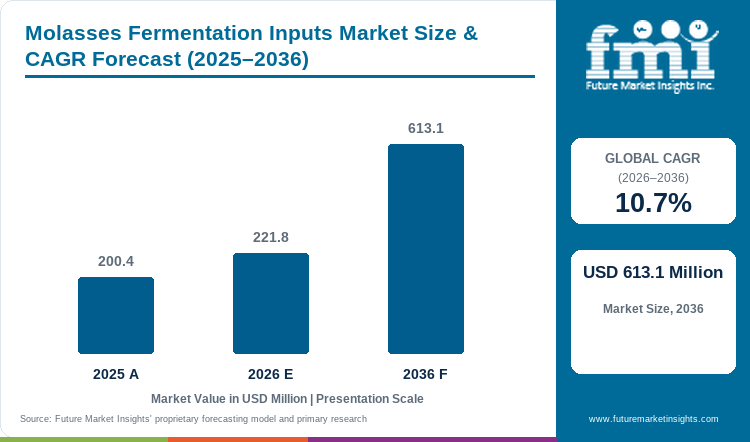
USD 221.8 million in 2026 and USD 613.1 million by 2036, expanding at 10.7% CAGR.
Sales of molasses fermentation inputs are estimated to rise at 10.7% CAGR through 2036, increasing valuation from USD 200.4 million in 2025 to USD 221.8 million in 2026, and reaching USD 613.1 million by 2036. Molasses gives fermenters a rich carbon source from sugar processing. It can cut feedstock cost while microbes grow. A February 2024 Frontiers in Agronomy review covered molasses use in biofertilizers and soil care. Sales depend on steady output from each batch. Product makers need blends that stay stable in storage and field use. They also test dose, mixing and crop response. Those checks decide whether low feedstock cost can become repeat sales.
Germany is projected to grow at 9.7% CAGR through 2036 compared with 8.6% for Japan. Destatis estimated 6.03 million hectares of cereal area in Germany for the 2026 harvest. Winter wheat covered 2.9 million hectares. This large farm base supports wide treatment programs. Japanese buyers rely more on local crop trials before farms place repeat orders. Both markets still need clear farm data before wider sales.
Key Takeaways
- Demand is rising because product makers want low-cost feedstocks that still give steady batches and good field results.
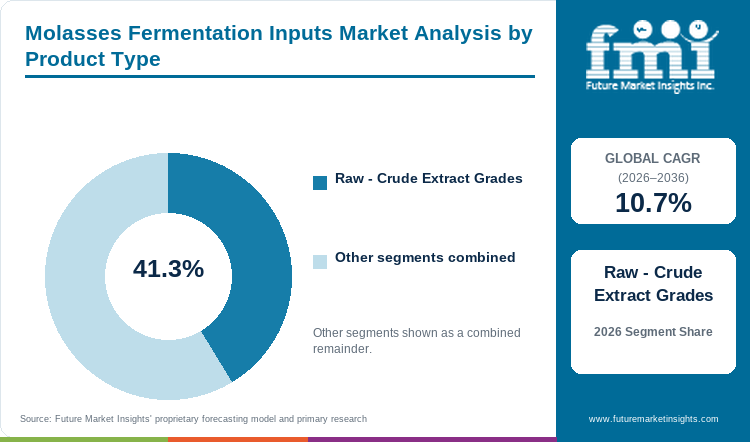
- By product type, raw - crude extract grades are estimated to hold 41.3% in 2026, supported by low processing cost and easy finishing.
- In 2026, cereals & grains are expected to lead crop type with 38.8% share, supported by large planted areas and repeat seasonal use.
- Soil application is projected to hold 42.3% of application method revenue in 2026, supported by use in common root-zone programs.
- Changes in feedstock and unclear claims can slow approval if firms lack clear data on contents, storage and use.
- Some of the key players in this market include BASF Agricultural Solutions, Rovensa Next, Novonesis, Pivot Bio, Syngenta, Corteva Agriscience, Seipasa, and Indigo Agriculture.
Analyst Perspective
"Low feedstock cost has value only if firms keep each batch steady and prove crop results. Buyers accept higher prices for standard products when clear checks lower field risk and protect repeat orders."
- Nandini Roy Choudhury, Principal Consultant, Future Market Insights
How is the molasses fermentation inputs market segmented?
The molasses fermentation inputs market is segmented by Product Type, Crop Type, Application Method, Farm Type, Sales Channel, and Region.
The molasses fermentation inputs market is segmented by product type, crop type, application method, farm type, sales channel and region. Product type covers raw - crude extract grades, refined & standardized fractions, formulated end-use blends and others. Crop type covers cereals & grains, fruits & vegetables, oilseeds & pulses, turf & ornamentals and others. Application method includes soil, foliar, fertigation - drip, seed and other routes. Farm type shows operating scale. Sales channel shows how products reach farms.
What makes raw - crude extract grades central to the product type category?
Raw grades keep more of the cost benefit from the basic process. Product makers can still change concentration and carriers for agricultural microbials. Molasses makeup can vary with the sugar process and source crop. Incoming-lot checks remain important. Standard fractions reduce this work but add cost before final blending.
- By product type, raw - crude extract grades are estimated to hold 41.3% in 2026, supported by low processing cost and easy finishing.
- In June 2026, the International Sugar Organization listed molasses as a feedstock used in fermentation and other bio-based output.
Why do cereals & grains lead the crop type category?
Large crop programs favor inputs that work with normal farm schedules and keep treatment cost clear. biostimulants and microbe-based products can serve large planted areas without adding many field steps. Fruit and vegetable programs can pay more per unit. They often need more crop-specific testing before wider use.
- In 2026, cereals & grains are expected to lead crop type with 38.8% share, influenced by large treatment areas and repeat seasonal use.
- USDA NASS estimated 95.3 million corn acres and 42.7 million wheat acres for 2026. Those broad-acre crops provide a large treatment base.
How does soil application shape the application method category?
Soil application places bio-based inputs near roots and common fertilizer work. Growers can use them with liquid amendments or fertigation microbe carriers if basic tests pass. Foliar and seed routes can target plants more closely. They need different checks for dose, coating and storage.
- Soil application is projected to hold 42.3% of application method revenue in 2026, supported by use in root-zone nutrient and microbe-based programs.
- In July 2026, Syngenta partnered with Groundwork BioAg to expand mycorrhizal tools for major field crops and root-zone use.
What supports large commercial farms within the farm type category?
Large farms spread testing cost over more treated acres. They already manage bulk crop inputs and specialty fertilizers. New bio-products can enter the same seasonal plan. Firms still need steady batches and clear mixing directions. Poor repeatability can affect a large acreage commitment.
- Large commercial farms are likely to capture 49.5% of farm type revenue in 2026, tied to repeat acreage and lower testing cost.
- In March 2026, Pivot Bio and Red Reef Partners announced a program to use microbe-based nitrogen tools on North American farmland.
Why do agri-input distributors lead the sales channel category?
Distributors turn product details into local crop advice and keep stock near farms. Local advice is useful for biofertilizers because dose, storage and claims affect how products are sold. Direct farm sales remove one channel step. They also shift more field help and stock work to the manufacturer.
- Agri-input distributors are set to lead the sales channel with 40.2% share in 2026, supported by local advice and nearby inventory.
- Acadian Plant Health expanded direct sales in California in September 2026. Closer field support can change how bio-products reach farms.
What are the drivers, restraints and opportunities in the Molasses Fermentation Inputs Market?
Biological nutrient-efficiency programs lift demand, fermentation scale-up governs qualification risk, and standardized registered formulations offer the clearest route to higher-value sales.
- Driver: Growers and product makers use bio-based tools to get more from fertilizer and cut standard input use.
- Restraint: Changes in feedstock and fermentation output can force more testing before a batch is approved for farm use.
- Opportunity: Standard fractions with clear legal status can pass dealer review faster and support repeat crop programs.
Farms are paying more attention to better fertilizer use as costs and farm rules shape crop plans. Molasses gives the process a low-cost carbon source for growing useful microbes and making key compounds. USDA Agricultural Research Service work through April 2026 tested biostimulants and microbe-based methods for better nutrient use. The work supports bio-based crop nutrition but does not prove demand for one feedstock. Molasses-based inputs gain value when each batch works the same way in a clear crop program. Firms can move past feedstock pricing by pairing batch control with clear field data. Better field data can shorten review before seasonal purchases. Growers then have a clear way to compare cost with crop response.
Scale-up is the main test because lab success does not promise the same result in a large tank. Molasses can change between lots in sugar level, minerals and other compounds. In February 2026, Rovensa Next opened a pilot fermentation plant in Brazil to move microbe-based farm products toward full-scale output. Its 100-liter system gives teams a safe step before tanks above 3,000 liters. Farm product makers must keep live microbes and useful compounds stable as volume grows. Buyers check lot data, contamination tests and storage results before large seasonal orders. Low feedstock cost loses value if repeated fixes delay product release. A clear scale-up process protects both product control and delivery time.
Standard products can earn more because farm dealers can review a fixed product more easily than a changing process input. Firms still need clear data on contents and intended farm use. In April 2026, Seipasa gained a new European registration for Kynetic4 and widened the legal base for its biostimulant line. Clear product status can support repeat sales once development work is done. Refined fractions and ready-to-use blends follow the same logic when set specifications reduce buyer tests. The sales route can pair low-cost processing with stable products and simple use directions. Farm dealers can then train staff with one clear product record. Farms can repeat seasonal use with less product review.
Which country CAGRs are profiled in the Molasses Fermentation Inputs Market?
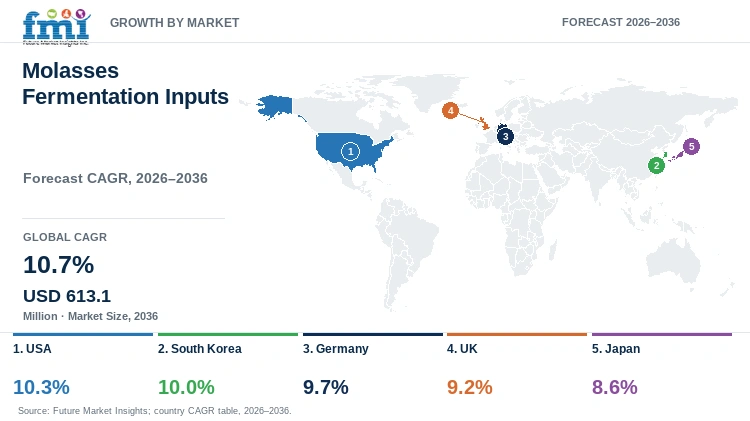
| Country | CAGR |
|---|---|
| USA | 10.3% |
| South Korea | 10.0% |
| Germany | 9.7% |
| UK | 9.2% |
| Japan | 8.6% |
How do country-level CAGRs compare in the Molasses Fermentation Inputs Market?
The USA at 10.3%, South Korea at 10.0% and Germany at 9.7% form a close upper group. The UK follows at 9.2% and Japan at 8.6%. The 1.7-point range affects investment timing. Local crop programs and approval rules still decide how fast forecast growth becomes repeat sales.
- US retailer and farm-advice networks give firms several ways to train staff before bio-products reach farm shelves.
- South Korea's greenhouse farms value clear dose guidance for bio-based inputs used with irrigation and covered-crop routines.
- German farm cooperatives can spread new products across cereal farms once handling and use directions are clear.
- UK arable farms favor products that work with current spray or seed-treatment plans without adding extra seasonal labor.
- Japanese farm dealers rely on crop trial results before new bio-products move from small tests to wider sales.
Similar CAGRs can still lead to different entry conditions because sales channels and approval costs differ by country. The full report provides country-level CAGR analysis across North America, Latin America, Western Europe, Eastern Europe, East Asia, South Asia and Pacific, and the Middle East and Africa.
Country-wise Analysis
- US firms must define product claims early because labels can trigger FIFRA plant-regulator rules. The USA is projected to record 10.3% CAGR through 2036, supported by a large crop base and clear claims review. EPA updated its plant-regulator and biostimulant draft guidance in November 2025. The guidance explains how some claims can change a product's legal status. Seed treatment materials enter the same farm plan but follow their own use rules. Firms need steady batch data and labels that match the intended farm use. Local field trials help dealers explain dose and crop fit. Clear claims and steady batches make repeat seasonal orders easier.
- South Korea is expanding support for lower-input farming as growers still test the cost of bio-products. Molasses fermentation input demand is forecast to rise at 10.0% CAGR through 2036, linked to country goals for better fertilizer use. MAFRA's December 2025 plan aims to raise organic certified area from 2.5% to 5% by 2030. It also targets chemical fertilizer use falling from 233 kg/ha to 227 kg/ha. Fertigation monitoring helps covered-crop farms keep dose and timing under control. Firms still need local field data on yield and use timing. Clear dose guidance makes adoption easier in greenhouse and field programs. Products that show crop value and simple use have a stronger path to repeat sales.
- Germany has a large cereal base and well-used organic farm programs. Germany is estimated to post 9.7% CAGR over the forecast period, influenced by broad crop use and strict product records. Destatis reported 1.86 million hectares of organic arable and permanent grassland in 2025. Organic cereal area reached 399,300 hectares in the same year. Demand for organic fertilizer and bio-based inputs already serves this large farm base. Buyers still expect steady contents and proof that a product works in the planned crop program. Firms can win repeat orders by making product checks easier. Clear use data also helps farm advisers plan each season.
- UK farm dealers must separate nutrient claims from plant-protection claims before they sell a bio-based crop input. The UK outlook for molasses fermentation inputs is anticipated to rise at 9.2% CAGR through 2036, shaped by claim rules and dealer guidance. HSE states that some biostimulants fall under plant-protection rules based on function and claims. Fertilizer additives can enter the same crop plan but follow different product rules. Firms need labels that farm dealers can explain without making an unintended legal claim. Clear product status reduces channel concern and keeps support focused on the stated farm use. Local field data can then support repeat seasonal orders. Simple guidance also makes staff training easier.
- Japan's farm policy supports products that help farms use inputs well, but buyers still require local crop proof. Demand in Japan is estimated to expand at 8.6% CAGR through 2036, supported by national fertilizer-reduction goals. MAFF's Green Food System Strategy keeps a 2050 goal to cut fertilizer from imported or fossil resources by 30%. Water soluble fertilizers remain part of crop nutrition programs that new bio-products must complement. Product makers need data on dose control and crop response. Local dealers need clear storage and use directions before repeat sales begin. Those steps keep field trials central to market entry. Products with simple use guidance can move through local review more smoothly.
Who are the notable companies in the Molasses Fermentation Inputs Market?
BASF Agricultural Solutions, Rovensa Next, Novonesis, Pivot Bio, Syngenta, Corteva Agriscience, Seipasa, and Indigo Agriculture are active within the defined competitive boundary.
The field includes firms that make bio-products and companies that use microbes for crop nutrition. New firms need steady output, stable blends and access to farms. Most firms sell the finished bio-product instead of the molasses feedstock. Buyers focus on batch control, crop data and field support. Farm buyers need products that work the same way each season. Clear field support helps them use those products well.
- BASF Agricultural Solutions, Rovensa Next and Novonesis run large bio-product platforms. All three work with fermentation.
- Pivot Bio, Syngenta, Corteva Agriscience and Indigo Agriculture sell farm bio-products. Their tools support crop nutrition.
- Seipasa sells registered bio-products for crop protection and nutrition. Its range includes biostimulants.
Competitive Benchmarking: Molasses Fermentation Inputs Market
| Company | Fermentation or Microbial Platform | Agricultural Formulation Breadth | Commercial Field Access | Geographic Reach |
|---|---|---|---|---|
| BASF Agricultural Solutions | High | High | High | Global |
| Rovensa Next | High | High | High | 90+ countries |
| Novonesis | High | High | High | Global |
| Pivot Bio | High | Medium | High | North America with international partnerships |
| Syngenta | Medium | High | High | Global |
| Corteva Agriscience | Medium | High | High | Global |
| Seipasa | Medium | High | Medium | 30+ countries |
| Indigo Agriculture | High | High | High | United States with international biological partnerships |
Scoring basis: A High platform score needs clear proof of in-house microbe work, fermentation or bio-product output. Medium means the company makes bio-products but shows less scale. A High breadth score needs several bio-product types or use routes. High field access means direct farm use or broad distribution. Medium means a smaller regional reach. Geographic Reach is a description and is not scored.
Key Developments in the Molasses Fermentation Inputs Market
- In March 2026, BASF Agricultural Solutions bought AgBiTech. The deal added insect-control output and research assets to BASF's farm business.
- In March 2026, Seipasa launched Seithor in Portugal. The bioherbicide had country approval for plant protection.
- In March 2026, Syngenta announced its BioSTaR farm bioscience center at Jealott's Hill. The center adds space for bio-based and molecular research.
Key Players in the Molasses Fermentation Inputs Market
Fermentation and microbial production platforms
- BASF Agricultural Solutions
- Rovensa Next
- Novonesis
Microbial crop nutrition and biological platforms
- Pivot Bio
- Syngenta
- Corteva Agriscience
- Indigo Agriculture
Biological formulation specialist
- Seipasa
Molasses Fermentation Inputs Market - Report Scope
| Coverage field | Report scope |
|---|---|
| Market breakdown | By product type, crop type, application method, farm type, sales channel and region. |
| Quantitative Units | USD million. |
| Market Definition | Commercial inputs derived from or formulated around molasses-supported fermentation for agricultural biological and crop-input use are included. Raw molasses sold only as a commodity and unrelated final crop products are excluded. |
| Regions Covered | North America, Latin America, Western Europe, Eastern Europe, East Asia, South Asia and Pacific, and Middle East and Africa. |
| Countries Covered | USA, South Korea, Germany, UK, Japan, and 20+ countries included in the full report. |
| Key Companies Profiled | BASF Agricultural Solutions, Rovensa Next, Novonesis, Pivot Bio, Syngenta, Corteva Agriscience, Seipasa, and Indigo Agriculture. |
| Forecast Period | 2026 to 2036. |
| Approach | Primary and secondary research with market triangulation. |
Molasses Fermentation Inputs Market - Research Methodology
| Method | Approach |
|---|---|
| Primary Research | FMI analysts gathered input from manufacturers, service providers, technology developers, distributors, end users, procurement teams, and subject-matter experts. Interviews examined purchasing decisions, product or service evaluation, adoption barriers, approval requirements, pricing considerations, and expectations for technical or commercial support. Respondents were also asked what evidence is required before a trial, pilot, or initial order develops into regular purchasing. |
| Desk Research | Desk research covered government statistics, regulatory publications, trade data, industry associations, technical literature, standards, company filings, product information, and official corporate announcements. Sources were reviewed for relevance, publication date, geographic coverage, and consistency with the defined market scope. Claims relating to performance, applications, approvals, capacity, investment, and commercial activity were retained only when supported by credible public evidence. |
| Market Sizing and Forecasting | The market model combined the baseline value with historical performance, segment structure, pricing and volume indicators, adoption levels, company participation, and country-level demand conditions. Forecast assumptions considered economic activity, investment trends, regulatory developments, technology adoption, purchasing cycles, supply availability, and barriers to wider market use. Segment and regional estimates were reconciled before the final market total was calculated. |
| Data Validation | Estimates were checked against multiple independent indicators, including public data, company activity, trade patterns, industry developments, and findings from primary interviews. Validation also tested whether products, services, applications, and company revenues fell within the defined market boundaries. Adjacent categories, unsupported claims, overlapping revenues, and activities without direct market relevance were excluded to reduce double counting and maintain consistency across segments and countries. |
Molasses Fermentation Inputs Market by Segments
Molasses Fermentation Inputs Market segmented by Product Type:
- Raw - Crude Extract Grades
- Refined & Standardized Fractions
- Formulated End-Use Blends
- Others
Molasses Fermentation Inputs Market segmented by Crop Type:
- Cereals & Grains
- Fruits & Vegetables
- Oilseeds & Pulses
- Turf & Ornamentals
- Others
Molasses Fermentation Inputs Market segmented by Application Method:
- Soil Application
- Foliar Application
- Fertigation - Drip
- Seed Application
- Others
Molasses Fermentation Inputs Market segmented by Farm Type:
- Large Commercial Farms
- Mid-Size Farms
- Smallholders
- Greenhouses & Nurseries
- Others
Molasses Fermentation Inputs Market segmented by Sales Channel:
- Agri-Input Distributors
- Cooperatives
- Agri-Retail Chains
- Online - Direct-to-Farm
- Others
Molasses Fermentation Inputs Market by Region:
- North America
- United States
- Canada
- Latin America
- Brazil
- Mexico
- Chile
- Rest of Latin America
- Western Europe
- Germany
- United Kingdom
- Italy
- Spain
- France
- Nordics
- Benelux
- Rest of Western Europe
- Eastern Europe
- Russia
- Poland
- Hungary
- Balkan and Baltic States
- Rest of Eastern Europe
- East Asia
- China
- Japan
- South Korea
- South Asia and Pacific
- India
- ASEAN
- Australia and New Zealand
- Rest of South Asia and Pacific
- Middle East and Africa
- Kingdom of Saudi Arabia
- Other GCC Countries
- Türkiye
- South Africa
- Other African Union Countries
- Rest of Middle East and Africa
Research Sources and Bibliography
- Stephen, J., et al. (2024, February 27). Harnessing the potential of sugarcane-based liquid byproducts - molasses and spentwash (vinasse) for enhanced soil health and environmental quality: A systematic review.
- Federal Statistical Office of Germany (Destatis). (2026, May 19). Winter wheat cultivation area in 2026 is expected to increase by 5.5%.
- International Sugar Organization. (2026, June 11). ISO studies.
- U.S. Department of Agriculture, National Agricultural Statistics Service. (2026, June 30). Corn planted acreage down 3% from 2025, soybean acreage up 5% from last year.
- Syngenta. (2026, July 14). Syngenta and Groundwork BioAg enter partnership to bring innovation in mycorrhizal technology to farmers.
- Pivot Bio. (2026, March 26). Pivot Bio Announces Strategic Partnership with Red Reef Partners to Accelerate Nitrogen Optimization on North American Farmland.
- Acadian Plant Health. (2026, September 2). Acadian Plant Health Builds Direct Sales Presence in California.
- U.S. Department of Agriculture, Agricultural Research Service. (2024-2026). Innovative Fertilizer Research for Improved Crop Nutrient Use Efficiency and Reduced Environmental Impacts.
- Rovensa Next. (2026, February 2). Rovensa Next strengthens global innovation capabilities with new pilot fermentation plant in Brazil.
- Seipasa. (2026, April 28). Seipasa secures new European biostimulant registration for Kynetic4 and strengthens its portfolio of biotechnological solutions.
- U.S. Environmental Protection Agency. (2025, November 4). Draft Guidance for Plant Regulators and Claims, Including Plant Biostimulants.
- Ministry of Agriculture, Food and Rural Affairs, Republic of Korea. (2025, December 29).
- Federal Statistical Office of Germany (Destatis). (n.d.; retrieved September 21, 2026). Ökologischer Landbau in Deutschland: Ackerland und Dauergrünland.
- Health and Safety Executive. (n.d.; retrieved September 21, 2026). Biostimulants and plant protection product regulation.
- Ministry of Agriculture, Forestry and Fisheries, Japan. (2026).
- BASF. (2026, April 1). BASF completes acquisition of AgBiTech to boost biologicals portfolio.
- Seipasa. (2026, March 31). Seipasa introduces Seithor bioherbicide in Portugal, marking a new era in weed control.
- Syngenta. (2026, March 17). Syngenta builds world-leading research center for agricultural bioscience - powered by advanced technology and AI.
- Rovensa Next. (2026, September 10). Rovensa Next secures R$45 million in FINEP funding to accelerate biosolutions R&D and advance agricultural innovation in Brazil.
- Pivot Bio. (2026, March 4). Pivot Bio to Increase Production and Lower Price to Meet Historic Nitrogen Demand.
- Rovensa Next. (2026, June 23). Rovensa Next participates in BIO2 initiative to turn circular economy materials into agricultural innovation.
- Seipasa. (2026, June 1). Seipasa presents its new Citrus Line: a comprehensive biotechnological strategy for chemical residue-free crops.
- Pivot Bio. (2026, March 30). Pivot Bio Expands Rapid Response to Fertilizer Market Volatility with Multiyear Nitrogen Price and Supply Assurance Program.
- BASF. (2026, May 11). BASF starts up new fermentation plant for biological and biotechnology-based crop protection products.
- Rovensa Next. (2026, March 9). Otimais Duo, Rovensa Next’s high-performance synergistic inoculant for maximizing nutrient efficiency, is launched in Brazil.
- Novonesis. (2026, June 11). Rovensa Next to distribute Novonesis biosolutions for plant health in the United States.
- Pivot Bio. (2026, March 11). Pivot Bio Launches RETAIN Dry, Expanding Application Options for Sorghum Growers.
- Syngenta. (2026, February 19). From Chile’s Forests to Fields, Syngenta brings botanical-based biofungicide to the Americas.
- Corteva Agriscience. (2026, March 5). Biologicals Update 2026.
- Seipasa. (2026, January 9). Seipasa awarded Ivace+i grant for its participation in the MiCropBiome drought-resilience research project.
- Indigo Agriculture. (2026, September 16). Indigo Agriculture launches ENAI biologicals.
This bibliography is provided for reader reference and is not exhaustive. The full report contains the complete reference list and detailed citations
This Report Answers
- How large is the molasses fermentation inputs market in 2026 and 2036?
- What supports the 10.7% CAGR for molasses fermentation inputs?
- Why do raw - crude extract grades hold 41.3% of product type revenue?
- Why do cereals & grains account for 38.8% of crop type demand?
- Why does soil application hold 42.3% of 2026 application method revenue?
- What slows repeat buying for fermentation-derived crop inputs?
- How do country CAGRs differ among the profiled national markets?
- Which firms sell molasses fermentation inputs or related farm bio-products?
- What should product makers, farm dealers and buyers check before purchase?
Frequently Asked Questions
How big is the molasses fermentation inputs market in 2026?
The molasses fermentation inputs market is valued at USD 221.8 million in 2026. It is projected to reach USD 613.1 million by 2036 as bio-products gain wider farm use.
What is the CAGR of the molasses fermentation inputs market from 2026 to 2036?
The molasses fermentation inputs market is projected to grow at 10.7% CAGR between 2026 and 2036. Steady batches, clear crop data and good sales support can turn trials into repeat orders.
Which product type leads the molasses fermentation inputs market?
The raw - crude extract grades segment is expected to hold 41.3% of product type revenue in 2026. Low processing cost and easy finishing support use by product makers.
Which application method leads the molasses fermentation inputs market?
The soil application segment is projected to hold 42.3% of application method revenue in 2026. Farms can use it in common root-zone and fertilizer programs.
Which countries are projected to record the highest growth in the molasses fermentation inputs market?
The USA is projected to grow at 10.3% CAGR through 2036. South Korea follows at 10.0% and Germany at 9.7% because national farm policies and product review rules differ.
Which companies are active in the molasses fermentation inputs market?
Key companies include BASF Agricultural Solutions, Rovensa Next, Novonesis, Pivot Bio, Syngenta, Corteva Agriscience, Seipasa and Indigo Agriculture. They sell farm bio-products and provide field support.
Preview the report firsthand - request a free sample
Get SampleGet the brochure for pricing and purchase details.
Get PDFTable of Content
- Key Takeaways
- Market Size and CAGR
- Top Growth Driver
- Fastest Growing Segment
- Leading Region
- Key Companies
- Emerging Opportunities
- Executive Summary
- Global Market Outlook
- Demand-side Trends
- Supply-side Trends
- Technology Roadmap Analysis
- Analysis and Recommendations
- Analyst Perspective (What is happening? Why now? What should investors know?)
- Key Questions Answered
- How large is the market?
- What is the CAGR?
- What are key trends?
- Which region dominates?
- Who are the leaders?
- Market Overview
- Market Coverage / Taxonomy
- Market Definition / Scope / Limitations
- Research Methodology
- Chapter Orientation
- Analytical Lens and Working Hypotheses
- Market Structure, Signals, and Trend Drivers
- Benchmarking and Cross-market Comparability
- Market Sizing, Forecasting, and Opportunity Mapping
- Research Design and Evidence Framework
- Desk Research Programme (Secondary Evidence)
- Expert Input and Fieldwork (Primary Evidence)
- Tooling, Models, and Reference Databases
- Data Engineering and Model Build
- Quality Assurance and Audit Trail
- Market Background
- Market Dynamics (Drivers, Restraints, Opportunity, Trends)
- Scenario Forecast (Optimistic, Likely, Conservative)
- Impact Analysis
- AI Impact
- Sustainability Impact
- Regulatory Impact
- Technology Impact
- Consumer / Buyer Analysis
- Purchase Drivers
- Adoption Barriers
- Buyer Journey
- Opportunity Map Analysis
- Product Life Cycle Analysis
- Supply Chain Analysis
- Investment Feasibility Matrix
- Value Chain Analysis
- PESTLE and Porter's Analysis
- Regulatory Landscape
- Regional Parent Market Outlook
- Production and Consumption Statistics
- Import and Export Statistics
- Global Market Analysis and Forecast, 2021 to 2036
- Historical Market Size Value (USD Million) Analysis, 2021 to 2025
- Current and Future Market Size Value (USD Million) Projections, 2026 to 2036
- Y-o-Y Growth Trend Analysis
- Absolute $ Opportunity Analysis
- Global Market Pricing Analysis, 2021 to 2036
- Global Market Analysis and Forecast, By Product Type, 2021 to 2036
- Introduction / Key Findings
- Historical Market Size Value (USD Million) Analysis By Product Type, 2021 to 2025
- Current and Future Market Size Value (USD Million) Analysis and Forecast By Product Type, 2026 to 2036
- Raw - Crude Extract Grades
- Refined & Standardized Fractions
- Formulated End-Use Blends
- Others
- Y-o-Y Growth Trend Analysis By Product Type, 2021 to 2025
- Absolute $ Opportunity Analysis By Product Type, 2026 to 2036
- Global Market Analysis and Forecast, By Crop Type, 2021 to 2036
- Introduction / Key Findings
- Historical Market Size Value (USD Million) Analysis By Crop Type, 2021 to 2025
- Current and Future Market Size Value (USD Million) Analysis and Forecast By Crop Type, 2026 to 2036
- Cereals & Grains
- Fruits & Vegetables
- Oilseeds & Pulses
- Turf & Ornamentals
- Others
- Y-o-Y Growth Trend Analysis By Crop Type, 2021 to 2025
- Absolute $ Opportunity Analysis By Crop Type, 2026 to 2036
- Global Market Analysis and Forecast, By Application Method, 2021 to 2036
- Introduction / Key Findings
- Historical Market Size Value (USD Million) Analysis By Application Method, 2021 to 2025
- Current and Future Market Size Value (USD Million) Analysis and Forecast By Application Method, 2026 to 2036
- Soil Application
- Foliar Application
- Fertigation - Drip
- Seed Application
- Others
- Y-o-Y Growth Trend Analysis By Application Method, 2021 to 2025
- Absolute $ Opportunity Analysis By Application Method, 2026 to 2036
- Global Market Analysis and Forecast, By Farm Type, 2021 to 2036
- Introduction / Key Findings
- Historical Market Size Value (USD Million) Analysis By Farm Type, 2021 to 2025
- Current and Future Market Size Value (USD Million) Analysis and Forecast By Farm Type, 2026 to 2036
- Large Commercial Farms
- Mid-Size Farms
- Smallholders
- Greenhouses & Nurseries
- Others
- Y-o-Y Growth Trend Analysis By Farm Type, 2021 to 2025
- Absolute $ Opportunity Analysis By Farm Type, 2026 to 2036
- Global Market Analysis and Forecast, By Sales Channel, 2021 to 2036
- Introduction / Key Findings
- Historical Market Size Value (USD Million) Analysis By Sales Channel, 2021 to 2025
- Current and Future Market Size Value (USD Million) Analysis and Forecast By Sales Channel, 2026 to 2036
- Agri-Input Distributors
- Cooperatives
- Agri-Retail Chains
- Online - Direct-to-Farm
- Others
- Y-o-Y Growth Trend Analysis By Sales Channel, 2021 to 2025
- Absolute $ Opportunity Analysis By Sales Channel, 2026 to 2036
- Global Market Analysis and Forecast, By Region, 2021 to 2036
- Introduction
- Historical Market Size Value (USD Million) Analysis By Region, 2021 to 2025
- Current Market Size Value (USD Million) Analysis and Forecast By Region, 2026 to 2036
- North America
- Latin America
- Western Europe
- Eastern Europe
- East Asia
- South Asia and Pacific
- Middle East and Africa
- Market Attractiveness Analysis By Region
- North America Market Analysis and Forecast, By Country, 2021 to 2036
- Historical Market Size Value (USD Million) Trend Analysis By Market Taxonomy, 2021 to 2025
- Market Size Value (USD Million) Forecast By Market Taxonomy, 2026 to 2036
- By Country
- United States
- Canada
- By Product Type
- By Crop Type
- By Application Method
- By Farm Type
- By Sales Channel
- By Country
- Market Attractiveness Analysis
- By Country
- By Product Type
- By Crop Type
- By Application Method
- By Farm Type
- By Sales Channel
- Key Takeaways
- Latin America Market Analysis and Forecast, By Country
- Historical Market Size Value (USD Million) Trend Analysis By Market Taxonomy, 2021 to 2025
- Market Size Value (USD Million) Forecast By Market Taxonomy, 2026 to 2036
- By Country
- Brazil
- Mexico
- Chile
- Rest of Latin America
- By Product Type
- By Crop Type
- By Application Method
- By Farm Type
- By Sales Channel
- By Country
- Market Attractiveness Analysis
- By Country
- By Product Type
- By Crop Type
- By Application Method
- By Farm Type
- By Sales Channel
- Key Takeaways
- Western Europe Market Analysis and Forecast, By Country
- Historical Market Size Value (USD Million) Trend Analysis By Market Taxonomy, 2021 to 2025
- Market Size Value (USD Million) Forecast By Market Taxonomy, 2026 to 2036
- By Country
- Germany
- United Kingdom
- Italy
- Spain
- France
- Nordics
- Benelux
- Rest of Western Europe
- By Product Type
- By Crop Type
- By Application Method
- By Farm Type
- By Sales Channel
- By Country
- Market Attractiveness Analysis
- By Country
- By Product Type
- By Crop Type
- By Application Method
- By Farm Type
- By Sales Channel
- Key Takeaways
- Eastern Europe Market Analysis and Forecast, By Country
- Historical Market Size Value (USD Million) Trend Analysis By Market Taxonomy, 2021 to 2025
- Market Size Value (USD Million) Forecast By Market Taxonomy, 2026 to 2036
- By Country
- Russia
- Poland
- Hungary
- Balkan and Baltic States
- Rest of Eastern Europe
- By Product Type
- By Crop Type
- By Application Method
- By Farm Type
- By Sales Channel
- By Country
- Market Attractiveness Analysis
- By Country
- By Product Type
- By Crop Type
- By Application Method
- By Farm Type
- By Sales Channel
- Key Takeaways
- East Asia Market Analysis and Forecast, By Country
- Historical Market Size Value (USD Million) Trend Analysis By Market Taxonomy, 2021 to 2025
- Market Size Value (USD Million) Forecast By Market Taxonomy, 2026 to 2036
- By Country
- China
- Japan
- South Korea
- By Product Type
- By Crop Type
- By Application Method
- By Farm Type
- By Sales Channel
- By Country
- Market Attractiveness Analysis
- By Country
- By Product Type
- By Crop Type
- By Application Method
- By Farm Type
- By Sales Channel
- Key Takeaways
- South Asia and Pacific Market Analysis and Forecast, By Country
- Historical Market Size Value (USD Million) Trend Analysis By Market Taxonomy, 2021 to 2025
- Market Size Value (USD Million) Forecast By Market Taxonomy, 2026 to 2036
- By Country
- India
- ASEAN
- Australia and New Zealand
- Rest of South Asia and Pacific
- By Product Type
- By Crop Type
- By Application Method
- By Farm Type
- By Sales Channel
- By Country
- Market Attractiveness Analysis
- By Country
- By Product Type
- By Crop Type
- By Application Method
- By Farm Type
- By Sales Channel
- Key Takeaways
- Middle East and Africa Market Analysis and Forecast, By Country
- Historical Market Size Value (USD Million) Trend Analysis By Market Taxonomy, 2021 to 2025
- Market Size Value (USD Million) Forecast By Market Taxonomy, 2026 to 2036
- By Country
- Kingdom of Saudi Arabia
- Other GCC Countries
- Türkiye
- South Africa
- Other African Union Countries
- Rest of Middle East and Africa
- By Product Type
- By Crop Type
- By Application Method
- By Farm Type
- By Sales Channel
- By Country
- Market Attractiveness Analysis
- By Country
- By Product Type
- By Crop Type
- By Application Method
- By Farm Type
- By Sales Channel
- Key Takeaways
- Key Countries Market Analysis
- United States
- Pricing Analysis
- Market Share Analysis, 2025
- By Product Type
- By Crop Type
- By Application Method
- By Farm Type
- By Sales Channel
- Canada
- Pricing Analysis
- Market Share Analysis, 2025
- By Product Type
- By Crop Type
- By Application Method
- By Farm Type
- By Sales Channel
- Mexico
- Pricing Analysis
- Market Share Analysis, 2025
- By Product Type
- By Crop Type
- By Application Method
- By Farm Type
- By Sales Channel
- Brazil
- Pricing Analysis
- Market Share Analysis, 2025
- By Product Type
- By Crop Type
- By Application Method
- By Farm Type
- By Sales Channel
- Chile
- Pricing Analysis
- Market Share Analysis, 2025
- By Product Type
- By Crop Type
- By Application Method
- By Farm Type
- By Sales Channel
- Germany
- Pricing Analysis
- Market Share Analysis, 2025
- By Product Type
- By Crop Type
- By Application Method
- By Farm Type
- By Sales Channel
- United Kingdom
- Pricing Analysis
- Market Share Analysis, 2025
- By Product Type
- By Crop Type
- By Application Method
- By Farm Type
- By Sales Channel
- Italy
- Pricing Analysis
- Market Share Analysis, 2025
- By Product Type
- By Crop Type
- By Application Method
- By Farm Type
- By Sales Channel
- Spain
- Pricing Analysis
- Market Share Analysis, 2025
- By Product Type
- By Crop Type
- By Application Method
- By Farm Type
- By Sales Channel
- France
- Pricing Analysis
- Market Share Analysis, 2025
- By Product Type
- By Crop Type
- By Application Method
- By Farm Type
- By Sales Channel
- India
- Pricing Analysis
- Market Share Analysis, 2025
- By Product Type
- By Crop Type
- By Application Method
- By Farm Type
- By Sales Channel
- ASEAN
- Pricing Analysis
- Market Share Analysis, 2025
- By Product Type
- By Crop Type
- By Application Method
- By Farm Type
- By Sales Channel
- Australia and New Zealand
- Pricing Analysis
- Market Share Analysis, 2025
- By Product Type
- By Crop Type
- By Application Method
- By Farm Type
- By Sales Channel
- China
- Pricing Analysis
- Market Share Analysis, 2025
- By Product Type
- By Crop Type
- By Application Method
- By Farm Type
- By Sales Channel
- Japan
- Pricing Analysis
- Market Share Analysis, 2025
- By Product Type
- By Crop Type
- By Application Method
- By Farm Type
- By Sales Channel
- South Korea
- Pricing Analysis
- Market Share Analysis, 2025
- By Product Type
- By Crop Type
- By Application Method
- By Farm Type
- By Sales Channel
- Russia
- Pricing Analysis
- Market Share Analysis, 2025
- By Product Type
- By Crop Type
- By Application Method
- By Farm Type
- By Sales Channel
- Poland
- Pricing Analysis
- Market Share Analysis, 2025
- By Product Type
- By Crop Type
- By Application Method
- By Farm Type
- By Sales Channel
- Hungary
- Pricing Analysis
- Market Share Analysis, 2025
- By Product Type
- By Crop Type
- By Application Method
- By Farm Type
- By Sales Channel
- Kingdom of Saudi Arabia
- Pricing Analysis
- Market Share Analysis, 2025
- By Product Type
- By Crop Type
- By Application Method
- By Farm Type
- By Sales Channel
- Türkiye
- Pricing Analysis
- Market Share Analysis, 2025
- By Product Type
- By Crop Type
- By Application Method
- By Farm Type
- By Sales Channel
- South Africa
- Pricing Analysis
- Market Share Analysis, 2025
- By Product Type
- By Crop Type
- By Application Method
- By Farm Type
- By Sales Channel
- United States
- Market Structure Analysis
- Competition Dashboard
- Competition Benchmarking
- Market Share Analysis of Top Players
- By Regional
- By Product Type
- By Crop Type
- By Application Method
- By Farm Type
- By Sales Channel
- Emerging Startups
- Innovation Benchmarking
- Competition Analysis
- Competition Deep Dive
- BASF Agricultural Solutions
- Overview
- Product Portfolio
- Profitability by Market Segments
- Sales Footprint
- Strategy Overview
- Marketing Strategy
- Product Strategy
- Channel Strategy
- Rovensa Next
- Novonesis
- Pivot Bio
- Syngenta
- Corteva Agriscience
- Seipasa
- Indigo Agriculture
- BASF Agricultural Solutions
- Case Studies
- Success Stories
- Recent Developments
- Competition Deep Dive
- Assumptions & Acronyms Used


