

- Market Size (2026)
- USD 248.2 Mn
- Forecast (2036)
- USD 479.2 Mn
- CAGR (2026 to 2036)
- 6.8%
Molecular Quality Controls Market Size, Market Forecast and Outlook By FMI
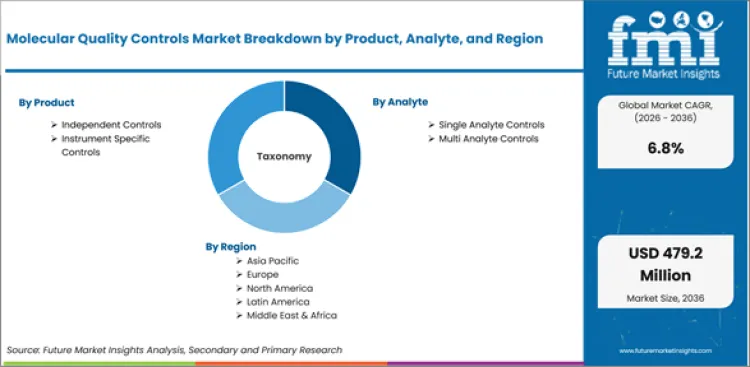
The molecular quality controls market was valued at USD 232.4 million in 2025. The market is set to reach USD 248.2 million by 2026-end and grow at a CAGR of 6.8% between 2026-2036 to reach USD 479.2 million by 2036. Independent Controls will dominate with a 58.0% share, while Single Analyte Controls will lead with a 59.0% share.
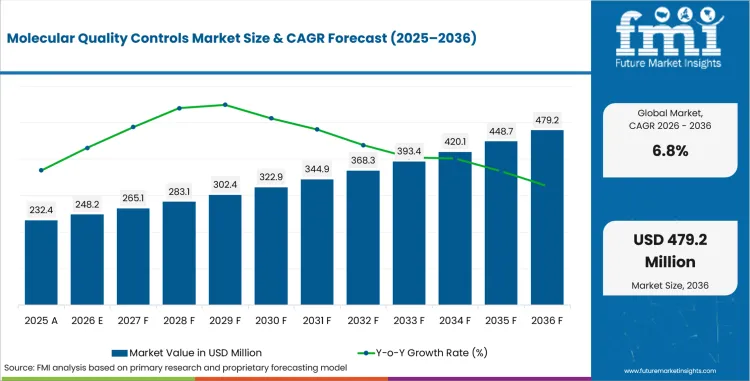
Molecular Quality Controls Market Overview: Size and Forecast
- Molecular Quality Controls Market Value (2026): USD 248.2 Mn
- Molecular Quality Controls Market Forecast Value (2036): USD 479.2 Mn
- Molecular Quality Controls Market Forecast CAGR (2026 to 2036): 6.8%
- Molecular Quality Controls Market Leading Product: Independent Controls (58.0%)
- Molecular Quality Controls Market Key Growth Regions: USA, UK, EU, Japan, South Korea
- Molecular Quality Controls Market Key Players: Bio-Rad Laboratories, Inc., Thermo Fisher Scientific, Inc., LGC Limited, Roche Diagnostics, Microbiologics, Inc.
| Parameter | Details |
|---|---|
| Market Size in 2026 (Value) | USD 248.2 Mn |
| Market Forecast in 2036 (Value) | USD 479.2 Mn |
| CAGR (2026 to 2036) | 6.8% |
| Years Considered | 2021 to 2036 |
| Base Year | 2025 |
| Forecast Period | 2026 to 2036 |
| Units Considered | Value (USD Mn) |
| Leading Sub-Region | USA |
Summary of the Molecular Quality Controls Market
- Demand and Growth Drivers
- Infectious Diseases Diagnostics, and Oncology Testing and Genetic Testing applications are expected to sustain procurement of independent controls products as clinical protocols tighten and patient populations expand through 2036.
- Polymerase Chain Reaction and next generation sequencing are projected to shape procurement patterns, with regulatory-approved formats capturing the largest volume share.
- USA at 7.0% and South Korea at 7.0% are the fastest-growing markets, reflecting expanding institutional infrastructure and policy-driven adoption during the forecast period.
- Product and Segment View
- Liquid Controls is expected to account for 64.0% of the form segment in 2026, supported by demand across Assay Independent Controls, Universal Controls, and Third Party Controls in clinical and diagnostic settings.
- Instrument Specific Controls is projected to gain share during the forecast period as platform specific controls and polymerase chain reaction systems applications expand across Infectious Diseases Diagnostics, and Oncology Testing and Genetic Testing sectors.
- Multi Analyte Controls represent a significant share of analyte demand owing to increasing adoption of multiplex infectious disease and oncology testing panels.
- Geography and Competitive Outlook
- USA is projected to lead growth at 7.0% through 2036, driven by FDA regulatory pathway maturity, Medicare reimbursement structures, and high per-capita independent controls utilization rates in hospital and ambulatory settings.
- South Korea at 7.0% reflects MFDS regulatory frameworks, advanced hospital infrastructure, and domestic medical device OEM positions supporting independent controls adoption.
- Bio-Rad Laboratories, Inc. and Thermo Fisher Scientific, Inc. lead the competitive field through regulatory approval breadth, clinical evidence portfolios, and institutional procurement contracts across high-volume markets.
- Analyst Opinion
- Anurag Sharma, Principal Consultant at FMI says, 'Companies that can align liquid controls product portfolios with evolving infectious diseases diagnostics requirements while maintaining cost-competitive pricing across instrument specific controls categories are expected to strengthen their procurement positions through the forecast period.'
- The molecular quality controls market is shifting from a standardized supply model toward differentiated product portfolios where independent controls performance, polymerase chain reaction capability, and total cost of ownership shape purchasing decisions.
- Adoption is growing due to infectious diseases diagnostics and oncology testing and genetic testing demand, regulatory protocol updates and replacement of legacy instrument specific controls configurations that no longer meet current requirements.
- Further demand support comes from procurement consolidation by the buyers of diagnostic laboratories and a preference for suppliers who combine the breadth of independent controls with polymerase chain reaction capability.
Molecular Quality Controls Market Definition
The molecular quality controls market encompasses medical devices, consumables, and services used across Infectious Diseases Diagnostics, and Oncology Testing and Genetic Testing applications, serving Diagnostic Laboratories, and Hospitals sectors.
Molecular Quality Controls Market Inclusions
Market scope encompasses all commercially traded molecular quality controls products categorized by product (Independent Controls, and Instrument Specific Controls), analyte (Single Analyte Controls, and Multi Analyte Controls), application (Infectious Diseases Diagnostics, and Oncology Testing and Genetic Testing), end use (Diagnostic Laboratories, Hospitals, In Vitro Diagnostic Manufacturers and Contract Research Organizations, and others), technology (Polymerase Chain Reaction, Next Generation Sequencing, and Other Molecular Technologies), form (Liquid Controls, and Lyophilized Controls). Revenue estimates cover the period from 2026 to 2036 across all regions and distribution channels.
Molecular Quality Controls Market Exclusions
The scope does not include unregulated or non-commercial medical products, experimental devices without regulatory clearance, or services unrelated to molecular quality controls procurement and clinical deployment.
Molecular Quality Controls Market Research Methodology
- Primary Research: FMI analysts conducted interviews with device manufacturers, clinical procurement specialists, hospital supply chain managers, and end-use operators across USA, South Korea, and EU to validate demand patterns and pricing structures for independent controls and related product categories.
- Desk Research: Combined clinical trial registries, regulatory approval databases, reimbursement data, and manufacturer disclosures to establish baseline parameters for molecular quality controls across product and analyte segments.
- Market Sizing and Forecasting: Bottom-up aggregation across Independent Controls, and Instrument Specific Controls product categories and Infectious Diseases Diagnostics, and Oncology Testing and Genetic Testing applications, triangulated with top-down macro indicators and regional adoption curves.
- Data Validation: Cross-checked quarterly against regulatory clearance volumes, hospital procurement records, and manufacturer revenue disclosures for molecular quality controls products.
Why is the Molecular Quality Controls Market Growing?
- Infectious Diseases diagnostics, and Oncology testing and genetic testing applications are creating long-term procurement for independent controls and instrument specific controls products in developing and emerging markets.
- USA leads growth at 7.0% driven by maturity of the FDA regulatory pathway, Medicare reimbursement structures and high per-capita independent controls utilization rates in hospital and ambulatory settings.
- The form segment is led by Liquid Controls at 64.0%, fueled by the demand for Assay Independent Controls, Universal Controls configurations and broad applicability in clinical settings.
Molecular Quality Controls Market is estimated to be USD 248.2 Mn in 2026 and is projected to reach USD 479.2 Mn by 2036, at a CAGR of 6.8% Growth is due to rising demand for Independent Controls and Instrument Specific Controls in Infectious Diseases Diagnostics, Oncology Testing and Genetic Testing applications. The cumulative impact of clinical adoption, regulatory compliance cycles and geographical expansion of procurement has resulted in an incremental opportunity of USD 231.0 Mn during 2026 and 2036. The most popular processing method is Polymerase Chain Reaction , but next generation sequencing is catching on in niche applications .
Liquid Controls is the largest form category with a share of 64.0% in 2026. Demand is focused on the sub-categories of Assay Independent Controls, Universal Controls and Third Party Controls, which cater to different infectious diseases diagnostics needs. Platform Specific Controls and Polymerase Chain Reaction Systems sub-segments are gaining traction with procurement diversification, and Instrument Specific Controls is projected to be a secondary growth category.
Geographically, USA is leading at 7.0% owing to maturity of the FDA regulatory pathway, Medicare reimbursement structures and high per capita rates of independent controls utilization in hospital and ambulatory settings. South Korea at 7.0% is influenced by MFDS regulatory frameworks, the presence of advanced hospital infrastructure and domestic medical device OEM positions which allows for the independent adoption of controls. Replacement and compliance cycles in North America and Western Europe underpin demand.
Market Segmentation Analysis
- Liquid Controls is the leader in the form segment with 64.0% in 2026, with Assay Independent Controls, and Universal Controls also comprise a huge chunk of procurement volume in clinical channels.
- The Single Analyte Controls reflects historical procurement patterns for single analyte controls and multi analyte controls by analyte.
- Based on application segmentation, the infectious diseases diagnostics segment is the leading application segment. This is indicative of the institutional procurement structure and the GPO relationships in high volume markets.
The molecular quality controls market is classified on the basis of product, analyte, application, end use, technology and form. Segmenting the market based on product, the market is segmented into Independent Controls and Instrument Specific Controls. These are for different procurement needs. The major categories are: Single Analyte Controls, Multi Analyte Controls, by analyte.
Insights into the Independent Controls Segment
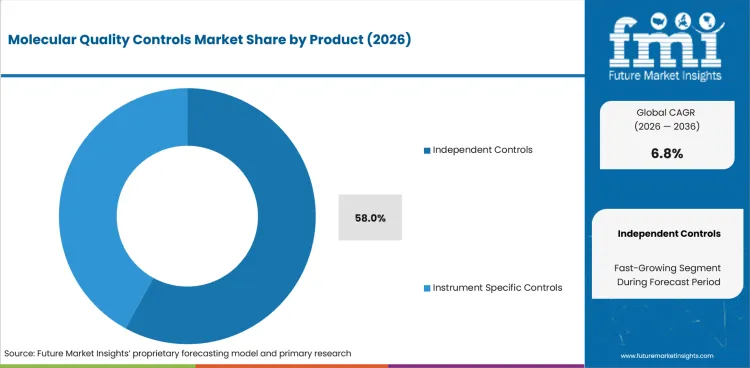
In 2026, the Independent Controls product segment holds the maximum market share of 58.0%, due to the concentrated demand from hospital, diagnostic and outpatient settings. Key sub-categories include Assay Independent Controls, Universal Controls, Third Party Controls and Custom Controls, each addressing differentiated infectious diseases diagnostics requirements and procurement specifications.
Procurement patterns for independent controls will be dictated by clinical protocol alignment, regulatory clearance status and institutional formulary positioning. The assay independent controls sub-category is leading in volume. Universal controls is gaining share with growth in oncology testing and genetic testing applications.
Insights into the Instrument Specific Controls Segment
Instrument Specific Controls is an increasing product segment category. Sub-categories include Platform Specific Controls, Polymerase Chain Reaction Systems, Next Generation Sequencing Systems and Proprietary Controls to meet specialized requirements for Infectious Diseases Diagnostics, Oncology Testing and Genetic Testing applications.
The rising adoption of instrument specific controls is driven by evolving clinical protocols, updated regulatory requirements and the growing need for precision grade products in oncology testing and genetic testing settings. Platform specific controls and polymerase chain reaction systems are the growth sub-segments during the forecast period.
Molecular Quality Controls Market Drivers, Restraints, and Opportunities
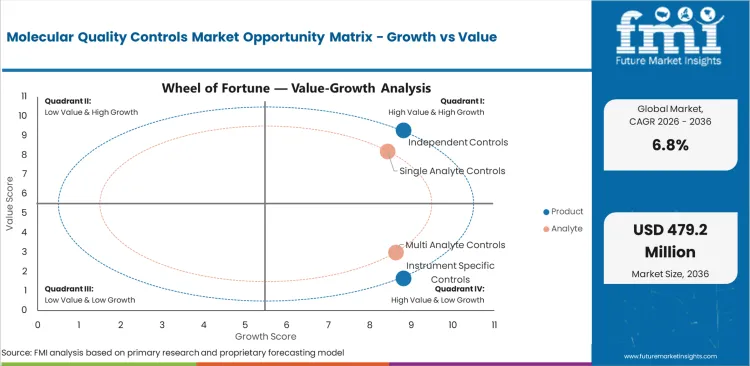
- The key structural drivers are Infectious Diseases Diagnostics and oncology testing and genetic testing applications, creating recurring procurement cycles for independent controls products through 2036.
- The main restraints limiting adoption in price-sensitive market segments are reimbursement constraints, pricing pressure in institutional procurement and long regulatory approval timelines.
- Incremental procurement opportunities are anticipated to be driven by point of care expansion, modernization of hospitals in emerging markets, and updates to clinical protocols during the forecast period.
Molecular Quality Controls Market is driven by demand from Infectious Diseases Diagnostics, Oncology Testing and Genetic Testing applications. Polymerase Chain Reaction (PCR) remains the dominant technology owing to its widespread use in infectious disease diagnostics, while next-generation sequencing (NGS) is gaining adoption in oncology and genetic testing applications.
Infectious Diseases Diagnostics Demand and Regulatory Procurement Cycles for Independent Controls
Infectious diseases diagnostics and oncology testing and genetic testing application requirements are driving recurring procurement cycles requiring independent controls. Majority share in Assay Independent Controls and universal controls sub-categories driven by specifications from operator requirements of diagnostic laboratories and polymerase chain reaction compatibility. Growth comes from both new adoption in growing markets and replacement of legacy products in mature ones.
Pricing Pressure and Reimbursement Constraints on Instrument Specific Controls Adoption
Institutional pricing pressure, reimbursement issues in emerging markets and long regulatory approval processes delay market access for new configurations, limiting instrument specific controls. Hospitals’ purchasing committees favor products that have been proven to be cost-effective over a defined clinical use cycle, creating barriers for new players without established reimbursement codes.
Emerging Market Expansion and Independent Controls Procurement Growth in USA
The United States drives growth at 7.0%, driven by maturity of the FDA regulatory pathway, Medicare reimbursement structures and high per-capita independent controls utilization rates in the hospital and ambulatory settings. South Korea at 7.0% is reflective of MFDS regulatory frameworks, advanced hospital infrastructure and domestic medical device OEM positions that support adoption of independent controls. These markets are the main growth corridors for independent controls procurement through 2036 with demand concentrated in infectious diseases diagnostics and oncology testing and genetic testing applications.
Analysis of Molecular Quality Controls Market By Key Countries
.webp "Top Country Growth Comparison Molecular Quality Controls Market Cagr (2026 2036)")
| Country | CAGR |
|---|---|
| USA | 7.0% |
| South Korea | 7.0% |
| EU | 6.8% |
| Japan | 6.7% |
| UK | 6.6% |
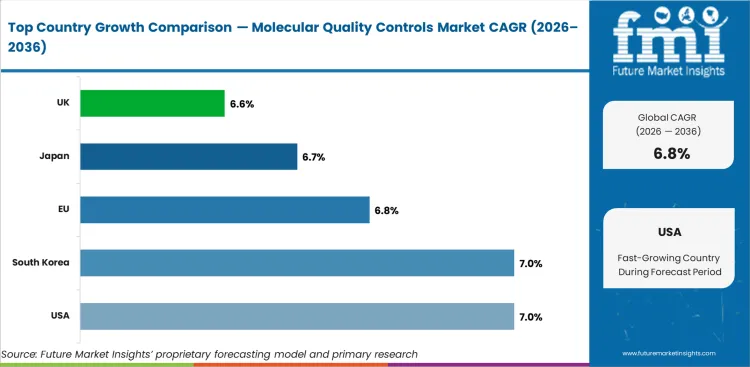
- USA at 7.0% reflects FDA regulatory pathway maturity, Medicare reimbursement structures, and high per-capita independent controls utilization rates in hospital and ambulatory settings.
- South Korea at 7.0% reflects MFDS regulatory frameworks, advanced hospital infrastructure, and domestic medical device OEM positions supporting independent controls adoption.
- EU at 6.8% reflects EU MDR regulatory transition, hospital modernization across member states, and centralized procurement structures for independent controls products.
The global molecular quality controls market is projected to expand at 6.8% from 2026 to 2036. The study covers more than 30 countries, and the primary markets are listed below.
Demand Outlook for Molecular Quality Controls Market in USA
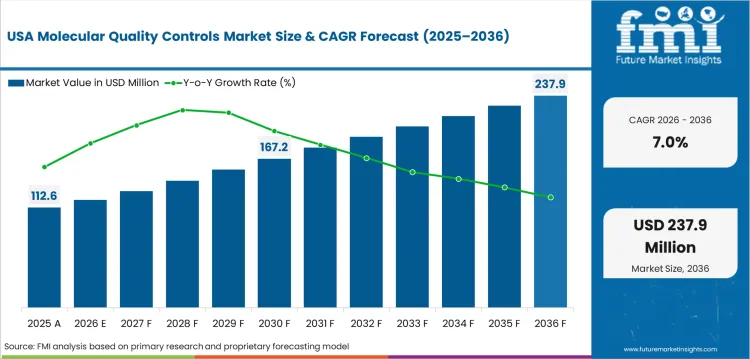
In the USA, demand for molecular quality controls is mainly for infectious diseases diagnostics and oncology testing and genetic testing applications and the market is expected to grow at 7.0% through 2036. The growth is driven by maturity of the FDA regulatory pathway, Medicare reimbursement structures, and high per-capita independent controls utilization rates in hospital and ambulatory settings.
- Procurement of independent controls is focused on hospital and clinic channels, aligning with infectious diseases diagnostic needs and regulatory compliance standards in USA.
- The use of instrument specific controls is growing in diagnostic and outpatient settings as clinical protocols change and diagnostic laboratory buyers extend supplier qualification programs.
- Market demand for polymerase chain reaction reflects clinical validation requirements and increasing preference for regulatory-cleared independent controls products with verified efficacy and safety data.
Future Outlook for Molecular Quality Controls Market in South Korea
South Korea’s government and regulatory frameworks are creating structured procurement demand for independent controls, and the market is expanding at 7.0% through 2036. The demand is supported by MFDS regulatory frameworks, advanced hospital infrastructure and domestic medical device OEM positions which support adoption of independent controls.
- Infectious diseases diagnostics applications are driving hospital and clinic channel volumes, reflecting infectious diseases diagnostics requirements and regulatory compliance standards in South Korea.
- Instrument specific controls procurement is supported by diagnostic and outpatient settings as clinical protocols evolve and diagnostic laboratory buyers expand supplier qualification programs.
- Rising demand for oncology testing and genetic testing is creating incremental opportunities in clinical validation requirements and growing preference for regulatory-cleared independent controls products with proven efficacy and safety data.
Opportunity Analysis of Molecular Quality Controls Market in EU
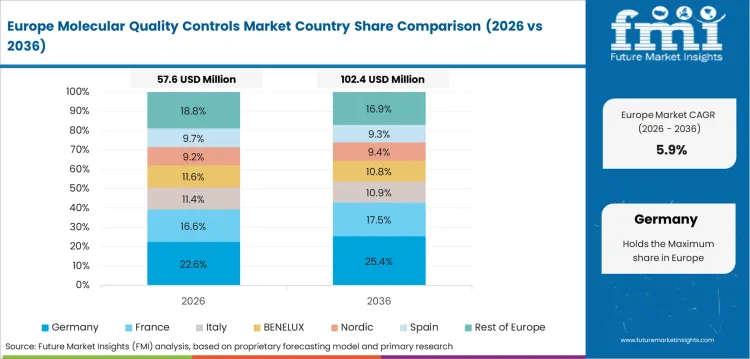
The molecular quality controls products market is forecast to expand at a CAGR of 6.8% through 2036, fueled by the EU's healthcare infrastructure and institutional procurement base. Procurement trends reflect the shift to the EU MDR regulatory framework, the modernization of hospitals in member countries and centralized procurement systems for independent controls products.
- Independent controls are guided by hospital and clinic channels, consistent with infectious diseases diagnostics requirements and regulatory compliance standards in the EU.
- Investments in infectious diseases diagnostics, evolving clinical protocols and expanding supplier qualification programs from diagnostic laboratories buyers are driving procurement in diagnostic and outpatient settings.
- Legacy instrument specific controls configurations replacement cycles meet clinical validation requirements and increasing preference for regulatory cleared independent controls products with verified efficacy and safety data.
In-depth Analysis of Molecular Quality Controls Market in Japan
Regulatory requirements in Japan are shaping procurement standards for independent controls. The market is growing at 6.7% to 2036. PMDA approval pathways, aging population demographics and hospital automation investment supporting independent controls demand are some of the demand drivers.
- Institutional procurement of independent controls reflects hospital and clinic channels reflecting infectious diseases diagnostics requirements and regulatory compliance standards in Japan.
- Demand from diagnostic laboratories and outpatient testing centers continues to expand as molecular testing volumes increase.
- Instrument-specific controls are driving increased clinical validation requirements for supply chain development and increased preference for regulatory-cleared independent controls products with proven efficacy and safety data.
Sales Analysis of Molecular Quality Controls Market in UK
Demand for molecular quality controls at 6.6% through 2036 is driven by UK infrastructure investment. Demand for independent controls is driven by growth through NHS procurement frameworks, MHRA regulatory pathways and hospital modernisation programmes.
- The demand for independent controls is highest in hospital and clinic channels in UK, driven by the requirements for infectious diseases diagnostics and regulatory compliance standards.
- The diagnostic and outpatient settings support the adoption of instrument specific controls as clinical protocols advance and diagnostic laboratories buyers extend supplier qualification programs.
- Clinical validation requirements and laboratory quality assurance initiatives are supporting continued adoption of molecular quality controls across NHS laboratories.
Competitive Landscape and Strategic Positioning
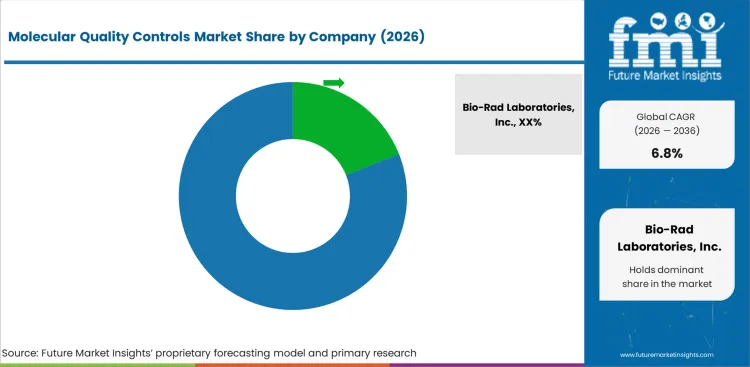
- Bio-Rad Laboratories, Inc. leads the molecular quality controls market through broad regulatory clearance portfolios, clinical evidence depth, and established hospital procurement relationships across USA, South Korea, and EU.
- Thermo Fisher Scientific, Inc., LGC Limited, and Roche Diagnostics maintain competitive positions through specialized product lines in independent controls and instrument specific controls categories.
- Emerging participants are targeting specialized clinical applications in infectious diseases diagnostics and oncology testing and genetic testing segments to establish initial procurement relationships.
Bio-Rad Laboratories, Inc. leads the molecular quality controls market through broad regulatory clearance portfolios and clinical validation across FDA and EU MDR pathways. Thermo Fisher Scientific, Inc. maintains a strong position through specialized instrument specific controls product lines.
LGC Limited and Roche Diagnostics compete on product performance and institutional access. Barriers include regulatory timelines, clinical evidence, and GPO contracts.
Strategic priorities for market leaders include expanding independent controls portfolios into oncology testing and genetic testing applications, accelerating regulatory submissions in emerging markets, and reducing manufacturing cost per unit.
Key Companies in the Molecular Quality Controls Market
Key global companies leading the molecular quality controls market include:
- Bio-Rad Laboratories, Inc., Thermo Fisher Scientific, Inc., LGC Limited, Roche Diagnostics, and Microbiologics, Inc. maintain leading positions through established regulatory clearance portfolios, clinical evidence bases, and institutional procurement contracts across global markets.
- Other Molecular Quality Control Providers (combined) have built competitive positions in regional markets through specialized instrument specific controls product capabilities and focused distribution networks.
- Emerging entrants are targeting oncology testing and genetic testing applications and point-of-care segments to establish initial procurement positions and scale.
Competitive Benchmarking: Molecular Quality Controls Market
| Company | Independent Controls Range | Regulatory Coverage | Clinical Reach | Geographic Footprint |
|---|---|---|---|---|
| Bio-Rad Laboratories, Inc. | High | High | Strong | Global |
| Thermo Fisher Scientific, Inc. | High | High | Strong | Global |
| LGC Limited | Medium | High | Moderate | Regional |
| Roche Diagnostics | Medium | High | Moderate | Regional |
| Microbiologics, Inc. | Medium | High | Moderate | Regional |
| Other Molecular Quality Control Providers (combined) | Medium | Medium | Low | Regional |
Source: Future Market Insights competitive analysis, 2026.
Key Developments in Molecular Quality Controls Market
- In 2025, Bio-Rad Laboratories, Inc. expanded its independent controls product line with additional IVDR-certified solutions to address infectious diseases diagnostics application requirements across North American and European hospital networks.
- In 2025, Thermo Fisher Scientific, Inc. continued to strengthen its AcroMetrix portfolio with enhanced instrument-specific quality controls for oncology and genetic testing applications to support clinical laboratories across key global markets.
Key Players in the Molecular Quality Controls Market
Major Global Players
- Bio-Rad Laboratories, Inc.
- Thermo Fisher Scientific, Inc.
- LGC Limited
- Roche Diagnostics
- Microbiologics, Inc.
- Other Molecular Quality Control Providers (combined)
Emerging Players/Startups
- ZeptoMetrix
- SeraCare Life Sciences
- Maine Molecular Quality Controls
- Qnostics
- Vircell
Molecular Quality Controls Market - Research Methodology
| Method | Description |
|---|---|
| Primary Research | FMI analysts conducted interviews with device manufacturers, clinical procurement specialists, hospital supply chain managers, and end-use operators across USA, South Korea, and EU to validate demand patterns and pricing structures for independent controls and related product categories. |
| Desk Research | Combined clinical trial registries, regulatory approval databases, reimbursement data, and manufacturer disclosures to establish baseline parameters for molecular quality controls across product and analyte segments. |
| Market Sizing & Forecasting | Bottom-up aggregation across Independent Controls, and Instrument Specific Controls product categories and Infectious Diseases Diagnostics, and Oncology Testing and Genetic Testing applications, triangulated with top-down macro indicators and regional adoption curves. |
| Data Validation | Cross-checked quarterly against regulatory clearance volumes, hospital procurement records, and manufacturer revenue disclosures for molecular quality controls products. |
Report Scope and Coverage
| Parameter | Details |
|---|---|
| Market size by 2036 | USD 479.2 Mn |
| Growth rate | 6.8% CAGR (2026 to 2036) |
| Forecast period | 2026 to 2036 |
| Base year value (2025) | USD 232.4 Mn |
| Key Segment Covered | Product, Analyte, Application, End Use, Technology, Form |
| Regions covered | North America, Latin America, Western Europe, Eastern Europe, East Asia, South Asia and Pacific, Middle East and Africa |
| Countries covered | USA, South Korea, Japan, UK, 30 plus countries |
| Key companies profiled | Bio-Rad Laboratories, Inc., Thermo Fisher Scientific, Inc., LGC Limited, Roche Diagnostics, Microbiologics, Inc., Other Molecular Quality Control Providers (combined) |
Market Segmentation Analysis
Molecular Quality Controls Market Segmented by Product:
- Independent Controls
- Assay Independent Controls
- Universal Controls
- Third Party Controls
- Custom Controls
- Lab Developed Controls
- Panel Specific Controls
- Assay Independent Controls
- Instrument Specific Controls
- Platform Specific Controls
- Polymerase Chain Reaction Systems
- Next Generation Sequencing Systems
- Proprietary Controls
- Closed System Controls
- Manufacturer Calibrated Controls
- Platform Specific Controls
Molecular Quality Controls Market Segmented by Analyte:
- Single Analyte Controls
- Disease Specific Controls
- Viral Targets
- Bacterial Targets
- Genetic Targets
- Single Gene Controls
- Mutation Specific Controls
- Disease Specific Controls
- Multi Analyte Controls
- Multiplex Panels
- Respiratory Panels
- Sexually Transmitted Disease Panels
- Broad Spectrum Panels
- Oncology Panels
- Genetic Disorder Panels
- Multiplex Panels
Molecular Quality Controls Market Segmented by Application:
- Infectious Diseases Diagnostics
- Respiratory Infections
- Influenza
- Coronavirus
- Sexually Transmitted Infections
- Human Immunodeficiency Virus
- Chlamydia
- Blood Borne Infections
- Hepatitis B
- Hepatitis C
- Respiratory Infections
- Oncology Testing and Genetic Testing
- Cancer Diagnostics
- Solid Tumor Testing
- Liquid Biopsy
- Genetic Testing
- Hereditary Disorders
- Prenatal Testing
- Cancer Diagnostics
Molecular Quality Controls Market Segmented by End Use:
- Diagnostic Laboratories
- Independent Laboratories
- Routine Testing
- High Volume Testing
- Hospital Laboratories
- Inpatient Testing
- Outpatient Testing
- Independent Laboratories
- Hospitals
- Public Hospitals
- Central Laboratories
- Specialty Departments
- Private Hospitals
- Advanced Diagnostics
- Integrated Care
- Public Hospitals
- In Vitro Diagnostic Manufacturers and Contract Research Organizations
- Test Development
- Assay Validation
- Quality Assurance
- Clinical Trials
- Biomarker Testing
- Regulatory Studies
- Test Development
- Academic and Research Institutes
- University Research Centers
- Molecular Biology Research
- Genomics Research
- Government Research Institutes
- Public Health Studies
- Epidemiology Research
- University Research Centers
Molecular Quality Controls Market Segmented by Technology:
- Polymerase Chain Reaction
- Real Time Polymerase Chain Reaction
- Quantitative Testing
- High Sensitivity Detection
- Digital Polymerase Chain Reaction
- Absolute Quantification
- Rare Mutation Detection
- Real Time Polymerase Chain Reaction
- Next Generation Sequencing
- Targeted Sequencing
- Gene Panels
- Amplicon Sequencing
- Whole Genome Sequencing
- Comprehensive Analysis
- High Throughput Testing
- Targeted Sequencing
- Other Molecular Technologies
- Isothermal Amplification
- Loop Mediated Amplification
- Rapid Testing
- Hybridization Based Methods
- Microarray Testing
- Probe Based Detection
- Isothermal Amplification
Molecular Quality Controls Market Segmented by Form:
- Liquid Controls
- Ready to Use Controls
- Single Use Vials
- Multi Use Vials
- Lyophilized Liquid Controls
- Reconstituted Controls
- Stability Enhanced Controls
- Ready to Use Controls
- Lyophilized Controls
- Freeze Dried Controls
- Long Shelf Life
- Ambient Storage
- Stabilized Controls
- Transport Friendly
- Cold Chain Independent
- Freeze Dried Controls
Molecular Quality Controls Market by Region:
- North America
- USA
- Canada
- Mexico
- Latin America
- Brazil
- Chile
- Rest of Latin America
- Western Europe
- Germany
- UK
- Italy
- Spain
- France
- Nordic
- BENELUX
- Rest of Western Europe
- Eastern Europe
- Russia
- Poland
- Hungary
- Balkan & Baltic
- Rest of Eastern Europe
- East Asia
- China
- Japan
- South Korea
- South Asia and Pacific
- India
- ASEAN
- Australia & New Zealand
- Rest of South Asia and Pacific
- Middle East & Africa
- Kingdom of Saudi Arabia
- Other GCC Countries
- Türkiye
- South Africa
- Other African Union
- Rest of Middle East & Africa
Research Sources and Bibliography
- Clinical and Laboratory Standards Institute. Molecular Diagnostic Methods for Infectious Diseases and Quality Control Guidelines.
- College of American Pathologists. Molecular Pathology Proficiency Testing Programs.
- USA Food and Drug Administration. In Vitro Diagnostic and Molecular Testing Regulatory Database.
- European Commission. In Vitro Diagnostic Regulation (IVDR) Guidance Documents.
- World Health Organization. Laboratory Quality Management System and Molecular Diagnostics Guidance.
This bibliography is provided for reader reference.
This Report Answers
- Estimating the size of the molecular quality controls market and revenue projections from 2026 to 2036.
- Segmentation by product, analyte, application, end use, technology, form.
- Insights across more than 30 regional and country-level markets.
- Analysis of Infectious Diseases Diagnostics, and Oncology Testing and Genetic Testing demand drivers, procurement patterns, and adoption dynamics.
- Assessment of the competitive landscape including Bio-Rad Laboratories, Inc., Thermo Fisher Scientific, Inc., and LGC Limited and other participants.
- Identification of growth opportunities across independent controls and instrument specific controls segments.
- Evaluation of supply chain dynamics, polymerase chain reaction trends, and distribution channel structures.
- Delivery of data in PDF and Excel formats.
Frequently Asked Questions
How big is the molecular quality controls market in 2026?
The global molecular quality controls market is estimated to be valued at USD 248.2 million in 2026.
What will be the size of the molecular quality controls market in 2036?
The market size for the molecular quality controls market is projected to reach USD 479.2 million by 2036.
How much will the molecular quality controls market grow between 2026 and 2036?
The molecular quality controls market is expected to grow at a 6.8% CAGR between 2026 and 2036.
What are the key products in the molecular quality controls market?
The key products in the molecular quality controls market are Independent Controls and Instrument Specific Controls.
Which analyte segment is expected to contribute a significant share in the molecular quality controls market in 2026?
In terms of analyte, the single analyte controls segment is expected to command 59.0% share in the molecular quality controls market in 2026.
Preview the report firsthand - request a free sample
Get SampleGet the brochure for pricing and purchase details.
Get PDFTable of Content
- Key Takeaways
- Market Size and CAGR
- Top Growth Driver
- Fastest Growing Segment
- Leading Region
- Key Companies
- Emerging Opportunities
- Executive Summary
- Global Market Outlook
- Demand-side Trends
- Supply-side Trends
- Technology Roadmap Analysis
- Analysis and Recommendations
- Analyst Perspective (What is happening? Why now? What should investors know?)
- Key Questions Answered
- How large is the market?
- What is the CAGR?
- What are key trends?
- Which region dominates?
- Who are the leaders?
- Market Overview
- Market Coverage / Taxonomy
- Market Definition / Scope / Limitations
- Research Methodology
- Chapter Orientation
- Analytical Lens and Working Hypotheses
- Market Structure, Signals, and Trend Drivers
- Benchmarking and Cross-market Comparability
- Market Sizing, Forecasting, and Opportunity Mapping
- Research Design and Evidence Framework
- Desk Research Programme (Secondary Evidence)
- Expert Input and Fieldwork (Primary Evidence)
- Tooling, Models, and Reference Databases
- Data Engineering and Model Build
- Quality Assurance and Audit Trail
- Market Background
- Market Dynamics (Drivers, Restraints, Opportunity, Trends)
- Scenario Forecast (Optimistic, Likely, Conservative)
- Impact Analysis
- AI Impact
- Sustainability Impact
- Regulatory Impact
- Technology Impact
- Consumer / Buyer Analysis
- Purchase Drivers
- Adoption Barriers
- Buyer Journey
- Opportunity Map Analysis
- Product Life Cycle Analysis
- Supply Chain Analysis
- Investment Feasibility Matrix
- Value Chain Analysis
- PESTLE and Porter's Analysis
- Regulatory Landscape
- Regional Parent Market Outlook
- Production and Consumption Statistics
- Import and Export Statistics
- Global Market Analysis and Forecast, 2021 to 2036
- Historical Market Size Value (USD Million) Analysis, 2021 to 2025
- Current and Future Market Size Value (USD Million) Projections, 2026 to 2036
- Y-o-Y Growth Trend Analysis
- Absolute $ Opportunity Analysis
- Global Market Pricing Analysis, 2021 to 2036
- Global Market Analysis and Forecast, By Product, 2021 to 2036
- Introduction / Key Findings
- Historical Market Size Value (USD Million) Analysis By Product, 2021 to 2025
- Current and Future Market Size Value (USD Million) Analysis and Forecast By Product, 2026 to 2036
- Independent Controls
- Assay Independent Controls
- Custom Controls
- Instrument Specific Controls
- Platform Specific Controls
- Proprietary Controls
- Independent Controls
- Y-o-Y Growth Trend Analysis By Product, 2021 to 2025
- Absolute $ Opportunity Analysis By Product, 2026 to 2036
- Global Market Analysis and Forecast, By Analyte, 2021 to 2036
- Introduction / Key Findings
- Historical Market Size Value (USD Million) Analysis By Analyte, 2021 to 2025
- Current and Future Market Size Value (USD Million) Analysis and Forecast By Analyte, 2026 to 2036
- Single Analyte Controls
- Disease Specific Controls
- Genetic Targets
- Multi Analyte Controls
- Multiplex Panels
- Broad Spectrum Panels
- Single Analyte Controls
- Y-o-Y Growth Trend Analysis By Analyte, 2021 to 2025
- Absolute $ Opportunity Analysis By Analyte, 2026 to 2036
- Global Market Analysis and Forecast, By Application, 2021 to 2036
- Introduction / Key Findings
- Historical Market Size Value (USD Million) Analysis By Application, 2021 to 2025
- Current and Future Market Size Value (USD Million) Analysis and Forecast By Application, 2026 to 2036
- Infectious Diseases Diagnostics
- Respiratory Infections
- Sexually Transmitted Infections
- Blood Borne Infections
- Oncology Testing and Genetic Testing
- Cancer Diagnostics
- Genetic Testing
- Infectious Diseases Diagnostics
- Y-o-Y Growth Trend Analysis By Application, 2021 to 2025
- Absolute $ Opportunity Analysis By Application, 2026 to 2036
- Global Market Analysis and Forecast, By End Use, 2021 to 2036
- Introduction / Key Findings
- Historical Market Size Value (USD Million) Analysis By End Use, 2021 to 2025
- Current and Future Market Size Value (USD Million) Analysis and Forecast By End Use, 2026 to 2036
- Diagnostic Laboratories
- Independent Laboratories
- Hospital Laboratories
- Hospitals
- Public Hospitals
- Private Hospitals
- In Vitro Diagnostic Manufacturers and Contract Research Organizations
- Test Development
- Clinical Trials
- Academic and Research Institutes
- University Research Centers
- Government Research Institutes
- Diagnostic Laboratories
- Y-o-Y Growth Trend Analysis By End Use, 2021 to 2025
- Absolute $ Opportunity Analysis By End Use, 2026 to 2036
- Global Market Analysis and Forecast, By Technology, 2021 to 2036
- Introduction / Key Findings
- Historical Market Size Value (USD Million) Analysis By Technology, 2021 to 2025
- Current and Future Market Size Value (USD Million) Analysis and Forecast By Technology, 2026 to 2036
- Polymerase Chain Reaction
- Real Time Polymerase Chain Reaction
- Digital Polymerase Chain Reaction
- Next Generation Sequencing
- Targeted Sequencing
- Whole Genome Sequencing
- Other Molecular Technologies
- Isothermal Amplification
- Hybridization Based Methods
- Polymerase Chain Reaction
- Y-o-Y Growth Trend Analysis By Technology, 2021 to 2025
- Absolute $ Opportunity Analysis By Technology, 2026 to 2036
- Global Market Analysis and Forecast, By Form
- Introduction / Key Findings
- Historical Market Size Value (USD Million) Analysis By Form, 2021 to 2025
- Current and Future Market Size Value (USD Million) Analysis and Forecast By Form, 2026 to 2036
- Liquid Controls
- Ready to Use Controls
- Lyophilized Liquid Controls
- Lyophilized Controls
- Freeze Dried Controls
- Stabilized Controls
- Liquid Controls
- Y-o-Y Growth Trend Analysis By Form, 2021 to 2025
- Absolute $ Opportunity Analysis By Form, 2026 to 2036
- Global Market Analysis and Forecast, By Region, 2021 to 2036
- Introduction
- Historical Market Size Value (USD Million) Analysis By Region, 2021 to 2025
- Current Market Size Value (USD Million) Analysis and Forecast By Region, 2026 to 2036
- North America
- Latin America
- Western Europe
- Eastern Europe
- East Asia
- South Asia and Pacific
- Middle East & Africa
- Market Attractiveness Analysis By Region
- North America Market Analysis and Forecast, By Country, 2021 to 2036
- Historical Market Size Value (USD Million) Trend Analysis By Market Taxonomy, 2021 to 2025
- Market Size Value (USD Million) Forecast By Market Taxonomy, 2026 to 2036
- By Country
- USA
- Canada
- Mexico
- By Product
- By Analyte
- By Application
- By End Use
- By Technology
- By Form
- By Country
- Market Attractiveness Analysis
- By Country
- By Product
- By Analyte
- By Application
- By End Use
- By Technology
- By Form
- Key Takeaways
- Latin America Market Analysis and Forecast, By Country
- Historical Market Size Value (USD Million) Trend Analysis By Market Taxonomy, 2021 to 2025
- Market Size Value (USD Million) Forecast By Market Taxonomy, 2026 to 2036
- By Country
- Brazil
- Chile
- Rest of Latin America
- By Product
- By Analyte
- By Application
- By End Use
- By Technology
- By Form
- By Country
- Market Attractiveness Analysis
- By Country
- By Product
- By Analyte
- By Application
- By End Use
- By Technology
- By Form
- Key Takeaways
- Western Europe Market Analysis and Forecast, By Country
- Historical Market Size Value (USD Million) Trend Analysis By Market Taxonomy, 2021 to 2025
- Market Size Value (USD Million) Forecast By Market Taxonomy, 2026 to 2036
- By Country
- Germany
- UK
- Italy
- Spain
- France
- Nordic
- BENELUX
- Rest of Western Europe
- By Product
- By Analyte
- By Application
- By End Use
- By Technology
- By Form
- By Country
- Market Attractiveness Analysis
- By Country
- By Product
- By Analyte
- By Application
- By End Use
- By Technology
- By Form
- Key Takeaways
- Eastern Europe Market Analysis and Forecast, By Country
- Historical Market Size Value (USD Million) Trend Analysis By Market Taxonomy, 2021 to 2025
- Market Size Value (USD Million) Forecast By Market Taxonomy, 2026 to 2036
- By Country
- Russia
- Poland
- Hungary
- Balkan & Baltic
- Rest of Eastern Europe
- By Product
- By Analyte
- By Application
- By End Use
- By Technology
- By Form
- By Country
- Market Attractiveness Analysis
- By Country
- By Product
- By Analyte
- By Application
- By End Use
- By Technology
- By Form
- Key Takeaways
- East Asia Market Analysis and Forecast, By Country
- Historical Market Size Value (USD Million) Trend Analysis By Market Taxonomy, 2021 to 2025
- Market Size Value (USD Million) Forecast By Market Taxonomy, 2026 to 2036
- By Country
- China
- Japan
- South Korea
- By Product
- By Analyte
- By Application
- By End Use
- By Technology
- By Form
- By Country
- Market Attractiveness Analysis
- By Country
- By Product
- By Analyte
- By Application
- By End Use
- By Technology
- By Form
- Key Takeaways
- South Asia and Pacific Market Analysis and Forecast, By Country
- Historical Market Size Value (USD Million) Trend Analysis By Market Taxonomy, 2021 to 2025
- Market Size Value (USD Million) Forecast By Market Taxonomy, 2026 to 2036
- By Country
- India
- ASEAN
- Australia & New Zealand
- Rest of South Asia and Pacific
- By Product
- By Analyte
- By Application
- By End Use
- By Technology
- By Form
- By Country
- Market Attractiveness Analysis
- By Country
- By Product
- By Analyte
- By Application
- By End Use
- By Technology
- By Form
- Key Takeaways
- Middle East & Africa Market Analysis and Forecast, By Country
- Historical Market Size Value (USD Million) Trend Analysis By Market Taxonomy, 2021 to 2025
- Market Size Value (USD Million) Forecast By Market Taxonomy, 2026 to 2036
- By Country
- Kingdom of Saudi Arabia
- Other GCC Countries
- Türkiye
- South Africa
- Other African Union
- Rest of Middle East & Africa
- By Product
- By Analyte
- By Application
- By End Use
- By Technology
- By Form
- By Country
- Market Attractiveness Analysis
- By Country
- By Product
- By Analyte
- By Application
- By End Use
- By Technology
- By Form
- Key Takeaways
- Key Countries Market Analysis
- USA
- Pricing Analysis
- Market Share Analysis, 2025
- By Product
- By Analyte
- By Application
- By End Use
- By Technology
- By Form
- Canada
- Pricing Analysis
- Market Share Analysis, 2025
- By Product
- By Analyte
- By Application
- By End Use
- By Technology
- By Form
- Mexico
- Pricing Analysis
- Market Share Analysis, 2025
- By Product
- By Analyte
- By Application
- By End Use
- By Technology
- By Form
- Brazil
- Pricing Analysis
- Market Share Analysis, 2025
- By Product
- By Analyte
- By Application
- By End Use
- By Technology
- By Form
- Chile
- Pricing Analysis
- Market Share Analysis, 2025
- By Product
- By Analyte
- By Application
- By End Use
- By Technology
- By Form
- Germany
- Pricing Analysis
- Market Share Analysis, 2025
- By Product
- By Analyte
- By Application
- By End Use
- By Technology
- By Form
- UK
- Pricing Analysis
- Market Share Analysis, 2025
- By Product
- By Analyte
- By Application
- By End Use
- By Technology
- By Form
- Italy
- Pricing Analysis
- Market Share Analysis, 2025
- By Product
- By Analyte
- By Application
- By End Use
- By Technology
- By Form
- Spain
- Pricing Analysis
- Market Share Analysis, 2025
- By Product
- By Analyte
- By Application
- By End Use
- By Technology
- By Form
- France
- Pricing Analysis
- Market Share Analysis, 2025
- By Product
- By Analyte
- By Application
- By End Use
- By Technology
- By Form
- India
- Pricing Analysis
- Market Share Analysis, 2025
- By Product
- By Analyte
- By Application
- By End Use
- By Technology
- By Form
- ASEAN
- Pricing Analysis
- Market Share Analysis, 2025
- By Product
- By Analyte
- By Application
- By End Use
- By Technology
- By Form
- Australia & New Zealand
- Pricing Analysis
- Market Share Analysis, 2025
- By Product
- By Analyte
- By Application
- By End Use
- By Technology
- By Form
- China
- Pricing Analysis
- Market Share Analysis, 2025
- By Product
- By Analyte
- By Application
- By End Use
- By Technology
- By Form
- Japan
- Pricing Analysis
- Market Share Analysis, 2025
- By Product
- By Analyte
- By Application
- By End Use
- By Technology
- By Form
- South Korea
- Pricing Analysis
- Market Share Analysis, 2025
- By Product
- By Analyte
- By Application
- By End Use
- By Technology
- By Form
- Russia
- Pricing Analysis
- Market Share Analysis, 2025
- By Product
- By Analyte
- By Application
- By End Use
- By Technology
- By Form
- Poland
- Pricing Analysis
- Market Share Analysis, 2025
- By Product
- By Analyte
- By Application
- By End Use
- By Technology
- By Form
- Hungary
- Pricing Analysis
- Market Share Analysis, 2025
- By Product
- By Analyte
- By Application
- By End Use
- By Technology
- By Form
- Kingdom of Saudi Arabia
- Pricing Analysis
- Market Share Analysis, 2025
- By Product
- By Analyte
- By Application
- By End Use
- By Technology
- By Form
- Türkiye
- Pricing Analysis
- Market Share Analysis, 2025
- By Product
- By Analyte
- By Application
- By End Use
- By Technology
- By Form
- South Africa
- Pricing Analysis
- Market Share Analysis, 2025
- By Product
- By Analyte
- By Application
- By End Use
- By Technology
- By Form
- USA
- Market Structure Analysis
- Competition Dashboard
- Competition Benchmarking
- Market Share Analysis of Top Players
- By Regional
- By Product
- By Analyte
- By Application
- By End Use
- By Technology
- By Form
- Emerging Startups
- Innovation Benchmarking
- Competition Analysis
- Competition Deep Dive
- Bio-Rad Laboratories, Inc.
- Overview
- Product Portfolio
- Profitability by Market Segments (Product/Region/Sales Channel)
- Sales Footprint
- Strategy Overview
- Marketing Strategy
- Product Strategy
- Channel Strategy
- Thermo Fisher Scientific, Inc.
- LGC Limited
- Roche Diagnostics
- Microbiologics, Inc.
- Other Molecular Quality Control Providers (combined)
- Bio-Rad Laboratories, Inc.
- Case Studies
- Success Stories
- Recent Developments
- Competition Deep Dive
- Assumptions & Acronyms Used


