

- Market Size (2026)
- USD 50.0 Mn
- Forecast (2036)
- USD 120.0 Mn
- CAGR (2026 to 2036)
- 9.1%
How big is Mono-Material Stand-Up Pouch Barrier Films Market in 2026?
USD 50.0 million in 2026 and USD 120.0 million by 2036 at a 9.1% CAGR.
Sales of mono-material stand-up pouch barrier films are estimated to rise at 9.1% CAGR through 2036 from USD 50.0 million in 2026 to USD 120.0 million by 2036 as film manufacturers replaced mixed-polymer laminates with polyethylene structures that retain oxygen and moisture protection. United Kingdom guidance updated in April 2026 requires large producers to meet material-specific recycling obligations and pay waste-disposal fees for covered household packaging. Material-specific obligations increase the commercial value of mono-material packaging that supports clear reporting without shortening product shelf life. Full production approval requires documented seal stability and retained barrier performance across commercial filling-line tests.
United States packaging programs increasingly connect producer fees with measurable recycling outcomes across household product portfolios. Indian pouch projects rely more heavily on nearby film-making support and registered recovery routes across regions with uneven collection capacity. Oregon launched its Recycling Modernization Act on July 1, 2025 and assigned program costs to companies selling packaging into the state. The Oregon framework directly affects flexible plastic packaging placed into state collection systems and requires program-specific records from obligated companies. Indian launches face longer service routes and wider differences in film recovery outside major conversion clusters, which changes qualification timing across national portfolios. Investment decisions become clearer through separate assessments of film performance and downstream acceptance across each intended sales route.
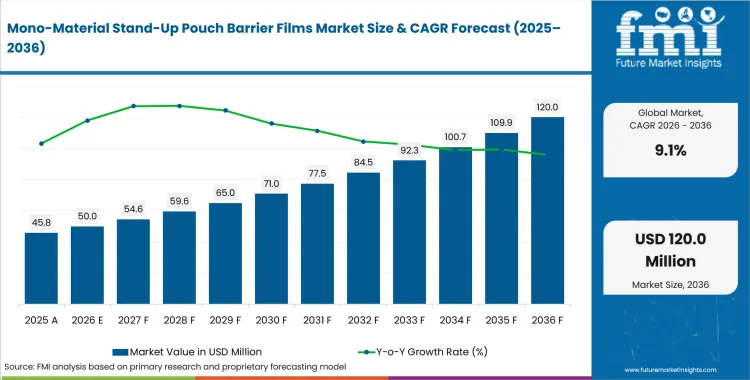
Key Takeaways of Mono-Material Stand-Up Pouch Barrier Films Market
- Material-specific recycling fees and retailer targets are increasing commercial interest in mono-material pouches that preserve product protection across established filling and distribution systems.
- By material, mono-material PE is expected to hold 41.0% share in 2026 owing to familiar sealing behavior and broad polyethylene processing experience.
- Pouches are projected to represent 30.0% share in 2026, reflecting low empty-pack weight and flexible fit across refill and portioned products.
- Food is forecast to account for 52.0% share in 2026, underpinned by frequent packaging turnover and strict shelf-life controls across packaged categories.
- Country-specific recovery rules create a material restraint by producing different recyclability outcomes for the same technically sound pouch across national collection systems.
- Documented barrier retention and line support shape competition, with commercial production evidence carrying more weight than an unsupported recyclability claim.
Analyst Perspective
"Commercial approval depends on one polymer structure protecting shelf life and sealing consistently on existing filling lines. The same pouch must also fit a documented recovery route in every intended sales market. Film manufacturers that combine barrier data with line-trial records and country-specific recyclability evidence can reduce repeated qualification work across food, home-care and pet-food launches."
- Nandini Roy Choudhury, Principal Analyst, Future Market Insights
How is the Mono-Material Stand-Up Pouch Barrier Films Market segmented?
The mono-material stand-up pouch barrier films industry is segmented by material, format, barrier or feature, end use, and region.
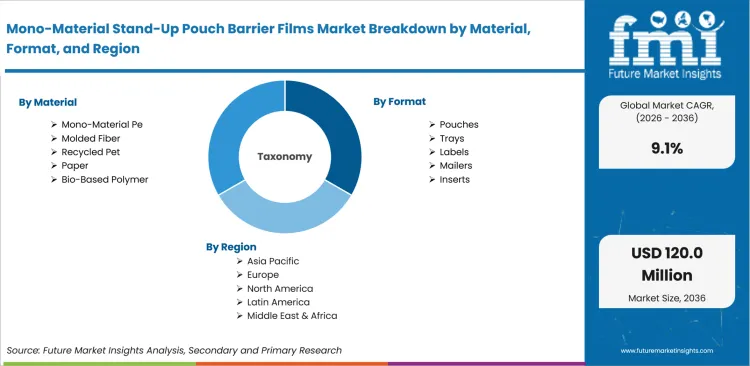
The market is segmented by material, format, barrier or feature, end use, and region to separate pouch design from commercial operating conditions. Material separates paper, molded fiber, recycled PET, mono-material PE and bio-based polymers by their sealing and recovery characteristics. Format covers pouches, trays, labels, mailers and inserts with different filling, handling and transport requirements. Barrier or feature distinguishes grease resistance, high-barrier protection, tamper evidence, traceability and freshness indication according to the product risk being controlled. End use compares food, pharmaceuticals, e-commerce, personal care and cold-chain applications across distinct shelf-life and approval requirements. Regional analysis connects local recovery definitions with product qualification; adjacent packaging films coverage provides context for broader conversion technologies and supply needs.
Why does mono-material PE lead material demand in the mono-material stand-up pouch barrier films market?
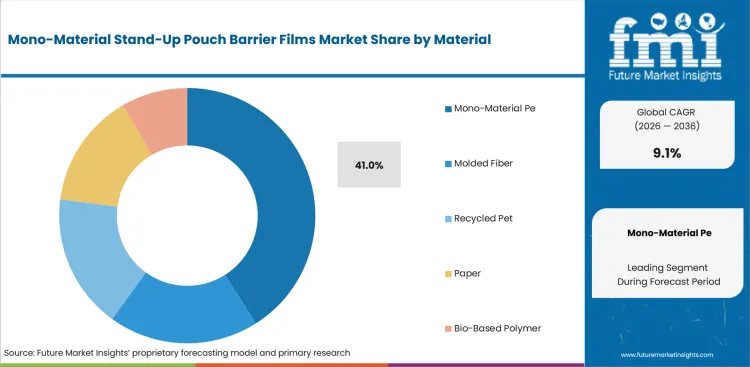
Mono-material PE combines a polyethylene seal layer with a compatible outer web, reducing separation problems during recycling assessment. Amcor and Mediacor launched a two-liter spouted stand-up pouch in July 2025 for Nana laundry and cleaning products across Italy, Germany and Austria. The commercial recyclable packaging release shows that a large refill format can retain transport durability within one main polymer family. Packaging engineers can test line stability and recovery compatibility within the same approval program for several regional product launches.
- In 2026, mono-material PE is expected to lead material with 41.0% share owing to familiar sealing behavior and broad polyethylene processing experience. Film manufacturers can qualify barrier coatings and print layers without adding another major polymer to the primary structure. The design supports clearer material documentation during technical review and commercial approval across several customer product lines.
- Refill programs use mono-material PE for pouches that need puncture resistance and dependable seals throughout distribution. High-barrier PCR films provide a related comparison for structures that combine product protection with recycled-content targets. Qualification takes longer for products that require retort temperatures or extended oxygen protection across demanding storage and transport conditions.
How do pouches shape demand within the format category?
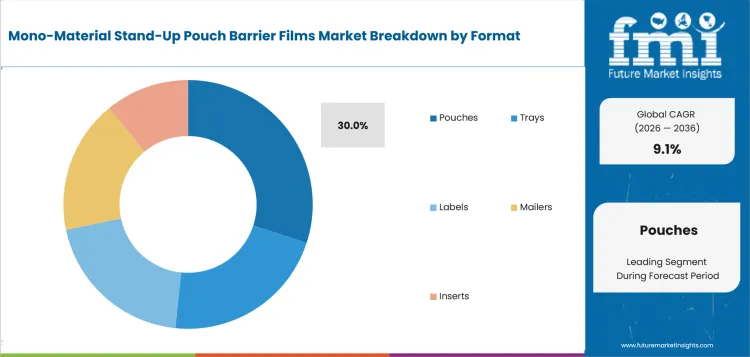
Pouches reduce empty-pack weight and fit refill or portioned products across several established filling systems. Premade formats lower the equipment burden for smaller product lines, whereas rollstock gives high-volume plants tighter control over forming and sealing. Commercial approval therefore examines drop resistance, spout performance and seal consistency under filled-product transport conditions. The broader pouch formats market provides context for equipment choices that influence conversion costs and production scale.
- The format category is forecast to be led by pouches at 30.0% share in 2026 due to low empty-pack weight and broad refill compatibility. Spouts and reclosure features extend use across liquids and dry products without changing the main film platform. Drop resistance and consumer handling requirements influence format approval during full commercial production and distribution trials.
- ProAmpac presented its R-2300 recyclable film platform in March 2026 for food, pet-care and home-care applications. The company offered the platform as rollstock and premade pouches, giving packaging plants two production routes within one recyclable structure. Premade formats let smaller brands qualify recyclable structures without installing forming equipment or managing an additional forming process. Stable high volumes can justify rollstock conversion with tighter process control at larger manufacturing sites.
Why does grease resistance create a distinct barrier or feature requirement?
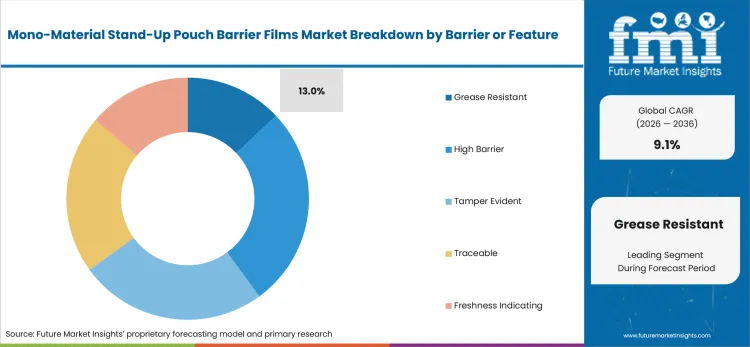
Grease resistance protects pouch appearance and nearby packaging from oil migration during shelf storage and distribution. The requirement differs from oxygen or moisture control; fats can stain printed surfaces and weaken secondary packaging without an obvious seal failure. Packaging engineers therefore test filled products across realistic storage periods and repeated warehouse handling conditions. Related high-barrier films help separate grease control from broader shelf-life requirements during specification approval and commercial line trials.
- Grease resistance is projected to hold 13.0% share in 2026 owing to applications that expose seals and printed surfaces to fat contact. Mondi reported in June 2025 that Saga Nutrition had launched a mono-material format (commercially available since October 2024) to protect dry pet food from moisture, fat and odor. The commercialization record shows why grease control remains necessary beside sealing performance across packaged food distribution.
- Food processors adopt grease-resistant structures for oily snacks and pet food that can mark weaker films or damage nearby cartons. Dependable grease control reduces leakage complaints and supports cleaner pallet handling across extended regional distribution networks. Adoption slows if coating choices complicate recycling assessment or narrow the sealing window on faster filling lines.
What keeps food central to end-use demand?
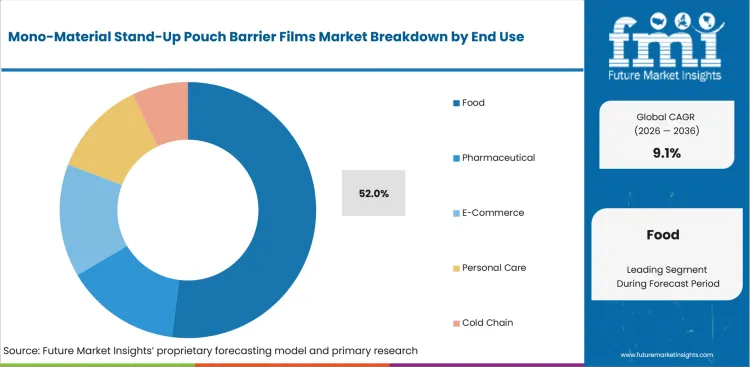
Food applications consume film frequently and expose pouch structures to oxygen, moisture and grease across varied shelf-life requirements. Commercial qualification uses filled-product trials to confirm that one structure preserves quality and seals reliably on existing equipment. Retailer approval can extend one validated format across repeated production schedules and several product lines. Related food packaging films show why protection and line performance require joint assessment during specification and commercial approval.
- Food is set to lead the end-use category with 52.0% share in 2026 due to frequent packaging turnover and strict spoilage controls. Food processors require commercial filling trials that confirm oxygen protection and seal integrity for any replacement laminate. Successful trials can scale across recurring production schedules and retailer programs within the same manufacturing network.
- Coveris confirmed in June 2025 that MonoFlexBE cheese packaging was already in use with major United Kingdom retailers including Tesco, Sainsbury's and ASDA with high-barrier performance and shelf life reaching 120 days. The commercial use shows how a mono-material structure can preserve an established food product through actual retail distribution. Pharmaceutical and personal-care applications require additional approval work that extends qualification beyond routine food-packaging schedules.
What are the drivers, restraints, and opportunities in the Mono-Material Stand-Up Pouch Barrier Films Market?
Regulatory cost signals and verified recycling routes are accelerating mono-material pouch qualification without removing the need for dependable barrier and sealing performance.
- Driver: Material-specific fees and recyclability requirements give brand owners a measurable reason to replace complex laminates with qualified mono-material pouch structures.
- Restraint: Local sorting and recovery practices differ across countries and can prevent one technical design from receiving equal acceptance in every sales market.
- Opportunity: New orientation and coating processes can improve barrier performance without introducing incompatible layers that weaken recyclability assessments.
Material-specific fees now give packaging programs a measurable cost for designs that perform poorly in local recycling systems. Citeo reported in June 2026 that 75% of plastic packaging sold in France during 2025 was recyclable. The result shows that design-for-recycling work has entered established consumer portfolios rather than isolated trials. Barrier packaging demand rises as film manufacturers pair a clearer material route with verified seal strength. Shelf-life evidence from full production trials then determines whether a recyclable pouch can replace an established laminate.
Local recovery rules poses a notable restraint by tying recyclability to the collection and sorting systems available in each country. The Central Agency Packaging Register published its 2025 minimum standard in August 2025 and retained practice-based assessment across packaging categories. A pouch can perform reliably on a filling line yet receive a weaker classification under another national recovery route. Brand owners must therefore verify local collection compatibility and coating behavior for every market included in a commercial specification.
Better orientation and coating processes offers a revenue opening for films that retain protection without adding incompatible layers. Constantia Flexibles commissioned a new MDO line in July 2025 to produce EcoLamHighPlus mono-PE film at its Pirk facility. The new equipment improves film strength and clarity across the oriented polyethylene web during commercial production. It also raises barrier performance within a recyclable structure, allowing packaging plants to qualify mono-material pouches for products with longer protection requirements.
Which country CAGRs are profiled in the Mono-Material Stand-Up Pouch Barrier Films Market?
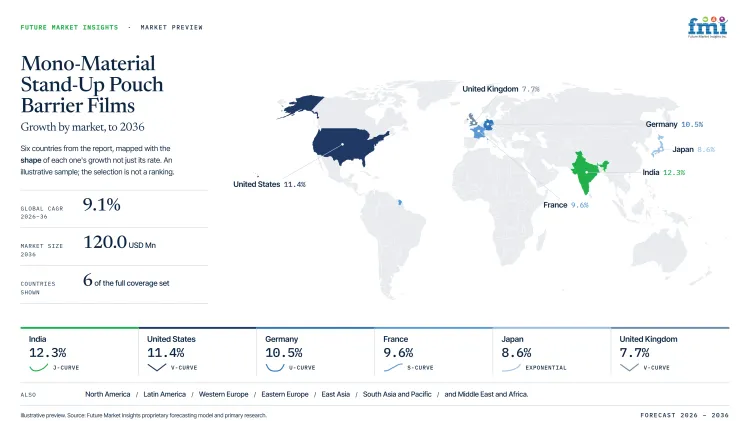
| Country | CAGR |
|---|---|
| India | 12.3% |
| United States | 11.4% |
| Germany | 10.5% |
| France | 9.6% |
| Japan | 8.6% |
| United Kingdom | 7.7% |
How do country-level CAGRs compare in the Mono-Material Stand-Up Pouch Barrier Films Market?
The forecasts form a gradual progression rather than sharply separated growth tiers across the profiled national markets. A 4.6-point spread separates India from the United Kingdom across the complete assessment period. India and the United States form the upper range through large packaged-product programs and active compliance investment. Germany and France follow through established recycling assessments and experienced packaging manufacturing across major consumer-product programs. Japan and the United Kingdom show steadier expansion as mature supply networks require strong evidence that new films fit local recovery rules. Similar rates can therefore mask different service needs and approval timelines across multinational brand portfolios.
- India combines a broad packaged-food base with expanding film production across several important industrial regions. Uneven recovery quality separates metropolitan launches from smaller processing and collection networks serving national brands.
- United States growth reflects state packaging rules and mature testing capacity across national brand portfolios. Program differences complicate one-film strategies across jurisdictions with separate fees, reporting rules and recovery definitions.
- Germany combines established sorting infrastructure with detailed recyclability assessment for household flexible packaging and barrier films. Technical approval follows documented local recovery practice rather than broad polymer compatibility statements or isolated laboratory results.
- France benefits from funded collection and sorting projects that expand recovery routes for household packaging. Regional system differences influence film separation and reprocessing acceptance across retailer programs and manufacturing sites.
- Japan relies on organized municipal collection and careful quality review across several plastic packaging categories. Packaging engineers adapt pouch specifications to local sorting definitions and demanding customer validation requirements for commercial launches.
- United Kingdom growth reflects material-specific EPR duties and retailer packaging targets across household product portfolios. Fee calculations increase the commercial value of clear recyclability evidence for each pouch structure during approval.
Comparable growth rates do not create identical entry conditions across the six profiled markets or their recycling systems. Local film-making support and recovery acceptance determine whether a qualified structure can scale beyond one product line. The full report provides country-level CAGR analysis across North America, Latin America, Europe, East Asia, South Asia, Oceania and the Middle East and Africa.
Country-wise Analysis
- India combines a large packaged-food base with plastic recovery capacity that varies sharply between industrial clusters. The Press Information Bureau reported in March 2026 that India operated an online plastic EPR portal with 2,986 registered recyclers. The Indian mono-material stand-up pouch barrier films sector is projected to record 12.3% CAGR during the assessment period, underpinned by wider EPR reporting and registered processing investment. Regional film manufacturers enable rapid trials across food and home-care products with established filling infrastructure. Recovery quality and transport distance remain material frictions outside major processing centers and established industrial corridors. Brand owners should qualify each pouch against the recovery route serving its intended sales region rather than relying on a national material declaration.
- United States packaging programs differ by state and create separate reporting obligations for national brands and retailers. Mono-material stand-up pouch barrier film sales in the United States are forecast to expand at 11.4% CAGR by 2036, facilitated by active producer-responsibility implementation. Oregon DEQ approved the state program plan in February 2025 for packaging and paper obligations beginning that July. Mature testing laboratories and flexible-packaging plants support production trials across several pouch formats and product categories. State definitions and fee structures create commercial friction for one design intended for a national rollout. National brand teams should separate film qualification from the compliance review required in each active program.
- Germany combines mature sorting systems with detailed technical rules that measure packaging recyclability against documented recovery practice. Local testing laboratories and film manufacturers support evidence-based specification changes across established food and consumer-product programs. Composite layers and weak sorting compatibility remain material commercial frictions for complex high-barrier pouch structures. Germany’s mono-material stand-up pouch barrier films market is estimated to post 10.5% CAGR over the forecast period, aided by stable material recovery and formal design assessment. The German Environment Agency reported in January 2026 that plastic packaging reached a 70% material recycling rate during 2024. Packaging engineers should validate each coating against German recovery practice during final commercial approval reviews.
- France is expanding sorting and recycling capacity through coordinated funding for local authorities and processing operators. Adoption of mono-material stand-up pouch barrier films in France is estimated to expand at 9.6% CAGR through 2036, strengthened by continued collection and sorting investment. Citeo reported in April 2026 that 210 local projects supported during 2025 were expected to recycle 63,000 additional tonnes of packaging. The funded project network enables broader recovery trials across municipal collection and packaging sorting systems. Regional differences in collection quality remain a material friction for consistent pouch acceptance across retail programs. Brand owners should confirm each regional downstream route during decisions to replace a proven laminate across national retailer programs.
- Japan relies on municipal collection plans that define how plastic packaging enters established recovery systems. Local sorting categories and strict quality expectations create friction for unfamiliar coatings and closure designs. Mono-material stand-up pouch barrier film demand in Japan is forecast to rise at 8.6% CAGR over the forecast period, supported by organized collection and careful packaging qualification. Japan’s Ministry of the Environment reported in March 2026 that 1,434 municipalities planned separate collection for plastic packaging during fiscal 2026. The broad collection base enables controlled trials across nationwide food and household product packaging programs. Packaging companies need Japanese-language technical records and nearby film-making support throughout customer validation and production launch.
- United Kingdom producers face material-specific recycling duties and household packaging disposal charges under the EPR framework. PackUK published notice-of-liability guidance in March 2026 confirming that liable producers must pay assessed packaging waste-disposal fees. The United Kingdom’s mono-material stand-up pouch barrier films outlook is anticipated to advance at 7.7% CAGR over the assessment period, reinforced by formal producer obligations and retailer packaging targets. Established retail programs enable mono-material pouch trials across food and home-care products with recurring national volumes. Detailed reporting and uncertain recyclability classifications create material commercial friction for complex barrier structures nationwide. Packaging companies should document material composition and local recovery assumptions during commercial conversion across major retailer programs.
Who are the notable companies in the Mono-Material Stand-Up Pouch Barrier Films Market?
Amcor, Mondi, ProAmpac, Constantia Flexibles, UFlex, Coveris, Dow, and Huhtamaki are notable companies shaping this market.
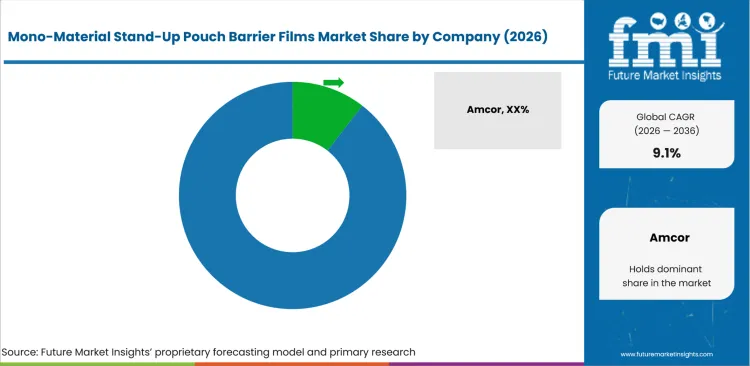
The competitive field combines integrated film producers with pouch manufacturers and resin technology companies across global packaging programs. Amcor completed its combination with Berry Global in April 2025 and now reports the combined operations under Amcor. The transaction removes Berry Global as a separate current competitor and expands Amcor’s flexible-packaging production network. Commercial approval requires integrated producers to provide evidence for both film design and finished-pouch line performance. Across packaging barrier films competition depends on documented production performance rather than isolated laboratory claims.
- Amcor and Mondi combine film development with finished-pouch programs across food and consumer packaging applications. Amcor documented mono-PE cheese packaging in February 2026 with verified barrier and commercial line evidence. Mondi supports stand-up and flexible formats through integrated film extrusion and pouch production across several European plants.
- ProAmpac and Constantia Flexibles compete through specialized barrier structures and technical support for commercial packaging plants. ProAmpac expanded its patent portfolio in March 2025 with mono-material stand-up pouch and high-barrier platforms. Constantia Flexibles commissioned a new MDO line in July 2025 to produce EcoLamHighPlus at its Pirk facility, with a separate EUR 6.5 million MDO investment, and announced broader portfolio expansion at FACHPACK in August 2025.
- UFlex and Huhtamaki support mono-material barrier development through different polymer routes and commercial packaging platforms. UFlex introduced F-HSS mono-material PET film in February 2026 for pouches requiring strong seals and reliable machinability. Huhtamaki reported in January 2026 that Omnilock MAX PE combines barrier performance with material recyclability. Dow contributes resin technology and Coveris adds regional pouch production across established European food-packaging programs.
Competitive Benchmarking: Mono-Material Stand-Up Pouch Barrier Films Market
| Company | Mono-Material Pouch Depth | Barrier and Seal Performance | Conversion and Scale Support | Geographic Reach |
|---|---|---|---|---|
| Amcor | High | High | High | Global |
| Mondi | High | High | High | Global |
| ProAmpac | High | High | Medium | Global |
| Constantia Flexibles | High | High | Medium | Europe, Americas and Asia-Pacific |
| UFlex | Medium | Medium | High | Global |
| Coveris | High | High | Medium | Europe |
| Dow | Low | Medium | Medium | Global |
| Huhtamaki | Medium | Medium | Medium | Global |
Key Developments in the Mono-Material Stand-Up Pouch Barrier Films Market
- In March 2026, Amcor expanded its Lugo di Vicenza facility in Italy with a line dedicated to high-barrier recycle-ready films for pouches and lidding. The nearly 7,000-square-meter department includes quality laboratories and temperature-controlled curing chambers that support consistent film production. The investment gives food and healthcare packaging programs more commercial capacity for structures that require dependable barrier performance across longer production runs.
- In February 2025, Mondi introduced a 950-milliliter mono-PE spouted pouch with Sherwin-Williams for concentrated paint sold in the United Kingdom. The format increased units per pallet by 230% and reduced plastic use by up to 90% compared with a five-liter bucket. The project shows how a stand-up pouch can replace rigid packaging without losing controlled pouring, reclosure or transport efficiency.
- In September 2025, Dow joined Zermatt and Nature’s Variety to launch a mono-PE pet-food pouch containing 10% advanced recycled content through mass balance. The structure replaced a PET and PE laminate and aligned with current European design-for-recycling requirements. Commercial availability across Spain, France and Portugal extends recycled-content use into contact-sensitive pet-food packaging with established retail distribution and regional food-contact requirements.
- In May 2026, Coveris announced that MonoFlexBE polyethylene pouches would be showcased at the International Cheese & Dairy EXPO in the United Kingdom. The official release described high-barrier protection and shelf life reaching 120 days across grated-cheese applications. The commercialization record gives dairy processors a current format for testing seal performance and product protection without returning to multi-material laminates during retailer qualification.
Key Players in the Mono-Material Stand-Up Pouch Barrier Films Market
Global Film and Pouch Platforms
- Amcor
- Mondi
- Huhtamaki
Specialist Flexible Packaging Companies
- ProAmpac
- Constantia Flexibles
- Coveris
Material and Regional Scale Providers
- Dow
- UFlex
Mono-Material Stand-Up Pouch Barrier Films Market - Report Scope
| Coverage field | Report scope |
|---|---|
| Market breakdown | Material, format, barrier or feature, end use, and region. |
| Quantitative Units | USD Million, CAGR in %. |
| Market Definition | Commercial demand for mono-material stand-up pouch barrier films across packaging conversion and end-use applications. |
| Regions Covered | North America, Latin America, Western Europe, Eastern Europe, East Asia, South Asia and Pacific, and Middle East and Africa. |
| Countries Covered | India, United States, Germany, France, Japan, United Kingdom, and 30+ countries. |
| Key Companies Profiled | Amcor, Mondi, ProAmpac, Constantia Flexibles, UFlex, Coveris, Dow, and Huhtamaki. |
| Forecast Period | 2026 to 2036. |
| Approach | Hybrid bottom-up and top-down market sizing supported by primary interviews and official desk research. |
Mono-Material Stand-Up Pouch Barrier Films Market - Research Methodology
| Method | Approach |
|---|---|
| Primary Research | FMI analysts gathered input from manufacturers, service providers, technology developers, distributors, end users, sourcing teams, and subject-matter experts. Interviews examined purchasing decisions, product or service evaluation, adoption barriers, approval requirements, pricing considerations, and expectations for technical or commercial support. Respondents were also asked what evidence is required before a trial, pilot, or initial order develops into regular purchasing. |
| Desk Research | Desk research covered government statistics, regulatory publications, trade data, industry associations, technical literature, standards, company filings, product information, and official corporate announcements. Sources were reviewed for relevance, publication date, geographic coverage, and consistency with the defined market scope. Claims relating to performance, applications, approvals, capacity, investment, and commercial activity were retained only when supported by credible public evidence. |
| Market Sizing and Forecasting | The market model combined the baseline value with historical performance, segment structure, pricing and volume indicators, adoption levels, company participation, and country-level demand conditions. Forecast assumptions considered economic activity, investment trends, regulatory developments, technology adoption, purchasing cycles, supply availability, and barriers to wider market use. Segment and regional estimates were reconciled before the final market total was calculated. |
| Data Validation | Estimates were checked against multiple independent indicators, including public data, company activity, trade patterns, industry developments, and findings from primary interviews. Validation also tested whether products, services, applications, and company revenues fell within the defined market boundaries. Adjacent categories, unsupported claims, overlapping revenues, and activities without direct market relevance were excluded to reduce double counting and maintain consistency across segments and countries. |
Mono-Material Stand-Up Pouch Barrier Films Market by Segments
Mono-Material Stand-Up Pouch Barrier Films Market segmented by Material:
- Paper
- Molded Fiber
- Recycled PET
- Mono-material PE
- Bio-based Polymer
Mono-Material Stand-Up Pouch Barrier Films Market segmented by Format:
- Pouches
- Trays
- Labels
- Mailers
- Inserts
Mono-Material Stand-Up Pouch Barrier Films Market segmented by Barrier or Feature:
- Grease Resistant
- High Barrier
- Tamper Evident
- Traceable
- Freshness Indicating
Mono-Material Stand-Up Pouch Barrier Films Market segmented by End Use:
- Food
- Pharmaceutical
- E-commerce
- Personal Care
- Cold Chain
Mono-Material Stand-Up Pouch Barrier Films Market segmented by Region:
- North America
- Europe
- East Asia
- South Asia and Pacific
- Latin America
- Middle East and Africa
Research Sources and Bibliography
- Department for Environment, Food & Rural Affairs, & Environment Agency. (2026, April 7). Extended producer responsibility for packaging: recycling obligations and waste disposal fees.
- Oregon Department of Environmental Quality. (2025, July 1). Oregon leads the nation in implementing the Plastic Pollution and Recycling Modernization Act.
- Amcor. (2025, July 11). Amcor & Mediacor launch a refill pouch for Nana laundry and cleaning products.
- ProAmpac. (2026, March 2). The Whole Package: Innovation in Motion at Expo West.
- Mondi. (2025, June 5). Happier pets, smarter packaging: Mondi & Saga Nutrition launch sustainable solution.
- Coveris. (2025, June 13). Visit Coveris at the International Cheese & Dairy Awards.
- Citeo. (2026, June 18). Les chiffres du recyclage en France.
- Central Agency Packaging Register. (2025, August 29). 2025 minimum standard published - initial touchstone for companies preparing for the EU Packaging and Packaging Waste Regulation (PPWR).
- Constantia Flexibles. (2025, July 4). 6.5 million Euro investment in Hosokawa Alpine MDO technology advances packaging innovation.
- Press Information Bureau. (2026, March 23). PARLIAMENT QUESTION: Circular Economy Framework and Extended Producer Responsibility.
- Oregon Department of Environmental Quality. (2025, February 21). DEQ approves Producer Responsibility Organization program plan, advances Plastic Pollution and Recycling Modernization Act.
- German Environment Agency, & Central Agency Packaging Register. (2026, January 27). Facts against myths: Packaging waste recycling in Germany is working.
- Citeo. (2026, April 14). Accélérer l’innovation et la performance dans les territoires : 210 projets locaux soutenus.
- Ministry of the Environment, Government of Japan. (2026, March 31). Compilation Results of Projected Separate Collection Volumes for Fiscal Year 2026 and Beyond under the Containers and Packaging Recycling Act. Tokyo: Ministry of the Environment, 2025.
- PackUK, & Department for Environment, Food & Rural Affairs. (2026, March 23). Extended producer responsibility for packaging: notice of liability.
- Amcor. (2025, April 30). Amcor completes combination with Berry Global; Positioned to significantly enhance value for customers and shareholders.
- Amcor. (2026, February 20). Amcor wins two WorldStar Global Packaging Awards for recycle-ready shredded cheese packs.
- ProAmpac. (2025, March 4). Bolstering Sustainable Packaging Leadership, ProAmpac Expands Intellectual Property Portfolio.
- Constantia Flexibles. (2025, August 12). FACHPACK 2025: Constantia Flexibles invests over €100 million and expands product portfolio.
- UFlex. (2026, February 9). UFlex Introduces F-HSS Mono-Material PET Film for Sustainable Packaging at PLASTINDIA 2026.
- Huhtamaki. (2026, January 12). Huhtamaki Solutions Recognised at the WorldStar Awards 2026.
- Amcor. (2026, March 9). Amcor’s expanded facility in Italy will meet demand for recyclable packaging.
- Mondi. (2025, February 26). Mondi’s re/cycle SpoutedPouch replaces plastic tubs for paint.
- Dow. (2025, September 29). Dow, Zermatt, and Nature’s Variety launch pet food pouch with food-contact compliant advanced recycled content.
- Coveris. (2026, May 27). Coveris Highlights Recycle-Ready Packaging at International Cheese & Dairy EXPO.
This bibliography provides selected reader references and does not represent the complete source register used for the full report. The full report includes the complete reference list together with detailed citations for retained factual claims.
This Report Answers
- How large is the mono-material stand-up pouch barrier films market in 2026 and 2036?
- Which regulatory and operating pressures support commercial conversion from multi-material pouch laminates?
- Why does mono-material PE hold the clearest material position during 2026?
- How do pouch formats influence filling economics and product handling requirements?
- Which barrier conditions determine adoption across food and pet-food applications?
- How do country growth rates differ across India, the United States, Europe, and Japan?
- Which companies combine film technology with finished pouch conversion and technical support?
- What local recycling conditions can delay adoption despite acceptable packaging performance?
- How should packaging teams evaluate return on investment for a mono-material conversion program?
Frequently Asked Questions
How big is the Mono-Material Stand-Up Pouch Barrier Films Market in 2026?
The mono-material stand-up pouch barrier films market is valued at USD 50.0 million in 2026 and is forecast to reach USD 120.0 million by 2036.
What is the CAGR of the Mono-Material Stand-Up Pouch Barrier Films Market from 2026 to 2036?
The mono-material stand-up pouch barrier films market is projected to grow at a CAGR of 9.1% between 2026 and 2036, supported by material-specific fees and recyclability requirements giving brand owners a measurable reason to replace complex laminates with qualified mono-material pouch structures.
Which end use leads the Mono-Material Stand-Up Pouch Barrier Films Market?
Food accounts for 52.0% of the mono-material stand-up pouch barrier films market by end use in 2026, driven by frequent packaging turnover and strict shelf-life controls requiring commercial filling trials that confirm oxygen protection and seal integrity for any replacement laminate.
Which country is growing fastest in the Mono-Material Stand-Up Pouch Barrier Films Market?
India is the fastest-growing country in the mono-material stand-up pouch barrier films market, expanding at a 12.3% CAGR through 2036, ahead of the market average of 9.1%, underpinned by wider EPR reporting, registered processing investment, and expanding regional film production across food and home-care product programs.
Who are the leading companies in the Mono-Material Stand-Up Pouch Barrier Films Market?
Leading companies in the mono-material stand-up pouch barrier films market include Amcor, Mondi, ProAmpac, Constantia Flexibles, UFlex, Coveris, Dow, and Huhtamaki, competing across global film and pouch platforms, specialist flexible packaging programs, and material and regional scale supply networks.
Preview the report firsthand - request a free sample
Get SampleGet the brochure for pricing and purchase details.
Get PDFTable of Content
- Key Takeaways
- Market Size and CAGR
- Top Growth Driver
- Fastest Growing Segment
- Leading Region
- Key Companies
- Emerging Opportunities
- Executive Summary
- Global Market Outlook
- Demand-side Trends
- Supply-side Trends
- Technology Roadmap Analysis
- Analysis and Recommendations
- Analyst Perspective (What is happening? Why now? What should investors know?)
- Key Questions Answered
- How large is the market?
- What is the CAGR?
- What are key trends?
- Which region dominates?
- Who are the leaders?
- Market Overview
- Market Coverage / Taxonomy
- Market Definition / Scope / Limitations
- Research Methodology
- Chapter Orientation
- Analytical Lens and Working Hypotheses
- Market Structure, Signals, and Trend Drivers
- Benchmarking and Cross-market Comparability
- Market Sizing, Forecasting, and Opportunity Mapping
- Research Design and Evidence Framework
- Desk Research Programme (Secondary Evidence)
- Expert Input and Fieldwork (Primary Evidence)
- Tooling, Models, and Reference Databases
- Data Engineering and Model Build
- Quality Assurance and Audit Trail
- Market Background
- Market Dynamics (Drivers, Restraints, Opportunity, Trends)
- Scenario Forecast (Optimistic, Likely, Conservative)
- Impact Analysis
- AI Impact
- Sustainability Impact
- Regulatory Impact
- Technology Impact
- Consumer / Buyer Analysis
- Purchase Drivers
- Adoption Barriers
- Buyer Journey
- Opportunity Map Analysis
- Product Life Cycle Analysis
- Supply Chain Analysis
- Investment Feasibility Matrix
- Value Chain Analysis
- PESTLE and Porter's Analysis
- Regulatory Landscape
- Regional Parent Market Outlook
- Production and Consumption Statistics
- Import and Export Statistics
- Global Market Analysis and Forecast, 2021 to 2036
- Historical Market Size Value (USD Million) Analysis, 2021 to 2025
- Current and Future Market Size Value (USD Million) Projections, 2026 to 2036
- Y-o-Y Growth Trend Analysis
- Absolute $ Opportunity Analysis
- Global Market Pricing Analysis, 2021 to 2036
- Global Market Analysis and Forecast, By Material, 2021 to 2036
- Introduction / Key Findings
- Historical Market Size Value (USD Million) Analysis By Material, 2021 to 2025
- Current and Future Market Size Value (USD Million) Analysis and Forecast By Material, 2026 to 2036
- Mono-Material Pe
- Molded Fiber
- Recycled Pet
- Paper
- Bio-Based Polymer
- Mono-Material Pe
- Y-o-Y Growth Trend Analysis By Material, 2021 to 2025
- Absolute $ Opportunity Analysis By Material, 2026 to 2036
- Global Market Analysis and Forecast, By Format, 2021 to 2036
- Introduction / Key Findings
- Historical Market Size Value (USD Million) Analysis By Format, 2021 to 2025
- Current and Future Market Size Value (USD Million) Analysis and Forecast By Format, 2026 to 2036
- Pouches
- Trays
- Labels
- Mailers
- Inserts
- Pouches
- Y-o-Y Growth Trend Analysis By Format, 2021 to 2025
- Absolute $ Opportunity Analysis By Format, 2026 to 2036
- Global Market Analysis and Forecast, By Barrier or Feature, 2021 to 2036
- Introduction / Key Findings
- Historical Market Size Value (USD Million) Analysis By Barrier or Feature, 2021 to 2025
- Current and Future Market Size Value (USD Million) Analysis and Forecast By Barrier or Feature, 2026 to 2036
- Grease Resistant
- High Barrier
- Tamper Evident
- Traceable
- Freshness Indicating
- Grease Resistant
- Y-o-Y Growth Trend Analysis By Barrier or Feature, 2021 to 2025
- Absolute $ Opportunity Analysis By Barrier or Feature, 2026 to 2036
- Global Market Analysis and Forecast, By End Use, 2021 to 2036
- Introduction / Key Findings
- Historical Market Size Value (USD Million) Analysis By End Use, 2021 to 2025
- Current and Future Market Size Value (USD Million) Analysis and Forecast By End Use, 2026 to 2036
- Food
- Pharmaceutical
- E-Commerce
- Personal Care
- Cold Chain
- Food
- Y-o-Y Growth Trend Analysis By End Use, 2021 to 2025
- Absolute $ Opportunity Analysis By End Use, 2026 to 2036
- Global Market Analysis and Forecast, By Region, 2021 to 2036
- Introduction
- Historical Market Size Value (USD Million) Analysis By Region, 2021 to 2025
- Current Market Size Value (USD Million) Analysis and Forecast By Region, 2026 to 2036
- North America
- Latin America
- Western Europe
- Eastern Europe
- East Asia
- South Asia and Pacific
- Middle East & Africa
- Market Attractiveness Analysis By Region
- North America Market Analysis and Forecast, By Country, 2021 to 2036
- Historical Market Size Value (USD Million) Trend Analysis By Market Taxonomy, 2021 to 2025
- Market Size Value (USD Million) Forecast By Market Taxonomy, 2026 to 2036
- By Country
- USA
- Canada
- By Material
- By Format
- By Barrier or Feature
- By End Use
- By Country
- Market Attractiveness Analysis
- By Country
- By Material
- By Format
- By Barrier or Feature
- By End Use
- Key Takeaways
- Latin America Market Analysis and Forecast, By Country
- Historical Market Size Value (USD Million) Trend Analysis By Market Taxonomy, 2021 to 2025
- Market Size Value (USD Million) Forecast By Market Taxonomy, 2026 to 2036
- By Country
- Brazil
- Mexico
- Chile
- Rest of Latin America
- By Material
- By Format
- By Barrier or Feature
- By End Use
- By Country
- Market Attractiveness Analysis
- By Country
- By Material
- By Format
- By Barrier or Feature
- By End Use
- Key Takeaways
- Western Europe Market Analysis and Forecast, By Country
- Historical Market Size Value (USD Million) Trend Analysis By Market Taxonomy, 2021 to 2025
- Market Size Value (USD Million) Forecast By Market Taxonomy, 2026 to 2036
- By Country
- Germany
- UK
- Italy
- Spain
- France
- Nordic
- BENELUX
- Rest of Western Europe
- By Material
- By Format
- By Barrier or Feature
- By End Use
- By Country
- Market Attractiveness Analysis
- By Country
- By Material
- By Format
- By Barrier or Feature
- By End Use
- Key Takeaways
- Eastern Europe Market Analysis and Forecast, By Country
- Historical Market Size Value (USD Million) Trend Analysis By Market Taxonomy, 2021 to 2025
- Market Size Value (USD Million) Forecast By Market Taxonomy, 2026 to 2036
- By Country
- Russia
- Poland
- Hungary
- Balkan & Baltic
- Rest of Eastern Europe
- By Material
- By Format
- By Barrier or Feature
- By End Use
- By Country
- Market Attractiveness Analysis
- By Country
- By Material
- By Format
- By Barrier or Feature
- By End Use
- Key Takeaways
- East Asia Market Analysis and Forecast, By Country
- Historical Market Size Value (USD Million) Trend Analysis By Market Taxonomy, 2021 to 2025
- Market Size Value (USD Million) Forecast By Market Taxonomy, 2026 to 2036
- By Country
- China
- Japan
- South Korea
- By Material
- By Format
- By Barrier or Feature
- By End Use
- By Country
- Market Attractiveness Analysis
- By Country
- By Material
- By Format
- By Barrier or Feature
- By End Use
- Key Takeaways
- South Asia and Pacific Market Analysis and Forecast, By Country
- Historical Market Size Value (USD Million) Trend Analysis By Market Taxonomy, 2021 to 2025
- Market Size Value (USD Million) Forecast By Market Taxonomy, 2026 to 2036
- By Country
- India
- ASEAN
- Australia & New Zealand
- Rest of South Asia and Pacific
- By Material
- By Format
- By Barrier or Feature
- By End Use
- By Country
- Market Attractiveness Analysis
- By Country
- By Material
- By Format
- By Barrier or Feature
- By End Use
- Key Takeaways
- Middle East & Africa Market Analysis and Forecast, By Country
- Historical Market Size Value (USD Million) Trend Analysis By Market Taxonomy, 2021 to 2025
- Market Size Value (USD Million) Forecast By Market Taxonomy, 2026 to 2036
- By Country
- Kingdom of Saudi Arabia
- Other GCC Countries
- Türkiye
- South Africa
- Other African Union
- Rest of Middle East & Africa
- By Material
- By Format
- By Barrier or Feature
- By End Use
- By Country
- Market Attractiveness Analysis
- By Country
- By Material
- By Format
- By Barrier or Feature
- By End Use
- Key Takeaways
- Key Countries Market Analysis
- USA
- Pricing Analysis
- Market Share Analysis, 2025
- By Material
- By Format
- By Barrier or Feature
- By End Use
- Canada
- Pricing Analysis
- Market Share Analysis, 2025
- By Material
- By Format
- By Barrier or Feature
- By End Use
- Mexico
- Pricing Analysis
- Market Share Analysis, 2025
- By Material
- By Format
- By Barrier or Feature
- By End Use
- Brazil
- Pricing Analysis
- Market Share Analysis, 2025
- By Material
- By Format
- By Barrier or Feature
- By End Use
- Chile
- Pricing Analysis
- Market Share Analysis, 2025
- By Material
- By Format
- By Barrier or Feature
- By End Use
- Germany
- Pricing Analysis
- Market Share Analysis, 2025
- By Material
- By Format
- By Barrier or Feature
- By End Use
- UK
- Pricing Analysis
- Market Share Analysis, 2025
- By Material
- By Format
- By Barrier or Feature
- By End Use
- Italy
- Pricing Analysis
- Market Share Analysis, 2025
- By Material
- By Format
- By Barrier or Feature
- By End Use
- Spain
- Pricing Analysis
- Market Share Analysis, 2025
- By Material
- By Format
- By Barrier or Feature
- By End Use
- France
- Pricing Analysis
- Market Share Analysis, 2025
- By Material
- By Format
- By Barrier or Feature
- By End Use
- India
- Pricing Analysis
- Market Share Analysis, 2025
- By Material
- By Format
- By Barrier or Feature
- By End Use
- ASEAN
- Pricing Analysis
- Market Share Analysis, 2025
- By Material
- By Format
- By Barrier or Feature
- By End Use
- Australia & New Zealand
- Pricing Analysis
- Market Share Analysis, 2025
- By Material
- By Format
- By Barrier or Feature
- By End Use
- China
- Pricing Analysis
- Market Share Analysis, 2025
- By Material
- By Format
- By Barrier or Feature
- By End Use
- Japan
- Pricing Analysis
- Market Share Analysis, 2025
- By Material
- By Format
- By Barrier or Feature
- By End Use
- South Korea
- Pricing Analysis
- Market Share Analysis, 2025
- By Material
- By Format
- By Barrier or Feature
- By End Use
- Russia
- Pricing Analysis
- Market Share Analysis, 2025
- By Material
- By Format
- By Barrier or Feature
- By End Use
- Poland
- Pricing Analysis
- Market Share Analysis, 2025
- By Material
- By Format
- By Barrier or Feature
- By End Use
- Hungary
- Pricing Analysis
- Market Share Analysis, 2025
- By Material
- By Format
- By Barrier or Feature
- By End Use
- Kingdom of Saudi Arabia
- Pricing Analysis
- Market Share Analysis, 2025
- By Material
- By Format
- By Barrier or Feature
- By End Use
- Türkiye
- Pricing Analysis
- Market Share Analysis, 2025
- By Material
- By Format
- By Barrier or Feature
- By End Use
- South Africa
- Pricing Analysis
- Market Share Analysis, 2025
- By Material
- By Format
- By Barrier or Feature
- By End Use
- USA
- Market Structure Analysis
- Competition Dashboard
- Competition Benchmarking
- Market Share Analysis of Top Players
- By Regional
- By Material
- By Format
- By Barrier or Feature
- By End Use
- Emerging Startups
- Innovation Benchmarking
- Competition Analysis
- Competition Deep Dive
- Amcor
- Overview
- Product Portfolio
- Profitability by Market Segments
- Sales Footprint
- Strategy Overview
- Marketing Strategy
- Product Strategy
- Channel Strategy
- Mondi
- Berry Global
- ProAmpac
- Constantia Flexibles
- UFlex
- Coveris
- Dow
- Amcor
- Case Studies
- Success Stories
- Recent Developments
- Competition Deep Dive
- Assumptions & Acronyms Used


