

- Market Size (2026)
- USD 1.7 Bn
- Forecast (2036)
- USD 2.9 Bn
- CAGR (2026 to 2036)
- 5.5%
How big is Mortar Mixer Machines Market in 2026?
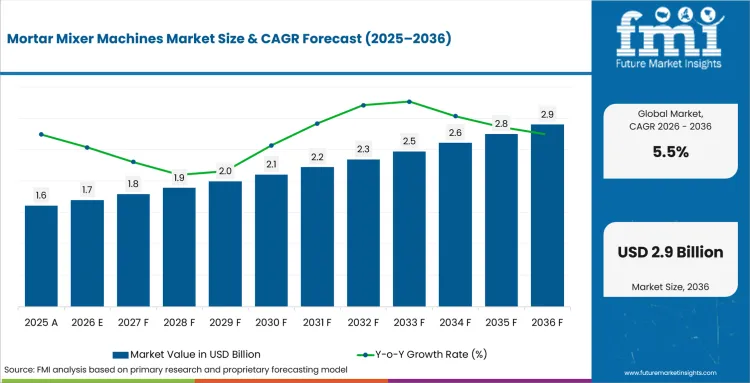
USD 1.7 billion in 2026 and USD 2.9 billion by 2036 at a 5.5% CAGR.
Demand for mortar mixer machines are estimated to rise at 5.5% CAGR through 2036, increasing valuation from USD 1.7 billion in 2026 to USD 2.9 billion by 2036. Portable machines serve indoor projects that require repeated batches and limited space without centralized production. A March 2025, Collomix jobsite case documented 48 cement screed batches completed in two and one-half hours. The documented workload links constrained access with rapid preparation across active operations rather than isolated equipment tests onsite. Construction equipment attachments affect transport choices across changing workfaces; ready-mix concrete specifications influence water control and batch timing during smaller mortar workflows.
Power choice separates projects with dependable electrical service from remote jobsites that require combustion engines and fuel handling. Distributor economics also depend on shipping density and inventory space across fragmented channels serving contractors. Logistics influence which configurations remain practical for dealers carrying several capacities and engine formats across regional territories. Lino Sella reported in January 2025, that boxed designs take up to 40% less container space. Greater loading density lowers handling pressure for dealers that stock hand tools beside masonry equipment packages. Larger contractors compare industrial mixers and balance site power with transport costs and service response across changing schedules.
Key Takeaways of Mortar Mixer Machines Market
- Masonry projects support mixer demand across contractors requiring repeatable batches without centralized production equipment onsite.
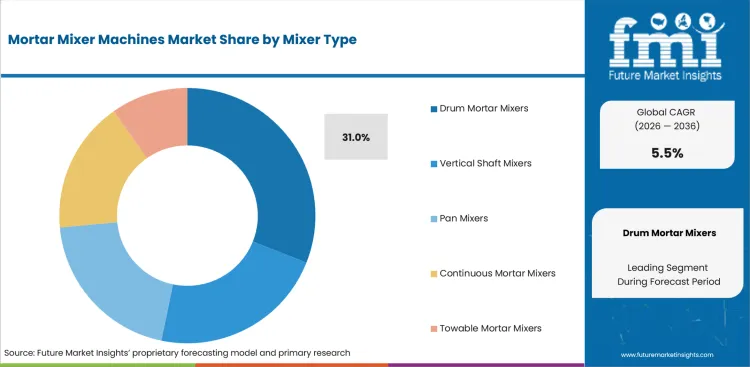
- Drum mortar mixers are expected to hold 31.0% share in 2026, reflecting familiar discharge routines.
- In 2026, the 3-6 cu ft category is projected to hold 34.0% share, supported by transportability.
- Electric machines are forecast to capture 42.0% share in 2026, aided by reliable power access.
- Silica exposure controls and uneven technician coverage remain barriers across smaller fleets and remote territories.
- Competition spans global equipment groups and specialist mixer manufacturers with distinct channel and application coverage.
Analyst Perspective
“Mortar mixer economics depend on whether one machine can serve repair and new-build schedules without idle time. Drum designs support familiar loading; electric models suit occupied sites with dependable power and placement. Dealers improve utilization through demonstrations, parts access and training across dispersed territories requiring reliable service between short projects.”
- Nikhil Kaitwade, Principal Analyst, Future Market Insights
How is the Mortar Mixer Machines Market segmented?
The mortar mixer machines industry is segmented by mixer type, capacity, power source, application, end use, sales channel, and region.
The market is segmented by mixer type, capacity, power source, application, end use, sales channel, and region. Mixer type covers drum, pan, continuous, twin-shaft, and other configurations, and capacity separates four defined output bands. Power source includes electric, gasoline, diesel, and battery-powered models beside broader power tools market categories. Application covers masonry mortar, plaster and stucco, tile adhesives and grouts, repair mortar, and other prepared materials. End use includes masonry contractors, general contractors, rental companies, and other users across recurring construction workflows. Sales channels cover equipment dealers, rentals, direct sales, and online channels across every assessed region and country group.
What supports demand for drum mortar mixers within the mixer type category?
Drum mixers support familiar mortar recipes across mobile projects that require simple loading and predictable discharge during repeated contractor shifts. Lino Sella stated in May 2025 that traditional mixers use simple controls across mobile construction sites and changing operators. Dealers pair these units with compact construction equipment as towable frames align with familiar rental maintenance routines during recurring project work.
- Drum mortar mixers are projected to hold 31.0% share in 2026 owing to familiar loading and discharge routines. Their position reflects broad fleet compatibility across masonry repairs and construction packages through active rental channels. Continuous mixers remain better suited to uninterrupted production with sealed feeding and steady material flow onsite.
- Masonry crews adopt drum mixers for renovations and repair packages requiring several controlled daily batches during one working shift. Towable frames simplify relocation and equipment handover across changing operators during repeated project turnover cycles onsite. Dust-sensitive sites may require sealed feeding systems and stronger exposure controls during loading operations onsite.
Why does the 3-6 cu ft segment shape demand within the capacity category?
Medium-capacity machines balance useful output with access through narrow gates and staging areas during renovations. Contractors need workable batch frequency without holding excess mortar beyond its practical placement window onsite. Lino Sella explained in January 2025 that compact mixers suit limited spaces and material volumes. The capacity fits typical equipment rental services bookings across short projects and seasonal schedules onsite.
- By capacity, 3-6 cu ft machines are estimated to hold 34.0% share in 2026 owing to balanced output and transportability. Smaller units require extra loading cycles across recurring repair work and short placement windows onsite. Larger machines need wider staging areas and stronger towing arrangements across projects and contractor schedules.
- Rental fleets favor 3-6 cu ft mixers as one machine supports repair crews and small contractors across varied bookings. The capacity reduces unused mortar and cleanup volume during shorter tasks with changing material requirements. Repeated loading becomes too costly across long production shifts, weakening adoption within continuous high-volume work schedules.
How is electric positioned within the power source category?
Electric mixers suit urban projects with dependable power and operating limits near occupied buildings during scheduled repairs and interior finishing work. Lino Sella described a silent electric mixer in February 2025 that uses specialized transmission design to reduce operating noise. Electric units support construction chemicals applications and interior repairs without routine engine exhaust near occupants across active renovation areas onsite.
- The power source category is forecast to be led by electric at 42.0% share in 2026 due to dependable starting. Urban repairs favor electric units through accessible power connections and lower point-of-use exhaust during operation. Remote construction locations require combustion models as onsite supply reliability and cable distance limit electric operation.
- General contractors adopt electric mixers across work areas supplied by distribution panels for cutting and finishing equipment. Consistent power simplifies operator training and scheduled maintenance across recurring projects with similar site conditions. Voltage variation and long cable runs make combustion models more practical across infrastructure projects and remote work areas.
What makes masonry mortar central to the application category?
Masonry mortar requires controlled water addition and uniform mixing to preserve workability during active placement. Poor consistency slows placement and produces visible variation across joints or rendered surfaces during finishing. Lino Sella explained in January 2025 that pan mixers use rotating blades for uniform preparation. Contractors use masonry cement specifications to plan machine settings and material packages during onsite review.
- The masonry mortar segment is likely to capture 41.0% share in 2026 attributable to repeated use across brickwork and blockwork. Its position reflects the need for consistent workability across many small batches and placement phases. Specialty grouts and renders require different agitation patterns or delivery systems that limit substitution onsite.
- Bricklayers adopt dedicated mixers to maintain water ratios and placement rhythm throughout repeated lifts across active work areas. Equipment reduces manual variation and allows crews to prepare material near the active work face. Hardened residue raises maintenance effort across later shifts; accessible cleaning points therefore influence daily equipment use onsite.
How do masonry contractors influence demand within the end use category?
Masonry contractors coordinate labor and material placement across several work areas during demanding project schedules. Repeated preparation consumes skilled crew time across projects requiring mortar batches during a working day. Lino Sella explained in February 2025 that construction mixers improve homogeneity and reduce manual effort. Contractors use mortar testing equipment with dedicated mixers to document material performance during acceptance reviews.
- Based on end use, masonry contractors are projected to account for 38.0% share in 2026 due to recurring batch preparation. Direct control over loading rhythm and machine care supports ownership across repair and new-build schedules. General contractors often outsource specialized masonry packages requiring dedicated crews and equipment onsite during placement.
- Portable mixers give masonry contractors scheduling independence across repair work requiring several planned site visits. Ownership supports familiar materials and repeatable loading practices across recurring workloads and varied project locations. Rental remains practical for irregular projects if dealers provide demonstrations and maintenance support through local parts and repair routes onsite.
What are the drivers, restraints, and opportunities in the Mortar Mixer Machines Market?
Recurring masonry work supports portable batch preparation, safety and service gaps delay fleet decisions, and dealer or auction channels widen equipment access.
- Driver: Recurring residential and repair projects require repeated mortar preparation across dispersed contractor jobsites during active schedules.
- Restraint: Silica controls and limited technician coverage increase training demands and equipment downtime across smaller contractor fleets.
- Opportunity: Dealer demonstrations and auctions widen equipment access for contractors unable to justify immediate new-machine purchases.
Repeated masonry work depends on uniform mortar that remains workable across each planned placement sequence. Manual preparation can leave dry pockets or uneven water content across larger batches that extend placement time. In August 2025, the Mason Contractors Association of America explained that mechanical mixers provide uniform batches for large-scale projects. Mechanical preparation supports steadier crew rhythm and limits repair exposure across contracts with enough workload to justify equipment ownership.
Silica and chemical exposure controls can delay mixer deployment across rotating crews at temporary construction sites. Written training and safety data must travel with each machine as supervisors shift between locations. OSHA issued a June 2025 serious citation to Mch Masonry for missing a written hazard communication program at a concrete masonry cement mixer. Smaller fleets may defer purchases if supervision and records cannot follow each machine across projects consistently.
Dealer and auction channels reduce capital exposure for contractors with irregular mixer utilization across seasonal schedules. In March 2026, the Mason Contractors Association of America announced an annual auction featuring name-brand mixers and advance purchase options. The event gave smaller firms a lower-cost equipment route without requiring immediate investment in new machines. Used mixers retain commercial value if condition records and dependable repairs support recurring work through local parts channels.
Which country CAGRs are profiled in the Mortar Mixer Machines Market?
| Country | CAGR |
|---|---|
| United States | 4.7% |
| Germany | 4.3% |
| Japan | 4.0% |
| UK | 5.0% |
| Mexico | 5.4% |
How do country-level CAGRs compare in the Mortar Mixer Machines Market?
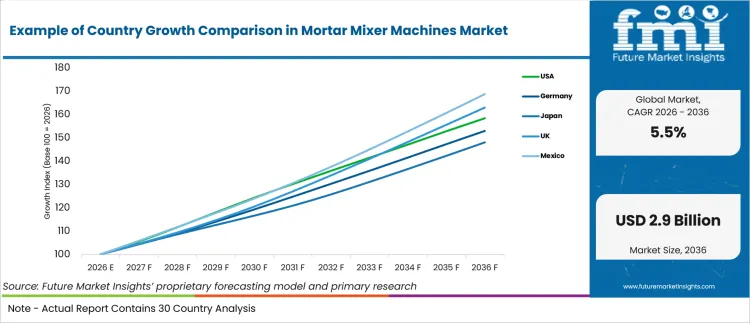
Five profiled countries remain within a 1.4 percentage-point band, yet their equipment conversion routes differ. Mexico and the United Kingdom rely heavily on distributor or hire access across regional fleets and temporary project schedules. The United States tracks the global rate through broad dealer coverage across dispersed masonry work. Germany advances through documented safety and formal service routes; Japan relies on compact formats with local import support and voltage compatibility. Similar forecasts therefore conceal different maintenance distances, power constraints and purchasing models across diverse national construction markets and contractor territories.
- Mexico’s 0.4-point separation from the United Kingdom reflects distributor coverage across territories and seasonal projects.
- The United Kingdom’s 0.3-point separation from the United States reflects hire networks serving repair projects.
- A 0.4-point gap separates the United States from Germany as dealer coverage supports masonry work.
- Germany’s 0.3-point separation from Japan reflects documentation requirements extending replacement decisions across regulated construction projects.
- Japan’s position reflects compact-site requirements and imported-equipment service needs that lengthen conversion across regional projects.
Service distance and rental coverage make similar CAGRs represent different equipment entry conditions across markets. The full report provides country-level CAGR analysis across North America, Latin America, Europe, East Asia, South Asia, Oceania and the Middle East and Africa.
Country-wise Analysis
- United States contractors purchase through dense dealer and rental networks that support local demonstrations and repairs across dispersed project locations nationwide. Adoption of mortar mixer machines in the United States is estimated to expand at 4.7% CAGR through 2036, supported by recurring residential and repair work. New housing starts provide recurring jobsites that sustain rental and dealer fleet utilization during replacement cycles. The USA Census Bureau reported in July 2026 that June housing starts reached an annualized 1.427 million units. Established channels offer several power formats, although silica controls and technician distance remain material frictions outside major service areas nationwide.
- German construction sites emphasize documented machine safety and dependable service access across projects governed by formal operating procedures. Local distributors support electric models and provide technical documentation for renovation and building work across markets. Germany is estimated to post 4.3% CAGR over the forecast period, influenced by specification-led replacement and renovation activity. Construction orders frame the workload available to contractors planning equipment replacement and rental use across Germany. Destatis reported in February 2026 that construction orders increased 6.8% in real terms during 2025. Documentation demands and urban noise controls can lengthen sales cycles across regulated projects beyond major service centers.
- Japanese projects favor compact machines that enter restricted staging areas and operate safely beside occupied buildings. Mortar mixer machine demand in Japan is forecast to rise at 4.0% CAGR over the forecast period, shaped by construction investment and limited working space. Project planning therefore favors portable electric formats with local voltage compatibility across dense urban construction sites and recurring repairs. Japan’s transport ministry projected in August 2025 that construction investment would increase 3.2% during fiscal 2025. The forecast supports building and repair workloads, but imported equipment requires dependable regional maintenance coverage beyond major cities and established local distributor corridors nationwide.
- United Kingdom contractors rely on hire channels that place mixers near short-duration building and repair projects. Rental companies provide training and maintenance support across temporary demand cycles and regional project schedules. United Kingdom's mortar mixer machines outlook is anticipated to advance at 5.0% CAGR over the assessment period, reinforced by hire networks. Annual construction output frames the workload supporting hired mixers across renovation and smaller contractor packages. The Office for National Statistics reported in February 2026 that annual construction output increased 1.8% during 2025. Quarterly volatility weakens fleet utilization and replacement budgets outside major service areas despite established hire coverage.
- Mexican contractors purchase through regional distributors that coordinate imported machines and replacement parts across long service distances. Mortar mixer machine sales in Mexico are forecast to expand at 5.4% CAGR by 2036, attributable to stronger construction activity. Construction production value helps distributors assess stock requirements across seasonal demand and distant service territories. INEGI reported in July 2026 that construction production value increased 7.5% year over year during May 2026. Rising project value supports inventory planning for distributors serving several construction regions and contractor categories. Gasoline models suit remote sites, although financing costs and technician availability remain frictions for smaller fleets.
Who are the notable companies in the Mortar Mixer Machines Market?
Multiquip, IMER Group, Crown Construction Equipment, Altrad Belle, Collomix, Putzmeister, Lino Sella World, and TK Equipment are the notable companies shaping this market.
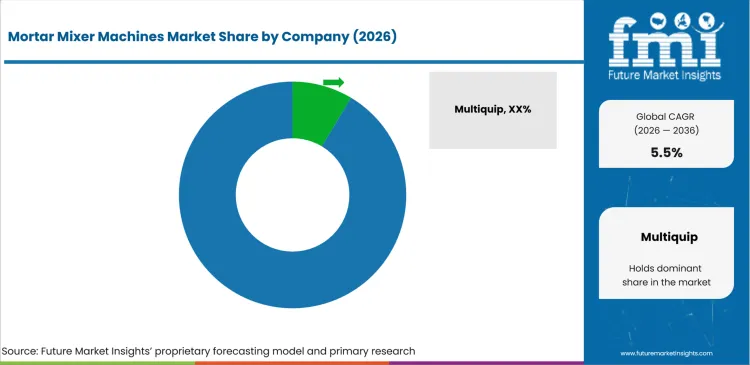
Competition remains fragmented across equipment groups, mixer specialists and firms focused on mechanized mortar delivery. No manufacturer spans every capacity and power configuration across fleets and rental channels within one portfolio. Entry remains possible through niche equipment; service coverage and replacement parts create barriers beyond fabrication capabilities.
- Multiquip and IMER Group compete through broad mixer ranges supported by manuals and established service networks. Their portfolios cover portable and higher-capacity formats, giving dealers several options for capacity and power requirements across mixed contractor fleets during planned replacement cycles.
- Crown Construction Equipment and TK Equipment emphasize towable mortar mixers across several capacities for North American contractors. Altrad Belle adds wider light-equipment channel coverage, strengthening access through hire companies and construction distributors serving smaller project packages across regional construction schedules.
- Collomix focuses on compact automatic batch preparation; Putzmeister covers mechanized mixing and delivery for premixed dry mortar. Lino Sella World spans portable drum and pan mixers through international dealers serving fragmented construction markets and varied contractor operating requirements across worksites.
Competitive Benchmarking: Mortar Mixer Machines Market
| Company | Mixer Range | Safety Documentation | Service Access | Geographic Reach |
|---|---|---|---|---|
| Multiquip | High | High | High | North America |
| IMER Group | High | High | High | North America and Europe |
| Crown Construction Equipment | High | High | Medium | North America |
| Altrad Belle | Medium | High | High | Global |
| Collomix | Medium | High | Medium | Europe and North America |
| Putzmeister | Medium | High | High | Global |
| Lino Sella World | High | Medium | High | Europe and export markets |
| TK Equipment | High | High | High | North America |
Scoring basis: Mixer range rates four verified formats as high, two or three as medium and one as low; safety documentation uses formal/basic/limited guidance for high/medium/low. Service access rates three/two/one routes as high/medium/low; geographic reach lists the regions supported through official dealer or service pages.
Key Developments in the Mortar Mixer Machines Market
- In January 2025, Collomix used World of Concrete to introduce the XQ series and oneMIX 340 for portable material preparation. The oneMIX combines motorized bucket rotation with dust collection inside a seventy-two-pound format designed for single-bag workflows.
- In February 2025, Altrad Belle partnered with MAC Distributors to expand equipment access across Ireland’s hire and construction channels. The agreement assigned equipment sales together with product consultancy and training support to the regional distributor.
- In March 2025, Putzmeister presented the MP 25 mixing pump for premixed dry mortar during bauma 2025. The machine handles bagged or silo-fed material and combines continuous mixing with delivery across plastering applications.
- In May 2025, Lino Sella presented pan mixers and towable cement mixers during its bauma review. The pan mixer combined compact dimensions with quiet operation and uniform preparation for smaller construction sites.
Mortar Mixer Machines Market - Report Scope
| Coverage field | Report scope |
|---|---|
| Market breakdown | Mixer type, capacity, power source, application, end use, sales channel, and region. |
| Market Definition | Portable and mechanized machines used to prepare mortar across construction, repair, rental, and small-batch production workflows. |
| Regions Covered | North America, Latin America, Western Europe, Eastern Europe, East Asia, South Asia and Pacific, and Middle East and Africa. |
| Countries Covered | United States, Germany, Japan, UK, and Mexico. |
| Key Companies Profiled | Multiquip, IMER Group, Crown Construction Equipment, Altrad Belle, Collomix, Putzmeister, Lino Sella World, and TK Equipment. |
| Forecast Period | 2026 to 2036. |
| Approach | Hybrid bottom-up and top-down market sizing supported by primary interviews and official desk research. |
Mortar Mixer Machines Market - Research Methodology
| Method | Approach |
|---|---|
| Primary Research | FMI analysts gathered input from manufacturers, service providers, technology developers, distributors, end users, procurement teams, and subject-matter experts. Interviews examined purchasing decisions, product or service evaluation, adoption barriers, approval requirements, pricing considerations, and expectations for technical or commercial support. Respondents were also asked what evidence is required before a trial, pilot, or initial order develops into regular purchasing. |
| Desk Research | Desk research covered government statistics, regulatory publications, trade data, industry associations, technical literature, standards, company filings, product information, and official corporate announcements. Sources were reviewed for relevance, publication date, geographic coverage, and consistency with the defined market scope. Claims relating to performance, applications, approvals, capacity, investment, and commercial activity were retained only when supported by credible public evidence. |
| Market Sizing and Forecasting | The market model combined the baseline value with historical performance, segment structure, pricing and volume indicators, adoption levels, company participation, and country-level demand conditions. Forecast assumptions considered economic activity, investment trends, regulatory developments, technology adoption, purchasing cycles, supply availability, and barriers to wider market use. Segment and regional estimates were reconciled before the final market total was calculated. |
| Data Validation | Estimates were checked against multiple independent indicators, including public data, company activity, trade patterns, industry developments, and findings from primary interviews. Validation also tested whether products, services, applications, and company revenues fell within the defined market boundaries. Adjacent categories, unsupported claims, overlapping revenues, and activities without direct market relevance were excluded to reduce double counting and maintain consistency across segments and countries. |
Mortar Mixer Machines Market by Segments
Mortar Mixer Machines Market segmented by Mixer Type:
- Drum Mortar Mixers
- Pan Mortar Mixers
- Continuous Mortar Mixers
- Twin-Shaft Mortar Mixers
- Other Mixer Types
Mortar Mixer Machines Market segmented by Capacity:
- Below 3 Cu Ft
- 3-6 Cu Ft
- Above 6-12 Cu Ft
- Above 12 Cu Ft
Mortar Mixer Machines Market segmented by Power Source:
- Electric
- Gasoline
- Diesel
- Battery-Powered
Mortar Mixer Machines Market segmented by Application:
- Masonry Mortar
- Plaster And Stucco
- Tile Adhesives And Grouts
- Repair Mortar
- Other Applications
Mortar Mixer Machines Market segmented by End Use:
- Masonry Contractors
- General Contractors
- Rental Companies
- Other End Users
Mortar Mixer Machines Market segmented by Sales Channel:
- Equipment Dealers
- Rental Channels
- Direct Sales
- Online Channels
Mortar Mixer Machines Market by Region:
- North America
- United States
- Canada
- Mexico
- Latin America
- Brazil
- Argentina
- Chile
- Rest of Latin America
- Western Europe
- Germany
- United Kingdom
- France
- Italy
- Spain
- Nordic countries
- Benelux
- Rest of Western Europe
- Eastern Europe
- Poland
- Russia
- Rest of Eastern Europe
- East Asia
- Japan
- South Korea
- South Asia and Pacific
- India
- ASEAN
- Australia and New Zealand
- Middle East and Africa
- GCC countries
- South Africa
- Türkiye
- Israel
Research Sources and Bibliography
- Collomix GmbH. (2025, March 21).
- Lino Sella World. (2025, January 30).
- Lino Sella World. (2025, January 8).
- Lino Sella World. (2025, May 27).
- Wheeler, S. (2025, August).
- Lino Sella World. (2025, February 12).
- Lino Sella World. (2025, February 5).
- Lino Sella World. (2025, January 16).
- Occupational Safety and Health Administration. (2025, June 3).
- Stengel, J. (2026, March 2).
- USA Census Bureau. (2026, July 17).
- Federal Statistical Office of Germany. (2026, February 25).
- Ministry of Land, Infrastructure, Transport and Tourism. (2025, August 29).
- Office for National Statistics. (2026, February 12).
- Instituto Nacional de Estadística y Geografía. (2026, July 24).
- Collomix GmbH. (2025, January 21)
- Altrad Belle. (2025, February 20).
- Putzmeister. (2025, March 28).
- Lino Sella World. (2025, May 12).
This bibliography is provided for reader reference and is not exhaustive. The full report contains the complete reference list and detailed citations.
This Report Answers
- How large is the global Mortar Mixer Machines market, and what is its growth outlook?
- What factors are driving the purchase and adoption of mortar mixer machines across construction applications?
- Why do drum-type mortar mixer machines hold the largest share of the market?
- How do different capacity ranges influence equipment selection and project efficiency?
- Why do electric mortar mixer machines account for a significant share of market demand?
- How do market trends, growth rates, and demand patterns differ across key countries?
- Which notable companies are competing in the global Mortar Mixer Machines market?
- What barriers and operational challenges can limit the adoption of mortar mixer machines?
- How do dealer, distributor, rental, and direct sales channels support market growth?
Frequently Asked Questions
How big is the Mortar Mixer Machines Market in 2026?
The mortar mixer machines market is valued at USD 1.7 billion in 2026 and is forecast to reach USD 2.9 billion by 2036. Growth is supported by recurring masonry and repair projects that sustain demand for portable, repeatable batch preparation across dispersed contractor jobsites lacking centralized production equipment.
What is the CAGR of the Mortar Mixer Machines Market from 2026 to 2036?
The mortar mixer machines market grows at a CAGR of 5.5% between 2026 and 2036, supported by recurring residential and repair projects that require repeated mortar preparation across dispersed contractor jobsites, alongside dealer, rental, and auction channels that widen equipment access for smaller fleets.
Which mixer type leads the Mortar Mixer Machines Market?
Drum mortar mixers account for 31.0% of the mortar mixer machines market by mixer type in 2026, reflecting familiar loading and discharge routines and broad fleet compatibility across masonry repairs and construction packages supported by active rental channels and towable-frame designs.
How much will the Mortar Mixer Machines Market add between 2026 and 2036?
The mortar mixer machines market is set to add USD 1.2 billion between 2026 and 2036, growing from USD 1.7 billion to USD 2.9 billion as recurring masonry, repair, and rental demand sustains portable batch-preparation equipment across dispersed contractor jobsites and regional dealer networks worldwide.
Who are the leading companies in the Mortar Mixer Machines Market?
Eight companies lead the mortar mixer machines market, including Multiquip, IMER Group, Crown Construction Equipment, Altrad Belle, Collomix, Putzmeister, Lino Sella World, and TK Equipment, competing through mixer range, safety documentation, and service access across regional dealer and rental networks.
Preview the report firsthand - request a free sample
Get SampleGet the brochure for pricing and purchase details.
Get PDFTable of Content
- Key Takeaways
- Market Size and CAGR
- Top Growth Driver
- Fastest Growing Segment
- Leading Region
- Key Companies
- Emerging Opportunities
- Executive Summary
- Global Market Outlook
- Demand-side Trends
- Supply-side Trends
- Technology Roadmap Analysis
- Analysis and Recommendations
- Analyst Perspective (What is happening? Why now? What should investors know?)
- Key Questions Answered
- How large is the market?
- What is the CAGR?
- What are key trends?
- Which region dominates?
- Who are the leaders?
- Market Overview
- Market Coverage / Taxonomy
- Market Definition / Scope / Limitations
- Research Methodology
- Chapter Orientation
- Analytical Lens and Working Hypotheses
- Market Structure, Signals, and Trend Drivers
- Benchmarking and Cross-market Comparability
- Market Sizing, Forecasting, and Opportunity Mapping
- Research Design and Evidence Framework
- Desk Research Programme (Secondary Evidence)
- Expert Input and Fieldwork (Primary Evidence)
- Tooling, Models, and Reference Databases
- Data Engineering and Model Build
- Quality Assurance and Audit Trail
- Market Background
- Market Dynamics (Drivers, Restraints, Opportunity, Trends)
- Scenario Forecast (Optimistic, Likely, Conservative)
- Impact Analysis
- AI Impact
- Sustainability Impact
- Regulatory Impact
- Technology Impact
- Consumer / Buyer Analysis
- Purchase Drivers
- Adoption Barriers
- Buyer Journey
- Opportunity Map Analysis
- Product Life Cycle Analysis
- Supply Chain Analysis
- Investment Feasibility Matrix
- Value Chain Analysis
- PESTLE and Porter's Analysis
- Regulatory Landscape
- Regional Parent Market Outlook
- Production and Consumption Statistics
- Import and Export Statistics
- Global Market Analysis and Forecast, 2021 to 2036
- Historical Market Size Value (USD Billion) Analysis, 2021 to 2025
- Current and Future Market Size Value (USD Billion) Projections, 2026 to 2036
- Y-o-Y Growth Trend Analysis
- Absolute $ Opportunity Analysis
- Global Market Pricing Analysis, 2021 to 2036
- Global Market Analysis and Forecast, By Mixer Type, 2021 to 2036
- Introduction / Key Findings
- Historical Market Size Value (USD Billion) Analysis By Mixer Type, 2021 to 2025
- Current and Future Market Size Value (USD Billion) Analysis and Forecast By Mixer Type, 2026 to 2036
- Drum Mortar Mixers
- Vertical Shaft Mixers
- Pan Mixers
- Continuous Mortar Mixers
- Towable Mortar Mixers
- Drum Mortar Mixers
- Y-o-Y Growth Trend Analysis By Mixer Type, 2021 to 2025
- Absolute $ Opportunity Analysis By Mixer Type, 2026 to 2036
- Global Market Analysis and Forecast, By Capacity, 2021 to 2036
- Introduction / Key Findings
- Historical Market Size Value (USD Billion) Analysis By Capacity, 2021 to 2025
- Current and Future Market Size Value (USD Billion) Analysis and Forecast By Capacity, 2026 to 2036
- 3-6 cu ft
- <3 cu ft
- 6-12 cu ft
- >12 cu ft
- 3-6 cu ft
- Y-o-Y Growth Trend Analysis By Capacity, 2021 to 2025
- Absolute $ Opportunity Analysis By Capacity, 2026 to 2036
- Global Market Analysis and Forecast, By Power Source, 2021 to 2036
- Introduction / Key Findings
- Historical Market Size Value (USD Billion) Analysis By Power Source, 2021 to 2025
- Current and Future Market Size Value (USD Billion) Analysis and Forecast By Power Source, 2026 to 2036
- Electric
- Gasoline / Petrol
- Diesel
- Hydraulic / PTO
- Electric
- Y-o-Y Growth Trend Analysis By Power Source, 2021 to 2025
- Absolute $ Opportunity Analysis By Power Source, 2026 to 2036
- Global Market Analysis and Forecast, By Application, 2021 to 2036
- Introduction / Key Findings
- Historical Market Size Value (USD Billion) Analysis By Application, 2021 to 2025
- Current and Future Market Size Value (USD Billion) Analysis and Forecast By Application, 2026 to 2036
- Masonry Mortar
- Plaster / Stucco
- Tile Adhesive / Grout
- Repair Mortars
- Pre-mix Dry Mortar
- Masonry Mortar
- Y-o-Y Growth Trend Analysis By Application, 2021 to 2025
- Absolute $ Opportunity Analysis By Application, 2026 to 2036
- Global Market Analysis and Forecast, By End Use, 2021 to 2036
- Introduction / Key Findings
- Historical Market Size Value (USD Billion) Analysis By End Use, 2021 to 2025
- Current and Future Market Size Value (USD Billion) Analysis and Forecast By End Use, 2026 to 2036
- Masonry Contractors
- Rental Fleets
- General Contractors
- Precast / Small Batch Plants
- Masonry Contractors
- Y-o-Y Growth Trend Analysis By End Use, 2021 to 2025
- Absolute $ Opportunity Analysis By End Use, 2026 to 2036
- Global Market Analysis and Forecast, By Sales Channel
- Introduction / Key Findings
- Historical Market Size Value (USD Billion) Analysis By Sales Channel, 2021 to 2025
- Current and Future Market Size Value (USD Billion) Analysis and Forecast By Sales Channel, 2026 to 2036
- Equipment Dealers
- Rental Channel
- Direct OEM
- Retail / E-commerce
- Equipment Dealers
- Y-o-Y Growth Trend Analysis By Sales Channel, 2021 to 2025
- Absolute $ Opportunity Analysis By Sales Channel, 2026 to 2036
- Global Market Analysis and Forecast, By Region, 2021 to 2036
- Introduction
- Historical Market Size Value (USD Billion) Analysis By Region, 2021 to 2025
- Current Market Size Value (USD Billion) Analysis and Forecast By Region, 2026 to 2036
- North America
- Latin America
- Western Europe
- Eastern Europe
- East Asia
- South Asia and Pacific
- Middle East & Africa
- Market Attractiveness Analysis By Region
- North America Market Analysis and Forecast, By Country, 2021 to 2036
- Historical Market Size Value (USD Billion) Trend Analysis By Market Taxonomy, 2021 to 2025
- Market Size Value (USD Billion) Forecast By Market Taxonomy, 2026 to 2036
- By Country
- USA
- Canada
- By Mixer Type
- By Capacity
- By Power Source
- By Application
- By End Use
- By Sales Channel
- By Country
- Market Attractiveness Analysis
- By Country
- By Mixer Type
- By Capacity
- By Power Source
- By Application
- By End Use
- By Sales Channel
- Key Takeaways
- Latin America Market Analysis and Forecast, By Country
- Historical Market Size Value (USD Billion) Trend Analysis By Market Taxonomy, 2021 to 2025
- Market Size Value (USD Billion) Forecast By Market Taxonomy, 2026 to 2036
- By Country
- Brazil
- Mexico
- Chile
- Rest of Latin America
- By Mixer Type
- By Capacity
- By Power Source
- By Application
- By End Use
- By Sales Channel
- By Country
- Market Attractiveness Analysis
- By Country
- By Mixer Type
- By Capacity
- By Power Source
- By Application
- By End Use
- By Sales Channel
- Key Takeaways
- Western Europe Market Analysis and Forecast, By Country
- Historical Market Size Value (USD Billion) Trend Analysis By Market Taxonomy, 2021 to 2025
- Market Size Value (USD Billion) Forecast By Market Taxonomy, 2026 to 2036
- By Country
- Germany
- UK
- Italy
- Spain
- France
- Nordic
- BENELUX
- Rest of Western Europe
- By Mixer Type
- By Capacity
- By Power Source
- By Application
- By End Use
- By Sales Channel
- By Country
- Market Attractiveness Analysis
- By Country
- By Mixer Type
- By Capacity
- By Power Source
- By Application
- By End Use
- By Sales Channel
- Key Takeaways
- Eastern Europe Market Analysis and Forecast, By Country
- Historical Market Size Value (USD Billion) Trend Analysis By Market Taxonomy, 2021 to 2025
- Market Size Value (USD Billion) Forecast By Market Taxonomy, 2026 to 2036
- By Country
- Russia
- Poland
- Hungary
- Balkan & Baltic
- Rest of Eastern Europe
- By Mixer Type
- By Capacity
- By Power Source
- By Application
- By End Use
- By Sales Channel
- By Country
- Market Attractiveness Analysis
- By Country
- By Mixer Type
- By Capacity
- By Power Source
- By Application
- By End Use
- By Sales Channel
- Key Takeaways
- East Asia Market Analysis and Forecast, By Country
- Historical Market Size Value (USD Billion) Trend Analysis By Market Taxonomy, 2021 to 2025
- Market Size Value (USD Billion) Forecast By Market Taxonomy, 2026 to 2036
- By Country
- China
- Japan
- South Korea
- By Mixer Type
- By Capacity
- By Power Source
- By Application
- By End Use
- By Sales Channel
- By Country
- Market Attractiveness Analysis
- By Country
- By Mixer Type
- By Capacity
- By Power Source
- By Application
- By End Use
- By Sales Channel
- Key Takeaways
- South Asia and Pacific Market Analysis and Forecast, By Country
- Historical Market Size Value (USD Billion) Trend Analysis By Market Taxonomy, 2021 to 2025
- Market Size Value (USD Billion) Forecast By Market Taxonomy, 2026 to 2036
- By Country
- India
- ASEAN
- Australia & New Zealand
- Rest of South Asia and Pacific
- By Mixer Type
- By Capacity
- By Power Source
- By Application
- By End Use
- By Sales Channel
- By Country
- Market Attractiveness Analysis
- By Country
- By Mixer Type
- By Capacity
- By Power Source
- By Application
- By End Use
- By Sales Channel
- Key Takeaways
- Middle East & Africa Market Analysis and Forecast, By Country
- Historical Market Size Value (USD Billion) Trend Analysis By Market Taxonomy, 2021 to 2025
- Market Size Value (USD Billion) Forecast By Market Taxonomy, 2026 to 2036
- By Country
- Kingdom of Saudi Arabia
- Other GCC Countries
- Türkiye
- South Africa
- Other African Union
- Rest of Middle East & Africa
- By Mixer Type
- By Capacity
- By Power Source
- By Application
- By End Use
- By Sales Channel
- By Country
- Market Attractiveness Analysis
- By Country
- By Mixer Type
- By Capacity
- By Power Source
- By Application
- By End Use
- By Sales Channel
- Key Takeaways
- Key Countries Market Analysis
- USA
- Pricing Analysis
- Market Share Analysis, 2025
- By Mixer Type
- By Capacity
- By Power Source
- By Application
- By End Use
- By Sales Channel
- Canada
- Pricing Analysis
- Market Share Analysis, 2025
- By Mixer Type
- By Capacity
- By Power Source
- By Application
- By End Use
- By Sales Channel
- Mexico
- Pricing Analysis
- Market Share Analysis, 2025
- By Mixer Type
- By Capacity
- By Power Source
- By Application
- By End Use
- By Sales Channel
- Brazil
- Pricing Analysis
- Market Share Analysis, 2025
- By Mixer Type
- By Capacity
- By Power Source
- By Application
- By End Use
- By Sales Channel
- Chile
- Pricing Analysis
- Market Share Analysis, 2025
- By Mixer Type
- By Capacity
- By Power Source
- By Application
- By End Use
- By Sales Channel
- Germany
- Pricing Analysis
- Market Share Analysis, 2025
- By Mixer Type
- By Capacity
- By Power Source
- By Application
- By End Use
- By Sales Channel
- UK
- Pricing Analysis
- Market Share Analysis, 2025
- By Mixer Type
- By Capacity
- By Power Source
- By Application
- By End Use
- By Sales Channel
- Italy
- Pricing Analysis
- Market Share Analysis, 2025
- By Mixer Type
- By Capacity
- By Power Source
- By Application
- By End Use
- By Sales Channel
- Spain
- Pricing Analysis
- Market Share Analysis, 2025
- By Mixer Type
- By Capacity
- By Power Source
- By Application
- By End Use
- By Sales Channel
- France
- Pricing Analysis
- Market Share Analysis, 2025
- By Mixer Type
- By Capacity
- By Power Source
- By Application
- By End Use
- By Sales Channel
- India
- Pricing Analysis
- Market Share Analysis, 2025
- By Mixer Type
- By Capacity
- By Power Source
- By Application
- By End Use
- By Sales Channel
- ASEAN
- Pricing Analysis
- Market Share Analysis, 2025
- By Mixer Type
- By Capacity
- By Power Source
- By Application
- By End Use
- By Sales Channel
- Australia & New Zealand
- Pricing Analysis
- Market Share Analysis, 2025
- By Mixer Type
- By Capacity
- By Power Source
- By Application
- By End Use
- By Sales Channel
- China
- Pricing Analysis
- Market Share Analysis, 2025
- By Mixer Type
- By Capacity
- By Power Source
- By Application
- By End Use
- By Sales Channel
- Japan
- Pricing Analysis
- Market Share Analysis, 2025
- By Mixer Type
- By Capacity
- By Power Source
- By Application
- By End Use
- By Sales Channel
- South Korea
- Pricing Analysis
- Market Share Analysis, 2025
- By Mixer Type
- By Capacity
- By Power Source
- By Application
- By End Use
- By Sales Channel
- Russia
- Pricing Analysis
- Market Share Analysis, 2025
- By Mixer Type
- By Capacity
- By Power Source
- By Application
- By End Use
- By Sales Channel
- Poland
- Pricing Analysis
- Market Share Analysis, 2025
- By Mixer Type
- By Capacity
- By Power Source
- By Application
- By End Use
- By Sales Channel
- Hungary
- Pricing Analysis
- Market Share Analysis, 2025
- By Mixer Type
- By Capacity
- By Power Source
- By Application
- By End Use
- By Sales Channel
- Kingdom of Saudi Arabia
- Pricing Analysis
- Market Share Analysis, 2025
- By Mixer Type
- By Capacity
- By Power Source
- By Application
- By End Use
- By Sales Channel
- Türkiye
- Pricing Analysis
- Market Share Analysis, 2025
- By Mixer Type
- By Capacity
- By Power Source
- By Application
- By End Use
- By Sales Channel
- South Africa
- Pricing Analysis
- Market Share Analysis, 2025
- By Mixer Type
- By Capacity
- By Power Source
- By Application
- By End Use
- By Sales Channel
- USA
- Market Structure Analysis
- Competition Dashboard
- Competition Benchmarking
- Market Share Analysis of Top Players
- By Regional
- By Mixer Type
- By Capacity
- By Power Source
- By Application
- By End Use
- By Sales Channel
- Emerging Startups
- Innovation Benchmarking
- Competition Analysis
- Competition Deep Dive
- Multiquip
- Overview
- Product Portfolio
- Profitability by Market Segments
- Sales Footprint
- Strategy Overview
- Marketing Strategy
- Product Strategy
- Channel Strategy
- IMER Group
- Toro
- Crown Construction Equipment
- TK Equipment
- Belle Group
- Collomix
- Putzmeister
- Lino Sella
- Steele Mixer
- Multiquip
- Case Studies
- Success Stories
- Recent Developments
- Competition Deep Dive
- Assumptions & Acronyms Used


