

- Market Size (2026)
- USD 1172.4 Mn
- Forecast (2036)
- USD 1895.2 Mn
- CAGR (2026 to 2036)
- 4.9%
How big is Motorcycle Radiators Market in 2026?
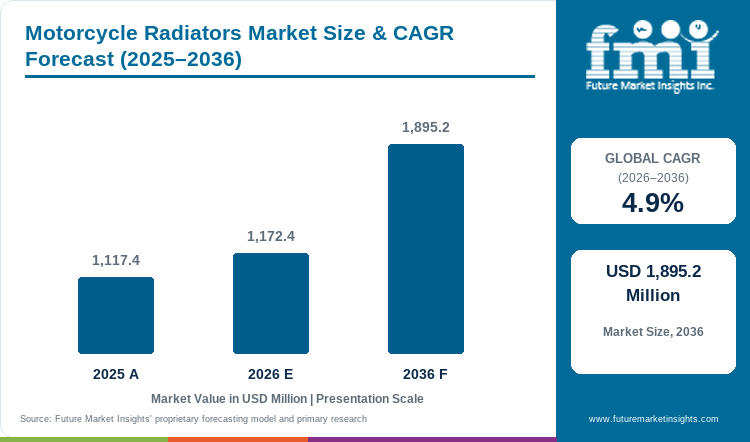
USD 1,172.4 million in 2026 and USD 1,895.2 million by 2036, expanding at 4.9% CAGR.
Sales of motorcycle radiators are projected to rise at a 4.9% CAGR through 2036, increasing from USD 1,117.4 million in 2025 to USD 1,172.4 million in 2026 and reaching USD 1,895.2 million by 2036. Growth is supported by the widespread adoption of liquid-cooled motorcycles, which depend on compact, high-efficiency radiators to maintain engine temperatures and support performance. The aftermarket opportunity is also expanding as motorcycles remain in service for longer periods. In the United States alone, the Federal Highway Administration reported 9.26 million registered motorcycles in 2024, creating a substantial installed base that will require periodic cooling-system maintenance and radiator replacement over time.
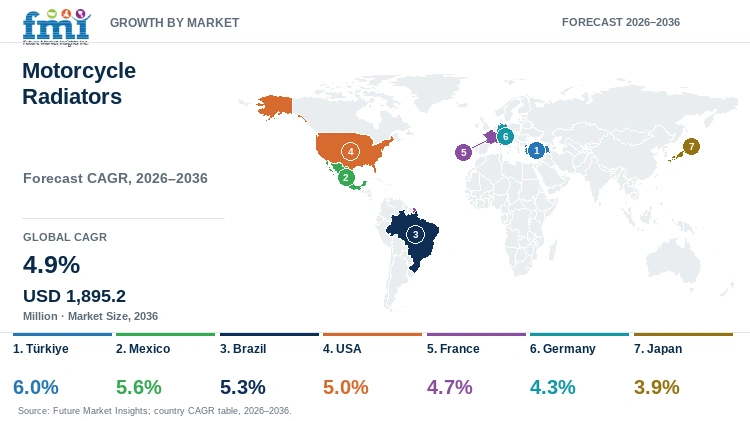
The USA is projected to grow at 5.0% CAGR through 2036, compared with 3.9% for Japan. The large U.S. motorcycle parc provides a broad customer base for replacement radiators and other cooling components, particularly as motorcycles age and accumulate mileage. By contrast, Japan is a more mature market where demand is driven less by fleet expansion and more by replacement purchases, placing greater emphasis on fit accuracy, product quality and dealer support networks.
Key Takeaways
- Liquid-cooled bike output and repair of bikes already on the road support both factory and service radiator demand.
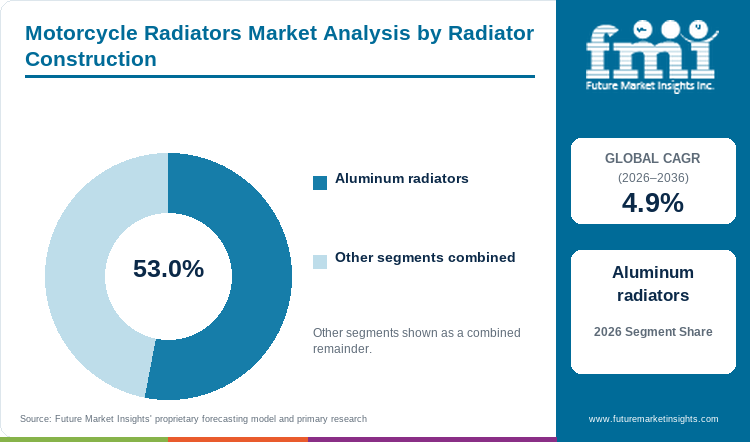
- By radiator construction, aluminum radiators are estimated to hold 53.0% share in 2026, supported by low weight and strong heat transfer.
- In 2026, street motorcycles are expected to lead motorcycle type with 31.0% share, linked to broad road use and service exposure.
- The engine size category is forecast to be led by 250-500 cc motorcycles at 31.0% share in 2026, supported by common mid-size liquid-cooled bikes.
- Model-specific mounting points, hose routes, fans, and shrouds raise stocking cost and increase return risk after a fitment error.
- Some of the key players in this market include DENSO Corporation, T.RAD Co., Ltd., Marelli, PWR Advanced Cooling Technology, CSF Cooling, Mishimoto, Koyorad, Fluidyne, FEBUR, and GPI Racing.
Analyst Perspective
"Radiator firms win repeat sales by proving cooling ability and exact bike fit before price becomes the main issue. Electric bikes add new cooling jobs, but repair demand from combustion bikes remains the larger near-term sales base."
- Nikhil Kaitwade, Principal Consultant, Future Market Insights
How is the motorcycle radiators market segmented?
The motorcycle radiators market is segmented by Radiator Construction, Motorcycle Type, Engine Size, Sales Channel, Powertrain Type, and Region.
The motorcycle radiators market has five main segment axes plus region. Radiator construction covers aluminum, copper/brass, and other builds. Motorcycle type covers street, scooter, sport, off-road, and touring/cruiser bikes. Engine size runs from below 250 cc to above 1,000 cc. Sales channels include OEM direct, dealer/service, independent repair, and performance sales. Powertrain type covers liquid-cooled ICE, hybrid, and battery-electric bikes.
How does aluminum shape demand within the radiator construction category?
Aluminum lets designers use thin tubes and compact cores without adding much front-end weight. The material also works well in tight bike frames. These traits link bike radiators with automotive heat exchangers that must shed heat in small spaces.
- Based on radiator construction, aluminum radiators are projected to account for 53.0% in 2026, supported by low weight and strong cooling.
- Suppliers still need model-specific mounts because even a strong core fails if the unit does not fit the bike frame.
What supports street motorcycles within the motorcycle type category?
Street bikes see frequent road use and a large repair base. Cooling loads rise in traffic because airflow falls at low speed. Their broad model range also keeps two-wheeler aftermarket components relevant after leaks, crashes, or age take the original unit out of service.
- By motorcycle type, street motorcycles are estimated to hold 31.0% in 2026, influenced by daily road use and repeat repair needs.
- Sport bikes need more cooling headroom, but street bikes create more routine repair orders over many model years.
How do 250-500 cc motorcycles shape the engine size category?
The 250-500 cc class combines useful power with lower ownership cost than large touring bikes. Liquid cooling is common in this band. That mix keeps thermal management systems relevant to both factory fit and later repair work.
- In 2026, 250-500 cc motorcycles are expected to lead engine size with 31.0% share, tied to broad use of liquid-cooled mid-displacement platforms.
- Fit work stays hard because frame shape and fan position can change even within the same engine-size band.
What makes OEM direct important within the sales channel category?
Bike makers test radiator size and pressure before a model enters production. A firm that wins the program can ship the same approved unit during the model cycle. Dealer and repair channels stay important, but two-wheeler accessories do not replace factory cooling tests.
- By sales channel, OEM direct is forecast to represent 50.0% in 2026, supported by approved fit and repeat factory use.
- The channel rewards early design access and steady factory control more than a broad retail range.
What role does liquid-cooled ICE play within the powertrain type category?
Liquid-cooled engines send heat into a radiator loop, so the unit is part of the normal drive system. Sport and touring bikes can need more heat margin. Battery-electric bikes shift cooling toward cells and electronics. That shift changes heat-exchanger design for low-temperature loops.
- Liquid-cooled ICE is set to lead powertrain type with 72.0% share in 2026, attributable to the large combustion bike base. Electric bikes add battery and inverter heat loads.
- Firms serving combustion and electric loops can reuse alloy skills while changing coolant circuits. Similar e-axle cooling systems show how EVs add lower-temperature fluid loops.
What are the drivers, restraints and opportunities in the Motorcycle Radiators Market?
Motorcycle production and replacement support demand, exact-fit complexity raises inventory cost, and electrified powertrains add new cooling work.
- Driver: New bike production and repair of bikes already in use create first-fit and service radiator demand.
- Restraint: Model-specific mounts and hose layouts raise stock work, return risk, and repair-channel testing costs.
- Opportunity: Electric two-wheelers need battery and power-electronics cooling, giving heat-exchanger firms a new sales route as volumes grow.
Bikes create radiator demand at assembly and again during later repair. Abraciclo reported 1,980,538 motorcycles made in Brazil during 2025. That output creates first-fit demand for liquid-cooled models. Large fleets then add repair work after leaks and crashes. Air-cooled bikes reduce the pool that can use radiators. Firms must map the liquid-cooled models they can serve. Work on automotive coolant systems helps teams manage fluid quality and heat limits that affect radiator life. Dealers also need stock for older bikes because a failed unit can stop daily travel. Price matters when an old bike needs a major cooling repair. Common fit data also helps firms plan repair stock.
Exact fit is the main barrier in the repair channel. A radiator must match the frame and hose points for one bike model. Fan and shroud links can also differ by year. Mishimoto published new radiator selection guidance in March 2026 and stressed fit beside core design. Wide catalogs tie cash to slow stock and raise returns after selection errors. The same issue appears with automotive cooling fans because mounts and electrical links must match the vehicle. Better fit data cuts avoidable returns, but dealers still need enough stock for older bikes. A returned unit adds freight cost and delays the rider repair. Fit data is therefore part of margin control.
Electric drive changes the cooling job instead of removing it. Batteries and power electronics work best inside tight heat ranges. New thermal management technologies split heat control between cells, inverters, and drive units. DENSO launched a battery-passport service in August 2026 for regulated battery products, including light transport batteries. That step shows how electric bike programs add new system and data tasks around the battery. Cooling firms still need small packages that resist bike vibration. Shared alloy cores and braze work can lower the first tool cost. Full custom systems need more volume before firms can fund separate tools and stock. Early EV programs can share tools with existing units.
Which country CAGRs are profiled in the Motorcycle Radiators Market?
| Country | CAGR |
|---|---|
| Türkiye | 6.0% |
| Mexico | 5.6% |
| Brazil | 5.3% |
| USA | 5.0% |
| France | 4.7% |
| Germany | 4.3% |
| Japan | 3.9% |
How do country-level CAGRs compare in the Motorcycle Radiators Market?
The seven countries span 2.1 percentage points from Türkiye at 6.0% to Japan at 3.9%. Türkiye and Mexico form the upper band. Mature countries depend more on repair demand from bikes already in use.
- Türkiye: Bikes form a large share of road vehicles, giving repair channels a broad fleet beyond new sales.
- Mexico: National vehicle records help parts firms plan stock, but limited monthly bike detail can slow updates.
- Brazil: Manaus bike output gives cooling firms a direct OEM route before those same models enter repair channels.
- USA: A large bike fleet keeps repair coverage important even when riding seasons and bike age vary by state.
- France: National new and used vehicle records help parts firms separate factory fit from later repair needs.
- Germany: Mature ownership puts more weight on OE-like repair units and durable high-load parts than fast new-bike growth.
- Japan: Replacement dominates new-bike purchase modes, which favors known fits and steady dealer support over fleet growth.
Similar CAGRs can still lead to different sales conditions because bike fleets, plant output, and repair routes differ by country. The full report provides country-level CAGR analysis across North America, Latin America, Western Europe, Eastern Europe, East Asia, South Asia and Pacific, and the Middle East and Africa.
Country-wise Analysis
- US riders use a large stock of bikes that spans many model years. Demand for motorcycle radiators is forecast to rise at 5.0% CAGR through 2036, supported by repair work after leaks or crashes. FHWA counted 9,261,249 registered motorcycles in 2024. That fleet gives parts dealers a wide service base. It also makes exact fit data vital for older models. Owners of low-value bikes can reject a repair when cost gets too high. Firms need clear fit data and steady stock for common models. A missing bracket or hose match can turn a simple repair into a return.
- Germany has a mature bike fleet and active service routes. Motorcycle radiator demand is forecast to rise at 4.3% CAGR through 2036, influenced by repair work more than fast fleet growth. Federal transport data track road vehicle stock nationwide. The supplied model also uses Destatis data showing softer new bike records in 2025. That mix puts more weight on parts for bikes already in use. Firms need OE-like fit and durable alloy cores for routine repair. Performance units serve a smaller group that pays for more heat margin. The main limit is carrying enough model coverage without too much slow stock.
- Japan has a mature bike base and a strong repair culture. Demand for motorcycle radiators is anticipated to grow at 3.9% CAGR through 2036, linked to repeat buying in known service routes. JAMA reported in April 2026 that replacement made up 53% of new-bike purchase modes. That pattern favors known fits and clear parts data. The survey also put the average buyer age at 56.5 years. Dealer support and parts quality remain important. Firms need compact cooling units for bikes that stay in service for years. A broad new range adds less value when the model base changes slowly.
- Brazil links radiator demand to large bike output in Manaus. The country is estimated to post 5.3% CAGR through 2036, driven by high plant output and strong retail records. Abraciclo reported 1,980,538 motorcycles made in 2025 and 2,197,851 retail registrations. OEM programs can create first-fit orders before repair demand builds. Cost still matters because commuter bikes make up much road use. Light alloy units help control weight and fit in small frames. Firms need local program access plus repair coverage for high-volume models. Long import lead times can leave riders waiting after a crash or leak.
- France mixes urban bike use with leisure riding and a busy second-hand channel. Motorcycle radiator sector is predicted to rise at 4.7% CAGR through 2036, shaped by repair supply in a mature fleet. SDES published 2025 national registration data in February 2026 and covers vehicle types nationwide. That data helps parts firms split new sales from used-bike activity. Repair buyers compare OE-like cost with higher-output alloy units. Firms need exact model coverage instead of one broad range. Stock plans also need to account for seasonal riding. Fast supply matters when a failed unit keeps a sound bike off the road.
- Mexico has a growing bike fleet and an independent repair trade. Motorcycle radiators industry is forecast to rise at 5.6% CAGR through 2036, supported by bikes moving beyond factory warranty. INEGI documented its 2025 national vehicle register in July 2026 using state records. Annual data help parts firms plan despite thin monthly detail. Stock still has to match local model mix and repair cost. Price-sensitive owners may choose a basic repair instead of a premium unit. Dealers need clear fit records and steady supply for common commuter bikes. Poor fit data raise returns and trap cash in wrong parts.
- Türkiye combines fast bike growth with a large repair base. Demand for motorcycle radiators is set to post 6.0% CAGR during the forecast period, attributable to the role bikes play in road transport. TÜİK reported that motorcycles made up 21.2% of registered road vehicles at year-end 2025. The total was 33,612,650 road vehicles. New records and older bikes can create first-fit and repair orders together. Price is a hard limit for older commuter bikes. Firms need direct-fit parts and dealer reach beyond the largest cities. Deep stock matters because a small fit error can lose a repair job.
Who are the notable companies in the Motorcycle Radiators Market?
DENSO Corporation, T.RAD Co., Ltd., Marelli, PWR Advanced Cooling Technology, CSF Cooling, Mishimoto, Koyorad, Fluidyne, FEBUR, and GPI Racing are active within the defined motorcycle radiator supply boundary.
Competition splits among OEM thermal groups, high-load cooling firms, and parts brands with deep fit catalogs. Entry is hard because unit shape changes by bike model while heat tests must stay repeatable. Scale helps, but repair sales still depend on exact fit data and steady stock.
- DENSO Corporation, T.RAD Co., Ltd., and Marelli bring vehicle-level cooling design and OEM program work.
- PWR Advanced Cooling Technology, CSF Cooling, Koyorad, and FEBUR focus on high-load cooling and race use.
- Mishimoto, Fluidyne, and GPI Racing compete mainly through wide repair ranges, direct sales, and rider access.
Competitive Benchmarking: Motorcycle Radiators Market
| Company | Motorcycle Fitment Coverage | Performance Cooling Engineering | OEM / Program Integration | Geographic Reach |
|---|---|---|---|---|
| DENSO Corporation | Low | High | High | Global |
| T.RAD Co., Ltd. | Medium | High | High | Japan, Asia, Europe, North America |
| Marelli | Low | High | High | Global |
| PWR Advanced Cooling Technology | Medium | High | Medium | Australia, North America, Europe, global motorsport |
| CSF Cooling | Medium | High | Low | North America, international motorsport |
| Mishimoto | High | High | Low | North America, international aftermarket |
| Koyorad | High | High | Medium | Japan, North America, international aftermarket |
| Fluidyne | Low | High | Low | North America |
| FEBUR | High | High | Low | Europe, international racing aftermarket |
| GPI Racing | High | Medium | Low | United States, international e-commerce |
Scoring basis: High fitment coverage needs a broad bike range. Medium marks a smaller public range, and Low marks limited proof. High cooling design needs race or custom work. OEM integration is High for vehicle programs. Medium marks narrower proof, and Low marks parts-market work.
Key Developments in the Motorcycle Radiators Market
- In August 2026, PWR Advanced Cooling Technology said its new Australian headquarters and factory were fully open. The site expands heat-exchanger production.
- In April 2026, T.RAD Co., Ltd. announced T.RAD-2026 and confirmed orders for its multi-function radiator. The plan covers several powertrain types.
- In April 2026, Marelli presented a full-aluminum radiator for electric powertrains at Auto China 2026. The compact unit uses one main material.
Key Players in the Motorcycle Radiators Market
OEM-integrated thermal system suppliers
- DENSO Corporation
- T.RAD Co., Ltd.
- Marelli
Performance and motorsport cooling specialists
- PWR Advanced Cooling Technology
- CSF Cooling
- Koyorad
- FEBUR
Aftermarket and application-access suppliers
- Mishimoto
- Fluidyne
- GPI Racing
Motorcycle Radiators Market - Report Scope
| Coverage field | Report scope |
|---|---|
| Market breakdown | By radiator construction, motorcycle type, engine size, sales channel, powertrain type, and region. |
| Quantitative Units | USD million. |
| Market Definition | Commercial motorcycle radiators and radiator assemblies sold for motorcycle cooling applications are included. Separate coolant parts and non-motorcycle heat exchangers are excluded. |
| Regions Covered | North America, Latin America, Western Europe, Eastern Europe, East Asia, South Asia and Pacific, and Middle East and Africa. |
| Countries Covered | Türkiye, Mexico, Brazil, USA, France, Germany, Japan, and 20+ countries included in the full report. |
| Key Companies Profiled | DENSO Corporation, T.RAD Co., Ltd., Marelli, PWR Advanced Cooling Technology, CSF Cooling, Mishimoto, Koyorad, Fluidyne, FEBUR, and GPI Racing. |
| Forecast Period | 2026 to 2036. |
| Approach | Primary and secondary research with market triangulation. |
Motorcycle Radiators Market - Research Methodology
| Method | Approach |
|---|---|
| Primary Research | FMI analysts gathered input from manufacturers, service providers, technology developers, distributors, end users, procurement teams, and subject-matter experts. Interviews examined purchasing decisions, product or service evaluation, adoption barriers, approval requirements, pricing considerations, and expectations for technical or commercial support. Respondents were also asked what evidence is required before a trial, pilot, or initial order develops into regular purchasing. |
| Desk Research | Desk research covered government statistics, regulatory publications, trade data, industry associations, technical literature, standards, company filings, product information, and official corporate announcements. Sources were reviewed for relevance, publication date, geographic coverage, and consistency with the defined market scope. Claims relating to performance, applications, approvals, capacity, investment, and commercial activity were retained only when supported by credible public evidence. |
| Market Sizing and Forecasting | The market model combined the baseline value with historical performance, segment structure, pricing and volume indicators, adoption levels, company participation, and country-level demand conditions. Forecast assumptions considered economic activity, investment trends, regulatory developments, technology adoption, purchasing cycles, supply availability, and barriers to wider market use. Segment and regional estimates were reconciled before the final market total was calculated. |
| Data Validation | Estimates were checked against multiple independent indicators, including public data, company activity, trade patterns, industry developments, and findings from primary interviews. Validation also tested whether products, services, applications, and company revenues fell within the defined market boundaries. Adjacent categories, unsupported claims, overlapping revenues, and activities without direct market relevance were excluded to reduce double counting and maintain consistency across segments and countries. |
Motorcycle Radiators Market by Segments
Motorcycle Radiators Market segmented by Radiator Construction:
- Aluminum radiators
- Copper/brass radiators
- Other constructions
Motorcycle Radiators Market segmented by Motorcycle Type:
- Street motorcycles
- Scooters
- Sport motorcycles
- Off-road motorcycles
- Touring/cruiser motorcycles
Motorcycle Radiators Market segmented by Engine Size:
- Below 250 cc
- 250-500 cc
- 500-1,000 cc
- Above 1,000 cc
Motorcycle Radiators Market segmented by Sales Channel:
- OEM direct
- Dealer/service network
- Independent aftermarket replacement
- Performance aftermarket
Motorcycle Radiators Market segmented by Powertrain Type:
- Liquid-cooled ICE
- Hybrid
- Battery-electric
Motorcycle Radiators Market by Region:
- North America
- United States
- Canada
- Latin America
- Brazil
- Mexico
- Chile
- Rest of Latin America
- Western Europe
- Germany
- United Kingdom
- Italy
- Spain
- France
- Nordics
- Benelux
- Rest of Western Europe
- Eastern Europe
- Russia
- Poland
- Hungary
- Balkan and Baltic States
- Rest of Eastern Europe
- East Asia
- China
- Japan
- South Korea
- South Asia and Pacific
- India
- ASEAN
- Australia and New Zealand
- Rest of South Asia and Pacific
- Middle East and Africa
- Kingdom of Saudi Arabia
- Other GCC Countries
- Türkiye
- South Africa
- Other African Union Countries
- Rest of Middle East and Africa
Research Sources and Bibliography
- Federal Highway Administration. (2026, January). Highway Statistics 2024: Table MV-1, State Motor-Vehicle Registrations - 2024.
- Japan Automobile Manufacturers Association. (2026, April 14). 2025
- Abraciclo. (2026, January). Produção de motocicletas deve ultrapassar dois milhões de unidades em 2026.
- Federal Ministry for Digital and Transport, Germany. (2025, May 28). Fahrzeugbestand.
- Service des données et études statistiques. (2026, February 11). Données 2025 sur les immatriculations des véhicules.
- Instituto Nacional de Estadística y Geografía. (2026, July 23). Vehículos de Motor Registrados en Circulación 2025, Datos al mes de diciembre.
- Turkish Statistical Institute. (2026, January 16). Motorlu Kara Taşıtları - Aralık 2025.
- T.RAD Co., Ltd. (2026, April 27). Notice of Medium-Term Management Plan (T.RAD-2026).
- Marelli. (2026, April). Marelli to showcase propulsion and thermal innovations supporting powertrain evolution at Auto China.
- PWR Holdings Limited. (2026, August 28). PWR Holdings Limited Annual Report 2026.
- DENSO Corporation. (2026, August 25). DENSO launches battery passport service supporting compliance with the European Battery Regulation.
- Mishimoto. (2026, March 11). Choosing the right performance aluminum radiator - core thickness, tube design, and airflow explained.
- PWR Advanced Cooling Technology. (2026, July 1). PWR announces strategic partnership with Major Training to strengthen future workforce capability.
- Federal Highway Administration. (2026, January). Highway Statistics 2024, Table MV-1: State Motor-Vehicle Registrations. U.S. Department of Transportation.
This bibliography is provided for reader reference and is not exhaustive. The full report contains the complete reference list and detailed citations
This Report Answers
- How large is the motorcycle radiators market in 2026 and 2036?
- Which production and replacement conditions support motorcycle radiator demand?
- Why do aluminum radiators lead the radiator construction category?
- How do street motorcycles shape factory and replacement radiator demand?
- Why does the 250-500 cc class lead its engine size category?
- How do profiled country growth rates differ through 2036?
- Which companies compete in motorcycle radiator engineering and replacement channels?
- How does model-specific fitment raise inventory and testing costs?
- What changes as electric motorcycles add battery and power-electronics cooling?
Frequently Asked Questions
How big is the motorcycle radiators market in 2026?
The motorcycle radiators market is valued at USD 1,172.4 million in 2026 and reaches USD 1,895.2 million by 2036. Bike output and repair support the rise.
What is the CAGR of the motorcycle radiators market from 2026 to 2036?
The motorcycle radiators market is projected to grow at 4.9% CAGR from 2026 to 2036. Factory fit and repair after leaks support the forecast.
Which radiator construction segment leads the motorcycle radiators market?
The aluminum radiator segment is expected to hold 53.0% of radiator construction revenue in 2026, supported by low weight and heat transfer. Exact frame fit still controls each sale.
Which motorcycle type holds a major current share in the motorcycle radiators market?
The street motorcycle segment is estimated to hold 31.0% of motorcycle type revenue in 2026, linked to road use and repair. Its wide model base makes fit data important.
Which profiled countries are projected to grow fastest in the motorcycle radiators market?
Türkiye is projected to grow at 6.0% CAGR, followed by Mexico at 5.6% and Brazil at 5.3% through 2036. Fleet size and repair routes shape each path.
Which companies are active in the motorcycle radiators market?
Key companies in the motorcycle radiators market include DENSO Corporation, T.RAD Co., Ltd., Marelli, PWR Advanced Cooling Technology, CSF Cooling, Mishimoto, Koyorad, Fluidyne, FEBUR, and GPI Racing. They compete on program access, heat design, fit coverage, and parts supply.
Preview the report firsthand - request a free sample
Get SampleGet the brochure for pricing and purchase details.
Get PDFTable of Content
- Key Takeaways
- Market Size and CAGR
- Top Growth Driver
- Fastest Growing Segment
- Leading Region
- Key Companies
- Emerging Opportunities
- Executive Summary
- Global Market Outlook
- Demand-side Trends
- Supply-side Trends
- Technology Roadmap Analysis
- Analysis and Recommendations
- Analyst Perspective (What is happening? Why now? What should investors know?)
- Key Questions Answered
- How large is the market?
- What is the CAGR?
- What are key trends?
- Which region dominates?
- Who are the leaders?
- Market Overview
- Market Coverage / Taxonomy
- Market Definition / Scope / Limitations
- Research Methodology
- Chapter Orientation
- Analytical Lens and Working Hypotheses
- Market Structure, Signals, and Trend Drivers
- Benchmarking and Cross-market Comparability
- Market Sizing, Forecasting, and Opportunity Mapping
- Research Design and Evidence Framework
- Desk Research Programme (Secondary Evidence)
- Expert Input and Fieldwork (Primary Evidence)
- Tooling, Models, and Reference Databases
- Data Engineering and Model Build
- Quality Assurance and Audit Trail
- Market Background
- Market Dynamics (Drivers, Restraints, Opportunity, Trends)
- Scenario Forecast (Optimistic, Likely, Conservative)
- Impact Analysis
- AI Impact
- Sustainability Impact
- Regulatory Impact
- Technology Impact
- Consumer / Buyer Analysis
- Purchase Drivers
- Adoption Barriers
- Buyer Journey
- Opportunity Map Analysis
- Product Life Cycle Analysis
- Supply Chain Analysis
- Investment Feasibility Matrix
- Value Chain Analysis
- PESTLE and Porter's Analysis
- Regulatory Landscape
- Regional Parent Market Outlook
- Production and Consumption Statistics
- Import and Export Statistics
- Global Market Analysis and Forecast, 2021 to 2036
- Historical Market Size Value (USD Million) Analysis, 2021 to 2025
- Current and Future Market Size Value (USD Million) Projections, 2026 to 2036
- Y-o-Y Growth Trend Analysis
- Absolute $ Opportunity Analysis
- Global Market Pricing Analysis, 2021 to 2036
- Global Market Analysis and Forecast, By Radiator Construction, 2021 to 2036
- Introduction / Key Findings
- Historical Market Size Value (USD Million) Analysis By Radiator Construction, 2021 to 2025
- Current and Future Market Size Value (USD Million) Analysis and Forecast By Radiator Construction, 2026 to 2036
- Aluminum radiators
- Copper/brass radiators
- Other constructions
- Y-o-Y Growth Trend Analysis By Radiator Construction, 2021 to 2025
- Absolute $ Opportunity Analysis By Radiator Construction, 2026 to 2036
- Global Market Analysis and Forecast, By Motorcycle Type, 2021 to 2036
- Introduction / Key Findings
- Historical Market Size Value (USD Million) Analysis By Motorcycle Type, 2021 to 2025
- Current and Future Market Size Value (USD Million) Analysis and Forecast By Motorcycle Type, 2026 to 2036
- Street motorcycles
- Scooters
- Sport motorcycles
- Off-road motorcycles
- Touring/cruiser motorcycles
- Y-o-Y Growth Trend Analysis By Motorcycle Type, 2021 to 2025
- Absolute $ Opportunity Analysis By Motorcycle Type, 2026 to 2036
- Global Market Analysis and Forecast, By Engine Size, 2021 to 2036
- Introduction / Key Findings
- Historical Market Size Value (USD Million) Analysis By Engine Size, 2021 to 2025
- Current and Future Market Size Value (USD Million) Analysis and Forecast By Engine Size, 2026 to 2036
- Below 250 cc
- 250-500 cc
- 500-1,000 cc
- Above 1,000 cc
- Y-o-Y Growth Trend Analysis By Engine Size, 2021 to 2025
- Absolute $ Opportunity Analysis By Engine Size, 2026 to 2036
- Global Market Analysis and Forecast, By Sales Channel, 2021 to 2036
- Introduction / Key Findings
- Historical Market Size Value (USD Million) Analysis By Sales Channel, 2021 to 2025
- Current and Future Market Size Value (USD Million) Analysis and Forecast By Sales Channel, 2026 to 2036
- OEM direct
- Dealer/service network
- Independent aftermarket replacement
- Performance aftermarket
- Y-o-Y Growth Trend Analysis By Sales Channel, 2021 to 2025
- Absolute $ Opportunity Analysis By Sales Channel, 2026 to 2036
- Global Market Analysis and Forecast, By Powertrain Type, 2021 to 2036
- Introduction / Key Findings
- Historical Market Size Value (USD Million) Analysis By Powertrain Type, 2021 to 2025
- Current and Future Market Size Value (USD Million) Analysis and Forecast By Powertrain Type, 2026 to 2036
- Liquid-cooled ICE
- Hybrid
- Battery-electric
- Y-o-Y Growth Trend Analysis By Powertrain Type, 2021 to 2025
- Absolute $ Opportunity Analysis By Powertrain Type, 2026 to 2036
- Global Market Analysis and Forecast, By Region, 2021 to 2036
- Introduction
- Historical Market Size Value (USD Million) Analysis By Region, 2021 to 2025
- Current Market Size Value (USD Million) Analysis and Forecast By Region, 2026 to 2036
- North America
- Latin America
- Western Europe
- Eastern Europe
- East Asia
- South Asia and Pacific
- Middle East and Africa
- Market Attractiveness Analysis By Region
- North America Market Analysis and Forecast, By Country, 2021 to 2036
- Historical Market Size Value (USD Million) Trend Analysis By Market Taxonomy, 2021 to 2025
- Market Size Value (USD Million) Forecast By Market Taxonomy, 2026 to 2036
- By Country
- United States
- Canada
- By Radiator Construction
- By Motorcycle Type
- By Engine Size
- By Sales Channel
- By Powertrain Type
- By Country
- Market Attractiveness Analysis
- By Country
- By Radiator Construction
- By Motorcycle Type
- By Engine Size
- By Sales Channel
- By Powertrain Type
- Key Takeaways
- Latin America Market Analysis and Forecast, By Country
- Historical Market Size Value (USD Million) Trend Analysis By Market Taxonomy, 2021 to 2025
- Market Size Value (USD Million) Forecast By Market Taxonomy, 2026 to 2036
- By Country
- Brazil
- Mexico
- Chile
- Rest of Latin America
- By Radiator Construction
- By Motorcycle Type
- By Engine Size
- By Sales Channel
- By Powertrain Type
- By Country
- Market Attractiveness Analysis
- By Country
- By Radiator Construction
- By Motorcycle Type
- By Engine Size
- By Sales Channel
- By Powertrain Type
- Key Takeaways
- Western Europe Market Analysis and Forecast, By Country
- Historical Market Size Value (USD Million) Trend Analysis By Market Taxonomy, 2021 to 2025
- Market Size Value (USD Million) Forecast By Market Taxonomy, 2026 to 2036
- By Country
- Germany
- United Kingdom
- Italy
- Spain
- France
- Nordics
- Benelux
- Rest of Western Europe
- By Radiator Construction
- By Motorcycle Type
- By Engine Size
- By Sales Channel
- By Powertrain Type
- By Country
- Market Attractiveness Analysis
- By Country
- By Radiator Construction
- By Motorcycle Type
- By Engine Size
- By Sales Channel
- By Powertrain Type
- Key Takeaways
- Eastern Europe Market Analysis and Forecast, By Country
- Historical Market Size Value (USD Million) Trend Analysis By Market Taxonomy, 2021 to 2025
- Market Size Value (USD Million) Forecast By Market Taxonomy, 2026 to 2036
- By Country
- Russia
- Poland
- Hungary
- Balkan and Baltic States
- Rest of Eastern Europe
- By Radiator Construction
- By Motorcycle Type
- By Engine Size
- By Sales Channel
- By Powertrain Type
- By Country
- Market Attractiveness Analysis
- By Country
- By Radiator Construction
- By Motorcycle Type
- By Engine Size
- By Sales Channel
- By Powertrain Type
- Key Takeaways
- East Asia Market Analysis and Forecast, By Country
- Historical Market Size Value (USD Million) Trend Analysis By Market Taxonomy, 2021 to 2025
- Market Size Value (USD Million) Forecast By Market Taxonomy, 2026 to 2036
- By Country
- China
- Japan
- South Korea
- By Radiator Construction
- By Motorcycle Type
- By Engine Size
- By Sales Channel
- By Powertrain Type
- By Country
- Market Attractiveness Analysis
- By Country
- By Radiator Construction
- By Motorcycle Type
- By Engine Size
- By Sales Channel
- By Powertrain Type
- Key Takeaways
- South Asia and Pacific Market Analysis and Forecast, By Country
- Historical Market Size Value (USD Million) Trend Analysis By Market Taxonomy, 2021 to 2025
- Market Size Value (USD Million) Forecast By Market Taxonomy, 2026 to 2036
- By Country
- India
- ASEAN
- Australia and New Zealand
- Rest of South Asia and Pacific
- By Radiator Construction
- By Motorcycle Type
- By Engine Size
- By Sales Channel
- By Powertrain Type
- By Country
- Market Attractiveness Analysis
- By Country
- By Radiator Construction
- By Motorcycle Type
- By Engine Size
- By Sales Channel
- By Powertrain Type
- Key Takeaways
- Middle East and Africa Market Analysis and Forecast, By Country
- Historical Market Size Value (USD Million) Trend Analysis By Market Taxonomy, 2021 to 2025
- Market Size Value (USD Million) Forecast By Market Taxonomy, 2026 to 2036
- By Country
- Kingdom of Saudi Arabia
- Other GCC Countries
- Türkiye
- South Africa
- Other African Union Countries
- Rest of Middle East and Africa
- By Radiator Construction
- By Motorcycle Type
- By Engine Size
- By Sales Channel
- By Powertrain Type
- By Country
- Market Attractiveness Analysis
- By Country
- By Radiator Construction
- By Motorcycle Type
- By Engine Size
- By Sales Channel
- By Powertrain Type
- Key Takeaways
- Key Countries Market Analysis
- United States
- Pricing Analysis
- Market Share Analysis, 2025
- By Radiator Construction
- By Motorcycle Type
- By Engine Size
- By Sales Channel
- By Powertrain Type
- Canada
- Pricing Analysis
- Market Share Analysis, 2025
- By Radiator Construction
- By Motorcycle Type
- By Engine Size
- By Sales Channel
- By Powertrain Type
- Mexico
- Pricing Analysis
- Market Share Analysis, 2025
- By Radiator Construction
- By Motorcycle Type
- By Engine Size
- By Sales Channel
- By Powertrain Type
- Brazil
- Pricing Analysis
- Market Share Analysis, 2025
- By Radiator Construction
- By Motorcycle Type
- By Engine Size
- By Sales Channel
- By Powertrain Type
- Chile
- Pricing Analysis
- Market Share Analysis, 2025
- By Radiator Construction
- By Motorcycle Type
- By Engine Size
- By Sales Channel
- By Powertrain Type
- Germany
- Pricing Analysis
- Market Share Analysis, 2025
- By Radiator Construction
- By Motorcycle Type
- By Engine Size
- By Sales Channel
- By Powertrain Type
- United Kingdom
- Pricing Analysis
- Market Share Analysis, 2025
- By Radiator Construction
- By Motorcycle Type
- By Engine Size
- By Sales Channel
- By Powertrain Type
- Italy
- Pricing Analysis
- Market Share Analysis, 2025
- By Radiator Construction
- By Motorcycle Type
- By Engine Size
- By Sales Channel
- By Powertrain Type
- Spain
- Pricing Analysis
- Market Share Analysis, 2025
- By Radiator Construction
- By Motorcycle Type
- By Engine Size
- By Sales Channel
- By Powertrain Type
- France
- Pricing Analysis
- Market Share Analysis, 2025
- By Radiator Construction
- By Motorcycle Type
- By Engine Size
- By Sales Channel
- By Powertrain Type
- India
- Pricing Analysis
- Market Share Analysis, 2025
- By Radiator Construction
- By Motorcycle Type
- By Engine Size
- By Sales Channel
- By Powertrain Type
- ASEAN
- Pricing Analysis
- Market Share Analysis, 2025
- By Radiator Construction
- By Motorcycle Type
- By Engine Size
- By Sales Channel
- By Powertrain Type
- Australia and New Zealand
- Pricing Analysis
- Market Share Analysis, 2025
- By Radiator Construction
- By Motorcycle Type
- By Engine Size
- By Sales Channel
- By Powertrain Type
- China
- Pricing Analysis
- Market Share Analysis, 2025
- By Radiator Construction
- By Motorcycle Type
- By Engine Size
- By Sales Channel
- By Powertrain Type
- Japan
- Pricing Analysis
- Market Share Analysis, 2025
- By Radiator Construction
- By Motorcycle Type
- By Engine Size
- By Sales Channel
- By Powertrain Type
- South Korea
- Pricing Analysis
- Market Share Analysis, 2025
- By Radiator Construction
- By Motorcycle Type
- By Engine Size
- By Sales Channel
- By Powertrain Type
- Russia
- Pricing Analysis
- Market Share Analysis, 2025
- By Radiator Construction
- By Motorcycle Type
- By Engine Size
- By Sales Channel
- By Powertrain Type
- Poland
- Pricing Analysis
- Market Share Analysis, 2025
- By Radiator Construction
- By Motorcycle Type
- By Engine Size
- By Sales Channel
- By Powertrain Type
- Hungary
- Pricing Analysis
- Market Share Analysis, 2025
- By Radiator Construction
- By Motorcycle Type
- By Engine Size
- By Sales Channel
- By Powertrain Type
- Kingdom of Saudi Arabia
- Pricing Analysis
- Market Share Analysis, 2025
- By Radiator Construction
- By Motorcycle Type
- By Engine Size
- By Sales Channel
- By Powertrain Type
- Türkiye
- Pricing Analysis
- Market Share Analysis, 2025
- By Radiator Construction
- By Motorcycle Type
- By Engine Size
- By Sales Channel
- By Powertrain Type
- South Africa
- Pricing Analysis
- Market Share Analysis, 2025
- By Radiator Construction
- By Motorcycle Type
- By Engine Size
- By Sales Channel
- By Powertrain Type
- United States
- Market Structure Analysis
- Competition Dashboard
- Competition Benchmarking
- Market Share Analysis of Top Players
- By Regional
- By Radiator Construction
- By Motorcycle Type
- By Engine Size
- By Sales Channel
- By Powertrain Type
- Emerging Startups
- Innovation Benchmarking
- Competition Analysis
- Competition Deep Dive
- DENSO Corporation
- Overview
- Product Portfolio
- Profitability by Market Segments
- Sales Footprint
- Strategy Overview
- Marketing Strategy
- Product Strategy
- Channel Strategy
- T.RAD Co., Ltd.
- Marelli
- PWR Advanced Cooling Technology
- CSF Cooling
- Mishimoto
- Koyorad
- Fluidyne
- FEBUR
- GPI Racing
- DENSO Corporation
- Case Studies
- Success Stories
- Recent Developments
- Competition Deep Dive
- Assumptions & Acronyms Used


