

- Market Size (2026)
- USD 3.9 Bn
- Forecast (2036)
- USD 6.1 Bn
- CAGR (2026 to 2036)
- 4.7%
How Big is the Mud Weighting Agents Market in 2026?
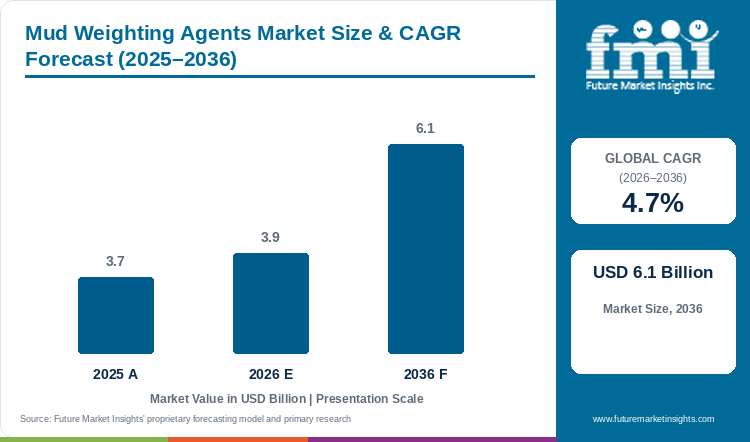
Mud weighting agent sales are projected at USD 3.9 Billion in 2026 and USD 6.1 Billion by 2036, a 4.7% CAGR during the forecast period.
Mud weighting agents make up a USD 3.9 Billion market in 2026, according to FMI, with sales projected to reach USD 6.1 Billion by 2036 at 4.7% CAGR. The 2026 estimate column on the market size chart stands above a 2025 base of USD 3.7 Billion, and the forecast period adds USD 2.2 Billion in new value.
Consumption per well is rising as operators drill longer and deeper holes. EIA data show the average Permian lateral reached 10,867 feet in 2025, up from 6,149 feet in 2015, and laterals beyond 15,000 feet made up 15% of new completions [1]. Horizontal completions in the basin have held near 6,000 a year since 2022, so added tonnage comes from longer hole per well. Offshore, Beacon Offshore Energy started Shenandoah in July 2025 as the second 20,000 psi field in the US Gulf, with reservoirs near 30,000 feet true vertical depth [2]. Wells in this pressure class carry heavy mud through long, deep sections. Footage drilled per well is expected to keep growing through 2036, so sales of weighting agents should rise even with flat rig counts.
Key Takeaways
- Key players operating in the mud weighting agents market include SLB, Halliburton, Baker Hughes, Cimbar Resources, Imerys, Sibelco and TETRA Technologies.
- Barite will supply 58% of demand by material type in 2026. Bulk grinding near drilling basins keeps the mineral the default choice for mud companies.
- Oilfield service companies control 41% of demand by sales channel in 2026, as operators buy weighting material inside full mud contracts.
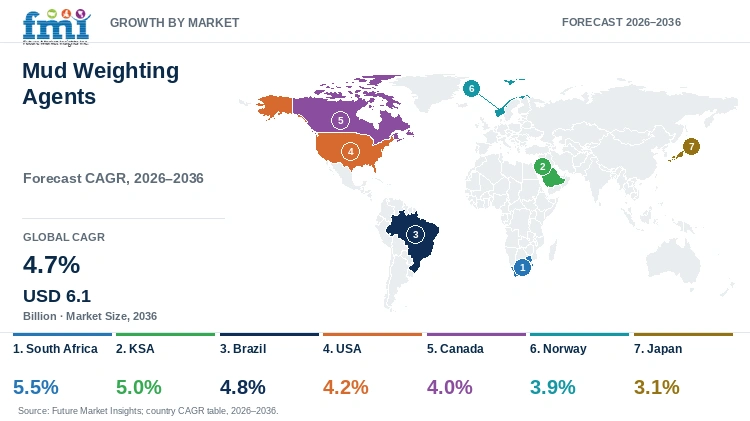
- South Africa is projected to grow fastest at 5.5% CAGR through 2036. KSA follows at 5% as Jafurah gas drilling adds deep, high-pressure wells.
Analyst Perspective
“A sharper fall in USA land rigs or delays to 20,000 psi deepwater fields could slow demand for mud weighting agents before 2036, and faster gas drilling in KSA and offshore drilling in Brazil could speed demand up. My read is that longer laterals and deep HPHT wells will offset most of the rig decline, keeping the market on a 4.7% CAGR path to USD 6.1 Billion by 2036.”
- Nikhil Kaitwade, Principal Consultant, Future Market Insights
How is the Mud Weighting Agents Market Segmented?
The mud weighting agents market is split into material type, mud system, particle size, well type, sales channel and region.
As per FMI, material types are split into barite, hematite, calcium carbonate, ilmenite, manganese tetraoxide and micronized weighting agents. Mud systems are divided into water-based mud, oil-based mud, synthetic-based mud and completion fluids. Particle size spans standard API grade, fine grind, micronized and specialty low-sag grades. Onshore, offshore, deepwater, HPHT and unconventional wells make up the well type split. Sales are tracked across oilfield service companies, mineral producers, mud chemical distributors and direct E&P supply. Country estimates cover more than 30 markets grouped into seven regions.
Why Does Barite Lead the Mud Weighting Agents Market by Material Type?
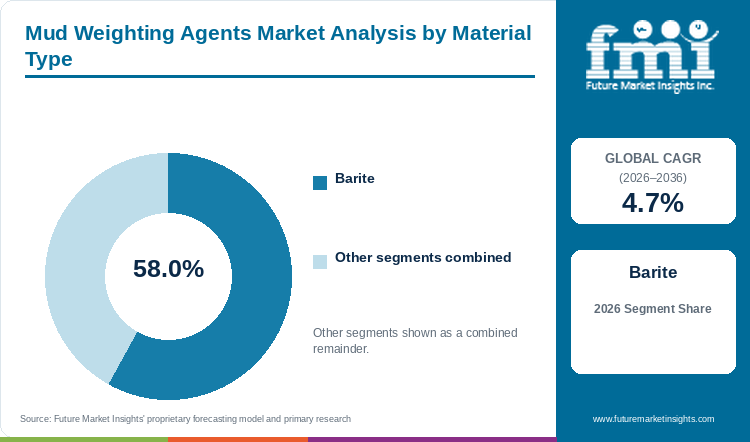
Barite carries 58% of market share by material type in 2026.
Barite holds 58% of demand by material type in 2026, and hematite is the closest alternative. Mud companies keep barite as the default because API-grade supply is ground at scale near most basins and stock points carry the grade in bulk. Hematite is heavier per sack, but fewer grinders stock oilfield grades, so operators order hematite mainly for selected high-density programs. Calcium carbonate, ilmenite and manganese tetraoxide serve reservoir sections, special density targets or tight solids limits on fewer wells.
- Deep hole sections on gas and HPHT wells are expected to pull the largest new barite tonnage through 2036.
- The U.S. Geological Survey reported in February 2026 that more than 90% of barite sold in the USA goes into oil and gas drilling fluids [3].
Why Does Water-Based Mud Lead the Mud Weighting Agents Market by Mud System?
Water-based mud is the largest mud system in 2026, with 47% of market share.
Water-based mud accounts for 47% of demand by mud system in 2026. Operators pick water-based systems on most land and conventional wells to avoid the higher fluid cost and cuttings handling rules attached to nonaqueous mud. Oil-based and synthetic-based muds take over on reactive shale, hot holes and extended-reach sections, and completion fluids rely mostly on dissolved salts, so solid weighting agents sell in smaller volumes there.
- Land mud plants are expected to keep water-based programs as the largest outlet for API barite through 2036.
- TETRA Technologies reported in July 2025 that the three-well CS Neptune Gulf project was complete and deepwater completion fluid volumes were stronger [4].
Why Does Standard API Grade Lead the Mud Weighting Agents Market by Particle Size?
Demand by particle size in 2026 is led by standard API grade at 48%.
Standard API grade takes 48% of demand by particle size in 2026, because grinding plants, bulk silos and rig handling systems are built around this specification. Fine grind and micronized grades cost more per tonne to mill, so buyers order them mainly for HPHT and narrow-window wells with sag limits.
- Mills able to switch between API and micronized output are expected to hold both routine and specialty orders.
- The Norwegian Offshore Directorate reported in January 2026 that 49 exploration wells were terminated in 2025, including one wellbore 10.7 km long [5].
Why Do Onshore Wells Lead the Mud Weighting Agents Market by Well Type?
Onshore wells take a 39% share by well type in 2026.
Onshore wells account for 39% of demand by well type in 2026, since repeat land programs keep tonnage high across North America, the Middle East and Latin America. EIA data show short laterals under 5,000 feet fell to 4% of Permian completions in 2025 from 43% in 2015, so each land well now carries more hole to weight [1]. Offshore, deepwater and HPHT wells use more material per well, but operators drill far fewer of them each year.
- Land operators drilling longer laterals are expected to buy more weighting material per program through 2036.
- Halliburton delivered a BaraDrilN X Generation III fluid system for a 344°F HPHT reservoir in the US Gulf in August 2025 [6].
Why Do Oilfield Service Companies Lead the Mud Weighting Agents Market by Sales Channel?
Oilfield service companies handle 41% of sales by channel in 2026.
Because operators want one contractor accountable for density, sag and well control, most weighting agents are bought inside full mud contracts. That buying habit gives oilfield service companies 41% of demand by sales channel in 2026. Mineral producers sell mainly to the service tier, distributors serve regional mixed loads, and direct E&P supply stays with operators owning storage at scale.
- Contractors with secure barite stock behind each mud program are expected to keep repeat awards on long drilling campaigns.
- Baker Hughes stated in the 2025 Form 10-K, filed in February 2026, that Well Construction includes drilling services, drill bits, and drilling and completion fluids [7].
What are the Drivers, Restraints, and Opportunities in the Mud Weighting Agents Market?
Longer laterals and deeper HPHT wells are raising weighting agent use per well, according to FMI. Barite import reliance adds delivered cost, and micronized grades for narrow-window wells will open higher-value orders through 2036.
- Driver: Deeper wells and longer laterals raise barite use per well, so sales of weighting agents grow with fewer rigs.
- Restraint: Import reliance and long freight routes raise the delivered cost of high-density mud in many basins.
- Opportunity: Micronized and higher-gravity grades for HPHT and narrow-window wells can open higher-value supply contracts.
Hole depth and reservoir pressure set the pace for sales of weighting agents. The U.S. Geological Survey estimated higher barite sales in 2025 even as the domestic rig count fell from 599 to 564, as deeper wells raised consumption per rig [3]. TETRA Technologies received a three-well, 20,000 psi Gulf of America program for TETRA Neptune Z-Lite in 2026 [8]. Sales in the fluid density modifiers market are projected to grow from USD 1.3 Billion in 2026 to USD 2.1 Billion by 2036. Service companies also buy from the drilling and completion fluids market inside the same well budgets.
Barite supply comes from a short list of mining countries. The United States relies on imports for more than 75% of apparent barite consumption, mainly from India, China, Morocco and Mexico [3]. A December 2025 policy study warned that India has less than 10 years of accessible barite reserves left [9]. Growth in the wider barite market, projected at 3.9% CAGR through 2036, will not ease freight and grade risk. Suppliers qualifying hematite, also used across the cement density enhancers market, are expected to reduce exposure to a single source.
Which Country CAGRs are Profiled in the Mud Weighting Agents Market?
| Country | CAGR, 2026 to 2036 |
|---|---|
| South Africa | 5.5% |
| KSA | 5% |
| Brazil | 4.8% |
| USA | 4.2% |
| Canada | 4% |
| Norway | 3.9% |
| Japan | 3.1% |
How do Country-level CAGRs Compare in the Mud Weighting Agents Market?
South Africa, KSA and Brazil make up the faster group, with growth projected between 4.8% and 5.5% CAGR through 2036 as offshore exploration and deep gas programs add new wells. FMI's country CAGR chart groups the USA, Canada and Norway at 3.9% to 4.2%, with large installed demand and steady drilling. Japan is expected to grow at 3.1% by 2036 on single trial wells. Sales in the United States barite market are projected at 2.8% CAGR through 2035, as efficiency gains limit new well starts.
- South Africa is projected to grow at 5.5% CAGR through 2036. Offshore exploration acreage is moving toward the first drilling campaigns.
- KSA follows with 5% CAGR by 2036, driven by deep, high-pressure wells at Jafurah and other gas fields.
- Offshore exploration will carry Brazil to 4.8% CAGR during the forecast period.
- Demand for mud weighting agents in the USA is set to rise at 4.2% CAGR through 2036, tracking footage drilled more closely than rig counts.
- Western gas drilling in Alberta and British Columbia supports 4% CAGR in Canada by 2036.
- Norway is expected to grow at 3.9% CAGR through 2036. Long offshore wellbores in mature fields raise density and sag requirements on each well.
- Japan posts the slowest rate at 3.1% CAGR during the forecast period, with orders tied to a small number of trial wells.
Regional estimates in the full report extend to seven regions and more than 30 countries.
Country Outlook
- Offshore exploration acreage in South Africa is moving toward drilling, and early campaigns are expected to arrive in intermittent batches. Buyers will need flexible coastal stock and project-level qualification, supporting 5.5% CAGR through 2036.
- Aramco reported 2025 capital investment of USD 52.2 billion, with production started at Jafurah and operations running at the Tanajib Gas Plant [10]. Deep gas wells in a region covered by the GCC barite market are expected to raise barite tonnage per program, and demand in KSA is projected at 5% CAGR by 2036.
- ANP reported 19 exploration wells initiated in 2025 against ten in 2024, with about 96% of planned 2026 exploration investment directed offshore [11]. Offshore programs move dense bulk minerals through marine supply chains, and growth of 4.8% CAGR through 2036 is expected to favour suppliers with port-side storage.
- Lower 48 rig activity fell 5% and wells drilled fell 1% in 2025, even as U.S. crude output reached a record 13.6 million barrels per day [12]. Longer laterals keep material use per well rising, so the USA is projected at 4.2% CAGR during the forecast period.
- The Canada Energy Regulator reported that natural gas production averaged about 19 Bcf/d in 2025 [13]. Sustained gas drilling in Alberta and British Columbia keeps barite moving to western stock points, and demand is projected at 4% CAGR by 2036, favouring suppliers with rail-served stock.
- The Norwegian Offshore Directorate reported 49 terminated exploration wells and 21 new discoveries in 2025 [5]. Mature fields need long wellbores with tight density control, supporting 3.9% CAGR in Norway through 2036.
- The Agency for Natural Resources and Energy designated an offshore area near Joetsu in Niigata in June 2025 and invited applications for trial drilling rights [14]. Orders follow single exploration decisions and arrive one well at a time, holding Japan to 3.1% CAGR during the forecast period.
Who are the Notable Companies in the Mud Weighting Agents Market?
SLB, Halliburton, Baker Hughes, Cimbar Resources, Imerys and TETRA Technologies are among the leading companies profiled by FMI across mud engineering, mineral supply and high-density fluids.
Operators rarely change a mud supplier during a drilling campaign, so the contractor named at award time controls weighting agent purchases for the length of the program. SLB, Halliburton and Baker Hughes hold most mud engineering work, with Baker Hughes reporting drilling and completion fluids inside Well Construction and Halliburton running drilling fluids through Baroid [7] [15]. Halliburton delivered a BaraDrilN X Generation III fluid system for an HPHT US Gulf well in August 2025 [6]. TETRA Technologies holds a three-well Beacon Offshore Energy contract for TETRA Neptune Z-Lite [16]. Barite mines and grinders supply most of the tonnage, often alongside clays sold into the bentonite fluids market. FMI expects secure barite sourcing near active basins to separate leading suppliers through 2036.
- Integrated Drilling-Fluid Systems: SLB, Halliburton, Baker Hughes and Baroid sell weighting material inside mud engineering, laboratory testing and field service contracts.
- Mineral Weighting Supply: Excalibar Minerals, Cimbar Resources, Imerys and Sibelco grind barite and other industrial minerals for drilling fluid buyers.
- Completion and Specialty Fluids Platforms: Newpark Resources and TETRA Technologies cover completion and specialty fluids, and TETRA launched TETRA Neptune Z-Lite in June 2026.
Competitive Benchmarking
| Company | Weighting-Agent Portfolio Visibility | Fluid-System Integration | Specialty High-Density Capability | Geographic Reach |
|---|---|---|---|---|
| SLB | High | High | High | Global oilfield service network |
| Halliburton | High | High | High | Global oilfield service network |
| Baker Hughes | Medium | High | Medium | Global oilfield service network |
| Newpark Resources | Low | Low | Low | Reduced direct fluids exposure after divestiture |
| Baroid | High | High | High | Global through Halliburton |
| Excalibar Minerals | Medium | Low | Low | U.S. grinding assets operated under Cimbar |
| Cimbar Resources | High | Low | Low | U.S. mineral base with international mineral operations |
| Imerys | Low | Low | Low | International industrial mineral footprint |
| Sibelco | Low | Low | Low | International industrial mineral footprint |
| TETRA Technologies | Medium | High | High | U.S. Gulf with international completion fluid activity |
Scoring basis: Weighting-Agent Portfolio Visibility rates documented public evidence of oilfield density materials or closely related mineral products. Fluid-System Integration rates documented drilling or completion fluid formulation and field-service capability. Specialty High-Density Capability rates documented evidence for HPHT, deepwater or micronized density programs. High reflects broad documented capability, Medium a narrower proven range, and Low limited public documentation or an adjacent role.
Key Developments
- TETRA Technologies reported in July 2025 that the three-well CS Neptune Gulf project was complete and deepwater completion fluid volumes had strengthened during the quarter [4].
- Halliburton delivered a BaraDrilN X Generation III reservoir drill-in fluid in August 2025 for an HPHT US Gulf well with a 344°F bottomhole temperature [6].
- TETRA Technologies introduced TETRA Neptune Z-Lite in June 2026, a high-density completion fluid available up to 17.5 ppg, and secured a three-well Beacon Offshore Energy contract [16].
Key Players
Integrated Drilling-Fluid Systems
- SLB
- Halliburton
- Baker Hughes
- Baroid
Mineral Weighting Supply
- Excalibar Minerals
- Cimbar Resources
- Imerys
- Sibelco
Completion and Specialty Fluids Platforms
- Newpark Resources
- TETRA Technologies
Report Scope and Methodology
| Coverage field | Report scope |
|---|---|
| Market breakdown | 5 categories plus region: Material Type (Barite, Hematite, Calcium carbonate, Ilmenite, Manganese tetraoxide, Micronized weighting agents), Mud System (Water-based mud, Oil-based mud, Synthetic-based mud, Completion fluids), Particle Size (Standard API grade, Fine grind, Micronized, Specialty low-sag), Well Type (Onshore wells, Offshore wells, Deepwater wells, HPHT wells, Unconventional wells), Sales Channel (Oilfield service companies, Mineral producers, Mud chemical distributors, Direct E&P supply), and Region |
| Quantitative units | USD Billion |
| Market definition | Revenue from barite, hematite, calcium carbonate, ilmenite, manganese tetraoxide and micronized or specialty weighting agents sold to raise or control drilling and completion fluid density. The definition excludes downstream hydrocarbon revenue, other drilling fluid additives, substitute categories and standalone clear-brine revenue without a sold weighting-agent component. |
| Regions covered | North America, Latin America, Western Europe, Eastern Europe, East Asia, South Asia and Pacific, Middle East and Africa |
| Countries covered | More than 30 countries, including South Africa, KSA, Brazil, the USA, Canada, Norway and Japan |
| Key companies profiled | A few of the leading companies out of many players covered in the study: SLB, Halliburton, Baker Hughes, Newpark Resources, Baroid, Excalibar Minerals, Cimbar Resources, Imerys, Sibelco and TETRA Technologies |
| Forecast period | 2026 to 2036 |
| Approach | A hybrid bottom-up and top-down model built by FMI reconciles weighting-agent product flows, drilling and completion activity, price realization and channel checks within the defined revenue boundary. |
Research Methodology
| Method | Approach |
|---|---|
| Primary research | Consultations with mineral processors, drilling fluid suppliers, distributors, E&P procurement teams and well construction specialists test product specifications, buying criteria, channel behavior and country demand signals. |
| Desk research | The analysis reviews public statistics, company filings, government and regulator publications, operator disclosures, technical case material and industry standards, retaining evidence relevant to the defined revenue boundary. |
| Market sizing and forecasting | The sizing framework reconciles weighting-agent material flows with drilling and completion activity, channel structure, product mix and price realization. Forecasts consider well activity, operating severity, material substitution and the shift between standard and specialty grades. |
| Data validation | Estimates are cross-checked across independent source types. Downstream hydrocarbon revenue, adjacent drilling fluid additives and clear-brine revenue without a weighting-agent component are excluded to avoid double counting. |
Mud Weighting Agents Market by Segments
Mud Weighting Agents Market Segmented by Material Type
- Barite
- Hematite
- Calcium carbonate
- Ilmenite
- Manganese tetraoxide
- Micronized weighting agents
Mud Weighting Agents Market Segmented by Mud System
- Water-based mud
- Oil-based mud
- Synthetic-based mud
- Completion fluids
Mud Weighting Agents Market Segmented by Particle Size
- Standard API grade
- Fine grind
- Micronized
- Specialty low-sag
Mud Weighting Agents Market Segmented by Well Type
- Onshore wells
- Offshore wells
- Deepwater wells
- HPHT wells
- Unconventional wells
Mud Weighting Agents Market Segmented by Sales Channel
- Oilfield service companies
- Mineral producers
- Mud chemical distributors
- Direct E&P supply
Mud Weighting Agents Market Segmented by Region
- North America
- Latin America
- Western Europe
- Eastern Europe
- East Asia
- South Asia and Pacific
- Middle East and Africa
Research Sources and Bibliography
- [1] U.S. Energy Information Administration (2026, August 19). Longer wells boost Permian crude oil and natural gas production.
- [2] Journal of Petroleum Technology (2025, July 29). Beacon Brings Shenandoah Volumes Online.
- [3] U.S. Geological Survey (2026, February). Barite, Mineral Commodity Summaries 2026.
- [4] TETRA Technologies (2025, July 29). TETRA Technologies, Inc. Announces Strong Second Quarter 2025 Results and Provides Full Year Guidance.
- [5] Norwegian Offshore Directorate (2026, January 8). Oil and gas on the NCS moving forward.
- [6] Drilling Contractor (2025, August 21). Drilling & Completion Tech Digest.
- [7] Baker Hughes Company (2026, February 5). 2025 Form 10-K.
- [8] TETRA Technologies (2026, August 3). TETRA Technologies, Inc. Reports Strong Second-Quarter 2026 Results.
- [9] Indian Chemical News (2025, December 17). Critical shortage of Baryte reserves threatens India’s long-term energy security: C-DEP.
- [10] Aramco (2026, March 10). Aramco announces fourth quarter and full-year 2025 results.
- [11] Agência Nacional do Petróleo, Gás Natural e Biocombustíveis (2026, August 6). Seminário da ANP apresenta resultados da atividade de exploração em 2025.
- [12] U.S. Energy Information Administration (2026, March 31). U.S. crude oil production rose in 2025, setting new record.
- [13] Canada Energy Regulator (2026, May 20). Canada’s natural gas production kept climbing in 2025.
- [14] Agency for Natural Resources and Energy, Japan (2025, June 13). Designation of a specified area under the Mining Act and call for a specified developer.
- [15] Halliburton Company (2026, February 6). 2025 Form 10-K.
- [16] TETRA Technologies (2026, June 29). TETRA Technologies Introduces TETRA Neptune Z-Lite Deepwater Completions Fluid.
This bibliography is provided for reader reference and is not exhaustive. The full report contains the complete reference list and detailed citations.
This Report Answers
- What will the Mud Weighting Agents Market size be in 2026, and what value will the market reach by 2036?
- What effect will deeper wells and lower rig counts have on barite use per rig?
- Why will barite hold the leading position within the Material Type category in 2026?
- In what ways will import reliance and reserve concentration change the delivered cost of barite?
- Why will water-based mud, standard API grade and onshore wells anchor demand across the other categories?
- Which growth rates will South Africa, KSA, Brazil, the USA, Canada, Norway and Japan post till 2036?
- Which sag, rheology and particle-size checks will shape the move to micronized grades?
- What will drilling and procurement teams need to verify before qualifying a new weighting agent supplier?
Frequently Asked Questions
How Big Is the Mud Weighting Agents Market Expected to Be in 2026?
Mud weighting agent sales will reach USD 3.9 Billion in 2026, up from USD 3.7 Billion in 2025, as FMI estimates show. Revenue will rise to USD 6.1 Billion by 2036 as deeper and higher-pressure wells increase barite use per rig.
What Is the CAGR of the Mud Weighting Agents Market from 2026 to 2036?
The market will grow at a 4.7% CAGR from 2026 to 2036. Sales will rise faster than rig counts, as deeper hole sections and specialty grades add density and value to each well.
Which Material Type Holds the Largest Share of the Mud Weighting Agents Market?
Barite will lead with 58% of market share by material type in 2026. High density, chemical inertness and an established grinding and bulk-delivery chain will support the position.
Which Mud System Leads the Mud Weighting Agents Market?
Water-based mud will account for 47% of market share by mud system in 2026. Lower fluid cost and broad use across onshore and conventional wells will support the lead.
Which Country Is Expected to Grow Fastest in the Mud Weighting Agents Market?
South Africa will grow fastest at a 5.5% CAGR till 2036, followed by KSA at 5% and Brazil at 4.8%. Japan will post the slowest rate of the seven profiled countries at 3.1%.
What Notable Restraint Affects the Mud Weighting Agents Market?
Key challenges will come from barite supply, as the USA will continue to import more than three quarters of the barite consumed. Long freight routes and grade variation will raise the delivered cost of high-density mud in many basins.
Which Are the Key Companies in the Mud Weighting Agents Market?
SLB, Halliburton, Baker Hughes, Newpark Resources, Baroid, Excalibar Minerals, Cimbar Resources, Imerys, Sibelco and TETRA Technologies rank among the leading companies covered by FMI. The report assigns each company to one of three supplier groups.
Preview the report firsthand - request a free sample
Get SampleGet the brochure for pricing and purchase details.
Get PDFTable of Content
- Key Takeaways
- Market Size and CAGR
- Top Growth Driver
- Fastest Growing Segment
- Leading Region
- Key Companies
- Emerging Opportunities
- Executive Summary
- Global Market Outlook
- Demand-side Trends
- Supply-side Trends
- Technology Roadmap Analysis
- Analysis and Recommendations
- Analyst Perspective (What is happening? Why now? What should investors know?)
- Key Questions Answered
- How large is the market?
- What is the CAGR?
- What are key trends?
- Which region dominates?
- Who are the leaders?
- Market Overview
- Market Coverage / Taxonomy
- Market Definition / Scope / Limitations
- Research Methodology
- Chapter Orientation
- Analytical Lens and Working Hypotheses
- Market Structure, Signals, and Trend Drivers
- Benchmarking and Cross-market Comparability
- Market Sizing, Forecasting, and Opportunity Mapping
- Research Design and Evidence Framework
- Desk Research Programme (Secondary Evidence)
- Expert Input and Fieldwork (Primary Evidence)
- Tooling, Models, and Reference Databases
- Data Engineering and Model Build
- Quality Assurance and Audit Trail
- Market Background
- Market Dynamics (Drivers, Restraints, Opportunity, Trends)
- Scenario Forecast (Optimistic, Likely, Conservative)
- Impact Analysis
- AI Impact
- Sustainability Impact
- Regulatory Impact
- Technology Impact
- Consumer / Buyer Analysis
- Purchase Drivers
- Adoption Barriers
- Buyer Journey
- Opportunity Map Analysis
- Product Life Cycle Analysis
- Supply Chain Analysis
- Investment Feasibility Matrix
- Value Chain Analysis
- PESTLE and Porter's Analysis
- Regulatory Landscape
- Regional Parent Market Outlook
- Production and Consumption Statistics
- Import and Export Statistics
- Global Market Analysis and Forecast, 2021 to 2036
- Historical Market Size Value (USD Billion) Analysis, 2021 to 2025
- Current and Future Market Size Value (USD Billion) Projections, 2026 to 2036
- Y-o-Y Growth Trend Analysis
- Absolute $ Opportunity Analysis
- Global Market Pricing Analysis, 2021 to 2036
- Global Market Analysis and Forecast, By Material Type, 2021 to 2036
- Introduction / Key Findings
- Historical Market Size Value (USD Billion) Analysis By Material Type, 2021 to 2025
- Current and Future Market Size Value (USD Billion) Analysis and Forecast By Material Type, 2026 to 2036
- Barite
- Hematite
- Calcium carbonate
- Ilmenite
- Manganese tetraoxide
- Micronized weighting agents
- Y-o-Y Growth Trend Analysis By Material Type, 2021 to 2025
- Absolute $ Opportunity Analysis By Material Type, 2026 to 2036
- Global Market Analysis and Forecast, By Mud System, 2021 to 2036
- Introduction / Key Findings
- Historical Market Size Value (USD Billion) Analysis By Mud System, 2021 to 2025
- Current and Future Market Size Value (USD Billion) Analysis and Forecast By Mud System, 2026 to 2036
- Water-based mud
- Oil-based mud
- Synthetic-based mud
- Completion fluids
- Y-o-Y Growth Trend Analysis By Mud System, 2021 to 2025
- Absolute $ Opportunity Analysis By Mud System, 2026 to 2036
- Global Market Analysis and Forecast, By Particle Size, 2021 to 2036
- Introduction / Key Findings
- Historical Market Size Value (USD Billion) Analysis By Particle Size, 2021 to 2025
- Current and Future Market Size Value (USD Billion) Analysis and Forecast By Particle Size, 2026 to 2036
- Standard API grade
- Fine grind
- Micronized
- Specialty low-sag
- Y-o-Y Growth Trend Analysis By Particle Size, 2021 to 2025
- Absolute $ Opportunity Analysis By Particle Size, 2026 to 2036
- Global Market Analysis and Forecast, By Well Type, 2021 to 2036
- Introduction / Key Findings
- Historical Market Size Value (USD Billion) Analysis By Well Type, 2021 to 2025
- Current and Future Market Size Value (USD Billion) Analysis and Forecast By Well Type, 2026 to 2036
- Onshore wells
- Offshore wells
- Deepwater wells
- HPHT wells
- Unconventional wells
- Y-o-Y Growth Trend Analysis By Well Type, 2021 to 2025
- Absolute $ Opportunity Analysis By Well Type, 2026 to 2036
- Global Market Analysis and Forecast, By Sales Channel, 2021 to 2036
- Introduction / Key Findings
- Historical Market Size Value (USD Billion) Analysis By Sales Channel, 2021 to 2025
- Current and Future Market Size Value (USD Billion) Analysis and Forecast By Sales Channel, 2026 to 2036
- Oilfield service companies
- Mineral producers
- Mud chemical distributors
- Direct E&P supply
- Y-o-Y Growth Trend Analysis By Sales Channel, 2021 to 2025
- Absolute $ Opportunity Analysis By Sales Channel, 2026 to 2036
- Global Market Analysis and Forecast, By Region, 2021 to 2036
- Introduction
- Historical Market Size Value (USD Billion) Analysis By Region, 2021 to 2025
- Current Market Size Value (USD Billion) Analysis and Forecast By Region, 2026 to 2036
- North America
- Latin America
- Western Europe
- Eastern Europe
- East Asia
- South Asia and Pacific
- Middle East and Africa
- Market Attractiveness Analysis By Region
- North America Market Analysis and Forecast, By Country, 2021 to 2036
- Historical Market Size Value (USD Billion) Trend Analysis By Market Taxonomy, 2021 to 2025
- Market Size Value (USD Billion) Forecast By Market Taxonomy, 2026 to 2036
- By Country
- By Material Type
- By Mud System
- By Particle Size
- By Well Type
- By Sales Channel
- Market Attractiveness Analysis
- By Country
- By Material Type
- By Mud System
- By Particle Size
- By Well Type
- By Sales Channel
- Key Takeaways
- Latin America Market Analysis and Forecast, By Country
- Historical Market Size Value (USD Billion) Trend Analysis By Market Taxonomy, 2021 to 2025
- Market Size Value (USD Billion) Forecast By Market Taxonomy, 2026 to 2036
- By Country
- By Material Type
- By Mud System
- By Particle Size
- By Well Type
- By Sales Channel
- Market Attractiveness Analysis
- By Country
- By Material Type
- By Mud System
- By Particle Size
- By Well Type
- By Sales Channel
- Key Takeaways
- Western Europe Market Analysis and Forecast, By Country
- Historical Market Size Value (USD Billion) Trend Analysis By Market Taxonomy, 2021 to 2025
- Market Size Value (USD Billion) Forecast By Market Taxonomy, 2026 to 2036
- By Country
- By Material Type
- By Mud System
- By Particle Size
- By Well Type
- By Sales Channel
- Market Attractiveness Analysis
- By Country
- By Material Type
- By Mud System
- By Particle Size
- By Well Type
- By Sales Channel
- Key Takeaways
- Eastern Europe Market Analysis and Forecast, By Country
- Historical Market Size Value (USD Billion) Trend Analysis By Market Taxonomy, 2021 to 2025
- Market Size Value (USD Billion) Forecast By Market Taxonomy, 2026 to 2036
- By Country
- By Material Type
- By Mud System
- By Particle Size
- By Well Type
- By Sales Channel
- Market Attractiveness Analysis
- By Country
- By Material Type
- By Mud System
- By Particle Size
- By Well Type
- By Sales Channel
- Key Takeaways
- East Asia Market Analysis and Forecast, By Country
- Historical Market Size Value (USD Billion) Trend Analysis By Market Taxonomy, 2021 to 2025
- Market Size Value (USD Billion) Forecast By Market Taxonomy, 2026 to 2036
- By Country
- By Material Type
- By Mud System
- By Particle Size
- By Well Type
- By Sales Channel
- Market Attractiveness Analysis
- By Country
- By Material Type
- By Mud System
- By Particle Size
- By Well Type
- By Sales Channel
- Key Takeaways
- South Asia and Pacific Market Analysis and Forecast, By Country
- Historical Market Size Value (USD Billion) Trend Analysis By Market Taxonomy, 2021 to 2025
- Market Size Value (USD Billion) Forecast By Market Taxonomy, 2026 to 2036
- By Country
- By Material Type
- By Mud System
- By Particle Size
- By Well Type
- By Sales Channel
- Market Attractiveness Analysis
- By Country
- By Material Type
- By Mud System
- By Particle Size
- By Well Type
- By Sales Channel
- Key Takeaways
- Middle East and Africa Market Analysis and Forecast, By Country
- Historical Market Size Value (USD Billion) Trend Analysis By Market Taxonomy, 2021 to 2025
- Market Size Value (USD Billion) Forecast By Market Taxonomy, 2026 to 2036
- By Country
- By Material Type
- By Mud System
- By Particle Size
- By Well Type
- By Sales Channel
- Market Attractiveness Analysis
- By Country
- By Material Type
- By Mud System
- By Particle Size
- By Well Type
- By Sales Channel
- Key Takeaways
- Key Countries Market Analysis
- South Africa
- Pricing Analysis
- Market Share Analysis, 2025
- By Material Type
- By Mud System
- By Particle Size
- By Well Type
- By Sales Channel
- KSA
- Pricing Analysis
- Market Share Analysis, 2025
- By Material Type
- By Mud System
- By Particle Size
- By Well Type
- By Sales Channel
- Brazil
- Pricing Analysis
- Market Share Analysis, 2025
- By Material Type
- By Mud System
- By Particle Size
- By Well Type
- By Sales Channel
- USA
- Pricing Analysis
- Market Share Analysis, 2025
- By Material Type
- By Mud System
- By Particle Size
- By Well Type
- By Sales Channel
- Canada
- Pricing Analysis
- Market Share Analysis, 2025
- By Material Type
- By Mud System
- By Particle Size
- By Well Type
- By Sales Channel
- Norway
- Pricing Analysis
- Market Share Analysis, 2025
- By Material Type
- By Mud System
- By Particle Size
- By Well Type
- By Sales Channel
- Japan
- Pricing Analysis
- Market Share Analysis, 2025
- By Material Type
- By Mud System
- By Particle Size
- By Well Type
- By Sales Channel
- South Africa
- Market Structure Analysis
- Competition Dashboard
- Competition Benchmarking
- Market Share Analysis of Top Players
- By Regional
- By Material Type
- By Mud System
- By Particle Size
- By Well Type
- By Sales Channel
- Emerging Startups
- Innovation Benchmarking
- Competition Analysis
- Competition Deep Dive
- SLB
- Overview
- Product Portfolio
- Profitability by Market Segments
- Sales Footprint
- Strategy Overview
- Marketing Strategy
- Product Strategy
- Channel Strategy
- Halliburton
- Baker Hughes
- Newpark Resources
- Baroid
- Excalibar Minerals
- Cimbar Resources
- Imerys
- Sibelco
- TETRA Technologies
- SLB
- Case Studies
- Success Stories
- Recent Developments
- Competition Deep Dive
- Assumptions & Acronyms Used


