

- Industry Size (2026)
- USD 35.6 Bn
- Forecast (2036)
- USD 35.6 Bn
- CAGR (2026 to 2036)
- 2.7%
Multi-Core Coaxial Cable Market Forecast and Outlook 2026 to 2036
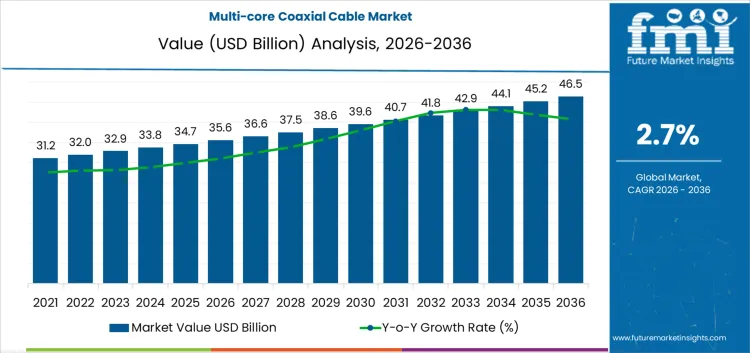
Multi core coaxial cable market is likely to be valued at USD 35.6 billion in 2026 and is expected to reach USD 46.5 billion by 2036, reflecting a CAGR of 2.7%. System designers begin with impedance budgets, shielding classes, and bend limits that fix cable geometry early. Once rack layouts and pathway fills are approved, specification change triggers rework across connectors, trays, and test plans. Broadcast plants, data centers, and transport nodes purchase by approved lists tied to sweep results and return loss thresholds. Suppliers win programs through process stability, braid coverage control, and dielectric uniformity. Price negotiations occur after qualification, not before.
Manufacturing performance centers on copper input management, extrusion consistency, and braid machine uptime across long runs. Plants schedule around die sets, jacket compounds, and color codes to protect yield. Every reel passes sweep, continuity, and return loss gates before release. Packaging choices affect damage during pulls and site staging. Distributors prefer mixed pallets matched to build plans. Contracts fix specifications inside approved vendor lists, which concentrates volume among a few qualified lines. Tooling amortization and scrap rates shape margin more than quarterly demand swings. Capacity decisions track awarded projects with dated ship windows and installation sequences for crew’s onsite teams.
Quick Stats for Multi-Core Coaxial Cable Market
- Multi-Core Coaxial Cable Market Value (2026): USD 35.6 billion
- Multi-Core Coaxial Cable Market Forecast Value (2036): USD 46.5 billion
- Multi-Core Coaxial Cable Market Forecast CAGR 2026 to 2036: 2.7%
- Leading Cable Type in Multi-Core Coaxial Cable Market: Standard multi-core coaxial cables
- Leading Application in Multi-Core Coaxial Cable Market: Telecommunications
- Key Growth Regions in Multi-Core Coaxial Cable Market: Asia Pacific, Europe, North America
- Top Players in Multi-Core Coaxial Cable Market: Belden Inc., CommScope, Prysmian Group, Sumitomo Electric Industries, Nexans, General Cable (part of Prysmian Group)
What is the Growth Forecast for the Multi-Core Coaxial Cable Market Through 2036?
Design lock in cycles set the pace for the multi core coaxial cable market more than short term shifts in electronics output. In 2026, at about USD 35.6 billion, demand is anchored in long running programs across telecom equipment, transport electronics, and defense systems. Once a cable architecture is qualified inside a platform, replacement tends to follow the product life rather than yearly budget decisions. Volume growth comes from higher channel counts inside compact assemblies and from the spread of multi-line routing in control and communication hardware. This keeps expansion gradual and predictable, with purchasing schedules tied to platform refresh timing rather than to quarterly production swings.
Factory economics shape the upper end of the forecast path for the multi core coaxial cable market. As the total approaches roughly USD 46.5 billion by 2036, attention shifts to yield control, conductor usage efficiency, and consistency in shielding performance. Production planning favors stable designs that run for many years with limited specification change. Engineering teams value bend stability, impedance consistency, and assembly speed inside customer plants. The climb from the high thirties into the mid-forties reflects accumulated program wins spread across many equipment families. Suppliers that combine process control with delivery reliability tend to secure repeat business.
Multi-core Coaxial Cable Market Key Takeaways
| Metric | Value |
|---|---|
| Market Value (2026) | USD 35.6 billion |
| Forecast Value (2036) | USD 46.5 billion |
| Forecast CAGR 2026 to 2036 | 2.7% |
How Is the Multi-Core Coaxial Cable Market Changing System Integration and Cabling Economics?
Multi-core coaxial cable is used when equipment requires many shielded channels but space, weight, and routing time are constrained. In earlier system designs, engineers accepted large cable looms and complex labeling because alternatives were limited. That approach increased assembly hours, inspection time, and failure points at connectors. The shift toward compact electronics in transport, imaging, and test equipment made dense cabling a design constraint rather than a convenience issue. Multi-core constructions answer that constraint by consolidating runs while preserving individual shielding performance. Product managers evaluate these cables through qualification cycles that test impedance stability, thermal behavior, and mechanical fatigue. Adoption usually follows platform redesigns, not incremental upgrades, since harness architecture must be frozen early in the development process for certification and tooling.
From a supplier perspective, competitive pressure sits more in manufacturing control than in raw material cost. Yield depends on keeping concentricity, shielding coverage, and pair-to-pair consistency inside narrow limits across long runs. Earlier production favored small batch custom assemblies with long lead times and high scrap rates. Current buyers push for repeatable constructions that can be stocked, cut, and terminated with predictable results. Documentation, traceability, and lot level test data influence supplier selection as much as price. System integrators compare total installed cost, including routing time and rework risk, rather than cable price alone. Over time, demand tracks equipment channel density and enclosure compression, not general wire and cable volume trends. Vendors that control process variation gain preferred status.
What Factors Are Shaping the Demand for Multi-Core Coaxial Cable Market in 2026 by Cable Type and Application?
In 2026, multi-core coaxial cable market is organized around performance assurance, qualification cost, and installation economics rather than short term equipment cycles. Purchasing decisions are tied to system architectures that remain fixed for long deployment periods. By cable type, the structure separates standard, low loss, shielded, and high frequency designs with different materials, testing burdens, and field tolerances. By application, demand is split across telecommunications, broadcasting and media, aerospace and defense, and industrial and instrumentation uses. Each segment imposes different loss budgets, interference limits, and maintenance expectations. Suppliers compete on documented reliability, manufacturing consistency, and traceable compliance records rather than on visible feature differentiation.
How Does Cable Type Choice Shape Manufacturing Priorities and System Qualification in the Multi-Core Coaxial Cable Market?
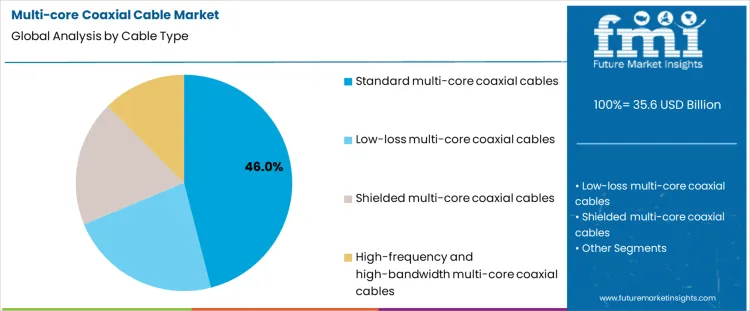
Standard multi-core coaxial cables account for about 46% of demand in the Multi-Core Coaxial Cable Market because they meet baseline impedance and shielding needs at controlled cost and predictable yield. Their use is concentrated in systems where routing density and connector count matter more than extreme attenuation control. Low loss variants address longer runs and tighter signal budgets, which shifts material choices toward improved dielectrics and tighter process control. Shielded designs target environments with persistent electromagnetic noise, increasing braid density, foil usage, and termination complexity. High frequency and high bandwidth designs serve equipment that pushes spectral limits, where geometry tolerance and surface finish directly affect performance. These differences separate production lines, inspection regimes, and scrap risk profiles across manufacturers.
The economics of cable type selection are driven by qualification effort and field failure exposure rather than by raw copper or polymer cost. Standard constructions benefit from broad approvals and stable tooling, which supports long production campaigns with limited revalidation. Low loss and high frequency products require tighter statistical process control, raising testing intensity and documentation load. Shielded constructions add assembly steps that affect throughput planning and labor content. Once a system is certified around a specific construction, changes are avoided because connector interfaces, bend radius rules, and signal models must be reworked. Demand therefore follows long design cycles and installed base expansion rather than short procurement experiments.
Why Does Application Mix Determine Performance Targets and Deployment Scale in the Multi-Core Coaxial Cable Market?
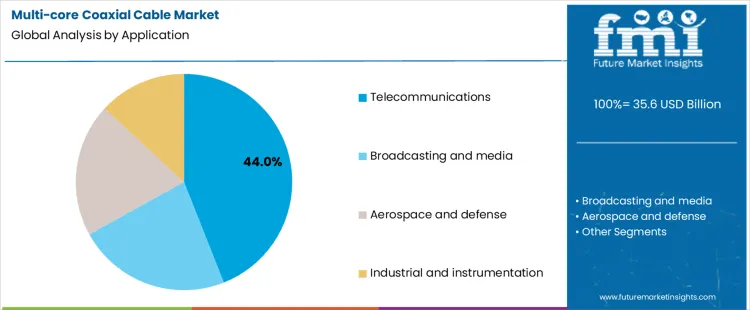
Telecommunications represents about 44% of demand in the multi-core coaxial cable market because network builds require large volumes of consistent, field tolerant cabling across access and backhaul segments. These deployments prioritize predictable attenuation, mechanical robustness, and fast installation over extreme performance margins. Broadcasting and media applications emphasize signal integrity across fixed studio and transmission paths, which increases attention to shielding quality and connector stability. Aerospace and defense programs impose weight limits, environmental resistance, and traceability requirements, which compress supplier lists and extend approval timelines. Industrial and instrumentation uses focus on noise immunity and uptime within electrically harsh facilities, often accepting shorter runs in exchange for higher interference protection.
Application driven demand also shapes lot sizes, logistics models, and service expectations. Telecommunications projects consume high volumes with standardized specifications, favoring suppliers that can guarantee continuity of supply and consistent batches. Broadcasting, aerospace, and industrial programs order smaller quantities, yet require deeper documentation, testing records, and configuration control. These customers often lock suppliers early because recertification carries schedule and cost risk. The contrast explains why volume growth concentrates in telecom even when technical complexity rises faster in other sectors. The overall segment mix reflects where installation scale, compliance burden, and lifetime maintenance costs intersect within infrastructure and equipment programs.
How Do Procurement, Compliance, and Production Realities Define the Multi Core Coaxial Cable Market Today?
The multi core coaxial cable market is defined by how equipment builders balance electrical performance targets against manufacturability, certification burden, and long-term service risk. In regulated environments such as medical systems, aerospace electronics, and defense platforms, interconnect choices are driven as much by documentation, traceability, and repeatability as by bandwidth or shielding. Historically, many programs accepted complex cable looms because they were familiar and easier to qualify. Current product cycles emphasize faster assembly, lower rework risk, and more predictable field behavior. This shifts attention toward consolidated assemblies that can be factory tested and version controlled, making cable architecture a governance and risk management decision rather than only an engineering choice.
What usage pattern trend is changing how the multi core coaxial cable market is consumed?
A visible trend in the multi core coaxial cable market is the move toward platform standardization across product families. Manufacturers increasingly reuse core electronic architectures across multiple models, which favors standardized interconnect blocks instead of custom harnesses for every variant. This encourages adoption of modular multi core cable sets that can be deployed across several configurations with minimal change. Another aspect of this trend is the growing preference for pre-qualified subassemblies that shorten internal build and test cycles. As a result, purchasing decisions are shifting from per-project cable sourcing toward framework agreements with fewer, more process-capable suppliers.
Where does revenue expansion come from in the multi core coaxial cable market if replacement cycles stay slow?
The most realistic opportunity in the multi core coaxial cable market lies in being designed into new equipment platforms where mechanical layout, service strategy, and assembly flow are still flexible. Growth is strongest when cable architecture is defined early and becomes part of the baseline product structure. There is also room to expand revenue through value added services such as pre-routing, labeling, testing, and documentation packages that reduce customer internal labor. Suppliers that can support co-design, rapid prototyping, and disciplined configuration control are better positioned to capture these programs than those competing only on per-meter cable pricing.
Why do organizational behavior and system lock-in restrain the multi core coaxial cable market?
A key restraint in the multi core coaxial cable market is not technical feasibility but organizational risk avoidance. Once an interconnect solution is qualified and documented, engineering and quality teams resist change because it triggers re-testing, paperwork, and audit exposure. This extends the service life of existing solutions even when better alternatives exist. In many companies, cabling is also treated as a low visibility component category, which limits strategic attention and budget priority. Combined with the fact that many systems were designed around discrete cables and legacy connectors, this creates structural inertia that slows broader migration to integrated multi core assemblies.
What is the Demand Analysis for Multi core Coaxial Cable by Country?
| Country | CAGR |
|---|---|
| USA | 2.5% |
| UK | 2.3% |
| China | 3.0% |
| India | 3.2% |
| Brazil | 2.6% |
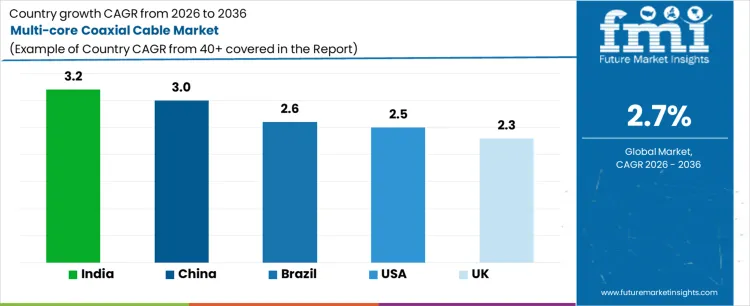
Demand for multi core coaxial cable is growing at a moderate pace as telecom, broadcast, and industrial users balance legacy infrastructure needs with gradual shifts toward fiber and wireless systems. India leads with a 3.2% CAGR, supported by network expansion in secondary cities, public infrastructure projects, and continued use of coaxial systems in surveillance and distribution networks. China follows at 3.0%, reflecting large installed bases in broadcast and security systems and steady replacement demand. Brazil records 2.6%, driven by cable TV, data networks, and industrial connectivity. The USA grows at 2.5%, shaped by maintenance and upgrade cycles in existing networks. The UK, at 2.3%, reflects a mature, replacement led demand profile.
How is the United States experiencing growth in the multi-core coaxial cable market?
Telecommunication expansion and high-definition broadcasting in urban hubs such as New York, Los Angeles, and Chicago are driving the multi-core coaxial cable market in the United States at a CAGR of 2.5%. Large-scale commercial buildings and industrial complexes are replacing legacy cabling with multi-core solutions to improve signal stability and reduce interference. Investments prioritize cable durability, ease of installation, and compatibility with hybrid fiber-coaxial networks. Concentration is high in metropolitan areas where broadband penetration is intensive, and replacement cycles encourage recurring demand. The need to support enterprise data centers, video streaming, and smart building connectivity further accelerates adoption. Growth reflects gradual network modernization, regulatory compliance, and urban infrastructure development ensuring reliable high-capacity signal transmission across residential and commercial environments.
How is the United Kingdom witnessing growth in the multi-core coaxial cable market?
Urban broadcasting networks and enterprise communication upgrades in London, Manchester, and Birmingham are increasing the adoption of multi-core coaxial cables in the United Kingdom, resulting in a CAGR of 2.3%. Digital media providers and telecom operators are replacing outdated cabling to meet growing demand for high-definition content and low-latency connectivity. Investments focus on shielding, signal integrity, and ease of integration with fiber-optic backbones. Market concentration is strongest in metropolitan regions, while regional commercial hubs provide secondary demand. Growth reflects infrastructure modernization initiatives, increasing data service consumption, and the need for reliable communication networks in office complexes, media studios, and public service installations.
How is China experiencing growth in the multi-core coaxial cable market?
Rapid industrialization and urbanization in cities like Shanghai, Beijing, and Guangzhou have accelerated demand for multi-core coaxial cables in China, with multi-core coaxial cable market growing at a CAGR of 3%. Manufacturing facilities, data centers, and large-scale residential complexes require high-performance cabling capable of maintaining signal quality under high usage. Investments prioritize advanced shielding, multi-core designs, and compatibility with both new and legacy systems. Adoption is concentrated in coastal industrial zones and major urban centers. Growth is propelled by large-scale broadband deployment, expansion of HD broadcasting networks, and the integration of cable infrastructure into smart building projects. The rising number of internet users and commercial facilities also contributes to steady demand.
How is India witnessing growth in the multi-core coaxial cable market?
Residential broadband expansion and commercial office network modernization in Mumbai, Delhi, and Bengaluru are driving India’s multi-core coaxial cable market at a CAGR of 3.2%. Replacement of old infrastructure and the deployment of high-speed internet for urban residential complexes and business parks encourage consistent demand. Investments focus on durable construction, low signal attenuation, and efficient installation in dense urban environments. Market concentration is highest in metropolitan hubs, while secondary urban centers show gradual adoption. Growth reflects rising digital content consumption, increased enterprise connectivity requirements, and the expansion of cable TV and internet services. Urban housing clusters and IT-enabled office parks form the primary sources of concentrated market demand.
How is Brazil experiencing growth in the multi-core coaxial cable market?
In Brazil, São Paulo, Rio de Janeiro, and Brasília are the epicenters of demand for multi-core coaxial cables, with multi-core coaxial cable market expanding at a CAGR of 2.6%. Telecom operators, cable TV providers, and commercial enterprises are upgrading networks to handle growing digital traffic and high-definition media streaming. Investments emphasize signal quality, cable durability under tropical conditions, and integration with hybrid fiber-optic systems. Adoption is concentrated in urban industrial and commercial districts, while regional cities are gradually incorporating these systems. Growth is driven by increased internet penetration, expansion of digital service offerings, and the need for reliable cabling in both residential and commercial environments, supporting operational efficiency and high-capacity connectivity.
How Do Major Suppliers Compete in the Multi Core Coaxial Cable Market?
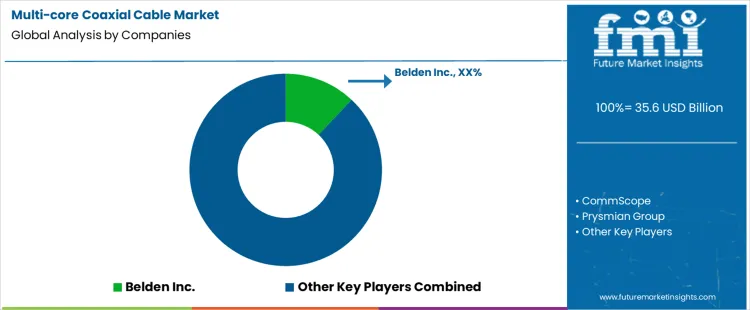
Multi core coaxial cable production sits inside broadcast, telecom backhaul, defense wiring, industrial imaging. Belden, CommScope, Prysmian Group, Sumitomo Electric Industries, Nexans, General Cable shape supply through scale manufacturing, specification depth, compliance testing. Purchasing decisions start with loss budgets, shielding classes, fire ratings, mechanical tolerances. Design engineers lock cable families early within platform programs. Once qualified, substitution remains rare due to revalidation cost. Belden holds strong positions in broadcast studios, data center backbones, factory networks. CommScope focuses on carrier infrastructure, structured cabling portfolios. Prysmian Group controls large volume output across energy, telecom, transport. Nexans keeps European utility relationships. Sumitomo Electric Industries aligns cable design with connector portfolios, production tooling, long qualification cycles across automotive, aerospace, defense programs worldwide procurement frameworks.
Competitive behavior reflects tender structures, framework contracts, distributor coverage. Buyers compare attenuation curves, shielding effectiveness, jacket compounds, certification files. Volume programs favor producers with copper access, extrusion scale, testing capacity. Short lead time orders favor stocked catalog lines. Belden invests in application engineering support, lab validation, field troubleshooting. CommScope emphasizes carrier approved portfolios, multi region manufacturing footprints. Prysmian Group uses vertical integration, metal supply agreements, regional plants. Nexans leverages utility relationships, project logistics control. Sumitomo Electric Industries links cable offerings with connector systems, harness assemblies. General Cable assets now sit inside Prysmian operating model. Price competition remains bounded by qualification cycles, compliance audits, customer change control. Market shares vary by sector, geography, procurement rule sets, installed base constraints, service expectations.
Key Players in the Multi-Core Coaxial Cable Market
- Belden Inc.
- CommScope
- Prysmian Group
- Sumitomo Electric Industries
- Nexans
- General Cable (now part of Prysmian Group)
Scope of the Report
| Items | Values |
|---|---|
| Quantitative Units (2026) | USD billion |
| Cable Type | Standard multi-core coaxial cables, Low-loss multi-core coaxial cables, Shielded multi-core coaxial cables, High-frequency and high-bandwidth multi-core coaxial cables |
| Application | Telecommunications, Broadcasting and media, Aerospace and defense, Industrial and instrumentation |
| Region | Asia Pacific, Europe, North America, Latin America, Middle East & Africa |
| Countries Covered | China, Japan, South Korea, India, Australia & New Zealand, ASEAN, Germany, United Kingdom, France, Italy, Spain, Nordic, BENELUX, United States, Canada, Mexico, Brazil, Chile, Saudi Arabia, Turkey, South Africa, and other regional markets |
| Key Companies Profiled | Belden Inc., CommScope, Prysmian Group, Sumitomo Electric Industries, Nexans, General Cable (part of Prysmian Group) |
| Additional Attributes | Dollar by sales by cable type and application; demand driven by platform design lock-in, channel density, and installation economics; growth led by telecom and broadcast deployments; purchasing shaped by qualification cycles, shielding performance, impedance stability, and long-run manufacturing consistency rather than short-term price moves. |
Multi-Core Coaxial Cable Market Segmentation
Cable Type:
- Standard multi-core coaxial cables
- Low-loss multi-core coaxial cables
- Shielded multi-core coaxial cables
- High-frequency and high-bandwidth multi-core coaxial cables
Application:
- Telecommunications
- Broadcasting and media
- Aerospace and defense
- Industrial and instrumentation
Region:
- Asia Pacific
- China
- Japan
- South Korea
- India
- Australia & New Zealand
- ASEAN
- Rest of Asia Pacific
- Europe
- Germany
- United Kingdom
- France
- Italy
- Spain
- Nordic
- BENELUX
- Rest of Europe
- North America
- United States
- Canada
- Mexico
- Latin America
- Brazil
- Chile
- Rest of Latin America
- Middle East & Africa
- Kingdom of Saudi Arabia
- Other GCC Countries
- Turkey
- South Africa
- Other African Union
- Rest of Middle East & Africa
Bibliography
- National Institute of Standards and Technology. (2024). Advanced metrology to enable next-generation extreme ultraviolet photoresists. U.S. Department of Commerce.
- National Institute of Standards and Technology. (2023). Metrology gaps in the semiconductor ecosystem: CHIPS R&D metrology program. U.S. Department of Commerce.
- IEEE Standards Association. (2024). International roadmap for devices and systems (IRDS): Metrology chapter. IEEE.
- National Science and Technology Council. (2024). National strategy on microelectronics research. Executive Office of the President of the United States.
Frequently Asked Questions
How big is the multi-core coaxial cable market in 2026?
The global multi-core coaxial cable market is estimated to be valued at USD 35.6 billion in 2026.
What will be the size of multi-core coaxial cable market in 2036?
The market size for the multi-core coaxial cable market is projected to reach USD 46.5 billion by 2036.
How much will be the multi-core coaxial cable market growth between 2026 and 2036?
The multi-core coaxial cable market is expected to grow at a 2.7% CAGR between 2026 and 2036.
What are the key product types in the multi-core coaxial cable market?
The key product types in multi-core coaxial cable market are standard multi‑core coaxial cables, low‑loss multi‑core coaxial cables, shielded multi‑core coaxial cables and high‑frequency and high‑bandwidth multi‑core coaxial cables.
Which application segment to contribute significant share in the multi-core coaxial cable market in 2026?
In terms of application, telecommunications segment to command 44.0% share in the multi-core coaxial cable market in 2026.
Preview the report firsthand - request a free sample
Get SampleGet the brochure for pricing and purchase details.
Get PDFTable of Content
- Executive Summary
- Global Market Outlook
- Demand-side Trends
- Supply-side Trends
- Technology Roadmap Analysis
- Analysis and Recommendations
- Market Overview
- Market Coverage / Taxonomy
- Market Definition / Scope / Limitations
- Market Background
- Market Dynamics
- Drivers
- Restraints
- Opportunity
- Trends
- Scenario Forecast
- Demand in Optimistic Scenario
- Demand in Likely Scenario
- Demand in Conservative Scenario
- Opportunity Map Analysis
- Product Life Cycle Analysis
- Supply Chain Analysis
- Investment Feasibility Matrix
- Value Chain Analysis
- PESTLE and Porter’s Analysis
- Regulatory Landscape
- Regional Parent Market Outlook
- Production and Consumption Statistics
- Import and Export Statistics
- Market Dynamics
- Global Market Analysis 2021 to 2025 and Forecast, 2026 to 2036
- Historical Market Size Value (USD Million) Analysis, 2021 to 2025
- Current and Future Market Size Value (USD Million) Projections, 2026 to 2036
- Y-o-Y Growth Trend Analysis
- Absolute $ Opportunity Analysis
- Global Market Pricing Analysis 2021 to 2025 and Forecast 2026 to 2036
- Global Market Analysis 2021 to 2025 and Forecast 2026 to 2036, By Cable Type
- Introduction / Key Findings
- Historical Market Size Value (USD Million) Analysis By Cable Type , 2021 to 2025
- Current and Future Market Size Value (USD Million) Analysis and Forecast By Cable Type , 2026 to 2036
- Standard multi‑core coaxial cables
- Low‑loss multi‑core coaxial cables
- Shielded multi‑core coaxial cables
- High‑frequency and high‑bandwidth multi‑core coaxial cables
- Standard multi‑core coaxial cables
- Y-o-Y Growth Trend Analysis By Cable Type , 2021 to 2025
- Absolute $ Opportunity Analysis By Cable Type , 2026 to 2036
- Global Market Analysis 2021 to 2025 and Forecast 2026 to 2036, By Application
- Introduction / Key Findings
- Historical Market Size Value (USD Million) Analysis By Application, 2021 to 2025
- Current and Future Market Size Value (USD Million) Analysis and Forecast By Application, 2026 to 2036
- Telecommunications
- Broadcasting and media
- Aerospace and defense
- Industrial and instrumentation
- Telecommunications
- Y-o-Y Growth Trend Analysis By Application, 2021 to 2025
- Absolute $ Opportunity Analysis By Application, 2026 to 2036
- Global Market Analysis 2021 to 2025 and Forecast 2026 to 2036, By Region
- Introduction
- Historical Market Size Value (USD Million) Analysis By Region, 2021 to 2025
- Current Market Size Value (USD Million) Analysis and Forecast By Region, 2026 to 2036
- North America
- Latin America
- Western Europe
- Eastern Europe
- East Asia
- South Asia and Pacific
- Middle East & Africa
- Market Attractiveness Analysis By Region
- North America Market Analysis 2021 to 2025 and Forecast 2026 to 2036, By Country
- Historical Market Size Value (USD Million) Trend Analysis By Market Taxonomy, 2021 to 2025
- Market Size Value (USD Million) Forecast By Market Taxonomy, 2026 to 2036
- By Country
- USA
- Canada
- Mexico
- By Cable Type
- By Application
- By Country
- Market Attractiveness Analysis
- By Country
- By Cable Type
- By Application
- Key Takeaways
- Latin America Market Analysis 2021 to 2025 and Forecast 2026 to 2036, By Country
- Historical Market Size Value (USD Million) Trend Analysis By Market Taxonomy, 2021 to 2025
- Market Size Value (USD Million) Forecast By Market Taxonomy, 2026 to 2036
- By Country
- Brazil
- Chile
- Rest of Latin America
- By Cable Type
- By Application
- By Country
- Market Attractiveness Analysis
- By Country
- By Cable Type
- By Application
- Key Takeaways
- Western Europe Market Analysis 2021 to 2025 and Forecast 2026 to 2036, By Country
- Historical Market Size Value (USD Million) Trend Analysis By Market Taxonomy, 2021 to 2025
- Market Size Value (USD Million) Forecast By Market Taxonomy, 2026 to 2036
- By Country
- Germany
- UK
- Italy
- Spain
- France
- Nordic
- BENELUX
- Rest of Western Europe
- By Cable Type
- By Application
- By Country
- Market Attractiveness Analysis
- By Country
- By Cable Type
- By Application
- Key Takeaways
- Eastern Europe Market Analysis 2021 to 2025 and Forecast 2026 to 2036, By Country
- Historical Market Size Value (USD Million) Trend Analysis By Market Taxonomy, 2021 to 2025
- Market Size Value (USD Million) Forecast By Market Taxonomy, 2026 to 2036
- By Country
- Russia
- Poland
- Hungary
- Balkan & Baltic
- Rest of Eastern Europe
- By Cable Type
- By Application
- By Country
- Market Attractiveness Analysis
- By Country
- By Cable Type
- By Application
- Key Takeaways
- East Asia Market Analysis 2021 to 2025 and Forecast 2026 to 2036, By Country
- Historical Market Size Value (USD Million) Trend Analysis By Market Taxonomy, 2021 to 2025
- Market Size Value (USD Million) Forecast By Market Taxonomy, 2026 to 2036
- By Country
- China
- Japan
- South Korea
- By Cable Type
- By Application
- By Country
- Market Attractiveness Analysis
- By Country
- By Cable Type
- By Application
- Key Takeaways
- South Asia and Pacific Market Analysis 2021 to 2025 and Forecast 2026 to 2036, By Country
- Historical Market Size Value (USD Million) Trend Analysis By Market Taxonomy, 2021 to 2025
- Market Size Value (USD Million) Forecast By Market Taxonomy, 2026 to 2036
- By Country
- India
- ASEAN
- Australia & New Zealand
- Rest of South Asia and Pacific
- By Cable Type
- By Application
- By Country
- Market Attractiveness Analysis
- By Country
- By Cable Type
- By Application
- Key Takeaways
- Middle East & Africa Market Analysis 2021 to 2025 and Forecast 2026 to 2036, By Country
- Historical Market Size Value (USD Million) Trend Analysis By Market Taxonomy, 2021 to 2025
- Market Size Value (USD Million) Forecast By Market Taxonomy, 2026 to 2036
- By Country
- Kingdom of Saudi Arabia
- Other GCC Countries
- Turkiye
- South Africa
- Other African Union
- Rest of Middle East & Africa
- By Cable Type
- By Application
- By Country
- Market Attractiveness Analysis
- By Country
- By Cable Type
- By Application
- Key Takeaways
- Key Countries Market Analysis
- USA
- Pricing Analysis
- Market Share Analysis, 2025
- By Cable Type
- By Application
- Canada
- Pricing Analysis
- Market Share Analysis, 2025
- By Cable Type
- By Application
- Mexico
- Pricing Analysis
- Market Share Analysis, 2025
- By Cable Type
- By Application
- Brazil
- Pricing Analysis
- Market Share Analysis, 2025
- By Cable Type
- By Application
- Chile
- Pricing Analysis
- Market Share Analysis, 2025
- By Cable Type
- By Application
- Germany
- Pricing Analysis
- Market Share Analysis, 2025
- By Cable Type
- By Application
- UK
- Pricing Analysis
- Market Share Analysis, 2025
- By Cable Type
- By Application
- Italy
- Pricing Analysis
- Market Share Analysis, 2025
- By Cable Type
- By Application
- Spain
- Pricing Analysis
- Market Share Analysis, 2025
- By Cable Type
- By Application
- France
- Pricing Analysis
- Market Share Analysis, 2025
- By Cable Type
- By Application
- India
- Pricing Analysis
- Market Share Analysis, 2025
- By Cable Type
- By Application
- ASEAN
- Pricing Analysis
- Market Share Analysis, 2025
- By Cable Type
- By Application
- Australia & New Zealand
- Pricing Analysis
- Market Share Analysis, 2025
- By Cable Type
- By Application
- China
- Pricing Analysis
- Market Share Analysis, 2025
- By Cable Type
- By Application
- Japan
- Pricing Analysis
- Market Share Analysis, 2025
- By Cable Type
- By Application
- South Korea
- Pricing Analysis
- Market Share Analysis, 2025
- By Cable Type
- By Application
- Russia
- Pricing Analysis
- Market Share Analysis, 2025
- By Cable Type
- By Application
- Poland
- Pricing Analysis
- Market Share Analysis, 2025
- By Cable Type
- By Application
- Hungary
- Pricing Analysis
- Market Share Analysis, 2025
- By Cable Type
- By Application
- Kingdom of Saudi Arabia
- Pricing Analysis
- Market Share Analysis, 2025
- By Cable Type
- By Application
- Turkiye
- Pricing Analysis
- Market Share Analysis, 2025
- By Cable Type
- By Application
- South Africa
- Pricing Analysis
- Market Share Analysis, 2025
- By Cable Type
- By Application
- USA
- Market Structure Analysis
- Competition Dashboard
- Competition Benchmarking
- Market Share Analysis of Top Players
- By Regional
- By Cable Type
- By Application
- Competition Analysis
- Competition Deep Dive
- Belden Inc.
- Overview
- Product Portfolio
- Profitability by Market Segments (Product/Age /Sales Channel/Region)
- Sales Footprint
- Strategy Overview
- Marketing Strategy
- Product Strategy
- Channel Strategy
- CommScope
- Prysmian Group
- Sumitomo Electric Industries
- Nexans
- General Cable (Now part of Prysmian Group)
- Belden Inc.
- Competition Deep Dive
- Assumptions & Acronyms Used
- Research Methodology


