

- Industry Size (2026)
- USD 2.0 Bn
- Forecast (2036)
- USD 4.8 Bn
- CAGR (2026 to 2036)
- 9.1%
Nail Psoriasis Treatment Market Forecast and Outlook 2026 to 2036
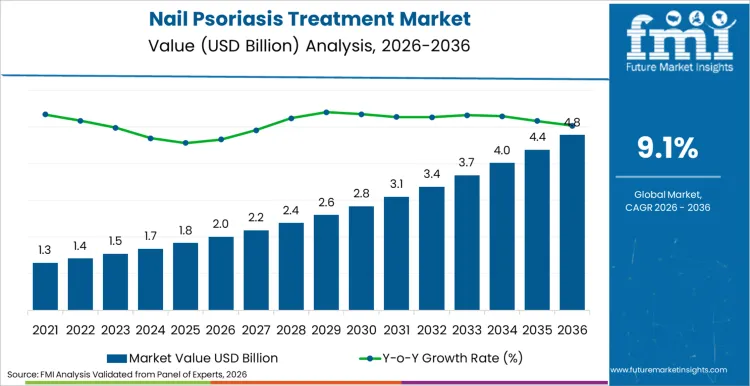
Nail psoriasis treatment market is set to reach USD 2.0 billion in 2026, driven by growing awareness of psoriatic disease complications. Revenue generation is projected to expand at a robust CAGR of 9.1% through 2036, pushing total sector worth beyond USD 4.8 billion by the conclusion of this assessment period. Increasing prevalence of autoimmune disorders, which often manifest as recalcitrant nail dystrophy, acts as a primary catalyst for this financial trajectory.
Pharmaceutical entities are channeling significant investments into research, aiming to develop biologics with higher efficacy and safety profiles for long-term use. Patients are shifting focus from simply managing skin symptoms to addressing visible nail deformities, redefining consumption patterns in major healthcare economies. Such behavioral changes encourage manufacturers to introduce advanced systemic therapies that offer superior clearance rates over traditional topical options.
Chronic nature of psoriasis and its psychological impact are significantly influencing industry expansion. Healthcare professionals emphasize early intervention, utilizing potent biologic classes to prevent permanent nail damage and functional impairment. Clinical trials investigating novel small-molecule inhibitors are showing positive outcomes, instilling confidence among investors and dermatologists regarding future product pipelines.
Quick Stats for Nail Psoriasis Treatment Market
- Nail Psoriasis Treatment Industry Value (2026): USD 2.0 Billion
- Nail Psoriasis Treatment Industry Forecast Value (2036): USD 4.8 Billion
- Nail Psoriasis Treatment Industry Forecast CAGR: 9.1%
- Nail Psoriasis Treatment Industry Leading Form: Topical corticosteroids (32%)
- Nail Psoriasis Treatment Industry Leading End Use: Dermatology clinics (46%)
- Nail Psoriasis Treatment Industry Leading Functionality: Symptom Management
- Nail Psoriasis Treatment Industry Key Growth Regions: India, Brazil, China
- Nail Psoriasis Treatment Industry Key Players: AbbVie, Johnson & Johnson, Novartis, Pfizer, Eli Lilly
Rising adoption of teledermatology platforms continues to fuel demand for accessible prescription therapies, creating sustained opportunities for specialized care solutions. Government health initiatives targeting autoimmune disease management are facilitating faster regulatory approvals for innovative treatments. Companies are witnessing robust growth potential in developing nations, where improving healthcare infrastructure and rising disposable incomes are aligning with increased medical awareness regarding psoriatic arthritis links.
Innovations in delivery mechanisms are transforming how active ingredients reach the nail bed. Researchers are combining psoriasis care formulas with advanced penetration enhancers that navigate the keratin matrix effectively. Development of psoriasis biosimilars is gaining traction, addressing cost barriers that often hinder patient access to biologic therapies. Focus is shifting toward comprehensive autoimmune disease therapeutics that target underlying inflammatory pathways. Advancements in biotechnology enable targeted delivery of inflammatory diseases treatments, enhancing therapeutic outcomes while significantly reducing systemic toxicity risks. These innovations are pivotal in shaping a future where treatment is both effective and patient-centric.
Nail Psoriasis Treatment Market Key Takeaways
| Metric | Value |
|---|---|
| Industry Size (2026) | USD 2.0 Billion |
| Industry Value (2036) | USD 4.8 Billion |
| CAGR (2026 to 2036) | 9.1% |
Source: FMI’s proprietary forecasting model and primary research
Which Technological Drivers Are Accelerating Therapeutic Adoption?
Integration of phototherapy with systemic treatments is serving as a significant catalyst for broader acceptance of combination regimens. Recent breakthroughs in north america and europe phototherapy treatment have revolutionized protocols by demonstrating that targeted UV exposure significantly enhances clearance rates when used with topical agents. This synergistic approach appeals to healthcare providers managing patients with resistant plaques. Clinical success of dermatology excimer lasers in facilitating rapid symptom relief has expanded prescribing precision. Education programs highlighting systemic risks of untreated psoriatic arthritis psa treatment needs are driving patient proactivity. Pharmaceutical firms are capitalizing on these trends by introducing phototherapy equipment compatible formulations. Integrating dermatology devices into routine care is becoming standard practice, supporting better clinical decision-making.
How Is the Nail Psoriasis Treatment Market Structured Across Key Categories?
The nail psoriasis treatment market is structured around several key categories that influence its growth and development. Firstly, the market is segmented by treatment types, which include topical therapies, systemic treatments, and phototherapy, each catering to different severity levels and patient needs. Topical treatments, such as corticosteroids and vitamin D analogs, are commonly used for milder cases, while systemic treatments, including biologics and oral medications like methotrexate, are reserved for more severe manifestations.
Why Do Topical Corticosteroids Maintain Market Dominance?
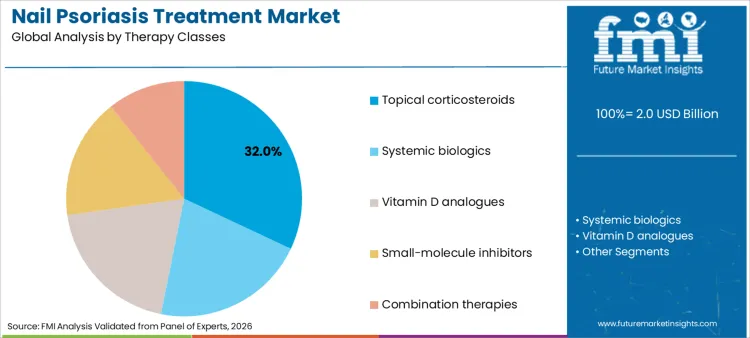
Topical corticosteroids account for 32% of share in 2026, driven by versatile effectiveness against inflammation and hyperkeratosis. Leadership position is underpinned by clinical guidelines widely recommending potent steroids as initial therapy for matrix and bed involvement. Segment benefits from continuous formulation improvements, such as inclusion of lacquers that allow drug retention. Research focused on minimizing skin atrophy risks is renewing interest among practitioners. Critical role in antipruritic management further solidifies standing, as they address itching associated with psoriasis. As healthcare systems prioritize cost-effective disease management, demand for advanced steroid formulations is expected to remain robust.
Why Are Dermatology Clinics the Preferred Setting?
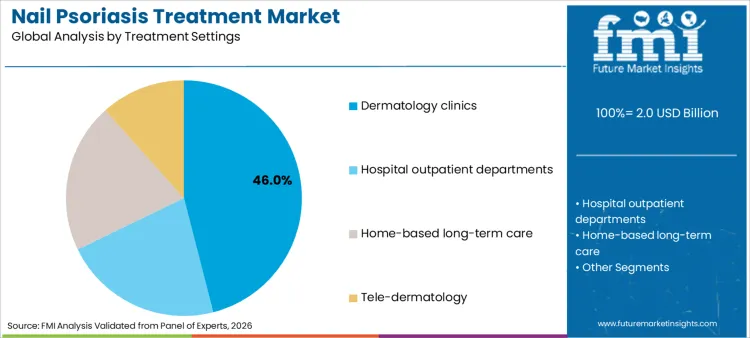
Dermatology clinics command 46% share of sector in 2026, reflecting global preference for specialized care. Dominance is inextricably linked to complex nature of nail psoriasis, requiring accurate diagnosis and monitoring. Clinics rely on specialized dermatology lasers to manage symptoms effectively. These settings are essential for initiating biologic therapies in high-risk populations, driving priority status in healthcare funding. Relentless pursuit of clinical clearance ensures products designed specifically for specialist application remain top priority. Chronic nature necessitates long-term patient-clinic relationships, bolstering sustained revenue streams for these facilities.
How Will Biologic Innovations Transform Sales?
Biologic adoption is set to reshape sales landscapes by enabling targeted immune modulation. As flaky skin treatment options evolve, patients access systemic therapies tackling root causes, expanding reach beyond topical relief. Shift toward biologic care creates demand for highly specific inhibitors patients can trust for long-term control. Manufacturers failing to integrate portfolios with advanced biologics risk losing visibility among specialists. Availability of phototherapy lamps for home use drives complimentary consumption volume. Rise of biosimilars stimulates innovation, with companies differentiating offerings by bundling drugs with patient support programs.
How Are Regulatory Frameworks Influencing Development?
Regulatory bodies are increasingly demanding rigorous clinical endpoints in psoriasis trials, directly impacting development costs. Shift forces pharmaceutical companies to prove not just symptom relief but also quality of life improvement, raising entry barriers. Opportunities for differentiation emerge as agents demonstrating superior nail clearance gain rapid endorsement. Strict safety standards impact production of potent formulations. Manufacturers must ensure rigorous monitoring to prevent adverse events. While regulations drive development of superior products, they impose higher compliance burdens. Companies proactively aligning with global guidelines regarding patient-reported outcomes gain competitive edge, positioning brands as gold standard.
How Will the Nail Psoriasis Treatment Industry Evolve in Major Nations?
Global landscape for nail psoriasis treatment is characterized by diverse growth patterns, influenced by genetic predisposition and healthcare accessibility. Established markets prioritize advanced biologics and laser therapies, whereas emerging economies rely on affordable topicals to address widespread prevalence. Asia-Pacific is emerging as rapid growth hub due to increasing diagnostic rates and better dermatological awareness. Conversely, North American and Western European sectors pivot towards holistic autoimmune management. Government initiatives in developing nations supporting public health campaigns against inflammatory diseases ensure sustained demand for essential medications across all geographies.
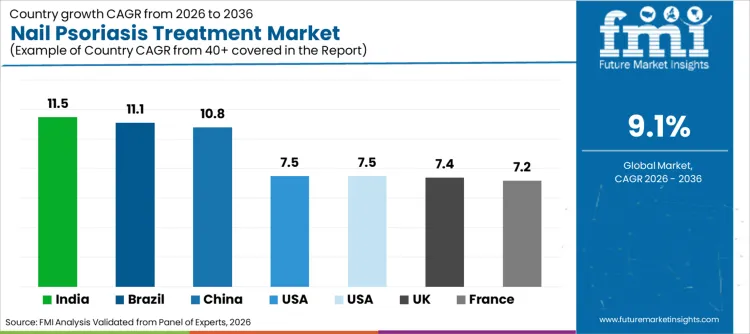
| Country | CAGR (2026 to 2036) |
|---|---|
| USA | 7.5% |
| Brazil | 11.1% |
| China | 10.8% |
| India | 11.5% |
| Germany | 7.5% |
| France | 7.2% |
| UK | 7.4% |
Source: FMI’s proprietary forecasting model and primary research
Why is the Nail Psoriasis Treatment Industry in the USA Growing?
Sales of nail psoriasis treatments in USA are set to grow at 7.5% CAGR through 2036. Expansion is underpinned by high awareness of psoriatic arthritis links and robust insurance framework supporting biologic coverage. Growth is fueled by widespread availability of advanced clinics, often necessitating systemic regimens for complete control. Rapid adoption of novel small-molecule inhibitors drives revenue generation per prescription. Presence of major pharmaceutical players headquartered within country streamlines supply chains. Emphasis on combining aesthetic restoration with medical treatment continues to be primary driver, maintaining USA position as critical revenue generator.
Why is the Nail Psoriasis Treatment Sector in China Expanding?
Demand for psoriasis solutions in China is projected to rise at 10.8% CAGR during assessment period. Initiatives emphasizing chronic disease management foster favorable environment for domestic and international brands. Increasing investment in private dermatology clinics creates massive supply channel for premium therapies. Rising prevalence of autoimmune conditions prompts local hospitals to stock advanced therapeutic protocols. Shift is supported by digital health platforms promoting specialist access, accelerating uptake of specialized products across country and fueling sector expansion.
Why is the Nail Psoriasis Treatment Industry in India Showing High Potential?
Nail psoriasis treatment industry in India is poised to expand at 11.5% CAGR, representing highest growth rate among analyzed nations. Surge is largely attributed to rapid urbanization and increasing footfall in clinics for chronic skin conditions. Government focus on improving healthcare access encourages population to upgrade from home remedies to clinically proven treatments. Increasing partnerships between Indian pharma giants and global innovators necessitate production of high-quality formulations. Cost advantages of local manufacturing combined with rising middle-class purchasing power attract significant investment. Generic availability of high-potency drugs further democratizes access.
What is the Competitive Outlook for the Nail Psoriasis Treatment Market?
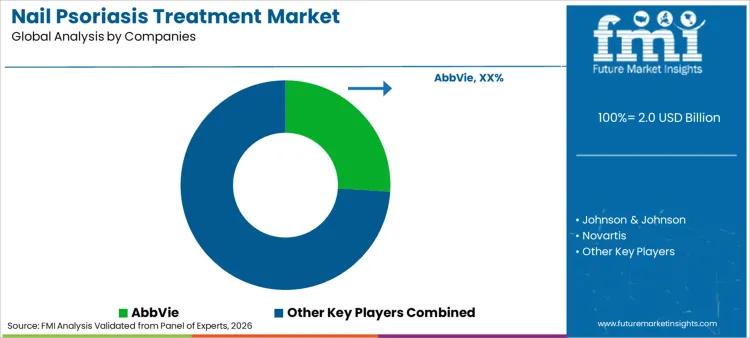
Market participants are increasingly focusing on portfolio diversification to combat patent cliffs for blockbuster biologics. Leading players like AbbVie and Johnson & Johnson are directing R&D budgets toward next-generation IL-inhibitors, promising superior clearance rates with fewer doses. Significant trend involves developing oral small molecules offering systemic benefits without injection burden, widening customer base. Companies actively engage in strategic collaborations with diagnostic firms to create early detection tools, enhancing clinical utility. Sustainability emerges as competitive frontier, with manufacturers exploring eco-friendly packaging. Consolidation activities remain high as large multinationals acquire biotech firms with promising pipelines to fortify dermatology portfolios.
Key Players in Nail Psoriasis Treatment Market
- AbbVie
- Johnson & Johnson
- Novartis
- Pfizer
- Eli Lilly
Scope of Report
| Items | Values |
|---|---|
| Quantitative Units | USD Million, USD Billion |
| Therapy Classes | Topical corticosteroids, Vitamin D analogues, Systemic biologics, Small-molecule inhibitors, Combination therapies |
| Treatment Settings | Dermatology clinics, Hospital outpatient departments, Home-based long-term care, Tele-dermatology |
| Distribution Channels | Specialty pharmacies, Retail pharmacies, Hospital pharmacies, Online pharmacies |
| Regions | North America, Europe, East Asia, South Asia, Latin America, MEA |
Nail Psoriasis Treatment Market by Segments
Therapy Classes:
- Topical corticosteroids
- Vitamin D analogues
- Systemic biologics
- Small-molecule inhibitors
- Combination therapies
Treatment Settings:
- Dermatology clinics
- Hospital outpatient departments
- Home-based long-term care
- Tele-dermatology
Distribution Channels:
- Specialty pharmacies
- Retail pharmacies
- Hospital pharmacies
- Online pharmacies
Regions:
- North America
- Europe
- East Asia
- South Asia
- Latin America
- Middle East & Africa
Bibliography
- National Psoriasis Foundation. (2025, October 29). Nail psoriasis: Symptoms, causes, and treatment. National Psoriasis Foundation, United States.
- American Academy of Dermatology. (2026, January 19). Psoriasis clinical guideline. American Academy of Dermatology, United States.
- World Health Organization. (2025, May 27). Skin diseases as a global public health priority (WHA78.15). World Health Organization.
- European Academy of Dermatology and Venereology. (2026, January 19). Clinical guidelines on dermatology and venereology. European Academy of Dermatology and Venereology.
- USA Food and Drug Administration. (2024, March 12). 2024 biological approvals. USA Food and Drug Administration, United States.
Frequently Asked Questions
How large is the demand for Nail Psoriasis Treatment in the global market in 2026?
Demand for Nail Psoriasis Treatment in global market is estimated to be valued at USD 2.0 billion in 2026.
What will be the market size of Nail Psoriasis Treatment in the global market by 2036?
Market size for Nail Psoriasis Treatment is projected to reach USD 4.8 billion by 2036.
What is the expected demand growth for Nail Psoriasis Treatment in the global market between 2026 and 2036?
Demand for Nail Psoriasis Treatment in global market is expected to grow at CAGR of 9.1% between 2026 and 2036.
Which Therapy Class is poised to lead global sales by 2026?
Topical corticosteroids are expected to be dominant therapy class, capturing approximately 32% of global market share in 2026 due to first-line efficacy.
How significant is the role of Dermatology Clinics in driving Nail Psoriasis Treatment adoption in 2026?
Dermatology Clinics represent critical treatment setting, projected to hold substantial 46% share of total market in 2026 as patients seek specialist management.
Preview the report firsthand - request a free sample
Get SampleGet the brochure for pricing and purchase details.
Get PDFTable of Content
- Executive Summary
- Global Market Outlook
- Demand-side Trends
- Supply-side Trends
- Technology Roadmap Analysis
- Analysis and Recommendations
- Market Overview
- Market Coverage / Taxonomy
- Market Definition / Scope / Limitations
- Market Background
- Market Dynamics
- Drivers
- Restraints
- Opportunity
- Trends
- Scenario Forecast
- Demand in Optimistic Scenario
- Demand in Likely Scenario
- Demand in Conservative Scenario
- Opportunity Map Analysis
- Product Life Cycle Analysis
- Supply Chain Analysis
- Investment Feasibility Matrix
- Value Chain Analysis
- PESTLE and Porter’s Analysis
- Regulatory Landscape
- Regional Parent Market Outlook
- Production and Consumption Statistics
- Import and Export Statistics
- Market Dynamics
- Global Market Analysis 2021 to 2025 and Forecast, 2026 to 2036
- Historical Market Size Value (USD Million) Analysis, 2021 to 2025
- Current and Future Market Size Value (USD Million) Projections, 2026 to 2036
- Y-o-Y Growth Trend Analysis
- Absolute $ Opportunity Analysis
- Global Market Pricing Analysis 2021 to 2025 and Forecast 2026 to 2036
- Global Market Analysis 2021 to 2025 and Forecast 2026 to 2036, By Therapy Classes
- Introduction / Key Findings
- Historical Market Size Value (USD Million) Analysis By Therapy Classes , 2021 to 2025
- Current and Future Market Size Value (USD Million) Analysis and Forecast By Therapy Classes , 2026 to 2036
- Topical corticosteroids
- Systemic biologics
- Vitamin D analogues
- Small-molecule inhibitors
- Combination therapies
- Topical corticosteroids
- Y-o-Y Growth Trend Analysis By Therapy Classes , 2021 to 2025
- Absolute $ Opportunity Analysis By Therapy Classes , 2026 to 2036
- Global Market Analysis 2021 to 2025 and Forecast 2026 to 2036, By Treatment Settings
- Introduction / Key Findings
- Historical Market Size Value (USD Million) Analysis By Treatment Settings, 2021 to 2025
- Current and Future Market Size Value (USD Million) Analysis and Forecast By Treatment Settings, 2026 to 2036
- Dermatology clinics
- Hospital outpatient departments
- Home-based long-term care
- Tele-dermatology
- Dermatology clinics
- Y-o-Y Growth Trend Analysis By Treatment Settings, 2021 to 2025
- Absolute $ Opportunity Analysis By Treatment Settings, 2026 to 2036
- Global Market Analysis 2021 to 2025 and Forecast 2026 to 2036, By Distribution Channels
- Introduction / Key Findings
- Historical Market Size Value (USD Million) Analysis By Distribution Channels, 2021 to 2025
- Current and Future Market Size Value (USD Million) Analysis and Forecast By Distribution Channels, 2026 to 2036
- Specialty pharmacies
- Retail pharmacies
- Hospital pharmacies
- Online pharmacies
- Specialty pharmacies
- Y-o-Y Growth Trend Analysis By Distribution Channels, 2021 to 2025
- Absolute $ Opportunity Analysis By Distribution Channels, 2026 to 2036
- Global Market Analysis 2021 to 2025 and Forecast 2026 to 2036, By Region
- Introduction
- Historical Market Size Value (USD Million) Analysis By Region, 2021 to 2025
- Current Market Size Value (USD Million) Analysis and Forecast By Region, 2026 to 2036
- North America
- Latin America
- Western Europe
- Eastern Europe
- East Asia
- South Asia and Pacific
- Middle East & Africa
- Market Attractiveness Analysis By Region
- North America Market Analysis 2021 to 2025 and Forecast 2026 to 2036, By Country
- Historical Market Size Value (USD Million) Trend Analysis By Market Taxonomy, 2021 to 2025
- Market Size Value (USD Million) Forecast By Market Taxonomy, 2026 to 2036
- By Country
- USA
- Canada
- Mexico
- By Therapy Classes
- By Treatment Settings
- By Distribution Channels
- By Country
- Market Attractiveness Analysis
- By Country
- By Therapy Classes
- By Treatment Settings
- By Distribution Channels
- Key Takeaways
- Latin America Market Analysis 2021 to 2025 and Forecast 2026 to 2036, By Country
- Historical Market Size Value (USD Million) Trend Analysis By Market Taxonomy, 2021 to 2025
- Market Size Value (USD Million) Forecast By Market Taxonomy, 2026 to 2036
- By Country
- Brazil
- Chile
- Rest of Latin America
- By Therapy Classes
- By Treatment Settings
- By Distribution Channels
- By Country
- Market Attractiveness Analysis
- By Country
- By Therapy Classes
- By Treatment Settings
- By Distribution Channels
- Key Takeaways
- Western Europe Market Analysis 2021 to 2025 and Forecast 2026 to 2036, By Country
- Historical Market Size Value (USD Million) Trend Analysis By Market Taxonomy, 2021 to 2025
- Market Size Value (USD Million) Forecast By Market Taxonomy, 2026 to 2036
- By Country
- Germany
- UK
- Italy
- Spain
- France
- Nordic
- BENELUX
- Rest of Western Europe
- By Therapy Classes
- By Treatment Settings
- By Distribution Channels
- By Country
- Market Attractiveness Analysis
- By Country
- By Therapy Classes
- By Treatment Settings
- By Distribution Channels
- Key Takeaways
- Eastern Europe Market Analysis 2021 to 2025 and Forecast 2026 to 2036, By Country
- Historical Market Size Value (USD Million) Trend Analysis By Market Taxonomy, 2021 to 2025
- Market Size Value (USD Million) Forecast By Market Taxonomy, 2026 to 2036
- By Country
- Russia
- Poland
- Hungary
- Balkan & Baltic
- Rest of Eastern Europe
- By Therapy Classes
- By Treatment Settings
- By Distribution Channels
- By Country
- Market Attractiveness Analysis
- By Country
- By Therapy Classes
- By Treatment Settings
- By Distribution Channels
- Key Takeaways
- East Asia Market Analysis 2021 to 2025 and Forecast 2026 to 2036, By Country
- Historical Market Size Value (USD Million) Trend Analysis By Market Taxonomy, 2021 to 2025
- Market Size Value (USD Million) Forecast By Market Taxonomy, 2026 to 2036
- By Country
- China
- Japan
- South Korea
- By Therapy Classes
- By Treatment Settings
- By Distribution Channels
- By Country
- Market Attractiveness Analysis
- By Country
- By Therapy Classes
- By Treatment Settings
- By Distribution Channels
- Key Takeaways
- South Asia and Pacific Market Analysis 2021 to 2025 and Forecast 2026 to 2036, By Country
- Historical Market Size Value (USD Million) Trend Analysis By Market Taxonomy, 2021 to 2025
- Market Size Value (USD Million) Forecast By Market Taxonomy, 2026 to 2036
- By Country
- India
- ASEAN
- Australia & New Zealand
- Rest of South Asia and Pacific
- By Therapy Classes
- By Treatment Settings
- By Distribution Channels
- By Country
- Market Attractiveness Analysis
- By Country
- By Therapy Classes
- By Treatment Settings
- By Distribution Channels
- Key Takeaways
- Middle East & Africa Market Analysis 2021 to 2025 and Forecast 2026 to 2036, By Country
- Historical Market Size Value (USD Million) Trend Analysis By Market Taxonomy, 2021 to 2025
- Market Size Value (USD Million) Forecast By Market Taxonomy, 2026 to 2036
- By Country
- Kingdom of Saudi Arabia
- Other GCC Countries
- Turkiye
- South Africa
- Other African Union
- Rest of Middle East & Africa
- By Therapy Classes
- By Treatment Settings
- By Distribution Channels
- By Country
- Market Attractiveness Analysis
- By Country
- By Therapy Classes
- By Treatment Settings
- By Distribution Channels
- Key Takeaways
- Key Countries Market Analysis
- USA
- Pricing Analysis
- Market Share Analysis, 2025
- By Therapy Classes
- By Treatment Settings
- By Distribution Channels
- Canada
- Pricing Analysis
- Market Share Analysis, 2025
- By Therapy Classes
- By Treatment Settings
- By Distribution Channels
- Mexico
- Pricing Analysis
- Market Share Analysis, 2025
- By Therapy Classes
- By Treatment Settings
- By Distribution Channels
- Brazil
- Pricing Analysis
- Market Share Analysis, 2025
- By Therapy Classes
- By Treatment Settings
- By Distribution Channels
- Chile
- Pricing Analysis
- Market Share Analysis, 2025
- By Therapy Classes
- By Treatment Settings
- By Distribution Channels
- Germany
- Pricing Analysis
- Market Share Analysis, 2025
- By Therapy Classes
- By Treatment Settings
- By Distribution Channels
- UK
- Pricing Analysis
- Market Share Analysis, 2025
- By Therapy Classes
- By Treatment Settings
- By Distribution Channels
- Italy
- Pricing Analysis
- Market Share Analysis, 2025
- By Therapy Classes
- By Treatment Settings
- By Distribution Channels
- Spain
- Pricing Analysis
- Market Share Analysis, 2025
- By Therapy Classes
- By Treatment Settings
- By Distribution Channels
- France
- Pricing Analysis
- Market Share Analysis, 2025
- By Therapy Classes
- By Treatment Settings
- By Distribution Channels
- India
- Pricing Analysis
- Market Share Analysis, 2025
- By Therapy Classes
- By Treatment Settings
- By Distribution Channels
- ASEAN
- Pricing Analysis
- Market Share Analysis, 2025
- By Therapy Classes
- By Treatment Settings
- By Distribution Channels
- Australia & New Zealand
- Pricing Analysis
- Market Share Analysis, 2025
- By Therapy Classes
- By Treatment Settings
- By Distribution Channels
- China
- Pricing Analysis
- Market Share Analysis, 2025
- By Therapy Classes
- By Treatment Settings
- By Distribution Channels
- Japan
- Pricing Analysis
- Market Share Analysis, 2025
- By Therapy Classes
- By Treatment Settings
- By Distribution Channels
- South Korea
- Pricing Analysis
- Market Share Analysis, 2025
- By Therapy Classes
- By Treatment Settings
- By Distribution Channels
- Russia
- Pricing Analysis
- Market Share Analysis, 2025
- By Therapy Classes
- By Treatment Settings
- By Distribution Channels
- Poland
- Pricing Analysis
- Market Share Analysis, 2025
- By Therapy Classes
- By Treatment Settings
- By Distribution Channels
- Hungary
- Pricing Analysis
- Market Share Analysis, 2025
- By Therapy Classes
- By Treatment Settings
- By Distribution Channels
- Kingdom of Saudi Arabia
- Pricing Analysis
- Market Share Analysis, 2025
- By Therapy Classes
- By Treatment Settings
- By Distribution Channels
- Turkiye
- Pricing Analysis
- Market Share Analysis, 2025
- By Therapy Classes
- By Treatment Settings
- By Distribution Channels
- South Africa
- Pricing Analysis
- Market Share Analysis, 2025
- By Therapy Classes
- By Treatment Settings
- By Distribution Channels
- USA
- Market Structure Analysis
- Competition Dashboard
- Competition Benchmarking
- Market Share Analysis of Top Players
- By Regional
- By Therapy Classes
- By Treatment Settings
- By Distribution Channels
- Competition Analysis
- Competition Deep Dive
- AbbVie
- Overview
- Product Portfolio
- Profitability by Market Segments (Product/Age /Sales Channel/Region)
- Sales Footprint
- Strategy Overview
- Marketing Strategy
- Product Strategy
- Channel Strategy
- Johnson & Johnson
- Novartis
- Pfizer
- Eli Lilly
- AbbVie
- Competition Deep Dive
- Assumptions & Acronyms Used
- Research Methodology


