

- Market Size (2026)
- USD 36.6 Mn
- Forecast (2036)
- USD 56.8 Mn
- CAGR (2026 to 2036)
- 4.5%
How big is Nattokinase Market in 2026?
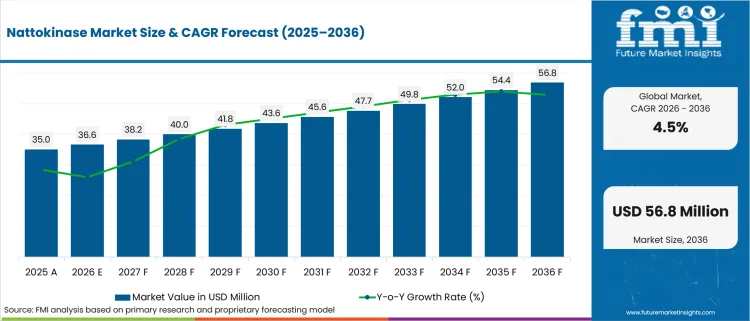
USD 36.6 million in 2026 and USD 56.8 million by 2036 at a 4.5% CAGR.
Sales of nattokinase are estimated to rise at 4.5% CAGR through 2036, increasing valuation from USD 36.6 million in 2026 to USD 56.8 million by 2036. Commercial demand depends on repeatable FU activity and responsible finished-label communication across established supplement channels. In November 2025, Contek Life Science reported that its SupplySide Global program paired nattiase with Actylis for United States inquiries. The program featured a European co-branded product that demonstrated how the ingredient enters a finished supplement formula. The example shows how technical records and local channel support help enzyme ingredients reach commercial evaluation. Dietary supplement channels provide access to capsule programs and blended-product development across established retail networks. Growth across heart health supplements remains measured; launch teams must align potency records with suitable instructions and lawful claims.
Japanese commercialization benefits from domestic fermentation expertise and a notification route for foods carrying functional claims. In May 2025, Contek Life Science reported that nattiase appeared with CellMark Japan during a health ingredient and OEM exhibition. The collaboration gives local formulators a nearby distributor for technical discussions and sample evaluation during early formulation work. United States commercialization places greater legal responsibility on supplement manufacturers and distributors across national sales channels. In June 2025, the Food and Drug Administration issued educational materials on complete new dietary ingredient notifications. The guidance links identity and safety records with launch timing without proving that every nattokinase ingredient requires notification. Japanese market entry relies on local filing support for food supplement ingredients used in notified functional products. US market entry requires federal classification and finished-label control across national commercial nutraceutical product channels.
Key Takeaways of Nattokinase Market
- Demand grows through activity-standardized ingredients that let finished brands compare lots and present consistent FU servings across retail channels.
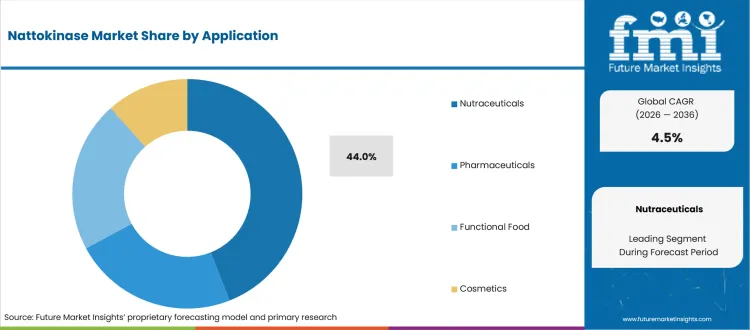
- By application, nutraceuticals are expected to account for 44% share in 2026 through controlled servings and familiar capsule formats.
- Fermentation is projected to represent 90% share in 2026, owing to repeatable microbial cultivation and established purification controls.
- Offline retail is estimated to capture 77% share in 2026, reflecting the value of visible labels and specialist product guidance.
- Ingredient classification and circulation-related claim controls extend launch reviews across countries with different supplement rules and communication standards.
- Japan Bio Science Laboratory and Daiwa Pharmaceutical manufacture proprietary ingredients; Contek Life Science and Far East Bio-Tec support formulation; LifeWave and Pure Encapsulations sell finished supplements alongside Allergy Research Group and Enzymedica.
Analyst Perspective
“Nattokinase growth depends less on adding new wellness language and more on proving stable FU activity through processing and shelf life. Ingredient manufacturers must give formulators clear assay records, and finished brands must translate those records into responsible serving instructions. Companies that combine dependable fermentation with local regulatory support should convert scientific interest into repeat orders more consistently than brands built around headline potency alone.”
- Nandini Roy Choudhury, Principal Analyst, Future Market Insights
How is the Nattokinase Market segmented?
The nattokinase industry is segmented by application, production method, distribution channel, potency, and region.
By application, the industry is divided by nutraceuticals, pharmaceuticals, functional food and cosmetics. Production method distinguishes fermentation from extraction according to how the enzyme is generated and recovered. Distribution channel compares offline retail with online sales, and potency groups ingredients by declared FU activity per gram. Regional analysis captures differences in ingredient recognition, filing routes and claim controls across national supplement systems. These dimensions help manufacturers compare an ingredient grade with the intended serving format and commercial route. They also prevent a standard capsule from being evaluated as though it follows the same evidence requirements as a pharmaceutical program or a fortified food.
What supports nutraceuticals within the application category?
Nutraceutical formats give brands a controlled serving size for nattokinase without changing the preparation of an everyday food. LifeWave launched Cellergize Evening in October 2025 with NSK-SD nattokinase and a nighttime blend containing magnesium with taurine and L-theanine. The launch placed the enzyme inside a multi-ingredient nighttime supplement rather than a dedicated circulation capsule. Product teams can use similar serving formats to combine measured activity with broader wellness food products while keeping claims within local supplement rules.
- Nutraceuticals are projected to hold 44% share in 2026, owing to controlled serving formats and familiar supplement purchasing. Capsules and blended powders let brands declare FU activity at the serving level during product qualification. The format also supports practical dosage adjustments without changing an everyday food matrix during formulation. Manufacturers gain a clearer route for testing stability and refining label instructions across national retail channels.
- Finished supplement manufacturers choose nutraceutical formats to shorten formulation cycles and compare activity across ingredient lots. Dedicated servings make it easier to adjust capsule weight or blend composition during product development. Adoption remains dependent on verified FU testing and suitable caution language for medicine users in each target country. Responsible brands also separate preliminary research from claims that appear on finished packaging and online listings.
Why does fermentation shape the production method category?
Commercial nattokinase production depends on controlled microbial cultivation followed by purification that preserves measurable FU activity across repeated lots. Culture conditions influence enzyme yield whereas downstream processing affects odor and the commercial stability specification used during formulation. In January 2026, Contek Life Science published a quality framework that placed verified activity ahead of ingredient weight. The framework also required transparent testing records and clear safe-use boundaries throughout commercial ingredient evaluation. These controls make batch records and finished-product stability central to annual qualification rather than treating fermented food enzymes as interchangeable commodities.
- Fermentation is likely to capture 90% share in 2026, attributable to repeatable cultivation and established purification controls. Defined microbial cultures support commercial batches with consistent handling requirements across multiple production lots and facilities. Downstream processing can also reduce odor and vitamin K2 according to the selected ingredient specification. This production route gives formulators a practical basis for comparing activity and safety records across ingredient manufacturers.
- Ingredient manufacturers use fermentation to scale enzyme output without changing the biological source between commercial lots. Process control supports planned sampling and repeat activity testing across multiple production stages and commercial batch releases. Extraction serves narrower development routes that use different starting materials and require specialized recovery steps for commercial output. Adoption therefore favors fermentation whenever brands need a documented supply route that supports regular capsule or powder production.
How does offline retail influence the distribution channel category?
Offline retail remains commercially useful for nattokinase products that require visible activity statements and clear caution language during purchase. Physical shelves let consumers compare FU information with serving directions alongside prices and package formats. Technical guidance about enzyme ingredient systems reaches finished-product teams through distributor relationships and regional training. In March 2026, Contek Life Science reported that its first Natural Products Expo appearance included brand discussions through United States partner Actylis. The event shows how channel relationships connect ingredient documentation with later retail communication and product explanations.
- Offline retail is set to lead the distribution channel category with 77% share in 2026, supported by label comparison and specialist guidance. Physical shelves give brands clear space for FU statements and caution language during product selection. Store staff can direct consumers toward package information without offering medical advice at the point of sale. This channel position favors products that require explanation beside price and format comparisons during purchase decisions.
- Retailers favor physical placement for nattokinase products that need clear serving instructions and visible safety information. Online channels extend geographic reach and support repeat orders across established customer groups without immediate retail expansion. Digital listings also create more room for incomplete descriptions or exaggerated claims during rapid product comparisons. Brands therefore need matching product information across store shelves, distributor materials and online listings to protect commercial credibility.
What supports the ≤10000 FU/g potency category?
Lower activity grades support conventional capsule designs that use larger ingredient weights and familiar blending controls. Capsule manufacturers can adjust serving weight without relying on extremely small inclusion rates during regular production. In December 2025, Contek Life Science published a dose-response review that described 2,000 FU as a general wellness reference point. The company presented higher activity inputs as formulation choices rather than automatic evidence of stronger outcomes. Product teams therefore compare serving-level activity and stability across industrial enzyme systems instead of using concentration alone.
- The potency category is forecast to be led by the ≤10000 FU/g grade at 44.8% share in 2026, driven by accessible formulation requirements and familiar activity targets. Standard-strength ingredients allow conventional capsule fills without extremely small inclusion rates across regular production batches. Commercial value depends on confirming that each finished serving retains declared FU activity throughout processing and shelf life.
- Formulators select lower potency grades for products that prioritize simple blending and familiar serving designs across established supplement channels. Higher activity grades can reduce ingredient weight or support specialized concepts within compact capsule formats. They also require tighter homogeneity controls and stronger evidence that the finished serving retains its declared activity during storage. The decision therefore depends on process capability rather than the appeal of a larger potency number.
What are the drivers, restraints, and opportunities in the Nattokinase Market?
Verified FU activity supports repeat purchasing; claim and classification rules slow commercialization; structured filing and distributor support create practical expansion routes.
- Driver: Repeatable FU specifications let formulation teams compare ingredient lots and design finished servings with clearer quality expectations.
- Restraint: Circulation-related claims require careful substantiation and suitable caution language across national labeling systems and digital sales channels.
- Opportunity: Structured filing routes and qualified distributors can connect technical evidence with local launch requirements and retail access.
Repeatable FU specifications support demand by giving finished brands predictable activity across production lots and stated shelf life. In October 2025, Contek Life Science advised companies to compare FU per serving and review assay methods alongside stability records and independent testing. Those checks help formulation teams distinguish verified enzyme performance from a larger milligram claim during ingredient qualification. Ingredient manufacturers that provide clear test methods can shorten qualification discussions and give distributors stronger technical material across food enzyme portfolios.
Circulation language can cross from general wellness into disease treatment, making claim control a material commercial restraint. Packages and digital descriptions must carry consistent support for each structure-function statement across the intended sales route. In December 2025, the United States Food and Drug Administration stated that qualifying claims must remain linked to the required DSHEA disclaimer. The requirement preserves a clear boundary between supplement communication and disease claims across commercial channels. Legal review takes longer whenever caution language is incomplete or distributor material exceeds the evidence available for nattokinase.
Japan provides a practical expansion route for companies that prepare safety and manufacturing records early in product development. Ingredient manufacturers can organize functionality evidence beside finished-label information at the start of a local commercial filing. Local partners can use the digital route to organize manufacturing controls and product details during submission. In April 2025, the Consumer Affairs Agency moved its Foods with Function Claims notification database to a new system. The new system supports earlier submission planning without reducing company responsibility for evidence or lawful claims.
Which country CAGRs are profiled in the Nattokinase Market?
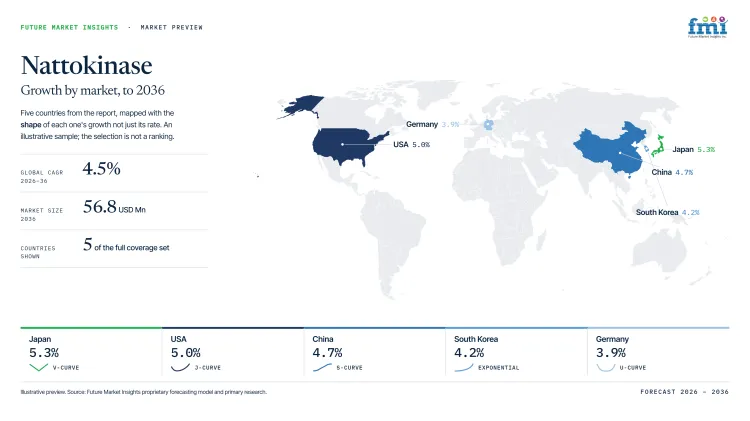
| Country | CAGR |
|---|---|
| Japan | 5.3% |
| United States | 5% |
| China | 4.7% |
| South Korea | 4.2% |
| Germany | 3.9% |
| India | 3.5% |
How do country-level CAGRs compare in the Nattokinase Market?
The country forecasts show a gradual progression across the nattokinase market, with no sharp breaks between adjacent countries. Japan, the United States and China form an upper band where growth is supported by established awareness of cardiovascular health ingredients and expanding use of preventive nutrition products. South Korea creates a transition between these markets and the lower-growth group represented by Germany and India. The differences across the comparison are relatively modest, suggesting that demand for nattokinase is expanding through similar health and wellness trends rather than fundamentally different market conditions.
- Japan benefits from being the origin market for nattokinase, where consumer familiarity with fermented soy-derived ingredients and long-standing use in health products continue to support market development.
- The United States reflects growing demand for cardiovascular and healthy aging supplements, encouraging broader incorporation of nattokinase into preventive wellness formulations.
- China continues to expand through rising interest in functional nutrition and increasing consumer adoption of ingredients positioned for circulatory and heart health support.
- South Korea supports steady growth through strong acceptance of fermented food-derived ingredients and growing demand for science-backed nutritional supplements.
- Germany's outlook is influenced by demand for evidence-based nutraceutical products, with adoption often linked to clinical substantiation and regulatory considerations.
- India maintains measured growth as awareness of specialty nutraceutical ingredients increases alongside the gradual expansion of the preventive health and dietary supplements sector.
Similar CAGRs do not necessarily translate into identical commercial opportunities. Differences in regulatory frameworks, consumer awareness, supplement usage patterns and distribution channels can significantly influence the adoption of nattokinase products. As a result, market participants may encounter distinct positioning, education and commercialization requirements across countries despite broadly comparable growth rates. The full report provides country-level CAGR analysis across North America, Latin America, Europe, East Asia, South Asia, Oceania and the Middle East and Africa.
Country-wise Analysis
- Japan operates a Foods with Function Claims system that places evidence and labeling responsibility on the company making the notification. Adoption of nattokinase products in Japan is estimated to expand at a 5.3% CAGR through 2036, supported by domestic fermentation expertise and familiar natto-based product concepts. In October 2025, the Consumer Affairs Agency updated its filing guidance and questions for the system. The revised materials give local formulators a clearer route for safety and manufacturing records together with claim documentation. Domestic nattokinase specialists reduce the distance between ingredient testing and finished-product design for local commercial programs. Notification does not equal government approval; each company must defend its evidence and monitor safety communication across retail channels.
- United States brands sell nattokinase through dietary supplement channels that place safety and truthful labeling responsibility on the manufacturer or distributor. Specialty retailers and online stores provide broad access for capsules and blended products across national consumer channels. The United States nattokinase sector is projected to record 5% CAGR during the assessment period, supported by established supplement access and specialist retail coverage. In March 2026, the Food and Drug Administration announced a public meeting on enzymes and new production methods within dietary ingredient categories. The meeting gave ingredient companies a formal route to raise identity questions without granting product acceptance. Brands must support structure-function claims and manage caution language consistently across packages and digital listings. Federal ingredient classification can extend reviews for novel production routes or unfamiliar enzyme specifications during commercial planning.
- China separates health food registration from filing according to ingredient status and product route within the national health food system. China's nattokinase market outlook is anticipated to advance at 4.7% CAGR over the assessment period, influenced by formal review and strict advertising controls. Domestic partners can coordinate identity records and electronic submissions for local product teams during formal review. In January 2025, the State Administration for Market Regulation published an enforcement case involving ordinary-food nattokinase capsules advertised with disease-treatment claims. The case shows that product classification and commercial language must align across national digital and retail distribution channels. First imports and non-catalog ingredients face deeper review; the added documentation can extend launch timing and raise regulatory support costs.
- South Korea uses notified standards and individual recognition routes for health functional food ingredients under national rules. Local health functional food channels give qualified products access across major urban consumer markets and specialist retail networks. Nattokinase sales in South Korea are forecast to expand at 4.2% CAGR by 2036, supported by a defined functional ingredient recognition process. In January 2026, the Ministry of Food and Drug Safety published an English version of Regulation No. 2024-79 covering functional ingredient recognition and specifications. The publication improves document planning for overseas companies; the Korean text remains legally controlling for commercial filings. Recognition conditions and strict claim boundaries restrict medical language within ordinary supplement communication and extend review work for unfamiliar ingredients.
- Germany requires food supplement notification; companies remain responsible for legal classification and advertising compliance across national sales channels. By 2036, nattokinase demand in Germany is projected to grow at a 3.9% CAGR across specialist supplement channels. Specialist pharmacies and health retailers support detailed label discussion and package review across established German consumer channels. In January 2025, Verbraucherzentrale published a nattokinase review that described cardiovascular evidence as limited and long-term safety as unresolved. The review strengthens the need for restrained claims and clear caution language across finished-product communication. Disease-related wording or pharmacological positioning can trigger a more demanding route, which raises legal review costs and limits ordinary supplement commercialization.
- India regulates health supplements and nutraceuticals through FSSAI categories and a separate route for non-specified foods or ingredients. Domestic formulation clusters can shorten capsule and powder development for brands entering established urban health retail channels. Nattokinase demand in India is forecast to rise at 3.5% CAGR over the forecast period, associated with urban supplement access and local formulation capacity. In July 2026, the Food Safety and Standards Authority of India published an updated application status list under the non-specified food and food ingredient regulations. The update gives manufacturers a current administrative reference for products outside established standards during review. Price sensitivity and uneven specialty retail access restrict distribution across cities; ingredient classification can also postpone commercial release outside established national standards.
Who are the notable companies in the Nattokinase Market?
Japan Bio Science Laboratory Co., Ltd.; Daiwa Pharmaceutical Co., Ltd.; Contek Life Science Co., Ltd.; Far East Bio-Tec Co., Ltd.; LifeWave, Inc.; Pure Encapsulations; Allergy Research Group; and Enzymedica, Inc. are notable companies profiled in this market.
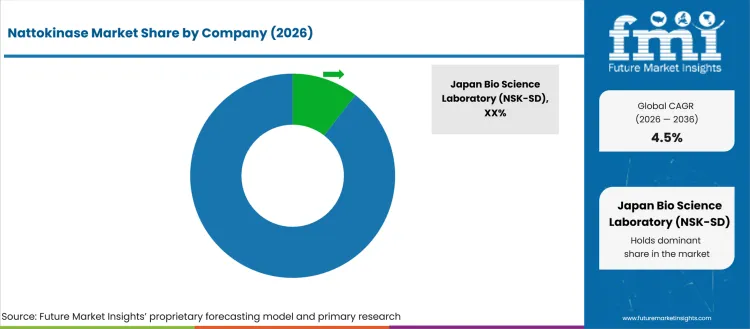
Competition spans proprietary ingredient manufacturers and finished supplement brands that control different points in commercialization. Japan Bio Science Laboratory and Daiwa Pharmaceutical provide proprietary fermentation routes with published activity specifications. Contek Life Science offers several FU grades through regional partners; Far East Bio-Tec combines fermentation with finished-product manufacturing. Pure Encapsulations and Allergy Research Group market dedicated NSK-SD products through established United States supplement channels. LifeWave uses NSK-SD in a blended evening formula, and Enzymedica sells a dedicated enzyme supplement through international distributors.
- Proprietary ingredient manufacturers: Japan Bio Science Laboratory and Daiwa Pharmaceutical differentiate through controlled fermentation and proprietary ingredient specifications. Formulators compare their activity records with manufacturing controls and destination-market documents throughout commercial ingredient qualification. The commercial decision rests on repeat activity performance and regulatory support rather than company recognition alone.
- Integrated manufacturing specialists: Contek Life Science and Far East Bio-Tec combine ingredient production with formulation or contract-manufacturing support. Their commercial role connects FU selection with practical capsule or blended-product development for regional launches. Brands can evaluate ingredient documentation beside pilot production and channel requirements through one coordinated relationship.
- Finished supplement brands: Pure Encapsulations and Allergy Research Group sell dedicated NSK-SD products through established United States channels. LifeWave uses the ingredient within a broader evening formula; Enzymedica offers a dedicated enzyme supplement. Selection depends on serving design and product communication alongside the reach of each commercial channel.
Competitive Benchmarking: Nattokinase Market
| Company | Fermentation Ingredient Capability | Potency Standardization | Finished Supplement Commercialization | Geographic Reach |
|---|---|---|---|---|
| Japan Bio Science Laboratory Co., Ltd. | High | High | Low | Japan, United States, South Korea, China and Taiwan |
| Daiwa Pharmaceutical Co., Ltd. | High | Medium | Low | More than 20 countries |
| Contek Life Science Co., Ltd. | High | High | Medium | Asia and United States partners |
| Far East Bio-Tec Co., Ltd. | High | Medium | High | Taiwan and international OEM channels |
| LifeWave, Inc. | Low | Medium | High | United States direct consumer channel |
| Pure Encapsulations | Low | Medium | High | United States professional channel |
| Allergy Research Group | Low | High | High | United States direct online |
| Enzymedica, Inc. | Low | Medium | High | More than 30 countries |
Key Developments in the Nattokinase Market
- In March 2026, Japan Bio Science Laboratory announced Japanese patent number 7804957 for an advanced glycation endproduct production inhibitor using NSK-SD nattokinase. The patent extends the ingredient’s protected research scope beyond its established circulation position within commercial research programs. Nutraceutical formulators gain another documented development route for metabolic health concepts that require further product-specific evidence. Commercial claims must follow the supplement and functional food rules that apply within each destination market.
- In March 2026, Contek Life Science announced that nattiase and CellMark Japan would present high-activity nattokinase alongside newly released preclinical neuroprotection research at Health Food Expo 2026. The program expanded commercial discussions from established circulation uses toward cognitive-health formulation concepts inside nutraceutical development programs. The evidence remained preclinical, so finished brands need separate human support and compliant language for any consumer-facing benefit. The advance gives nutraceutical developers a defined research direction without treating laboratory findings as established product performance.
- In September 2025, Contek Life Science presented nattiase during Vitafoods Asia in Thailand alongside three regional partners. The company identified CellMark Japan and CellMark Korea as distributors alongside TG Biotech as a regional exhibition partner. The partnership network gives regional formulators a direct route to samples and technical documents during product development. It also supports local discussions about activity specifications and compliant finished-product positioning across target markets.
- In December 2025, Far East Bio-Tec reported completion of a 3,967 m² stainless-steel and temperature-controlled functional supplement manufacturing expansion with automated equipment. The facility strengthens the company’s integrated route from raw-material processing to finished supplement production. Nattokinase brands can use the expanded infrastructure for private-label or OEM programs that require controlled production and packaging. The announcement supports broader commercial capacity without implying that every added line is dedicated exclusively to nattokinase.
Nattokinase Market - Report Scope
| Coverage field | Report scope |
|---|---|
| Market breakdown | Application, production method, distribution channel, potency, and region. |
| Quantitative Units | Revenue in USD Million and CAGR in %. |
| Market Definition | The nattokinase market covers ingredient production and finished supplement commercialization based on nattokinase enzyme activity. It includes fermentation-derived and extraction-derived supply across nutraceutical, pharmaceutical, functional food, and cosmetic applications. Products are distributed through offline and online channels and classified by potency grade. |
| Regions Covered | North America, Latin America, Western Europe, Eastern Europe, East Asia, South Asia and Pacific, and Middle East and Africa. |
| Countries Covered | Japan, United States, China, South Korea, Germany, and India. |
| Key Companies Profiled | Japan Bio Science Laboratory Co., Ltd.; Daiwa Pharmaceutical Co., Ltd.; Contek Life Science Co., Ltd.; Far East Bio-Tec Co., Ltd.; LifeWave, Inc.; Pure Encapsulations; Allergy Research Group; and Enzymedica, Inc. |
| Forecast Period | 2026 to 2036, with a base year of 2025. |
| Approach | Market sizing evaluates application demand, production routes, distribution structures, potency requirements, company participation, and country-specific commercial conditions across the defined nattokinase boundary. |
Nattokinase Market - Research Methodology
| Method | Approach |
|---|---|
| Primary Research | FMI analysts gathered input from manufacturers, service providers, technology developers, distributors, end users, procurement teams, and subject-matter experts. Interviews examined purchasing decisions, product or service evaluation, adoption barriers, approval requirements, pricing considerations, and expectations for technical or commercial support. Respondents were also asked what evidence is required before a trial, pilot, or initial order develops into regular purchasing. |
| Desk Research | Desk research covered government statistics, regulatory publications, trade data, industry associations, technical literature, standards, company filings, product information, and official corporate announcements. Sources were reviewed for relevance, publication date, geographic coverage, and consistency with the defined market scope. Claims relating to performance, applications, approvals, capacity, investment, and commercial activity were retained only when supported by credible public evidence. |
| Market Sizing and Forecasting | The market model combined the baseline value with historical performance, segment structure, pricing and volume indicators, adoption levels, company participation, and country-level demand conditions. Forecast assumptions considered economic activity, investment trends, regulatory developments, technology adoption, purchasing cycles, supply availability, and barriers to wider market use. Segment and regional estimates were reconciled before the final market total was calculated. |
| Data Validation | Estimates were checked against multiple independent indicators, including public data, company activity, trade patterns, industry developments, and findings from primary interviews. Validation also tested whether products, services, applications, and company revenues fell within the defined market boundaries. Adjacent categories, unsupported claims, overlapping revenues, and activities without direct market relevance were excluded to reduce double counting and maintain consistency across segments and countries. |
Nattokinase Market by Segments
Nattokinase Market segmented by Application:
- Nutraceuticals
- Pharmaceuticals
- Functional Food
- Cosmetics
Nattokinase Market segmented by Production Method:
- Fermentation
- Extraction
Nattokinase Market segmented by Distribution Channel:
- Offline Retail
- Online
Nattokinase Market segmented by Potency:
- ≤10000 FU/g
- 10000-20000 FU/g
- >20000 FU/g
Nattokinase Market by Region:
- North America
- United States
- Canada
- Latin America
- Brazil
- Mexico
- Rest of Latin America
- Western Europe
- Germany
- United Kingdom
- France
- Italy
- Spain
- Rest of Western Europe
- Eastern Europe
- Russia
- Poland
- Rest of Eastern Europe
- East Asia
- China
- Japan
- South Korea
- South Asia and Pacific
- India
- ASEAN
- Australia and New Zealand
- Rest of South Asia and Pacific
- Middle East and Africa
- GCC Countries
- South Africa
- Türkiye
- Israel
- Rest of Middle East and Africa
Research Sources and Bibliography
- Contek Life Science Co., Ltd. (2025, November 7). SupplySide Global 2025 Recap.
- Contek Life Science Co., Ltd. (2025, May 5). Recap - Health Food Expo 2025.
- USA Food and Drug Administration. (2025, June 11). FDA Releases Educational Materials on the New Dietary Ingredient Notification Process for Dietary Supplements.
- Contek Life Science Co., Ltd. (2026, March 27). nattiase® at Health Food Expo 2026.
- Contek Life Science Co., Ltd. (2026, January 27). Essentials, quality & safe use of nattokinase.
- Contek Life Science Co., Ltd. (2026, March 12). Exhibition Recap: nattiase®’s First Participation in Natural Products Expo.
- Contek Life Science Co., Ltd. (2025, December 17). Dose-Response Curve: How Much Nattokinase Is Enough for Fibrin Degradation?
- Contek Life Science Co., Ltd. (2025, October 30). Beginner’s Guide: Choosing a Quality Nattokinase Supplement.
- USA Food and Drug Administration. (2025, December 11). Letter to the Dietary Supplement Industry on the DSHEA Disclaimer.
- Consumer Affairs Agency. (2025, April 1).
- Consumer Affairs Agency. (2025, October 1).
- USA Food and Drug Administration. (2026, March 3). FDA Announces Public Meeting on Dietary Supplement Innovation and the Scope of Dietary Ingredients.
- State Administration for Market Regulation. (2025, January 16).
- Ministry of Food and Drug Safety. (2026, January 15). Regulation on Recognition of Functional Ingredient and of Standard·Specification for Health Functional Foods (No. 2024-79).
- Verbraucherzentrale. (2025, January 13). Nattokinase - Hilfe bei Herz-Kreislauf-Problemen?
- Food Safety and Standards Authority of India. (2026, July 22). Non-specified food.
- Japan Bio Science Laboratory Co., Ltd. (2026, March 27). JBSL Awarded Patent for NSK-SD Nattokinase for Reduction of AGEs.
- LifeWave, Inc. (2025, October). LifeWave Launches Cellergize™ Evening: Nighttime Supplement for Relaxation, Recovery, and Restorative Sleep.
- Contek Life Science Co., Ltd. (2025, September 25). Event Recap|Vitafoods Asia 2025, Thailand.
- Far East Bio-Tec Co., Ltd. (2025, December 15). Far East Bio-Tec: Global Health Industry Growth Creates New Momentum for Microalgae Biotechnology.
- Japan Bio Science Laboratory Co., Ltd. (n.d.). Fermented Soybean Extract NSK|Japan Bio Science Laboratory CO., Ltd.
- Daiwa Pharmaceutical Co., Ltd. (n.d.). NKCP | Daiwa Pharmaceutical Co., Ltd.
- Contek Life Science Co., Ltd. (n.d.). Globe of BeanCredible!
- Far East Bio-Tec Co., Ltd. (n.d.). Nattokinase Complex Supplements - Wholesale Nattokinase Supplement, Dietary supplements distributorship | Taiwan-Based Organic Chlorella, Organic Spirulina & Dietary Supplements Manufacturer | Far East Bio-Tec Co., Ltd.
- LifeWave, Inc. (n.d.). Cellergize™ Evening - LifeWave.
- Pure Encapsulations. (n.d.). Nattokinase Supplement | Pure Encapsulations®.
- Allergy Research Group. (n.d.). Nattokinase Supplement 100mg | Allergy Research Group.
- Enzymedica, Inc. (n.d.). Natto-K™ | Maintain healthy levels of Fibrin.
- Enzymedica, Inc. (n.d.). Digestive Enzymes | International Distributors.
This bibliography is provided for reader reference and is not exhaustive. The full report contains the complete reference list and detailed citations
This Report Answers
- How large is the nattokinase market in 2026 and what valuation is projected for 2036?
- Which commercial conditions support measured demand across ingredient and finished supplement channels?
- Why do nutraceutical applications account for 44% of nattokinase demand in 2026?
- How does fermentation influence production consistency and activity specification requirements?
- Why does offline retail retain substantial weight across the current distribution structure?
- How do approved country growth rates compare across six profiled national markets?
- Which companies manufacture fermented ingredients or commercialize finished nattokinase supplements?
- What regulatory and communication issues restrain broader commercial adoption?
- How do potency disclosure and distributor support strengthen commercial confidence?
Frequently Asked Questions
How big is the Nattokinase Market in 2026?
The nattokinase market is valued at USD 36.6 million in 2026 and is forecast to reach USD 56.8 million by 2036. Growth is supported by repeatable FU activity and responsible finished-label communication that sustain demand across established dietary supplement channels worldwide.
What is the CAGR of the Nattokinase Market from 2026 to 2036?
The nattokinase market grows at a CAGR of 4.5% between 2026 and 2036, supported by repeatable FU specifications that let formulation teams compare ingredient lots and design finished servings with clearer quality expectations across nutraceutical and functional food applications.
Which production method leads the Nattokinase Market?
Fermentation accounts for 90% of the nattokinase market by production method in 2026, driven by repeatable microbial cultivation and established purification controls that give formulators a practical basis for comparing activity and safety records across ingredient manufacturers.
How much will the Nattokinase Market add between 2026 and 2036?
The nattokinase market is set to add USD 20.2 million between 2026 and 2036, growing from USD 36.6 million to USD 56.8 million as nutraceutical formats and offline retail channels expand across established cardiovascular and preventive wellness supplement programs.
Who are the leading companies in the Nattokinase Market?
Eight companies lead the nattokinase market, including Japan Bio Science Laboratory, Daiwa Pharmaceutical, Contek Life Science, Far East Bio-Tec, LifeWave, Pure Encapsulations, Allergy Research Group, and Enzymedica, competing through fermentation capability, potency standardization, and finished supplement commercialization worldwide.
Preview the report firsthand - request a free sample
Get SampleGet the brochure for pricing and purchase details.
Get PDFTable of Content
- Key Takeaways
- Market Size and CAGR
- Top Growth Driver
- Fastest Growing Segment
- Leading Region
- Key Companies
- Emerging Opportunities
- Executive Summary
- Global Market Outlook
- Demand-side Trends
- Supply-side Trends
- Technology Roadmap Analysis
- Analysis and Recommendations
- Analyst Perspective (What is happening? Why now? What should investors know?)
- Key Questions Answered
- How large is the market?
- What is the CAGR?
- What are key trends?
- Which region dominates?
- Who are the leaders?
- Market Overview
- Market Coverage / Taxonomy
- Market Definition / Scope / Limitations
- Research Methodology
- Chapter Orientation
- Analytical Lens and Working Hypotheses
- Market Structure, Signals, and Trend Drivers
- Benchmarking and Cross-market Comparability
- Market Sizing, Forecasting, and Opportunity Mapping
- Research Design and Evidence Framework
- Desk Research Programme (Secondary Evidence)
- Expert Input and Fieldwork (Primary Evidence)
- Tooling, Models, and Reference Databases
- Data Engineering and Model Build
- Quality Assurance and Audit Trail
- Market Background
- Market Dynamics (Drivers, Restraints, Opportunity, Trends)
- Scenario Forecast (Optimistic, Likely, Conservative)
- Impact Analysis
- AI Impact
- Sustainability Impact
- Regulatory Impact
- Technology Impact
- Consumer / Buyer Analysis
- Purchase Drivers
- Adoption Barriers
- Buyer Journey
- Opportunity Map Analysis
- Product Life Cycle Analysis
- Supply Chain Analysis
- Investment Feasibility Matrix
- Value Chain Analysis
- PESTLE and Porter's Analysis
- Regulatory Landscape
- Regional Parent Market Outlook
- Production and Consumption Statistics
- Import and Export Statistics
- Global Market Analysis and Forecast, 2021 to 2036
- Historical Market Size Value (USD Million) Analysis, 2021 to 2025
- Current and Future Market Size Value (USD Million) Projections, 2026 to 2036
- Y-o-Y Growth Trend Analysis
- Absolute $ Opportunity Analysis
- Global Market Pricing Analysis, 2021 to 2036
- Global Market Analysis and Forecast, By Application, 2021 to 2036
- Introduction / Key Findings
- Historical Market Size Value (USD Million) Analysis By Application, 2021 to 2025
- Current and Future Market Size Value (USD Million) Analysis and Forecast By Application, 2026 to 2036
- Nutraceuticals
- Pharmaceuticals
- Functional Food
- Cosmetics
- Nutraceuticals
- Y-o-Y Growth Trend Analysis By Application, 2021 to 2025
- Absolute $ Opportunity Analysis By Application, 2026 to 2036
- Global Market Analysis and Forecast, By Production Method, 2021 to 2036
- Introduction / Key Findings
- Historical Market Size Value (USD Million) Analysis By Production Method, 2021 to 2025
- Current and Future Market Size Value (USD Million) Analysis and Forecast By Production Method, 2026 to 2036
- Fermentation
- Extraction
- Fermentation
- Y-o-Y Growth Trend Analysis By Production Method, 2021 to 2025
- Absolute $ Opportunity Analysis By Production Method, 2026 to 2036
- Global Market Analysis and Forecast, By Distribution Channel, 2021 to 2036
- Introduction / Key Findings
- Historical Market Size Value (USD Million) Analysis By Distribution Channel, 2021 to 2025
- Current and Future Market Size Value (USD Million) Analysis and Forecast By Distribution Channel, 2026 to 2036
- Offline Retail
- Online
- Offline Retail
- Y-o-Y Growth Trend Analysis By Distribution Channel, 2021 to 2025
- Absolute $ Opportunity Analysis By Distribution Channel, 2026 to 2036
- Global Market Analysis and Forecast, By Potency, 2021 to 2036
- Introduction / Key Findings
- Historical Market Size Value (USD Million) Analysis By Potency, 2021 to 2025
- Current and Future Market Size Value (USD Million) Analysis and Forecast By Potency, 2026 to 2036
- ≤10000 FU/g
- 10000-20000 FU/g
- >20000 FU/g
- ≤10000 FU/g
- Y-o-Y Growth Trend Analysis By Potency, 2021 to 2025
- Absolute $ Opportunity Analysis By Potency, 2026 to 2036
- Global Market Analysis and Forecast, By Region, 2021 to 2036
- Introduction
- Historical Market Size Value (USD Million) Analysis By Region, 2021 to 2025
- Current Market Size Value (USD Million) Analysis and Forecast By Region, 2026 to 2036
- North America
- Latin America
- Western Europe
- Eastern Europe
- East Asia
- South Asia and Pacific
- Middle East & Africa
- Market Attractiveness Analysis By Region
- North America Market Analysis and Forecast, By Country, 2021 to 2036
- Historical Market Size Value (USD Million) Trend Analysis By Market Taxonomy, 2021 to 2025
- Market Size Value (USD Million) Forecast By Market Taxonomy, 2026 to 2036
- By Country
- USA
- Canada
- By Application
- By Production Method
- By Distribution Channel
- By Potency
- By Country
- Market Attractiveness Analysis
- By Country
- By Application
- By Production Method
- By Distribution Channel
- By Potency
- Key Takeaways
- Latin America Market Analysis and Forecast, By Country
- Historical Market Size Value (USD Million) Trend Analysis By Market Taxonomy, 2021 to 2025
- Market Size Value (USD Million) Forecast By Market Taxonomy, 2026 to 2036
- By Country
- Brazil
- Mexico
- Chile
- Rest of Latin America
- By Application
- By Production Method
- By Distribution Channel
- By Potency
- By Country
- Market Attractiveness Analysis
- By Country
- By Application
- By Production Method
- By Distribution Channel
- By Potency
- Key Takeaways
- Western Europe Market Analysis and Forecast, By Country
- Historical Market Size Value (USD Million) Trend Analysis By Market Taxonomy, 2021 to 2025
- Market Size Value (USD Million) Forecast By Market Taxonomy, 2026 to 2036
- By Country
- Germany
- UK
- Italy
- Spain
- France
- Nordic
- BENELUX
- Rest of Western Europe
- By Application
- By Production Method
- By Distribution Channel
- By Potency
- By Country
- Market Attractiveness Analysis
- By Country
- By Application
- By Production Method
- By Distribution Channel
- By Potency
- Key Takeaways
- Eastern Europe Market Analysis and Forecast, By Country
- Historical Market Size Value (USD Million) Trend Analysis By Market Taxonomy, 2021 to 2025
- Market Size Value (USD Million) Forecast By Market Taxonomy, 2026 to 2036
- By Country
- Russia
- Poland
- Hungary
- Balkan & Baltic
- Rest of Eastern Europe
- By Application
- By Production Method
- By Distribution Channel
- By Potency
- By Country
- Market Attractiveness Analysis
- By Country
- By Application
- By Production Method
- By Distribution Channel
- By Potency
- Key Takeaways
- East Asia Market Analysis and Forecast, By Country
- Historical Market Size Value (USD Million) Trend Analysis By Market Taxonomy, 2021 to 2025
- Market Size Value (USD Million) Forecast By Market Taxonomy, 2026 to 2036
- By Country
- China
- Japan
- South Korea
- By Application
- By Production Method
- By Distribution Channel
- By Potency
- By Country
- Market Attractiveness Analysis
- By Country
- By Application
- By Production Method
- By Distribution Channel
- By Potency
- Key Takeaways
- South Asia and Pacific Market Analysis and Forecast, By Country
- Historical Market Size Value (USD Million) Trend Analysis By Market Taxonomy, 2021 to 2025
- Market Size Value (USD Million) Forecast By Market Taxonomy, 2026 to 2036
- By Country
- India
- ASEAN
- Australia & New Zealand
- Rest of South Asia and Pacific
- By Application
- By Production Method
- By Distribution Channel
- By Potency
- By Country
- Market Attractiveness Analysis
- By Country
- By Application
- By Production Method
- By Distribution Channel
- By Potency
- Key Takeaways
- Middle East & Africa Market Analysis and Forecast, By Country
- Historical Market Size Value (USD Million) Trend Analysis By Market Taxonomy, 2021 to 2025
- Market Size Value (USD Million) Forecast By Market Taxonomy, 2026 to 2036
- By Country
- Kingdom of Saudi Arabia
- Other GCC Countries
- Türkiye
- South Africa
- Other African Union
- Rest of Middle East & Africa
- By Application
- By Production Method
- By Distribution Channel
- By Potency
- By Country
- Market Attractiveness Analysis
- By Country
- By Application
- By Production Method
- By Distribution Channel
- By Potency
- Key Takeaways
- Key Countries Market Analysis
- USA
- Pricing Analysis
- Market Share Analysis, 2025
- By Application
- By Production Method
- By Distribution Channel
- By Potency
- Canada
- Pricing Analysis
- Market Share Analysis, 2025
- By Application
- By Production Method
- By Distribution Channel
- By Potency
- Mexico
- Pricing Analysis
- Market Share Analysis, 2025
- By Application
- By Production Method
- By Distribution Channel
- By Potency
- Brazil
- Pricing Analysis
- Market Share Analysis, 2025
- By Application
- By Production Method
- By Distribution Channel
- By Potency
- Chile
- Pricing Analysis
- Market Share Analysis, 2025
- By Application
- By Production Method
- By Distribution Channel
- By Potency
- Germany
- Pricing Analysis
- Market Share Analysis, 2025
- By Application
- By Production Method
- By Distribution Channel
- By Potency
- UK
- Pricing Analysis
- Market Share Analysis, 2025
- By Application
- By Production Method
- By Distribution Channel
- By Potency
- Italy
- Pricing Analysis
- Market Share Analysis, 2025
- By Application
- By Production Method
- By Distribution Channel
- By Potency
- Spain
- Pricing Analysis
- Market Share Analysis, 2025
- By Application
- By Production Method
- By Distribution Channel
- By Potency
- France
- Pricing Analysis
- Market Share Analysis, 2025
- By Application
- By Production Method
- By Distribution Channel
- By Potency
- India
- Pricing Analysis
- Market Share Analysis, 2025
- By Application
- By Production Method
- By Distribution Channel
- By Potency
- ASEAN
- Pricing Analysis
- Market Share Analysis, 2025
- By Application
- By Production Method
- By Distribution Channel
- By Potency
- Australia & New Zealand
- Pricing Analysis
- Market Share Analysis, 2025
- By Application
- By Production Method
- By Distribution Channel
- By Potency
- China
- Pricing Analysis
- Market Share Analysis, 2025
- By Application
- By Production Method
- By Distribution Channel
- By Potency
- Japan
- Pricing Analysis
- Market Share Analysis, 2025
- By Application
- By Production Method
- By Distribution Channel
- By Potency
- South Korea
- Pricing Analysis
- Market Share Analysis, 2025
- By Application
- By Production Method
- By Distribution Channel
- By Potency
- Russia
- Pricing Analysis
- Market Share Analysis, 2025
- By Application
- By Production Method
- By Distribution Channel
- By Potency
- Poland
- Pricing Analysis
- Market Share Analysis, 2025
- By Application
- By Production Method
- By Distribution Channel
- By Potency
- Hungary
- Pricing Analysis
- Market Share Analysis, 2025
- By Application
- By Production Method
- By Distribution Channel
- By Potency
- Kingdom of Saudi Arabia
- Pricing Analysis
- Market Share Analysis, 2025
- By Application
- By Production Method
- By Distribution Channel
- By Potency
- Türkiye
- Pricing Analysis
- Market Share Analysis, 2025
- By Application
- By Production Method
- By Distribution Channel
- By Potency
- South Africa
- Pricing Analysis
- Market Share Analysis, 2025
- By Application
- By Production Method
- By Distribution Channel
- By Potency
- USA
- Market Structure Analysis
- Competition Dashboard
- Competition Benchmarking
- Market Share Analysis of Top Players
- By Regional
- By Application
- By Production Method
- By Distribution Channel
- By Potency
- Emerging Startups
- Innovation Benchmarking
- Competition Analysis
- Competition Deep Dive
- Japan Bio Science Laboratory (NSK-SD)
- Overview
- Product Portfolio
- Profitability by Market Segments
- Sales Footprint
- Strategy Overview
- Marketing Strategy
- Product Strategy
- Channel Strategy
- Daiwa Pharmaceutical
- NattoPharma
- Novozymes / Novonesis
- BIO-CAT
- Bioven Ingredients
- Doctor's Best
- Japan Bio Science Laboratory (NSK-SD)
- Case Studies
- Success Stories
- Recent Developments
- Competition Deep Dive
- Assumptions & Acronyms Used


