

- Market Size (2026)
- USD 1.7 Bn
- Forecast (2036)
- USD 4.5 Bn
- CAGR (2026 to 2036)
- 10.1%
How big is Natural Vanilla & Sustainable Flavor Sourcing Market in 2026?
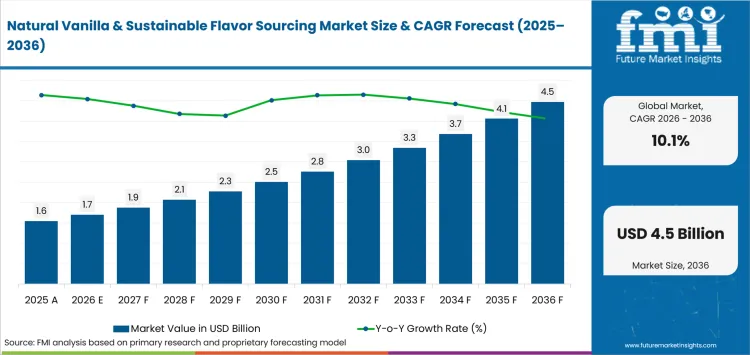
USD 1.7 billion in 2026 and USD 4.5 billion by 2036 at a 10.1% CAGR.
Demand for natural vanilla and sustainable flavor sourcing is projected to expand at 10.1% CAGR between 2026 and 2036. Valuation is expected to increase from USD 1.7 billion in 2026 to USD 4.5 billion by 2036. Food manufacturers are tightening flavor qualification as origin records become part of technical approval. India’s Press Information Bureau reported in July 2026 that Codex adopted a global vanilla standard alongside new standards for large cardamom and coriander. The vanilla standard gives cross-border quality specifications a common reference and raises the value of linking origin records with repeatable sensory performance.
Country conversion depends on whether food manufacturers qualify bean-derived extracts or vanillin under local trade and labeling rules. The USA Department of Commerce reported in June 2025 final dumping margins of 190.20% for Chinese vanillin exporters and 379.87% for the China-wide entity. Those margins distinguish USA vanillin sourcing from crop-derived vanilla and European purchasing under separate trade rules. Flavor houses with crop-linked extracts and compliant alternatives can protect formulation schedules without treating the routes as sensory equivalents.
Key Takeaways of Natural Vanilla & Sustainable Flavor Sourcing Market
- Demand is rising as food manufacturers place origin records and repeatable sensory performance inside the same technical approval process for natural vanilla ingredients.
- Based on product, natural vanilla is projected to account for 42.4% in 2026 due to full bean-derived profiles that support premium flavor briefs and origin-specific positioning.
- By source, bourbon is estimated to hold 54.1% in 2026 owing to Madagascar’s established curing network and the familiar sensory profile used in global formulations.
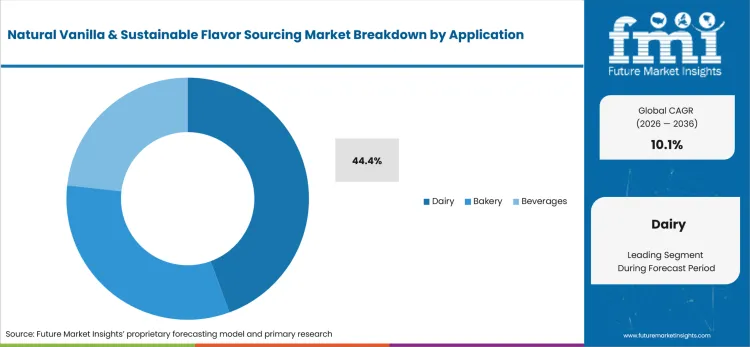
- In 2026, dairy is expected to lead application with 44.4% share because vanilla performs across ice cream, yogurt, desserts and milk-based beverages.
- Crop concentration in Madagascar can restrict sourcing flexibility as weather, curing quality and export logistics affect the quantity of beans that reach extraction specifications.
- Active companies include IFF, Givaudan, Symrise, dsm-firmenich, ADM, Prova, MANE and Syensqo across vanilla sourcing, extraction, flavor creation and vanillin production.
Analyst Perspective
“Food manufacturers evaluate flavor houses on whether each vanilla batch remains traceable and reproduces the approved sensory profile. Strong origin control and disciplined extraction reduce reformulation work during crop-quality shifts or labeling changes.”
- Nandini Roy Choudhury, Principal Consultant, Future Market Insights
How is the Natural Vanilla & Sustainable Flavor Sourcing Market segmented?
The natural vanilla & sustainable flavor sourcing market is segmented by product, source, application and region.
Product includes natural vanilla, vanillin and bio-based flavors. Source covers bourbon, fermentation and upcycled inputs, while application includes dairy, bakery and beverages. Regional analysis follows North America, Latin America, Western Europe, Eastern Europe, East Asia, South Asia and Pacific, and Middle East and Africa.
How does dairy shape demand within the application category?
USDA reported in July 2025 that USA frozen dairy production reached 1.386 billion gallons in 2024, tying vanilla qualification to commercial production. Dairy formulators test natural food flavors at different fat levels and temperatures so profiles remain stable in ice cream and yogurt.
- The application category is forecast to be led by dairy at 44.4% share in 2026 due to vanilla’s use across frozen desserts and milk-based products.
- Milk-based beverage flavoring gives dairy teams a stress case as fat content and heat treatment can shift the profile approved in frozen products.
What makes natural vanilla central to the product category?
Natural vanilla gives formulators the full bean-derived aroma profile expected in premium dairy and bakery products across established vanilla extract categories. Prova reported in October 2025 that its Madagascar program covered 250 hectares across 468 declared plots and traced a green vanilla batch to its production village.
- Natural vanilla is set to lead the product category with 42.4% share in 2026 due to full-spectrum extracts supporting premium flavor briefs and source-specific positioning.
- Plot-level traceability helps flavor teams investigate batch variation without repeating the same origin checks for every customer formulation brief across recurring purchase cycles.
What supports demand for bourbon within the source category?
Bourbon carries a recognizable Madagascar profile, but commercial approval depends on curing control and origin records that remain consistent across crop seasons and extraction lots.
- By source, bourbon is forecast to represent 54.1% in 2026 driven by Madagascar’s established curing and export network plus broad familiarity with its creamy and woody profile.
- MANE sources its vanilla directly from Madagascar, operating a Vanilla Community programme that has positively affected over 10,000 local inhabitants and supports farm-level traceability from green bean through to extraction.
What are the drivers, restraints and opportunities in the Natural Vanilla & Sustainable Flavor Sourcing Market?
Traceable flavor claims raise documentation demand while origin-side logistics limit crop flexibility and fermentation adds a second qualified sourcing route.
- Driver: Food manufacturers increasingly require origin and declaration records during technical approval for natural vanilla and related flavor systems.
- Restraint: Concentrated vanilla production and uneven local transformation can restrict the volume of cured beans that meets extraction specifications.
- Opportunity: Fermentation and bio-based vanillin routes can diversify sourcing once labeling status and performance are qualified for the intended food matrix.
Documentation Becomes Part of Flavor Qualification
Food manufacturers treat flavor identity records as part of technical approval, so origin and declaration evidence affects whether a vanilla system enters a commercial formula. DGCCRF reported in September 2025 that a concentrated vanilla extract contained 0.19% vanillin against a declared 0.35-0.45% range. That gap makes specification checks commercially relevant as mislabeled or under-strength extracts can trigger reformulation and delay clean-label flavors.
Origin Logistics Limit Crop Flexibility
Madagascar’s Agriculture Ministry reported in January 2026 that Sofia produced about 1,546 tonnes of vanilla annually while local processing remained uneven across priority crops. The processing gap adds quality work between harvest and export-grade extraction, extending handling time until cured beans reach repeatable moisture and sensory specifications for commercial flavor production.
Fermentation Adds a Second Vanillin Route
Bio-vanillin routes give flavor houses an alternative source during crop-supply or pricing disruptions in bean-derived planning. Commercial conversion of vanillin ingredients requires local natural-label acceptance and consistent performance in the intended food matrix. FDA closed GRN 1230 with no questions on June 11, 2025 for an E. coli-produced vanillin preparation intended for bakery and dairy uses.
Which country CAGRs are profiled in the Natural Vanilla & Sustainable Flavor Sourcing Market?
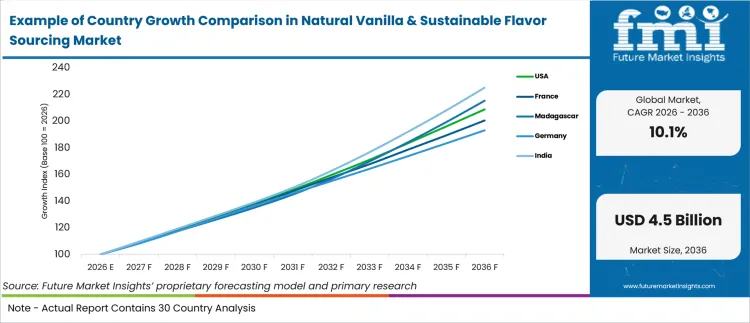
| Country | CAGR |
|---|---|
| India | 8.4% |
| Madagascar | 8.0% |
| USA | 7.6% |
| France | 7.2% |
| Germany | 6.8% |
How do country-level CAGRs compare in the Natural Vanilla & Sustainable Flavor Sourcing Market?
The profiled CAGRs form a narrow 1.6-point band with two operating groups. India and Madagascar combine stronger growth with supply roles. India is a formulation market with limited crop volume while Madagascar is the origin platform. USA, France and Germany convert demand under tighter import, labeling or authenticity controls.
- India’s small crop keeps formulators dependent on imported beans and alternative flavor routes.
- Madagascar’s outlook depends on curing quality and transport from farms into export-ready channels.
- USA faces vanillin trade measures alongside natural-flavor rules during commercial reformulation reviews.
- France pairs premium food use with protected origin channels for verified island vanilla.
- Germany gives ingredient-origin proof unusual visibility during vanilla labeling and product review.
Comparable growth rates therefore carry different qualification costs and sales cycles.
The full report provides country-level CAGR analysis across North America, Latin America, Europe, East Asia, South Asia, Oceania and the Middle East and Africa.
Country-wise Analysis
- Indian flavor formulators use vanilla across ice cream and bakery products, but domestic crop volume remains far below the needs of large domestic processing networks. The Directorate of Arecanut and Spices Development reported in July 2026 that the 2024-25 crop produced 0.040 thousand tonnes of vanilla from 0.041 thousand hectares, leaving processors with fragmented lots that require aggregation and reliable grade control. By 2036, India is projected to grow at 8.4% CAGR, supported by expanding food formulation and a sourcing mix that includes imported beans and bio-based alternatives for repeatable industrial batches across commercial dairy and bakery production schedules nationwide.
- Madagascar’s commercial advantage starts at origin with local curing and export networks that connect green beans to extraction programs and limit quality changes during long transport. Adoption of natural vanilla and sustainable flavor sourcing in Madagascar is estimated to expand at 8.0% CAGR through 2036, reinforced by demand for traceable crop-linked extraction and direct origin control for European and North American customers. The Agriculture Ministry reported in January 2026 that Vatovavy and Fitovinany produced about 350 tonnes of vanilla annually, yet cyclone exposure and uneven transformation can interrupt supply until cured beans reach repeatable commercial specifications across crop seasons.
- USITC’s June 2025 final determination found the USA vanillin industry materially injured by imports from China, putting route-specific trade exposure inside sourcing reviews for reformulated foods and new commercial flavor briefs. American flavor teams can pair federal declaration records with application testing to change vanilla routes, although duties on vanillin and crop-price swings raise the cost of switching approved formulations across national dairy and bakery portfolios. Natural vanilla and sustainable flavor sourcing sales in USA are forecast to expand at 7.6% CAGR by 2036, aided by major national food networks that need documented alternatives without repeating complete sensory qualification.
- French bakery and dairy formulators treat vanilla as a character ingredient, so source wording must survive recipe review while premium formulations remain dependent on imported bourbon and smaller protected-origin supplies. France’s natural vanilla and sustainable flavor sourcing outlook is anticipated to advance at 7.2% CAGR over the assessment period, supported by premium products that maintain identifiable vanilla profiles and local validation expertise. DAAF de La Réunion reported in December 2025 that post-cyclone support covered 138 hectares of vanilla, showing how weather can tighten a protected French origin channel and raise the value of alternate qualified supply for bakery flavor systems.
- German food labels distinguish sharply between real vanilla ingredients and broader aroma wording, while local laboratories give manufacturers a strong base for checking origin claims during product review at retail. Verbraucherzentrale explained in July 2026 that natural vanilla flavor must derive from real vanilla, while “Vanilla” itself has no food-law definition that guarantees ingredient origin and can therefore require closer label interpretation. The German natural vanilla and sustainable flavor sourcing sector is projected to record 6.8% CAGR during the assessment period, shaped by authentication requirements that reward clear ingredient declarations but add review work during premium-food label approval at retail.
Who are the notable companies in the Natural Vanilla & Sustainable Flavor Sourcing Market?
IFF, Givaudan, Symrise, dsm-firmenich, ADM, Prova, MANE and Syensqo are the notable companies serving this market.
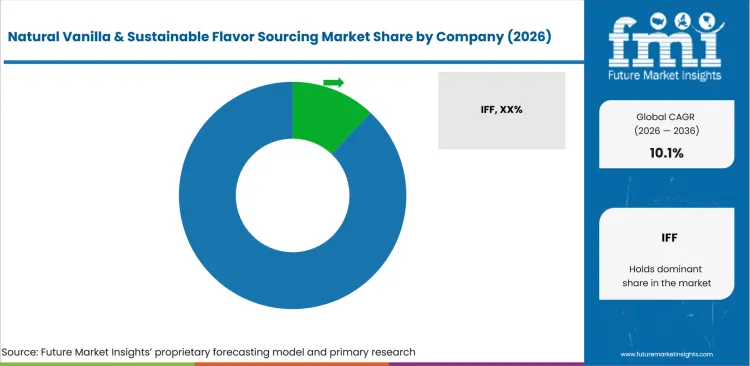
Competition spans global flavor houses with natural flavor ingredients portfolios and specialists focused on vanilla extraction or vanillin production. Entry depends on origin visibility and stable processing, while companies without those links must maintain food flavor formulations despite crop or labeling changes.
- IFF, Givaudan, Symrise and ADM connect Madagascar sourcing with extraction assets or international flavor creation.
- dsm-firmenich and MANE combine multi-market flavor creation with application support for dairy, bakery and beverage formulations.
- Prova specializes in vanilla extraction and Madagascar sourcing, while Syensqo supplies natural and synthetic vanillin for food applications.
Competitive Benchmarking: Natural Vanilla & Sustainable Flavor Sourcing Market
| Company | Origin & Traceability | Route Diversification | Application Support | Geographic Reach |
|---|---|---|---|---|
| IFF | High | Medium | High | Global with Madagascar center and multi-region flavor network |
| Givaudan | High | Medium | High | Global with Madagascar sourcing and European extraction |
| Symrise | High | Medium | Medium | Global with Madagascar origin operations and international flavor network |
| dsm-firmenich | High | High | High | Global with multi-origin vanilla sourcing and application network |
| ADM | High | Medium | High | International with Madagascar sourcing and North American flavor operations |
| Prova | High | Medium | High | France-centered extraction with Madagascar sourcing and international sales |
| MANE | High | High | High | International with Madagascar sourcing and multi-region flavor network |
| Syensqo | Low | High | Medium | Europe, USA and China vanillin production footprint |
Key Developments in the Natural Vanilla & Sustainable Flavor Sourcing Market
- In May 2026, IFF opened a 650 square meter Vanilla Innovation Center in Toamasina, bringing together lab analysis, extraction, scent and flavor creation, and application development in a single site to strengthen vanilla innovation at origin.
- In September 2025, Syensqo announced that its mothballed Saint-Fons synthetic vanillin unit was scheduled to restart by year-end beside continuing natural vanillin operations and increase planned European supply capacity.
- In June 2025, Givaudan introduced Rainforest Alliance certification for selected European vanilla extracts using traceable Madagascar beans processed at its Netherlands extraction facility.
Key Players in the Natural Vanilla & Sustainable Flavor Sourcing Market
Origin-Integrated Vanilla Platforms
- IFF
- Givaudan
- Symrise
- ADM
Flavor Creation and Application Networks
- dsm-firmenich
- MANE
Specialist Vanilla and Vanillin Platforms
- Prova
- Syensqo
Natural Vanilla & Sustainable Flavor Sourcing Market - Report Scope
| Coverage field | Report scope |
|---|---|
| Market breakdown | By product, source, application and region. |
| Quantitative Units | Revenue in USD billion and CAGR in % . |
| Market Definition | B2B revenue from natural vanilla ingredients, vanillin and bio-based flavor solutions within the defined product, source and application categories. |
| Regions Covered | North America, Latin America, Europe, East Asia, South Asia and Pacific, and Middle East and Africa. |
| Countries Covered | India, Madagascar, USA, France, Germany, and 20+ countries included in the full report. |
| Key Companies Profiled | IFF, Givaudan, Symrise, dsm-firmenich, ADM, Prova, MANE, Syensqo. |
| Forecast Period | 2026 to 2036. |
| Approach | Primary and secondary research with market triangulation. |
Natural Vanilla & Sustainable Flavor Sourcing Market - Research Methodology
| Method | Approach |
|---|---|
| Primary Research | FMI analysts gathered input from manufacturers, service providers, technology developers, distributors, end users, procurement teams, and subject-matter experts. Interviews examined purchasing decisions, product or service evaluation, adoption barriers, approval requirements, pricing considerations, and expectations for technical or commercial support. Respondents were also asked what evidence is required before a trial, pilot, or initial order develops into regular purchasing. |
| Desk Research | Desk research covered government statistics, regulatory publications, trade data, industry associations, technical literature, standards, company filings, product information, and official corporate announcements. Sources were reviewed for relevance, publication date, geographic coverage, and consistency with the defined market scope. Claims relating to performance, applications, approvals, capacity, investment, and commercial activity were retained only when supported by credible public evidence. |
| Market Sizing and Forecasting | The market model combined the baseline value with historical performance, segment structure, pricing and volume indicators, adoption levels, company participation, and country-level demand conditions. Forecast assumptions considered economic activity, investment trends, regulatory developments, technology adoption, purchasing cycles, supply availability, and barriers to wider market use. Segment and regional estimates were reconciled before the final market total was calculated. |
| Data Validation | Estimates were checked against multiple independent indicators, including public data, company activity, trade patterns, industry developments, and findings from primary interviews. Validation also tested whether products, services, applications, and company revenues fell within the defined market boundaries. Adjacent categories, unsupported claims, overlapping revenues, and activities without direct market relevance were excluded to reduce double counting and maintain consistency across segments and countries. |
Natural Vanilla & Sustainable Flavor Sourcing Market by Segments
Natural Vanilla & Sustainable Flavor Sourcing Market segmented by Product:
- Natural Vanilla
- Vanillin
- Bio-based Flavors
Natural Vanilla & Sustainable Flavor Sourcing Market segmented by Source:
- Bourbon
- Fermentation
- Upcycled
Natural Vanilla & Sustainable Flavor Sourcing Market segmented by Application:
- Dairy
- Bakery
- Beverages
Natural Vanilla & Sustainable Flavor Sourcing Market by Region:
- North America
- United States
- Canada
- Latin America
- Brazil
- Mexico
- Chile
- Rest of Latin America
- Western Europe
- Germany
- United Kingdom
- Italy
- Spain
- France
- Nordics
- Benelux
- Rest of Western Europe
- Eastern Europe
- Russia
- Poland
- Hungary
- Balkan and Baltic States
- Rest of Eastern Europe
- East Asia
- China
- Japan
- South Korea
- South Asia and Pacific
- India
- ASEAN
- Australia and New Zealand
- Rest of South Asia and Pacific
- Middle East and Africa
- Kingdom of Saudi Arabia
- Other GCC Countries
- Türkiye
- South Africa
- Other African Union Countries
- Rest of Middle East and Africa
Research Sources and Bibliography
- Ministry of Commerce & Industry, Press Information Bureau. (2026, July 16). India Achieves Major Milestone at Codex Commission with Adoption of Three Global Standards for Spices.
- USA Department of Commerce, International Trade Administration. (2025, June 3). Final Affirmative Determinations in the Antidumping and Countervailing Duty Investigations of Vanillin from China.
- Prova. (2025, October 9). Care&Act, 3 years of commitment in Madagascar.
- MANE. (n.d.). Conscious sourcing: Madagascar. Retrieved August 2026.
- Terán, A., & Scott, S. (2025, July 16). Ice cream and frozen dairy production dipped from 2000 to 2024.
- Direction générale de la concurrence, de la consommation et de la répression des fraudes. (2025, September 1). Étiquetage et composition : les arômes et denrées aromatisées sous surveillance.
- Ministère de l’Agriculture et de l’Élevage, Madagascar. (2026, January 23). Assises régionales pour la relance économique axées sur l’agribusiness.
- USA Food and Drug Administration. (2026, August 4). GRN No. 1230: Vanillin preparation produced by Escherichia coli BL21(DE3) SI-VAN1.
- Directorate of Arecanut and Spices Development. (2026, July 18). Statistics-Second Advance Estimates 2024-25.
- Ministère de l’Agriculture et de l’Élevage, Madagascar. (2026, January 23). Assises régionales de la relance économique à Madagascar.
- USA International Trade Commission. (2025, June 30). Vanillin from China Injures USA Industry, Says USITC.
- Direction de l’Alimentation, de l’Agriculture et de la Forêt de La Réunion. (2025, December 22). Rapport d’activité 2025.
- Verbraucherzentrale. (2026, July 30). Vanille, Vanilla und Vanillearoma: Was sind die Unterschiede?
- IFF. (2026, May 11). IFF opens Vanilla Innovation Center in Madagascar.
- Givaudan. (2025, June 18). Givaudan introduces Rainforest Alliance certified vanilla extracts for the European market.
- Symrise. (2026, April 10). Symrise celebrates third World Vanilla Day with global activities.
- ADM. (n.d.). How ADM Cares, SAVAN, and Fanamby are working together to support Madagascan Vanilla Farmers. Retrieved August 13, 2026.
- dsm-firmenich. (2026, February 27). Creating Consistent Vanilla Performance Across Applications.
- Syensqo. (2025, September 24). Syensqo to reopen synthetic vanillin production unit in Saint-Fons, France.
This bibliography is provided for reader reference and is not exhaustive. The full report contains the complete reference list and detailed citations
This Report Answers
- How does the market reach USD 4.5 billion by 2036?
- Which qualification records convert traceable vanilla sourcing into repeat orders?
- Why do natural vanilla, bourbon and dairy lead their categories?
- How does crop concentration affect vanilla availability and landed cost?
- Where can bio-based vanillin reduce dependence on bean-derived supply?
- How do profiled countries differ in sourcing and qualification conditions?
- Which capabilities separate integrated flavor houses from vanilla specialists?
- How do recent investments change application testing and supply reliability?
Frequently Asked Questions
How big is the natural vanilla & sustainable flavor sourcing market in 2026?
The natural vanilla & sustainable flavor sourcing market is valued at USD 1.7 billion in 2026 and is projected to reach USD 4.5 billion by 2036. Growth is driven by increasing demand for traceable, sustainably sourced vanilla ingredients and consistent flavor performance across food applications.
What is the CAGR of the natural vanilla & sustainable flavor sourcing market from 2026 to 2036?
The natural vanilla & sustainable flavor sourcing market is projected to grow at a CAGR of 10.1% between 2026 and 2036. Expansion is supported by rising demand for natural flavor solutions, transparent sourcing practices, and premium food formulations.
Which product leads the natural vanilla & sustainable flavor sourcing market?
Natural vanilla is projected to account for 42.4% of the market in 2026. Its leading share is supported by strong demand from dairy, bakery, and confectionery manufacturers seeking authentic vanilla flavor profiles.
How much value will the natural vanilla & sustainable flavor sourcing market add between 2026 and 2036?
The natural vanilla & sustainable flavor sourcing market is expected to add USD 2.8 billion in value between 2026 and 2036. Growth reflects increasing adoption of traceable vanilla extracts and sustainable flavor ingredients across commercial food production.
Which companies are active in the natural vanilla & sustainable flavor sourcing market?
Key companies operating in the market include IFF, Givaudan, Symrise, dsm-firmenich, ADM, Prova, MANE, and Syensqo. These companies compete through sustainable sourcing programs, extraction technologies, flavor development expertise, and global supply networks.
Preview the report firsthand - request a free sample
Get SampleGet the brochure for pricing and purchase details.
Get PDFTable of Content
- Key Takeaways
- Market Size and CAGR
- Top Growth Driver
- Fastest Growing Segment
- Leading Region
- Key Companies
- Emerging Opportunities
- Executive Summary
- Global Market Outlook
- Demand-side Trends
- Supply-side Trends
- Technology Roadmap Analysis
- Analysis and Recommendations
- Analyst Perspective (What is happening? Why now? What should investors know?)
- Key Questions Answered
- How large is the market?
- What is the CAGR?
- What are key trends?
- Which region dominates?
- Who are the leaders?
- Market Overview
- Market Coverage / Taxonomy
- Market Definition / Scope / Limitations
- Research Methodology
- Chapter Orientation
- Analytical Lens and Working Hypotheses
- Market Structure, Signals, and Trend Drivers
- Benchmarking and Cross-market Comparability
- Market Sizing, Forecasting, and Opportunity Mapping
- Research Design and Evidence Framework
- Desk Research Programme (Secondary Evidence)
- Expert Input and Fieldwork (Primary Evidence)
- Tooling, Models, and Reference Databases
- Data Engineering and Model Build
- Quality Assurance and Audit Trail
- Market Background
- Market Dynamics (Drivers, Restraints, Opportunity, Trends)
- Scenario Forecast (Optimistic, Likely, Conservative)
- Impact Analysis
- AI Impact
- Sustainability Impact
- Regulatory Impact
- Technology Impact
- Consumer / Buyer Analysis
- Purchase Drivers
- Adoption Barriers
- Buyer Journey
- Opportunity Map Analysis
- Product Life Cycle Analysis
- Supply Chain Analysis
- Investment Feasibility Matrix
- Value Chain Analysis
- PESTLE and Porter's Analysis
- Regulatory Landscape
- Regional Parent Market Outlook
- Production and Consumption Statistics
- Import and Export Statistics
- Global Market Analysis and Forecast, 2021 to 2036
- Historical Market Size Value (USD Million) Analysis, 2021 to 2025
- Current and Future Market Size Value (USD Million) Projections, 2026 to 2036
- Y-o-Y Growth Trend Analysis
- Absolute $ Opportunity Analysis
- Global Market Pricing Analysis, 2021 to 2036
- Global Market Analysis and Forecast, By Product, 2021 to 2036
- Introduction / Key Findings
- Historical Market Size Value (USD Million) Analysis By Product, 2021 to 2025
- Current and Future Market Size Value (USD Million) Analysis and Forecast By Product, 2026 to 2036
- Natural Vanilla
- Vanillin
- Bio-based Flavors
- Natural Vanilla
- Y-o-Y Growth Trend Analysis By Product, 2021 to 2025
- Absolute $ Opportunity Analysis By Product, 2026 to 2036
- Global Market Analysis and Forecast, By Source, 2021 to 2036
- Introduction / Key Findings
- Historical Market Size Value (USD Million) Analysis By Source, 2021 to 2025
- Current and Future Market Size Value (USD Million) Analysis and Forecast By Source, 2026 to 2036
- Bourbon
- Fermentation
- Upcycled
- Bourbon
- Y-o-Y Growth Trend Analysis By Source, 2021 to 2025
- Absolute $ Opportunity Analysis By Source, 2026 to 2036
- Global Market Analysis and Forecast, By Application, 2021 to 2036
- Introduction / Key Findings
- Historical Market Size Value (USD Million) Analysis By Application, 2021 to 2025
- Current and Future Market Size Value (USD Million) Analysis and Forecast By Application, 2026 to 2036
- Dairy
- Bakery
- Beverages
- Dairy
- Y-o-Y Growth Trend Analysis By Application, 2021 to 2025
- Absolute $ Opportunity Analysis By Application, 2026 to 2036
- Global Market Analysis and Forecast, By Region, 2021 to 2036
- Introduction
- Historical Market Size Value (USD Million) Analysis By Region, 2021 to 2025
- Current Market Size Value (USD Million) Analysis and Forecast By Region, 2026 to 2036
- North America
- Latin America
- Western Europe
- Eastern Europe
- East Asia
- South Asia and Pacific
- Middle East & Africa
- Market Attractiveness Analysis By Region
- North America Market Analysis and Forecast, By Country, 2021 to 2036
- Historical Market Size Value (USD Million) Trend Analysis By Market Taxonomy, 2021 to 2025
- Market Size Value (USD Million) Forecast By Market Taxonomy, 2026 to 2036
- By Country
- USA
- Canada
- By Product
- By Source
- By Application
- By Country
- Market Attractiveness Analysis
- By Country
- By Product
- By Source
- By Application
- Key Takeaways
- Latin America Market Analysis and Forecast, By Country
- Historical Market Size Value (USD Million) Trend Analysis By Market Taxonomy, 2021 to 2025
- Market Size Value (USD Million) Forecast By Market Taxonomy, 2026 to 2036
- By Country
- Brazil
- Mexico
- Chile
- Rest of Latin America
- By Product
- By Source
- By Application
- By Country
- Market Attractiveness Analysis
- By Country
- By Product
- By Source
- By Application
- Key Takeaways
- Western Europe Market Analysis and Forecast, By Country
- Historical Market Size Value (USD Million) Trend Analysis By Market Taxonomy, 2021 to 2025
- Market Size Value (USD Million) Forecast By Market Taxonomy, 2026 to 2036
- By Country
- Germany
- UK
- Italy
- Spain
- France
- Nordic
- BENELUX
- Rest of Western Europe
- By Product
- By Source
- By Application
- By Country
- Market Attractiveness Analysis
- By Country
- By Product
- By Source
- By Application
- Key Takeaways
- Eastern Europe Market Analysis and Forecast, By Country
- Historical Market Size Value (USD Million) Trend Analysis By Market Taxonomy, 2021 to 2025
- Market Size Value (USD Million) Forecast By Market Taxonomy, 2026 to 2036
- By Country
- Russia
- Poland
- Hungary
- Balkan & Baltic
- Rest of Eastern Europe
- By Product
- By Source
- By Application
- By Country
- Market Attractiveness Analysis
- By Country
- By Product
- By Source
- By Application
- Key Takeaways
- East Asia Market Analysis and Forecast, By Country
- Historical Market Size Value (USD Million) Trend Analysis By Market Taxonomy, 2021 to 2025
- Market Size Value (USD Million) Forecast By Market Taxonomy, 2026 to 2036
- By Country
- China
- Japan
- South Korea
- By Product
- By Source
- By Application
- By Country
- Market Attractiveness Analysis
- By Country
- By Product
- By Source
- By Application
- Key Takeaways
- South Asia and Pacific Market Analysis and Forecast, By Country
- Historical Market Size Value (USD Million) Trend Analysis By Market Taxonomy, 2021 to 2025
- Market Size Value (USD Million) Forecast By Market Taxonomy, 2026 to 2036
- By Country
- India
- ASEAN
- Australia & New Zealand
- Rest of South Asia and Pacific
- By Product
- By Source
- By Application
- By Country
- Market Attractiveness Analysis
- By Country
- By Product
- By Source
- By Application
- Key Takeaways
- Middle East & Africa Market Analysis and Forecast, By Country
- Historical Market Size Value (USD Million) Trend Analysis By Market Taxonomy, 2021 to 2025
- Market Size Value (USD Million) Forecast By Market Taxonomy, 2026 to 2036
- By Country
- Kingdom of Saudi Arabia
- Other GCC Countries
- Türkiye
- South Africa
- Other African Union
- Rest of Middle East & Africa
- By Product
- By Source
- By Application
- By Country
- Market Attractiveness Analysis
- By Country
- By Product
- By Source
- By Application
- Key Takeaways
- Key Countries Market Analysis
- USA
- Pricing Analysis
- Market Share Analysis, 2025
- By Product
- By Source
- By Application
- Canada
- Pricing Analysis
- Market Share Analysis, 2025
- By Product
- By Source
- By Application
- Mexico
- Pricing Analysis
- Market Share Analysis, 2025
- By Product
- By Source
- By Application
- Brazil
- Pricing Analysis
- Market Share Analysis, 2025
- By Product
- By Source
- By Application
- Chile
- Pricing Analysis
- Market Share Analysis, 2025
- By Product
- By Source
- By Application
- Germany
- Pricing Analysis
- Market Share Analysis, 2025
- By Product
- By Source
- By Application
- UK
- Pricing Analysis
- Market Share Analysis, 2025
- By Product
- By Source
- By Application
- Italy
- Pricing Analysis
- Market Share Analysis, 2025
- By Product
- By Source
- By Application
- Spain
- Pricing Analysis
- Market Share Analysis, 2025
- By Product
- By Source
- By Application
- France
- Pricing Analysis
- Market Share Analysis, 2025
- By Product
- By Source
- By Application
- India
- Pricing Analysis
- Market Share Analysis, 2025
- By Product
- By Source
- By Application
- ASEAN
- Pricing Analysis
- Market Share Analysis, 2025
- By Product
- By Source
- By Application
- Australia & New Zealand
- Pricing Analysis
- Market Share Analysis, 2025
- By Product
- By Source
- By Application
- China
- Pricing Analysis
- Market Share Analysis, 2025
- By Product
- By Source
- By Application
- Japan
- Pricing Analysis
- Market Share Analysis, 2025
- By Product
- By Source
- By Application
- South Korea
- Pricing Analysis
- Market Share Analysis, 2025
- By Product
- By Source
- By Application
- Russia
- Pricing Analysis
- Market Share Analysis, 2025
- By Product
- By Source
- By Application
- Poland
- Pricing Analysis
- Market Share Analysis, 2025
- By Product
- By Source
- By Application
- Hungary
- Pricing Analysis
- Market Share Analysis, 2025
- By Product
- By Source
- By Application
- Kingdom of Saudi Arabia
- Pricing Analysis
- Market Share Analysis, 2025
- By Product
- By Source
- By Application
- Türkiye
- Pricing Analysis
- Market Share Analysis, 2025
- By Product
- By Source
- By Application
- South Africa
- Pricing Analysis
- Market Share Analysis, 2025
- By Product
- By Source
- By Application
- USA
- Market Structure Analysis
- Competition Dashboard
- Competition Benchmarking
- Market Share Analysis of Top Players
- By Regional
- By Product
- By Source
- By Application
- Emerging Startups
- Innovation Benchmarking
- Competition Analysis
- Competition Deep Dive
- IFF
- Overview
- Product Portfolio
- Profitability by Market Segments
- Sales Footprint
- Strategy Overview
- Marketing Strategy
- Product Strategy
- Channel Strategy
- Givaudan
- Symrise
- dsm-firmenich
- ADM
- Solvay (vanillin)
- Prova
- IFF
- Case Studies
- Success Stories
- Recent Developments
- Competition Deep Dive
- Assumptions & Acronyms Used


