

- Market Size (2026)
- USD 64.5 Mn
- Forecast (2036)
- USD 130.5 Mn
- CAGR (2026 to 2036)
- 7.3%
How big is Neonatal Carbohydrate Supplement Market in 2026?
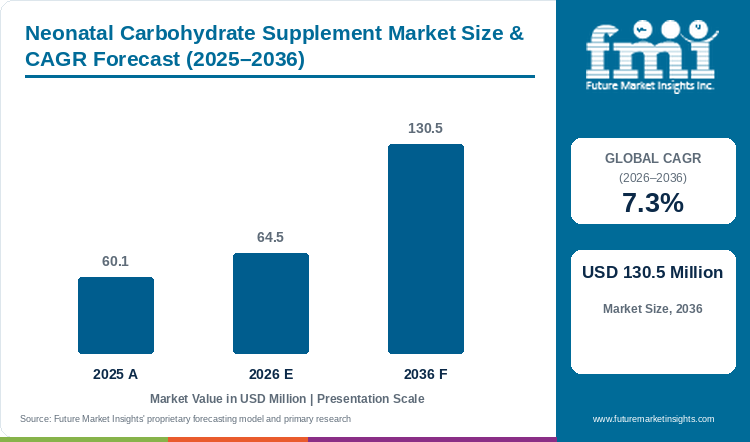
Demand for neonatal carbohydrate supplement is projected to expand at 7.3% CAGR between 2026 and 2036. Industry value grows from USD 60.1 million in 2025 to USD 64.5 million in 2026 and is projected to reach USD 130.5 million by 2036.
Neonatal carbohydrate supplements are witnessing adoption in cases where premature infants cannot receive the required calories through tolerated feed volume. The global neonatal carbohydrate supplement market was valued at USD 60.1 million in 2025 and is estimated at USD 64.5 million in 2026. Market value is projected to reach USD 130.5 million by 2036, expanding at 7.3% CAGR from 2026 to 2036. According to FMI, glucose polymer powders hold the leading 41.5% share in 2026, owing to measured calorie addition beside complete feeds and clinical nutrition products. The CDC recorded 377,204 preterm births and 308,966 low-birthweight births in the USA during 2024.[1] Korea Disease Control and Prevention Agency registered 2,331 high-risk infants during 2024 through more than 70 NICUs, while discharge survival reached 90.0% among very-low-birthweight infants.[2] A May 2026 review also reported that glucose polymers replace 50% to 60% of lactose in several preterm formulas.[3] These clinical conditions are expected to support controlled demand for neonatal carbohydrate supplements during the forecast period.
Key Market Trends & Insights
- By product type, glucose polymer powders hold 41.5% share in 2026, owing to small calorie changes during repeated feed reviews.
- Caloric enhancement of feeds accounts for 49.0% of application demand in 2026, as limited feed volume requires repeated energy adjustment.
- Powder represents the leading 47.5% share by product form in 2026, supported by concentrated storage and gram-based dispensing.
- NICUs hold 47.2% of end user demand in 2026, owing to monitored prescription, preparation and feeding reassessment.
- Hospital pharmacy accounts for 45.1% of sales channel demand in 2026, as product approval and bedside supply remain hospital controlled.
- North America, Western Europe and East Asia remain important hospital markets, whereas product use differs according to neonatal care practices.
Regional Highlights
- South Korea is projected to grow at 7.6% CAGR from 2026 to 2036, supported by a national registry covering more than 70 NICUs.
- The USA and UK follow at 7.0% and 6.7%, whereas Germany expands at 6.1% and Japan records 5.5% CAGR.
Market Size & Forecast
Table 1: Market Size and Forecast for the Neonatal Carbohydrate Supplement Market (USD million and percentage), 2025 to 2036
| Metric | Value |
|---|---|
| 2025 Market Size | USD 60.1 million |
| Estimated Market Size in 2026 | USD 64.5 million |
| Projected Market Size by 2036 | USD 130.5 million |
| CAGR, 2026 to 2036 | 7.3% |
Neonatal carbohydrate supplements do not apply to the complete premature-infant population, as product use begins after clinical review of growth and feed tolerance. Children’s Hospital of Philadelphia described an initial glucose infusion rate of 5 to 8 mg/kg/minute with monitored increases according to neonatal requirement.[4] Johns Hopkins stated in January 2025 that parenteral nutrition is indicated for preterm neonates below 1,800 g until adequate enteral feeding is established.[5] Starship’s September 2026 guideline requires intravenous nutrition within eight hours for babies below 31 weeks and continues support until enteral feeds reach at least 120 mL/kg/day.[6] These feeding thresholds indicate that carbohydrate demand develops around monitored calorie gaps and gradual feeding transition.
Clinical Need and Addressable Feeding Conditions
Neonatal carbohydrate supplements are not complete infant formulas and are selected only where separate calorie addition is required. Product demand is therefore concentrated among infants having limited feed tolerance, low body weight or slower feeding progression. The indicators below explain how clinical need and hospital monitoring narrows the addressable market.
Table 2: Clinical Need and Addressable Feeding Conditions for the Neonatal Carbohydrate Supplement Market (infants, percentages, dosage rates, body weight, and feed volume), mixed reporting years from 2024 to 2026
| Indicator | Data Point | Market Meaning | Source |
|---|---|---|---|
| USA preterm and low-birthweight births | 377,204 preterm; 308,966 low birthweight in 2024 | Provides a large clinical base, although only infants having defined calorie gaps require separate modules. | U.S. CDC FastStats |
| South Korea high-risk neonatal registry | 2,331 infants; more than 70 NICUs; 90.0% survival in 2024 | Shows organized inpatient monitoring and common outcome evidence for high-risk infants. | KDCA Neonatal Registry |
| Glucose polymers in preterm formula | 50% to 60% lactose replacement reported in May 2026 | Supports ingredient scrutiny and product-specific evidence before wider neonatal use. | Frontiers in Nutrition |
| Initial glucose infusion target | 5 to 8 mg/kg/minute | Shows that carbohydrate delivery is measured and adjusted according to neonatal response. | Children’s Hospital of Philadelphia |
| Parenteral nutrition eligibility | Preterm neonates below 1,800 g; three-day feeding threshold | Identifies a clinically monitored group requiring nutrition support before adequate enteral feeding. | Johns Hopkins All Children's Hospital |
| Feeding transition threshold | Below 31 weeks; IV nutrition within eight hours; 120 mL/kg/day enteral threshold | Indicates gradual transition and repeated reassessment before complete enteral feeding is reached. | Starship Child Health |
Basis: Clinical indicators describe potential need and care pathways, not direct measurements of product demand.
Analyst Perspective
“I expect measured carbohydrate additions to gain preference where premature infants cannot tolerate higher feed volume. Unit-dose formats having flexible dosing will reduce preparation work and widen hospital use through 2036.”
- Anurag Sharma, Principal Consultant, Future Market Insights.
How is the neonatal carbohydrate supplement market segmented?
Neonatal carbohydrate supplement market is segmented by five primary commercial axes and region: product type, application, product form, end user, sales channel, and region. In 2026, glucose polymer powders are projected at 41.5%, caloric enhancement of feeds at 49.0%, powder at 47.5%, NICUs at 47.2%, and hospital pharmacy at 45.1%.
Neonatal carbohydrate supplement market is segmented by product type, application, product form, end user, sales channel, and region.
By product type: glucose polymer powders, liquid carbohydrate modules, dextrose gel products, and other products.
By application: caloric enhancement of feeds, neonatal hypoglycemia support, and other applications.
By product form: powder, liquid, and gel.
By end user: NICUs, newborn nurseries, homecare, and other end users.
By sales channel: hospital pharmacy, retail pharmacy, online, institutional tender, and other channels.
By region: North America, Latin America, Western Europe, Eastern Europe, East Asia, South Asia and Pacific, and Middle East and Africa.
Why do glucose polymer powders retain a notable product type share?
Based on product type, glucose polymer powders are projected to account for 41.5% in 2026, supported by measured calorie adjustment.
Glucose polymer powders are carbohydrate-dominant products which are added separately in prescribed neonatal feeds. The powder permits small adjustment in calorie density without altering base preterm infant formulas or changing protein and fat in the complete feed. Due to this flexibility, glucose polymer powders are used where infant weight and feed tolerance requires repeated review. Demand for measured calorie addition is anticipated to support the segment growth.
- Glucose polymer powders account for 41.5% of product type revenue in 2026, owing to small dose changes during repeated feed reviews.
- A March 2025 clinical evaluation reported that glucose polymers with alpha-1,4 linkages are prioritized in preterm nutrition because intestinal maltase activity matures earlier than lactase in preterm infants.[7]
What supports caloric enhancement as the preferred application choice?
By application, caloric enhancement of feeds is estimated to hold 49.0% in 2026, owing to recurring energy-density decisions.
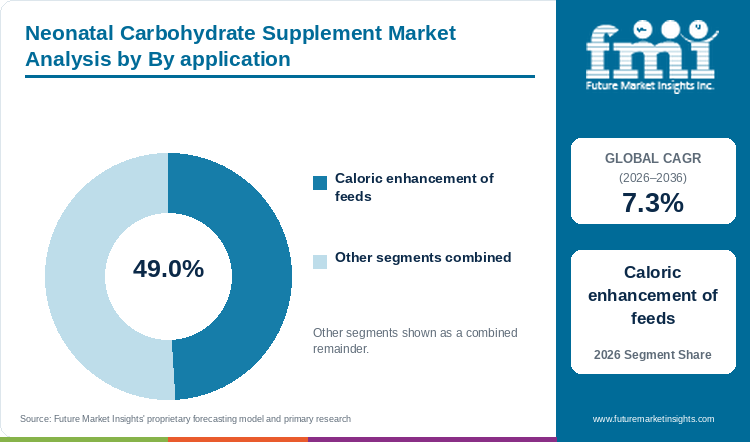
Table 3: Application Share for the Neonatal Carbohydrate Supplement Market (percentage share), 2026
| Product Type | Share (2026) |
|---|---|
| Caloric enhancement of feeds | 49.0% |
| Other Segments Combined | 51.0%* |
| Total | 100.0% |
*Calculated as the balance remaining after deducting the leading segment's reported share from 100.0%.
Table 4: Application Leadership and Market Growth for the Neonatal Carbohydrate Supplement Market (segment and CAGR percentage), 2026 to 2036
| Metric | Value |
|---|---|
| Global CAGR (2026 to 2036) | 7.3% |
| Leading Segment | Caloric enhancement of feeds |
Caloric enhancement of feeds is used when infant energy requirement cannot be achieved through tolerated feed volume. It allows neonatal teams to add carbohydrate calories alongside enteral feeding formulas without increasing every nutrient in the same proportion. The application changes according to infant weight, growth and feeding tolerance. This recurring requirement is expected to drive the caloric enhancement of feeds segment.
- Caloric enhancement of feeds represents 49.0% of application demand in 2026, supported by adjustment according to infant weight and tolerance.
- Clinical neonatal nutrition guidance published in 2025 recommends target enteral energy intake of 110 to 135 kcal/kg/day for preterm infants to overcome limited fluid tolerance.[8]
How does powder meet changing needs in the product form category?
In 2026, powder is expected to lead product form with 47.5% share, driven by precise gram-based dosing and storage efficiency.
Powder form provides concentrated carbohydrate and permits gram-based dosing according to the prescribed feed. It requires lower storage space than several ready-to-use products and can be dispensed in measured amounts. However, exact measurement and hygienic handling is required because powder is not sterile. Controlled pharmacy preparation aligns with handling requirements for specialized medical foods during the forecast period.
- Powder holds 47.5% of product form revenue in 2026, as hospital pharmacies can stock and dispense measured quantities.
- The CDC stated in May 2026 that powdered infant formula is not sterile and advised extra precautions for babies younger than two months or born prematurely.[9]
Why are NICUs central to the end user category?
NICUs are set to lead end user demand with 47.2% share in 2026, underpinned by monitored prescription and reassessment.
NICUs provide monitored care for premature and low-birthweight infants requiring repeated nutrition assessment. Neonatologists, dietitians, pharmacists and nurses supports product selection, preparation and use in the same care setting, anchoring comprehensive premature infant care. Weight, tolerance and calorie intake can also be reviewed regularly. Presence of trained neonatal teams is expected to drive the NICUs segment growth.
- NICUs account for 47.2% of end user demand in 2026, owing to monitored prescription, preparation and reassessment.
- England’s January 2025 response on preterm birth reported that 8.1% of births in 2023 occurred between 24 and 36 completed weeks.[10]
What drives hospital pharmacy leadership in the sales channel?
Hospital pharmacy is expected to command 45.1% of sales channel demand in 2026, reinforced by formulary control and bedside availability.
Hospital pharmacy supplies the approved carbohydrate supplement according to the neonatal prescription. Hospital pharmacies manages product storage, lot traceability and availability in neonatal wards. The channel also supports controlled dispensing where powder products requires exact measurement. Formulary-controlled specialized nutrition products are anticipated to support hospital pharmacy sales.
- Hospital pharmacy represents 45.1% of sales channel revenue in 2026, supported by formulary control and ward availability.
- In July 2025, Danone completed the acquisition of a majority stake in Kate Farms. The acquisition expanded its specialized nutrition business in the USA.[11]
What are the drivers, restraints, and opportunities in the neonatal carbohydrate supplement market?
In the neonatal carbohydrate supplement market, constrained feed volume is the key driver, preparation risk is the key restraint, and standardized dosing is the key opportunity.
- Driver: Higher energy requirements support carbohydrate additions when limited feed volume restricts calorie delivery.
- Restraint: Powder safety and preparation controls can narrow approved use in high-risk neonatal settings.
- Opportunity: Unit-dose liquids, gels, or measured powder packs can reduce preparation steps while retaining clinical flexibility.
Feed Volume Creates Calorie Gaps
Premature infants have higher energy requirement, whereas the feed volume tolerated by them can remain limited, making targeted premature infant nutrition essential. In 2025, clinical nutritional guidance published in Nutrients reported that target growth for preterm infants requires achieving an enteral energy intake of 100 to 120 kcal/kg/day, necessitating concentrated calorie additions when fluid volume is restricted.[12] Due to this condition, nutrition plans are reviewed according to growth, feed tolerance and clinical requirement. FMI research indicates that carbohydrate modules are demanded when additional calories are required beside complete nutrition. Growing number of prescribed nutrition adjustments is expected to drive the neonatal carbohydrate supplement market growth.
Preparation Risk Narrows Use
Preparation of powder products requires exact measurement, hygienic handling and a defined discard time across pediatric clinical nutrition regimens. In August 2026, Abbott announced agreements covering the Gill case and claims involving about 2,000 additional individuals.[13] The company stated that these agreements were not an admission of liability. Attention towards safety evidence is leading hospitals to review preparation instruction before product approval. High preparation requirement and longer hospital review may hamper the growth of neonatal carbohydrate supplement market.
Standardized Dosing Opens Access
Unit-dose liquids, gels and measured powder packs can reduce several preparation steps in neonatal care. In April 2026, Mead Johnson Nutrition entered into a five-year research agreement with Mass General Brigham covering human milk composition and premature infant nutrition.[14] Such research can support infant clinical nutrition solutions having defined dose and compatibility with prescribed feeds. Expansion of standardized neonatal nutrition formats is expected to create growth opportunities in the market.
Which country CAGRs are profiled in the neonatal carbohydrate supplement market?
Table 5: Country CAGR Comparison for the Neonatal Carbohydrate Supplement Market (CAGR percentage), 2026 to 2036
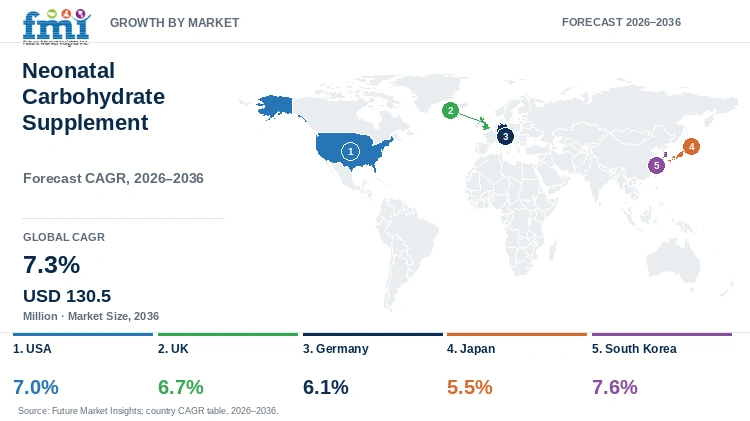
| Country | CAGR |
|---|---|
| USA | 7.0% |
| UK | 6.7% |
| Germany | 6.1% |
| Japan | 5.5% |
| South Korea | 7.6% |
How do country-level CAGRs compare in the neonatal carbohydrate supplement market?
As per the analysis from FMI, demand outlook remains stronger in countries where neonatal care is organized through registries, specialist networks and regulated hospitals. However, use of neonatal carbohydrate supplements differs according to hospital approval, preparation requirement and availability of trained nutrition staff.
- USA hospital demand is influenced by FDA nutrient review, contaminant testing and separate formulary approval for neonatal nutrition products.
- UK neonatal networks allow feeding guidance and preparation information to move through several specialist units.
- Germany concentrates premature-infant care in regulated perinatal centers having formal quality and transfer requirements.
- Japan demand remains concentrated in specialist hospitals as the national birth cohort continues to contract.
- South Korea connects neonatal product evaluation with national registry evidence from more than 70 participating NICUs.
Full report country CAGRs cover: North America; Latin America; Western Europe; Eastern Europe; East Asia; South Asia and Pacific; Middle East and Africa.
Country-wise Analysis
- Sales of neonatal carbohydrate supplements in the USA are forecast to expand at 7.0% CAGR through 2036, owing to regulated hospital use. In April 2026, the FDA reported testing 312 infant formula samples covering 16 brands, including 278 powders, 11 concentrated liquids and 23 ready-to-feed products.[15] The agency also generated more than 120,000 data points for contaminants. Such testing is keeping ingredient quality and preparation evidence visible during hospital review. Neonatal carbohydrate products therefore requires clear composition and dosing information before formulary use. Presence of specialist NICUs equipped with advanced neonatal intensive care devices along with regulatory attention is expected to support controlled market growth in the USA.
- The UK neonatal carbohydrate supplement market is anticipated to grow at 6.7% CAGR between 2026 and 2036, supported by networked neonatal services. Office for National Statistics reported 585,396 live births in England and Wales during 2025, decreasing by 1.6% from 2024.[16] It also reported that 91.0% of live births occurred between 37 and 41 weeks of gestation. Remaining births are keeping premature care visible in maternity planning. Products requires clear dosing and preparation information before use in neonatal units. Expansion of specialist hospital networks is anticipated to support measured demand in the UK.
- Germany is estimated to post 6.1% CAGR over the forecast period, owing to concentrated care in regulated perinatal centers. The Federal Joint Committee amended its quality-assurance directive in October 2025 and the revised version became effective on January 17, 2026.[17] The directive retains tiered perinatal care and risk-adapted transfer requirement for infants below 1,500 g. This structure concentrates nutrition decisions among hospitals having trained staff and documented procedures. Products having clear preparation information are expected to receive higher preference. Presence of regulated perinatal hospitals is anticipated to support the Germany market growth.
- Adoption of neonatal carbohydrate supplements in Japan is estimated to expand at 5.5% CAGR through 2036, influenced by selective hospital purchasing. Japan Ministry of Health, Labour and Welfare released the final 2024 Vital Statistics on September 16, 2025, including national tables for births and birthweight.[18] The smaller birth cohort is limiting broad channel expansion, whereas specialist hospitals continue to manage premature infants. Japanese hospitals also requires precise preparation information because carbohydrate modules are used beside complete feeds. Demand is expected to remain concentrated in specialist neonatal hospitals during the forecast period.
- By 2036, South Korea is projected to grow at 7.6% CAGR, supported by a national NICU network and common outcome reporting. Korea Disease Control and Prevention Agency updated its premature-infant information in August 2026 and included nutrition, temperature control, respiratory support and infection management under NICU treatment.[19] National guidance also identifies very-low-birthweight infants below 1,500 g as a separate group. Registry-linked hospitals are supporting organized product evaluation. Hospital pharmacy access and Korean dosing information is expected to propel the South Korea market growth.
Who are the notable companies in the neonatal carbohydrate supplement market?
Danone Nutricia, Vitaflo / Nestlé Health Science, Abbott, Solace Nutrition, Mead Johnson / Reckitt, Fresenius Kabi, Medtrition, and Global Health Products are notable companies profiled in this market.
Neonatal carbohydrate supplement market is moderately fragmented with presence of direct module suppliers and larger infant nutrition companies. FMI data suggests that Danone Nutricia, Vitaflo and Solace Nutrition are providing products closer to carbohydrate supplementation requirement. Abbott and Mead Johnson are participating through wider infant nutrition products, whereas Fresenius Kabi has broader hospital nutrition presence. Medtrition and Global Health Products are supplying modular nutrition through institutional channels. Some of the prominent players are focusing on preparation convenience and hospital availability in order to increase its customer base.
- Direct carbohydrate and metabolic modules: Danone Nutricia, Vitaflo, and Solace Nutrition.
- Infant and clinical nutrition platforms: Abbott, Mead Johnson / Reckitt, and Fresenius Kabi.
- Institutional modular nutrition suppliers: Medtrition and Global Health Products.
Competitive Benchmarking: Neonatal Carbohydrate Supplement Market
Table 6: Competitive Benchmarking for the Neonatal Carbohydrate Supplement Market (qualitative capability ratings), 2026
| Company | Product Fit | Hospital Access | Current Activity | Reach |
|---|---|---|---|---|
| Danone Nutricia | High | High | High | High |
| Vitaflo / Nestlé Health Science | High | High | Medium | High |
| Abbott | Medium | High | High | High |
| Solace Nutrition | High | Medium | Medium | Low |
| Mead Johnson / Reckitt | Medium | High | High | High |
| Fresenius Kabi | Low | High | Medium | High |
| Medtrition | Medium | Medium | Medium | Low |
| Global Health Products | Medium | High | Low | Low |
High indicates wider public evidence against the stated criterion, Medium indicates narrower evidence and Low indicates limited direct evidence. These ratings do not represent product quality, market share or company rank.
Key Developments in the Neonatal Carbohydrate Supplement Market
- In February 2026, Nestlé integrated Infant Nutrition and Nestlé Health Science into a single operational unit to accelerate clinical and pediatric specialized nutrition pipelines.[20]
- In January 2026, Solace Nutrition expanded its clinical modular nutrition portfolio with new medical food formats for specialized dietary management.[21]
- In September 2025, Danone completed a EUR 50 million line expansion at its European medical nutrition manufacturing plant to scale specialized enteral nutrition production.[22]
- In June 2025, Fresenius Kabi opened an expanded enteral nutrition research and development center to support development of specialized clinical nutrition products.[23]
Key Players in the Neonatal Carbohydrate Supplement Market
Specialized carbohydrate and metabolic modules
- Danone Nutricia
- Vitaflo / Nestlé Health Science
- Solace Nutrition
Infant and clinical nutrition platforms
- Abbott
- Mead Johnson / Reckitt
- Fresenius Kabi
Institutional modular nutrition suppliers
- Medtrition
- Global Health Products
Neonatal Carbohydrate Supplement Market - Report Scope
Table 7: Report Scope for the Neonatal Carbohydrate Supplement Market (coverage fields and definitions), 2026 to 2036
| Coverage field | Report scope |
|---|---|
| Market breakdown | Product type; application; product form; end user; sales channel; region |
| Quantitative units | USD million |
| Market definition | First-sale revenue from oral or enteral carbohydrate-dominant supplements used for neonatal caloric enhancement or protocol-defined hypoglycemia support. |
| Exclusions | Complete infant formulas, primary human-milk fortifiers, parenteral dextrose, downstream care revenue, and products without neonatal use. |
| Regions covered | North America; Latin America; Western Europe; Eastern Europe; East Asia; South Asia and Pacific; Middle East and Africa |
| Forecast period | 2026 to 2036 |
| Proprietary estimates | Segment shares and forecast values are proprietary analytical estimates, not government statistics or direct measurements of global market share. |
Neonatal Carbohydrate Supplement Market - Research Methodology
Table 8: Research Methodology for the Neonatal Carbohydrate Supplement Market (research methods and approach), 2026 edition
| Method | Approach |
|---|---|
| Primary Research | The research study includes primary interviews with manufacturers, service providers, technology developers, distributors, end users, procurement teams and industry experts. Interviews covers purchasing decision, product evaluation, adoption barrier, approval requirement, pricing and technical support. |
| Desk Research | Desk research includes government statistics, regulatory publications, trade data, industry associations, technical literature, company filings, product information and official company announcements. Sources are reviewed according to publication date, geographic coverage and relevance to the defined market. |
| Market Sizing and Forecasting | Market sizing combines base value, segment structure, pricing, volume, adoption, company participation and country demand condition. Forecasting considers regulatory development, product adoption, purchasing cycle, supply availability and barriers affecting wider market use. |
| Data Validation | Market estimates are checked with public data, company activity, trade pattern and primary research findings. Adjacent categories, overlapping revenue and products outside the market definition are excluded from final estimates. |
Neonatal Carbohydrate Supplement Market by Segments
By product type
- Glucose polymer powders
- Liquid carbohydrate modules
- Dextrose gel products
- Other products
By application
- Caloric enhancement of feeds
- Neonatal hypoglycemia support
- Other applications
By product form
- Powder
- Liquid
- Gel
By end user
- NICUs
- Newborn nurseries
- Homecare
- Other end users
By sales channel
- Hospital pharmacy
- Retail pharmacy
- Online
- Institutional tender
- Other channels
Neonatal Carbohydrate Supplement Market by Region
- North America
- United States
- Canada
- Latin America
- Brazil
- Mexico
- Argentina
- Chile
- Western Europe
- Germany
- France
- United Kingdom
- Italy
- Spain
- Benelux
- Nordics
- Eastern Europe
- Poland
- Czech Republic
- Romania
- Hungary
- East Asia
- Japan
- South Korea
- South Asia and Pacific
- ASEAN
- Australia and New Zealand
- Middle East and Africa
- GCC Countries
- South Africa
- Türkiye
- Israel
Research Sources and Bibliography
- [1] U.S. Centers for Disease Control and Prevention. (2026, June 10). FastStats: Birthweight and gestation.
- [2] Korea Disease Control and Prevention Agency. (2026, January 8). Domestic very-low-birthweight infant survival rate reaches 90%.
- [3] Buddington, R. K., & Howard, S. C. (2026, May 28). Preterm infant formulas with glucose polymers and reduced lactose content increase the risk of necrotizing enterocolitis. Frontiers in Nutrition, 13, 1768510.
- [4] Children’s Hospital of Philadelphia. (2025, January). Preterm nutrition consensus: Parenteral nutrition.
- [5] Johns Hopkins All Children's Hospital. (2025, January). Parenteral nutrition for the preterm neonate clinical pathway.
- [6] Starship Child Health. (2026, September 3). Nutrition: Preterm nutrition guideline.
- [7] National Center for Biotechnology Information. (2025, March 26). Preterm infant carbohydrate digestion and enteral feeding tolerance. PubMed Central, PMC12221966.
- [8] National Institutes of Health. (2025). Clinical recommendations for enteral caloric supplementation and energy targets in preterm neonates. PubMed Central, PMC13094189.
- [9] U.S. Centers for Disease Control and Prevention. (2026, May 14). Infant formula preparation and storage.
- [10] Department of Health and Social Care. (2025, January 14). Government response to the House of Lords inquiry into preterm birth: Reducing risks and improving lives.
- [11] Danone. (2025, July 1). Danone completes the acquisition of Kate Farms, enhancing its U.S. specialized nutrition offerings.
- [12] National Center for Biotechnology Information. (2025, June 9). Nutritional management for preterm infants with common comorbidities: A narrative review. Nutrients, 17(12), 1959. PubMed Central, PMC12195945.
- [13] Abbott. (2026, August 20). Abbott reaches agreements to resolve a portion of litigation involving its specialty formulas for preterm infants.
- [14] Reckitt. (2026, April 15). Mead Johnson Nutrition and Mass General Brigham expand research program with five-year commitment.
- [15] U.S. Food and Drug Administration. (2026, April 29). FDA releases results from largest-ever testing of infant formula in the U.S.
- [16] Office for National Statistics. (2026, September 8). Births in England and Wales: 2025 (final rates).
- [17] Gemeinsamer Bundesausschuss. (2026, January 17). Qualitätssicherungs-Richtlinie Früh- und Reifgeborene.
- [18] Ministry of Health, Labour and Welfare, Japan. (2025, September 16). 2024 vital statistics final report.
- [19] Korea Disease Control and Prevention Agency. (2026, August 28). Premature infants: National health information portal.
- [20] Nestlé. (2026, February 19). Nestlé combines Infant Nutrition and Nestlé Health Science to accelerate pediatric clinical offerings.
- [21] Solace Nutrition. (2026, January 30). Solace Nutrition expands tailored clinical nutrition and modular medical foods portfolio.
- [22] Danone. (2025, September 12). Danone reinforces European medical nutrition manufacturing footprint with EUR 50 million investment.
- [23] Fresenius Kabi. (2025, June). Fresenius Kabi expands clinical nutrition research and development capabilities.
- [24] Abbott. (2026, August 31). A formula first: Similac made with whole milk and ready-to-feed.
- [25] Medtrition, Inc. (2025, October 27). Medtrition, Inc. launches NutriConnect: A portfolio brand for personalized modular nutrition.
- [26] Global Health Products. (2026, April 21). Introducing LiquaCel TF: A new standard in enteral protein nutrition.
This bibliography is provided for reader reference. The full report contains the complete reference list and detailed citations.
This Report Answers
- How large is the neonatal carbohydrate supplement market during 2026?
- What value is projected for the market by the year 2036?
- Which product type holds a notable share in the market?
- Which application holds a notable share during the year 2026?
- Which country has a notable expansion outlook through the year 2036?
- Which companies are notable in the neonatal carbohydrate supplement market?
Frequently Asked Questions
How large is the neonatal carbohydrate supplement market expected in 2026?
Future Market Insights estimates that the neonatal carbohydrate supplement market will be valued at USD 64.5 million in 2026. The market is projected to reach USD 130.5 million by 2036 as measured calorie additions gain use in neonatal care.
What CAGR is projected for neonatal carbohydrate supplements through 2036?
As per FMI, the neonatal carbohydrate supplement market is projected to grow at 7.3% CAGR from 2026 to 2036. Growth is supported by calorie adjustment for premature infants having limited feed tolerance.
Which product type holds a notable market share in 2026?
Glucose polymer powders are projected to account for 41.5% of product type revenue in 2026. The segment benefits from measured dose changes without altering protein and fat in complete feeds.
Which application holds a leading share during 2026?
Caloric enhancement of feeds is estimated to represent 49.0% of application revenue in 2026. Demand is supported by repeated energy-density adjustment according to infant weight and tolerance.
Which country has a notable growth outlook through 2036?
South Korea is projected to register 7.6% CAGR from 2026 to 2036. Growth is supported by a national neonatal registry and more than 70 participating NICUs.
Who are the key companies in the neonatal carbohydrate supplement market?
Key participants include Danone Nutricia, Vitaflo, Abbott, Solace Nutrition, Mead Johnson, Fresenius Kabi, Medtrition, and Global Health Products. These companies are focusing on modular nutrition, infant feeding research and hospital availability.
Preview the report firsthand - request a free sample
Get SampleGet the brochure for pricing and purchase details.
Get PDFTable of Content
- Key Takeaways
- Market Size and CAGR
- Top Growth Driver
- Fastest Growing Segment
- Leading Region
- Key Companies
- Emerging Opportunities
- Executive Summary
- Global Market Outlook
- Demand-side Trends
- Supply-side Trends
- Technology Roadmap Analysis
- Analysis and Recommendations
- Analyst Perspective (What is happening? Why now? What should investors know?)
- Key Questions Answered
- How large is the market?
- What is the CAGR?
- What are key trends?
- Which region dominates?
- Who are the leaders?
- Market Overview
- Market Coverage / Taxonomy
- Market Definition / Scope / Limitations
- Research Methodology
- Chapter Orientation
- Analytical Lens and Working Hypotheses
- Market Structure, Signals, and Trend Drivers
- Benchmarking and Cross-market Comparability
- Market Sizing, Forecasting, and Opportunity Mapping
- Research Design and Evidence Framework
- Desk Research Programme (Secondary Evidence)
- Expert Input and Fieldwork (Primary Evidence)
- Tooling, Models, and Reference Databases
- Data Engineering and Model Build
- Quality Assurance and Audit Trail
- Market Background
- Market Dynamics (Drivers, Restraints, Opportunity, Trends)
- Scenario Forecast (Optimistic, Likely, Conservative)
- Impact Analysis
- AI Impact
- Sustainability Impact
- Regulatory Impact
- Technology Impact
- Consumer / Buyer Analysis
- Purchase Drivers
- Adoption Barriers
- Buyer Journey
- Opportunity Map Analysis
- Product Life Cycle Analysis
- Supply Chain Analysis
- Investment Feasibility Matrix
- Value Chain Analysis
- PESTLE and Porter's Analysis
- Regulatory Landscape
- Regional Parent Market Outlook
- Production and Consumption Statistics
- Import and Export Statistics
- Global Market Analysis and Forecast, 2021 to 2036
- Historical Market Size Value (USD Million) Analysis, 2021 to 2025
- Current and Future Market Size Value (USD Million) Projections, 2026 to 2036
- Y-o-Y Growth Trend Analysis
- Absolute $ Opportunity Analysis
- Global Market Pricing Analysis, 2021 to 2036
- Global Market Analysis and Forecast, By product type, 2021 to 2036
- Introduction / Key Findings
- Historical Market Size Value (USD Million) Analysis By product type, 2021 to 2025
- Current and Future Market Size Value (USD Million) Analysis and Forecast By product type, 2026 to 2036
- Glucose polymer powders
- Liquid carbohydrate modules
- Dextrose gel products
- Other products
- Y-o-Y Growth Trend Analysis By product type, 2021 to 2025
- Absolute $ Opportunity Analysis By product type, 2026 to 2036
- Global Market Analysis and Forecast, By application, 2021 to 2036
- Introduction / Key Findings
- Historical Market Size Value (USD Million) Analysis By application, 2021 to 2025
- Current and Future Market Size Value (USD Million) Analysis and Forecast By application, 2026 to 2036
- Caloric enhancement of feeds
- Neonatal hypoglycemia support
- Other applications
- Y-o-Y Growth Trend Analysis By application, 2021 to 2025
- Absolute $ Opportunity Analysis By application, 2026 to 2036
- Global Market Analysis and Forecast, By product form, 2021 to 2036
- Introduction / Key Findings
- Historical Market Size Value (USD Million) Analysis By product form, 2021 to 2025
- Current and Future Market Size Value (USD Million) Analysis and Forecast By product form, 2026 to 2036
- Powder
- Liquid
- Gel
- Y-o-Y Growth Trend Analysis By product form, 2021 to 2025
- Absolute $ Opportunity Analysis By product form, 2026 to 2036
- Global Market Analysis and Forecast, By end user, 2021 to 2036
- Introduction / Key Findings
- Historical Market Size Value (USD Million) Analysis By end user, 2021 to 2025
- Current and Future Market Size Value (USD Million) Analysis and Forecast By end user, 2026 to 2036
- NICUs
- Newborn nurseries
- Homecare
- Other end users
- Y-o-Y Growth Trend Analysis By end user, 2021 to 2025
- Absolute $ Opportunity Analysis By end user, 2026 to 2036
- Global Market Analysis and Forecast, By sales channel, 2021 to 2036
- Introduction / Key Findings
- Historical Market Size Value (USD Million) Analysis By sales channel, 2021 to 2025
- Current and Future Market Size Value (USD Million) Analysis and Forecast By sales channel, 2026 to 2036
- Hospital pharmacy
- Retail pharmacy
- Online
- Institutional tender
- Other channels
- Y-o-Y Growth Trend Analysis By sales channel, 2021 to 2025
- Absolute $ Opportunity Analysis By sales channel, 2026 to 2036
- Global Market Analysis and Forecast, By Region, 2021 to 2036
- Introduction
- Historical Market Size Value (USD Million) Analysis By Region, 2021 to 2025
- Current Market Size Value (USD Million) Analysis and Forecast By Region, 2026 to 2036
- North America
- Latin America
- Western Europe
- Eastern Europe
- East Asia
- South Asia and Pacific
- Middle East and Africa
- Market Attractiveness Analysis By Region
- North America Market Analysis and Forecast, By Country, 2021 to 2036
- Historical Market Size Value (USD Million) Trend Analysis By Market Taxonomy, 2021 to 2025
- Market Size Value (USD Million) Forecast By Market Taxonomy, 2026 to 2036
- By Country
- United States
- Canada
- By product type
- By application
- By product form
- By end user
- By sales channel
- By Country
- Market Attractiveness Analysis
- By Country
- By product type
- By application
- By product form
- By end user
- By sales channel
- Key Takeaways
- Latin America Market Analysis and Forecast, By Country
- Historical Market Size Value (USD Million) Trend Analysis By Market Taxonomy, 2021 to 2025
- Market Size Value (USD Million) Forecast By Market Taxonomy, 2026 to 2036
- By Country
- Brazil
- Mexico
- Argentina
- Chile
- By product type
- By application
- By product form
- By end user
- By sales channel
- By Country
- Market Attractiveness Analysis
- By Country
- By product type
- By application
- By product form
- By end user
- By sales channel
- Key Takeaways
- Western Europe Market Analysis and Forecast, By Country
- Historical Market Size Value (USD Million) Trend Analysis By Market Taxonomy, 2021 to 2025
- Market Size Value (USD Million) Forecast By Market Taxonomy, 2026 to 2036
- By Country
- Germany
- France
- United Kingdom
- Italy
- Spain
- Benelux
- Nordics
- By product type
- By application
- By product form
- By end user
- By sales channel
- By Country
- Market Attractiveness Analysis
- By Country
- By product type
- By application
- By product form
- By end user
- By sales channel
- Key Takeaways
- Eastern Europe Market Analysis and Forecast, By Country
- Historical Market Size Value (USD Million) Trend Analysis By Market Taxonomy, 2021 to 2025
- Market Size Value (USD Million) Forecast By Market Taxonomy, 2026 to 2036
- By Country
- Poland
- Czech Republic
- Romania
- Hungary
- By product type
- By application
- By product form
- By end user
- By sales channel
- By Country
- Market Attractiveness Analysis
- By Country
- By product type
- By application
- By product form
- By end user
- By sales channel
- Key Takeaways
- East Asia Market Analysis and Forecast, By Country
- Historical Market Size Value (USD Million) Trend Analysis By Market Taxonomy, 2021 to 2025
- Market Size Value (USD Million) Forecast By Market Taxonomy, 2026 to 2036
- By Country
- Japan
- South Korea
- By product type
- By application
- By product form
- By end user
- By sales channel
- By Country
- Market Attractiveness Analysis
- By Country
- By product type
- By application
- By product form
- By end user
- By sales channel
- Key Takeaways
- South Asia and Pacific Market Analysis and Forecast, By Country
- Historical Market Size Value (USD Million) Trend Analysis By Market Taxonomy, 2021 to 2025
- Market Size Value (USD Million) Forecast By Market Taxonomy, 2026 to 2036
- By Country
- ASEAN
- Australia and New Zealand
- By product type
- By application
- By product form
- By end user
- By sales channel
- By Country
- Market Attractiveness Analysis
- By Country
- By product type
- By application
- By product form
- By end user
- By sales channel
- Key Takeaways
- Middle East and Africa Market Analysis and Forecast, By Country
- Historical Market Size Value (USD Million) Trend Analysis By Market Taxonomy, 2021 to 2025
- Market Size Value (USD Million) Forecast By Market Taxonomy, 2026 to 2036
- By Country
- GCC Countries
- South Africa
- Türkiye
- Israel
- By product type
- By application
- By product form
- By end user
- By sales channel
- By Country
- Market Attractiveness Analysis
- By Country
- By product type
- By application
- By product form
- By end user
- By sales channel
- Key Takeaways
- Key Countries Market Analysis
- United States
- Pricing Analysis
- Market Share Analysis, 2025
- By product type
- By application
- By product form
- By end user
- By sales channel
- Canada
- Pricing Analysis
- Market Share Analysis, 2025
- By product type
- By application
- By product form
- By end user
- By sales channel
- Mexico
- Pricing Analysis
- Market Share Analysis, 2025
- By product type
- By application
- By product form
- By end user
- By sales channel
- Brazil
- Pricing Analysis
- Market Share Analysis, 2025
- By product type
- By application
- By product form
- By end user
- By sales channel
- Chile
- Pricing Analysis
- Market Share Analysis, 2025
- By product type
- By application
- By product form
- By end user
- By sales channel
- Germany
- Pricing Analysis
- Market Share Analysis, 2025
- By product type
- By application
- By product form
- By end user
- By sales channel
- United Kingdom
- Pricing Analysis
- Market Share Analysis, 2025
- By product type
- By application
- By product form
- By end user
- By sales channel
- Italy
- Pricing Analysis
- Market Share Analysis, 2025
- By product type
- By application
- By product form
- By end user
- By sales channel
- Spain
- Pricing Analysis
- Market Share Analysis, 2025
- By product type
- By application
- By product form
- By end user
- By sales channel
- France
- Pricing Analysis
- Market Share Analysis, 2025
- By product type
- By application
- By product form
- By end user
- By sales channel
- ASEAN
- Pricing Analysis
- Market Share Analysis, 2025
- By product type
- By application
- By product form
- By end user
- By sales channel
- Australia and New Zealand
- Pricing Analysis
- Market Share Analysis, 2025
- By product type
- By application
- By product form
- By end user
- By sales channel
- Japan
- Pricing Analysis
- Market Share Analysis, 2025
- By product type
- By application
- By product form
- By end user
- By sales channel
- South Korea
- Pricing Analysis
- Market Share Analysis, 2025
- By product type
- By application
- By product form
- By end user
- By sales channel
- Poland
- Pricing Analysis
- Market Share Analysis, 2025
- By product type
- By application
- By product form
- By end user
- By sales channel
- Hungary
- Pricing Analysis
- Market Share Analysis, 2025
- By product type
- By application
- By product form
- By end user
- By sales channel
- Türkiye
- Pricing Analysis
- Market Share Analysis, 2025
- By product type
- By application
- By product form
- By end user
- By sales channel
- South Africa
- Pricing Analysis
- Market Share Analysis, 2025
- By product type
- By application
- By product form
- By end user
- By sales channel
- United States
- Market Structure Analysis
- Competition Dashboard
- Competition Benchmarking
- Market Share Analysis of Top Players
- By Regional
- By product type
- By application
- By product form
- By end user
- By sales channel
- Emerging Startups
- Innovation Benchmarking
- Competition Analysis
- Competition Deep Dive
- Danone Nutricia
- Overview
- Product Portfolio
- Profitability by Market Segments
- Sales Footprint
- Strategy Overview
- Marketing Strategy
- Product Strategy
- Channel Strategy
- Vitaflo / Nestlé Health Science
- Abbott
- Solace Nutrition
- Mead Johnson / Reckitt
- Fresenius Kabi
- Medtrition
- Global Health Products
- Danone Nutricia
- Case Studies
- Success Stories
- Recent Developments
- Competition Deep Dive
- Assumptions & Acronyms Used


