

- Market Size (2026)
- USD 744.8 Mn
- Forecast (2036)
- USD 1896.9 Mn
- CAGR (2026 to 2036)
- 9.8%
How big is New Approach Methodologies Nonclinical Testing Market in 2026?
USD 744.8 million in 2026 and USD 1,896.9 million by 2036 at a 9.8% CAGR.
Demand for new approach methodologies nonclinical testing is expected to rise at 9.8% CAGR between 2026 and 2036, driving valuation from USD 744.8 million to USD 1896.9 million. Drug developers often prefer spending whenever human-relevant methods answer defined safety or candidate-selection questions within established quality systems. The FDA published draft guidance in March 2026 that outlined validation principles for NAMs used within United States drug development programs. The guidance makes study design and reporting quality central to regulatory confidence across specific contexts of use. Laboratories consequently compare organ-on-chip testing platforms through reproducibility and transferability rather than technical novelty during qualification reviews. Decision impact remains a separate purchasing measure for development teams reviewing methods across repeated regulatory programs. Purchasing expands whenever one validated workflow reduces costly uncertainty ahead of candidate progression or a formal regulatory discussion.
United States laboratories receive federal funding routes that support shared validation resources across academic and commercial development programs. NIH announced more than USD 150 million in March 2026 for United States projects developing and scaling human-based research technologies. The investment can lower duplicated qualification costs through reference data and shared infrastructure across participating laboratories. Japanese teams operate through PMDA regulatory-science initiatives that emphasize case-specific acceptance instead of automatic substitution of existing studies. Transferable cell culture systems therefore gain value in countries with local support that preserves model performance across sites and development stages. Providers must align training and technical service with each national advice route ahead of promising routine deployment.
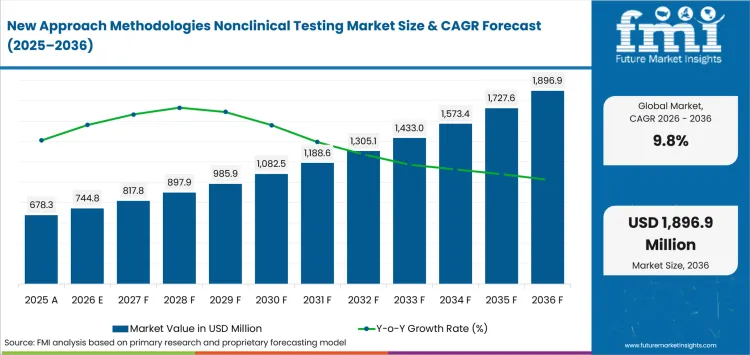
Key Takeaways of New Approach Methodologies Nonclinical Testing Market
- Demand for new approach methodologies in nonclinical testing is driven by nonclinical teams investing in human-relevant methods that improve costly development decisions without creating unmanageable qualification burden.
- By technology, in vitro testing holds the leading share at 32.6% in 2026, owing to familiar laboratory skills and broad application coverage across screening and toxicology programs.
- Drug discovery is the dominant application segment, accounting for 44.4% share in 2026, due to concentrated spending ahead of larger safety programs that consume limited capital and specialist capacity.
- Pharmaceutical and biotechnology companies lead end-user demand at 37.8% share in 2026, driven by direct control over pipeline decisions and evidence strategy.
- Systemic toxicity testing holds 30.8% test-type share in 2026, though multi-organ interpretation requires greater integration than single-endpoint assays.
- The USA combines federal validation programs with extensive biopharmaceutical research capacity, while Japan and the UK pair active policy work with structured regulatory discussion, and Germany and South Korea face local capacity constraints despite technical expertise.
- Competition centers on Emulate, MIMETAS, InSphero, Altis Biosystems, CN Bio, TissUse, Charles River Laboratories, and Hesperos, with vendors differentiating through organ-chip throughput design, plate-based tissue model integration, multi-organ configurations, and study execution service breadth.
Analyst Perspective
The commercial fate of any new approach method hinges on a narrower question than biological sophistication: whether it produces evidence that changes a specific candidate-selection or safety decision inside a sponsor's existing governance system, since a technically impressive organ-chip model that adds interpretation work without shifting a go/no-go call actually weakens the case for adoption. Drug discovery's concentrated spending makes sense as a filtering strategy, removing weak candidates before they consume the far larger toxicology budgets that systemic testing requires, but that logic only holds if throughput platforms keep outputs traceable back to specific chemistry changes rather than producing rankings sponsors can't defend during later regulatory discussions. Systemic toxicity testing's reliance on complementary methods rather than one dominant platform reflects a genuine scientific constraint, not a market immaturity signal, since multi-organ exposure risk resists the kind of single-endpoint validation that has let simpler in vitro assays scale faster.
-Anurag Sharma, Associate Director at Future Market Insights
How is the New Approach Methodologies Nonclinical Testing Market segmented?
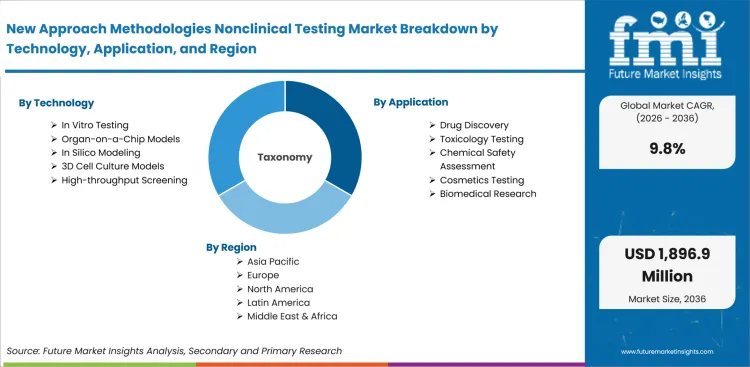
The new approach methodologies nonclinical testing industry is segmented by technology, application, end user, test type, and region.
Technology classifies in vitro testing and organ-on-chip models alongside in silico modeling plus three-dimensional cell cultures and high-throughput screening. Application separates drug discovery from toxicology testing and chemical safety assessment across cosmetics testing plus biomedical research. End user distinguishes pharmaceutical and biotechnology companies from contract research organizations and academic institutes alongside regulatory agencies. Test type separates systemic toxicity from genotoxicity and reproductive toxicity alongside carcinogenicity testing plus safety pharmacology. Region compares commercial adoption through local regulation and laboratory services across the approved geographic structure. The taxonomy separates scientific methods from purchasing organizations so adjacent research tools do not enter the revenue boundary automatically.
What supports demand for In vitro testing within the technology category?
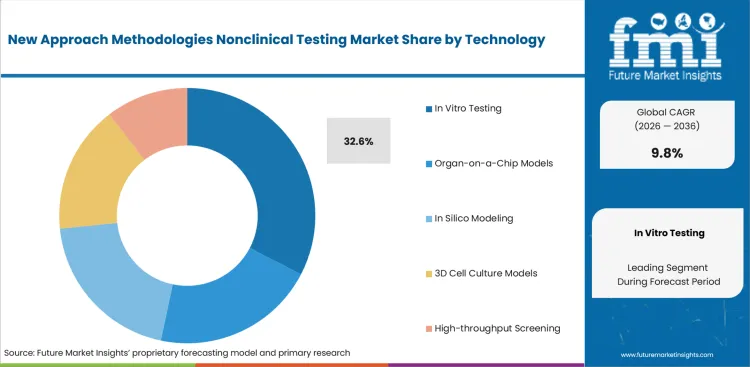
In vitro methods fit existing laboratory operations since technicians already manage cell culture controls and plate-based readouts. The European Commission Joint Research Centre published its EURL ECVAM status report in April 2025 and documented European Union work across in vitro methods plus organ-on-chip standardization. The program gives laboratories a structured route for comparing 3D cell culture models without implying universal regulatory acceptance. Commercial value depends on reproducible biology and protocols that transfer between internal teams and contract laboratories.
- By technology, in vitro testing is estimated to hold 32.6% in 2026 owing to familiar laboratory skills and broad application coverage. Its position reflects a practical qualification path across screening and toxicology rather than proof that every assay replaces an animal study.
- Laboratory directors favor in vitro testing whenever cell culture plasticware fits existing automation and quality records. Standard formats reduce retraining and equipment changes across repeated programs within established laboratory quality systems. Adoption remains dependent on representative reference compounds that demonstrate whether each assay supports a defined development decision.
How does drug discovery shape demand within the application category?
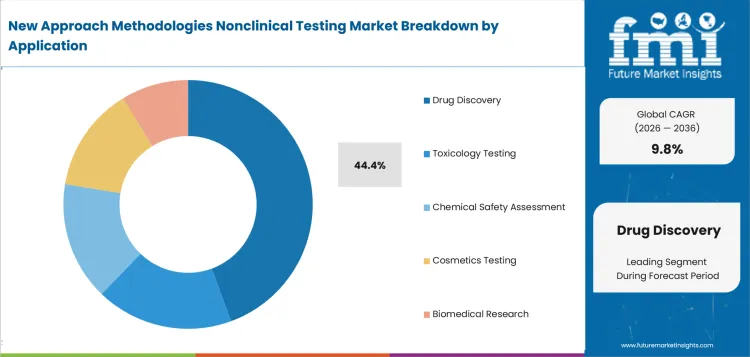
Drug discovery teams use human-relevant models to remove weak candidates ahead of larger safety programs that consume limited capital and specialist capacity. Commercial drug discovery services become useful whenever providers connect model selection with controlled execution and interpretable candidate ranking. Sponsors gain limited value from biological complexity that does not change a defined progression decision. Repeated controls and transparent reporting therefore determine whether a platform becomes routine pipeline infrastructure across development programs.
- Based on application, drug discovery is projected to account for 44.4% in 2026 due to concentrated spending ahead of later development commitments. NIH created ORIVA in June 2026 to coordinate United States development and acceptance of human-based technologies. The department gives sponsors a clearer route for validation planning across candidate programs and regulatory discussions.
- Discovery scientists adopt drug discovery models whenever high-throughput screening preserves assay quality across larger candidate sets. Procurement decisions compare throughput with biological depth and exception handling across representative candidate libraries and development programs. Platforms earn repeat orders whenever outputs remain traceable to chemistry changes and candidate-selection rules across several development cycles.
Why do pharmaceutical & biotechnology companies shape the end user category?
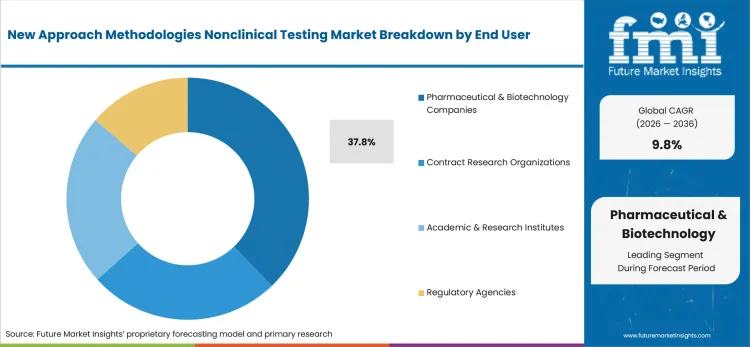
Pharmaceutical and biotechnology companies own compound histories and clinical strategies that determine how nonclinical evidence should influence development. Internal teams can connect automated cell culture outputs with chemistry changes and risk plans across portfolio reviews. Direct ownership also preserves qualification knowledge that supports later regulatory discussions across several pipeline development stages. Outsourcing remains useful for specialized execution although sponsors retain accountability for the final evidence package.
- By end user, pharmaceutical and biotechnology companies are forecast to represent 37.8% in 2026 driven by direct control over pipeline decisions and evidence strategy. Their spending covers platforms and services plus data systems that connect experimental results with governance decisions across development programs.
- Development teams adopt these methods whenever bioinformatics tools combine molecular signals with traceable assay records across candidate reviews. The FDA announced its implementation roadmap in April 2025 and encouraged NAM data within United States investigational applications. Internal evidence owners can therefore plan qualification around a defined submission question instead of general innovation goals.
How is systemic toxicity testing positioned within the test type category?
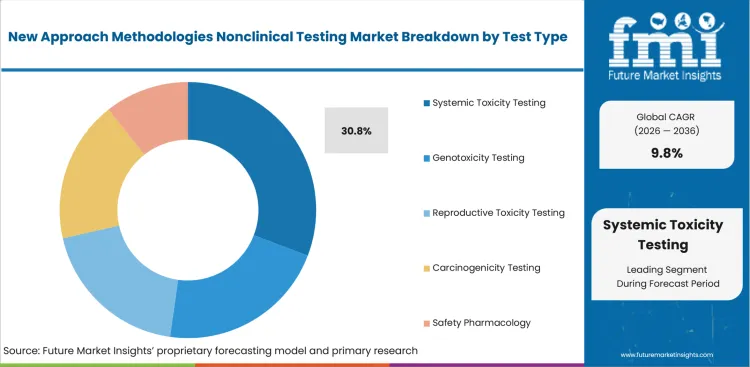
Systemic toxicity testing requires evidence across organs and exposure pathways rather than one isolated cellular response. Integrated testing strategies must connect organ-specific findings with computational evidence and residual uncertainty across defined exposure scenarios. NIEHS updated its acute systemic toxicity roadmap in June 2026 and documented coordination across seven United States agencies. The operating challenge creates demand for complementary apoptosis testing and organ-function endpoints within one documented interpretation framework.
- Systemic toxicity testing is projected to hold 30.8% share in 2026 owing to safety questions that require several complementary methods. The segment attracts spending on study design and evidence integration alongside individual assays and specialized interpretation services. Commercial acceptance depends on coverage of the relevant exposure route and target-organ risks within each intended use.
- Safety leaders use organoid platforms whenever organ-specific biology improves interpretation without claiming complete whole-body prediction. Adoption expands through transparent integration rules and representative controls that support repeat interpretation across development programs. Providers must explain which uncertainties remain unresolved so development teams can decide whether additional evidence remains necessary.
What are the drivers, restraints, and opportunities in the New Approach Methodologies Nonclinical Testing Market?
Regulatory clarity supports demand for human-relevant evidence, but validation cost restrains routine transfer while integrated qualification services create a practical commercial opening.
- Driver: Defined regulatory contexts give development teams a practical reason to fund validation and implementation across candidate programs.
- Restraint: Biological variability and interlaboratory transfer requirements increase qualification costs before complex methods support routine decisions.
- Opportunity: Integrated service packages can connect several human-relevant methods with shared controls and one documented interpretation framework.
Regulatory implementation is creating demand for New Approach Methodologies (NAMs) as sponsors increasingly link qualification investments to specific development milestones and regulatory submission requirements. In September 2025, the NIH Common Fund launched a USD 7 million Reduction to Practice Prize to accelerate NAM implementation in the United States. The program requires clear intended-use definitions and reproducibility data before selected platforms can advance into formal validation pathways. As a result, platform developers are increasingly structuring commercial pilot projects around measurable performance criteria and regulatory relevance rather than broad innovation claims. Revenue opportunities are expanding through validation studies and qualification services that enable methods to be deployed repeatedly across multiple development programs.
Interlaboratory variability remains a significant barrier to adoption because complex methods rely on consistent biological materials and disciplined execution across study sites. In March 2024, ICCVAM published an updated validation framework for USA regulatory agencies that emphasized the use of integrated evidence within defined regulatory contexts. While the framework provides greater flexibility, it also requires representative reference compounds and transparent approaches for combining multiple sources of evidence. Many smaller biotechnology companies lack dedicated qualification teams to manage these requirements across several development programs. Adoption is therefore expected to improve as service providers better define transferability limits and establish clear responsibilities for materials and data interpretation.
Growing investment in shared validation infrastructure is creating opportunities for providers that combine research models with regulatory planning and technology transfer services. The UK government’s alternative methods strategy, published in November 2025, established national initiatives to support the development and adoption of non-animal methods. Commercial laboratories are well positioned to convert these public initiatives into standardized assay packages supported by documented controls and reporting frameworks. The demand is likely to concentrate on services that address recurring evidence gaps across multiple development programs rather than one-off custom studies. Providers can strengthen their market position through transparent performance limitations and service agreements that clearly allocate responsibilities across participating organizations.
Which country CAGRs are profiled in the New Approach Methodologies Nonclinical Testing Market?
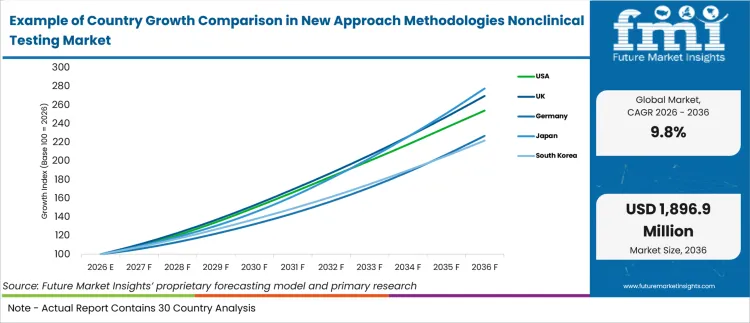
| Country | CAGR |
|---|---|
| USA | 9.8% |
| UK | 10.4% |
| Germany | 8.6% |
| Japan | 10.8% |
| South Korea | 8.3% |
How do country-level CAGRs compare in the New Approach Methodologies Nonclinical Testing Market?
The displayed forecasts form a narrow band across materially different regulatory and laboratory routes worldwide. The range between Japan and South Korea equals 2.5 percentage points across the 2026 to 2036 interval. Comparable commercial momentum therefore exists despite different national approval practices and service infrastructure conditions within each system.
- Japan and the UK occupy the upper cluster through regulatory engagement around non-animal evidence packages. Japan’s position reflects PMDA regulatory-science activity and model access through domestic subsidiaries and distributors. The UK combines national strategy with an early review route for selected non-animal development packages.
- The USA sits near the global CAGR and benefits from federal validation funding plus a biopharmaceutical research base. Domestic platform developers and contract laboratories reduce service distance for many United States research sponsors. Qualification costs remain material since federal guidance emphasizes specific contexts of use and documented performance boundaries.
- Germany and South Korea form the lower comparison cluster although their operating structures remain distinct. Germany combines strong research capability with federal and state oversight across regulated animal-use and alternative-method decisions. South Korea connects public technology programs with imported platform support and local distribution channels serving biopharmaceutical laboratories.
- The 0.4-point separation between Japan and the UK is smaller than the 1.2-point gap between the USA and Germany. Germany remains 0.3 points above South Korea despite materially different financing routes and laboratory service conditions. The measured gaps support country-specific entry planning instead of regional assumptions across distinct research systems.
Comparable CAGRs do not establish comparable current market sizes or identical purchasing routes across these countries. Commercial plans should examine local advice mechanisms and technical support alongside model availability within each national system. The full report provides country-level CAGR analysis across North America, Latin America, Europe, East Asia, South Asia, Oceania and the Middle East and Africa.
Country-wise Analysis
- United States drug developers operate within a large domestic research network that includes platform companies and contract laboratories across major biotechnology clusters. Demand in the new approach methodologies nonclinical testing market in the United States is forecast to rise at 9.8% CAGR during the forecast period, supported by federal validation investment and regulatory guidance. The FDA reported in April 2026 that it completed first-year roadmap actions for in vitro and computational approaches across United States drug development. Domestic service access reduces travel and maintenance delays for many sponsors although context-specific qualification remains costly. Market entry improves through pilots that align one method with a defined FDA discussion and representative compounds.
- United Kingdom sponsors can combine local regulatory advice with direct instrument support from CN Bio’s Cambridge operations and wider European service networks. Adoption in the UK’s new approach methodologies nonclinical testing market is estimated to expand at 10.4% CAGR by 2036 underpinned by structured review routes for non-animal evidence. The MHRA published guidance in March 2026 that permits product-specific non-animal packages and plans an advance Module 4 review mechanism within the UK. The route can reduce planning uncertainty although GLP expectations and total-evidence requirements remain material frictions.
- German laboratories benefit from domestic multi-organ platform expertise and established European research networks supporting technical collaboration. Industry in Germany’s new approach methodologies nonclinical testing market is projected to advance at 8.6% CAGR over the forecast period, aided by local model development and alternative-method research. The BfR reported in December 2025 that Germany used 1.95 million laboratory animals during 2024 and recorded an 8.2% annual decline. The operating direction supports alternatives although regulated safety work continues requiring validated evidence and state-level oversight. Providers can improve entry through German-language training and service contracts that define qualification responsibilities across customer laboratories.
- Japanese research organizations can access local subsidiaries and distributors for MIMETAS plus CN Bio and TissUse platforms with regional technical support. In Japan, demand in the new approach methodologies nonclinical testing market is predicted to advance at 10.8% CAGR through 2036 supported by regulatory-science engagement. PMDA issued an Early Consideration document in May 2026 covering general toxicity evaluation of monoclonal antibodies within Japan. The PMDA document creates a discussion route without granting automatic acceptance for any commercial model within regulated development programs.
- South Korean biopharmaceutical organizations combine strong technology policy with distributor access for imported organ-chip platforms and related support services. Sales in South Korea’s new approach methodologies nonclinical testing market are forecast to expand at 8.3% CAGR by 2036 supported by public development programs. The Ministry of Trade, Industry and Energy announced a joint project in June 2025 for non-animal testing methods across South Korean advanced biopharmaceutical development. Public financing supports local capability although specialist validation experience and imported maintenance routes remain practical constraints.
Who are the notable companies in the New Approach Methodologies Nonclinical Testing Market?
Emulate, InSphero, MIMETAS, CN Bio, Charles River Laboratories, Altis Biosystems, TissUse, and Hesperos are notable companies in the new approach methodologies nonclinical testing market.
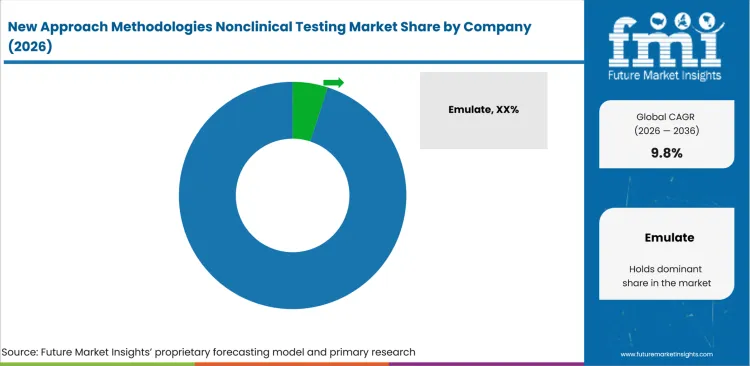
The competitive landscape includes platform developers, biological model specialists and contract research organizations that provide complete study execution. USA-based Emulate supplies organ-on-chip platforms for laboratory workflows. InSphero and MIMETAS provide plate-compatible tissue models and study services for discovery and safety applications. CN Bio and TissUse offer integrated platforms with multi-organ models and technical support. Altis Biosystems specializes in human intestinal models and Hesperos delivers custom multi-organ study services in the United States. Charles River Laboratories incorporates multiple NAM technologies into its global discovery and safety assessment offerings. Vendor selection depends on biological relevance and service accountability.
- Platform developers compete via model coverage and throughput alongside automation compatibility across different laboratory operating systems.
- Tissue-model specialists focus on biological relevance and reproducibility within defined organ systems or disease applications.
- Contract research organizations compete through study execution and regulatory integration across broader nonclinical development programs.
Competitive Benchmarking: New Approach Methodologies Nonclinical Testing Market
| Company | Model Coverage | Workflow Scale | Study Services | Geographic Reach |
|---|---|---|---|---|
| Emulate | High | High | Medium | North America and Europe |
| InSphero | High | High | High | Europe and North America |
| MIMETAS | High | High | High | Europe, North America, and Japan |
| CN Bio | High | High | High | Europe, North America, and Asia-Pacific |
| Charles River Laboratories | High | Medium | High | Global operations |
| Altis Biosystems | Medium | High | Medium | North America and Japan |
| TissUse | High | Medium | High | Europe, China, Brazil, and Japan |
| Hesperos | High | Medium | High | North America with global CRO access |
Key Developments in the New Approach Methodologies Nonclinical Testing Market
- In May 2026, InSphero announced its acquisition of PhenoVista Biosciences and expanded United States high-content imaging plus phenotypic services. The transaction connects three-dimensional tissue models with image-based discovery and safety workflows across United States customer programs. Pharmaceutical teams gain a more integrated service route although project value remains dependent on model selection and qualification.
- In October 2025, CN Bio launched PhysioMimix Core for single-organ and multi-organ studies with capacity reaching 288 samples. The system consolidates several study scales within one instrument family and support structure for expanding laboratory programs. Laboratories can expand organ-chip programs with fewer platform changes although representative controls remain necessary for decision-grade evidence.
- In June 2025, Emulate commercially launched the AVA Emulation System for culturing and imaging up to ninety-six independent Organ-Chip samples. Integrated incubation and automated imaging address throughput barriers within complex model studies that require consistent operating conditions. Development teams can compare larger candidate sets under consistent conditions ahead of narrower mechanistic work.
- In January 2025, MIMETAS launched OrganoPlate UniFlow with gravity-driven perfusion supporting as many as 512 chips within one setup. The pumpless format supports larger discovery and safety programs using standard liquid handling equipment across established laboratory workflows. Laboratories must qualify endpoints and reference compounds ahead of translating increased throughput into development decisions.
Key Players in the New Approach Methodologies Nonclinical Testing Market
Organ-on-Chip Platform Developers
- Emulate
- MIMETAS
- CN Bio
- TissUse
- Hesperos
3D Tissue Model Providers
- InSphero
- Altis Biosystems
Integrated Nonclinical Services
- Charles River Laboratories
New Approach Methodologies Nonclinical Testing Market - Report Scope
| Coverage field | Report scope |
|---|---|
| Market breakdown | Technology, application, end user, test type, and region |
| Quantitative Units | Revenue in USD Million, CAGR in %. |
| Market Definition | Commercial platforms, biological models, consumables, software, and study services used for human-relevant nonclinical discovery or safety testing. Conventional animal studies, clinical testing, and general laboratory products without a direct NAM use remain excluded. |
| Regions Covered | North America, Latin America, Western Europe, Eastern Europe, East Asia, South Asia and Pacific, and Middle East and Africa |
| Countries Covered | USA, UK, Germany, Japan, South Korea, and 30+ countries within the full report |
| Key Companies Profiled | Emulate, InSphero, MIMETAS, CN Bio, Charles River Laboratories, Altis Biosystems, TissUse, and Hesperos |
| Forecast Period | 2026 to 2036 |
| Approach | Hybrid bottom-up and top-down forecasting using segment demand, service adoption, platform pricing, country conditions, and company participation |
New Approach Methodologies Nonclinical Testing Market - Research Methodology
| Method | Approach |
|---|---|
| Primary Research | FMI analysts gathered input from manufacturers, service providers, technology developers, distributors, end users, procurement teams, and subject-matter experts. Interviews examined purchasing decisions, product or service evaluation, adoption barriers, approval requirements, pricing considerations, and expectations for technical or commercial support. Respondents were also asked what evidence is required before a trial, pilot, or initial order develops into regular purchasing. |
| Desk Research | Desk research covered government statistics, regulatory publications, trade data, industry associations, technical literature, standards, company filings, product information, and official corporate announcements. Sources were reviewed for relevance, publication date, geographic coverage, and consistency with the defined market scope. Claims relating to performance, applications, approvals, capacity, investment, and commercial activity were retained only when supported by credible public evidence. |
| Market Sizing and Forecasting | The market model combined the baseline value with historical performance, segment structure, pricing and volume indicators, adoption levels, company participation, and country-level demand conditions. Forecast assumptions considered economic activity, investment trends, regulatory developments, technology adoption, purchasing cycles, supply availability, and barriers to wider market use. Segment and regional estimates were reconciled before the final market total was calculated. |
| Data Validation | Estimates were checked against multiple independent indicators, including public data, company activity, trade patterns, industry developments, and findings from primary interviews. Validation also tested whether products, services, applications, and company revenues fell within the defined market boundaries. Adjacent categories, unsupported claims, overlapping revenues, and activities without direct market relevance were excluded to reduce double counting and maintain consistency across segments and countries. |
New Approach Methodologies Nonclinical Testing Market by Segments
New Approach Methodologies Nonclinical Testing Market segmented by Technology:
- In Vitro Testing
- Organ-on-a-Chip Models
- In Silico Modeling
- 3D Cell Culture Models
- High-throughput Screening
New Approach Methodologies Nonclinical Testing Market segmented by Application:
- Drug Discovery
- Toxicology Testing
- Chemical Safety Assessment
- Cosmetics Testing
- Biomedical Research
New Approach Methodologies Nonclinical Testing Market segmented by End User:
- Pharmaceutical & Biotechnology Companies
- Contract Research Organizations
- Academic & Research Institutes
- Regulatory Agencies
New Approach Methodologies Nonclinical Testing Market segmented by Test Type:
- Systemic Toxicity Testing
- Genotoxicity Testing
- Reproductive Toxicity Testing
- Carcinogenicity Testing
- Safety Pharmacology
New Approach Methodologies Nonclinical Testing Market by Region:
- North America
- United States
- Canada
- Latin America
- Brazil
- Mexico
- Argentina
- Chile
- Western Europe
- Germany
- France
- United Kingdom
- Italy
- Spain
- Benelux
- Nordics
- Eastern Europe
- Poland
- Czech Republic
- Romania
- Hungary
- East Asia
- China
- Japan
- South Korea
- South Asia and Pacific
- India
- ASEAN
- Australia and New Zealand
- Middle East and Africa
- GCC Countries
- South Africa
- Türkiye
- Israel
Research Sources and Bibliography
- USA Food and Drug Administration. (2026, March). General considerations for the use of new approach methodologies in drug development.
- National Institutes of Health. (2026, March 18). NIH invests $150 million in human-based research to reduce use of animal models.
- European Commission, Joint Research Centre. (2025, April 2). Non-animal methods in science and regulation: EURL ECVAM status report 2024.
- National Institutes of Health. (2026, June 15). NIH launches new office to advance human-based research and reduce animal use.
- USA Food and Drug Administration. (2025, April 10). FDA announces plan to phase out animal testing requirement for monoclonal antibodies and other drugs.
- National Institute of Environmental Health Sciences. (2026, June). Roadmap implementation: Acute systemic toxicity.
- National Institutes of Health Common Fund. (2025, September 30). NIH Common Fund launches the Complement-ARIE Reduction to Practice Prize.
- Interagency Coordinating Committee on the Validation of Alternative Methods. (2024, March). Validation, qualification, and regulatory acceptance of new approach methodologies.
- Department for Science, Innovation and Technology, Home Office, & Department for Environment, Food & Rural Affairs. (2025, November 11). Replacing animals in science: A strategy to support the development, validation and uptake of alternative methods.
- USA Food and Drug Administration. (2026, April 20). FDA achieves year 1 goals in reducing animal testing in drug development.
- Medicines and Healthcare products Regulatory Agency. (2026, March 25). MHRA approach to medicines using non-animal methods.
- German Federal Institute for Risk Assessment. (2025, December 9). Less than two million laboratory animals for the first time.
- Pharmaceuticals and Medical Devices Agency. (2026, May 13). Considerations for the general toxicity evaluation of monoclonal antibodies (Early Consideration).
- Ministry of Trade, Industry and Energy, Republic of Korea. (2025, June 30). Full-scale development of advanced alternative testing methods that do not use animals in the drug development process [English translation].
- InSphero AG. (2026, May 20). InSphero accelerates global growth and US expansion with acquisition of PhenoVista Biosciences.
- CN Bio. (2025, October 14). CN Bio launches all-in-one Organ-on-a-Chip system, PhysioMimix Core.
- Emulate, Inc. (2025, June 10). Emulate launches AVA Emulation System to accelerate drug development with first-of-its-kind high-throughput Organ-Chip platform.
- MIMETAS. (2025, January 27). MIMETAS launches OrganoPlate UniFlow technology.
This bibliography is provided for reader reference and is not exhaustive. The full report contains the complete reference list and detailed citations.
This Report Answers
- How large is the new approach methodologies nonclinical testing market in 2026 and 2036?
- Which operating conditions support the approved 9.8% CAGR through the complete forecast period?
- Why does in vitro testing hold the main approved technology share during 2026?
- How do approved country growth rates compare across USA, UK, Germany, Japan, and South Korea?
- Which verified companies provide market-specific platforms, tissue models, or integrated nonclinical study services?
- Which validation and workflow barriers limit routine adoption across regulated drug development programs?
- Which evidence should research executives examine ahead of approving a new method or service provider?
- How do model relevance and workflow scalability affect commercial value across different applications?
- Which conditions support long-term confidence in human-relevant nonclinical testing methods and related services?
Frequently Asked Questions
How big is the New Approach Methodologies Nonclinical Testing Market in 2026?
The new approach methodologies nonclinical testing market is valued at USD 744.8 million in 2026 and is forecast to reach USD 1896.9 million by 2036. Growth reflects drug developers preferring human-relevant methods that answer defined safety or candidate-selection questions within established quality systems.
What is the CAGR of the New Approach Methodologies Nonclinical Testing Market from 2026 to 2036?
The new approach methodologies nonclinical testing market grows at a CAGR of 9.8% between 2026 and 2036, supported by defined regulatory contexts that give development teams a practical reason to fund validation and implementation across candidate programs.
Which application leads the New Approach Methodologies Nonclinical Testing Market?
Drug discovery accounts for 44.4% of the new approach methodologies nonclinical testing market by application in 2026, due to concentrated spending ahead of larger safety programs that consume limited capital and specialist capacity across development pipelines.
How much will the New Approach Methodologies Nonclinical Testing Market add between 2026 and 2036?
The new approach methodologies nonclinical testing market is set to add USD 1152.1 million between 2026 and 2036, growing from USD 744.8 million to USD 1896.9 million as human-relevant testing platforms extend across a widening base of drug discovery and toxicology programs.
Who are the leading companies in the New Approach Methodologies Nonclinical Testing Market?
Five companies lead the new approach methodologies nonclinical testing market, including Emulate, MIMETAS, InSphero, CN Bio, and Charles River Laboratories, competing through organ-chip throughput design, plate-based tissue model integration, and study execution service breadth.
Preview the report firsthand - request a free sample
Get SampleGet the brochure for pricing and purchase details.
Get PDFTable of Content
- Key Takeaways
- Market Size and CAGR
- Top Growth Driver
- Fastest Growing Segment
- Leading Region
- Key Companies
- Emerging Opportunities
- Executive Summary
- Global Market Outlook
- Demand-side Trends
- Supply-side Trends
- Technology Roadmap Analysis
- Analysis and Recommendations
- Analyst Perspective (What is happening? Why now? What should investors know?)
- Key Questions Answered
- How large is the market?
- What is the CAGR?
- What are key trends?
- Which region dominates?
- Who are the leaders?
- Market Overview
- Market Coverage / Taxonomy
- Market Definition / Scope / Limitations
- Research Methodology
- Chapter Orientation
- Analytical Lens and Working Hypotheses
- Market Structure, Signals, and Trend Drivers
- Benchmarking and Cross-market Comparability
- Market Sizing, Forecasting, and Opportunity Mapping
- Research Design and Evidence Framework
- Desk Research Programme (Secondary Evidence)
- Expert Input and Fieldwork (Primary Evidence)
- Tooling, Models, and Reference Databases
- Data Engineering and Model Build
- Quality Assurance and Audit Trail
- Market Background
- Market Dynamics (Drivers, Restraints, Opportunity, Trends)
- Scenario Forecast (Optimistic, Likely, Conservative)
- Impact Analysis
- AI Impact
- Sustainability Impact
- Regulatory Impact
- Technology Impact
- Consumer / Buyer Analysis
- Purchase Drivers
- Adoption Barriers
- Buyer Journey
- Opportunity Map Analysis
- Product Life Cycle Analysis
- Supply Chain Analysis
- Investment Feasibility Matrix
- Value Chain Analysis
- PESTLE and Porter's Analysis
- Regulatory Landscape
- Regional Parent Market Outlook
- Production and Consumption Statistics
- Import and Export Statistics
- Global Market Analysis and Forecast, 2021 to 2036
- Historical Market Size Value (USD Million) Analysis, 2021 to 2025
- Current and Future Market Size Value (USD Million) Projections, 2026 to 2036
- Y-o-Y Growth Trend Analysis
- Absolute $ Opportunity Analysis
- Global Market Pricing Analysis, 2021 to 2036
- Global Market Analysis and Forecast, By Technology, 2021 to 2036
- Introduction / Key Findings
- Historical Market Size Value (USD Million) Analysis By Technology, 2021 to 2025
- Current and Future Market Size Value (USD Million) Analysis and Forecast By Technology, 2026 to 2036
- In Vitro Testing
- Organ-on-a-Chip Models
- In Silico Modeling
- 3D Cell Culture Models
- High-throughput Screening
- In Vitro Testing
- Y-o-Y Growth Trend Analysis By Technology, 2021 to 2025
- Absolute $ Opportunity Analysis By Technology, 2026 to 2036
- Global Market Analysis and Forecast, By Application, 2021 to 2036
- Introduction / Key Findings
- Historical Market Size Value (USD Million) Analysis By Application, 2021 to 2025
- Current and Future Market Size Value (USD Million) Analysis and Forecast By Application, 2026 to 2036
- Drug Discovery
- Toxicology Testing
- Chemical Safety Assessment
- Cosmetics Testing
- Biomedical Research
- Drug Discovery
- Y-o-Y Growth Trend Analysis By Application, 2021 to 2025
- Absolute $ Opportunity Analysis By Application, 2026 to 2036
- Global Market Analysis and Forecast, By End User, 2021 to 2036
- Introduction / Key Findings
- Historical Market Size Value (USD Million) Analysis By End User, 2021 to 2025
- Current and Future Market Size Value (USD Million) Analysis and Forecast By End User, 2026 to 2036
- Pharmaceutical & Biotechnology Companies
- Contract Research Organizations
- Academic & Research Institutes
- Regulatory Agencies
- Pharmaceutical & Biotechnology Companies
- Y-o-Y Growth Trend Analysis By End User, 2021 to 2025
- Absolute $ Opportunity Analysis By End User, 2026 to 2036
- Global Market Analysis and Forecast, By Test Type, 2021 to 2036
- Introduction / Key Findings
- Historical Market Size Value (USD Million) Analysis By Test Type, 2021 to 2025
- Current and Future Market Size Value (USD Million) Analysis and Forecast By Test Type, 2026 to 2036
- Systemic Toxicity Testing
- Genotoxicity Testing
- Reproductive Toxicity Testing
- Carcinogenicity Testing
- Safety Pharmacology
- Systemic Toxicity Testing
- Y-o-Y Growth Trend Analysis By Test Type, 2021 to 2025
- Absolute $ Opportunity Analysis By Test Type, 2026 to 2036
- Global Market Analysis and Forecast, By Region, 2021 to 2036
- Introduction
- Historical Market Size Value (USD Million) Analysis By Region, 2021 to 2025
- Current Market Size Value (USD Million) Analysis and Forecast By Region, 2026 to 2036
- North America
- Latin America
- Western Europe
- Eastern Europe
- East Asia
- South Asia and Pacific
- Middle East & Africa
- Market Attractiveness Analysis By Region
- North America Market Analysis and Forecast, By Country, 2021 to 2036
- Historical Market Size Value (USD Million) Trend Analysis By Market Taxonomy, 2021 to 2025
- Market Size Value (USD Million) Forecast By Market Taxonomy, 2026 to 2036
- By Country
- USA
- Canada
- By Technology
- By Application
- By End User
- By Test Type
- By Country
- Market Attractiveness Analysis
- By Country
- By Technology
- By Application
- By End User
- By Test Type
- Key Takeaways
- Latin America Market Analysis and Forecast, By Country
- Historical Market Size Value (USD Million) Trend Analysis By Market Taxonomy, 2021 to 2025
- Market Size Value (USD Million) Forecast By Market Taxonomy, 2026 to 2036
- By Country
- Brazil
- Mexico
- Chile
- Rest of Latin America
- By Technology
- By Application
- By End User
- By Test Type
- By Country
- Market Attractiveness Analysis
- By Country
- By Technology
- By Application
- By End User
- By Test Type
- Key Takeaways
- Western Europe Market Analysis and Forecast, By Country
- Historical Market Size Value (USD Million) Trend Analysis By Market Taxonomy, 2021 to 2025
- Market Size Value (USD Million) Forecast By Market Taxonomy, 2026 to 2036
- By Country
- Germany
- UK
- Italy
- Spain
- France
- Nordic
- BENELUX
- Rest of Western Europe
- By Technology
- By Application
- By End User
- By Test Type
- By Country
- Market Attractiveness Analysis
- By Country
- By Technology
- By Application
- By End User
- By Test Type
- Key Takeaways
- Eastern Europe Market Analysis and Forecast, By Country
- Historical Market Size Value (USD Million) Trend Analysis By Market Taxonomy, 2021 to 2025
- Market Size Value (USD Million) Forecast By Market Taxonomy, 2026 to 2036
- By Country
- Russia
- Poland
- Hungary
- Balkan & Baltic
- Rest of Eastern Europe
- By Technology
- By Application
- By End User
- By Test Type
- By Country
- Market Attractiveness Analysis
- By Country
- By Technology
- By Application
- By End User
- By Test Type
- Key Takeaways
- East Asia Market Analysis and Forecast, By Country
- Historical Market Size Value (USD Million) Trend Analysis By Market Taxonomy, 2021 to 2025
- Market Size Value (USD Million) Forecast By Market Taxonomy, 2026 to 2036
- By Country
- China
- Japan
- South Korea
- By Technology
- By Application
- By End User
- By Test Type
- By Country
- Market Attractiveness Analysis
- By Country
- By Technology
- By Application
- By End User
- By Test Type
- Key Takeaways
- South Asia and Pacific Market Analysis and Forecast, By Country
- Historical Market Size Value (USD Million) Trend Analysis By Market Taxonomy, 2021 to 2025
- Market Size Value (USD Million) Forecast By Market Taxonomy, 2026 to 2036
- By Country
- India
- ASEAN
- Australia & New Zealand
- Rest of South Asia and Pacific
- By Technology
- By Application
- By End User
- By Test Type
- By Country
- Market Attractiveness Analysis
- By Country
- By Technology
- By Application
- By End User
- By Test Type
- Key Takeaways
- Middle East & Africa Market Analysis and Forecast, By Country
- Historical Market Size Value (USD Million) Trend Analysis By Market Taxonomy, 2021 to 2025
- Market Size Value (USD Million) Forecast By Market Taxonomy, 2026 to 2036
- By Country
- Kingdom of Saudi Arabia
- Other GCC Countries
- Türkiye
- South Africa
- Other African Union
- Rest of Middle East & Africa
- By Technology
- By Application
- By End User
- By Test Type
- By Country
- Market Attractiveness Analysis
- By Country
- By Technology
- By Application
- By End User
- By Test Type
- Key Takeaways
- Key Countries Market Analysis
- USA
- Pricing Analysis
- Market Share Analysis, 2025
- By Technology
- By Application
- By End User
- By Test Type
- Canada
- Pricing Analysis
- Market Share Analysis, 2025
- By Technology
- By Application
- By End User
- By Test Type
- Mexico
- Pricing Analysis
- Market Share Analysis, 2025
- By Technology
- By Application
- By End User
- By Test Type
- Brazil
- Pricing Analysis
- Market Share Analysis, 2025
- By Technology
- By Application
- By End User
- By Test Type
- Chile
- Pricing Analysis
- Market Share Analysis, 2025
- By Technology
- By Application
- By End User
- By Test Type
- Germany
- Pricing Analysis
- Market Share Analysis, 2025
- By Technology
- By Application
- By End User
- By Test Type
- UK
- Pricing Analysis
- Market Share Analysis, 2025
- By Technology
- By Application
- By End User
- By Test Type
- Italy
- Pricing Analysis
- Market Share Analysis, 2025
- By Technology
- By Application
- By End User
- By Test Type
- Spain
- Pricing Analysis
- Market Share Analysis, 2025
- By Technology
- By Application
- By End User
- By Test Type
- France
- Pricing Analysis
- Market Share Analysis, 2025
- By Technology
- By Application
- By End User
- By Test Type
- India
- Pricing Analysis
- Market Share Analysis, 2025
- By Technology
- By Application
- By End User
- By Test Type
- ASEAN
- Pricing Analysis
- Market Share Analysis, 2025
- By Technology
- By Application
- By End User
- By Test Type
- Australia & New Zealand
- Pricing Analysis
- Market Share Analysis, 2025
- By Technology
- By Application
- By End User
- By Test Type
- China
- Pricing Analysis
- Market Share Analysis, 2025
- By Technology
- By Application
- By End User
- By Test Type
- Japan
- Pricing Analysis
- Market Share Analysis, 2025
- By Technology
- By Application
- By End User
- By Test Type
- South Korea
- Pricing Analysis
- Market Share Analysis, 2025
- By Technology
- By Application
- By End User
- By Test Type
- Russia
- Pricing Analysis
- Market Share Analysis, 2025
- By Technology
- By Application
- By End User
- By Test Type
- Poland
- Pricing Analysis
- Market Share Analysis, 2025
- By Technology
- By Application
- By End User
- By Test Type
- Hungary
- Pricing Analysis
- Market Share Analysis, 2025
- By Technology
- By Application
- By End User
- By Test Type
- Kingdom of Saudi Arabia
- Pricing Analysis
- Market Share Analysis, 2025
- By Technology
- By Application
- By End User
- By Test Type
- Türkiye
- Pricing Analysis
- Market Share Analysis, 2025
- By Technology
- By Application
- By End User
- By Test Type
- South Africa
- Pricing Analysis
- Market Share Analysis, 2025
- By Technology
- By Application
- By End User
- By Test Type
- USA
- Market Structure Analysis
- Competition Dashboard
- Competition Benchmarking
- Market Share Analysis of Top Players
- By Regional
- By Technology
- By Application
- By End User
- By Test Type
- Emerging Startups
- Innovation Benchmarking
- Competition Analysis
- Competition Deep Dive
- Emulate
- Overview
- Product Portfolio
- Profitability by Market Segments
- Sales Footprint
- Strategy Overview
- Marketing Strategy
- Product Strategy
- Channel Strategy
- InSphero
- MIMETAS
- CN Bio Innovations
- Charles River Laboratories
- Labcorp Drug Development
- Thermo Fisher Scientific
- Eurofins Scientific
- Altis Biosystems
- Organovo
- Emulate
- Case Studies
- Success Stories
- Recent Developments
- Competition Deep Dive
- Assumptions & Acronyms Used


