

- Market Size (2026)
- USD 812.8 Mn
- Forecast (2036)
- USD 1901.6 Mn
- CAGR (2026 to 2036)
- 8.9%
How big is New Approach Methodologies Drug Development Market in 2026?
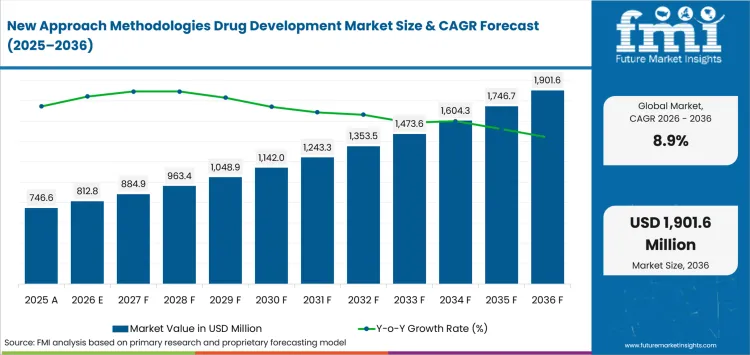
USD 812.8 million in 2026 and USD 1,901.6 million by 2036 at an 8.9% CAGR.
Demand in the new approach methodologies drug development market is anticipated to push valuation from USD 812.8 million in 2026 to USD 1,901.6 million by 2036 at an 8.9% CAGR. Drug developers purchase human-relevant models and specialist studies through earlier evidence that changes candidate selection ahead of costly clinical commitments. The National Institutes of Health stated in June 2026 that Complement-ARIE supports development and standardization together with validation and use of human-based methodologies in the United States. Programs involving organ-on-chip testing therefore require repeatable execution and defined data quality rather than biological novelty alone. Investment in AI-enabled discovery becomes defensible through model outputs that retain traceable inputs and support a documented portfolio decision. Commercial contracts should identify study ownership and escalation rules so uncertain results do not create another expensive review cycle.
United States programs combine regulator engagement with domestic access to computational tools and human-cell platforms across several development stages. The FDA recorded in April 2026 that its July 2025 United States workshop brought federal researchers and international regulators together to discuss practical NAM implementation. British laboratories operate through public research policy and local organ-on-chip support that can shorten installation and method-transfer distances. German teams apply three-dimensional cultures within a research system that places substantial weight on reproducibility and formal validation. Japanese programs depend more heavily on case-specific regulator dialogue and local technical distribution for specialized microphysiological instruments. South Korean laboratories can combine regional distributors with automated cell culture across concentrated biomedical research networks. Market-entry plans must therefore match service coverage and qualification support with each country’s regulatory and laboratory operating route.
| Metric | Value |
|---|---|
| 2025 Market Size | USD 746.6 million |
| 2026 Market Size | USD 812.8 million |
| 2036 Market Size | USD 1,901.6 million |
| Forecast CAGR (2026-2036) | 8.9% |
| Method Type Focus | In Silico Models (33.4% share in 2026) |
| Application Focus | Drug Discovery (33.0% share in 2026) |
| Technology Focus | Cell-based Assays (33.7% share in 2026) |
Summary of the New Approach Methodologies Drug Development Market
| Market Signal | Commercial Impact |
|---|---|
| Demand and Growth Drivers | Drug developers fund NAM programs through earlier human-relevant evidence that changes portfolio decisions and reduces spending on weak candidates.
|
| Product and Segment View | The product architecture combines computational prediction with cell-based evidence and specialist interpretation across one coordinated development pathway.
|
| Geography and Growth Outlook | Country positions differ through regulator access and local service capacity together with institutional experience in method qualification.
|
| Competitive Landscape | Competition separates platform specialists from research organizations that accept broader responsibility for study design and evidence delivery.
|
| Analyst Perspective | Executives should compare predictive value with the operating burden required to produce defensible evidence across participating laboratories.
|
Source: FMI's proprietary forecasting model and primary research
How is the new approach methodologies drug development market segmented?
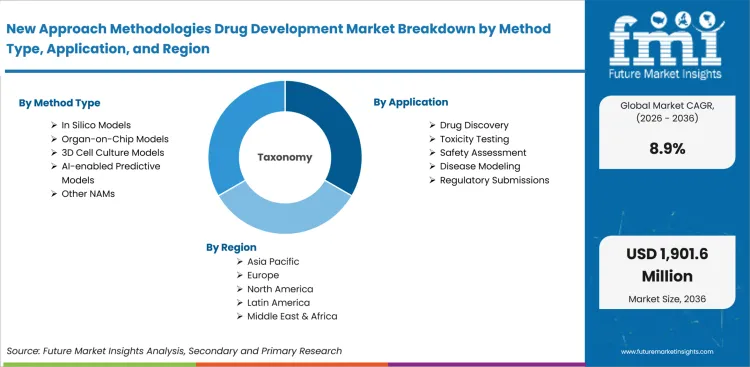
The new approach methodologies drug development market is segmented by method type, application, end user, technology, and region.
The segmentation framework separates scientific methods from their development purpose and the organizations purchasing each solution. Method type distinguishes in silico models from organ-on-chip systems and three-dimensional cultures together with other human-relevant approaches. Application analysis follows drug discovery through toxicity testing and safety assessment plus disease modeling and regulatory submissions. End user categories separate pharmaceutical and biotechnology companies from contract research organizations and academic institutes. Technology analysis distinguishes cell-based assays from microphysiological systems and computational modeling plus omics technologies used in development programs. Regional analysis compares national commercialization routes without changing the defined product and service revenue boundary.
How do In Silico Models support decisions within the Method Type category?
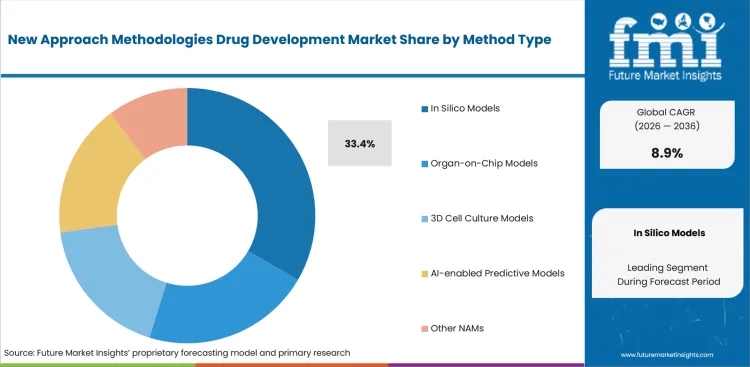
Computational models help development teams rank compounds before limited laboratory capacity is committed to deeper experiments. Useful systems connect molecular information with exposure estimates and interpretable safety predictions under documented assumptions. The FDA reported in January 2025 that United States reviewers had received more than 500 drug and biological product submissions containing artificial intelligence components since 2016. Broader bioinformatics platforms create value through controlled inputs and model governance rather than unsupported automation claims.
- In silico models are projected to account for 33.4% share by method type in 2026 driven by rapid candidate prioritization across large compound libraries. Their position reflects scalable screening that directs laboratory capacity toward candidates requiring deeper biological confirmation and exposure testing.
- Pharmaceutical modeling teams adopt in silico tools through predictions that shorten experimental lists without hiding uncertainty across candidate comparisons. Routine use requires version control and expert review so updated datasets do not invalidate earlier development decisions or formal regulatory interpretations across programs.
Why does Drug Discovery remain central within the Application category?
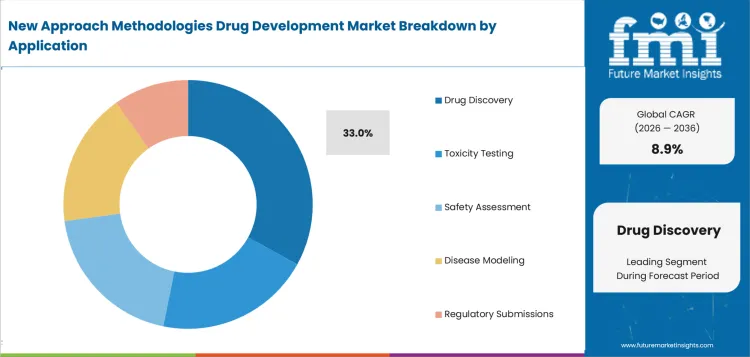
Early discovery programs must remove weak candidates ahead of rising chemistry and biological testing costs across several workstreams. NAMs combine predictive modeling with human-derived assays and organoid models that compare efficacy with emerging safety concerns during target validation. Commercial value comes from better candidate ranking across lead optimization and early development programs rather than replacing every established experiment with one method.
- Within application, drug discovery is projected to represent 33.0% share in 2026 owing to early decisions that influence spending across every later phase. Development teams favor evidence that differentiates candidates ahead of formal safety programs requiring larger commitments in chemistry and biological testing.
- Discovery groups need a clear evidence trail from initial screening through candidate nomination across every participating laboratory. An April 2025 FDA roadmap for the United States promotes organoids and organ-on-chip systems for drug safety testing and permits consideration of their data. Preserving method context and data lineage therefore strengthens early decisions that may later support formal regulatory review.
What drives Pharmaceutical Companies within the End User category?
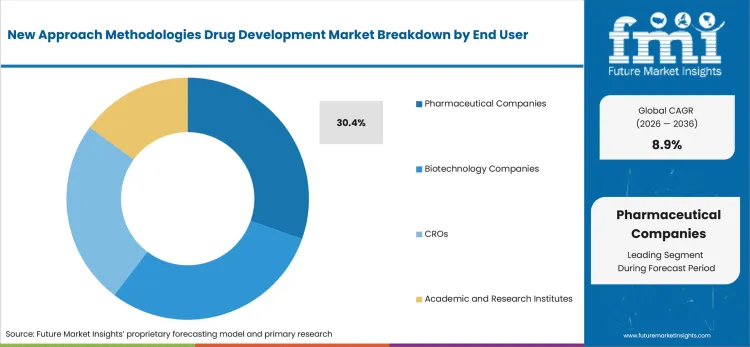
Pharmaceutical companies manage broad candidate portfolios and must compare evidence across therapeutic areas with different biological risks. Internal teams can combine computational models with specialist assays while retaining responsibility for development strategy and regulator communication. The Biotechnology Innovation Organization reported through a March 2025 multi-company study that NAM-based biotherapeutic filings replacing large-animal safety studies were generally accepted by global health authorities. Enterprise quality systems can therefore support repeatable method use across several development departments and external research partners.
- By end user, pharmaceutical companies are projected to capture 30.4% share in 2026 through portfolio-wide method use across discovery and safety programs. Their position also reflects enterprise quality systems that support controlled transfer across internal departments and external research partners.
- Pharmaceutical laboratories invest in cell culture workflows through standardized execution that supports comparable results across internal and external sites. Adoption slows under protocols that depend on scarce specialists or undocumented adjustments during routine transfer between participating laboratories and quality systems.
How do Cell-based Assays shape the Technology category?
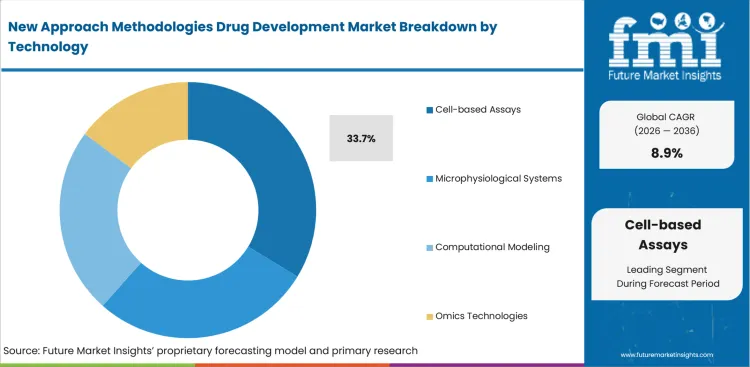
Cell-based assays provide direct biological readouts that computational predictions cannot produce without controlled experimental confirmation. Human primary cells and engineered tissues reveal pathway effects across defined efficacy and safety endpoints. Assay design must control cell source and culture maturity so performance survives transfer between laboratories. Instrument outputs also need reproducible biological interpretation and traceable links to documented study decisions and records. Commercial toxicology screening systems gain value through familiar formats that laboratories can qualify without rebuilding complete workflows.
- Based on technology, cell-based assays are forecast to represent 33.7% share in 2026 supported by direct biological readouts across discovery and safety programs. Their position also reflects familiar laboratory formats that reduce initial infrastructure barriers for development teams using human-derived models.
- Laboratory directors adopt cell-based assays through staged qualification using representative compounds and predefined acceptance criteria. The National Institutes of Health announced in September 2025 that a United States center supported by USD 87 million in three-year contracts would standardize liver and intestinal organoid protocols. Standardized biological materials can reduce protocol-transfer risk across participating laboratories with different equipment and quality systems.
What are the drivers, restraints, and opportunities in the new approach methodologies drug development market?
Human-relevant evidence supports demand as validation requirements constrain routine adoption and integrated study services improve standardized execution.
- Driver: Drug developers need predictive evidence that reduces expensive candidate failure during later development stages.
- Restraint: Method qualification and laboratory transfer can require substantial work before results support routine decisions.
- Opportunity: Integrated services can combine model selection with study execution and regulator-ready evidence across complete development programs.
Late-stage drug failures are creating strong demand for human-relevant development methods across pharmaceutical pipelines. Poor translation from preclinical models to human outcomes forces sponsors to invest in compounds that later fail during costly clinical trials. The FDA reported in April 2026 that more than 90% of drugs that historically advanced beyond animal studies did not receive USA approval. As a result, NAM investments become easier to justify when they improve candidate selection and reduce spending on weak development programs.
Validation requirements remain a key barrier because each methodology must be linked to a specific biological question and regulatory use case. Variations in cell sources and laboratory procedures can produce different results even when similar platforms are used. A March 2026 FDA draft guidance for USA submissions emphasized context of use and human relevance alongside technical characterization and fit-for-purpose evidence. Sponsors must also establish reference compounds and transfer controls before a method can support routine development decisions.
Opportunity: Coordinated validation efforts are creating opportunities for organizations that combine technology platforms with biological expertise and regulator-ready documentation. Contract research organizations can support adoption by linking method selection with study execution and evidence generation across multiple programs. In July 2025 the Foundation for the National Institutes of Health reported that more than 40 government agencies and life sciences organizations had joined its USA Validation and Qualification Network. Service providers are well positioned to benefit by delivering standardized data frameworks and comparable performance records across client portfolios.
Which country CAGRs are profiled in the new approach methodologies drug development market?
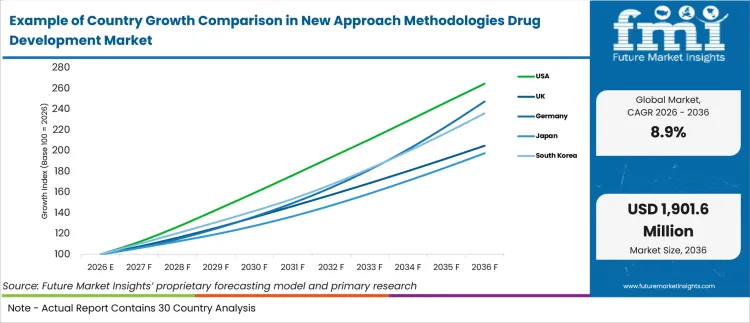
| Country | CAGR |
|---|---|
| USA | 10.2% |
| UK | 7.4% |
| Germany | 9.5% |
| Japan | 7.0% |
| South Korea | 9.0% |
How do country-level CAGRs compare in the new approach methodologies drug development market?
The forecast expansion rates form three practical growth bands across the country comparison rather than an evenly spaced sequence. A 3.2 percentage-point range separates the USA from Japan without establishing differences in current revenue or installed platform numbers.
- The USA stands 0.7 percentage points above Germany within the upper band. Commercial timing in both countries depends on regulator engagement and domestic technical support rather than the forecast gap alone.
- Germany and South Korea form the middle cluster with a 0.5 percentage-point separation between their forecast rates. German programs emphasize formal validation networks while South Korean laboratories benefit from concentrated research hubs and regional distribution coverage.
- The UK and Japan create another close cluster with a 0.4 percentage-point separation across their forecast rates. British adoption benefits from coordinated public policy across national research and regulatory programs with established funding channels. Japanese adoption relies more heavily on regulator consultation and qualified technical distribution for complex systems.
- A 1.6 percentage-point step separates South Korea from the UK within the displayed values. The difference informs commercialization timing without proving a larger current revenue base in either country or a simpler implementation route.
Commercial planning should combine the CAGR spacing with country evidence concerning validation and technical service coverage. The full report provides country-level CAGR analysis across North America, Latin America, Europe, East Asia, South Asia, Oceania and the Middle East and Africa.
Country-wise Analysis
- United States drug developers operate near federal regulators and domestic providers of computational and human-cell platforms. Demand for new approach methodologies in the USA is forecast to rise at 10.2% CAGR by 2036, supported by regulator engagement and domestic platform access. Emulate announced in June 2025 that its United States AVA workstation could run as many as 96 independent Organ-Chip samples. Domestic installation and scientific training provide a direct adoption enabler for programs requiring dependable onboarding and rapid technical escalation. A material friction remains the effort needed to qualify each model for a defined regulatory question across participating laboratories. Commercial plans should budget for method validation and support response times instead of treating instrument delivery as complete implementation.
- British laboratories operate through national policy networks and can access an organ-on-chip manufacturer based in Cambridge. Demand for new approach methodologies in the UK is projected at 7.4% CAGR through 2036, supported by coordinated policy and local expertise. The UK government published a five-year strategy in November 2025 that addressed development and validation alongside regulatory uptake of animal alternatives. CN Bio support guidance reviewed in July 2026 lists field application training for PhysioMimix systems. The same guidance describes on-site or back-to-base service that reduces maintenance distance for domestic laboratories. A material friction remains the alignment of evidence standards across public and private qualification programs. Commercial entrants should define qualification ownership and maintenance terms within each instrument or service agreement.
- German research organizations operate within formal alternative-method rules and can access domestic multi-organ platform service capacity. Adoption of new approach methodologies in Germany is estimated to expand at 9.5% CAGR during the forecast period, supported by validation capacity and local maintenance access. The German Federal Institute for Risk Assessment stated in January 2025 that reliable alternatives must replace animal experiments whenever available in Germany. TissUse guidance reviewed in July 2026 lists annual tubing replacement and an additional service contract, creating a maintenance route despite transfer risks. Projects should pair interlaboratory controls with local response commitments before recurring study purchasing begins across German networks.
- Japanese drug developers use a regulator-led pathway that evaluates novel evidence through case-specific scientific consultation. Demand for new approach methodologies in Japan is forecast to rise at 7.0% CAGR over the assessment period, supported by regulator dialogue and qualified local distribution. The Pharmaceuticals and Medical Devices Agency listed a May 2026 early consideration for monoclonal-antibody toxicity evaluation. The notice creates a formal discussion route for monoclonal-antibody evidence during local drug development planning. CN Bio appointed Primetech in January 2025 to provide Japanese sales support and technical expertise. Qualified distribution shortens service distance, but extended context-of-use discussions remain a material friction for sponsors. Market entrants should pair each platform proposal with a consultation plan and documented escalation route.
- South Korean biomedical programs operate through concentrated research hubs that share specialist equipment and technical knowledge across projects. Adoption of new approach methodologies in South Korea is projected to record 9.0% CAGR through 2036, supported by clustered laboratories and regional distribution. CN Bio appointed SCINCO in May 2025 to provide South Korean sales and technical support for organ-on-chip systems. Local distribution shortens service distance and enables user training, yet different biological quality systems complicate comparable validation records. Commercial agreements should define training coverage and response times before platform adoption expands across several laboratory sites.
Who are the notable companies in the new approach methodologies drug development market?
The notable companies include Emulate, InSphero, CN Bio, MIMETAS, TissUse, Hesperos, Charles River Laboratories, Evotec, and VivoSim Labs.
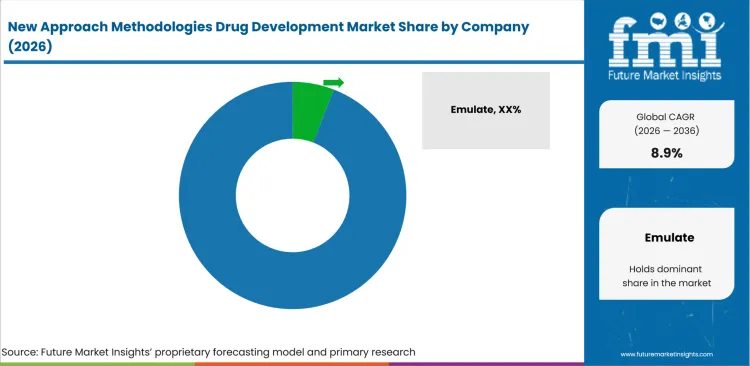
The competitive field combines platform manufacturers with research organizations that execute studies and interpret complex biological evidence. Dedicated microphysiological companies compete through organ coverage and throughput together with onboarding support for internal laboratories. Three-dimensional tissue specialists compete through standardized human-derived models and assay-ready formats for defined development questions. Integrated research organizations accept broader responsibility for project management and regulatory documentation across several development stages. VivoSim Labs stated in its July 2026 United States SEC filing that the renamed company provides three-dimensional liver and intestinal toxicology services. The drug discovery services market provides a useful comparison for contracting responsibility and evidence handoffs. Company selection should match the exact study question with service ownership and geographic support rather than corporate scale.
- Emulate and CN Bio provide instrument-centered organ-chip systems with onboarding support for laboratories managing their own studies. MIMETAS and TissUse add multi-tissue configurations and custom study options for defined efficacy or safety questions.
- InSphero supplies standardized spheroid and organoid tools together with assay services for discovery and toxicology programs. Hesperos provides custom single-organ and multi-organ studies through its Human-on-a-Chip service model for defined safety and efficacy questions.
- Charles River Laboratories and Evotec integrate human-cell models with broader discovery and safety services across several project stages. VivoSim Labs provides liver and intestinal toxicology services under its current corporate identity for nonclinical development programs.
Competitive Benchmarking: New Approach Methodologies Drug Development Market
| Company | Human-Relevant Model Platforms | Discovery and Safety Applications | Integrated Study Services | Region |
|---|---|---|---|---|
| Emulate | High | High | Medium | North America |
| InSphero | High | High | High | North America and Europe |
| CN Bio | High | High | High | North America, Europe and Asia-Pacific |
| MIMETAS | High | High | High | North America, Europe and Asia |
| TissUse | High | High | High | Europe with international project delivery |
| Hesperos | High | High | High | North America |
| Charles River Laboratories | High | High | High | Global service network |
| Evotec | Medium | High | High | Europe and North America |
Platform capability is High for several documented human-relevant model families and Medium for one primary family supporting multiple cell types. Low applies to an officially documented model scope that remains narrow within the exact market. Application capability is High for documented discovery and safety use across the same company offering. Medium applies to one documented application class and Low requires official evidence of limited exact-market use. Study-service capability is High for documented design and execution with reporting ownership across client programs. Medium applies to implementation support without complete study ownership and Low requires official evidence of narrowly restricted service responsibility.
Key Developments in the New Approach Methodologies Drug Development Market
- In April 2026, InSphero launched the 3D InSight DIGIT platform for early gastrointestinal toxicity assessment through patient-derived intestinal organoids and automated phenotypic imaging. The scheduled service delivers quantitative safety reports without requiring pharmaceutical teams to build the complete capability internally. The development expands access to standardized gastrointestinal evidence during early candidate selection across pharmaceutical safety programs.
- In October 2025, CN Bio launched PhysioMimix Core as an integrated organ-on-chip system supporting single-organ and multi-organ studies through one hardware and consumables architecture. Laboratories can use several biological configurations without operating unrelated instrument families across separate development teams. The launch broadens purchasing options for programs that require flexible study design and common technical support.
- In January 2025, MIMETAS launched OrganoPlate UniFlow technology for unidirectional gravity-driven flow without external pumps across a microplate-compatible format. The design supports as many as 512 tissue culture chips for scalable screening with familiar automation and imaging equipment. Screening laboratories gain another route to combine perfused tissues with established high-throughput workflows and familiar imaging systems.
- In October 2025, Hesperos formed a channel sales partnership with Oriental Yeast to expand Human-on-a-Chip services across Japan and other Asian markets. The agreement gives biopharmaceutical organizations regional access to custom single-organ and multi-organ safety or efficacy studies. Local commercial coverage can reduce contracting distance for Asian teams that lack internal organ-chip operations.
Key Players in the New Approach Methodologies Drug Development Market
Organ-on-Chip and MPS Platforms
- Emulate
- CN Bio
- MIMETAS
- TissUse
- Hesperos
3D Cell and Organoid Platforms
- InSphero
- VivoSim Labs
Integrated Discovery and Safety Services
- Charles River Laboratories
- Evotec
New Approach Methodologies Drug Development Market - Report Scope
| Coverage field | Report scope |
|---|---|
| Market breakdown | Method type, application, end user, technology, and region. |
| Quantitative Units | USD million and percentage shares with forecasts covering the complete period from 2026 through 2036. |
| Market Definition | Commercial products and study services that generate human-relevant in silico or in vitro evidence for drug discovery and nonclinical development decisions. |
| Regions Covered | North America; Latin America; Western Europe; Eastern Europe; East Asia; South Asia and Pacific; and Middle East and Africa. |
| Countries Covered | USA, UK, Germany, Japan, South Korea, and additional countries covered within the full report. |
| Key Companies Profiled | Emulate, InSphero, CN Bio, MIMETAS, TissUse, Hesperos, Charles River Laboratories, Evotec, and VivoSim Labs. |
| Forecast Period | 2026 to 2036. |
| Approach | Hybrid demand-side and company-level analysis supported by primary interviews, laboratory adoption trends, and company disclosures. |
New Approach Methodologies Drug Development Market - Research Methodology
| Method | Approach |
|---|---|
| Primary Research | FMI analysts gathered input from manufacturers, service providers, technology developers, distributors, end users, procurement teams, and subject-matter experts. Interviews examined purchasing decisions, product or service evaluation, adoption barriers, approval requirements, pricing considerations, and expectations for technical or commercial support. Respondents were also asked what evidence is required before a trial, pilot, or initial order develops into regular purchasing. |
| Desk Research | Desk research covered government statistics, regulatory publications, trade data, industry associations, technical literature, standards, company filings, product information, and official corporate announcements. Sources were reviewed for relevance, publication date, geographic coverage, and consistency with the defined market scope. Claims relating to performance, applications, approvals, capacity, investment, and commercial activity were retained only when supported by credible public evidence. |
| Market Sizing and Forecasting | The market model combined the baseline value with historical performance, segment structure, pricing and volume indicators, adoption levels, company participation, and country-level demand conditions. Forecast assumptions considered economic activity, investment trends, regulatory developments, technology adoption, purchasing cycles, supply availability, and barriers to wider market use. Segment and regional estimates were reconciled before the final market total was calculated. |
| Data Validation | Estimates were checked against multiple independent indicators, including public data, company activity, trade patterns, industry developments, and findings from primary interviews. Validation also tested whether products, services, applications, and company revenues fell within the defined market boundaries. Adjacent categories, unsupported claims, overlapping revenues, and activities without direct market relevance were excluded to reduce double counting and maintain consistency across segments and countries. |
New Approach Methodologies Drug Development Market by Segments
New Approach Methodologies Drug Development Market segmented by Method Type:
- In Silico Models
- Organ-on-Chip Models
- 3D Cell Culture Models
- AI-enabled Predictive Models
- Other NAMs
New Approach Methodologies Drug Development Market segmented by Application:
- Drug Discovery
- Toxicity Testing
- Safety Assessment
- Disease Modeling
- Regulatory Submissions
New Approach Methodologies Drug Development Market segmented by End User:
- Pharmaceutical Companies
- Biotechnology Companies
- CROs
- Academic and Research Institutes
New Approach Methodologies Drug Development Market segmented by Technology:
- Cell-based Assays
- Microphysiological Systems
- Computational Modeling
- Omics Technologies
New Approach Methodologies Drug Development Market by Region:
- North America
- United States
- Canada
- Latin America
- Brazil
- Mexico
- Argentina
- Chile
- Western Europe
- Germany
- France
- United Kingdom
- Italy
- Spain
- Benelux
- Nordics
- Eastern Europe
- Poland
- Czech Republic
- Romania
- Hungary
- East Asia
- China
- Japan
- South Korea
- South Asia and Pacific
- India
- ASEAN
- Australia and New Zealand
- Middle East and Africa
- GCC Countries
- South Africa
- Türkiye
- Israel
Research Sources and Bibliography
- National Institutes of Health. (2026, June 15). Complement Animal Research In Experimentation (Complement-ARIE) Program.
- USA Food and Drug Administration. (2026, April 20). New Approach Methodologies (NAMs).
- USA Food and Drug Administration. (2025, January 6). FDA Proposes Framework to Advance Credibility of AI Models Used for Drug and Biological Product Submissions.
- USA Food and Drug Administration. (2025, April 10). FDA Announces Plan to Phase Out Animal Testing Requirement for Monoclonal Antibodies and Other Drugs.
- Shenton, J., Bousnina, I., Oropallo, M., David, R., Weir, L., Baker, T. K., Dunmore, H.-M., Villenave, R., McElroy, M., Pettersen, B., Kokate, T., Fuller, C. L., Homan, K. A., Hudry, E., Wood, C., & Gunter, S. (2025). Opportunities and insights from pharmaceutical companies on the current use of new approach methodologies in nonclinical safety assessment. Drug Discovery Today, 30(4), 104328.
- National Institutes of Health. (2025, September 25). NIH Establishes Nation's First Dedicated Organoid Development Center to Reduce Reliance on Animal Modeling.
- USA Food and Drug Administration. (2026, April 20). FDA Achieves Year 1 Goals in Reducing Animal Testing in Drug Development.
- USA Food and Drug Administration. (2026, March 18). FDA Releases Draft Guidance on Alternatives to Animal Testing in Drug Development.
- Foundation for the National Institutes of Health. (2025, July 24). FNIH Program Will Advance Alternative Research Models.
- Emulate. (2025, June 10). Emulate Launches AVA™ Emulation System to Accelerate Drug Development with First-of-its-Kind High-Throughput Organ-Chip Platform.
- Department for Science, Innovation and Technology, Home Office, & Department for Environment, Food & Rural Affairs. (2025, November 11). Replacing animals in science: A strategy to support the development, validation and uptake of alternative methods.
- German Federal Institute for Risk Assessment. (2025, January 21). Questions and Answers on Animal Experiments, Alternative Methods and Animal Experiment Numbers.
- TissUse. (n.d.). FAQ. Retrieved July 20, 2026.
- Pharmaceuticals and Medical Devices Agency. (n.d.). New Approach Methodologies: NAMs. Retrieved July 20, 2026.
- CN Bio. (2025, January 13). CN Bio Signs Strategic Partnership with Primetech Corporation to Establish Distribution Channel for OOC Solutions in Japan.
- CN Bio. (2025, May 20). CN Bio Expands Access to OOC Solutions for APAC Customers with Distributor Agreement in South Korea.
- VivoSim Labs, Inc. (2026, July 14). Form 10-K for the Fiscal Year Ended March 31, 2026. USA Securities and Exchange Commission.
- InSphero. (2026, April 14). InSphero Launches 3D InSight™ DIGIT Platform for Early Gastrointestinal Toxicity Assessment.
- CN Bio. (2025, October 14). CN Bio Launches All-in-One Organ-on-a-Chip System, PhysioMimix® Core.
- MIMETAS. (2025, January 27). MIMETAS Launches OrganoPlate UniFlow Technology.
- Hesperos. (2025, October 23). Hesperos and Oriental Yeast Co., Ltd. Announce Strategic Partnership to Expand Human-on-a-Chip® Services Across Asia.
This bibliography is provided for reader reference and is not exhaustive. The full report contains the complete reference list and detailed citations.
This Report Answers
- How large is the new approach methodologies drug development market during 2026 and 2036?
- Which operating pressures support investment in human-relevant drug development methods?
- Why do in silico models hold the method type share during 2026?
- How does drug discovery shape demand across the application category?
- Why do pharmaceutical companies represent the end user share during 2026?
- How do country growth routes differ across the USA and the other profiled countries?
- Which companies provide platforms or integrated NAM study services across drug development programs?
- What limits routine adoption across laboratories and regulated development programs?
- How should executives evaluate evidence quality and implementation responsibility before purchasing?
Frequently Asked Questions
What is driving growth in the New Approach Methodologies Drug Development Market?
Drug developers need earlier evidence that separates promising candidates from compounds carrying avoidable safety or efficacy risks. Human-relevant methods create commercial value through results that change a documented portfolio decision ahead of later development cost increases.
Who are the key players in the New Approach Methodologies Drug Development Market?
The profiled companies include platform specialists and integrated research organizations that assume different levels of study responsibility. Their roles cover computational models and human-derived systems together with discovery or safety services across development programs.
What is a notable restraint in the New Approach Methodologies Drug Development Market?
Method qualification can require extensive reference testing and protocol control across laboratories using different biological materials. Adoption slows under programs that cannot define the exact development decision supported by each method output.
Why should executives track the New Approach Methodologies Drug Development Market?
Human-relevant evidence can influence candidate selection and regulatory planning together with spending across later development stages. Executives should track whether adoption reduces portfolio uncertainty without creating unmanaged laboratory complexity or fragmented data ownership.
What business problem does the New Approach Methodologies Drug Development Market address?
The new approach methodologies drug development market addresses weak translation between traditional preclinical results and actual human safety or efficacy outcomes. NAM platforms and services provide additional evidence that helps development teams compare candidates under more human-relevant conditions.
What should development teams evaluate in the New Approach Methodologies Drug Development Market?
Development teams should compare biological relevance and reproducibility together with throughput across representative compounds and normal operating conditions. They should also examine technical support and raw-data access together with responsibility for protocol changes during active studies.
What limits return on investment in the New Approach Methodologies Drug Development Market?
Low study volume and unclear decision ownership can prevent sophisticated platforms from influencing enough projects to recover implementation costs. Return also declines under models requiring extensive repeat work or failing transfer across internal and external laboratories.
What supports long-term commercial confidence in the New Approach Methodologies Drug Development Market?
Documented performance across representative compounds supports confidence more effectively than isolated demonstrations using favorable test conditions. Clear regulatory contexts and repeatable laboratory execution provide a practical basis for expanding NAM use across development portfolios.
Preview the report firsthand - request a free sample
Get SampleGet the brochure for pricing and purchase details.
Get PDFTable of Content
- Key Takeaways
- Market Size and CAGR
- Top Growth Driver
- Fastest Growing Segment
- Leading Region
- Key Companies
- Emerging Opportunities
- Executive Summary
- Global Market Outlook
- Demand-side Trends
- Supply-side Trends
- Technology Roadmap Analysis
- Analysis and Recommendations
- Analyst Perspective (What is happening? Why now? What should investors know?)
- Key Questions Answered
- How large is the market?
- What is the CAGR?
- What are key trends?
- Which region dominates?
- Who are the leaders?
- Market Overview
- Market Coverage / Taxonomy
- Market Definition / Scope / Limitations
- Research Methodology
- Chapter Orientation
- Analytical Lens and Working Hypotheses
- Market Structure, Signals, and Trend Drivers
- Benchmarking and Cross-market Comparability
- Market Sizing, Forecasting, and Opportunity Mapping
- Research Design and Evidence Framework
- Desk Research Programme (Secondary Evidence)
- Expert Input and Fieldwork (Primary Evidence)
- Tooling, Models, and Reference Databases
- Data Engineering and Model Build
- Quality Assurance and Audit Trail
- Market Background
- Market Dynamics (Drivers, Restraints, Opportunity, Trends)
- Scenario Forecast (Optimistic, Likely, Conservative)
- Impact Analysis
- AI Impact
- Sustainability Impact
- Regulatory Impact
- Technology Impact
- Consumer / Buyer Analysis
- Purchase Drivers
- Adoption Barriers
- Buyer Journey
- Opportunity Map Analysis
- Product Life Cycle Analysis
- Supply Chain Analysis
- Investment Feasibility Matrix
- Value Chain Analysis
- PESTLE and Porter's Analysis
- Regulatory Landscape
- Regional Parent Market Outlook
- Production and Consumption Statistics
- Import and Export Statistics
- Global Market Analysis and Forecast, 2021 to 2036
- Historical Market Size Value (USD Million) Analysis, 2021 to 2025
- Current and Future Market Size Value (USD Million) Projections, 2026 to 2036
- Y-o-Y Growth Trend Analysis
- Absolute $ Opportunity Analysis
- Global Market Pricing Analysis, 2021 to 2036
- Global Market Analysis and Forecast, By Method Type, 2021 to 2036
- Introduction / Key Findings
- Historical Market Size Value (USD Million) Analysis By Method Type, 2021 to 2025
- Current and Future Market Size Value (USD Million) Analysis and Forecast By Method Type, 2026 to 2036
- In Silico Models
- Organ-on-Chip Models
- 3D Cell Culture Models
- AI-enabled Predictive Models
- Other NAMs
- In Silico Models
- Y-o-Y Growth Trend Analysis By Method Type, 2021 to 2025
- Absolute $ Opportunity Analysis By Method Type, 2026 to 2036
- Global Market Analysis and Forecast, By Application, 2021 to 2036
- Introduction / Key Findings
- Historical Market Size Value (USD Million) Analysis By Application, 2021 to 2025
- Current and Future Market Size Value (USD Million) Analysis and Forecast By Application, 2026 to 2036
- Drug Discovery
- Toxicity Testing
- Safety Assessment
- Disease Modeling
- Regulatory Submissions
- Drug Discovery
- Y-o-Y Growth Trend Analysis By Application, 2021 to 2025
- Absolute $ Opportunity Analysis By Application, 2026 to 2036
- Global Market Analysis and Forecast, By End User, 2021 to 2036
- Introduction / Key Findings
- Historical Market Size Value (USD Million) Analysis By End User, 2021 to 2025
- Current and Future Market Size Value (USD Million) Analysis and Forecast By End User, 2026 to 2036
- Pharmaceutical Companies
- Biotechnology Companies
- CROs
- Academic and Research Institutes
- Pharmaceutical Companies
- Y-o-Y Growth Trend Analysis By End User, 2021 to 2025
- Absolute $ Opportunity Analysis By End User, 2026 to 2036
- Global Market Analysis and Forecast, By Technology, 2021 to 2036
- Introduction / Key Findings
- Historical Market Size Value (USD Million) Analysis By Technology, 2021 to 2025
- Current and Future Market Size Value (USD Million) Analysis and Forecast By Technology, 2026 to 2036
- Cell-based Assays
- Microphysiological Systems
- Computational Modeling
- Omics Technologies
- Cell-based Assays
- Y-o-Y Growth Trend Analysis By Technology, 2021 to 2025
- Absolute $ Opportunity Analysis By Technology, 2026 to 2036
- Global Market Analysis and Forecast, By Region, 2021 to 2036
- Introduction
- Historical Market Size Value (USD Million) Analysis By Region, 2021 to 2025
- Current Market Size Value (USD Million) Analysis and Forecast By Region, 2026 to 2036
- North America
- Latin America
- Western Europe
- Eastern Europe
- East Asia
- South Asia and Pacific
- Middle East & Africa
- Market Attractiveness Analysis By Region
- North America Market Analysis and Forecast, By Country, 2021 to 2036
- Historical Market Size Value (USD Million) Trend Analysis By Market Taxonomy, 2021 to 2025
- Market Size Value (USD Million) Forecast By Market Taxonomy, 2026 to 2036
- By Country
- USA
- Canada
- By Method Type
- By Application
- By End User
- By Technology
- By Country
- Market Attractiveness Analysis
- By Country
- By Method Type
- By Application
- By End User
- By Technology
- Key Takeaways
- Latin America Market Analysis and Forecast, By Country
- Historical Market Size Value (USD Million) Trend Analysis By Market Taxonomy, 2021 to 2025
- Market Size Value (USD Million) Forecast By Market Taxonomy, 2026 to 2036
- By Country
- Brazil
- Mexico
- Chile
- Rest of Latin America
- By Method Type
- By Application
- By End User
- By Technology
- By Country
- Market Attractiveness Analysis
- By Country
- By Method Type
- By Application
- By End User
- By Technology
- Key Takeaways
- Western Europe Market Analysis and Forecast, By Country
- Historical Market Size Value (USD Million) Trend Analysis By Market Taxonomy, 2021 to 2025
- Market Size Value (USD Million) Forecast By Market Taxonomy, 2026 to 2036
- By Country
- Germany
- UK
- Italy
- Spain
- France
- Nordic
- BENELUX
- Rest of Western Europe
- By Method Type
- By Application
- By End User
- By Technology
- By Country
- Market Attractiveness Analysis
- By Country
- By Method Type
- By Application
- By End User
- By Technology
- Key Takeaways
- Eastern Europe Market Analysis and Forecast, By Country
- Historical Market Size Value (USD Million) Trend Analysis By Market Taxonomy, 2021 to 2025
- Market Size Value (USD Million) Forecast By Market Taxonomy, 2026 to 2036
- By Country
- Russia
- Poland
- Hungary
- Balkan & Baltic
- Rest of Eastern Europe
- By Method Type
- By Application
- By End User
- By Technology
- By Country
- Market Attractiveness Analysis
- By Country
- By Method Type
- By Application
- By End User
- By Technology
- Key Takeaways
- East Asia Market Analysis and Forecast, By Country
- Historical Market Size Value (USD Million) Trend Analysis By Market Taxonomy, 2021 to 2025
- Market Size Value (USD Million) Forecast By Market Taxonomy, 2026 to 2036
- By Country
- China
- Japan
- South Korea
- By Method Type
- By Application
- By End User
- By Technology
- By Country
- Market Attractiveness Analysis
- By Country
- By Method Type
- By Application
- By End User
- By Technology
- Key Takeaways
- South Asia and Pacific Market Analysis and Forecast, By Country
- Historical Market Size Value (USD Million) Trend Analysis By Market Taxonomy, 2021 to 2025
- Market Size Value (USD Million) Forecast By Market Taxonomy, 2026 to 2036
- By Country
- India
- ASEAN
- Australia & New Zealand
- Rest of South Asia and Pacific
- By Method Type
- By Application
- By End User
- By Technology
- By Country
- Market Attractiveness Analysis
- By Country
- By Method Type
- By Application
- By End User
- By Technology
- Key Takeaways
- Middle East & Africa Market Analysis and Forecast, By Country
- Historical Market Size Value (USD Million) Trend Analysis By Market Taxonomy, 2021 to 2025
- Market Size Value (USD Million) Forecast By Market Taxonomy, 2026 to 2036
- By Country
- Kingdom of Saudi Arabia
- Other GCC Countries
- Türkiye
- South Africa
- Other African Union
- Rest of Middle East & Africa
- By Method Type
- By Application
- By End User
- By Technology
- By Country
- Market Attractiveness Analysis
- By Country
- By Method Type
- By Application
- By End User
- By Technology
- Key Takeaways
- Key Countries Market Analysis
- USA
- Pricing Analysis
- Market Share Analysis, 2025
- By Method Type
- By Application
- By End User
- By Technology
- Canada
- Pricing Analysis
- Market Share Analysis, 2025
- By Method Type
- By Application
- By End User
- By Technology
- Mexico
- Pricing Analysis
- Market Share Analysis, 2025
- By Method Type
- By Application
- By End User
- By Technology
- Brazil
- Pricing Analysis
- Market Share Analysis, 2025
- By Method Type
- By Application
- By End User
- By Technology
- Chile
- Pricing Analysis
- Market Share Analysis, 2025
- By Method Type
- By Application
- By End User
- By Technology
- Germany
- Pricing Analysis
- Market Share Analysis, 2025
- By Method Type
- By Application
- By End User
- By Technology
- UK
- Pricing Analysis
- Market Share Analysis, 2025
- By Method Type
- By Application
- By End User
- By Technology
- Italy
- Pricing Analysis
- Market Share Analysis, 2025
- By Method Type
- By Application
- By End User
- By Technology
- Spain
- Pricing Analysis
- Market Share Analysis, 2025
- By Method Type
- By Application
- By End User
- By Technology
- France
- Pricing Analysis
- Market Share Analysis, 2025
- By Method Type
- By Application
- By End User
- By Technology
- India
- Pricing Analysis
- Market Share Analysis, 2025
- By Method Type
- By Application
- By End User
- By Technology
- ASEAN
- Pricing Analysis
- Market Share Analysis, 2025
- By Method Type
- By Application
- By End User
- By Technology
- Australia & New Zealand
- Pricing Analysis
- Market Share Analysis, 2025
- By Method Type
- By Application
- By End User
- By Technology
- China
- Pricing Analysis
- Market Share Analysis, 2025
- By Method Type
- By Application
- By End User
- By Technology
- Japan
- Pricing Analysis
- Market Share Analysis, 2025
- By Method Type
- By Application
- By End User
- By Technology
- South Korea
- Pricing Analysis
- Market Share Analysis, 2025
- By Method Type
- By Application
- By End User
- By Technology
- Russia
- Pricing Analysis
- Market Share Analysis, 2025
- By Method Type
- By Application
- By End User
- By Technology
- Poland
- Pricing Analysis
- Market Share Analysis, 2025
- By Method Type
- By Application
- By End User
- By Technology
- Hungary
- Pricing Analysis
- Market Share Analysis, 2025
- By Method Type
- By Application
- By End User
- By Technology
- Kingdom of Saudi Arabia
- Pricing Analysis
- Market Share Analysis, 2025
- By Method Type
- By Application
- By End User
- By Technology
- Türkiye
- Pricing Analysis
- Market Share Analysis, 2025
- By Method Type
- By Application
- By End User
- By Technology
- South Africa
- Pricing Analysis
- Market Share Analysis, 2025
- By Method Type
- By Application
- By End User
- By Technology
- USA
- Market Structure Analysis
- Competition Dashboard
- Competition Benchmarking
- Market Share Analysis of Top Players
- By Regional
- By Method Type
- By Application
- By End User
- By Technology
- Emerging Startups
- Innovation Benchmarking
- Competition Analysis
- Competition Deep Dive
- Emulate
- Overview
- Product Portfolio
- Profitability by Market Segments
- Sales Footprint
- Strategy Overview
- Marketing Strategy
- Product Strategy
- Channel Strategy
- InSphero
- CN Bio Innovations
- MIMETAS
- Organovo
- Charles River Laboratories
- Labcorp
- Evotec
- Novo Nordisk
- Roche
- Emulate
- Case Studies
- Success Stories
- Recent Developments
- Competition Deep Dive
- Assumptions & Acronyms Used


